𝙍𝙚𝙖𝙙𝙈𝙤𝙧𝙚👉 The Neighbor Who Claimed My Driveway Learned Too Late That Confidence Is Not a Deed
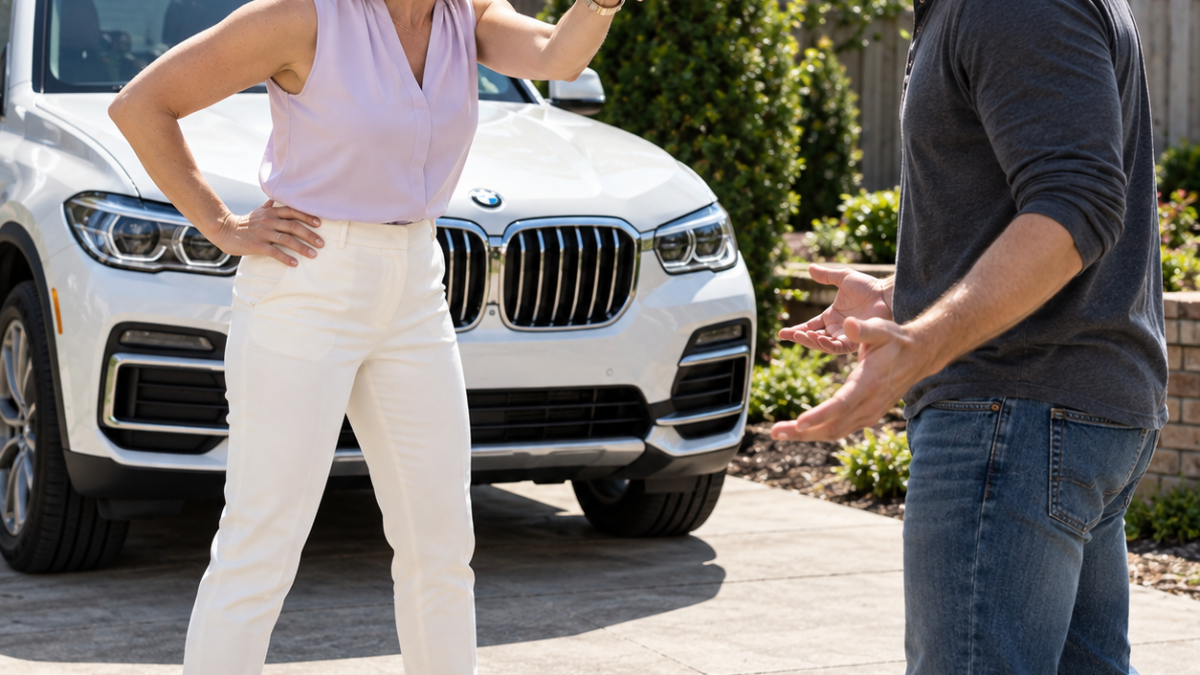
𝗙𝗨𝗟𝗟 𝗦𝗧𝗢𝗥𝗬
“To the shared access area.”
“It’s not shared.”
“It has historically been used for access.”
“No, it hasn’t.”
She sighed dramatically. “You’re new here.”
“I grew up in this house.”
“You’re new as the owner,” she said, with the faintest emphasis on owner, like she was not fully convinced I qualified. “There are understandings between neighbors.”
“My grandmother said she let you use it one afternoon while you had work done.”
Her expression hardened for half a second, then smoothed over.
“Your grandmother was a sweet woman.”
“She said she told you no after that.”
Karen rolled her eyes. “Your grandmother became very confused near the end.”
That landed like a slap.
My hands tightened at my sides.
Grandma was forgetful sometimes. She lost her keys, repeated stories, forgot whether she had turned off the stove. But she was not confused about people who disrespected her home. And Karen knew exactly what she was implying.
“Don’t do that,” I said quietly.
Karen lifted her eyebrows. “Excuse me?”
“Don’t talk about my grandmother like that.”
She looked almost pleased that she had found a nerve.
“I’m simply saying there were arrangements you may not understand.”
“There weren’t.”
“You don’t own the street.”
“This isn’t the street.”
“I’ll move it when I’m ready.”
“No,” I said. “You need to move it now.”
For the first time, her smile disappeared completely.
There was something cold behind it. Not anger, exactly. Calculation.
“How old are you?” she asked.
“What does that have to do with anything?”
“It has everything to do with this conversation. You’re what, twenty-two? Twenty-three?”
“Twenty-four.”
“Exactly.” She gave a small laugh. “You inherited a house and suddenly think you know how neighborhoods work.”
“I know how driveways work.”
Her eyes narrowed.
I could tell she was not used to being answered directly. Maybe other people backed down when she sharpened her voice. Maybe Grandma had not had the energy to argue. Maybe Karen had mistaken patience for permission for so long that a boundary sounded like an insult.
She brushed past me, close enough that her shoulder nearly touched my arm, and walked to her SUV.
“You’re selfish,” she said as she opened the door.
“For wanting to use my own driveway?”
“For making everything difficult.”
She drove away without looking back.
I stood there until she turned the corner, my jaw aching from how hard I had clenched it.
That was the beginning.
For the next few weeks, Karen treated my driveway like a challenge she had accepted.
Sometimes her SUV was there when I came home from work. Sometimes it appeared for twenty minutes in the middle of the afternoon and vanished before I could confront her. Sometimes it blocked the garage. Sometimes it sat close enough to my car that I had to squeeze around it to reach the back door.
At first, I tried talking.
I knocked on her door three different times. The first time, she did not answer, though I saw movement behind the curtains. The second time, she opened the door with her phone pressed to her ear, held up one finger like I was interrupting something important, then shut the door in my face. The third time, she told me she would “consider my concerns” and then parked in my driveway again the next morning.
I left a polite note under her windshield wiper.
Please do not park here. This is a private driveway. Thank you.
She tossed it onto my lawn.
I found it damp with dew and tire dust, crumpled near the mailbox.
There was trash, too. Not a lot at first. A coffee cup near the fence. A receipt. A fast-food wrapper. Little things that could have been accidental if they had not started appearing only on the days Karen used my driveway.
I was embarrassed by how powerless I felt.
That may sound ridiculous. It was my house. My property. My driveway. But I was young, newly responsible for a home I was terrified of mishandling, and Karen had the confidence of someone who had been getting away with small invasions for years. Every time I imagined calling the police or a tow company, I heard her voice in my head.
You’re new here.
You don’t understand.
You’re selfish.
And underneath that was another fear, one I hated admitting even to myself: what if she knew something I did not? What if there really was some obscure easement or neighborhood rule? What if I escalated and looked stupid? What if I caused a legal problem I could not afford to fight?
So I researched.
I pulled out every document Grandma had left in a folder labeled HOUSE. I checked the property survey. I searched county records online. I read through neighborhood covenants until my eyes burned. There was no shared access. No driveway easement. No parking agreement. No magical asphalt version of squatter’s rights.
The driveway was mine.
Knowing that helped.
It did not stop Karen.
The day everything changed started as the most important morning of my life up to that point.
I had a job interview downtown with a company I had been trying to get into for months. It was not glamorous, but it was real. Full-time. Benefits. A starting salary that would let me stop counting groceries item by item. I had passed the phone screening. I had survived the first video interview. This was the in-person meeting, the one where they wanted to “get a final feel” before making a decision.
I woke up before my alarm.
My suit was hanging from the closet door. My shoes were polished. I had printed extra copies of my resume at the library because my home printer had chosen that week to betray me. I rehearsed answers in the shower. I ate toast I could barely swallow. I gave myself forty-five extra minutes because I knew traffic could be ugly.
For once, I felt prepared.
Then I walked outside.
Karen’s SUV was in my driveway.
And my car was trapped behind it.
I stopped at the top of the porch steps, keys in my hand, and for a few seconds my mind refused to understand what I was seeing. My car was parked near the garage. Her SUV was pulled in behind it at an angle, close enough to block any chance of getting around. The white paint gleamed in the morning sun like a dare.
I crossed the yard fast and knocked on her door.
No answer.
I rang the bell.
No answer.
I knocked harder.
Still nothing.
I called the number Grandma had written beside Karen’s name in an old neighborhood contact sheet. It rang until voicemail.
I looked through the front window—not pressed against it, not creeping, just enough to see the entryway. No movement.
She was not home.
Her car was sitting there like a big shiny middle finger pointed directly at my future.
I called a rideshare, hands shaking so badly I mistyped the destination twice. The driver was eighteen minutes away. I spent those eighteen minutes pacing in front of my house, watching every second drain off my chances.
When the driver arrived, I was sweating through my shirt under the suit jacket.
“You okay, man?” he asked as I climbed in.
“Job interview,” I said.
He glanced at the trapped car and the SUV. “That yours?”
“The trapped one.”
He winced. “Neighbor?”
“Yeah.”
“Damn.”
I arrived late.
Only twelve minutes, but twelve minutes is a lifetime when you are trying to convince strangers you are responsible, organized, and worth a salary. I apologized the second I walked in. I explained there had been an unexpected driveway issue, then heard how absurd it sounded as the words left my mouth.
An unexpected driveway issue.
The interviewers were polite.
That was worse.
They smiled the way people smile when they have already made a note you cannot see. I did my best. I answered their questions. I made them laugh once. I explained my experience and tried not to sound desperate. But I never fully recovered. My mind kept flashing back to Karen’s SUV, to the empty doorway, to the minutes I had lost standing on my own porch because someone else had decided my property belonged to her convenience.
Two days later, I got the email.
Thank you for your time.
We have decided to move forward with another candidate.
I sat at Grandma’s kitchen table and read it three times.
Then I closed the laptop gently because if I did anything fast, I might throw it across the room.
That was the moment something in me shifted.
I had tried polite.
I had tried patient.
I had tried understanding.
Karen had not misunderstood kindness.
She had studied it, found the weak points, and pushed until it cost me something real.
The next morning, I went to the hardware store and bought the biggest, clearest sign they had.
PRIVATE DRIVEWAY.
NO PARKING.
VIOLATORS WILL BE TOWED.
I bolted it to the fence post beside the driveway entrance with four screws and washers because I wanted it impossible to miss and annoying to remove. Then I stood there in the heat with the drill still in my hand, staring at the sign until my anger settled into something more useful.
Resolve.
That afternoon, Karen parked in my driveway again.
Of course she did.
She pulled in just far enough to make a point, shut off the engine, and walked toward her house with a grocery bag over one arm. I stepped outside before she reached her porch.
“Karen.”
She did not turn.
“Karen.”
She stopped with a sigh so exaggerated I heard it from my steps.
“What now?”
I pointed to the sign. “That applies to you.”
She turned slowly, looked at the sign, then laughed.
Actually laughed.
“You put up a sign?”
“Yes.”
“How official.”
“It does not need to be official. It needs to be clear.”
She shifted the grocery bag to her other arm. “You are escalating a neighborly disagreement.”
“You blocked me in yesterday.”
“You weren’t blocked. You could have asked.”
“You weren’t home.”
“Well, I can’t organize my life around your schedule.”
“You made me late to a job interview.”
Her expression flickered. For one instant, I thought I saw surprise. Maybe even guilt.
Then she smirked.
“If you were a serious candidate, twelve minutes wouldn’t matter.”
It took everything in me not to step forward.
I felt the anger like heat behind my eyes, but I kept my voice controlled.
“Move your car.”
She looked at me, at the sign, then back at me.
“Eventually.”
“No. Now.”
Her chin lifted. “You don’t intimidate me.”
“I’m not trying to intimidate you.”
“You’re standing there with a drill in your hand.”
I looked down. I had forgotten I was still holding it. I set it on the porch rail.
“Move the car.”
She watched the drill leave my hand, and I hated the satisfaction in her face. She had wanted that. She wanted to make me aware of every movement, every tone, every inch of space I occupied. She wanted me defensive while she stood in the middle of the problem she had created.
“Fine,” she said at last. “But only because I have frozen food.”
She moved the SUV.
Barely.
The next time she parked there, I left one final note.
I wrote it carefully, with no insults, no threats beyond the legal one, no emotion she could twist.
This is private property. You do not have permission to park here. If your vehicle is parked here again, it will be towed at the owner’s expense. This is your final warning.
I took a picture of the note under her windshield wiper.
I took a picture of her SUV beside the sign.
Then I waited.
She found the note twenty minutes later.
I watched from the kitchen window as she read it.
She looked toward my house, smiled with her whole mouth but not her eyes, crumpled the paper into a ball, and threw it onto my lawn.
Then she reached into her SUV, pulled out a piece of cardboard, and placed it on her dashboard.
I waited until she went inside before I walked out to read it.
The words were written in thick black marker.
YOU DON’T OWN THE STREET.
I WILL PARK WHEREVER I WANT.
Underneath, she had signed her name.
Karen.
Like an autograph.
Like she believed history would want proof.
I stood there in the driveway with that cardboard note visible through the windshield, and for the first time in weeks, I smiled.
Not because it was funny.
Because she had just given me everything I needed.
I took pictures from three angles.
Then I called the tow company.
The dispatcher asked for the address, the vehicle description, and whether I owned the property.
“Yes,” I said.
“Is there signage?”
“Yes.”
“Has the owner been warned?”
“Yes.”
“Are you there now?”
“Yes.”
“All right. Driver should be there in about twenty minutes.”
I expected those twenty minutes to feel long.
They did not.
I made coffee.
I stood on my porch.
I looked at the SUV in my driveway and felt an odd calm settle through me. It was not joy yet. Not revenge exactly. It was more like finally setting down a heavy box I had been carrying for too long.
The tow truck arrived with a low diesel rumble. The driver was a thick-armed man with a gray beard and sunglasses, and he looked at the sign, the SUV, and the cardboard note before turning to me.
“Neighbor dispute?”
“You could say that.”
He leaned closer to read the note, then snorted. “They always help themselves.”
I signed the paperwork.
He hooked the SUV.
Less than ten minutes later, Karen’s vehicle rolled backward out of my driveway, lifted and helpless, its homemade declaration still visible on the dashboard.
I watched it leave.
My driveway looked enormous without it.
For a while, I just stood there.
Then I went inside, poured fresh coffee, and sat at the kitchen table under the same light fixture Grandma had loved. I did not feel triumphant. Not yet. Mostly, I felt tired.
But beneath that tiredness was relief.
My driveway was clear.
My car was free.
My house felt like mine again.
For fifty-three minutes.
Then Karen came home.
I heard her before I saw her.
The front door of her house slammed so hard I felt it through the air. Then came footsteps, fast and uneven, crossing the grass. By the time I opened my door, she was already halfway up my walkway, face red, ponytail swinging, phone clenched in one hand.
“What did you do?” she screamed.
I stepped onto the porch and closed the door behind me.
“Good afternoon.”
“Where is my car?”
“It was towed.”
Her mouth opened wide in disbelief, as if the word itself had insulted her.
“You had no right.”
“I had every right.”
“You stole my car.”
“I called a tow company.”
“That is theft.”
“That is towing.”
“You are going to pay every penny.”
“No, I’m not.”
She came closer, breathing hard, perfume and rage arriving before she did.
“You think you can target me because I’m a woman?”
I stared at her.
“What?”
“You think because you’re some big man now with your inherited house, you can bully me?”
“I asked you not to park in my driveway.”
“You harassed me.”
“You blocked my car in.”
“You threatened me.”
“I left a written warning.”
“You put up a hostile sign.”
“I put up a legal sign.”
Her voice rose higher with every exchange, sharp enough that curtains moved in nearby windows.
“You ruined my day.”
“You cost me a job interview.”
She scoffed. “Oh, please.”
That scoff did more to harden me than all her screaming.
I leaned against the porch railing and took a sip of coffee.
That small movement seemed to infuriate her.
“Do not stand there drinking coffee like this is funny.”
“It isn’t funny.”
“You’re smiling.”
“I’m peaceful.”
“You smug little—”
She stopped herself, but barely.
I looked at her phone. “Call the tow company. They’ll tell you what you need to pay.”
“I’m calling the police.”
“Okay.”
That was not the answer she wanted.
She blinked. “You think I won’t?”
“I think you should tell them the truth when you do.”
Her eyes narrowed.
Then she tapped her phone and put it to her ear.
I watched her transform.
It was almost impressive.
The rage did not disappear; it rearranged itself. Her voice turned shaky. Her shoulders curled inward. Her free hand pressed against her chest. She became, in less than five seconds, a frightened innocent woman standing on a porch with a dangerous man.
“Yes, I need police,” she said into the phone. “My neighbor stole my vehicle.”
I let out one laugh before I could stop myself.
Her eyes flashed.
“Yes,” she continued. “He had it taken. I don’t know where it is. He’s been threatening me. He’s standing here right now.”
I set my coffee on the porch rail because suddenly I wanted both hands visible.
“No,” she said, voice trembling harder. “I don’t feel safe.”
The words hit me cold.
There it was again—the weapon she had been polishing since the beginning. Not fear. The performance of fear.
She gave the dispatcher my address.
Then she stepped back onto the walkway and pointed at me.
“They’re coming.”
“I’ll wait.”
“Good.”
“Yes,” I said. “Good.”
For the first time since I met her, uncertainty crossed her face.
I do not think she expected me to welcome witnesses.
We stood there in silence for several minutes. Not peaceful silence. Not neighborly silence. The kind of silence that hums under power lines before a storm. Karen paced near the walkway, muttering to herself, occasionally glaring at me like she could force guilt into existence by staring hard enough.
Two police cruisers arrived about fifteen minutes later.
My stomach tightened even though I knew I had done nothing wrong.
That is the thing about police cars. Even when you are innocent, flashing lights make your body start checking itself for crimes.
Two officers got out. One was a tall Black woman with close-cropped hair and a calm, alert expression. Her name tag read HARRIS. The other was a younger white man with sandy hair and a cautious posture. His tag read MILLER.
Karen rushed toward them before they reached the sidewalk.
“Officers, thank God,” she cried. “He stole my car.”
Officer Harris held up one hand. “Ma’am, slow down.”
Karen did not slow down.
She launched into a story so dramatic that for a moment I wondered if she had rehearsed it.
According to Karen, I had been harassing her since I moved in. I had resented her because she “occasionally parked near the property line.” I had threatened to make her regret living next door. That morning, she claimed, I had somehow taken control of her SUV, had it “removed illegally,” and was refusing to tell her where it was. She implied I had damaged it. She implied I had stalked her schedule. She implied I was unstable.
Then she went too far.
“He probably drove it somewhere himself,” she said. “For all I know, he still has it hidden.”
Officer Miller looked at my driveway, then at me, then back at Karen.
“You believe he personally drove away with your vehicle?”
“Yes.”
I could not help it.
“How would I have gotten back?”
Karen whipped around. “Do not speak to me.”
Officer Harris looked at me. “Sir, we’ll get your side in a moment.”
“Yes, ma’am.”
Karen turned back, encouraged by the officer’s control of the scene.
“He thinks because he inherited that house, he can terrorize me,” she said. “I have been nothing but patient.”
I heard a muffled snort from across the street.
Mrs. Alvarez, who lived two houses down, was pretending to water plants that had not needed water since last week.
Officer Harris let Karen talk for several minutes.
She did not interrupt. She did not argue. She let Karen build the whole ridiculous tower brick by brick.
Then she turned to me.
“Sir, can you explain what happened?”
“Yes.” I kept my voice even. “That SUV was parked in my private driveway without permission. It has happened repeatedly. I posted a no-parking sign. I gave written notice. Today she parked there again and left a note saying she would park wherever she wanted. I called a tow company and had it removed legally.”
Karen scoffed loudly.
Officer Harris glanced at her once, and the scoff died.
“Do you have documentation?” the officer asked.
“Yes.”
I had it ready.
That was the moment I silently thanked every anxious part of myself that had overprepared. I showed them the property record on my phone. The photos of the sign. The photos of the SUV parked beside it. The note I had left. The crumpled version in my yard. The cardboard note on the dashboard. The tow slip.
Officer Harris scrolled through the pictures slowly.
Officer Miller leaned in.
When he saw the cardboard note, his mouth twitched like he was fighting a smile.
“You don’t own the street,” he read aloud.
“It wasn’t parked on the street,” I said.
“No,” he said. “It was not.”
Karen’s face turned a dangerous shade of red.
“That note was taken out of context.”
Officer Harris looked up. “What context would make that note mean you had permission to park in his driveway?”
Karen pointed at me. “He is manipulating this.”
“How?”
“He set me up.”
“He put up a sign on his own property and warned you not to park there?”
“He knew I would need to park there.”
“Why would you need to park in his driveway?”
Karen’s mouth opened.
For the first time, no answer came out immediately.
Officer Harris waited.
Karen lifted her chin. “There are neighborhood parking customs.”
“Is there a written agreement?”
“No, but—”
“An easement?”
“No.”
“Permission from the property owner?”
“He’s being unreasonable.”
“That was not my question.”
Karen’s eyes darted to Officer Miller, perhaps hoping the younger one would be easier.
He was staring at the tow slip.
“Ma’am,” Officer Harris said, “based on what I’m seeing, this is a civil parking issue, and the vehicle appears to have been legally towed from private property. You’ll need to contact the tow company to retrieve it.”
Karen stared at her.
“No.”
Officer Harris remained calm. “I understand you’re upset—”
“No,” Karen said again, louder. “You are not understanding. He stole my car.”
“He did not steal your car.”
“He arranged for it to be taken.”
“After you parked it on his property without permission.”
Karen let out a sharp, humorless laugh.
“So that’s it? Anyone can just take anyone’s car now?”
“No, ma’am,” Officer Miller said. “A property owner can have an unauthorized vehicle towed from their property if proper notice is posted and—”
“Do not lecture me,” Karen snapped.
His eyebrows rose.
Officer Harris shifted her stance slightly. “Ma’am.”
Karen turned on her. “And you. You’re just going to stand there and let him get away with this?”
“Nobody is getting away with anything. Your vehicle is at the impound lot.”
“He should be arrested.”
“For what?”
“For theft. Harassment. Intimidation. Whatever else he’s done.”
I said nothing.
There are moments when the best defense is silence because the other person is doing more damage to themselves than you ever could.
Karen’s voice climbed.
“I want him charged.”
“That is not happening today,” Officer Harris said.
“You don’t get to decide that.”
“Yes,” Officer Harris said, still calm. “I do.”
Karen’s body went rigid.
The air changed.
I felt it before I understood it. The neighbors felt it too. Mrs. Alvarez stopped pretending to water plants. Across the street, a garage door opened halfway and froze. Even Officer Miller’s posture sharpened.
Karen took one step closer to Officer Harris.
“I pay taxes,” she said.
“So do most people,” Officer Harris replied.
“I called you.”
“Yes.”
“You work for me.”
Officer Harris’s expression did not change, but something in her eyes cooled.
“No, ma’am. I serve the public. I do not work for you personally.”
Karen jabbed a finger toward my house. “Then serve the public and arrest him.”
“No.”
The word was simple.
Final.
Karen could not absorb it.
She looked from Officer Harris to Officer Miller, then to me, then back to Harris. Her face twisted with a fury so raw it stripped away every performance she had been using. No fake fear now. No wounded-neighbor act. Just entitlement meeting a wall it could not bully into moving.
“You people are useless,” she spat.
Officer Miller said, “Ma’am, you need to calm down.”
That was probably the wrong phrase.
Karen spun toward him.
“Do not tell me to calm down.”
“Then stop yelling.”
“Or what?”
“Or this becomes a different situation.”
She laughed in his face.
Officer Harris stepped slightly between them. “Karen, listen carefully. Right now, you need to contact the tow company. You are not under arrest. You are free to go inside. But you cannot continue causing a disturbance in the street.”
“This is my street.”
“No, ma’am.”
Karen shoved her.
It was not a huge shove.
It was not some dramatic movie punch. It was both hands against Officer Harris’s chest, hard enough to make the officer take half a step back.
But the whole world seemed to freeze around it.
My breath stopped.
Officer Miller moved immediately. “Ma’am, do not put your hands on—”
Karen swung at him.
Her open hand caught the side of his face, more slap than punch, but it landed. The sound cracked through the air.
Then everything happened fast.
Officer Harris grabbed Karen’s arm and turned her. Karen shrieked, twisting, flailing with surprising force. Her sunglasses flew off her head and skidded across the sidewalk. She kicked backward, catching Officer Miller in the shin. He cursed under his breath. Harris ordered her to stop resisting. Karen screamed that they had no right. Miller grabbed her other arm. She tried to pull away and nearly went down, then swung again wildly, striking Harris somewhere near the shoulder.
That was it.
They took her to the ground.
Not brutally.
Efficiently.
One second Karen was the queen of the sidewalk, and the next she was face-down on the grass between our houses with her wrists being cuffed behind her back.
She screamed the entire time.
“You can’t do this!”
“You’re hurting me!”
“I know my rights!”
“He did this!”
I stood on my porch, completely still, my coffee cooling untouched behind me.
Part of me felt horrified. Not sorry for her, exactly, but shaken by the suddenness of it. I had wanted my driveway back. I had wanted her to stop. I had wanted consequences, sure. But I had not imagined watching my neighbor get cuffed on the lawn because she attacked police officers over a tow slip.
Officer Miller readjusted his radio and called for a supervisor.
Officer Harris, breathing harder now but still controlled, told Karen to stop resisting.
Karen did not stop.
Even cuffed, she kept kicking her legs and twisting her shoulders, screaming so loudly that more neighbors came outside.
Her perfect ponytail had come loose. Grass clung to her white jacket. Her lipstick smeared at one corner of her mouth. She looked nothing like the composed woman who had once told me she had “parking rights.”
She looked like what she was.
Someone who had finally been told no by people she could not intimidate.
When they lifted her to her feet, she saw me.
The hatred in her eyes was so intense it almost felt physical.
“This is your fault,” she screamed.
I did not answer.
Officer Harris guided her toward the cruiser.
Karen dug in her heels. “Tell them! Tell them you stole my car!”
I looked at her for a long second.
Then I said, quietly, “I had it towed.”
That made her scream again.
They put her in the back of the cruiser still yelling.
A supervisor arrived. More questions followed. I gave my statement. Mrs. Alvarez gave hers. So did another neighbor who had watched Karen shove Officer Harris. The officers took photos. They collected information from the tow slip. Officer Miller had a red mark on his face and a limp he kept pretending was not there.
Before they left, Officer Harris came back to my porch.
“You did the right thing documenting everything,” she said.
“I didn’t think it would turn into all this.”
She glanced toward the cruiser, where Karen was still moving around behind the glass.
“People make choices.”
“She’s going to blame me.”
“I’m sure she is.”
“What happens now?”
“With the vehicle, she can contact the tow yard. With this?” Her expression hardened. “That’s no longer about parking.”
I nodded.
I did not sleep much that night.
The house felt too quiet. I kept replaying the shove, the slap, the sound of Karen screaming. Every time I closed my eyes, I saw her face through the cruiser window, twisted with blame.
I called Grandma the next morning.
I did not tell her everything at first. I tried to soften it. I said Karen’s car had been towed, that police came, that Karen “got herself into trouble.”
Grandma was quiet for a moment.
“How much trouble?”
I sighed. “She put her hands on an officer.”
“Oh, Karen,” Grandma whispered, not with pity, but with the weary sadness of someone hearing that a fire they had warned people about had finally reached the curtains.
“I feel weird,” I admitted.
“Because you did something wrong?”
“No.”
“Because she made a mess and handed you the broom?”
That made me laugh despite myself.
Grandma always did that. Cut straight through the fog.
“I just wanted her to stop parking there.”
“And did she?”
“Yes.”
“Then keep your driveway clear and your conscience clearer.”
I sat at the kitchen table, staring at the old dent in the pantry door.
“I miss you,” I said.
Her voice softened. “I miss you too, honey.”
News traveled fast after that.
By lunchtime, neighbors were texting. By evening, I knew more than I probably should have. Karen had been booked on multiple charges related to assaulting law enforcement and resisting. Someone knew someone at the courthouse. Someone else had a cousin who worked in bail bonds. The number that came back sounded unreal at first.
Three hundred seventy-five thousand dollars.
That was the bond.
When Mrs. Alvarez told me over the fence, I thought she had misunderstood.
“Three hundred seventy-five thousand?”
She nodded, eyes wide. “That’s what I heard.”
“For shoving and hitting officers?”
“Multiple charges. And apparently she had a prior incident.”
“What kind of incident?”
“Disorderly conduct last year. Maybe more. Nobody seems to know the whole thing.”
I stood there with my hands on the fence rail, letting that sink in.
Karen’s SUV was still at the tow yard, racking up daily storage fees. Karen was in jail. Her family was scrambling. Her reputation, which she had protected with arrogance and volume, collapsed in a single afternoon.
And my driveway was empty.
The first day after her arrest, the emptiness felt strange.
The second day, it felt peaceful.
The third day, I parked in my own driveway and just sat there after turning off the engine, one hand resting on the steering wheel. No white SUV. No cardboard note. No fear of being blocked in. No dread every time I came home from work.
I had not realized how much space Karen had taken up in my mind until she was gone.
It was not just the driveway.
It was the constant calculation. Would she be there today? Would I have to confront her? Would she twist it? Would I be late? Would she throw trash again? Would she tell some lie I could not disprove? Would owning this house always feel like defending it?
Now, for the first time since moving in, I felt the house exhale.
A week later, I got a call from the company that had rejected me after the ruined interview.
At first, I almost did not answer.
I recognized the number and felt that old embarrassment flare up. But I picked up anyway because adulthood is mostly answering calls you would rather avoid.
The hiring manager sounded brisk but friendly.
“Hi, we spoke recently about the operations coordinator position.”
“Yes,” I said, sitting up straighter though she could not see me.
“I know we moved forward with another candidate, but a second role has opened. Your background was strong, and the team liked you. Would you be interested in coming in again?”
For a second, I could not speak.
“Yes,” I said quickly. “Absolutely.”
“We’d like to schedule for Thursday morning.”
Thursday morning.
I looked out the window at my empty driveway.
“That works,” I said. “I’ll be there early.”
This time, I was.
I arrived twenty-five minutes early and sat in the parking lot reviewing notes with a calm I had not felt the first time. During the interview, someone jokingly asked if I had any trouble getting there.
“No,” I said. “Not this time.”
I got the job.
When the offer email came through, I read it at Grandma’s kitchen table, in the same chair where I had read the rejection. For a moment, everything blurred. I pressed the heels of my hands against my eyes and laughed once, quietly, because if I did not laugh, I might cry.
Then I called Grandma.
“I got it,” I said.
She made a sound I had not heard from her in months, bright and young and full of pride.
“I told you that house would bring you luck.”
I looked around at the walls, the old cabinets, the patched floor, the sunlight coming through the window onto the table where she had taught me to do multiplication.
“Maybe,” I said. “But I think it also taught me boundaries.”
Karen did not come home for a while.
I heard different versions. Her family could not afford the bond. Her relatives argued about whether to risk putting property up for it. Someone said her sister refused to help because Karen had “finally gone too far.” Someone else said her husband—yes, there was apparently an ex-husband somewhere, which did not surprise anyone—wanted nothing to do with it.
The SUV remained at the tow yard long enough that the storage fees became another neighborhood legend.
People stopped calling it the SUV and started calling it “the evidence.”
“Did evidence get picked up yet?”
“Nope, evidence is still accruing interest.”
It was petty.
It was also human.
For weeks, Karen had turned my life into a power game I never agreed to play. Watching her consequences unfold did not make me proud exactly, but I will not pretend I felt bad. Some disasters are tragic because they happen to people. Others are constructed piece by piece by the person standing in the middle of them, insisting everyone else is the architect.
Karen built hers with every smirk, every lie, every time she decided my silence meant weakness.
One evening, about a month after the arrest, I found an envelope taped to my front door.
For one wild second, I thought Karen had somehow sent me a letter from jail.
Instead, it was from a group of neighbors.
Inside was a gift card to the hardware store and a note signed by seven households.
For the driveway sign fund, it said.
I laughed so hard I had to sit down on the porch steps.
Later that week, I bought a small security camera for the front of the house. Not because I expected Karen to come back immediately, but because peace feels better when you do not have to rely on luck to protect it. I installed it above the porch, angled toward the driveway. I checked the view from my phone, adjusted it twice, and stood back satisfied.
Mrs. Alvarez saw me working and called over, “Planning for round two?”
“Planning for never again.”
She gave me a thumbs-up.
Winter came slowly.
The trees dropped the last of their leaves. Frost started silvering the grass in the mornings. My new job settled into a rhythm. I learned the commute, learned where to get decent coffee nearby, learned which coworker always stole lunches from the fridge and which supervisor actually meant it when she said her door was open.
The house became less of a museum of grief and more of a home.
I painted the spare bedroom. I fixed the faucet. I replaced a cracked porch board Grandpa had meant to get to for years. I cooked in Grandma’s kitchen, badly at first, then better. I invited her over one Sunday afternoon after arranging transportation from the facility, and she cried when she saw the living room because I had kept her curtains.
“You changed enough,” she said, touching the fabric. “Not too much.”
I helped her to the kitchen table.
She looked out the window toward the driveway.
“No Karen?”
“No Karen.”
“Good.”
Then, with perfect timing, Mrs. Alvarez walked by outside and waved.
Grandma waved back.
“I always liked her,” Grandma said.
“Why didn’t you tell me Karen was that bad?”
Grandma looked at me over her tea. “Would you have believed me before you met her?”
I thought about that.
Probably not.
Karen sounded unbelievable until she was standing in front of you, saying unbelievable things with total confidence.
“She said you were confused near the end,” I said.
Grandma’s eyes sharpened.
“Did she?”
“Yes.”
The room cooled around the words.
Grandma folded her hands. They were thinner now, veins raised, knuckles swollen, but they were still the hands that had packed my school lunches, held mine across parking lots, and clapped loudest at every graduation.
“I may forget where I put my glasses,” she said, “but I never forget when someone tries to take what isn’t theirs.”
That was the clearest sentence anyone had spoken about Karen.
Months passed before I saw Karen again.
I was pulling weeds near the mailbox on a mild spring afternoon when a car I did not recognize slowed in front of her house. A woman got out of the passenger seat.
For a second, I did not realize it was her.
She looked smaller.
Not physically, though maybe she had lost weight. It was the absence of polish that changed her. Her hair was pulled back loosely instead of scraped tight. No sunglasses. No glossy lipstick. No white jacket. She wore a gray sweatshirt and jeans, and she moved like someone aware of windows.
A man I assumed was a relative carried a bag to her door. She kept her eyes down until she reached the porch.
Then she looked over.
Our eyes met.
The air between our houses held months of history.
I stood slowly, dirt on my gloves, one knee damp from the grass.
Karen stared at me.
I expected anger. I expected a glare, a sneer, maybe some mouthed insult.
What I saw instead was worse for her.
Shame.
It passed quickly. Her face tightened, and the old Karen tried to reassemble itself in front of me. Chin up. Mouth hard. Eyes cold.
But it did not fit the same.
Consequences had warped the frame.
She looked at my driveway.
Empty.
Then she looked at the sign.
Still there.
PRIVATE DRIVEWAY.
NO PARKING.
VIOLATORS WILL BE TOWED.
I had added a smaller sign beneath it, a gift from Ben across the street.
YES, THIS MEANS YOU.
Karen read it.
Her face flushed.
I said nothing.
She went inside.
That was our entire reunion.
After that, she became almost ghostlike. She no longer swept around the neighborhood pretending to own the air. She did not park in my driveway. She did not park near my driveway. She did not leave notes, make speeches, or accuse me of anything where I could hear it. Sometimes I saw her taking trash to the curb in sunglasses and a baseball cap, moving quickly like the sidewalk might remember her.
The neighborhood remembered, of course.
People tried not to bring it up constantly, but stories leave fingerprints. New residents heard about it eventually. Not from me, usually. From someone else at a cookout or while discussing parking. The tale became a warning told with laughter around the edges.
Do not park in that driveway.
Why?
Ask Karen.
The legal side dragged on longer than the neighborhood gossip. I was contacted once by someone from the prosecutor’s office to confirm details. I gave a statement about the initial call, the tow, and what I witnessed when she shoved Officer Harris and struck Officer Miller. I did not embellish. I did not need to.
The truth was ugly enough.
I do not know every final detail of Karen’s case. I know there were charges. I know her bond had been set high because of the stack of accusations and whatever prior trouble the court considered relevant. I know she eventually got out under conditions because I saw her again. I know she was not supposed to contact me, which suited both of us fine.
Once, Officer Harris came by months later, not officially, just passing through on patrol. She stopped near my mailbox while I was outside trimming the hedge.
“How’s the driveway?” she asked.
I smiled. “Clear.”
“Good.”
“How are you?”
“Fine.” She tilted her head. “You?”
I thought about the question more seriously than she probably intended.
“I’m better.”
She nodded like she understood that better could mean a lot of things.
“Keep documenting if anything happens.”
“It won’t.”
“People surprise you.”
I glanced toward Karen’s house.
“Not always.”
Officer Harris smiled faintly, then drove on.
I kept the camera anyway.
I kept the sign too.
Not because I lived in fear. I did not. But because boundaries are easier to maintain when they are visible.
The strange thing is, I do not think about Karen every time I pull into my driveway anymore. At first, I did. For months, every empty space felt like victory. Every easy departure felt like proof that I had survived something ridiculous and exhausting. Every time I got to work on time, some petty part of me wanted to send Karen a calendar invite titled Look What Happens When My Driveway Is Mine.
But life expands around old conflicts.
The house needed work. Grandma needed visits. The new job needed focus. Bills needed paying. The lawn grew whether Karen existed or not. Seasons changed. My anger, once sharp and hot, cooled into a story I could tell without feeling my pulse in my throat.
What stayed was the lesson.
Some people do not begin with huge violations. They start small because small is easier to excuse. A car in a driveway for a minute. A comment about being selfish. A note thrown in the grass. A lie polished into a complaint. They take one inch, then act offended when you measure the missing foot.
Karen’s real mistake was not parking in my driveway.
It was believing that if she acted certain enough, the world would rearrange itself around her certainty.
For a while, it did.
I doubted myself. I hesitated. I worried about being seen as rude, aggressive, unreasonable. I let her confidence weigh more than my own rights because she spoke like a person who expected to win.
Then she cost me something.
And when someone else’s entitlement reaches into your future and damages it, politeness stops being peace. It becomes permission.
I still wish I had said something that first morning.
I wish I had stepped off the porch and said, “Excuse me, who are you, and why are you in my driveway?” I wish I had called the tow company sooner. I wish I had not let her make me feel like a guest in the house my grandparents built into a home for me.
But I also know I learned.
I learned to read documents before fear invents rules.
I learned to keep records.
I learned that calm is not the same as surrender.
And I learned that when a person signs a cardboard note saying they will park wherever they want, sometimes the universe is kind enough to let them autograph their own consequences.
The last time Karen and I spoke was almost a year after the tow.
It was early evening, warm enough that people were outside again. I was carrying groceries from my car when I heard her voice.
“Can I ask you something?”
I turned.
She stood near the property line, not crossing it. That alone told me things had changed.
“What?”
She looked older than when I first met her. Harder in some ways, but less sharp. Like broken glass after the edges have been sanded but not smoothed.
“Did you enjoy it?”
I held a grocery bag against my hip. “Enjoy what?”
“You know what.”
I did.
The towing. The police. The collapse. The gossip. Her humiliation.
I could have lied and said no.
I could have been noble.
Instead, I told her the truth carefully.
“I enjoyed getting my driveway back.”
Her mouth tightened. “That’s not what I asked.”
“That’s the only answer that matters.”
She looked toward the street.
“You ruined my life.”
I felt the old anger stir, but it no longer controlled me.
“No, Karen. I towed your car. Everything after that was you.”
Her eyes flashed. For a second, I saw the old storm gathering.
Then she looked at the camera above my porch.
She saw the sign.
She saw Mrs. Alvarez across the street pretending not to listen while absolutely listening.
And she swallowed whatever she had been about to say.
“You could have just let me park there,” she said.
I almost laughed, but there was something so empty in her voice that I did not.
“No,” I said. “I couldn’t.”
She stared at me for a long moment.
Then she turned and walked back to her house.
That was it.
No apology.
No understanding.
No dramatic closure where she admitted she had been wrong and I forgave her under golden sunset light.
Real life rarely gives you that.
Sometimes the only closure is a boundary that holds.
Mine held.
The driveway stayed clear.
The job became steady.
Grandma settled into assisted living better than any of us expected, mostly because she started winning at bingo and developed a rivalry with a retired nurse named Elaine. I brought her pictures of the house whenever I changed something. She approved most of it, except the modern light fixture I installed in the hallway, which she called “a spaceship hanging upside down.”
I kept it anyway.
She told me Grandpa would have loved the tow story.
“Not the police part,” she said, patting my hand. “But the towing? Oh, he would have laughed for a week.”
That made me happier than it should have.
Because in the end, the story was not really about Karen’s car.
It was about the house.
It was about learning to protect the place that had protected me.
It was about standing in a driveway where I once felt helpless and realizing that ownership is not just paperwork. It is responsibility. It is maintenance. It is taxes and repairs and late-night worries about plumbing. It is also the right to say no when someone tries to turn your home into their convenience.
Karen thought confidence could replace permission.
She thought volume could replace truth.
She thought calling the police would turn her lie into authority.
Instead, she gave everyone a front-row seat to what happens when entitlement finally runs out of road.
These days, when I pull into my driveway after work, I sometimes sit for a moment before going inside. The garage is still old. The fence still needs repainting. The porch step still creaks even though I swear I have fixed it twice. The house is imperfect, expensive, stubborn, and full of memories that can still knock the air out of me without warning.
But it is mine.
No SUV blocks the way.
No cardboard note waits under glass.
No neighbor waves from my property like she owns the ground beneath my feet.
The driveway is quiet.
And after everything Karen put me through, quiet feels like victory.