𝗙𝗨𝗟𝗟 𝗦𝗧𝗢𝗥𝗬 The Neighbor Who Called My Wheelchair an Eyesore Finally Showed the Whole Street What She Really Was
part2
I began hearing things within a week.
Not directly from her, because people like Karen rarely begin by saying their ugliest thoughts to your face. They seed them elsewhere first. They test the soil.
The retired woman across the street, Mrs. Bell, stopped by one afternoon with my mail, which had accidentally been put in her box. She lingered after handing it over, eyes flicking toward Karen’s house.
“Some people need hobbies,” she said.
I laughed a little. “That sounds like a sentence with a story behind it.”
She hesitated. “Karen has been talking.”
“About?”
Mrs. Bell’s mouth tightened. “Your van. Your ramp.”
Of course.
“What is she saying?”
“She thinks the modifications are… unattractive.”
I leaned back in my chair and looked down at my own driveway. My van was parked neatly. The ramp on the house was painted to match the trim. Nothing was broken. Nothing was rusting. Nothing spilled over the property line.
“Attractive,” I repeated.
Mrs. Bell sighed. “She said it makes the street look institutional.”
I almost laughed. “Institutional.”
“She said something about property values.”
There it was.
Property values.
The sacred language of people who can excuse any cruelty if they staple a dollar sign to it.
I thanked Mrs. Bell for telling me, and she looked embarrassed, like she had delivered a rotten package. After she left, I sat in my driveway longer than I meant to, staring at the house I had been proud to buy.
I had fought hard for that pride.
People think independence after disability is one big inspirational montage. It is not. It is paperwork, pain, trial and error, adaptive equipment, humiliation, stubbornness, and the slow rebuilding of trust in yourself. My van was not ugly to me. It was freedom. The ramp was not an eyesore. It was the reason I could enter my own front door without waiting for someone to lift me.
Karen looked at those things and saw damage.
I looked at them and saw survival.
For a while, I told myself not to care.
I had heard worse. Drill instructors in basic training had turned verbal cruelty into an art form. After the accident, I had heard whispers from people who thought disability meant deafness. I had been called inspiring, tragic, lucky, ruined, brave, broken, and “not as bad as some guys,” sometimes all in the same week. Karen’s muttering should not have mattered.
But thick skin is not the same as numb skin.
Even scar tissue can ache.
Karen never said hello, but she made sure I heard enough.
When I rolled down my ramp to get the mail, she would be in her yard muttering, “There goes the neighborhood.”
When I loaded groceries into the van, she would sigh loudly and say, “Some people need so much accommodation.”
When a delivery truck parked briefly in front of my house, she told the driver, loud enough for me to hear, “Be careful. This house has special equipment everywhere.”
Special equipment.
Like I was a construction zone.
One afternoon, a group of neighborhood kids rode by on bikes. One of them, maybe seven, slowed to look at my ramp. Not rudely. Curiously. Kids notice everything.
Karen happened to be outside.
“Don’t stare, honey,” she called to him. “It’s rude.”
I appreciated that for half a second.
Then she added, “Some things are just unfortunate.”
I looked straight at her.
She looked away.
That was Karen’s pattern. Brave enough to wound. Cowardly enough to avoid the eye contact afterward.
The first real incident happened on a Tuesday morning.
I had a grocery pickup scheduled and a prescription waiting at the pharmacy. Nothing dramatic. Just errands. I rolled out of the house, locked the front door, and headed down the ramp toward my driveway.
Karen’s sedan was parked directly behind my van.
Not partly blocking it.
Not accidentally close.
Directly behind it.
There was no way to deploy my rear ramp. No way to get into the van. No way to leave.
Karen stood in her yard with a garden hose in her hand, watering flowers that already looked wet. She saw me. She smiled.
That smile told me everything.
I rolled down to the edge of the driveway.
“Karen,” I called.
She looked over with fake surprise. “Oh. Good morning.”
“Can you move your car?”
She tilted her head. “Why?”
“My ramp comes out the back. You’re blocking it.”
She looked at the van, then at me.
“Well, maybe if you need that much special treatment, you shouldn’t live in a normal neighborhood.”
The words landed clean.
No muttering this time.
No plausible deniability.
Just contempt in daylight.
I took a breath. “Move your car.”
She turned off the hose slowly. “A hospital might be more appropriate for someone with your needs.”
For a second, the street went silent around me.
I could hear the distant buzz of a lawn mower. A bird on a roofline. My own pulse in my ears.
I wanted to answer the way Marines answer insults when nobody is filming. I wanted to tell her exactly what kind of person hides cruelty behind words like normal. I wanted to roll closer and make her look me in the eye while she explained why my driveway, my van, and my existence bothered her so much.
Instead, I went back inside and called the non-emergency police line.
That may sound calm.
It was not calm.
It was discipline.
The officer who arrived was younger than I expected, polite, and clearly annoyed the second he saw the situation. Karen tried to act confused.
“I was only parked there for a minute.”
“No, you weren’t,” I said from the top of my ramp.
She ignored me and spoke to the officer. “I had no idea he needed all that space.”
The officer looked at the van, the ramp markings, the driveway, and then at her car parked squarely where no reasonable person would park by accident.
“Ma’am, you need to move the vehicle.”
Karen’s face tightened. “Fine.”
“And if you block the driveway again, you may be cited or towed.”
That was when her mask slipped.
She looked at me over the roof of her sedan and said quietly, but not quietly enough, “You’re going to regret calling them.”
The officer was writing something down and did not react. Maybe he did not hear. Maybe he did and decided not to escalate.
I heard.
I said nothing.
Looking back, I wish I had spoken up right then. Not because it would have stopped Karen—people like her do not stop because you point out the obvious—but because threats deserve daylight. I was still trying, in some stubborn way, not to become the disabled guy who needed authorities to handle his neighbor.
That pride cost me.
For the next few weeks, Karen got meaner.
She did not block the driveway again, but she made sure to be outside when I came and went. She asked if taxpayers paid for my van. She asked if my ramp was “government-funded.” She told another neighbor that children might be frightened by me. Once, when I was taking a package inside, she said, “You know, some communities have appearance standards for a reason.”
I stopped answering.
Not because the words did not hurt.
Because every response fed her.
Silence made her angrier.
Then came the morning I opened my front door and saw my van covered in spray paint.
At first, I did not understand what I was seeing.
The side of the van was smeared with ugly black letters. The paint dripped down the door in thick lines. On the windshield, large enough to be seen from the street, someone had written:
GO AWAY.
There were other words too.
One on the passenger side.
Another near the rear door.
Cruel words. Disability slurs. Words I had heard before, but never painted across the machine that gave me freedom.
My van was not just a car.
It was my legs outside the house.
It was appointments, groceries, independence, dignity.
Seeing it vandalized felt like someone had written hatred across my body.
For a moment, I just sat there in my chair at the top of the ramp, cold despite the morning sun.
Then I remembered the doorbell camera.
My hands shook as I opened the app.
The footage was clear.
A figure approached around 1:13 a.m., hood up but face visible when he turned toward the porch light. Not Karen.
Her son.
Seventeen years old, tall, lanky, with the same sharp chin and entitled posture. I had seen him around a few times, usually with earbuds in, barely looking up from his phone. In the video, he shook the spray can, painted the words, stepped back to admire them, then laughed.
He was not hiding.
He did not think he needed to.
I called the police.
This time, they took it seriously from the start. Two officers came, photographed the van, watched the video, and asked if I knew the boy.
“He lives next door,” I said.
Karen’s house looked quiet.
Not for long.
The officers went over there. I stayed outside near my ramp, watching because I was done retreating into my own home to make other people comfortable.
I could not hear the whole conversation inside, but I heard Karen’s voice rise. Then her son’s. Then the door opened, and the officers brought him out in handcuffs.
Karen came behind them like a storm.
She was wearing a silky robe over pajamas, hair wild, face red, eyes locked not on her son but on me.
“Now look what you did!” she screamed.
I stared at her.
Her son had vandalized my van, and somehow I had done something.
“You ruined his life!”
One officer turned. “Ma’am, stay back.”
Karen pointed at me over his shoulder. “It was a harmless prank!”
“A hate crime isn’t a prank,” the officer said.
That shut her up for half a second.
Then she surged around him, not close enough to touch me, but close enough that I could smell perfume and panic.
“He’s a child!”
“He’s seventeen,” I said.
“He made a mistake!”
“He spray-painted slurs on my accessible van.”
“You could have let it go.”
I felt something inside me finally detach from patience.
“If your son is seventeen and does not know better than to vandalize a disabled veteran’s vehicle, then that is on you.”
Her face twisted.
“As for harmless,” I continued, “you can think about that when I send you the bill for cleaning and repairs.”
“You shouldn’t have moved here,” she spat.
“And you shouldn’t have reproduced.”
The words came out before I softened them.
I do not regret them.
Karen recoiled like I had slapped her, then recovered with a look so hateful it almost seemed to change her face.
“Stay away from me,” I said. “Stay away from my property.”
I turned my chair and went back inside.
I thought that would be the worst of it.
I thought an arrest, a hate crime charge, police involvement, and a repair bill would finally scare Karen into leaving me alone.
That was my mistake.
The next two days were quiet.
Too quiet, maybe, but I let myself believe in it because I needed to. The van had to be professionally cleaned. Some of the paint had bonded badly enough that the shop warned me repairs might be expensive. I had to arrange transportation for an appointment because I could not use the van safely with the windshield marked the way it was.
Every inconvenience reminded me of Karen’s son laughing in the camera footage.
Still, I told myself the system was handling it.
Then I had another appointment.
Medical, routine, one I had waited months for because specialists move at the speed of glaciers unless they are billing you. My van had been cleaned enough to drive, though faint shadows of the paint remained on one side. I rolled down the ramp, locked the door, and started toward the driveway.
I heard the first pop before I felt anything.
A sharp plastic crack.
Then pain burst across my upper arm.
I flinched, more confused than afraid.
Another pop.
This one hit the back of my neck.
Then another. My shoulder. My forearm. My chest.
Paint splattered across my shirt.
I turned my chair as fast as I could.
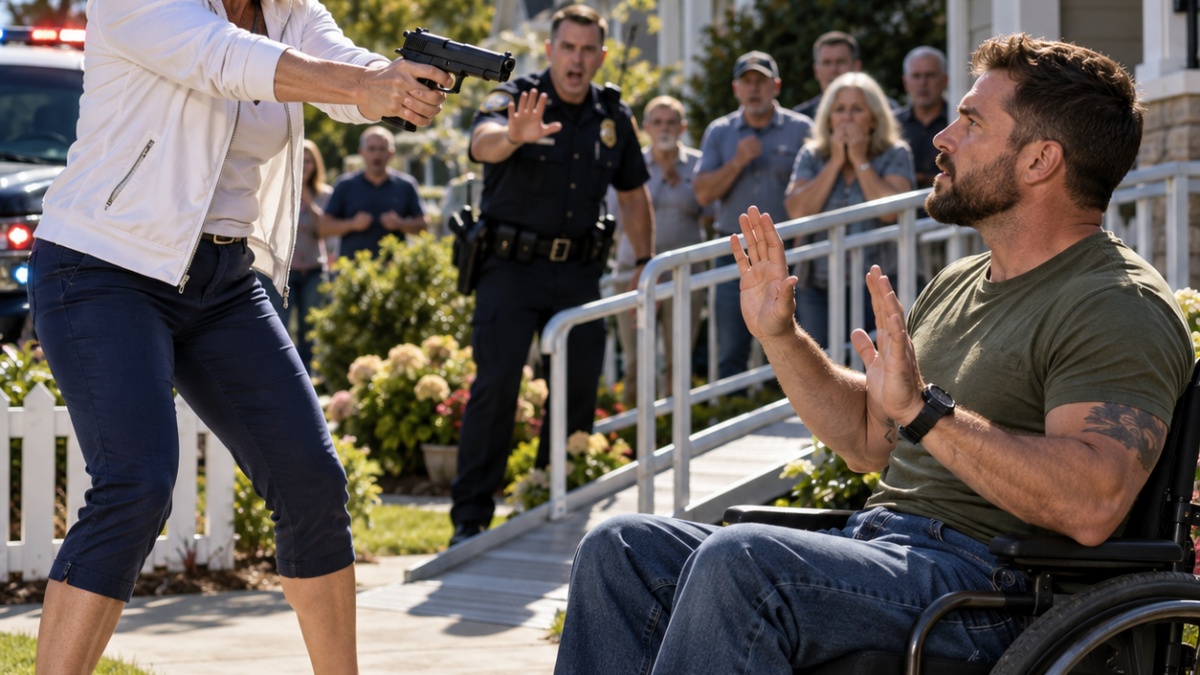
Karen stood in her yard holding a paintball gun.
For a second, my brain refused to make sense of it.
She had both feet planted, the marker raised, her face twisted with rage. This was no accident, no backyard game gone wrong. She wanted me to see her. She wanted me to know exactly who was doing it.
Pop.
A paintball struck my wrist hard enough to make my fingers spasm.
Pop.
Another hit my upper arm.
I tried to move, but maneuvering a chair while being shot in the arms is not like running for cover. My wheels caught slightly on the edge of the walkway. Pain flashed again as a paintball struck the back of my neck. The gun was high-powered, or close enough that each hit felt like being snapped with a rock-hard fist.
Karen screamed while she fired.
“Get out!”
Pop.
“Nobody wants you here!”
Pop.
“You ruined my son!”
Pop.
“You devalue this whole community!”
I tried to reach for my phone.
Another shot hit my forearm.
My hand jerked away.
For the first time in years, I felt truly trapped by my chair.
Not inconvenienced.
Not challenged.
Trapped.
I was in the open, taking hits, unable to get to the van, unable to get back up the ramp fast enough, unable to grab the phone without exposing the same arms she kept targeting. Paint burst against my skin, my shirt, my chair, the driveway. My body registered each impact as pain, then heat, then throbbing.
I shouted, “Stop!”
She laughed.
Not playfully.
Wildly.
“You don’t like harmless pranks?” she screamed.
Pop.
That one hit my shoulder where old injury pain still lived.
I yelled from the shock of it.
She lifted the marker again.
Then someone else screamed.
“Police! Stop!”
For a split second, I thought I was hallucinating.
But tires screeched at the curb, and two officers were already moving across the lawn. Later, I learned Mrs. Bell had seen Karen come out with the paintball gun and called 911 before the first shot hit me. She stayed on the line, yelling updates while Karen fired.
Karen lowered the marker slowly, as if surprised the world had interrupted her.
One officer drew his weapon.
“Drop it!”
Karen’s face changed instantly.
The rage vanished into performance.
She dropped the paintball gun and raised both hands.
“We were playing!” she cried. “It was a joke! I didn’t mean to hurt him!”
I sat there covered in paint, breathing hard, arms shaking, welts already rising under my sleeves.
“A joke?” I shouted.
The officer nearest me turned. “Sir, stay still. Medical is coming.”
“I’m supposed to be at an appointment.”
I do not know why that was what came out. Maybe because my brain could not yet hold the full weight of what had happened, so it grabbed the nearest practical outrage.
My appointment.
My shirt.
My chair.
My van.
My dignity sitting in the driveway while my neighbor shot me and laughed.
Karen kept talking as they cuffed her.
“He ruined my son’s life!”
“He made us look bad!”
“He shouldn’t live here!”
Then, because Karen could not stop revealing herself, she used another slur.
The officer’s face hardened.
“Add that to the report,” he said to his partner.
She tried to backtrack immediately.
“I didn’t mean it like that.”
But it was too late.
The paintball gun was taken as evidence. Officers photographed me from multiple angles. My chair. My van. The paint splatter on the driveway. The marks on my arms and neck. Mrs. Bell gave her statement. Another neighbor, a man I had barely spoken to before, came over and told police he had heard Karen screaming for me to leave the community.
I was taken to the hospital.
I hated that part more than I expected.
I have been in hospitals enough for one lifetime. The smell alone can take me back if I let it: antiseptic, plastic tubing, old coffee, fear. They checked the welts, cleaned spots where the skin had split, documented bruising, and made sure there was no deeper injury from repeated hits. I was physically all right, according to the doctor.
Physically.
That word did a lot of work.
Because inside, I felt useless.
I know that is not a fair word. I know what happened was not my fault. I know anyone can be ambushed, and I know a wheelchair does not make me lesser because I could not roll faster than a paintball gun could fire.
Knowing something and feeling it are different wars.
As I sat in that exam room with paint still dried along the edge of my chair and welts burning under my shirt, I felt every ugly thing Karen had tried to make true.
I felt like a target.
I felt like a burden.
I felt like the neighborhood had watched my vulnerability become entertainment.
Then Mrs. Bell arrived.
She had followed the ambulance in her own car. She was in her seventies, small, with white hair and the kind of cardigan that made everybody look like they should be holding tea. She came into the room with permission from the nurse and stood beside the bed.
“I called,” she said.
I looked up.
“I know.”
“I should have called sooner. About the other things.”
“You called today.”
Her lips pressed together.
“I saw her with that gun, and I thought, not again. Not one more thing.”
I did not know what to say.
She reached out and touched my hand lightly, careful of the bruising.
“You belong here,” she said.
That sentence hit harder than I was prepared for.
I looked away fast, but not fast enough.
Mrs. Bell pretended not to notice my eyes filling, which was its own kindness.
Karen was arrested.
Her assault charge was serious. Felony serious. The disability-related harassment, the slurs, the prior vandalism through her son, and the pattern of targeting me all made the situation worse for her. The paintball gun was treated as a weapon because, used the way she used it, that is what it was. I had the welts and medical documentation to prove it.
Her son’s case stayed in juvenile court.
That surprised me at first, but I learned more later. He was seventeen, yes, but still legally a juvenile in that process. First offense. Clear evidence. Cooperation. And most importantly, he told the truth.
His mother had put him up to it.
She had encouraged the vandalism. Told him I was ruining the neighborhood. Told him I deserved to be scared off. Told him nobody would take it seriously if it was “just paint.” Whether he believed her or just wanted her approval, I do not know. I am not excusing him. Seventeen is old enough to know cruelty when you spray it across someone’s vehicle.
But I know what it is to be shaped by authority.
And Karen had shaped him badly.
A week after the assault, he came to my door with his father.
I had not met the father before. Quiet man. Tired eyes. Work boots. He stood a step behind his son like he was making sure the boy did not run from the consequences.
The kid looked smaller without the camera footage’s arrogance. Hands shoved in his hoodie pocket. Face pale. Eyes fixed somewhere near my ramp.
“I’m sorry,” he said.
I waited.
His father said, “Look at him when you say it.”
The boy swallowed and looked up.
“I’m sorry I spray-painted your van. I’m sorry for what I wrote. It was wrong. It was hateful. I knew it was wrong when I did it.”
That last part mattered.
Not because it fixed anything.
Because it was true.
“Why did you do it?” I asked.
His eyes flicked toward his father, then back to me.
“My mom said you were trying to get us in trouble. She said you were ruining the street and acting like everyone had to treat you special.”
His father closed his eyes briefly, pain crossing his face.
“And what do you think now?” I asked.
The kid shifted.
“I think she was wrong.”
I let the silence sit between us.
Then I said, “You didn’t ruin my life. You damaged my van. You hurt me. You made me feel unsafe in my own home. There’s a difference. Damage can be repaired. Trust takes longer.”
He nodded, eyes wet.
His father said they would pay what they could toward the cleaning and repairs. I told them my lawyer would handle the numbers. That was not me being cold. That was me refusing to turn my porch into a negotiation over hate.
Before they left, the boy said, “I really am sorry.”
“I hope you mean that longer than today,” I said.
He flinched, but he nodded.
Karen, from what I heard, was furious he had told on her.
That did not surprise me.
The civil side came next.
My attorney was direct. Karen had caused physical injury, emotional distress, property damage, and disability-related harassment. Her son’s vandalism involved my van, and Karen’s role in encouraging it mattered. My wheelchair had paint damage from the assault. My clothing was ruined. My medical visit was documented. The van needed further detailing and possible repainting. The chair needed professional cleaning and inspection because paint had gotten into places paint should never be.
I sued.
I did not do it for revenge, though I will not pretend revenge never whispered.
I did it because accessibility equipment is expensive. Because cleaning and repairs cost money. Because court records matter. Because people like Karen rely on victims being too exhausted to pursue consequences after surviving the initial harm.
I was exhausted.
I pursued them anyway.
Meanwhile, the neighborhood changed.
At first, people were awkward. Some avoided eye contact, probably embarrassed they had ignored Karen’s comments for weeks. Some overcorrected, waving too enthusiastically or offering help I did not need. A few brought food. One man pressure-washed the paint splatter from the edge of my driveway without making a speech about it. I appreciated him the most.
Mrs. Bell became my unofficial neighborhood intelligence officer.
“She was always mean,” she told me one afternoon, sitting on my porch with lemonade. “But not like this.”
“Mean is usually practice,” I said. “People just notice when it gets loud.”
She nodded slowly. “You’re probably right.”
The homeowners on the street began talking more honestly. Karen had complained about everyone, apparently. Too many weeds. Too many toys. Trash cans out too long. Cars not nice enough. Flags she disliked. Children too loud. Dogs too barky. But with me, she had found something she thought others might quietly agree with.
That was the part that stayed with me.
Karen believed my presence lowered the neighborhood because somewhere in her mind, disability was contamination. Not hardship. Not difference. Contamination. She thought if she said “property values” or “community appearance,” she could make prejudice sound practical.
And for a little while, people let her talk.
Maybe because they were uncomfortable.
Maybe because they thought ignoring her was harmless.
Maybe because the target was me, and I was new, and it is easier not to get involved when cruelty parks itself next door instead of in your own driveway.
I do not hate them for that.
But I remember it.
Karen eventually went to court.
I was present for one hearing. Not all of them. I did not need to watch every turn of the machine. But I wanted to look at her once in a place where she could not pretend the rules were whatever she wanted them to be.
She wore a conservative navy dress and had softened her hair. No sunglasses. No sharp jewelry. She looked smaller, but not sorry. Her attorney did most of the talking. Karen stared straight ahead until the prosecutor described the assault: firing repeatedly at a wheelchair user, targeting his arms and upper body, shouting for him to leave the community.
Wheelchair user.
Targeting.
Leave the community.
Words sound different in court.
Cleaner. Colder. Harder to wriggle away from.
When the prosecutor mentioned the slurs, Karen’s mouth tightened. Not with shame. With irritation that people kept bringing them up.
That told me enough.
I did not need an apology from her after that.
An apology from Karen would have been another performance, another tool, another way to reduce consequences. She had already shown me who she was when she thought she had power. I did not need to hear who she pretended to be when power was gone.
Her felony charge meant she was likely facing real jail time. The exact final outcome took longer than I wanted, because courts move slowly unless you are the one waiting under them. But the direction was clear: this was not being brushed off as a neighbor dispute.
Her son got a deal. Community service, counseling, restitution, and a record situation that depended on him staying out of trouble. I hope he took it seriously. I hope he learned that love for a parent does not require inheriting their hatred. I hope the shame of handcuffs at seventeen scared him straight before he became the kind of adult who raises another version of himself.
As for Karen’s husband, he moved out before the case finished.
I saw the moving truck one Saturday morning. He loaded boxes with the help of another man while Karen was gone or not allowed to be there; I am not sure. The son helped too, head down, carrying lamps and plastic bins. The house looked less hostile with her absent, as if even the windows were relieved.
A month later, a For Sale sign appeared.
I sat in my driveway and looked at it for a long time.
I expected to feel triumph.
Mostly, I felt tired.
That is something people do not understand about dealing with harassment. Even when you win, even when the bad person faces consequences, even when neighbors finally admit you were right, the body does not instantly unclench. You still scan. You still listen for footsteps. You still feel exposed going to your own van. You still remember the sound of paintballs cracking through the air and the awful helpless second between seeing the gun and realizing you cannot move fast enough.
Healing is not the same as the other person leaving.
But leaving helps.
The house sold to a young couple with a baby and an elderly golden retriever. On moving day, the husband came over to introduce himself. He did not mention Karen, though I am sure someone had warned him. He simply shook my hand, admired the ramp design because his father used a walker and might visit, and asked who I recommended for lawn care.
Normal.
Beautifully normal.
I gave him a number.
Life settled after that.
Not perfectly. My van still had faint evidence of the spray paint if you knew where to look. My chair had been cleaned, but I replaced a cushion because I could not stop seeing paint on it even after it was gone. My arms healed. The welts faded from purple to yellow to memory. My neck stopped aching.
The deeper part took longer.
The first few times I went out for appointments after the assault, I felt ridiculous. I checked Karen’s old house even though she was gone. I scanned for movement. I kept my phone in my lap, not my pocket. I angled my chair differently on the ramp so I could see more of the yard.
I hated every adjustment.
Then one morning, I caught myself humming while locking the front door.
That was when I realized I had gone three full minutes without thinking about her.
Three minutes sounds small until fear has been measuring your life by seconds.
Mrs. Bell continued stopping by. The retired couple across the street invited me to a cookout. The man who pressure-washed my driveway asked if I wanted to join a weekly poker night. I said no the first time, then yes the second. I am terrible at poker, but it turns out being underestimated because you are quiet is useful at a card table.
The neighborhood, slowly, became what I had wanted when I moved in.
Not perfect.
Not free of gossip.
Not some shining example of human decency.
But livable.
Friendly enough.
Quiet enough.
Mine enough.
One evening, months later, I was out front adjusting a small solar light along the ramp. A little boy from the new family next door came toddling across the grass, supervised by his mother from a few steps behind. He stopped at the bottom of my ramp and looked at my chair.
“Wheels,” he said.
I smiled. “Yep. Wheels.”
He pointed at the ramp. “Road.”
His mother looked embarrassed. “Sorry.”
“Don’t be,” I said. “He’s right. It is kind of a road.”
The boy grinned.
Then he pushed a toy truck gently up the bottom of the ramp, made an engine noise, and rolled it back down. His mother started to stop him, but I shook my head.
“It’s fine.”
And it was.
There was no pity in the child’s face. No disgust. No property-value calculation. No fear. Just curiosity and a ramp that looked, to him, like a good place for a truck.
That moment did more for me than any speech about belonging.
Karen had looked at that ramp and seen ugliness.
A toddler looked at it and saw possibility.
I know which one I trust.
People ask sometimes if I regret moving there.
The answer is no.
I regret that Karen lived next door when I did. I regret giving her chances to be merely rude when she was already becoming dangerous. I regret not reporting every threat, every slur, every muttered comment sooner. I regret the fact that people like her can make a man question whether his own independence is an inconvenience to others.
But I do not regret the house.
I do not regret the ramp.
I do not regret the van.
I do not regret taking up space in a neighborhood Karen thought should be reserved for bodies she approved of.
That may be the final lesson she never meant to teach me.
There is a difference between wanting peace and making yourself small.
For a while, I confused the two. I thought being a good neighbor meant absorbing insults. I thought independence meant never asking for help, never calling the police unless things were undeniable, never admitting that someone had scared me. I thought thick skin meant letting cruelty slide off without documentation.
I was wrong.
Independence does not mean facing everything alone.
Strength does not mean pretending nothing hurts.
And peace, real peace, sometimes has to be defended with police reports, camera footage, medical records, lawsuits, neighbors willing to call 911, and the stubborn refusal to leave just because someone hateful thinks you should.
Karen wanted me gone.
She got arrested.
Her son learned that hate leaves a record.
Her family left the neighborhood.
I stayed.
I still roll down my ramp every morning.
I still load into my van from the driveway she once blocked.
I still wave to neighbors, though now most of them wave first.
I still keep the doorbell camera active, because trust is good but evidence is better.
And sometimes, when the sun hits the windshield just right, I can almost see where the words GO AWAY used to be.
Almost.
They are gone now.
Polished out, painted over, repaired.
Like the welts.
Like the worst of the fear.
Not forgotten, exactly.
But no longer in charge.
Karen thought my wheelchair made the neighborhood look broken.
She was wrong.
The broken thing was the part of her that looked at another human being’s access to the world and called it ugly.
My ramp is still here.
My van is still here.
I am still here.
And every time I lower that ramp and roll forward into my own life, I know I am doing the one thing Karen tried hardest to stop.
I am taking up space without apology.
𝗧𝗛𝗘 𝗘𝗡𝗗
The Neighbor Who Called My Wheelchair an Eyesore Finally Showed the Whole Street What She Really Was
Karen said I made the neighborhood look broken.
She thought my wheelchair, my ramp, and my van were things decent people should not have to see.
Then she picked up a weapon and proved the ugliest thing on our street had never been me.
I moved into that neighborhood because I was tired of surviving noise.
That is the simplest way I can explain it. After the Marines, after the accident, after the surgeries and the rehab and the years of learning how to live inside a body that no longer answered every command the way it used to, I wanted quiet. Not pity. Not applause. Not people thanking me for my service in grocery store aisles while looking anywhere except at my chair.
Just quiet.
A place where the mornings belonged to coffee and birds instead of alarms and appointments. A place where I could pull my van into the driveway, lower my ramp, roll into my house, cook my own meals, clean my own counters, fix what I could reach, and live my life without every doorway turning into a negotiation.
I had spent enough time proving I was not helpless.
I did not need a neighborhood full of people watching me do it.
The house was perfect for me because it had already been modified before I bought it. Not perfectly, but close enough that I could make it work. The front porch step had been replaced with a sturdy ramp that curved neatly along the side of the house. The doorways were widened. The kitchen counters had been adjusted. The bathroom had rails where I needed them and enough turning space that I did not have to perform a ten-point maneuver just to wash my hands. The driveway was wide and flat, which mattered more than most people understand. My van had a rear ramp, and I needed clearance behind it to get in and out safely.
Those details were not luxuries.
They were the difference between independence and asking someone else for help every time I wanted milk.
I had been injured in a training accident years earlier, back when I was still teaching at the School of Infantry. It was not some cinematic battlefield story. No dramatic last stand. No slow-motion explosion in a foreign desert with music swelling behind it. It was a grenade accident during training, the kind of thing that happens fast and leaves a lifetime of consequences behind. One moment, I was a Marine doing the job. The next, my body had changed its contract with me forever.
People hear “disabled veteran” and fill in blanks with whatever makes them comfortable. Some imagine tragedy. Some imagine heroism. Some imagine burden. I learned to let them imagine. Their version of me was rarely useful.
My version was simpler.
I was a man in a wheelchair who could still drive, still cook, still argue with insurance companies, still swear at plumbing repairs, still forget laundry in the dryer, still pay my bills, still take pride in keeping my yard decent, and still want a life that felt like mine.
For the first few days after I moved in, I thought I had found it.
The street was clean and ordinary. Two-story houses with trimmed lawns, basketball hoops in driveways, mailboxes shaped like tiny barns, and neighbors who waved without making a production out of it. A retired couple across the street brought over banana bread. The guy two houses down offered to help if I ever needed anything heavy moved, then had the good sense not to hover after I thanked him. A woman walking a little terrier told me which day trash came and warned me about the raccoons.
Normal stuff.
Good stuff.
Then I met Karen.
She lived next door.
Or, more accurately, she occupied the house next door like it was a throne from which she monitored the decline of civilization.
Karen was in her mid-forties, maybe a few years older than me, with stiff highlighted hair cut just below her jaw, sharp sunglasses she wore even when the sky was cloudy, and a face that seemed permanently arranged around disappointment. She dressed like someone who wanted to look casual but expensive: white capris, fitted athletic jackets, gold jewelry, wedge sandals, manicured nails. Everything matched. Nothing softened her.
The first time I saw her, I was unloading groceries from the van.
I had the rear ramp down and two bags hooked over my lap. She stood in her yard holding a coffee tumbler, staring at the ramp like it had personally offended her. I looked up and gave her a nod.
“Morning.”
She did not answer.
Her eyes went from me to the van, from the van to my chair, from my chair to the ramp leading up my porch.
Then her mouth tightened.
I had seen that look before.
Not always from bad people, either. Sometimes discomfort makes decent people awkward. Sometimes they do not know whether to offer help, ignore the chair, ask questions, avoid questions, make eye contact, look away. I can forgive awkwardness. I have been living in this chair long enough to tell the difference between awkwardness and contempt.
Karen’s look was contempt.
Still, I tried.
The next day, I saw her at the mailbox.
“Hi,” I said. “I’m Mark. Just moved in.”
She looked at me like I had handed her paperwork.
“I noticed.”
Not welcome to the neighborhood.
Not nice to meet you.
I noticed.
“Well,” I said, forcing a small smile, “I guess I’ll see you around.”
“I suppose.”
She turned away before I could say anything else.
That should have been my first warning that Karen did not simply dislike me.
She disliked what I represented.
part2
I began hearing things within a week.
Not directly from her, because people like Karen rarely begin by saying their ugliest thoughts to your face. They seed them elsewhere first. They test the soil.
The retired woman across the street, Mrs. Bell, stopped by one afternoon with my mail, which had accidentally been put in her box. She lingered after handing it over, eyes flicking toward Karen’s house.
“Some people need hobbies,” she said.
I laughed a little. “That sounds like a sentence with a story behind it.”
She hesitated. “Karen has been talking.”
“About?”
Mrs. Bell’s mouth tightened. “Your van. Your ramp.”
Of course.
“What is she saying?”
“She thinks the modifications are… unattractive.”
I leaned back in my chair and looked down at my own driveway. My van was parked neatly. The ramp on the house was painted to match the trim. Nothing was broken. Nothing was rusting. Nothing spilled over the property line.
“Attractive,” I repeated.
Mrs. Bell sighed. “She said it makes the street look institutional.”
I almost laughed. “Institutional.”
“She said something about property values.”
There it was.
Property values.
The sacred language of people who can excuse any cruelty if they staple a dollar sign to it.
I thanked Mrs. Bell for telling me, and she looked embarrassed, like she had delivered a rotten package. After she left, I sat in my driveway longer than I meant to, staring at the house I had been proud to buy.
I had fought hard for that pride.
People think independence after disability is one big inspirational montage. It is not. It is paperwork, pain, trial and error, adaptive equipment, humiliation, stubbornness, and the slow rebuilding of trust in yourself. My van was not ugly to me. It was freedom. The ramp was not an eyesore. It was the reason I could enter my own front door without waiting for someone to lift me.
Karen looked at those things and saw damage.
I looked at them and saw survival.
For a while, I told myself not to care.
I had heard worse. Drill instructors in basic training had turned verbal cruelty into an art form. After the accident, I had heard whispers from people who thought disability meant deafness. I had been called inspiring, tragic, lucky, ruined, brave, broken, and “not as bad as some guys,” sometimes all in the same week. Karen’s muttering should not have mattered.
But thick skin is not the same as numb skin.
Even scar tissue can ache.
Karen never said hello, but she made sure I heard enough.
When I rolled down my ramp to get the mail, she would be in her yard muttering, “There goes the neighborhood.”
When I loaded groceries into the van, she would sigh loudly and say, “Some people need so much accommodation.”
When a delivery truck parked briefly in front of my house, she told the driver, loud enough for me to hear, “Be careful. This house has special equipment everywhere.”
Special equipment.
Like I was a construction zone.
One afternoon, a group of neighborhood kids rode by on bikes. One of them, maybe seven, slowed to look at my ramp. Not rudely. Curiously. Kids notice everything.
Karen happened to be outside.
“Don’t stare, honey,” she called to him. “It’s rude.”
I appreciated that for half a second.
Then she added, “Some things are just unfortunate.”
I looked straight at her.
She looked away.
That was Karen’s pattern. Brave enough to wound. Cowardly enough to avoid the eye contact afterward.
The first real incident happened on a Tuesday morning.
I had a grocery pickup scheduled and a prescription waiting at the pharmacy. Nothing dramatic. Just errands. I rolled out of the house, locked the front door, and headed down the ramp toward my driveway.
Karen’s sedan was parked directly behind my van.
Not partly blocking it.
Not accidentally close.
Directly behind it.
There was no way to deploy my rear ramp. No way to get into the van. No way to leave.
Karen stood in her yard with a garden hose in her hand, watering flowers that already looked wet. She saw me. She smiled.
That smile told me everything.
I rolled down to the edge of the driveway.
“Karen,” I called.
She looked over with fake surprise. “Oh. Good morning.”
“Can you move your car?”
She tilted her head. “Why?”
“My ramp comes out the back. You’re blocking it.”
She looked at the van, then at me.
“Well, maybe if you need that much special treatment, you shouldn’t live in a normal neighborhood.”
The words landed clean.
No muttering this time.
No plausible deniability.
Just contempt in daylight.
I took a breath. “Move your car.”
She turned off the hose slowly. “A hospital might be more appropriate for someone with your needs.”
For a second, the street went silent around me.
I could hear the distant buzz of a lawn mower. A bird on a roofline. My own pulse in my ears.
I wanted to answer the way Marines answer insults when nobody is filming. I wanted to tell her exactly what kind of person hides cruelty behind words like normal. I wanted to roll closer and make her look me in the eye while she explained why my driveway, my van, and my existence bothered her so much.
Instead, I went back inside and called the non-emergency police line.
That may sound calm.
It was not calm.
It was discipline.
The officer who arrived was younger than I expected, polite, and clearly annoyed the second he saw the situation. Karen tried to act confused.
“I was only parked there for a minute.”
“No, you weren’t,” I said from the top of my ramp.
She ignored me and spoke to the officer. “I had no idea he needed all that space.”
The officer looked at the van, the ramp markings, the driveway, and then at her car parked squarely where no reasonable person would park by accident.
“Ma’am, you need to move the vehicle.”
Karen’s face tightened. “Fine.”
“And if you block the driveway again, you may be cited or towed.”
That was when her mask slipped.
She looked at me over the roof of her sedan and said quietly, but not quietly enough, “You’re going to regret calling them.”
The officer was writing something down and did not react. Maybe he did not hear. Maybe he did and decided not to escalate.
I heard.
I said nothing.
Looking back, I wish I had spoken up right then. Not because it would have stopped Karen—people like her do not stop because you point out the obvious—but because threats deserve daylight. I was still trying, in some stubborn way, not to become the disabled guy who needed authorities to handle his neighbor.
That pride cost me.
For the next few weeks, Karen got meaner.
She did not block the driveway again, but she made sure to be outside when I came and went. She asked if taxpayers paid for my van. She asked if my ramp was “government-funded.” She told another neighbor that children might be frightened by me. Once, when I was taking a package inside, she said, “You know, some communities have appearance standards for a reason.”
I stopped answering.
Not because the words did not hurt.
Because every response fed her.
Silence made her angrier.
Then came the morning I opened my front door and saw my van covered in spray paint.
At first, I did not understand what I was seeing.
The side of the van was smeared with ugly black letters. The paint dripped down the door in thick lines. On the windshield, large enough to be seen from the street, someone had written:
GO AWAY.
There were other words too.
One on the passenger side.
Another near the rear door.
Cruel words. Disability slurs. Words I had heard before, but never painted across the machine that gave me freedom.
My van was not just a car.
It was my legs outside the house.
It was appointments, groceries, independence, dignity.
Seeing it vandalized felt like someone had written hatred across my body.
For a moment, I just sat there in my chair at the top of the ramp, cold despite the morning sun.
Then I remembered the doorbell camera.
My hands shook as I opened the app.
The footage was clear.
A figure approached around 1:13 a.m., hood up but face visible when he turned toward the porch light. Not Karen.
Her son.
Seventeen years old, tall, lanky, with the same sharp chin and entitled posture. I had seen him around a few times, usually with earbuds in, barely looking up from his phone. In the video, he shook the spray can, painted the words, stepped back to admire them, then laughed.
He was not hiding.
He did not think he needed to.
I called the police.
This time, they took it seriously from the start. Two officers came, photographed the van, watched the video, and asked if I knew the boy.
“He lives next door,” I said.
Karen’s house looked quiet.
Not for long.
The officers went over there. I stayed outside near my ramp, watching because I was done retreating into my own home to make other people comfortable.
I could not hear the whole conversation inside, but I heard Karen’s voice rise. Then her son’s. Then the door opened, and the officers brought him out in handcuffs.
Karen came behind them like a storm.
She was wearing a silky robe over pajamas, hair wild, face red, eyes locked not on her son but on me.
“Now look what you did!” she screamed.
I stared at her.
Her son had vandalized my van, and somehow I had done something.
“You ruined his life!”
One officer turned. “Ma’am, stay back.”
Karen pointed at me over his shoulder. “It was a harmless prank!”
“A hate crime isn’t a prank,” the officer said.
That shut her up for half a second.
Then she surged around him, not close enough to touch me, but close enough that I could smell perfume and panic.
“He’s a child!”
“He’s seventeen,” I said.
“He made a mistake!”
“He spray-painted slurs on my accessible van.”
“You could have let it go.”
I felt something inside me finally detach from patience.
“If your son is seventeen and does not know better than to vandalize a disabled veteran’s vehicle, then that is on you.”
Her face twisted.
“As for harmless,” I continued, “you can think about that when I send you the bill for cleaning and repairs.”
“You shouldn’t have moved here,” she spat.
“And you shouldn’t have reproduced.”
The words came out before I softened them.
I do not regret them.
Karen recoiled like I had slapped her, then recovered with a look so hateful it almost seemed to change her face.
“Stay away from me,” I said. “Stay away from my property.”
I turned my chair and went back inside.
I thought that would be the worst of it.
I thought an arrest, a hate crime charge, police involvement, and a repair bill would finally scare Karen into leaving me alone.
That was my mistake.
The next two days were quiet.
Too quiet, maybe, but I let myself believe in it because I needed to. The van had to be professionally cleaned. Some of the paint had bonded badly enough that the shop warned me repairs might be expensive. I had to arrange transportation for an appointment because I could not use the van safely with the windshield marked the way it was.
Every inconvenience reminded me of Karen’s son laughing in the camera footage.
Still, I told myself the system was handling it.
Then I had another appointment.
Medical, routine, one I had waited months for because specialists move at the speed of glaciers unless they are billing you. My van had been cleaned enough to drive, though faint shadows of the paint remained on one side. I rolled down the ramp, locked the door, and started toward the driveway.
I heard the first pop before I felt anything.
A sharp plastic crack.
Then pain burst across my upper arm.
I flinched, more confused than afraid.
Another pop.
This one hit the back of my neck.
Then another. My shoulder. My forearm. My chest.
Paint splattered across my shirt.
I turned my chair as fast as I could.
Karen stood in her yard holding a paintball gun.
For a second, my brain refused to make sense of it.
She had both feet planted, the marker raised, her face twisted with rage. This was no accident, no backyard game gone wrong. She wanted me to see her. She wanted me to know exactly who was doing it.
Pop.
A paintball struck my wrist hard enough to make my fingers spasm.
Pop.
Another hit my upper arm.
I tried to move, but maneuvering a chair while being shot in the arms is not like running for cover. My wheels caught slightly on the edge of the walkway. Pain flashed again as a paintball struck the back of my neck. The gun was high-powered, or close enough that each hit felt like being snapped with a rock-hard fist.
Karen screamed while she fired.
“Get out!”
Pop.
“Nobody wants you here!”
Pop.
“You ruined my son!”
Pop.
“You devalue this whole community!”
I tried to reach for my phone.
Another shot hit my forearm.
My hand jerked away.
For the first time in years, I felt truly trapped by my chair.
Not inconvenienced.
Not challenged.
Trapped.
I was in the open, taking hits, unable to get to the van, unable to get back up the ramp fast enough, unable to grab the phone without exposing the same arms she kept targeting. Paint burst against my skin, my shirt, my chair, the driveway. My body registered each impact as pain, then heat, then throbbing.
I shouted, “Stop!”
She laughed.
Not playfully.
Wildly.
“You don’t like harmless pranks?” she screamed.
Pop.
That one hit my shoulder where old injury pain still lived.
I yelled from the shock of it.
She lifted the marker again.
Then someone else screamed.
“Police! Stop!”
For a split second, I thought I was hallucinating.
But tires screeched at the curb, and two officers were already moving across the lawn. Later, I learned Mrs. Bell had seen Karen come out with the paintball gun and called 911 before the first shot hit me. She stayed on the line, yelling updates while Karen fired.
Karen lowered the marker slowly, as if surprised the world had interrupted her.
One officer drew his weapon.
“Drop it!”
Karen’s face changed instantly.
The rage vanished into performance.
She dropped the paintball gun and raised both hands.
“We were playing!” she cried. “It was a joke! I didn’t mean to hurt him!”
I sat there covered in paint, breathing hard, arms shaking, welts already rising under my sleeves.
“A joke?” I shouted.
The officer nearest me turned. “Sir, stay still. Medical is coming.”
“I’m supposed to be at an appointment.”
I do not know why that was what came out. Maybe because my brain could not yet hold the full weight of what had happened, so it grabbed the nearest practical outrage.
My appointment.
My shirt.
My chair.
My van.
My dignity sitting in the driveway while my neighbor shot me and laughed.
Karen kept talking as they cuffed her.
“He ruined my son’s life!”
“He made us look bad!”
“He shouldn’t live here!”
Then, because Karen could not stop revealing herself, she used another slur.
The officer’s face hardened.
“Add that to the report,” he said to his partner.
She tried to backtrack immediately.
“I didn’t mean it like that.”
But it was too late.
The paintball gun was taken as evidence. Officers photographed me from multiple angles. My chair. My van. The paint splatter on the driveway. The marks on my arms and neck. Mrs. Bell gave her statement. Another neighbor, a man I had barely spoken to before, came over and told police he had heard Karen screaming for me to leave the community.
I was taken to the hospital.
I hated that part more than I expected.
I have been in hospitals enough for one lifetime. The smell alone can take me back if I let it: antiseptic, plastic tubing, old coffee, fear. They checked the welts, cleaned spots where the skin had split, documented bruising, and made sure there was no deeper injury from repeated hits. I was physically all right, according to the doctor.
Physically.
That word did a lot of work.
Because inside, I felt useless.
I know that is not a fair word. I know what happened was not my fault. I know anyone can be ambushed, and I know a wheelchair does not make me lesser because I could not roll faster than a paintball gun could fire.
Knowing something and feeling it are different wars.
As I sat in that exam room with paint still dried along the edge of my chair and welts burning under my shirt, I felt every ugly thing Karen had tried to make true.
I felt like a target.
I felt like a burden.
I felt like the neighborhood had watched my vulnerability become entertainment.
Then Mrs. Bell arrived.
She had followed the ambulance in her own car. She was in her seventies, small, with white hair and the kind of cardigan that made everybody look like they should be holding tea. She came into the room with permission from the nurse and stood beside the bed.
“I called,” she said.
I looked up.
“I know.”
“I should have called sooner. About the other things.”
“You called today.”
Her lips pressed together.
“I saw her with that gun, and I thought, not again. Not one more thing.”
I did not know what to say.
She reached out and touched my hand lightly, careful of the bruising.
“You belong here,” she said.
That sentence hit harder than I was prepared for.
I looked away fast, but not fast enough.
Mrs. Bell pretended not to notice my eyes filling, which was its own kindness.
Karen was arrested.
Her assault charge was serious. Felony serious. The disability-related harassment, the slurs, the prior vandalism through her son, and the pattern of targeting me all made the situation worse for her. The paintball gun was treated as a weapon because, used the way she used it, that is what it was. I had the welts and medical documentation to prove it.
Her son’s case stayed in juvenile court.
That surprised me at first, but I learned more later. He was seventeen, yes, but still legally a juvenile in that process. First offense. Clear evidence. Cooperation. And most importantly, he told the truth.
His mother had put him up to it.
She had encouraged the vandalism. Told him I was ruining the neighborhood. Told him I deserved to be scared off. Told him nobody would take it seriously if it was “just paint.” Whether he believed her or just wanted her approval, I do not know. I am not excusing him. Seventeen is old enough to know cruelty when you spray it across someone’s vehicle.
But I know what it is to be shaped by authority.
And Karen had shaped him badly.
A week after the assault, he came to my door with his father.
I had not met the father before. Quiet man. Tired eyes. Work boots. He stood a step behind his son like he was making sure the boy did not run from the consequences.
The kid looked smaller without the camera footage’s arrogance. Hands shoved in his hoodie pocket. Face pale. Eyes fixed somewhere near my ramp.
“I’m sorry,” he said.
I waited.
His father said, “Look at him when you say it.”
The boy swallowed and looked up.
“I’m sorry I spray-painted your van. I’m sorry for what I wrote. It was wrong. It was hateful. I knew it was wrong when I did it.”
That last part mattered.
Not because it fixed anything.
Because it was true.
“Why did you do it?” I asked.
His eyes flicked toward his father, then back to me.
“My mom said you were trying to get us in trouble. She said you were ruining the street and acting like everyone had to treat you special.”
His father closed his eyes briefly, pain crossing his face.
“And what do you think now?” I asked.
The kid shifted.
“I think she was wrong.”
I let the silence sit between us.
Then I said, “You didn’t ruin my life. You damaged my van. You hurt me. You made me feel unsafe in my own home. There’s a difference. Damage can be repaired. Trust takes longer.”
He nodded, eyes wet.
His father said they would pay what they could toward the cleaning and repairs. I told them my lawyer would handle the numbers. That was not me being cold. That was me refusing to turn my porch into a negotiation over hate.
Before they left, the boy said, “I really am sorry.”
“I hope you mean that longer than today,” I said.
He flinched, but he nodded.
Karen, from what I heard, was furious he had told on her.
That did not surprise me.
The civil side came next.
My attorney was direct. Karen had caused physical injury, emotional distress, property damage, and disability-related harassment. Her son’s vandalism involved my van, and Karen’s role in encouraging it mattered. My wheelchair had paint damage from the assault. My clothing was ruined. My medical visit was documented. The van needed further detailing and possible repainting. The chair needed professional cleaning and inspection because paint had gotten into places paint should never be.
I sued.
I did not do it for revenge, though I will not pretend revenge never whispered.
I did it because accessibility equipment is expensive. Because cleaning and repairs cost money. Because court records matter. Because people like Karen rely on victims being too exhausted to pursue consequences after surviving the initial harm.
I was exhausted.
I pursued them anyway.
Meanwhile, the neighborhood changed.
At first, people were awkward. Some avoided eye contact, probably embarrassed they had ignored Karen’s comments for weeks. Some overcorrected, waving too enthusiastically or offering help I did not need. A few brought food. One man pressure-washed the paint splatter from the edge of my driveway without making a speech about it. I appreciated him the most.
Mrs. Bell became my unofficial neighborhood intelligence officer.
“She was always mean,” she told me one afternoon, sitting on my porch with lemonade. “But not like this.”
“Mean is usually practice,” I said. “People just notice when it gets loud.”
She nodded slowly. “You’re probably right.”
The homeowners on the street began talking more honestly. Karen had complained about everyone, apparently. Too many weeds. Too many toys. Trash cans out too long. Cars not nice enough. Flags she disliked. Children too loud. Dogs too barky. But with me, she had found something she thought others might quietly agree with.
That was the part that stayed with me.
Karen believed my presence lowered the neighborhood because somewhere in her mind, disability was contamination. Not hardship. Not difference. Contamination. She thought if she said “property values” or “community appearance,” she could make prejudice sound practical.
And for a little while, people let her talk.
Maybe because they were uncomfortable.
Maybe because they thought ignoring her was harmless.
Maybe because the target was me, and I was new, and it is easier not to get involved when cruelty parks itself next door instead of in your own driveway.
I do not hate them for that.
But I remember it.
Karen eventually went to court.
I was present for one hearing. Not all of them. I did not need to watch every turn of the machine. But I wanted to look at her once in a place where she could not pretend the rules were whatever she wanted them to be.
She wore a conservative navy dress and had softened her hair. No sunglasses. No sharp jewelry. She looked smaller, but not sorry. Her attorney did most of the talking. Karen stared straight ahead until the prosecutor described the assault: firing repeatedly at a wheelchair user, targeting his arms and upper body, shouting for him to leave the community.
Wheelchair user.
Targeting.
Leave the community.
Words sound different in court.
Cleaner. Colder. Harder to wriggle away from.
When the prosecutor mentioned the slurs, Karen’s mouth tightened. Not with shame. With irritation that people kept bringing them up.
That told me enough.
I did not need an apology from her after that.
An apology from Karen would have been another performance, another tool, another way to reduce consequences. She had already shown me who she was when she thought she had power. I did not need to hear who she pretended to be when power was gone.
Her felony charge meant she was likely facing real jail time. The exact final outcome took longer than I wanted, because courts move slowly unless you are the one waiting under them. But the direction was clear: this was not being brushed off as a neighbor dispute.
Her son got a deal. Community service, counseling, restitution, and a record situation that depended on him staying out of trouble. I hope he took it seriously. I hope he learned that love for a parent does not require inheriting their hatred. I hope the shame of handcuffs at seventeen scared him straight before he became the kind of adult who raises another version of himself.
As for Karen’s husband, he moved out before the case finished.
I saw the moving truck one Saturday morning. He loaded boxes with the help of another man while Karen was gone or not allowed to be there; I am not sure. The son helped too, head down, carrying lamps and plastic bins. The house looked less hostile with her absent, as if even the windows were relieved.
A month later, a For Sale sign appeared.
I sat in my driveway and looked at it for a long time.
I expected to feel triumph.
Mostly, I felt tired.
That is something people do not understand about dealing with harassment. Even when you win, even when the bad person faces consequences, even when neighbors finally admit you were right, the body does not instantly unclench. You still scan. You still listen for footsteps. You still feel exposed going to your own van. You still remember the sound of paintballs cracking through the air and the awful helpless second between seeing the gun and realizing you cannot move fast enough.
Healing is not the same as the other person leaving.
But leaving helps.
The house sold to a young couple with a baby and an elderly golden retriever. On moving day, the husband came over to introduce himself. He did not mention Karen, though I am sure someone had warned him. He simply shook my hand, admired the ramp design because his father used a walker and might visit, and asked who I recommended for lawn care.
Normal.
Beautifully normal.
I gave him a number.
Life settled after that.
Not perfectly. My van still had faint evidence of the spray paint if you knew where to look. My chair had been cleaned, but I replaced a cushion because I could not stop seeing paint on it even after it was gone. My arms healed. The welts faded from purple to yellow to memory. My neck stopped aching.
The deeper part took longer.
The first few times I went out for appointments after the assault, I felt ridiculous. I checked Karen’s old house even though she was gone. I scanned for movement. I kept my phone in my lap, not my pocket. I angled my chair differently on the ramp so I could see more of the yard.
I hated every adjustment.
Then one morning, I caught myself humming while locking the front door.
That was when I realized I had gone three full minutes without thinking about her.
Three minutes sounds small until fear has been measuring your life by seconds.
Mrs. Bell continued stopping by. The retired couple across the street invited me to a cookout. The man who pressure-washed my driveway asked if I wanted to join a weekly poker night. I said no the first time, then yes the second. I am terrible at poker, but it turns out being underestimated because you are quiet is useful at a card table.
The neighborhood, slowly, became what I had wanted when I moved in.
Not perfect.
Not free of gossip.
Not some shining example of human decency.
But livable.
Friendly enough.
Quiet enough.
Mine enough.
One evening, months later, I was out front adjusting a small solar light along the ramp. A little boy from the new family next door came toddling across the grass, supervised by his mother from a few steps behind. He stopped at the bottom of my ramp and looked at my chair.
“Wheels,” he said.
I smiled. “Yep. Wheels.”
He pointed at the ramp. “Road.”
His mother looked embarrassed. “Sorry.”
“Don’t be,” I said. “He’s right. It is kind of a road.”
The boy grinned.
Then he pushed a toy truck gently up the bottom of the ramp, made an engine noise, and rolled it back down. His mother started to stop him, but I shook my head.
“It’s fine.”
And it was.
There was no pity in the child’s face. No disgust. No property-value calculation. No fear. Just curiosity and a ramp that looked, to him, like a good place for a truck.
That moment did more for me than any speech about belonging.
Karen had looked at that ramp and seen ugliness.
A toddler looked at it and saw possibility.
I know which one I trust.
People ask sometimes if I regret moving there.
The answer is no.
I regret that Karen lived next door when I did. I regret giving her chances to be merely rude when she was already becoming dangerous. I regret not reporting every threat, every slur, every muttered comment sooner. I regret the fact that people like her can make a man question whether his own independence is an inconvenience to others.
But I do not regret the house.
I do not regret the ramp.
I do not regret the van.
I do not regret taking up space in a neighborhood Karen thought should be reserved for bodies she approved of.
That may be the final lesson she never meant to teach me.
There is a difference between wanting peace and making yourself small.
For a while, I confused the two. I thought being a good neighbor meant absorbing insults. I thought independence meant never asking for help, never calling the police unless things were undeniable, never admitting that someone had scared me. I thought thick skin meant letting cruelty slide off without documentation.
I was wrong.
Independence does not mean facing everything alone.
Strength does not mean pretending nothing hurts.
And peace, real peace, sometimes has to be defended with police reports, camera footage, medical records, lawsuits, neighbors willing to call 911, and the stubborn refusal to leave just because someone hateful thinks you should.
Karen wanted me gone.
She got arrested.
Her son learned that hate leaves a record.
Her family left the neighborhood.
I stayed.
I still roll down my ramp every morning.
I still load into my van from the driveway she once blocked.
I still wave to neighbors, though now most of them wave first.
I still keep the doorbell camera active, because trust is good but evidence is better.
And sometimes, when the sun hits the windshield just right, I can almost see where the words GO AWAY used to be.
Almost.
They are gone now.
Polished out, painted over, repaired.
Like the welts.
Like the worst of the fear.
Not forgotten, exactly.
But no longer in charge.
Karen thought my wheelchair made the neighborhood look broken.
She was wrong.
The broken thing was the part of her that looked at another human being’s access to the world and called it ugly.
My ramp is still here.
My van is still here.
I am still here.
And every time I lower that ramp and roll forward into my own life, I know I am doing the one thing Karen tried hardest to stop.
I am taking up space without apology.