𝗙𝗨𝗟𝗟 𝗦𝗧𝗢𝗥𝗬 The Name I Was Never Supposed to Scream
𝗙𝗨𝗟𝗟 𝗦𝗧𝗢𝗥𝗬
I wanted to explain.
I had no time.
“Do not let anyone take Walter’s belongings,” I said.
Then I ran.
The emergency department blurred past me.
A resident called my name.
A guard shouted.
I hit the sliding doors with my shoulder and burst into the ambulance bay.
Rain slapped my face hard enough to make me blink.
The pavement shone under harsh white lights. Soldiers and sailors waiting near the entrance turned toward me. Two men in dark suits stood beside a polished black sedan at the east curb.
Between them stood a tall man in a black jacket, black cap, and dark glasses.
A heavy duffel hung from his shoulder.
His right hand was reaching for the passenger door handle.
I did not know his face.
I did not need to.
I knew the shape of him.
The way his weight rested evenly over both feet. The way his shoulders appeared loose while every part of him remained ready. The way he stood like a man who expected danger even in ordinary gestures.
The name tore out of me.
“Kodiak, do not touch that door!”
The ambulance bay went still.
The bald man in a black suit raised a hand to his earpiece.
A sailor standing near the entrance stopped mid-step.
The man in the black cap froze with his fingers already on the handle.
Three heartbeats.
That was all.
But poison does not need permission.
He lifted his hand slowly, as if the car had become a live wire.
Then he turned his head toward me.
“Say that again,” he said.
His voice was low and rough.
“The name.”
I stopped three feet from him, chest heaving.
“Do not touch your face. Do not wipe that hand on anything. Walter Pike is inside dying, and he said you would reach for this door.”
The man’s head tilted slightly.
“Walter Pike?”
“Yes.”
The bald man stepped forward.
“Ma’am, step back.”
“I need him inside for decontamination.”
Another suited guard moved to my right.
The bald man caught my arm above the elbow.
His grip was firm and practiced.
Not protective.
Controlling.
“Rusk,” he said.
The second guard grabbed my other arm.
I looked at both of them.
“Let go.”
The bald one leaned close.
“You have no authority here.”
Before I could answer, a smooth voice came from behind us.
“She has a panic disorder.”
I knew that voice.
Neil Garrick, director of security at Port Caro, stepped from beneath the awning in a gray suit that somehow remained almost dry despite the storm. Silver hair combed back. Badge on his lapel. Smile polished and empty.
“I apologize, Commander Prescott,” Garrick said to the man in the black cap. “One of our staff has had a breakdown.”
My pulse struck hard once.
Commander Prescott.
Owen Prescott.
Kodiak.
Alive.
Garrick turned to the guards.
“Dell, take her to the behavioral unit.”
“No,” Prescott said.
The word was quiet.
Everyone heard it.
He removed his sunglasses.
His eyes were gray, tired, and fixed on my face as if he were searching for someone buried under my skin.
“Where did you hear that name, nurse?”
I looked at his right hand.
Two fingertips shone wet under the bay lights.
“From a chauffeur with poison on his palms,” I said, “and from a long time ago.”
Prescott went very still.
“Nobody alive should know it.”
“I know it.”
The silence stretched.
Garrick laughed softly.
“Commander, you are exhausted. This woman is confused.”
Prescott did not look at him.
He turned his right hand palm up and studied the wet shine on his fingertips.
Then he looked back at me.
“How long do I have?”
That snapped me fully into the present.
“Not long enough to argue. Walk with me. Do not run. Keep that hand away from your face, clothes, and bag.”
“Commander,” Garrick said, his tone sharpening, “you are not leaving this curb without your escort.”
Prescott shifted the duffel on his shoulder.
“My escort is the woman who just stopped me from opening a poisoned door.”
He stepped past Garrick as if the man were furniture.
Garrick’s smile thinned.
For the first time, I saw something beneath it.
Not irritation.
Calculation.
He gave the smallest shake of his head.
Dell and Rusk released me, but they followed.
I led Prescott through the sliding doors, past the stunned triage desk, and down the side corridor toward decontamination.
Beverly met us there, breathless.
“Walter’s heart rate is holding,” she said. “Barely. What the hell happened outside?”
“He touched the car.”
Beverly looked at Prescott’s hand and swore under her breath.
“Okay. Him first?”
“Yes.”
She glanced behind us and lowered her voice.
“Megan, security is already calling the administrator about you.”
“Let them call.”
I pushed open the decontamination room door.
“Beverly, saline. Antidote kit. Towels. Fresh gloves. And do not let anyone in.”
Prescott reached toward the heavy duffel strap across his shoulder, then hesitated.
“Do not open that bag,” he said.
I held his eyes.
“I won’t.”
He hung it on a hook by the door slowly, almost against his will.
Like a man leaving a child with a stranger.
Then he stripped off his jacket without touching his contaminated fingers to anything.
I moved his hand beneath running water.
“We irrigate first,” I said. “No scrubbing hard enough to break the skin. Keep breathing.”
“You’ve done this before.”
“Yes.”
“Where?”
I checked his pupils with a penlight.
“Somewhere else.”
His mouth almost smiled.
“That is not an answer.”
“It is tonight.”
Through the thin window in the door, I saw movement in the corridor.
Garrick stood just outside, speaking quietly to Rusk.
I could not hear the words over the water.
But I could read bodies.
Rusk’s shoulders squared.
Garrick’s mouth barely moved.
Then Garrick looked at the decontamination door and away.
Seal the east entrance.
Nobody takes the car.
Nobody takes the bag.
My blood turned cold.
This was not a random attack.
Whoever had coated that door handle had planned for more than one victim.
Walter had discovered it.
Tried to wipe it.
Driven himself to the hospital.
Warned me.
And now Garrick was positioning himself around the evidence.
I looked at Prescott’s hand.
The redness had begun at the fingertips. His breathing remained steady, but a tremor moved through his wrist.
“Any chest tightness?”
“A little.”
“Nausea?”
“Manageable.”
“Sweating?”
“I was standing in the rain.”
“Do not be funny.”
He looked at me.
“You are very calm, nurse.”
“That is my job.”
“No,” he said. “That is a medic’s calm.”
My hands paused for half a second.
Then I kept irrigating.
“I caught it early. You touched the handle for less than a second. Small dose. You will be sore. You may sweat. You will not die.”
He watched me.
“You sound certain.”
“I need you to believe me.”
“Do you believe you?”
I looked at his gray eyes.
“Yes.”
That was mostly true.
I pushed my sleeve up to adjust the tubing.
The scrub cuff slid back.
The light caught my left wrist.
Prescott went rigid.
His eyes dropped to the faded olive bracelet that had lived on my skin for nine years.
Four strands of parachute cord braided flat, tied off with an ugly tight loop at the center. The cord was frayed in places, darkened by sweat, soap, and time. I had tried once to remove it and failed. Not physically. Emotionally.
“Where did you get that?” he whispered.
My fingers stopped completely.
The water kept running.
“I’ve had it a long time.”
“Where?”
I closed my eyes.
Rain struck the window.
In the room behind my eyelids, it was not rain.
It was dirt.
Smoke.
Blood.
A radio crackling.
“A radio man tied it on me,” I said finally, “in a ditch above a place called Ashgrove Pass.”
Prescott stopped breathing.
I made myself continue.
“I was holding your face together at the time.”
The decontamination room seemed to shrink.
The past entered so fully that I could smell it.
Dust and metal.
Blood and sweat.
The chemical burn of explosives in mountain air.
Prescott whispered one word.
“Doc.”
No one had called me that in nine years.
Not once.
The sound opened something I had buried badly.
I had to grip the sink with one hand.
“They told me you died on the helicopter,” he said.
His voice broke.
“They told me the corpsman who saved me was dead. I searched every record the Navy would open. Every file was blank.”
“They were blank because someone made them blank.”
He stared at the bracelet.
“Tobias tied that on you.”
I could not speak.
“Petty Officer Tobias Pike,” Prescott said. “Twenty-four years old. Our radio man.”
The name struck harder than Kodiak had.
Tobias.
Tobias with the too-big grin and the headset always slightly crooked around his neck. Tobias who had called me Doc within twenty minutes of meeting me because, he said, “Ma’am sounds like I work at a bank, and you look like you bite.” Tobias who had tied the bracelet on my wrist with bloody fingers because I was using both hands to keep Owen Prescott alive.
My throat tightened.
“He asked me to keep it closed,” I said. “I never knew why.”
Prescott’s eyes filled.
“Walter Pike is his father.”
My knees nearly gave out.
I saw Walter’s blistered hands.
The way he’d fought to speak.
The way he’d whispered, Tell Kodiak.
“That chauffeur,” I said. “The man in Bed Three.”
“Yes.”
“He came because of Tobias?”
Prescott nodded slowly.
“I wrote to him for two years after I found out Tobias’s father was still asking questions. When I finally got orders to testify, Walter insisted on driving me from the airfield. He said he owed his son one honest ride.”
The room tilted around me.
“And somebody poisoned the door.”
“Somebody who knew the plan.”
“Somebody standing in my hallway.”
Prescott’s eyes changed.
The exhaustion drained out of them.
For the first time, I saw the man the code name had belonged to.
“Kodiak,” I said quietly.
He looked toward the door.
“Garrick.”
“You know him.”
“He was my commander at Ashgrove.”
The name passed through me like ice.
Neil Garrick.
Security director.
Smiling administrator.
The man who had greeted me when I first arrived at Port Caro, praised my quiet professionalism, and told me the hospital valued people who knew how to keep their heads down.
I heard those words differently now.
Prescott continued.
“He came out of that mountain with a medal. Four of my men did not come out at all. I never could prove what happened on the road.”
“What is in the bag?”
“Letters. Tobias’s letters to his father. Mine. Dates. Names. A map I drew from memory.”
“Evidence?”
“Not enough. It was never enough.”
He swallowed hard.
“I came here hoping I would be enough.”
I stared at him.
“And I screamed your name in front of the man who wanted you dead.”
A hard knock rattled the door.
“Nurse Hartley.”
Dell’s voice.
Flat.
Polite.
“Director Garrick has suspended you pending review. Please step out and bring the commander’s property.”
Beverly’s whisper came through the side crack.
“Megan. They have a letter from the administrator. They can take him.”
Prescott looked at me.
His hand had stopped trembling, but his face had gone pale.
He nodded once.
I opened the door.
Garrick stood in the corridor, a folded paper in his hand.
Rusk already had the duffel strap in his fist.
Garrick smiled at me gently.
Almost fondly.
“Hello, Doc.”
The world lost balance beneath my feet.
He had known.
All this time.
He had known who I was.
My fingers curled at my sides.
“You knew.”
“Of course I knew.” His voice remained soft, reasonable. “I read your hiring file the day you applied. A quiet nurse with a blank past and perfect references. Someone had scrubbed that file very carefully.”
“You let me work here for three years.”
“A silent witness is the safest kind.” His eyes dropped briefly to my wrist. “I assumed you didn’t know what you were carrying.”
Prescott lunged toward the duffel, but the poison had slowed his legs.
He stumbled.
“Easy, Commander,” Garrick said. “You’re sick. The hospital will place you in the secure ward until you are medically cleared.”
“For your safety,” Prescott rasped.
Garrick ignored him.
“Take him.”
Two orderlies appeared with a wheelchair.
I had never seen either of them on night shift.
They wore security lanyards, not hospital IDs.
They lifted Prescott between them. He tried to resist, but his body betrayed him.
“Megan,” he said, voice thick. “Walter. Keep Walter alive.”
Then they wheeled him around the corner.
Garrick turned back to me.
“Go home, Nurse Hartley.”
I stood still.
“If you say a word about tonight,” he continued, “I will make sure your license disappears like everything else about you. And Mr. Pike’s care team answers to my approvals, not yours.”
His smile faded.
“Do not mistake survival for leverage.”
He walked away with the duffel.
Beverly caught my arm before I followed.
“Megan.”
“I need to see Walter.”
“You heard him. They’re watching you.”
“Then help me.”
She searched my face.
Beverly was not military. She had never been in a ditch at Ashgrove Pass. She had never heard the name Kodiak or seen a commander poisoned through a car door.
But she knew me.
And sometimes that is enough.
She pulled a plastic key card from her pocket.
“ICU Four. The night supervisor is on break for twenty minutes. Garrick’s men are watching the lobby and east entrance, not the service elevator.”
I took the card.
“Thank you.”
“If this gets me fired, I am haunting you.”
“If this gets us killed, get in line.”
She almost smiled.
“Go.”
I took the service elevator with my heart pounding hard enough to feel it in my throat.
The elevator smelled of bleach and metal. My reflection stared back at me from the scratched doors.
For years, I had kept my hair longer than regulation would have allowed. I wore soft colors outside work. I spoke gently. I avoided military ceremonies and memorial pages. I told myself that Megan Hartley had a right to live even if Doc had died on paper.
But under the hospital lights, with the bracelet tight against my wrist, I could feel both women standing inside me.
One had tried to vanish.
The other had never stopped listening for the radio.
Walter Pike lay in ICU Four with a ventilator hissing beside him. His hands were wrapped in thick gauze. His face looked smaller than before, older, as if the poison had stolen years from him instead of minutes.
Dr. Okafor stood near the monitor, rubbing her eyes.
“He is stable,” she said. “Barely.”
“Thank you.”
“You want to tell me why security is treating my emergency department like a military checkpoint?”
“Not yet.”
She looked at me.
“Megan.”
“I need his belongings.”
“Security took the jacket.”
“The phone?”
She hesitated.
Then she opened a drawer and handed me a small cracked cell phone sealed in a clear patient-property bag.
“Nobody asked for it.”
“Good.”
I thumbed the screen.
No passcode.
Just an old man’s trust.
His messages opened with a swipe.
The last text from an unsaved number had been sent that morning.
Drive the car to the east curb at the scheduled time. Wait for the officer. Say nothing about the bag or the settlement is gone.
Beneath it sat an unsent draft, typed slowly enough that I could almost see Walter’s bandaged thumb pressing each letter.
Doc Hartley. Tobias wrote me your name in his last letter. He said you would know what to do. I found the poison at the curb. I’m so sorry. I tried to wipe it. Please tell Kodiak I tried.
I pressed my hand over my mouth.
Walter had not been bait.
He had found the trap.
He had wiped what he could from the driver’s door, taken the poison into his own skin, and driven himself to the hospital because abandoning Prescott would have meant abandoning his son again.
I looked at him through tears.
“You tried,” I whispered. “God, Walter, you tried.”
The phone buzzed in my hand.
A new message from the same unsaved number appeared on screen.
Roof helipad. Bring the commander.
Beverly’s voice crackled over the unit speaker.
“Megan, the secure ward is empty. Garrick moved him upstairs. They’re taking Prescott to the roof.”
I put the phone in my pocket.
Tightened the old bracelet on my wrist.
And ran.
The stairwell was colder than the rest of the hospital. My shoes slapped the concrete. The metal rail was slick beneath my palm. I took the steps two at a time, lungs burning, the past climbing with me.
Ashgrove Pass returned in pieces.
Not as a memory.
As weather inside my body.
Cold rock beneath my knees. A blood-slick radio. Tobias lying on his side with one hand pressed to his own stomach and the other still reaching for the handset.
“Doc,” he’d gasped.
“I’m here.”
“Keep the line open.”
“Save your breath.”
He had laughed once. Even dying, Tobias Pike had laughed.
“Never been good at that.”
He wore a bracelet then. Olive paracord, braided flat, tied with an ugly little knot at the center. I remembered noticing it because his hands were shaking as he worked it loose.
I had been holding gauze against Prescott’s cheek, trying to keep pressure while blood ran between my fingers.
Tobias tied the bracelet around my wrist with clumsy urgency.
“Keep it closed,” he said.
“Tobias, what is this?”
“Somebody good will find you.”
Then gunfire cracked above us, and the world split apart.
I shoved through the rooftop fire door.
Wind hit me hard.
The roof of Port Caro spread wide and wet beneath floodlights. A faded yellow helipad circle glistened under the rain. At the far edge sat a dark helicopter, rotors still, lights low.
Garrick stood near the circle with his hands in his pockets.
Dell and Rusk flanked him.
Between them, Owen Prescott sat slumped in a wheelchair, sweating, a blanket over his knees. The duffel lay open at Garrick’s feet.
Letters spilled from it.
A folded map.
A battered notebook.
Garrick turned.
“Nurse Hartley. I expected you.”
“Let him go.”
“I will, as soon as I have what I came for.”
He nudged the bag with one polished shoe.
“I’m disappointed, Commander. Personal letters. Old grief. A hand-drawn map with no admissible corroboration. Nothing about the road. Nothing about the radio. Nothing about the order.”
Prescott lifted his head.
His face was gray, but his voice remained steady.
“I told you. I never had it.”
“Do not insult me.”
“I never had it,” Prescott said again. “Tobias did.”
Garrick went still.
Prescott’s eyes found mine across the rain.
“Tobias recorded your voice that morning. Every word. The radio traffic you ordered us to ignore. The order to take the north road.”
Garrick’s smile thinned.
“Where is it?”
“Tobias told me on his last transmission he hid the proof where nobody would search.”
The roof seemed to tilt beneath me.
Prescott’s gaze dropped to my wrist.
“He said, ‘Doc has it tied in the knot.'”
My heart stopped.
The bracelet.
The ugly little loop.
The one Tobias told me to keep closed.
Nine years of showers, shifts, sleep, loneliness, and silence. Nine years of refusing to cut it off because I did not know whether removing it would be betrayal or relief.
I stared down at it as if seeing it for the first time.
Garrick began to laugh.
Softly.
With real delight.
“After all these years,” he said. “On the wrist of the nurse I hired myself.”
He stepped toward me.
“Hand it over, Doc.”
“No.”
His expression cooled.
“Dell. Rusk.”
The two guards moved.
I backed away, hands raised, heels touching the edge of the painted circle.
“You cannot shoot a nurse on a hospital roof.”
“I do not need to.” Garrick held out his palm. “Walter Pike is on a ventilator that answers to my approvals. Commander Prescott is a sick man who may have a terrible reaction while in my care. I can end this slowly, and no one will ever ask why.”
He took another step.
“Or you can give me the knot, and they both live.”
Prescott shook his head slightly.
“Do not.”
I looked at Garrick.
For nine years, I had believed silence was the price of survival.
I had allowed official blankness to erase Doc so Megan could live. I had accepted that no one would ever know why Tobias died, why Prescott vanished into classified recovery, why four men did not come down from that mountain.
But Walter Pike had not stayed silent.
He had driven through poison.
Prescott had not stayed silent.
He had carried letters across years.
Tobias had not stayed silent.
He had hidden his last truth on my wrist.
And I had mistaken a promise for a wound.
Behind Garrick, I heard something faint.
Footsteps in the stairwell.
Not one person.
Several.
Heavy.
Measured.
Garrick heard them too.
His hand lowered.
The fire door opened.
A woman in a Navy captain’s dress blues stepped onto the roof, rain beading across her cap. She was flanked by four uniformed officers.
Iron-gray hair.
Face carved from patience and command.
“Neil Garrick,” she said. “Naval Inspector General.”
Garrick’s smile slipped for the first time.
Captain Enz Calder walked forward slowly.
“And I would very much like to hear what you were saying about a radio.”
No one on the roof breathed.
Garrick recovered quickly.
“Captain Calder. This is a medical matter. Nurse Hartley has been unstable all night.”
“Beverly Tran called my aide,” Calder said. “Commander Prescott’s car never arrived at the airfield. Walter Pike was admitted with contact poisoning. Your security team sealed evidence without medical authorization.”
Her eyes moved to me.
“And the commander’s last letter named a surviving medic from Ashgrove Pass.”
My throat tightened.
“Nurse Hartley,” she said, “if you are carrying what Commander Prescott believes you are carrying, I need you to hand it to me in front of these witnesses.”
I looked down at the bracelet.
My thumbnail dug beneath the ugly loop.
The cord resisted.
For a terrifying second, I thought time had fused it shut forever.
Then it gave way with a faint tearing sound.
The braid loosened.
Inside the flat center, wrapped in a thin scrap of plastic darkened by years of sweat and soap, lay a memory card no bigger than a fingernail.
Garrick lunged.
Prescott moved faster than anyone expected a poisoned man to move.
Half-drugged, furious, and still dangerous, he swung the blanket across Rusk’s knees.
Rusk tripped.
Dell froze.
Calder’s officers surged forward.
The roof exploded into shouting, skidding boots, rain, and bodies.
I ran.
Not away.
Toward the service door.
Because evidence hidden is not the same as evidence heard.
Beverly was waiting inside with a laptop and card reader, white as paper.
“I only had five minutes,” she gasped. “The nurse’s station terminal is tied into the PA if we route it through the training broadcast.”
I nearly laughed.
“You’re terrifying.”
“I know. Plug it in.”
My hands shook as I slid the card into the reader.
For once, they did not steady immediately.
Beverly placed her hand over mine.
“Megan.”
I looked at her.
“Move anyway,” she said.
I breathed once.
Then pressed play.
Static cracked through the hospital speakers.
Every floor.
Every corridor.
Every patient room.
Every nurses’ station.
Every office where someone believed the night still belonged to them.
A young voice came first, ragged with pain and interference.
“Tobias Pike, Kodiak Actual, this is Relay. Command is ordering us onto the north road. It is not clear. I repeat, it is not clear.”
My knees weakened.
Tobias.
Then a second voice.
Cool.
Controlled.
Unmistakable.
“Relay, this is Command. The north road is clear. You will move now. That is a direct order.”
A pause.
Gunfire in the distance.
Tobias again, lower now.
“Command, they are waiting for us up there. Somebody told them our route.”
My hands covered my mouth.
The recording crackled, broke, returned.
Then Tobias’s voice came one final time, so quiet the hospital seemed to lean closer to hear it.
“Doc, if you can hear me, I’m putting this in the knot. Keep it closed until somebody good finds you.”
The recording ended.
The silence after it was bigger than the storm.
On the roof, Neil Garrick stood under floodlights with two of Calder’s officers holding his arms.
His smile was gone.
“That is not my voice,” he said.
Captain Calder looked almost sad.
“Director,” she said, “I would call that evidence.”
She nodded.
The cuffs closed around his wrists.
Dell stepped aside without a word.
Rusk stayed on the ground, staring at nothing.
Garrick did not look at me as they led him past.
I was glad.
I did not know what I would have done if he had.
Hours later, dawn bled gray across the harbor.
Walter Pike woke in ICU Four.
The ventilator was gone. His voice was a thread, but his eyes were clear.
I sat beside his bed, holding his bandaged hand carefully between mine.
The skin beneath the dressings would need time. Maybe grafting. Maybe months of pain. But he was alive.
His first words were barely audible.
“Did he touch it?”
“He touched it,” I said.
His face crumpled.
“But he is alive. You saved him, Walter.”
His eyes closed.
“I tried.”
“I know. You wiped the driver’s door. You got yourself here. You told me the name.”
A tear slid into his gray hair.
“My boy?”
I leaned closer.
“Tobias kept the line open.”
Walter’s lips trembled.
“He always did.”
“He was not alone,” I said. “I was with him in the ditch. He was brave to the end, and he thought of you. He thought of all of us.”
Walter turned his bandaged hand slightly, just enough to touch my fingers.
“He wrote me your name,” he whispered. “Said if the world ever went dark, Doc would know what to do.”
I could not speak for a moment.
In the doorway, Owen Prescott stood leaning on a cane.
Pale.
Upright.
Alive.
He did not come into the room at first.
He simply lifted his hand in a slow salute toward Walter Pike.
The old man saw it and began to cry.
Prescott lowered his hand and looked at me.
“Doc.”
I looked down at my bare wrist.
For nine years, the bracelet had been part of my body. Without it, my skin looked strangely naked. Lighter where the cord had shielded it from sun, soap, and life.
“I don’t know who I am without it,” I admitted.
Prescott’s expression softened.
“You’re the one who carried it long enough.”
Captain Calder entered quietly behind him.
“The investigation will move quickly now,” she said. “Garrick’s communications are being seized. His prior command records are being reopened. The deaths at Ashgrove Pass will finally be reviewed with full evidence.”
Walter closed his eyes.
“Thank God.”
Calder turned to me.
“Nurse Hartley, your sealed record will remain protected unless you choose otherwise. But you are no longer alone inside it.”
That sentence nearly undid me.
You are no longer alone inside it.
For years, silence had felt like punishment.
A hospital badge over a grave.
A civilian name covering the place where Doc had been.
But silence had also kept the evidence safe until the right people finally arrived.
Some silences are not empty.
Some are waiting.
Later that morning, I stepped outside the hospital.
The storm had moved out over the water, leaving the streets wet and shining under a pale sun. The black sedan was gone, wrapped in evidence tape and towed under military guard. The east curb where Walter had collapsed was washed clean by rain.
Beverly stood beside me with two cups of coffee.
“I brought you the terrible one,” she said.
“My favorite.”
She handed it over.
For a few minutes, we watched the harbor.
Then she said, “So. Doc?”
I gave her a tired look.
“Don’t start.”
“I am absolutely starting.”
“Beverly.”
“You saved a commander, exposed a security director, carried evidence in jewelry for nine years, and somehow still charted Walter’s vitals more neatly than anyone else on shift. I’m allowed one question.”
I sighed.
“One.”
“Are you okay?”
That was not the question I expected.
It was also the only one that mattered.
I looked toward the water.
“No.”
She nodded.
“But maybe I will be.”
“Good.”
She sipped her coffee and grimaced.
“This really is terrible.”
“I told you.”
Inside, Walter slept.
Prescott gave his statement.
Captain Calder began opening doors that had stayed locked for nearly a decade.
And somewhere in the evidence system, Tobias Pike’s voice existed outside the knot at last.
I returned to work the next night.
People looked at me differently.
Of course they did.
Some with curiosity.
Some with guilt.
Some with respect they should have offered when I was only Megan, not Doc, not a ghost from Ashgrove, not a person tied to a scandal moving through military channels faster than anyone could control.
I wore the same blue scrubs.
My ponytail still came loose by midnight.
My badge still read Megan Hartley.
But my wrist was bare.
A young corpsman noticed while I was checking supplies.
“Did you lose something?” he asked.
I looked at the pale band around my skin.
“No,” I said. “I delivered it.”
Near dawn, I walked into ICU Four.
Walter was awake.
Prescott sat in a chair beside him, arguing quietly about baseball with the old man as though the world had not nearly ended between them.
When I entered, both men stopped.
Walter smiled weakly.
“Morning, Doc.”
I thought the name would hurt.
It did.
But not the way it had before.
Some pain is only a wound reopening.
Other pain is feeling returning to something you thought had died.
“Morning, Walter.”
Prescott held out a folded piece of paper.
“What is that?”
“A copy of Tobias’s last official letter to his father. Calder cleared Walter to have it.”
Walter looked at the ceiling, blinking hard.
“He mentions you,” Prescott said.
“I don’t know if I can read it.”
“You don’t have to.”
Walter lifted one bandaged hand.
“Read it.”
Prescott unfolded the paper carefully.
His voice was rough when he began.
The letter was simple.
Tobias wrote about the cold. About the mountains. About missing home. About how his father would hate the coffee and love the view. Near the end, he wrote one line that made my breath stop.
If anything ever happens and a medic named Doc Hartley comes to you, trust her. She listens even when the world is too loud.
Prescott lowered the paper.
Walter wept silently.
So did I.
Not because the past had been fixed.
It had not.
Four men were still gone.
Tobias was still gone.
Nine years had still been stolen by a man who wore authority like clean clothing over rot.
But truth had surfaced.
And sometimes justice begins not as thunder, not as punishment, not as a perfect restoration of what was lost.
Sometimes it begins as a dead man’s voice finally being heard in the halls of the living.
Weeks later, the official review of Ashgrove Pass reopened.
Neil Garrick’s command decisions were stripped of their polished language and examined under light. The north road order. The ignored warning. The suspicious route leak. The medals built on missing pieces.
Other people came forward.
Not at first.
At first, they were afraid.
Then one former analyst submitted a memo she had kept hidden for years. A retired logistics officer remembered a change order no one had allowed him to question. A helicopter crew chief produced a maintenance log that contradicted Garrick’s original timeline.
Truth, once given air, has a way of finding other buried things.
Walter recovered slowly.
His hands would never be the same, but he learned to hold a coffee cup again.
Prescott visited him every Thursday.
Sometimes they spoke about Tobias.
Sometimes they watched baseball.
Sometimes they sat in silence, which I understood better than most.
As for me, I stayed at Port Caro.
Captain Calder asked once whether I wanted my military medical record fully restored.
“You earned that recognition,” she said.
“I know.”
“Then why hesitate?”
I looked at my hands.
“Because I don’t want to spend the rest of my life proving Doc existed.”
Calder considered that.
“What do you want?”
“I want to be Megan Hartley. Nurse. Night shift. Emergency department.”
“And Doc?”
I looked toward the trauma bay, where a frightened young sailor was laughing because Beverly had just told him his sprained ankle did not require a farewell letter to his mother.
“Doc is still here when I need her.”
Calder nodded.
“That may be the healthiest answer I’ve heard all month.”
The hospital changed after that night.
Not completely.
No place changes completely because of one story.
But enough.
Security no longer moved like a private kingdom. Beverly became charge nurse permanently. Dr. Okafor started a training session on chemical exposure response and insisted I teach the first practical module. I hated standing in front of people, but I did it anyway.
When a new nurse froze during a code, nobody laughed.
We trained her.
When a patient’s family member insisted something was wrong, we listened before defending our routines.
When someone said, “I’ve never heard that name before,” people at Port Caro learned to ask why before dismissing it.
And every so often, when rain struck the ambulance bay hard enough to make the pavement shine like black glass, I would hear my own voice again.
Kodiak, do not touch that door.
The scream that saved a life.
The scream that broke a silence.
The scream that brought Tobias Pike home.
One night, months later, Walter returned to Port Caro not as a patient but as a visitor.
His hands were still wrapped lightly, healing beneath thin gloves. Prescott drove him. He insisted on that, claiming Walter was a terrible passenger, which Walter answered by calling him a reckless driver with government credentials.
They found me near the east entrance.
Walter held out something small.
A new bracelet.
Olive paracord.
Four strands braided flat.
No hidden card inside.
No ugly loop.
Just a clean knot.
“I know the old one had to go,” Walter said. “But Tobias would want you to have something that wasn’t only evidence.”
I took it carefully.
My throat tightened.
“I don’t know what to say.”
Walter smiled.
“Good. Then don’t say anything.”
Prescott tied it around my wrist.
His fingers were steady now.
When he finished, he stepped back.
No one spoke for a while.
Rain tapped softly against the glass doors.
Finally, Walter said, “He called you the one who listens.”
I looked at the bracelet.
Then at the ambulance bay.
Then at the people moving inside the emergency department under bright lights, each carrying some private terror, some private hope, some story we might never know unless we paid attention.
“He was right,” I said.
That became my promise.
Not silence anymore.
Listening.
There is a difference.
Silence can be fear. Silence can be survival. Silence can be a locked room where grief teaches you to breathe quietly so no one asks questions.
But listening is active.
Listening reaches for the faint warning beneath the storm.
Listening hears a dying man whisper a name that should not exist.
Listening believes an old chauffeur, a poisoned hand, a broken commander, and a radio man’s last wish.
Listening keeps the line open.
I still work nights.
I still wear blue scrubs.
My ponytail still fails halfway through every shift.
Most patients know nothing about Ashgrove Pass, Kodiak, Tobias Pike, Neil Garrick, or the evidence carried for nine years in a knot on my wrist.
That is all right.
They do not need my ghosts.
They need my hands.
They need me to notice the medication allergy. The tremor. The wrong chart. The quiet spouse who knows something is worse than the monitor says. The old man who says one word that makes no sense until someone cares enough to ask another question.
I spent nine years thinking my silence was punishment.
I was wrong.
It was a promise waiting for the right voice.
And when that voice finally came through poisoned breath and rain, I answered.
Not because I was brave.
Not because I was ready.
But because somewhere inside me, Doc had never stopped listening.
And some lines, once opened, must be kept open until every lost voice finds its way home.
𝗧𝗛𝗘 𝗘𝗡𝗗
The Name I Was Never Supposed to Scream
The name left my mouth before I could stop it.
Nine years of silence shattered across the ambulance bay, and every man who heard it turned as if I had fired a weapon.
I had spent almost a decade pretending the dead stayed buried, but that night, a poisoned chauffeur brought the mountain road back to me.
My name is Megan Hartley, and for three quiet years, I worked the night shift at Port Caro Naval Medical Center pretending I had never been anyone else.
That was the life I wanted.
Bright blue scrubs. A ponytail that never stayed tight. A badge clipped to my chest. Twelve-hour shifts that stretched into fourteen. Coffee that tasted like burnt cardboard. Patients who called me sweetheart, ma’am, nurse, or sometimes nothing at all because pain had taken every spare word from them.
I liked being useful in a way that did not require a rifle team outside the door.
I liked medication carts, pulse oximeters, IV pumps, clean gloves, and the steady logic of hospital routines. I liked that when something went wrong, people shouted for a doctor instead of air support.
Most of all, I liked that nobody at Port Caro knew me as Doc.
That name belonged to another life.
A mountain road.
A ditch full of smoke.
A radio man bleeding into the dirt.
A commander whose face I held together with gauze and prayer while gunfire cracked against stone above us.
No one in the emergency department knew any of that.
To them, I was Megan Hartley, thirty-three years old, a competent night nurse with calm hands and a quiet voice. The kind of nurse patients trusted because I listened more than I spoke. The kind new residents liked because I corrected them gently. The kind administrators ignored because I did not create problems, request attention, or invite questions about why six years of my file appeared as sealed civilian-contract medical service with references no one could call twice.
That was how I survived.
By being calm.
By being useful.
By staying small.
On the night everything came back, rain had turned the ambulance bay into black glass.
The storm had been moving in from the harbor since dusk, dragging low clouds over Port Caro until the windows became dark mirrors. Wind shoved sheets of water against the sliding doors, and every time they opened, the emergency department breathed in diesel, salt, wet pavement, and cold air.
It was 1:17 in the morning when the triage doors banged open.
I remember the time because I had just finished documenting vitals for a sailor with a broken wrist and was debating whether the vending machine coffee was worth the damage it would do to my stomach.
A security guard came through first, pushing a wheelchair too fast.
In it sat an older man wearing a chauffeur’s jacket.
His hair was gray and pasted to his forehead with rain. His lips were blue. His hands trembled so hard the metal footrests rattled.
“Found him by the east curb,” the guard said. “He just dropped.”
I was already moving.
“Bed Three. Now.”
Dr. Okafor reached the foot of the bed as we transferred him. She was the attending that night, sharp-eyed and unflappable, the kind of physician who had learned that panic wastes oxygen.
“Name?” she asked.
I leaned close to the man.
“Sir, can you hear me? I’m Megan. What’s your name?”
His eyelids fluttered.
“Walter,” he whispered.
“Last name?”
“Pike.”
The name meant nothing to me then.
It should have.
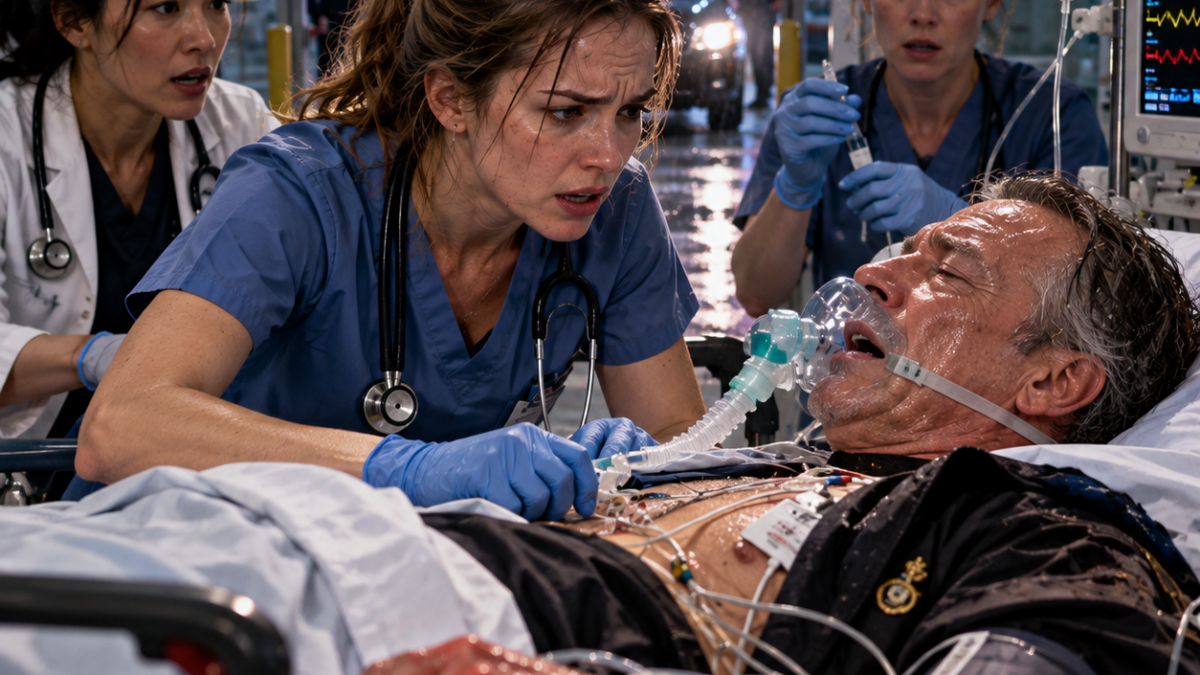
His breathing came in thin, shallow sips. Sweat rolled from his temples despite the chill. His pupils were tiny. His jaw twitched. Saliva gathered at one corner of his mouth.
Dr. Okafor’s expression changed.
“Pinpoint pupils. Diaphoresis. Drooling. Muscle fasciculations.”
“Possible organophosphate exposure,” I said.
“Contact? Inhalation?”
“I don’t know yet.”
I cut open his sleeves.
Both palms were red, shiny, and beginning to blister.
But there was nothing hot in his hands. No chemical container. No powder. No smell of gasoline or industrial cleaner.
Only his chauffeur’s jacket, dark with rain and something faintly sweet beneath it.
I stopped.
The scent was barely there.
A chemical sweetness under wet wool.
Memory moved before thought.
A burned-out vehicle. A wet scarf over my mouth. A warning passed too late.
No.
Not here.
Not now.
Beverly Tran, the charge nurse, dragged the antidote cart toward us.
“Atropine ready,” she said.
“Bag the jacket,” I told the security guard. “Do not touch the inside lining. Gloves only.”
The guard stared.
“Now,” Dr. Okafor said.
He obeyed.
Walter Pike’s hand clamped around my wrist.
His grip was weak, but there was desperation in it.
“The car,” he whispered.
I bent closer.
“What car?”
“Black sedan. East curb.”
“Stay with me, Walter.”
His eyes rolled toward mine.
“I wiped the driver’s door. Couldn’t reach the other.”
My stomach tightened.
“What was on the door?”
His fingers dug into my skin.
“He’ll touch it.”
“Who?”
His lips barely moved.
“Tell Kodiak.”
The room went silent inside me.
Not outside.
Outside, the monitor continued beeping. Beverly opened packaging. Dr. Okafor called for respiratory support. The guard fumbled with the evidence bag.
But inside me, everything stopped.
Kodiak.
A name nobody at Port Caro should know.
A name nobody alive should speak in my presence unless the world had cracked open.
I leaned closer until my ear was nearly against Walter’s mouth.
“Who is Kodiak?”
“Black cap,” he breathed. “Black bag.”
His eyes fluttered shut.
The monitor shrieked.
“He’s seizing,” Dr. Okafor said. “Atropine now.”
Beverly pressed the syringe into my hand.
I pushed it into the IV line, watching Walter’s body jerk against the mattress. His back arched. His jaw clenched. His hands shook beneath the blankets.
“Come on, Walter,” I whispered. “Stay with us.”
The seizure eased.
His breathing remained shallow.
For one terrible second, I stood frozen between two duties.
The patient in front of me was dying.
But a man outside was about to touch the same poison that had put him there.
And that man carried a name from a grave I had spent nine years trying not to visit.
Beverly saw my face.
“Megan?”
“Watch his rhythm.”
“What?”
“I have to go outside.”
Dr. Okafor looked up.
“You cannot leave the patient.”
“I know.”
“Megan.”
I was already stepping back.
“If he crashes, start the protocol. I will answer for leaving.”
Beverly grabbed my sleeve.
“What the hell is going on?”
I looked at her.
Beverly had worked with me for three years. She had covered my breaks, argued with supply management on my behalf, and once sat beside me in the staff lounge after a pediatric code because she understood that silence could be company.
I wanted to explain.
I had no time.
“Do not let anyone take Walter’s belongings,” I said.
Then I ran.
The emergency department blurred past me.
A resident called my name.
A guard shouted.
I hit the sliding doors with my shoulder and burst into the ambulance bay.
Rain slapped my face hard enough to make me blink.
The pavement shone under harsh white lights. Soldiers and sailors waiting near the entrance turned toward me. Two men in dark suits stood beside a polished black sedan at the east curb.
Between them stood a tall man in a black jacket, black cap, and dark glasses.
A heavy duffel hung from his shoulder.
His right hand was reaching for the passenger door handle.
I did not know his face.
I did not need to.
I knew the shape of him.
The way his weight rested evenly over both feet. The way his shoulders appeared loose while every part of him remained ready. The way he stood like a man who expected danger even in ordinary gestures.
The name tore out of me.
“Kodiak, do not touch that door!”
The ambulance bay went still.
The bald man in a black suit raised a hand to his earpiece.
A sailor standing near the entrance stopped mid-step.
The man in the black cap froze with his fingers already on the handle.
Three heartbeats.
That was all.
But poison does not need permission.
He lifted his hand slowly, as if the car had become a live wire.
Then he turned his head toward me.
“Say that again,” he said.
His voice was low and rough.
“The name.”
I stopped three feet from him, chest heaving.
“Do not touch your face. Do not wipe that hand on anything. Walter Pike is inside dying, and he said you would reach for this door.”
The man’s head tilted slightly.
“Walter Pike?”
“Yes.”
The bald man stepped forward.
“Ma’am, step back.”
“I need him inside for decontamination.”
Another suited guard moved to my right.
The bald man caught my arm above the elbow.
His grip was firm and practiced.
Not protective.
Controlling.
“Rusk,” he said.
The second guard grabbed my other arm.
I looked at both of them.
“Let go.”
The bald one leaned close.
“You have no authority here.”
Before I could answer, a smooth voice came from behind us.
“She has a panic disorder.”
I knew that voice.
Neil Garrick, director of security at Port Caro, stepped from beneath the awning in a gray suit that somehow remained almost dry despite the storm. Silver hair combed back. Badge on his lapel. Smile polished and empty.
“I apologize, Commander Prescott,” Garrick said to the man in the black cap. “One of our staff has had a breakdown.”
My pulse struck hard once.
Commander Prescott.
Owen Prescott.
Kodiak.
Alive.
Garrick turned to the guards.
“Dell, take her to the behavioral unit.”
“No,” Prescott said.
The word was quiet.
Everyone heard it.
He removed his sunglasses.
His eyes were gray, tired, and fixed on my face as if he were searching for someone buried under my skin.
“Where did you hear that name, nurse?”
I looked at his right hand.
Two fingertips shone wet under the bay lights.
“From a chauffeur with poison on his palms,” I said, “and from a long time ago.”
Prescott went very still.
“Nobody alive should know it.”
“I know it.”
The silence stretched.
Garrick laughed softly.
“Commander, you are exhausted. This woman is confused.”
Prescott did not look at him.
He turned his right hand palm up and studied the wet shine on his fingertips.
Then he looked back at me.
“How long do I have?”
That snapped me fully into the present.
“Not long enough to argue. Walk with me. Do not run. Keep that hand away from your face, clothes, and bag.”
“Commander,” Garrick said, his tone sharpening, “you are not leaving this curb without your escort.”
Prescott shifted the duffel on his shoulder.
“My escort is the woman who just stopped me from opening a poisoned door.”
He stepped past Garrick as if the man were furniture.
Garrick’s smile thinned.
For the first time, I saw something beneath it.
Not irritation.
Calculation.
He gave the smallest shake of his head.
Dell and Rusk released me, but they followed.
I led Prescott through the sliding doors, past the stunned triage desk, and down the side corridor toward decontamination.
Beverly met us there, breathless.
“Walter’s heart rate is holding,” she said. “Barely. What the hell happened outside?”
“He touched the car.”
Beverly looked at Prescott’s hand and swore under her breath.
“Okay. Him first?”
“Yes.”
She glanced behind us and lowered her voice.
“Megan, security is already calling the administrator about you.”
“Let them call.”
I pushed open the decontamination room door.
“Beverly, saline. Antidote kit. Towels. Fresh gloves. And do not let anyone in.”
Prescott reached toward the heavy duffel strap across his shoulder, then hesitated.
“Do not open that bag,” he said.
I held his eyes.
“I won’t.”
He hung it on a hook by the door slowly, almost against his will.
Like a man leaving a child with a stranger.
Then he stripped off his jacket without touching his contaminated fingers to anything.
I moved his hand beneath running water.
“We irrigate first,” I said. “No scrubbing hard enough to break the skin. Keep breathing.”
“You’ve done this before.”
“Yes.”
“Where?”
I checked his pupils with a penlight.
“Somewhere else.”
His mouth almost smiled.
“That is not an answer.”
“It is tonight.”
Through the thin window in the door, I saw movement in the corridor.
Garrick stood just outside, speaking quietly to Rusk.
I could not hear the words over the water.
But I could read bodies.
Rusk’s shoulders squared.
Garrick’s mouth barely moved.
Then Garrick looked at the decontamination door and away.
Seal the east entrance.
Nobody takes the car.
Nobody takes the bag.
My blood turned cold.
This was not a random attack.
Whoever had coated that door handle had planned for more than one victim.
Walter had discovered it.
Tried to wipe it.
Driven himself to the hospital.
Warned me.
And now Garrick was positioning himself around the evidence.
I looked at Prescott’s hand.
The redness had begun at the fingertips. His breathing remained steady, but a tremor moved through his wrist.
“Any chest tightness?”
“A little.”
“Nausea?”
“Manageable.”
“Sweating?”
“I was standing in the rain.”
“Do not be funny.”
He looked at me.
“You are very calm, nurse.”
“That is my job.”
“No,” he said. “That is a medic’s calm.”
My hands paused for half a second.
Then I kept irrigating.
“I caught it early. You touched the handle for less than a second. Small dose. You will be sore. You may sweat. You will not die.”
He watched me.
“You sound certain.”
“I need you to believe me.”
“Do you believe you?”
I looked at his gray eyes.
“Yes.”
That was mostly true.
I pushed my sleeve up to adjust the tubing.
The scrub cuff slid back.
The light caught my left wrist.
Prescott went rigid.
His eyes dropped to the faded olive bracelet that had lived on my skin for nine years.
Four strands of parachute cord braided flat, tied off with an ugly tight loop at the center. The cord was frayed in places, darkened by sweat, soap, and time. I had tried once to remove it and failed. Not physically. Emotionally.
“Where did you get that?” he whispered.
My fingers stopped completely.
The water kept running.
“I’ve had it a long time.”
“Where?”
I closed my eyes.
Rain struck the window.
In the room behind my eyelids, it was not rain.
It was dirt.
Smoke.
Blood.
A radio crackling.
“A radio man tied it on me,” I said finally, “in a ditch above a place called Ashgrove Pass.”
Prescott stopped breathing.
I made myself continue.
“I was holding your face together at the time.”
The decontamination room seemed to shrink.
The past entered so fully that I could smell it.
Dust and metal.
Blood and sweat.
The chemical burn of explosives in mountain air.
Prescott whispered one word.
“Doc.”
No one had called me that in nine years.
Not once.
The sound opened something I had buried badly.
I had to grip the sink with one hand.
“They told me you died on the helicopter,” he said.
His voice broke.
“They told me the corpsman who saved me was dead. I searched every record the Navy would open. Every file was blank.”
“They were blank because someone made them blank.”
He stared at the bracelet.
“Tobias tied that on you.”
I could not speak.
“Petty Officer Tobias Pike,” Prescott said. “Twenty-four years old. Our radio man.”
The name struck harder than Kodiak had.
Tobias.
Tobias with the too-big grin and the headset always slightly crooked around his neck. Tobias who had called me Doc within twenty minutes of meeting me because, he said, “Ma’am sounds like I work at a bank, and you look like you bite.” Tobias who had tied the bracelet on my wrist with bloody fingers because I was using both hands to keep Owen Prescott alive.
My throat tightened.
“He asked me to keep it closed,” I said. “I never knew why.”
Prescott’s eyes filled.
“Walter Pike is his father.”
My knees nearly gave out.
I saw Walter’s blistered hands.
The way he’d fought to speak.
The way he’d whispered, Tell Kodiak.
“That chauffeur,” I said. “The man in Bed Three.”
“Yes.”
“He came because of Tobias?”
Prescott nodded slowly.
“I wrote to him for two years after I found out Tobias’s father was still asking questions. When I finally got orders to testify, Walter insisted on driving me from the airfield. He said he owed his son one honest ride.”
The room tilted around me.
“And somebody poisoned the door.”
“Somebody who knew the plan.”
“Somebody standing in my hallway.”
Prescott’s eyes changed.
The exhaustion drained out of them.
For the first time, I saw the man the code name had belonged to.
“Kodiak,” I said quietly.
He looked toward the door.
“Garrick.”
“You know him.”
“He was my commander at Ashgrove.”
The name passed through me like ice.
Neil Garrick.
Security director.
Smiling administrator.
The man who had greeted me when I first arrived at Port Caro, praised my quiet professionalism, and told me the hospital valued people who knew how to keep their heads down.
I heard those words differently now.
Prescott continued.
“He came out of that mountain with a medal. Four of my men did not come out at all. I never could prove what happened on the road.”
“What is in the bag?”
“Letters. Tobias’s letters to his father. Mine. Dates. Names. A map I drew from memory.”
“Evidence?”
“Not enough. It was never enough.”
He swallowed hard.
“I came here hoping I would be enough.”
I stared at him.
“And I screamed your name in front of the man who wanted you dead.”
A hard knock rattled the door.
“Nurse Hartley.”
Dell’s voice.
Flat.
Polite.
“Director Garrick has suspended you pending review. Please step out and bring the commander’s property.”
Beverly’s whisper came through the side crack.
“Megan. They have a letter from the administrator. They can take him.”
Prescott looked at me.
His hand had stopped trembling, but his face had gone pale.
He nodded once.
I opened the door.
Garrick stood in the corridor, a folded paper in his hand.
Rusk already had the duffel strap in his fist.
Garrick smiled at me gently.
Almost fondly.
“Hello, Doc.”
The world lost balance beneath my feet.
He had known.
All this time.
He had known who I was.
My fingers curled at my sides.
“You knew.”
“Of course I knew.” His voice remained soft, reasonable. “I read your hiring file the day you applied. A quiet nurse with a blank past and perfect references. Someone had scrubbed that file very carefully.”
“You let me work here for three years.”
“A silent witness is the safest kind.” His eyes dropped briefly to my wrist. “I assumed you didn’t know what you were carrying.”
Prescott lunged toward the duffel, but the poison had slowed his legs.
He stumbled.
“Easy, Commander,” Garrick said. “You’re sick. The hospital will place you in the secure ward until you are medically cleared.”
“For your safety,” Prescott rasped.
Garrick ignored him.
“Take him.”
Two orderlies appeared with a wheelchair.
I had never seen either of them on night shift.
They wore security lanyards, not hospital IDs.
They lifted Prescott between them. He tried to resist, but his body betrayed him.
“Megan,” he said, voice thick. “Walter. Keep Walter alive.”
Then they wheeled him around the corner.
Garrick turned back to me.
“Go home, Nurse Hartley.”
I stood still.
“If you say a word about tonight,” he continued, “I will make sure your license disappears like everything else about you. And Mr. Pike’s care team answers to my approvals, not yours.”
His smile faded.
“Do not mistake survival for leverage.”
He walked away with the duffel.
Beverly caught my arm before I followed.
“Megan.”
“I need to see Walter.”
“You heard him. They’re watching you.”
“Then help me.”
She searched my face.
Beverly was not military. She had never been in a ditch at Ashgrove Pass. She had never heard the name Kodiak or seen a commander poisoned through a car door.
But she knew me.
And sometimes that is enough.
She pulled a plastic key card from her pocket.
“ICU Four. The night supervisor is on break for twenty minutes. Garrick’s men are watching the lobby and east entrance, not the service elevator.”
I took the card.
“Thank you.”
“If this gets me fired, I am haunting you.”
“If this gets us killed, get in line.”
She almost smiled.
“Go.”
I took the service elevator with my heart pounding hard enough to feel it in my throat.
The elevator smelled of bleach and metal. My reflection stared back at me from the scratched doors.
For years, I had kept my hair longer than regulation would have allowed. I wore soft colors outside work. I spoke gently. I avoided military ceremonies and memorial pages. I told myself that Megan Hartley had a right to live even if Doc had died on paper.
But under the hospital lights, with the bracelet tight against my wrist, I could feel both women standing inside me.
One had tried to vanish.
The other had never stopped listening for the radio.
Walter Pike lay in ICU Four with a ventilator hissing beside him. His hands were wrapped in thick gauze. His face looked smaller than before, older, as if the poison had stolen years from him instead of minutes.
Dr. Okafor stood near the monitor, rubbing her eyes.
“He is stable,” she said. “Barely.”
“Thank you.”
“You want to tell me why security is treating my emergency department like a military checkpoint?”
“Not yet.”
She looked at me.
“Megan.”
“I need his belongings.”
“Security took the jacket.”
“The phone?”
She hesitated.
Then she opened a drawer and handed me a small cracked cell phone sealed in a clear patient-property bag.
“Nobody asked for it.”
“Good.”
I thumbed the screen.
No passcode.
Just an old man’s trust.
His messages opened with a swipe.
The last text from an unsaved number had been sent that morning.
Drive the car to the east curb at the scheduled time. Wait for the officer. Say nothing about the bag or the settlement is gone.
Beneath it sat an unsent draft, typed slowly enough that I could almost see Walter’s bandaged thumb pressing each letter.
Doc Hartley. Tobias wrote me your name in his last letter. He said you would know what to do. I found the poison at the curb. I’m so sorry. I tried to wipe it. Please tell Kodiak I tried.
I pressed my hand over my mouth.
Walter had not been bait.
He had found the trap.
He had wiped what he could from the driver’s door, taken the poison into his own skin, and driven himself to the hospital because abandoning Prescott would have meant abandoning his son again.
I looked at him through tears.
“You tried,” I whispered. “God, Walter, you tried.”
The phone buzzed in my hand.
A new message from the same unsaved number appeared on screen.
Roof helipad. Bring the commander.
Beverly’s voice crackled over the unit speaker.
“Megan, the secure ward is empty. Garrick moved him upstairs. They’re taking Prescott to the roof.”
I put the phone in my pocket.
Tightened the old bracelet on my wrist.
And ran.
The stairwell was colder than the rest of the hospital. My shoes slapped the concrete. The metal rail was slick beneath my palm. I took the steps two at a time, lungs burning, the past climbing with me.
Ashgrove Pass returned in pieces.
Not as a memory.
As weather inside my body.
Cold rock beneath my knees. A blood-slick radio. Tobias lying on his side with one hand pressed to his own stomach and the other still reaching for the handset.
“Doc,” he’d gasped.
“I’m here.”
“Keep the line open.”
“Save your breath.”
He had laughed once. Even dying, Tobias Pike had laughed.
“Never been good at that.”
He wore a bracelet then. Olive paracord, braided flat, tied with an ugly little knot at the center. I remembered noticing it because his hands were shaking as he worked it loose.
I had been holding gauze against Prescott’s cheek, trying to keep pressure while blood ran between my fingers.
Tobias tied the bracelet around my wrist with clumsy urgency.
“Keep it closed,” he said.
“Tobias, what is this?”
“Somebody good will find you.”
Then gunfire cracked above us, and the world split apart.
I shoved through the rooftop fire door.
Wind hit me hard.
The roof of Port Caro spread wide and wet beneath floodlights. A faded yellow helipad circle glistened under the rain. At the far edge sat a dark helicopter, rotors still, lights low.
Garrick stood near the circle with his hands in his pockets.
Dell and Rusk flanked him.
Between them, Owen Prescott sat slumped in a wheelchair, sweating, a blanket over his knees. The duffel lay open at Garrick’s feet.
Letters spilled from it.
A folded map.
A battered notebook.
Garrick turned.
“Nurse Hartley. I expected you.”
“Let him go.”
“I will, as soon as I have what I came for.”
He nudged the bag with one polished shoe.
“I’m disappointed, Commander. Personal letters. Old grief. A hand-drawn map with no admissible corroboration. Nothing about the road. Nothing about the radio. Nothing about the order.”
Prescott lifted his head.
His face was gray, but his voice remained steady.
“I told you. I never had it.”
“Do not insult me.”
“I never had it,” Prescott said again. “Tobias did.”
Garrick went still.
Prescott’s eyes found mine across the rain.
“Tobias recorded your voice that morning. Every word. The radio traffic you ordered us to ignore. The order to take the north road.”
Garrick’s smile thinned.
“Where is it?”
“Tobias told me on his last transmission he hid the proof where nobody would search.”
The roof seemed to tilt beneath me.
Prescott’s gaze dropped to my wrist.
“He said, ‘Doc has it tied in the knot.'”
My heart stopped.
The bracelet.
The ugly little loop.
The one Tobias told me to keep closed.
Nine years of showers, shifts, sleep, loneliness, and silence. Nine years of refusing to cut it off because I did not know whether removing it would be betrayal or relief.
I stared down at it as if seeing it for the first time.
Garrick began to laugh.
Softly.
With real delight.
“After all these years,” he said. “On the wrist of the nurse I hired myself.”
He stepped toward me.
“Hand it over, Doc.”
“No.”
His expression cooled.
“Dell. Rusk.”
The two guards moved.
I backed away, hands raised, heels touching the edge of the painted circle.
“You cannot shoot a nurse on a hospital roof.”
“I do not need to.” Garrick held out his palm. “Walter Pike is on a ventilator that answers to my approvals. Commander Prescott is a sick man who may have a terrible reaction while in my care. I can end this slowly, and no one will ever ask why.”
He took another step.
“Or you can give me the knot, and they both live.”
Prescott shook his head slightly.
“Do not.”
I looked at Garrick.
For nine years, I had believed silence was the price of survival.
I had allowed official blankness to erase Doc so Megan could live. I had accepted that no one would ever know why Tobias died, why Prescott vanished into classified recovery, why four men did not come down from that mountain.
But Walter Pike had not stayed silent.
He had driven through poison.
Prescott had not stayed silent.
He had carried letters across years.
Tobias had not stayed silent.
He had hidden his last truth on my wrist.
And I had mistaken a promise for a wound.
Behind Garrick, I heard something faint.
Footsteps in the stairwell.
Not one person.
Several.
Heavy.
Measured.
Garrick heard them too.
His hand lowered.
The fire door opened.
A woman in a Navy captain’s dress blues stepped onto the roof, rain beading across her cap. She was flanked by four uniformed officers.
Iron-gray hair.
Face carved from patience and command.
“Neil Garrick,” she said. “Naval Inspector General.”
Garrick’s smile slipped for the first time.
Captain Enz Calder walked forward slowly.
“And I would very much like to hear what you were saying about a radio.”
No one on the roof breathed.
Garrick recovered quickly.
“Captain Calder. This is a medical matter. Nurse Hartley has been unstable all night.”
“Beverly Tran called my aide,” Calder said. “Commander Prescott’s car never arrived at the airfield. Walter Pike was admitted with contact poisoning. Your security team sealed evidence without medical authorization.”
Her eyes moved to me.
“And the commander’s last letter named a surviving medic from Ashgrove Pass.”
My throat tightened.
“Nurse Hartley,” she said, “if you are carrying what Commander Prescott believes you are carrying, I need you to hand it to me in front of these witnesses.”
I looked down at the bracelet.
My thumbnail dug beneath the ugly loop.
The cord resisted.
For a terrifying second, I thought time had fused it shut forever.
Then it gave way with a faint tearing sound.
The braid loosened.
Inside the flat center, wrapped in a thin scrap of plastic darkened by years of sweat and soap, lay a memory card no bigger than a fingernail.
Garrick lunged.
Prescott moved faster than anyone expected a poisoned man to move.
Half-drugged, furious, and still dangerous, he swung the blanket across Rusk’s knees.
Rusk tripped.
Dell froze.
Calder’s officers surged forward.
The roof exploded into shouting, skidding boots, rain, and bodies.
I ran.
Not away.
Toward the service door.
Because evidence hidden is not the same as evidence heard.
Beverly was waiting inside with a laptop and card reader, white as paper.
“I only had five minutes,” she gasped. “The nurse’s station terminal is tied into the PA if we route it through the training broadcast.”
I nearly laughed.
“You’re terrifying.”
“I know. Plug it in.”
My hands shook as I slid the card into the reader.
For once, they did not steady immediately.
Beverly placed her hand over mine.
“Megan.”
I looked at her.
“Move anyway,” she said.
I breathed once.
Then pressed play.
Static cracked through the hospital speakers.
Every floor.
Every corridor.
Every patient room.
Every nurses’ station.
Every office where someone believed the night still belonged to them.
A young voice came first, ragged with pain and interference.
“Tobias Pike, Kodiak Actual, this is Relay. Command is ordering us onto the north road. It is not clear. I repeat, it is not clear.”
My knees weakened.
Tobias.
Then a second voice.
Cool.
Controlled.
Unmistakable.
“Relay, this is Command. The north road is clear. You will move now. That is a direct order.”
A pause.
Gunfire in the distance.
Tobias again, lower now.
“Command, they are waiting for us up there. Somebody told them our route.”
My hands covered my mouth.
The recording crackled, broke, returned.
Then Tobias’s voice came one final time, so quiet the hospital seemed to lean closer to hear it.
“Doc, if you can hear me, I’m putting this in the knot. Keep it closed until somebody good finds you.”
The recording ended.
The silence after it was bigger than the storm.
On the roof, Neil Garrick stood under floodlights with two of Calder’s officers holding his arms.
His smile was gone.
“That is not my voice,” he said.
Captain Calder looked almost sad.
“Director,” she said, “I would call that evidence.”
She nodded.
The cuffs closed around his wrists.
Dell stepped aside without a word.
Rusk stayed on the ground, staring at nothing.
Garrick did not look at me as they led him past.
I was glad.
I did not know what I would have done if he had.
Hours later, dawn bled gray across the harbor.
Walter Pike woke in ICU Four.
The ventilator was gone. His voice was a thread, but his eyes were clear.
I sat beside his bed, holding his bandaged hand carefully between mine.
The skin beneath the dressings would need time. Maybe grafting. Maybe months of pain. But he was alive.
His first words were barely audible.
“Did he touch it?”
“He touched it,” I said.
His face crumpled.
“But he is alive. You saved him, Walter.”
His eyes closed.
“I tried.”
“I know. You wiped the driver’s door. You got yourself here. You told me the name.”
A tear slid into his gray hair.
“My boy?”
I leaned closer.
“Tobias kept the line open.”
Walter’s lips trembled.
“He always did.”
“He was not alone,” I said. “I was with him in the ditch. He was brave to the end, and he thought of you. He thought of all of us.”
Walter turned his bandaged hand slightly, just enough to touch my fingers.
“He wrote me your name,” he whispered. “Said if the world ever went dark, Doc would know what to do.”
I could not speak for a moment.
In the doorway, Owen Prescott stood leaning on a cane.
Pale.
Upright.
Alive.
He did not come into the room at first.
He simply lifted his hand in a slow salute toward Walter Pike.
The old man saw it and began to cry.
Prescott lowered his hand and looked at me.
“Doc.”
I looked down at my bare wrist.
For nine years, the bracelet had been part of my body. Without it, my skin looked strangely naked. Lighter where the cord had shielded it from sun, soap, and life.
“I don’t know who I am without it,” I admitted.
Prescott’s expression softened.
“You’re the one who carried it long enough.”
Captain Calder entered quietly behind him.
“The investigation will move quickly now,” she said. “Garrick’s communications are being seized. His prior command records are being reopened. The deaths at Ashgrove Pass will finally be reviewed with full evidence.”
Walter closed his eyes.
“Thank God.”
Calder turned to me.
“Nurse Hartley, your sealed record will remain protected unless you choose otherwise. But you are no longer alone inside it.”
That sentence nearly undid me.
You are no longer alone inside it.
For years, silence had felt like punishment.
A hospital badge over a grave.
A civilian name covering the place where Doc had been.
But silence had also kept the evidence safe until the right people finally arrived.
Some silences are not empty.
Some are waiting.
Later that morning, I stepped outside the hospital.
The storm had moved out over the water, leaving the streets wet and shining under a pale sun. The black sedan was gone, wrapped in evidence tape and towed under military guard. The east curb where Walter had collapsed was washed clean by rain.
Beverly stood beside me with two cups of coffee.
“I brought you the terrible one,” she said.
“My favorite.”
She handed it over.
For a few minutes, we watched the harbor.
Then she said, “So. Doc?”
I gave her a tired look.
“Don’t start.”
“I am absolutely starting.”
“Beverly.”
“You saved a commander, exposed a security director, carried evidence in jewelry for nine years, and somehow still charted Walter’s vitals more neatly than anyone else on shift. I’m allowed one question.”
I sighed.
“One.”
“Are you okay?”
That was not the question I expected.
It was also the only one that mattered.
I looked toward the water.
“No.”
She nodded.
“But maybe I will be.”
“Good.”
She sipped her coffee and grimaced.
“This really is terrible.”
“I told you.”
Inside, Walter slept.
Prescott gave his statement.
Captain Calder began opening doors that had stayed locked for nearly a decade.
And somewhere in the evidence system, Tobias Pike’s voice existed outside the knot at last.
I returned to work the next night.
People looked at me differently.
Of course they did.
Some with curiosity.
Some with guilt.
Some with respect they should have offered when I was only Megan, not Doc, not a ghost from Ashgrove, not a person tied to a scandal moving through military channels faster than anyone could control.
I wore the same blue scrubs.
My ponytail still came loose by midnight.
My badge still read Megan Hartley.
But my wrist was bare.
A young corpsman noticed while I was checking supplies.
“Did you lose something?” he asked.
I looked at the pale band around my skin.
“No,” I said. “I delivered it.”
Near dawn, I walked into ICU Four.
Walter was awake.
Prescott sat in a chair beside him, arguing quietly about baseball with the old man as though the world had not nearly ended between them.
When I entered, both men stopped.
Walter smiled weakly.
“Morning, Doc.”
I thought the name would hurt.
It did.
But not the way it had before.
Some pain is only a wound reopening.
Other pain is feeling returning to something you thought had died.
“Morning, Walter.”
Prescott held out a folded piece of paper.
“What is that?”
“A copy of Tobias’s last official letter to his father. Calder cleared Walter to have it.”
Walter looked at the ceiling, blinking hard.
“He mentions you,” Prescott said.
“I don’t know if I can read it.”
“You don’t have to.”
Walter lifted one bandaged hand.
“Read it.”
Prescott unfolded the paper carefully.
His voice was rough when he began.
The letter was simple.
Tobias wrote about the cold. About the mountains. About missing home. About how his father would hate the coffee and love the view. Near the end, he wrote one line that made my breath stop.
If anything ever happens and a medic named Doc Hartley comes to you, trust her. She listens even when the world is too loud.
Prescott lowered the paper.
Walter wept silently.
So did I.
Not because the past had been fixed.
It had not.
Four men were still gone.
Tobias was still gone.
Nine years had still been stolen by a man who wore authority like clean clothing over rot.
But truth had surfaced.
And sometimes justice begins not as thunder, not as punishment, not as a perfect restoration of what was lost.
Sometimes it begins as a dead man’s voice finally being heard in the halls of the living.
Weeks later, the official review of Ashgrove Pass reopened.
Neil Garrick’s command decisions were stripped of their polished language and examined under light. The north road order. The ignored warning. The suspicious route leak. The medals built on missing pieces.
Other people came forward.
Not at first.
At first, they were afraid.
Then one former analyst submitted a memo she had kept hidden for years. A retired logistics officer remembered a change order no one had allowed him to question. A helicopter crew chief produced a maintenance log that contradicted Garrick’s original timeline.
Truth, once given air, has a way of finding other buried things.
Walter recovered slowly.
His hands would never be the same, but he learned to hold a coffee cup again.
Prescott visited him every Thursday.
Sometimes they spoke about Tobias.
Sometimes they watched baseball.
Sometimes they sat in silence, which I understood better than most.
As for me, I stayed at Port Caro.
Captain Calder asked once whether I wanted my military medical record fully restored.
“You earned that recognition,” she said.
“I know.”
“Then why hesitate?”
I looked at my hands.
“Because I don’t want to spend the rest of my life proving Doc existed.”
Calder considered that.
“What do you want?”
“I want to be Megan Hartley. Nurse. Night shift. Emergency department.”
“And Doc?”
I looked toward the trauma bay, where a frightened young sailor was laughing because Beverly had just told him his sprained ankle did not require a farewell letter to his mother.
“Doc is still here when I need her.”
Calder nodded.
“That may be the healthiest answer I’ve heard all month.”
The hospital changed after that night.
Not completely.
No place changes completely because of one story.
But enough.
Security no longer moved like a private kingdom. Beverly became charge nurse permanently. Dr. Okafor started a training session on chemical exposure response and insisted I teach the first practical module. I hated standing in front of people, but I did it anyway.
When a new nurse froze during a code, nobody laughed.
We trained her.
When a patient’s family member insisted something was wrong, we listened before defending our routines.
When someone said, “I’ve never heard that name before,” people at Port Caro learned to ask why before dismissing it.
And every so often, when rain struck the ambulance bay hard enough to make the pavement shine like black glass, I would hear my own voice again.
Kodiak, do not touch that door.
The scream that saved a life.
The scream that broke a silence.
The scream that brought Tobias Pike home.
One night, months later, Walter returned to Port Caro not as a patient but as a visitor.
His hands were still wrapped lightly, healing beneath thin gloves. Prescott drove him. He insisted on that, claiming Walter was a terrible passenger, which Walter answered by calling him a reckless driver with government credentials.
They found me near the east entrance.
Walter held out something small.
A new bracelet.
Olive paracord.
Four strands braided flat.
No hidden card inside.
No ugly loop.
Just a clean knot.
“I know the old one had to go,” Walter said. “But Tobias would want you to have something that wasn’t only evidence.”
I took it carefully.
My throat tightened.
“I don’t know what to say.”
Walter smiled.
“Good. Then don’t say anything.”
Prescott tied it around my wrist.
His fingers were steady now.
When he finished, he stepped back.
No one spoke for a while.
Rain tapped softly against the glass doors.
Finally, Walter said, “He called you the one who listens.”
I looked at the bracelet.
Then at the ambulance bay.
Then at the people moving inside the emergency department under bright lights, each carrying some private terror, some private hope, some story we might never know unless we paid attention.
“He was right,” I said.
That became my promise.
Not silence anymore.
Listening.
There is a difference.
Silence can be fear. Silence can be survival. Silence can be a locked room where grief teaches you to breathe quietly so no one asks questions.
But listening is active.
Listening reaches for the faint warning beneath the storm.
Listening hears a dying man whisper a name that should not exist.
Listening believes an old chauffeur, a poisoned hand, a broken commander, and a radio man’s last wish.
Listening keeps the line open.
I still work nights.
I still wear blue scrubs.
My ponytail still fails halfway through every shift.
Most patients know nothing about Ashgrove Pass, Kodiak, Tobias Pike, Neil Garrick, or the evidence carried for nine years in a knot on my wrist.
That is all right.
They do not need my ghosts.
They need my hands.
They need me to notice the medication allergy. The tremor. The wrong chart. The quiet spouse who knows something is worse than the monitor says. The old man who says one word that makes no sense until someone cares enough to ask another question.
I spent nine years thinking my silence was punishment.
I was wrong.
It was a promise waiting for the right voice.
And when that voice finally came through poisoned breath and rain, I answered.
Not because I was brave.
Not because I was ready.
But because somewhere inside me, Doc had never stopped listening.
And some lines, once opened, must be kept open until every lost voice finds its way home.