𝗙𝗨𝗟𝗟 𝗦𝗧𝗢𝗥𝗬 The Man Behind My House Spoke Like My Land Had Already Chosen Him
𝗙𝗨𝗟𝗟 𝗦𝗧𝗢𝗥𝗬
He reached toward a plastic folder lying on top of a crate.
My body tensed before I realized what he was reaching for.
He noticed.
For the first time, something like amusement crossed his face.
“Relax,” he said. “I’m getting my documents.”
He pulled out a stack of papers, some folded, some printed, some with stamps or symbols I did not recognize.
He held them up but did not hand them to me.
“These prove my claim.”
“What claim?”
“My claim to this land.”
“You cannot claim my land.”
“I already did.”
“No, you didn’t.”
His face reddened.
“You people always think you can just say no and that settles it.”
I could feel my pulse in my throat.
“I am saying no because this is my property.”
“This is an independent state now.”
I almost did not understand him.
“What?”
“This land is no longer under your false jurisdiction.”
The words came out rehearsed.
“This is my home. My sovereign place. You don’t have authority here.”
I looked at the house behind me.
My house.
The porch where I drank coffee.
The lavender I had planted.
The stones I had dug from the grass.
Everything I had worked for and waited for and finally allowed myself to love.
And then I looked at the stranger standing in my yard, claiming it with a hammer in his hand.
Fear came first.
Then anger.
Not loud anger. Not the kind that makes you shout.
A deep, quiet anger that made me feel strangely still.
“You are not living in my backyard,” I said.
He stepped toward me.
Only one step.
But with the hammer still in his hand, it was enough.
“I wouldn’t advise you to get bossy with me.”
My instincts told me to move back, but pride told me not to.
Instinct won.
I took one small step away.
He smiled.
That smile made my skin crawl.
I tried to keep my voice calm.
“Can I see those papers?”
“You can see them from there.”
“I need to understand what you think gives you the right to be here.”
“I don’t need you to understand.”
“If you believe they’re valid, then let me make a copy.”
His expression hardened.
“What do you need a copy for?”
“I’d like to show them to the authorities.”
The word authorities changed him.
His face twisted.
“No.”
His voice grew louder.
“No, you don’t get to take them. You’ll lose them. Or you’ll pay somebody to lie and say they aren’t real.”
“I only want—”
“No,” he snapped. “People like you are always looking down on us. Treating us like we’re stupid. Like we’re trash.”
“I didn’t say that.”
“You didn’t have to.”
He shook the papers in his hand.
“I’m a poor man, but I’m finally going to have something that belongs to me.”
The words struck something complicated in me.
For one second, beneath the fear and outrage, I saw a desperate man.
Not harmless.
Not right.
But desperate.
A man who had convinced himself that the world had cheated him so completely that he was entitled to take from someone else and call it justice.
“I’m sorry you’re struggling,” I said carefully. “But you can’t fix that by taking my land.”
“It was never yours.”
“It is mine.”
“No,” he said. “It was claimed by fraud. All government land is fraud.”
I realized then that I was not going to reason him out of this.
He did not see me as a person.
He saw me as part of the system he hated.
The deed, the survey, the sale, the money I had saved, the work I had done, none of it mattered to him because accepting any of it would destroy the fantasy that allowed him to stand there.
I thought about my doors.
My windows.
The long darkness that fell out here at night.
I thought about sleeping in the house with this man camping yards away.
I thought about waking to the sound of him walking near the porch.
I thought about him watching me.
Waiting.
Building.
Claiming.
No.
Absolutely not.
“I’m asking you one more time,” I said. “Please leave.”
“This is an independent state,” he said. “It will be my home.”
“It will not.”
“That’s too bad for you.”
His hand tightened around the hammer.
That was when my anger gave way to something more practical.
I could not physically remove him. I could not safely take his tools. I could not stand there arguing until he decided the hammer was useful for something besides wood.
So I backed away.
Slowly.
I tried not to make it look like retreat, though it was.
“I’m going to get help,” I said.
“Run to your fake authorities,” he shouted after me. “They have no jurisdiction here.”
I did not answer.
I walked around the side of the house with my shoulders stiff and my hands trembling.
Only when I got into my car and locked the doors did I let myself breathe.
For a moment, I sat there gripping the steering wheel.
I could see part of the cabin frame in the side mirror.
It looked impossible.
A stranger had moved into my life while I was away.
A man with a hammer, a campfire, and papers claiming my backyard as his own.
I called the police station first, then decided I did not want to sit alone in the driveway waiting.
The dispatcher told me I could come in and speak to an officer if I felt unsafe.
I started the car.
As I drove, I kept checking the rearview mirror, half-expecting him to appear behind me on the road.
He did not.
The police station sat in a small town center that suddenly felt very far from the quiet dream I had bought. I parked crookedly, corrected the car, then sat for a second trying to collect myself.
Inside, the desk officer looked up.
“Can I help you?”
“I need to speak to someone,” I said. “There’s a man on my property.”
He straightened slightly.
“What kind of man?”
“A stranger. He’s building a cabin in my backyard.”
The officer paused.
“He’s what?”
“He says he’s a sovereign citizen. He says my land is an independent state now.”
The officer’s expression changed.
Not shock, exactly.
Recognition.
That frightened me more than shock would have.
“I don’t know how dangerous he is,” I added quickly. “He had a hammer. He got angry when I asked him to leave. I live alone.”
“Ma’am, take a breath,” the officer said.
I tried.
It came out shaky.
“Is he there right now?”
“Yes.”
“Did he threaten you directly?”
“He told me I shouldn’t get bossy with him. He refused to leave. He said the police have no authority.”
The officer nodded slowly.
“Do you have documentation showing ownership of the property?”
“Yes. Deed, survey, everything. But I don’t have it with me.”
“That’s all right. We can sort that out.”
Another officer came over after hearing part of the conversation. The desk officer explained the situation in a low voice. They exchanged a look.
I hated that look.
It was the look professionals give each other when the situation is not new, but also not simple.
One of the officers turned to me.
“We’ve dealt with people like this before.”
“So he can’t really live on my land?”
“No, ma’am.”
The relief was immediate, but incomplete.
“Then why would my address be on his papers?” I asked. “He had documents. They looked like they were claiming the property.”
“Those documents don’t give him legal ownership,” the officer said. “Sometimes people make them. Sometimes someone else sells or gives them paperwork that sounds official but has no legal force. Either way, private property doesn’t become theirs because they declare it.”
“He said this is an independent state now.”
“That’s not how land ownership works.”
I pressed my palms together because my fingers would not stop shaking.
“He was so sure.”
“They often are.”
Something about that sentence made my stomach sink.
“How dangerous is he?”
The officer’s face softened a little.
“We won’t know until we speak with him. That’s why you’re not going to approach him again. We’ll go out there. You can follow us back to your property, but you’ll stay in your car across the road. Do not get out unless we tell you to.”
I nodded.
“I mean it,” he said. “If he’s unstable or becomes aggressive, we don’t want you nearby.”
“I understand.”
“We’ll take another officer with us and have backup available if we need it.”
I wanted to feel reassured.
Part of me did.
But another part of me felt strangely guilty.
I know that sounds irrational.
The man had invaded my property. He had frightened me. He had refused to leave.
Still, as I followed the police car back toward my house, guilt twisted through my fear.
What if he was mentally ill?
What if he had nowhere else to go?
What if this escalated because I could not find some better, kinder way to solve it?
Then I pictured the hammer in his hand.
I pictured the cabin frame.
I pictured myself trying to sleep in that house while he sat beside a fire in my backyard, convinced the land was his and that I was the intruder.
Compassion did not require me to surrender my safety.
I repeated that to myself all the way home.
Compassion did not require me to surrender my safety.
When we reached my property, I parked where the officers told me to, across the road and slightly down from the driveway.
From there, I could see the house and part of the backyard through the gap beside it.
The officers got out.
There were two of them at first. Another patrol vehicle arrived moments later and stopped nearby.
One officer walked over to my car.
“Stay here,” he said.
“I will.”
“If anything changes, lock your doors and call dispatch.”
My doors were already locked.
He nodded and went with the others around the house.
I watched them disappear.
Waiting was awful.
I could see smoke rising behind the house again.
The smell of cooking fish drifted faintly even across the road, and for some reason that made me angrier than almost anything else.
He was not hiding.
He was not ashamed.
He had built a fire and cooked food on my land as if he had every right to settle in.
I imagined him sitting there while I was away, maybe laughing at the empty house, maybe telling himself that possession was all that mattered.
My hands gripped the steering wheel.
A minute passed.
Then another.
I could hear voices, but not clearly at first.
Then one voice rose.
His.
“I’m a sovereign citizen!”
The words carried across the yard.
One of the officers responded, calm and firm.
“Sir, you cannot be here. This is private property. We need you to dismantle your structure, gather your belongings, and leave.”
“I have every right to be here.”
“No, sir. You don’t.”
“I’m not under your jurisdiction.”
“You are trespassing.”
“This is independent land.”
I closed my eyes for a second.
He was saying the same things to them.
The exact same things.
Part of me had hoped that the presence of uniformed officers would shake his certainty. That he would realize the situation had become serious and simply pack up.
Instead, he dug in deeper.
The officer continued speaking.
“There are shelters and assistance programs if you need help. We can provide information. But you cannot live on someone else’s property.”
“I don’t want a shelter,” the man shouted. “This is my place.”
“It isn’t.”
“You government men always take from hardworking people.”
“Sir, no one is taking anything from you. We are telling you that you are on private land and you need to leave.”
“You have no authority here.”
The officers remained controlled.
I admired that.
It is one thing to imagine police work as dramatic confrontations and sudden action. It is another to watch officers patiently repeat reality to someone who refuses to live inside it.
They gave him chances.
More than I expected.
They told him he could pack up and leave. They told him he did not need to make the situation worse. They told him the paperwork he had did not grant him any rights to the land.
I could not see every movement from where I sat, but I saw him pull out the documents again.
He waved them like a shield.
The officers looked at them from a distance.
One said, “Sir, whether you made those yourself or someone gave them to you, they are not valid legal documents.”
“They are valid,” he shouted.
“They do not override the property deed.”
“The deed is fraud.”
“It is not.”
“You have no authority.”
“We do.”
“No, you don’t.”
The repetition became chilling.
It was like watching someone throw himself against a wall he insisted was not there.
The wall did not move.
But he kept insisting.
Then his voice changed.
Until then, he had been angry.
Now there was something sharper in it.
“I will not be chased off my land again.”
The word again caught me.
Again?
Had this happened before?
Had he tried to claim somewhere else? Had someone else removed him? Was this a pattern? Or was it part of his story, something real mixed with something distorted?
“I’m not leaving,” he shouted. “Prepare to fight if you won’t leave me be.”
My stomach clenched.
One of the officers raised his voice.
“Sir, this is your last warning. If you do not comply with lawful commands, you will be arrested.”
“You have no authority!”
“Put down what’s in your hand.”
For the first time, I realized I could not see the hammer.
I leaned forward, heart pounding.
“Put it down,” the officer repeated.
The man shouted something I could not understand.
Then everything happened fast.
He moved.
One officer stepped in.
Another shifted around him.
I saw the man’s arm swing, not clearly enough to know whether he threw something or tried to push past them, but the officers reacted immediately.
They took him to the ground.
I heard yelling.
His voice.
The officers’ commands.
“Stop resisting.”
“Hands behind your back.”
“Do not reach.”
My breath stopped.
For a few seconds, all I could see was movement in the grass near the half-built cabin.
Then they had him.
Handcuffed.
Angry.
Still shouting.
Still insisting.
“I do not consent!”
“You have no jurisdiction!”
“This is unlawful!”
They brought him around the side of the house toward the patrol car.
He looked different now.
Smaller, somehow, though physically he had not changed.
Without the hammer in his hand, without the illusion that his papers made him untouchable, he looked like a furious man who had built his entire defense out of words that could not protect him.
As they guided him past my parked car, his head turned.
For one second, his eyes met mine through the windshield.
I expected rage.
There was rage there, yes.
But beneath it, I saw betrayal.
As if I had taken something from him.
As if I were the trespasser.
As if calling the police on a stranger building a cabin in my backyard had been an act of cruelty rather than survival.
He shouted something at me, but the glass and distance swallowed most of it.
I caught only a few words.
“You’ll answer for this.”
Then they put him in the back of the patrol car.
I sat completely still.
My body had been tense for so long that I did not know how to release it.
One of the officers walked back toward my car.
I lowered the window.
“You okay, ma’am?”
I nodded, though I was not sure it was true.
“He’s in custody,” the officer said. “You did the right thing calling us.”
“I hoped he would just leave.”
“We did too.”
“What happens now?”
“He’ll be taken in. Likely trespassing, disorderly conduct, resisting. We’ll sort out the exact charges.”
I looked toward my yard.
The cabin frame stood there like an insult.
“What about all of that?”
“We’re going to call someone from the city to help remove the belongings and dismantle the structure. We’ll also put out the fire. We don’t want anything spreading.”
The fire.
I had almost forgotten it in the chaos.
“Thank you,” I said.
My voice broke on the words.
The officer’s expression softened.
“I know this was upsetting.”
“I feel like I should have done something sooner.”
“You called as soon as you found him.”
“I was gone. He must have been here for days.”
“That’s not your fault.”
I looked at him.
“What if he comes back?”
“He’ll be warned not to. If he does, call immediately.”
“But what if he believes all this? Truly believes it?”
The officer glanced toward the patrol car.
“Then he may keep making bad decisions. But that doesn’t give him the right to occupy your property.”
That sentence stayed with me.
It sounded simple.
It was simple.
But after the surreal madness of the afternoon, I needed simple.
The man’s beliefs did not give him the right to make me unsafe.
His desperation did not make my home available.
His papers did not erase my deed.
His need did not outweigh my right to live without a stranger building walls behind my house.
The officers put out the fire.
More people came later to remove what he had dragged onto the property. Boards. Tarps. Tools. A folding chair. The camp stove. Bags of supplies. Random belongings bundled into containers.
Watching them dismantle the cabin frame was strangely emotional.
It had not even been finished, yet seeing it taken apart felt like watching an invasion being undone piece by piece.
A board lifted from the frame.
A nail pulled free.
A tarp folded.
The shape of the thing disappeared slowly, and with it, some of the pressure in my chest.
By evening, the backyard looked wounded but recognizable.
There were flattened patches in the grass, burn marks from the fire, and scattered sawdust where he had worked.
But the structure was gone.
He was gone.
I walked the property after everyone left.
The house stood quiet behind me.
The sky had deepened to purple at the edges.
Crickets started up in the grass as if nothing extraordinary had happened.
I stopped where the cabin had been.
For a while, I just stood there.
This was the place where I had imagined a small fire pit.
Maybe a garden bench.
Maybe a row of berry bushes.
He had looked at the same patch of land and seen something else entirely.
A place to claim.
A place to conquer.
A place where his belief could become shelter if only he hammered enough boards together.
I wondered where he had come from.
I wondered if anyone loved him.
I wondered whether someone had sold him those ideas, fed him words like freedom and sovereignty until they became weapons he used against strangers.
Then I wondered why I was trying so hard to understand a man who had made me afraid in my own home.
Maybe because understanding feels safer than not understanding.
Maybe because random danger is harder to live with.
If I could make his actions make sense, then perhaps I could put them in a box and close it.
But people are not always boxes.
Sometimes they are storms.
And sometimes the best you can do is lock the door before the storm reaches the porch.
That night, I barely slept.
Every sound became something.
A branch brushing the siding.
The refrigerator settling.
An animal moving outside.
I got up three times to check the locks.
At two in the morning, I stood in the kitchen holding a glass of water, staring toward the back window.
The darkness beyond it felt different now.
Before, the dark had been peaceful.
That night, it felt occupied by memory.
I hated him for that.
Not dramatically.
Not forever.
But in that moment, I hated him for taking the first true home I had ever owned and making it feel uncertain.
The next day, I ordered an alarm system.
I also started looking at dogs.
I had resisted the idea before because I did not want fear to dictate my life. But after seeing a stranger build a cabin in my yard, I no longer thought of security as paranoia.
Security was not fear.
Security was a boundary.
And I had learned exactly what could happen when a person decided boundaries did not apply to him.
Over the next few weeks, life slowly returned to its routine.
I worked.
I made coffee.
I sat on the porch again, though at first I found myself looking over my shoulder more than watching the trees.
I repaired the damaged patch of yard where the cabin had been. I raked the sawdust out of the grass. I filled shallow holes. I cleaned the blackened circle left by the fire.
Each small repair felt like taking my property back.
Still, I was not the same.
I no longer romanticized isolation in quite the same way.
When friends asked how I was, I told them I was fine because I did not want to retell the story endlessly. But fine was not exactly true.
I was functioning.
I was grateful.
I was safe.
But sometimes, while working at my kitchen table, I would remember the sound of his voice saying, “It is my home now,” and anger would rise through me all over again.
There is something uniquely violating about someone trying to rewrite your life while standing inside it.
Burglary would have been frightening.
Vandalism would have been upsetting.
But this was different.
He had not just stolen something or damaged something.
He had declared that my ownership, my work, my choices, my legal rights, and my sense of home were all illusions.
He had tried to make me the outsider on land I had paid for.
That was what stayed with me.
The court process unfolded from a distance.
I was contacted when necessary. I gave statements. I provided documents. I confirmed that I had never given the man permission to be on the property.
I learned his name, though I rarely used it in my mind.
Somehow, naming him made him feel too ordinary.
He was not a monster. That would have been easier.
He was a man.
A man with beliefs that had hardened into something dangerous.
A man who had decided that wanting land and claiming land were the same thing.
A man who had mistaken refusal for oppression and consequences for persecution.
When he appeared before a judge, he did not back down.
That was what I was told.
He argued that the court had no jurisdiction.
He insisted that his documents were valid.
He claimed he was not subject to ordinary law.
He refused to accept the basic premise that he had trespassed on someone else’s property.
Part of me had hoped that arrest would puncture the illusion.
That a night in custody, a conversation with a public defender, or the simple reality of handcuffs would force him to reconsider.
It did not.
His belief did not bend when reality pressed against it.
It only became louder.
Eventually, the court determined that he remained a risk.
The charges included trespassing, disorderly conduct, and resisting arrest, but the deeper issue was his refusal to accept that he could not simply occupy private property because he had declared himself free from the rules everyone else lived under.
He was jailed.
When I heard that, I did not feel the satisfaction I expected.
I felt tired.
I felt relieved.
I felt sad in a distant, complicated way.
Not sad that consequences had found him.
They needed to.
But sad that a person could walk himself so far into a false world that jail became the only place left for the real one to stop him.
I hoped he would get help.
I truly did.
Not because he deserved my property.
Not because what he did was harmless.
But because I could not imagine that a healthy, stable person would choose to stand in a stranger’s yard with a hammer, wave fraudulent papers, and prepare to fight police over land that was never his.
Something in him had gone wrong.
Maybe long before he found my address.
Maybe long before he started building that cabin.
I hoped someone, somewhere, could reach whatever part of him still understood that other people were real.
But I also knew that hope did not obligate me to become his victim.
That was the lesson I kept returning to.
You can feel compassion and still call the police.
You can recognize someone’s pain and still protect yourself.
You can hope a person gets help and still be grateful when he is no longer close enough to hurt you.
The world often tries to make women feel cruel for defending their boundaries.
We are taught to soften things.
To explain.
To make room.
To ask ourselves whether we misunderstood.
To wonder whether our fear is an overreaction.
I had done all of that in the first few minutes.
I had tried to talk.
I had asked questions.
I had even felt guilty while driving to the police station.
But the truth was brutally simple.
A strange man was building a cabin in my backyard.
He refused to leave.
He held a hammer.
He claimed my land was his independent state.
There was no version of kindness that required me to negotiate my own safety away.
After the case ended, I made changes.
The alarm system was installed.
Motion lights went up near the back of the house.
I met more neighbors, not because I suddenly became social, but because I understood the value of people knowing when something looked wrong.
One older couple down the road told me they had seen a truck near my place while I was gone but assumed I had hired someone.
I did not blame them.
Why would they assume otherwise?
Still, we exchanged phone numbers.
Another neighbor offered to keep an eye out when I traveled.
I promised to do the same.
I did not get the big dog, at least not immediately.
I thought about it often, though.
Sometimes I visited shelter websites and looked at serious-faced dogs with descriptions like “loyal,” “protective,” and “needs space to run.” I imagined one sleeping by the door, lifting its head at the sound of a stranger.
Maybe someday.
For the time being, the house and I learned how to be comfortable with each other again.
Spring moved into summer.
The grass recovered.
The scorch mark faded.
The lavender along the porch bloomed.
I started taking my coffee outside again without scanning the tree line first.
Not always.
But more often.
One afternoon, months after everything happened, I walked to the back of the property with a shovel and a packet of wildflower seeds.
The spot where the cabin had stood was mostly healed, but I still saw it in my mind every time I passed.
The wooden frame.
The smoke.
The man with the hammer.
I was tired of letting that patch belong to the memory of him.
So I turned the soil.
It was harder than I expected. Roots caught the shovel. Rocks surfaced. My shoulders ached.
But I kept working.
I scattered the seeds by hand and covered them lightly.
Then I stood there, dirty and sweating, and felt something inside me settle.
He had tried to build a home there by force.
I planted flowers.
It was a small act.
Maybe even a silly one.
But it mattered to me.
A few weeks later, the first green shoots appeared.
By late summer, there were blooms.
Not perfect, not carefully arranged, not like something from a landscaping magazine.
Just color.
Life.
Proof that the ground could hold something other than fear.
Sometimes people ask whether I regret moving there.
They expect hesitation.
They expect me to say the incident ruined the dream.
It did not.
It changed it.
There is a difference.
Before that day, my idea of peace was passive.
I thought peace meant finding the right place, closing the door, and letting the world stay away.
Now I know peace sometimes has to be defended.
Not with cruelty.
Not with paranoia.
But with boundaries strong enough to survive being tested.
My rural home was never magical.
It was never outside the reach of human problems.
No place is.
But it was mine.
Legally.
Emotionally.
Practically.
Mine in the way a place becomes yours when you choose it, care for it, learn its sounds, plant things in its soil, and come back to it tired because it is where your life waits for you.
A stranger tried to take that from me.
He failed.
He failed because the law did not bend to his fantasy.
He failed because I asked for help when fear told me to stay quiet.
He failed because ownership is not erased by volume, or anger, or printed documents full of meaningless claims.
And he failed because my compassion, shaky as it was, did not overcome my will to protect myself.
I still think of him sometimes.
Usually when I pass the wildflowers.
I wonder where he is now.
Whether he still repeats the same phrases to anyone forced to listen.
Whether he ever accepted that freedom does not mean taking what belongs to someone else.
Whether he ever understood that the woman he frightened was not a symbol of government oppression, not a faceless enemy, not a barrier between him and dignity.
Just a person.
A woman who had worked hard, saved money, bought a home, planted lavender, and wanted to drink coffee in peace.
Maybe he never will understand that.
I have learned to live without needing him to.
The last time I walked to the back of the property, the sun was low and the air smelled like cut grass.
The wildflowers moved softly in the breeze.
My house stood behind me, windows glowing gold.
There was no smoke.
No hammering.
No stranger declaring my land independent from reality.
Just the sound of evening settling over a place that had survived being claimed by someone who had no right to it.
I stood there longer than I meant to.
Then I turned and walked back toward the porch.
Inside, my laptop waited on the table, along with an unfinished cup of tea and a list of things I needed to do the next day.
Ordinary things.
Beautifully ordinary things.
Before going in, I looked once more across the yard.
For the first time in months, I did not see the cabin.
I did not see him.
I saw my land.
My home.
My peace.
And this time, I knew exactly what it was worth.
𝗧𝗛𝗘 𝗘𝗡𝗗\
The Man Behind My House Spoke Like My Land Had Already Chosen Him
I bought that land because I wanted silence, but the first scream I heard there came from a stranger who believed my backyard belonged to him.
When I came home from a camping trip and saw smoke rising behind my house, I thought something had caught fire.
Then I saw the half-built cabin, the hammer in his hand, and the papers that claimed my home was no longer mine.
For most of my adult life, I believed peace was something you earned.
Not the kind of peace people talk about when they mean happiness or perfection, but the quieter kind.
The kind that comes when you finally step out of the noise long enough to hear yourself think.
I had spent years in the city surrounded by traffic, sirens, crowded sidewalks, neighbors arguing through thin apartment walls, and the constant gray pressure of knowing that no matter how hard I worked, the space around me would never truly feel like mine.
I lived in a small apartment on the fourth floor of a building where the elevator worked only when it felt like it. My kitchen window faced a brick wall. My bedroom looked down over an alley where delivery trucks reversed at five in the morning and someone always seemed to be dragging a trash bin across cracked pavement.
For years, I told myself it was temporary.
I told myself I was saving.
I told myself that one day, when the timing was right, I would leave the city and buy something with trees, sky, and distance.
Then my office changed everything.
Management decided remote work would save money, and for once, a corporate decision that sounded cold and practical felt like a door opening in front of me.
Suddenly, I did not need to live close to the office.
I did not need to pay city rent for a place that never gave me rest.
I could take all those years of savings, all those lunches packed at home, all those vacations I had skipped, and turn them into something real.
A home.
Not just a house.
A place that belonged to me.
When I first saw the rural property, I tried not to fall in love too quickly.
The listing had described it as quiet, private, and full of potential, which usually meant there was something wrong with it that the seller hoped you would overlook. But when I pulled into the gravel drive for the first showing, I felt something inside me unclench.
The house itself was modest, but sturdy.
A porch wrapped around the front like an invitation. The land stretched behind it in uneven green waves, with patches of trees at the edges and open space where sunlight settled in warm squares on the grass.
There were no honking cars. No upstairs neighbor walking around in shoes at midnight. No alley full of trash bins.
Just wind moving through leaves, the distant call of birds, and the low hum of insects in the grass.
I stood there with the realtor beside me, pretending to be practical while my heart had already started imagining morning coffee on that porch.
Of course, I did everything properly.
I was not reckless.
Before I signed anything, I reviewed the deed. I looked at the land survey. I asked questions until the realtor’s smile started to look tired. I wanted to know exactly what I was buying, where the boundaries sat, whether there were easements, disputes, claims, old agreements, or anything that might come back later and make my dream feel foolish.
Everything checked out.
The deed was clear.
The survey was clean.
The boundaries were marked.
There were no hidden conditions waiting to swallow me whole.
When I finally signed the papers, I drove back to the city with my hands shaking on the steering wheel, not from fear, but from the strange feeling of having actually crossed a line I had spent years imagining.
A month later, I moved in.
The first few weeks felt almost unreal.
I would wake up before my alarm because the light came through my bedroom window differently there. Softer. Cleaner. In the city, morning had always arrived with noise. At the house, morning arrived with color.
I made coffee and took it outside.
At first, I sat on the porch because it felt like something a person who owned a rural home should do. Then it became my ritual.
Steam rising from the mug.
Bare feet tucked under me.
Laptop unopened on the small table beside my chair.
Sometimes I just watched the trees.
I had forgotten that doing nothing could feel so necessary.
Remote work suited me better than I expected. I discovered that I could get more done in four uninterrupted hours at home than I ever had in a full day at the office, surrounded by meetings that should have been emails and coworkers stopping by my desk to ask quick questions that were never quick.
I started working early in the mornings.
By midafternoon, when my focus naturally faded, I would close my laptop and go outside.
I pulled weeds. I trimmed back overgrown shrubs. I started sketching out ideas for landscaping, though most of them were more ambitious than my budget. I bought gloves, tools, seeds, and more bags of mulch than any reasonable person should try to fit into a small car.
Every little improvement made the place feel more like mine.
I planted lavender along one side of the porch.
I cleared a patch near the back where I thought I might someday put a small fire pit.
I found an old stone border half-buried under grass and spent an entire Saturday digging it free, stone by stone, feeling absurdly proud when I finally saw its shape again.
I was tired at the end of those days, but it was a good kind of tired.
The kind that settled in your body and said you had done something tangible.
In the city, my work disappeared into spreadsheets and reports and messages that would be forgotten by the next quarter.
On the land, I could look down and see exactly where my hands had been.
I was a single woman living alone, and people had opinions about that.
They always do.
A coworker asked whether I was scared being so far out by myself.
A friend told me I needed a big dog.
My aunt asked if I had bought a gun.
I understood why they worried, but for the first time in years, I did not feel afraid.
The house locked properly.
The neighbors were not close, but they existed.
I had a phone, a car, and common sense.
More than anything, I had a feeling I had not known in a long time.
Control.
My life finally seemed to fit around me instead of pressing against me from every side.
Then I went camping.
It was supposed to be simple.
A friend of mine, Julia, had been asking for months if I would take a long weekend away. She loved camping and claimed that, now that I had become “a rural woman with porch coffee energy,” I had no excuse not to join her.
I told her repeatedly that owning land did not magically make me outdoorsy.
She told me to pack boots.
Eventually, I agreed.
We planned a four-day trip in a state park a few hours away. I locked the house carefully before I left. I checked every window twice, unplugged things I did not need, took out the trash, and walked the property once before getting into my car.
I remember looking back at the house from the driveway.
It sat there in the morning light, quiet and waiting.
Mine.
That word still felt new enough to warm me.
The camping trip was good.
Not perfect.
There were mosquitoes, and I slept badly the first night because the ground seemed determined to remind me that mattresses exist for a reason. But Julia was good company, the trails were beautiful, and for a few days, my life became very simple.
Coffee over a camp stove.
Mud on my boots.
Stars visible in a way they never were in the city.
By the time I drove home, I was tired, dusty, and deeply ready for my own shower.
I turned onto my road late in the afternoon.
The sky had that golden color that makes everything look gentler than it is. I remember thinking I should mow the lawn soon. I remember wondering whether the plants on the porch had survived without me.
Then I saw smoke.
At first, I thought it came from beyond my property.
A neighbor burning brush, maybe.
But as I drove closer, the smoke seemed wrong.
Too near.
Too direct.
It rose from behind my house.
My first thought was fire.
I pressed the gas harder, gravel spitting under the tires as I pulled into the drive. My heart was already pounding when I jumped out of the car.
The house looked fine from the front.
No flames.
No broken windows.
No obvious sign of disaster.
But the smoke was still curling upward from somewhere behind it.
I grabbed my phone and hurried around the side of the house.
That was when I saw him.
A man I had never seen before was standing in my backyard, hammer in hand, beside the wooden frame of what looked like the beginning of a small cabin.
For a moment, my mind refused to understand what my eyes were seeing.
There were boards stacked in the grass.
A tarp.
A small camp stove.
A pile of tools.
A half-built wall.
And the man.
He was broad-shouldered and dirty, wearing faded clothes and boots caked with mud. His hair stuck out from beneath an old cap, and his beard looked uneven, as if he had trimmed it with a knife and impatience.
He did not look startled to see me.
That was the part that frightened me first.
Not the cabin.
Not the hammer.
His lack of surprise.
He looked up as if I had interrupted him on land he had every right to occupy.
I stopped several yards away.
My mouth felt dry.
“Hello,” I said.
My voice came out thinner than I wanted.
He stared at me.
“What are you doing on my property?” I asked.
He lifted the hammer slightly, not as a threat exactly, but as if reminding me he had it.
“What does it look like I’m doing?”
I looked at the wooden frame.
The smoke came from a small fire near the camp stove. Something was cooking there. Fish, I thought. The smell made the whole scene feel even more surreal, as though he had settled in long enough to prepare dinner in my yard.
“It looks like you’re trespassing,” I said.
He snorted.
“Trespassing.”
The way he repeated the word made it sound childish to him.
“Yes,” I said, forcing myself to stand straight. “This is private property. My private property.”
“I’m a sovereign citizen,” he said.
He spoke the words with the certainty of someone revealing a truth that should end the discussion.
I blinked.
“I have every right to be here,” he continued.
“No,” I said. “You don’t.”
His eyes narrowed.
“I paid for this land,” I said. “I have the deed. I have the survey. You cannot build anything here.”
He turned back toward the cabin frame as if I were a distraction he had already grown bored with.
“That’s what people like you always say.”
“People like me?”
“People who think paperwork means something.”
I looked at the boards again.
The frame was not finished, but it was more than a few pieces of lumber thrown together. He had been there for a while. Long enough to haul supplies. Long enough to start construction. Long enough to feel comfortable lighting a fire.
A cold thought moved through me.
He had probably started while I was away.
Maybe he had watched the house. Maybe he had seen me leave. Maybe he had waited.
Or maybe the timing was random.
I did not know which possibility frightened me more.
“You need to leave,” I said.
He laughed once, sharply.
“No.”
“This is not your home.”
“It is now.”
“No, it isn’t.”
“You don’t decide that.”
I stared at him.
“It’s my land.”
“That’s the problem,” he said. “Everybody thinks land belongs to whoever the government says it belongs to. But the government is fake. Their rules are fake. Their papers are fake.”
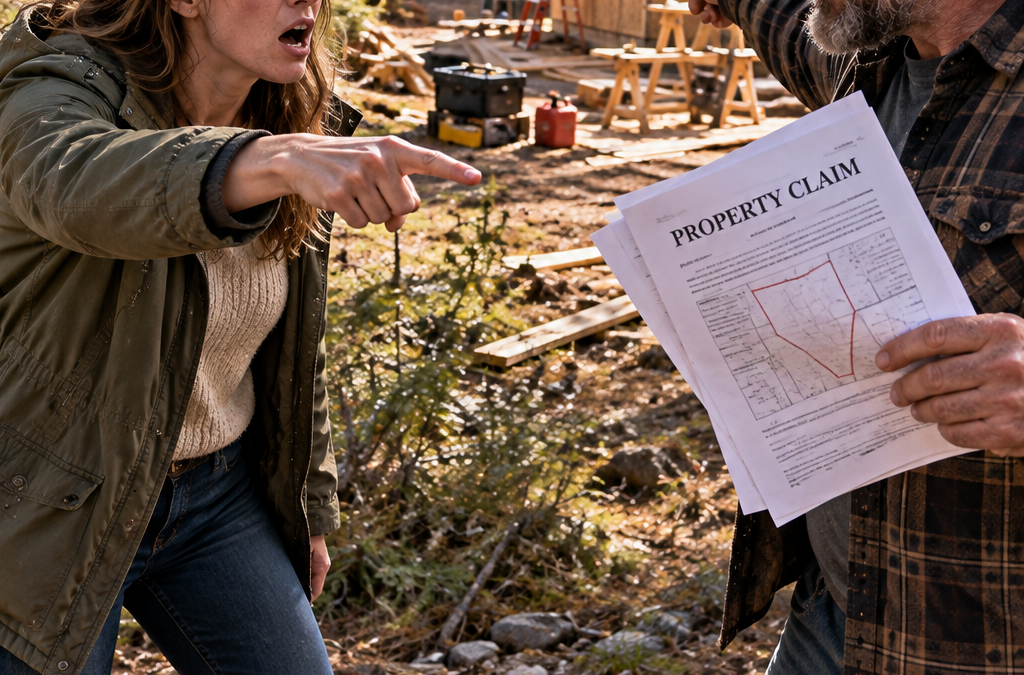
He reached toward a plastic folder lying on top of a crate.
My body tensed before I realized what he was reaching for.
He noticed.
For the first time, something like amusement crossed his face.
“Relax,” he said. “I’m getting my documents.”
He pulled out a stack of papers, some folded, some printed, some with stamps or symbols I did not recognize.
He held them up but did not hand them to me.
“These prove my claim.”
“What claim?”
“My claim to this land.”
“You cannot claim my land.”
“I already did.”
“No, you didn’t.”
His face reddened.
“You people always think you can just say no and that settles it.”
I could feel my pulse in my throat.
“I am saying no because this is my property.”
“This is an independent state now.”
I almost did not understand him.
“What?”
“This land is no longer under your false jurisdiction.”
The words came out rehearsed.
“This is my home. My sovereign place. You don’t have authority here.”
I looked at the house behind me.
My house.
The porch where I drank coffee.
The lavender I had planted.
The stones I had dug from the grass.
Everything I had worked for and waited for and finally allowed myself to love.
And then I looked at the stranger standing in my yard, claiming it with a hammer in his hand.
Fear came first.
Then anger.
Not loud anger. Not the kind that makes you shout.
A deep, quiet anger that made me feel strangely still.
“You are not living in my backyard,” I said.
He stepped toward me.
Only one step.
But with the hammer still in his hand, it was enough.
“I wouldn’t advise you to get bossy with me.”
My instincts told me to move back, but pride told me not to.
Instinct won.
I took one small step away.
He smiled.
That smile made my skin crawl.
I tried to keep my voice calm.
“Can I see those papers?”
“You can see them from there.”
“I need to understand what you think gives you the right to be here.”
“I don’t need you to understand.”
“If you believe they’re valid, then let me make a copy.”
His expression hardened.
“What do you need a copy for?”
“I’d like to show them to the authorities.”
The word authorities changed him.
His face twisted.
“No.”
His voice grew louder.
“No, you don’t get to take them. You’ll lose them. Or you’ll pay somebody to lie and say they aren’t real.”
“I only want—”
“No,” he snapped. “People like you are always looking down on us. Treating us like we’re stupid. Like we’re trash.”
“I didn’t say that.”
“You didn’t have to.”
He shook the papers in his hand.
“I’m a poor man, but I’m finally going to have something that belongs to me.”
The words struck something complicated in me.
For one second, beneath the fear and outrage, I saw a desperate man.
Not harmless.
Not right.
But desperate.
A man who had convinced himself that the world had cheated him so completely that he was entitled to take from someone else and call it justice.
“I’m sorry you’re struggling,” I said carefully. “But you can’t fix that by taking my land.”
“It was never yours.”
“It is mine.”
“No,” he said. “It was claimed by fraud. All government land is fraud.”
I realized then that I was not going to reason him out of this.
He did not see me as a person.
He saw me as part of the system he hated.
The deed, the survey, the sale, the money I had saved, the work I had done, none of it mattered to him because accepting any of it would destroy the fantasy that allowed him to stand there.
I thought about my doors.
My windows.
The long darkness that fell out here at night.
I thought about sleeping in the house with this man camping yards away.
I thought about waking to the sound of him walking near the porch.
I thought about him watching me.
Waiting.
Building.
Claiming.
No.
Absolutely not.
“I’m asking you one more time,” I said. “Please leave.”
“This is an independent state,” he said. “It will be my home.”
“It will not.”
“That’s too bad for you.”
His hand tightened around the hammer.
That was when my anger gave way to something more practical.
I could not physically remove him. I could not safely take his tools. I could not stand there arguing until he decided the hammer was useful for something besides wood.
So I backed away.
Slowly.
I tried not to make it look like retreat, though it was.
“I’m going to get help,” I said.
“Run to your fake authorities,” he shouted after me. “They have no jurisdiction here.”
I did not answer.
I walked around the side of the house with my shoulders stiff and my hands trembling.
Only when I got into my car and locked the doors did I let myself breathe.
For a moment, I sat there gripping the steering wheel.
I could see part of the cabin frame in the side mirror.
It looked impossible.
A stranger had moved into my life while I was away.
A man with a hammer, a campfire, and papers claiming my backyard as his own.
I called the police station first, then decided I did not want to sit alone in the driveway waiting.
The dispatcher told me I could come in and speak to an officer if I felt unsafe.
I started the car.
As I drove, I kept checking the rearview mirror, half-expecting him to appear behind me on the road.
He did not.
The police station sat in a small town center that suddenly felt very far from the quiet dream I had bought. I parked crookedly, corrected the car, then sat for a second trying to collect myself.
Inside, the desk officer looked up.
“Can I help you?”
“I need to speak to someone,” I said. “There’s a man on my property.”
He straightened slightly.
“What kind of man?”
“A stranger. He’s building a cabin in my backyard.”
The officer paused.
“He’s what?”
“He says he’s a sovereign citizen. He says my land is an independent state now.”
The officer’s expression changed.
Not shock, exactly.
Recognition.
That frightened me more than shock would have.
“I don’t know how dangerous he is,” I added quickly. “He had a hammer. He got angry when I asked him to leave. I live alone.”
“Ma’am, take a breath,” the officer said.
I tried.
It came out shaky.
“Is he there right now?”
“Yes.”
“Did he threaten you directly?”
“He told me I shouldn’t get bossy with him. He refused to leave. He said the police have no authority.”
The officer nodded slowly.
“Do you have documentation showing ownership of the property?”
“Yes. Deed, survey, everything. But I don’t have it with me.”
“That’s all right. We can sort that out.”
Another officer came over after hearing part of the conversation. The desk officer explained the situation in a low voice. They exchanged a look.
I hated that look.
It was the look professionals give each other when the situation is not new, but also not simple.
One of the officers turned to me.
“We’ve dealt with people like this before.”
“So he can’t really live on my land?”
“No, ma’am.”
The relief was immediate, but incomplete.
“Then why would my address be on his papers?” I asked. “He had documents. They looked like they were claiming the property.”
“Those documents don’t give him legal ownership,” the officer said. “Sometimes people make them. Sometimes someone else sells or gives them paperwork that sounds official but has no legal force. Either way, private property doesn’t become theirs because they declare it.”
“He said this is an independent state now.”
“That’s not how land ownership works.”
I pressed my palms together because my fingers would not stop shaking.
“He was so sure.”
“They often are.”
Something about that sentence made my stomach sink.
“How dangerous is he?”
The officer’s face softened a little.
“We won’t know until we speak with him. That’s why you’re not going to approach him again. We’ll go out there. You can follow us back to your property, but you’ll stay in your car across the road. Do not get out unless we tell you to.”
I nodded.
“I mean it,” he said. “If he’s unstable or becomes aggressive, we don’t want you nearby.”
“I understand.”
“We’ll take another officer with us and have backup available if we need it.”
I wanted to feel reassured.
Part of me did.
But another part of me felt strangely guilty.
I know that sounds irrational.
The man had invaded my property. He had frightened me. He had refused to leave.
Still, as I followed the police car back toward my house, guilt twisted through my fear.
What if he was mentally ill?
What if he had nowhere else to go?
What if this escalated because I could not find some better, kinder way to solve it?
Then I pictured the hammer in his hand.
I pictured the cabin frame.
I pictured myself trying to sleep in that house while he sat beside a fire in my backyard, convinced the land was his and that I was the intruder.
Compassion did not require me to surrender my safety.
I repeated that to myself all the way home.
Compassion did not require me to surrender my safety.
When we reached my property, I parked where the officers told me to, across the road and slightly down from the driveway.
From there, I could see the house and part of the backyard through the gap beside it.
The officers got out.
There were two of them at first. Another patrol vehicle arrived moments later and stopped nearby.
One officer walked over to my car.
“Stay here,” he said.
“I will.”
“If anything changes, lock your doors and call dispatch.”
My doors were already locked.
He nodded and went with the others around the house.
I watched them disappear.
Waiting was awful.
I could see smoke rising behind the house again.
The smell of cooking fish drifted faintly even across the road, and for some reason that made me angrier than almost anything else.
He was not hiding.
He was not ashamed.
He had built a fire and cooked food on my land as if he had every right to settle in.
I imagined him sitting there while I was away, maybe laughing at the empty house, maybe telling himself that possession was all that mattered.
My hands gripped the steering wheel.
A minute passed.
Then another.
I could hear voices, but not clearly at first.
Then one voice rose.
His.
“I’m a sovereign citizen!”
The words carried across the yard.
One of the officers responded, calm and firm.
“Sir, you cannot be here. This is private property. We need you to dismantle your structure, gather your belongings, and leave.”
“I have every right to be here.”
“No, sir. You don’t.”
“I’m not under your jurisdiction.”
“You are trespassing.”
“This is independent land.”
I closed my eyes for a second.
He was saying the same things to them.
The exact same things.
Part of me had hoped that the presence of uniformed officers would shake his certainty. That he would realize the situation had become serious and simply pack up.
Instead, he dug in deeper.
The officer continued speaking.
“There are shelters and assistance programs if you need help. We can provide information. But you cannot live on someone else’s property.”
“I don’t want a shelter,” the man shouted. “This is my place.”
“It isn’t.”
“You government men always take from hardworking people.”
“Sir, no one is taking anything from you. We are telling you that you are on private land and you need to leave.”
“You have no authority here.”
The officers remained controlled.
I admired that.
It is one thing to imagine police work as dramatic confrontations and sudden action. It is another to watch officers patiently repeat reality to someone who refuses to live inside it.
They gave him chances.
More than I expected.
They told him he could pack up and leave. They told him he did not need to make the situation worse. They told him the paperwork he had did not grant him any rights to the land.
I could not see every movement from where I sat, but I saw him pull out the documents again.
He waved them like a shield.
The officers looked at them from a distance.
One said, “Sir, whether you made those yourself or someone gave them to you, they are not valid legal documents.”
“They are valid,” he shouted.
“They do not override the property deed.”
“The deed is fraud.”
“It is not.”
“You have no authority.”
“We do.”
“No, you don’t.”
The repetition became chilling.
It was like watching someone throw himself against a wall he insisted was not there.
The wall did not move.
But he kept insisting.
Then his voice changed.
Until then, he had been angry.
Now there was something sharper in it.
“I will not be chased off my land again.”
The word again caught me.
Again?
Had this happened before?
Had he tried to claim somewhere else? Had someone else removed him? Was this a pattern? Or was it part of his story, something real mixed with something distorted?
“I’m not leaving,” he shouted. “Prepare to fight if you won’t leave me be.”
My stomach clenched.
One of the officers raised his voice.
“Sir, this is your last warning. If you do not comply with lawful commands, you will be arrested.”
“You have no authority!”
“Put down what’s in your hand.”
For the first time, I realized I could not see the hammer.
I leaned forward, heart pounding.
“Put it down,” the officer repeated.
The man shouted something I could not understand.
Then everything happened fast.
He moved.
One officer stepped in.
Another shifted around him.
I saw the man’s arm swing, not clearly enough to know whether he threw something or tried to push past them, but the officers reacted immediately.
They took him to the ground.
I heard yelling.
His voice.
The officers’ commands.
“Stop resisting.”
“Hands behind your back.”
“Do not reach.”
My breath stopped.
For a few seconds, all I could see was movement in the grass near the half-built cabin.
Then they had him.
Handcuffed.
Angry.
Still shouting.
Still insisting.
“I do not consent!”
“You have no jurisdiction!”
“This is unlawful!”
They brought him around the side of the house toward the patrol car.
He looked different now.
Smaller, somehow, though physically he had not changed.
Without the hammer in his hand, without the illusion that his papers made him untouchable, he looked like a furious man who had built his entire defense out of words that could not protect him.
As they guided him past my parked car, his head turned.
For one second, his eyes met mine through the windshield.
I expected rage.
There was rage there, yes.
But beneath it, I saw betrayal.
As if I had taken something from him.
As if I were the trespasser.
As if calling the police on a stranger building a cabin in my backyard had been an act of cruelty rather than survival.
He shouted something at me, but the glass and distance swallowed most of it.
I caught only a few words.
“You’ll answer for this.”
Then they put him in the back of the patrol car.
I sat completely still.
My body had been tense for so long that I did not know how to release it.
One of the officers walked back toward my car.
I lowered the window.
“You okay, ma’am?”
I nodded, though I was not sure it was true.
“He’s in custody,” the officer said. “You did the right thing calling us.”
“I hoped he would just leave.”
“We did too.”
“What happens now?”
“He’ll be taken in. Likely trespassing, disorderly conduct, resisting. We’ll sort out the exact charges.”
I looked toward my yard.
The cabin frame stood there like an insult.
“What about all of that?”
“We’re going to call someone from the city to help remove the belongings and dismantle the structure. We’ll also put out the fire. We don’t want anything spreading.”
The fire.
I had almost forgotten it in the chaos.
“Thank you,” I said.
My voice broke on the words.
The officer’s expression softened.
“I know this was upsetting.”
“I feel like I should have done something sooner.”
“You called as soon as you found him.”
“I was gone. He must have been here for days.”
“That’s not your fault.”
I looked at him.
“What if he comes back?”
“He’ll be warned not to. If he does, call immediately.”
“But what if he believes all this? Truly believes it?”
The officer glanced toward the patrol car.
“Then he may keep making bad decisions. But that doesn’t give him the right to occupy your property.”
That sentence stayed with me.
It sounded simple.
It was simple.
But after the surreal madness of the afternoon, I needed simple.
The man’s beliefs did not give him the right to make me unsafe.
His desperation did not make my home available.
His papers did not erase my deed.
His need did not outweigh my right to live without a stranger building walls behind my house.
The officers put out the fire.
More people came later to remove what he had dragged onto the property. Boards. Tarps. Tools. A folding chair. The camp stove. Bags of supplies. Random belongings bundled into containers.
Watching them dismantle the cabin frame was strangely emotional.
It had not even been finished, yet seeing it taken apart felt like watching an invasion being undone piece by piece.
A board lifted from the frame.
A nail pulled free.
A tarp folded.
The shape of the thing disappeared slowly, and with it, some of the pressure in my chest.
By evening, the backyard looked wounded but recognizable.
There were flattened patches in the grass, burn marks from the fire, and scattered sawdust where he had worked.
But the structure was gone.
He was gone.
I walked the property after everyone left.
The house stood quiet behind me.
The sky had deepened to purple at the edges.
Crickets started up in the grass as if nothing extraordinary had happened.
I stopped where the cabin had been.
For a while, I just stood there.
This was the place where I had imagined a small fire pit.
Maybe a garden bench.
Maybe a row of berry bushes.
He had looked at the same patch of land and seen something else entirely.
A place to claim.
A place to conquer.
A place where his belief could become shelter if only he hammered enough boards together.
I wondered where he had come from.
I wondered if anyone loved him.
I wondered whether someone had sold him those ideas, fed him words like freedom and sovereignty until they became weapons he used against strangers.
Then I wondered why I was trying so hard to understand a man who had made me afraid in my own home.
Maybe because understanding feels safer than not understanding.
Maybe because random danger is harder to live with.
If I could make his actions make sense, then perhaps I could put them in a box and close it.
But people are not always boxes.
Sometimes they are storms.
And sometimes the best you can do is lock the door before the storm reaches the porch.
That night, I barely slept.
Every sound became something.
A branch brushing the siding.
The refrigerator settling.
An animal moving outside.
I got up three times to check the locks.
At two in the morning, I stood in the kitchen holding a glass of water, staring toward the back window.
The darkness beyond it felt different now.
Before, the dark had been peaceful.
That night, it felt occupied by memory.
I hated him for that.
Not dramatically.
Not forever.
But in that moment, I hated him for taking the first true home I had ever owned and making it feel uncertain.
The next day, I ordered an alarm system.
I also started looking at dogs.
I had resisted the idea before because I did not want fear to dictate my life. But after seeing a stranger build a cabin in my yard, I no longer thought of security as paranoia.
Security was not fear.
Security was a boundary.
And I had learned exactly what could happen when a person decided boundaries did not apply to him.
Over the next few weeks, life slowly returned to its routine.
I worked.
I made coffee.
I sat on the porch again, though at first I found myself looking over my shoulder more than watching the trees.
I repaired the damaged patch of yard where the cabin had been. I raked the sawdust out of the grass. I filled shallow holes. I cleaned the blackened circle left by the fire.
Each small repair felt like taking my property back.
Still, I was not the same.
I no longer romanticized isolation in quite the same way.
When friends asked how I was, I told them I was fine because I did not want to retell the story endlessly. But fine was not exactly true.
I was functioning.
I was grateful.
I was safe.
But sometimes, while working at my kitchen table, I would remember the sound of his voice saying, “It is my home now,” and anger would rise through me all over again.
There is something uniquely violating about someone trying to rewrite your life while standing inside it.
Burglary would have been frightening.
Vandalism would have been upsetting.
But this was different.
He had not just stolen something or damaged something.
He had declared that my ownership, my work, my choices, my legal rights, and my sense of home were all illusions.
He had tried to make me the outsider on land I had paid for.
That was what stayed with me.
The court process unfolded from a distance.
I was contacted when necessary. I gave statements. I provided documents. I confirmed that I had never given the man permission to be on the property.
I learned his name, though I rarely used it in my mind.
Somehow, naming him made him feel too ordinary.
He was not a monster. That would have been easier.
He was a man.
A man with beliefs that had hardened into something dangerous.
A man who had decided that wanting land and claiming land were the same thing.
A man who had mistaken refusal for oppression and consequences for persecution.
When he appeared before a judge, he did not back down.
That was what I was told.
He argued that the court had no jurisdiction.
He insisted that his documents were valid.
He claimed he was not subject to ordinary law.
He refused to accept the basic premise that he had trespassed on someone else’s property.
Part of me had hoped that arrest would puncture the illusion.
That a night in custody, a conversation with a public defender, or the simple reality of handcuffs would force him to reconsider.
It did not.
His belief did not bend when reality pressed against it.
It only became louder.
Eventually, the court determined that he remained a risk.
The charges included trespassing, disorderly conduct, and resisting arrest, but the deeper issue was his refusal to accept that he could not simply occupy private property because he had declared himself free from the rules everyone else lived under.
He was jailed.
When I heard that, I did not feel the satisfaction I expected.
I felt tired.
I felt relieved.
I felt sad in a distant, complicated way.
Not sad that consequences had found him.
They needed to.
But sad that a person could walk himself so far into a false world that jail became the only place left for the real one to stop him.
I hoped he would get help.
I truly did.
Not because he deserved my property.
Not because what he did was harmless.
But because I could not imagine that a healthy, stable person would choose to stand in a stranger’s yard with a hammer, wave fraudulent papers, and prepare to fight police over land that was never his.
Something in him had gone wrong.
Maybe long before he found my address.
Maybe long before he started building that cabin.
I hoped someone, somewhere, could reach whatever part of him still understood that other people were real.
But I also knew that hope did not obligate me to become his victim.
That was the lesson I kept returning to.
You can feel compassion and still call the police.
You can recognize someone’s pain and still protect yourself.
You can hope a person gets help and still be grateful when he is no longer close enough to hurt you.
The world often tries to make women feel cruel for defending their boundaries.
We are taught to soften things.
To explain.
To make room.
To ask ourselves whether we misunderstood.
To wonder whether our fear is an overreaction.
I had done all of that in the first few minutes.
I had tried to talk.
I had asked questions.
I had even felt guilty while driving to the police station.
But the truth was brutally simple.
A strange man was building a cabin in my backyard.
He refused to leave.
He held a hammer.
He claimed my land was his independent state.
There was no version of kindness that required me to negotiate my own safety away.
After the case ended, I made changes.
The alarm system was installed.
Motion lights went up near the back of the house.
I met more neighbors, not because I suddenly became social, but because I understood the value of people knowing when something looked wrong.
One older couple down the road told me they had seen a truck near my place while I was gone but assumed I had hired someone.
I did not blame them.
Why would they assume otherwise?
Still, we exchanged phone numbers.
Another neighbor offered to keep an eye out when I traveled.
I promised to do the same.
I did not get the big dog, at least not immediately.
I thought about it often, though.
Sometimes I visited shelter websites and looked at serious-faced dogs with descriptions like “loyal,” “protective,” and “needs space to run.” I imagined one sleeping by the door, lifting its head at the sound of a stranger.
Maybe someday.
For the time being, the house and I learned how to be comfortable with each other again.
Spring moved into summer.
The grass recovered.
The scorch mark faded.
The lavender along the porch bloomed.
I started taking my coffee outside again without scanning the tree line first.
Not always.
But more often.
One afternoon, months after everything happened, I walked to the back of the property with a shovel and a packet of wildflower seeds.
The spot where the cabin had stood was mostly healed, but I still saw it in my mind every time I passed.
The wooden frame.
The smoke.
The man with the hammer.
I was tired of letting that patch belong to the memory of him.
So I turned the soil.
It was harder than I expected. Roots caught the shovel. Rocks surfaced. My shoulders ached.
But I kept working.
I scattered the seeds by hand and covered them lightly.
Then I stood there, dirty and sweating, and felt something inside me settle.
He had tried to build a home there by force.
I planted flowers.
It was a small act.
Maybe even a silly one.
But it mattered to me.
A few weeks later, the first green shoots appeared.
By late summer, there were blooms.
Not perfect, not carefully arranged, not like something from a landscaping magazine.
Just color.
Life.
Proof that the ground could hold something other than fear.
Sometimes people ask whether I regret moving there.
They expect hesitation.
They expect me to say the incident ruined the dream.
It did not.
It changed it.
There is a difference.
Before that day, my idea of peace was passive.
I thought peace meant finding the right place, closing the door, and letting the world stay away.
Now I know peace sometimes has to be defended.
Not with cruelty.
Not with paranoia.
But with boundaries strong enough to survive being tested.
My rural home was never magical.
It was never outside the reach of human problems.
No place is.
But it was mine.
Legally.
Emotionally.
Practically.
Mine in the way a place becomes yours when you choose it, care for it, learn its sounds, plant things in its soil, and come back to it tired because it is where your life waits for you.
A stranger tried to take that from me.
He failed.
He failed because the law did not bend to his fantasy.
He failed because I asked for help when fear told me to stay quiet.
He failed because ownership is not erased by volume, or anger, or printed documents full of meaningless claims.
And he failed because my compassion, shaky as it was, did not overcome my will to protect myself.
I still think of him sometimes.
Usually when I pass the wildflowers.
I wonder where he is now.
Whether he still repeats the same phrases to anyone forced to listen.
Whether he ever accepted that freedom does not mean taking what belongs to someone else.
Whether he ever understood that the woman he frightened was not a symbol of government oppression, not a faceless enemy, not a barrier between him and dignity.
Just a person.
A woman who had worked hard, saved money, bought a home, planted lavender, and wanted to drink coffee in peace.
Maybe he never will understand that.
I have learned to live without needing him to.
The last time I walked to the back of the property, the sun was low and the air smelled like cut grass.
The wildflowers moved softly in the breeze.
My house stood behind me, windows glowing gold.
There was no smoke.
No hammering.
No stranger declaring my land independent from reality.
Just the sound of evening settling over a place that had survived being claimed by someone who had no right to it.
I stood there longer than I meant to.
Then I turned and walked back toward the porch.
Inside, my laptop waited on the table, along with an unfinished cup of tea and a list of things I needed to do the next day.
Ordinary things.
Beautifully ordinary things.
Before going in, I looked once more across the yard.
For the first time in months, I did not see the cabin.
I did not see him.
I saw my land.
My home.
My peace.
And this time, I knew exactly what it was worth.