𝗙𝗨𝗟𝗟 𝗦𝗧𝗢𝗥𝗬 The Ink Had Barely Touched the Page When I Finally Stopped Being Silent
𝗙𝗨𝗟𝗟 𝗦𝗧𝗢𝗥𝗬
The silence after those words was so complete I could hear my own badge swinging against my chest.
Master Chief Andre Coleman, standing near the side aisle, crossed toward me in three long steps.
“Ma’am,” he said quietly, “you need to come with me now.”
“Please,” I said.
My voice cracked.
I hated that.
“Just let me say one thing.”
Conrad Vogelsang laughed softly.
“Admiral, surely this is a misunderstanding. Perhaps she is overtired.”
Captain Pike was already on his feet.
“Admiral, I apologize. I will have her removed at once.”
Stroud lifted his eyes from the unfinished signature.
They were as hard as I expected.
“Young lady,” he said, “do you know where you’re standing?”
“Yes, sir.”
My throat felt dry enough to split.
“I know exactly where I’m standing.”
I looked at Pike.
“I’m standing where I stood six years ago, watching people trust a green light.”
Something flickered across his face.
Small.
Fast.
But I had spent six years studying memories of guilty men.
I saw it.
Admiral Stroud set the pen down, though it still touched the paper.
“You have thirty seconds. Explain yourself.”
The room blurred at the edges.
Thirty seconds for six years.
Thirty seconds for Micah.
Thirty seconds for Wesley.
I forced air into my lungs.
“Ask them about Camp Meridian,” I said. “Ask them about the night the monitors lied.”
Vogelsang’s smile froze for half a heartbeat.
Dr. Kranz, at the far end of the table, slowly closed her folder and looked directly at me.
Master Chief Coleman stopped one step from my side. He waited for the admiral’s order.
None came.
“Six years ago,” I began, “I was a Navy hospital corpsman at a field hospital called Camp Meridian. A convoy hit a roadside blast. Twenty-two wounded came through our doors in less than an hour. We had new German monitors that week, the same design family being certified under this agreement. Blood pressure, oxygen, heart rate, all on one screen. Every unit showed green.”
I paused.
A camera clicked.
“Every number looked perfect. Then a young Marine named Micah Toiver stopped breathing in front of me, and his screen still said he was fine.”
No one spoke.
“I put my fingers on his neck. His pulse was gone. The machine said seventy-two. I checked the next patient. Same problem. Then another.”
Vogelsang cleared his throat.
“Admiral, with respect, this is a tragic battlefield story, not evidence. Equipment fails in war.”
“I didn’t say it failed,” I said.
He looked at me.
“I said it lied. There’s a difference. A broken machine goes dark. This one stayed green while men died.”
Stroud’s jaw tightened.
“What did you do?”
“I turned them off, sir. All of them. I used paper charts, a stopwatch, and manual pulse counts. I saved three men. I lost four.”
The admiral’s gaze did not move.
“Who ordered you to trust the screens?”
I tried not to look.
Failed.
My eyes went to Pike.
He sighed as though I had forced him into an unpleasant duty.
“Everett,” he said, “may I?”
The admiral said nothing.
Pike opened a slim folder from his briefcase.
“I did not want to do this in front of guests.”
He read from the file in a flat, practiced tone.
“Hospital Corpsman Second Class Tessa Callaway. Relieved of duty at Camp Meridian for insubordination and destruction of government equipment. Recommended for discharge.”
He looked up.
“She left the service under a cloud, Admiral. She has carried a grudge ever since.”
The floor tilted.
Not because he lied.
Because most of it was true.
That was always how the cruelest traps worked.
They used pieces of truth as wire.
Stroud looked at me.
“Is that accurate?”
“Yes, sir.”
A murmur moved through the room.
I lifted my chin.
“All of it is accurate except the reason.”
The admiral’s face hardened with disappointment.
“Then you have a grudge and no proof.”
His voice was not cruel.
That almost made it worse.
“Do you have documents? Records? Anything I can put in front of a court?”
My fingers rose halfway to my badge.
Stopped.
The card was there.
The truth was there.
But possessing it was a crime. Removing records from a military site. Keeping them unauthorized. Concealing them for six years.
A review board was scheduled in four weeks to decide whether I might return to the service in some limited capacity. I had dreamed of that hearing with an ache so steady it had become part of me.
The card could destroy that hope.
Not might.
Would.
“Not yet, sir,” I said.
Stroud’s expression closed.
“Then I’m sorry.”
He rose halfway.
The room rose with him.
“Nurse Callaway, you have accused a partner nation and my chief of staff in front of the press without proof. That is not courage. That is damage. Master Chief, escort her out.”
Coleman took my elbow gently but firmly.
I let him guide me three steps toward the door.
My shoes felt heavy.
My face burned.
For one terrible moment, I thought this was how it would end.
Not with truth.
Not with justice.
With me removed politely while the ink dried.
Then Vogelsang leaned toward his young aide and murmured in German.
He sounded satisfied.
He said, “The Americans will not reopen anything after the signature. The Meridian lot records are already gone. The only problem left is the nurse by the wall.”
I stopped walking.
Coleman felt it and looked down at me.
I turned back.
The room watched.
Then I answered Vogelsang in flawless German.
“Unfortunately for you, Herr Vogelsang, the nurse by the wall understood every word.”
For three seconds, no one breathed.
Vogelsang’s smile fell from his face like a mask slipping loose.
His aide went pale and looked at the carpet.
I turned to the room and spoke in English.
“Mr. Vogelsang just told his aide that the Americans would never reopen the case once the ink was dry. He said the Camp Meridian lot records were already destroyed. And he said the only real problem left was me.”
“That is nonsense,” Vogelsang snapped. “She invents a private conversation no one can confirm.”
Stroud stared at me.
“You speak German?”
“My grandmother raised me on it. Her name was Greta. It’s in my service record.”
I looked toward Pike.
“Though I doubt anyone read that page either.”
At the head of the German delegation, Minister Weber turned slowly toward Vogelsang’s aide and spoke in German.
He asked whether I had told the truth.
The young man opened his mouth.
Closed it.
Looked at Vogelsang.
Then at the floor.
His silence answered for him.
Weber’s face changed.
He did not look angry at first.
He looked wounded.
Like a man realizing the bridge beneath him had been rotten long before he stepped onto it.
“Admiral,” Weber said in careful English, “I request a recess. A private one.”
Stroud studied him, then nodded.
“Fifteen minutes. My conference room. Principals only.” He turned toward his aide. “Lieutenant Oay, bring a secure laptop. Master Chief, the nurse comes with us.”
Pike’s jaw flexed.
“Everett, this is a mistake.”
“Then it will be a short one,” Stroud said.
The conference room was small, cold, and windowless, which felt appropriate for the kind of truth waiting inside it.
Admiral Stroud sat at the head of the table.
Pike sat to his right.
Weber and Vogelsang sat across from them.
Dr. Kranz took the far corner, quiet as before but pale now.
Lieutenant Hannah Oay opened a secure laptop.
Master Chief Coleman stood by the door.
I sat near the end of the table with my badge still clipped to my scrubs and my heart hammering so loudly I thought everyone could hear it.
Stroud looked at me.
“Earlier, I asked if you had documents. You said not yet.”
His eyes dropped briefly to my badge.
“Is it yet?”
There are moments in life when you understand the cost before you pay it.
Not vaguely.
Not romantically.
Clearly.
I knew what would happen if I handed over that card. The board would not return me to the Navy. No one would risk reinstating a corpsman who had kept unauthorized records for six years, no matter how noble the reason. The uniform I had dreamed of wearing again would be gone.
And maybe that was what had kept me silent all along.
Not fear of prison.
Not even fear of being disbelieved.
Hope.
Hope can be a chain when it asks you to stay quiet.
I unclipped my badge.
Opened the plastic casing with my thumbnail.
The tiny black card fell into my palm.
I placed it on the table.
“Now,” I said. “Now it’s yet.”
Lieutenant Oay inserted the card into the reader.
The screen flickered.
A gray box appeared.
Enter passphrase.
Three attempts remaining.
My stomach dropped.
I stared at it.
I had never opened the card.
I had no idea what Wesley had used.
Across the table, Pike began to smile.
Slowly.
Gently.
As if he were already comforting me through my collapse.
“Go ahead,” he said. “Try Meridian. Try the date. Try your own name. We’ll wait.”
My hands shook as I typed Meridian.
The box flashed red.
Two attempts remaining.
Vogelsang leaned back.
His relief was almost imperceptible, but I saw it.
Pike spoke again.
“It might contain nothing. A shopping list. A corrupted file. A desperate fantasy. You cannot build a treaty on a locked card and one woman’s resentment.”
“Give her a moment,” Stroud said.
Pike stood and moved toward the window.
As he passed behind my chair, he bent as if picking up a pen.
His voice reached me barely above a breath.
“Listen carefully, Callaway. Tell them the card is empty. Say you panicked. Your hearing sails through.”
My blood went cold.
“And Wesley Baird’s pension gets reviewed the way I could have arranged years ago.”
The room continued to watch the screen.
No one else heard him.
“Or,” Pike whispered, “you keep pushing, and a nurse who stole military records goes to prison. Think about who you’re really protecting.”
He straightened.
And I understood something.
A man that certain does not whisper.
He was afraid.
I turned toward the table.
“Admiral, Captain Pike just offered me my hearing and Wesley Baird’s pension if I say this card is empty.”
Pike’s face hardened.
“That is a lie, Everett.”
“Is it?” Stroud asked.
His voice had gone very quiet.
I closed my eyes.
Wesley’s voice returned to me from the day he placed the card in my hand.
“It’s the number the machine gave you. The number you’ll never forget.”
The number.
The screen had said seventy-two.
Micah’s pulse had said nothing.
But Wesley would not use only a number.
He had known me better than that.
He would use the wound itself.
I typed carefully.
Micah72.
The gray box vanished.
A folder opened.
Then another.
Lieutenant Oay leaned toward the screen and began reading filenames aloud.
Monitor logs.
Photographs.
Handwritten charts.
Procurement waiver.
Email chain.
Sensor drift warning.
The room changed temperature.
Oay opened the logs first.
Two columns of numbers appeared side by side.
One from the German monitor.
One from a corpsman’s paper chart, written by hand under impossible conditions.
The monitor column stayed calm.
Green.
Steady.
Believable.
The chart told the truth.
Pulse fading.
Respirations dropping.
Pressure collapsing.
Patient by patient, the gap widened.
The machine said stable.
The body said dying.
Weber whispered something in German I did not repeat.
Then Oay opened the procurement form.
At the bottom were two signatures.
One belonged to a Vogelsang Medical Systems executive.
The other sat beneath a stamp that read Field Validation Waived.
Beside it, in blue ink, was the signature I had memorized six years earlier.
Roland Pike.
The admiral read it once.
Then again.
More slowly.
“Roland.”
His voice was almost gentle.
That gentleness hurt worse than shouting.
“Everett,” Pike said, “listen to me. Files can be altered. That card came from an unsecured source. She admitted possessing it illegally. Lieutenant, call military police.”
“Hold that call,” Stroud said without turning.
Oay’s hand froze above her phone.
Then she opened the final memo.
Sensor Drift Warning.
Internal Vogelsang Medical Systems.
Author: Dr. Ilza Kranz.
I turned.
In the corner, Dr. Kranz had risen to her feet.
“That memo is mine,” she said.
Her English was careful.
Her voice was not loud, but it carried.
“I wrote it seven years ago. The sensor modules drift under heat and humidity. In battlefield conditions, they can continue reporting the last valid reading instead of the patient’s current state.”
Vogelsang stood.
“Dr. Kranz, you will stop talking. You are under contract.”
“I am,” she said. “I signed that contract because I believed silence would protect my family.”
Her eyes moved to me.
“I no longer believe silence protects anyone.”
Vogelsang’s face darkened.
Weber looked at her with an expression I could not read.
Dr. Kranz turned fully toward me.
“Miss Callaway, you should know something. This meeting was not an accident.”
I stared at her.
“What?”
“You were not assigned to that wall by luck.”
I could not speak.
“Two months ago, I received a message from a man named Wesley Baird.”
My chest tightened so sharply that I had to press one hand against the table.
“He had read about this accord,” she continued. “He said he had a friend who kept the truth on a small memory card. A friend who spoke German. A friend who would never come forward for herself.”
My eyes burned.
“He asked me to help. I had no power to stop the deal. Vogelsang watches email, phone records, travel, everything. But Minister Weber’s office requested a medical standby through the hospital liaison.”
She swallowed.
“I made one small request. A nurse who spoke German. I gave them your name.”
The room blurred.
Marjorie Dunn’s voice returned.
Easy shift, Tessa. Stand still and look useful.
The easy shift had been a door.
Dr. Kranz had opened it.
Wesley had led me to it.
I had almost turned away.
“Where is he?” I asked.
“Downstairs in the lobby,” she said. “He drove eleven hours in an old truck. He said if you said no, he would understand. If you said yes, he wanted to be near.”
I covered my mouth.
For six years, I had thought Wesley disappeared because he could not bear the weight of what happened.
But he had not disappeared.
He had been working in the dark, building a road back to truth one quiet mile at a time.
Minister Weber stood.
His voice, when he spoke, carried iron.
“Germany will not sign.”
Vogelsang turned toward him.
“Minister, you cannot take the word of a nurse and an unhappy employee over years of partnership.”
“I am not taking only their word,” Weber said. “I am taking the word of your own machine’s numbers. Your engineer’s warning. Your company’s hidden records.”
He looked at the unsigned accord.
“A bridge built on a lie collapses under the first heavy load.”
Vogelsang sat down slowly.
That left Pike.
He stood by the window, shoulders rigid, all polish gone from his face.
When he spoke, his voice sounded older.
“You don’t understand what it was like, Everett. The budget was gone. Wounded were coming in faster than we could build capacity. The equipment was delayed. The waivers were temporary.”
Stroud did not move.
“I signed to get systems through the door,” Pike said. “They were supposed to be replaced within a month. Nobody was meant to die.”
“But they did,” Stroud said.
Pike looked away.
“And you hid it,” the admiral continued. His voice cracked. “For six years, you let a corpsman carry it. You let Wesley Baird take the fall. You let me shake your hand at retirement dinners, and then you sat beside me at that table and handed me the pen.”
Pike had no answer.
A knock came at the door.
Two military police officers stepped inside.
Pike had not needed Oay to call.
He had used his own phone when no one was looking.
The senior officer’s eyes went straight to me.
“Ma’am, we received a report that you are in unlawful possession of protected military records. I need you to come with us.”
I surprised myself by smiling.
Because for the first time in six years, I was not afraid of being punished for the truth.
“He’s right, Admiral,” I said. “I took those records. I knew it was wrong the day I kept them.”
“Tessa,” Stroud said quietly.
I looked at him.
“I can file that card as evidence under my authority,” he said. “I can make your possession of it disappear into a paragraph no one reads. Your hearing can proceed. All you have to do is let me handle Camp Meridian quietly.”
Quietly.
There it was again.
The beautiful word men used when they meant buried.
He meant it kindly.
That almost made it more dangerous.
“Sir,” I said, “if you bury it quietly, Micah Toiver’s mother never learns the truth. Wesley stays branded until someone decides it is convenient to forgive him. And the next bad machine gets a signature from someone who is no braver than Captain Pike.”
The admiral’s face tightened.
“You could lose your hearing.”
“I know.”
“The board will not return a corpsman who kept protected records, whatever the reason.”
“I know.”
The words came easier than I expected.
“I’ve wanted that uniform back every day since I left. But I would rather lose it standing up than keep it sitting down.”
Stroud looked at me for a long moment.
Then he turned to the military police.
“Sergeant, the man you need to take into custody is Captain Roland Pike.”
Pike’s face emptied.
“Miss Callaway will follow as a witness,” Stroud said, “and she will give her statement in public.”
Pike did not resist.
He let the cuffs close around his wrists while staring at the oldest friend he had betrayed.
Not with rage.
With loss.
Some betrayals are too complete even for anger.
We walked back into the great hall together.
The cameras turned instantly.
The agreement still lay on the walnut table.
One unfinished blue line crossed the place where Admiral Stroud’s signature should have been.
He picked up the pen.
For one terrifying second, I thought he might sign anyway.
Instead, he drew a hard line through his own beginning.
“This accord will not be signed,” he said into the microphones. “Not by me. Not today. Not until every machine in this program is proven by people with no reason to lie.”
No one moved.
Then he told them everything.
Not all at once.
Not dramatically.
Like a man choosing each word because truth deserved precision.
He told them about Camp Meridian.
The waived validation.
The machines.
The four who died and the three who lived because manual checks replaced false screens.
He named Micah Toiver aloud.
That broke something in me.
For six years, I had carried Micah as a private wound.
Hearing his name in that public room felt like opening a window in a sealed cell.
“The corpsman punished for saving them was right,” Stroud said. “The Navy owes Tessa Callaway and Wesley Baird a debt it can never fully repay.”
At the back of the hall, the doors opened.
A lean man in a worn work jacket stood holding a cap in both hands.
He was older than I remembered.
Grayer.
His shoulders seemed narrower.
But his eyes were Wesley’s.
The same steady eyes that had watched monitors lie and bodies tell the truth.
I walked to him without a word.
For a second, we only stared at each other.
Then he folded me into his arms like a brother welcoming a sister home from a war no one else had known we were still fighting.
“You kept it,” he whispered.
I laughed through tears.
“You knew I would.”
“I hoped you would.”
“You built all this?”
“I opened a few doors,” he said. “You walked through.”
I pressed my face into his shoulder.
“I almost didn’t.”
“I know.”
His voice broke.
“That’s why I came.”
Weeks later, the Navy board withdrew my reinstatement hearing.
There was no cruelty in the letter.
No triumph.
Just official language.
Unauthorized retention of protected military records.
Formal reprimand.
Ineligible for return to service.
I read it at my kitchen table with my coffee cooling beside me.
For six years, I thought that letter would destroy me.
It did not.
It hurt.
Of course it hurt.
Grief is still grief even when you choose it.
But beneath the hurt was something steadier.
I had lost the uniform I wanted.
I had found the voice I should never have hidden.
That was not nothing.
Wesley’s record was corrected. His pension was restored with an apology signed by Admiral Stroud himself. He called me when the letter arrived and tried to sound casual, but his voice failed halfway through.
“Guess they finally remembered how to spell my name,” he said.
“About time.”
Neither of us mentioned that he was crying.
Vogelsang Medical Systems lost every contract tied to the program. Investigations spread through boardrooms and ministries, uncovering old warnings, buried complaints, falsified validation summaries, and a company culture where silence had been treated as a business strategy.
Minister Weber returned to Germany and faced his own political storm, but he did something I respected.
He did not pretend he had known all along.
He stood before cameras and said, “We were deceived, and we failed to question deeply enough. That failure ends now.”
Pike faced court-martial.
I testified.
So did Wesley.
So did Dr. Kranz, whose hands shook badly on the stand until she began explaining the sensor drift. Once the science was in front of her, she steadied. I understood that. Competence can be shelter.
Admiral Stroud testified too.
When asked how he had missed Pike’s role for six years, he answered, “Because I trusted a friend more than I examined the record. That was my failure.”
It was the bravest thing I had ever heard an admiral say.
On a gray Saturday months later, I was finishing a shift at Bay Ridge when a woman in a faded blue coat asked for me by name.
She was small.
Carefully dressed.
Hands folded around a purse strap.
I knew before she said it.
“My name is Ruth Toiver,” she said.
The hallway seemed to tilt.
Micah’s mother.
I led her to a quiet family room.
For a long moment, she only looked at me.
“They told me he died alone,” she said.
I shook my head.
“No.”
Her face crumpled.
“No, ma’am. He was not alone.”
I sat across from her and told her what I could.
Not the sanitized version.
Not the cruel details.
The human truth.
“He was brave. He was confused for a little while, but not alone. I held his hand. Wesley was with us. We counted every beat we could. We fought for him.”
She covered her mouth.
“Did he suffer?”
I answered honestly, gently.
“Less than you fear. More than I wish.”
She reached across the table and took my hands.
Her fingers were cold.
“Thank you for staying with him.”
I looked down at our joined hands.
For six years, I had imagined Micah’s mother blaming me.
Maybe some part of me had needed her to.
Instead, she held my hands as if they had brought her son home in the only way left.
After that, I returned to my scrubs and quiet corridors.
But I was not invisible anymore.
People knew my name now.
Some treated me with caution, as if truth-telling were contagious.
Others treated me with a respect that made me uncomfortable at first.
Young nurses asked me questions.
Not about fame.
Not about the ceremony.
About patients.
About what to do when a number did not match a body.
About when to challenge a doctor.
About how to live with being wrong sometimes because the alternative—never speaking—was worse.
I told them what I wished someone had told me earlier.
“Machines are tools. So are protocols. So are ranks and reports and signatures. None of them replaces your eyes, your hands, or your conscience.”
A new corpsman once asked me if I regretted losing my chance to return.
I thought about the hearing that never happened.
The uniform I would never wear again.
The path that had closed.
Then I thought about Ruth Toiver finally knowing her son had not died alone.
Wesley opening the pension letter with shaking hands.
Dr. Kranz testifying without a corporate lawyer telling her when to stop.
The blue ink line Admiral Stroud crossed through his own signature.
“No,” I said.
He looked surprised.
“Not at all?”
I smiled.
“Every day. But regret is not the same as wishing I chose differently.”
That confused him, which meant he had heard me.
Six years earlier, I thought courage would feel like certainty.
It does not.
Courage often feels like nausea, shaking fingers, and the unbearable awareness of what standing up will cost.
It feels like being escorted toward a door and turning around anyway.
It feels like opening the one file that can ruin the future you wanted.
It feels like telling the truth in a room full of people who would rather call you unstable than admit the powerful lied.
For a long time, I believed I had carried that memory card because I was afraid.
Now I know I carried it because some buried part of me was waiting for the moment when fear would no longer be reason enough.
I still clip a hospital badge to my scrubs every morning.
There is no memory card behind it now.
Only my name.
Tessa Callaway.
Nurse.
Former Navy corpsman.
Witness.
The woman by the wall who finally spoke.
And sometimes, when I pass a monitor glowing green beside a patient’s bed, I look at the numbers.
Then I look at the person.
I count the pulse with my fingers when something feels wrong.
I listen.
I trust what is living more than what is lit.
Because history is not only made by admirals with pens or ministers with flags behind them.
Sometimes history is stopped by a trembling nurse who remembers the dead, understands the language no one thought she spoke, and refuses to let one more signature bury the truth.
The ink had barely touched the page that day.
But my silence ended before his name was finished.
And that, in the end, was the first honest line written in that room.
𝗧𝗛𝗘 𝗘𝗡𝗗
The Ink Had Barely Touched the Page When I Finally Stopped Being Silent
I had spent six years carrying proof no one wanted to see, until the wrong man picked up a pen in front of the whole world.
They thought I was only a nurse standing against the wall, too quiet to matter and too small to interrupt history.
But the last time I trusted a green light, four men died while the machines told us everything was fine.
My name is Tessa Callaway, and for six years, I wore my silence like a second uniform.
Not proudly.
Not comfortably.
Just constantly.
Silence followed me through hospital corridors, staff briefings, break rooms, and sleepless nights when I sat at my kitchen table with both hands wrapped around cold coffee, staring at a tiny black memory card I had never opened.
Some people keep photographs.
Some keep medals.
Some keep letters folded inside drawers.
I kept a piece of plastic smaller than my thumbnail hidden behind my hospital ID badge.
Every morning before my shift at Bay Ridge Naval Hospital, I clipped that badge to my scrubs and felt the slight hard edge of the card pressing beneath the plastic. It was light enough that no one would ever notice.
Heavy enough that I never forgot it was there.
For six years, it lay over my heart while I took temperatures, changed dressings, checked pupils, started IV lines, and told frightened young sailors to breathe through pain they were pretending not to feel.
For six years, it carried the truth about Camp Meridian.
And for six years, I told myself no one with enough power would ever be ready to hear it.
That morning, I was not supposed to matter.
That was the whole point of my assignment.
Bay Ridge sent one duty nurse to every major ceremony at Fort Alden in case some admiral, foreign official, or aging veteran got light-headed under cameras and stage lights. Usually, the nurse stood near a wall, smiled politely, and handed out water if someone looked pale.
Head Nurse Marjorie Dunn had handed me the assignment with a shrug.
“Easy shift, Tessa. Stand still and look useful.”
I was good at standing still.
I was good at looking useful without being remembered.
I tied my dark hair back, put on clean navy scrubs, clipped my badge to my chest, and rode the shuttle to Fort Alden with a paper cup of coffee cooling between my palms.
The ceremony hall had been transformed into a stage for history.
Flags stood behind a long walnut table polished so deeply that the overhead lights reflected in it like water. The American delegation sat on one side. The German delegation sat on the other. Cameras lined the rear of the room. Microphones waited at the table’s center like small metal insects.
The agreement was supposed to tie the United States Navy to Germany for twenty years in a shared combat medical systems program. That was what the official briefing called it.
A partnership.
An innovation.
A leap forward in battlefield casualty care.
Those words were printed on glossy folders and press releases. They sounded clean, modern, impossible to argue with.
I had learned long ago that the cleanest words often hid the dirtiest rooms.
Still, I stood where I was told.
Against the wall.
Near the emergency kit.
Quiet.
Unimportant.
Two hours passed that way.
Powerful people shook hands. Aides whispered into phones. Reporters adjusted lenses. Military officers made careful jokes with foreign officials, everyone smiling just enough to show cooperation without appearing unserious.
At the head of the American side sat Admiral Everett Stroud.
He was in his sixties, with hard gray eyes and the kind of face that looked carved by salt wind and command decisions. He did not smile often. When he did, people seemed relieved. His reputation was brutal but fair, which in the Navy usually meant people hated disappointing him more than they feared being punished by him.
Beside him sat Captain Roland Pike.
Chief of staff.
Old friend.
Trusted adviser.
Tall, silver-haired, composed, with a courteous smile that never reached his eyes.
I knew Pike’s name before I knew his face.
More importantly, I knew his signature.
On the German side sat Conrad Vogelsang, the executive whose company had built the field medical systems at the heart of the deal. He was heavyset, smooth, perfectly dressed, and comfortable in the way only rich men in official rooms seem comfortable. He smiled as if every objection in the world could be handled by better lighting and a firmer handshake.
Beside him sat Minister Anselm Weber, gray-haired and watchful, with a quiet face that gave away very little.
And near the far end of the German delegation sat a woman in a gray blazer.
Dr. Ilza Kranz.
No one introduced her to the room. Not properly. Her name passed through a whispered exchange between aides while everyone else focused on the cameras. She kept a closed folder in front of her and said almost nothing, but I noticed her because quiet people notice each other.
She was not bored.
She was waiting.
At first, I did not understand for what.
Then I heard one word.
Meridian.
It came from Vogelsang, spoken softly in German to a younger aide standing near him.
He said it carelessly because he thought no one nearby could understand.
Most Americans in uniform knew a few words of German at best. Enough for greetings, food, directions, maybe a toast at an embassy reception.
My grandmother Greta had raised me on German lullabies, German curses, and German prayers. She believed language was an inheritance, and she had given it to me with both hands.
So when Vogelsang said Meridian, every muscle in my body went cold.
I kept my eyes forward.
I did not move.
He and the aide continued speaking two steps away from me.
They treated me like furniture.
That was useful.
The aide asked whether there was any risk that the old records might resurface.
Vogelsang said no.
He said the Americans would never reopen the case once the ink was dry.
He said the lot records from Camp Meridian were destroyed.
Then he smiled and added that the only real problem left was the nurse by the wall.
Me.
I felt the memory card behind my badge as though it had heated against my skin.
For a moment, I could not breathe.
Six years disappeared.
I was back in a field hospital at Camp Meridian, dust coating my tongue, generators coughing outside, twenty-two wounded men arriving in less than an hour after a convoy hit an explosive device on a road that was supposed to be clear.
We had been using new German monitors that week.
Compact.
Integrated.
Efficient.
Blood pressure, oxygen saturation, heart rate, all displayed on one bright screen.
The officers loved them.
The procurement people loved them.
The visiting evaluation teams loved them.
The screens glowed green beside our patients, promising order inside chaos.
I believed them.
At first.
So did everyone else.
Then a young Marine named Micah Toiver stopped breathing in front of me while his monitor still said he was fine.
His oxygen was green.
His pulse was green.
His heart rate read seventy-two.
I put two fingers against his neck and felt nothing.
At first, I thought I had missed it.
I changed position.
Pressed harder.
Checked his wrist.
Nothing.
The screen still said seventy-two.
I shouted for help.
Someone told me to trust the monitor.
That sentence has haunted me longer than any scream.
Trust the monitor.
I checked the next patient manually.
Then the next.
The screens showed numbers that had stopped belonging to the bodies beneath them.
Not dead screens.
Not alarms.
Not errors.
Worse.
Green.
Calm.
Convincing.
They were not failing loudly.
They were lying quietly.
I turned them off.
All of them.
I took paper charts, a stopwatch, and my own hands, and I started counting pulses the way my instructors had taught us before war decided technology was faster than touch.
I saved three men that night.
I lost four.
Micah was one of them.
The official inquiry said I had panicked.
It said I destroyed government equipment.
It said I disobeyed orders.
It said the machines had not been conclusively responsible.
It said I was emotionally compromised.
And because I was young, exhausted, ashamed, and outranked by men who needed the story buried, I signed statements I should have fought.
Wesley Baird fought harder.
He was the corpsman beside me that night, older, steadier, the kind of man who could make a frightened nineteen-year-old casualty laugh while holding pressure on a wound. He took blame that should not have belonged to him. He said certain decisions had been his, not mine. He gave up the career he loved so I might still have one someday.
Before we both left, he put the memory card in my palm.
“Keep it,” he said.
“What is it?”
“Everything I could save.”
“Wesley—”
“No. Listen to me.” His eyes were red, but his voice did not shake. “Keep it until somebody with real power is ready to listen.”
I asked him for the passphrase.
He only squeezed my hand.
“It’s the number the machine gave you. The number you’ll never forget.”
I did not understand then.
Or maybe I did, and grief made me refuse it.
I never opened the card.
I carried it.
I feared it.
I let it decide the weight of every day.
Now Admiral Stroud’s pen touched the paper.
The whole room seemed to inhale.
Cameras were rolling.
The German delegation sat forward.
Captain Pike watched from the admiral’s right side, a small satisfied stillness in his face.
The pen began the first stroke of Stroud’s name.
I saw Micah Toiver’s mother in my mind.
Not because I had ever met her.
Because I had imagined her a thousand times.
A woman being told her son died because war was cruel.
Not because a machine lied.
Not because men hid the truth.
Not because I was too afraid to speak loudly enough.
My body moved before fear finished arguing.
“Stop, Admiral.”
My voice tore through the room.
The pen froze.
Every head turned.
I stepped away from the wall, arm extended toward him, fingers trembling.
“They’re lying to you.”
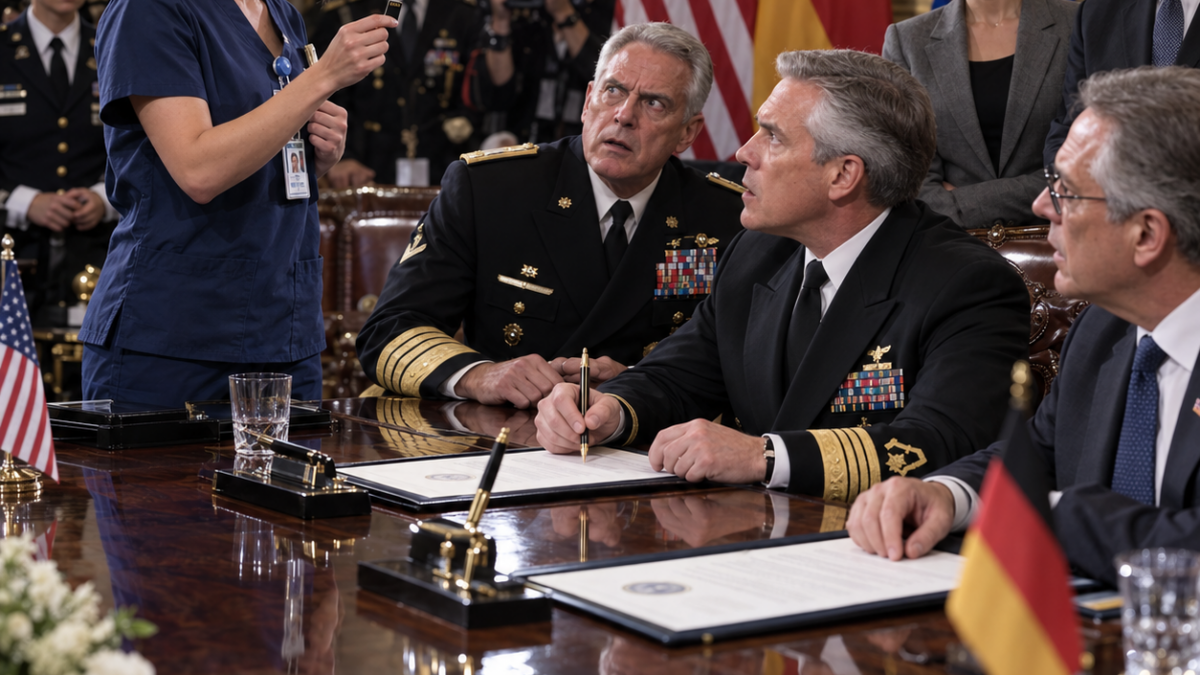
The silence after those words was so complete I could hear my own badge swinging against my chest.
Master Chief Andre Coleman, standing near the side aisle, crossed toward me in three long steps.
“Ma’am,” he said quietly, “you need to come with me now.”
“Please,” I said.
My voice cracked.
I hated that.
“Just let me say one thing.”
Conrad Vogelsang laughed softly.
“Admiral, surely this is a misunderstanding. Perhaps she is overtired.”
Captain Pike was already on his feet.
“Admiral, I apologize. I will have her removed at once.”
Stroud lifted his eyes from the unfinished signature.
They were as hard as I expected.
“Young lady,” he said, “do you know where you’re standing?”
“Yes, sir.”
My throat felt dry enough to split.
“I know exactly where I’m standing.”
I looked at Pike.
“I’m standing where I stood six years ago, watching people trust a green light.”
Something flickered across his face.
Small.
Fast.
But I had spent six years studying memories of guilty men.
I saw it.
Admiral Stroud set the pen down, though it still touched the paper.
“You have thirty seconds. Explain yourself.”
The room blurred at the edges.
Thirty seconds for six years.
Thirty seconds for Micah.
Thirty seconds for Wesley.
I forced air into my lungs.
“Ask them about Camp Meridian,” I said. “Ask them about the night the monitors lied.”
Vogelsang’s smile froze for half a heartbeat.
Dr. Kranz, at the far end of the table, slowly closed her folder and looked directly at me.
Master Chief Coleman stopped one step from my side. He waited for the admiral’s order.
None came.
“Six years ago,” I began, “I was a Navy hospital corpsman at a field hospital called Camp Meridian. A convoy hit a roadside blast. Twenty-two wounded came through our doors in less than an hour. We had new German monitors that week, the same design family being certified under this agreement. Blood pressure, oxygen, heart rate, all on one screen. Every unit showed green.”
I paused.
A camera clicked.
“Every number looked perfect. Then a young Marine named Micah Toiver stopped breathing in front of me, and his screen still said he was fine.”
No one spoke.
“I put my fingers on his neck. His pulse was gone. The machine said seventy-two. I checked the next patient. Same problem. Then another.”
Vogelsang cleared his throat.
“Admiral, with respect, this is a tragic battlefield story, not evidence. Equipment fails in war.”
“I didn’t say it failed,” I said.
He looked at me.
“I said it lied. There’s a difference. A broken machine goes dark. This one stayed green while men died.”
Stroud’s jaw tightened.
“What did you do?”
“I turned them off, sir. All of them. I used paper charts, a stopwatch, and manual pulse counts. I saved three men. I lost four.”
The admiral’s gaze did not move.
“Who ordered you to trust the screens?”
I tried not to look.
Failed.
My eyes went to Pike.
He sighed as though I had forced him into an unpleasant duty.
“Everett,” he said, “may I?”
The admiral said nothing.
Pike opened a slim folder from his briefcase.
“I did not want to do this in front of guests.”
He read from the file in a flat, practiced tone.
“Hospital Corpsman Second Class Tessa Callaway. Relieved of duty at Camp Meridian for insubordination and destruction of government equipment. Recommended for discharge.”
He looked up.
“She left the service under a cloud, Admiral. She has carried a grudge ever since.”
The floor tilted.
Not because he lied.
Because most of it was true.
That was always how the cruelest traps worked.
They used pieces of truth as wire.
Stroud looked at me.
“Is that accurate?”
“Yes, sir.”
A murmur moved through the room.
I lifted my chin.
“All of it is accurate except the reason.”
The admiral’s face hardened with disappointment.
“Then you have a grudge and no proof.”
His voice was not cruel.
That almost made it worse.
“Do you have documents? Records? Anything I can put in front of a court?”
My fingers rose halfway to my badge.
Stopped.
The card was there.
The truth was there.
But possessing it was a crime. Removing records from a military site. Keeping them unauthorized. Concealing them for six years.
A review board was scheduled in four weeks to decide whether I might return to the service in some limited capacity. I had dreamed of that hearing with an ache so steady it had become part of me.
The card could destroy that hope.
Not might.
Would.
“Not yet, sir,” I said.
Stroud’s expression closed.
“Then I’m sorry.”
He rose halfway.
The room rose with him.
“Nurse Callaway, you have accused a partner nation and my chief of staff in front of the press without proof. That is not courage. That is damage. Master Chief, escort her out.”
Coleman took my elbow gently but firmly.
I let him guide me three steps toward the door.
My shoes felt heavy.
My face burned.
For one terrible moment, I thought this was how it would end.
Not with truth.
Not with justice.
With me removed politely while the ink dried.
Then Vogelsang leaned toward his young aide and murmured in German.
He sounded satisfied.
He said, “The Americans will not reopen anything after the signature. The Meridian lot records are already gone. The only problem left is the nurse by the wall.”
I stopped walking.
Coleman felt it and looked down at me.
I turned back.
The room watched.
Then I answered Vogelsang in flawless German.
“Unfortunately for you, Herr Vogelsang, the nurse by the wall understood every word.”
For three seconds, no one breathed.
Vogelsang’s smile fell from his face like a mask slipping loose.
His aide went pale and looked at the carpet.
I turned to the room and spoke in English.
“Mr. Vogelsang just told his aide that the Americans would never reopen the case once the ink was dry. He said the Camp Meridian lot records were already destroyed. And he said the only real problem left was me.”
“That is nonsense,” Vogelsang snapped. “She invents a private conversation no one can confirm.”
Stroud stared at me.
“You speak German?”
“My grandmother raised me on it. Her name was Greta. It’s in my service record.”
I looked toward Pike.
“Though I doubt anyone read that page either.”
At the head of the German delegation, Minister Weber turned slowly toward Vogelsang’s aide and spoke in German.
He asked whether I had told the truth.
The young man opened his mouth.
Closed it.
Looked at Vogelsang.
Then at the floor.
His silence answered for him.
Weber’s face changed.
He did not look angry at first.
He looked wounded.
Like a man realizing the bridge beneath him had been rotten long before he stepped onto it.
“Admiral,” Weber said in careful English, “I request a recess. A private one.”
Stroud studied him, then nodded.
“Fifteen minutes. My conference room. Principals only.” He turned toward his aide. “Lieutenant Oay, bring a secure laptop. Master Chief, the nurse comes with us.”
Pike’s jaw flexed.
“Everett, this is a mistake.”
“Then it will be a short one,” Stroud said.
The conference room was small, cold, and windowless, which felt appropriate for the kind of truth waiting inside it.
Admiral Stroud sat at the head of the table.
Pike sat to his right.
Weber and Vogelsang sat across from them.
Dr. Kranz took the far corner, quiet as before but pale now.
Lieutenant Hannah Oay opened a secure laptop.
Master Chief Coleman stood by the door.
I sat near the end of the table with my badge still clipped to my scrubs and my heart hammering so loudly I thought everyone could hear it.
Stroud looked at me.
“Earlier, I asked if you had documents. You said not yet.”
His eyes dropped briefly to my badge.
“Is it yet?”
There are moments in life when you understand the cost before you pay it.
Not vaguely.
Not romantically.
Clearly.
I knew what would happen if I handed over that card. The board would not return me to the Navy. No one would risk reinstating a corpsman who had kept unauthorized records for six years, no matter how noble the reason. The uniform I had dreamed of wearing again would be gone.
And maybe that was what had kept me silent all along.
Not fear of prison.
Not even fear of being disbelieved.
Hope.
Hope can be a chain when it asks you to stay quiet.
I unclipped my badge.
Opened the plastic casing with my thumbnail.
The tiny black card fell into my palm.
I placed it on the table.
“Now,” I said. “Now it’s yet.”
Lieutenant Oay inserted the card into the reader.
The screen flickered.
A gray box appeared.
Enter passphrase.
Three attempts remaining.
My stomach dropped.
I stared at it.
I had never opened the card.
I had no idea what Wesley had used.
Across the table, Pike began to smile.
Slowly.
Gently.
As if he were already comforting me through my collapse.
“Go ahead,” he said. “Try Meridian. Try the date. Try your own name. We’ll wait.”
My hands shook as I typed Meridian.
The box flashed red.
Two attempts remaining.
Vogelsang leaned back.
His relief was almost imperceptible, but I saw it.
Pike spoke again.
“It might contain nothing. A shopping list. A corrupted file. A desperate fantasy. You cannot build a treaty on a locked card and one woman’s resentment.”
“Give her a moment,” Stroud said.
Pike stood and moved toward the window.
As he passed behind my chair, he bent as if picking up a pen.
His voice reached me barely above a breath.
“Listen carefully, Callaway. Tell them the card is empty. Say you panicked. Your hearing sails through.”
My blood went cold.
“And Wesley Baird’s pension gets reviewed the way I could have arranged years ago.”
The room continued to watch the screen.
No one else heard him.
“Or,” Pike whispered, “you keep pushing, and a nurse who stole military records goes to prison. Think about who you’re really protecting.”
He straightened.
And I understood something.
A man that certain does not whisper.
He was afraid.
I turned toward the table.
“Admiral, Captain Pike just offered me my hearing and Wesley Baird’s pension if I say this card is empty.”
Pike’s face hardened.
“That is a lie, Everett.”
“Is it?” Stroud asked.
His voice had gone very quiet.
I closed my eyes.
Wesley’s voice returned to me from the day he placed the card in my hand.
“It’s the number the machine gave you. The number you’ll never forget.”
The number.
The screen had said seventy-two.
Micah’s pulse had said nothing.
But Wesley would not use only a number.
He had known me better than that.
He would use the wound itself.
I typed carefully.
Micah72.
The gray box vanished.
A folder opened.
Then another.
Lieutenant Oay leaned toward the screen and began reading filenames aloud.
Monitor logs.
Photographs.
Handwritten charts.
Procurement waiver.
Email chain.
Sensor drift warning.
The room changed temperature.
Oay opened the logs first.
Two columns of numbers appeared side by side.
One from the German monitor.
One from a corpsman’s paper chart, written by hand under impossible conditions.
The monitor column stayed calm.
Green.
Steady.
Believable.
The chart told the truth.
Pulse fading.
Respirations dropping.
Pressure collapsing.
Patient by patient, the gap widened.
The machine said stable.
The body said dying.
Weber whispered something in German I did not repeat.
Then Oay opened the procurement form.
At the bottom were two signatures.
One belonged to a Vogelsang Medical Systems executive.
The other sat beneath a stamp that read Field Validation Waived.
Beside it, in blue ink, was the signature I had memorized six years earlier.
Roland Pike.
The admiral read it once.
Then again.
More slowly.
“Roland.”
His voice was almost gentle.
That gentleness hurt worse than shouting.
“Everett,” Pike said, “listen to me. Files can be altered. That card came from an unsecured source. She admitted possessing it illegally. Lieutenant, call military police.”
“Hold that call,” Stroud said without turning.
Oay’s hand froze above her phone.
Then she opened the final memo.
Sensor Drift Warning.
Internal Vogelsang Medical Systems.
Author: Dr. Ilza Kranz.
I turned.
In the corner, Dr. Kranz had risen to her feet.
“That memo is mine,” she said.
Her English was careful.
Her voice was not loud, but it carried.
“I wrote it seven years ago. The sensor modules drift under heat and humidity. In battlefield conditions, they can continue reporting the last valid reading instead of the patient’s current state.”
Vogelsang stood.
“Dr. Kranz, you will stop talking. You are under contract.”
“I am,” she said. “I signed that contract because I believed silence would protect my family.”
Her eyes moved to me.
“I no longer believe silence protects anyone.”
Vogelsang’s face darkened.
Weber looked at her with an expression I could not read.
Dr. Kranz turned fully toward me.
“Miss Callaway, you should know something. This meeting was not an accident.”
I stared at her.
“What?”
“You were not assigned to that wall by luck.”
I could not speak.
“Two months ago, I received a message from a man named Wesley Baird.”
My chest tightened so sharply that I had to press one hand against the table.
“He had read about this accord,” she continued. “He said he had a friend who kept the truth on a small memory card. A friend who spoke German. A friend who would never come forward for herself.”
My eyes burned.
“He asked me to help. I had no power to stop the deal. Vogelsang watches email, phone records, travel, everything. But Minister Weber’s office requested a medical standby through the hospital liaison.”
She swallowed.
“I made one small request. A nurse who spoke German. I gave them your name.”
The room blurred.
Marjorie Dunn’s voice returned.
Easy shift, Tessa. Stand still and look useful.
The easy shift had been a door.
Dr. Kranz had opened it.
Wesley had led me to it.
I had almost turned away.
“Where is he?” I asked.
“Downstairs in the lobby,” she said. “He drove eleven hours in an old truck. He said if you said no, he would understand. If you said yes, he wanted to be near.”
I covered my mouth.
For six years, I had thought Wesley disappeared because he could not bear the weight of what happened.
But he had not disappeared.
He had been working in the dark, building a road back to truth one quiet mile at a time.
Minister Weber stood.
His voice, when he spoke, carried iron.
“Germany will not sign.”
Vogelsang turned toward him.
“Minister, you cannot take the word of a nurse and an unhappy employee over years of partnership.”
“I am not taking only their word,” Weber said. “I am taking the word of your own machine’s numbers. Your engineer’s warning. Your company’s hidden records.”
He looked at the unsigned accord.
“A bridge built on a lie collapses under the first heavy load.”
Vogelsang sat down slowly.
That left Pike.
He stood by the window, shoulders rigid, all polish gone from his face.
When he spoke, his voice sounded older.
“You don’t understand what it was like, Everett. The budget was gone. Wounded were coming in faster than we could build capacity. The equipment was delayed. The waivers were temporary.”
Stroud did not move.
“I signed to get systems through the door,” Pike said. “They were supposed to be replaced within a month. Nobody was meant to die.”
“But they did,” Stroud said.
Pike looked away.
“And you hid it,” the admiral continued. His voice cracked. “For six years, you let a corpsman carry it. You let Wesley Baird take the fall. You let me shake your hand at retirement dinners, and then you sat beside me at that table and handed me the pen.”
Pike had no answer.
A knock came at the door.
Two military police officers stepped inside.
Pike had not needed Oay to call.
He had used his own phone when no one was looking.
The senior officer’s eyes went straight to me.
“Ma’am, we received a report that you are in unlawful possession of protected military records. I need you to come with us.”
I surprised myself by smiling.
Because for the first time in six years, I was not afraid of being punished for the truth.
“He’s right, Admiral,” I said. “I took those records. I knew it was wrong the day I kept them.”
“Tessa,” Stroud said quietly.
I looked at him.
“I can file that card as evidence under my authority,” he said. “I can make your possession of it disappear into a paragraph no one reads. Your hearing can proceed. All you have to do is let me handle Camp Meridian quietly.”
Quietly.
There it was again.
The beautiful word men used when they meant buried.
He meant it kindly.
That almost made it more dangerous.
“Sir,” I said, “if you bury it quietly, Micah Toiver’s mother never learns the truth. Wesley stays branded until someone decides it is convenient to forgive him. And the next bad machine gets a signature from someone who is no braver than Captain Pike.”
The admiral’s face tightened.
“You could lose your hearing.”
“I know.”
“The board will not return a corpsman who kept protected records, whatever the reason.”
“I know.”
The words came easier than I expected.
“I’ve wanted that uniform back every day since I left. But I would rather lose it standing up than keep it sitting down.”
Stroud looked at me for a long moment.
Then he turned to the military police.
“Sergeant, the man you need to take into custody is Captain Roland Pike.”
Pike’s face emptied.
“Miss Callaway will follow as a witness,” Stroud said, “and she will give her statement in public.”
Pike did not resist.
He let the cuffs close around his wrists while staring at the oldest friend he had betrayed.
Not with rage.
With loss.
Some betrayals are too complete even for anger.
We walked back into the great hall together.
The cameras turned instantly.
The agreement still lay on the walnut table.
One unfinished blue line crossed the place where Admiral Stroud’s signature should have been.
He picked up the pen.
For one terrifying second, I thought he might sign anyway.
Instead, he drew a hard line through his own beginning.
“This accord will not be signed,” he said into the microphones. “Not by me. Not today. Not until every machine in this program is proven by people with no reason to lie.”
No one moved.
Then he told them everything.
Not all at once.
Not dramatically.
Like a man choosing each word because truth deserved precision.
He told them about Camp Meridian.
The waived validation.
The machines.
The four who died and the three who lived because manual checks replaced false screens.
He named Micah Toiver aloud.
That broke something in me.
For six years, I had carried Micah as a private wound.
Hearing his name in that public room felt like opening a window in a sealed cell.
“The corpsman punished for saving them was right,” Stroud said. “The Navy owes Tessa Callaway and Wesley Baird a debt it can never fully repay.”
At the back of the hall, the doors opened.
A lean man in a worn work jacket stood holding a cap in both hands.
He was older than I remembered.
Grayer.
His shoulders seemed narrower.
But his eyes were Wesley’s.
The same steady eyes that had watched monitors lie and bodies tell the truth.
I walked to him without a word.
For a second, we only stared at each other.
Then he folded me into his arms like a brother welcoming a sister home from a war no one else had known we were still fighting.
“You kept it,” he whispered.
I laughed through tears.
“You knew I would.”
“I hoped you would.”
“You built all this?”
“I opened a few doors,” he said. “You walked through.”
I pressed my face into his shoulder.
“I almost didn’t.”
“I know.”
His voice broke.
“That’s why I came.”
Weeks later, the Navy board withdrew my reinstatement hearing.
There was no cruelty in the letter.
No triumph.
Just official language.
Unauthorized retention of protected military records.
Formal reprimand.
Ineligible for return to service.
I read it at my kitchen table with my coffee cooling beside me.
For six years, I thought that letter would destroy me.
It did not.
It hurt.
Of course it hurt.
Grief is still grief even when you choose it.
But beneath the hurt was something steadier.
I had lost the uniform I wanted.
I had found the voice I should never have hidden.
That was not nothing.
Wesley’s record was corrected. His pension was restored with an apology signed by Admiral Stroud himself. He called me when the letter arrived and tried to sound casual, but his voice failed halfway through.
“Guess they finally remembered how to spell my name,” he said.
“About time.”
Neither of us mentioned that he was crying.
Vogelsang Medical Systems lost every contract tied to the program. Investigations spread through boardrooms and ministries, uncovering old warnings, buried complaints, falsified validation summaries, and a company culture where silence had been treated as a business strategy.
Minister Weber returned to Germany and faced his own political storm, but he did something I respected.
He did not pretend he had known all along.
He stood before cameras and said, “We were deceived, and we failed to question deeply enough. That failure ends now.”
Pike faced court-martial.
I testified.
So did Wesley.
So did Dr. Kranz, whose hands shook badly on the stand until she began explaining the sensor drift. Once the science was in front of her, she steadied. I understood that. Competence can be shelter.
Admiral Stroud testified too.
When asked how he had missed Pike’s role for six years, he answered, “Because I trusted a friend more than I examined the record. That was my failure.”
It was the bravest thing I had ever heard an admiral say.
On a gray Saturday months later, I was finishing a shift at Bay Ridge when a woman in a faded blue coat asked for me by name.
She was small.
Carefully dressed.
Hands folded around a purse strap.
I knew before she said it.
“My name is Ruth Toiver,” she said.
The hallway seemed to tilt.
Micah’s mother.
I led her to a quiet family room.
For a long moment, she only looked at me.
“They told me he died alone,” she said.
I shook my head.
“No.”
Her face crumpled.
“No, ma’am. He was not alone.”
I sat across from her and told her what I could.
Not the sanitized version.
Not the cruel details.
The human truth.
“He was brave. He was confused for a little while, but not alone. I held his hand. Wesley was with us. We counted every beat we could. We fought for him.”
She covered her mouth.
“Did he suffer?”
I answered honestly, gently.
“Less than you fear. More than I wish.”
She reached across the table and took my hands.
Her fingers were cold.
“Thank you for staying with him.”
I looked down at our joined hands.
For six years, I had imagined Micah’s mother blaming me.
Maybe some part of me had needed her to.
Instead, she held my hands as if they had brought her son home in the only way left.
After that, I returned to my scrubs and quiet corridors.
But I was not invisible anymore.
People knew my name now.
Some treated me with caution, as if truth-telling were contagious.
Others treated me with a respect that made me uncomfortable at first.
Young nurses asked me questions.
Not about fame.
Not about the ceremony.
About patients.
About what to do when a number did not match a body.
About when to challenge a doctor.
About how to live with being wrong sometimes because the alternative—never speaking—was worse.
I told them what I wished someone had told me earlier.
“Machines are tools. So are protocols. So are ranks and reports and signatures. None of them replaces your eyes, your hands, or your conscience.”
A new corpsman once asked me if I regretted losing my chance to return.
I thought about the hearing that never happened.
The uniform I would never wear again.
The path that had closed.
Then I thought about Ruth Toiver finally knowing her son had not died alone.
Wesley opening the pension letter with shaking hands.
Dr. Kranz testifying without a corporate lawyer telling her when to stop.
The blue ink line Admiral Stroud crossed through his own signature.
“No,” I said.
He looked surprised.
“Not at all?”
I smiled.
“Every day. But regret is not the same as wishing I chose differently.”
That confused him, which meant he had heard me.
Six years earlier, I thought courage would feel like certainty.
It does not.
Courage often feels like nausea, shaking fingers, and the unbearable awareness of what standing up will cost.
It feels like being escorted toward a door and turning around anyway.
It feels like opening the one file that can ruin the future you wanted.
It feels like telling the truth in a room full of people who would rather call you unstable than admit the powerful lied.
For a long time, I believed I had carried that memory card because I was afraid.
Now I know I carried it because some buried part of me was waiting for the moment when fear would no longer be reason enough.
I still clip a hospital badge to my scrubs every morning.
There is no memory card behind it now.
Only my name.
Tessa Callaway.
Nurse.
Former Navy corpsman.
Witness.
The woman by the wall who finally spoke.
And sometimes, when I pass a monitor glowing green beside a patient’s bed, I look at the numbers.
Then I look at the person.
I count the pulse with my fingers when something feels wrong.
I listen.
I trust what is living more than what is lit.
Because history is not only made by admirals with pens or ministers with flags behind them.
Sometimes history is stopped by a trembling nurse who remembers the dead, understands the language no one thought she spoke, and refuses to let one more signature bury the truth.
The ink had barely touched the page that day.
But my silence ended before his name was finished.
And that, in the end, was the first honest line written in that room.