𝗙𝗨𝗟𝗟 𝗦𝗧𝗢𝗥𝗬 The HOA’s Fake Police Pointed a Taser at My Pregnant Wife, Not Knowing I Was Real Law Enforcement
PART 2
Sophia met the HOA security team before I did.
She mentioned it casually one night while we were eating dinner.
“By the way, the neighborhood has its own patrol.”
I looked up from my plate.
“Patrol?”
“Security, I guess. Two guys in a golf cart. They stopped by and introduced themselves.”
“What were they wearing?”
She shrugged.
“Uniforms.”
That got my attention.
“What kind of uniforms?”
“I don’t know. Green shirts. Patches. Belts. They looked official.”
I put my fork down.
“Official how?”
“Like police, kind of. But not exactly.”
I had been a cop long enough to know there is a certain type of man who desperately wants to look like law enforcement without ever going through the process of becoming law enforcement.
I saw them myself a few nights later.
I was taking out the trash when a golf cart rolled slowly down our street. Two men sat inside wearing dark green button-up shirts with shoulder patches that said HOA ENFORCEMENT in gold lettering. Black tactical pants. Black boots. Duty belts. Flashlights. Radios. Little metal nameplates.
And holsters.
At first glance, to someone who didn’t know better, they could pass for some kind of private police.
Not quite real.
But close enough to make people hesitate.
That pissed me off immediately.
The driver gave me a little nod as they passed, like we were colleagues. Like he was on patrol and I was just a civilian in basketball shorts dragging trash to the curb.
I stared after them until the golf cart turned the corner.
Sophia came up beside me.
“That’s them.”
“I see.”
“You okay?”
“Yeah.”
I wasn’t.
Because I knew that posture.
That walk.
That slow scan of the street.
That way of holding the shoulders like authority was something strapped onto the belt beside the flashlight.
They were cosplaying power.
And the problem with people who cosplay power is that eventually they start believing the costume.
I told myself to let it go.
We were not HOA members. They had no authority over us. I was not going to drag my job into neighborhood politics. One lesson I learned early as a cop was to keep my badge out of my private life as much as possible.
Once people know you’re police, everything changes.
A neighbor hears a noise at midnight? They call you before dispatch.
Somebody’s teenager gets a speeding ticket? They ask if you can “look into it.”
A dog barks too much? Somehow you become the official street mediator.
I wanted to be a husband at home.
Not Officer Somebody.
So I didn’t tell the HOA patrol guys what I did for a living.
I didn’t flash my badge.
I didn’t confront them about their uniforms.
I just kept my distance.
Then the visits started.
At first, it was polite.
Two men at the door with clipboards and membership forms.
They introduced themselves as HOA security officers. The bigger one, the obvious leader, was named Grant. Broad shoulders, shaved head, thick neck, mirrored sunglasses he wore even when standing on our porch in shade. His partner, Mills, was leaner, nervous, and seemed to take his cues from Grant.
They asked if we had any questions about membership.
I told them no.
They explained the HOA offered neighborhood protection.
I told them we weren’t interested.
Grant smiled.
Not friendly.
“You sure? County sheriff takes a while to get out here sometimes.”
“I’m aware.”
“Lot can happen in a few minutes.”
I looked at him.
“So I’ve heard.”
He didn’t know what to make of that.
The visits became weekly.
Then more than weekly.
Sometimes they left flyers about neighborhood events we couldn’t attend because we weren’t members. Sometimes they talked about property standards. Sometimes they mentioned “security gaps” around non-member homes.
Then Karen started appearing in the background.
Karen Whitcomb, the HOA president.
She was around forty, maybe a little older, and carried herself like she expected the entire neighborhood to shift when she entered it. Beautiful, polished, and poisonous. Long dark hair, perfect makeup, fitted blazers, tight dresses at meetings, glossy lips, gold jewelry, and heels that clicked on pavement like a countdown.
She had the kind of beauty that made people underestimate how cruel she could be.
When she wanted charm, she could lean in, lower her voice, and make every sentence sound almost intimate. When charm failed, her face went cold fast enough to give you whiplash.
The first time she came to our door with Grant and Mills behind her, she smiled at Sophia like they were old friends.
“Your home is lovely,” Karen said. “It would be a shame for you to feel isolated from the rest of us.”
Sophia, polite as always, said, “Thank you, but we’re happy as we are.”
Karen’s smile held.
“For now.”
I stepped beside my wife.
“What does that mean?”
Karen looked at me like I had interrupted a performance.
“It means community matters. People who separate themselves often discover they needed neighbors more than they realized.”
“We have neighbors.”
“You don’t have protection.”
“We’re fine.”
Grant shifted behind her.
Karen noticed my eyes move to him, and her smile sharpened.
“Our security team takes neighborhood safety very seriously.”
“I can see that.”
“You work odd hours, don’t you?”
That one landed wrong.
My face stayed neutral, but inside, something sharpened.
“What makes you say that?”
Karen shrugged lightly.
“People notice things. Cars coming and going. Lights on at strange times.”
Sophia’s hand found mine.
Karen looked at that too.
Then she looked at Sophia’s stomach.
Sophia wasn’t showing much yet, but we had recently found out she was pregnant. We hadn’t told many people.
Karen smiled.
“Families need stability.”
After they left, Sophia locked the door behind them.
“Did she just threaten us?”
“I don’t know.”
But my gut said yes.
Things got worse after Sophia’s pregnancy became obvious.
Those first months were hard on her. She was exhausted, emotional, nauseated at random times, hungry at worse times, and overwhelmed by changes neither of us fully knew how to handle. She cried at commercials. She once sobbed because the grocery store was out of the exact brand of pickles she wanted. Then she cried again because she knew crying over pickles was ridiculous.
I loved her through all of it.
But we were both running on fumes.
I worked patrol shifts, came home tired, took care of what I could, drove out late at night for whatever food she suddenly needed, and tried not to let her see how worried I was every time she winced, cried, or said something felt strange.
The last thing we needed was Karen’s private army showing up at our door.
But they kept coming.
One afternoon, Grant told Sophia that non-member homes were “lower priority” in emergencies.
Another time, Mills said they had noticed I wasn’t always home at night.
Grant added, “That has to be scary for a woman in your condition.”
Sophia told me about that one when I got home.
I nearly drove to Karen’s house right then.
Instead, I went outside, sat in my truck for ten minutes, and forced myself to breathe.
The next time Grant came by, I opened the door before he could finish knocking.
“We are not joining,” I said. “Do not come back.”
He smiled.
“Sir, we’re only trying to keep everyone safe.”
“No. You’re harassing my wife.”
His expression tightened.
“That’s a serious accusation.”
“Then take it seriously.”
Mills looked away.
Grant leaned slightly closer.
“You know, refusing community cooperation can create misunderstandings.”
“Leave.”
For a few seconds, neither of us moved.
Then Grant stepped back.
“Have it your way.”
I watched them walk to the golf cart.
Karen was standing across the street near the corner, sunglasses on, arms folded. When Grant looked toward her, she gave the smallest nod.
That was when I knew.
This wasn’t just two security idiots freelancing.
Karen was directing it.
The day everything went to hell started like any other Thursday.
I was at work, writing up a report from a traffic stop, when my phone buzzed.
Sophia.
She rarely called during my shift unless it mattered.
I answered immediately.
“Hey, babe.”
At first, I couldn’t understand her.
She was crying too hard.
Words came in broken pieces.
“HOA—house—police—taser—baby—”
My body went cold.
“Sophia. Breathe. Are you hurt?”
She sobbed.
“Please come home.”
I was already moving.
I told my sergeant enough to get cleared to leave and drove faster than I should have.
Every bad possibility ran through my head.
A break-in.
An assault.
Something wrong with the baby.
An ambulance.
Sophia on the ground.
I told myself to breathe.
Training helps in emergencies when you’re working them.
It does not feel the same when the person crying on the phone is your pregnant wife.
When I turned onto our street, I saw the lights before I saw the house.
Two county sheriff cruisers sat out front, lights flashing.
Neighbors stood in yards and driveways.
A golf cart was parked crooked near the curb, half onto the grass.
Sophia sat on our porch steps wrapped in a blanket even though the weather was warm. A female deputy crouched beside her, speaking softly.
My wife’s face was blotchy from crying. One hand rested protectively over her stomach.
I got out fast.
The deputy stood, her hand moving instinctively toward her belt until she saw the badge clipped at mine.
“I’m her husband,” I said. “What happened?”
She looked at my face, then glanced toward the cruisers.
“Two HOA security officers are in custody.”
“In custody for what?”
Her expression hardened.
“One drew a taser on your wife.”
Everything inside me went silent.
Not calm.
Not peace.
A silence so deep it felt like the world had narrowed to a single point.
I walked to Sophia and knelt in front of her.
She grabbed me so hard her nails dug into my arm.
“I’m sorry,” she kept saying. “I’m sorry, I yelled, I told them to leave, and he—”
“Hey.” I held her face gently. “You did nothing wrong.”
“He pointed it at the baby.”
I looked down at her stomach.
Then over at the cruiser.
Grant sat in the back seat.
I saw him through the window.
Same shaved head.
Same uniform.
Same fake-police posture, now folded into the back of a real police car.
I wanted to go over there.
I wanted to open that door.
I wanted to drag him out and make him understand exactly what kind of line he had crossed.
But I was a cop.
I knew what that choice would cost.
So I stayed with my wife.
The deputies pieced the story together.
Grant and Mills had shown up again that afternoon, this time claiming they needed to discuss “safety concerns” involving our property. Sophia had answered the door exhausted, five months pregnant, and already at the end of her patience.
She told them we weren’t interested and asked them to leave.
Grant refused.
He said if we didn’t join the HOA, they couldn’t guarantee they’d be able to keep the baby safe.
The baby.
Not the house.
Not the property.
The baby.
Maybe he thought he was being clever.
Maybe Karen had taught him fear worked better when aimed at what people loved most.
Sophia snapped.
She stepped onto the porch in slippers and an oversized T-shirt, told them to get off our property, and said she was calling the real police.
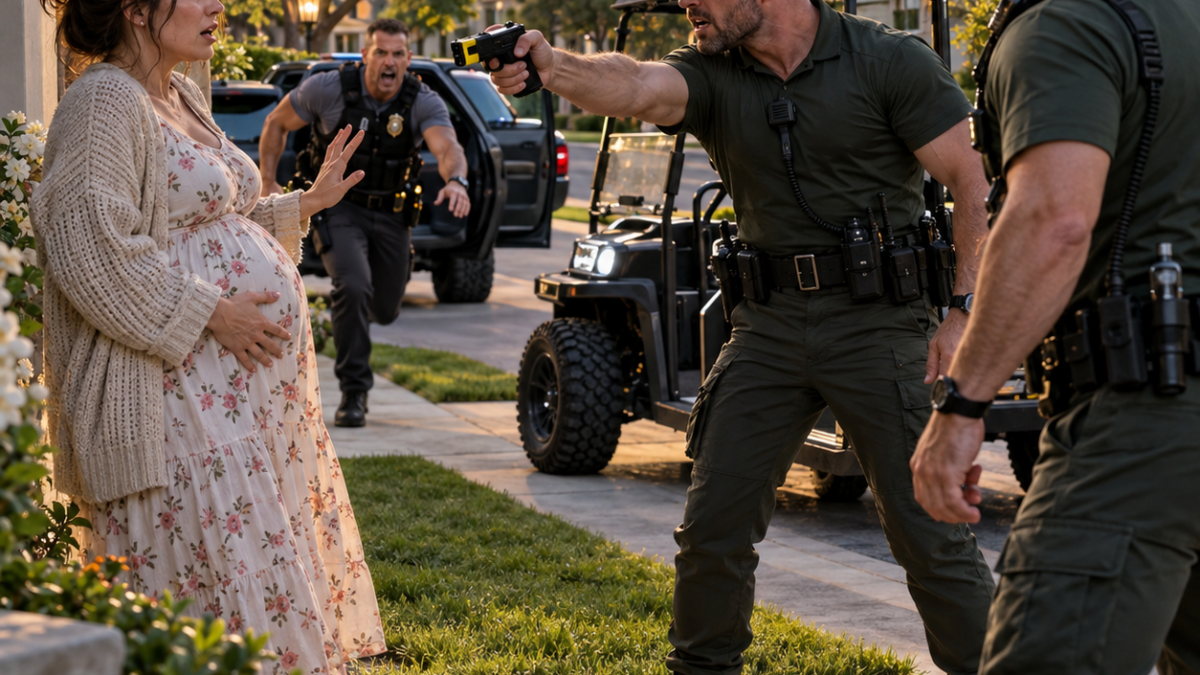
That was when Grant unholstered his taser.
A real taser.
Functional.
Loaded.
He pointed it at my pregnant wife.
Sophia froze.
She said later she didn’t remember what happened after that. Only that her hands went to her stomach and she couldn’t move.
Mrs. Beveridge, our older neighbor across the street, saw everything from her front window and called 911.
The county deputies arrived within ten minutes.
When they pulled up, Grant still had the taser out.
The deputies drew their weapons and ordered him to drop it.
Mills raised his hands and stood there with another taser on his belt.
Both were arrested.
Then came the detail that made my blood run even colder.
The deputies found firearms in the golf cart.
Actual guns.
Not just tasers.
Guns.
These HOA cosplay cops had been driving around the neighborhood armed.
That night, Sophia cried herself to sleep.
I did not sleep at all.
I lay beside her in the dark, listening to her breathing, staring at the ceiling while the scene replayed in my head even though I hadn’t seen it.
Grant on my porch.
Sophia in slippers.
Her hands on her stomach.
The taser pointed at my wife and unborn child.
Every cop knows how dangerous tasers can be in the wrong circumstances. Pregnancy makes that danger worse. A fall alone could have hurt her. Stress could have triggered complications. Electrical exposure could have caused God knows what.
And for what?
Because she told two men to leave property they had no authority over.
The next morning, while Sophia slept, I made coffee and walked across the street to thank Mrs. Beveridge.
She opened the door before I knocked twice.
Her eyes were red.
“I’ve been waiting for you.”
“Thank you for calling.”
She pulled me into a hug before I could react.
“That poor girl.”
We sat at her kitchen table, and I told her everything that had been happening. The visits. The comments. Karen. The pressure to join.
Mrs. Beveridge listened silently.
When I finished, she shook her head.
“I knew something like this would happen. Those boys have been out of control for years.”
That was the first time I realized Sophia and I were not special.
We were just the latest target.
I spent the rest of the day knocking on doors.
Not as a cop.
As a neighbor.
I introduced myself, explained what had happened, and asked if anyone had experienced issues with HOA security.
The stories came pouring out.
Some residents thought Grant and Mills were actual law enforcement because of the uniforms.
Some had been “ticketed” for trash cans, lawn decorations, parking choices, and noise complaints even when they were not HOA members.
One father told me the golf cart had followed his teenage daughter home from the bus stop “for safety,” terrifying her so badly she called him crying.
Several people said Karen used the patrol as her personal enforcement arm. If she disliked someone, Grant showed up with a clipboard. If someone questioned HOA dues or rules, Mills appeared in the golf cart outside their house.
By midafternoon, my phone was buzzing nonstop.
Neighbors were texting me videos, photos, old notices, and stories. Someone started a group chat. Someone else suggested an emergency gathering at the community park that evening.
Not an HOA meeting.
A residents’ meeting.
People wanted to talk without Karen controlling the room.
When I arrived around six, there were already forty or fifty people near the picnic pavilion. Moms with strollers. Older couples. Teenagers pretending not to be invested while obviously loving the drama. Someone had brought bottled water. Someone else brought cookies.
Suburban rebellion apparently comes with snacks.
Then Karen arrived.
She came with three HOA board members and Mills, the security partner who had not pulled the taser but had stood there while Grant did.
Karen looked immaculate.
White fitted blazer.
Dark jeans.
Heeled boots.
Hair perfect.
Makeup flawless.
She walked like she expected the crowd to part for her.
It didn’t.
People went quiet instead.
Mills stepped forward first.
“Okay,” he said loudly. “Everyone needs to calm down. There’s been a lot of misinformation going around.”
I stepped out from the crowd before I could talk myself out of it.
“Great. Why don’t you clear it up?”
His jaw tightened.
“Your wife was aggressive and confrontational.”
“She is five months pregnant.”
“She was screaming.”
“Because you were on our property threatening her.”
Karen lifted one hand.
“Let’s not inflame emotions.”
I turned toward her.
“No. Let’s.”
Her polished expression flickered.
Mills raised his voice.
“We warned her multiple times.”
“Warned her about what? Not joining a voluntary HOA?”
He puffed up.
“We were addressing safety concerns.”
“You told my pregnant wife you couldn’t guarantee our baby would be safe.”
A ripple moved through the crowd.
Karen’s eyes sharpened.
“That is being taken out of context.”
I looked at her.
“What context makes that okay?”
She smiled thinly.
“You’re emotional.”
“Yes.”
“Understandably, but emotional.”
I stepped closer.
“Do not try to make my wife’s fear sound like a misunderstanding.”
Mills pointed at me.
“Listen, buddy. I’ve done security for years. I know the law better than you do.”
That was the moment.
I had kept my job private for months because I wanted peace.
But peace had ended the second they pointed a weapon at Sophia.
I kept my voice calm.
Calm is important.
Calm makes people listen.
“I’m a police officer.”
The effect was immediate.
Mills’ face emptied.
Karen went completely still.
Someone behind me muttered, “Oh, damn.”
I continued.
“Seven years on patrol. Actual police. Badge number available if anyone wants it.”
Mills swallowed.
“You’re lying.”
I gestured at the crowd.
“You think I’d lie about that in front of fifty witnesses while half of them are recording?”
Phones were everywhere.
Karen’s face had gone pale beneath her makeup.
For the first time since I met her, she looked unsure.
Not sorry.
Just unsure of how to regain control.
I turned back to Mills.
“Your partner pointed a taser at my pregnant wife on private property. Deputies had to draw down on him because he was still holding it when they arrived. You had weapons in that golf cart. This is not misinformation. This is criminal.”
Karen stepped in.
“The HOA board was not aware of every detail—”
I cut her off.
“You sent them.”
Her mouth snapped shut.
“You stood across from my house when they came before. You watched them harass us. You nodded them forward like they were your personal police.”
“That is not true.”
Mrs. Beveridge’s voice rang out from the side.
“It is.”
Everyone turned.
She stood with both hands gripping her purse.
“I saw you many times, Karen. Sitting in that cart. Pointing at houses. Sending those boys to doors.”
Karen’s eyes flashed.
“Margaret, you don’t understand the responsibilities of community leadership.”
Mrs. Beveridge lifted her chin.
“I understand bullying when I see it.”
That broke something open.
People started speaking.
One after another.
The father whose daughter had been followed.
A woman fined for trash cans when she wasn’t a member.
A retired man who had been threatened with towing.
A young couple who said Grant photographed their backyard.
A mother who said Mills told her the sheriff wouldn’t come fast enough if she had an emergency outside HOA protection.
Karen tried to speak over them.
She failed.
The board members behind her looked increasingly horrified.
One of them, a man named David, turned to her.
“Did you authorize armed patrols?”
Karen’s lips parted.
“The security team is licensed.”
“Did you know they had guns in the golf cart?”
She hesitated.
That hesitation answered for her.
People erupted.
The meeting dissolved into anger, fear, and demands for resignations.
Karen tried one final speech about safety, order, and misunderstood intentions, but nobody was listening anymore.
Her beauty, her confidence, her title, her carefully practiced voice—none of it worked in a crowd that had finally stopped being afraid of her.
Over the next few weeks, everything moved fast.
Residents petitioned for a vote on HOA leadership.
Karen tried to block it procedurally.
Failed.
Tried to claim non-members had no standing to complain.
Failed again, because enough HOA members had their own stories and wanted her gone.
When the vote happened, every board member was removed.
Not just Karen.
All of them.
The security program was suspended immediately. Uniforms, golf carts, patrols, the whole embarrassing little police fantasy.
Grant—the one who pointed the taser at Sophia—ended up behind bars for a long time after pleading out to charges tied to aggravated assault, menacing, and weapons violations.
Mills got probation and lost whatever security certification he had.
The guns in the golf cart triggered a separate investigation into how HOA funds had been used, who approved the equipment, and whether Karen or the board had broken additional laws. I was not directly involved in all of that, but from what I heard, it was ugly.
Karen resigned before she could be formally removed from every committee she had attached herself to.
Then the neighborhood did what neighborhoods do.
It talked.
Her name went from powerful to poisonous almost overnight.
The woman who once swept through meetings like a queen stopped appearing in public for a while. Her house went quiet. The spotless SUV disappeared from the clubhouse lot. Her social circle shrank.
Sophia slowly recovered.
Not all at once.
Trauma does not leave because charges are filed or bad people lose titles.
For months, she flinched when golf carts rolled by.
She hated answering the door.
She cried during one prenatal appointment because the nurse reached for a blood pressure cuff too quickly and Sophia’s body remembered fear before her mind understood where she was.
But the neighbors rallied around her.
Mrs. Beveridge checked in constantly.
A young mom from down the street brought meals.
Two families hired Sophia for interior decorating projects, partly because she was good and partly because they wanted her to feel connected instead of hunted.
Our daughter was born healthy.
Tiny.
Furious.
Perfect.
The first time I held her, I cried so hard Sophia laughed at me.
“Big tough cop,” she whispered.
“Shut up,” I said, crying harder.
We named her Lily.
Sometimes, when I held Lily at night and watched Sophia finally sleep, I thought about what could have happened if Mrs. Beveridge had not looked out her window.
If the deputies had arrived later.
If Grant had fired.
If Sophia had fallen.
If the stress had hurt the baby.
Those thoughts still find me sometimes.
But then Lily shifts in my arms, warm and real and alive, and I come back to the room.
We never joined the HOA.
We probably never will.
The new board sent us a formal apology and rewrote policies to ban armed patrols, police-style uniforms, and any enforcement action toward non-members. They also made it clear that security personnel, if they ever hired any again, would have no authority beyond observing and reporting.
Imagine that.
Security doing security instead of pretending to be cops.
The neighborhood is quieter now.
Not because nothing bad can happen here.
I know better than that.
But because the people who wanted power most finally lost it.
The golf cart is gone.
The fake uniforms are gone.
Karen’s little kingdom is gone.
The house Sophia loved still stands.
Our daughter sleeps in the nursery Sophia decorated with soft yellow curtains and painted clouds near the ceiling. Sometimes sunlight comes through the window in the morning, and Sophia stands there holding Lily, looking around the room like she is still seeing our future.
That is what I wanted when we moved.
Not control.
Not conflict.
Not a war with an HOA president in heels and her armed make-believe police force.
Just a home where my wife felt safe.
Karen tried to take that from us because we refused to submit.
Grant tried to weaponize fear because a badge-shaped patch made him feel bigger than he was.
Mills stood by because weak men love borrowed authority.
And all of them forgot something simple.
Real authority is accountable.
Fake authority is theater.
And theater ends the moment the lights come on.
Karen thought she was running a neighborhood.
Grant thought he was enforcing law.
Mills thought silence would protect him.
But when they pointed a taser at my pregnant wife, they exposed everything they had been hiding behind.
The uniforms.
The golf cart.
The patches.
The clipboard.
The pretty HOA language about safety and community.
All of it came down to this: a group of people wanted control they had no legal right to have.
They chose the wrong porch.
The wrong woman.
The wrong family.
I still work patrol.
I still see bad things in places that look safe.
But I also saw something good come out of this.
I saw neighbors stop whispering and start speaking.
I saw people who had been intimidated for years realize they were not alone.
I saw my wife, terrified and pregnant on our porch one afternoon, become the reason an entire neighborhood finally stood up.
And when Lily is old enough, maybe we will tell her a gentler version.
That before she was born, some people tried to scare her mother.
That her mother was braver than she knew.
That an old woman across the street did the right thing.
That neighbors can be powerful when they stop letting bullies isolate them.
And that nobody gets to call themselves authority just because they bought a uniform and found someone willing to be afraid of it.
For now, though, I let her sleep.
I lock the door at night.
I kiss Sophia’s forehead before shift.
And when I drive past the empty spot where that HOA golf cart used to idle, I feel one quiet, steady satisfaction.
They wanted us scared into joining.
Instead, they scared the whole neighborhood awake.
𝗧𝗛𝗘 𝗘𝗡𝗗
The HOA’s Fake Police Pointed a Taser at My Pregnant Wife, Not Knowing I Was Real Law Enforcement
The men in fake police uniforms thought my pregnant wife was alone, scared, and easy to intimidate.
They had tasers, tactical belts, a golf cart with hidden weapons, and a neighborhood board that had spent months teaching them to believe they were untouchable.
What they did not know was that the woman they threatened was married to an actual cop—and by the time I got home, their little kingdom had already started collapsing.
I have been a police officer for seven years.
Long enough to know that most people have no idea how fragile their sense of safety really is.
Before the job, I thought quiet streets meant safe streets. I thought nice lawns, porch lights, kids riding bikes, and neighbors waving from driveways meant nothing truly ugly could happen there. Then I started responding to calls at two in the morning, and that illusion disappeared fast.
Domestic disputes behind expensive doors.
Drunk drivers on roads people called peaceful.
Break-ins on streets where everyone said, “Things like that don’t happen here.”
After a few years on patrol, I stopped judging neighborhoods by how they looked in daylight.
That was part of why my wife, Sophia, and I started talking about leaving the city.
At the time, we were renting a two-bedroom apartment that cost way too much for what it was. The walls were thin, parking was a daily battle, and every time I worked nights, I hated picturing Sophia alone in that building while I was forty minutes away dealing with everyone else’s emergencies.
When we ran the numbers, we realized that if we moved outside the city, my salary could actually get us a house.
A real house.
A yard.
A garage.
A place quiet enough that when I came home from shift, I could sit in the kitchen and not hear somebody upstairs dropping furniture at midnight.
Sophia was the one who fell in love with the house.
She was an interior decorator, which meant she saw things I never noticed. I would walk into a room and think, Walls, floor, ceiling, no weird smell. Great.
Sophia would walk in and start talking about sightlines, natural light, crown molding, original hardwood, kitchen flow, and how a space “wanted to breathe.”
The house we bought had all of that, apparently.
What I saw was a decent structure in a quiet neighborhood with low crime stats, decent county sheriff response times, and a garage big enough for my tools.
What Sophia saw was our future.
She stood in the living room on our first showing, one hand pressed lightly against her chest, and whispered, “This is it.”
So that was that.
The neighborhood seemed almost too perfect at first.
Quiet streets.
Good schools, which didn’t seem urgent then but would matter sooner than we expected.
Neighbors who actually introduced themselves.
People walking dogs after dinner.
Kids shooting basketball in driveways.
The kind of place where people decorated early for holidays and waved with both hands.
There was only one thing I hesitated over.
The HOA.
But when we looked into it, we learned the HOA was voluntary. You could join if you wanted access to certain community events, extra neighborhood patrol services, and whatever else they claimed justified the dues. But the previous owners of our house had never joined, and membership did not automatically transfer with the sale.
I read through the rules.
Sophia read through the welcome packet.
Then we looked at each other and said no.
Not because every HOA is evil.
Some are probably fine.
But I spend enough of my professional life dealing with people who confuse authority with control. I didn’t need to pay monthly dues for the privilege of arguing over mailbox colors and lawn height.
We decided not to join.
At the time, I thought that was the end of the matter.
I had no idea we had painted a target on our own front door.
PART 2
Sophia met the HOA security team before I did.
She mentioned it casually one night while we were eating dinner.
“By the way, the neighborhood has its own patrol.”
I looked up from my plate.
“Patrol?”
“Security, I guess. Two guys in a golf cart. They stopped by and introduced themselves.”
“What were they wearing?”
She shrugged.
“Uniforms.”
That got my attention.
“What kind of uniforms?”
“I don’t know. Green shirts. Patches. Belts. They looked official.”
I put my fork down.
“Official how?”
“Like police, kind of. But not exactly.”
I had been a cop long enough to know there is a certain type of man who desperately wants to look like law enforcement without ever going through the process of becoming law enforcement.
I saw them myself a few nights later.
I was taking out the trash when a golf cart rolled slowly down our street. Two men sat inside wearing dark green button-up shirts with shoulder patches that said HOA ENFORCEMENT in gold lettering. Black tactical pants. Black boots. Duty belts. Flashlights. Radios. Little metal nameplates.
And holsters.
At first glance, to someone who didn’t know better, they could pass for some kind of private police.
Not quite real.
But close enough to make people hesitate.
That pissed me off immediately.
The driver gave me a little nod as they passed, like we were colleagues. Like he was on patrol and I was just a civilian in basketball shorts dragging trash to the curb.
I stared after them until the golf cart turned the corner.
Sophia came up beside me.
“That’s them.”
“I see.”
“You okay?”
“Yeah.”
I wasn’t.
Because I knew that posture.
That walk.
That slow scan of the street.
That way of holding the shoulders like authority was something strapped onto the belt beside the flashlight.
They were cosplaying power.
And the problem with people who cosplay power is that eventually they start believing the costume.
I told myself to let it go.
We were not HOA members. They had no authority over us. I was not going to drag my job into neighborhood politics. One lesson I learned early as a cop was to keep my badge out of my private life as much as possible.
Once people know you’re police, everything changes.
A neighbor hears a noise at midnight? They call you before dispatch.
Somebody’s teenager gets a speeding ticket? They ask if you can “look into it.”
A dog barks too much? Somehow you become the official street mediator.
I wanted to be a husband at home.
Not Officer Somebody.
So I didn’t tell the HOA patrol guys what I did for a living.
I didn’t flash my badge.
I didn’t confront them about their uniforms.
I just kept my distance.
Then the visits started.
At first, it was polite.
Two men at the door with clipboards and membership forms.
They introduced themselves as HOA security officers. The bigger one, the obvious leader, was named Grant. Broad shoulders, shaved head, thick neck, mirrored sunglasses he wore even when standing on our porch in shade. His partner, Mills, was leaner, nervous, and seemed to take his cues from Grant.
They asked if we had any questions about membership.
I told them no.
They explained the HOA offered neighborhood protection.
I told them we weren’t interested.
Grant smiled.
Not friendly.
“You sure? County sheriff takes a while to get out here sometimes.”
“I’m aware.”
“Lot can happen in a few minutes.”
I looked at him.
“So I’ve heard.”
He didn’t know what to make of that.
The visits became weekly.
Then more than weekly.
Sometimes they left flyers about neighborhood events we couldn’t attend because we weren’t members. Sometimes they talked about property standards. Sometimes they mentioned “security gaps” around non-member homes.
Then Karen started appearing in the background.
Karen Whitcomb, the HOA president.
She was around forty, maybe a little older, and carried herself like she expected the entire neighborhood to shift when she entered it. Beautiful, polished, and poisonous. Long dark hair, perfect makeup, fitted blazers, tight dresses at meetings, glossy lips, gold jewelry, and heels that clicked on pavement like a countdown.
She had the kind of beauty that made people underestimate how cruel she could be.
When she wanted charm, she could lean in, lower her voice, and make every sentence sound almost intimate. When charm failed, her face went cold fast enough to give you whiplash.
The first time she came to our door with Grant and Mills behind her, she smiled at Sophia like they were old friends.
“Your home is lovely,” Karen said. “It would be a shame for you to feel isolated from the rest of us.”
Sophia, polite as always, said, “Thank you, but we’re happy as we are.”
Karen’s smile held.
“For now.”
I stepped beside my wife.
“What does that mean?”
Karen looked at me like I had interrupted a performance.
“It means community matters. People who separate themselves often discover they needed neighbors more than they realized.”
“We have neighbors.”
“You don’t have protection.”
“We’re fine.”
Grant shifted behind her.
Karen noticed my eyes move to him, and her smile sharpened.
“Our security team takes neighborhood safety very seriously.”
“I can see that.”
“You work odd hours, don’t you?”
That one landed wrong.
My face stayed neutral, but inside, something sharpened.
“What makes you say that?”
Karen shrugged lightly.
“People notice things. Cars coming and going. Lights on at strange times.”
Sophia’s hand found mine.
Karen looked at that too.
Then she looked at Sophia’s stomach.
Sophia wasn’t showing much yet, but we had recently found out she was pregnant. We hadn’t told many people.
Karen smiled.
“Families need stability.”
After they left, Sophia locked the door behind them.
“Did she just threaten us?”
“I don’t know.”
But my gut said yes.
Things got worse after Sophia’s pregnancy became obvious.
Those first months were hard on her. She was exhausted, emotional, nauseated at random times, hungry at worse times, and overwhelmed by changes neither of us fully knew how to handle. She cried at commercials. She once sobbed because the grocery store was out of the exact brand of pickles she wanted. Then she cried again because she knew crying over pickles was ridiculous.
I loved her through all of it.
But we were both running on fumes.
I worked patrol shifts, came home tired, took care of what I could, drove out late at night for whatever food she suddenly needed, and tried not to let her see how worried I was every time she winced, cried, or said something felt strange.
The last thing we needed was Karen’s private army showing up at our door.
But they kept coming.
One afternoon, Grant told Sophia that non-member homes were “lower priority” in emergencies.
Another time, Mills said they had noticed I wasn’t always home at night.
Grant added, “That has to be scary for a woman in your condition.”
Sophia told me about that one when I got home.
I nearly drove to Karen’s house right then.
Instead, I went outside, sat in my truck for ten minutes, and forced myself to breathe.
The next time Grant came by, I opened the door before he could finish knocking.
“We are not joining,” I said. “Do not come back.”
He smiled.
“Sir, we’re only trying to keep everyone safe.”
“No. You’re harassing my wife.”
His expression tightened.
“That’s a serious accusation.”
“Then take it seriously.”
Mills looked away.
Grant leaned slightly closer.
“You know, refusing community cooperation can create misunderstandings.”
“Leave.”
For a few seconds, neither of us moved.
Then Grant stepped back.
“Have it your way.”
I watched them walk to the golf cart.
Karen was standing across the street near the corner, sunglasses on, arms folded. When Grant looked toward her, she gave the smallest nod.
That was when I knew.
This wasn’t just two security idiots freelancing.
Karen was directing it.
The day everything went to hell started like any other Thursday.
I was at work, writing up a report from a traffic stop, when my phone buzzed.
Sophia.
She rarely called during my shift unless it mattered.
I answered immediately.
“Hey, babe.”
At first, I couldn’t understand her.
She was crying too hard.
Words came in broken pieces.
“HOA—house—police—taser—baby—”
My body went cold.
“Sophia. Breathe. Are you hurt?”
She sobbed.
“Please come home.”
I was already moving.
I told my sergeant enough to get cleared to leave and drove faster than I should have.
Every bad possibility ran through my head.
A break-in.
An assault.
Something wrong with the baby.
An ambulance.
Sophia on the ground.
I told myself to breathe.
Training helps in emergencies when you’re working them.
It does not feel the same when the person crying on the phone is your pregnant wife.
When I turned onto our street, I saw the lights before I saw the house.
Two county sheriff cruisers sat out front, lights flashing.
Neighbors stood in yards and driveways.
A golf cart was parked crooked near the curb, half onto the grass.
Sophia sat on our porch steps wrapped in a blanket even though the weather was warm. A female deputy crouched beside her, speaking softly.
My wife’s face was blotchy from crying. One hand rested protectively over her stomach.
I got out fast.
The deputy stood, her hand moving instinctively toward her belt until she saw the badge clipped at mine.
“I’m her husband,” I said. “What happened?”
She looked at my face, then glanced toward the cruisers.
“Two HOA security officers are in custody.”
“In custody for what?”
Her expression hardened.
“One drew a taser on your wife.”
Everything inside me went silent.
Not calm.
Not peace.
A silence so deep it felt like the world had narrowed to a single point.
I walked to Sophia and knelt in front of her.
She grabbed me so hard her nails dug into my arm.
“I’m sorry,” she kept saying. “I’m sorry, I yelled, I told them to leave, and he—”
“Hey.” I held her face gently. “You did nothing wrong.”
“He pointed it at the baby.”
I looked down at her stomach.
Then over at the cruiser.
Grant sat in the back seat.
I saw him through the window.
Same shaved head.
Same uniform.
Same fake-police posture, now folded into the back of a real police car.
I wanted to go over there.
I wanted to open that door.
I wanted to drag him out and make him understand exactly what kind of line he had crossed.
But I was a cop.
I knew what that choice would cost.
So I stayed with my wife.
The deputies pieced the story together.
Grant and Mills had shown up again that afternoon, this time claiming they needed to discuss “safety concerns” involving our property. Sophia had answered the door exhausted, five months pregnant, and already at the end of her patience.
She told them we weren’t interested and asked them to leave.
Grant refused.
He said if we didn’t join the HOA, they couldn’t guarantee they’d be able to keep the baby safe.
The baby.
Not the house.
Not the property.
The baby.
Maybe he thought he was being clever.
Maybe Karen had taught him fear worked better when aimed at what people loved most.
Sophia snapped.
She stepped onto the porch in slippers and an oversized T-shirt, told them to get off our property, and said she was calling the real police.
That was when Grant unholstered his taser.
A real taser.
Functional.
Loaded.
He pointed it at my pregnant wife.
Sophia froze.
She said later she didn’t remember what happened after that. Only that her hands went to her stomach and she couldn’t move.
Mrs. Beveridge, our older neighbor across the street, saw everything from her front window and called 911.
The county deputies arrived within ten minutes.
When they pulled up, Grant still had the taser out.
The deputies drew their weapons and ordered him to drop it.
Mills raised his hands and stood there with another taser on his belt.
Both were arrested.
Then came the detail that made my blood run even colder.
The deputies found firearms in the golf cart.
Actual guns.
Not just tasers.
Guns.
These HOA cosplay cops had been driving around the neighborhood armed.
That night, Sophia cried herself to sleep.
I did not sleep at all.
I lay beside her in the dark, listening to her breathing, staring at the ceiling while the scene replayed in my head even though I hadn’t seen it.
Grant on my porch.
Sophia in slippers.
Her hands on her stomach.
The taser pointed at my wife and unborn child.
Every cop knows how dangerous tasers can be in the wrong circumstances. Pregnancy makes that danger worse. A fall alone could have hurt her. Stress could have triggered complications. Electrical exposure could have caused God knows what.
And for what?
Because she told two men to leave property they had no authority over.
The next morning, while Sophia slept, I made coffee and walked across the street to thank Mrs. Beveridge.
She opened the door before I knocked twice.
Her eyes were red.
“I’ve been waiting for you.”
“Thank you for calling.”
She pulled me into a hug before I could react.
“That poor girl.”
We sat at her kitchen table, and I told her everything that had been happening. The visits. The comments. Karen. The pressure to join.
Mrs. Beveridge listened silently.
When I finished, she shook her head.
“I knew something like this would happen. Those boys have been out of control for years.”
That was the first time I realized Sophia and I were not special.
We were just the latest target.
I spent the rest of the day knocking on doors.
Not as a cop.
As a neighbor.
I introduced myself, explained what had happened, and asked if anyone had experienced issues with HOA security.
The stories came pouring out.
Some residents thought Grant and Mills were actual law enforcement because of the uniforms.
Some had been “ticketed” for trash cans, lawn decorations, parking choices, and noise complaints even when they were not HOA members.
One father told me the golf cart had followed his teenage daughter home from the bus stop “for safety,” terrifying her so badly she called him crying.
Several people said Karen used the patrol as her personal enforcement arm. If she disliked someone, Grant showed up with a clipboard. If someone questioned HOA dues or rules, Mills appeared in the golf cart outside their house.
By midafternoon, my phone was buzzing nonstop.
Neighbors were texting me videos, photos, old notices, and stories. Someone started a group chat. Someone else suggested an emergency gathering at the community park that evening.
Not an HOA meeting.
A residents’ meeting.
People wanted to talk without Karen controlling the room.
When I arrived around six, there were already forty or fifty people near the picnic pavilion. Moms with strollers. Older couples. Teenagers pretending not to be invested while obviously loving the drama. Someone had brought bottled water. Someone else brought cookies.
Suburban rebellion apparently comes with snacks.
Then Karen arrived.
She came with three HOA board members and Mills, the security partner who had not pulled the taser but had stood there while Grant did.
Karen looked immaculate.
White fitted blazer.
Dark jeans.
Heeled boots.
Hair perfect.
Makeup flawless.
She walked like she expected the crowd to part for her.
It didn’t.
People went quiet instead.
Mills stepped forward first.
“Okay,” he said loudly. “Everyone needs to calm down. There’s been a lot of misinformation going around.”
I stepped out from the crowd before I could talk myself out of it.
“Great. Why don’t you clear it up?”
His jaw tightened.
“Your wife was aggressive and confrontational.”
“She is five months pregnant.”
“She was screaming.”
“Because you were on our property threatening her.”
Karen lifted one hand.
“Let’s not inflame emotions.”
I turned toward her.
“No. Let’s.”
Her polished expression flickered.
Mills raised his voice.
“We warned her multiple times.”
“Warned her about what? Not joining a voluntary HOA?”
He puffed up.
“We were addressing safety concerns.”
“You told my pregnant wife you couldn’t guarantee our baby would be safe.”
A ripple moved through the crowd.
Karen’s eyes sharpened.
“That is being taken out of context.”
I looked at her.
“What context makes that okay?”
She smiled thinly.
“You’re emotional.”
“Yes.”
“Understandably, but emotional.”
I stepped closer.
“Do not try to make my wife’s fear sound like a misunderstanding.”
Mills pointed at me.
“Listen, buddy. I’ve done security for years. I know the law better than you do.”
That was the moment.
I had kept my job private for months because I wanted peace.
But peace had ended the second they pointed a weapon at Sophia.
I kept my voice calm.
Calm is important.
Calm makes people listen.
“I’m a police officer.”
The effect was immediate.
Mills’ face emptied.
Karen went completely still.
Someone behind me muttered, “Oh, damn.”
I continued.
“Seven years on patrol. Actual police. Badge number available if anyone wants it.”
Mills swallowed.
“You’re lying.”
I gestured at the crowd.
“You think I’d lie about that in front of fifty witnesses while half of them are recording?”
Phones were everywhere.
Karen’s face had gone pale beneath her makeup.
For the first time since I met her, she looked unsure.
Not sorry.
Just unsure of how to regain control.
I turned back to Mills.
“Your partner pointed a taser at my pregnant wife on private property. Deputies had to draw down on him because he was still holding it when they arrived. You had weapons in that golf cart. This is not misinformation. This is criminal.”
Karen stepped in.
“The HOA board was not aware of every detail—”
I cut her off.
“You sent them.”
Her mouth snapped shut.
“You stood across from my house when they came before. You watched them harass us. You nodded them forward like they were your personal police.”
“That is not true.”
Mrs. Beveridge’s voice rang out from the side.
“It is.”
Everyone turned.
She stood with both hands gripping her purse.
“I saw you many times, Karen. Sitting in that cart. Pointing at houses. Sending those boys to doors.”
Karen’s eyes flashed.
“Margaret, you don’t understand the responsibilities of community leadership.”
Mrs. Beveridge lifted her chin.
“I understand bullying when I see it.”
That broke something open.
People started speaking.
One after another.
The father whose daughter had been followed.
A woman fined for trash cans when she wasn’t a member.
A retired man who had been threatened with towing.
A young couple who said Grant photographed their backyard.
A mother who said Mills told her the sheriff wouldn’t come fast enough if she had an emergency outside HOA protection.
Karen tried to speak over them.
She failed.
The board members behind her looked increasingly horrified.
One of them, a man named David, turned to her.
“Did you authorize armed patrols?”
Karen’s lips parted.
“The security team is licensed.”
“Did you know they had guns in the golf cart?”
She hesitated.
That hesitation answered for her.
People erupted.
The meeting dissolved into anger, fear, and demands for resignations.
Karen tried one final speech about safety, order, and misunderstood intentions, but nobody was listening anymore.
Her beauty, her confidence, her title, her carefully practiced voice—none of it worked in a crowd that had finally stopped being afraid of her.
Over the next few weeks, everything moved fast.
Residents petitioned for a vote on HOA leadership.
Karen tried to block it procedurally.
Failed.
Tried to claim non-members had no standing to complain.
Failed again, because enough HOA members had their own stories and wanted her gone.
When the vote happened, every board member was removed.
Not just Karen.
All of them.
The security program was suspended immediately. Uniforms, golf carts, patrols, the whole embarrassing little police fantasy.
Grant—the one who pointed the taser at Sophia—ended up behind bars for a long time after pleading out to charges tied to aggravated assault, menacing, and weapons violations.
Mills got probation and lost whatever security certification he had.
The guns in the golf cart triggered a separate investigation into how HOA funds had been used, who approved the equipment, and whether Karen or the board had broken additional laws. I was not directly involved in all of that, but from what I heard, it was ugly.
Karen resigned before she could be formally removed from every committee she had attached herself to.
Then the neighborhood did what neighborhoods do.
It talked.
Her name went from powerful to poisonous almost overnight.
The woman who once swept through meetings like a queen stopped appearing in public for a while. Her house went quiet. The spotless SUV disappeared from the clubhouse lot. Her social circle shrank.
Sophia slowly recovered.
Not all at once.
Trauma does not leave because charges are filed or bad people lose titles.
For months, she flinched when golf carts rolled by.
She hated answering the door.
She cried during one prenatal appointment because the nurse reached for a blood pressure cuff too quickly and Sophia’s body remembered fear before her mind understood where she was.
But the neighbors rallied around her.
Mrs. Beveridge checked in constantly.
A young mom from down the street brought meals.
Two families hired Sophia for interior decorating projects, partly because she was good and partly because they wanted her to feel connected instead of hunted.
Our daughter was born healthy.
Tiny.
Furious.
Perfect.
The first time I held her, I cried so hard Sophia laughed at me.
“Big tough cop,” she whispered.
“Shut up,” I said, crying harder.
We named her Lily.
Sometimes, when I held Lily at night and watched Sophia finally sleep, I thought about what could have happened if Mrs. Beveridge had not looked out her window.
If the deputies had arrived later.
If Grant had fired.
If Sophia had fallen.
If the stress had hurt the baby.
Those thoughts still find me sometimes.
But then Lily shifts in my arms, warm and real and alive, and I come back to the room.
We never joined the HOA.
We probably never will.
The new board sent us a formal apology and rewrote policies to ban armed patrols, police-style uniforms, and any enforcement action toward non-members. They also made it clear that security personnel, if they ever hired any again, would have no authority beyond observing and reporting.
Imagine that.
Security doing security instead of pretending to be cops.
The neighborhood is quieter now.
Not because nothing bad can happen here.
I know better than that.
But because the people who wanted power most finally lost it.
The golf cart is gone.
The fake uniforms are gone.
Karen’s little kingdom is gone.
The house Sophia loved still stands.
Our daughter sleeps in the nursery Sophia decorated with soft yellow curtains and painted clouds near the ceiling. Sometimes sunlight comes through the window in the morning, and Sophia stands there holding Lily, looking around the room like she is still seeing our future.
That is what I wanted when we moved.
Not control.
Not conflict.
Not a war with an HOA president in heels and her armed make-believe police force.
Just a home where my wife felt safe.
Karen tried to take that from us because we refused to submit.
Grant tried to weaponize fear because a badge-shaped patch made him feel bigger than he was.
Mills stood by because weak men love borrowed authority.
And all of them forgot something simple.
Real authority is accountable.
Fake authority is theater.
And theater ends the moment the lights come on.
Karen thought she was running a neighborhood.
Grant thought he was enforcing law.
Mills thought silence would protect him.
But when they pointed a taser at my pregnant wife, they exposed everything they had been hiding behind.
The uniforms.
The golf cart.
The patches.
The clipboard.
The pretty HOA language about safety and community.
All of it came down to this: a group of people wanted control they had no legal right to have.
They chose the wrong porch.
The wrong woman.
The wrong family.
I still work patrol.
I still see bad things in places that look safe.
But I also saw something good come out of this.
I saw neighbors stop whispering and start speaking.
I saw people who had been intimidated for years realize they were not alone.
I saw my wife, terrified and pregnant on our porch one afternoon, become the reason an entire neighborhood finally stood up.
And when Lily is old enough, maybe we will tell her a gentler version.
That before she was born, some people tried to scare her mother.
That her mother was braver than she knew.
That an old woman across the street did the right thing.
That neighbors can be powerful when they stop letting bullies isolate them.
And that nobody gets to call themselves authority just because they bought a uniform and found someone willing to be afraid of it.
For now, though, I let her sleep.
I lock the door at night.
I kiss Sophia’s forehead before shift.
And when I drive past the empty spot where that HOA golf cart used to idle, I feel one quiet, steady satisfaction.
They wanted us scared into joining.
Instead, they scared the whole neighborhood awake.