𝙍𝙚𝙖𝙙𝙈𝙤𝙧𝙚👉 The HOA Woman at My Door Said My Backyard Pool Belonged to the Neighborhood, So I Made Sure Everyone Saw Her Get Turned Away
part2
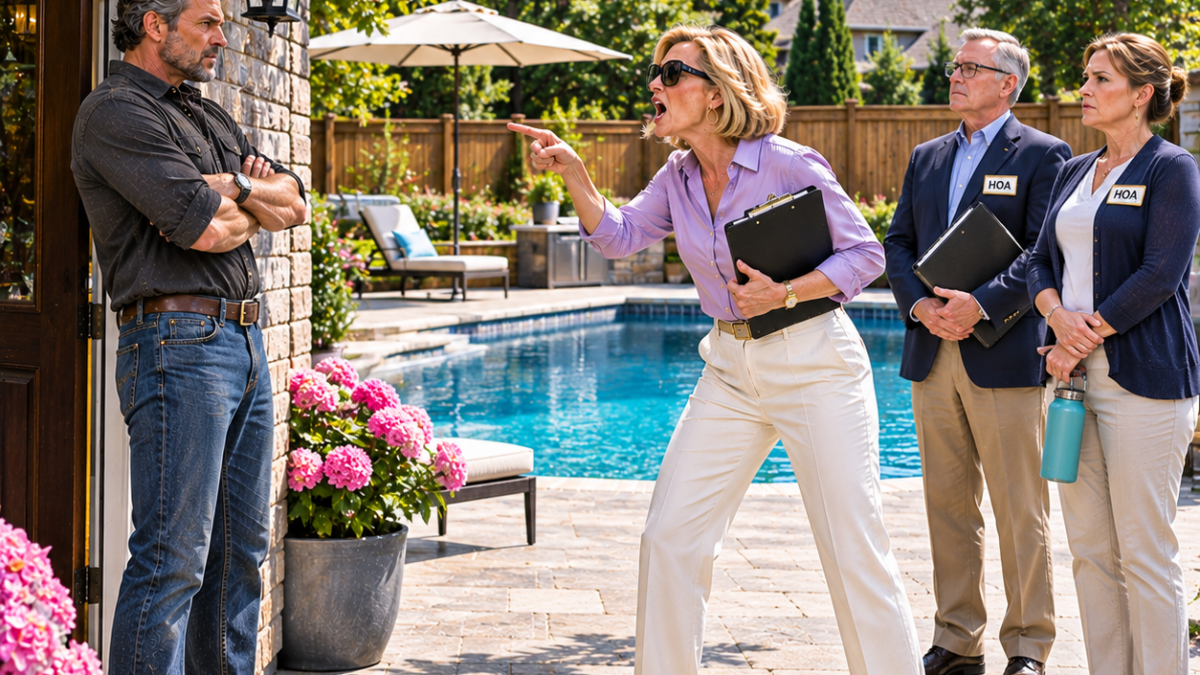
Karen folded her hands in front of her stomach, gold bracelet flashing in the afternoon light.
“The board has determined that your pool area would be the ideal location for monthly meetings.”
For a second, my brain refused to make sense of the sentence.
“My pool area,” I repeated.
“Yes.” She brightened, mistaking shock for interest. “It has privacy, seating potential, a pleasant atmosphere, and enough distance from the street to allow confidential board discussions. The park is too exposed, and frankly, the bugs have been terrible.”
I stared at her.
Then I laughed.
I wish I could say it was a controlled laugh, but it came out of me before I could stop it. Not cruel, exactly. More like the sound a person makes when reality briefly trips over itself.
Karen’s face changed instantly.
Alan looked down at the folder.
Brenda took a sip from the water bottle even though it appeared to be empty.
“You’re serious,” I said.
Karen’s smile was gone now. “Of course we’re serious.”
“No.”
Her eyes narrowed. “Excuse me?”
“No, you cannot use my pool for your HOA meetings.”
She drew herself up, shoulders back, chin high. “The board voted.”
“The board could vote to meet on the moon. That doesn’t make NASA responsible for snacks.”
Brenda made a small noise that might have been a cough. Karen shot her a look.
“This is not a joke,” Karen said.
“You’re right. It’s trespassing with minutes attached.”
Alan finally spoke. “Maybe we should clarify. The bylaws allow the board to use neighborhood amenities for official association business.”
“That’s nice,” I said. “My pool is not a neighborhood amenity.”
“It’s within the neighborhood,” Karen said.
“My refrigerator is also within the neighborhood. You can’t hold budget meetings next to my leftovers.”
Her mouth tightened. “This attitude is exactly why community cooperation has become so difficult.”
I stepped onto the porch and pulled the door partly closed behind me.
“Karen, listen carefully. I own this house. I own the backyard. I own the pool. I paid for it, maintain it, insure it, and lock the gate to keep people out. I am not part of your HOA. Your bylaws do not apply to me, and your board does not get to vote on my property.”
She looked genuinely offended, as if I had insulted her family.
“You don’t even use it during the evenings when we would meet.”
That stopped me.
“How would you know when I use my pool?”
Her eyes flicked away for half a second.
“I live nearby. People notice things.”
“You’ve been watching my backyard?”
“Don’t be dramatic.”
“My backyard is fenced.”
“For privacy,” she said quickly. “Which is why it is perfect.”
“No.”
“We would be respectful.”
“No.”
“We could sign a basic use agreement.”
“No.”
“You are being extremely selfish.”
I laughed again, but this time there was no humor in it. “Selfish is showing up at someone’s house and asking to use their private pool because the public park has bugs.”
Karen’s cheeks flushed pink beneath her makeup.
Alan cleared his throat. “Maybe we should revisit—”
“No,” Karen snapped, then seemed to remember she had an audience and softened her voice. “No, Alan. We have a responsibility to secure appropriate meeting facilities.”
“Then rent a room.”
“That costs money.”
“There it is.”
Karen’s eyes hardened.
“We pay dues to maintain this community.”
“I don’t.”
“But you benefit from the neighborhood’s overall appearance and property values.”
“I also benefit from the sun coming up. I don’t let it hold meetings in my pool.”
Brenda looked like she was struggling not to smile.
Karen took one step closer.
“The HOA has authority over common community resources.”
“My pool is not common.”
“The board disagrees.”
“The board is wrong.”
Her voice dropped lower. “You may want to think carefully before alienating the people around you.”
I looked past her at the quiet street, at the identical mailboxes, at the clipped lawns and shuttered windows. I wondered how many people had smiled through Karen’s nonsense because saying no felt harder than giving her what she wanted.
Then I looked back at her.
“Get off my porch.”
For one second, nobody moved.
Then Karen stepped backward, her lips pressed into a white line.
“This is not over,” she said.
“It is from my side.”
She turned sharply, the wedge heels clicking against the porch steps.
Alan gave me an apologetic glance as he followed. Brenda whispered, “Sorry,” so softly I barely heard it.
Karen heard it, though.
Her head snapped toward Brenda, and I saw Brenda shrink.
That told me plenty about the board.
I closed the door and stood there for a moment with my hand still on the knob. My laundry was still waiting. The towels were probably wrinkled. The house was quiet.
Then I laughed again, but this time it felt uneasy.
Because absurd people are funny until they have power.
And Karen, somehow, believed she did.
The next week was calm in the way the air goes calm before a storm.
I saw Karen twice from a distance. Once, she was walking down the sidewalk with another woman, talking with dramatic hand gestures. When she saw me getting my mail, she stopped mid-sentence and stared. I gave her a small wave. She did not return it.
Another time, I caught her slowing her car in front of my house. She looked toward my side gate, then drove on.
I checked the gate lock that night.
Twice.
The following Saturday, at 10:03 in the morning, my doorbell rang.
This time, there were four people on my porch.
Karen.
A man I recognized as the HOA president, though I had never spoken to him.
And two police officers.
For half a second, all I could do was stare through the glass.
Then I opened the door.
Karen started talking before I said a word.
“Officers, this is the homeowner. He has locked off access to community property and refused to cooperate with an official HOA function.”
The younger officer looked at me with the tired patience of someone who had already realized this call was going to waste everyone’s morning.
“Sir,” he said, “can we speak with you for a moment?”
“Sure,” I said. “But just so we’re starting from reality, the ‘community property’ she’s talking about is my fenced backyard pool.”
Karen made an outraged sound.
The older officer looked past me toward the side of the house, where the top edge of my privacy fence was visible.
“Your backyard pool?” he asked.
“Yes.”
The HOA president shifted uncomfortably. His name, I later learned, was Martin Hale. He was a broad-shouldered man in his sixties with gray hair and a face that suggested he had woken up regretting this before he even got dressed.
Karen cut in. “It is being used as a private amenity within the neighborhood, and under our bylaws—”
“I’m not in your HOA,” I said.
The officers looked at her.
Karen smiled tightly. “He lives within the neighborhood.”
“Not within the association,” I said.
The older officer asked, “Do you have proof that this property belongs to the HOA?”
Karen blinked. “The bylaws—”
“Do you have a deed, easement, court order, access agreement, anything showing the HOA has legal access to his backyard?”
“The board voted—”
“That’s not what I asked.”
The porch went very quiet.
I almost felt bad for Martin Hale. Almost. He looked like a man realizing the problem he thought he was supervising was actually standing next to him wearing coral lipstick.
I said, “I can get my deed if you want. Property records. Closing documents. County parcel map.”
The younger officer shook his head. “That won’t be necessary unless there’s an actual dispute over ownership.”
Karen pointed toward my fence. “There is a dispute over community access.”
“No,” I said. “There is a woman who wants to trespass.”
Her head whipped toward me. “How dare you?”
The older officer held up one hand. “Ma’am.”
Karen turned back to him. “We are simply asking for access to hold a meeting.”
“You called the police,” I said.
“Because you were obstructing official business.”
“I was drinking coffee in my kitchen.”
The younger officer’s mouth twitched. He hid it quickly.
The older officer took a breath. “Ma’am, we cannot force a homeowner to allow an HOA meeting in his private backyard. If he is not a member of your association, this appears to be a civil matter at best, and frankly I’m not hearing anything that suggests you have any legal access.”
Karen’s face turned red.
“So he can just refuse?”
“Yes,” the officer said.
“It affects the entire community.”
“Still yes.”
Martin finally spoke. “Karen, we should go.”
She glared at him. “You’re the president.”
“And I’m saying we should go.”
That was the first moment I saw the crack between them.
Karen had dragged him there expecting him to back her play. Maybe he had not understood the full absurdity of what she had promised. Maybe he had thought there was some easement, some shared amenity status, some plausible basis for the call. Or maybe he had simply let Karen run too far ahead because stopping her was exhausting.
Whatever the reason, he now looked embarrassed.
The officers left after telling Karen, very clearly, that she could not enter my backyard without permission.
Karen stayed on the sidewalk after they walked away, staring at me.
“This is not over,” she said again.
I smiled. “You keep saying that like it helps.”
Her nostrils flared.
Then she turned and marched down the street, Martin following several steps behind her like a man trying not to be seen near a fire he had helped carry.
You would think the police explaining private property to her would have ended the matter.
It did not.
Three days later, I received a letter from the HOA.
It was printed on official letterhead, which would have been more intimidating if my name had not been misspelled in the first line.
Dear Mr. Harris,
Failure to cooperate with official HOA activities has been documented. Your refusal to allow reasonable access to a neighborhood amenity has created unnecessary disruption to association governance. Continued obstruction may result in fines and further action.
I read it once.
Then again.
Then I called a lawyer.
His name was David Russo, and he specialized in HOA disputes. I found him through a late-night search that included phrases like “HOA no jurisdiction non-member harassment” and “can HOA fine someone not in HOA,” which felt ridiculous to type but apparently not ridiculous enough for my life.
David listened to my story without interrupting.
When I finished, he said, “You’re not in the HOA?”
“No.”
“Your deed isn’t subject to their covenants?”
“No.”
“The pool is entirely on your property?”
“Yes.”
“And they called the police?”
“Yes.”
He was quiet for a moment.
Then he said, “Some people really do wake up and choose billable hours.”
I liked him immediately.
He had me send the letter, my deed, the HOA boundary map, and the police incident number. Two days later, he sent the HOA a formal cease-and-desist letter. It stated, in very plain terms, that I was not a member, my property was not subject to their bylaws, my pool was private property, and any further attempt to fine, threaten, access, or represent otherwise would be treated as harassment and potential tortious interference with property rights.
I thought that would scare them.
It scared the wrong people.
The HOA president’s office sent back a brief email acknowledging receipt and saying they would review the matter with counsel.
Karen sent another fine.
This one claimed my trash bins were visible from the street.
They were not. They were behind my side gate. The only way she could have known they existed there was by walking close enough to peer through a gap in the fence.
Then came a warning about my mailbox.
Then a notice about “excessive pool noise,” despite the fact that I had not had anyone over and mostly used the pool alone after work with headphones in.
Then a “courtesy reminder” that private amenities visible from common areas should maintain “community aesthetic harmony.”
My pool was not visible from the street.
That phrase—community aesthetic harmony—made me stare at the paper for almost a full minute before I laughed.
I saved everything.
David told me not to respond directly.
“Let her keep making paper,” he said. “Paper is useful.”
While Karen was busy inventing violations, I started noticing something else.
People were watching.
Not in a sinister way. In that suburban way where everyone pretends they are just watering flowers, adjusting sprinklers, checking mail, walking dogs, or inspecting clouds while absolutely absorbing every detail of neighborhood conflict. A woman across the street asked me, too casually, if “everything was okay with the board.” The guy with the black Labrador said, “I heard something about your pool,” then looked immediately guilty for saying it.
I realized Karen had not kept this quiet.
Why would she?
People like Karen thrive on narrative. If she could turn me into the selfish homeowner who refused to support community governance, she could turn her humiliation into leadership. She could make me the problem, make herself the victim, and make the HOA the wounded institution.
I had ignored her long enough.
Now I needed witnesses too.
But I did not want to sue if I could avoid it. Lawsuits cost money, time, energy, and pieces of your peace you do not get back. David said we had options, but he also understood when I told him what I really wanted.
“I want her embarrassed,” I said. “Not the whole HOA. Her.”
David paused. “As your attorney, I’m supposed to advise measured restraint.”
“And as a person?”
“As a person, I’m listening.”
That was when I thought of the pool party.
At first, it was just a petty idea. A little harmless revenge. If Karen was so obsessed with my pool being a community amenity, I would show everyone exactly what it was: private property, used by invitation.
So I planned carefully.
I picked a Saturday with good weather. I invited neighbors within three blocks, including plenty of HOA members, but not Karen. I also avoided inviting the small circle of women who always seemed to orbit her at board events. I printed simple invitations and hand-delivered most of them because I wanted people to hear the tone directly from me.
“Nothing fancy,” I told them. “Just burgers, pool, music, a chance to actually know the people we wave at.”
Some looked surprised.
Some looked pleased.
Some looked like they were mentally calculating how mad Karen would be.
Good.
I hired a lifeguard for the afternoon because liability matters, and I wanted this done right. I checked my homeowner’s insurance. I bought extra towels, coolers, drinks, food, paper plates, sunscreen, and a ridiculous inflatable flamingo that looked like it had seen things.
I also posted a small sign at the side gate.
PRIVATE PARTY
INVITED GUESTS ONLY
NO HOA BUSINESS
NO ENTRY WITHOUT OWNER PERMISSION
Was that petty?
Absolutely.
Was it accurate?
Also yes.
People showed up.
More than I expected.
By three o’clock, my backyard was full of neighbors I had mostly only known by house numbers and dog names. Kids splashed in the shallow end. Adults stood around with drinks, laughing, introducing themselves, asking how long I had lived there. Someone brought pasta salad. Someone else brought brownies. A man named Kevin discovered my grill was uneven and fixed it with a folded piece of cardboard like it was a sacred duty.
For the first time since buying the house, I felt like maybe I had been wrong about keeping everyone at arm’s length.
Not about the HOA.
Never that.
But about the people.
Most of them were just people. Tired, curious, funny, awkward, neighborly in the normal way. Some had stories about Karen. Once they realized the party was not a trap but a place where Karen was not present, the stories started flowing.
“She tried to fine us because our Halloween skeleton was too tall.”
“She reported my grandson’s chalk drawings.”
“She once told me my hydrangeas looked emotionally chaotic.”
“I don’t even know what that means.”
“She walked into my daughter’s graduation party and asked if the chicken was from Costco.”
That one made me choke on my drink.
Photos went up online almost immediately. People tagged each other. Someone posted in the town group. Someone else posted in the HOA community page. Kids posed with the flamingo. Adults took selfies by the pool. I didn’t encourage anyone to be cruel, but I did not mind the visibility.
Karen saw it.
Of course she did.
At 4:17 p.m., the side gate buzzer rang.
I checked the camera feed from my phone.
Karen stood outside.
She had dressed for entry.
White linen pants. Teal blouse. Big sunglasses. A sunhat. A tote bag over one shoulder. She was smiling like a woman arriving at an event she believed could not survive without her.
Behind her, two of her loyal friends hovered uncertainly.
I walked to the gate.
Several people noticed.
The backyard conversation lowered slightly as if everyone had felt a storm front move in.
I opened the gate just enough to stand in the gap.
“Karen.”
Her smile widened. “There you are. We heard there was a neighborhood pool gathering.”
“There is a private party.”
“Yes, well.” She lifted her tote bag slightly. “We’re here.”
“You’re not invited.”
Her smile froze.
Behind me, I could feel people listening.
Karen’s voice dropped. “Don’t be childish.”
“This is my home. My pool. My guest list.”
“You invited HOA members.”
“I invited neighbors.”
“That makes it a community event.”
“No. It makes it a private party with neighbors I invited.”
One of her friends whispered, “Karen, maybe we should—”
Karen ignored her.
“You cannot exclude board members from a neighborhood gathering.”
“You’re not here as a board member.”
“I am always a representative of this community.”
“Not in my backyard.”
Her cheeks flushed.
I kept my voice calm, because calm humiliation lasts longer.
“You called the police on me because I would not let you use my pool. You sent me fake fines even though I’m not in your HOA. You’ve repeatedly claimed authority over property you don’t own. So no, Karen. You are not coming in.”
The yard behind me was silent now.
Karen knew it.
Her eyes flicked past my shoulder and saw phones. Not many, but enough. People pretending to check messages. People not pretending very well.
“You are making a mistake,” she hissed.
“No,” I said. “I’m enforcing a boundary.”
For a second, I thought she might try to push past me.
Instead, she straightened.
“Fine,” she said loudly. “Enjoy your little party.”
“I am.”
I closed the gate.
The latch clicked.
And something on the other side of it broke—not the gate, not the lock, but the image Karen had built of herself as someone nobody could refuse in public.
When I turned around, no one clapped. Thank God. That would have made it cartoonish.
But Kevin, the grill guy, lifted his drink and said, “Good boundary.”
People laughed.
The party recovered.
Actually, it got better.
By evening, the story had grown legs and run through the neighborhood faster than any official HOA notice ever could. People who had not come to the party were texting people who had. Screenshots of Karen at the gate started circulating. Someone posted a vague but obvious comment in the HOA group: Great afternoon at a PRIVATE pool party hosted by a NON-HOA neighbor who understands invitations better than some board members understand property rights.
I made my own post later.
Thank you to everyone who came by today. It was great getting to know actual neighbors. Special thanks to the HOA members who understand the difference between private property and association property. My backyard is always private, always by invitation, and never available for board meetings.
The comments were glorious.
Karen must have reported the post because it disappeared the next day.
Too late.
People had already seen it.
By Monday, the rumor mill was not a rumor mill anymore. It was a truth mill. People were openly talking about the police incident, the fake fines, the meeting request, and Karen being turned away. Some were angry on my behalf. Others were furious because Karen’s behavior made the whole HOA look ridiculous.
That part mattered.
Karen had spent years convincing people her overreach was leadership. But leadership that embarrasses the group eventually becomes liability.
The HOA president, Martin Hale, called me that Wednesday.
I almost didn’t answer.
Then I thought, why not?
“Mr. Carter,” he said, sounding tired. “This is Martin Hale with the Stonebridge HOA.”
“My pool is booked,” I said.
There was a pause.
Then, to my surprise, he chuckled once. “I probably deserved that.”
I waited.
“I want to apologize,” he said.
That got my attention.
“For what exactly?”
“For coming to your house with the police. For allowing Ms. Whitmore to represent the situation as if there was an access issue when there was not. And for any letters or fines sent after that. They are being withdrawn.”
“They were never valid.”
“I understand.”
“Does Karen?”
Another pause.
“The board is addressing that.”
“That sounds vague.”
“It has to, for now.”
“I have an attorney, Martin. Vague doesn’t help.”
He sighed. “Fair. There is a special board meeting tomorrow. Ms. Whitmore’s conduct is on the agenda. Our counsel has reviewed the matter. She had no authority to send notices to a non-member, no authority to threaten fines, and no authority to claim your property as an association amenity.”
“That was all obvious before counsel charged you to say it.”
“Yes,” he said quietly. “It was.”
For the first time, I felt a little sympathy for him.
Not much.
A little.
He continued, “I would like to send you a written apology and confirmation that the association asserts no jurisdiction over your property.”
“Do that.”
“We will.”
“And make sure Karen doesn’t come near my gate again.”
“We will address that too.”
The special meeting happened the next night.
I did not attend because, again, not in the HOA. But by that point, I had enough friendly neighbors willing to report back that I might as well have had press credentials.
According to Kevin, it was brutal.
Martin opened by explaining that the board had received legal advice confirming the HOA had no authority over my property or pool. Then he said board members could not use their positions to harass non-members, waste association resources, or expose the HOA to liability.
Karen tried to defend herself.
She said she had been acting in the association’s best interests.
People groaned.
She said private amenities affected neighborhood cohesion.
Someone asked if that meant the HOA could use his grill.
Someone else asked if Karen wanted to hold meetings in their hot tub.
Then Brenda, the woman who had stood silently on my porch that first day, finally spoke.
She told the room that Karen had pressured the board into voting on my pool without providing proof it was an HOA amenity. She admitted she had felt uncomfortable but had not pushed back hard enough. She apologized to the members and said she would not support Karen’s continued role.
That, apparently, was the turning point.
Karen accused Brenda of betrayal.
Martin cut her off.
A motion was made to remove Karen from her committee roles and censure her conduct. The board voted. She lost.
Then, because her position had already become a public embarrassment, enough residents pushed for her removal from the board entirely through the process allowed by their bylaws. That took longer—petitions, notices, procedural nonsense—but the momentum was there.
Karen had finally become more expensive than useful.
Three weeks later, she was voted out.
Not suspended.
Not warned.
Out.
I found out from Martin’s formal letter, which arrived in the mail with actual postage and no misspelling of my name.
Mr. Carter,
On behalf of the Stonebridge Homeowners Association, I apologize for the improper conduct directed toward you regarding your private backyard pool and property. The Association acknowledges that your property is not subject to our governing documents, that you are not a member of the Association, and that the Association has no right of access, control, enforcement, or use related to your home, pool, yard, or any portion of your property.
All prior notices or purported fines sent to you are withdrawn and void.
The Association has also taken internal action regarding the board member responsible for the improper communications.
Sincerely,
Martin Hale
President, Stonebridge HOA
I read it twice.
Then I framed it.
Not in the living room. I’m not that dramatic.
I put it in the garage, above the shelf where I keep pool chemicals.
It felt appropriate.
Karen’s fall from power changed the neighborhood almost overnight.
Not because she disappeared. She still lived down the block. She still walked with her stiff posture and her sunglasses and her little cloud of perfume. But she no longer had the badge. No longer had the title. No longer had the implied threat of “the board” behind every opinion.
She was just Karen.
And for a woman like Karen, just being Karen was a punishment all by itself.
People stopped inviting her to things. Not officially, maybe, but socially. Conversations quieted when she approached. The women who used to stand with her at mailboxes became suddenly busy. Her posts in the community group received fewer comments. When she complained about a neighbor’s garden gnome being “visually disruptive,” three people replied with laughing emojis before a moderator turned off comments.
I did not gloat publicly.
I wanted to.
I am not above wanting.
But I kept it clean. I had made my point. The neighbors knew. The HOA knew. Karen knew.
That was enough.
Mostly.
The strange thing was that the pool party had done more than embarrass Karen. It had changed my relationship with the neighborhood.
Before all this, I had kept people at a distance. Friendly distance, sure, but distance. I told myself it was because I didn’t want HOA drama, and that was partly true. But I think I had also confused privacy with isolation.
After the party, people waved more. Stopped to talk more. Invited me to cookouts. Asked for help moving patio furniture. Brought over extra tomatoes. Kevin became my unofficial grill consultant whether I wanted one or not. Brenda came by one afternoon with a handwritten apology and a bottle of wine.
“I should have spoken up sooner,” she said.
I accepted the wine.
“You did eventually.”
“That’s generous.”
“It’s accurate.”
She looked relieved.
Then she said, “For what it’s worth, a lot of us were tired of Karen too. We just didn’t want to be next.”
That stayed with me.
Karen had not controlled the neighborhood because everyone loved her. She controlled it because too many people had decided resisting her was not worth the trouble. I understood that better than I wanted to. I had almost done the same thing. Ignore the letters. Laugh off the absurdity. Let her be ridiculous until she got bored.
But people like Karen do not get bored when they smell compliance.
They get bigger.
A month after Karen was removed, Martin stopped by my house alone.
He did not ring three times. That already made him better company.
I opened the door.
“No police?” I asked.
He smiled tiredly. “Not today.”
“What can I do for you?”
“I wanted to hand-deliver the final confirmation.” He gave me an envelope. “All improper notices are voided in our records. Your address has been flagged as non-member, no contact unless initiated by you or required by law. Our management company has been instructed accordingly.”
“Good.”
“And I wanted to say something off the record.”
“Sounds dangerous.”
“Probably.” He looked down the street toward Karen’s house. “We let her have too much room because she was willing to do work nobody else wanted to do. Newsletter. compliance reminders. meeting logistics. Complaints. She made herself useful, then used usefulness as leverage.”
“That sounds familiar.”
“It shouldn’t have taken your situation to make us see it.”
“No, it shouldn’t.”
He accepted that.
“I’m sorry,” he said.
This time, I believed him.
“Thank you.”
He turned to leave, then paused. “For what it’s worth, your party looked fun.”
“It was.”
“The flamingo was a nice touch.”
“That flamingo has seen battle.”
He laughed and walked back down the path.
After that, life settled.
Not perfectly. Suburbs are never perfect. Someone always hates someone’s lawn treatment, dog barking, leaf blower, wind chimes, or teenager’s car. But the specific pressure of Karen’s attention lifted from my house like a storm moving east.
One evening in late summer, I was floating in the pool after work, staring up at a sky turning purple around the edges. The water was warm from the day’s heat. Music played softly from a speaker on the patio. The fence stood around the yard, tall and solid, and for the first time in months, I did not feel watched.
Then I heard voices on the sidewalk beyond the fence.
Karen’s voice.
I opened one eye.
She was talking to someone, probably one of the few people still willing to walk with her. Her tone was lower than usual, but I caught a sentence.
“People don’t understand what community used to mean.”
I almost laughed.
Maybe she truly believed that.
Maybe, in Karen’s mind, community meant everyone surrendering private boundaries whenever she found them inconvenient. Maybe it meant giving her access, attention, agreement, and authority because she had decided she was the kind of person who should have those things.
But floating there in the pool she had tried to claim, I thought about the neighbors laughing in my yard, kids passing sunscreen back and forth, Brenda apologizing, Kevin fixing the grill, Martin owning his mistake, people finally telling Karen no.
That was community.
Not forced access.
Not fake fines.
Not showing up with police because someone refused to open a gate.
Community is invitation.
Karen never understood that.
The following spring, I hosted another pool party.
Smaller this time. Less revenge, more burgers.
I invited neighbors I actually liked. HOA members and non-HOA homeowners both came. Kids swam. Adults complained about property taxes. Kevin brought a new grill brush as a gift because apparently my old one had offended him spiritually. Brenda brought fruit salad. Martin came for an hour and stayed carefully away from any sentence that included the word “board.”
Karen did not appear at the gate.
Nobody mentioned her for almost two hours.
Then someone asked, “Does she still live down the block?”
“Unfortunately,” Kevin said.
Brenda nudged him. “Be nice.”
“I said unfortunately nicely.”
People laughed, then moved on.
That was when I knew Karen had truly lost.
Not when she was voted off the board. Not when the fines were voided. Not when Martin apologized. Not even when she stood outside my gate and got turned away in front of the neighborhood.
She lost when she became boring.
When her drama stopped commanding the room.
When people could laugh, shrug, and keep eating fruit salad.
There is no worse fate for a person addicted to control than becoming background noise.
I still have the pool.
I still lock the gate.
I still maintain the insurance, the permits, the safety equipment, and the water chemistry. I still keep the framed HOA apology in the garage above the pool supplies. Sometimes, when I test chlorine levels, I glance at it and smile.
It reminds me that private property is not selfish.
Boundaries are not cruelty.
Saying no is not hostility.
And a vote taken by people with no authority is just a group hallucination with paperwork.
Karen taught me that some people will call you selfish for refusing to give them what they had no right to ask for. They will call your fence unneighborly because it stops them. They will call your refusal disruptive because their plans depended on your surrender. They will misuse words like community, cooperation, harmony, and access until those words sound almost ugly.
But the words were never the problem.
The lie was.
Real community does not begin with someone forcing open your gate.
It begins when people respect that the gate is yours.
My pool is still not an HOA amenity.
My backyard is still private.
Karen is still not invited.
And every time I hear laughter from friends and neighbors inside that fence, I remember the day she stood outside it with her tote bag, her sunglasses, and all her borrowed authority draining into the sidewalk.
She wanted my pool for a meeting.
Instead, she became the agenda.
𝗧𝗛𝗘 𝗘𝗡𝗗
The HOA Woman at My Door Said My Backyard Pool Belonged to the Neighborhood, So I Made Sure Everyone Saw Her Get Turned Away
I had never joined their HOA, never used their park, and never asked for a single thing from them. But Karen looked at my fenced backyard and decided her board had voted my private pool into community service. When she brought the police to my door and accused me of blocking access to “neighborhood property,” I knew being polite was no longer enough.
The first thing I need to make clear is that I am not against neighbors.
I know that sounds like something a person says right before proving they absolutely are against neighbors, but I mean it. I wave. I say hello. I bring my trash cans in on time most weeks. If a package lands on the wrong porch, I walk it over instead of pretending I never saw it. When the guy two houses down had surgery, I helped his wife drag their bins to the curb for a month. When the retired couple across the street asked if I could keep an eye on their place while they visited their daughter, I did.
So no, I do not hate community.
What I hate is the kind of person who uses the word community when what they really mean is control.
I live in one of those suburban neighborhoods that looks like it was copied and pasted from a builder’s brochure. Curved streets, matching rooflines, trimmed lawns, mailboxes that all appear to have been chosen by the same committee of people who fear personality. Most of the houses belong to an HOA that covers a few blocks around mine. Mine does not. That fact is not a rumor, not a loophole, not a misunderstanding. It is right there in the paperwork from when I bought the place.
My property predates the HOA boundary by a few years, and for reasons I have thanked the universe for more than once, my house was never folded into it.
That means I do not pay dues.
It also means I do not use their little park, their seasonal picnic pavilion, their flowerbed fund, or their newsletter that apparently contains dramatic updates about mulch color. Fair trade, in my opinion.
The HOA had rules about everything. Mailbox color. Fence stain. Garage door windows. Holiday decorations. Trash bins. How long a basketball hoop could sit in a driveway. What kind of edging counted as “visually harmonious.” I once saw a neighbor get a warning letter because his recycling bin was visible from the street for too many hours after pickup.
I am not built for that.
I bought my house because it had three things I wanted: a decent kitchen, enough distance from my office to feel like I had escaped work, and a private fenced backyard with a pool.
Not a mansion pool. Not one of those resort-style setups with waterfalls, stone grottos, and lighting systems that probably require a software update. Mine was modest. Rectangular. Clean. Deep enough to float in after work and long enough to do a lazy lap if I felt ambitious. There was a concrete patio around it, a little shed for pool supplies, a grill, two lounge chairs, and a six-foot privacy fence that wrapped the entire yard.
I paid for that pool myself.
I maintained it myself.
I insured it myself.
I checked every permit, every safety rule, every county requirement when I bought the house. Fence height. Gate latch. Drain compliance. Electrical grounding. Pool cover. Signage. I dotted every i and crossed every t because water on private property is not something I take lightly. I knew exactly what I owned and exactly what I was responsible for.
That mattered later.
The HOA’s self-appointed queen of standards lived down the block.
Her name was Karen Whitmore, and if her name had been anything else, people would still have called her Karen behind her back because some souls arrive on earth already carrying a clipboard. She was a white American woman in her early fifties with stiff blond hair cut into a polished bob, bright red lipstick, and the kind of smile that looked less like warmth and more like a warning label. She dressed like every sidewalk was a board meeting: pressed capris, pastel blouses, wedge sandals, gold bracelets, sunglasses pushed up on her head, and a little HOA badge she wore to events as if it had been issued by the federal government.
Karen was known for overstepping.
That is a polite word for it.
She would see someone having a backyard cookout and wander over like she had been invited by the smoke. She would “just stop by” during birthday parties and somehow end up with a paper plate. She sent reminder texts and flyers to people who were not even in the HOA. I once found a note tucked under my windshield wiper that said, Friendly reminder: snow season is approaching. Please keep sidewalks clear for community safety.
It was August.
Another time, she left a printed notice on my door reminding “all residents” that trash containers should be stored out of view from the street. I ignored it because, again, I was not in the HOA.
Karen did not like being ignored.
The first time she came for my pool, I was folding towels in the laundry room.
The doorbell rang three times in the rhythm of someone who believed urgency could be created by repetition. I looked through the side window and saw Karen standing on my porch with two people I did not recognize. One was a tall, nervous-looking man holding a folder. The other was a woman in a navy cardigan clutching a reusable water bottle like she wished it were stronger.
Karen stood front and center.
Of course.
I opened the door halfway.
“Hi,” I said.
“Good afternoon,” Karen said, already smiling too widely. “We need a few minutes of your time.”
No hello. No how are you. No sorry to bother you.
We need.
That should have warned me.
“What’s up?”
She gestured to the two people beside her. “This is Alan and Brenda from the board.”
I looked at them, then back at her. “Okay.”
Karen’s smile sharpened. “The HOA board has voted on a new location for our monthly meetings.”
I waited.
She waited too, as if expecting me to congratulate her.
“I’m not in the HOA,” I said. “So I’m not sure why you’re telling me.”
“Well,” she said, with the tone of a kindergarten teacher about to explain glue sticks, “that’s actually why we’re here.”
part2
Karen folded her hands in front of her stomach, gold bracelet flashing in the afternoon light.
“The board has determined that your pool area would be the ideal location for monthly meetings.”
For a second, my brain refused to make sense of the sentence.
“My pool area,” I repeated.
“Yes.” She brightened, mistaking shock for interest. “It has privacy, seating potential, a pleasant atmosphere, and enough distance from the street to allow confidential board discussions. The park is too exposed, and frankly, the bugs have been terrible.”
I stared at her.
Then I laughed.
I wish I could say it was a controlled laugh, but it came out of me before I could stop it. Not cruel, exactly. More like the sound a person makes when reality briefly trips over itself.
Karen’s face changed instantly.
Alan looked down at the folder.
Brenda took a sip from the water bottle even though it appeared to be empty.
“You’re serious,” I said.
Karen’s smile was gone now. “Of course we’re serious.”
“No.”
Her eyes narrowed. “Excuse me?”
“No, you cannot use my pool for your HOA meetings.”
She drew herself up, shoulders back, chin high. “The board voted.”
“The board could vote to meet on the moon. That doesn’t make NASA responsible for snacks.”
Brenda made a small noise that might have been a cough. Karen shot her a look.
“This is not a joke,” Karen said.
“You’re right. It’s trespassing with minutes attached.”
Alan finally spoke. “Maybe we should clarify. The bylaws allow the board to use neighborhood amenities for official association business.”
“That’s nice,” I said. “My pool is not a neighborhood amenity.”
“It’s within the neighborhood,” Karen said.
“My refrigerator is also within the neighborhood. You can’t hold budget meetings next to my leftovers.”
Her mouth tightened. “This attitude is exactly why community cooperation has become so difficult.”
I stepped onto the porch and pulled the door partly closed behind me.
“Karen, listen carefully. I own this house. I own the backyard. I own the pool. I paid for it, maintain it, insure it, and lock the gate to keep people out. I am not part of your HOA. Your bylaws do not apply to me, and your board does not get to vote on my property.”
She looked genuinely offended, as if I had insulted her family.
“You don’t even use it during the evenings when we would meet.”
That stopped me.
“How would you know when I use my pool?”
Her eyes flicked away for half a second.
“I live nearby. People notice things.”
“You’ve been watching my backyard?”
“Don’t be dramatic.”
“My backyard is fenced.”
“For privacy,” she said quickly. “Which is why it is perfect.”
“No.”
“We would be respectful.”
“No.”
“We could sign a basic use agreement.”
“No.”
“You are being extremely selfish.”
I laughed again, but this time there was no humor in it. “Selfish is showing up at someone’s house and asking to use their private pool because the public park has bugs.”
Karen’s cheeks flushed pink beneath her makeup.
Alan cleared his throat. “Maybe we should revisit—”
“No,” Karen snapped, then seemed to remember she had an audience and softened her voice. “No, Alan. We have a responsibility to secure appropriate meeting facilities.”
“Then rent a room.”
“That costs money.”
“There it is.”
Karen’s eyes hardened.
“We pay dues to maintain this community.”
“I don’t.”
“But you benefit from the neighborhood’s overall appearance and property values.”
“I also benefit from the sun coming up. I don’t let it hold meetings in my pool.”
Brenda looked like she was struggling not to smile.
Karen took one step closer.
“The HOA has authority over common community resources.”
“My pool is not common.”
“The board disagrees.”
“The board is wrong.”
Her voice dropped lower. “You may want to think carefully before alienating the people around you.”
I looked past her at the quiet street, at the identical mailboxes, at the clipped lawns and shuttered windows. I wondered how many people had smiled through Karen’s nonsense because saying no felt harder than giving her what she wanted.
Then I looked back at her.
“Get off my porch.”
For one second, nobody moved.
Then Karen stepped backward, her lips pressed into a white line.
“This is not over,” she said.
“It is from my side.”
She turned sharply, the wedge heels clicking against the porch steps.
Alan gave me an apologetic glance as he followed. Brenda whispered, “Sorry,” so softly I barely heard it.
Karen heard it, though.
Her head snapped toward Brenda, and I saw Brenda shrink.
That told me plenty about the board.
I closed the door and stood there for a moment with my hand still on the knob. My laundry was still waiting. The towels were probably wrinkled. The house was quiet.
Then I laughed again, but this time it felt uneasy.
Because absurd people are funny until they have power.
And Karen, somehow, believed she did.
The next week was calm in the way the air goes calm before a storm.
I saw Karen twice from a distance. Once, she was walking down the sidewalk with another woman, talking with dramatic hand gestures. When she saw me getting my mail, she stopped mid-sentence and stared. I gave her a small wave. She did not return it.
Another time, I caught her slowing her car in front of my house. She looked toward my side gate, then drove on.
I checked the gate lock that night.
Twice.
The following Saturday, at 10:03 in the morning, my doorbell rang.
This time, there were four people on my porch.
Karen.
A man I recognized as the HOA president, though I had never spoken to him.
And two police officers.
For half a second, all I could do was stare through the glass.
Then I opened the door.
Karen started talking before I said a word.
“Officers, this is the homeowner. He has locked off access to community property and refused to cooperate with an official HOA function.”
The younger officer looked at me with the tired patience of someone who had already realized this call was going to waste everyone’s morning.
“Sir,” he said, “can we speak with you for a moment?”
“Sure,” I said. “But just so we’re starting from reality, the ‘community property’ she’s talking about is my fenced backyard pool.”
Karen made an outraged sound.
The older officer looked past me toward the side of the house, where the top edge of my privacy fence was visible.
“Your backyard pool?” he asked.
“Yes.”
The HOA president shifted uncomfortably. His name, I later learned, was Martin Hale. He was a broad-shouldered man in his sixties with gray hair and a face that suggested he had woken up regretting this before he even got dressed.
Karen cut in. “It is being used as a private amenity within the neighborhood, and under our bylaws—”
“I’m not in your HOA,” I said.
The officers looked at her.
Karen smiled tightly. “He lives within the neighborhood.”
“Not within the association,” I said.
The older officer asked, “Do you have proof that this property belongs to the HOA?”
Karen blinked. “The bylaws—”
“Do you have a deed, easement, court order, access agreement, anything showing the HOA has legal access to his backyard?”
“The board voted—”
“That’s not what I asked.”
The porch went very quiet.
I almost felt bad for Martin Hale. Almost. He looked like a man realizing the problem he thought he was supervising was actually standing next to him wearing coral lipstick.
I said, “I can get my deed if you want. Property records. Closing documents. County parcel map.”
The younger officer shook his head. “That won’t be necessary unless there’s an actual dispute over ownership.”
Karen pointed toward my fence. “There is a dispute over community access.”
“No,” I said. “There is a woman who wants to trespass.”
Her head whipped toward me. “How dare you?”
The older officer held up one hand. “Ma’am.”
Karen turned back to him. “We are simply asking for access to hold a meeting.”
“You called the police,” I said.
“Because you were obstructing official business.”
“I was drinking coffee in my kitchen.”
The younger officer’s mouth twitched. He hid it quickly.
The older officer took a breath. “Ma’am, we cannot force a homeowner to allow an HOA meeting in his private backyard. If he is not a member of your association, this appears to be a civil matter at best, and frankly I’m not hearing anything that suggests you have any legal access.”
Karen’s face turned red.
“So he can just refuse?”
“Yes,” the officer said.
“It affects the entire community.”
“Still yes.”
Martin finally spoke. “Karen, we should go.”
She glared at him. “You’re the president.”
“And I’m saying we should go.”
That was the first moment I saw the crack between them.
Karen had dragged him there expecting him to back her play. Maybe he had not understood the full absurdity of what she had promised. Maybe he had thought there was some easement, some shared amenity status, some plausible basis for the call. Or maybe he had simply let Karen run too far ahead because stopping her was exhausting.
Whatever the reason, he now looked embarrassed.
The officers left after telling Karen, very clearly, that she could not enter my backyard without permission.
Karen stayed on the sidewalk after they walked away, staring at me.
“This is not over,” she said again.
I smiled. “You keep saying that like it helps.”
Her nostrils flared.
Then she turned and marched down the street, Martin following several steps behind her like a man trying not to be seen near a fire he had helped carry.
You would think the police explaining private property to her would have ended the matter.
It did not.
Three days later, I received a letter from the HOA.
It was printed on official letterhead, which would have been more intimidating if my name had not been misspelled in the first line.
Dear Mr. Harris,
Failure to cooperate with official HOA activities has been documented. Your refusal to allow reasonable access to a neighborhood amenity has created unnecessary disruption to association governance. Continued obstruction may result in fines and further action.
I read it once.
Then again.
Then I called a lawyer.
His name was David Russo, and he specialized in HOA disputes. I found him through a late-night search that included phrases like “HOA no jurisdiction non-member harassment” and “can HOA fine someone not in HOA,” which felt ridiculous to type but apparently not ridiculous enough for my life.
David listened to my story without interrupting.
When I finished, he said, “You’re not in the HOA?”
“No.”
“Your deed isn’t subject to their covenants?”
“No.”
“The pool is entirely on your property?”
“Yes.”
“And they called the police?”
“Yes.”
He was quiet for a moment.
Then he said, “Some people really do wake up and choose billable hours.”
I liked him immediately.
He had me send the letter, my deed, the HOA boundary map, and the police incident number. Two days later, he sent the HOA a formal cease-and-desist letter. It stated, in very plain terms, that I was not a member, my property was not subject to their bylaws, my pool was private property, and any further attempt to fine, threaten, access, or represent otherwise would be treated as harassment and potential tortious interference with property rights.
I thought that would scare them.
It scared the wrong people.
The HOA president’s office sent back a brief email acknowledging receipt and saying they would review the matter with counsel.
Karen sent another fine.
This one claimed my trash bins were visible from the street.
They were not. They were behind my side gate. The only way she could have known they existed there was by walking close enough to peer through a gap in the fence.
Then came a warning about my mailbox.
Then a notice about “excessive pool noise,” despite the fact that I had not had anyone over and mostly used the pool alone after work with headphones in.
Then a “courtesy reminder” that private amenities visible from common areas should maintain “community aesthetic harmony.”
My pool was not visible from the street.
That phrase—community aesthetic harmony—made me stare at the paper for almost a full minute before I laughed.
I saved everything.
David told me not to respond directly.
“Let her keep making paper,” he said. “Paper is useful.”
While Karen was busy inventing violations, I started noticing something else.
People were watching.
Not in a sinister way. In that suburban way where everyone pretends they are just watering flowers, adjusting sprinklers, checking mail, walking dogs, or inspecting clouds while absolutely absorbing every detail of neighborhood conflict. A woman across the street asked me, too casually, if “everything was okay with the board.” The guy with the black Labrador said, “I heard something about your pool,” then looked immediately guilty for saying it.
I realized Karen had not kept this quiet.
Why would she?
People like Karen thrive on narrative. If she could turn me into the selfish homeowner who refused to support community governance, she could turn her humiliation into leadership. She could make me the problem, make herself the victim, and make the HOA the wounded institution.
I had ignored her long enough.
Now I needed witnesses too.
But I did not want to sue if I could avoid it. Lawsuits cost money, time, energy, and pieces of your peace you do not get back. David said we had options, but he also understood when I told him what I really wanted.
“I want her embarrassed,” I said. “Not the whole HOA. Her.”
David paused. “As your attorney, I’m supposed to advise measured restraint.”
“And as a person?”
“As a person, I’m listening.”
That was when I thought of the pool party.
At first, it was just a petty idea. A little harmless revenge. If Karen was so obsessed with my pool being a community amenity, I would show everyone exactly what it was: private property, used by invitation.
So I planned carefully.
I picked a Saturday with good weather. I invited neighbors within three blocks, including plenty of HOA members, but not Karen. I also avoided inviting the small circle of women who always seemed to orbit her at board events. I printed simple invitations and hand-delivered most of them because I wanted people to hear the tone directly from me.
“Nothing fancy,” I told them. “Just burgers, pool, music, a chance to actually know the people we wave at.”
Some looked surprised.
Some looked pleased.
Some looked like they were mentally calculating how mad Karen would be.
Good.
I hired a lifeguard for the afternoon because liability matters, and I wanted this done right. I checked my homeowner’s insurance. I bought extra towels, coolers, drinks, food, paper plates, sunscreen, and a ridiculous inflatable flamingo that looked like it had seen things.
I also posted a small sign at the side gate.
PRIVATE PARTY
INVITED GUESTS ONLY
NO HOA BUSINESS
NO ENTRY WITHOUT OWNER PERMISSION
Was that petty?
Absolutely.
Was it accurate?
Also yes.
People showed up.
More than I expected.
By three o’clock, my backyard was full of neighbors I had mostly only known by house numbers and dog names. Kids splashed in the shallow end. Adults stood around with drinks, laughing, introducing themselves, asking how long I had lived there. Someone brought pasta salad. Someone else brought brownies. A man named Kevin discovered my grill was uneven and fixed it with a folded piece of cardboard like it was a sacred duty.
For the first time since buying the house, I felt like maybe I had been wrong about keeping everyone at arm’s length.
Not about the HOA.
Never that.
But about the people.
Most of them were just people. Tired, curious, funny, awkward, neighborly in the normal way. Some had stories about Karen. Once they realized the party was not a trap but a place where Karen was not present, the stories started flowing.
“She tried to fine us because our Halloween skeleton was too tall.”
“She reported my grandson’s chalk drawings.”
“She once told me my hydrangeas looked emotionally chaotic.”
“I don’t even know what that means.”
“She walked into my daughter’s graduation party and asked if the chicken was from Costco.”
That one made me choke on my drink.
Photos went up online almost immediately. People tagged each other. Someone posted in the town group. Someone else posted in the HOA community page. Kids posed with the flamingo. Adults took selfies by the pool. I didn’t encourage anyone to be cruel, but I did not mind the visibility.
Karen saw it.
Of course she did.
At 4:17 p.m., the side gate buzzer rang.
I checked the camera feed from my phone.
Karen stood outside.
She had dressed for entry.
White linen pants. Teal blouse. Big sunglasses. A sunhat. A tote bag over one shoulder. She was smiling like a woman arriving at an event she believed could not survive without her.
Behind her, two of her loyal friends hovered uncertainly.
I walked to the gate.
Several people noticed.
The backyard conversation lowered slightly as if everyone had felt a storm front move in.
I opened the gate just enough to stand in the gap.
“Karen.”
Her smile widened. “There you are. We heard there was a neighborhood pool gathering.”
“There is a private party.”
“Yes, well.” She lifted her tote bag slightly. “We’re here.”
“You’re not invited.”
Her smile froze.
Behind me, I could feel people listening.
Karen’s voice dropped. “Don’t be childish.”
“This is my home. My pool. My guest list.”
“You invited HOA members.”
“I invited neighbors.”
“That makes it a community event.”
“No. It makes it a private party with neighbors I invited.”
One of her friends whispered, “Karen, maybe we should—”
Karen ignored her.
“You cannot exclude board members from a neighborhood gathering.”
“You’re not here as a board member.”
“I am always a representative of this community.”
“Not in my backyard.”
Her cheeks flushed.
I kept my voice calm, because calm humiliation lasts longer.
“You called the police on me because I would not let you use my pool. You sent me fake fines even though I’m not in your HOA. You’ve repeatedly claimed authority over property you don’t own. So no, Karen. You are not coming in.”
The yard behind me was silent now.
Karen knew it.
Her eyes flicked past my shoulder and saw phones. Not many, but enough. People pretending to check messages. People not pretending very well.
“You are making a mistake,” she hissed.
“No,” I said. “I’m enforcing a boundary.”
For a second, I thought she might try to push past me.
Instead, she straightened.
“Fine,” she said loudly. “Enjoy your little party.”
“I am.”
I closed the gate.
The latch clicked.
And something on the other side of it broke—not the gate, not the lock, but the image Karen had built of herself as someone nobody could refuse in public.
When I turned around, no one clapped. Thank God. That would have made it cartoonish.
But Kevin, the grill guy, lifted his drink and said, “Good boundary.”
People laughed.
The party recovered.
Actually, it got better.
By evening, the story had grown legs and run through the neighborhood faster than any official HOA notice ever could. People who had not come to the party were texting people who had. Screenshots of Karen at the gate started circulating. Someone posted a vague but obvious comment in the HOA group: Great afternoon at a PRIVATE pool party hosted by a NON-HOA neighbor who understands invitations better than some board members understand property rights.
I made my own post later.
Thank you to everyone who came by today. It was great getting to know actual neighbors. Special thanks to the HOA members who understand the difference between private property and association property. My backyard is always private, always by invitation, and never available for board meetings.
The comments were glorious.
Karen must have reported the post because it disappeared the next day.
Too late.
People had already seen it.
By Monday, the rumor mill was not a rumor mill anymore. It was a truth mill. People were openly talking about the police incident, the fake fines, the meeting request, and Karen being turned away. Some were angry on my behalf. Others were furious because Karen’s behavior made the whole HOA look ridiculous.
That part mattered.
Karen had spent years convincing people her overreach was leadership. But leadership that embarrasses the group eventually becomes liability.
The HOA president, Martin Hale, called me that Wednesday.
I almost didn’t answer.
Then I thought, why not?
“Mr. Carter,” he said, sounding tired. “This is Martin Hale with the Stonebridge HOA.”
“My pool is booked,” I said.
There was a pause.
Then, to my surprise, he chuckled once. “I probably deserved that.”
I waited.
“I want to apologize,” he said.
That got my attention.
“For what exactly?”
“For coming to your house with the police. For allowing Ms. Whitmore to represent the situation as if there was an access issue when there was not. And for any letters or fines sent after that. They are being withdrawn.”
“They were never valid.”
“I understand.”
“Does Karen?”
Another pause.
“The board is addressing that.”
“That sounds vague.”
“It has to, for now.”
“I have an attorney, Martin. Vague doesn’t help.”
He sighed. “Fair. There is a special board meeting tomorrow. Ms. Whitmore’s conduct is on the agenda. Our counsel has reviewed the matter. She had no authority to send notices to a non-member, no authority to threaten fines, and no authority to claim your property as an association amenity.”
“That was all obvious before counsel charged you to say it.”
“Yes,” he said quietly. “It was.”
For the first time, I felt a little sympathy for him.
Not much.
A little.
He continued, “I would like to send you a written apology and confirmation that the association asserts no jurisdiction over your property.”
“Do that.”
“We will.”
“And make sure Karen doesn’t come near my gate again.”
“We will address that too.”
The special meeting happened the next night.
I did not attend because, again, not in the HOA. But by that point, I had enough friendly neighbors willing to report back that I might as well have had press credentials.
According to Kevin, it was brutal.
Martin opened by explaining that the board had received legal advice confirming the HOA had no authority over my property or pool. Then he said board members could not use their positions to harass non-members, waste association resources, or expose the HOA to liability.
Karen tried to defend herself.
She said she had been acting in the association’s best interests.
People groaned.
She said private amenities affected neighborhood cohesion.
Someone asked if that meant the HOA could use his grill.
Someone else asked if Karen wanted to hold meetings in their hot tub.
Then Brenda, the woman who had stood silently on my porch that first day, finally spoke.
She told the room that Karen had pressured the board into voting on my pool without providing proof it was an HOA amenity. She admitted she had felt uncomfortable but had not pushed back hard enough. She apologized to the members and said she would not support Karen’s continued role.
That, apparently, was the turning point.
Karen accused Brenda of betrayal.
Martin cut her off.
A motion was made to remove Karen from her committee roles and censure her conduct. The board voted. She lost.
Then, because her position had already become a public embarrassment, enough residents pushed for her removal from the board entirely through the process allowed by their bylaws. That took longer—petitions, notices, procedural nonsense—but the momentum was there.
Karen had finally become more expensive than useful.
Three weeks later, she was voted out.
Not suspended.
Not warned.
Out.
I found out from Martin’s formal letter, which arrived in the mail with actual postage and no misspelling of my name.
Mr. Carter,
On behalf of the Stonebridge Homeowners Association, I apologize for the improper conduct directed toward you regarding your private backyard pool and property. The Association acknowledges that your property is not subject to our governing documents, that you are not a member of the Association, and that the Association has no right of access, control, enforcement, or use related to your home, pool, yard, or any portion of your property.
All prior notices or purported fines sent to you are withdrawn and void.
The Association has also taken internal action regarding the board member responsible for the improper communications.
Sincerely,
Martin Hale
President, Stonebridge HOA
I read it twice.
Then I framed it.
Not in the living room. I’m not that dramatic.
I put it in the garage, above the shelf where I keep pool chemicals.
It felt appropriate.
Karen’s fall from power changed the neighborhood almost overnight.
Not because she disappeared. She still lived down the block. She still walked with her stiff posture and her sunglasses and her little cloud of perfume. But she no longer had the badge. No longer had the title. No longer had the implied threat of “the board” behind every opinion.
She was just Karen.
And for a woman like Karen, just being Karen was a punishment all by itself.
People stopped inviting her to things. Not officially, maybe, but socially. Conversations quieted when she approached. The women who used to stand with her at mailboxes became suddenly busy. Her posts in the community group received fewer comments. When she complained about a neighbor’s garden gnome being “visually disruptive,” three people replied with laughing emojis before a moderator turned off comments.
I did not gloat publicly.
I wanted to.
I am not above wanting.
But I kept it clean. I had made my point. The neighbors knew. The HOA knew. Karen knew.
That was enough.
Mostly.
The strange thing was that the pool party had done more than embarrass Karen. It had changed my relationship with the neighborhood.
Before all this, I had kept people at a distance. Friendly distance, sure, but distance. I told myself it was because I didn’t want HOA drama, and that was partly true. But I think I had also confused privacy with isolation.
After the party, people waved more. Stopped to talk more. Invited me to cookouts. Asked for help moving patio furniture. Brought over extra tomatoes. Kevin became my unofficial grill consultant whether I wanted one or not. Brenda came by one afternoon with a handwritten apology and a bottle of wine.
“I should have spoken up sooner,” she said.
I accepted the wine.
“You did eventually.”
“That’s generous.”
“It’s accurate.”
She looked relieved.
Then she said, “For what it’s worth, a lot of us were tired of Karen too. We just didn’t want to be next.”
That stayed with me.
Karen had not controlled the neighborhood because everyone loved her. She controlled it because too many people had decided resisting her was not worth the trouble. I understood that better than I wanted to. I had almost done the same thing. Ignore the letters. Laugh off the absurdity. Let her be ridiculous until she got bored.
But people like Karen do not get bored when they smell compliance.
They get bigger.
A month after Karen was removed, Martin stopped by my house alone.
He did not ring three times. That already made him better company.
I opened the door.
“No police?” I asked.
He smiled tiredly. “Not today.”
“What can I do for you?”
“I wanted to hand-deliver the final confirmation.” He gave me an envelope. “All improper notices are voided in our records. Your address has been flagged as non-member, no contact unless initiated by you or required by law. Our management company has been instructed accordingly.”
“Good.”
“And I wanted to say something off the record.”
“Sounds dangerous.”
“Probably.” He looked down the street toward Karen’s house. “We let her have too much room because she was willing to do work nobody else wanted to do. Newsletter. compliance reminders. meeting logistics. Complaints. She made herself useful, then used usefulness as leverage.”
“That sounds familiar.”
“It shouldn’t have taken your situation to make us see it.”
“No, it shouldn’t.”
He accepted that.
“I’m sorry,” he said.
This time, I believed him.
“Thank you.”
He turned to leave, then paused. “For what it’s worth, your party looked fun.”
“It was.”
“The flamingo was a nice touch.”
“That flamingo has seen battle.”
He laughed and walked back down the path.
After that, life settled.
Not perfectly. Suburbs are never perfect. Someone always hates someone’s lawn treatment, dog barking, leaf blower, wind chimes, or teenager’s car. But the specific pressure of Karen’s attention lifted from my house like a storm moving east.
One evening in late summer, I was floating in the pool after work, staring up at a sky turning purple around the edges. The water was warm from the day’s heat. Music played softly from a speaker on the patio. The fence stood around the yard, tall and solid, and for the first time in months, I did not feel watched.
Then I heard voices on the sidewalk beyond the fence.
Karen’s voice.
I opened one eye.
She was talking to someone, probably one of the few people still willing to walk with her. Her tone was lower than usual, but I caught a sentence.
“People don’t understand what community used to mean.”
I almost laughed.
Maybe she truly believed that.
Maybe, in Karen’s mind, community meant everyone surrendering private boundaries whenever she found them inconvenient. Maybe it meant giving her access, attention, agreement, and authority because she had decided she was the kind of person who should have those things.
But floating there in the pool she had tried to claim, I thought about the neighbors laughing in my yard, kids passing sunscreen back and forth, Brenda apologizing, Kevin fixing the grill, Martin owning his mistake, people finally telling Karen no.
That was community.
Not forced access.
Not fake fines.
Not showing up with police because someone refused to open a gate.
Community is invitation.
Karen never understood that.
The following spring, I hosted another pool party.
Smaller this time. Less revenge, more burgers.
I invited neighbors I actually liked. HOA members and non-HOA homeowners both came. Kids swam. Adults complained about property taxes. Kevin brought a new grill brush as a gift because apparently my old one had offended him spiritually. Brenda brought fruit salad. Martin came for an hour and stayed carefully away from any sentence that included the word “board.”
Karen did not appear at the gate.
Nobody mentioned her for almost two hours.
Then someone asked, “Does she still live down the block?”
“Unfortunately,” Kevin said.
Brenda nudged him. “Be nice.”
“I said unfortunately nicely.”
People laughed, then moved on.
That was when I knew Karen had truly lost.
Not when she was voted off the board. Not when the fines were voided. Not when Martin apologized. Not even when she stood outside my gate and got turned away in front of the neighborhood.
She lost when she became boring.
When her drama stopped commanding the room.
When people could laugh, shrug, and keep eating fruit salad.
There is no worse fate for a person addicted to control than becoming background noise.
I still have the pool.
I still lock the gate.
I still maintain the insurance, the permits, the safety equipment, and the water chemistry. I still keep the framed HOA apology in the garage above the pool supplies. Sometimes, when I test chlorine levels, I glance at it and smile.
It reminds me that private property is not selfish.
Boundaries are not cruelty.
Saying no is not hostility.
And a vote taken by people with no authority is just a group hallucination with paperwork.
Karen taught me that some people will call you selfish for refusing to give them what they had no right to ask for. They will call your fence unneighborly because it stops them. They will call your refusal disruptive because their plans depended on your surrender. They will misuse words like community, cooperation, harmony, and access until those words sound almost ugly.
But the words were never the problem.
The lie was.
Real community does not begin with someone forcing open your gate.
It begins when people respect that the gate is yours.
My pool is still not an HOA amenity.
My backyard is still private.
Karen is still not invited.
And every time I hear laughter from friends and neighbors inside that fence, I remember the day she stood outside it with her tote bag, her sunglasses, and all her borrowed authority draining into the sidewalk.
She wanted my pool for a meeting.
Instead, she became the agenda.