𝙍𝙚𝙖𝙙𝙈𝙤𝙧𝙚👉 The HOA Waited Until I Was Overseas to Put a Stranger’s Lock on My Front Door
part2
Deployment was not glamorous.
Most deployments are not, no matter what people imagine. Kuwait was heat, logistics, schedules, long days, dust that found its way into everything, and the kind of routine that becomes both exhausting and comforting because routine means you are still moving forward. I worked. I slept when I could. I checked messages when time allowed. I kept track of home in the ways I could from far away.
My bank withdrawals continued.
That was what reassured me.
Every month, the money left my account for the property management company. I would glance at the transaction, see it there, and move on. I had enough else to handle. If the money was being taken, I assumed the job was being done.
That assumption cost me.
Six months into my deployment, the property management company filed for bankruptcy.
I did not know.
I did not receive a warning, a transition notice, a formal letter, a phone call, an email that reached me, anything. Later, I found court documents showing they had notified the bankruptcy court about client obligations, but somehow my account fell into a hole. Maybe someone failed to update an address. Maybe notices went to the house instead of being forwarded. Maybe the company was already collapsing too badly to care about doing things properly.
All I know is that from where I sat overseas, the system looked like it was still running.
Money had been coming out.
Nobody contacted me.
No neighbor warned me.
No HOA email reached me.
No urgent mail was forwarded.
Back home, according to the HOA, letters began piling up.
First notices.
Then late notices.
Then fines.
Then fees.
Then threats.
Then foreclosure.
All while I was on active duty overseas, believing my house was being watched, my bills were being handled, and the place I had worked years to pay off was waiting quietly under the Texas sun.
When my deployment ended, I was tired in a way sleep alone could not fix.
Coming home after a long absence is strange. People expect you to be excited, and you are, but there is also a delay inside you. Part of your mind is still overseas. Part of you is counting bags, scanning for problems, waiting for the next instruction. Homecoming is not a switch. It is a slow return to yourself.
I landed, processed out, stayed briefly with family, and then finally drove toward my neighborhood.
The closer I got, the more I felt something loosen in my chest.
The same gas station near the entrance.
The same school-zone sign.
The same brick walls around the subdivision.
The same oak trees leaning over the road.
I turned onto my street expecting that odd little punch of recognition you get when your house appears after too long away.
I saw it.
And immediately knew something was wrong.
The lawn was cut, but not the way my lawn company used to cut it. The edging was too sharp, too recent. There was a different doormat. A small potted plant sat by the door, and I knew for a fact I had not left one there. The front blinds were open at a different angle.
I parked in the driveway slowly.
My stomach had already started to sink.
I went to the front door and put my key in the lock.
It did not turn.
For a second, I thought I was using the wrong key.
I tried again.
Nothing.
I looked closer and saw the deadbolt had been changed.
New hardware.
Not mine.
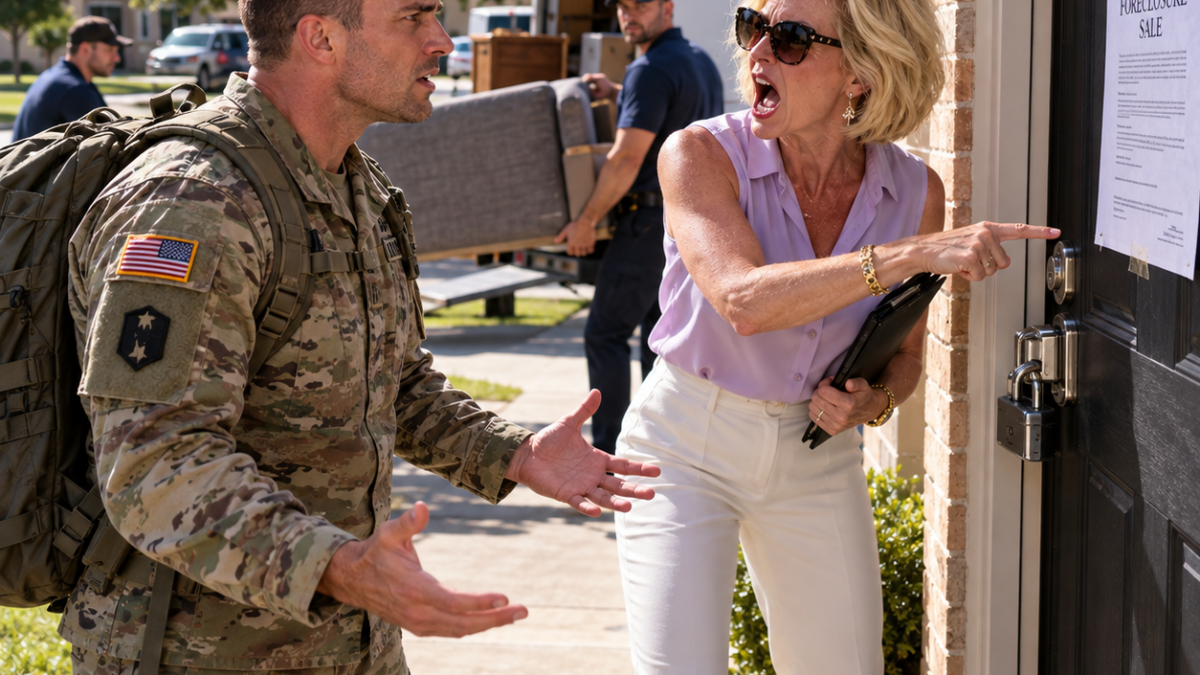
I stepped back, heart suddenly pounding, and looked through the front window.
The house had been cleared out.
Not empty exactly. That was what made it worse. It was not the bare, quiet house I had left. There were things inside—different things. A cheap folding table where my couch used to be. A cardboard box near the hall. No covered furniture. No bookshelves. No framed unit photos. No recliner I had bought after my first promotion. No dining table my sister had helped me move in. No traces of me.
Then I saw the notice on the door.
It was taped at eye level, official paper, county sheriff’s office letterhead.
Completed foreclosure sale.
For a few seconds, the words did not arrange themselves into meaning.
Completed.
Foreclosure.
Sale.
My house.
Paid off.
While I was deployed.
I stood on my own porch with my bags still in the car and felt something cold spread through my body.
Not fear exactly.
Not yet.
It was disbelief so complete it felt physical.
I read the notice again and again until the words finally became real enough to hurt.
The HOA was mentioned in the paperwork.
That gave me a target.
I called them from the porch.
The first conversation lasted less than two minutes.
A man answered with the bored irritation of someone who had already decided no one calling him deserved help.
I gave my name.
I gave my address.
I said, “I just returned from deployment and there is a foreclosure notice on my door. My key doesn’t work. I need to know what happened.”
There was a pause.
Then he said, “The property was foreclosed due to unpaid assessments, late fees, and fines.”
“That’s impossible. My property manager was supposed to be paying the HOA fees.”
“That’s between you and your property manager.”
“I was deployed overseas.”
“Okay.”
That one word almost made me lose my temper.
Okay.
Like I had told him it might rain.
“I need to speak with someone who can explain this,” I said. “My house was paid off. There was no mortgage. I never received notice.”
“We sent notices.”
“To whom?”
“To the property address.”
“I was in Kuwait.”
“That is not our responsibility.”
I closed my eyes.
“What amount was owed?”
“Two thousand four hundred dollars.”
I opened them.
“You foreclosed on a house worth hundreds of thousands over twenty-four hundred dollars?”
“The house was sold at auction.”
“To who?”
“I can’t discuss that.”
“This is my house.”
“No, sir,” he said. “It is not.”
Then he hung up.
I called back.
No answer.
Again.
No answer.
A third time.
Straight to voicemail.
I stood there holding the phone, staring at a front door that had my house number beside it and a lock that no longer recognized me.
I had been tired when I arrived.
Now I was awake in a way I did not want to be.
I drove to the HOA office in person.
It was located in a low beige commercial building near a dentist and a title company, the kind of place where injustice wears carpet squares and fluorescent lighting. The receptionist looked uncomfortable the moment I gave my name, which told me they knew exactly who I was.
The same man from the phone came out.
I knew from his voice before he introduced himself as Brent.
He was in his forties, clean-shaven, wearing a navy polo with the HOA management logo stitched over the chest. He had the careful blankness of someone trained to say unpleasant things without appearing emotionally involved.
I did not sit when he offered.
“Explain to me how my home was sold while I was deployed.”
He folded his hands.
“Your account became delinquent.”
“My property manager was supposed to pay.”
“We sent notices.”
“To a house I was not occupying.”
“It is the homeowner’s responsibility to maintain current contact information and payment status.”
“My payment system was set up before I left.”
“That may be, but payments stopped.”
“When?”
He looked at a file.
“Roughly six months into your deployment.”
That timing hit me later. In the moment, I was focused on staying calm.
“And instead of contacting me by email, phone, emergency contact, anything, you just mailed letters to an empty house?”
“We followed our standard procedure.”
“I was on active duty.”
“You keep saying that.”
“Because it matters.”
He finally looked up at me fully.
“With respect, Captain, military status does not exempt you from HOA dues.”
“I never said it did. I wanted them paid.”
“They weren’t.”
“Because the company I hired failed.”
“That is unfortunate.”
That word.
Unfortunate.
My house gone.
My belongings missing.
My front door lock changed.
Unfortunate.
I leaned closer to his desk.
“Who bought it?”
“The property was sold through lawful auction.”
“For how much?”
He hesitated just long enough.
“How much?” I repeated.
“Forty-eight thousand dollars.”
The room seemed to shrink around me.
I knew the market value. I had checked it before deployment for insurance reasons. Around three hundred fifty thousand. Maybe more, depending on timing. My paid-off home had been sold for less than the price of some trucks.
“Who bought it?” I asked again.
Brent’s expression shut down.
“I’m not able to provide more information.”
“Then provide someone who can.”
“The matter is closed.”
“The matter is not closed.”
“The house has been sold.”
“I am going to fight this.”
His face changed then.
Not much.
Just enough to show that he found the idea annoying, maybe even amusing.
“You can speak with an attorney if you want,” he said. “But if you are no longer a homeowner here, you really have no business being in this office.”
I stared at him for a long second.
That was when the anger finally arrived.
Not hot and reckless.
Cold.
Clean.
Operational.
The same kind of focus I knew from missions where panic had no place because panic wasted time.
“All right,” I said.
Brent blinked, maybe surprised I did not yell.
I picked up my folder.
“I’ll speak with an attorney.”
I walked out before I said anything else.
The first person I called was the property management company.
Disconnected.
I searched from my phone in the parking lot. Their website was still up but broken in several places. The office number looped to an automated message. After digging through state business records and bankruptcy filings, I found the truth.
They had filed for bankruptcy six months earlier.
Right around the time the HOA said payments stopped.
I sat in my car reading documents on a cracked phone screen, still in uniform pants, still with deployment bags in the backseat, and felt like the ground under my life had been quietly removed while I was thousands of miles away.
The company had failed.
The mail had not been forwarded.
The HOA had pushed foreclosure.
The house had sold for a fraction of its value.
My belongings were gone or displaced.
And everyone involved was already practicing the same sentence.
Not our responsibility.
For the next few days, I slept wherever people would take me.
Friends. Family. A spare room. A couch. I had returned from deployment to become, in the most absurd technical sense, homeless. Not because I had missed mortgage payments. Not because I had abandoned my house. Not because I had ignored responsibilities. Because a property manager collapsed, an HOA saw an opening, and nobody bothered to ask whether federal law protected the homeowner serving overseas.
I gathered documents.
Deployment orders.
Active duty status.
Proof of property ownership.
Bank statements showing payments to the property management company.
Contract with the property manager.
HOA notices once I could get copies.
Foreclosure paperwork.
Sheriff’s notice.
Auction records.
Anything I could find.
Military legal assistance became my lifeline.
I had always known legal assistance existed, but I had never expected to need it for my own home on American soil. The attorney I met with was calm, precise, and very interested the moment I said the HOA foreclosed without a court order while I was on active duty.
“Say that again,” she said.
I did.
She leaned back slightly.
“Did they obtain judicial approval?”
“I don’t think so.”
“Do you have the foreclosure documents?”
I handed over everything.
She read quietly for several minutes.
Then she said, “You may have a case under the Servicemembers Civil Relief Act.”
I had heard of the SCRA in passing. Most service members have, at least vaguely. It is one of those protections you are told exists, but the details blur unless you need them. I knew it had to do with interest rates, leases, court proceedings, certain protections during active duty. I did not know it could be the thing standing between me and losing my home.
She explained it in plain English.
Service members on active duty have protections against certain civil actions, including foreclosure, without court approval. That can include liens and assessments when the outcome is loss of property. The protections can extend during active duty and for a period after returning. If an HOA wanted to foreclose on a protected service member, it could not just run the usual process and hope nobody noticed.
“They needed a court order,” she said.
“They didn’t get one.”
“Then we fight.”
Those three words were the first solid thing I had heard since finding the notice on my door.
Then she asked about the auction.
When I told her the sale price, her eyebrows rose.
“Forty-eight thousand?”
“Yes.”
“For a property worth?”
“Approximately three hundred fifty thousand.”
“Who bought it?”
“I’m trying to find out.”
We found out.
The buyer had business connections to the HOA president.
Not technically illegal on its face, the attorney warned me. Connections are not automatically proof of fraud. Auctions can be ugly. Low sale prices happen. But combined with the lack of judicial approval, the timing, the ignored military status, and the fact that the HOA president’s associate ended up with a paid-off house for pennies on the dollar, the whole thing smelled rotten.
Her words, not mine.
Actually, no.
Mine were worse.
The HOA president’s name was Harold Sweeney.
I had met him once before deployment at a community meeting. He was the kind of man who wore loafers without socks and spoke like every sentence had been rehearsed in front of a mirror. Back then, he had seemed harmless in the way petty powerful people can seem harmless if they have not pointed that pettiness at you yet. He talked about standards, community values, fiscal responsibility, preserving property value.
Now I understood what preserving property value meant to him.
Mine.
For someone else.
The lawsuit moved slower than I wanted and faster than the HOA expected.
Harold was served.
Brent stopped taking my calls entirely.
The board went quiet.
The buyer’s attorney sent a letter claiming his client had purchased the home through a valid foreclosure auction and had no knowledge of any issue. Maybe that was true. Maybe it was not. I did not care as much about punishing the buyer as I cared about getting my house back. If he had done nothing wrong, he could take that up with the people who had sold him a poisoned asset.
For four months, I lived in limbo.
Four months of borrowing rooms, rotating between people who loved me but had lives of their own. Four months of driving past my own street when I could not help myself and seeing my house with unfamiliar blinds and a lock I could not open. Four months of phone calls, emails, document requests, legal explanations, court dates, and the quiet humiliation of telling people, “I’m still fighting for the house.”
I had just come back from deployment.
I should have been unpacking.
Instead, I was proving I had the right to return.
The hardest part was my belongings.
Some had been removed before I returned. Some were apparently placed in storage. Some could not be located. No one had a straight answer at first. My dining table, my tools, family photos, military keepsakes, a footlocker with things I had kept from different stages of my career. None of it was worth as much as the house, but value is not always financial.
The HOA had treated my life like debris inside a property they wanted cleared.
That made me angrier than the lock.
The lock said I was excluded.
The missing belongings said I had been erased.
When we finally got before the judge, the HOA’s side tried to make it sound boring.
That was their strategy.
Unpaid assessments.
Notices mailed.
Standard procedures followed.
Auction completed.
Buyer relied on public process.
Homeowner failed to maintain payments.
Responsible associations must enforce covenants.
They wanted the case to sound like paperwork.
My attorney made it sound like what it was.
A deployed service member, on active duty overseas, had arranged professional management of a paid-off home. The management company collapsed. Notices were not properly forwarded. The HOA proceeded with foreclosure without judicial approval despite protections under federal law. A $350,000 home was sold for $48,000 to a buyer connected to the HOA president. The soldier returned home to find himself locked out and displaced.
By the time she finished, the room felt different.
The judge asked questions.
Sharp ones.
Did the HOA know I was deployed?
They had records showing they had been informed before I left.
Did they seek judicial approval?
No.
Did they attempt alternate contact?
They mailed notices to the property.
Did they know the property manager was involved?
They had correspondence listing the property manager.
Did they consider SCRA protections?
Their attorney gave an answer so tangled it answered the question by failing to.
The judge did not look impressed.
I sat at the table listening, hands folded, jaw tight.
There is a particular anger in hearing people discuss your home in legal phrases. Property. Asset. Sale. Assessment. Notice. Possession. Displacement. It is necessary language, but it sands the human edges off everything. Nobody says, “This is where he planned to sleep after fourteen months away.” Nobody says, “This is the kitchen where his sister made coffee the morning he got promoted.” Nobody says, “This is the only place he thought would still be his.”
But the judge understood enough.
The ruling came in my favor.
The foreclosure was improper because the HOA had violated federal protections by proceeding without proper court approval while I was on active duty. The buyer was required to deed the property back to me. The HOA was ordered to compensate me for displacement costs and personal property losses tied to what had happened.
I won.
I should have felt only relief.
I did feel relief.
But I also felt something heavier, something close to grief.
Because getting back what should never have been taken is not the same as never having lost it.
The first time I walked back into my house, the air smelled wrong.
That is the detail I remember most.
Not the changed lock being removed. Not the paperwork. Not even the empty spaces. The smell. Someone else’s cardboard, cleaning products I did not use, stale air trapped under closed blinds. My house had been occupied by uncertainty.
I stood in the living room and looked at the places my furniture used to be.
The recliner was gone.
The bookshelf was gone.
The wall where my framed unit photo had hung was bare except for a small nail hole.
The tile in the guest bathroom was still ugly.
That almost broke me.
I laughed first, then sat down on the floor because there was nowhere else to sit, and for a few minutes I just stayed there.
Home again.
Damaged.
Changed.
Mine.
News got hold of the story after the ruling.
Not national news. Nothing huge. Local coverage. A few articles. A segment on the evening news. The angle was obvious: HOA forecloses on deployed soldier’s home, court orders property returned. Abuse of HOA power. Legal protections for service members. Texas foreclosure process. Paid-off home sold cheap while owner was overseas.
I did not love being in the news.
I am not built for cameras pointed at my face unless they belong to security briefings or bad ID photos. But I agreed to speak because the more I learned, the more I realized how easily this could happen to someone who did not know their rights, did not have access to legal assistance, or did not have the stubbornness to fight for months.
I said what mattered.
Service members need to know their protections.
HOAs need to understand those protections are not suggestions.
Property managers need oversight.
Do not assume automatic systems are working just because money moved once.
Do not wait.
Do not trust silence.
The response surprised me.
Letters came.
Emails.
Messages from strangers.
Veterans. Military spouses. Guard members. Reservists. People telling me about storage units lost, cars repossessed, apartments mishandled, HOA nightmares, property damage, missed notices, debt collectors who did not care that someone was deployed until a lawyer made them care.
Some thanked me for my service.
Some thanked me for speaking up.
Some just wrote, “This almost happened to me.”
Those messages made the whole thing feel bigger than my house.
That was hard, because I had wanted the story to become smaller. I wanted to repair the damage, replace what was missing, sit in my own living room, and stop being a cautionary tale. But sometimes your problem becomes useful to other people. Sometimes the worst thing that happened to you becomes a warning flare.
So I let it burn.
The pressure hit the HOA hard.
There was an emergency board meeting.
I did not attend.
I had spent enough time in rooms where people who had harmed me pretended to be concerned about procedure. I let the neighbors tell me what happened.
Harold Sweeney stepped down.
Officially, he resigned for “personal reasons” and to allow the community to move forward.
Unofficially, he had become radioactive.
The board did not want more scrutiny. The homeowners did not want lawsuits. The local coverage had embarrassed them. The connection between the buyer and Harold had raised too many eyebrows, even if no criminal finding came out of it. Nobody wanted to be the person defending the foreclosure of a deployed soldier’s paid-off home over a few thousand dollars in dues and fees.
New policies were adopted for handling accounts connected to deployed military members.
Better contact requirements.
Review before escalation.
Legal verification before foreclosure actions.
Documentation of military status.
Actual human judgment, apparently a revolutionary concept.
Some neighbors came by after I moved back in.
That surprised me too.
I had never been extremely close with most of them. Friendly, yes. Waves, small talk, holiday lights, package pickups. Normal suburban distance. But after the story broke, several welcomed me home like I had returned from two deployments instead of one.
Mrs. Alvarez from three houses down brought a casserole and apologized for not knowing what had happened.
Mr. Talbot looked like he had aged ten years from guilt.
“I should’ve checked more,” he said.
“You didn’t know.”
“I saw papers once. On the door. I thought the property manager was handling it.”
“I thought that too.”
He shook his head. “Still.”
A family across the street put small American flags in their yard. I did not ask them to. I would not have asked them to. But when I saw them, something in my chest loosened.
Support does not undo harm.
But it does remind you harm is not the only thing people are capable of.
Rebuilding the house took time.
Not structurally. Emotionally.
I replaced furniture slowly. Some things I recovered. Some things were gone for good. The HOA compensation helped, but money has no memory. It can buy a new dining table; it cannot make it the one your sister scratched moving through the doorway while both of you laughed too hard to be useful.
I changed every lock.
Then changed them again because the first set did not feel secure enough.
I installed cameras.
I created redundant contact systems. Email, phone, family contact, military contact, attorney contact. I set calendar reminders to personally verify every payment connected to the house. HOA dues. Utilities. Insurance. Taxes. Lawn care. Everything. I became the kind of man who checked accounts at midnight because trusting systems had once cost me a home.
That is the hidden tax of being wronged.
You pay in vigilance.
The HOA sent a formal apology eventually.
It was written by lawyers.
I could tell because it said almost nothing in many polished sentences. It acknowledged “procedural failures.” It expressed regret for “the hardship experienced.” It affirmed the association’s commitment to compliance with applicable law.
I read it once.
Then I put it in a folder.
Not because it healed anything.
Because documentation had become part of my religion.
Months later, I saw Brent at a grocery store.
The rude HOA employee.
He was comparing cereal prices like a normal human being, which irritated me for reasons I cannot fully explain. There is something offensive about seeing someone who helped dismantle your life standing under fluorescent lights deciding between raisin bran and granola.
He saw me.
His face changed.
I expected him to turn away.
Instead, he walked over.
“Captain,” he said awkwardly.
I said nothing.
“I just wanted to say… I’m sorry for how I handled things.”
The apology hung there between us, thin but not entirely empty.
“You hung up on me.”
He winced. “I know.”
“You told me I had no business in the office.”
“I know.”
“I had just gotten back from deployment and found out my house was gone.”
He looked down. “I know.”
I waited.
He sighed.
“We were told not to engage beyond the standard language. Harold was pushing everything. He kept saying the account was delinquent, process was process, and the auction was clean. I didn’t know about the military protections.”
“You didn’t ask.”
“No.”
That honesty mattered more than any excuse would have.
“No,” I said. “You didn’t.”
He swallowed.
“I’m sorry.”
I looked at him for a long moment.
Then I nodded once and moved on.
That was not forgiveness.
It was acknowledgment.
Forgiveness requires more work than a cereal aisle.
As for Harold, he disappeared from neighborhood life quickly after stepping down. Sold his house within the year, according to Mr. Talbot. Moved somewhere north, maybe Dallas, maybe farther. People like Harold rarely vanish completely. They simply relocate and hope the next group does not know what the last one learned.
I hope they Google him.
The buyer who had purchased my house never spoke to me directly.
His attorney handled the transfer back. Officially, he had participated in what appeared to be a legitimate auction. The court did not find he had broken the law. Maybe that is true. Maybe he saw an opportunity and did not ask questions because asking questions ruins discounts.
I do not know.
I know he gave the house back because a judge made him.
That is enough.
A year after I returned from Kuwait, I hosted a small barbecue in the backyard.
Nothing big. A few neighbors. Some friends from my unit. My sister. Mr. Talbot and his wife. Mrs. Alvarez with enough dessert for a platoon. The lawn still had trouble growing evenly. The oak tree still dropped leaves wherever it pleased. The guest bathroom tile was still ugly because after everything, I decided it had earned the right to exist.
At one point, I stepped inside to grab ice and stopped in the hallway.
Laughter came from the backyard.
Real laughter.
The house was full of sound that belonged there.
For months, the place had felt like evidence. Like a crime scene I happened to live in. That afternoon, for the first time, it felt like a home again.
I stood there holding an empty ice bucket and let myself feel it.
Not victory.
Not justice.
Something quieter.
Return.
Later, one of the younger soldiers from my unit asked me if I had any advice for people deploying who owned homes.
I laughed once.
“How much time do you have?”
Then I gave him the list.
Do not rely on one property manager without backup.
Set up direct online access to every account.
Make sure the HOA has multiple ways to contact you.
Give trusted people written authority to receive notices.
Check payments yourself whenever possible.
Know the Servicemembers Civil Relief Act.
Talk to legal assistance before you leave, not just after something goes wrong.
Document everything.
Assume silence means nothing.
He listened more seriously than I expected.
Good.
If my mess could save someone else from standing on their own porch with a dead key in their hand, then at least some part of it had been put to use.
People sometimes ask whether I still hate the HOA.
The honest answer is complicated.
I do not hate every neighbor who pays dues. I do not hate the idea of communities having rules about shared spaces, road maintenance, or keeping things reasonable. I understand why associations exist.
But I will never again underestimate how dangerous small power can become when nobody checks it.
A board president is not a king.
A fee is not a moral judgment.
A late notice is not a license to steal someone’s life.
And a deployed service member’s absence should never be treated as an opportunity.
That is what they did.
They saw an empty house, missed payments, a broken management chain, and a homeowner too far away to answer the door. They wrapped greed or negligence or both in procedure and called it legal. They counted on distance, confusion, and exhaustion.
They did not count on the law they had ignored.
They did not count on military legal assistance.
They did not count on local news.
They did not count on the fact that coming home from deployment had already taught me one thing very well.
You finish the mission.
Getting my house back became the mission.
These days, my key turns in the lock.
That still matters to me.
Every time.
It is a small sound—metal sliding, tumblers shifting, the deadbolt giving way—but after what happened, I hear it differently. I hear proof. I hear warning. I hear memory. I hear the difference between a house taken and a home returned.
I keep the foreclosure notice.
People think that is strange.
Maybe it is.
It sits in a folder with court documents, apology letters, legal notes, media clippings, and copies of the new HOA policy. I keep it because forgetting is how people like Harold count on the world resetting. I keep it because one day another service member might sit at my table and need to see exactly how bad it can get and exactly how hard you can fight back.
I also keep it because it reminds me that home is not passive.
Home is defended by locks, yes.
But also by knowledge.
By law.
By neighbors willing to speak.
By records.
By refusal.
By the decision to stand in an HOA office after someone tells you the matter is closed and know, with absolute certainty, that it is not.
Fourteen months in Kuwait did not take my house from me.
A failed property manager did not take my house from me.
A stack of notices mailed to an empty address did not take my house from me.
The HOA tried.
And for a little while, they succeeded.
They changed the lock. Cleared my things. Sold my paid-off home for less than the land beneath it was worth. Told me I no longer belonged in the office, on the property, or in the neighborhood I had left in good faith.
But they made one mistake.
They assumed being deployed meant being unreachable.
They assumed being tired meant being weak.
They assumed a man who came home from overseas and found a stranger’s lock on his door would simply accept the word sold as final.
I did not.
I fought them in the place they thought protected them.
Paperwork.
Law.
Procedure.
Court.
And when I finally walked back through my own front door, the house was not the same as I had left it.
Neither was I.
But the deed was back where it belonged.
The key was mine again.
The oak tree still stood in the front yard, dropping leaves like it had no respect for schedules, boards, wars, deployments, or men who thought they could hide theft behind policy.
And every morning now, when I step outside with coffee and watch the sun hit the brick, I think about the notice they taped to my door.
Completed foreclosure sale.
They were wrong.
Nothing was completed.
Not while I was still willing to fight.
𝗧𝗛𝗘 𝗘𝗡𝗗
The HOA Waited Until I Was Overseas to Put a Stranger’s Lock on My Front Door
I came home from fourteen months overseas expecting dust, silence, and a house that still belonged to me.
Instead, my key would not turn, my furniture was gone, and a foreclosure notice from the sheriff’s office was taped to my front door.
The HOA thought a deployed soldier was too far away to fight back.
I did not buy my house because it was impressive.
It was a modest place in a suburban neighborhood outside San Antonio, Texas, with tan brick, a two-car garage, a patchy backyard that refused to grow evenly no matter what I did, and an oak tree in the front yard that dropped enough leaves every fall to make me question nature’s efficiency. It was not the biggest house on the block or the newest. The kitchen cabinets had seen better decades, the guest bathroom had a tile pattern that looked like someone had lost a bet in 1994, and one bedroom door stuck whenever the humidity climbed.
But it was mine.
Paid off.
That mattered to me more than granite countertops or a perfect lawn ever could.
I am a captain in the Army National Guard, and when you spend enough of your life packing bags, checking orders, moving between duty and civilian life, and learning not to get too attached to comfort, a paid-off home feels like more than shelter. It feels like proof that at least one place in the world will be waiting when you come back.
At least, that was what I believed.
Before I deployed to Kuwait, I did everything the responsible version of myself knew how to do.
Fourteen months is a long time to be gone. Long enough for grass to grow wild, pipes to leak, mail to pile up, dues to be missed, notices to expire, small problems to turn into expensive ones. I did not want to dump all that on a neighbor or a friend. I did not want to be that guy overseas asking people back home to handle every little thing because I failed to plan.
So I hired a property management company.
They were not some random name I found on a flyer. I researched them. Read reviews. Spoke to a representative twice. Asked other service members how they handled long deployments. A lot of deployed Guard and Reserve folks set up systems like that, especially if they own homes and do not have family nearby. It made sense.
Every month, money would automatically come out of my bank account and go to the property manager. They were supposed to pay utilities, keep the grass cut, handle basic upkeep, make sure HOA dues were paid, and forward anything urgent to me. Government notices. HOA letters. Legal documents. Anything that required my attention.
I had no mortgage. That was the one thing I did not have to worry about.
Or so I thought.
I remember standing in my living room the week before I left, looking at the place after I had cleaned it more thoroughly than it had ever been cleaned in its life. The furniture was covered. The fridge was empty. Important documents were locked in a fireproof box. A stack of spare keys had been organized and labeled. The property manager had copies. My neighbor, Mr. Talbot, had my contact email and deployment mailing information in case of emergency.
Everything was squared away.
That phrase matters in the military.
Squared away.
It means there are no loose ends, no sloppy assumptions, no avoidable mistakes waiting to become somebody else’s problem. I took pride in that. Maybe it was training. Maybe it was personality. Maybe it was the part of me that needed order because deployment already comes with enough uncertainty.
I did not want special treatment.
I was not trying to use my service to dodge responsibilities. If dues were owed, I wanted them paid. If my grass needed cutting, I wanted it cut. If the HOA had some legitimate notice about the property, I wanted to know about it and deal with it.
I just could not micromanage a suburban house in Texas while stationed thousands of miles away on a logistics support mission.
That was the whole point of hiring professionals.
The HOA already had my contact information. The property manager had instructions. My bank account had funds. I had done everything a reasonable person could do before leaving.
The morning I locked the door, I stood on the porch for a few seconds longer than I expected.
The neighborhood was quiet. Sprinklers ticked somewhere down the street. A dog barked behind a fence. The oak tree shifted in a warm breeze. My house looked ordinary and peaceful, the way a home should look when you are about to leave it behind.
I remember thinking, I’ll see you in fourteen months.
I did not know that while I was gone, men in polo shirts and boardroom smiles would decide my house was an opportunity.
part2
Deployment was not glamorous.
Most deployments are not, no matter what people imagine. Kuwait was heat, logistics, schedules, long days, dust that found its way into everything, and the kind of routine that becomes both exhausting and comforting because routine means you are still moving forward. I worked. I slept when I could. I checked messages when time allowed. I kept track of home in the ways I could from far away.
My bank withdrawals continued.
That was what reassured me.
Every month, the money left my account for the property management company. I would glance at the transaction, see it there, and move on. I had enough else to handle. If the money was being taken, I assumed the job was being done.
That assumption cost me.
Six months into my deployment, the property management company filed for bankruptcy.
I did not know.
I did not receive a warning, a transition notice, a formal letter, a phone call, an email that reached me, anything. Later, I found court documents showing they had notified the bankruptcy court about client obligations, but somehow my account fell into a hole. Maybe someone failed to update an address. Maybe notices went to the house instead of being forwarded. Maybe the company was already collapsing too badly to care about doing things properly.
All I know is that from where I sat overseas, the system looked like it was still running.
Money had been coming out.
Nobody contacted me.
No neighbor warned me.
No HOA email reached me.
No urgent mail was forwarded.
Back home, according to the HOA, letters began piling up.
First notices.
Then late notices.
Then fines.
Then fees.
Then threats.
Then foreclosure.
All while I was on active duty overseas, believing my house was being watched, my bills were being handled, and the place I had worked years to pay off was waiting quietly under the Texas sun.
When my deployment ended, I was tired in a way sleep alone could not fix.
Coming home after a long absence is strange. People expect you to be excited, and you are, but there is also a delay inside you. Part of your mind is still overseas. Part of you is counting bags, scanning for problems, waiting for the next instruction. Homecoming is not a switch. It is a slow return to yourself.
I landed, processed out, stayed briefly with family, and then finally drove toward my neighborhood.
The closer I got, the more I felt something loosen in my chest.
The same gas station near the entrance.
The same school-zone sign.
The same brick walls around the subdivision.
The same oak trees leaning over the road.
I turned onto my street expecting that odd little punch of recognition you get when your house appears after too long away.
I saw it.
And immediately knew something was wrong.
The lawn was cut, but not the way my lawn company used to cut it. The edging was too sharp, too recent. There was a different doormat. A small potted plant sat by the door, and I knew for a fact I had not left one there. The front blinds were open at a different angle.
I parked in the driveway slowly.
My stomach had already started to sink.
I went to the front door and put my key in the lock.
It did not turn.
For a second, I thought I was using the wrong key.
I tried again.
Nothing.
I looked closer and saw the deadbolt had been changed.
New hardware.
Not mine.
I stepped back, heart suddenly pounding, and looked through the front window.
The house had been cleared out.
Not empty exactly. That was what made it worse. It was not the bare, quiet house I had left. There were things inside—different things. A cheap folding table where my couch used to be. A cardboard box near the hall. No covered furniture. No bookshelves. No framed unit photos. No recliner I had bought after my first promotion. No dining table my sister had helped me move in. No traces of me.
Then I saw the notice on the door.
It was taped at eye level, official paper, county sheriff’s office letterhead.
Completed foreclosure sale.
For a few seconds, the words did not arrange themselves into meaning.
Completed.
Foreclosure.
Sale.
My house.
Paid off.
While I was deployed.
I stood on my own porch with my bags still in the car and felt something cold spread through my body.
Not fear exactly.
Not yet.
It was disbelief so complete it felt physical.
I read the notice again and again until the words finally became real enough to hurt.
The HOA was mentioned in the paperwork.
That gave me a target.
I called them from the porch.
The first conversation lasted less than two minutes.
A man answered with the bored irritation of someone who had already decided no one calling him deserved help.
I gave my name.
I gave my address.
I said, “I just returned from deployment and there is a foreclosure notice on my door. My key doesn’t work. I need to know what happened.”
There was a pause.
Then he said, “The property was foreclosed due to unpaid assessments, late fees, and fines.”
“That’s impossible. My property manager was supposed to be paying the HOA fees.”
“That’s between you and your property manager.”
“I was deployed overseas.”
“Okay.”
That one word almost made me lose my temper.
Okay.
Like I had told him it might rain.
“I need to speak with someone who can explain this,” I said. “My house was paid off. There was no mortgage. I never received notice.”
“We sent notices.”
“To whom?”
“To the property address.”
“I was in Kuwait.”
“That is not our responsibility.”
I closed my eyes.
“What amount was owed?”
“Two thousand four hundred dollars.”
I opened them.
“You foreclosed on a house worth hundreds of thousands over twenty-four hundred dollars?”
“The house was sold at auction.”
“To who?”
“I can’t discuss that.”
“This is my house.”
“No, sir,” he said. “It is not.”
Then he hung up.
I called back.
No answer.
Again.
No answer.
A third time.
Straight to voicemail.
I stood there holding the phone, staring at a front door that had my house number beside it and a lock that no longer recognized me.
I had been tired when I arrived.
Now I was awake in a way I did not want to be.
I drove to the HOA office in person.
It was located in a low beige commercial building near a dentist and a title company, the kind of place where injustice wears carpet squares and fluorescent lighting. The receptionist looked uncomfortable the moment I gave my name, which told me they knew exactly who I was.
The same man from the phone came out.
I knew from his voice before he introduced himself as Brent.
He was in his forties, clean-shaven, wearing a navy polo with the HOA management logo stitched over the chest. He had the careful blankness of someone trained to say unpleasant things without appearing emotionally involved.
I did not sit when he offered.
“Explain to me how my home was sold while I was deployed.”
He folded his hands.
“Your account became delinquent.”
“My property manager was supposed to pay.”
“We sent notices.”
“To a house I was not occupying.”
“It is the homeowner’s responsibility to maintain current contact information and payment status.”
“My payment system was set up before I left.”
“That may be, but payments stopped.”
“When?”
He looked at a file.
“Roughly six months into your deployment.”
That timing hit me later. In the moment, I was focused on staying calm.
“And instead of contacting me by email, phone, emergency contact, anything, you just mailed letters to an empty house?”
“We followed our standard procedure.”
“I was on active duty.”
“You keep saying that.”
“Because it matters.”
He finally looked up at me fully.
“With respect, Captain, military status does not exempt you from HOA dues.”
“I never said it did. I wanted them paid.”
“They weren’t.”
“Because the company I hired failed.”
“That is unfortunate.”
That word.
Unfortunate.
My house gone.
My belongings missing.
My front door lock changed.
Unfortunate.
I leaned closer to his desk.
“Who bought it?”
“The property was sold through lawful auction.”
“For how much?”
He hesitated just long enough.
“How much?” I repeated.
“Forty-eight thousand dollars.”
The room seemed to shrink around me.
I knew the market value. I had checked it before deployment for insurance reasons. Around three hundred fifty thousand. Maybe more, depending on timing. My paid-off home had been sold for less than the price of some trucks.
“Who bought it?” I asked again.
Brent’s expression shut down.
“I’m not able to provide more information.”
“Then provide someone who can.”
“The matter is closed.”
“The matter is not closed.”
“The house has been sold.”
“I am going to fight this.”
His face changed then.
Not much.
Just enough to show that he found the idea annoying, maybe even amusing.
“You can speak with an attorney if you want,” he said. “But if you are no longer a homeowner here, you really have no business being in this office.”
I stared at him for a long second.
That was when the anger finally arrived.
Not hot and reckless.
Cold.
Clean.
Operational.
The same kind of focus I knew from missions where panic had no place because panic wasted time.
“All right,” I said.
Brent blinked, maybe surprised I did not yell.
I picked up my folder.
“I’ll speak with an attorney.”
I walked out before I said anything else.
The first person I called was the property management company.
Disconnected.
I searched from my phone in the parking lot. Their website was still up but broken in several places. The office number looped to an automated message. After digging through state business records and bankruptcy filings, I found the truth.
They had filed for bankruptcy six months earlier.
Right around the time the HOA said payments stopped.
I sat in my car reading documents on a cracked phone screen, still in uniform pants, still with deployment bags in the backseat, and felt like the ground under my life had been quietly removed while I was thousands of miles away.
The company had failed.
The mail had not been forwarded.
The HOA had pushed foreclosure.
The house had sold for a fraction of its value.
My belongings were gone or displaced.
And everyone involved was already practicing the same sentence.
Not our responsibility.
For the next few days, I slept wherever people would take me.
Friends. Family. A spare room. A couch. I had returned from deployment to become, in the most absurd technical sense, homeless. Not because I had missed mortgage payments. Not because I had abandoned my house. Not because I had ignored responsibilities. Because a property manager collapsed, an HOA saw an opening, and nobody bothered to ask whether federal law protected the homeowner serving overseas.
I gathered documents.
Deployment orders.
Active duty status.
Proof of property ownership.
Bank statements showing payments to the property management company.
Contract with the property manager.
HOA notices once I could get copies.
Foreclosure paperwork.
Sheriff’s notice.
Auction records.
Anything I could find.
Military legal assistance became my lifeline.
I had always known legal assistance existed, but I had never expected to need it for my own home on American soil. The attorney I met with was calm, precise, and very interested the moment I said the HOA foreclosed without a court order while I was on active duty.
“Say that again,” she said.
I did.
She leaned back slightly.
“Did they obtain judicial approval?”
“I don’t think so.”
“Do you have the foreclosure documents?”
I handed over everything.
She read quietly for several minutes.
Then she said, “You may have a case under the Servicemembers Civil Relief Act.”
I had heard of the SCRA in passing. Most service members have, at least vaguely. It is one of those protections you are told exists, but the details blur unless you need them. I knew it had to do with interest rates, leases, court proceedings, certain protections during active duty. I did not know it could be the thing standing between me and losing my home.
She explained it in plain English.
Service members on active duty have protections against certain civil actions, including foreclosure, without court approval. That can include liens and assessments when the outcome is loss of property. The protections can extend during active duty and for a period after returning. If an HOA wanted to foreclose on a protected service member, it could not just run the usual process and hope nobody noticed.
“They needed a court order,” she said.
“They didn’t get one.”
“Then we fight.”
Those three words were the first solid thing I had heard since finding the notice on my door.
Then she asked about the auction.
When I told her the sale price, her eyebrows rose.
“Forty-eight thousand?”
“Yes.”
“For a property worth?”
“Approximately three hundred fifty thousand.”
“Who bought it?”
“I’m trying to find out.”
We found out.
The buyer had business connections to the HOA president.
Not technically illegal on its face, the attorney warned me. Connections are not automatically proof of fraud. Auctions can be ugly. Low sale prices happen. But combined with the lack of judicial approval, the timing, the ignored military status, and the fact that the HOA president’s associate ended up with a paid-off house for pennies on the dollar, the whole thing smelled rotten.
Her words, not mine.
Actually, no.
Mine were worse.
The HOA president’s name was Harold Sweeney.
I had met him once before deployment at a community meeting. He was the kind of man who wore loafers without socks and spoke like every sentence had been rehearsed in front of a mirror. Back then, he had seemed harmless in the way petty powerful people can seem harmless if they have not pointed that pettiness at you yet. He talked about standards, community values, fiscal responsibility, preserving property value.
Now I understood what preserving property value meant to him.
Mine.
For someone else.
The lawsuit moved slower than I wanted and faster than the HOA expected.
Harold was served.
Brent stopped taking my calls entirely.
The board went quiet.
The buyer’s attorney sent a letter claiming his client had purchased the home through a valid foreclosure auction and had no knowledge of any issue. Maybe that was true. Maybe it was not. I did not care as much about punishing the buyer as I cared about getting my house back. If he had done nothing wrong, he could take that up with the people who had sold him a poisoned asset.
For four months, I lived in limbo.
Four months of borrowing rooms, rotating between people who loved me but had lives of their own. Four months of driving past my own street when I could not help myself and seeing my house with unfamiliar blinds and a lock I could not open. Four months of phone calls, emails, document requests, legal explanations, court dates, and the quiet humiliation of telling people, “I’m still fighting for the house.”
I had just come back from deployment.
I should have been unpacking.
Instead, I was proving I had the right to return.
The hardest part was my belongings.
Some had been removed before I returned. Some were apparently placed in storage. Some could not be located. No one had a straight answer at first. My dining table, my tools, family photos, military keepsakes, a footlocker with things I had kept from different stages of my career. None of it was worth as much as the house, but value is not always financial.
The HOA had treated my life like debris inside a property they wanted cleared.
That made me angrier than the lock.
The lock said I was excluded.
The missing belongings said I had been erased.
When we finally got before the judge, the HOA’s side tried to make it sound boring.
That was their strategy.
Unpaid assessments.
Notices mailed.
Standard procedures followed.
Auction completed.
Buyer relied on public process.
Homeowner failed to maintain payments.
Responsible associations must enforce covenants.
They wanted the case to sound like paperwork.
My attorney made it sound like what it was.
A deployed service member, on active duty overseas, had arranged professional management of a paid-off home. The management company collapsed. Notices were not properly forwarded. The HOA proceeded with foreclosure without judicial approval despite protections under federal law. A $350,000 home was sold for $48,000 to a buyer connected to the HOA president. The soldier returned home to find himself locked out and displaced.
By the time she finished, the room felt different.
The judge asked questions.
Sharp ones.
Did the HOA know I was deployed?
They had records showing they had been informed before I left.
Did they seek judicial approval?
No.
Did they attempt alternate contact?
They mailed notices to the property.
Did they know the property manager was involved?
They had correspondence listing the property manager.
Did they consider SCRA protections?
Their attorney gave an answer so tangled it answered the question by failing to.
The judge did not look impressed.
I sat at the table listening, hands folded, jaw tight.
There is a particular anger in hearing people discuss your home in legal phrases. Property. Asset. Sale. Assessment. Notice. Possession. Displacement. It is necessary language, but it sands the human edges off everything. Nobody says, “This is where he planned to sleep after fourteen months away.” Nobody says, “This is the kitchen where his sister made coffee the morning he got promoted.” Nobody says, “This is the only place he thought would still be his.”
But the judge understood enough.
The ruling came in my favor.
The foreclosure was improper because the HOA had violated federal protections by proceeding without proper court approval while I was on active duty. The buyer was required to deed the property back to me. The HOA was ordered to compensate me for displacement costs and personal property losses tied to what had happened.
I won.
I should have felt only relief.
I did feel relief.
But I also felt something heavier, something close to grief.
Because getting back what should never have been taken is not the same as never having lost it.
The first time I walked back into my house, the air smelled wrong.
That is the detail I remember most.
Not the changed lock being removed. Not the paperwork. Not even the empty spaces. The smell. Someone else’s cardboard, cleaning products I did not use, stale air trapped under closed blinds. My house had been occupied by uncertainty.
I stood in the living room and looked at the places my furniture used to be.
The recliner was gone.
The bookshelf was gone.
The wall where my framed unit photo had hung was bare except for a small nail hole.
The tile in the guest bathroom was still ugly.
That almost broke me.
I laughed first, then sat down on the floor because there was nowhere else to sit, and for a few minutes I just stayed there.
Home again.
Damaged.
Changed.
Mine.
News got hold of the story after the ruling.
Not national news. Nothing huge. Local coverage. A few articles. A segment on the evening news. The angle was obvious: HOA forecloses on deployed soldier’s home, court orders property returned. Abuse of HOA power. Legal protections for service members. Texas foreclosure process. Paid-off home sold cheap while owner was overseas.
I did not love being in the news.
I am not built for cameras pointed at my face unless they belong to security briefings or bad ID photos. But I agreed to speak because the more I learned, the more I realized how easily this could happen to someone who did not know their rights, did not have access to legal assistance, or did not have the stubbornness to fight for months.
I said what mattered.
Service members need to know their protections.
HOAs need to understand those protections are not suggestions.
Property managers need oversight.
Do not assume automatic systems are working just because money moved once.
Do not wait.
Do not trust silence.
The response surprised me.
Letters came.
Emails.
Messages from strangers.
Veterans. Military spouses. Guard members. Reservists. People telling me about storage units lost, cars repossessed, apartments mishandled, HOA nightmares, property damage, missed notices, debt collectors who did not care that someone was deployed until a lawyer made them care.
Some thanked me for my service.
Some thanked me for speaking up.
Some just wrote, “This almost happened to me.”
Those messages made the whole thing feel bigger than my house.
That was hard, because I had wanted the story to become smaller. I wanted to repair the damage, replace what was missing, sit in my own living room, and stop being a cautionary tale. But sometimes your problem becomes useful to other people. Sometimes the worst thing that happened to you becomes a warning flare.
So I let it burn.
The pressure hit the HOA hard.
There was an emergency board meeting.
I did not attend.
I had spent enough time in rooms where people who had harmed me pretended to be concerned about procedure. I let the neighbors tell me what happened.
Harold Sweeney stepped down.
Officially, he resigned for “personal reasons” and to allow the community to move forward.
Unofficially, he had become radioactive.
The board did not want more scrutiny. The homeowners did not want lawsuits. The local coverage had embarrassed them. The connection between the buyer and Harold had raised too many eyebrows, even if no criminal finding came out of it. Nobody wanted to be the person defending the foreclosure of a deployed soldier’s paid-off home over a few thousand dollars in dues and fees.
New policies were adopted for handling accounts connected to deployed military members.
Better contact requirements.
Review before escalation.
Legal verification before foreclosure actions.
Documentation of military status.
Actual human judgment, apparently a revolutionary concept.
Some neighbors came by after I moved back in.
That surprised me too.
I had never been extremely close with most of them. Friendly, yes. Waves, small talk, holiday lights, package pickups. Normal suburban distance. But after the story broke, several welcomed me home like I had returned from two deployments instead of one.
Mrs. Alvarez from three houses down brought a casserole and apologized for not knowing what had happened.
Mr. Talbot looked like he had aged ten years from guilt.
“I should’ve checked more,” he said.
“You didn’t know.”
“I saw papers once. On the door. I thought the property manager was handling it.”
“I thought that too.”
He shook his head. “Still.”
A family across the street put small American flags in their yard. I did not ask them to. I would not have asked them to. But when I saw them, something in my chest loosened.
Support does not undo harm.
But it does remind you harm is not the only thing people are capable of.
Rebuilding the house took time.
Not structurally. Emotionally.
I replaced furniture slowly. Some things I recovered. Some things were gone for good. The HOA compensation helped, but money has no memory. It can buy a new dining table; it cannot make it the one your sister scratched moving through the doorway while both of you laughed too hard to be useful.
I changed every lock.
Then changed them again because the first set did not feel secure enough.
I installed cameras.
I created redundant contact systems. Email, phone, family contact, military contact, attorney contact. I set calendar reminders to personally verify every payment connected to the house. HOA dues. Utilities. Insurance. Taxes. Lawn care. Everything. I became the kind of man who checked accounts at midnight because trusting systems had once cost me a home.
That is the hidden tax of being wronged.
You pay in vigilance.
The HOA sent a formal apology eventually.
It was written by lawyers.
I could tell because it said almost nothing in many polished sentences. It acknowledged “procedural failures.” It expressed regret for “the hardship experienced.” It affirmed the association’s commitment to compliance with applicable law.
I read it once.
Then I put it in a folder.
Not because it healed anything.
Because documentation had become part of my religion.
Months later, I saw Brent at a grocery store.
The rude HOA employee.
He was comparing cereal prices like a normal human being, which irritated me for reasons I cannot fully explain. There is something offensive about seeing someone who helped dismantle your life standing under fluorescent lights deciding between raisin bran and granola.
He saw me.
His face changed.
I expected him to turn away.
Instead, he walked over.
“Captain,” he said awkwardly.
I said nothing.
“I just wanted to say… I’m sorry for how I handled things.”
The apology hung there between us, thin but not entirely empty.
“You hung up on me.”
He winced. “I know.”
“You told me I had no business in the office.”
“I know.”
“I had just gotten back from deployment and found out my house was gone.”
He looked down. “I know.”
I waited.
He sighed.
“We were told not to engage beyond the standard language. Harold was pushing everything. He kept saying the account was delinquent, process was process, and the auction was clean. I didn’t know about the military protections.”
“You didn’t ask.”
“No.”
That honesty mattered more than any excuse would have.
“No,” I said. “You didn’t.”
He swallowed.
“I’m sorry.”
I looked at him for a long moment.
Then I nodded once and moved on.
That was not forgiveness.
It was acknowledgment.
Forgiveness requires more work than a cereal aisle.
As for Harold, he disappeared from neighborhood life quickly after stepping down. Sold his house within the year, according to Mr. Talbot. Moved somewhere north, maybe Dallas, maybe farther. People like Harold rarely vanish completely. They simply relocate and hope the next group does not know what the last one learned.
I hope they Google him.
The buyer who had purchased my house never spoke to me directly.
His attorney handled the transfer back. Officially, he had participated in what appeared to be a legitimate auction. The court did not find he had broken the law. Maybe that is true. Maybe he saw an opportunity and did not ask questions because asking questions ruins discounts.
I do not know.
I know he gave the house back because a judge made him.
That is enough.
A year after I returned from Kuwait, I hosted a small barbecue in the backyard.
Nothing big. A few neighbors. Some friends from my unit. My sister. Mr. Talbot and his wife. Mrs. Alvarez with enough dessert for a platoon. The lawn still had trouble growing evenly. The oak tree still dropped leaves wherever it pleased. The guest bathroom tile was still ugly because after everything, I decided it had earned the right to exist.
At one point, I stepped inside to grab ice and stopped in the hallway.
Laughter came from the backyard.
Real laughter.
The house was full of sound that belonged there.
For months, the place had felt like evidence. Like a crime scene I happened to live in. That afternoon, for the first time, it felt like a home again.
I stood there holding an empty ice bucket and let myself feel it.
Not victory.
Not justice.
Something quieter.
Return.
Later, one of the younger soldiers from my unit asked me if I had any advice for people deploying who owned homes.
I laughed once.
“How much time do you have?”
Then I gave him the list.
Do not rely on one property manager without backup.
Set up direct online access to every account.
Make sure the HOA has multiple ways to contact you.
Give trusted people written authority to receive notices.
Check payments yourself whenever possible.
Know the Servicemembers Civil Relief Act.
Talk to legal assistance before you leave, not just after something goes wrong.
Document everything.
Assume silence means nothing.
He listened more seriously than I expected.
Good.
If my mess could save someone else from standing on their own porch with a dead key in their hand, then at least some part of it had been put to use.
People sometimes ask whether I still hate the HOA.
The honest answer is complicated.
I do not hate every neighbor who pays dues. I do not hate the idea of communities having rules about shared spaces, road maintenance, or keeping things reasonable. I understand why associations exist.
But I will never again underestimate how dangerous small power can become when nobody checks it.
A board president is not a king.
A fee is not a moral judgment.
A late notice is not a license to steal someone’s life.
And a deployed service member’s absence should never be treated as an opportunity.
That is what they did.
They saw an empty house, missed payments, a broken management chain, and a homeowner too far away to answer the door. They wrapped greed or negligence or both in procedure and called it legal. They counted on distance, confusion, and exhaustion.
They did not count on the law they had ignored.
They did not count on military legal assistance.
They did not count on local news.
They did not count on the fact that coming home from deployment had already taught me one thing very well.
You finish the mission.
Getting my house back became the mission.
These days, my key turns in the lock.
That still matters to me.
Every time.
It is a small sound—metal sliding, tumblers shifting, the deadbolt giving way—but after what happened, I hear it differently. I hear proof. I hear warning. I hear memory. I hear the difference between a house taken and a home returned.
I keep the foreclosure notice.
People think that is strange.
Maybe it is.
It sits in a folder with court documents, apology letters, legal notes, media clippings, and copies of the new HOA policy. I keep it because forgetting is how people like Harold count on the world resetting. I keep it because one day another service member might sit at my table and need to see exactly how bad it can get and exactly how hard you can fight back.
I also keep it because it reminds me that home is not passive.
Home is defended by locks, yes.
But also by knowledge.
By law.
By neighbors willing to speak.
By records.
By refusal.
By the decision to stand in an HOA office after someone tells you the matter is closed and know, with absolute certainty, that it is not.
Fourteen months in Kuwait did not take my house from me.
A failed property manager did not take my house from me.
A stack of notices mailed to an empty address did not take my house from me.
The HOA tried.
And for a little while, they succeeded.
They changed the lock. Cleared my things. Sold my paid-off home for less than the land beneath it was worth. Told me I no longer belonged in the office, on the property, or in the neighborhood I had left in good faith.
But they made one mistake.
They assumed being deployed meant being unreachable.
They assumed being tired meant being weak.
They assumed a man who came home from overseas and found a stranger’s lock on his door would simply accept the word sold as final.
I did not.
I fought them in the place they thought protected them.
Paperwork.
Law.
Procedure.
Court.
And when I finally walked back through my own front door, the house was not the same as I had left it.
Neither was I.
But the deed was back where it belonged.
The key was mine again.
The oak tree still stood in the front yard, dropping leaves like it had no respect for schedules, boards, wars, deployments, or men who thought they could hide theft behind policy.
And every morning now, when I step outside with coffee and watch the sun hit the brick, I think about the notice they taped to my door.
Completed foreclosure sale.
They were wrong.
Nothing was completed.
Not while I was still willing to fight.