𝗙𝗨𝗟𝗟 𝗦𝗧𝗢𝗥𝗬 The HOA Tried to Take Six Feet of My Backyard—Then I Found the Paper Trail Showing They’d Been Stealing Land for Years
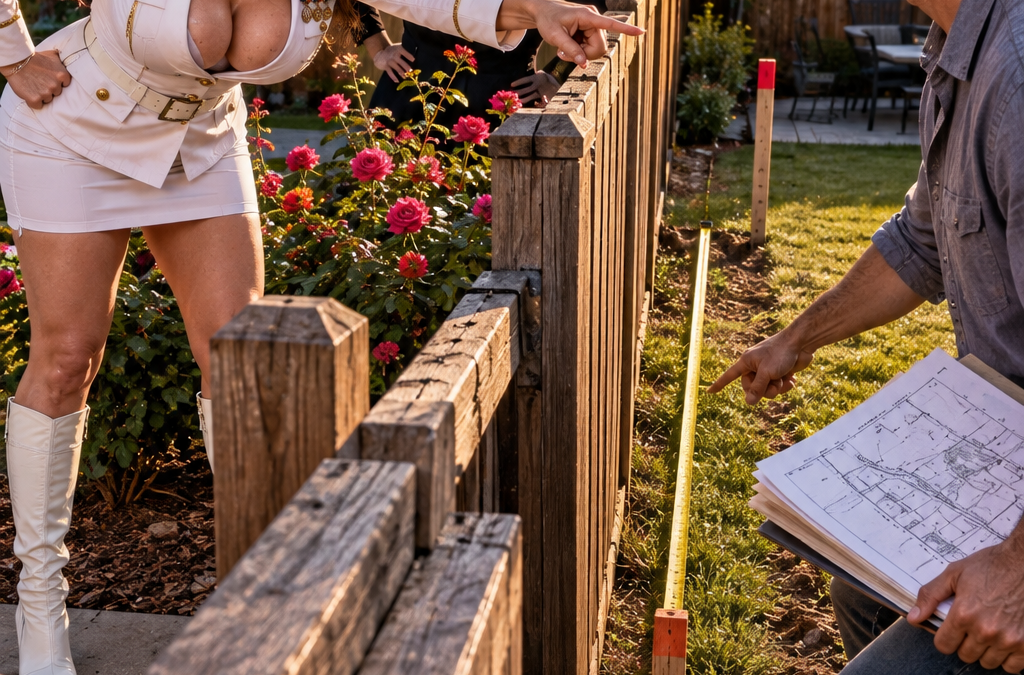
𝗙𝗨𝗟𝗟 𝗦𝗧𝗢𝗥𝗬
It was circular enough to become impressive.
My wife eventually convinced me the roses weren’t worth a war.
I hated removing them.
Not because of the plants.
Because it felt wrong.
But fifty dollars a day adds up quickly.
So I dug them out and moved them to the backyard.
We paid the processing fee.
Two weeks later, the supposedly updated HOA packet arrived.
It was identical to the one we already owned.
Same revision date.
Same sections.
Still nothing about roses.
I called again.
Victoria told me another amendment must have been omitted.
“Can you send the amendment?”
“Submit a request.”
“Another twenty-five dollars?”
“Yes.”
I should have recognized the pattern then.
Instead, I assumed incompetence.
Over the next six months, violation notices became a regular feature of life.
A trash container visible too early.
A decorative planter supposedly outside approved dimensions.
A garden hose allegedly visible from the street.
A temporary ladder leaning against the side of the garage for part of an afternoon.
Each notice referenced rules or subsections we couldn’t locate.
Each time we asked questions, Victoria or someone working under her told us our copy was old.
We paid for “updated guidelines” three different times.
Three times, we received the same documents.
My wife stopped laughing about the HOA.
“So they’re charging people to ask what rules they’re breaking?”
“Apparently.”
“That’s insane.”
“I know.”
“Can we stop paying these processing fees?”
“Yes.”
“What happens when another violation arrives?”
“We challenge it in writing.”
“And if they fine us?”
“Then we deal with it.”
She sat quietly.
“I hate that we have to think about this.”
That was the beginning of what the HOA gradually stole from us before I ever understood they were literally stealing land.
Peace.
Homeownership was supposed to feel more secure than renting.
Instead, every envelope from the association made us wonder what new rule they had invented.
Still, I tried to keep perspective.
Annoying letters weren’t the end of the world.
We liked our house.
We liked most of our neighbors.
We could handle paperwork.
Then came the Saturday that changed everything.
It was early fall.
I was raking leaves in the backyard when I heard voices near the side gate.
At first, I assumed my wife had stepped outside with someone.
Then I heard a woman’s voice say, “Take the measurement from this marker.”
I put down the rake.
Walked around the side of the house.
Three people were standing in our yard.
Not at the edge.
Inside our property.
Clipboards.
Measuring tapes.
One man was crouched near the rear fence.
Another held a long tape.
And standing in the middle of them was Victoria.
I recognized her voice before I recognized her.
She was around forty, maybe early forties, and strikingly attractive in a way that seemed almost weaponized.
Long blonde hair.
Perfect makeup.
Sharp cheekbones.
A curvy figure she made no attempt to hide.
She wore a tight white military-inspired uniform with polished gold buttons, decorative shoulder pieces, and a deep neckline emphasizing her very large chest.
White skirt.
High heels.
A leather clipboard under one arm.
She looked less like a volunteer HOA president than someone auditioning to command a private army.
I stopped a few yards away.
“Can I help you?”
Victoria looked up.
There was no embarrassment over being found in someone else’s backyard.
No apology.
Just a small, satisfied smile.
“We’re conducting a boundary verification.”
“A what?”
“We received concerns regarding property encroachment.”
I looked at the two people with her.
Then toward my fence.
“What encroachment?”
Victoria pointed.
“Your rear fence.”
“My rear fence.”
“Yes.”
“What about it?”
“It extends into HOA common area.”
I stared at her.
“That fence was here when we bought the house.”
“That doesn’t make it correct.”
“It appears on our survey.”
Victoria gave a dismissive little smile.
“Surveys contain errors.”
“The survey was done by a licensed surveyor.”
“Your survey.”
She tapped her clipboard.
“Our measurements show approximately six feet of encroachment.”
I thought I had misheard.
“Six feet?”
“At minimum.”
I looked beyond the fence.
There was a strip of open grass and then the backs of neighboring properties.
Nothing marked common space.
No path.
No playground.
No landscaping.
No HOA facility.
Just land.
“You’re saying six feet of my backyard belongs to the association?”
“Correct.”
“No.”
Victoria’s eyebrows lifted.
“Excuse me?”
“No.”
The man beside her shifted uncomfortably.
I continued.
“I have a recorded survey.”
“We have the master development plan.”
“Show it to me.”
Her smile returned.
“We are not required to provide internal association documents on demand.”
“You’re standing in my yard telling me I don’t own part of it.”
“Yes.”
“Then show me the map.”
“You can submit a records request.”
I almost laughed.
“Let me guess. Processing fee.”
“Fifty dollars.”
“Fifty?”
“Administrative costs have increased.”
I stared at her.
This woman was charging me for the privilege of seeing the evidence she claimed justified taking my land.
My wife came through the back door.
“What is going on?”
Victoria turned toward her.
“Honey, we discovered that your fence encroaches onto common property.”
I watched my wife’s face change at the word honey.
“How much?”
“Approximately six feet.”
My wife looked at me.
Then at the fence.
“We have a legal survey.”
Victoria smiled at her with a condescension so polished it almost looked rehearsed.
“Honey, legal surveys can be wrong.”
My wife’s cheeks flushed.
“What matters,” Victoria continued, “is the HOA’s official boundary map.”
“Then show us.”
“Submit the request.”
I stepped slightly between them before my wife said something that might make the situation worse.
“We’ll hire our own surveyor.”
Victoria shrugged.
“Waste your money.”
“We’ll verify the boundary.”
“You can verify whatever you like.”
“If we’re wrong, we’ll move the fence.”
“You are wrong.”
“And if we’re not, you leave us alone.”
Victoria laughed softly.
“That’s not how this works.”
I felt my temper rise.
“How does it work?”
“You have thirty days to relocate the fence.”
She gestured toward her assistant.
He handed me a notice.
“One hundred dollars per day after the deadline.”
I read the first paragraph.
Encroachment onto HOA-managed common area.
Master development plan.
Required relocation.
The language looked official.
That was what made it dangerous.
My wife said, “Are you threatening us?”
Victoria adjusted the front of her fitted white jacket.
“I am informing you of the consequences of noncompliance.”
“You don’t even know if your boundary is right.”
She smiled.
“We know exactly where our boundaries are.”
I looked up from the notice.
“Good.”
Victoria’s eyes narrowed.
“Good?”
“Then you won’t mind proving it.”
She tilted her head.
“Do you have any idea what legal disputes cost?”
“I have some idea.”
“The association has insurance.”
“Okay.”
“Lawyers on retainer.”
“Okay.”
“You’ll spend more fighting than you’d spend moving this fence.”
There it was.
The real strategy.
Not truth.
Cost.
Victoria stepped closer.
Her perfume was strong enough to reach me in the open air.
Her voice softened.
“You’re new here.”
“Not that new.”
“You should learn how things work.”
“I’m learning.”
“If the board says the boundary is six feet back, that’s the boundary.”
“No.”
“The association governs this community.”
“Under documents and law.”
She smiled.
“The truth is whatever the board says it is.”
I stared at her.
My wife went completely still.
Victoria continued.
“If you don’t like that, sell your house and move somewhere else.”
Something in me settled.
Anger became clarity.
I folded the violation notice.
“You know what?”
Victoria’s smile widened.
“What?”
“Bring it on.”
She blinked.
“You’re so sure about the boundary?”
“Yes.”
“Then let’s settle it properly.”
Her expression became amused.
“You want to fight the HOA?”
“I want the actual boundary established.”
“Careful what you wish for.”
“I’m serious.”
“So am I.”
She looked toward my fence.
“We have never lost a boundary dispute.”
That sentence would matter later.
At the time, it simply sounded arrogant.
“If you take this to court,” she continued, “you’ll lose.”
“Maybe.”
“You’ll pay your legal fees.”
“I know.”
“And possibly ours.”
“I understand.”
Victoria’s smile became almost flirtatious.
“Then I dare you.”
My wife looked at me.
I looked at Victoria.
“Fine.”
The smile froze slightly.
“Let’s do it.”
After Victoria and her assistants left, my wife and I sat at the kitchen table with the violation notice between us.
“Are we really doing this?”
“Yes.”
“This could cost a lot.”
“I know.”
“What if the survey is wrong?”
“Then we move the fence.”
She watched me for a moment.
“This isn’t about the fence anymore, is it?”
“No.”
She nodded.
“I didn’t think so.”
I called the surveyor who had prepared the survey during our purchase.
He remembered the property.
When I explained the HOA’s claim, he sounded genuinely confused.
“Six feet?”
“That’s what they say.”
“Behind the rear fence?”
“Yes.”
“That doesn’t sound right.”
“Can you recheck?”
“Absolutely.”
He came the following Tuesday.
Spent almost three hours on the property.
Located original markers.
Measured.
Cross-checked.
Measured again.
I tried not to hover.
Eventually he called me over.
“Your fence is fine.”
“How fine?”
“It’s approximately two inches inside your actual line.”
“So it’s on my property.”
“Yes.”
“And not six feet into HOA property.”
He laughed.
“Not remotely.”
I felt the first real relief I’d had in days.
“Can you put that in writing?”
“Of course.”
Then I asked him something else.
“Can you look at the development records?”
“For what?”
“They keep calling the area behind the fence common space.”
He glanced over.
“That would surprise me.”
“Why?”
“My memory is that these lots run farther back.”
“Can you check?”
He agreed.
A week later, he called.
His tone had changed.
“You’ve got something weird happening.”
That sentence is rarely good.
“What did you find?”
“I pulled the original development plats.”
“And?”
“There is no common area behind your house.”
I sat down.
“None?”
“None.”
“What is it?”
“Private residential property.”
“All of it?”
“Yes.”
“Mine?”
“Your parcel, your neighbors’ parcels. Exactly what the original survey suggests.”
I looked out the kitchen window toward the fence.
“So why is the HOA telling me it’s theirs?”
“I can’t answer that.”
That was when curiosity became suspicion.
I went to the county recorder.
Requested the original HOA formation documents.
Plats.
Declarations.
Maps.
Amendments.
Anything associated with the subdivision.
I spent evenings at our dining-room table reading.
My wife would sometimes come in, see papers covering everything, and shake her head.
“Still digging?”
“Yep.”
“What are you looking for?”
“I’ll know when I find it.”
Eventually I did.
The original HOA documents were remarkably clear.
The association controlled certain common infrastructure.
Streets.
Sidewalks.
A small centralized mailbox area.
Some landscaped entrance spaces.
But the land behind the houses?
Private property.
The original map showed parcel lines clearly.
My backyard extended exactly where our survey said it did.
So did the neighboring lots.
No six-foot common strip.
No mysterious HOA land.
Nothing.
I placed the original map beside the violation notice.
Two incompatible realities.
That raised an obvious question.
Where was Victoria getting her map?
I submitted a formal written request for all current governing documents and the “master development plan” being used to assert boundary violations.
This time, I cited the state law requiring HOA records access.
No informal phone call.
No processing-fee nonsense.
Written request.
Date.
Delivery confirmation.
The statutory deadline passed.
Nothing.
I sent another request by certified mail.
I noted the missed deadline.
Requested the map again.
Two more weeks.
Finally, an envelope arrived from a law firm.
Not the HOA.
Their attorney.
The letter claimed the documents I requested contained “proprietary association information” and could not be released without judicial process.
I laughed out loud.
My wife came into the room.
“What?”
I handed her the letter.
She read it.
“Proprietary?”
“Apparently our property boundary is a trade secret.”
“Can they do that?”
“No.”
“You’re sure?”
“Governing documents aren’t secret corporate formulas.”
I sat back.
“They don’t want us to see something.”
That evening, I mentioned the dispute to our next-door neighbor, Mark.
He listened quietly.
Then said, “They did that to me.”
I turned.
“What?”
“Fence violation.”
“When?”
“Couple months before you guys moved in.”
My stomach tightened.
“What did they claim?”
“That I was over the common-area line.”
“How far?”
“Four feet.”
“What did you do?”
He shrugged.
“Moved the fence.”
“You moved it?”
“I didn’t want the hassle.”
“Did you get a survey?”
“No.”
“You just gave them four feet?”
“It wasn’t worth paying lawyers.”
That sentence echoed Victoria almost exactly.
You will spend more fighting than it costs to move the fence.
“Do you still have the notice?”
Mark thought for a moment.
“Maybe.”
He found it later that night.
Same language.
Same reference to a master development plan.
Same claim of HOA common space.
I started knocking on doors.
Not dramatically.
Just asking.
Had the HOA ever challenged your rear property line?
One homeowner said yes.
Then another.
Then another.
Over the previous two years, at least eight households had received similar notices.
Some paid fines.
Some moved fences.
One hired a lawyer, then gave up after costs began mounting.
Another family surrendered a wider strip because they thought their closing survey must have been wrong.
Every time, the HOA claimed the land was needed for community use.
“What use?” I asked one neighbor.
“No idea.”
“Walking trail?”
“No.”
“Drainage?”
“They never said.”
“Landscaping?”
“I’ve never seen anybody maintain it.”
Neither had I.
The strips simply sat behind the houses.
Empty.
But on HOA paperwork, they were becoming common property.
That was when the situation stopped looking like an ordinary boundary dispute.
I returned to the county recorder.
This time, I requested property transactions and parcel changes throughout the neighborhood over the previous five years.
It took time.
More papers.
More fees.
More nights at the dining-room table.
Then I found the first transfer.
A small strip behind one house had been reclassified.
Then another.
Then another.
After homeowners complied with boundary notices and moved their fences, the association filed documents claiming those surrendered areas as common property.
The pattern repeated.
Violation.
Fence moved.
Boundary paperwork.
HOA claim.
Over time, those strips added up.
Several acres.
My wife stared at the map I had assembled.
“They’re taking people’s yards.”
“Yes.”
“How?”
“People are giving up possession because they think the HOA map is legitimate.”
“But legal title doesn’t just change because you move a fence.”
“No.”
“So there must be paperwork.”
“Exactly.”
That was where things became much worse.
Some of the documents appeared to rely on representations that homeowners had accepted corrected boundaries.
Others referenced maps that did not match the original development plat.
There were administrative filings.
Affidavits.
Board certifications.
Documents that gave the impression the HOA was merely correcting historical errors.
But the original records contained no such errors.
The HOA was manufacturing them.
Then I found a land sale.
A piece of supposed common area had been sold to a developer.
Not huge.
Easy to miss.
Then another.
And another.
Small parcels.
Access strips.
Odd pieces of land behind homes.
Nothing dramatic enough individually to make headlines.
Together, they represented serious money.
I traced one purchasing company.
Then another.
That led me to Victoria’s property-management business.
The relationships weren’t always direct.
Some companies shared registered addresses.
Some had business ties.
Some transactions involved entities Victoria had financial interests in.
I stared at the screen.
My wife asked, “What?”
“I think they’re selling the land.”
“What land?”
“The land they’re taking.”
“To who?”
I turned the laptop toward her.
She read.
Then looked at me.
“No.”
“That’s what it looks like.”
“Victoria?”
“At least businesses connected to her.”
“This is criminal.”
“I think we need a lawyer.”
Not an HOA lawyer.
Not someone who occasionally handled neighbor disputes.
I found a property attorney with experience in land-title litigation and homeowner associations.
His office looked reassuringly boring.
Shelves.
Files.
Certificates.
No gold buttons.
I gave him everything.
Original plat.
Our survey.
HOA notice.
Records requests.
Attorney response.
Neighbor notices.
Parcel filings.
Land-sale records.
Victoria’s company information.
He read quietly for nearly an hour.
At one point, he stopped.
Went back several pages.
Then asked, “How did you find this?”
“Anger and too much coffee.”
He almost smiled.
Then he became serious.
“I’ve handled a lot of HOA disputes.”
“Okay.”
“I’ve never seen this exact thing.”
“That sounds encouraging.”
“Not for them.”
He spread several maps across the table.
“The original development documents are clear.”
“So we own the land.”
“Yes.”
“And the HOA doesn’t.”
“Correct.”
“What about their master plan?”
“I haven’t seen it.”
“They refuse to produce it.”
“That is concerning.”
I pointed toward the sale records.
“What about these?”
He studied them.
“If your interpretation is right, this is no longer a fence dispute.”
“What is it?”
“Potential fraud. Breach of fiduciary duty. Improper conveyance. Maybe title fraud, depending on the documents.”
I sat back.
My wife squeezed my hand.
“So what do we do?”
He looked at both of us.
“We can litigate your boundary specifically.”
“And?”
“Or we go bigger.”
“How big?”
He tapped the stack of neighbor notices.
“If multiple homeowners lost land through the same scheme, we investigate a collective action.”
“A class action?”
“Possibly.”
My wife exhaled.
“That sounds expensive.”
“It can be.”
I thought about Victoria standing in my yard.
Do you know what legal battles cost?
I dare you.
I looked at the attorney.
“How strong?”
He answered without hesitation.
“Based on what you’ve shown me? Strong enough that I would keep digging.”
So we did.
The more we investigated, the worse it became.
Our attorney subpoenaed and obtained records through proper legal channels.
The HOA hired a major law firm almost immediately after we filed.
Their first move was predictable.
Dismiss.
No standing.
No valid claim.
Homeowners supposedly bound by HOA determinations.
At the same time, several residents who joined us suddenly received new violation notices.
Parking.
Landscaping.
Exterior maintenance.
Things that had somehow never mattered until they became plaintiffs.
It was intimidation dressed as enforcement.
But by then everyone understood the game.
Instead of dropping out, more homeowners joined.
Then our attorney discovered the issue that changed the entire case.
Victoria’s board itself might not legally exist.
The original HOA bylaws required seven directors.
Defined terms.
Elections every two years.
Quorum requirements.
Member notice.
Voting thresholds for amendments.
For more than three years, Victoria’s faction had ignored nearly all of it.
They held meetings with only board insiders present.
“Reelected” themselves without proper member participation.
Changed bylaws without sufficient votes.
Expanded their powers through internal resolutions.
Invented authority never contained in the original declaration.
My attorney called me.
“You should sit down.”
“That phrase has never led to good news.”
“This might.”
He explained the problem.
“So the board isn’t valid?”
“That’s the argument.”
“And if it isn’t?”
“Then every action taken under that improperly constituted board becomes vulnerable.”
“Fines?”
“Yes.”
“Boundary declarations?”
“Yes.”
“Land transfers?”
“Very much yes.”
I remembered Victoria’s words.
The truth is whatever the HOA board says it is.
Turns out the truth was that her board might not even have lawful authority to say anything.
We amended the complaint.
The case expanded.
We weren’t simply asking a court to confirm my fence line anymore.
We challenged years of board action.
Invalid elections.
Unauthorized rule changes.
Improper assessments.
Boundary modifications.
Property transfers.
The HOA’s lawyers argued that procedural defects were technicalities.
The judge did not seem impressed.
I attended one hearing where the association’s attorney tried to explain why homeowners should still be bound by decisions made by an improperly elected board.
The judge leaned forward.
“If these homeowners are subjected to private governance through restrictive covenants, the governing body is expected to follow the documents granting that authority.”
The lawyer tried again.
“No organization operates perfectly, Your Honor.”
“Perfection is not the issue.”
The judge looked down at the bylaws.
“Notice is not optional.”
Silence.
“Elections are not optional.”
Another pause.
“Voting thresholds are not suggestions.”
I remember sitting beside my wife and feeling something almost physical shift in the room.
For months, Victoria had relied on confidence.
Then lawyers.
Then cost.
But she could not bully a recorded document.
The HOA tried another argument.
Homeowners had supposedly waived objections by failing to challenge the board earlier.
The judge asked the obvious question.
“How were members expected to challenge elections they were not properly notified about?”
The association lawyer had no satisfying answer.
“How were they expected to challenge amendments they were not told were adopted?”
Again, nothing convincing.
The case moved forward.
Discovery opened doors Victoria probably wished had stayed permanently locked.
Financial records showed that land sales had generated substantial money.
Then we found where some of it went.
Victoria personally benefited by more than $150,000 over roughly three years through transactions connected to companies she controlled or had financial interests in.
Two other board members benefited too.
The HOA had also charged homeowners maintenance fees for supposed common land that was actually private property.
In other words, residents were paying the association to “maintain” property it didn’t lawfully own.
Sometimes the HOA didn’t maintain it at all.
It simply collected the money.
But the worst evidence wasn’t financial.
It was email.
Board emails.
Messages between Victoria and her allies.
I still remember reading one line from her.
These people just want to be left alone. They’ll pay a fine or move a fence rather than deal with legal hassles. Easy money.
Easy money.
My wife read it over my shoulder.
“She actually wrote that?”
“Yes.”
“About us?”
“About everyone.”
Another email discussed newer homeowners as preferred targets because they were less likely to know the original boundaries.
New residents.
People like us.
People who assumed the HOA must know more about the neighborhood than they did.
People who had just spent most of their savings buying a house and didn’t have another twenty thousand dollars lying around for a boundary lawsuit.
Victoria understood that.
She had built the scheme around it.
Send an official-looking notice.
Claim the survey is wrong.
Cite an internal map.
Threaten daily fines.
Mention liens.
Mention legal costs.
Refuse to produce documents.
Most homeowners would calculate the price of resistance and surrender.
Four feet.
Six feet.
Whatever.
A strip of grass wasn’t worth financial ruin.
Then the HOA converted that exhaustion into property.
Once those emails surfaced, everything changed.
The association’s law firm stopped talking confidently about dismissal.
They started talking settlement.
I saw Victoria at one final major meeting before negotiations accelerated.
She arrived in her usual armor.
White military-style uniform.
Gold buttons.
Deep neckline.
Large chest held high.
Blonde hair perfect.
High heels.
But something had changed in the way the room responded.
Months earlier, neighbors stepped aside when Victoria approached.
Now they watched her.
Not fearfully.
Knowingly.
She still tried the old performance.
“This entire case is based on misinterpretation and personal hostility.”
Nobody reacted.
“We have always acted in the best interests of property owners.”
A man behind me muttered, “Which property owners?”
Several people laughed.
Victoria’s face tightened.
She looked directly at me.
“You started this over rose bushes.”
I shook my head.
“No.”
“Then a fence.”
“No.”
“You could have handled this internally.”
“I tried.”
“You came after an entire community because you didn’t like being told no.”
I almost admired the projection.
I stood.
“You told me to take you to court.”
Silence.
“You dared me.”
Her lips tightened.
“So I did.”
“You wanted to destroy the association.”
“No.”
I looked around the room.
“I wanted to know where my property line was.”
A few people nodded.
“Everything after that came from records you didn’t want homeowners to see.”
Victoria’s voice became sharper.
“You have no idea how difficult it is to manage a neighborhood.”
“I’m sure stealing land made it complicated.”
Her face went white.
One of her lawyers leaned toward her and whispered something.
She ignored him.
“You’d better be careful.”
My wife stiffened beside me.
I smiled faintly.
“That line worked better before discovery.”
Victoria said nothing else.
Settlement negotiations moved quickly after the internal emails became impossible to explain.
The final agreement was sweeping.
All illegally seized property had to be restored to the rightful homeowners.
Boundary records had to be corrected.
Fines and fees imposed through invalid enforcement actions were refunded.
With interest.
Homeowners who paid administrative fees for supposed updated documents received reimbursement.
Land-sale proceeds had to be accounted for.
Victoria and two other board members were personally responsible for money they had improperly received.
Additional penalties applied.
But the biggest consequence involved the HOA itself.
It was dissolved.
Completely.
Not simply reformed.
Not Victoria removed while another president took over.
Dissolved.
The association’s governing structure had been abused so thoroughly and operated unlawfully for so long that the settlement process ended private HOA authority in the neighborhood.
No more sixty-dollar monthly dues.
No architectural review committee.
No fake updated-guideline fees.
No invented violation sections.
No threats that homeowners had to pay before seeing rules.
No board declaring part of a yard common property because someone wanted it.
Afterward, homeowners were responsible for their own properties subject to ordinary city and county regulations.
Exactly like most normal neighborhoods.
When the dissolution became official, my wife stared at the notice.
“That’s it?”
“That’s it.”
“No HOA?”
“No HOA.”
She smiled.
“I’m planting roses.”
I laughed.
“Of course you are.”
The financial impact on Victoria was brutal.
She had to repay money.
The judgments and settlement obligations were substantial.
Her property-management company collapsed.
Eventually, she sold her house.
Two other board members filed for personal bankruptcy.
I didn’t celebrate that part.
I know how strange that sounds after everything they’d done.
But by the end, I didn’t need to see them suffer.
I needed the damage repaired.
Land returned.
Money returned.
Records corrected.
Authority removed.
That happened.
Our neighbor Mark got his four-foot strip back.
He stood in his backyard after the survey stakes were restored and shook his head.
“I moved that fence myself.”
“I know.”
“Spent an entire weekend.”
“I remember you telling me.”
“And they never owned it.”
“No.”
He looked toward his fence.
“I feel like an idiot.”
“You shouldn’t.”
“I just believed them.”
“That was the scam.”
He nodded.
“They made it easier to surrender than question them.”
Exactly.
One family recovered almost a quarter acre.
A quarter acre.
Land they had been told was common space.
Land the HOA eventually planned to control and potentially monetize.
Another homeowner discovered a strange section of his deed history made sense only after the fraudulent boundary filings were removed.
Dozens of people received refunds.
Some small.
Some significant.
And me?
The corrected records restored approximately six feet at the rear area the HOA had been trying to absorb into its supposed common strip.
Technically, our original fence had always sat slightly inside our legitimate survey line.
But the association’s fabricated planning documents had been positioning that entire rear section as land we were eventually expected to surrender.
Once everything was corrected, there was no question.
It was ours.
Always had been.
The irony was that none of this might have surfaced if Victoria had left the roses alone.
Sometimes I think about that.
Twelve rose bushes.
That was the beginning.
If she had ignored them, maybe I would have remained one more homeowner quietly paying dues.
If she had shown me a legitimate rule instead of charging me twenty-five dollars for the same outdated packet, maybe I never would have become suspicious.
If she had backed off when the survey confirmed my fence, maybe the investigation stopped there.
If she had provided the master map when I requested it, maybe I would have seen the fraud sooner, but at least she wouldn’t have created a records violation trail.
At every stage, Victoria could have reduced her risk by showing restraint.
She never did.
Because the scheme depended on certainty.
She needed residents to believe fighting was hopeless.
That was why she stood in my backyard smiling.
Do you know how much lawyers cost?
She wasn’t warning me.
She was explaining the business model.
Legal expense was the weapon.
The association didn’t need to win every case on the merits.
It needed homeowners to quit before anyone looked deeply enough at the merits.
Most did.
That email said it perfectly.
Easy money.
The scheme worked because normal people don’t want litigation.
They want dinner.
Weekends.
School events.
Vacations.
A little peace after work.
Most homeowners do not buy a house hoping to become experts in plats, easements, covenants, title records, corporate structures, fiduciary duties, and association-election procedure.
Victoria counted on that.
She believed every family would look at a four-foot strip of yard and ask:
Is this worth ten thousand dollars in legal fees?
Usually the answer was no.
She converted that perfectly reasonable answer into profit.
That was what made the whole thing so ugly.
It wasn’t just theft.
It was theft built around understanding how decent people avoid conflict.
My wife asked me once whether I thought Victoria ever believed the boundaries were legitimate.
At first, I said no.
Later, I wasn’t so sure.
People can live inside their own lies long enough to confuse control with correctness.
Maybe at the beginning she knew exactly what she was doing.
The emails certainly suggested it.
But by the time we challenged her, she carried herself like someone who genuinely believed homeowners existed beneath her authority.
The white military-style outfits.
The way she said honey to women she wanted to belittle.
The way she entered yards without permission.
The way she talked about the board as though it were a court.
The way she said the truth was whatever the board said it was.
Power had stopped being a tool.
It had become her identity.
That was why losing the association seemed to destroy her more completely than losing the money.
Without the board, she was simply Victoria.
A homeowner.
No clipboard.
No committee.
No authority to summon people.
No violation letters.
No title that made neighbors answer phone calls.
She eventually moved.
The day the moving truck arrived, I happened to be outside.
I wasn’t waiting for her.
Honestly.
I was repairing a section of edging near our driveway when I saw workers carrying furniture from her house.
Victoria came outside.
She wore ordinary clothes.
Jeans.
Sunglasses.
A sweater.
No white uniform.
No gold buttons.
No high heels.
She looked younger somehow.
Or maybe simply less artificial.
She saw me.
Stopped.
For a moment, neither of us spoke.
Then she walked toward the edge of the road.
Not onto my property.
That detail didn’t escape me.
“You happy?”
Her voice lacked the old confidence.
I set down the tool in my hand.
“About what?”
“You got what you wanted.”
“No.”
She laughed bitterly.
“Don’t pretend.”
“I wanted to keep my property.”
“You destroyed everything.”
“No.”
“You destroyed the association.”
“The board did.”
“You bankrupted people.”
“They took money that wasn’t theirs.”
Her mouth tightened.
“You think you’re some hero.”
“I don’t.”
“You ruined my business.”
“I didn’t sell homeowners’ land through companies tied to me.”
She looked away.
For the first time, I could see something other than anger.
Embarrassment maybe.
Or exhaustion.
Then she said quietly, “You could have moved the fence.”
I almost laughed.
After everything.
After the lawsuits.
The records.
The land sales.
The refunds.
The collapse.
She still returned to that.
“You could have shown me the real map.”
Her jaw tightened.
“You don’t understand what it takes to run a community.”
“And you don’t understand what ownership means.”
She stared at me.
I continued.
“You told me to fight it properly.”
She said nothing.
“You dared me.”
Her lips pressed together.
“So I did.”
Victoria turned without another word.
Walked back to her house.
That was the last conversation we ever had.
The moving truck left later that afternoon.
Her car followed.
I watched from my driveway as she turned at the end of the street.
Then disappeared.
My wife came outside.
“She’s gone?”
“Yeah.”
“Good.”
That evening, we walked the neighborhood.
Something about it felt different.
Not physically.
Same houses.
Same sidewalks.
Same mailboxes.
But the invisible pressure was gone.
Neighbors were outside.
Someone had a basketball hoop that probably would have generated an architectural-review discussion under Victoria.
Another family had started repainting shutters.
Mark was planning to move his fence back to the real property line.
People talked.
Nobody whispered about violation notices.
Nobody asked whether an HOA inspector might see something.
One man called from his porch.
“When’s the next board meeting?”
I smiled.
“Never.”
He raised a beer.
“Best meeting schedule we’ve ever had.”
The rose bushes came back to the front.
Every single one.
My wife replanted them almost immediately after the HOA dissolved.
I helped.
Of course.
We spent an entire Saturday digging.
When we finished, she stood back and admired them.
“Beautiful.”
“You realize these caused all of this.”
“No.”
She pointed at me.
“You caused all of this.”
“I planted them because you wanted them.”
“Exactly. Your fault.”
We laughed.
By the following spring, they bloomed.
Pink.
Red.
A few pale yellow.
Neighbors stopped and commented.
Nobody fined us.
Nobody charged twenty-five dollars to explain whether flowers were legal.
Nobody stood with a measuring tape.
No government collapsed.
The neighborhood looked better than ever.
That may have been the most satisfying part.
Victoria’s entire justification had been protecting property values and maintaining standards.
Yet once her HOA disappeared, nobody suddenly abandoned their homes.
Lawns still got cut.
Houses still got painted.
Garbage still got collected.
People still cared.
Most homeowners did not need threats to want their biggest investment to look decent.
They just wanted the freedom to make reasonable choices without asking permission from someone who saw their house as a revenue opportunity.
The city still had ordinances.
The county still had property rules.
Actual nuisances could still be addressed.
We simply no longer had a private board inventing violations for profit.
For the first time since we’d moved in, opening the mailbox wasn’t stressful.
No violation envelope.
No fake section number.
No processing fee.
Just bills, advertisements, birthday cards, and more credit-card offers than any human being needs.
Normal mail.
I had underestimated how comforting normal could be.
Years later, I still keep copies of the records.
The original violation over the roses.
The fence notice.
The certified records request.
The attorney letter claiming HOA maps were proprietary.
The original development plat.
The sales records.
And, printed separately, Victoria’s email:
These people just want to be left alone. They’ll pay a fine or move a fence rather than deal with legal hassles. Easy money.
I keep that one because it captures the entire story in two sentences.
She was right about one thing.
People do want to be left alone.
That isn’t weakness.
It’s normal.
Most of us don’t want to spend years fighting people who should have no reason to become our enemies.
What Victoria misunderstood was that there is a point where leaving people alone becomes impossible because the cost of surrender keeps growing.
First roses.
Then fines.
Then land.
If I had moved the fence, maybe she would have claimed another section later.
Maybe another homeowner lost more land.
Maybe another parcel got sold.
Maybe the scheme ran another five years.
I don’t know.
What I do know is that Victoria stood in my yard and dared me to verify her authority.
So I did.
I verified the boundary.
Then I verified the HOA map.
Then the formation documents.
Then the board elections.
Then the land transfers.
Then the money.
Every layer she told me not to question revealed another reason I should have questioned it sooner.
That is what finally destroyed the scheme.
Not revenge.
Documentation.
She wanted an emotional fight.
She expected me to scream, refuse, rack up fines, then surrender.
Instead, I asked for paper.
Show me the rule.
Show me the map.
Show me the vote.
Show me the authority.
Show me the title.
Show me the transaction.
Again and again, the answers failed.
That’s the part I remember whenever someone says paperwork doesn’t matter.
Paperwork is what Victoria used to scare people.
Paperwork was also what brought her down.
The difference was whether the paper told the truth.
Our first year of homeownership was nothing like we expected.
We thought we’d spend it deciding paint colors.
Learning where the pipes were.
Replacing cabinet hardware.
Arguing over furniture.
Instead, I learned more about HOA governance and property records than any sane homeowner ever wants to know.
But we kept the house.
We kept our land.
Our neighbors recovered theirs.
People got money back.
The board disappeared.
And the woman who told me I should sell and move if I didn’t like her version of the truth ended up being the one who sold.
Sometimes on summer evenings, my wife and I sit in the backyard.
The real backyard.
All of it.
The fence sits where our survey says it should.
Mark’s fence is back where his survey says it belongs too.
Beyond ours, other families reclaimed strips they had once thought were gone forever.
There is no HOA common area behind us.
There never was.
Just people’s yards.
On the front side of the house, the roses bloom along the fence.
My wife takes ridiculous pride in them.
Every spring she trims them carefully.
Every summer they fill out.
And every time I see them, I remember the first violation notice that said we had ten days to remove them.
Victoria probably thought that letter would teach us how things worked.
In a way, it did.
It taught me that authority which refuses to show its source deserves examination.
It taught me that a rule nobody can produce may not be a rule.
It taught me that people who threaten you with the cost of defending yourself may be counting on the fact that their position cannot survive scrutiny.
And it taught me one other thing.
Never dare a stubborn homeowner with access to county records to take you to court unless you’re absolutely sure you own the land you’re trying to steal.
Victoria wasn’t.
And six feet of backyard ended up costing her an entire empire.
𝗧𝗛𝗘 𝗘𝗡𝗗
The HOA Tried to Take Six Feet of My Backyard—Then I Found the Paper Trail Showing They’d Been Stealing Land for Years
The HOA president stood in my backyard, pointed at the fence that had been there since before I bought the house, and told me six feet of my property belonged to her association.
Then she smiled and dared me to take her to court.
She had no idea that one boundary dispute was about to expose a scheme involving forged maps, stolen land, secret sales, and a board that had no legal right to exist.
When my wife and I bought our first house, I thought the hardest part was finally behind us.
We had rented for years.
Apartment after apartment.
Thin walls.
Parking disputes.
Rent increases.
Landlords who could somehow answer within three minutes when a payment was due but needed three weeks to respond when the water heater died.
Owning a home had become this distant goal we talked about whenever life felt especially temporary.
Someday.
Someday we’d have our own yard.
Someday we could paint a room whatever color we wanted.
Someday I wouldn’t have to ask another adult whether I was allowed to hang shelves.
By the time we finally had enough saved for a down payment, I had become almost superstitious about the process.
Every house we liked seemed to sell immediately.
Every inspection revealed something expensive.
Every decent property had ten offers by the time we saw it.
Then we found the place.
Three bedrooms.
Quiet street.
Good-sized yard.
Mature trees.
A front porch just wide enough for two chairs.
The kitchen needed updating, but nothing was falling apart.
There was a wooden fence around the backyard and a long strip of lawn where my wife immediately began imagining a garden.
The neighborhood looked almost aggressively peaceful.
Clean sidewalks.
Trimmed lawns.
Kids riding bikes.
People waving without trying to become your best friend.
There was an HOA, which made me hesitate.
I’d heard stories.
Everybody has.
But the monthly dues were around sixty dollars, and the association documents we received during closing looked ordinary.
Trash pickup.
Parking rules.
Basic landscaping standards.
Architectural approval for major exterior changes.
Nothing that seemed especially invasive.
My wife read the packet beside me at the kitchen table of our apartment.
“Honestly, this doesn’t look bad.”
I flipped through it again.
“That’s how they get you.”
She laughed.
“You think the neighborhood board is setting a trap?”
“I’ve seen people form committees over less.”
“Sixty dollars a month for maintained common areas isn’t terrible.”
“No.”
“The neighborhood looks great.”
“It does.”
“And the house is perfect.”
I looked at her.
She smiled.
I knew I had already lost the argument.
We bought it.
For the first three months, everything went exactly the way we’d hoped.
The HOA collected its dues.
Somebody maintained the sidewalks and entrance landscaping.
We received a welcome packet.
Nobody bothered us.
I began thinking I had been unfairly suspicious.
Then I planted the roses.
My wife had always wanted roses along a fence.
Not an enormous formal garden.
Just a line of bushes where the front section of our wooden fence met the side yard.
I spent a Saturday digging holes, mixing compost into the soil, and planting twelve young rose bushes.
By Sunday evening, they looked great.
A couple neighbors stopped while walking dogs and complimented them.
My wife stood in the driveway with her hands on her hips.
“I told you.”
“What?”
“Roses.”
“You told me roses existed?”
“I told you they’d look good there.”
“I did all the digging.”
“And you did a beautiful job following my vision.”
“Interesting version of events.”
Two weeks later, an HOA notice arrived.
VIOLATION OF LANDSCAPING STANDARD.
I assumed it was a mistake.
The notice said we had installed exterior landscaping without prior approval.
We had ten days to remove the rose bushes.
After that, fines would accrue at fifty dollars per day.
I read it twice.
Then pulled out our HOA documents.
The landscaping section required approval for significant structural or visual alterations.
Trees over a certain height.
Retaining walls.
Hardscape.
Large permanent features.
Nothing about ordinary flowers.
Nothing about rose bushes.
The notice cited a section number that didn’t even exist.
My wife leaned over my shoulder.
“Maybe they updated the rules.”
“We’ve been here three months.”
“Could still happen.”
“Without sending us anything?”
She shrugged.
“Call them.”
So I did.
The woman who answered introduced herself as Victoria Harlan, president of the architectural review committee.
I would later learn she was also the HOA board president, owner of a property-management company, and someone who believed those titles collectively made her empress of the subdivision.
At that point, she was just a voice on the phone.
A cold one.
I explained that we’d received a violation regarding our roses.
Victoria didn’t ask for our address.
Apparently she already knew.
“Yes.”
I waited.
“Yes what?”
“The violation is correct.”
“I’ve checked the guidelines.”
“You obviously didn’t check them very carefully.”
“The section on the notice doesn’t exist.”
There was a pause.
Then her tone changed.
“Are you calling me a liar?”
“No. I’m saying the section number listed isn’t in the documents we received at closing.”
“Then your documents are outdated.”
“We bought three months ago.”
“The rules change.”
“Okay. Can you send me the current version?”
“You should have received updates.”
“We didn’t.”
“That isn’t our responsibility.”
I almost laughed.
“You’re fining me under a rule I haven’t been given.”
“You purchased a home in an association.”
“I know.”
“You have a duty to stay informed.”
“I am trying to stay informed. That’s why I’m asking for the current rules.”
Victoria sighed theatrically.
“You can submit a document request.”
“Great.”
“There is a twenty-five-dollar processing fee.”
I stared at the wall.
“I’m being charged twenty-five dollars to see the rule you’re threatening to fine me fifty dollars a day for violating.”
“That is the administrative fee.”
“What exactly did the roses violate?”
“Unauthorized landscaping.”
“But the documents I have allow ordinary plantings.”
“Your documents are outdated.”
It was circular enough to become impressive.
My wife eventually convinced me the roses weren’t worth a war.
I hated removing them.
Not because of the plants.
Because it felt wrong.
But fifty dollars a day adds up quickly.
So I dug them out and moved them to the backyard.
We paid the processing fee.
Two weeks later, the supposedly updated HOA packet arrived.
It was identical to the one we already owned.
Same revision date.
Same sections.
Still nothing about roses.
I called again.
Victoria told me another amendment must have been omitted.
“Can you send the amendment?”
“Submit a request.”
“Another twenty-five dollars?”
“Yes.”
I should have recognized the pattern then.
Instead, I assumed incompetence.
Over the next six months, violation notices became a regular feature of life.
A trash container visible too early.
A decorative planter supposedly outside approved dimensions.
A garden hose allegedly visible from the street.
A temporary ladder leaning against the side of the garage for part of an afternoon.
Each notice referenced rules or subsections we couldn’t locate.
Each time we asked questions, Victoria or someone working under her told us our copy was old.
We paid for “updated guidelines” three different times.
Three times, we received the same documents.
My wife stopped laughing about the HOA.
“So they’re charging people to ask what rules they’re breaking?”
“Apparently.”
“That’s insane.”
“I know.”
“Can we stop paying these processing fees?”
“Yes.”
“What happens when another violation arrives?”
“We challenge it in writing.”
“And if they fine us?”
“Then we deal with it.”
She sat quietly.
“I hate that we have to think about this.”
That was the beginning of what the HOA gradually stole from us before I ever understood they were literally stealing land.
Peace.
Homeownership was supposed to feel more secure than renting.
Instead, every envelope from the association made us wonder what new rule they had invented.
Still, I tried to keep perspective.
Annoying letters weren’t the end of the world.
We liked our house.
We liked most of our neighbors.
We could handle paperwork.
Then came the Saturday that changed everything.
It was early fall.
I was raking leaves in the backyard when I heard voices near the side gate.
At first, I assumed my wife had stepped outside with someone.
Then I heard a woman’s voice say, “Take the measurement from this marker.”
I put down the rake.
Walked around the side of the house.
Three people were standing in our yard.
Not at the edge.
Inside our property.
Clipboards.
Measuring tapes.
One man was crouched near the rear fence.
Another held a long tape.
And standing in the middle of them was Victoria.
I recognized her voice before I recognized her.
She was around forty, maybe early forties, and strikingly attractive in a way that seemed almost weaponized.
Long blonde hair.
Perfect makeup.
Sharp cheekbones.
A curvy figure she made no attempt to hide.
She wore a tight white military-inspired uniform with polished gold buttons, decorative shoulder pieces, and a deep neckline emphasizing her very large chest.
White skirt.
High heels.
A leather clipboard under one arm.
She looked less like a volunteer HOA president than someone auditioning to command a private army.
I stopped a few yards away.
“Can I help you?”
Victoria looked up.
There was no embarrassment over being found in someone else’s backyard.
No apology.
Just a small, satisfied smile.
“We’re conducting a boundary verification.”
“A what?”
“We received concerns regarding property encroachment.”
I looked at the two people with her.
Then toward my fence.
“What encroachment?”
Victoria pointed.
“Your rear fence.”
“My rear fence.”
“Yes.”
“What about it?”
“It extends into HOA common area.”
I stared at her.
“That fence was here when we bought the house.”
“That doesn’t make it correct.”
“It appears on our survey.”
Victoria gave a dismissive little smile.
“Surveys contain errors.”
“The survey was done by a licensed surveyor.”
“Your survey.”
She tapped her clipboard.
“Our measurements show approximately six feet of encroachment.”
I thought I had misheard.
“Six feet?”
“At minimum.”
I looked beyond the fence.
There was a strip of open grass and then the backs of neighboring properties.
Nothing marked common space.
No path.
No playground.
No landscaping.
No HOA facility.
Just land.
“You’re saying six feet of my backyard belongs to the association?”
“Correct.”
“No.”
Victoria’s eyebrows lifted.
“Excuse me?”
“No.”
The man beside her shifted uncomfortably.
I continued.
“I have a recorded survey.”
“We have the master development plan.”
“Show it to me.”
Her smile returned.
“We are not required to provide internal association documents on demand.”
“You’re standing in my yard telling me I don’t own part of it.”
“Yes.”
“Then show me the map.”
“You can submit a records request.”
I almost laughed.
“Let me guess. Processing fee.”
“Fifty dollars.”
“Fifty?”
“Administrative costs have increased.”
I stared at her.
This woman was charging me for the privilege of seeing the evidence she claimed justified taking my land.
My wife came through the back door.
“What is going on?”
Victoria turned toward her.
“Honey, we discovered that your fence encroaches onto common property.”
I watched my wife’s face change at the word honey.
“How much?”
“Approximately six feet.”
My wife looked at me.
Then at the fence.
“We have a legal survey.”
Victoria smiled at her with a condescension so polished it almost looked rehearsed.
“Honey, legal surveys can be wrong.”
My wife’s cheeks flushed.
“What matters,” Victoria continued, “is the HOA’s official boundary map.”
“Then show us.”
“Submit the request.”
I stepped slightly between them before my wife said something that might make the situation worse.
“We’ll hire our own surveyor.”
Victoria shrugged.
“Waste your money.”
“We’ll verify the boundary.”
“You can verify whatever you like.”
“If we’re wrong, we’ll move the fence.”
“You are wrong.”
“And if we’re not, you leave us alone.”
Victoria laughed softly.
“That’s not how this works.”
I felt my temper rise.
“How does it work?”
“You have thirty days to relocate the fence.”
She gestured toward her assistant.
He handed me a notice.
“One hundred dollars per day after the deadline.”
I read the first paragraph.
Encroachment onto HOA-managed common area.
Master development plan.
Required relocation.
The language looked official.
That was what made it dangerous.
My wife said, “Are you threatening us?”
Victoria adjusted the front of her fitted white jacket.
“I am informing you of the consequences of noncompliance.”
“You don’t even know if your boundary is right.”
She smiled.
“We know exactly where our boundaries are.”
I looked up from the notice.
“Good.”
Victoria’s eyes narrowed.
“Good?”
“Then you won’t mind proving it.”
She tilted her head.
“Do you have any idea what legal disputes cost?”
“I have some idea.”
“The association has insurance.”
“Okay.”
“Lawyers on retainer.”
“Okay.”
“You’ll spend more fighting than you’d spend moving this fence.”
There it was.
The real strategy.
Not truth.
Cost.
Victoria stepped closer.
Her perfume was strong enough to reach me in the open air.
Her voice softened.
“You’re new here.”
“Not that new.”
“You should learn how things work.”
“I’m learning.”
“If the board says the boundary is six feet back, that’s the boundary.”
“No.”
“The association governs this community.”
“Under documents and law.”
She smiled.
“The truth is whatever the board says it is.”
I stared at her.
My wife went completely still.
Victoria continued.
“If you don’t like that, sell your house and move somewhere else.”
Something in me settled.
Anger became clarity.
I folded the violation notice.
“You know what?”
Victoria’s smile widened.
“What?”
“Bring it on.”
She blinked.
“You’re so sure about the boundary?”
“Yes.”
“Then let’s settle it properly.”
Her expression became amused.
“You want to fight the HOA?”
“I want the actual boundary established.”
“Careful what you wish for.”
“I’m serious.”
“So am I.”
She looked toward my fence.
“We have never lost a boundary dispute.”
That sentence would matter later.
At the time, it simply sounded arrogant.
“If you take this to court,” she continued, “you’ll lose.”
“Maybe.”
“You’ll pay your legal fees.”
“I know.”
“And possibly ours.”
“I understand.”
Victoria’s smile became almost flirtatious.
“Then I dare you.”
My wife looked at me.
I looked at Victoria.
“Fine.”
The smile froze slightly.
“Let’s do it.”
After Victoria and her assistants left, my wife and I sat at the kitchen table with the violation notice between us.
“Are we really doing this?”
“Yes.”
“This could cost a lot.”
“I know.”
“What if the survey is wrong?”
“Then we move the fence.”
She watched me for a moment.
“This isn’t about the fence anymore, is it?”
“No.”
She nodded.
“I didn’t think so.”
I called the surveyor who had prepared the survey during our purchase.
He remembered the property.
When I explained the HOA’s claim, he sounded genuinely confused.
“Six feet?”
“That’s what they say.”
“Behind the rear fence?”
“Yes.”
“That doesn’t sound right.”
“Can you recheck?”
“Absolutely.”
He came the following Tuesday.
Spent almost three hours on the property.
Located original markers.
Measured.
Cross-checked.
Measured again.
I tried not to hover.
Eventually he called me over.
“Your fence is fine.”
“How fine?”
“It’s approximately two inches inside your actual line.”
“So it’s on my property.”
“Yes.”
“And not six feet into HOA property.”
He laughed.
“Not remotely.”
I felt the first real relief I’d had in days.
“Can you put that in writing?”
“Of course.”
Then I asked him something else.
“Can you look at the development records?”
“For what?”
“They keep calling the area behind the fence common space.”
He glanced over.
“That would surprise me.”
“Why?”
“My memory is that these lots run farther back.”
“Can you check?”
He agreed.
A week later, he called.
His tone had changed.
“You’ve got something weird happening.”
That sentence is rarely good.
“What did you find?”
“I pulled the original development plats.”
“And?”
“There is no common area behind your house.”
I sat down.
“None?”
“None.”
“What is it?”
“Private residential property.”
“All of it?”
“Yes.”
“Mine?”
“Your parcel, your neighbors’ parcels. Exactly what the original survey suggests.”
I looked out the kitchen window toward the fence.
“So why is the HOA telling me it’s theirs?”
“I can’t answer that.”
That was when curiosity became suspicion.
I went to the county recorder.
Requested the original HOA formation documents.
Plats.
Declarations.
Maps.
Amendments.
Anything associated with the subdivision.
I spent evenings at our dining-room table reading.
My wife would sometimes come in, see papers covering everything, and shake her head.
“Still digging?”
“Yep.”
“What are you looking for?”
“I’ll know when I find it.”
Eventually I did.
The original HOA documents were remarkably clear.
The association controlled certain common infrastructure.
Streets.
Sidewalks.
A small centralized mailbox area.
Some landscaped entrance spaces.
But the land behind the houses?
Private property.
The original map showed parcel lines clearly.
My backyard extended exactly where our survey said it did.
So did the neighboring lots.
No six-foot common strip.
No mysterious HOA land.
Nothing.
I placed the original map beside the violation notice.
Two incompatible realities.
That raised an obvious question.
Where was Victoria getting her map?
I submitted a formal written request for all current governing documents and the “master development plan” being used to assert boundary violations.
This time, I cited the state law requiring HOA records access.
No informal phone call.
No processing-fee nonsense.
Written request.
Date.
Delivery confirmation.
The statutory deadline passed.
Nothing.
I sent another request by certified mail.
I noted the missed deadline.
Requested the map again.
Two more weeks.
Finally, an envelope arrived from a law firm.
Not the HOA.
Their attorney.
The letter claimed the documents I requested contained “proprietary association information” and could not be released without judicial process.
I laughed out loud.
My wife came into the room.
“What?”
I handed her the letter.
She read it.
“Proprietary?”
“Apparently our property boundary is a trade secret.”
“Can they do that?”
“No.”
“You’re sure?”
“Governing documents aren’t secret corporate formulas.”
I sat back.
“They don’t want us to see something.”
That evening, I mentioned the dispute to our next-door neighbor, Mark.
He listened quietly.
Then said, “They did that to me.”
I turned.
“What?”
“Fence violation.”
“When?”
“Couple months before you guys moved in.”
My stomach tightened.
“What did they claim?”
“That I was over the common-area line.”
“How far?”
“Four feet.”
“What did you do?”
He shrugged.
“Moved the fence.”
“You moved it?”
“I didn’t want the hassle.”
“Did you get a survey?”
“No.”
“You just gave them four feet?”
“It wasn’t worth paying lawyers.”
That sentence echoed Victoria almost exactly.
You will spend more fighting than it costs to move the fence.
“Do you still have the notice?”
Mark thought for a moment.
“Maybe.”
He found it later that night.
Same language.
Same reference to a master development plan.
Same claim of HOA common space.
I started knocking on doors.
Not dramatically.
Just asking.
Had the HOA ever challenged your rear property line?
One homeowner said yes.
Then another.
Then another.
Over the previous two years, at least eight households had received similar notices.
Some paid fines.
Some moved fences.
One hired a lawyer, then gave up after costs began mounting.
Another family surrendered a wider strip because they thought their closing survey must have been wrong.
Every time, the HOA claimed the land was needed for community use.
“What use?” I asked one neighbor.
“No idea.”
“Walking trail?”
“No.”
“Drainage?”
“They never said.”
“Landscaping?”
“I’ve never seen anybody maintain it.”
Neither had I.
The strips simply sat behind the houses.
Empty.
But on HOA paperwork, they were becoming common property.
That was when the situation stopped looking like an ordinary boundary dispute.
I returned to the county recorder.
This time, I requested property transactions and parcel changes throughout the neighborhood over the previous five years.
It took time.
More papers.
More fees.
More nights at the dining-room table.
Then I found the first transfer.
A small strip behind one house had been reclassified.
Then another.
Then another.
After homeowners complied with boundary notices and moved their fences, the association filed documents claiming those surrendered areas as common property.
The pattern repeated.
Violation.
Fence moved.
Boundary paperwork.
HOA claim.
Over time, those strips added up.
Several acres.
My wife stared at the map I had assembled.
“They’re taking people’s yards.”
“Yes.”
“How?”
“People are giving up possession because they think the HOA map is legitimate.”
“But legal title doesn’t just change because you move a fence.”
“No.”
“So there must be paperwork.”
“Exactly.”
That was where things became much worse.
Some of the documents appeared to rely on representations that homeowners had accepted corrected boundaries.
Others referenced maps that did not match the original development plat.
There were administrative filings.
Affidavits.
Board certifications.
Documents that gave the impression the HOA was merely correcting historical errors.
But the original records contained no such errors.
The HOA was manufacturing them.
Then I found a land sale.
A piece of supposed common area had been sold to a developer.
Not huge.
Easy to miss.
Then another.
And another.
Small parcels.
Access strips.
Odd pieces of land behind homes.
Nothing dramatic enough individually to make headlines.
Together, they represented serious money.
I traced one purchasing company.
Then another.
That led me to Victoria’s property-management business.
The relationships weren’t always direct.
Some companies shared registered addresses.
Some had business ties.
Some transactions involved entities Victoria had financial interests in.
I stared at the screen.
My wife asked, “What?”
“I think they’re selling the land.”
“What land?”
“The land they’re taking.”
“To who?”
I turned the laptop toward her.
She read.
Then looked at me.
“No.”
“That’s what it looks like.”
“Victoria?”
“At least businesses connected to her.”
“This is criminal.”
“I think we need a lawyer.”
Not an HOA lawyer.
Not someone who occasionally handled neighbor disputes.
I found a property attorney with experience in land-title litigation and homeowner associations.
His office looked reassuringly boring.
Shelves.
Files.
Certificates.
No gold buttons.
I gave him everything.
Original plat.
Our survey.
HOA notice.
Records requests.
Attorney response.
Neighbor notices.
Parcel filings.
Land-sale records.
Victoria’s company information.
He read quietly for nearly an hour.
At one point, he stopped.
Went back several pages.
Then asked, “How did you find this?”
“Anger and too much coffee.”
He almost smiled.
Then he became serious.
“I’ve handled a lot of HOA disputes.”
“Okay.”
“I’ve never seen this exact thing.”
“That sounds encouraging.”
“Not for them.”
He spread several maps across the table.
“The original development documents are clear.”
“So we own the land.”
“Yes.”
“And the HOA doesn’t.”
“Correct.”
“What about their master plan?”
“I haven’t seen it.”
“They refuse to produce it.”
“That is concerning.”
I pointed toward the sale records.
“What about these?”
He studied them.
“If your interpretation is right, this is no longer a fence dispute.”
“What is it?”
“Potential fraud. Breach of fiduciary duty. Improper conveyance. Maybe title fraud, depending on the documents.”
I sat back.
My wife squeezed my hand.
“So what do we do?”
He looked at both of us.
“We can litigate your boundary specifically.”
“And?”
“Or we go bigger.”
“How big?”
He tapped the stack of neighbor notices.
“If multiple homeowners lost land through the same scheme, we investigate a collective action.”
“A class action?”
“Possibly.”
My wife exhaled.
“That sounds expensive.”
“It can be.”
I thought about Victoria standing in my yard.
Do you know what legal battles cost?
I dare you.
I looked at the attorney.
“How strong?”
He answered without hesitation.
“Based on what you’ve shown me? Strong enough that I would keep digging.”
So we did.
The more we investigated, the worse it became.
Our attorney subpoenaed and obtained records through proper legal channels.
The HOA hired a major law firm almost immediately after we filed.
Their first move was predictable.
Dismiss.
No standing.
No valid claim.
Homeowners supposedly bound by HOA determinations.
At the same time, several residents who joined us suddenly received new violation notices.
Parking.
Landscaping.
Exterior maintenance.
Things that had somehow never mattered until they became plaintiffs.
It was intimidation dressed as enforcement.
But by then everyone understood the game.
Instead of dropping out, more homeowners joined.
Then our attorney discovered the issue that changed the entire case.
Victoria’s board itself might not legally exist.
The original HOA bylaws required seven directors.
Defined terms.
Elections every two years.
Quorum requirements.
Member notice.
Voting thresholds for amendments.
For more than three years, Victoria’s faction had ignored nearly all of it.
They held meetings with only board insiders present.
“Reelected” themselves without proper member participation.
Changed bylaws without sufficient votes.
Expanded their powers through internal resolutions.
Invented authority never contained in the original declaration.
My attorney called me.
“You should sit down.”
“That phrase has never led to good news.”
“This might.”
He explained the problem.
“So the board isn’t valid?”
“That’s the argument.”
“And if it isn’t?”
“Then every action taken under that improperly constituted board becomes vulnerable.”
“Fines?”
“Yes.”
“Boundary declarations?”
“Yes.”
“Land transfers?”
“Very much yes.”
I remembered Victoria’s words.
The truth is whatever the HOA board says it is.
Turns out the truth was that her board might not even have lawful authority to say anything.
We amended the complaint.
The case expanded.
We weren’t simply asking a court to confirm my fence line anymore.
We challenged years of board action.
Invalid elections.
Unauthorized rule changes.
Improper assessments.
Boundary modifications.
Property transfers.
The HOA’s lawyers argued that procedural defects were technicalities.
The judge did not seem impressed.
I attended one hearing where the association’s attorney tried to explain why homeowners should still be bound by decisions made by an improperly elected board.
The judge leaned forward.
“If these homeowners are subjected to private governance through restrictive covenants, the governing body is expected to follow the documents granting that authority.”
The lawyer tried again.
“No organization operates perfectly, Your Honor.”
“Perfection is not the issue.”
The judge looked down at the bylaws.
“Notice is not optional.”
Silence.
“Elections are not optional.”
Another pause.
“Voting thresholds are not suggestions.”
I remember sitting beside my wife and feeling something almost physical shift in the room.
For months, Victoria had relied on confidence.
Then lawyers.
Then cost.
But she could not bully a recorded document.
The HOA tried another argument.
Homeowners had supposedly waived objections by failing to challenge the board earlier.
The judge asked the obvious question.
“How were members expected to challenge elections they were not properly notified about?”
The association lawyer had no satisfying answer.
“How were they expected to challenge amendments they were not told were adopted?”
Again, nothing convincing.
The case moved forward.
Discovery opened doors Victoria probably wished had stayed permanently locked.
Financial records showed that land sales had generated substantial money.
Then we found where some of it went.
Victoria personally benefited by more than $150,000 over roughly three years through transactions connected to companies she controlled or had financial interests in.
Two other board members benefited too.
The HOA had also charged homeowners maintenance fees for supposed common land that was actually private property.
In other words, residents were paying the association to “maintain” property it didn’t lawfully own.
Sometimes the HOA didn’t maintain it at all.
It simply collected the money.
But the worst evidence wasn’t financial.
It was email.
Board emails.
Messages between Victoria and her allies.
I still remember reading one line from her.
These people just want to be left alone. They’ll pay a fine or move a fence rather than deal with legal hassles. Easy money.
Easy money.
My wife read it over my shoulder.
“She actually wrote that?”
“Yes.”
“About us?”
“About everyone.”
Another email discussed newer homeowners as preferred targets because they were less likely to know the original boundaries.
New residents.
People like us.
People who assumed the HOA must know more about the neighborhood than they did.
People who had just spent most of their savings buying a house and didn’t have another twenty thousand dollars lying around for a boundary lawsuit.
Victoria understood that.
She had built the scheme around it.
Send an official-looking notice.
Claim the survey is wrong.
Cite an internal map.
Threaten daily fines.
Mention liens.
Mention legal costs.
Refuse to produce documents.
Most homeowners would calculate the price of resistance and surrender.
Four feet.
Six feet.
Whatever.
A strip of grass wasn’t worth financial ruin.
Then the HOA converted that exhaustion into property.
Once those emails surfaced, everything changed.
The association’s law firm stopped talking confidently about dismissal.
They started talking settlement.
I saw Victoria at one final major meeting before negotiations accelerated.
She arrived in her usual armor.
White military-style uniform.
Gold buttons.
Deep neckline.
Large chest held high.
Blonde hair perfect.
High heels.
But something had changed in the way the room responded.
Months earlier, neighbors stepped aside when Victoria approached.
Now they watched her.
Not fearfully.
Knowingly.
She still tried the old performance.
“This entire case is based on misinterpretation and personal hostility.”
Nobody reacted.
“We have always acted in the best interests of property owners.”
A man behind me muttered, “Which property owners?”
Several people laughed.
Victoria’s face tightened.
She looked directly at me.
“You started this over rose bushes.”
I shook my head.
“No.”
“Then a fence.”
“No.”
“You could have handled this internally.”
“I tried.”
“You came after an entire community because you didn’t like being told no.”
I almost admired the projection.
I stood.
“You told me to take you to court.”
Silence.
“You dared me.”
Her lips tightened.
“So I did.”
“You wanted to destroy the association.”
“No.”
I looked around the room.
“I wanted to know where my property line was.”
A few people nodded.
“Everything after that came from records you didn’t want homeowners to see.”
Victoria’s voice became sharper.
“You have no idea how difficult it is to manage a neighborhood.”
“I’m sure stealing land made it complicated.”
Her face went white.
One of her lawyers leaned toward her and whispered something.
She ignored him.
“You’d better be careful.”
My wife stiffened beside me.
I smiled faintly.
“That line worked better before discovery.”
Victoria said nothing else.
Settlement negotiations moved quickly after the internal emails became impossible to explain.
The final agreement was sweeping.
All illegally seized property had to be restored to the rightful homeowners.
Boundary records had to be corrected.
Fines and fees imposed through invalid enforcement actions were refunded.
With interest.
Homeowners who paid administrative fees for supposed updated documents received reimbursement.
Land-sale proceeds had to be accounted for.
Victoria and two other board members were personally responsible for money they had improperly received.
Additional penalties applied.
But the biggest consequence involved the HOA itself.
It was dissolved.
Completely.
Not simply reformed.
Not Victoria removed while another president took over.
Dissolved.
The association’s governing structure had been abused so thoroughly and operated unlawfully for so long that the settlement process ended private HOA authority in the neighborhood.
No more sixty-dollar monthly dues.
No architectural review committee.
No fake updated-guideline fees.
No invented violation sections.
No threats that homeowners had to pay before seeing rules.
No board declaring part of a yard common property because someone wanted it.
Afterward, homeowners were responsible for their own properties subject to ordinary city and county regulations.
Exactly like most normal neighborhoods.
When the dissolution became official, my wife stared at the notice.
“That’s it?”
“That’s it.”
“No HOA?”
“No HOA.”
She smiled.
“I’m planting roses.”
I laughed.
“Of course you are.”
The financial impact on Victoria was brutal.
She had to repay money.
The judgments and settlement obligations were substantial.
Her property-management company collapsed.
Eventually, she sold her house.
Two other board members filed for personal bankruptcy.
I didn’t celebrate that part.
I know how strange that sounds after everything they’d done.
But by the end, I didn’t need to see them suffer.
I needed the damage repaired.
Land returned.
Money returned.
Records corrected.
Authority removed.
That happened.
Our neighbor Mark got his four-foot strip back.
He stood in his backyard after the survey stakes were restored and shook his head.
“I moved that fence myself.”
“I know.”
“Spent an entire weekend.”
“I remember you telling me.”
“And they never owned it.”
“No.”
He looked toward his fence.
“I feel like an idiot.”
“You shouldn’t.”
“I just believed them.”
“That was the scam.”
He nodded.
“They made it easier to surrender than question them.”
Exactly.
One family recovered almost a quarter acre.
A quarter acre.
Land they had been told was common space.
Land the HOA eventually planned to control and potentially monetize.
Another homeowner discovered a strange section of his deed history made sense only after the fraudulent boundary filings were removed.
Dozens of people received refunds.
Some small.
Some significant.
And me?
The corrected records restored approximately six feet at the rear area the HOA had been trying to absorb into its supposed common strip.
Technically, our original fence had always sat slightly inside our legitimate survey line.
But the association’s fabricated planning documents had been positioning that entire rear section as land we were eventually expected to surrender.
Once everything was corrected, there was no question.
It was ours.
Always had been.
The irony was that none of this might have surfaced if Victoria had left the roses alone.
Sometimes I think about that.
Twelve rose bushes.
That was the beginning.
If she had ignored them, maybe I would have remained one more homeowner quietly paying dues.
If she had shown me a legitimate rule instead of charging me twenty-five dollars for the same outdated packet, maybe I never would have become suspicious.
If she had backed off when the survey confirmed my fence, maybe the investigation stopped there.
If she had provided the master map when I requested it, maybe I would have seen the fraud sooner, but at least she wouldn’t have created a records violation trail.
At every stage, Victoria could have reduced her risk by showing restraint.
She never did.
Because the scheme depended on certainty.
She needed residents to believe fighting was hopeless.
That was why she stood in my backyard smiling.
Do you know how much lawyers cost?
She wasn’t warning me.
She was explaining the business model.
Legal expense was the weapon.
The association didn’t need to win every case on the merits.
It needed homeowners to quit before anyone looked deeply enough at the merits.
Most did.
That email said it perfectly.
Easy money.
The scheme worked because normal people don’t want litigation.
They want dinner.
Weekends.
School events.
Vacations.
A little peace after work.
Most homeowners do not buy a house hoping to become experts in plats, easements, covenants, title records, corporate structures, fiduciary duties, and association-election procedure.
Victoria counted on that.
She believed every family would look at a four-foot strip of yard and ask:
Is this worth ten thousand dollars in legal fees?
Usually the answer was no.
She converted that perfectly reasonable answer into profit.
That was what made the whole thing so ugly.
It wasn’t just theft.
It was theft built around understanding how decent people avoid conflict.
My wife asked me once whether I thought Victoria ever believed the boundaries were legitimate.
At first, I said no.
Later, I wasn’t so sure.
People can live inside their own lies long enough to confuse control with correctness.
Maybe at the beginning she knew exactly what she was doing.
The emails certainly suggested it.
But by the time we challenged her, she carried herself like someone who genuinely believed homeowners existed beneath her authority.
The white military-style outfits.
The way she said honey to women she wanted to belittle.
The way she entered yards without permission.
The way she talked about the board as though it were a court.
The way she said the truth was whatever the board said it was.
Power had stopped being a tool.
It had become her identity.
That was why losing the association seemed to destroy her more completely than losing the money.
Without the board, she was simply Victoria.
A homeowner.
No clipboard.
No committee.
No authority to summon people.
No violation letters.
No title that made neighbors answer phone calls.
She eventually moved.
The day the moving truck arrived, I happened to be outside.
I wasn’t waiting for her.
Honestly.
I was repairing a section of edging near our driveway when I saw workers carrying furniture from her house.
Victoria came outside.
She wore ordinary clothes.
Jeans.
Sunglasses.
A sweater.
No white uniform.
No gold buttons.
No high heels.
She looked younger somehow.
Or maybe simply less artificial.
She saw me.
Stopped.
For a moment, neither of us spoke.
Then she walked toward the edge of the road.
Not onto my property.
That detail didn’t escape me.
“You happy?”
Her voice lacked the old confidence.
I set down the tool in my hand.
“About what?”
“You got what you wanted.”
“No.”
She laughed bitterly.
“Don’t pretend.”
“I wanted to keep my property.”
“You destroyed everything.”
“No.”
“You destroyed the association.”
“The board did.”
“You bankrupted people.”
“They took money that wasn’t theirs.”
Her mouth tightened.
“You think you’re some hero.”
“I don’t.”
“You ruined my business.”
“I didn’t sell homeowners’ land through companies tied to me.”
She looked away.
For the first time, I could see something other than anger.
Embarrassment maybe.
Or exhaustion.
Then she said quietly, “You could have moved the fence.”
I almost laughed.
After everything.
After the lawsuits.
The records.
The land sales.
The refunds.
The collapse.
She still returned to that.
“You could have shown me the real map.”
Her jaw tightened.
“You don’t understand what it takes to run a community.”
“And you don’t understand what ownership means.”
She stared at me.
I continued.
“You told me to fight it properly.”
She said nothing.
“You dared me.”
Her lips pressed together.
“So I did.”
Victoria turned without another word.
Walked back to her house.
That was the last conversation we ever had.
The moving truck left later that afternoon.
Her car followed.
I watched from my driveway as she turned at the end of the street.
Then disappeared.
My wife came outside.
“She’s gone?”
“Yeah.”
“Good.”
That evening, we walked the neighborhood.
Something about it felt different.
Not physically.
Same houses.
Same sidewalks.
Same mailboxes.
But the invisible pressure was gone.
Neighbors were outside.
Someone had a basketball hoop that probably would have generated an architectural-review discussion under Victoria.
Another family had started repainting shutters.
Mark was planning to move his fence back to the real property line.
People talked.
Nobody whispered about violation notices.
Nobody asked whether an HOA inspector might see something.
One man called from his porch.
“When’s the next board meeting?”
I smiled.
“Never.”
He raised a beer.
“Best meeting schedule we’ve ever had.”
The rose bushes came back to the front.
Every single one.
My wife replanted them almost immediately after the HOA dissolved.
I helped.
Of course.
We spent an entire Saturday digging.
When we finished, she stood back and admired them.
“Beautiful.”
“You realize these caused all of this.”
“No.”
She pointed at me.
“You caused all of this.”
“I planted them because you wanted them.”
“Exactly. Your fault.”
We laughed.
By the following spring, they bloomed.
Pink.
Red.
A few pale yellow.
Neighbors stopped and commented.
Nobody fined us.
Nobody charged twenty-five dollars to explain whether flowers were legal.
Nobody stood with a measuring tape.
No government collapsed.
The neighborhood looked better than ever.
That may have been the most satisfying part.
Victoria’s entire justification had been protecting property values and maintaining standards.
Yet once her HOA disappeared, nobody suddenly abandoned their homes.
Lawns still got cut.
Houses still got painted.
Garbage still got collected.
People still cared.
Most homeowners did not need threats to want their biggest investment to look decent.
They just wanted the freedom to make reasonable choices without asking permission from someone who saw their house as a revenue opportunity.
The city still had ordinances.
The county still had property rules.
Actual nuisances could still be addressed.
We simply no longer had a private board inventing violations for profit.
For the first time since we’d moved in, opening the mailbox wasn’t stressful.
No violation envelope.
No fake section number.
No processing fee.
Just bills, advertisements, birthday cards, and more credit-card offers than any human being needs.
Normal mail.
I had underestimated how comforting normal could be.
Years later, I still keep copies of the records.
The original violation over the roses.
The fence notice.
The certified records request.
The attorney letter claiming HOA maps were proprietary.
The original development plat.
The sales records.
And, printed separately, Victoria’s email:
These people just want to be left alone. They’ll pay a fine or move a fence rather than deal with legal hassles. Easy money.
I keep that one because it captures the entire story in two sentences.
She was right about one thing.
People do want to be left alone.
That isn’t weakness.
It’s normal.
Most of us don’t want to spend years fighting people who should have no reason to become our enemies.
What Victoria misunderstood was that there is a point where leaving people alone becomes impossible because the cost of surrender keeps growing.
First roses.
Then fines.
Then land.
If I had moved the fence, maybe she would have claimed another section later.
Maybe another homeowner lost more land.
Maybe another parcel got sold.
Maybe the scheme ran another five years.
I don’t know.
What I do know is that Victoria stood in my yard and dared me to verify her authority.
So I did.
I verified the boundary.
Then I verified the HOA map.
Then the formation documents.
Then the board elections.
Then the land transfers.
Then the money.
Every layer she told me not to question revealed another reason I should have questioned it sooner.
That is what finally destroyed the scheme.
Not revenge.
Documentation.
She wanted an emotional fight.
She expected me to scream, refuse, rack up fines, then surrender.
Instead, I asked for paper.
Show me the rule.
Show me the map.
Show me the vote.
Show me the authority.
Show me the title.
Show me the transaction.
Again and again, the answers failed.
That’s the part I remember whenever someone says paperwork doesn’t matter.
Paperwork is what Victoria used to scare people.
Paperwork was also what brought her down.
The difference was whether the paper told the truth.
Our first year of homeownership was nothing like we expected.
We thought we’d spend it deciding paint colors.
Learning where the pipes were.
Replacing cabinet hardware.
Arguing over furniture.
Instead, I learned more about HOA governance and property records than any sane homeowner ever wants to know.
But we kept the house.
We kept our land.
Our neighbors recovered theirs.
People got money back.
The board disappeared.
And the woman who told me I should sell and move if I didn’t like her version of the truth ended up being the one who sold.
Sometimes on summer evenings, my wife and I sit in the backyard.
The real backyard.
All of it.
The fence sits where our survey says it should.
Mark’s fence is back where his survey says it belongs too.
Beyond ours, other families reclaimed strips they had once thought were gone forever.
There is no HOA common area behind us.
There never was.
Just people’s yards.
On the front side of the house, the roses bloom along the fence.
My wife takes ridiculous pride in them.
Every spring she trims them carefully.
Every summer they fill out.
And every time I see them, I remember the first violation notice that said we had ten days to remove them.
Victoria probably thought that letter would teach us how things worked.
In a way, it did.
It taught me that authority which refuses to show its source deserves examination.
It taught me that a rule nobody can produce may not be a rule.
It taught me that people who threaten you with the cost of defending yourself may be counting on the fact that their position cannot survive scrutiny.
And it taught me one other thing.
Never dare a stubborn homeowner with access to county records to take you to court unless you’re absolutely sure you own the land you’re trying to steal.
Victoria wasn’t.
And six feet of backyard ended up costing her an entire empire.