𝙍𝙚𝙖𝙙𝙈𝙤𝙧𝙚👉 The HOA Tried to Put a Lien on My Home Because I Was a Single Mom—They Forgot I Worked in Law
𝗣𝗔𝗥𝗧 𝟮
Then glanced toward the front window.
My boys were visible inside.
“Your husband at work?”
There it was.
“No husband.”
Her eyebrows lifted.
“Oh.”
“Just me and the boys.”
Another small pause.
Then:
“How brave.”
I hated that phrase immediately.
How brave.
The polite version of:
That sounds unfortunate.
I smiled anyway.
“We’re doing fine.”
“Of course.”
Karen looked back at the mailbox.
“Members use an approved design.”
“I’m not a member.”
“Yes.”
Her smile tightened.
“I remember.”
Then she returned to her SUV.
Nothing about the interaction was openly hostile.
Just enough pressure to make me notice.
I forgot about her within an hour.
A month after we moved in, Ethan and Caleb came through the front door looking upset.
That was unusual.
I had sent them outside maybe ten minutes earlier.
They were supposed to ride their bikes around the block.
Normally I’d have to drag them back inside for dinner.
Instead, Ethan came in first.
Caleb behind him.
“What happened?”
Caleb said:
“That lady yelled at us.”
Every instinct in me changed.
“What lady?”
“The weird one.”
Helpful.
Ethan pointed toward the street.
“She said we can’t ride bikes.”
“Did you go on someone’s lawn?”
“No.”
“Did you hit anything?”
“No.”
“Were you in the road?”
“Just the side like you said.”
“What did she say?”
Ethan looked embarrassed.
“She said we were too loud.”
I walked outside.
Mama bear is a cliché until somebody targets your children.
Then suddenly you understand exactly why the phrase exists.
Karen was standing near the sidewalk.
Watching our house.
Of course she was.
I walked toward her.
“Did you just tell my sons they can’t ride their bikes?”
Karen didn’t look embarrassed.
“They were being disruptive.”
“Disruptive how?”
“Noise.”
“What noise?”
“Laughing. Shouting.”
“They’re children.”
“There are rules.”
“What rules?”
Karen folded her arms.
“The community has quiet enjoyment standards.”
“At four in the afternoon?”
“Noise can be disruptive at any hour.”
I looked around.
Two other children were playing basketball three houses away.
Another kid rode a scooter past us.
Someone’s dog was barking.
My boys had apparently been singled out for laughing.
“They weren’t making unusual noise.”
Karen’s lips tightened.
“The other children come from stable households that understand community expectations.”
I stared at her.
“What does that mean?”
She made a strange little hand gesture toward my house.
“Well.”
“Well what?”
“You know your situation.”
“My situation?”
Her eyes flicked toward my wedding-ring-less hand.
Then the house.
Then me.
I understood.
Single mother.
That was the problem.
I felt anger rise.
Slowly.
“Say what you mean.”
Karen immediately retreated into plausible deniability.
“I simply mean that families who have lived here longer understand standards.”
“That isn’t what you said.”
“You’re being defensive.”
“You spoke to my children without me.”
“Someone had to correct them.”
“No.”
I stepped closer.
“You do not discipline my sons.”
“I wasn’t disciplining—”
“You told them they weren’t allowed to ride bicycles on their own street.”
“They were violating HOA rules.”
“We aren’t in the HOA.”
She blinked.
“We discussed that.”
“I remember.”
“Then why are you quoting HOA rules at my children?”
“Everyone needs to respect neighborhood standards.”
“No.”
Karen’s eyebrows rose.
“No?”
“No. Your HOA rules apply to members. I’m not a member.”
She laughed softly.
“You still live here.”
“Yes.”
“You can’t just ignore community expectations.”
“I can ignore rules I never agreed to.”
Karen’s face tightened.
“Your front door is also an unapproved color.”
I actually laughed.
“What?”
“That blue.”
She pointed.
“It isn’t approved.”
“Good thing I don’t need approval.”
“The mailbox design is wrong.”
“Also not your problem.”
“The landscaping—”
I cut her off.
“Karen.”
She went silent.
“Leave my children alone.”
Her eyes hardened.
“You don’t need to become hostile.”
“You made my eight-year-old afraid to ride his bike.”
“I corrected inappropriate behavior.”
“No.”
I looked her directly in the eye.
“You bullied two children because their mother isn’t in your club.”
She drew herself up.
“That is ridiculous.”
“Then prove me wrong by never doing it again.”
I turned toward the house.
Karen called after me:
“You still need to follow standards!”
I turned back.
“Or what?”
She smiled.
It wasn’t friendly anymore.
“You’ll find out.”
That was the beginning.
The letters started soon afterward.
At first, they almost looked unofficial.
Printed pages.
HOA logo.
Karen’s signature.
VIOLATION: UNAPPROVED EXTERIOR PAINT COLOR.
VIOLATION: NONCONFORMING MAILBOX.
VIOLATION: EXCESSIVE CHILD NOISE.
VIOLATION: UNAUTHORIZED BICYCLE ACTIVITY.
That last one made me laugh.
Unauthorized bicycle activity.
Apparently Ethan and Caleb were operating some kind of criminal cycling ring.
I ignored the first few.
Then Karen began leaving notices taped to the door.
One accused me of maintaining “visually inconsistent curtains.”
Curtains.
Inside my house.
Another claimed the boys’ basketball hoop violated recreational equipment standards.
It was portable.
In my driveway.
Then came landscaping.
I had planted flowers.
Apparently the colors were wrong.
I eventually wrote Karen one email.
Short.
Professional.
My property is not a member of the association and is not bound by the association’s voluntary covenants. Please stop sending violation notices.
She replied within an hour.
All homeowners are expected to maintain community standards regardless of membership status.
I wrote:
Please identify the recorded legal authority supporting that statement.
No response.
Instead, another violation arrived.
This one about my children’s “repeated excessive outdoor noise.”
That changed how we lived.
I hated that.
The entire point of buying the house was giving my sons the freedom to play outside.
Now I found myself watching through windows.
If they rode bikes, I checked whether Karen was nearby.
If they played catch, I worried she would approach them.
Once, Caleb came inside because he saw Karen’s SUV.
He hadn’t even spoken to her.
He just saw the vehicle.
That made me furious.
I told the boys:
“You are allowed to play outside.”
Caleb asked:
“What if the mean lady comes?”
“Come get me.”
“Are we doing something bad?”
“No.”
“Then why does she keep yelling?”
There is no good answer to that question.
Because some adults confuse control with importance?
Because you’re children and easier to intimidate?
Because she thinks a woman raising kids alone is automatically irresponsible?
I said:
“She doesn’t get to decide what you’re allowed to do.”
That was true.
But I hated that they needed reassurance inside their own home.
About two months after the bicycle incident, Karen escalated.
I came home from work and found a thick envelope in the mail.
HOA letterhead.
Certified-looking formatting.
Itemized charges.
I opened it at the kitchen counter.
My stomach dropped.
TOTAL OUTSTANDING HOA FINES:
$4,000.
Four thousand dollars.
For violations of rules I had never agreed to.
There was an attached page warning that failure to pay could result in collection proceedings and a lien against my property.
Possibly foreclosure if the lien remained unsatisfied.
I read the words several times.
Even when you know something is legally questionable, the word foreclosure hits differently when you’re a single mother who spent years fighting to buy her first home.
For a few seconds, I wasn’t a paralegal.
I was the woman who remembered shared bedrooms.
Overdue bills.
Cheap apartments.
The fear of losing stability.
I imagined Ethan and Caleb packing boxes.
I imagined explaining that some HOA had taken our house.
Then the legal part of my brain returned.
No.
I pulled out the closing file.
Opt-out documentation.
Title.
Association disclosure.
Everything.
Karen had no membership agreement.
No covenant binding the property.
No contractual basis for fines.
And therefore no legitimate HOA debt on which to base a lien.
I was still angry.
But fear became focus.
That evening, I spoke to my neighbor Rachel.
Rachel lived two houses down.
She was in the HOA.
Married.
Two children.
Completely normal.
I’d gotten to know her because our sons attended the same school.
I showed her the letter.
Rachel barely finished reading before she sighed.
“Oh God.”
“What?”
“Karen.”
“You sound unsurprised.”
Rachel handed it back.
“She did this before.”
My stomach tightened.
“To who?”
Rachel hesitated.
Then:
“Another single mom.”
Everything in me went still.
“Tell me.”
Her name was Monica.
She had lived on the other side of the neighborhood several years earlier.
Unlike me, Monica had joined the HOA.
According to Rachel, Karen targeted her constantly.
Parking complaints.
Noise complaints.
Grass.
Trash cans.
Children’s toys.
Things other homeowners did without consequence somehow became violations when Monica did them.
Karen issued repeated fines.
Monica struggled financially.
Then the association placed a lien.
Eventually Monica sold.
Whether the lien alone forced her out or the constant pressure became too much, Rachel didn’t know.
But everyone knew Karen hated her.
“Why?”
I asked.
Rachel lowered her voice.
“Karen said things.”
“What things?”
“That the neighborhood needed stable families.”
There was that phrase again.
Stable.
“What did she mean?”
Rachel gave me a sad look.
“You know exactly what she meant.”
Yes.
I did.
My family was incomplete in Karen’s eyes.
No husband.
Therefore unstable.
That was when her earlier comment about my boys made complete sense.
Those kids are in stable households.
She wasn’t enforcing noise standards.
She had decided my children were somehow lesser because only one parent lived under our roof.
That night, I sat after the boys were asleep and looked around our living room.
Paint cans in one corner.
An old lamp I planned to replace.
Laundry basket on the stairs.
Homework papers on the coffee table.
It was not a perfect house.
But we had earned it.
I had earned it.
And some woman with a board position thought she could frighten us out because we didn’t match her preferred family structure.
Karen had made one very serious miscalculation.
She did not know what I did for a living.
I had never told her.
To Karen, I was apparently just the single mother with a fixer-upper who might be easy to intimidate.
In reality, I spent my workdays organizing documents for lawsuits.
I knew what evidence looked like.
I knew how to preserve communications.
I knew the difference between angry statements and legally useful statements.
And I knew enough attorneys personally that getting competent advice did not require opening a phone book.
The next morning, I brought Karen’s packet to work.
My supervising attorney, Daniel Mercer, was drinking coffee when I put it on his desk.
“What is this?”
“My HOA.”
“I thought you weren’t in the HOA.”
“Exactly.”
He started reading.
Halfway through, he looked up.
“They’re threatening a lien?”
“Yep.”
“You signed nothing?”
I handed him the opt-out documents.
Daniel read those too.
Then leaned back.
“Who sent this?”
“Board member named Karen Whitmore.”
“She an attorney?”
I laughed.
“No.”
“Good.”
“Why?”
“Because I’d be more worried about the profession if she were.”
I explained everything.
The bike incident.
The stable household comment.
The letters.
The alleged violations.
The $4,000 bill.
Rachel’s story about Monica.
Daniel’s expression changed.
“That last part matters.”
“I know.”
“Document everything.”
“Already started.”
He smiled.
“Of course you did.”
By lunchtime, I had a binder.
Tab one:
Closing documents.
Tab two:
HOA opt-out confirmation.
Tab three:
Karen’s violation letters.
Tab four:
Emails.
Tab five:
Photographs.
Tab six:
Timeline.
Dates.
Times.
Conversations.
Every interaction I could remember.
The legal assistant next to me joked:
“She’s picked the wrong mom.”
I didn’t feel triumphant yet.
I still wanted the entire thing to disappear.
My first step wasn’t a lawsuit.
It was a cease-and-desist letter.
Daniel helped me draft it professionally.
The letter stated that my property was not subject to the association.
That Karen had no authority to assess fines.
That further collection threats could expose her and potentially the association to legal liability.
That she was not to contact my minor children.
That all communications regarding alleged assessments were disputed.
That any attempt to record an invalid lien would be challenged immediately.
We sent it certified.
Signed receipt.
Karen received it.
She ignored it.
Three days later, I got another email.
SUBJECT: OUTSTANDING BALANCE.
Dear Homeowner,
Your refusal to comply does not invalidate HOA authority.
I almost laughed at homeowner.
Not member.
Homeowner.
Then came:
Your current balance remains $4,000 plus administrative charges.
Further noncompliance may result in lien enforcement.
I forwarded it to Daniel.
His reply:
Save this.
I did.
Then Karen sent another.
This one was worse.
You should reconsider wasting money on counsel. The association has experienced attorneys and significantly greater resources than an individual homeowner. Continued resistance will only increase your financial burden.
That sentence made Daniel smile.
“She wrote that?”
“Yes.”
“Beautiful.”
“Beautiful?”
“She’s providing our exhibits for us.”
Karen believed threats worked because they had worked before.
Monica had been vulnerable.
Maybe others too.
Karen had learned that official-looking letters plus financial pressure usually produced compliance.
She had no idea she was creating a record.
Then the alleged lien letter arrived.
It claimed that a lien had been placed against my property.
Karen demanded the $4,000 fines plus additional charges for release.
That finally pushed me past correspondence.
I brought it directly to Daniel.
“Can she do this?”
“Not lawfully based on what you’ve shown me.”
“But did she actually record one?”
“We check.”
That process was more frustrating than it should have been.
County records.
Index searches.
Filing status.
Property description.
Grantor-grantee information.
Documents sometimes don’t appear instantly.
I understood why normal homeowners panic when they receive something like that.
Even knowing how to navigate the system, it was stressful.
Eventually we learned Karen had attempted to submit lien paperwork.
It had not been properly accepted as a valid recorded lien.
The filing was defective.
The underlying authority was unsupported.
But the attempt mattered.
She hadn’t merely threatened.
She had tried to interfere with title to my home.
And she had done so after receiving a cease-and-desist explaining exactly why she lacked authority.
Daniel brought another attorney from the firm into the matter.
Her name was Susan Cole.
Susan handled real estate litigation.
She reviewed everything.
Then said:
“I think you’ve been much more patient than I would’ve been.”
“That’s comforting.”
“Do you want this stopped or do you want damages too?”
“Mostly stopped.”
“Mostly?”
I thought of my sons coming inside because they saw Karen’s vehicle.
“I want her away from my kids.”
Susan nodded.
“Then let’s build around that.”
We filed.
The defendants included Karen personally and, because she had been acting under HOA letterhead and claiming association authority, the HOA was brought into the dispute as well.
The claims covered the improper collection activity, interference involving the attempted lien, harassment, and related conduct.
I won’t pretend filing a lawsuit felt exciting.
People imagine legal action as one dramatic moment.
It isn’t.
It’s paper.
Waiting.
More paper.
Scheduling.
Calls.
Responses.
Motions.
Rescheduling.
Then more waiting.
Karen’s biggest surprise wasn’t the lawsuit itself.
It was that the HOA board had apparently not understood what she had been doing.
That revelation came when the management company called me.
The representative sounded nervous.
“Ms. Bennett, we’d like to discuss the misunderstanding.”
I said:
“All communication goes through my attorney.”
I had wanted to say those words ever since Karen told me I couldn’t afford to fight them.
It felt wonderful.
The representative tried again.
“We believe this could be resolved informally.”
“My attorney’s information is on the complaint.”
“We’d really prefer—”
“Please contact counsel.”
Then I ended the call.
Later, through discovery and communications between attorneys, the picture became clearer.
Karen had represented me to the board as a delinquent homeowner.
She had not emphasized that I had formally opted out.
In some communications, she apparently blurred the distinction entirely.
She described me as refusing community standards.
Refusing fines.
Creating nuisance conditions.
The board had not authorized some of her most aggressive communications in the way she suggested.
Several directors had simply assumed I was a member because Karen told them the matter was legitimate.
That did not completely excuse them.
Their name was on letters.
Their management company sent notices.
But Karen had been driving the campaign.
When the board finally saw my closing documents, they panicked.
Good.
Because by that point, I wasn’t asking them to believe me.
I had proof.
Karen went quiet almost overnight.
No letters.
No emails.
No vehicle idling near my house.
No comments to the boys.
Nothing.
Caleb noticed before I did.
One afternoon he came inside after riding bikes.
“Mom.”
“What?”
“The mean lady didn’t say anything.”
I looked up.
“Did you see her?”
“She drove past.”
“And?”
“She looked away.”
I smiled.
“Good.”
“Did you beat her?”
Kids.
“Not exactly.”
Ethan said:
“Are you suing her?”
I stared.
“How do you know that word?”
“You work at a law office.”
Fair.
“We’re handling it.”
“Is she going to take the house?”
That question hurt.
“No.”
I put down what I was doing.
“Listen to me. Nobody is taking this house.”
“Promise?”
“Yes.”
I meant it.
Eventually, we got our court date.
The night before, I barely slept.
Not because I doubted the documents.
Because court makes everything real.
I had attended hearings for work.
Prepared files.
Sat behind attorneys.
Watched witnesses testify.
Being the client was different.
I put on my best navy suit.
Dropped the boys at Rachel’s.
Then went to court with Susan.
Karen arrived wearing white.
Of course.
Her fitted military-style suit had gold buttons down the front and a deep neckline beneath the tailored jacket.
Blond hair perfectly arranged.
Makeup flawless.
She looked confident.
Almost cheerful.
When she saw me, she gave a tiny smile.
The kind that said:
You don’t belong here.
I said nothing.
Her confidence lasted until the judge started asking basic questions.
Not dramatic questions.
Basic.
“Is the plaintiff’s property contractually subject to this association?”
Karen’s attorney hesitated.
“The property is located within the broader neighborhood—”
“That wasn’t my question.”
Susan handed over the documents.
The judge reviewed them.
“Where is the membership agreement?”
Karen spoke.
“She lives in the community.”
The judge looked at her.
“Ma’am, your attorney will speak unless you’re asked.”
Karen closed her mouth.
The judge turned back to counsel.
“Where is the agreement?”
There wasn’t one.
Because I never joined.
Then:
“Where is the recorded covenant binding the plaintiff’s parcel?”
Again, none.
Then the $4,000 fines.
The alleged lien.
The defective filing attempt.
The emails.
Susan presented Karen’s line about the HOA having stronger lawyers than I could afford.
The judge read it.
Expression unchanged.
Then another email threatening increased financial burden.
Then the cease-and-desist.
Then the messages sent after Karen received it.
Each document made the room feel smaller.
Karen’s confidence faded.
When asked why she believed she had authority, she fell back on the same phrases I’d heard for months.
Community standards.
Neighborhood character.
Fairness to paying members.
Property values.
The judge interrupted.
“None of that establishes contractual jurisdiction.”
Karen tried again.
“Everyone benefits from the HOA.”
“That also does not establish contractual jurisdiction.”
She looked at her lawyer.
He looked uncomfortable.
Then came the attempted lien.
Karen insisted she believed the association had a right to secure unpaid assessments.
The judge asked:
“What assessments?”
Karen said:
“The fines.”
“For rules that did not bind the property?”
Karen went silent.
Her attorney requested a recess.
Outside the courtroom, Susan looked at me.
“How are you doing?”
“Trying not to smile.”
“You can smile after.”
“What happens now?”
“They want to talk settlement.”
We returned.
The HOA lawyer did most of the speaking.
Karen hardly said anything.
The proposed resolution was straightforward.
All alleged fines withdrawn.
Any attempted lien claim abandoned and formally disavowed.
Written confirmation that my property was not and had never been a member of the association.
My legal fees covered.
No contact from Karen to me or my children.
Karen removed from the board.
There was also a modest monetary payment tied to the harassment and costs I’d incurred.
Nothing life-changing.
I didn’t care.
I had never wanted a jackpot.
I wanted my boys to ride bicycles without being harassed.
I wanted mail to stop containing threats.
I wanted my title left alone.
I wanted Karen to understand one word:
No.
I accepted.
Karen did not look at me when the terms were finalized.
She stared down at the table.
The woman who had once stood on my driveway telling me not to test her suddenly seemed smaller.
Not physically.
Psychologically.
Authority had been her armor.
HOA board.
Official letters.
Fine notices.
Lien threats.
Once those were exposed as unsupported, there wasn’t much underneath except a woman who had decided she could punish families she disapproved of.
The written HOA statement arrived later.
I read it twice.
Then put it in my property file.
It confirmed clearly that my home was not part of the association and was not subject to its bylaws or assessments.
I made three copies.
One in my home records.
One digital.
One in my work file.
Paralegal habits die hard.
Karen’s removal happened quickly.
Rachel texted me after the board meeting.
She’s out.
I stared at the message.
Then:
Really?
Immediate.
Apparently several board members were furious when they learned how much she had done without proper authorization.
The association’s insurer and attorney were even less impressed.
Karen lost the board position she’d treated like personal sovereignty.
I didn’t attend the meeting.
Didn’t need to.
The consequences were hers.
The first Saturday after everything ended, I told the boys:
“Go ride.”
Caleb looked toward the street.
“Is Karen outside?”
“Doesn’t matter.”
“What if she talks to us?”
“She isn’t allowed to.”
Ethan’s eyes widened.
“Like a rule?”
“Yes.”
He grinned.
“She has a rule now.”
I laughed.
“Exactly.”
They rode for almost two hours.
Up the street.
Down.
Around the corner.
Back again.
Laughing.
Shouting.
Being children.
I sat on the front steps with coffee.
Nobody complained.
The blue door remained blue.
The supposedly unacceptable mailbox remained exactly where it was.
My flowers remained whatever colors I wanted.
The sky did not fall.
Property values survived.
Months passed.
The house slowly changed.
I replaced the ugly downstairs carpet.
Painted the living room.
Fixed the fence.
The boys helped me build shelves in the garage.
Their help mostly involved handing me tools I didn’t ask for, but they were proud.
We planted a small tree in the backyard.
Caleb named it Steve.
No reason.
Steve grew.
So did the boys.
The house became ours in the way property documents can never fully capture.
Scuffed walls.
Height marks inside a closet door.
School photos.
Birthday decorations.
A basketball bounced against the garage so many times that I stopped noticing.
That was what Karen had almost poisoned.
Not ownership.
Belonging.
For months, she had made me feel as if I needed permission to exist in the neighborhood.
Permission to have children who laughed.
Permission to paint.
Permission to park.
Permission to be a family without a husband.
I didn’t realize how deeply that had affected me until the pressure stopped.
The first time I saw Karen after the case was at the grocery store.
Produce section.
I was comparing strawberries.
She turned the corner.
Saw me.
Stopped.
For one second, I thought she might say something.
Then she looked directly past me.
As though I were invisible.
Perfect.
I bought my strawberries.
Another time, she was across a parking lot.
Same thing.
No eye contact.
No confrontation.
Karen now avoided my block entirely.
The woman who once patrolled my house had apparently discovered alternate routes through the neighborhood.
Fine by me.
Months later, I learned more about Monica.
The previous single mother Karen had targeted.
Rachel managed to contact her through an old neighborhood group.
I didn’t need to know every detail.
But enough came back to confirm the pattern.
Karen had made similar comments about household stability.
Questioned Monica’s children.
Applied rules selectively.
The difference was that Monica had actually joined the association.
That gave Karen legitimate enforcement mechanisms to abuse.
By the time Monica understood the pattern, she was financially overwhelmed.
She sold and left.
Hearing that made me angry all over again.
I asked Susan whether anything could still be done.
She said Monica would need to consult counsel based on her specific records, timing, and circumstances.
I gave Rachel Susan’s contact information to pass along.
Then I stepped back.
It wasn’t my case.
But it reinforced something important.
Karen had not made a mistake with me.
She had a target type.
Single mothers.
Women she believed lacked resources.
Families that didn’t fit her preferred image.
She had tried it before.
I was simply the first one with an opt-out document, legal training, and coworkers willing to help me fight.
That realization bothered me.
Because people sometimes tell stories like mine as though the ending proves the system always works.
It doesn’t.
The system worked for me because I had advantages.
I understood paperwork.
I knew not to throw letters away.
I had access to attorneys.
I knew what a lien was.
I knew how to search filings.
I knew when a threat sounded legally suspicious.
Another person might not.
Another single mom receiving a $4,000 demand and foreclosure language might panic.
She might borrow money.
Put it on credit cards.
Sell.
Move.
All because someone with a letterhead sounded confident.
That is why Karen’s behavior was so ugly.
She weaponized confusion.
She counted on fear filling the gaps where actual authority was missing.
I once asked Daniel:
“What would’ve happened if I’d paid?”
He shrugged.
“You’d probably have had a harder time convincing her she couldn’t fine you.”
“Because payment looks like acceptance?”
“Potentially. Depends on context.”
I stared at my binder.
“So she wanted me scared enough to validate her.”
“Bullies often do.”
That word fit better than HOA tyrant.
Bully.
Karen’s power existed only when people acted as though it existed.
Once forced to show the actual legal basis, she had nothing.
A lot of people asked why the board didn’t catch it sooner.
That is a fair question.
The answer seemed to be a combination of laziness, misplaced trust, and Karen’s confidence.
She had been involved for years.
She knew the procedures.
She produced paperwork.
Other directors assumed she had checked membership status.
Management assumed the board had authorized enforcement.
Everyone assumed somebody else had verified the basics.
Nobody did.
Until I forced them.
After Karen left, the HOA changed procedures.
Even though I wasn’t a member, Rachel told me about it.
Before issuing fines, management had to verify that the property was actually subject to the association.
Imagine that.
Revolutionary concept.
Board members could no longer independently send certain enforcement letters using association branding without review.
Lien procedures required legal confirmation.
They also added conduct expectations for board interactions with minors.
I smiled when Rachel told me that.
“So my kids caused policy reform?”
“Basically.”
Caleb overheard.
“Do we get paid?”
“No.”
He looked disappointed.
I bought them ice cream.
Close enough.
Eventually, I thought less about Karen.
That was the best outcome.
Revenge stories usually focus on the moment the antagonist loses.
Karen removed.
Legal fees paid.
Court embarrassment.
Those moments felt good.
I’d be lying if I pretended otherwise.
Watching a judge ask Karen questions she couldn’t answer was satisfying.
Hearing she had been removed from the board was satisfying.
Watching my children reclaim their street was better.
Real victory was boring.
No letters.
No emails.
No one watching the house.
No conversations about liens.
No terrified boys asking whether they had done something wrong.
Just life.
A couple years later, Ethan asked me about the case.
He was older.
Old enough to understand more.
“Did that woman hate us because Dad doesn’t live here?”
His father had never been a significant part of their daily lives.
The complicated reasons didn’t matter.
I looked at Ethan.
“I think she had ideas about what families should look like.”
“Like two parents?”
“Yes.”
“That’s stupid.”
Kids are efficient.
“Yes.”
“We were still a family.”
“Exactly.”
He nodded.
Then went back to whatever he was doing.
I sat there thinking:
That’s the whole story.
Karen believed family was architecture.
Two parents.
Approved colors.
Quiet children.
Matching mailbox.
Rules.
Appearance.
I believed family was responsibility.
Showing up.
Feeding kids.
Homework.
Doctor appointments.
Saving for a house.
Going back to school.
Working late.
Making breakfast.
Sitting beside a sick child at two in the morning.
Teaching someone to ride a bike.
Holding everything together when nobody else is coming.
If Karen wanted to call that unstable, she was free to be wrong.
One Saturday, years after the lawsuit, I repainted the front door.
The old blue had faded.
I stood in the hardware store looking at color samples.
For a second, I considered another blue.
Then I saw a deep red.
Bold.
Definitely not something Karen would have approved.
I bought it.
Sarah—my friend from work, not the neighbor Rachel—came over to help.
She laughed when she saw the can.
“Is this revenge painting?”
“Maybe.”
“You know she’s not on the board anymore.”
“I know.”
“She doesn’t even come down your street.”
“I know.”
“Then why red?”
I smiled.
“Because I like red.”
That was better than revenge.
We painted the door.
Ethan got paint on the porch.
Caleb got paint on himself despite barely touching the brush.
By evening, the door looked beautiful.
No application.
No approval.
No committee.
Just my house.
My choice.
I still kept the old evidence binder for years.
Not because I expected another fight.
Because I couldn’t bring myself to throw it away.
Four thousand dollar invoice.
Photographs.
Cease-and-desist.
Emails.
The fake authority of it all looked almost ridiculous in hindsight.
One day, I was cleaning my office and opened it.
Karen’s email sat on top.
You should not bother with a lawyer. The HOA has experienced counsel and resources beyond what an individual homeowner can afford.
I laughed.
That sentence had once been intended to scare me.
Instead, it became one of the worst things she could have put in writing.
I showed it to one of the newer paralegals at work.
She read it.
“Wow.”
“Yep.”
“She really wrote that?”
“Yep.”
“What happened?”
“She stopped writing eventually.”
I put the page back.
The irony was perfect.
Karen thought money and institutional backing made her unbeatable.
She believed a single mother would see HOA letterhead and surrender.
Instead, the association wound up paying my attorney’s fees.
I never became rich from the settlement.
That part matters.
Some revenge stories end with absurd six-figure checks.
Mine didn’t.
The money covered what needed covering.
The legal costs were paid.
There was a little compensation beyond that.
Fine.
What I valued was the written confirmation:
Not a member.
No fines.
No lien.
No contact.
Done.
Sometimes justice isn’t getting everything from someone.
Sometimes it’s getting them out of your life.
I also stopped feeling embarrassed about being a single mother after that.
I hadn’t thought I was embarrassed before.
But Karen exposed a little scar I didn’t realize I carried.
When she said stable household, part of me reacted because I had spent years hearing softer versions of the same judgment.
Poor kids.
Must be hard without a father around.
You do so much by yourself.
How do you manage?
You’re so strong.
Sometimes sincere.
Sometimes pity.
Sometimes judgment disguised as concern.
Karen simply said the quiet part louder.
She looked at the three of us and saw deficiency.
I looked at us and saw survival.
Then achievement.
We had gone from sharing cramped spaces to owning a home.
From wondering whether bills would clear to building savings.
From me taking whatever job fit childcare to working in a profession I respected.
We weren’t unstable.
We had survived instability.
There’s a difference.
Karen never understood that.
She didn’t need to.
Eventually, I stopped caring whether she did.
One summer evening, I sat on the front steps while Ethan and Caleb raced bicycles.
They were bigger now.
Faster.
Too old to need me watching every second.
Their laughter carried down the street.
I remembered the first confrontation.
Those children are from stable households.
I looked around.
Rachel’s kids were outside too.
Somebody grilled nearby.
A dog barked.
Two teenagers played basketball.
Normal noise.
Life.
No one complained.
Rachel walked over carrying two drinks.
She handed me one.
“Remember when bicycle laughter was apparently illegal?”
I smiled.
“Dark times.”
“You know Karen still complains about you.”
“Really?”
“To people who’ll listen.”
“What does she say?”
“That you destroyed her reputation.”
I laughed.
“I didn’t send the emails.”
“That’s basically what I said.”
We watched the boys.
Rachel eventually asked:
“Do you ever feel bad?”
“About what?”
“Getting her removed.”
I thought about it.
“No.”
Not because I hated Karen.
I didn’t anymore.
Hate takes energy.
I didn’t feel responsible for removing her.
She removed herself.
One letter at a time.
One threat at a time.
One unauthorized fine at a time.
One defective lien attempt at a time.
I just preserved the receipts.
That distinction mattered.
Karen had every opportunity to stop.
When I told her the property was not in the HOA.
When I sent the first email.
When she saw the opt-out paperwork.
When she received the cease-and-desist.
When lawyers became involved.
At every point, she could have said:
We were mistaken.
She never did.
Because admitting error would have required surrendering control.
For someone like Karen, being wrong was worse than causing harm.
So she doubled down until doubling down became legally expensive.
That’s one reason I teach my boys something very specific now.
Apologizing is not weakness.
Being wrong isn’t humiliation.
If you accidentally hurt someone, fix it early.
The longer you defend a mistake, the more it becomes a choice.
Karen’s first letter might have been a mistake.
Everything after my proof wasn’t.
Those were choices.
A few years later, I learned Karen had moved.
Rachel texted:
Your favorite person has a moving truck.
I looked out my window.
Sure enough.
White SUV.
Boxes.
Truck.
People carrying furniture.
Karen stood on the driveway supervising.
No military-style white outfit this time.
Jeans.
Blouse.
She looked tired.
I didn’t go outside.
Didn’t wave.
Didn’t celebrate.
Didn’t photograph it.
I made dinner.
The next morning, her house was quiet.
A FOR SALE sign appeared.
Eventually another family moved in.
Married couple.
One daughter.
A dog.
The mother introduced herself while I was checking mail.
She said:
“We’ve heard this is a great street.”
I smiled.
“It is.”
She had no idea.
Good.
I didn’t need Karen’s story becoming neighborhood mythology forever.
The street deserved to move on.
So did we.
Today, the house still isn’t perfect.
I never transformed it into some magazine home.
The kitchen eventually got new cabinets.
The yellow bathroom tile survived much longer than planned.
Steve the backyard tree got tall.
The boys left dents in walls.
The garage became impossibly full.
I refinanced once.
Paid down principal.
Kept every title document organized with almost obsessive care.
Some habits stay.
Whenever someone asks what buying that house meant to me, I never mention investment value first.
I mention bedroom doors.
Three of them.
One for me.
One for Ethan.
One for Caleb.
Privacy.
Space.
Safety.
A yard.
That was the dream.
Karen tried to make that dream feel conditional.
As though I could keep it only if I became the kind of family she respected.
She was wrong.
The deed never said:
Valid only if married.
The opt-out agreement never said:
Single mothers must obey anyway.
The law never said:
HOA board members may invent authority when they dislike someone’s family.
Karen simply believed her opinion carried legal weight.
It didn’t.
That’s ultimately why the entire story ended the way it did.
Not because I was smarter.
Not because I worked at a law firm.
Not because I had some secret loophole.
The documents were simple.
My property was not in the association.
I had never joined.
Karen had no authority to fine me under HOA rules.
Once everything was stripped down to those facts, all her confidence disappeared.
Her uniform didn’t matter.
Her title didn’t matter.
Her threats didn’t matter.
Her opinion about single mothers definitely didn’t matter.
Paperwork mattered.
Boundaries mattered.
Evidence mattered.
And the word no mattered.
I sometimes wonder what would have happened if I had joined the HOA at closing.
I probably still could have fought selective harassment.
Karen’s behavior toward my children and the discriminatory pattern would still have mattered.
But the case would have been messier.
The fines might have had some contractual basis, even if selectively enforced.
The lien threat could have been more dangerous.
Instead, one decision I made because I wanted to save money became a shield.
I opted out.
Karen hated that.
I think that is why she became so obsessed.
She could control nearly every house around mine.
Not mine.
My blue door stood in the middle of her carefully governed neighborhood like a tiny reminder that her authority had limits.
For a person like Karen, limits feel like disrespect.
She tried to erase mine.
Instead, she taught me to defend them.
My sons don’t remember every detail now.
Caleb mostly remembers “the mean HOA lady.”
Ethan remembers more.
Neither of them carries the fear anymore.
Good.
That’s exactly what I wanted.
Childhood should not be defined by adults fighting over bylaws.
It should be bicycles.
Grass stains.
Laughter.
Friends.
Falling down.
Getting back up.
Coming inside when the streetlights turn on.
I bought that house to give them those things.
And I refused to let Karen take them away because she thought only certain families deserved to belong.
The last time anyone mentioned her to me, it was Daniel at work.
We were reviewing another property dispute.
A client had received an aggressive demand from a neighborhood association claiming authority it might not have.
Daniel looked over the file.
Then looked at me.
“Feeling nostalgic?”
I laughed.
“Please don’t.”
He pointed at the client’s letter.
“Official-looking paper.”
“Yep.”
“Lots of bold language.”
“Yep.”
“Possibly unsupported.”
“Check the deed.”
He smiled.
“You learned something.”
“No.”
I closed the file.
“Karen did.”
Daniel laughed.
Maybe she did.
Maybe she didn’t.
Either way, she learned one fact the hard way.
Being loud does not make you right.
Being on a board does not make you law enforcement.
Having an attorney does not make every threat enforceable.
And being a single mother does not make someone weak.
Karen looked at me and saw a woman raising two boys alone.
She assumed that meant I would be easy to scare.
What she missed was everything required to get us there.
Years of bad jobs.
Night classes.
Homework after bedtime.
Bills.
Fear.
Exhaustion.
Persistence.
I had already fought much harder things than a woman with a clipboard and a fake lien.
By the time Karen figured that out, it was too late.
Her letters were evidence.
Her threats were evidence.
Her emails were evidence.
Her attempted lien was evidence.
And the first home I ever bought for my sons stayed exactly where it belonged.
With us.
The front door is still not HOA-approved.
The boys still laugh outside.
And nobody has told them to stop since.
𝗧𝗛𝗘 𝗘𝗡𝗗
The HOA Tried to Put a Lien on My Home Because I Was a Single Mom—They Forgot I Worked in Law
The HOA board member next door decided my sons laughed too loudly, my blue front door offended the neighborhood, and a single mother like me did not belong among what she called “stable families.”
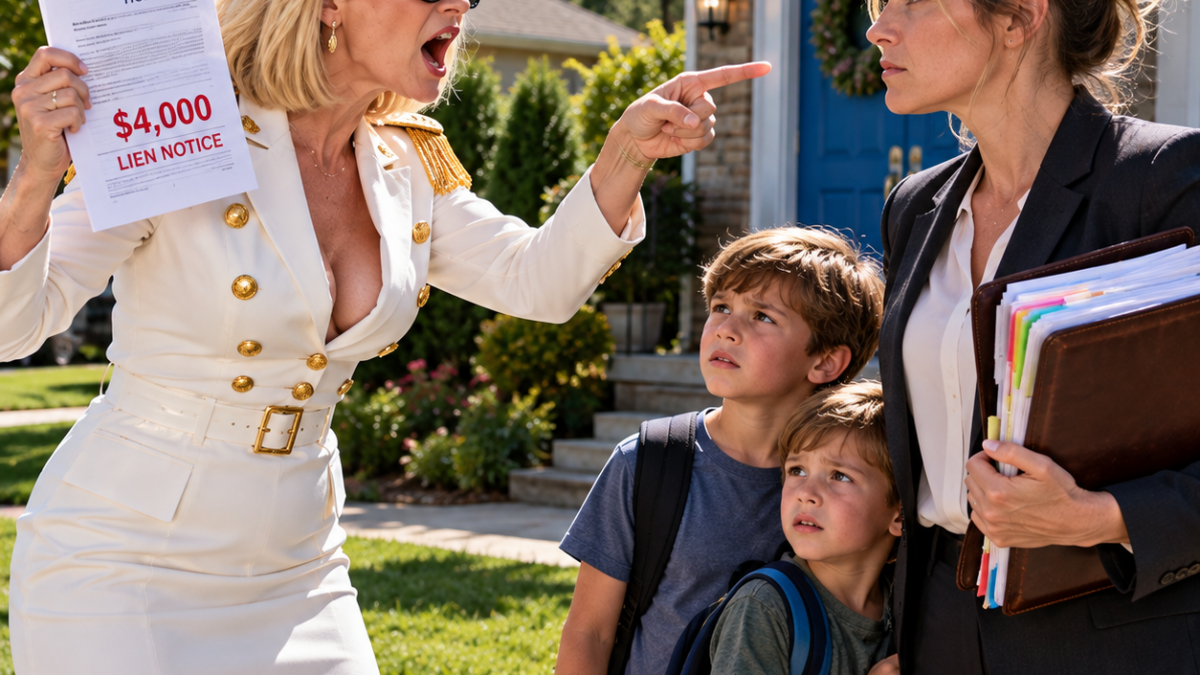
Then she sent me a $4,000 bill and threatened to put a lien on the first home I had ever managed to buy for my children.
What Karen did not know was that I worked as a paralegal—and by the time she figured that out, every letter, every threat, and every lie she had sent me was already sitting neatly inside an evidence folder.
I was thirty-seven when I bought that house.
To some people, it probably wasn’t impressive.
Three bedrooms.
One and a half bathrooms.
A modest yard.
A garage barely large enough for one vehicle and everything two boys somehow accumulated without me ever remembering buying any of it.
The kitchen needed work.
The downstairs carpet looked like it had survived several generations of children and at least one large dog.
The back fence leaned slightly to the left.
One bathroom still had pale yellow tile that might have been fashionable twenty-five years earlier.
I loved every inch of it.
More importantly, my sons loved it.
Ethan was ten.
Caleb was eight.
Before that house, the three of us had spent years living in places chosen almost entirely by one question:
What can I afford?
Not what neighborhood has the best schools.
Not whether there was a yard.
Not whether each child could have his own room.
Not whether the street felt safe after dark.
Affordability decided almost everything.
There were periods when the boys shared a bedroom so small that their beds nearly touched.
For a while, things were even tighter than that.
I don’t like remembering those years as though we were miserable every day, because we weren’t.
My boys laughed.
We had movie nights.
We ate pancakes for dinner.
I turned cheap apartments into homes as best I could.
But there is a particular exhaustion that comes with constantly calculating survival.
Rent.
Food.
Childcare.
Electric bill.
School supplies.
Gas.
Doctor visits.
One unexpected car repair could knock the entire month sideways.
I worked bad jobs for bad pay because I needed flexibility more than dignity.
Then I went back to school.
That part sounds simple when I summarize it now.
It wasn’t.
I was working.
Raising two children.
Taking classes.
Studying after bedtime.
Writing papers while one boy slept beside me because he had a fever.
Taking exams after spending the previous night cleaning vomit off sheets.
There were mornings when I dropped the boys at school, sat in my car, and cried because I didn’t know how I would keep doing everything.
Then I did it anyway.
Eventually I finished my degree and got hired as a paralegal.
Not at some enormous corporate law firm with elevators made of glass and partners billing a thousand dollars an hour.
A medium-sized local practice.
Civil matters.
Property disputes.
Employment issues.
Some family law.
Some small-business litigation.
Nothing glamorous.
But compared with where I had been, the salary felt extraordinary.
I had health insurance.
Predictable hours.
Paid leave.
People used words like deposition and discovery instead of asking me whether I could cover a Sunday night shift with fifteen minutes’ notice.
For the first time in years, I began saving.
Slowly.
Then seriously.
Eventually I started looking at houses.
The boys came with me to almost every showing.
They had no concept of budget.
Ethan wanted whichever house had the largest bedroom.
Caleb wanted any house with stairs.
One had a swimming pool and both boys became convinced we would immediately die if I failed to buy it.
We did not buy the pool house.
Then we found ours.
Small.
A little outdated.
Quiet street.
Low crime.
Good school district.
Kids riding bicycles.
Trees.
A yard.
The first time we toured it, Caleb ran upstairs and shouted:
“Mom! I get my own room?”
I remember standing at the bottom of the stairs.
That question hit harder than it should have.
“Yes.”
He disappeared into the room.
Ethan claimed the slightly larger one across the hall.
They started planning decorations before I had even made an offer.
I stood in the empty living room imagining our furniture there.
Our Christmas tree.
Homework at the kitchen table.
The boys coming home from school.
Ordinary life.
That was all I wanted.
Ordinary.
Safe.
Mine.
There was an HOA in the neighborhood, but unlike many associations, membership on my specific property was voluntary.
That mattered.
The title paperwork clearly showed that my house was not automatically bound into mandatory membership.
I could opt in.
If I joined, the property would then become subject to the association’s rules and leaving later would be far more complicated.
The seller and closing agent both explained it carefully.
The HOA maintained certain common amenities and landscaping.
Members paid dues.
Members followed architectural rules.
I considered it.
Then decided against it.
Money was one reason.
Every dollar mattered.
But I also didn’t see much benefit for us.
We didn’t need the clubhouse.
The boys didn’t care about the association’s events.
And I liked having control over my own property.
So I signed the paperwork confirming I was not joining.
That decision saved me later.
At the time, it felt boring.
We moved in.
The first month was wonderful chaos.
Boxes everywhere.
Pizza on the floor because I hadn’t found the dining table hardware.
Paint samples taped to walls.
The boys arguing about who got which bathroom shelf.
Our first night there, all three of us ended up sleeping in the living room anyway because the beds hadn’t been assembled.
I lay there listening to the boys whisper and laugh inside sleeping bags.
I remember thinking:
We made it.
Not rich.
Not finished.
But safe.
I didn’t know Karen Whitmore was already watching.
I met her about two weeks after we moved in.
She appeared while I was struggling with a mailbox post.
The existing one leaned badly.
I planned to replace it eventually, but I was trying to stabilize it temporarily.
A white luxury SUV stopped at the curb.
Karen got out.
She was about forty.
Maybe slightly older.
Tall.
Blond.
Beautiful in a deliberate, polished way.
Perfect makeup.
Expensive manicure.
A very curvy figure with a particularly full chest that she emphasized with a fitted white military-style outfit decorated with gold buttons.
Not an actual military uniform.
More like something designed by someone who thought authority needed tailoring.
The jacket hugged her waist.
The neckline was deeper than anything remotely practical.
She wore white heels.
To inspect a mailbox.
That told me a lot.
At first, though, she was pleasant.
Almost overly pleasant.
“You must be the new owner.”
I wiped dirt from my hand.
“I am.”
She introduced herself.
“Karen Whitmore. HOA board.”
Not president.
At least not officially.
But the way she said it made HOA board sound like federal office.
She looked at the house.
“Very charming.”
“Thanks.”
“You’re renovating?”
“Slowly.”
She smiled.
“We love owners who take pride in the neighborhood.”
The sentence was harmless enough.
Then:
“Have you joined the association yet?”
“No.”
Her smile stayed.
“Oh.”
Only one syllable.
But something in it changed.
“I decided not to.”
“Temporarily?”
“No. I opted out at closing.”
Karen tilted her head.
“Most responsible homeowners join.”
I smiled.
“Then I’m sure the association has plenty of members.”
She laughed lightly.
“It’s really for everyone’s benefit.”
“I understand.”
“You should reconsider.”
“Maybe someday.”
She stepped closer.
Her perfume was strong.
“We maintain standards here.”
“I noticed.”
“That’s why the neighborhood stays desirable.”
“Makes sense.”
“And you get access to voting.”
“I’m okay.”
She studied me.
Then glanced toward the front window.
My boys were visible inside.
“Your husband at work?”
There it was.
“No husband.”
Her eyebrows lifted.
“Oh.”
“Just me and the boys.”
Another small pause.
Then:
“How brave.”
I hated that phrase immediately.
How brave.
The polite version of:
That sounds unfortunate.
I smiled anyway.
“We’re doing fine.”
“Of course.”
Karen looked back at the mailbox.
“Members use an approved design.”
“I’m not a member.”
“Yes.”
Her smile tightened.
“I remember.”
Then she returned to her SUV.
Nothing about the interaction was openly hostile.
Just enough pressure to make me notice.
I forgot about her within an hour.
A month after we moved in, Ethan and Caleb came through the front door looking upset.
That was unusual.
I had sent them outside maybe ten minutes earlier.
They were supposed to ride their bikes around the block.
Normally I’d have to drag them back inside for dinner.
Instead, Ethan came in first.
Caleb behind him.
“What happened?”
Caleb said:
“That lady yelled at us.”
Every instinct in me changed.
“What lady?”
“The weird one.”
Helpful.
Ethan pointed toward the street.
“She said we can’t ride bikes.”
“Did you go on someone’s lawn?”
“No.”
“Did you hit anything?”
“No.”
“Were you in the road?”
“Just the side like you said.”
“What did she say?”
Ethan looked embarrassed.
“She said we were too loud.”
I walked outside.
Mama bear is a cliché until somebody targets your children.
Then suddenly you understand exactly why the phrase exists.
Karen was standing near the sidewalk.
Watching our house.
Of course she was.
I walked toward her.
“Did you just tell my sons they can’t ride their bikes?”
Karen didn’t look embarrassed.
“They were being disruptive.”
“Disruptive how?”
“Noise.”
“What noise?”
“Laughing. Shouting.”
“They’re children.”
“There are rules.”
“What rules?”
Karen folded her arms.
“The community has quiet enjoyment standards.”
“At four in the afternoon?”
“Noise can be disruptive at any hour.”
I looked around.
Two other children were playing basketball three houses away.
Another kid rode a scooter past us.
Someone’s dog was barking.
My boys had apparently been singled out for laughing.
“They weren’t making unusual noise.”
Karen’s lips tightened.
“The other children come from stable households that understand community expectations.”
I stared at her.
“What does that mean?”
She made a strange little hand gesture toward my house.
“Well.”
“Well what?”
“You know your situation.”
“My situation?”
Her eyes flicked toward my wedding-ring-less hand.
Then the house.
Then me.
I understood.
Single mother.
That was the problem.
I felt anger rise.
Slowly.
“Say what you mean.”
Karen immediately retreated into plausible deniability.
“I simply mean that families who have lived here longer understand standards.”
“That isn’t what you said.”
“You’re being defensive.”
“You spoke to my children without me.”
“Someone had to correct them.”
“No.”
I stepped closer.
“You do not discipline my sons.”
“I wasn’t disciplining—”
“You told them they weren’t allowed to ride bicycles on their own street.”
“They were violating HOA rules.”
“We aren’t in the HOA.”
She blinked.
“We discussed that.”
“I remember.”
“Then why are you quoting HOA rules at my children?”
“Everyone needs to respect neighborhood standards.”
“No.”
Karen’s eyebrows rose.
“No?”
“No. Your HOA rules apply to members. I’m not a member.”
She laughed softly.
“You still live here.”
“Yes.”
“You can’t just ignore community expectations.”
“I can ignore rules I never agreed to.”
Karen’s face tightened.
“Your front door is also an unapproved color.”
I actually laughed.
“What?”
“That blue.”
She pointed.
“It isn’t approved.”
“Good thing I don’t need approval.”
“The mailbox design is wrong.”
“Also not your problem.”
“The landscaping—”
I cut her off.
“Karen.”
She went silent.
“Leave my children alone.”
Her eyes hardened.
“You don’t need to become hostile.”
“You made my eight-year-old afraid to ride his bike.”
“I corrected inappropriate behavior.”
“No.”
I looked her directly in the eye.
“You bullied two children because their mother isn’t in your club.”
She drew herself up.
“That is ridiculous.”
“Then prove me wrong by never doing it again.”
I turned toward the house.
Karen called after me:
“You still need to follow standards!”
I turned back.
“Or what?”
She smiled.
It wasn’t friendly anymore.
“You’ll find out.”
That was the beginning.
The letters started soon afterward.
At first, they almost looked unofficial.
Printed pages.
HOA logo.
Karen’s signature.
VIOLATION: UNAPPROVED EXTERIOR PAINT COLOR.
VIOLATION: NONCONFORMING MAILBOX.
VIOLATION: EXCESSIVE CHILD NOISE.
VIOLATION: UNAUTHORIZED BICYCLE ACTIVITY.
That last one made me laugh.
Unauthorized bicycle activity.
Apparently Ethan and Caleb were operating some kind of criminal cycling ring.
I ignored the first few.
Then Karen began leaving notices taped to the door.
One accused me of maintaining “visually inconsistent curtains.”
Curtains.
Inside my house.
Another claimed the boys’ basketball hoop violated recreational equipment standards.
It was portable.
In my driveway.
Then came landscaping.
I had planted flowers.
Apparently the colors were wrong.
I eventually wrote Karen one email.
Short.
Professional.
My property is not a member of the association and is not bound by the association’s voluntary covenants. Please stop sending violation notices.
She replied within an hour.
All homeowners are expected to maintain community standards regardless of membership status.
I wrote:
Please identify the recorded legal authority supporting that statement.
No response.
Instead, another violation arrived.
This one about my children’s “repeated excessive outdoor noise.”
That changed how we lived.
I hated that.
The entire point of buying the house was giving my sons the freedom to play outside.
Now I found myself watching through windows.
If they rode bikes, I checked whether Karen was nearby.
If they played catch, I worried she would approach them.
Once, Caleb came inside because he saw Karen’s SUV.
He hadn’t even spoken to her.
He just saw the vehicle.
That made me furious.
I told the boys:
“You are allowed to play outside.”
Caleb asked:
“What if the mean lady comes?”
“Come get me.”
“Are we doing something bad?”
“No.”
“Then why does she keep yelling?”
There is no good answer to that question.
Because some adults confuse control with importance?
Because you’re children and easier to intimidate?
Because she thinks a woman raising kids alone is automatically irresponsible?
I said:
“She doesn’t get to decide what you’re allowed to do.”
That was true.
But I hated that they needed reassurance inside their own home.
About two months after the bicycle incident, Karen escalated.
I came home from work and found a thick envelope in the mail.
HOA letterhead.
Certified-looking formatting.
Itemized charges.
I opened it at the kitchen counter.
My stomach dropped.
TOTAL OUTSTANDING HOA FINES:
$4,000.
Four thousand dollars.
For violations of rules I had never agreed to.
There was an attached page warning that failure to pay could result in collection proceedings and a lien against my property.
Possibly foreclosure if the lien remained unsatisfied.
I read the words several times.
Even when you know something is legally questionable, the word foreclosure hits differently when you’re a single mother who spent years fighting to buy her first home.
For a few seconds, I wasn’t a paralegal.
I was the woman who remembered shared bedrooms.
Overdue bills.
Cheap apartments.
The fear of losing stability.
I imagined Ethan and Caleb packing boxes.
I imagined explaining that some HOA had taken our house.
Then the legal part of my brain returned.
No.
I pulled out the closing file.
Opt-out documentation.
Title.
Association disclosure.
Everything.
Karen had no membership agreement.
No covenant binding the property.
No contractual basis for fines.
And therefore no legitimate HOA debt on which to base a lien.
I was still angry.
But fear became focus.
That evening, I spoke to my neighbor Rachel.
Rachel lived two houses down.
She was in the HOA.
Married.
Two children.
Completely normal.
I’d gotten to know her because our sons attended the same school.
I showed her the letter.
Rachel barely finished reading before she sighed.
“Oh God.”
“What?”
“Karen.”
“You sound unsurprised.”
Rachel handed it back.
“She did this before.”
My stomach tightened.
“To who?”
Rachel hesitated.
Then:
“Another single mom.”
Everything in me went still.
“Tell me.”
Her name was Monica.
She had lived on the other side of the neighborhood several years earlier.
Unlike me, Monica had joined the HOA.
According to Rachel, Karen targeted her constantly.
Parking complaints.
Noise complaints.
Grass.
Trash cans.
Children’s toys.
Things other homeowners did without consequence somehow became violations when Monica did them.
Karen issued repeated fines.
Monica struggled financially.
Then the association placed a lien.
Eventually Monica sold.
Whether the lien alone forced her out or the constant pressure became too much, Rachel didn’t know.
But everyone knew Karen hated her.
“Why?”
I asked.
Rachel lowered her voice.
“Karen said things.”
“What things?”
“That the neighborhood needed stable families.”
There was that phrase again.
Stable.
“What did she mean?”
Rachel gave me a sad look.
“You know exactly what she meant.”
Yes.
I did.
My family was incomplete in Karen’s eyes.
No husband.
Therefore unstable.
That was when her earlier comment about my boys made complete sense.
Those kids are in stable households.
She wasn’t enforcing noise standards.
She had decided my children were somehow lesser because only one parent lived under our roof.
That night, I sat after the boys were asleep and looked around our living room.
Paint cans in one corner.
An old lamp I planned to replace.
Laundry basket on the stairs.
Homework papers on the coffee table.
It was not a perfect house.
But we had earned it.
I had earned it.
And some woman with a board position thought she could frighten us out because we didn’t match her preferred family structure.
Karen had made one very serious miscalculation.
She did not know what I did for a living.
I had never told her.
To Karen, I was apparently just the single mother with a fixer-upper who might be easy to intimidate.
In reality, I spent my workdays organizing documents for lawsuits.
I knew what evidence looked like.
I knew how to preserve communications.
I knew the difference between angry statements and legally useful statements.
And I knew enough attorneys personally that getting competent advice did not require opening a phone book.
The next morning, I brought Karen’s packet to work.
My supervising attorney, Daniel Mercer, was drinking coffee when I put it on his desk.
“What is this?”
“My HOA.”
“I thought you weren’t in the HOA.”
“Exactly.”
He started reading.
Halfway through, he looked up.
“They’re threatening a lien?”
“Yep.”
“You signed nothing?”
I handed him the opt-out documents.
Daniel read those too.
Then leaned back.
“Who sent this?”
“Board member named Karen Whitmore.”
“She an attorney?”
I laughed.
“No.”
“Good.”
“Why?”
“Because I’d be more worried about the profession if she were.”
I explained everything.
The bike incident.
The stable household comment.
The letters.
The alleged violations.
The $4,000 bill.
Rachel’s story about Monica.
Daniel’s expression changed.
“That last part matters.”
“I know.”
“Document everything.”
“Already started.”
He smiled.
“Of course you did.”
By lunchtime, I had a binder.
Tab one:
Closing documents.
Tab two:
HOA opt-out confirmation.
Tab three:
Karen’s violation letters.
Tab four:
Emails.
Tab five:
Photographs.
Tab six:
Timeline.
Dates.
Times.
Conversations.
Every interaction I could remember.
The legal assistant next to me joked:
“She’s picked the wrong mom.”
I didn’t feel triumphant yet.
I still wanted the entire thing to disappear.
My first step wasn’t a lawsuit.
It was a cease-and-desist letter.
Daniel helped me draft it professionally.
The letter stated that my property was not subject to the association.
That Karen had no authority to assess fines.
That further collection threats could expose her and potentially the association to legal liability.
That she was not to contact my minor children.
That all communications regarding alleged assessments were disputed.
That any attempt to record an invalid lien would be challenged immediately.
We sent it certified.
Signed receipt.
Karen received it.
She ignored it.
Three days later, I got another email.
SUBJECT: OUTSTANDING BALANCE.
Dear Homeowner,
Your refusal to comply does not invalidate HOA authority.
I almost laughed at homeowner.
Not member.
Homeowner.
Then came:
Your current balance remains $4,000 plus administrative charges.
Further noncompliance may result in lien enforcement.
I forwarded it to Daniel.
His reply:
Save this.
I did.
Then Karen sent another.
This one was worse.
You should reconsider wasting money on counsel. The association has experienced attorneys and significantly greater resources than an individual homeowner. Continued resistance will only increase your financial burden.
That sentence made Daniel smile.
“She wrote that?”
“Yes.”
“Beautiful.”
“Beautiful?”
“She’s providing our exhibits for us.”
Karen believed threats worked because they had worked before.
Monica had been vulnerable.
Maybe others too.
Karen had learned that official-looking letters plus financial pressure usually produced compliance.
She had no idea she was creating a record.
Then the alleged lien letter arrived.
It claimed that a lien had been placed against my property.
Karen demanded the $4,000 fines plus additional charges for release.
That finally pushed me past correspondence.
I brought it directly to Daniel.
“Can she do this?”
“Not lawfully based on what you’ve shown me.”
“But did she actually record one?”
“We check.”
That process was more frustrating than it should have been.
County records.
Index searches.
Filing status.
Property description.
Grantor-grantee information.
Documents sometimes don’t appear instantly.
I understood why normal homeowners panic when they receive something like that.
Even knowing how to navigate the system, it was stressful.
Eventually we learned Karen had attempted to submit lien paperwork.
It had not been properly accepted as a valid recorded lien.
The filing was defective.
The underlying authority was unsupported.
But the attempt mattered.
She hadn’t merely threatened.
She had tried to interfere with title to my home.
And she had done so after receiving a cease-and-desist explaining exactly why she lacked authority.
Daniel brought another attorney from the firm into the matter.
Her name was Susan Cole.
Susan handled real estate litigation.
She reviewed everything.
Then said:
“I think you’ve been much more patient than I would’ve been.”
“That’s comforting.”
“Do you want this stopped or do you want damages too?”
“Mostly stopped.”
“Mostly?”
I thought of my sons coming inside because they saw Karen’s vehicle.
“I want her away from my kids.”
Susan nodded.
“Then let’s build around that.”
We filed.
The defendants included Karen personally and, because she had been acting under HOA letterhead and claiming association authority, the HOA was brought into the dispute as well.
The claims covered the improper collection activity, interference involving the attempted lien, harassment, and related conduct.
I won’t pretend filing a lawsuit felt exciting.
People imagine legal action as one dramatic moment.
It isn’t.
It’s paper.
Waiting.
More paper.
Scheduling.
Calls.
Responses.
Motions.
Rescheduling.
Then more waiting.
Karen’s biggest surprise wasn’t the lawsuit itself.
It was that the HOA board had apparently not understood what she had been doing.
That revelation came when the management company called me.
The representative sounded nervous.
“Ms. Bennett, we’d like to discuss the misunderstanding.”
I said:
“All communication goes through my attorney.”
I had wanted to say those words ever since Karen told me I couldn’t afford to fight them.
It felt wonderful.
The representative tried again.
“We believe this could be resolved informally.”
“My attorney’s information is on the complaint.”
“We’d really prefer—”
“Please contact counsel.”
Then I ended the call.
Later, through discovery and communications between attorneys, the picture became clearer.
Karen had represented me to the board as a delinquent homeowner.
She had not emphasized that I had formally opted out.
In some communications, she apparently blurred the distinction entirely.
She described me as refusing community standards.
Refusing fines.
Creating nuisance conditions.
The board had not authorized some of her most aggressive communications in the way she suggested.
Several directors had simply assumed I was a member because Karen told them the matter was legitimate.
That did not completely excuse them.
Their name was on letters.
Their management company sent notices.
But Karen had been driving the campaign.
When the board finally saw my closing documents, they panicked.
Good.
Because by that point, I wasn’t asking them to believe me.
I had proof.
Karen went quiet almost overnight.
No letters.
No emails.
No vehicle idling near my house.
No comments to the boys.
Nothing.
Caleb noticed before I did.
One afternoon he came inside after riding bikes.
“Mom.”
“What?”
“The mean lady didn’t say anything.”
I looked up.
“Did you see her?”
“She drove past.”
“And?”
“She looked away.”
I smiled.
“Good.”
“Did you beat her?”
Kids.
“Not exactly.”
Ethan said:
“Are you suing her?”
I stared.
“How do you know that word?”
“You work at a law office.”
Fair.
“We’re handling it.”
“Is she going to take the house?”
That question hurt.
“No.”
I put down what I was doing.
“Listen to me. Nobody is taking this house.”
“Promise?”
“Yes.”
I meant it.
Eventually, we got our court date.
The night before, I barely slept.
Not because I doubted the documents.
Because court makes everything real.
I had attended hearings for work.
Prepared files.
Sat behind attorneys.
Watched witnesses testify.
Being the client was different.
I put on my best navy suit.
Dropped the boys at Rachel’s.
Then went to court with Susan.
Karen arrived wearing white.
Of course.
Her fitted military-style suit had gold buttons down the front and a deep neckline beneath the tailored jacket.
Blond hair perfectly arranged.
Makeup flawless.
She looked confident.
Almost cheerful.
When she saw me, she gave a tiny smile.
The kind that said:
You don’t belong here.
I said nothing.
Her confidence lasted until the judge started asking basic questions.
Not dramatic questions.
Basic.
“Is the plaintiff’s property contractually subject to this association?”
Karen’s attorney hesitated.
“The property is located within the broader neighborhood—”
“That wasn’t my question.”
Susan handed over the documents.
The judge reviewed them.
“Where is the membership agreement?”
Karen spoke.
“She lives in the community.”
The judge looked at her.
“Ma’am, your attorney will speak unless you’re asked.”
Karen closed her mouth.
The judge turned back to counsel.
“Where is the agreement?”
There wasn’t one.
Because I never joined.
Then:
“Where is the recorded covenant binding the plaintiff’s parcel?”
Again, none.
Then the $4,000 fines.
The alleged lien.
The defective filing attempt.
The emails.
Susan presented Karen’s line about the HOA having stronger lawyers than I could afford.
The judge read it.
Expression unchanged.
Then another email threatening increased financial burden.
Then the cease-and-desist.
Then the messages sent after Karen received it.
Each document made the room feel smaller.
Karen’s confidence faded.
When asked why she believed she had authority, she fell back on the same phrases I’d heard for months.
Community standards.
Neighborhood character.
Fairness to paying members.
Property values.
The judge interrupted.
“None of that establishes contractual jurisdiction.”
Karen tried again.
“Everyone benefits from the HOA.”
“That also does not establish contractual jurisdiction.”
She looked at her lawyer.
He looked uncomfortable.
Then came the attempted lien.
Karen insisted she believed the association had a right to secure unpaid assessments.
The judge asked:
“What assessments?”
Karen said:
“The fines.”
“For rules that did not bind the property?”
Karen went silent.
Her attorney requested a recess.
Outside the courtroom, Susan looked at me.
“How are you doing?”
“Trying not to smile.”
“You can smile after.”
“What happens now?”
“They want to talk settlement.”
We returned.
The HOA lawyer did most of the speaking.
Karen hardly said anything.
The proposed resolution was straightforward.
All alleged fines withdrawn.
Any attempted lien claim abandoned and formally disavowed.
Written confirmation that my property was not and had never been a member of the association.
My legal fees covered.
No contact from Karen to me or my children.
Karen removed from the board.
There was also a modest monetary payment tied to the harassment and costs I’d incurred.
Nothing life-changing.
I didn’t care.
I had never wanted a jackpot.
I wanted my boys to ride bicycles without being harassed.
I wanted mail to stop containing threats.
I wanted my title left alone.
I wanted Karen to understand one word:
No.
I accepted.
Karen did not look at me when the terms were finalized.
She stared down at the table.
The woman who had once stood on my driveway telling me not to test her suddenly seemed smaller.
Not physically.
Psychologically.
Authority had been her armor.
HOA board.
Official letters.
Fine notices.
Lien threats.
Once those were exposed as unsupported, there wasn’t much underneath except a woman who had decided she could punish families she disapproved of.
The written HOA statement arrived later.
I read it twice.
Then put it in my property file.
It confirmed clearly that my home was not part of the association and was not subject to its bylaws or assessments.
I made three copies.
One in my home records.
One digital.
One in my work file.
Paralegal habits die hard.
Karen’s removal happened quickly.
Rachel texted me after the board meeting.
She’s out.
I stared at the message.
Then:
Really?
Immediate.
Apparently several board members were furious when they learned how much she had done without proper authorization.
The association’s insurer and attorney were even less impressed.
Karen lost the board position she’d treated like personal sovereignty.
I didn’t attend the meeting.
Didn’t need to.
The consequences were hers.
The first Saturday after everything ended, I told the boys:
“Go ride.”
Caleb looked toward the street.
“Is Karen outside?”
“Doesn’t matter.”
“What if she talks to us?”
“She isn’t allowed to.”
Ethan’s eyes widened.
“Like a rule?”
“Yes.”
He grinned.
“She has a rule now.”
I laughed.
“Exactly.”
They rode for almost two hours.
Up the street.
Down.
Around the corner.
Back again.
Laughing.
Shouting.
Being children.
I sat on the front steps with coffee.
Nobody complained.
The blue door remained blue.
The supposedly unacceptable mailbox remained exactly where it was.
My flowers remained whatever colors I wanted.
The sky did not fall.
Property values survived.
Months passed.
The house slowly changed.
I replaced the ugly downstairs carpet.
Painted the living room.
Fixed the fence.
The boys helped me build shelves in the garage.
Their help mostly involved handing me tools I didn’t ask for, but they were proud.
We planted a small tree in the backyard.
Caleb named it Steve.
No reason.
Steve grew.
So did the boys.
The house became ours in the way property documents can never fully capture.
Scuffed walls.
Height marks inside a closet door.
School photos.
Birthday decorations.
A basketball bounced against the garage so many times that I stopped noticing.
That was what Karen had almost poisoned.
Not ownership.
Belonging.
For months, she had made me feel as if I needed permission to exist in the neighborhood.
Permission to have children who laughed.
Permission to paint.
Permission to park.
Permission to be a family without a husband.
I didn’t realize how deeply that had affected me until the pressure stopped.
The first time I saw Karen after the case was at the grocery store.
Produce section.
I was comparing strawberries.
She turned the corner.
Saw me.
Stopped.
For one second, I thought she might say something.
Then she looked directly past me.
As though I were invisible.
Perfect.
I bought my strawberries.
Another time, she was across a parking lot.
Same thing.
No eye contact.
No confrontation.
Karen now avoided my block entirely.
The woman who once patrolled my house had apparently discovered alternate routes through the neighborhood.
Fine by me.
Months later, I learned more about Monica.
The previous single mother Karen had targeted.
Rachel managed to contact her through an old neighborhood group.
I didn’t need to know every detail.
But enough came back to confirm the pattern.
Karen had made similar comments about household stability.
Questioned Monica’s children.
Applied rules selectively.
The difference was that Monica had actually joined the association.
That gave Karen legitimate enforcement mechanisms to abuse.
By the time Monica understood the pattern, she was financially overwhelmed.
She sold and left.
Hearing that made me angry all over again.
I asked Susan whether anything could still be done.
She said Monica would need to consult counsel based on her specific records, timing, and circumstances.
I gave Rachel Susan’s contact information to pass along.
Then I stepped back.
It wasn’t my case.
But it reinforced something important.
Karen had not made a mistake with me.
She had a target type.
Single mothers.
Women she believed lacked resources.
Families that didn’t fit her preferred image.
She had tried it before.
I was simply the first one with an opt-out document, legal training, and coworkers willing to help me fight.
That realization bothered me.
Because people sometimes tell stories like mine as though the ending proves the system always works.
It doesn’t.
The system worked for me because I had advantages.
I understood paperwork.
I knew not to throw letters away.
I had access to attorneys.
I knew what a lien was.
I knew how to search filings.
I knew when a threat sounded legally suspicious.
Another person might not.
Another single mom receiving a $4,000 demand and foreclosure language might panic.
She might borrow money.
Put it on credit cards.
Sell.
Move.
All because someone with a letterhead sounded confident.
That is why Karen’s behavior was so ugly.
She weaponized confusion.
She counted on fear filling the gaps where actual authority was missing.
I once asked Daniel:
“What would’ve happened if I’d paid?”
He shrugged.
“You’d probably have had a harder time convincing her she couldn’t fine you.”
“Because payment looks like acceptance?”
“Potentially. Depends on context.”
I stared at my binder.
“So she wanted me scared enough to validate her.”
“Bullies often do.”
That word fit better than HOA tyrant.
Bully.
Karen’s power existed only when people acted as though it existed.
Once forced to show the actual legal basis, she had nothing.
A lot of people asked why the board didn’t catch it sooner.
That is a fair question.
The answer seemed to be a combination of laziness, misplaced trust, and Karen’s confidence.
She had been involved for years.
She knew the procedures.
She produced paperwork.
Other directors assumed she had checked membership status.
Management assumed the board had authorized enforcement.
Everyone assumed somebody else had verified the basics.
Nobody did.
Until I forced them.
After Karen left, the HOA changed procedures.
Even though I wasn’t a member, Rachel told me about it.
Before issuing fines, management had to verify that the property was actually subject to the association.
Imagine that.
Revolutionary concept.
Board members could no longer independently send certain enforcement letters using association branding without review.
Lien procedures required legal confirmation.
They also added conduct expectations for board interactions with minors.
I smiled when Rachel told me that.
“So my kids caused policy reform?”
“Basically.”
Caleb overheard.
“Do we get paid?”
“No.”
He looked disappointed.
I bought them ice cream.
Close enough.
Eventually, I thought less about Karen.
That was the best outcome.
Revenge stories usually focus on the moment the antagonist loses.
Karen removed.
Legal fees paid.
Court embarrassment.
Those moments felt good.
I’d be lying if I pretended otherwise.
Watching a judge ask Karen questions she couldn’t answer was satisfying.
Hearing she had been removed from the board was satisfying.
Watching my children reclaim their street was better.
Real victory was boring.
No letters.
No emails.
No one watching the house.
No conversations about liens.
No terrified boys asking whether they had done something wrong.
Just life.
A couple years later, Ethan asked me about the case.
He was older.
Old enough to understand more.
“Did that woman hate us because Dad doesn’t live here?”
His father had never been a significant part of their daily lives.
The complicated reasons didn’t matter.
I looked at Ethan.
“I think she had ideas about what families should look like.”
“Like two parents?”
“Yes.”
“That’s stupid.”
Kids are efficient.
“Yes.”
“We were still a family.”
“Exactly.”
He nodded.
Then went back to whatever he was doing.
I sat there thinking:
That’s the whole story.
Karen believed family was architecture.
Two parents.
Approved colors.
Quiet children.
Matching mailbox.
Rules.
Appearance.
I believed family was responsibility.
Showing up.
Feeding kids.
Homework.
Doctor appointments.
Saving for a house.
Going back to school.
Working late.
Making breakfast.
Sitting beside a sick child at two in the morning.
Teaching someone to ride a bike.
Holding everything together when nobody else is coming.
If Karen wanted to call that unstable, she was free to be wrong.
One Saturday, years after the lawsuit, I repainted the front door.
The old blue had faded.
I stood in the hardware store looking at color samples.
For a second, I considered another blue.
Then I saw a deep red.
Bold.
Definitely not something Karen would have approved.
I bought it.
Sarah—my friend from work, not the neighbor Rachel—came over to help.
She laughed when she saw the can.
“Is this revenge painting?”
“Maybe.”
“You know she’s not on the board anymore.”
“I know.”
“She doesn’t even come down your street.”
“I know.”
“Then why red?”
I smiled.
“Because I like red.”
That was better than revenge.
We painted the door.
Ethan got paint on the porch.
Caleb got paint on himself despite barely touching the brush.
By evening, the door looked beautiful.
No application.
No approval.
No committee.
Just my house.
My choice.
I still kept the old evidence binder for years.
Not because I expected another fight.
Because I couldn’t bring myself to throw it away.
Four thousand dollar invoice.
Photographs.
Cease-and-desist.
Emails.
The fake authority of it all looked almost ridiculous in hindsight.
One day, I was cleaning my office and opened it.
Karen’s email sat on top.
You should not bother with a lawyer. The HOA has experienced counsel and resources beyond what an individual homeowner can afford.
I laughed.
That sentence had once been intended to scare me.
Instead, it became one of the worst things she could have put in writing.
I showed it to one of the newer paralegals at work.
She read it.
“Wow.”
“Yep.”
“She really wrote that?”
“Yep.”
“What happened?”
“She stopped writing eventually.”
I put the page back.
The irony was perfect.
Karen thought money and institutional backing made her unbeatable.
She believed a single mother would see HOA letterhead and surrender.
Instead, the association wound up paying my attorney’s fees.
I never became rich from the settlement.
That part matters.
Some revenge stories end with absurd six-figure checks.
Mine didn’t.
The money covered what needed covering.
The legal costs were paid.
There was a little compensation beyond that.
Fine.
What I valued was the written confirmation:
Not a member.
No fines.
No lien.
No contact.
Done.
Sometimes justice isn’t getting everything from someone.
Sometimes it’s getting them out of your life.
I also stopped feeling embarrassed about being a single mother after that.
I hadn’t thought I was embarrassed before.
But Karen exposed a little scar I didn’t realize I carried.
When she said stable household, part of me reacted because I had spent years hearing softer versions of the same judgment.
Poor kids.
Must be hard without a father around.
You do so much by yourself.
How do you manage?
You’re so strong.
Sometimes sincere.
Sometimes pity.
Sometimes judgment disguised as concern.
Karen simply said the quiet part louder.
She looked at the three of us and saw deficiency.
I looked at us and saw survival.
Then achievement.
We had gone from sharing cramped spaces to owning a home.
From wondering whether bills would clear to building savings.
From me taking whatever job fit childcare to working in a profession I respected.
We weren’t unstable.
We had survived instability.
There’s a difference.
Karen never understood that.
She didn’t need to.
Eventually, I stopped caring whether she did.
One summer evening, I sat on the front steps while Ethan and Caleb raced bicycles.
They were bigger now.
Faster.
Too old to need me watching every second.
Their laughter carried down the street.
I remembered the first confrontation.
Those children are from stable households.
I looked around.
Rachel’s kids were outside too.
Somebody grilled nearby.
A dog barked.
Two teenagers played basketball.
Normal noise.
Life.
No one complained.
Rachel walked over carrying two drinks.
She handed me one.
“Remember when bicycle laughter was apparently illegal?”
I smiled.
“Dark times.”
“You know Karen still complains about you.”
“Really?”
“To people who’ll listen.”
“What does she say?”
“That you destroyed her reputation.”
I laughed.
“I didn’t send the emails.”
“That’s basically what I said.”
We watched the boys.
Rachel eventually asked:
“Do you ever feel bad?”
“About what?”
“Getting her removed.”
I thought about it.
“No.”
Not because I hated Karen.
I didn’t anymore.
Hate takes energy.
I didn’t feel responsible for removing her.
She removed herself.
One letter at a time.
One threat at a time.
One unauthorized fine at a time.
One defective lien attempt at a time.
I just preserved the receipts.
That distinction mattered.
Karen had every opportunity to stop.
When I told her the property was not in the HOA.
When I sent the first email.
When she saw the opt-out paperwork.
When she received the cease-and-desist.
When lawyers became involved.
At every point, she could have said:
We were mistaken.
She never did.
Because admitting error would have required surrendering control.
For someone like Karen, being wrong was worse than causing harm.
So she doubled down until doubling down became legally expensive.
That’s one reason I teach my boys something very specific now.
Apologizing is not weakness.
Being wrong isn’t humiliation.
If you accidentally hurt someone, fix it early.
The longer you defend a mistake, the more it becomes a choice.
Karen’s first letter might have been a mistake.
Everything after my proof wasn’t.
Those were choices.
A few years later, I learned Karen had moved.
Rachel texted:
Your favorite person has a moving truck.
I looked out my window.
Sure enough.
White SUV.
Boxes.
Truck.
People carrying furniture.
Karen stood on the driveway supervising.
No military-style white outfit this time.
Jeans.
Blouse.
She looked tired.
I didn’t go outside.
Didn’t wave.
Didn’t celebrate.
Didn’t photograph it.
I made dinner.
The next morning, her house was quiet.
A FOR SALE sign appeared.
Eventually another family moved in.
Married couple.
One daughter.
A dog.
The mother introduced herself while I was checking mail.
She said:
“We’ve heard this is a great street.”
I smiled.
“It is.”
She had no idea.
Good.
I didn’t need Karen’s story becoming neighborhood mythology forever.
The street deserved to move on.
So did we.
Today, the house still isn’t perfect.
I never transformed it into some magazine home.
The kitchen eventually got new cabinets.
The yellow bathroom tile survived much longer than planned.
Steve the backyard tree got tall.
The boys left dents in walls.
The garage became impossibly full.
I refinanced once.
Paid down principal.
Kept every title document organized with almost obsessive care.
Some habits stay.
Whenever someone asks what buying that house meant to me, I never mention investment value first.
I mention bedroom doors.
Three of them.
One for me.
One for Ethan.
One for Caleb.
Privacy.
Space.
Safety.
A yard.
That was the dream.
Karen tried to make that dream feel conditional.
As though I could keep it only if I became the kind of family she respected.
She was wrong.
The deed never said:
Valid only if married.
The opt-out agreement never said:
Single mothers must obey anyway.
The law never said:
HOA board members may invent authority when they dislike someone’s family.
Karen simply believed her opinion carried legal weight.
It didn’t.
That’s ultimately why the entire story ended the way it did.
Not because I was smarter.
Not because I worked at a law firm.
Not because I had some secret loophole.
The documents were simple.
My property was not in the association.
I had never joined.
Karen had no authority to fine me under HOA rules.
Once everything was stripped down to those facts, all her confidence disappeared.
Her uniform didn’t matter.
Her title didn’t matter.
Her threats didn’t matter.
Her opinion about single mothers definitely didn’t matter.
Paperwork mattered.
Boundaries mattered.
Evidence mattered.
And the word no mattered.
I sometimes wonder what would have happened if I had joined the HOA at closing.
I probably still could have fought selective harassment.
Karen’s behavior toward my children and the discriminatory pattern would still have mattered.
But the case would have been messier.
The fines might have had some contractual basis, even if selectively enforced.
The lien threat could have been more dangerous.
Instead, one decision I made because I wanted to save money became a shield.
I opted out.
Karen hated that.
I think that is why she became so obsessed.
She could control nearly every house around mine.
Not mine.
My blue door stood in the middle of her carefully governed neighborhood like a tiny reminder that her authority had limits.
For a person like Karen, limits feel like disrespect.
She tried to erase mine.
Instead, she taught me to defend them.
My sons don’t remember every detail now.
Caleb mostly remembers “the mean HOA lady.”
Ethan remembers more.
Neither of them carries the fear anymore.
Good.
That’s exactly what I wanted.
Childhood should not be defined by adults fighting over bylaws.
It should be bicycles.
Grass stains.
Laughter.
Friends.
Falling down.
Getting back up.
Coming inside when the streetlights turn on.
I bought that house to give them those things.
And I refused to let Karen take them away because she thought only certain families deserved to belong.
The last time anyone mentioned her to me, it was Daniel at work.
We were reviewing another property dispute.
A client had received an aggressive demand from a neighborhood association claiming authority it might not have.
Daniel looked over the file.
Then looked at me.
“Feeling nostalgic?”
I laughed.
“Please don’t.”
He pointed at the client’s letter.
“Official-looking paper.”
“Yep.”
“Lots of bold language.”
“Yep.”
“Possibly unsupported.”
“Check the deed.”
He smiled.
“You learned something.”
“No.”
I closed the file.
“Karen did.”
Daniel laughed.
Maybe she did.
Maybe she didn’t.
Either way, she learned one fact the hard way.
Being loud does not make you right.
Being on a board does not make you law enforcement.
Having an attorney does not make every threat enforceable.
And being a single mother does not make someone weak.
Karen looked at me and saw a woman raising two boys alone.
She assumed that meant I would be easy to scare.
What she missed was everything required to get us there.
Years of bad jobs.
Night classes.
Homework after bedtime.
Bills.
Fear.
Exhaustion.
Persistence.
I had already fought much harder things than a woman with a clipboard and a fake lien.
By the time Karen figured that out, it was too late.
Her letters were evidence.
Her threats were evidence.
Her emails were evidence.
Her attempted lien was evidence.
And the first home I ever bought for my sons stayed exactly where it belonged.
With us.
The front door is still not HOA-approved.
The boys still laugh outside.
And nobody has told them to stop since.