FULL ENDING The HOA Tried to Evict a Grieving Single Mom Over Her Lawn, So I Mowed It for Free and Helped Expose Everything
part2
“No,” I said quickly. “No, ma’am. I’m not.”
Her shoulders lowered half an inch, but she still looked wary.
I held out the card. “My name is Daniel. I own a lawn care company. I was driving through the neighborhood and noticed your yard. I wanted to ask if you’d be interested in having it mowed for free.”
She stared at me.
For a second, I honestly thought I had made things worse.
“What?” she said.
“I know it sounds strange. I do free mow jobs sometimes, usually for yards that have gotten a little out of control. It helps me advertise, and it helps the homeowner. There’s no charge.”
Her expression did not soften. If anything, she looked more overwhelmed, like I had handed her a math problem while her house was on fire.
Before I could explain more, two little kids squeezed around her legs.
A boy and a girl, maybe six and seven. Both barefoot. Both curious. The girl had a stuffed rabbit tucked under one arm. The boy pointed at my hat.
“Why do you have grass on your shoes?”
“Because I cut grass,” I said.
“Do you cut trees too?”
“Not usually.”
“Do you know dinosaurs?”
Sarah put one hand over her eyes.
That was the moment I realized she was close to crying.
Not because of me exactly.
Because one more thing had arrived at her door. One more person asking her to process information, make a decision, explain herself, trust a stranger, think beyond the next five minutes. I had come with good intentions, but good intentions can still feel like pressure when someone is already carrying too much.
“I’m sorry,” I said. “I didn’t mean to bother you. Here’s my card. You can throw it away if you want. No pressure.”
She opened her mouth like she wanted to answer, but the little boy tugged on her shirt and asked for juice.
I backed away.
“Have a good day,” I said.
She nodded once and closed the door.
I drove off feeling like an idiot.
For the rest of the day, I could not stop thinking about that house.
I had seen neglect before. I had seen yards abandoned by owners who just did not care. I had also seen what grief, illness, disability, job loss, and poverty could do to a home from the outside in. People love judging an overgrown yard because it makes them feel responsible by comparison. They do not ask whether the person inside is sick, broke, alone, or choosing between groceries and gasoline.
Sarah’s face stayed with me.
So did the kids.
The next day, I went back.
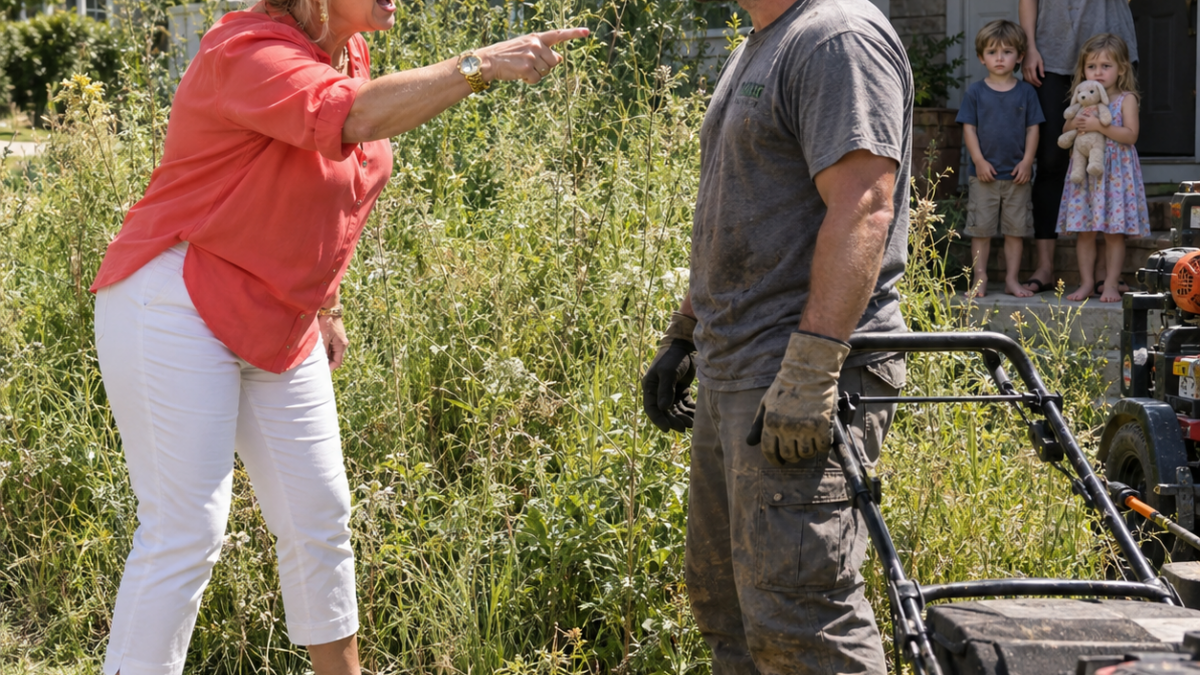
This time, there was a silver SUV parked in front of Sarah’s house and an older woman picking her way through the grass like she was crossing a swamp in designer sandals. She wore white cropped pants, a coral blouse, big sunglasses, and a bright gold watch that flashed every time she swatted at the weeds. Her blonde hair was sprayed into a helmet shape that probably could have survived a hurricane.
She saw my truck before she saw me.
The logo on the door caught her eye, and she walked over like she had been waiting to complain to someone all morning.
“Well,” she said, looking me up and down. “She finally decided to do something about this disaster.”
I kept my voice polite. “Good morning. I’m sorry, and you are?”
She drew herself up.
“Karen Whitcomb. President of the HOA board.”
Of course she was.
Some people introduce themselves like they are offering a name. Karen presented hers like a badge.
“I see,” I said.
She glanced toward Sarah’s house with open disgust. “I hope you get payment upfront. I doubt she can afford much of anything right now. She’s delinquent on fines, dues, and multiple compliance fees.”
Every word made me dislike her more.
“I’m just here to talk to the homeowner,” I said.
Karen leaned closer, lowering her voice in a way that made it more insulting, not less. “Maybe you can talk some sense into her. We’ve been more than patient. The entire cul-de-sac has had to look at this mess for months. It brings down everyone’s property values.”
“I don’t work for the HOA.”
“I didn’t say you did.”
“You kind of implied I should deliver a message.”
She smiled without warmth. “Well, if you’re going to speak with her, you can tell her notices will continue until she complies fully.”
“Anything you need to say to Sarah should come from you,” I said. “Not from a lawn guy you met thirty seconds ago.”
Her sunglasses tilted slightly as her eyebrows rose behind them.
“There’s no need to be rude.”
“I’m not being rude. I’m setting a boundary.”
She looked at my truck again, pulled out her phone, and took a picture of the logo.
“I’ll be sure to tell your manager how you speak to potential customers.”
“I am the manager.”
That took some air out of her.
Not all of it.
People like Karen always keep a reserve tank.
She sniffed. “That explains a lot.”
Then she got into her SUV and drove off, tires crunching against the curb because she was too angry to steer gracefully.
I watched her leave, then headed to Sarah’s door.
This time, Sarah answered faster.
Her eyes were red. She looked past me, saw Karen’s SUV disappear, and let out a breath so tired it sounded painful.
“Do you want to come in for a minute?” she asked.
Inside, the house was not dirty the way cruel people imagine struggling homes are dirty. It was cluttered because life was happening too fast. Children’s shoes by the door. Laundry basket on the couch. School papers on the counter. Dishes drying beside the sink. A stack of envelopes on the kitchen table, all opened, all too official-looking.
The kids followed me like I was a visiting zoo exhibit.
“Do you cut grass every day?”
“Most days.”
“Do snakes live in tall grass?”
“Sometimes.”
“Are there snakes outside?”
Sarah’s face tightened.
“Maybe not,” I said quickly. “I didn’t see any.”
The little girl held up her stuffed rabbit. “This is Pancake.”
“Pancake is a good name.”
She considered me seriously. “He is not for eating.”
“Understood.”
That made Sarah laugh once, sudden and shaky.
She made iced tea and apologized twice for the wait, the clutter, the kids, the yard, the heat, and probably three other things she had no reason to apologize for. I sat at the kitchen table and explained the offer again. Free mow. No obligation. Social media optional. If she did not want cameras, there would be no cameras. If she wanted me to leave after the conversation, I would leave.
She listened without interrupting, both hands wrapped around her glass.
When I finished, she looked down at the table.
“I appreciate it,” she said. “I really do. I just don’t know if it matters anymore.”
That sentence was heavier than the whole yard.
“What do you mean?”
She took a long breath.
Then she told me what had happened.
Her husband, Mark, had died of cancer the year before.
He had been the main breadwinner. She had thought she could work part-time after he got sick, then full-time after he passed, but nothing nearby offered the flexibility she needed with two young kids. Her children were in first and second grade, old enough for school but still young enough that every schedule change became a crisis. After-school care cost money she did not have. Sick days destroyed interviews. Jobs wanted evenings, weekends, availability she could not give.
There was supposed to be money from Mark’s pension, but because of age rules and company policy, a portion of it was locked away for a few more years. What she did receive went to the mortgage, utilities, food, school clothes, medicine, and keeping the house barely afloat.
The lawn had been Mark’s job.
After he got too sick, a neighbor mowed it for a while. Then the neighbor moved away. The elderly women on both sides used paid lawn services Sarah could not afford. Three months earlier, she had found a used weed whacker on the side of the road and tried to beat the grass back herself, but the battery was almost dead. It worked for a few minutes, then had to charge for hours.
“I’d get maybe one little strip done,” she said. “Then I’d have to go back inside. The kids needed dinner. Laundry needed washing. Bills needed sorting. Someone always needed something. By the time the battery charged, it was dark or raining or I was just…” She pressed her lips together. “I was done.”
She pointed toward the stack of envelopes.
“Karen knew all of this.”
I looked at the envelopes. “She knew?”
“She knew when Mark got diagnosed. She knew when he was in treatment. She knew when he died. I wasn’t expecting them to erase everything. I know I live in an HOA. I know there are rules. But I thought maybe there would be some discretion. More time. A payment plan. Something.”
Her eyes filled.
“Instead, the letters got worse.”
She slid one envelope across the table.
Then another.
Then another.
Fines for grass height. Fines for weeds. Administrative fees. Late fees. Failure-to-cure fees. Notices about dues she said she had paid. Threats of legal action. Warnings about nuisance conditions. The amount at the top of the most recent summary made my stomach tighten.
$3,512.40.
Because a widow could not keep up with her lawn.
“She was just here,” Sarah said. “She said if I don’t pay and get the property under control, the board will have no choice but to escalate.”
“What does escalate mean?”
Sarah’s mouth trembled.
“She said I could lose the house.”
I sat back.
I did not know HOA law well enough then to say exactly what was possible. But I knew cruelty when I saw it. And I knew Karen had spoken to me outside like Sarah was already beneath her, already a problem to solve rather than a person to help.
“My offer still stands,” I said. “No camera. No charge. No catch.”
Sarah wiped her face quickly, like crying embarrassed her.
“I don’t want charity.”
“I get that,” I said. “Then think of it as advertising. My truck sits in your driveway for a few hours. Neighbors see the logo. Maybe I get business. You get the yard knocked down. We both win.”
She looked toward the living room where her kids were watching cartoons too loudly.
“What happens after?”
“That’s up to you. I can come back once after a week to even things out. Tall grass can look rough after the first cut. Then we figure out what you want to do.”
She studied me for a long time.
“You’re serious.”
“Yes.”
“You won’t bill me later?”
“No.”
“You won’t post my name?”
“No.”
“You won’t show my kids?”
“Absolutely not.”
She nodded slowly, but she did not agree that day.
I left my card.
Two days later, she called.
“Are you free this weekend?” she asked.
“I can be.”
“After noon?”
“I’ll be there.”
That Saturday, I loaded everything I had.
Push mower. Commercial mower. Weed whackers. Edger. Rakes. Leaf blower. Extra line. Fuel. Gloves. The kind of job Sarah’s yard needed was not a quick pass. Grass that tall hides everything—rocks, toys, hoses, holes, sticks, trash, sometimes snakes. You cannot just charge through it like a normal lawn. You have to reveal it in layers.
When I arrived, Sarah opened the door before I rang.
She looked nervous, like she was afraid I would change my mind once I saw the scale of the work.
“I know it’s bad,” she said.
“I’ve seen worse.”
That was true.
Barely.
The front yard took two hours.
I started high with the trimmer, cutting down the worst of the weeds so I could see what the mower might hit. Sweat ran into my eyes. Grass clippings stuck to my arms. Neighbors slowed as they drove by. Some watched from windows. One woman from next door stood on her porch with a cup of coffee and stared like I was performing surgery.
I uncovered the driveway first.
Then the walkway.
Then a flower bed that had disappeared under weeds.
By the time I reached the curb, the yard looked less like an abandoned lot and more like a home that had been waiting for someone to remember it.
The backyard took nearly four hours.
It was worse.
The grass reached my waist in places. The patio was almost invisible. A plastic slide lay on its side in the weeds. There were soccer balls, a cracked flowerpot, a rusted garden stake, and a little toy truck buried near the fence. Every time I found something, I set it aside carefully because those small things mattered. They were proof kids still lived there, still played there once, still deserved a yard that did not feel dangerous.
Sarah came out once with water.
“You don’t have to do all of it today,” she said.
“Yes, I do.”
She looked like she might cry again, so I started the mower before either of us had to deal with that.
When I finished, the transformation was not perfect. A lawn neglected that long does not become magazine-ready in one day. There were pale patches where sunlight had not reached properly. Some spots were uneven. The edges needed another visit. But the property looked alive again.
The driveway was visible.
The front path was clear.
The backyard patio existed.
Her kids could run without disappearing.
Sarah came outside while I was loading the truck. She stood at the edge of the patio with both hands over her mouth.
The little boy ran past her into the yard and shouted, “Mom! We have ground!”
The little girl carried Pancake the rabbit out and spun in a circle.
Sarah walked over and hugged me.
Not a polite side hug.
A real one.
The kind people give when words are too small.
“Thank you,” she whispered.
I patted her shoulder awkwardly because I am much better with mowers than emotions.
“You’re welcome.”
I told her I would come back the next week to even out the cut.
She agreed.
I drove home exhausted, sunburned, and angrier than I expected.
Not at the yard.
At the fact that one day of work had been treated like a moral failure by people who knew exactly why it had happened.
A week later, I returned.
Sarah opened the door with a pinched expression that vanished when she saw me.
“Oh,” she said. “It’s you.”
“That reaction worries me.”
She tried to smile. “Sorry.”
“What happened?”
At first, she hesitated.
Then she handed me another HOA letter.
This one was dated two days after I mowed.
The letter stated that Sarah’s property remained a nuisance, that the board was reviewing additional penalties, and that failure to resolve outstanding balances could result in legal action up to and including forced removal from the property.
Forced removal.
Over grass and fines.
“She sent this after the lawn was cut,” Sarah said. “I called and told them it was done. I even said I could start paying the fines in small increments if they stopped adding more.”
“And?”
“Karen said the issue was bigger than grass now.”
That sentence chilled me.
Because that is what people like Karen do when compliance ruins their excuse. They move the target. If grass is cut, the issue becomes nuisance. If nuisance is addressed, the issue becomes attitude. If payment is offered, the issue becomes history. The goal is never correction. The goal is control.
“I think you should talk to a lawyer,” I said.
Sarah gave a sad little laugh. “With what money?”
“There are legal aid groups. Pro bono programs. Property attorneys who take cases when something looks this wrong.”
“I wouldn’t even know where to start.”
“I can ask around.”
She looked embarrassed. “You’ve already done enough.”
“No,” I said. “I mowed a lawn. That’s not enough if they’re trying to scare you out of your house.”
I trimmed the yard that day and left still thinking about the letter.
For two weeks, I checked on other jobs, answered emails, handled estimates, and kept wondering about Sarah. Then I stopped by again on a Friday afternoon and found Karen in the driveway.
She was getting into her silver SUV when I pulled up.
She looked at my truck, then at me, and her mouth curled.
“Oh. It’s you.”
“Karen.”
“I see she had enough money to hire your company after all.”
“She didn’t hire me.”
Karen’s eyes narrowed. “Excuse me?”
“I did the mow for free.”
Her smile turned brittle. “How generous.”
“It needed doing.”
“And what exactly do you get out of it?”
“I get to sleep at night.”
She did not like that.
“You know,” she said, “I filed a complaint on your company website after your behavior last time.”
“I saw it.”
“And?”
“And I rejected it.”
She blinked.
“I own the company, Karen.”
For a second, she looked like someone had moved a chair she was trying to sit in.
Then she recovered. “That makes your behavior even more unprofessional.”
“No,” I said. “What’s unprofessional is harassing a grieving widow over grass you know she couldn’t manage.”
Her lips pressed together.
“You don’t know anything about this community.”
“I know enough.”
“You know what she told you.”
“I know what you told me outside her house before you even knew who I was.”
Color rose in her neck.
She stepped closer, lowering her voice. “You should be careful inserting yourself into matters that do not involve you.”
“You made it involve me when you tried to use me as your messenger.”
Karen stared at me for a long moment.
Then she got into her SUV.
Before she closed the door, she said, “People like her always find someone else to clean up their mess.”
I stood there until she drove away because if I had moved too quickly, I might have said something I would regret.
Sarah opened the door before I knocked.
Her face was pale.
“She just dropped this off.”
The document in her hand looked more official than the others.
At the top, in bold letters, it said NOTICE OF EVICTION PROCEEDINGS.
I am not a lawyer, but even I knew enough to feel my blood pressure rise.
Sarah’s hands shook as she laid it on the kitchen table. The kids were at school, thank God. The house was quiet except for the refrigerator humming.
The notice claimed Sarah had failed to follow HOA guidelines, failed to cure nuisance conditions, failed to pay fines, and was required to vacate by the end of the month or face forced removal.
“This can’t be legal,” I said.
Sarah sat down hard.
“I can’t lose the house.”
“You’re not going to lose the house today.”
“But what if—”
“Sarah.” I sat across from her. “Do you have every letter they sent?”
“Yes.”
“Bank statements?”
“Yes.”
“Proof you paid regular dues?”
“Yes.”
“My receipt from the free mow?”
She looked confused. “You gave me a receipt for a free mow.”
“Standard procedure. It proves the date and what was done.”
For the first time that afternoon, a tiny bit of focus came back into her eyes.
“We gather everything,” I said. “Every letter. Every payment. Every email. Every note. Then we find a lawyer.”
She nodded.
Then she stood and opened a drawer.
Inside were envelopes. Dozens of them. Some sorted, some not. HOA letters dating back over a year. Notices from before Mark died. Notices after his diagnosis. Notices after his death. Fines Sarah swore she had already paid. Duplicate charges. Late fees on fees. Administrative costs with vague names.
The stack was not just long.
It was ugly.
I took photos of the eviction notice with her permission. I called a law office I knew through an old customer, a place that handled property disputes and occasionally took pro bono cases when something smelled bad enough. I explained as much as I could without oversharing Sarah’s private details. They agreed to speak with her.
A few days later, Sarah called me crying.
But this time, it was relief.
“They’ll take it,” she said. “The lawyer said they’ll take the case.”
The lawyer’s name was Melissa Grant, and from the first conversation, Sarah said she sounded angry in the best possible way.
Melissa asked for documents. All of them. HOA letters. Bank statements. Payment receipts. The eviction notice. Any communication about Mark’s illness. Any proof Karen knew Sarah’s circumstances. She asked me for my involvement too, so I sent the free-mow receipt, my follow-up invoices showing zero charge, dates of service, and a short written statement about what Karen had said to me before and after the mow.
Then everything slowed down.
Legal time is not human time.
Weeks passed.
Sarah and I kept in touch. I stopped by every few weeks to keep the lawn manageable. I did not charge her. I did not ask again. It became one of those decisions you make once and keep making because it is already true. Her kids started recognizing my truck. The little boy would run to the window and shout, “Grass guy!” which, honestly, I have been called worse.
Sarah got a little steadier.
Not okay.
People throw around okay like it is a destination. Sarah was grieving, parenting, fighting, budgeting, and surviving. But after Melissa took the case, fear no longer had her alone in a corner. That mattered.
Karen disappeared for a while.
I did not see her SUV. No driveway ambushes. No comments about my business. No surprise visits while I mowed. I hoped that meant the lawyer’s first letter had scared her into silence.
It had not.
It meant she was preparing.
By October, Sarah told me the HOA had hired counsel and was claiming she had a long history of noncompliance. Melissa had requested documentation for each fine. What came back, according to Sarah, was a mess. Some fines had no photos. Some photos had no dates. Some letters referenced violations that were not listed in the bylaws. Some charges looked duplicated. Some dues Karen claimed were unpaid matched bank records showing Sarah had paid on time.
The yard fines were the strongest part of the HOA’s case.
That alone said everything.
They could prove Sarah’s grass had gotten too tall.
They could not prove the mountain of other money they demanded.
Then Melissa found the pattern.
Letters increased after Mark got sick.
Not after the lawn got bad.
After Karen knew the family was vulnerable.
At first, the HOA notices were standard. Annoying, but standard. Then Mark’s diagnosis became known because Sarah had asked for grace with fees and deadlines. After that, fines multiplied. Administrative fees appeared. Deadlines shortened. Language hardened. Karen’s emails shifted from procedural to personal.
One message said, Residents cannot expect the community to absorb the consequences of private hardship.
Private hardship.
Her husband was dying.
Another said, Allowing exceptions creates moral hazard.
Moral hazard.
For a widow trying to keep lights on and children fed.
When Sarah read that one to me over the phone, I had to set the mower gas can down and take a walk around my garage before answering.
Court came in March.
I went because Sarah asked me to.
Not as a hero. Not as some central figure. I was a witness, and a minor one compared to the paper trail Melissa had built. But Sarah said having a familiar face there would help, so I wore my cleanest button-down, sat behind her, and watched Karen enter like she expected the room to rearrange itself around her.
Karen wore a navy suit, pearls, and the same helmet of blonde hair. She looked polished, controlled, and deeply annoyed that this situation had not resolved itself with Sarah quietly leaving the neighborhood.
The HOA’s attorney tried to make it sound simple.
Rules existed.
Sarah violated them.
Fines accumulated.
The board acted within authority.
Community standards mattered.
Melissa let him talk.
Then she stood.
She was not dramatic. She did not need to be. She walked the judge through the timeline with the calm precision of someone laying wire before turning on power.
Mark’s diagnosis.
Sarah notifying Karen.
Requests for time.
Fines increasing.
Payments made but marked delinquent.
Duplicate charges.
Vague administrative fees.
Grass violations continuing after the lawn was cut.
Eviction language used without proper legal basis.
Evidence that Sarah tried to comply.
Evidence that the HOA escalated anyway.
Then Melissa introduced my records.
The free mow receipt.
The date.
The follow-up visits.
The zero-dollar invoices.
Photos Sarah had taken before and after.
The HOA letter dated after the mow, still describing the property as an ongoing nuisance.
The judge looked at that one for a long time.
Karen was called to answer questions.
Her confidence held for about ten minutes.
Then Melissa started asking about documentation.
Karen had none for several fines.
She claimed records were maintained by the board.
Melissa asked where.
Karen said some were “in transition.”
Melissa asked why dues listed as unpaid matched bank withdrawals from Sarah’s account.
Karen said she would need to review.
Melissa asked why fines increased after Sarah notified the HOA of her husband’s illness.
Karen said enforcement was consistent.
Melissa handed her the timeline.
Karen said nothing.
Melissa asked whether Sarah’s lawn had been mowed before the nuisance escalation letter.
Karen said she was not sure.
Melissa showed the dated receipt.
Karen said the issue had become broader than the lawn.
Melissa asked broader how.
Karen’s jaw tightened.
“Overall community impact,” she said.
“What does that mean?”
Karen looked at the judge, then back at Melissa. “Her property affected neighborhood morale.”
Neighborhood morale.
I saw the judge’s expression change.
Not dramatically. Judges do not usually gasp or clutch pearls. But something in his face went cold.
Melissa asked, “Is neighborhood morale listed in your governing documents as grounds for eviction?”
Karen did not answer.
The judge made her.
“No,” she said.
By the end, the HOA’s case looked less like enforcement and more like punishment.
That was the word the judge used later.
Punitive.
Discriminatory.
Improper.
The ruling did not give Sarah everything a movie would give her, because real court is not a movie. But it gave her what mattered. The eviction threat was thrown out. The fines and fees tied to unsupported or improper claims were rescinded. The HOA was ordered to pay damages and legal costs connected to discriminatory enforcement and harassment. The judge made it clear that using HOA authority to pressure a vulnerable homeowner beyond documented violations was an abuse of power.
Sarah cried silently when the ruling came down.
I looked at Karen.
She looked furious.
Not ashamed.
Furious.
That told me who she was more clearly than anything else.
If Karen had felt even one ounce of regret, I might have pitied her. Instead, she looked like a woman offended that consequences had spoken to her in public.
The money hit the HOA hard.
Harder than I expected.
In April, Sarah told me the settlement and court-ordered costs had pushed the association deep into the red. That was when the rest of the neighborhood started paying attention. Not because they suddenly became morally awake, though some did. Because their dues were at risk. Because special assessments were being discussed. Because Karen’s private cruelty had become a shared financial problem.
People started asking for records.
They discovered the HOA had spent money on an upgraded meeting room nobody asked for. New chairs. Audio system. Decorative wall panels. Catering for board meetings. They discovered strange fees had been assessed not just against Sarah, but against other residents too. Small charges. Vague charges. Penalties that people had paid because fighting seemed harder.
Sarah’s case gave them a map.
Once people knew where to look, the whole thing unraveled.
An elderly man had been fined for a ramp installation Karen claimed was not aesthetically approved, even though it was medically necessary and allowed under accommodation rules. A family had been charged repeatedly for “improper play equipment” because their kids left bikes near the garage. Another widow had been pressured over peeling paint while recovering from surgery. Residents who had thought they were isolated discovered they were part of a pattern.
Karen had not been enforcing standards.
She had been harvesting fear.
That is the thing about petty tyrants. They survive by making every victim feel separate. Your letter. Your fee. Your problem. Your shame. But once people put the letters side by side, the system shows itself.
The board meetings turned ugly.
I did not attend, but Sarah told me enough.
People shouted.
Karen tried to maintain control and failed.
Someone demanded her resignation.
Someone else demanded an audit.
The HOA attorney stopped returning calls as quickly once he realized how bad the documents looked. The upgraded meeting room became a running joke. Residents started calling it the Fine Palace.
By summer, Karen was out.
So were the board members who had backed her.
But the damage was already too deep. The association had legal costs, angry residents, pending complaints, and no credibility left. A group of homeowners pushed to dissolve or restructure it. I do not know every legal step because that part was not my world. I know it took months. I know there were votes, paperwork, fights, and more meetings than anyone wanted. I know that eventually, the HOA as Sarah had known it was gone.
No more Karen letters.
No more surprise fines.
No more eviction threats over grass.
Karen moved out not long after.
I was mowing Sarah’s yard the day the moving truck showed up at Karen’s house.
I did not know it was her house until Sarah came outside and pointed.
“That’s her.”
Karen stood in the driveway wearing oversized sunglasses and white pants, directing movers like she was commanding troops. At one point, she looked down the street and saw me.
I lifted one hand.
Just a little.
Not friendly.
Not hostile.
A reminder.
She looked away first.
I will admit that felt good.
Not noble.
Good.
Sarah laughed from the porch.
“What?” I asked.
“She hates you.”
“She should have tipped better.”
That made her laugh harder than the joke deserved, which told me she needed the laugh badly.
A year has passed since everything wrapped up.
Sarah is doing better.
Not magically. Not perfectly. Life did not become easy because Karen left. Mark is still gone. Money is still careful. Kids still outgrow shoes the moment you buy them. The house still needs repairs. Grief still appears on random Tuesdays because a song comes on or a child says something exactly like his father.
But Sarah is not drowning alone anymore.
The neighbors changed too.
That surprised me most.
Once Karen and the old board were gone, people seemed almost embarrassed by how long they had let things happen. Some apologized to Sarah. Some did not. Apologies are uneven things. But people started showing up in practical ways. One neighbor helped fix a loose railing. Another gave the kids bikes her grandchildren had outgrown. The elderly women on either side started sending over extra food “by accident.” Someone organized a rotating list for snow shoveling that winter without making a big show of it.
Real community does not need a clipboard.
It needs people willing to notice before someone breaks.
I still mow Sarah’s lawn for free.
She argues sometimes.
I ignore her.
Technically, I call it a sponsorship in my books because that makes her roll her eyes and lets me pretend it is a business decision. Her kids still call me Grass Guy. The little girl, older now, once asked if I was rich because I had “so many mowers.” The boy told me he wanted to start a company one day where he helped people for free and still somehow paid rent.
“Let me know when you figure out that business model,” I said. “I’m still working on it.”
I never posted Sarah’s original yard transformation.
Not the full story. Not the worst of it. Not her name, her face, her kids, or the letters stacked on her table. She gave me permission later to tell a version of what happened because she wanted people to understand that HOA abuse does not always look dramatic at first. Sometimes it looks like fees. Notices. Deadlines. Professional language. Smiling people saying rules are rules while ignoring everything human in front of them.
So I tell it carefully.
I tell people about the lawn because that part matters.
I tell them about the $3,500 because numbers make cruelty visible.
I tell them about Karen because every story like this seems to have one: a woman with authority too small for her ego, using rules as weapons and calling it standards.
But when I think of the story, I do not think first of Karen.
I think of Sarah opening the door that first day, exhausted and afraid I was another person coming to take something from her.
I think of her kids stepping into their backyard after I cut the grass, shouting because they had room to run.
I think of the judge holding that letter and realizing the HOA had continued punishing her even after she complied.
I think of the moving truck in Karen’s driveway.
And I think of the first time I came by after the HOA was gone.
Sarah was outside before I even got the mower unloaded. Her lawn was not perfect, but it was healthy. Green. Manageable. There were chalk drawings on the driveway. A plastic soccer goal in the backyard. Pancake the stuffed rabbit sat on a patio chair like a supervisor.
Sarah stood there with her arms crossed, looking at the house like she was still learning it belonged to her.
“You okay?” I asked.
She nodded.
Then she said, “For the first time in a long time, I didn’t feel scared opening the mail.”
That stayed with me.
People who have never been trapped under paperwork do not understand that kind of fear. A mailbox can become a threat. An envelope can ruin your breathing. A logo in the corner can make your hands shake before you even open it. Karen had done that to Sarah. She had turned ordinary mail into a weapon.
And now that weapon was gone.
I started the mower.
The kids cheered from the window.
Sarah sat on the porch with a cup of coffee while I worked.
It was just grass.
That is what Karen would have said if anyone asked her to explain herself. Just grass. Just rules. Just fines. Just standards. Just the way communities stay nice.
But it was never just grass.
It was whether a grieving woman got to keep her dignity.
Whether two kids got a yard.
Whether a neighborhood chose compassion or cowardice.
Whether rules existed to protect people or punish whoever was easiest to corner.
Karen looked at Sarah and saw weakness.
I looked at Sarah and saw someone who had carried more than most people could carry and still opened the door when a stranger knocked.
The mower cut clean lines across the lawn. Sunlight hit the fresh grass. The smell rose warm and sharp, the way it does after a good cut. Across the street, a neighbor waved. Sarah waved back.
No clipboard.
No threat.
No silver SUV idling at the curb.
Just a house, a lawn, two kids laughing somewhere inside, and a woman finally allowed to breathe in the home her husband had left behind.
I finished the front, trimmed the walkway, cleared the clippings, and stood at the curb for a moment before loading my truck.
That feeling came back, the one that made me love this work in the first place.
A place looked cared for because somebody showed up.
Only this time, it was not just the lawn.
It was the line between decency and cruelty.
And for once, decency held.
𝗧𝗛𝗘 𝗘𝗡𝗗
The HOA Tried to Evict a Grieving Single Mom Over Her Lawn, So I Mowed It for Free and Helped Expose Everything
Karen thought a widow with two little kids would be easy to break.
All I did was offer to mow her lawn for free, but that one afternoon uncovered the cruelty her HOA had been hiding in plain sight.
I make a living cutting grass.
That sounds simple when I say it like that, and in some ways it is. Grass grows, people get busy, heat gets brutal, equipment breaks, weeds take over, and someone eventually has to show up with blades, fuel, trimmers, sweat, and patience. I own a small lawn care and landscaping business in a mid-sized American town where spring comes in soft and green, then summer drops like a hammer. My work is not glamorous. It is early mornings, sunburned necks, clogged mower decks, customers who forget gates are locked, dogs who believe every weed whacker is a mortal enemy, and the kind of dirt that somehow gets inside your socks no matter what boots you wear.
But I love it.
There is something honest about taking a property that looks abandoned and bringing it back into shape. You can see the work. You can smell it. You can stand at the curb afterward, covered in clippings, and know that a place looks better because you showed up.
A few years ago, I started recording some of that work for social media. Nothing fancy at first. Just before-and-after videos, time lapses, tool reviews, little clips from jobs. Then one day I mowed an elderly man’s overgrown front yard for free because he reminded me of my grandfather and looked too embarrassed to ask anyone for help. I posted the transformation with his permission, and the video did better than anything I had made before.
People liked seeing something neglected become cared for again.
So I made it part of my business.
Whenever I was out running errands or driving between jobs, I kept an eye out for yards that had clearly gotten away from someone. Not just a little long. I mean swallowed driveways, hidden sidewalks, grass up to your knees, weeds crowding windows, the kind of yard that makes neighbors whisper and city code officers start writing things down. If I could find the homeowner and they agreed, I would mow it for free. Sometimes I filmed it. Sometimes I did not. I always asked. I always explained what I would show and what I would leave private.
Not everybody wants their struggle on the internet.
I understood that.
Some people said yes to the mow but no to the camera, and I still did the mow. Exposure is useful, sure. A video can bring customers. But my company name on the side of my truck was advertising too. Neighbors saw me working. People stopped to ask for cards. More than once, a free job turned into paid landscaping later because someone saw what their yard could look like when it finally got a fresh start.
So no, I was not a saint.
I was a business owner with a mower, a conscience, and a marketing strategy that occasionally let me help someone who needed it.
That is how I found Sarah.
I was coming home from a dentist appointment, still tasting fluoride and irritation, when traffic got redirected because of a wreck on the main road. Officers were waving cars through a neighborhood I had never really explored. It was one of those HOA communities built to look friendly from the entrance: clean signs, matching mailboxes, trimmed medians, little decorative streetlights, houses close enough together that you could hear someone sneeze through a screen door.
I turned down a side street because I had time, and because habit made me look at lawns.
Most were perfect.
Too perfect, honestly.
Then I reached a no-outlet sign and saw three houses at the end of the road.
The middle one looked like the earth was trying to take it back.
The grass was so high it moved in waves. Weeds climbed almost to the lower windows. I could not see the driveway at first, just a faint depression where tires had pushed a path through the green. A narrow trail of trampled grass ran from the front door to the sidewalk, which told me someone was living there, or at least coming and going often enough to need a route.
I parked by the curb and sat for a moment.
There are houses you look at and think, Somebody does not care.
Then there are houses you look at and think, Somebody is drowning.
This one felt like the second.
I grabbed a business card, walked carefully up the makeshift path, and rang the bell.
For a long time, nothing happened.
Then I heard a muffled voice inside. A few thumps. A child asking something. A lock turning.
When the door opened, Sarah stood there looking like she had not slept properly in months.
She was maybe early thirties, thin in the exhausted way stress makes people thin, with brown hair pulled into a messy bun and dark circles under red-rimmed eyes. She wore an oversized T-shirt and leggings, and she held the door only halfway open like she expected bad news.
When she saw me, confusion crossed her face.
Then fear.
Then resignation.
“Are you from the HOA?” she asked.
part2
“No,” I said quickly. “No, ma’am. I’m not.”
Her shoulders lowered half an inch, but she still looked wary.
I held out the card. “My name is Daniel. I own a lawn care company. I was driving through the neighborhood and noticed your yard. I wanted to ask if you’d be interested in having it mowed for free.”
She stared at me.
For a second, I honestly thought I had made things worse.
“What?” she said.
“I know it sounds strange. I do free mow jobs sometimes, usually for yards that have gotten a little out of control. It helps me advertise, and it helps the homeowner. There’s no charge.”
Her expression did not soften. If anything, she looked more overwhelmed, like I had handed her a math problem while her house was on fire.
Before I could explain more, two little kids squeezed around her legs.
A boy and a girl, maybe six and seven. Both barefoot. Both curious. The girl had a stuffed rabbit tucked under one arm. The boy pointed at my hat.
“Why do you have grass on your shoes?”
“Because I cut grass,” I said.
“Do you cut trees too?”
“Not usually.”
“Do you know dinosaurs?”
Sarah put one hand over her eyes.
That was the moment I realized she was close to crying.
Not because of me exactly.
Because one more thing had arrived at her door. One more person asking her to process information, make a decision, explain herself, trust a stranger, think beyond the next five minutes. I had come with good intentions, but good intentions can still feel like pressure when someone is already carrying too much.
“I’m sorry,” I said. “I didn’t mean to bother you. Here’s my card. You can throw it away if you want. No pressure.”
She opened her mouth like she wanted to answer, but the little boy tugged on her shirt and asked for juice.
I backed away.
“Have a good day,” I said.
She nodded once and closed the door.
I drove off feeling like an idiot.
For the rest of the day, I could not stop thinking about that house.
I had seen neglect before. I had seen yards abandoned by owners who just did not care. I had also seen what grief, illness, disability, job loss, and poverty could do to a home from the outside in. People love judging an overgrown yard because it makes them feel responsible by comparison. They do not ask whether the person inside is sick, broke, alone, or choosing between groceries and gasoline.
Sarah’s face stayed with me.
So did the kids.
The next day, I went back.
This time, there was a silver SUV parked in front of Sarah’s house and an older woman picking her way through the grass like she was crossing a swamp in designer sandals. She wore white cropped pants, a coral blouse, big sunglasses, and a bright gold watch that flashed every time she swatted at the weeds. Her blonde hair was sprayed into a helmet shape that probably could have survived a hurricane.
She saw my truck before she saw me.
The logo on the door caught her eye, and she walked over like she had been waiting to complain to someone all morning.
“Well,” she said, looking me up and down. “She finally decided to do something about this disaster.”
I kept my voice polite. “Good morning. I’m sorry, and you are?”
She drew herself up.
“Karen Whitcomb. President of the HOA board.”
Of course she was.
Some people introduce themselves like they are offering a name. Karen presented hers like a badge.
“I see,” I said.
She glanced toward Sarah’s house with open disgust. “I hope you get payment upfront. I doubt she can afford much of anything right now. She’s delinquent on fines, dues, and multiple compliance fees.”
Every word made me dislike her more.
“I’m just here to talk to the homeowner,” I said.
Karen leaned closer, lowering her voice in a way that made it more insulting, not less. “Maybe you can talk some sense into her. We’ve been more than patient. The entire cul-de-sac has had to look at this mess for months. It brings down everyone’s property values.”
“I don’t work for the HOA.”
“I didn’t say you did.”
“You kind of implied I should deliver a message.”
She smiled without warmth. “Well, if you’re going to speak with her, you can tell her notices will continue until she complies fully.”
“Anything you need to say to Sarah should come from you,” I said. “Not from a lawn guy you met thirty seconds ago.”
Her sunglasses tilted slightly as her eyebrows rose behind them.
“There’s no need to be rude.”
“I’m not being rude. I’m setting a boundary.”
She looked at my truck again, pulled out her phone, and took a picture of the logo.
“I’ll be sure to tell your manager how you speak to potential customers.”
“I am the manager.”
That took some air out of her.
Not all of it.
People like Karen always keep a reserve tank.
She sniffed. “That explains a lot.”
Then she got into her SUV and drove off, tires crunching against the curb because she was too angry to steer gracefully.
I watched her leave, then headed to Sarah’s door.
This time, Sarah answered faster.
Her eyes were red. She looked past me, saw Karen’s SUV disappear, and let out a breath so tired it sounded painful.
“Do you want to come in for a minute?” she asked.
Inside, the house was not dirty the way cruel people imagine struggling homes are dirty. It was cluttered because life was happening too fast. Children’s shoes by the door. Laundry basket on the couch. School papers on the counter. Dishes drying beside the sink. A stack of envelopes on the kitchen table, all opened, all too official-looking.
The kids followed me like I was a visiting zoo exhibit.
“Do you cut grass every day?”
“Most days.”
“Do snakes live in tall grass?”
“Sometimes.”
“Are there snakes outside?”
Sarah’s face tightened.
“Maybe not,” I said quickly. “I didn’t see any.”
The little girl held up her stuffed rabbit. “This is Pancake.”
“Pancake is a good name.”
She considered me seriously. “He is not for eating.”
“Understood.”
That made Sarah laugh once, sudden and shaky.
She made iced tea and apologized twice for the wait, the clutter, the kids, the yard, the heat, and probably three other things she had no reason to apologize for. I sat at the kitchen table and explained the offer again. Free mow. No obligation. Social media optional. If she did not want cameras, there would be no cameras. If she wanted me to leave after the conversation, I would leave.
She listened without interrupting, both hands wrapped around her glass.
When I finished, she looked down at the table.
“I appreciate it,” she said. “I really do. I just don’t know if it matters anymore.”
That sentence was heavier than the whole yard.
“What do you mean?”
She took a long breath.
Then she told me what had happened.
Her husband, Mark, had died of cancer the year before.
He had been the main breadwinner. She had thought she could work part-time after he got sick, then full-time after he passed, but nothing nearby offered the flexibility she needed with two young kids. Her children were in first and second grade, old enough for school but still young enough that every schedule change became a crisis. After-school care cost money she did not have. Sick days destroyed interviews. Jobs wanted evenings, weekends, availability she could not give.
There was supposed to be money from Mark’s pension, but because of age rules and company policy, a portion of it was locked away for a few more years. What she did receive went to the mortgage, utilities, food, school clothes, medicine, and keeping the house barely afloat.
The lawn had been Mark’s job.
After he got too sick, a neighbor mowed it for a while. Then the neighbor moved away. The elderly women on both sides used paid lawn services Sarah could not afford. Three months earlier, she had found a used weed whacker on the side of the road and tried to beat the grass back herself, but the battery was almost dead. It worked for a few minutes, then had to charge for hours.
“I’d get maybe one little strip done,” she said. “Then I’d have to go back inside. The kids needed dinner. Laundry needed washing. Bills needed sorting. Someone always needed something. By the time the battery charged, it was dark or raining or I was just…” She pressed her lips together. “I was done.”
She pointed toward the stack of envelopes.
“Karen knew all of this.”
I looked at the envelopes. “She knew?”
“She knew when Mark got diagnosed. She knew when he was in treatment. She knew when he died. I wasn’t expecting them to erase everything. I know I live in an HOA. I know there are rules. But I thought maybe there would be some discretion. More time. A payment plan. Something.”
Her eyes filled.
“Instead, the letters got worse.”
She slid one envelope across the table.
Then another.
Then another.
Fines for grass height. Fines for weeds. Administrative fees. Late fees. Failure-to-cure fees. Notices about dues she said she had paid. Threats of legal action. Warnings about nuisance conditions. The amount at the top of the most recent summary made my stomach tighten.
$3,512.40.
Because a widow could not keep up with her lawn.
“She was just here,” Sarah said. “She said if I don’t pay and get the property under control, the board will have no choice but to escalate.”
“What does escalate mean?”
Sarah’s mouth trembled.
“She said I could lose the house.”
I sat back.
I did not know HOA law well enough then to say exactly what was possible. But I knew cruelty when I saw it. And I knew Karen had spoken to me outside like Sarah was already beneath her, already a problem to solve rather than a person to help.
“My offer still stands,” I said. “No camera. No charge. No catch.”
Sarah wiped her face quickly, like crying embarrassed her.
“I don’t want charity.”
“I get that,” I said. “Then think of it as advertising. My truck sits in your driveway for a few hours. Neighbors see the logo. Maybe I get business. You get the yard knocked down. We both win.”
She looked toward the living room where her kids were watching cartoons too loudly.
“What happens after?”
“That’s up to you. I can come back once after a week to even things out. Tall grass can look rough after the first cut. Then we figure out what you want to do.”
She studied me for a long time.
“You’re serious.”
“Yes.”
“You won’t bill me later?”
“No.”
“You won’t post my name?”
“No.”
“You won’t show my kids?”
“Absolutely not.”
She nodded slowly, but she did not agree that day.
I left my card.
Two days later, she called.
“Are you free this weekend?” she asked.
“I can be.”
“After noon?”
“I’ll be there.”
That Saturday, I loaded everything I had.
Push mower. Commercial mower. Weed whackers. Edger. Rakes. Leaf blower. Extra line. Fuel. Gloves. The kind of job Sarah’s yard needed was not a quick pass. Grass that tall hides everything—rocks, toys, hoses, holes, sticks, trash, sometimes snakes. You cannot just charge through it like a normal lawn. You have to reveal it in layers.
When I arrived, Sarah opened the door before I rang.
She looked nervous, like she was afraid I would change my mind once I saw the scale of the work.
“I know it’s bad,” she said.
“I’ve seen worse.”
That was true.
Barely.
The front yard took two hours.
I started high with the trimmer, cutting down the worst of the weeds so I could see what the mower might hit. Sweat ran into my eyes. Grass clippings stuck to my arms. Neighbors slowed as they drove by. Some watched from windows. One woman from next door stood on her porch with a cup of coffee and stared like I was performing surgery.
I uncovered the driveway first.
Then the walkway.
Then a flower bed that had disappeared under weeds.
By the time I reached the curb, the yard looked less like an abandoned lot and more like a home that had been waiting for someone to remember it.
The backyard took nearly four hours.
It was worse.
The grass reached my waist in places. The patio was almost invisible. A plastic slide lay on its side in the weeds. There were soccer balls, a cracked flowerpot, a rusted garden stake, and a little toy truck buried near the fence. Every time I found something, I set it aside carefully because those small things mattered. They were proof kids still lived there, still played there once, still deserved a yard that did not feel dangerous.
Sarah came out once with water.
“You don’t have to do all of it today,” she said.
“Yes, I do.”
She looked like she might cry again, so I started the mower before either of us had to deal with that.
When I finished, the transformation was not perfect. A lawn neglected that long does not become magazine-ready in one day. There were pale patches where sunlight had not reached properly. Some spots were uneven. The edges needed another visit. But the property looked alive again.
The driveway was visible.
The front path was clear.
The backyard patio existed.
Her kids could run without disappearing.
Sarah came outside while I was loading the truck. She stood at the edge of the patio with both hands over her mouth.
The little boy ran past her into the yard and shouted, “Mom! We have ground!”
The little girl carried Pancake the rabbit out and spun in a circle.
Sarah walked over and hugged me.
Not a polite side hug.
A real one.
The kind people give when words are too small.
“Thank you,” she whispered.
I patted her shoulder awkwardly because I am much better with mowers than emotions.
“You’re welcome.”
I told her I would come back the next week to even out the cut.
She agreed.
I drove home exhausted, sunburned, and angrier than I expected.
Not at the yard.
At the fact that one day of work had been treated like a moral failure by people who knew exactly why it had happened.
A week later, I returned.
Sarah opened the door with a pinched expression that vanished when she saw me.
“Oh,” she said. “It’s you.”
“That reaction worries me.”
She tried to smile. “Sorry.”
“What happened?”
At first, she hesitated.
Then she handed me another HOA letter.
This one was dated two days after I mowed.
The letter stated that Sarah’s property remained a nuisance, that the board was reviewing additional penalties, and that failure to resolve outstanding balances could result in legal action up to and including forced removal from the property.
Forced removal.
Over grass and fines.
“She sent this after the lawn was cut,” Sarah said. “I called and told them it was done. I even said I could start paying the fines in small increments if they stopped adding more.”
“And?”
“Karen said the issue was bigger than grass now.”
That sentence chilled me.
Because that is what people like Karen do when compliance ruins their excuse. They move the target. If grass is cut, the issue becomes nuisance. If nuisance is addressed, the issue becomes attitude. If payment is offered, the issue becomes history. The goal is never correction. The goal is control.
“I think you should talk to a lawyer,” I said.
Sarah gave a sad little laugh. “With what money?”
“There are legal aid groups. Pro bono programs. Property attorneys who take cases when something looks this wrong.”
“I wouldn’t even know where to start.”
“I can ask around.”
She looked embarrassed. “You’ve already done enough.”
“No,” I said. “I mowed a lawn. That’s not enough if they’re trying to scare you out of your house.”
I trimmed the yard that day and left still thinking about the letter.
For two weeks, I checked on other jobs, answered emails, handled estimates, and kept wondering about Sarah. Then I stopped by again on a Friday afternoon and found Karen in the driveway.
She was getting into her silver SUV when I pulled up.
She looked at my truck, then at me, and her mouth curled.
“Oh. It’s you.”
“Karen.”
“I see she had enough money to hire your company after all.”
“She didn’t hire me.”
Karen’s eyes narrowed. “Excuse me?”
“I did the mow for free.”
Her smile turned brittle. “How generous.”
“It needed doing.”
“And what exactly do you get out of it?”
“I get to sleep at night.”
She did not like that.
“You know,” she said, “I filed a complaint on your company website after your behavior last time.”
“I saw it.”
“And?”
“And I rejected it.”
She blinked.
“I own the company, Karen.”
For a second, she looked like someone had moved a chair she was trying to sit in.
Then she recovered. “That makes your behavior even more unprofessional.”
“No,” I said. “What’s unprofessional is harassing a grieving widow over grass you know she couldn’t manage.”
Her lips pressed together.
“You don’t know anything about this community.”
“I know enough.”
“You know what she told you.”
“I know what you told me outside her house before you even knew who I was.”
Color rose in her neck.
She stepped closer, lowering her voice. “You should be careful inserting yourself into matters that do not involve you.”
“You made it involve me when you tried to use me as your messenger.”
Karen stared at me for a long moment.
Then she got into her SUV.
Before she closed the door, she said, “People like her always find someone else to clean up their mess.”
I stood there until she drove away because if I had moved too quickly, I might have said something I would regret.
Sarah opened the door before I knocked.
Her face was pale.
“She just dropped this off.”
The document in her hand looked more official than the others.
At the top, in bold letters, it said NOTICE OF EVICTION PROCEEDINGS.
I am not a lawyer, but even I knew enough to feel my blood pressure rise.
Sarah’s hands shook as she laid it on the kitchen table. The kids were at school, thank God. The house was quiet except for the refrigerator humming.
The notice claimed Sarah had failed to follow HOA guidelines, failed to cure nuisance conditions, failed to pay fines, and was required to vacate by the end of the month or face forced removal.
“This can’t be legal,” I said.
Sarah sat down hard.
“I can’t lose the house.”
“You’re not going to lose the house today.”
“But what if—”
“Sarah.” I sat across from her. “Do you have every letter they sent?”
“Yes.”
“Bank statements?”
“Yes.”
“Proof you paid regular dues?”
“Yes.”
“My receipt from the free mow?”
She looked confused. “You gave me a receipt for a free mow.”
“Standard procedure. It proves the date and what was done.”
For the first time that afternoon, a tiny bit of focus came back into her eyes.
“We gather everything,” I said. “Every letter. Every payment. Every email. Every note. Then we find a lawyer.”
She nodded.
Then she stood and opened a drawer.
Inside were envelopes. Dozens of them. Some sorted, some not. HOA letters dating back over a year. Notices from before Mark died. Notices after his diagnosis. Notices after his death. Fines Sarah swore she had already paid. Duplicate charges. Late fees on fees. Administrative costs with vague names.
The stack was not just long.
It was ugly.
I took photos of the eviction notice with her permission. I called a law office I knew through an old customer, a place that handled property disputes and occasionally took pro bono cases when something smelled bad enough. I explained as much as I could without oversharing Sarah’s private details. They agreed to speak with her.
A few days later, Sarah called me crying.
But this time, it was relief.
“They’ll take it,” she said. “The lawyer said they’ll take the case.”
The lawyer’s name was Melissa Grant, and from the first conversation, Sarah said she sounded angry in the best possible way.
Melissa asked for documents. All of them. HOA letters. Bank statements. Payment receipts. The eviction notice. Any communication about Mark’s illness. Any proof Karen knew Sarah’s circumstances. She asked me for my involvement too, so I sent the free-mow receipt, my follow-up invoices showing zero charge, dates of service, and a short written statement about what Karen had said to me before and after the mow.
Then everything slowed down.
Legal time is not human time.
Weeks passed.
Sarah and I kept in touch. I stopped by every few weeks to keep the lawn manageable. I did not charge her. I did not ask again. It became one of those decisions you make once and keep making because it is already true. Her kids started recognizing my truck. The little boy would run to the window and shout, “Grass guy!” which, honestly, I have been called worse.
Sarah got a little steadier.
Not okay.
People throw around okay like it is a destination. Sarah was grieving, parenting, fighting, budgeting, and surviving. But after Melissa took the case, fear no longer had her alone in a corner. That mattered.
Karen disappeared for a while.
I did not see her SUV. No driveway ambushes. No comments about my business. No surprise visits while I mowed. I hoped that meant the lawyer’s first letter had scared her into silence.
It had not.
It meant she was preparing.
By October, Sarah told me the HOA had hired counsel and was claiming she had a long history of noncompliance. Melissa had requested documentation for each fine. What came back, according to Sarah, was a mess. Some fines had no photos. Some photos had no dates. Some letters referenced violations that were not listed in the bylaws. Some charges looked duplicated. Some dues Karen claimed were unpaid matched bank records showing Sarah had paid on time.
The yard fines were the strongest part of the HOA’s case.
That alone said everything.
They could prove Sarah’s grass had gotten too tall.
They could not prove the mountain of other money they demanded.
Then Melissa found the pattern.
Letters increased after Mark got sick.
Not after the lawn got bad.
After Karen knew the family was vulnerable.
At first, the HOA notices were standard. Annoying, but standard. Then Mark’s diagnosis became known because Sarah had asked for grace with fees and deadlines. After that, fines multiplied. Administrative fees appeared. Deadlines shortened. Language hardened. Karen’s emails shifted from procedural to personal.
One message said, Residents cannot expect the community to absorb the consequences of private hardship.
Private hardship.
Her husband was dying.
Another said, Allowing exceptions creates moral hazard.
Moral hazard.
For a widow trying to keep lights on and children fed.
When Sarah read that one to me over the phone, I had to set the mower gas can down and take a walk around my garage before answering.
Court came in March.
I went because Sarah asked me to.
Not as a hero. Not as some central figure. I was a witness, and a minor one compared to the paper trail Melissa had built. But Sarah said having a familiar face there would help, so I wore my cleanest button-down, sat behind her, and watched Karen enter like she expected the room to rearrange itself around her.
Karen wore a navy suit, pearls, and the same helmet of blonde hair. She looked polished, controlled, and deeply annoyed that this situation had not resolved itself with Sarah quietly leaving the neighborhood.
The HOA’s attorney tried to make it sound simple.
Rules existed.
Sarah violated them.
Fines accumulated.
The board acted within authority.
Community standards mattered.
Melissa let him talk.
Then she stood.
She was not dramatic. She did not need to be. She walked the judge through the timeline with the calm precision of someone laying wire before turning on power.
Mark’s diagnosis.
Sarah notifying Karen.
Requests for time.
Fines increasing.
Payments made but marked delinquent.
Duplicate charges.
Vague administrative fees.
Grass violations continuing after the lawn was cut.
Eviction language used without proper legal basis.
Evidence that Sarah tried to comply.
Evidence that the HOA escalated anyway.
Then Melissa introduced my records.
The free mow receipt.
The date.
The follow-up visits.
The zero-dollar invoices.
Photos Sarah had taken before and after.
The HOA letter dated after the mow, still describing the property as an ongoing nuisance.
The judge looked at that one for a long time.
Karen was called to answer questions.
Her confidence held for about ten minutes.
Then Melissa started asking about documentation.
Karen had none for several fines.
She claimed records were maintained by the board.
Melissa asked where.
Karen said some were “in transition.”
Melissa asked why dues listed as unpaid matched bank withdrawals from Sarah’s account.
Karen said she would need to review.
Melissa asked why fines increased after Sarah notified the HOA of her husband’s illness.
Karen said enforcement was consistent.
Melissa handed her the timeline.
Karen said nothing.
Melissa asked whether Sarah’s lawn had been mowed before the nuisance escalation letter.
Karen said she was not sure.
Melissa showed the dated receipt.
Karen said the issue had become broader than the lawn.
Melissa asked broader how.
Karen’s jaw tightened.
“Overall community impact,” she said.
“What does that mean?”
Karen looked at the judge, then back at Melissa. “Her property affected neighborhood morale.”
Neighborhood morale.
I saw the judge’s expression change.
Not dramatically. Judges do not usually gasp or clutch pearls. But something in his face went cold.
Melissa asked, “Is neighborhood morale listed in your governing documents as grounds for eviction?”
Karen did not answer.
The judge made her.
“No,” she said.
By the end, the HOA’s case looked less like enforcement and more like punishment.
That was the word the judge used later.
Punitive.
Discriminatory.
Improper.
The ruling did not give Sarah everything a movie would give her, because real court is not a movie. But it gave her what mattered. The eviction threat was thrown out. The fines and fees tied to unsupported or improper claims were rescinded. The HOA was ordered to pay damages and legal costs connected to discriminatory enforcement and harassment. The judge made it clear that using HOA authority to pressure a vulnerable homeowner beyond documented violations was an abuse of power.
Sarah cried silently when the ruling came down.
I looked at Karen.
She looked furious.
Not ashamed.
Furious.
That told me who she was more clearly than anything else.
If Karen had felt even one ounce of regret, I might have pitied her. Instead, she looked like a woman offended that consequences had spoken to her in public.
The money hit the HOA hard.
Harder than I expected.
In April, Sarah told me the settlement and court-ordered costs had pushed the association deep into the red. That was when the rest of the neighborhood started paying attention. Not because they suddenly became morally awake, though some did. Because their dues were at risk. Because special assessments were being discussed. Because Karen’s private cruelty had become a shared financial problem.
People started asking for records.
They discovered the HOA had spent money on an upgraded meeting room nobody asked for. New chairs. Audio system. Decorative wall panels. Catering for board meetings. They discovered strange fees had been assessed not just against Sarah, but against other residents too. Small charges. Vague charges. Penalties that people had paid because fighting seemed harder.
Sarah’s case gave them a map.
Once people knew where to look, the whole thing unraveled.
An elderly man had been fined for a ramp installation Karen claimed was not aesthetically approved, even though it was medically necessary and allowed under accommodation rules. A family had been charged repeatedly for “improper play equipment” because their kids left bikes near the garage. Another widow had been pressured over peeling paint while recovering from surgery. Residents who had thought they were isolated discovered they were part of a pattern.
Karen had not been enforcing standards.
She had been harvesting fear.
That is the thing about petty tyrants. They survive by making every victim feel separate. Your letter. Your fee. Your problem. Your shame. But once people put the letters side by side, the system shows itself.
The board meetings turned ugly.
I did not attend, but Sarah told me enough.
People shouted.
Karen tried to maintain control and failed.
Someone demanded her resignation.
Someone else demanded an audit.
The HOA attorney stopped returning calls as quickly once he realized how bad the documents looked. The upgraded meeting room became a running joke. Residents started calling it the Fine Palace.
By summer, Karen was out.
So were the board members who had backed her.
But the damage was already too deep. The association had legal costs, angry residents, pending complaints, and no credibility left. A group of homeowners pushed to dissolve or restructure it. I do not know every legal step because that part was not my world. I know it took months. I know there were votes, paperwork, fights, and more meetings than anyone wanted. I know that eventually, the HOA as Sarah had known it was gone.
No more Karen letters.
No more surprise fines.
No more eviction threats over grass.
Karen moved out not long after.
I was mowing Sarah’s yard the day the moving truck showed up at Karen’s house.
I did not know it was her house until Sarah came outside and pointed.
“That’s her.”
Karen stood in the driveway wearing oversized sunglasses and white pants, directing movers like she was commanding troops. At one point, she looked down the street and saw me.
I lifted one hand.
Just a little.
Not friendly.
Not hostile.
A reminder.
She looked away first.
I will admit that felt good.
Not noble.
Good.
Sarah laughed from the porch.
“What?” I asked.
“She hates you.”
“She should have tipped better.”
That made her laugh harder than the joke deserved, which told me she needed the laugh badly.
A year has passed since everything wrapped up.
Sarah is doing better.
Not magically. Not perfectly. Life did not become easy because Karen left. Mark is still gone. Money is still careful. Kids still outgrow shoes the moment you buy them. The house still needs repairs. Grief still appears on random Tuesdays because a song comes on or a child says something exactly like his father.
But Sarah is not drowning alone anymore.
The neighbors changed too.
That surprised me most.
Once Karen and the old board were gone, people seemed almost embarrassed by how long they had let things happen. Some apologized to Sarah. Some did not. Apologies are uneven things. But people started showing up in practical ways. One neighbor helped fix a loose railing. Another gave the kids bikes her grandchildren had outgrown. The elderly women on either side started sending over extra food “by accident.” Someone organized a rotating list for snow shoveling that winter without making a big show of it.
Real community does not need a clipboard.
It needs people willing to notice before someone breaks.
I still mow Sarah’s lawn for free.
She argues sometimes.
I ignore her.
Technically, I call it a sponsorship in my books because that makes her roll her eyes and lets me pretend it is a business decision. Her kids still call me Grass Guy. The little girl, older now, once asked if I was rich because I had “so many mowers.” The boy told me he wanted to start a company one day where he helped people for free and still somehow paid rent.
“Let me know when you figure out that business model,” I said. “I’m still working on it.”
I never posted Sarah’s original yard transformation.
Not the full story. Not the worst of it. Not her name, her face, her kids, or the letters stacked on her table. She gave me permission later to tell a version of what happened because she wanted people to understand that HOA abuse does not always look dramatic at first. Sometimes it looks like fees. Notices. Deadlines. Professional language. Smiling people saying rules are rules while ignoring everything human in front of them.
So I tell it carefully.
I tell people about the lawn because that part matters.
I tell them about the $3,500 because numbers make cruelty visible.
I tell them about Karen because every story like this seems to have one: a woman with authority too small for her ego, using rules as weapons and calling it standards.
But when I think of the story, I do not think first of Karen.
I think of Sarah opening the door that first day, exhausted and afraid I was another person coming to take something from her.
I think of her kids stepping into their backyard after I cut the grass, shouting because they had room to run.
I think of the judge holding that letter and realizing the HOA had continued punishing her even after she complied.
I think of the moving truck in Karen’s driveway.
And I think of the first time I came by after the HOA was gone.
Sarah was outside before I even got the mower unloaded. Her lawn was not perfect, but it was healthy. Green. Manageable. There were chalk drawings on the driveway. A plastic soccer goal in the backyard. Pancake the stuffed rabbit sat on a patio chair like a supervisor.
Sarah stood there with her arms crossed, looking at the house like she was still learning it belonged to her.
“You okay?” I asked.
She nodded.
Then she said, “For the first time in a long time, I didn’t feel scared opening the mail.”
That stayed with me.
People who have never been trapped under paperwork do not understand that kind of fear. A mailbox can become a threat. An envelope can ruin your breathing. A logo in the corner can make your hands shake before you even open it. Karen had done that to Sarah. She had turned ordinary mail into a weapon.
And now that weapon was gone.
I started the mower.
The kids cheered from the window.
Sarah sat on the porch with a cup of coffee while I worked.
It was just grass.
That is what Karen would have said if anyone asked her to explain herself. Just grass. Just rules. Just fines. Just standards. Just the way communities stay nice.
But it was never just grass.
It was whether a grieving woman got to keep her dignity.
Whether two kids got a yard.
Whether a neighborhood chose compassion or cowardice.
Whether rules existed to protect people or punish whoever was easiest to corner.
Karen looked at Sarah and saw weakness.
I looked at Sarah and saw someone who had carried more than most people could carry and still opened the door when a stranger knocked.
The mower cut clean lines across the lawn. Sunlight hit the fresh grass. The smell rose warm and sharp, the way it does after a good cut. Across the street, a neighbor waved. Sarah waved back.
No clipboard.
No threat.
No silver SUV idling at the curb.
Just a house, a lawn, two kids laughing somewhere inside, and a woman finally allowed to breathe in the home her husband had left behind.
I finished the front, trimmed the walkway, cleared the clippings, and stood at the curb for a moment before loading my truck.
That feeling came back, the one that made me love this work in the first place.
A place looked cared for because somebody showed up.
Only this time, it was not just the lawn.
It was the line between decency and cruelty.
And for once, decency held.