𝗙𝗨𝗟𝗟 𝗦𝗧𝗢𝗥𝗬 The HOA Tried to Ban Me From Camping Beside My Own River—Then They Called the Sheriff to Remove Me
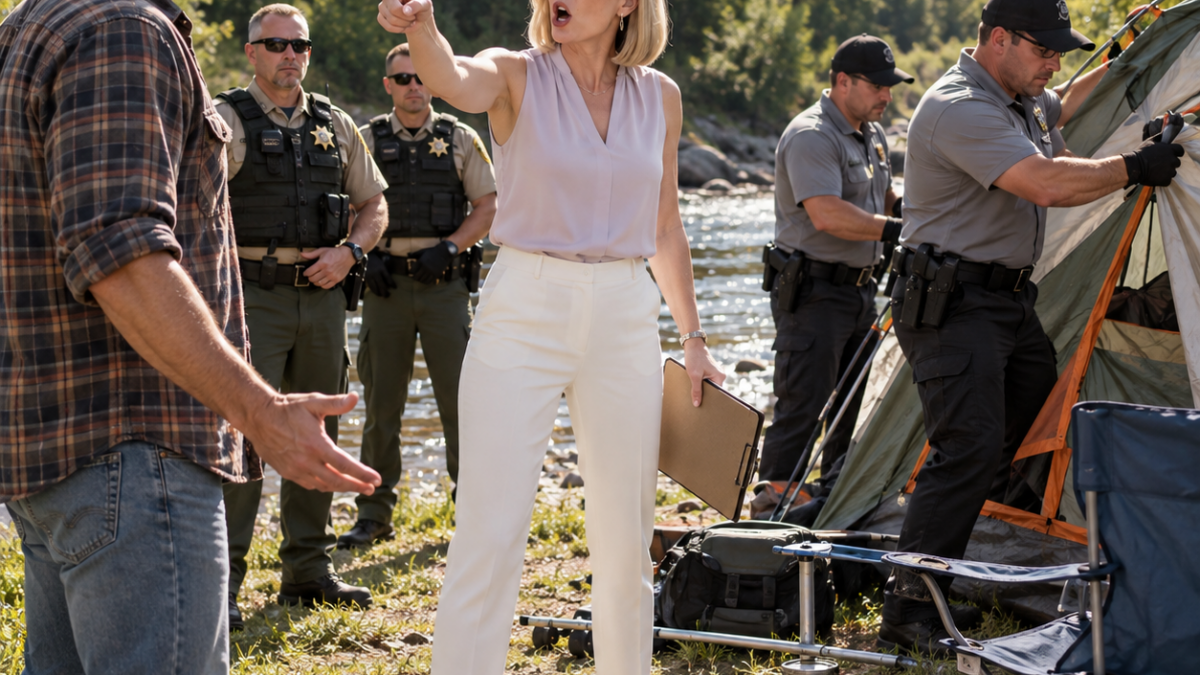
𝗙𝗨𝗟𝗟 𝗦𝗧𝗢𝗥𝗬
“That may be your interpretation.”
I laughed.
Actually laughed.
A recorded public easement is not an interpretation.
But that sentence taught me something early.
Facts didn’t matter to these people when facts interfered with the authority they wanted.
Then came the community-unity picnic invitation.
Printed on expensive cardstock.
A handwritten note at the bottom:
Would be a good opportunity to discuss your membership status.
I threw it away.
After that, the tone changed.
Violation notices started appearing on my gate.
FIRE PIT VIOLATION.
UNAUTHORIZED GUEST VEHICLE.
IMPROPER EXTERIOR STORAGE.
That last one concerned my utility trailer parked beside my barn.
The notice cited HOA rules.
Rules that did not apply to me.
I called the management company again.
This time the woman sounded bored.
“If your property is contiguous with the HOA, the board may issue compliance notices regarding nuisance conditions affecting the community.”
“No.”
Silence.
“No what?”
“No, they may not.”
“Sir—”
“My property isn’t under the HOA declaration.”
“The board interprets its authority differently.”
“I don’t care how they interpret it.”
Another pause.
I continued.
“My deed predates the subdivision. I am excluded from the restrictions. You have no authority to regulate my property.”
“We’ll note your objection.”
“It’s not an objection. It’s a fact.”
After the call, I emailed them documentation.
Recorded deed.
Survey.
Parcel map.
The language showing my land was excluded from the later subdivision declaration.
I highlighted it.
I tried to make ignoring reality as difficult as possible.
They ignored it anyway.
Instead of backing off, the board escalated.
They created what they called a river patrol squad.
I’m completely serious.
Two middle-aged men.
Dark polo shirts.
Black SUV.
Reflective decals.
Badges that looked official from ten feet away if you weren’t paying attention.
The vehicle said:
HOA RIVER PATROL
COMMUNITY WATCH UNIT
They weren’t law enforcement.
They weren’t county employees.
They weren’t park rangers.
They weren’t even licensed public officers of any kind.
They were two residents or contractors being paid by the HOA to drive around acting important.
The first time one confronted me, I was checking a pump near my fence.
The black SUV rolled up slowly.
One patrol guy got out.
Dark sunglasses.
Radio clipped to his shirt.
Flashlight on his belt.
Broad daylight.
He walked toward me.
“Are you the property owner?”
“Yes.”
“We’ve had complaints.”
“About?”
“Unauthorized activity along the riverbank.”
“Unauthorized by who?”
“The association.”
I looked toward the subdivision.
“You mean the people who don’t own my riverbank?”
He gave me a slow, practiced nod.
The kind of nod somebody uses when trying to appear patient with a difficult child.
“Community rules prohibit overnight camping and open-flame use near the river.”
“Not on my land.”
“Sir.”
“Did they tell you the riverbed through this section is on my deed?”
He shifted.
“That would be a civil issue.”
There it was.
The perfect sentence.
He wasn’t interested in ownership.
He was interested in playing officer.
“Great.”
I pointed toward the fence.
“Then here’s my civil response. Get off my property.”
His posture changed.
“No need to become hostile.”
“I’m not hostile.”
“You’re being confrontational.”
“You’re standing inside my survey line telling me rules from an organization I don’t belong to.”
I pointed at the marked boundary post.
“That’s your side.”
He looked down.
Then stepped back.
“You’ve been warned.”
“No, I’ve been entertained.”
He didn’t appreciate that.
He returned to the SUV and drove away.
I honestly thought that might be the end of it.
Fake authority usually survives only until it meets someone who knows where the boundary is.
Then I met the HOA president.
I’ll call her Victoria.
She was around forty.
Blonde.
Attractive.
Immaculately maintained.
The kind of person who looked like she expected a camera to be nearby at all times.
And she dressed for authority.
Her favorite outfit was a tight white military-inspired uniform with gold buttons, decorative shoulder details, a narrow fitted waist, and a deep neckline that emphasized her very large chest.
It would have been almost funny if she hadn’t taken herself so seriously.
Victoria had turned HOA leadership into an identity.
She didn’t volunteer on a neighborhood board.
She governed.
She loved phrases like:
For the good of the community.
Community standards.
Safety authority.
Shared responsibility.
Board determination.
Every conversation sounded like she was auditioning to lead a tiny country that existed only in her imagination.
She arrived one afternoon while I was stacking split firewood.
A white side-by-side utility vehicle came down the edge of the road.
Victoria parked near my fence.
Got out.
White heels.
White fitted uniform.
Large sunglasses.
Folder under one arm.
She didn’t bother with small talk.
“We need to resolve your river situation.”
I stopped stacking.
“My what?”
“Your river situation.”
“I wasn’t aware the river had a situation.”
“Residents have reported continuing activities creating liability exposure.”
“Residents on my property?”
She ignored that.
“Fishing.”
I waited.
“Camping.”
Still waited.
“Open fires.”
“You mean my steel fire ring?”
“You’re creating risk.”
“On my land.”
“Your activities impact our community.”
I leaned against the wood splitter.
“What exactly do you want?”
Victoria opened her folder.
Removed a document.
Held it toward me.
“The board has passed a resolution prohibiting overnight occupancy along the river corridor.”
I read the first line.
Official heading.
Board resolution.
Signatures.
Stamp.
Completely irrelevant.
“You voted on my property?”
“We voted on use of the river amenity area.”
“You don’t own it.”
“Our residents use the corridor.”
“Not my section.”
“You seem confused.”
She smiled tightly.
That smile people use when they’re already imagining how impressive they’ll look after winning.
“I’ve explained this repeatedly.”
I handed the paper back.
“You cannot vote rules onto land outside your association.”
“We can regulate activities that affect the neighborhood.”
“No.”
“We can fine you.”
“No.”
“We can suspend your river access.”
That one made me laugh.
Victoria’s expression hardened.
“Something funny?”
“You’re going to suspend me from accessing my own property?”
“Your attitude is exactly why formal enforcement is necessary.”
“Victoria, your board has no jurisdiction here.”
“Fishing and overnight camping in this corridor are prohibited.”
“By your HOA.”
“Yes.”
“Which I don’t belong to.”
She looked at me like I was deliberately refusing to understand basic mathematics.
“The community surrounds you.”
“That doesn’t make me a member.”
“You benefit from our infrastructure.”
“No.”
“You benefit from our security.”
“I definitely don’t.”
She crossed her arms.
“You seem confused about how communities work.”
“And you seem confused about county property records.”
That hit.
Her face changed.
Not embarrassment.
Anger.
People like Victoria can handle ignorance.
They can handle fear.
Correction is what they hate.
“Fine.”
Her voice went cold.
“We’ll handle it formally.”
She took the resolution back.
Turned.
Walked to her utility vehicle.
Then stopped.
“Oh, and camping this weekend would be considered deliberate noncompliance.”
I smiled.
“Good to know.”
She drove away.
After that, normal subdivision residents started approaching me.
That was interesting.
They weren’t aggressive.
Mostly confused.
One man stopped while I was repairing part of my fence.
“Can I ask you something?”
“Sure.”
“Do we need your permission to fish down there?”
“Where?”
“The river.”
“Depends where.”
“Behind your property.”
“Yes.”
He frowned.
“The HOA says residents have private access.”
“Not through my section.”
Another homeowner asked:
“Did you sell the association an easement?”
“No.”
Someone else:
“Are they really installing cameras along the stream?”
“I hope not on my land.”
Then one homeowner handed me an HOA newsletter.
I read it.
And that’s when the situation changed from ridiculous to serious.
The HOA was charging residents for river-related services.
RIVER STEWARDSHIP ASSESSMENT.
BANK STABILIZATION FEE.
WATER SAFETY PATROL.
RIVER AMENITY MAINTENANCE.
The wording made it sound as though the association owned and managed a continuous stream corridor for residents.
They didn’t.
Some of the fees clearly related to land I owned.
The HOA wasn’t simply trying to bully me.
They were collecting money from homeowners based on control they did not have.
I went home and pulled every document I owned.
Then I started researching.
I’m not an attorney.
But my work involves contracts, title information, and technical documentation, so paper doesn’t scare me.
Over several weekends, I built a file.
Original deed.
Parcel history.
Subdivision declaration.
Recorded restrictions.
Maps.
County information.
Easements.
HOA common-area descriptions.
The answer was exactly what I expected.
The association owned the decorative entrance.
Some landscaping.
A small retention area.
A narrow path strip.
Certain internal common spaces.
That was basically it.
They did not own the stream through my property.
They did not own the bed.
They did not own either bank.
They had no recorded easement over my gravel bar.
They had no authority over my campsite.
Yet their budgets and newsletters represented the area as an HOA amenity.
I sent another email.
This one was longer.
Professional.
No sarcasm.
I attached supporting documents.
I stated clearly that the association must stop representing my land as community property.
Stop sending violation notices.
Stop charging fees tied to maintenance or control of my parcel.
Stop sending patrol personnel onto my property.
Stop telling residents they had association-created access rights.
I also warned that continued misrepresentation would be referred to appropriate county authorities and disclosed to homeowners who might reasonably want to know what their assessments were funding.
The management company responded with one sentence.
The board disagrees with your interpretation.
That’s it.
No statute.
No deed language.
No recorded easement.
No map.
Nothing.
The board disagrees.
At that point, I stopped trying to persuade them.
I decided to give them one last opportunity to expose themselves.
I picked a weekend.
Loaded my truck.
Small tent.
Folding chair.
Cooler.
Fishing rod.
Coffee.
Fire ring.
I drove to my gravel bar.
On my property.
Set up camp.
Built a small contained fire in the steel ring.
Nothing reckless.
Nothing illegal.
I wasn’t trying to hide.
That was the point.
I stayed overnight.
Slept well.
The next morning, I had coffee brewing when I heard footsteps.
One of the fake patrol officers came marching down the bank.
Dark polo.
Badge.
Radio.
He looked thrilled to finally have an enforcement action.
“You were warned.”
I lifted my coffee.
“Morning.”
“No overnight occupancy.”
I took a sip.
“Okay.”
“No open fires.”
I looked at the steel ring.
“Looks pretty contained.”
“Pack it up.”
“No.”
He blinked.
“You need to leave.”
“No.”
“This will be documented as noncompliance.”
“Great.”
I pointed toward the water.
“Get the river in the picture.”
He glared.
Pulled out his phone.
Started photographing.
Tent.
Chair.
Fire ring.
Truck.
Me.
I smiled for one.
That made him angrier.
He stepped away and made a phone call.
About twenty minutes later, Victoria arrived.
Of course she did.
Side-by-side utility vehicle.
White military-style uniform.
Gold buttons.
Deep neckline.
Sunglasses.
The management-company representative followed in a crossover and parked farther up.
Victoria stepped out.
Didn’t say good morning.
“You’re banned from this area.”
I was sitting in a folding chair.
Fishing rod beside me.
Boots off.
Coffee in hand.
“No, I’m not.”
“Camping here is prohibited.”
“No.”
“Fishing is prohibited.”
“No.”
“The board passed a resolution.”
“I know.”
She waited.
I smiled.
“It was adorable.”
Her mouth tightened.
The management representative stepped in with the soft corporate voice people use when they think sounding calm automatically makes them correct.
“Sir, the association has determined that your use of the river frontage presents a nuisance and safety risk.”
“The association has no authority here.”
“If you refuse to leave voluntarily, we will escalate.”
I looked at her.
“Escalate to what?”
The patrol guy answered immediately.
“Trespass enforcement.”
I almost laughed.
“Please do.”
Victoria’s mouth curled into a smile.
She thought I was bluffing.
“You think you’re the first difficult homeowner we’ve dealt with?”
“I’m not one of your homeowners.”
“You know what I mean.”
“I do.”
I stood slowly.
“And I may be the last person you try this with.”
Her expression hardened.
Then she turned toward the patrol officer.
“Call the sheriff.”
He did.
While we waited, Victoria paced.
She took photographs.
Talked quietly to the management representative.
Occasionally looked at me like she expected me to panic and dismantle the tent before law enforcement arrived.
I didn’t.
I finished my coffee.
Added water to the fire.
Checked my fishing line.
When the sheriff’s vehicle finally came down the access route, Victoria straightened instantly.
Two deputies got out.
Actual badges.
Actual authority.
One older.
One younger.
Victoria hurried toward them before they had fully closed their doors.
“This man has repeatedly violated community regulations.”
The older deputy held up one hand.
“Slow down.”
“He’s trespassing on restricted river property.”
I said nothing.
“He has built an unauthorized fire.”
Still nothing.
“He is camping overnight despite formal prohibition.”
The deputy looked at me.
“Do you live here?”
“Yes.”
Victoria answered at the same time.
“Not in the HOA.”
I nodded.
“That part is true.”
The management representative handed the deputy a folder.
Inside were HOA resolutions.
Violation notices.
A glossy map.
The map was impressive.
Shaded areas.
Colored labels.
Community river corridor.
Safety zones.
Amenity boundaries.
If you didn’t know county records, it looked official.
The deputy studied it.
Then looked at me.
“Do you have anything showing ownership?”
“I do.”
I had prepared copies before camping.
Deed.
Survey.
County parcel printout.
Relevant recorded language.
I handed them over.
Victoria leaned toward the deputy.
“Those are incomplete.”
He kept reading.
“Our counsel has reviewed this issue.”
Still reading.
Victoria shifted impatiently.
Then she made the mistake that changed everything.
She turned toward the patrol guy.
“Go ahead.”
He looked at her.
“What?”
“Start breaking down the campsite.”
I stood so quickly my chair tipped backward.
The deputy snapped around.
“Nobody touches anything.”
The patrol guy froze.
Victoria frowned.
“He’s already been given multiple opportunities.”
The second deputy looked directly at her.
“Ma’am.”
She turned.
“If you direct somebody to remove property from land you don’t own, you’re creating a problem for yourself.”
That should have ended it.
Plain English.
Actual law enforcement.
Stop.
Victoria didn’t.
“This is an HOA amenity corridor.”
I pointed at the map.
“Ask her the parcel number.”
The deputy looked at me.
“What?”
“Ask which parcel she thinks the HOA owns.”
Then he looked at Victoria.
“What parcel number are you claiming?”
She paused.
“The river common area.”
“Parcel number.”
“The entire corridor is governed by the association.”
“What’s the recorded parcel?”
She looked toward the management representative.
The representative opened the folder.
Flipped pages.
Too fast.
That’s when I saw what they had done.
Their internal map didn’t show my land as adjacent private property.
It relabeled it.
COMMUNITY RIVER TRACT.
That was it.
They had taken my parcel on an HOA map and renamed it.
Not purchased.
Not acquired.
Not recorded.
Renamed.
I pointed.
“That.”
The deputy looked.
“My parcel.”
Victoria interrupted.
“No.”
I handed him the county record.
“Same location.”
He compared them.
The management representative started talking.
“The association has historically exercised stewardship over—”
The deputy ignored her.
He looked at Victoria.
“Why are your people on this man’s property?”
“Because we govern the river.”
The deputy looked at the county map again.
“No.”
Victoria blinked.
He continued.
“It appears you don’t.”
For the first time, I watched genuine shock cross her face.
Not because she suddenly understood ownership.
Because somebody with authority had told her no.
The management representative tried another angle.
“At minimum, the HOA has safety authority because of fire risk.”
The deputy looked at her.
“Private homeowner associations do not have public fire-enforcement authority.”
The patrol guy visibly shrank.
He’d been happy to play river police when everyone treated the costume seriously.
Now an actual deputy was explaining the limits.
Victoria pointed at my fire ring.
“So he can just do whatever he wants?”
I answered.
“On my own property within county law? Pretty much.”
She threw up both hands.
“This is insane.”
“No.”
I nodded toward the deputies.
“This is recorded.”
The deputies instructed the patrol officer and management representative to leave my riverbank.
Then they told Victoria she needed to stop directing enforcement actions outside HOA property.
The older deputy pulled me aside.
“Do you want an incident number?”
“Yes.”
“For the attempted removal?”
“And the repeated entry.”
He nodded.
“We’ll document it.”
Victoria heard that.
Her expression changed again.
The HOA had arrived believing I was about to receive a trespass warning.
Instead, their own conduct was being written into a sheriff’s report.
They climbed back into their vehicles.
The patrol SUV left first.
Then the management representative.
Victoria remained another minute.
She looked toward my campsite.
Then at me.
“This isn’t over.”
I picked up my chair.
“That’s your choice.”
She drove away.
I went fishing.
Caught nothing.
Didn’t care.
Watching the HOA retreat up the trail had already made the morning worthwhile.
Most people probably would have stopped there.
Sheriff confirms your ownership.
HOA embarrassed.
Go home.
Problem solved.
But I knew Victoria.
Humiliation wouldn’t change her.
People like that learn from paperwork.
Money.
Public consequences.
So I followed through.
I filed a formal county complaint.
Submitted my documentation to relevant agencies.
And I contacted a small number of homeowners who had previously asked me directly about river access.
The letter was intentionally boring.
No accusations of theft.
No emotional language.
I included the parcel map.
I wrote that I believed the HOA had been collecting river-related fees and representing privately owned land as an association-controlled amenity.
I suggested they review their own closing documents and HOA budgets.
Then I waited.
Victoria made my job easier almost immediately.
The board sent a mass email.
It warned residents that an “adjacent non-member property owner” was circulating misinformation designed to destabilize the community.
That was me.
They also announced expanded river patrol for resident safety.
Three homeowners forwarded the email to me within twenty-four hours.
A week later, one of the patrol guys installed a plastic sign near my trail entrance.
AUTHORIZED COMMUNITY ACCESS ONLY.
On my property.
I photographed it.
Pulled it out.
Added it to the folder.
Then residents started asking questions.
Real ones.
“If the HOA owns the river, why doesn’t my closing packet show it as common property?”
No answer.
“Where is the easement?”
No answer.
“Why does the county map show private ownership?”
No answer.
“Why are we paying river stewardship assessments?”
Vague answer.
“How much are the patrol officers being paid?”
More vague answers.
“Who owns the patrol company?”
That question would become important.
Victoria responded badly.
At an HOA meeting, one homeowner asked for the recorded river easement.
She accused him of being anti-community.
Another resident questioned the patrol spending.
Suddenly his pending deck-extension request became “complicated.”
Someone spoke up about the river fees.
Two days later, they received a violation notice regarding a kayak rack.
That was Victoria’s problem.
She didn’t know how to lose quietly.
Every attempt to intimidate one questioner created three more.
People started sharing documents.
Newsletters.
Budgets.
Portal screenshots.
Invoices.
Meeting minutes.
Emails.
One resident sent me a budget page showing charges for riverbank rehabilitation.
On land the HOA did not own.
Another found line items for patrol operations.
Another found water-safety expenses.
The deeper they looked, the worse it became.
The management company bailed first.
Not dramatically.
No confession.
Just a professional notice saying they would terminate services after a transition period.
Victoria told homeowners it was a routine vendor change.
Nobody believed her.
At the next meeting, someone reportedly asked:
“Funny how the routine vendor change happened right after sheriff’s deputies told you to stop policing private property.”
The meeting fell apart.
People wanted records.
Contracts.
Invoices.
Maps.
Insurance documents.
The river-patrol agreement.
Then someone stood and asked the question that broke the room.
“If the river isn’t HOA property, were all those river-related fines invalid?”
Nobody on the board had a good answer.
Because the honest answer was yes.
At minimum, many of them had no enforceable basis.
Then came audit requests.
A special meeting petition.
Formal records demands.
Financial review.
And eventually someone discovered the patrol company was owned by Victoria’s brother-in-law.
That was the moment this stopped looking like overzealous HOA nonsense and started looking financially ugly.
The association had created a fake enforcement need.
Then hired a related-party company to provide patrol services for the fake amenity.
Residents paid.
Victoria’s family connection benefited.
Maybe everything had been disclosed properly.
Maybe it hadn’t.
I wasn’t interested in making criminal accusations I couldn’t prove.
But homeowners were very interested in asking.
Then someone reviewed the HOA insurance binder.
The river corridor was described as an association-controlled amenity.
That created another problem.
Had the HOA represented ownership or control to an insurer that it didn’t legally possess?
Now attorneys were interested.
Insurance people were interested.
Accountants were interested.
Victoria’s little river fantasy was no longer just a dispute between her and me.
She came to my house one final time.
No utility cart.
No patrol squad.
Just Victoria.
White military-style jacket.
Gold buttons.
Blonde hair perfect.
But she looked tired.
She stood outside my gate.
Didn’t cross onto the property.
Interesting improvement.
“I think this has gone far enough.”
I looked at her.
“I agree.”
She seemed relieved for half a second.
“It went too far when you tried to ban me from my own river.”
Her jaw tightened.
“We can resolve this privately.”
“No.”
“You’ve turned residents against the board.”
“No.”
“Yes.”
“You did that.”
“By contacting them.”
“By collecting money for land you didn’t own.”
Her face flushed.
“That is your interpretation.”
“County records seem to share it.”
She took a breath.
“If you stop distributing documents and communicating with homeowners, I can recommend closing all open compliance matters involving your parcel.”
I stared at her.
Then laughed.
Not politely.
“You still think you have open compliance matters involving my property?”
Victoria looked offended.
“We have unresolved nuisance concerns.”
“Victoria.”
She said nothing.
“You have no authority here.”
“That remains disputed.”
“No. The sheriff already explained it.”
Her voice softened.
“Do you understand what you’re doing to this neighborhood?”
“Yes.”
“What?”
“Teaching people to read.”
She stared at me.
Then turned.
Walked back to her vehicle.
That was the last time she personally tried to negotiate with me.
A few days later, residents held a special HOA meeting.
I didn’t attend.
I wasn’t a member.
That distinction mattered to me.
I had no vote.
No role in their internal government.
I had never wanted one.
But I had made friends with enough homeowners by then that my phone lit up all evening.
Updates.
Pictures.
Messages.
Packed room.
Proxies.
Angry residents.
Victoria tried to control the meeting.
Failed.
The management contract was already ending.
The patrol agreement was cancelled immediately.
Then came the recall.
Not one board member.
Not Victoria alone.
The entire board.
Residents removed all of them.
Victoria reportedly tried to resign before the recall was formally completed.
It didn’t save much.
The homeowners wanted a record of what had happened.
An interim group took over.
They did what the old board should have done from the beginning.
They hired an outside accountant.
And a real HOA attorney.
Not someone whose job was to justify Victoria’s conclusions.
Someone asked to tell them what the documents actually meant.
The answer was worse than homeowners expected.
For years, the association had acted beyond its recorded boundaries.
It had billed members for services connected to private property.
It had collected assessments tied to river maintenance and patrol.
It had issued fines based on rules applied in areas it didn’t control.
It had exposed itself to possible refund claims.
Possible insurance issues.
Possible claims of misrepresentation.
The patrol contract needed review because of the family relationship.
And once the fake river amenity disappeared from the HOA’s identity, homeowners were left staring at a surprisingly small list of legitimate shared assets.
Decorative entrance.
Some landscaping.
A little common path.
A retention area.
That was about it.
The river had been the crown jewel.
The thing used in sales language.
The thing that made the neighborhood feel exclusive.
Private river lifestyle.
River stewardship.
River patrol.
Water access.
Except the best section didn’t belong to them.
It never had.
Once that illusion disappeared, people started asking another question.
Why are we paying for this HOA at all?
The answer from many residents was:
We shouldn’t.
Victoria and the old board had done something they never intended.
By inflating the HOA into a miniature government, they made people examine whether they needed the government.
Many decided they didn’t.
There were practical issues.
The entrance landscaping had to be dealt with.
Existing contracts wound down.
Reserve funds accounted for.
Outstanding claims reviewed.
Legal steps followed.
But eventually the homeowners voted to dissolve the association.
No more HOA.
No more management company.
No monthly board politics.
No violation letters about planters.
No architectural committee deciding whether somebody’s deck offended community aesthetics.
No fake river patrol.
No dark SUV.
No badges.
No people pretending to be law enforcement beside a stream they didn’t own.
The entrance still existed.
The houses didn’t collapse.
People still maintained their property.
The river kept flowing.
Civilization survived.
The fallout for the former board continued after dissolution.
Residents wanted records.
They wanted refund reviews.
They wanted explanations.
The brother-in-law patrol contract became its own controversy.
Who approved it?
Was it competitively bid?
Was the relationship disclosed?
How much had residents paid?
What exactly had the patrol company been authorized to do?
I stayed out of most of that.
I wasn’t interested in becoming neighborhood prosecutor.
Or gossip king.
Or honorary leader of the anti-HOA movement.
I had wanted one thing from the beginning.
Leave me alone.
Stop lying about my land.
Eventually, I got exactly that.
Months later, I camped on the gravel bar again.
Same small tent.
Same chair.
Same fire ring.
Same bad fishing luck.
But the atmosphere felt completely different.
No black SUV.
No radio crackling.
No golf cart.
No Victoria.
A homeowner from the old subdivision walked down the public trail on the opposite side and waved.
“Morning.”
“Morning.”
He pointed toward my rod.
“Catch anything?”
“No.”
He laughed.
“Some things never change.”
“Apparently.”
He hesitated.
“Can I ask permission to fish that bend sometime?”
That question meant more to me than he probably understood.
“Sure.”
“What days work?”
“Text me first.”
“Absolutely.”
That was all it ever needed to be.
Respect.
Ask.
Receive an answer.
No fake resolution.
No invented authority.
No patrol officer.
No fine.
People act like property disputes are always about greed.
Sometimes they’re about something much simpler.
Consent.
If the HOA had approached me honestly at the beginning, things might have been very different.
Imagine the developer or later board saying:
“We’ve marketed river access. Would you be interested in granting a limited recreational easement for residents?”
I might have considered it.
For compensation.
With insurance.
Clear rules.
Defined access.
Liability protections.
Maybe.
Or maybe I would have said no.
But we could have had a legitimate conversation.
Instead, they chose fiction.
Act like the access already exists.
Tell residents it’s a community amenity.
Collect fees.
Send patrol officers.
Issue fake violations.
Repeat the story until everyone assumes it must be true.
And when the actual owner objects?
Call him difficult.
Anti-community.
Noncompliant.
That strategy worked for longer than it should have.
Because most people don’t check records.
Why would they?
If a gated subdivision newsletter tells you the HOA maintains a river amenity, you probably believe it.
If your monthly assessment includes river stewardship, you assume there is a river to steward.
If two men with badges patrol the river, you assume somebody authorized them.
Presentation becomes reality.
That’s what Victoria understood.
She understood theater.
The white military-style uniform.
The gold buttons.
The clipboard.
The resolutions.
The dark SUV.
The badges.
The shaded maps.
Everything looked official.
The mistake was believing official appearance could replace ownership.
It couldn’t.
A fake badge doesn’t grant police powers.
A board resolution doesn’t change a deed.
A colored map doesn’t alter recorded parcel lines.
A management company cannot create jurisdiction by saying the board interprets things differently.
And a community cannot charge itself into owning somebody else’s river.
The sheriff encounter exposed that in less than an hour.
That moment stayed with me.
Victoria standing there.
Confidence completely intact.
Ordering the patrol guy to tear down my campsite.
She believed the deputies were her enforcement arm.
In her mind, they would arrive, see HOA paperwork, and make the stubborn outsider obey.
Then the deputy said:
Nobody’s touching anything.
You could almost watch two realities collide.
Victoria’s authority had always depended on everybody agreeing to pretend.
Residents pretended.
The management company pretended.
The patrol squad definitely pretended.
Then two people with actual legal authority looked at the recorded documents and refused to play.
That was enough.
Once one person publicly said no, others started asking why they had ever said yes.
I sometimes hear that I destroyed the HOA.
I don’t think that’s accurate.
I didn’t vote.
I wasn’t a member.
I couldn’t dissolve it.
Residents did.
I gave them information.
That’s different.
Could I have simply hired a lawyer and sent a cease-and-desist?
Probably.
Would that have protected my individual parcel?
Maybe.
But it wouldn’t have answered why residents were paying river assessments tied to my land.
It wouldn’t have corrected the maps circulated to homeowners.
It wouldn’t have addressed fines already issued.
And it wouldn’t have exposed the patrol contract.
Those were their problems.
But they had a right to know the problems existed.
If showing people their own association documents causes the association to collapse, the documents aren’t the problem.
One resident later told me something I still think about.
“We didn’t hate the HOA because of you.”
“What changed?”
“We realized we were afraid of it.”
That surprised me.
“Afraid?”
“Every request felt like something you could be punished for.”
Deck extension.
Fence.
Boat storage.
Kayak rack.
Paint.
Parking.
People had stopped seeing the board as neighbors handling shared expenses.
They saw it as a group that could make life expensive if questioned.
Victoria had confused fear with respect.
That’s common in small power structures.
If nobody challenges you, you start thinking everyone agrees.
Maybe they’re simply tired.
Maybe they don’t want a fine.
Maybe they don’t have time for another meeting.
Maybe they want to raise kids and go to work and not spend Tuesday night arguing over mailbox colors.
Silence isn’t consent.
Eventually the river dispute gave residents a reason to compare experiences.
Then silence broke.
After the HOA dissolved, some people expected the neighborhood to become chaotic.
It didn’t.
No one painted a skull on their house.
No one abandoned vehicles across sidewalks.
No one turned the clubhouse into a nightclub.
Normal county codes still existed.
Neighbors still had property rights.
People could still sue over genuine nuisances.
They just lost the extra layer of private bureaucracy.
The old subdivision became simply a neighborhood.
A nice one.
The gate was eventually handled through a smaller shared arrangement among owners who needed it.
Common landscaping got a straightforward maintenance solution.
People figured it out.
Adults often do when you stop telling them they require a president in a white uniform to survive.
I kept my river.
That’s the part I cared about.
The gravel bar is still quiet.
The fishing is still inconsistent.
The water still rises after storms and shrinks during dry stretches.
Sometimes I camp there.
Sometimes friends come.
Occasionally an old subdivision resident asks permission to access part of the bank.
If it makes sense, I say yes.
No assessment.
No river stewardship fee.
No badge.
Just permission.
I’ve wondered whether Victoria ever understood what she did wrong.
I doubt it.
Her last conversation with me suggested she still believed the central problem was that I had “turned residents against the board.”
People like Victoria often experience consequences as betrayal.
They don’t see the chain.
Trespass.
Fake authority.
Fees.
Threats.
Misrepresentation.
Related-party contracts.
They see the ending.
People stopped listening to me.
Therefore someone must have poisoned them.
But I didn’t need to poison anyone.
I just showed them a parcel map.
That’s all.
Paper.
Lines.
Numbers.
Ownership.
The truth was boring.
That’s what made it powerful.
Victoria’s story needed uniforms and patrol cars and resolutions and newsletters.
Mine needed a deed.
Years later, I still have the original fake violation notices.
Fire pit.
Camping.
Unauthorized activity.
I keep the board resolution too.
The one declaring overnight occupancy prohibited on my property.
Sometimes I pull it out and read the language.
It’s incredibly confident.
That was their entire problem.
Confidence without authority.
The resolution didn’t say:
We request.
It said:
The board hereby prohibits.
That single phrase captured the mentality.
They thought voting created ownership.
If five people sat around a table and raised their hands, reality changed.
River access became theirs.
My camping became illegal.
My fire became a violation.
My consent became irrelevant.
That isn’t governance.
It’s fantasy.
And fantasies become dangerous when money gets attached.
Once homeowners were being assessed for the river, the board needed the river to be theirs.
Once patrol contracts existed, the board needed violations to enforce.
Once residents were told the HOA controlled the corridor, admitting the truth meant admitting years of fees and enforcement rested on nothing.
That is probably why they kept escalating even after I sent documentation.
Backing down early would have been embarrassing.
Backing down later had financial consequences.
So they doubled down.
Again.
Again.
Again.
Until they called the sheriff on the actual landowner.
That morning could have gone differently.
If I hadn’t prepared documents, maybe deputies would have been confused.
Maybe they would have told everyone to leave and settle it in civil court.
Maybe Victoria would have claimed victory.
That’s why documentation matters.
I had the deed.
Survey.
County parcel printout.
Excluded-covenant language.
Everything.
People joke that I planned an ambush.
I didn’t.
I planned for the possibility that a woman willing to send fake police onto my land might eventually call real police.
There is a difference.
The camping trip was deliberate.
Absolutely.
I wanted the board to choose.
Either they respected the boundary after all my warnings, or they escalated in front of witnesses.
They chose escalation.
The sheriff simply made the consequences visible.
Would I do it again?
Yes.
Maybe sooner.
The only thing I would change is how long I spent trying to persuade people who had already decided facts were negotiable.
I kept thinking one more deed copy would work.
One more survey.
One more calm explanation.
One more email.
At some point, continued explanation becomes permission for delay.
Not because you should become aggressive.
Because you should move the disagreement to the proper forum.
Records.
Authorities.
Courts if necessary.
Document.
Stop arguing.
That’s what eventually worked.
The HOA had wanted my river to be the symbol of their community.
In brochures, it made them upscale.
In budgets, it justified assessments.
In meetings, it justified patrols.
In Victoria’s mind, it justified control.
Ironically, the river did become the defining symbol of that neighborhood.
Just not in the way she wanted.
It became the thing that forced homeowners to ask what else the board had been lying about.
Once they started asking, the structure collapsed.
Sometimes when I’m sitting beside the water, I think about that first management representative.
“We need to bring your parcel into alignment.”
She hadn’t realized how accurate the phrase would become.
The parcel never moved.
The HOA was the thing that eventually had to align with reality.
And reality was very simple.
The river wasn’t theirs.
The land wasn’t theirs.
The rules weren’t mine.
The patrol officers weren’t police.
The fines weren’t valid.
The authority wasn’t real.
Once everyone saw that clearly, there wasn’t much left for Victoria to govern.
She had tried to ban me from camping beside my own river.
Instead, she gave an entire neighborhood a reason to examine the institution she controlled.
And by the time they were finished reading, there was no HOA left to ban anyone from anything.
𝗧𝗛𝗘 𝗘𝗡𝗗
The HOA Tried to Ban Me From Camping Beside My Own River—Then They Called the Sheriff to Remove Me
The HOA president stood on my riverbank, pointed at my tent, and told me I was trespassing on land my deed said I owned.
Then she ordered her fake patrol officers to tear down my campsite while two actual sheriff’s deputies were standing ten feet away.
My property has always been a little strange.
That’s important to understand before anything else about this story makes sense.
I own a parcel of land beside what real estate agents like to call a river.
Calling it a river makes the property sound romantic.
In reality, it’s a shallow rocky stream that winds through the back half of my land.
During dry months, there are places where you can walk across it in waterproof boots without getting much above your ankles.
After heavy rain, it gets deeper and fast enough that you don’t mess around with it.
In spring and fall, there are stretches where the fishing is decent.
There’s one bend near the back of my property where the water widens around a gravel bar.
Trees grow thick along both banks.
The sound of the current blocks out most traffic and neighborhood noise.
That’s my favorite spot.
The legal part is less romantic, but far more important.
My deed is old.
Older than the subdivision that eventually appeared beside me.
And the deed language is clear.
My parcel includes both banks of the stream along that stretch.
It includes the riverbed itself.
Not just access.
Not some vague recreational easement.
Mine.
That fact had never been controversial until people built a gated subdivision next door and started marketing homes around something they didn’t own.
My property existed first.
Years before the first house in the subdivision was built, the surrounding land was pasture and scrub.
Then a developer came in.
Bought the larger tract around me.
Subdivided it.
Installed streets.
Built a decorative stone entrance.
Added walking paths.
Planted expensive landscaping.
Put up gates.
And sold the neighborhood using words like exclusive, natural, private, serene, and riverfront lifestyle.
There was only one major problem with that last part.
The best stretch of river access wasn’t on the developer’s land.
It was on mine.
I remember seeing one of their early advertisements.
PRIVATE RIVER ACCESS.
I laughed.
At the time, I assumed there had to be another access point somewhere.
Maybe a narrow trail farther upstream.
Maybe the developer had acquired an easement I didn’t know about.
But nothing affected my parcel, so I didn’t investigate deeply.
I wasn’t part of the subdivision.
That was the second important fact.
No covenant on my deed.
No HOA declaration.
No membership agreement.
No dues.
No architectural committee.
No board authority.
I had never signed anything.
I had never joined anything.
My land had been specifically carved out before the subdivision restrictions attached.
The developer knew it.
The title company knew it.
I knew it.
For the first couple years, the arrangement worked fine.
New houses went up.
Families moved in.
I continued living exactly as I always had.
I cut firewood.
Kept a utility trailer near my barn.
Fished.
Camped occasionally on the gravel bar.
Drove through the public access road when convenient.
Used my rear access when I wanted.
Nobody cared.
Then the subdivision HOA became active.
The first contact was almost harmless.
A newsletter appeared in my mailbox.
WELCOME, RESIDENTS.
I wasn’t a resident of their subdivision, but mistakes happen.
I threw it away.
Then I received a dues statement.
I called the management office.
“Hi. You mailed me an HOA assessment.”
The woman on the phone asked for my address.
I gave it.
There was typing.
Then silence.
“Oh.”
“Yeah.”
“Well, you’re adjacent to the community.”
“Correct.”
She sounded uncertain.
“Let me make a note.”
“Please do.”
I assumed that was the end of it.
A few weeks later, a woman from the management company came to my house.
Friendly smile.
Professional clothes.
Clipboard.
“We’re updating the neighborhood directory.”
“I don’t live in your neighborhood.”
She laughed lightly.
“You’re surrounded by it.”
“Still not in it.”
The smile weakened.
“We’d just like basic contact information.”
“You already have enough to mail me invoices.”
She pretended not to hear the sarcasm.
“The board would also appreciate discussing bringing your parcel into alignment with the rest of the community.”
That phrase stayed with me.
Bringing your parcel into alignment.
Like my property had misbehaved.
“I don’t want to join.”
“It’s not exactly joining.”
“What is it?”
“Integrating your parcel into the community standards.”
“That sounds exactly like joining.”
“The board believes it would benefit everyone.”
“I’m fine.”
Her smile disappeared for half a second.
Then came back.
“I’ll let them know.”
“Thank you.”
She left.
A few weeks after that, a board member came by in a golf cart.
That should tell you the personality type we’re dealing with.
A grown man driving around a suburban neighborhood in a golf cart as though he were inspecting troops.
He stopped beside my fence.
“You use our front road.”
“Sometimes.”
“So you benefit from HOA maintenance.”
“It’s a county easement.”
“The association maintains the landscaping.”
“I don’t drive on landscaping.”
He stared at me.
“You still benefit from our community.”
“I have separate access from the back.”
“That may be your interpretation.”
I laughed.
Actually laughed.
A recorded public easement is not an interpretation.
But that sentence taught me something early.
Facts didn’t matter to these people when facts interfered with the authority they wanted.
Then came the community-unity picnic invitation.
Printed on expensive cardstock.
A handwritten note at the bottom:
Would be a good opportunity to discuss your membership status.
I threw it away.
After that, the tone changed.
Violation notices started appearing on my gate.
FIRE PIT VIOLATION.
UNAUTHORIZED GUEST VEHICLE.
IMPROPER EXTERIOR STORAGE.
That last one concerned my utility trailer parked beside my barn.
The notice cited HOA rules.
Rules that did not apply to me.
I called the management company again.
This time the woman sounded bored.
“If your property is contiguous with the HOA, the board may issue compliance notices regarding nuisance conditions affecting the community.”
“No.”
Silence.
“No what?”
“No, they may not.”
“Sir—”
“My property isn’t under the HOA declaration.”
“The board interprets its authority differently.”
“I don’t care how they interpret it.”
Another pause.
I continued.
“My deed predates the subdivision. I am excluded from the restrictions. You have no authority to regulate my property.”
“We’ll note your objection.”
“It’s not an objection. It’s a fact.”
After the call, I emailed them documentation.
Recorded deed.
Survey.
Parcel map.
The language showing my land was excluded from the later subdivision declaration.
I highlighted it.
I tried to make ignoring reality as difficult as possible.
They ignored it anyway.
Instead of backing off, the board escalated.
They created what they called a river patrol squad.
I’m completely serious.
Two middle-aged men.
Dark polo shirts.
Black SUV.
Reflective decals.
Badges that looked official from ten feet away if you weren’t paying attention.
The vehicle said:
HOA RIVER PATROL
COMMUNITY WATCH UNIT
They weren’t law enforcement.
They weren’t county employees.
They weren’t park rangers.
They weren’t even licensed public officers of any kind.
They were two residents or contractors being paid by the HOA to drive around acting important.
The first time one confronted me, I was checking a pump near my fence.
The black SUV rolled up slowly.
One patrol guy got out.
Dark sunglasses.
Radio clipped to his shirt.
Flashlight on his belt.
Broad daylight.
He walked toward me.
“Are you the property owner?”
“Yes.”
“We’ve had complaints.”
“About?”
“Unauthorized activity along the riverbank.”
“Unauthorized by who?”
“The association.”
I looked toward the subdivision.
“You mean the people who don’t own my riverbank?”
He gave me a slow, practiced nod.
The kind of nod somebody uses when trying to appear patient with a difficult child.
“Community rules prohibit overnight camping and open-flame use near the river.”
“Not on my land.”
“Sir.”
“Did they tell you the riverbed through this section is on my deed?”
He shifted.
“That would be a civil issue.”
There it was.
The perfect sentence.
He wasn’t interested in ownership.
He was interested in playing officer.
“Great.”
I pointed toward the fence.
“Then here’s my civil response. Get off my property.”
His posture changed.
“No need to become hostile.”
“I’m not hostile.”
“You’re being confrontational.”
“You’re standing inside my survey line telling me rules from an organization I don’t belong to.”
I pointed at the marked boundary post.
“That’s your side.”
He looked down.
Then stepped back.
“You’ve been warned.”
“No, I’ve been entertained.”
He didn’t appreciate that.
He returned to the SUV and drove away.
I honestly thought that might be the end of it.
Fake authority usually survives only until it meets someone who knows where the boundary is.
Then I met the HOA president.
I’ll call her Victoria.
She was around forty.
Blonde.
Attractive.
Immaculately maintained.
The kind of person who looked like she expected a camera to be nearby at all times.
And she dressed for authority.
Her favorite outfit was a tight white military-inspired uniform with gold buttons, decorative shoulder details, a narrow fitted waist, and a deep neckline that emphasized her very large chest.
It would have been almost funny if she hadn’t taken herself so seriously.
Victoria had turned HOA leadership into an identity.
She didn’t volunteer on a neighborhood board.
She governed.
She loved phrases like:
For the good of the community.
Community standards.
Safety authority.
Shared responsibility.
Board determination.
Every conversation sounded like she was auditioning to lead a tiny country that existed only in her imagination.
She arrived one afternoon while I was stacking split firewood.
A white side-by-side utility vehicle came down the edge of the road.
Victoria parked near my fence.
Got out.
White heels.
White fitted uniform.
Large sunglasses.
Folder under one arm.
She didn’t bother with small talk.
“We need to resolve your river situation.”
I stopped stacking.
“My what?”
“Your river situation.”
“I wasn’t aware the river had a situation.”
“Residents have reported continuing activities creating liability exposure.”
“Residents on my property?”
She ignored that.
“Fishing.”
I waited.
“Camping.”
Still waited.
“Open fires.”
“You mean my steel fire ring?”
“You’re creating risk.”
“On my land.”
“Your activities impact our community.”
I leaned against the wood splitter.
“What exactly do you want?”
Victoria opened her folder.
Removed a document.
Held it toward me.
“The board has passed a resolution prohibiting overnight occupancy along the river corridor.”
I read the first line.
Official heading.
Board resolution.
Signatures.
Stamp.
Completely irrelevant.
“You voted on my property?”
“We voted on use of the river amenity area.”
“You don’t own it.”
“Our residents use the corridor.”
“Not my section.”
“You seem confused.”
She smiled tightly.
That smile people use when they’re already imagining how impressive they’ll look after winning.
“I’ve explained this repeatedly.”
I handed the paper back.
“You cannot vote rules onto land outside your association.”
“We can regulate activities that affect the neighborhood.”
“No.”
“We can fine you.”
“No.”
“We can suspend your river access.”
That one made me laugh.
Victoria’s expression hardened.
“Something funny?”
“You’re going to suspend me from accessing my own property?”
“Your attitude is exactly why formal enforcement is necessary.”
“Victoria, your board has no jurisdiction here.”
“Fishing and overnight camping in this corridor are prohibited.”
“By your HOA.”
“Yes.”
“Which I don’t belong to.”
She looked at me like I was deliberately refusing to understand basic mathematics.
“The community surrounds you.”
“That doesn’t make me a member.”
“You benefit from our infrastructure.”
“No.”
“You benefit from our security.”
“I definitely don’t.”
She crossed her arms.
“You seem confused about how communities work.”
“And you seem confused about county property records.”
That hit.
Her face changed.
Not embarrassment.
Anger.
People like Victoria can handle ignorance.
They can handle fear.
Correction is what they hate.
“Fine.”
Her voice went cold.
“We’ll handle it formally.”
She took the resolution back.
Turned.
Walked to her utility vehicle.
Then stopped.
“Oh, and camping this weekend would be considered deliberate noncompliance.”
I smiled.
“Good to know.”
She drove away.
After that, normal subdivision residents started approaching me.
That was interesting.
They weren’t aggressive.
Mostly confused.
One man stopped while I was repairing part of my fence.
“Can I ask you something?”
“Sure.”
“Do we need your permission to fish down there?”
“Where?”
“The river.”
“Depends where.”
“Behind your property.”
“Yes.”
He frowned.
“The HOA says residents have private access.”
“Not through my section.”
Another homeowner asked:
“Did you sell the association an easement?”
“No.”
Someone else:
“Are they really installing cameras along the stream?”
“I hope not on my land.”
Then one homeowner handed me an HOA newsletter.
I read it.
And that’s when the situation changed from ridiculous to serious.
The HOA was charging residents for river-related services.
RIVER STEWARDSHIP ASSESSMENT.
BANK STABILIZATION FEE.
WATER SAFETY PATROL.
RIVER AMENITY MAINTENANCE.
The wording made it sound as though the association owned and managed a continuous stream corridor for residents.
They didn’t.
Some of the fees clearly related to land I owned.
The HOA wasn’t simply trying to bully me.
They were collecting money from homeowners based on control they did not have.
I went home and pulled every document I owned.
Then I started researching.
I’m not an attorney.
But my work involves contracts, title information, and technical documentation, so paper doesn’t scare me.
Over several weekends, I built a file.
Original deed.
Parcel history.
Subdivision declaration.
Recorded restrictions.
Maps.
County information.
Easements.
HOA common-area descriptions.
The answer was exactly what I expected.
The association owned the decorative entrance.
Some landscaping.
A small retention area.
A narrow path strip.
Certain internal common spaces.
That was basically it.
They did not own the stream through my property.
They did not own the bed.
They did not own either bank.
They had no recorded easement over my gravel bar.
They had no authority over my campsite.
Yet their budgets and newsletters represented the area as an HOA amenity.
I sent another email.
This one was longer.
Professional.
No sarcasm.
I attached supporting documents.
I stated clearly that the association must stop representing my land as community property.
Stop sending violation notices.
Stop charging fees tied to maintenance or control of my parcel.
Stop sending patrol personnel onto my property.
Stop telling residents they had association-created access rights.
I also warned that continued misrepresentation would be referred to appropriate county authorities and disclosed to homeowners who might reasonably want to know what their assessments were funding.
The management company responded with one sentence.
The board disagrees with your interpretation.
That’s it.
No statute.
No deed language.
No recorded easement.
No map.
Nothing.
The board disagrees.
At that point, I stopped trying to persuade them.
I decided to give them one last opportunity to expose themselves.
I picked a weekend.
Loaded my truck.
Small tent.
Folding chair.
Cooler.
Fishing rod.
Coffee.
Fire ring.
I drove to my gravel bar.
On my property.
Set up camp.
Built a small contained fire in the steel ring.
Nothing reckless.
Nothing illegal.
I wasn’t trying to hide.
That was the point.
I stayed overnight.
Slept well.
The next morning, I had coffee brewing when I heard footsteps.
One of the fake patrol officers came marching down the bank.
Dark polo.
Badge.
Radio.
He looked thrilled to finally have an enforcement action.
“You were warned.”
I lifted my coffee.
“Morning.”
“No overnight occupancy.”
I took a sip.
“Okay.”
“No open fires.”
I looked at the steel ring.
“Looks pretty contained.”
“Pack it up.”
“No.”
He blinked.
“You need to leave.”
“No.”
“This will be documented as noncompliance.”
“Great.”
I pointed toward the water.
“Get the river in the picture.”
He glared.
Pulled out his phone.
Started photographing.
Tent.
Chair.
Fire ring.
Truck.
Me.
I smiled for one.
That made him angrier.
He stepped away and made a phone call.
About twenty minutes later, Victoria arrived.
Of course she did.
Side-by-side utility vehicle.
White military-style uniform.
Gold buttons.
Deep neckline.
Sunglasses.
The management-company representative followed in a crossover and parked farther up.
Victoria stepped out.
Didn’t say good morning.
“You’re banned from this area.”
I was sitting in a folding chair.
Fishing rod beside me.
Boots off.
Coffee in hand.
“No, I’m not.”
“Camping here is prohibited.”
“No.”
“Fishing is prohibited.”
“No.”
“The board passed a resolution.”
“I know.”
She waited.
I smiled.
“It was adorable.”
Her mouth tightened.
The management representative stepped in with the soft corporate voice people use when they think sounding calm automatically makes them correct.
“Sir, the association has determined that your use of the river frontage presents a nuisance and safety risk.”
“The association has no authority here.”
“If you refuse to leave voluntarily, we will escalate.”
I looked at her.
“Escalate to what?”
The patrol guy answered immediately.
“Trespass enforcement.”
I almost laughed.
“Please do.”
Victoria’s mouth curled into a smile.
She thought I was bluffing.
“You think you’re the first difficult homeowner we’ve dealt with?”
“I’m not one of your homeowners.”
“You know what I mean.”
“I do.”
I stood slowly.
“And I may be the last person you try this with.”
Her expression hardened.
Then she turned toward the patrol officer.
“Call the sheriff.”
He did.
While we waited, Victoria paced.
She took photographs.
Talked quietly to the management representative.
Occasionally looked at me like she expected me to panic and dismantle the tent before law enforcement arrived.
I didn’t.
I finished my coffee.
Added water to the fire.
Checked my fishing line.
When the sheriff’s vehicle finally came down the access route, Victoria straightened instantly.
Two deputies got out.
Actual badges.
Actual authority.
One older.
One younger.
Victoria hurried toward them before they had fully closed their doors.
“This man has repeatedly violated community regulations.”
The older deputy held up one hand.
“Slow down.”
“He’s trespassing on restricted river property.”
I said nothing.
“He has built an unauthorized fire.”
Still nothing.
“He is camping overnight despite formal prohibition.”
The deputy looked at me.
“Do you live here?”
“Yes.”
Victoria answered at the same time.
“Not in the HOA.”
I nodded.
“That part is true.”
The management representative handed the deputy a folder.
Inside were HOA resolutions.
Violation notices.
A glossy map.
The map was impressive.
Shaded areas.
Colored labels.
Community river corridor.
Safety zones.
Amenity boundaries.
If you didn’t know county records, it looked official.
The deputy studied it.
Then looked at me.
“Do you have anything showing ownership?”
“I do.”
I had prepared copies before camping.
Deed.
Survey.
County parcel printout.
Relevant recorded language.
I handed them over.
Victoria leaned toward the deputy.
“Those are incomplete.”
He kept reading.
“Our counsel has reviewed this issue.”
Still reading.
Victoria shifted impatiently.
Then she made the mistake that changed everything.
She turned toward the patrol guy.
“Go ahead.”
He looked at her.
“What?”
“Start breaking down the campsite.”
I stood so quickly my chair tipped backward.
The deputy snapped around.
“Nobody touches anything.”
The patrol guy froze.
Victoria frowned.
“He’s already been given multiple opportunities.”
The second deputy looked directly at her.
“Ma’am.”
She turned.
“If you direct somebody to remove property from land you don’t own, you’re creating a problem for yourself.”
That should have ended it.
Plain English.
Actual law enforcement.
Stop.
Victoria didn’t.
“This is an HOA amenity corridor.”
I pointed at the map.
“Ask her the parcel number.”
The deputy looked at me.
“What?”
“Ask which parcel she thinks the HOA owns.”
Then he looked at Victoria.
“What parcel number are you claiming?”
She paused.
“The river common area.”
“Parcel number.”
“The entire corridor is governed by the association.”
“What’s the recorded parcel?”
She looked toward the management representative.
The representative opened the folder.
Flipped pages.
Too fast.
That’s when I saw what they had done.
Their internal map didn’t show my land as adjacent private property.
It relabeled it.
COMMUNITY RIVER TRACT.
That was it.
They had taken my parcel on an HOA map and renamed it.
Not purchased.
Not acquired.
Not recorded.
Renamed.
I pointed.
“That.”
The deputy looked.
“My parcel.”
Victoria interrupted.
“No.”
I handed him the county record.
“Same location.”
He compared them.
The management representative started talking.
“The association has historically exercised stewardship over—”
The deputy ignored her.
He looked at Victoria.
“Why are your people on this man’s property?”
“Because we govern the river.”
The deputy looked at the county map again.
“No.”
Victoria blinked.
He continued.
“It appears you don’t.”
For the first time, I watched genuine shock cross her face.
Not because she suddenly understood ownership.
Because somebody with authority had told her no.
The management representative tried another angle.
“At minimum, the HOA has safety authority because of fire risk.”
The deputy looked at her.
“Private homeowner associations do not have public fire-enforcement authority.”
The patrol guy visibly shrank.
He’d been happy to play river police when everyone treated the costume seriously.
Now an actual deputy was explaining the limits.
Victoria pointed at my fire ring.
“So he can just do whatever he wants?”
I answered.
“On my own property within county law? Pretty much.”
She threw up both hands.
“This is insane.”
“No.”
I nodded toward the deputies.
“This is recorded.”
The deputies instructed the patrol officer and management representative to leave my riverbank.
Then they told Victoria she needed to stop directing enforcement actions outside HOA property.
The older deputy pulled me aside.
“Do you want an incident number?”
“Yes.”
“For the attempted removal?”
“And the repeated entry.”
He nodded.
“We’ll document it.”
Victoria heard that.
Her expression changed again.
The HOA had arrived believing I was about to receive a trespass warning.
Instead, their own conduct was being written into a sheriff’s report.
They climbed back into their vehicles.
The patrol SUV left first.
Then the management representative.
Victoria remained another minute.
She looked toward my campsite.
Then at me.
“This isn’t over.”
I picked up my chair.
“That’s your choice.”
She drove away.
I went fishing.
Caught nothing.
Didn’t care.
Watching the HOA retreat up the trail had already made the morning worthwhile.
Most people probably would have stopped there.
Sheriff confirms your ownership.
HOA embarrassed.
Go home.
Problem solved.
But I knew Victoria.
Humiliation wouldn’t change her.
People like that learn from paperwork.
Money.
Public consequences.
So I followed through.
I filed a formal county complaint.
Submitted my documentation to relevant agencies.
And I contacted a small number of homeowners who had previously asked me directly about river access.
The letter was intentionally boring.
No accusations of theft.
No emotional language.
I included the parcel map.
I wrote that I believed the HOA had been collecting river-related fees and representing privately owned land as an association-controlled amenity.
I suggested they review their own closing documents and HOA budgets.
Then I waited.
Victoria made my job easier almost immediately.
The board sent a mass email.
It warned residents that an “adjacent non-member property owner” was circulating misinformation designed to destabilize the community.
That was me.
They also announced expanded river patrol for resident safety.
Three homeowners forwarded the email to me within twenty-four hours.
A week later, one of the patrol guys installed a plastic sign near my trail entrance.
AUTHORIZED COMMUNITY ACCESS ONLY.
On my property.
I photographed it.
Pulled it out.
Added it to the folder.
Then residents started asking questions.
Real ones.
“If the HOA owns the river, why doesn’t my closing packet show it as common property?”
No answer.
“Where is the easement?”
No answer.
“Why does the county map show private ownership?”
No answer.
“Why are we paying river stewardship assessments?”
Vague answer.
“How much are the patrol officers being paid?”
More vague answers.
“Who owns the patrol company?”
That question would become important.
Victoria responded badly.
At an HOA meeting, one homeowner asked for the recorded river easement.
She accused him of being anti-community.
Another resident questioned the patrol spending.
Suddenly his pending deck-extension request became “complicated.”
Someone spoke up about the river fees.
Two days later, they received a violation notice regarding a kayak rack.
That was Victoria’s problem.
She didn’t know how to lose quietly.
Every attempt to intimidate one questioner created three more.
People started sharing documents.
Newsletters.
Budgets.
Portal screenshots.
Invoices.
Meeting minutes.
Emails.
One resident sent me a budget page showing charges for riverbank rehabilitation.
On land the HOA did not own.
Another found line items for patrol operations.
Another found water-safety expenses.
The deeper they looked, the worse it became.
The management company bailed first.
Not dramatically.
No confession.
Just a professional notice saying they would terminate services after a transition period.
Victoria told homeowners it was a routine vendor change.
Nobody believed her.
At the next meeting, someone reportedly asked:
“Funny how the routine vendor change happened right after sheriff’s deputies told you to stop policing private property.”
The meeting fell apart.
People wanted records.
Contracts.
Invoices.
Maps.
Insurance documents.
The river-patrol agreement.
Then someone stood and asked the question that broke the room.
“If the river isn’t HOA property, were all those river-related fines invalid?”
Nobody on the board had a good answer.
Because the honest answer was yes.
At minimum, many of them had no enforceable basis.
Then came audit requests.
A special meeting petition.
Formal records demands.
Financial review.
And eventually someone discovered the patrol company was owned by Victoria’s brother-in-law.
That was the moment this stopped looking like overzealous HOA nonsense and started looking financially ugly.
The association had created a fake enforcement need.
Then hired a related-party company to provide patrol services for the fake amenity.
Residents paid.
Victoria’s family connection benefited.
Maybe everything had been disclosed properly.
Maybe it hadn’t.
I wasn’t interested in making criminal accusations I couldn’t prove.
But homeowners were very interested in asking.
Then someone reviewed the HOA insurance binder.
The river corridor was described as an association-controlled amenity.
That created another problem.
Had the HOA represented ownership or control to an insurer that it didn’t legally possess?
Now attorneys were interested.
Insurance people were interested.
Accountants were interested.
Victoria’s little river fantasy was no longer just a dispute between her and me.
She came to my house one final time.
No utility cart.
No patrol squad.
Just Victoria.
White military-style jacket.
Gold buttons.
Blonde hair perfect.
But she looked tired.
She stood outside my gate.
Didn’t cross onto the property.
Interesting improvement.
“I think this has gone far enough.”
I looked at her.
“I agree.”
She seemed relieved for half a second.
“It went too far when you tried to ban me from my own river.”
Her jaw tightened.
“We can resolve this privately.”
“No.”
“You’ve turned residents against the board.”
“No.”
“Yes.”
“You did that.”
“By contacting them.”
“By collecting money for land you didn’t own.”
Her face flushed.
“That is your interpretation.”
“County records seem to share it.”
She took a breath.
“If you stop distributing documents and communicating with homeowners, I can recommend closing all open compliance matters involving your parcel.”
I stared at her.
Then laughed.
Not politely.
“You still think you have open compliance matters involving my property?”
Victoria looked offended.
“We have unresolved nuisance concerns.”
“Victoria.”
She said nothing.
“You have no authority here.”
“That remains disputed.”
“No. The sheriff already explained it.”
Her voice softened.
“Do you understand what you’re doing to this neighborhood?”
“Yes.”
“What?”
“Teaching people to read.”
She stared at me.
Then turned.
Walked back to her vehicle.
That was the last time she personally tried to negotiate with me.
A few days later, residents held a special HOA meeting.
I didn’t attend.
I wasn’t a member.
That distinction mattered to me.
I had no vote.
No role in their internal government.
I had never wanted one.
But I had made friends with enough homeowners by then that my phone lit up all evening.
Updates.
Pictures.
Messages.
Packed room.
Proxies.
Angry residents.
Victoria tried to control the meeting.
Failed.
The management contract was already ending.
The patrol agreement was cancelled immediately.
Then came the recall.
Not one board member.
Not Victoria alone.
The entire board.
Residents removed all of them.
Victoria reportedly tried to resign before the recall was formally completed.
It didn’t save much.
The homeowners wanted a record of what had happened.
An interim group took over.
They did what the old board should have done from the beginning.
They hired an outside accountant.
And a real HOA attorney.
Not someone whose job was to justify Victoria’s conclusions.
Someone asked to tell them what the documents actually meant.
The answer was worse than homeowners expected.
For years, the association had acted beyond its recorded boundaries.
It had billed members for services connected to private property.
It had collected assessments tied to river maintenance and patrol.
It had issued fines based on rules applied in areas it didn’t control.
It had exposed itself to possible refund claims.
Possible insurance issues.
Possible claims of misrepresentation.
The patrol contract needed review because of the family relationship.
And once the fake river amenity disappeared from the HOA’s identity, homeowners were left staring at a surprisingly small list of legitimate shared assets.
Decorative entrance.
Some landscaping.
A little common path.
A retention area.
That was about it.
The river had been the crown jewel.
The thing used in sales language.
The thing that made the neighborhood feel exclusive.
Private river lifestyle.
River stewardship.
River patrol.
Water access.
Except the best section didn’t belong to them.
It never had.
Once that illusion disappeared, people started asking another question.
Why are we paying for this HOA at all?
The answer from many residents was:
We shouldn’t.
Victoria and the old board had done something they never intended.
By inflating the HOA into a miniature government, they made people examine whether they needed the government.
Many decided they didn’t.
There were practical issues.
The entrance landscaping had to be dealt with.
Existing contracts wound down.
Reserve funds accounted for.
Outstanding claims reviewed.
Legal steps followed.
But eventually the homeowners voted to dissolve the association.
No more HOA.
No more management company.
No monthly board politics.
No violation letters about planters.
No architectural committee deciding whether somebody’s deck offended community aesthetics.
No fake river patrol.
No dark SUV.
No badges.
No people pretending to be law enforcement beside a stream they didn’t own.
The entrance still existed.
The houses didn’t collapse.
People still maintained their property.
The river kept flowing.
Civilization survived.
The fallout for the former board continued after dissolution.
Residents wanted records.
They wanted refund reviews.
They wanted explanations.
The brother-in-law patrol contract became its own controversy.
Who approved it?
Was it competitively bid?
Was the relationship disclosed?
How much had residents paid?
What exactly had the patrol company been authorized to do?
I stayed out of most of that.
I wasn’t interested in becoming neighborhood prosecutor.
Or gossip king.
Or honorary leader of the anti-HOA movement.
I had wanted one thing from the beginning.
Leave me alone.
Stop lying about my land.
Eventually, I got exactly that.
Months later, I camped on the gravel bar again.
Same small tent.
Same chair.
Same fire ring.
Same bad fishing luck.
But the atmosphere felt completely different.
No black SUV.
No radio crackling.
No golf cart.
No Victoria.
A homeowner from the old subdivision walked down the public trail on the opposite side and waved.
“Morning.”
“Morning.”
He pointed toward my rod.
“Catch anything?”
“No.”
He laughed.
“Some things never change.”
“Apparently.”
He hesitated.
“Can I ask permission to fish that bend sometime?”
That question meant more to me than he probably understood.
“Sure.”
“What days work?”
“Text me first.”
“Absolutely.”
That was all it ever needed to be.
Respect.
Ask.
Receive an answer.
No fake resolution.
No invented authority.
No patrol officer.
No fine.
People act like property disputes are always about greed.
Sometimes they’re about something much simpler.
Consent.
If the HOA had approached me honestly at the beginning, things might have been very different.
Imagine the developer or later board saying:
“We’ve marketed river access. Would you be interested in granting a limited recreational easement for residents?”
I might have considered it.
For compensation.
With insurance.
Clear rules.
Defined access.
Liability protections.
Maybe.
Or maybe I would have said no.
But we could have had a legitimate conversation.
Instead, they chose fiction.
Act like the access already exists.
Tell residents it’s a community amenity.
Collect fees.
Send patrol officers.
Issue fake violations.
Repeat the story until everyone assumes it must be true.
And when the actual owner objects?
Call him difficult.
Anti-community.
Noncompliant.
That strategy worked for longer than it should have.
Because most people don’t check records.
Why would they?
If a gated subdivision newsletter tells you the HOA maintains a river amenity, you probably believe it.
If your monthly assessment includes river stewardship, you assume there is a river to steward.
If two men with badges patrol the river, you assume somebody authorized them.
Presentation becomes reality.
That’s what Victoria understood.
She understood theater.
The white military-style uniform.
The gold buttons.
The clipboard.
The resolutions.
The dark SUV.
The badges.
The shaded maps.
Everything looked official.
The mistake was believing official appearance could replace ownership.
It couldn’t.
A fake badge doesn’t grant police powers.
A board resolution doesn’t change a deed.
A colored map doesn’t alter recorded parcel lines.
A management company cannot create jurisdiction by saying the board interprets things differently.
And a community cannot charge itself into owning somebody else’s river.
The sheriff encounter exposed that in less than an hour.
That moment stayed with me.
Victoria standing there.
Confidence completely intact.
Ordering the patrol guy to tear down my campsite.
She believed the deputies were her enforcement arm.
In her mind, they would arrive, see HOA paperwork, and make the stubborn outsider obey.
Then the deputy said:
Nobody’s touching anything.
You could almost watch two realities collide.
Victoria’s authority had always depended on everybody agreeing to pretend.
Residents pretended.
The management company pretended.
The patrol squad definitely pretended.
Then two people with actual legal authority looked at the recorded documents and refused to play.
That was enough.
Once one person publicly said no, others started asking why they had ever said yes.
I sometimes hear that I destroyed the HOA.
I don’t think that’s accurate.
I didn’t vote.
I wasn’t a member.
I couldn’t dissolve it.
Residents did.
I gave them information.
That’s different.
Could I have simply hired a lawyer and sent a cease-and-desist?
Probably.
Would that have protected my individual parcel?
Maybe.
But it wouldn’t have answered why residents were paying river assessments tied to my land.
It wouldn’t have corrected the maps circulated to homeowners.
It wouldn’t have addressed fines already issued.
And it wouldn’t have exposed the patrol contract.
Those were their problems.
But they had a right to know the problems existed.
If showing people their own association documents causes the association to collapse, the documents aren’t the problem.
One resident later told me something I still think about.
“We didn’t hate the HOA because of you.”
“What changed?”
“We realized we were afraid of it.”
That surprised me.
“Afraid?”
“Every request felt like something you could be punished for.”
Deck extension.
Fence.
Boat storage.
Kayak rack.
Paint.
Parking.
People had stopped seeing the board as neighbors handling shared expenses.
They saw it as a group that could make life expensive if questioned.
Victoria had confused fear with respect.
That’s common in small power structures.
If nobody challenges you, you start thinking everyone agrees.
Maybe they’re simply tired.
Maybe they don’t want a fine.
Maybe they don’t have time for another meeting.
Maybe they want to raise kids and go to work and not spend Tuesday night arguing over mailbox colors.
Silence isn’t consent.
Eventually the river dispute gave residents a reason to compare experiences.
Then silence broke.
After the HOA dissolved, some people expected the neighborhood to become chaotic.
It didn’t.
No one painted a skull on their house.
No one abandoned vehicles across sidewalks.
No one turned the clubhouse into a nightclub.
Normal county codes still existed.
Neighbors still had property rights.
People could still sue over genuine nuisances.
They just lost the extra layer of private bureaucracy.
The old subdivision became simply a neighborhood.
A nice one.
The gate was eventually handled through a smaller shared arrangement among owners who needed it.
Common landscaping got a straightforward maintenance solution.
People figured it out.
Adults often do when you stop telling them they require a president in a white uniform to survive.
I kept my river.
That’s the part I cared about.
The gravel bar is still quiet.
The fishing is still inconsistent.
The water still rises after storms and shrinks during dry stretches.
Sometimes I camp there.
Sometimes friends come.
Occasionally an old subdivision resident asks permission to access part of the bank.
If it makes sense, I say yes.
No assessment.
No river stewardship fee.
No badge.
Just permission.
I’ve wondered whether Victoria ever understood what she did wrong.
I doubt it.
Her last conversation with me suggested she still believed the central problem was that I had “turned residents against the board.”
People like Victoria often experience consequences as betrayal.
They don’t see the chain.
Trespass.
Fake authority.
Fees.
Threats.
Misrepresentation.
Related-party contracts.
They see the ending.
People stopped listening to me.
Therefore someone must have poisoned them.
But I didn’t need to poison anyone.
I just showed them a parcel map.
That’s all.
Paper.
Lines.
Numbers.
Ownership.
The truth was boring.
That’s what made it powerful.
Victoria’s story needed uniforms and patrol cars and resolutions and newsletters.
Mine needed a deed.
Years later, I still have the original fake violation notices.
Fire pit.
Camping.
Unauthorized activity.
I keep the board resolution too.
The one declaring overnight occupancy prohibited on my property.
Sometimes I pull it out and read the language.
It’s incredibly confident.
That was their entire problem.
Confidence without authority.
The resolution didn’t say:
We request.
It said:
The board hereby prohibits.
That single phrase captured the mentality.
They thought voting created ownership.
If five people sat around a table and raised their hands, reality changed.
River access became theirs.
My camping became illegal.
My fire became a violation.
My consent became irrelevant.
That isn’t governance.
It’s fantasy.
And fantasies become dangerous when money gets attached.
Once homeowners were being assessed for the river, the board needed the river to be theirs.
Once patrol contracts existed, the board needed violations to enforce.
Once residents were told the HOA controlled the corridor, admitting the truth meant admitting years of fees and enforcement rested on nothing.
That is probably why they kept escalating even after I sent documentation.
Backing down early would have been embarrassing.
Backing down later had financial consequences.
So they doubled down.
Again.
Again.
Again.
Until they called the sheriff on the actual landowner.
That morning could have gone differently.
If I hadn’t prepared documents, maybe deputies would have been confused.
Maybe they would have told everyone to leave and settle it in civil court.
Maybe Victoria would have claimed victory.
That’s why documentation matters.
I had the deed.
Survey.
County parcel printout.
Excluded-covenant language.
Everything.
People joke that I planned an ambush.
I didn’t.
I planned for the possibility that a woman willing to send fake police onto my land might eventually call real police.
There is a difference.
The camping trip was deliberate.
Absolutely.
I wanted the board to choose.
Either they respected the boundary after all my warnings, or they escalated in front of witnesses.
They chose escalation.
The sheriff simply made the consequences visible.
Would I do it again?
Yes.
Maybe sooner.
The only thing I would change is how long I spent trying to persuade people who had already decided facts were negotiable.
I kept thinking one more deed copy would work.
One more survey.
One more calm explanation.
One more email.
At some point, continued explanation becomes permission for delay.
Not because you should become aggressive.
Because you should move the disagreement to the proper forum.
Records.
Authorities.
Courts if necessary.
Document.
Stop arguing.
That’s what eventually worked.
The HOA had wanted my river to be the symbol of their community.
In brochures, it made them upscale.
In budgets, it justified assessments.
In meetings, it justified patrols.
In Victoria’s mind, it justified control.
Ironically, the river did become the defining symbol of that neighborhood.
Just not in the way she wanted.
It became the thing that forced homeowners to ask what else the board had been lying about.
Once they started asking, the structure collapsed.
Sometimes when I’m sitting beside the water, I think about that first management representative.
“We need to bring your parcel into alignment.”
She hadn’t realized how accurate the phrase would become.
The parcel never moved.
The HOA was the thing that eventually had to align with reality.
And reality was very simple.
The river wasn’t theirs.
The land wasn’t theirs.
The rules weren’t mine.
The patrol officers weren’t police.
The fines weren’t valid.
The authority wasn’t real.
Once everyone saw that clearly, there wasn’t much left for Victoria to govern.
She had tried to ban me from camping beside my own river.
Instead, she gave an entire neighborhood a reason to examine the institution she controlled.
And by the time they were finished reading, there was no HOA left to ban anyone from anything.