𝗙𝗨𝗟𝗟 𝗦𝗧𝗢𝗥𝗬 The HOA Treasurer Walked Into My Backyard to Film My Kids on Easter—Then She Called the Police When I Told Her to Leave
𝗙𝗨𝗟𝗟 𝗦𝗧𝗢𝗥𝗬
She typed something.
Actually typed something.
Then nodded.
“Good.”
I put down the box cutter.
“Sorry, who are you?”
She looked mildly offended that I didn’t know.
“Doris Whitmore.”
Pause.
“Treasurer.”
I waited for clarification.
She gave none.
“Treasurer of what?”
“The HOA.”
“Oh.”
That explained absolutely nothing about why the treasurer was inspecting cardboard.
“We just moved in.”
“I know.”
“Nice to meet you.”
She looked around the garage one more time.
Then at the front yard.
Then at me.
“Make sure you’ve read the covenants.”
“We have.”
“People often say that.”
She turned.
Walked down the driveway.
Emily appeared from inside carrying a kitchen box.
“Who was that?”
“Apparently the Secretary of Defense.”
“What?”
“HOA treasurer.”
Emily looked toward the sidewalk.
“What did she want?”
“An operational timetable for cardboard disposal.”
Emily laughed.
So did I.
That was the last time Doris felt funny for quite a while.
The first written notice arrived the following week.
Trash bins.
Collection happened Tuesday morning.
I had brought them in Tuesday afternoon.
Apparently I was about thirty minutes beyond some preferred window.
Not a fine.
Just a warning.
Reporting board member:
Doris Whitmore.
Emily held it over breakfast.
“She’s serious?”
“Apparently.”
“You want to respond?”
“To thirty minutes?”
I threw it in a drawer.
Two days later, Ben left his bicycle beside the house overnight.
Not on the sidewalk.
Not in the driveway.
Inside our side yard.
Another notice.
IMPROPER STORAGE OF RECREATIONAL EQUIPMENT.
Doris again.
Then Emily hung a small seasonal fabric decoration on the front door.
Nothing political.
Nothing offensive.
Literally flowers and the word Welcome.
Violation.
UNAPPROVED EXTERIOR DECORATIVE DISPLAY.
That one made me open the HOA rules again.
I searched for any approval process covering small temporary door decorations.
Nothing obvious.
I emailed the property management contact asking for clarification.
Two days passed.
No response.
Doris appeared instead.
I was pulling weeds near the driveway.
White skirt this time.
Same fitted white jacket.
Gold buttons.
Deep neckline.
Phone in hand.
“You received the decoration notice?”
“I did.”
“And?”
“And I can’t find the rule.”
Doris smiled.
Not warmly.
“There are exterior standards.”
“For a fabric door hanging?”
“For visible modifications.”
“It’s hanging on a hook.”
“That doesn’t change visibility.”
“Can you show me the actual provision?”
Her expression cooled.
“You’re new.”
“I am.”
“Then I’d advise against starting your relationship with the association by arguing over every little requirement.”
That sentence irritated me.
“I’m not arguing.”
“You emailed management.”
“Because I couldn’t find the rule.”
“Most people simply correct the issue.”
I stood.
“Most people don’t ask what rule they’re violating?”
Doris shifted her weight.
Her jacket pulled tight across her waist and chest as she folded her arms.
“People who want to be good neighbors generally cooperate.”
“Good neighbors also explain the rules.”
Her eyes narrowed.
There it was.
Our first real moment.
Not anger.
Recognition.
Doris had expected obedience.
Instead I’d asked a question.
She didn’t like questions.
She walked away without answering.
A week later, the flower decoration was still there.
Nothing happened.
That was when I began noticing something else.
Doris didn’t enforce rules evenly.
Two houses down, a family had construction debris stacked behind their driveway.
Plywood.
Old cabinets.
Chunks of drywall.
It sat there for months.
No orange notice.
No phone inspection.
Another neighbor regularly left two garbage bins beside the garage where they were clearly visible from the street.
Nothing.
A work trailer stayed parked in one driveway for almost three weeks.
Nothing.
Meanwhile, on a windy afternoon, one lid on our trash can didn’t close completely.
Doris sent us a written warning.
I wish I were exaggerating.
REFUSE CONTAINER MUST REMAIN SECURELY CLOSED.
Emily read it.
Then looked outside.
“It blew open.”
“Criminal negligence.”
“Should we surrender?”
“I’m considering exile.”
The jokes helped.
At first.
Then Doris discovered our children.
To be fair, Luke was loud.
Our youngest could turn finding a worm into a public announcement.
But our kids weren’t destructive.
They weren’t throwing rocks.
Weren’t kicking balls into cars.
Weren’t climbing neighbors’ fences.
They played.
In our yard.
During daytime.
That was the entire crime.
One Saturday afternoon, the three of them were chasing each other around the backyard.
It was maybe two o’clock.
Emily and I were inside cleaning up after lunch.
A few minutes later, the back door opened.
Ben came in.
“Mom?”
“What?”
“There’s a lady at the fence.”
Emily looked at me.
I already knew.
She went outside.
I watched from the kitchen.
Doris was standing on the other side of the back fence where a small strip of common landscaping ran behind several homes.
Her head and shoulders were visible above the top because the terrain rose slightly there.
Emily approached.
“Can I help you?”
Doris looked toward the kids.
“The noise is excessive.”
Emily glanced at them.
They had stopped playing.
“What’s excessive?”
“The shouting.”
“They’re playing.”
“I can hear them from my patio.”
“Okay.”
Doris looked almost surprised.
“Okay?”
“It’s two in the afternoon.”
“There’s a reasonable enjoyment clause.”
Emily had read the bylaws too.
“It applies to unreasonable disturbances.”
“Exactly.”
“Children playing at two o’clock isn’t unreasonable.”
“That’s your interpretation.”
“No, Doris. That’s three kids playing in their own yard.”
Doris’s face tightened.
“I sit on my patio in the afternoons.”
Emily waited.
“And?”
“The screaming interferes with my enjoyment.”
I could see Emily’s shoulders shift.
That was not good.
I opened the back door.
Before she could answer in a way we’d both regret, I stepped outside.
“Doris.”
She looked at me.
“There’s no need for both of you to gang up on me.”
I almost laughed.
“Nobody’s ganging up on anybody.”
“I’m trying to resolve a violation.”
“What violation?”
“Noise.”
“Quiet hours don’t start until evening.”
“The covenant isn’t limited to quiet hours.”
I had checked it.
She was technically right that there was a general nuisance clause.
But applying it to normal daytime child play was absurd.
“Are you asking us to keep the kids inside?”
“I’m asking you to control them.”
“They’re playing.”
“Then have them play quietly.”
Ben was listening.
Mia too.
Luke stood near the tree holding a plastic dinosaur.
Something about seeing their faces made me choose peace.
I said, “We’ll ask them to keep it down.”
Doris nodded as if she’d just won a zoning appeal.
“Thank you.”
She walked away.
Emily turned on me.
“Why did you give her that?”
“Because I’m tired.”
“She’s not going to stop.”
“Maybe if we meet her halfway.”
Emily looked toward the fence.
“People like that don’t have halfway.”
She was right.
But I still wanted to believe otherwise.
For several weeks, we kept the kids inside more.
I hated it.
Every time they got too loud, one of us would say:
“Remember the neighbors.”
Every time Luke started running toward the back door early Saturday morning:
“Not yet.”
Ben asked once:
“Why did we get a yard if we’re not allowed to use it?”
I didn’t have a good answer.
That was the whole reason we’d bought the house.
We had saved.
Sacrificed.
Moved away from apartments.
Bought a place with a yard so our children could live a little louder.
Now some woman four houses down had trained us to check whether she might be sitting on her patio before we let them outside.
Emily eventually started looking through the back window toward Doris’s house.
If her blinds were open, she hesitated.
That was when I first wondered whether we’d made a terrible mistake buying there.
The holidays made everything worse.
Fourth of July came.
We didn’t buy fireworks.
No rockets.
No firecrackers.
No giant mortar shells.
We bought small sparklers.
The cheap kind.
After dinner, we took the kids into the backyard.
Emily held the lighter.
I had a bucket of water ready.
The kids waved sparklers around for maybe fifteen minutes.
Nobody was drunk.
Nobody was launching explosives.
The next thing I knew, a patrol officer knocked on our front door.
He looked deeply bored.
“Evening.”
“Evening.”
“Got a complaint about fireworks.”
I looked behind me.
“Fireworks?”
“That’s what the caller said.”
Emily appeared holding an unopened box of sparklers.
“This?”
The officer stared.
Then sighed.
“Can I see the yard?”
“Sure.”
We walked around back.
Bucket of water.
Three kids.
Half-burned sparklers.
Nothing else.
The officer looked at us.
Then toward the houses.
“These are legal.”
“I know.”
“Someone specifically reported explosive fireworks.”
“Let me guess.”
He didn’t ask.
I didn’t say.
Doris stood at the corner of her property looking toward us.
The officer saw her.
His expression changed slightly.
He left.
No citation.
No warning.
But the kids had stopped smiling.
Halloween was next.
We put a plastic skeleton in a lawn chair.
That’s it.
One plastic skeleton.
It wore an old baseball cap.
Luke named him Steve.
Doris submitted a complaint that the display was “frightening” and inappropriate for the neighborhood aesthetic.
The board didn’t make us remove Steve.
That didn’t stop her from circling the house twice in her car one evening.
By spring, we were exhausted.
Doris had transformed normal family life into a series of tactical calculations.
Trash.
Decorations.
Kids.
Parking.
Noise.
Anything could become the next notice.
We avoided HOA meetings because I didn’t want to spend one more minute thinking about neighborhood governance than necessary.
We told ourselves we’d survive.
Keep our heads down.
Raise the kids.
Maybe Doris would eventually focus on someone else.
She didn’t.
Then Easter came.
The night before, the house looked like a craft store had exploded.
Egg dye everywhere.
Ben insisted his red-and-yellow egg looked like fire.
Mia disagreed and said hers was prettier because she’d made purple swirls.
Luke put his entire hand into blue dye because apparently dipping the egg itself was too conventional.
He spent the next two days looking partially Smurf.
Emily and I laughed so hard we had tears in our eyes.
That night, after the kids went to sleep, we prepared the backyard.
Plastic eggs.
A ridiculous number.
Candy in some.
Tiny toys in others.
We bought three special gold-colored eggs and put folded dollar bills inside.
We hid eggs behind planters.
Under patio chairs.
Inside the fork of the tree.
Beside the grill.
Near fence posts.
One inside an empty watering can.
We got carried away.
At one point Emily held up another bag.
“We have too many.”
“There is no such thing.”
“We’re going to find plastic eggs in October.”
“Future surprise.”
She laughed.
We finished after midnight.
Then came Easter morning.
The kids found their baskets.
Candy.
Cheap toys.
Chocolate rabbits.
Then I told them:
“I heard there might be something outside.”
Luke’s eyes widened.
“What?”
“Don’t know.”
Ben was already moving toward the back door.
Emily stopped him.
“Wait.”
Three children froze.
She smiled.
“Okay. Go.”
They exploded.
The back door slammed open.
All three ran into the yard.
Within seconds:
“I FOUND ONE!”
“ME TOO!”
“THAT’S MINE!”
“No fighting!”
“They’re going to kill each other,” Emily said.
“Festively.”
We had family coming later for lunch.
Ham in the oven.
Potatoes.
Deviled eggs.
Dessert.
Emily worked at the kitchen island.
I sliced vegetables and kept looking through the window.
The kids were visible the whole time.
That’s important.
They were supervised.
Maybe not with us physically standing beside them, but the kitchen window looked directly over the entire yard.
We watched them constantly.
Every minute or two, one would run to the window and show us an egg.
Twenty minutes passed.
Then Mia found one of the gold eggs.
The scream she made could probably have been measured from orbit.
Emily and I both laughed.
“What happened?” I asked through the closed window.
Mia held up the gold egg.
Ben yelled something.
Luke began searching faster.
I turned toward Emily.
“Now they’re going to destroy the yard.”
“Absolutely.”
I picked up the knife again.
Then something in the window changed.
Movement.
Adult-sized.
I looked up.
At first, my mind refused to understand it.
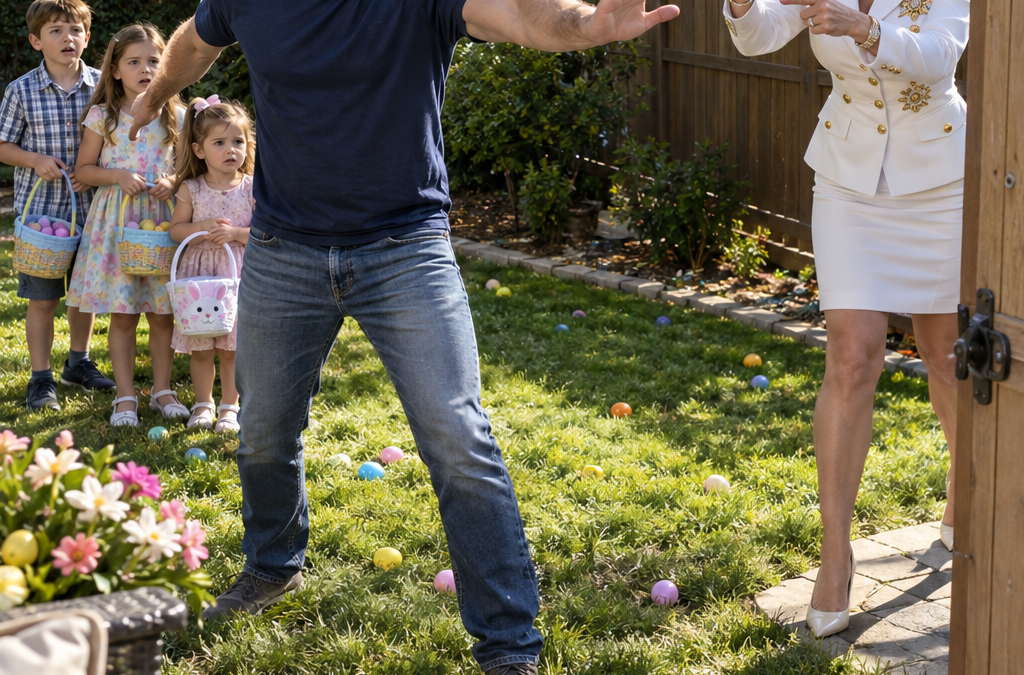
Doris was standing in our backyard.
Not behind the fence.
Not on the common strip.
Inside.
On our grass.
Holding her phone upright.
Recording.
I stopped breathing.
The knife slipped from my hand onto the cutting board.
Emily looked at me.
“What?”
I pointed.
She turned.
“Oh, hell no.”
Outside, all three children had stopped hunting.
Doris stood among the hidden Easter eggs like some deranged holiday inspector.
White military-inspired trousers.
White fitted jacket with gold buttons.
Deep neckline.
High heels sinking slightly into our grass.
Her blonde hair was perfectly styled.
Phone held toward the kids.
Luke looked terrified.
His mouth was beginning to tremble.
Doris was saying something to Ben.
I couldn’t hear through the glass.
Then Ben looked toward the house.
His face was confused.
That did it.
I was through the back door in seconds.
Emily was directly behind me.
By the time we reached them, Doris was mid-sentence.
“—lower your voice. This kind of disturbance is completely unacceptable in this community.”
She was lecturing my eight-year-old.
On Easter.
Standing in my private fenced backyard.
Filming him.
“What are you doing?”
My voice came out louder than I intended.
Doris turned.
Phone still recording.
“I’m documenting the violation.”
I stepped between her and the kids.
“Emily.”
She understood immediately.
“Come on, guys.”
Luke started crying.
Emily scooped him up.
Ben tried to say something.
“Inside,” I told him.
“But Dad—”
“Inside.”
Mia followed.
Emily shepherded all three toward the back door.
Before she entered, she looked at Doris.
The expression on my wife’s face could have peeled paint.
Then the door closed.
Now it was just Doris and me.
And dozens of plastic eggs scattered across the grass.
My heart was pounding.
I forced myself to keep my voice low.
“Get off my property.”
Doris lifted the phone higher.
“I’m documenting an ongoing noise violation.”
“You walked through my gate.”
“Your children have been disturbing the entire street.”
“It’s Easter morning.”
“That doesn’t exempt you from community standards.”
“They’re hunting eggs.”
“They’re screaming.”
“They’re children.”
“I can hear them from my house.”
“Then close your window.”
Her face tightened.
“Excuse me?”
“You entered my fenced backyard without permission.”
“I have association authority.”
“No, you don’t.”
She actually smiled.
“I’m the treasurer of this HOA.”
I stared at her.
Those words were so insane in context that for half a second I nearly laughed.
“Treasurer.”
“Correct.”
“You handle money.”
“I am a board officer.”
“That doesn’t give you the right to enter my property.”
“I have the right to document violations.”
“From outside.”
Her smile vanished.
“You don’t determine board authority.”
“I determine who gets to stand in my backyard.”
She pointed the phone toward me.
“You’re becoming aggressive.”
I took one step backward.
Not because I was afraid.
Because I suddenly understood what she was doing.
Narrative.
She wanted footage.
An angry father.
Loud voice.
Confrontation.
Something she could show later without context.
So I slowed everything down.
“Doris.”
“What?”
“I’m telling you clearly and calmly to leave my property.”
“I’m not finished.”
“You’re refusing?”
“I don’t have to leave.”
“Why?”
“I just told you.”
“Because you’re treasurer?”
“Yes.”
I nodded.
“Okay.”
That “okay” irritated her.
“What?”
“Nothing.”
I pointed toward the gate.
“Leave.”
She stared at me.
Then, incredibly, smiled again.
“Fine.”
For one stupid second, I thought she’d finally listened.
Instead, she tapped her phone screen.
Three numbers.
I couldn’t believe it.
“You’re calling the police?”
“Yes.”
“For what?”
“Severe disturbance.”
I looked toward the house.
My children were now inside.
Luke crying.
Ben and Mia pressed near the window.
Doris put the phone to her ear.
“Yes, I’d like to report an ongoing disturbance.”
Pause.
“I’m at a residence in—”
She gave the address.
Mine.
“There are unsupervised children creating a serious nuisance and safety concern.”
I felt my stomach turn.
Unsupervised?
We had watched them through the kitchen window the entire time.
She continued.
“Yes, they’re screaming.”
Pause.
“No, it’s been ongoing.”
She looked directly at me.
“And the homeowner is now confronting me aggressively.”
That was when fear slipped through the anger.
Not because I’d done anything wrong.
Because people like Doris make accusations with such confidence that, for a moment, you wonder whether confidence itself can become evidence.
She was standing in my yard.
Calling police.
Describing herself as the threatened party.
And she sounded completely certain.
I thought:
What if they believe her first?
It’s irrational.
But if you’ve ever dealt with someone willing to lie while staring directly at you, you know the feeling.
They can make reality feel temporarily unstable.
Doris kept speaking.
“I am the HOA treasurer.”
Of course.
She said it like the dispatcher might salute through the phone.
“I have a responsibility to respond to violations.”
Pause.
“Yes, I feel unsafe.”
That almost broke me.
“You came into my yard,” I said.
She raised one finger at me.
Like I was interrupting an official proceeding.
The dispatcher apparently told her officers were being sent.
Doris hung up.
Her eyes were triumphant.
“They’re coming.”
“Good.”
That answer surprised her.
“Good?”
“Absolutely.”
I walked toward the back door.
“I’m not done speaking to you.”
“I am.”
I opened the door.
Emily was standing inside.
Luke sat at the kitchen table crying quietly.
Ben looked furious.
Mia held the gold egg against her chest.
Emily said, “I called the non-emergency line too.”
“When?”
“While she was calling 911.”
“For trespassing?”
“Yes.”
I looked back.
Doris was still standing in the middle of our yard.
She hadn’t moved.
“What did they say?”
“Someone’s coming.”
I nodded.
Emily lowered her voice.
“Is she really staying?”
“Apparently.”
We went outside together.
I locked the back door behind us so the kids would stay inside.
Then we waited.
Fifteen minutes.
Maybe less.
It felt like an hour.
No one spoke.
Emily and I stood near the patio.
Doris remained near the middle of the lawn.
Plastic eggs around her shoes.
One pink egg had been crushed under her heel.
That detail bothered me more than it should have.
It had probably cost five cents.
But it had been part of the morning.
Part of our plan.
Part of the memory we were trying to make.
Now our children were inside while a strange woman occupied their Easter egg hunt waiting for police to validate her authority.
I looked through the kitchen window.
Ben was watching us.
I hated that.
Finally, a squad car stopped out front.
Doris practically brightened.
She walked toward the side gate.
I almost thanked God.
At least she was leaving the yard.
Emily and I followed.
By the time we reached the driveway, two officers had stepped out.
One looked maybe late twenties.
The other mid-forties.
Doris went straight toward them.
Phone already raised.
“Officers.”
The older officer held up one hand.
“Ma’am—”
“I’m the treasurer of the homeowners association.”
Of course.
“I’ve been attempting to address a serious disturbance at this residence.”
The younger officer looked toward us.
Doris kept going.
“Their children have been completely unsupervised, running and screaming for nearly an hour.”
“That’s not true,” Emily said.
Doris turned.
“Please don’t interrupt.”
The older officer looked at her.
Then at Emily.
Then back.
Doris continued.
“When I attempted to document the violation, this man became aggressive.”
She pointed at me.
“I felt unsafe.”
The officer let her finish.
That impressed me.
No reaction.
No argument.
Just listened.
Then he looked at me.
“Who lives here?”
“We do.”
“Homeowners?”
“Yes.”
He nodded toward Doris.
“Where do you live, ma’am?”
“Four houses down.”
“Okay.”
She tried to continue.
“But as treasurer—”
He held up one hand.
“So you do not live at this residence.”
Doris hesitated.
“No.”
“And you were in their backyard?”
Her confidence dipped.
Barely.
But I saw it.
“I was documenting an ongoing violation.”
“That’s not what I asked.”
Silence.
“Were you in their backyard?”
“Yes, but—”
“How did you enter?”
“The gate.”
The younger officer walked toward our side yard.
He opened the gate.
Looked through.
There were still dozens of plastic eggs scattered everywhere.
A little wicker basket near the tree.
One gold egg half hidden by the flower bed.
No broken property.
No alcohol.
No fireworks.
No dangerous gathering.
Just Easter.
He came back.
Said something quietly to his partner.
The older officer looked at Doris again.
“Did they invite you into their yard?”
Doris folded her arms beneath her chest.
“That’s not the issue.”
“It’s an issue.”
“I am authorized to investigate covenant violations.”
“Who authorized you to enter the yard?”
“The HOA.”
“Do you have documentation giving you permission to enter private fenced property without the homeowner’s consent?”
Doris’s eyes narrowed.
“This is a community enforcement matter.”
“So no?”
She exhaled sharply.
“You’re oversimplifying.”
The officer looked at me.
“Did you ask her to leave?”
“Several times.”
He looked toward Emily.
“Did you hear that?”
“Yes.”
Doris interrupted.
“He was hostile.”
“I told you to leave.”
“You raised your voice.”
“After finding you filming my children.”
“I was collecting evidence.”
The officer looked at her.
“Evidence of what?”
“Noise.”
He glanced toward the yard.
“It’s Easter.”
Doris’s face flushed.
“That doesn’t suspend HOA rules.”
The younger officer said, “What specific law are you asking us to enforce?”
That stopped her.
“I’m not asking you to enforce HOA rules.”
“Then why did you call 911?”
Doris opened her mouth.
Closed it.
Then said, “Because I felt unsafe.”
The older officer nodded.
“Okay. At what point did you feel unsafe?”
“When he confronted me.”
“After you entered his yard?”
She looked angry now.
“I was doing my job.”
“You’re the treasurer.”
“Exactly.”
“I understand.”
His tone made clear that he did not understand in the way she wanted.
“Ma’am, I’m going to be direct.”
Doris straightened.
“You entered private property.”
She started to speak.
He continued.
“You were not invited.”
“I—”
“The homeowner told you to leave.”
She opened her mouth again.
“And you did not.”
Doris’s cheeks reddened.
“I have authority in this community.”
The officer stared at her.
“You do not have authority over their backyard.”
Something passed across her face.
Shock.
Not at the legal explanation.
At being told no.
She actually took half a step backward.
“I’m an elected board officer.”
“That doesn’t give you police authority.”
“I’m not claiming to be police.”
“You called police because the homeowner told you to leave his own property.”
“He was interfering with enforcement.”
The older officer’s patience visibly shortened.
“Ma’am, I’m officially telling you now to return to your residence and stay off this property.”
Doris stared.
“Excuse me?”
“Go home.”
The street had become very quiet.
Too quiet.
I looked around.
Curtains.
Porches.
Garage openings.
Neighbors were watching.
Of course they were.
A police car in an HOA neighborhood is basically live theater.
Doris seemed to notice too.
Maybe that made the next decision inevitable.
She couldn’t retreat in front of an audience.
Her identity depended too heavily on authority.
She crossed her arms.
“No.”
I genuinely thought I’d misheard her.
The older officer tilted his head.
“No?”
“I will not be ordered around by people who have no respect for this community.”
Emily slowly looked at me.
I looked at her.
The younger officer seemed to stop breathing.
The older one gave Doris another chance.
A generous one.
“Ma’am.”
His voice was calm.
“I’m directing you to leave this property and return to your home.”
Doris lifted her chin.
“If you refuse, you may be placed under arrest for trespassing.”
Her face changed.
Not fear yet.
Defiance.
“This is absurd.”
“Go home.”
“I am within my rights.”
“Go home.”
“No.”
A pause.
The officer looked directly at her.
“This is your last warning.”
Doris smiled.
Actually smiled.
“I’m not going anywhere until this situation is properly handled.”
The younger officer stepped forward.
“Ma’am.”
She turned toward him.
“Turn around.”
The smile vanished.
“What?”
“Turn around and put your hands behind your back.”
For the first time since I’d met Doris, true confusion appeared on her face.
“You cannot do this.”
“Turn around.”
“I’m the HOA treasurer.”
“Ma’am.”
“This is harassment.”
“Hands behind your back.”
She looked at the older officer.
“Do you know who I am?”
He said, “Yes.”
That one word destroyed something.
Because he did know.
He knew exactly who she was.
A woman four houses down who had walked through somebody else’s gate, refused repeated instructions to leave, called police, then refused the police officer’s own lawful instruction to go home.
Not sheriff.
Not inspector.
Not judge.
Not commander.
HOA treasurer.
The younger officer took her arm.
Doris started protesting.
“Do not touch me.”
“Turn around.”
“This is illegal.”
“Hands behind your back.”
He cuffed her.
White sleeves.
Gold buttons.
Deep neckline.
Perfect blonde hair.
Hands behind her back.
The visual was surreal.
Doris kept talking.
“This association is going to hear about this.”
The older officer said nothing.
“You are making an enormous mistake.”
Nothing.
“I will file complaints.”
Nothing.
“These people are violating—”
“Ma’am.”
His voice sharpened.
“Stop.”
She did.
For maybe three seconds.
Then started again as they walked her toward the squad car.
Across the street, a man stood in his driveway openly watching.
A woman farther down had come onto her porch.
Walter—the retired neighbor who’d once told me Doris had targeted him too—stood beside his mailbox.
Nobody pretended not to see.
Doris saw them.
That was when humiliation finally replaced outrage.
Her face went pale.
Because her power had always depended on appearances.
People didn’t respect Doris.
They complied.
She had mistaken fear of inconvenience for admiration.
Now those same people were watching her be placed in the back of a police car because she literally couldn’t bring herself to walk four houses home when asked.
The door closed.
Silence.
The older officer came toward us.
His expression softened.
“You two okay?”
Emily nodded.
“I’m fine.”
I looked toward the kitchen window.
“The kids are upset.”
“Understandable.”
He looked at me.
“You did not do anything wrong by having your children play in your backyard.”
I nodded.
“I know.”
“But I’ll say it anyway.”
“Thank you.”
He asked what had happened before they arrived.
We gave the timeline.
Egg hunt.
Doris entering.
Filming.
Her comments.
My request that she leave.
Her refusal.
911 call.
Emily’s report.
He wrote everything.
Then asked:
“Any previous issues?”
Emily laughed without humor.
“How much time do you have?”
I told him briefly.
Trash notices.
Bicycle.
Door decoration.
Kids.
Sparklers.
Halloween.
The constant surveillance.
His eyebrows rose.
“You have documentation?”
“Most of it.”
“Keep it.”
That advice sounded familiar.
Documentation.
I had been treating Doris like a nuisance.
Standing beside that patrol car, I realized we’d been tolerating a pattern.
The officers eventually left.
Doris went with them.
No sirens.
No drama.
Just consequences.
Then Emily and I stood in the driveway.
Neither of us spoke.
Finally she said, “Well.”
I looked at her.
“That’s one Easter memory.”
She laughed.
I started laughing too.
Not because it was funny.
Because the adrenaline had nowhere else to go.
Then we remembered the kids.
We went inside.
Luke was sitting in Emily’s mother’s lap.
She had arrived during the police situation and stayed with them.
Ben immediately asked:
“Did the police take that lady?”
I crouched.
“They did.”
“Because she was mean?”
“Because she wouldn’t leave when she was told.”
Mia held up her gold egg.
“Can we finish?”
That question hit me harder than anything Doris had said.
Can we finish?
A morning that should have belonged completely to them had become something they needed permission to resume.
“Yes.”
I smiled.
“We’re absolutely finishing.”
We went outside.
The kids were hesitant at first.
They kept looking toward the gate.
Emily noticed.
She locked it.
Then said loudly:
“Okay. Whoever finds the last gold egg gets an extra dollar.”
That worked.
Within seconds, they were running again.
The laughter came back.
Not immediately as loud.
But it came.
Luke found three eggs in less than a minute.
Ben accused Mia of searching his section.
Mia accused Ben of inventing sections.
Normal.
Beautiful.
I stood near the patio watching.
Then I looked four houses down.
No Doris.
For the first time in months, I didn’t care whether her blinds were open.
The legal outcome was surprisingly simple.
Trespassing.
Minor charge.
Real enough to exist on paper.
We didn’t demand prosecution.
Didn’t push for maximum consequences.
Didn’t want revenge.
We wanted our house back.
Emotionally, I mean.
We wanted to stop wondering whether every laugh, trash can, decoration, or bicycle would summon Doris.
But the arrest did something bigger than resolve the Easter incident.
It broke the neighborhood spell.
Two days later, Walter knocked on our door.
He looked almost cheerful.
“You going to the HOA meeting?”
“No.”
“You should.”
“Why?”
“Because everybody else is.”
That sounded ominous.
“What happened?”
Walter smiled.
“Doris happened.”
Apparently the street had started talking.
People who had never compared stories before were suddenly comparing everything.
One homeowner had been fined repeatedly for planters that technically complied with the rules.
Another said Doris once threatened penalties because their teenage daughter’s car was parked “too frequently” in the driveway.
A couple around the corner had received warnings over holiday lights even though several houses with nearly identical displays received nothing.
Walter reminded me about his welcome mat.
“She made you change a mat?”
“Red.”
“What was wrong with red?”
“She said it wasn’t consistent with the approved palette.”
“Was there an approved welcome-mat palette?”
“No.”
“Then why did you change it?”
He shrugged.
“Because I didn’t want to deal with her.”
There it was again.
The source of Doris’s empire.
Not law.
Not authority.
Exhaustion.
She made resistance expensive enough emotionally that obedience felt cheaper.
Emily and I went to the meeting.
The community room was packed.
Usually, Walter said, maybe eight people showed up.
That night?
Standing room.
Doris wasn’t there.
For obvious reasons.
The HOA president, a nervous-looking man named Peter, opened with a statement about “recent events.”
Someone in the audience immediately said:
“Say arrest.”
A few people laughed.
Peter sighed.
“Yes. Recent events involving an arrest.”
Then everything came out.
Not just our complaints.
Years.
Selective enforcement.
Rules Doris couldn’t cite.
Notices she had apparently issued on her own without the board formally approving them.
Threats made under the vague phrase “board authority.”
Residents who had paid questionable fines because they assumed the treasurer knew what she was doing.
Then someone asked:
“Why was she allowed to do this?”
Peter looked exhausted.
“That’s what we’re reviewing.”
A woman behind us said:
“Because everybody was afraid of her.”
Nobody disagreed.
That was the real answer.
Doris had spent years acting as though disagreement itself were a violation.
And because most people didn’t have the time or energy to fight over twenty-five dollars here or fifty dollars there, she’d mistaken surrender for legitimacy.
The Easter arrest changed that.
The moment neighbors saw Doris in handcuffs, the illusion died.
She wasn’t untouchable.
She wasn’t the law.
She wasn’t even the HOA president.
She was the treasurer.
A volunteer board member.
A woman with a title and too much confidence.
Within a week, Doris was removed as treasurer.
The board reviewed her enforcement history.
Some fines were canceled.
Some residents received credits.
Processes changed.
No single board member could independently issue certain categories of violation anymore.
Complaints needed documented rule citations.
Repeated fines required broader review.
Most importantly to me, board members were explicitly prohibited from entering fenced private yards for routine enforcement without owner permission except in genuine emergencies or legally defined circumstances.
That rule probably should never have needed writing.
But apparently Doris had created new educational requirements for everyone.
A few days after the meeting, Peter came to our house.
He didn’t bring a violation.
He brought an apology.
“I’m sorry.”
I leaned against the doorway.
“For Easter?”
“For more than Easter.”
Emily stood beside me.
Peter looked uncomfortable.
“We should have noticed the pattern sooner.”
“You had complaints.”
“We did.”
“Then why didn’t you?”
He looked toward the sidewalk.
“Because Doris was difficult.”
I almost laughed.
“That’s the explanation?”
“No.”
He sighed.
“It’s not an excuse.”
At least he knew that.
“She handled enforcement because nobody else wanted to.”
“And then nobody checked her.”
“Correct.”
Emily said, “Our kids were afraid to play outside.”
Peter’s expression changed.
“I know.”
“No, I don’t think you do.”
She pointed toward the backyard.
“We bought this house for that yard.”
He nodded.
“I’m sorry.”
There wasn’t much else to say.
After he left, Emily closed the door.
“You believe him?”
“Mostly.”
“So do I.”
She looked toward the back window.
“Still mad.”
“Definitely.”
Life didn’t become perfect immediately.
For weeks, Luke asked whether Doris was coming back whenever someone walked behind the fence.
Ben became unusually quiet when playing outside.
Mia wanted the gate locked.
So we installed a better latch.
Then a lock.
Not because our own property suddenly felt unsafe.
Because rebuilding trust takes time.
One Saturday, I was grilling when I realized the kids had been outside for nearly an hour.
Loud.
Really loud.
Nobody had complained.
No car had slowed.
No face had appeared near the fence.
Nothing.
I stood there holding the spatula.
Emily came outside.
“What?”
I pointed.
She listened.
Luke was shouting something about dragons.
Ben was arguing that bicycles could not technically be dragons.
Mia disagreed.
Emily smiled.
“Sounds terrible.”
“Absolutely.”
She leaned against me.
“Nice, isn’t it?”
Yeah.
It was.
We stopped checking Doris’s blinds.
That might sound small.
It wasn’t.
For months, Emily had developed this unconscious ritual before letting the kids outside.
Glance through the window.
See whether Doris’s car was home.
Look for movement behind the blinds.
Calculate the likelihood of conflict.
Then decide.
That isn’t how people should live.
Not in a home they own.
Not because an HOA treasurer dislikes children.
The first holiday after Easter was Memorial Day.
We had family over.
Kids outside.
Music.
Food.
Normal volume.
At one point I saw Emily watching the fence.
Old habit.
I touched her arm.
She looked at me.
Then smiled.
“No Doris.”
“No Doris.”
Fourth of July arrived again.
The kids asked about sparklers.
Ben actually said:
“Are we allowed?”
That question hurt.
“Yes.”
“Will police come?”
“No.”
I paused.
“And if somebody calls them, we haven’t done anything wrong.”
That evening, the kids waved sparklers around the yard.
Same bucket of water.
Same cheap little sparks.
No patrol car.
No complaint.
Nothing.
It felt almost rebellious.
Which was ridiculous.
Normal family life shouldn’t feel rebellious.
But after Doris, it did.
Halloween came.
We brought Steve the plastic skeleton back.
This time Ben positioned him in a lawn chair with sunglasses and a little handwritten sign:
HOA INSPECTOR
Emily laughed so hard she made him remove the sign.
“Why?”
“Because we’re not starting another war.”
“But it’s funny.”
“It is very funny.”
“Then—”
“No.”
Steve stayed.
Without the sign.
Doris continued living four houses down.
For a while, she disappeared from public life.
No white uniform walking the neighborhood.
No phone inspections.
No driveway visits.
Then gradually, we saw her again.
Always polished.
Always blonde.
Always wearing those strange fitted white military-inspired outfits with gold accents and deep necklines.
But the clipboard was gone.
That mattered.
Sometimes she’d drive past.
She never slowed.
Sometimes we’d see her collecting mail.
No one waved.
Months after Easter, I had my only real conversation with her after the arrest.
I was taking the bins in.
On time, for the record.
Doris was walking past.
She stopped.
I kept moving.
“Are you happy?”
I looked up.
“About what?”
“You know.”
I put the bin beside the garage.
“Be specific.”
She hated that.
“You destroyed my reputation.”
I stared at her.
“I didn’t arrest you.”
Her cheeks colored.
“You caused the confrontation.”
“You entered my yard.”
“Because your children were creating a disturbance.”
“They were hunting Easter eggs.”
“You always minimize everything.”
“And you always make everything sound like a federal emergency.”
Her eyes flashed.
“You embarrassed me in front of the entire neighborhood.”
“No.”
I shook my head.
“You refused to leave after a police officer gave you three chances.”
“I was standing up for the community.”
“Against plastic eggs?”
“Against people who think rules don’t apply to them.”
That almost made me laugh.
“Doris.”
“What?”
“The rules didn’t give you permission to enter my yard.”
“That’s your interpretation.”
“No.”
I stepped closer.
“That’s the board’s interpretation now too.”
She folded her arms.
The white jacket tightened across her chest.
“The board threw me under the bus because they were scared of bad publicity.”
“Maybe.”
“They know how much I’ve done for this neighborhood.”
“Do they?”
She looked at me.
I continued.
“Because when you got arrested, people didn’t defend you.”
That landed.
Hard.
Her expression changed.
Not angry.
Hurt.
For a split second, I felt guilty.
Then I remembered Luke crying in his own backyard.
I kept my voice calm.
“Nobody respected you, Doris.”
She stared.
“They were afraid you’d make their lives difficult.”
Her lips parted.
“That’s not leadership.”
“You don’t know anything about leadership.”
“I know people shouldn’t have to check whether your blinds are open before letting their children outside.”
She looked toward our house.
Then back.
“Your wife did that?”
“Yes.”
Silence.
For maybe two seconds, something human seemed to pass across Doris’s face.
Regret?
Maybe.
Then it hardened.
“That’s ridiculous.”
There it was.
Any possibility of accountability gone.
I nodded.
“Have a good afternoon.”
I turned.
She called after me.
“You think you won.”
I looked back.
“No.”
I glanced toward the backyard.
The sound of kids laughing drifted over the fence.
“I think we got our home back.”
Then I went inside.
I never spoke to her again.
Eventually, another HOA election came around.
Doris didn’t run.
Whether she chose not to or was politely encouraged to avoid it, I never knew.
The board changed.
Peter remained president for another year, but enforcement became boring.
Boring was wonderful.
Trash notice?
Actual rule citation.
Architectural request?
Actual process.
Noise complaint?
Management investigated before accusing anybody.
No more drive-by surveillance.
No more unilateral decisions from somebody whose financial title had apparently evolved into neighborhood sheriff.
We even started attending occasional meetings.
Not every one.
I value my sanity.
But enough to know what was happening.
One evening, the board discussed landscaping budgets for forty-five minutes.
I nearly fell asleep.
I left thinking:
This is what HOA government should feel like.
Mind-numbingly dull.
Not terrifying.
The most important change happened with the kids.
They stopped asking permission to be children.
Luke grew louder.
Somehow.
Ben became obsessed with basketball.
We put a small hoop near the patio.
Mia started inviting friends over.
The yard became messy in the way a family yard should.
Chalk.
Balls.
Water guns.
A little plastic slide.
Bicycles occasionally lying where bicycles shouldn’t lie.
We cleaned.
We followed actual rules.
But we stopped behaving like the yard was a stage Doris might inspect at any moment.
The following Easter, we did another egg hunt.
Of course.
Emily and I stayed up too late again.
More plastic eggs.
More candy.
One gold egg for each kid this time because we had learned that introducing scarcity into sibling Easter economics was a terrible idea.
Before bed, Emily stood by the side gate.
Then locked it.
I watched her.
She looked at me.
“Tradition.”
I smiled.
“Good tradition.”
Easter morning came.
The kids were older.
Slightly less gullible.
Still excited.
They charged outside.
Screamed.
Ran.
Argued.
Found eggs.
Nobody entered the yard.
Nobody filmed.
No police.
At one point Luke yelled so loudly after finding his gold egg that I instinctively looked toward Doris’s house.
Emily caught me.
“Don’t.”
I laughed.
“Habit.”
“Break it.”
I looked at Luke.
Then shouted:
“WHAT’D YOU FIND?”
He screamed back:
“GOLD!”
Louder than necessary.
I grinned.
Emily shook her head.
“You’re worse than they are.”
“Probably.”
We ate lunch outside.
Family came over.
The kids told the story of the previous Easter in the simplified version children had created.
“That mean lady got arrested because she wouldn’t leave.”
Technically accurate.
Ben asked me:
“Why didn’t she just go home?”
That was actually the entire story reduced to one perfect question.
Why didn’t she?
She lived four houses away.
All she had to do was leave.
Even after entering our yard.
Even after filming our kids.
Even after calling police.
Even after lying about feeling unsafe.
When the officer told her to go home, she could have ended everything.
No arrest.
No cuffs.
No humiliation.
No neighborhood reckoning.
Walk four houses.
Open door.
Go inside.
But Doris couldn’t do it.
Because going home meant accepting that someone else’s authority outranked her own.
Worse, it meant accepting that there were places where she had no authority at all.
People like Doris can tolerate almost anything except a boundary.
Tell them:
This is my property.
This is my family.
This is my decision.
This rule doesn’t exist.
You need permission.
No.
That last word becomes unbearable.
No.
No, you can’t dictate whether children laugh at two in the afternoon.
No, you can’t invent an approval process for a fabric flower.
No, you can’t call sparklers fireworks because you dislike them.
No, being treasurer doesn’t make your preferences law.
No, you cannot enter my backyard.
No, you cannot film my kids.
No, you cannot stay after I ask you to leave.
And finally:
No, a police officer doesn’t care that your title is “HOA treasurer.”
I think about that sometimes when people complain about HOA Karens.
They imagine some ridiculous woman screaming about grass length.
That’s easy to laugh at.
The darker part is how control grows.
It rarely starts with something dramatic.
A trash bin thirty minutes late.
A bicycle.
A welcome mat.
Five dollars.
Twenty-five dollars.
A warning.
Most people ask themselves:
Is this worth fighting?
Usually the answer is no.
So they comply.
The controlling person sees compliance.
Not exhaustion.
Not practicality.
Compliance.
They think:
I was right.
Then the next demand gets larger.
And larger.
Until one Easter morning, a woman who handles association money convinces herself she can open a family’s gate, enter their yard, point a camera at frightened children, and call emergency services when the father tells her to leave.
That doesn’t happen all at once.
It’s built from hundreds of moments where nobody says:
You don’t get to do that.
I don’t blame the neighbors.
We were them.
We kept the kids inside.
We lowered our voices.
We adjusted.
We tried being easy.
We told ourselves Doris would find someone else.
We gave her room.
She filled all of it.
The arrest didn’t magically make her a different person.
What changed was everyone else.
We compared notes.
We attended meetings.
We asked where rules were written.
We made the board explain procedures.
Not because anybody wanted rebellion.
Because nobody wanted another Doris.
A few years have passed.
Our kids are bigger now.
Ben barely fits on the old backyard swing.
Mia has friends over more often.
Luke is still loud.
The tree we once talked about during the showing gives more shade.
There’s a patch of grass near the fence that never recovered from the kids’ soccer years.
I don’t care.
Sometimes I stand at the kitchen window and remember that Easter.
Same window.
Same yard.
Different feeling.
In the memory, I look up and see Doris standing among plastic eggs with her phone pointed at my children.
For a long time, that image made me angry.
Now what I remember more is what came afterward.
My kids returning outside after the police left.
Mia still holding the gold egg.
Luke slowly stopping his tears.
Ben pretending he wasn’t scared.
Then, within minutes, running again.
That mattered.
Because Doris had tried to turn their own yard into somewhere they needed to fear.
We didn’t let her keep it.
That was the real victory.
Not watching her get handcuffed.
I’ll admit, there was satisfaction.
Anyone who says otherwise is probably more evolved than I am.
Seeing someone who had spent months threatening consequences finally experience consequences was powerful.
But I don’t replay the handcuffs because I enjoy humiliation.
I replay the moment before them.
The officer gave her a choice.
Go home.
Doris said no.
That’s why everything after belonged to her.
We didn’t demand it.
Didn’t trick her.
Didn’t provoke her.
She called the police.
She summoned the authority she was so sure would validate her.
Then when that authority told her she was wrong, she refused to accept it.
Sometimes people destroy themselves more efficiently than anyone else ever could.
All you have to do is stop protecting them from the consequences.
Last Easter, I hid eggs again.
I’m probably going to keep doing it until the kids physically refuse.
Emily says eventually we’ll be the embarrassing parents hiding plastic eggs for teenagers.
I said that’s fine.
I’ll put gas money inside.
The night before, we stood under the patio lights hiding the last few.
Emily handed me a gold egg.
“Tree?”
“Too obvious.”
“Grill?”
“Luke checks there first.”
She looked toward the fence.
“Where Doris stood?”
I laughed.
There was a planter near the exact spot.
I tucked the gold egg behind it.
“Perfect.”
The next morning, Luke found it.
He screamed.
Of course.
I heard the sound through the closed kitchen window.
Emily looked at me.
I looked toward the fence.
Nothing.
No phone.
No white military-style jacket.
No treasurer.
Just sunlight.
A few leaves moving.
Our kids in our yard.
I smiled.
“That’s loud.”
Emily laughed.
“Want me to call the cops?”
“Absolutely.”
She bumped my shoulder.
Outside, Luke shouted again.
This time I opened the window.
“YOU FIND SOMETHING?”
“GOLD EGG!”
“GOOD JOB!”
He ran away laughing.
I left the window open.
Because after everything we had gone through, I finally understood something that should never have required a police report, an arrest, and an HOA board revolt to learn.
Our children were allowed to exist loudly in the home we bought for them.
Our backyard was ours.
And being the HOA treasurer never gave Doris the right to cross that gate.