FULL ENDING The HOA Thought My Fence Was a Suggestion Until Karen Decided My Ranch Belonged to Her
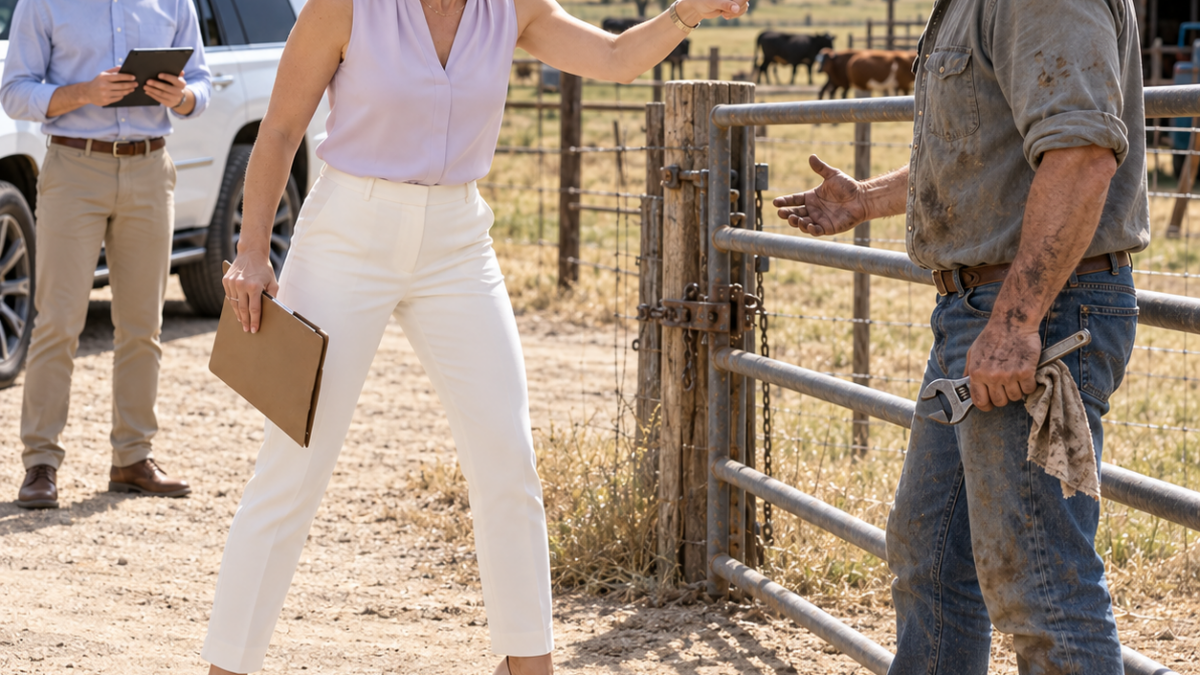
FULL ENDING
I got up so fast the chair scraped across the floor. I went to the office, unlocked the safe, and pulled out the old deed, the survey from the refinance, and every boundary document I kept in the bottom drawer. I spread them across the desk and compared them against Karen’s map.
It did not take a lawyer to see the problem.
Their actual subdivision trail curved around their lots and stopped where their land stopped. But the shaded area in the violation letter kept going in a clean, confident line straight across my property, as if whoever drew it thought maps were wishes. They had followed a marketing concept plan past the end of their ownership, across my fence, over my pasture, and into a natural berm on my side.
I called the number on the letter.
An answering service picked up first.
When Karen finally called me back, she did not say hello.
“Mr. Harlan, I understand you have questions about your violation notice.”
“No,” I said. “I have answers. You sent me a fake map.”
There was a short silence.
Then she laughed.
“It’s not fake.”
“It shows your HOA claiming five hundred acres of my ranch.”
“It shows the trail reserve as presented to residents.”
“Presented by who?”
“The developer’s materials were clear.”
“Marketing materials don’t transfer land.”
She sighed, like I was a child refusing vegetables.
“You’re focusing on technicalities.”
“Deeds are not technicalities.”
“Our residents bought into Oak Hollow Estates with a reasonable expectation of open space.”
“Then they should ask the developer why he promised them land he didn’t own.”
Her voice cooled.
“You need to be careful how you speak about this community.”
“I’m being careful. Don’t contact me again unless you can produce a recorded instrument showing an interest in my property.”
“We have governing authority.”
“Not over me.”
“You are adjacent to us.”
“That is not a legal category.”
“Mr. Harlan,” she said, and now the sweetness was gone, “you can cooperate now, or you can be compelled later.”
I gripped the phone hard enough that my knuckles hurt.
“Try it.”
She hung up.
I should have called my lawyer that second. Instead, because pride is a stubborn animal, I emailed her copies of the relevant survey pages and told her plainly that Oak Hollow had no ownership, easement, covenant, or right of access on my ranch. I wrote it clean, factual, and short.
Karen replied twenty minutes later.
You remain non-compliant. Fines will begin accruing immediately.
I laughed once, but there was no humor in it.
The next morning, I forwarded everything to my lawyer, Caleb Morse.
Caleb was not a big-city shark. He did not pound tables or wear shoes that looked more expensive than trucks. He was a small-town land attorney with a calm voice, gray at the temples, and a way of reading documents that made foolish people look even more foolish. He had walked my boundaries with me when we refinanced. He knew where the fence doglegged and why. He knew my family. He knew the county.
When he called me back, he sounded tired already.
“They have nothing,” he said.
“I know.”
“No recorded easement. No annexation. No covenant. No common area. Nothing touches your parcel.”
“So why do they sound so confident?”
“Because people confuse confidence with rights.”
He sent a formal cease and desist to Karen, the HOA, the management company, and the developer. He demanded that they stop contacting me, stop representing any interest in my land, and confirm in writing that they understood they had no right to access or regulate my property.
Karen answered by putting me in the HOA newsletter.
A buddy sent me the screenshot two days later.
Neighboring landowner blocks community trail expansion, the headline said. Board working with counsel to restore promised resident access.
Below that, Karen had written three paragraphs about “shared values,” “responsible land stewardship,” and “one individual’s refusal to cooperate with the broader community vision.”
She never named me.
She did not have to.
The comments were worse.
People I had never met called me greedy, backward, anti-community, and “exactly why counties need stronger development oversight.” One man wrote, Just build the trail. Let him sue if he wants. Another woman posted, We paid for access. He can’t just fence off our amenities.
My wife, Emily, read the screenshots over my shoulder and went still.
“They really think it belongs to them,” she said.
“No,” I said. “Karen wants them to think that.”
Emily looked at me.
There are marriages where people fight about money, chores, in-laws, whose turn it is to unload the dishwasher. Emily and I had argued over all of that at some point, but never over the ranch. She knew what this land was. She knew the sound my voice got when I was trying not to panic.
“What are you going to do?” she asked.
“Document,” I said.
That was what Caleb had told me.
Document everything.
So I did.
I printed emails, saved screenshots, recorded calls when the law allowed it, wrote down times, dates, names, plates. I took pictures of gates, fences, signs, tracks. I started a folder on my computer called Oak Hollow Problem, then renamed it later to HOA War, because sometimes accuracy matters.
The first actual trespass came on a Tuesday morning.
I was on the tractor cutting across the hayfield when I saw a white pickup parked inside my north gate. A logo on the door read City Greenscape Contractors. Three men were out in my field with wooden stakes, spray paint, and a paper plan flapping in the wind.
For a second, my body reacted before my mind caught up.
Heat flooded my neck.
My hand tightened on the wheel.
I drove the tractor straight toward them and killed the engine ten yards away.
The youngest of the crew looked up first. His face said he already knew this was going badly.
“You lost?” I asked.
He swallowed. “We’re with City Greenscape. We’re marking the trail improvement corridor.”
“You’re marking my hayfield.”
He looked down at the paper like it might save him. “We were told the HOA had permission.”
“By who?”
He hesitated.
I held out my hand.
He gave me the work order.
Karen Whitmore’s name was on the authorization line.
I stared at it until my pulse slowed enough for me to speak without shouting.
“Pack up,” I said.
“Sir, I’m just doing the job.”
“No. You’re trespassing. Your boss sent you onto private property with a fake work order. I’m giving you the chance to leave before I call the sheriff.”
The other two men had gone very quiet.
The young guy folded the paper with shaking hands.
“We’ll go.”
“Smart.”
They pulled the stakes they had already hammered and loaded everything back into the truck. I filmed them leaving from the tractor seat. Ten minutes after their dust disappeared down the road, my phone buzzed.
Karen had left a voicemail.
Her voice was low, furious, and polished.
“You are obstructing community development and interfering with contractors authorized by this association. This behavior will have consequences. You can either get on board, Mr. Harlan, or we will sue you into compliance.”
I sent the voicemail to Caleb.
His response came back in two words.
Good evidence.
Three days later, the fence crew arrived.
Not stakes this time.
Posts.
Augers.
Concrete bags.
They came in two trucks and started drilling a line through my western pasture, not along any boundary, not even close. The line would have cut me off from one of my main water points. It would have turned a functional grazing section into a puzzle of trapped cattle and wasted land.
I saw the auger bite into my soil, and something ancient and ugly rose in my chest.
For half a second, I wanted to tear across that pasture, screaming.
But anger is a tool only if you keep the handle.
I parked by the gate, pulled out my phone, and started filming.
I filmed the trucks.
I filmed the workers.
I filmed the auger.
I filmed the first post going in.
Then I called the sheriff.
The deputy who came out was young, sunburned, and clearly wishing he had gotten a speeding ticket instead. He talked to me. He talked to the crew. He looked at their work order. He looked at my deed copies. Then he did what small-town deputies do when paperwork turns into property law.
He shrugged.
“Sounds civil to me.”
“They’re drilling into my pasture.”
“I understand.”
“Do you?”
He looked away.
“I can tell them there’s a dispute. But without a court order—”
“Fine,” I said.
I called Caleb.
By that afternoon, he had filed for a temporary restraining order.
The judge signed it the next morning.
The order directed Oak Hollow Estates Community Association, its agents, contractors, officers, and anyone acting under their direction to stop all work on my property pending a hearing. Caleb served it by email, certified mail, and through the sheriff’s office. The fence company, to their credit, packed up the second they saw it.
Karen called me personally.
“You are making a mistake,” she said.
“I’m reading a court order.”
“You are denying families access to nature.”
“Nature is doing fine without your SUV tracks.”
“These residents paid for a lifestyle.”
“They can ask for a refund.”
“You think this is funny?”
“No,” I said. “I think it’s illegal.”
Her breath sharpened.
“You have no idea what you’re up against.”
That line should have sounded ridiculous coming from a woman whose legal theory depended on a sales brochure. But it stayed with me because she said it with real belief.
And then she showed me.
The tax bill arrived the following week.
At first, I thought there had been a mistake.
The number at the bottom did not fit inside my understanding of the year. Our county had agricultural valuation for working land. Cattle, hay, wildlife management, conservation programs—if the land qualified, you were taxed in a way that made keeping land possible. If the use changed, the taxes jumped. If it was reclassified after years of agricultural valuation, the county could hit you with rollback taxes.
The corrected bill showed five hundred acres reclassified as recreational common area.
I sat down on the kitchen floor because my knees simply stopped.
Emily found me there with the bill in my hand.
“What happened?” she asked.
I handed it to her.
She read it once.
Then again.
Her face went white.
“Can they do this?”
“They already did.”
The tax office summary said they had received documentation from Oak Hollow’s management company indicating that the disputed acreage was part of the subdivision’s recorded common area. They had processed the change pending owner documentation.
Owner documentation.
I was the owner.
Nobody had asked me.
The amount due was not just painful. It was dangerous. Ranches do not run on piles of spare cash. Feed bills come whether you’re in litigation or not. Veterinary emergencies do not wait for corrected government records. Equipment breaks at the worst possible moment. Hay prices do not care that your neighbor’s HOA president has lost her mind.
Even knowing it was wrong did not make it harmless.
Bureaucracy moves at the speed of paper.
Bills move at the speed of ruin.
I drove to the county tax office that same afternoon.
The woman behind the counter knew me. Her name was Marlene, and she had helped my father more than once when forms changed and nobody understood them. When I put the bill on her counter, her expression tightened before I said a word.
“We wondered when you’d come in,” she said softly.
“You processed this?”
“We received a plat amendment package from Oak Hollow’s management company. It looked official.”
“I never signed anything.”
“I know that now.”
She took me into a side office and pulled the file.
The document inside looked official from ten feet away. Watermark. legal description. Surveyor stamp. Signature block. Shaded map. It claimed the five hundred acres had been designated as Oak Hollow common recreational area connected to a trail system.
I felt cold before I understood why.
The surveyor stamp had a name I recognized.
But the signature was wrong.
The legal description was worse. Whoever wrote it had spliced pieces of Oak Hollow’s subdivision language into my metes and bounds like a child taping two different puzzles together. Bearings didn’t match. Segments ended nowhere. One line described a boundary that would have run straight through a county ditch and into a neighbor’s barn if followed literally.
“This wasn’t prepared by that surveyor,” I said.
Marlene looked miserable.
“We flagged some issues, but the management company represented it as a pending correction.”
“Did the clerk record it?”
“I don’t know.”
I took a copy to my truck.
I sat behind the wheel with the door closed, the paper shaking in my hand.
This was no longer arrogance.
This was fraud.
Not a neighbor misunderstanding. Not a boundary disagreement. Not some HOA board puffing itself up with legal-sounding nonsense.
Somebody had forged or misused a surveyor’s seal on a document intended to alter government records and choke me financially until I gave up.
I called Caleb.
When he opened the PDF, he was quiet for a long time.
Then he whistled.
“That’s a felony-shaped document,” he said.
He called the county clerk. The clerk had received the plat amendment from Oak Hollow’s management company, but she had not recorded it yet because something looked off. She had sent it to the county surveyor for review.
Caleb called the surveyor whose stamp was on the document.
The man answered on the second ring.
By the time Caleb finished explaining, I could hear the surveyor shouting through the phone from across the office.
He had not prepared the plat.
He had not signed it.
He had not authorized his stamp.
Within an hour, he sent a written statement on letterhead, with his license number, declaring that the document was unauthorized and the seal had been misused.
Caleb sent it to the clerk, the tax office, and Karen’s attorney.
I thought maybe that would finally make them stop.
Instead, Karen doubled down.
Her management company sent a letter claiming the common area designation had been “adopted by board action pursuant to the association’s governing authority.”
Caleb read that sentence aloud and laughed in a way I had never heard from him before.
“They think a board vote annexes land,” he said.
The next weekend, someone cut my north fence.
I found the break at dawn.
Fresh wire clipped clean. ATV tracks through the hay. Beer cans crushed near the corner post. A laminated sign zip-tied to my fence read TRAIL OPEN FOR RESIDENT USE.
For a moment, I stood there in the wet grass and felt something close to despair.
Not because I was weak.
Because it is a special kind of exhaustion when people attack the thing that feeds you, shelters you, holds your dead, and then call themselves the victims.
I fixed the fence.
I put up a game camera.
I added hot wire.
Then I printed more screenshots from the Oak Hollow residents’ group, where people bragged about “taking back the trail” and one man posted a picture of mud on his ATV tires with the caption Finally got to enjoy what we paid for.
I saved everything.
Karen wanted a paper war.
So I built a paper fortress.
Then the lawsuit arrived.
Oak Hollow Estates Community Association filed for declaratory judgment. They wanted the court to declare that they had an implied easement across my land based on “historic use,” “planned community reliance,” and “resident expectations.” They also wanted my fence declared a nuisance, my signage removed, and title quieted in their favor for the five hundred acres labeled as community common area.
I read the petition twice.
Then I walked outside because the house suddenly felt too small.
The audacity was almost impressive.
Their “historic use” consisted of residents walking dogs where they had no right to be and four fence posts their own contractor had set before a court order stopped them. Their “improvements” were trespass evidence. Their “resident expectations” were marketing promises made by people who did not own what they sold.
Caleb filed our response and counterclaims.
Trespass.
Slander of title.
Fraud.
Defamation.
Damage to property.
Tortious interference.
We added the HOA, Karen personally, the management company, the manager who submitted the false plat, and, once Caleb found enough email smoke, the developer.
When Caleb sent me the draft, I expected dry legal language.
Instead, I read fire wrapped in court formatting.
They wanted a fight.
Caleb gave them one.
The first hearing was for the injunction.
Karen arrived at the courthouse in a navy blazer, pearl earrings, and a face arranged into wounded dignity. She sat with her attorney and kept glancing toward the handful of Oak Hollow residents who had come to watch. She looked like she expected applause for surviving persecution.
Her lawyer was polished in that expensive suburban way, with perfect hair and a voice that treated every sentence like a billable hour. He told the judge this was a misunderstanding. He said Oak Hollow had relied on development plans. He said I had escalated the situation. He said any trespass was accidental.
The judge listened without expression.
Then she asked one question.
“Do you have any recorded right, easement, covenant, deed restriction, or ownership interest touching Mr. Harlan’s land?”
Karen’s lawyer opened his mouth.
Closed it.
Then said, “Not in the conventional sense, Your Honor.”
The courtroom went silent.
The judge leaned forward.
“There is only the legal sense.”
Karen stared straight ahead.
The judge extended the restraining order into a temporary injunction. Oak Hollow, its board, its members, its agents, and anyone acting under its direction could not enter my land without court permission. If they did, she said, contempt would be on the table.
Then she looked over her glasses at Karen.
“Do I need to explain what that means?”
Karen’s mouth tightened.
“No, Your Honor.”
But outside the courtroom, her mask cracked.
She approached me near the courthouse steps with her lawyer trailing behind her.
“You must be very proud,” she said.
“I’m tired.”
“You are humiliating an entire community.”
“No,” I said. “You are.”
Her eyes narrowed.
“You think you’ve won because you got one order. You haven’t. People like you always think fences make you powerful.”
I looked at her then, really looked.
She was not afraid of being wrong.
She was afraid of being seen as wrong.
That was worse.
Because someone afraid of being wrong can still stop. Someone afraid of exposure will burn everything just to keep the smoke thick.
I turned away from her.
“See you in court, Karen.”
The injunction bought time.
And time let the truth move.
I started with the county.
Caleb and I met with the county attorney in a plain conference room that smelled like old coffee and carpet cleaner. I brought a binder with tabs. Caleb had taught me how to organize it: chronology first, documents second, photos third, screenshots fourth, damages last. Clean copies. Numbered exhibits. No rants.
The county attorney flipped through the false plat, the surveyor statement, the tax reclassification, the newsletter, the contractor work orders, and the trail-open screenshots.
When he reached the surveyor seal, his eyebrows climbed.
“You understand,” he said, “if this goes criminal, it gets ugly.”
I thought about the tax bill. The cut fence. The posts in my pasture. Karen smiling in my driveway like my land was a problem to be managed.
“The ugly already happened,” I said.
He nodded.
The district attorney’s office opened an investigation.
I filed complaints with the state surveyor board for misuse of a professional seal. I filed with the real estate commission over deceptive marketing. I filed with consumer protection over the HOA representing private ranch land as community open space. Every complaint was calm, factual, and supported with exhibits. No insults. No emotion beyond what the documents already carried.
Bureaucracies may be slow, but they love clean evidence.
Then I called a reporter.
Her name was Diane Foster. She wrote for the regional paper and had done a series a few years back about water rights, development pressure, and rural land disputes. I told her I had documents showing a subdivision HOA had attempted to claim five hundred acres of neighboring ranch land as common area, triggered a tax reclassification, and submitted a document bearing an unauthorized surveyor seal.
She went quiet.
Then she said, “Can you prove that?”
“Yes.”
“Can I see it?”
“Yes.”
We met in a diner off Highway 12.
I gave her copies. She asked precise questions. She did not seem interested in making me sound like a cowboy hero or Karen sound like a cartoon villain. That made me trust her more. The documents were dramatic enough.
When she asked if she could quote me, I gave her the plainest truth I had.
“I’m not part of their HOA. My land is my land. They tried to claim it, and they got caught.”
The article ran the following Sunday.
The headline was measured, but it landed like a hammer.
SUBDIVISION HOA ACCUSED OF USING FALSE PLAT TO CLAIM NEIGHBORING RANCH LAND
There was a photo of me standing by my actual fence, hat low against the sun, arms crossed. There was a screenshot from Oak Hollow’s newsletter accusing an unnamed landowner of blocking community access. There was a statement from the surveyor calling the use of his stamp unauthorized. The county clerk confirmed the plat amendment had not been recorded because it appeared defective. The tax office confirmed the reclassification was being reversed pending review.
Karen issued a response that afternoon.
Oak Hollow Estates rejects the false narrative being spread by a hostile neighboring landowner and a biased local paper. We remain committed to protecting resident access, community values, and the lifestyle promised to our homeowners. The facts will come out in court.
They did.
Just not the ones she wanted.
Within twenty-four hours of the article, my email inbox started filling.
Some messages came from ranchers I knew. Some from strangers. Some from Oak Hollow residents who suddenly wanted to explain that they had never supported Karen. A few called me names. One told me I should “share the land God gave me.” I deleted that one before Emily could answer it.
Then an anonymous email arrived with three attachments.
Board emails.
Real ones.
Karen writing to the management company.
Karen telling the board that the plat amendment was “aggressive but worth attempting.” Karen saying the tax office might “create leverage.” Karen writing, Even if he fights it, the financial pressure may bring him to the table.
I read that sentence at least ten times.
Financial pressure.
Not community values.
Not nature.
Not families.
Pressure.
Emily stood behind me, one hand over her mouth.
“She knew,” she whispered.
“Yes.”
Caleb amended our complaint the next morning.
The lawsuit changed temperature after that.
Before, Karen had been reckless.
Now she was exposed.
Oak Hollow started fracturing from the inside. Residents demanded meetings. Karen moved discussions into executive session. Someone leaked invoices showing the HOA had spent reserve funds on legal fees and fencing deposits without the full approval required under its own bylaws. Another resident sent Caleb meeting minutes where Karen bragged that “the rancher will bend once the numbers get real.”
She had said that about me.
The rancher.
Not a neighbor. Not a landowner. Not a human being with parents buried under a cedar hill less than two miles from where she wanted to lay her walking trail.
Just the rancher.
A problem category.
At the same time, Karen kept sending letters demanding “aesthetic compliance.” That was her obsession when she could not win outright. If she could not take the land yet, she wanted to make my boundary look like Oak Hollow property. She claimed my wire fence, warning signs, and hot wire created an “adverse visual experience” for residents.
Caleb told me to ignore it.
I had a better idea.
Oak Hollow’s governing documents were posted publicly. I read them one evening with Emily beside me and two cups of cold coffee between us. Buried in the design standards was a fencing section. Three-rail white vinyl. Specific height. Specific spacing. Approved post caps. Approved sign colors and letter size.
So I complied.
Exactly.
I hired a licensed contractor to build a white three-rail vinyl fence just inside the actual surveyed boundary, visible from Oak Hollow’s side. It was the ugliest pretty thing I had ever paid for. Bright white, uniform, HOA-approved, and absolutely useless for cattle.
Then, on my side, where function mattered, I kept my working wire fence and hot strand.
From Oak Hollow, residents saw their perfect country fantasy.
From my pasture, my cattle saw something that would actually hold.
I added black metal signs with three-inch letters, exactly within Oak Hollow’s own sign rules.
PRIVATE PROPERTY. NO TRESPASSING.
Then I mailed Karen photographs with a short note.
Per your repeated requests regarding visible fencing standards, I have installed boundary-facing fencing consistent with Oak Hollow design specifications. This does not grant access, easement, ownership, or control over any portion of my property.
When the judge saw the photos at the next status conference, she raised one eyebrow.
“That is creative,” she said.
Caleb smiled.
“We aim to be responsive, Your Honor.”
Karen looked like she had swallowed a nail.
Residents hated it.
Not because it was non-compliant. Because it worked.
ATVs could not slip under it. Dog walkers could not pretend they had wandered by accident. The white rails made the boundary obvious from a distance, and the no trespassing signs removed any possible claim of confusion.
The residents’ group filled with complaints.
Why is there ranch fencing behind the pretty fence?
Why can’t we access the open space yet?
Why is the board spending so much on this?
Are we liable if someone gets hurt?
Karen kept posting updates about defending resident rights, but the confidence was gone from her language. Every message sounded like a person trying to hold water in her hands.
Then the DA’s investigator visited the management company.
That was when the false plat blew open.
The manager who submitted it had kept the original editing file.
Nobody could believe it.
There were layers labeled stamp, signature, shade, and trail expansion.
The surveyor seal had been scanned from an unrelated document and pasted over the concept plan. The signature had been altered. The shaded common area had been drawn manually. The metadata tied the file to the management company’s computer system.
When Caleb told me, I sat in silence for so long he said my name twice.
“They saved the file?” I asked.
“They saved the file.”
“With the layers?”
“With the layers.”
I laughed then.
Not because it was funny.
Because sometimes the universe hands arrogant people a shovel and they dig with enthusiasm.
Criminal charges followed.
The management company representative was charged with tampering with a governmental record and misuse of a professional seal. Karen was charged with solicitation related to the same conduct. Her attorney released a statement calling it politically motivated. Karen posted that she would step back from HOA duties temporarily “to focus on family.”
Everyone knew what that meant.
Lawyer up.
The civil case moved into depositions.
Karen arrived for hers in a blue suit, hair perfect, lips tight. She brought two lawyers and the same brittle confidence I had seen in my driveway. For the first hour, she answered with rehearsed calm.
I don’t recall.
That was my understanding.
I relied on professionals.
The board acted in good faith.
Then Caleb slid a printed email across the table.
Even if he fights it, the financial pressure may bring him to the table.
Karen read it.
Her face changed.
Not much. Just enough.
Caleb folded his hands.
“Ms. Whitmore, when you wrote ‘financial pressure,’ what pressure were you referring to?”
Her lawyer objected.
Caleb waited.
Karen looked at the email again.
“I don’t recall the context.”
“The context is five lines above, where you discuss the tax office.”
“I don’t recall.”
“You don’t recall writing that having five hundred acres reclassified might ‘create leverage’?”
“I relied on the management company.”
“That was not my question.”
Her jaw tightened.
“I don’t recall.”
For three hours, she did not recall.
She did not recall the contractor authorization with her signature. She did not recall the newsletter drafts accusing me of blocking access. She did not recall telling residents that the association would “restore” the trail. She did not recall asking whether the county would process the plat before notifying me.
But the emails remembered.
The invoices remembered.
The Photoshop file remembered.
The court reporter typed every word.
The management company representative folded faster. Under questioning, he tried to say he was not a surveyor and did not understand the significance of the seal.
Caleb asked, “Did you place a licensed surveyor’s seal on a document the surveyor had not prepared?”
The man looked at his lawyer.
“Answer,” Caleb said.
“Yes.”
“Who told you to make the document match the concept plan?”
His lawyer objected.
The man swallowed.
“The board wanted it aligned.”
“Which board member?”
Silence.
Then his eyes flicked toward Karen.
That was enough.
By then, Oak Hollow was tearing itself apart.
Residents packed board meetings. Some shouted about assessments. Some asked whether insurance would cover fraud. Some wanted Karen removed permanently. Some still believed I was the villain because it is easier to hate a stranger than admit you bought a lie.
The directors and officers insurance carrier sent a reservation of rights letter. Someone leaked it. Fraud and intentional misconduct might not be covered. Personal exposure was possible.
That phrase, personal exposure, did more to educate the neighborhood than all my deeds and surveys combined.
Money makes abstract principles clear.
Karen tried one last public performance.
Oak Hollow announced a “community appreciation walk” to the edge of the disputed open space. The email invited residents to gather near the boundary and “stand together for responsible access.”
I heard about it from a resident who had quietly switched sides and now forwarded me everything.
So on Saturday morning, when fifty Oak Hollow homeowners walked up to the white vinyl fence with dogs, kids, coffee cups, and matching outrage, I was already on my side.
In a lawn chair.
With lemonade.
I sat fifteen feet back from the fence, hat low, boots crossed at the ankles, my dog sleeping beside me. I did not say a word when they arrived.
Their faces were priceless.
Karen stood at the front in sunglasses, one hand lifted like she was leading a tour.
“This is the area we’ve been fighting to preserve,” she announced.
“For who?” someone muttered from the back.
Karen ignored it.
A man in a golf shirt called through the fence, “When are we getting access?”
I lifted my glass.
“Ask your board to buy it.”
Karen spun toward me.
“This is not helpful.”
“Neither was fraud.”
A few residents gasped.
Karen’s lips went white.
“You should be ashamed of yourself,” she said.
I stood then.
Slowly.
Not angry. Not loud. Just done.
“No,” I said. “You cut my fence. You sent contractors onto my land. You tried to change my tax status. You used a false plat. You told these people I stole something from them because you were too proud to admit they were promised something that was never yours to give.”
The group went quiet.
Karen looked around, and for the first time, I saw fear break through her polish.
Not fear of me.
Fear that the crowd was listening.
A woman near the back said, “Is that true?”
Karen snapped, “This is pending litigation.”
“That’s not a no,” someone else said.
The walk ended early.
Two days later, the developer’s attorney called Caleb.
Settlement had been mentioned before, but always in insulting ways. A narrow license. A token payment. A shared access agreement. A statement that both sides regretted confusion.
This time, they sounded different.
The judge ordered mediation before trial.
We met in a neutral office with bad coffee, beige walls, and a mediator who had probably survived every neighbor dispute known to man. Karen sat across from us at the opening session, arms crossed, her face fixed in a blank mask. The developer’s attorney sat beside her. The management company’s lawyer looked like he had aged ten years in three months.
The mediator separated us into rooms.
Their first offer was predictable.
Reduced trail footprint.
Mutual non-disparagement.
Small payment for fence damage.
No admission of wrongdoing.
Caleb looked at me.
I shook my head.
Our offer was simple.
They would sign and record a quitclaim deed disclaiming any interest in my property, including the disputed five hundred acres. They would agree to a permanent injunction barring the HOA, its members, agents, and anyone under its direction from entering my land without express written permission. They would pay all attorney fees and costs, all damages, and a punitive settlement for slander of title. The HOA would adopt bylaw changes requiring independent legal review and a two-thirds member vote before any litigation or filing involving property outside the subdivision. They would cap legal spending without member approval.
And Karen, the management company representative, and a developer representative would issue written and video apologies to the community correcting the false claims.
The mediator stared at Caleb.
“That’s a lot.”
Caleb nodded.
“They tried to take five hundred acres.”
The mediator went to the other room.
Fifteen minutes later, we heard Karen through the wall.
“Never!”
I looked at Caleb.
He smiled faintly.
We stood.
The mediator hurried back in.
“Give me a little more time.”
“No,” I said. “They can explain it to a jury.”
Trial began on a Thursday.
The courthouse gallery was fuller than I expected. Ranchers. Oak Hollow residents. County employees. Diane Foster from the paper. A few people who just loved a public mess.
Karen did not look at me when she walked in.
She looked smaller somehow, though nothing about her clothes or posture had changed. Maybe arrogance has weight only when nobody challenges it.
Caleb’s opening statement was quiet and devastating.
He did not shout.
He did not call names.
He told the jury about a ranch older than the subdivision. A developer’s sales promise. An HOA president who wanted control. A false map. Trespass. Tax pressure. A forged seal. A landowner forced to defend what was already his.
Then he played the first video.
It was from a recorded board Zoom produced in discovery.
The management company representative, smiling like a man too comfortable with fools, said, “The county is too dumb to catch a fake plat if the seal looks official.”
A sound moved through the courtroom.
Not loud.
Worse.
Recognition.
The developer’s attorney asked for a recess before Karen’s side could begin.
By lunch, we were back in a conference room.
This time, the developer was ready to write checks. They wanted the bleeding to stop. They wanted their unsold lots protected. They wanted distance from Karen, from the management company, from the word fake.
They offered more money.
I told them money was not the first condition.
The apology was.
The quitclaim was.
The permanent injunction was.
The bylaw change was.
Karen sat at the table with her hands clasped so tightly her knuckles looked bloodless.
“I will not apologize to him,” she said.
The developer’s attorney leaned close to her. His voice was low, but I heard it.
“You will apologize.”
Karen stared at him.
He did not blink.
For one long moment, all the control she had spent months performing collapsed into silence.
Then she nodded once.
We signed that afternoon.
The settlement recorded the truth in black and white.
Oak Hollow Estates had no legal claim, easement, ownership interest, covenant authority, or access right over my ranch. The HOA disclaimed any and all actual, implied, imagined, or asserted interest in the disputed five hundred acres. A permanent injunction barred the HOA, its members, officers, agents, contractors, and anyone acting under their direction from entering my land without express written permission. Violations carried liquidated damages high enough to make even the richest resident think twice.
They paid my attorney fees.
All of them.
They paid for fence repairs, field damage, survey costs, lost time, and a punitive amount for slander of title. The developer funded an agricultural scholarship in my grandparents’ names at the local high school. That part hit me harder than I expected. When Caleb told me the fund had cleared, I went out to the cedar hill where my grandparents were buried and stood there in the wind for a while.
They would have laughed at the white vinyl fence.
They would have liked the scholarship.
The HOA adopted the bylaw changes under court supervision. No litigation, filing, easement claim, land-use assertion, or spending beyond a set threshold involving property outside the subdivision could happen without independent legal counsel, full member disclosure, and a two-thirds vote. Legal spending got capped. Executive session abuse got limited. Karen’s little kingdom had rules now.
And yes, Karen apologized.
The video was posted to the Oak Hollow forum.
She sat at a conference table with no sunglasses, no clipboard, no crowd to perform for.
“My statements regarding Mr. Harlan’s property were inaccurate,” she said, voice stiff. “Oak Hollow Estates has no ownership or access rights over his ranch land. Communications suggesting otherwise should not have been made. I apologize for the harm caused.”
It was not warm.
It was not sincere.
But it was public.
That mattered.
The criminal cases continued after the settlement.
The management company representative pled to a lesser charge of attempted tampering, paid a fine, received probation, and submitted a statement to the surveyor board admitting he had misused the seal. The surveyor, I heard, pushed hard for professional consequences, and I did not blame him.
Karen went to trial.
She tried the same strategy from her deposition.
I don’t recall.
I relied on others.
I acted in good faith.
The jury saw the email about financial pressure.
They saw the contractor authorization.
They saw the newsletter drafts.
They heard the management company representative testify that Karen wanted the document to match the concept plan so the county would “recognize the common area.”
They did not buy her act.
Karen was convicted of solicitation related to tampering with a governmental record. Her sentence included community service, a fine large enough that rumor said she sold her second SUV, and a court order barring her from serving on any HOA board for a set period.
That last part felt almost poetic.
A woman who had tried to govern land she did not own lost the right to govern a neighborhood pool schedule.
Oak Hollow tried to pretend she had been a rogue actor.
Nobody believed it.
Their insurance carrier dropped them. Their premiums doubled. A special assessment hit the residents, and suddenly the same people who had cheered about “taking back the trail” were furious about paying for Karen’s crusade. The board was voted out wholesale. The new board looked exhausted in every photo, which made them more trustworthy to me. Their first public statement said Oak Hollow Estates would not engage in external property disputes and would respect all neighboring landowners’ rights.
Someone commented under it, Lesson learned.
The tax office reversed the reclassification completely. More importantly, the county updated its procedures. Any major land-use classification change based on third-party documentation now required direct owner confirmation before processing. The clerk’s office added review steps for plat amendments affecting large acreage. The surveyor board circulated guidance about seal misuse.
That was a quieter victory, but maybe the most important one.
Karen had aimed at me.
The system learned to duck next time.
As for the fence, I did something that made Emily laugh for ten minutes.
The settlement required Oak Hollow to maintain any aesthetic improvements visible from their side of the boundary, including the white vinyl fence they had insisted represented community harmony. So I left it there.
On their side.
Their problem.
Behind it, on my side, I rebuilt my working fence the way a ranch fence should be built: tight wire, solid posts, functional gates, hot where needed, ugly only to people who think fences are decorations.
Every summer, the white vinyl warps a little in the heat. Every spring, mildew creeps up where the sprinklers hit. Weeds grow under it. Someone from Oak Hollow hires a crew to power wash it, trim it, straighten it, and keep it pretty for residents who no longer have access to anything beyond it.
They got their view.
I kept my land.
I also installed two locked gates along the north line, set back behind my fence. Not for Oak Hollow. Never for Oak Hollow. They are for the volunteer fire department, because out here, grass fires run faster than arguments, and minutes matter. My neighbors—the real ones, the ones who show up with water tanks and gloves instead of forged plats—know how to reach me when it counts.
Now and then, somebody from Oak Hollow sends a polite letter asking whether I would consider a walking easement for the community, this time at fair market value and with liability insurance.
I keep Caleb’s answer saved as a template.
No.
Sometimes I drive the north fence at sunset and look over the land Karen tried to turn into an amenity. The grass moves in long waves when the wind comes right. Cattle gather near the water. The old cottonwoods my grandmother planted still lean toward the draw. In the distance, I can see the roofs of Oak Hollow Estates shining clean and bright, a neighborhood built on the idea that country life could be packaged, sold, and controlled.
Maybe some of the people there understand better now.
Maybe some never will.
But when I stop by the boundary and see those white rails on their side, I think about Karen standing in my driveway with her clipboard, telling me people who cooperate find the process painless.
She was wrong about almost everything.
But she taught me one thing.
A fence is only as strong as the person willing to defend what it means.
Mine means no.
It means my grandparents’ work was not for sale through someone else’s brochure. It means a board vote is not a deed. It means no polished smile, no newsletter, no fake map, no tax threat, no courtroom performance can turn another person’s home into your community feature.
Karen came to my ranch believing land belonged to whoever could pressure hardest.
She left with a criminal record, a public apology, a neighborhood that had to pay for her arrogance, and a white fence she could admire from the wrong side.
And every time the wind rattles those rails, I hear the same quiet truth.
My land is still mine.