FULL ENDING The HOA Sent Fake Cops to My Driveway, Not Knowing They Were Standing in Front of the County Sheriff
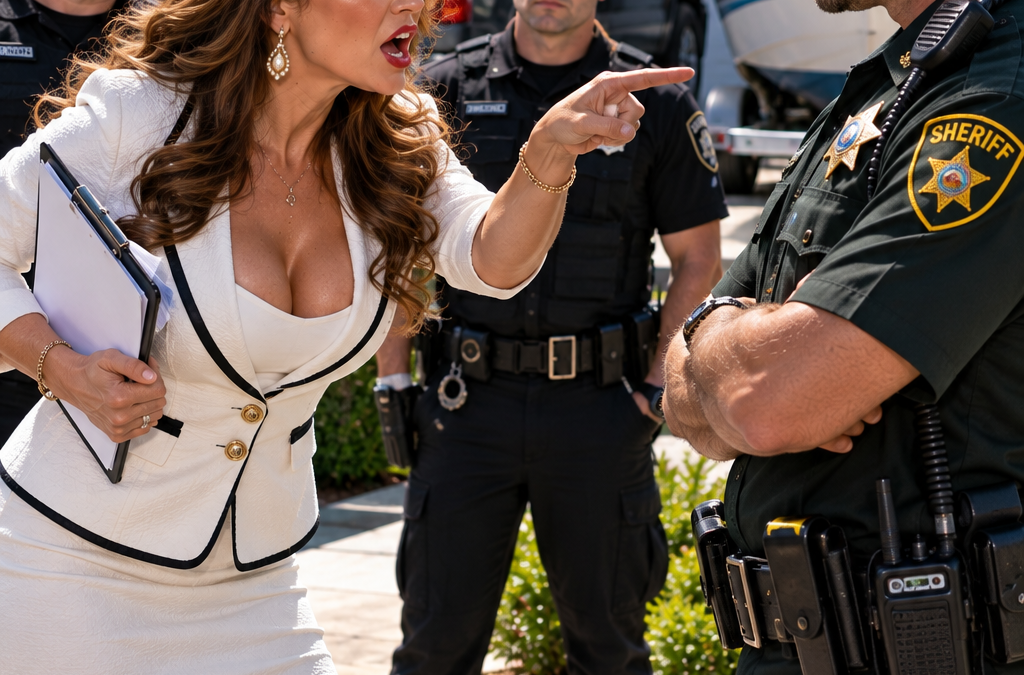
𝗙𝗨𝗟𝗟 𝗦𝗧𝗢𝗥𝗬
A little pause.
Then a soft laugh.
“You’re very direct.”
“Occupational habit.”
“I admire that. Truly. But you have to understand, community standards only work if everyone in the surrounding neighborhood participates.”
“I’m not in your community.”
“You border it.”
“So does the county road.”
“That’s not quite the same thing.”
“Legally, it is exactly the same thing.”
Her sweetness cooled slightly.
“We’re trying to create harmony.”
“No, you’re trying to create jurisdiction where none exists.”
“Sheriff, with all respect, when one property refuses to maintain the same standards as everyone else, it affects the collective.”
“My property is maintained.”
“Your truck, for example—”
“My truck is legal.”
“The boat trailer—”
“Also legal.”
“The lawn—”
“Measured last weekend. Also legal.”
She let the silence stretch just long enough to show me she was switching tactics.
“I would hate for this to become contentious,” she said.
“Then stop sending letters.”
“I hope you’re not using your position to intimidate a volunteer board.”
I smiled despite myself.
There it was.
The first attempt to make herself the victim.
“No,” I said. “I’m using my mailbox to receive mail and my phone to answer a call. You’re the one threatening liens.”
“Only as part of standard collection procedure.”
“For debts I do not owe.”
“In your opinion.”
“In the property records.”
Her voice sharpened.
“We’ll be in touch.”
“I’d rather you weren’t.”
She hung up.
My wife, who had been standing near the kitchen island with a mug of tea, raised an eyebrow.
“She sounds fun.”
“She sounds like paperwork in heels.”
For a few weeks, things quieted down.
Not completely. I still got the occasional letter. But no one came to the house, and I had actual work to do. Being sheriff does not leave much time for suburban theater. Between budget meetings, court appearances, staffing issues, calls from commissioners, and the daily circus of keeping a county functional, I had better things to worry about than Karen Whitmore’s pretend empire.
Then came the Saturday morning that made the whole thing worth remembering.
It was late spring, warm enough to work with the garage door open but not hot enough to hate the sun yet. My wife had asked me months earlier to build a cabinet for the laundry room, and I had finally carved out time to work on it. I had lumber stacked against one wall, coffee on the workbench, and old country music playing low from a speaker.
I was sanding a side panel when I heard tires crunching on the driveway.
That was not unusual. Neighbors stopped by sometimes. Delivery drivers came to the wrong house occasionally. Once, a kid from down the street rolled up on his bike to ask if I knew how to get a fishing hook out of a backpack zipper.
I wiped my hands on a rag and looked out.
Two men were stepping out of a white sedan.
For a second, my brain tried to make sense of what I was seeing.
They were dressed like law enforcement officers.
Almost.
Dark shirts. Dark pants. Utility belts. Sunglasses. Patches on their sleeves. Badges clipped to their chests. One carried a clipboard. The other had a phone out like he was ready to document evidence.
But something was off immediately.
After fifteen years as sheriff, I know uniforms. I know posture. I know how real officers move when they approach a house. These two had the swagger of men who had watched too many police shows and understood none of the responsibility. Their badges were too shiny in the wrong way. Their belts looked like costume props. Their shirts did not fit right. The patches had bold letters that said HOA PATROL, designed with the kind of dramatic font you might see on a children’s action figure package.
The taller one was in his forties, with a narrow face and a dead-serious expression that made the costume even funnier. The shorter one was stockier, with a shaved head and the eager aggression of a man who had been waiting his whole life for someone to hand him a fake badge.
They marched toward my front door.
I stepped out of the garage before they could knock.
“Morning,” I said. “Can I help you gentlemen?”
The tall one adjusted his clipboard.
“We’re with Hollow Ridge Estates HOA Enforcement Patrol.”
I bit the inside of my cheek.
HOA Enforcement Patrol.
That was new.
“We need to discuss your overdue HOA fees and multiple outstanding violation notices.”
I glanced at their sedan.
Magnetic signs on both doors read HOLLOW RIDGE HOA PATROL. The letters were slightly crooked.
“Is that right?” I asked.
“Yes, sir,” the tall one said. “You are currently delinquent in association dues and in active violation of community standards.”
The shorter one had already wandered a few steps sideways and started taking pictures of my truck.
“Unlicensed commercial vehicle,” he said loudly, as if narrating for a documentary. “Parked in residential driveway. Violation of Section 4.2.”
“That’s my personal truck,” I said.
He snapped another photo.
“Visible work equipment in cargo bed.”
“That’s a toolbox.”
“Commercial appearance.”
I looked back at the tall one.
“I think there’s been a misunderstanding. I am not a member of your HOA.”
The tall one flipped a page on his clipboard with great ceremony.
“All residents in the Hollow Ridge area are subject to HOA regulations, fee obligations, and enforcement actions.”
“No, they’re not.”
“Yes, sir, they are.”
“No,” I said, still calm. “They are not.”
The shorter man stepped closer, chest puffed.
“Sir, failure to cooperate may result in additional citations.”
I almost laughed right in his face.
Instead, I folded my arms.
“Can I see your identification?”
The tall man did not hesitate. He pulled a laminated card from a badge holder and held it up.
It had his picture, his name, and the title HOA ENFORCEMENT OFFICER beneath a fake-looking seal that appeared to have been downloaded from the internet and printed at an office supply store.
I leaned slightly closer.
“This is not a law enforcement ID.”
“We are duly authorized by the Hollow Ridge Estates HOA board,” he said, with the full confidence of a man repeating words someone else had taught him.
“To do what?”
“To enforce community regulations, collect overdue fees, conduct compliance investigations, and issue citations.”
“On private property outside your HOA?”
“Within the greater community enforcement zone.”
“There is no such thing.”
He stiffened.
“Sir, we are not here to debate jurisdiction. We are here to collect payment and document violations.”
The shorter one came back from photographing my truck.
“Boat trailer visible from road,” he said.
“That boat trailer is also mine.”
“Recreational watercraft storage violation.”
“Fishing season starts next week.”
“Still a violation.”
“Of what?”
“Community standard 7.1.”
“I’m not in your community.”
The shorter man smiled in a way he probably thought looked intimidating.
“We can do this the easy way or the hard way.”
There it was.
The line.
I have heard that sentence from actual criminals, drunk husbands, teenagers with stolen dirt bikes, and one man who tried to fight a deputy while wearing only socks and a bathrobe. Hearing it from a man in a plastic badge on my own driveway was almost beautiful.
The tall one added, “You owe twenty-four hundred dollars in unpaid association dues, plus eighteen hundred in accumulated fines. Payment is due immediately.”
“Immediately.”
“Yes, sir.”
“And if I don’t pay?”
“We will begin lien proceedings.”
“Against property you don’t have authority over.”
“We have authority.”
“You don’t.”
The shorter one shifted forward another half step.
“Sir, refusing lawful orders from enforcement personnel can escalate quickly.”
That was when I decided the game had gone far enough.
I reached slowly into my pocket.
Both of them tensed, which would have been funny if it had not been so pathetic.
I pulled out my wallet, opened it, and held up my badge.
Not plastic.
Not laminated.
Not printed from a website.
Real.
County-issued.
Backed by law, oath, training, voters, courts, responsibility, and more late nights than I cared to count.
“I’m Sheriff Caleb Morgan,” I said. “Those are fake uniforms, fake badges, and fake authority. You are civilians in costumes trespassing on my property while pretending to conduct official enforcement.”
The tall man’s face emptied.
The clipboard slipped from his hand.
Papers scattered across my driveway like the world’s saddest parade confetti.
The shorter man’s mouth opened. Closed. Opened again.
He looked at my badge, then at his own, then back at mine.
“We—uh—we’re official HOA enforcement.”
“No,” I said. “You are two grown men playing pretend cop.”
“We didn’t know—”
“Obviously.”
The tall one bent quickly to gather his papers, hands clumsy.
“Our company is authorized by the board.”
“Your company sent you onto my property to demand money you are not owed while using badges and uniforms designed to imply law enforcement authority.”
“We never said we were police.”
“You said you had authority to investigate, cite, and collect fees. You wore fake badges. You used the phrase lawful orders.”
The shorter one swallowed.
“I didn’t mean lawful like police lawful.”
I stared at him.
He looked away.
“Get off my property,” I said.
The tall one nodded so hard I thought his sunglasses would fall.
“Yes, sir. Of course, sir. We apologize for the confusion.”
“There was no confusion.”
They scrambled back to their car, bumping into each other, dropping one more sheet from the clipboard before snatching it up. The shorter guy nearly tripped over the edge of the driveway. They got in, reversed too fast, and pulled away with their magnetic HOA PATROL signs catching the sunlight like a final insult to common sense.
I stood there for a moment, watching them disappear.
Then I started laughing.
I laughed so hard I had to put a hand on my truck.
My wife came out the front door.
“What happened?”
I pointed down the street.
“Fake HOA cops.”
She blinked.
“What?”
“Fake. HOA. Cops.”
She stared at me for two seconds.
Then she started laughing too.
Once I stopped laughing, I did what I always do when something stupid might become something serious.
I documented everything.
I took photos of the tire marks in the driveway. Photos of the letterhead on one of the papers they had missed. Photos of the sedan from my security camera footage, including the license plate and the magnetic door signs. I pulled the camera audio from the garage camera, which had captured most of the conversation clearly enough.
Then I sat at my laptop and started digging.
The company was called Community Standard Solutions.
Its website was a masterpiece of legal-adjacent nonsense. Uniformed compliance officers. Authoritative presence. Fee recovery visits. Violation documentation. Resident accountability. Enforcement patrol packages. It never quite said police, but every photo, every graphic, every phrase leaned hard in that direction. Their employees wore badges. They drove marked vehicles. They used words like citation, investigation, patrol, compliance demand, and field enforcement.
It was designed to scare people.
Not inform them.
Scare them.
I found testimonials from HOAs praising the company for “increasing collections” and “reducing resident resistance.” One review mentioned that elderly homeowners “responded well to uniformed visits,” which made my jaw tighten.
That stopped being funny.
I imagined those two men at the door of Mrs. Delaney down the road, a widow in her seventies who had lost her husband last winter. I imagined them flashing fake badges, telling her she owed money, threatening liens, using official language until she wrote a check because she thought the police were at her door.
I imagined them doing it to families. Retirees. Immigrants. Anyone who did not know where HOA authority ended and real law began.
Karen had not just been annoying.
She had hired intimidation and dressed it up as management.
My first call was to Community Standard Solutions.
A woman answered with a cheerful script.
“Community Standard Solutions, helping communities protect what matters. How may I direct your call?”
“This is Sheriff Caleb Morgan.”
The cheer vanished.
“Oh. Um. Good morning, Sheriff.”
“I need to speak with whoever supervises your field enforcement personnel.”
“May I ask what this is regarding?”
“Two of your employees came onto my property this morning wearing fake badges and uniforms, claimed enforcement authority, demanded money, threatened lien proceedings, and implied noncompliance with their orders could escalate.”
A silence.
Then frantic typing.
“One moment, please.”
The hold music began.
It was upbeat.
Insultingly upbeat.
A man came on the line less than thirty seconds later.
“Sheriff Morgan, this is David Lyle, regional operations director. I understand there was a misunderstanding.”
“That word is doing a lot of work today.”
“I assure you, our compliance officers are clearly identified as HOA enforcement personnel, not law enforcement.”
“They showed fake badges.”
“Our badges are company identification tools.”
“They wore police-style uniforms.”
“Professional presentation is part of our service model.”
“They claimed authority to conduct investigations and issue citations.”
“Within the scope of HOA governance—”
“They were on my property. I am not in the HOA. They demanded payment I do not owe.”
His breathing changed.
“Sheriff, we act based on client-provided account information.”
“Your client provided bad information. Your company provided the costumes.”
“With respect—”
“No,” I said. “With respect, you are operating a business model built to make civilians believe they are dealing with government authority. That is dangerous. It may also be criminal depending on what your employees say and do at the door.”
He did not answer.
I let the silence work.
Finally, he said, “What would you like us to do?”
“Stop sending fake cops to people’s homes in my county.”
“I understand your concern.”
“I don’t think you do yet.”
Papers shuffled on his end.
“We can suspend activity in that area pending review.”
“You will cease operations in this county immediately. You will preserve all records related to Hollow Ridge Estates. You will provide written confirmation that your personnel are not law enforcement, have no arrest authority, no investigative authority beyond private documentation, and no right to demand entry or payment. And if I hear about one more uniformed visit from your company to any resident in this county, I will personally make sure the district attorney has everything my office can legally provide.”
His voice was much smaller when he answered.
“Yes, Sheriff.”
“Good.”
After that, I called Karen.
She answered on the third ring.
“Sheriff Morgan,” she said warmly, as if we were old friends and not participants in a slow-motion jurisdictional dispute. “What a pleasant surprise.”
“We need to meet.”
“Oh?”
“At the community center. Today.”
A pause.
“I’m rather busy today.”
“I’m sure. Make time.”
Her voice cooled.
“Is this official sheriff’s business?”
“It concerns two men in fake law enforcement uniforms your HOA sent to my property this morning.”
Another pause.
This one had less confidence in it.
“I see.”
“I’ll be at the community center at two.”
I hung up before she could perform.
At 1:55, I pulled into the Hollow Ridge community center parking lot.
It was a ridiculous building for a subdivision that had existed barely three years—stone facade, fake shutters, cupola on top, landscaping trimmed within an inch of its life. The kind of place built to make HOA members feel like they belonged to a country club without providing any actual country club amenities.
Karen was waiting inside.
She had dressed for battle.
White fitted blazer. Cream blouse. Black skirt. Heels high enough to make me worry about the polished floor. Her hair fell in smooth waves over one shoulder, and her lipstick was the same perfect red I had seen in county meeting photos. She was beautiful, no question. She knew it. She used it. When I walked in, she smiled like she expected beauty to soften the room.
Two board members sat with her.
A nervous-looking treasurer named Alan and a retired dentist named Martin who looked like he regretted every choice that had led him to that folding chair.
Karen stood.
“Sheriff,” she said. “Thank you for coming.”
“You invited the problem. I invited myself.”
Her smile tightened.
“Let’s not begin with hostility.”
I set my folder on the table.
“Your HOA hired a company that sent men to my home dressed like law enforcement officers, carrying fake badges, demanding money, and threatening legal action.”
Karen sat slowly.
“They are professional enforcement contractors.”
“They are private citizens in costumes.”
Alan shifted in his chair.
Karen looked at him sharply, then back at me.
“The company was recommended by our management consultant. They assured us their officers were fully licensed.”
“Licensed as what?”
She hesitated.
“To provide enforcement support.”
“That means nothing.”
Martin cleared his throat.
“Sheriff, we were told this was common practice.”
“Common does not mean legal.”
Karen leaned forward slightly, hands folded.
“Perhaps your personal feelings about HOAs are coloring your interpretation.”
I looked at her for a long moment.
It was an impressive move, I had to admit. She had taken fake cops in my driveway and tried to turn the issue into my bias.
“My interpretation,” I said, “is based on fifteen years of law enforcement experience, state statutes on impersonation, consumer intimidation concerns, trespass, and the fact that your agents tried to collect money from a property your HOA does not control.”
Karen’s cheeks colored, but her smile stayed.
“I think agents is a dramatic word.”
“So is patrol.”
Alan looked like he wanted to crawl under the table.
I opened the folder.
Inside were printed photos from my security camera, screenshots from Community Standard Solutions’ website, copies of the fake ID card image I had captured on video, and the latest HOA letter threatening lien proceedings.
I slid the first photo across the table.
Karen glanced at it.
Her expression flickered.
Not enough for the board members to catch, maybe. But I caught it.
She had expected uniforms.
She had not expected the uniforms to look that fake when frozen in high-resolution evidence.
I slid another photo.
Then another.
Then a screenshot from the company website showing a man in nearly identical clothing standing on someone’s porch with the caption: Uniformed authority encourages compliance.
Martin muttered, “Oh, Lord.”
Karen said nothing.
I looked at her.
“Did you authorize visits to non-member properties?”
She lifted her chin.
“We authorized enforcement outreach in the greater community area.”
“There is no legal greater community area.”
“That phrase refers to properties whose appearance impacts Hollow Ridge values.”
“No,” I said. “It refers to your desire to control things you don’t own.”
Her eyes flashed.
For the first time, the polished mask slipped.
“You have been difficult from the beginning.”
“There it is.”
“You refuse to cooperate. You park unsightly vehicles. You store a boat in open view. You maintain a property that affects our entrance corridor.”
“My house was here before your entrance corridor.”
“Our residents invested in a certain standard of living.”
“They bought into an HOA. I did not.”
She leaned back, regaining control of her face.
“Sheriff, surely you understand community responsibility.”
“I understand legal boundaries.”
“And I understand leadership,” she said. “Sometimes leadership requires pushing reluctant people toward what benefits everyone.”
Alan closed his eyes.
That was the truest thing Karen had said all day.
She believed it.
She believed leadership meant pressure. She believed resistance justified escalation. She believed if she wanted something badly enough, law would eventually bend around her confidence.
I tapped the letter on the table.
“You threatened liens against my property.”
“Standard language.”
“You demanded dues from a non-member.”
“Administrative error.”
“You sent fake officers after I refused.”
“Contractor misunderstanding.”
“You are very good at renaming things.”
Karen’s mouth tightened.
“What do you want?”
That was better.
I pulled a single page from the folder and placed it in front of her.
“Three things. First, Hollow Ridge terminates its contract with Community Standard Solutions immediately and confirms in writing that no uniformed enforcement contractors will conduct residential visits in this county on your behalf.”
Karen opened her mouth.
I kept going.
“Second, your HOA sends written notice to every resident and every targeted non-member property explaining that those uniformed individuals were not law enforcement officers, had no police authority, and should not have represented themselves in a way that caused confusion.”
Alan whispered, “Every resident?”
“Yes.”
Karen’s eyes narrowed.
“And third,” I said, “your HOA publicly acknowledges in writing that my property and several other preexisting properties are not part of Hollow Ridge Estates and are not subject to your dues, fines, liens, standards, or enforcement process.”
Karen let out a short laugh.
“You want us to humiliate ourselves.”
“No. You already did that. I want you to correct the record.”
Martin rubbed his forehead.
“And if we don’t?” Karen asked.
There was the defiance.
Still alive.
Still reckless.
I leaned back.
“If you don’t, I will make sure every media outlet in this county receives documentation that Hollow Ridge Estates hired fake police-style enforcement contractors to intimidate homeowners and non-members into paying unauthorized fees. I will recommend every resident who paid under pressure file complaints with the state consumer protection office. I will make referrals where appropriate. And I will personally make sure your management company, your contractor, and your board’s conduct receive every bit of scrutiny available.”
Karen stared at me.
Her face had gone pale beneath the makeup.
For once, she looked her age.
Maybe older.
Alan spoke first.
“We should comply.”
Karen snapped her head toward him.
He swallowed but continued.
“We should. This is bad. This is very bad.”
Martin nodded slowly.
“I agree.”
Karen looked at both of them as if they had betrayed her on a battlefield.
“You two are panicking.”
“No,” Martin said. “I think we’re finally reacting appropriately.”
That one almost made me smile.
Karen looked back at me.
“This will create unnecessary fear.”
“You created it when you sent men with fake badges to people’s doors.”
“We didn’t know they would behave that way.”
“You hired a company whose entire sales pitch was behaving that way.”
She had no answer.
So she did what people like Karen do when cornered.
She softened.
Her shoulders lowered. Her eyes became glossy. Her voice changed from sharp to wounded.
“Sheriff,” she said quietly, “I know you think I’m some kind of villain, but I have only ever tried to protect this neighborhood. These residents depend on me. They expect standards. They expect safety. They expect someone to stand up for them.”
I had seen this performance in interrogation rooms, domestic calls, city meetings, and parking lots after fender benders. The switch from aggression to vulnerability. The attempt to make consequences feel cruel. The invitation to become the bad guy for holding firm.
“You can protect your neighborhood,” I said, “without breaking the law or terrorizing people.”
A tear gathered at the corner of her eye.
Alan looked at it like he was afraid of it.
I was not.
“You have forty-eight hours,” I said, standing. “I suggest you use them.”
Community Standard Solutions vanished faster than a raccoon when a porch light turns on.
By the next afternoon, their website was down.
By evening, their phone number went to a generic voicemail.
Two days later, Hollow Ridge residents received a letter.
I know because five people forwarded it to me before dinner.
The letter admitted that the HOA had retained a third-party compliance contractor whose representatives were not law enforcement officers and had no government authority. It advised residents that the contractor’s services had been terminated. It stated that several properties outside Hollow Ridge boundaries had been contacted in error and confirmed that those properties, including mine, were not subject to HOA dues, fines, or enforcement.
It was stiff.
Legalistic.
Clearly written by an attorney trying to keep a bad situation from becoming a catastrophic one.
But it said what needed to be said.
Then the neighborhood exploded.
Hollow Ridge had a private Facebook group, and while I was not in it, screenshots travel faster than official communications ever will.
Residents were furious.
Not mildly annoyed.
Furious.
People started sharing stories.
An elderly couple had paid a seventy-five-dollar “landscape compliance fee” after two uniformed men came to their door and said the matter could escalate if ignored.
A single mother had been threatened over a trampoline visible from the street. She said the men never claimed to be police, but they let her believe they were “some kind of official enforcement.”
A retired veteran posted that he had challenged them and been told he was “obstructing compliance activity.”
Someone else uploaded a photo of the fake patrol car parked outside a house with its magnetic signs visible. Within an hour, people were comparing it to mall security, Halloween costumes, and low-budget crime shows.
Karen tried to control the damage.
Of course she did.
She posted a statement saying the board had acted in good faith based on contractor assurances. She blamed the management company. She blamed unclear communication. She blamed residents for misunderstanding the contractor’s role. She described herself as “deeply disappointed by the situation” while never admitting she had pushed enforcement beyond the HOA’s boundaries.
Nobody bought it.
Not this time.
Because once people realized they had been frightened on purpose, embarrassment turned into anger. Nobody likes admitting they were fooled. But they dislike the person who fooled them even more.
The next board meeting had standing room only.
I did not plan to attend.
My property was not part of the HOA, and I had no official role in their internal politics. But two neighbors asked if I would come in case Karen tried to claim I had threatened the board or abused my position. I agreed to sit in the back and say nothing unless necessary.
The meeting was held in the same community center.
Karen sat at the front table, looking immaculate in a dark green dress and gold necklace. She had chosen elegance again, probably hoping beauty and composure would make people forget the fake badges. Her hair was perfect. Her makeup flawless. Her posture regal.
But the room was different now.
People were not watching her like a leader.
They were watching her like a bill that had come due.
She opened with a prepared statement.
“We are here tonight because recent misinformation has caused anxiety in our community.”
A man in the second row stood immediately.
“Not misinformation. Fake cops.”
The room murmured.
Karen’s smile tightened.
“Please allow me to finish.”
“No,” a woman snapped. “You allowed those men to come to my mother’s house.”
Karen lifted a hand.
“I understand emotions are high.”
“My mother paid them because she thought she was going to lose her home.”
“That was not our intention.”
“But it happened.”
Alan, the treasurer, looked like he had aged five years in forty-eight hours.
Karen tried again.
“The board relied on a licensed vendor—”
“Licensed to do what?” someone shouted.
“Scare people?” another voice added.
The room grew louder.
Residents stood one after another.
They talked about money paid, threats made, letters received, violations invented, and the humiliation of realizing their HOA had hired people in fake uniforms to pressure them. One man said his teenage son had been afraid because he thought police were taking pictures of their house. Another said the fake patrol had warned him that continued noncompliance could affect his “property standing,” a phrase no one could define but everyone agreed sounded threatening.
Then Mrs. Callahan stood.
She was eighty-one, small, white-haired, and usually gentle enough that my wife once described her as “a human teacup.” That night, she stood with both hands on her cane and stared at Karen like a school principal about to end a career.
“You sent those men to my door,” she said.
Karen softened instantly.
“Mrs. Callahan, I am so sorry if you felt—”
“No,” Mrs. Callahan said.
The room went silent.
Karen blinked.
“You do not get to say if I felt. I know what I felt. I felt scared. I felt ashamed. I felt like I had done something wrong because two men with badges told me I owed money. My husband handled these things before he died, and for one terrible moment, I thought I had failed him.”
Karen’s expression wavered.
Mrs. Callahan pointed her cane toward the front table.
“You took advantage of people who trusted you to know better.”
That landed harder than any shouting.
A motion to remove Karen as president came ten minutes later.
It was seconded before the first person finished speaking.
Karen stood.
“This is outrageous.”
Someone shouted, “So was sending fake cops!”
Her face flushed.
“I have given countless hours to this community.”
“And look what you did with them,” a man said.
The vote was not unanimous.
A few loyalists stayed with her, mostly people who had enjoyed her aggressive enforcement when it targeted others.
But it was not close.
Karen was removed as president that night.
Half the board resigned before the meeting ended.
Alan stayed only long enough to promise a financial review, then announced he would not seek another term.
Karen gathered her papers slowly, hands trembling with rage. She looked around the room, searching for sympathy and finding mostly crossed arms.
When her eyes reached me in the back row, they stopped.
For a moment, the mask fell completely.
No tears. No charm. No wounded community servant.
Just hatred.
Pure and bright.
“You did this,” she said.
The room turned toward me.
I stood.
“No,” I said. “You did.”
Then I sat back down.
She left without another word.
The aftermath lasted months.
The remaining board hired a real attorney. Then a new management company. Then an outside accountant to review payments collected through Community Standard Solutions. Some residents got refunds. Some filed complaints. The state consumer protection office opened inquiries into the company’s practices, and while I cannot take credit for whatever happened after that, I can say they never operated in my county again.
Hollow Ridge changed too.
The new board was quieter, more boring, and therefore much better.
They focused on common areas, drainage issues, pool maintenance, and organizing a fall block party instead of trying to annex nearby properties by intimidation. Their newsletters stopped sounding like military orders. The phrase greater community enforcement zone disappeared entirely, hopefully buried somewhere deep enough no future board president could dig it up.
As for me, life went back to normal.
Better than normal, actually.
The letters stopped.
No more fines for my truck.
No more complaints about my boat.
No more implied threats about liens.
I continued mowing my lawn on Saturdays. I continued keeping my truck exactly where I wanted it. During fishing season, the boat trailer sat in the driveway in full view of Hollow Ridge’s entrance road, and nobody said a word.
A few neighbors from the HOA stopped by afterward.
One man brought me a six-pack.
“I paid those fake badge idiots fifty bucks for a violation that didn’t exist,” he said, handing it over. “Figured you earned this.”
“I can’t accept gifts for official action,” I said.
He looked at my garage.
“Then consider it a neighbor thanking another neighbor for exposing stupidity.”
“That sounds less official.”
“Exactly.”
I accepted the beer.
Mrs. Callahan brought cookies.
My wife accepted those before I could raise ethical concerns.
“She is eighty-one,” my wife said. “You are not refusing cookies from an eighty-one-year-old.”
Fair enough.
One evening, months later, I was in the garage finishing that laundry cabinet when I found one of the fake patrol papers stuck behind a stack of lumber. It must have blown in there the day the clipboard exploded across my driveway.
It was a violation checklist.
Grass height. Vehicle type. Trailer visibility. Exterior paint compliance. Trash receptacle placement. Seasonal decoration infractions. Fee collection status. At the bottom, in bold letters, it said: RESIDENT COOPERATION IS MANDATORY.
I stared at that line for a while.
Then I pinned the paper to the garage wall above my workbench.
Not because I respected it.
Because it reminded me of something important.
Most bullies do not start with a fist.
They start with language.
Mandatory. Compliance. Enforcement. Authority. Standard. Obligation.
They wrap control in official-sounding words and hope nobody asks who gave them power. They count on people being too busy, too scared, too polite, too embarrassed, or too uninformed to push back. Sometimes they wear suits. Sometimes uniforms. Sometimes plastic badges from a party store.
Karen understood that instinctively.
She knew a threat did not have to be legal to be effective. It only had to sound legal long enough for someone to pay.
That was what made her dangerous.
Not her beauty. Not her clipboard. Not her title.
Her willingness to use fear while pretending it was leadership.
I still see her sometimes, though not often. She remained in Hollow Ridge for a while after losing the presidency. Her SUV would pass my corner lot slower than necessary, and she would look straight ahead like turning her head might acknowledge defeat. Eventually, I heard she sold her house and moved two towns over, into another gated community.
I hope they read their bylaws carefully.
The two fake enforcement guys never came back.
Part of me wonders whether they learned anything. Maybe they went back to regular door-to-door sales. Maybe they found another county where people were less likely to ask questions. Maybe one of them finally realized that authority is not a shirt, a badge, or a stern voice.
Real authority is accountable.
That is the part people like Karen hate.
A badge does not make you powerful because it is shiny. It gives you responsibility because everyone should be able to ask who you answer to. Courts. Laws. Voters. Policies. Supervisors. Public records. Consequences.
Karen wanted the appearance of enforcement without accountability.
She wanted fear without oversight.
She wanted obedience without jurisdiction.
And for a while, she got close enough to hurt people.
But she made one mistake.
She forgot that boundaries exist even when she dislikes them.
Property boundaries. Legal boundaries. Ethical boundaries. The line between civil rules and criminal authority. The line between persuasion and intimidation. The line between a neighborhood association and a government.
She crossed those lines in a fake patrol car with crooked magnetic signs.
And she crossed them into the driveway of the county sheriff.
People still joke about it.
My deputies heard the story, of course. Law enforcement gossip moves faster than dispatch. For weeks, every time I walked into the office, someone asked if HOA Patrol had cleared the building. One deputy taped a plastic toy badge to my office door with a sticky note that said Official Lawn Police.
I left it there for three days.
My wife still calls my boat “the contraband watercraft.”
Every time I back it into the driveway for the season, she says, “Careful. Section 7.1.”
I tell her I am prepared to resist.
But under the jokes, there is a serious truth.
A lot of people were relieved when Karen was removed. Not because they hated rules. Most people do not mind reasonable standards when they buy into an HOA knowingly. They were relieved because the rules had become tools for control. They were relieved because somebody finally said no in a way that could not be ignored.
I was lucky.
I knew the law.
I had documents.
I had cameras.
I had a badge real enough to make the fake ones look as foolish as they were.
Not everyone has that.
Some people get a knock on the door and see a uniform, and their stomach drops. Some write checks they cannot afford because a stranger with a badge-shaped piece of plastic says they must. Some comply because they have spent their whole lives being punished when they question authority.
That is why I did not just laugh and let it go.
The first moment was funny.
The rest was not.
Because fake authority, left alone, becomes real harm.
These days, Hollow Ridge is quiet. Their entrance sign is still too large. Their lawns are still too perfect. Their mailboxes still match in a way I find mildly depressing. But the people seem happier. The block party last fall spilled out onto the older neighborhood streets, and for the first time, it felt less like two separate communities glaring across invisible lines and more like neighbors sharing a Saturday.
Mrs. Callahan danced with a widower from our side of the road.
My wife brought potato salad.
I brought folding chairs and did not mention code violations once.
At sunset, I stood near my truck with a paper plate in my hand and watched kids from both sides ride bikes in loops around the cul-de-sac.
A man from Hollow Ridge walked over and nodded toward my driveway.
“That your boat?”
“Yep.”
“Nice.”
“Careful,” I said. “You say that too loud and someone might form a committee.”
He laughed.
That was peace.
Not silence. Not perfection. Not everyone agreeing on paint colors and fence heights.
Peace is knowing the rules have limits.
Peace is knowing your home is still yours when someone else wants control.
Peace is a Saturday morning in your garage, building a cabinet for your wife, without two men in plastic badges walking up the driveway to demand money you do not owe.
And if they ever do?
Well.
I still keep my real badge close.
𝗧𝗛𝗘 𝗘𝗡𝗗
The HOA Sent Fake Cops to My Driveway, Not Knowing They Were Standing in Front of the County Sheriff
They pulled into my driveway wearing plastic badges and cheap uniforms, ready to scare me into paying dues I never owed.
They thought they were enforcing neighborhood law, right up until I showed them what a real badge looked like.
I had been the county sheriff for fifteen years, which meant I had seen people do stupid things with a level of confidence that should have required a permit.
I had seen burglars leave their driver’s licenses at crime scenes. I had seen a man try to hide from deputies in a kiddie pool with a tarp over his head. I had once watched a drunk guy argue with a stop sign because he thought it had insulted his truck. Human beings are creative when they are desperate, drunk, arrogant, scared, or convinced the rules do not apply to them.
So when I say the HOA situation surprised me, understand that my standards for surprise were already pretty low.
My house sits on a corner lot I bought eight years ago. It is not fancy. It is not the kind of place people tour on weekends for design inspiration. It is a solid, comfortable home with a wide yard, a good garage, and enough space for me to work on my truck without someone breathing down my neck. My wife loved the kitchen window because it looked out toward the maple trees. I loved the garage because it gave me room for woodworking, which is about the only hobby I have that does not involve paperwork, public complaints, or someone lying directly to my face.
For years, the neighborhood was peaceful.
Families walked dogs in the evening. Retirees waved from porches. Kids rode bikes too fast in the street and pretended not to hear their mothers calling them home. If someone’s car would not start, somebody else came out with jumper cables. If a storm knocked a limb down, half the block showed up with chainsaws and coffee.
It was the kind of place where people minded their business until help was needed, and then everybody minded yours in the best possible way.
Then, about five years after I moved in, a developer bought the old farmland east of us.
At first, it was just survey flags and bulldozers. Then roads appeared. Then streetlights. Then rows of large, expensive-looking houses on lots so small you could almost borrow sugar from your neighbor by opening your kitchen window and shouting. The development was called Hollow Ridge Estates, though most of us old neighbors privately called it Hell Ridge after the construction dust blew over our cars for six months straight.
The developer created an HOA to manage it, of course.
At first, I did not care.
Hollow Ridge could regulate its own mailboxes, lawns, holiday lights, fence stains, and whatever else kept suburban committees awake at night. My property was not part of it. I had bought my house before that subdivision existed. My deed was clear. My survey was clear. The HOA boundary was drawn around existing properties like mine because the developer never owned my lot and had no authority to include it.
For a while, everybody understood that.
The new homeowners did their thing behind their decorative stone entrance sign. I did mine on my corner lot. Some of them were decent people. I helped one guy change a tire in the rain. My wife traded garden cuttings with a woman two streets in. A retired teacher from Hollow Ridge brought us lemon bread every Christmas.
Then the HOA board changed.
That was when Karen Whitmore took over as president.
Karen was about forty, maybe forty-one, and she had the kind of beauty that made people underestimate how dangerous she was. She had glossy dark hair, bright red lipstick, and a figure she dressed with military precision: fitted blazers, high heels, pencil skirts, pearl earrings, nails painted in pale colors that made every hand gesture look rehearsed. Her smile was stunning and completely unreliable. She used it like a badge when she wanted admiration and like a blade when she wanted obedience.
I had known people like Karen my whole career.
They did not always commit crimes. Some never broke laws at all. They operated in the gray spaces—social pressure, gossip, paperwork, small threats, official-sounding language. They collected titles because titles let them speak louder. Chairperson. President. Director. Coordinator. They loved authority most when it was just vague enough to abuse.
Karen treated the HOA like she had been elected governor of a small country.
The newsletters changed first.
What used to be harmless updates about landscaping and pool hours turned into stiff declarations about “protecting community values” and “preserving neighborhood harmony.” Then came language about enforcement. Then compliance. Then financial responsibility. Then consequences.
I skimmed them sometimes when a neighbor forwarded one as a joke.
Then they started arriving in my mailbox.
Part 2
The first letter was almost polite.
Dear Property Resident,
Hollow Ridge Estates Homeowners Association invites you to join our community framework voluntarily in the interest of neighborhood cohesion, property value protection, and consistent aesthetic standards.
I laughed, tossed it into a drawer, and forgot about it.
The second letter was less friendly.
It explained that although my property “fell within the broader residential influence area,” I had not yet completed HOA enrollment paperwork or paid applicable participation dues. It included a fee schedule.
I sent that one back with a short written response.
I am not a member of Hollow Ridge Estates HOA. My property predates the development and is outside HOA boundaries. I do not consent to join. Please remove my address from your mailing list.
To be helpful, I included copies of my deed and property survey.
I thought that would settle it.
It did not.
Karen—or whoever was writing under her authority—seemed to take the word no as a personal attack.
The letters became more frequent and more aggressive.
One claimed my grass exceeded community height limits, even though I mowed every Saturday unless it rained. Another said my truck violated aesthetic standards because it was an “oversized commercial vehicle.” It was my personal pickup, the same one I drove to the county office, hauled lumber in, and used for fishing trips. It had county plates, yes, but that did not make it commercial.
Another letter objected to my boat trailer in the driveway during fishing season.
That one annoyed me more than it should have.
I like that boat. It is not pretty, but it floats, and that is the main quality I require from a boat.
I ignored the first few violation notices.
Then they threatened fines.
Then liens.
Then “legal escalation.”
That was when I wrote a firmer letter explaining again, in plain English, that Hollow Ridge Estates HOA had no legal authority over my property. I attached the deed and survey again. I also included the county parcel map, a copy of the development boundary, and a note that continued attempts to collect unauthorized fees might be considered harassment.
My wife read it over my shoulder and said, “That sounded very sheriff.”
“I was going for neighborly.”
“You failed.”
She was right.
Still, I expected rational people to understand when presented with documents.
That was my mistake.
Karen called me three days later.
I recognized her voice before she gave her name because she had spoken at a county community safety meeting once. Back then, she had introduced herself with a bright smile and a breathy little laugh, complimented my department in front of everyone, then spent twenty minutes asking whether the sheriff’s office could “support HOA enforcement efforts” against noncompliant homeowners.
I had told her politely that civil HOA matters were not law enforcement issues.
She had not liked that answer.
Now she was calling my home.
“Sheriff Morgan,” she said, voice honey-smooth, “this is Karen Whitmore from Hollow Ridge Estates.”
“Mrs. Whitmore.”
“Karen is fine.”
Her tone suggested it would be a privilege.
“I received your letter,” she said.
“Good.”
“I think we may have gotten off on the wrong foot.”
“I think your HOA is trying to fine property it does not control.”
A little pause.
Then a soft laugh.
“You’re very direct.”
“Occupational habit.”
“I admire that. Truly. But you have to understand, community standards only work if everyone in the surrounding neighborhood participates.”
“I’m not in your community.”
“You border it.”
“So does the county road.”
“That’s not quite the same thing.”
“Legally, it is exactly the same thing.”
Her sweetness cooled slightly.
“We’re trying to create harmony.”
“No, you’re trying to create jurisdiction where none exists.”
“Sheriff, with all respect, when one property refuses to maintain the same standards as everyone else, it affects the collective.”
“My property is maintained.”
“Your truck, for example—”
“My truck is legal.”
“The boat trailer—”
“Also legal.”
“The lawn—”
“Measured last weekend. Also legal.”
She let the silence stretch just long enough to show me she was switching tactics.
“I would hate for this to become contentious,” she said.
“Then stop sending letters.”
“I hope you’re not using your position to intimidate a volunteer board.”
I smiled despite myself.
There it was.
The first attempt to make herself the victim.
“No,” I said. “I’m using my mailbox to receive mail and my phone to answer a call. You’re the one threatening liens.”
“Only as part of standard collection procedure.”
“For debts I do not owe.”
“In your opinion.”
“In the property records.”
Her voice sharpened.
“We’ll be in touch.”
“I’d rather you weren’t.”
She hung up.
My wife, who had been standing near the kitchen island with a mug of tea, raised an eyebrow.
“She sounds fun.”
“She sounds like paperwork in heels.”
For a few weeks, things quieted down.
Not completely. I still got the occasional letter. But no one came to the house, and I had actual work to do. Being sheriff does not leave much time for suburban theater. Between budget meetings, court appearances, staffing issues, calls from commissioners, and the daily circus of keeping a county functional, I had better things to worry about than Karen Whitmore’s pretend empire.
Then came the Saturday morning that made the whole thing worth remembering.
It was late spring, warm enough to work with the garage door open but not hot enough to hate the sun yet. My wife had asked me months earlier to build a cabinet for the laundry room, and I had finally carved out time to work on it. I had lumber stacked against one wall, coffee on the workbench, and old country music playing low from a speaker.
I was sanding a side panel when I heard tires crunching on the driveway.
That was not unusual. Neighbors stopped by sometimes. Delivery drivers came to the wrong house occasionally. Once, a kid from down the street rolled up on his bike to ask if I knew how to get a fishing hook out of a backpack zipper.
I wiped my hands on a rag and looked out.
Two men were stepping out of a white sedan.
For a second, my brain tried to make sense of what I was seeing.
They were dressed like law enforcement officers.
Almost.
Dark shirts. Dark pants. Utility belts. Sunglasses. Patches on their sleeves. Badges clipped to their chests. One carried a clipboard. The other had a phone out like he was ready to document evidence.
But something was off immediately.
After fifteen years as sheriff, I know uniforms. I know posture. I know how real officers move when they approach a house. These two had the swagger of men who had watched too many police shows and understood none of the responsibility. Their badges were too shiny in the wrong way. Their belts looked like costume props. Their shirts did not fit right. The patches had bold letters that said HOA PATROL, designed with the kind of dramatic font you might see on a children’s action figure package.
The taller one was in his forties, with a narrow face and a dead-serious expression that made the costume even funnier. The shorter one was stockier, with a shaved head and the eager aggression of a man who had been waiting his whole life for someone to hand him a fake badge.
They marched toward my front door.
I stepped out of the garage before they could knock.
“Morning,” I said. “Can I help you gentlemen?”
The tall one adjusted his clipboard.
“We’re with Hollow Ridge Estates HOA Enforcement Patrol.”
I bit the inside of my cheek.
HOA Enforcement Patrol.
That was new.
“We need to discuss your overdue HOA fees and multiple outstanding violation notices.”
I glanced at their sedan.
Magnetic signs on both doors read HOLLOW RIDGE HOA PATROL. The letters were slightly crooked.
“Is that right?” I asked.
“Yes, sir,” the tall one said. “You are currently delinquent in association dues and in active violation of community standards.”
The shorter one had already wandered a few steps sideways and started taking pictures of my truck.
“Unlicensed commercial vehicle,” he said loudly, as if narrating for a documentary. “Parked in residential driveway. Violation of Section 4.2.”
“That’s my personal truck,” I said.
He snapped another photo.
“Visible work equipment in cargo bed.”
“That’s a toolbox.”
“Commercial appearance.”
I looked back at the tall one.
“I think there’s been a misunderstanding. I am not a member of your HOA.”
The tall one flipped a page on his clipboard with great ceremony.
“All residents in the Hollow Ridge area are subject to HOA regulations, fee obligations, and enforcement actions.”
“No, they’re not.”
“Yes, sir, they are.”
“No,” I said, still calm. “They are not.”
The shorter man stepped closer, chest puffed.
“Sir, failure to cooperate may result in additional citations.”
I almost laughed right in his face.
Instead, I folded my arms.
“Can I see your identification?”
The tall man did not hesitate. He pulled a laminated card from a badge holder and held it up.
It had his picture, his name, and the title HOA ENFORCEMENT OFFICER beneath a fake-looking seal that appeared to have been downloaded from the internet and printed at an office supply store.
I leaned slightly closer.
“This is not a law enforcement ID.”
“We are duly authorized by the Hollow Ridge Estates HOA board,” he said, with the full confidence of a man repeating words someone else had taught him.
“To do what?”
“To enforce community regulations, collect overdue fees, conduct compliance investigations, and issue citations.”
“On private property outside your HOA?”
“Within the greater community enforcement zone.”
“There is no such thing.”
He stiffened.
“Sir, we are not here to debate jurisdiction. We are here to collect payment and document violations.”
The shorter one came back from photographing my truck.
“Boat trailer visible from road,” he said.
“That boat trailer is also mine.”
“Recreational watercraft storage violation.”
“Fishing season starts next week.”
“Still a violation.”
“Of what?”
“Community standard 7.1.”
“I’m not in your community.”
The shorter man smiled in a way he probably thought looked intimidating.
“We can do this the easy way or the hard way.”
There it was.
The line.
I have heard that sentence from actual criminals, drunk husbands, teenagers with stolen dirt bikes, and one man who tried to fight a deputy while wearing only socks and a bathrobe. Hearing it from a man in a plastic badge on my own driveway was almost beautiful.
The tall one added, “You owe twenty-four hundred dollars in unpaid association dues, plus eighteen hundred in accumulated fines. Payment is due immediately.”
“Immediately.”
“Yes, sir.”
“And if I don’t pay?”
“We will begin lien proceedings.”
“Against property you don’t have authority over.”
“We have authority.”
“You don’t.”
The shorter one shifted forward another half step.
“Sir, refusing lawful orders from enforcement personnel can escalate quickly.”
That was when I decided the game had gone far enough.
I reached slowly into my pocket.
Both of them tensed, which would have been funny if it had not been so pathetic.
I pulled out my wallet, opened it, and held up my badge.
Not plastic.
Not laminated.
Not printed from a website.
Real.
County-issued.
Backed by law, oath, training, voters, courts, responsibility, and more late nights than I cared to count.
“I’m Sheriff Caleb Morgan,” I said. “Those are fake uniforms, fake badges, and fake authority. You are civilians in costumes trespassing on my property while pretending to conduct official enforcement.”
The tall man’s face emptied.
The clipboard slipped from his hand.
Papers scattered across my driveway like the world’s saddest parade confetti.
The shorter man’s mouth opened. Closed. Opened again.
He looked at my badge, then at his own, then back at mine.
“We—uh—we’re official HOA enforcement.”
“No,” I said. “You are two grown men playing pretend cop.”
“We didn’t know—”
“Obviously.”
The tall one bent quickly to gather his papers, hands clumsy.
“Our company is authorized by the board.”
“Your company sent you onto my property to demand money you are not owed while using badges and uniforms designed to imply law enforcement authority.”
“We never said we were police.”
“You said you had authority to investigate, cite, and collect fees. You wore fake badges. You used the phrase lawful orders.”
The shorter one swallowed.
“I didn’t mean lawful like police lawful.”
I stared at him.
He looked away.
“Get off my property,” I said.
The tall one nodded so hard I thought his sunglasses would fall.
“Yes, sir. Of course, sir. We apologize for the confusion.”
“There was no confusion.”
They scrambled back to their car, bumping into each other, dropping one more sheet from the clipboard before snatching it up. The shorter guy nearly tripped over the edge of the driveway. They got in, reversed too fast, and pulled away with their magnetic HOA PATROL signs catching the sunlight like a final insult to common sense.
I stood there for a moment, watching them disappear.
Then I started laughing.
I laughed so hard I had to put a hand on my truck.
My wife came out the front door.
“What happened?”
I pointed down the street.
“Fake HOA cops.”
She blinked.
“What?”
“Fake. HOA. Cops.”
She stared at me for two seconds.
Then she started laughing too.
Once I stopped laughing, I did what I always do when something stupid might become something serious.
I documented everything.
I took photos of the tire marks in the driveway. Photos of the letterhead on one of the papers they had missed. Photos of the sedan from my security camera footage, including the license plate and the magnetic door signs. I pulled the camera audio from the garage camera, which had captured most of the conversation clearly enough.
Then I sat at my laptop and started digging.
The company was called Community Standard Solutions.
Its website was a masterpiece of legal-adjacent nonsense. Uniformed compliance officers. Authoritative presence. Fee recovery visits. Violation documentation. Resident accountability. Enforcement patrol packages. It never quite said police, but every photo, every graphic, every phrase leaned hard in that direction. Their employees wore badges. They drove marked vehicles. They used words like citation, investigation, patrol, compliance demand, and field enforcement.
It was designed to scare people.
Not inform them.
Scare them.
I found testimonials from HOAs praising the company for “increasing collections” and “reducing resident resistance.” One review mentioned that elderly homeowners “responded well to uniformed visits,” which made my jaw tighten.
That stopped being funny.
I imagined those two men at the door of Mrs. Delaney down the road, a widow in her seventies who had lost her husband last winter. I imagined them flashing fake badges, telling her she owed money, threatening liens, using official language until she wrote a check because she thought the police were at her door.
I imagined them doing it to families. Retirees. Immigrants. Anyone who did not know where HOA authority ended and real law began.
Karen had not just been annoying.
She had hired intimidation and dressed it up as management.
My first call was to Community Standard Solutions.
A woman answered with a cheerful script.
“Community Standard Solutions, helping communities protect what matters. How may I direct your call?”
“This is Sheriff Caleb Morgan.”
The cheer vanished.
“Oh. Um. Good morning, Sheriff.”
“I need to speak with whoever supervises your field enforcement personnel.”
“May I ask what this is regarding?”
“Two of your employees came onto my property this morning wearing fake badges and uniforms, claimed enforcement authority, demanded money, threatened lien proceedings, and implied noncompliance with their orders could escalate.”
A silence.
Then frantic typing.
“One moment, please.”
The hold music began.
It was upbeat.
Insultingly upbeat.
A man came on the line less than thirty seconds later.
“Sheriff Morgan, this is David Lyle, regional operations director. I understand there was a misunderstanding.”
“That word is doing a lot of work today.”
“I assure you, our compliance officers are clearly identified as HOA enforcement personnel, not law enforcement.”
“They showed fake badges.”
“Our badges are company identification tools.”
“They wore police-style uniforms.”
“Professional presentation is part of our service model.”
“They claimed authority to conduct investigations and issue citations.”
“Within the scope of HOA governance—”
“They were on my property. I am not in the HOA. They demanded payment I do not owe.”
His breathing changed.
“Sheriff, we act based on client-provided account information.”
“Your client provided bad information. Your company provided the costumes.”
“With respect—”
“No,” I said. “With respect, you are operating a business model built to make civilians believe they are dealing with government authority. That is dangerous. It may also be criminal depending on what your employees say and do at the door.”
He did not answer.
I let the silence work.
Finally, he said, “What would you like us to do?”
“Stop sending fake cops to people’s homes in my county.”
“I understand your concern.”
“I don’t think you do yet.”
Papers shuffled on his end.
“We can suspend activity in that area pending review.”
“You will cease operations in this county immediately. You will preserve all records related to Hollow Ridge Estates. You will provide written confirmation that your personnel are not law enforcement, have no arrest authority, no investigative authority beyond private documentation, and no right to demand entry or payment. And if I hear about one more uniformed visit from your company to any resident in this county, I will personally make sure the district attorney has everything my office can legally provide.”
His voice was much smaller when he answered.
“Yes, Sheriff.”
“Good.”
After that, I called Karen.
She answered on the third ring.
“Sheriff Morgan,” she said warmly, as if we were old friends and not participants in a slow-motion jurisdictional dispute. “What a pleasant surprise.”
“We need to meet.”
“Oh?”
“At the community center. Today.”
A pause.
“I’m rather busy today.”
“I’m sure. Make time.”
Her voice cooled.
“Is this official sheriff’s business?”
“It concerns two men in fake law enforcement uniforms your HOA sent to my property this morning.”
Another pause.
This one had less confidence in it.
“I see.”
“I’ll be at the community center at two.”
I hung up before she could perform.
At 1:55, I pulled into the Hollow Ridge community center parking lot.
It was a ridiculous building for a subdivision that had existed barely three years—stone facade, fake shutters, cupola on top, landscaping trimmed within an inch of its life. The kind of place built to make HOA members feel like they belonged to a country club without providing any actual country club amenities.
Karen was waiting inside.
She had dressed for battle.
White fitted blazer. Cream blouse. Black skirt. Heels high enough to make me worry about the polished floor. Her hair fell in smooth waves over one shoulder, and her lipstick was the same perfect red I had seen in county meeting photos. She was beautiful, no question. She knew it. She used it. When I walked in, she smiled like she expected beauty to soften the room.
Two board members sat with her.
A nervous-looking treasurer named Alan and a retired dentist named Martin who looked like he regretted every choice that had led him to that folding chair.
Karen stood.
“Sheriff,” she said. “Thank you for coming.”
“You invited the problem. I invited myself.”
Her smile tightened.
“Let’s not begin with hostility.”
I set my folder on the table.
“Your HOA hired a company that sent men to my home dressed like law enforcement officers, carrying fake badges, demanding money, and threatening legal action.”
Karen sat slowly.
“They are professional enforcement contractors.”
“They are private citizens in costumes.”
Alan shifted in his chair.
Karen looked at him sharply, then back at me.
“The company was recommended by our management consultant. They assured us their officers were fully licensed.”
“Licensed as what?”
She hesitated.
“To provide enforcement support.”
“That means nothing.”
Martin cleared his throat.
“Sheriff, we were told this was common practice.”
“Common does not mean legal.”
Karen leaned forward slightly, hands folded.
“Perhaps your personal feelings about HOAs are coloring your interpretation.”
I looked at her for a long moment.
It was an impressive move, I had to admit. She had taken fake cops in my driveway and tried to turn the issue into my bias.
“My interpretation,” I said, “is based on fifteen years of law enforcement experience, state statutes on impersonation, consumer intimidation concerns, trespass, and the fact that your agents tried to collect money from a property your HOA does not control.”
Karen’s cheeks colored, but her smile stayed.
“I think agents is a dramatic word.”
“So is patrol.”
Alan looked like he wanted to crawl under the table.
I opened the folder.
Inside were printed photos from my security camera, screenshots from Community Standard Solutions’ website, copies of the fake ID card image I had captured on video, and the latest HOA letter threatening lien proceedings.
I slid the first photo across the table.
Karen glanced at it.
Her expression flickered.
Not enough for the board members to catch, maybe. But I caught it.
She had expected uniforms.
She had not expected the uniforms to look that fake when frozen in high-resolution evidence.
I slid another photo.
Then another.
Then a screenshot from the company website showing a man in nearly identical clothing standing on someone’s porch with the caption: Uniformed authority encourages compliance.
Martin muttered, “Oh, Lord.”
Karen said nothing.
I looked at her.
“Did you authorize visits to non-member properties?”
She lifted her chin.
“We authorized enforcement outreach in the greater community area.”
“There is no legal greater community area.”
“That phrase refers to properties whose appearance impacts Hollow Ridge values.”
“No,” I said. “It refers to your desire to control things you don’t own.”
Her eyes flashed.
For the first time, the polished mask slipped.
“You have been difficult from the beginning.”
“There it is.”
“You refuse to cooperate. You park unsightly vehicles. You store a boat in open view. You maintain a property that affects our entrance corridor.”
“My house was here before your entrance corridor.”
“Our residents invested in a certain standard of living.”
“They bought into an HOA. I did not.”
She leaned back, regaining control of her face.
“Sheriff, surely you understand community responsibility.”
“I understand legal boundaries.”
“And I understand leadership,” she said. “Sometimes leadership requires pushing reluctant people toward what benefits everyone.”
Alan closed his eyes.
That was the truest thing Karen had said all day.
She believed it.
She believed leadership meant pressure. She believed resistance justified escalation. She believed if she wanted something badly enough, law would eventually bend around her confidence.
I tapped the letter on the table.
“You threatened liens against my property.”
“Standard language.”
“You demanded dues from a non-member.”
“Administrative error.”
“You sent fake officers after I refused.”
“Contractor misunderstanding.”
“You are very good at renaming things.”
Karen’s mouth tightened.
“What do you want?”
That was better.
I pulled a single page from the folder and placed it in front of her.
“Three things. First, Hollow Ridge terminates its contract with Community Standard Solutions immediately and confirms in writing that no uniformed enforcement contractors will conduct residential visits in this county on your behalf.”
Karen opened her mouth.
I kept going.
“Second, your HOA sends written notice to every resident and every targeted non-member property explaining that those uniformed individuals were not law enforcement officers, had no police authority, and should not have represented themselves in a way that caused confusion.”
Alan whispered, “Every resident?”
“Yes.”
Karen’s eyes narrowed.
“And third,” I said, “your HOA publicly acknowledges in writing that my property and several other preexisting properties are not part of Hollow Ridge Estates and are not subject to your dues, fines, liens, standards, or enforcement process.”
Karen let out a short laugh.
“You want us to humiliate ourselves.”
“No. You already did that. I want you to correct the record.”
Martin rubbed his forehead.
“And if we don’t?” Karen asked.
There was the defiance.
Still alive.
Still reckless.
I leaned back.
“If you don’t, I will make sure every media outlet in this county receives documentation that Hollow Ridge Estates hired fake police-style enforcement contractors to intimidate homeowners and non-members into paying unauthorized fees. I will recommend every resident who paid under pressure file complaints with the state consumer protection office. I will make referrals where appropriate. And I will personally make sure your management company, your contractor, and your board’s conduct receive every bit of scrutiny available.”
Karen stared at me.
Her face had gone pale beneath the makeup.
For once, she looked her age.
Maybe older.
Alan spoke first.
“We should comply.”
Karen snapped her head toward him.
He swallowed but continued.
“We should. This is bad. This is very bad.”
Martin nodded slowly.
“I agree.”
Karen looked at both of them as if they had betrayed her on a battlefield.
“You two are panicking.”
“No,” Martin said. “I think we’re finally reacting appropriately.”
That one almost made me smile.
Karen looked back at me.
“This will create unnecessary fear.”
“You created it when you sent men with fake badges to people’s doors.”
“We didn’t know they would behave that way.”
“You hired a company whose entire sales pitch was behaving that way.”
She had no answer.
So she did what people like Karen do when cornered.
She softened.
Her shoulders lowered. Her eyes became glossy. Her voice changed from sharp to wounded.
“Sheriff,” she said quietly, “I know you think I’m some kind of villain, but I have only ever tried to protect this neighborhood. These residents depend on me. They expect standards. They expect safety. They expect someone to stand up for them.”
I had seen this performance in interrogation rooms, domestic calls, city meetings, and parking lots after fender benders. The switch from aggression to vulnerability. The attempt to make consequences feel cruel. The invitation to become the bad guy for holding firm.
“You can protect your neighborhood,” I said, “without breaking the law or terrorizing people.”
A tear gathered at the corner of her eye.
Alan looked at it like he was afraid of it.
I was not.
“You have forty-eight hours,” I said, standing. “I suggest you use them.”
Community Standard Solutions vanished faster than a raccoon when a porch light turns on.
By the next afternoon, their website was down.
By evening, their phone number went to a generic voicemail.
Two days later, Hollow Ridge residents received a letter.
I know because five people forwarded it to me before dinner.
The letter admitted that the HOA had retained a third-party compliance contractor whose representatives were not law enforcement officers and had no government authority. It advised residents that the contractor’s services had been terminated. It stated that several properties outside Hollow Ridge boundaries had been contacted in error and confirmed that those properties, including mine, were not subject to HOA dues, fines, or enforcement.
It was stiff.
Legalistic.
Clearly written by an attorney trying to keep a bad situation from becoming a catastrophic one.
But it said what needed to be said.
Then the neighborhood exploded.
Hollow Ridge had a private Facebook group, and while I was not in it, screenshots travel faster than official communications ever will.
Residents were furious.
Not mildly annoyed.
Furious.
People started sharing stories.
An elderly couple had paid a seventy-five-dollar “landscape compliance fee” after two uniformed men came to their door and said the matter could escalate if ignored.
A single mother had been threatened over a trampoline visible from the street. She said the men never claimed to be police, but they let her believe they were “some kind of official enforcement.”
A retired veteran posted that he had challenged them and been told he was “obstructing compliance activity.”
Someone else uploaded a photo of the fake patrol car parked outside a house with its magnetic signs visible. Within an hour, people were comparing it to mall security, Halloween costumes, and low-budget crime shows.
Karen tried to control the damage.
Of course she did.
She posted a statement saying the board had acted in good faith based on contractor assurances. She blamed the management company. She blamed unclear communication. She blamed residents for misunderstanding the contractor’s role. She described herself as “deeply disappointed by the situation” while never admitting she had pushed enforcement beyond the HOA’s boundaries.
Nobody bought it.
Not this time.
Because once people realized they had been frightened on purpose, embarrassment turned into anger. Nobody likes admitting they were fooled. But they dislike the person who fooled them even more.
The next board meeting had standing room only.
I did not plan to attend.
My property was not part of the HOA, and I had no official role in their internal politics. But two neighbors asked if I would come in case Karen tried to claim I had threatened the board or abused my position. I agreed to sit in the back and say nothing unless necessary.
The meeting was held in the same community center.
Karen sat at the front table, looking immaculate in a dark green dress and gold necklace. She had chosen elegance again, probably hoping beauty and composure would make people forget the fake badges. Her hair was perfect. Her makeup flawless. Her posture regal.
But the room was different now.
People were not watching her like a leader.
They were watching her like a bill that had come due.
She opened with a prepared statement.
“We are here tonight because recent misinformation has caused anxiety in our community.”
A man in the second row stood immediately.
“Not misinformation. Fake cops.”
The room murmured.
Karen’s smile tightened.
“Please allow me to finish.”
“No,” a woman snapped. “You allowed those men to come to my mother’s house.”
Karen lifted a hand.
“I understand emotions are high.”
“My mother paid them because she thought she was going to lose her home.”
“That was not our intention.”
“But it happened.”
Alan, the treasurer, looked like he had aged five years in forty-eight hours.
Karen tried again.
“The board relied on a licensed vendor—”
“Licensed to do what?” someone shouted.
“Scare people?” another voice added.
The room grew louder.
Residents stood one after another.
They talked about money paid, threats made, letters received, violations invented, and the humiliation of realizing their HOA had hired people in fake uniforms to pressure them. One man said his teenage son had been afraid because he thought police were taking pictures of their house. Another said the fake patrol had warned him that continued noncompliance could affect his “property standing,” a phrase no one could define but everyone agreed sounded threatening.
Then Mrs. Callahan stood.
She was eighty-one, small, white-haired, and usually gentle enough that my wife once described her as “a human teacup.” That night, she stood with both hands on her cane and stared at Karen like a school principal about to end a career.
“You sent those men to my door,” she said.
Karen softened instantly.
“Mrs. Callahan, I am so sorry if you felt—”
“No,” Mrs. Callahan said.
The room went silent.
Karen blinked.
“You do not get to say if I felt. I know what I felt. I felt scared. I felt ashamed. I felt like I had done something wrong because two men with badges told me I owed money. My husband handled these things before he died, and for one terrible moment, I thought I had failed him.”
Karen’s expression wavered.
Mrs. Callahan pointed her cane toward the front table.
“You took advantage of people who trusted you to know better.”
That landed harder than any shouting.
A motion to remove Karen as president came ten minutes later.
It was seconded before the first person finished speaking.
Karen stood.
“This is outrageous.”
Someone shouted, “So was sending fake cops!”
Her face flushed.
“I have given countless hours to this community.”
“And look what you did with them,” a man said.
The vote was not unanimous.
A few loyalists stayed with her, mostly people who had enjoyed her aggressive enforcement when it targeted others.
But it was not close.
Karen was removed as president that night.
Half the board resigned before the meeting ended.
Alan stayed only long enough to promise a financial review, then announced he would not seek another term.
Karen gathered her papers slowly, hands trembling with rage. She looked around the room, searching for sympathy and finding mostly crossed arms.
When her eyes reached me in the back row, they stopped.
For a moment, the mask fell completely.
No tears. No charm. No wounded community servant.
Just hatred.
Pure and bright.
“You did this,” she said.
The room turned toward me.
I stood.
“No,” I said. “You did.”
Then I sat back down.
She left without another word.
The aftermath lasted months.
The remaining board hired a real attorney. Then a new management company. Then an outside accountant to review payments collected through Community Standard Solutions. Some residents got refunds. Some filed complaints. The state consumer protection office opened inquiries into the company’s practices, and while I cannot take credit for whatever happened after that, I can say they never operated in my county again.
Hollow Ridge changed too.
The new board was quieter, more boring, and therefore much better.
They focused on common areas, drainage issues, pool maintenance, and organizing a fall block party instead of trying to annex nearby properties by intimidation. Their newsletters stopped sounding like military orders. The phrase greater community enforcement zone disappeared entirely, hopefully buried somewhere deep enough no future board president could dig it up.
As for me, life went back to normal.
Better than normal, actually.
The letters stopped.
No more fines for my truck.
No more complaints about my boat.
No more implied threats about liens.
I continued mowing my lawn on Saturdays. I continued keeping my truck exactly where I wanted it. During fishing season, the boat trailer sat in the driveway in full view of Hollow Ridge’s entrance road, and nobody said a word.
A few neighbors from the HOA stopped by afterward.
One man brought me a six-pack.
“I paid those fake badge idiots fifty bucks for a violation that didn’t exist,” he said, handing it over. “Figured you earned this.”
“I can’t accept gifts for official action,” I said.
He looked at my garage.
“Then consider it a neighbor thanking another neighbor for exposing stupidity.”
“That sounds less official.”
“Exactly.”
I accepted the beer.
Mrs. Callahan brought cookies.
My wife accepted those before I could raise ethical concerns.
“She is eighty-one,” my wife said. “You are not refusing cookies from an eighty-one-year-old.”
Fair enough.
One evening, months later, I was in the garage finishing that laundry cabinet when I found one of the fake patrol papers stuck behind a stack of lumber. It must have blown in there the day the clipboard exploded across my driveway.
It was a violation checklist.
Grass height. Vehicle type. Trailer visibility. Exterior paint compliance. Trash receptacle placement. Seasonal decoration infractions. Fee collection status. At the bottom, in bold letters, it said: RESIDENT COOPERATION IS MANDATORY.
I stared at that line for a while.
Then I pinned the paper to the garage wall above my workbench.
Not because I respected it.
Because it reminded me of something important.
Most bullies do not start with a fist.
They start with language.
Mandatory. Compliance. Enforcement. Authority. Standard. Obligation.
They wrap control in official-sounding words and hope nobody asks who gave them power. They count on people being too busy, too scared, too polite, too embarrassed, or too uninformed to push back. Sometimes they wear suits. Sometimes uniforms. Sometimes plastic badges from a party store.
Karen understood that instinctively.
She knew a threat did not have to be legal to be effective. It only had to sound legal long enough for someone to pay.
That was what made her dangerous.
Not her beauty. Not her clipboard. Not her title.
Her willingness to use fear while pretending it was leadership.
I still see her sometimes, though not often. She remained in Hollow Ridge for a while after losing the presidency. Her SUV would pass my corner lot slower than necessary, and she would look straight ahead like turning her head might acknowledge defeat. Eventually, I heard she sold her house and moved two towns over, into another gated community.
I hope they read their bylaws carefully.
The two fake enforcement guys never came back.
Part of me wonders whether they learned anything. Maybe they went back to regular door-to-door sales. Maybe they found another county where people were less likely to ask questions. Maybe one of them finally realized that authority is not a shirt, a badge, or a stern voice.
Real authority is accountable.
That is the part people like Karen hate.
A badge does not make you powerful because it is shiny. It gives you responsibility because everyone should be able to ask who you answer to. Courts. Laws. Voters. Policies. Supervisors. Public records. Consequences.
Karen wanted the appearance of enforcement without accountability.
She wanted fear without oversight.
She wanted obedience without jurisdiction.
And for a while, she got close enough to hurt people.
But she made one mistake.
She forgot that boundaries exist even when she dislikes them.
Property boundaries. Legal boundaries. Ethical boundaries. The line between civil rules and criminal authority. The line between persuasion and intimidation. The line between a neighborhood association and a government.
She crossed those lines in a fake patrol car with crooked magnetic signs.
And she crossed them into the driveway of the county sheriff.
People still joke about it.
My deputies heard the story, of course. Law enforcement gossip moves faster than dispatch. For weeks, every time I walked into the office, someone asked if HOA Patrol had cleared the building. One deputy taped a plastic toy badge to my office door with a sticky note that said Official Lawn Police.
I left it there for three days.
My wife still calls my boat “the contraband watercraft.”
Every time I back it into the driveway for the season, she says, “Careful. Section 7.1.”
I tell her I am prepared to resist.
But under the jokes, there is a serious truth.
A lot of people were relieved when Karen was removed. Not because they hated rules. Most people do not mind reasonable standards when they buy into an HOA knowingly. They were relieved because the rules had become tools for control. They were relieved because somebody finally said no in a way that could not be ignored.
I was lucky.
I knew the law.
I had documents.
I had cameras.
I had a badge real enough to make the fake ones look as foolish as they were.
Not everyone has that.
Some people get a knock on the door and see a uniform, and their stomach drops. Some write checks they cannot afford because a stranger with a badge-shaped piece of plastic says they must. Some comply because they have spent their whole lives being punished when they question authority.
That is why I did not just laugh and let it go.
The first moment was funny.
The rest was not.
Because fake authority, left alone, becomes real harm.
These days, Hollow Ridge is quiet. Their entrance sign is still too large. Their lawns are still too perfect. Their mailboxes still match in a way I find mildly depressing. But the people seem happier. The block party last fall spilled out onto the older neighborhood streets, and for the first time, it felt less like two separate communities glaring across invisible lines and more like neighbors sharing a Saturday.
Mrs. Callahan danced with a widower from our side of the road.
My wife brought potato salad.
I brought folding chairs and did not mention code violations once.
At sunset, I stood near my truck with a paper plate in my hand and watched kids from both sides ride bikes in loops around the cul-de-sac.
A man from Hollow Ridge walked over and nodded toward my driveway.
“That your boat?”
“Yep.”
“Nice.”
“Careful,” I said. “You say that too loud and someone might form a committee.”
He laughed.
That was peace.
Not silence. Not perfection. Not everyone agreeing on paint colors and fence heights.
Peace is knowing the rules have limits.
Peace is knowing your home is still yours when someone else wants control.
Peace is a Saturday morning in your garage, building a cabinet for your wife, without two men in plastic badges walking up the driveway to demand money you do not owe.
And if they ever do?
Well.
I still keep my real badge close.