𝗙𝗨𝗟𝗟 𝗦𝗧𝗢𝗥𝗬 The HOA Queen Walked Onto My Land With a Taser and Pointed It at My Wife
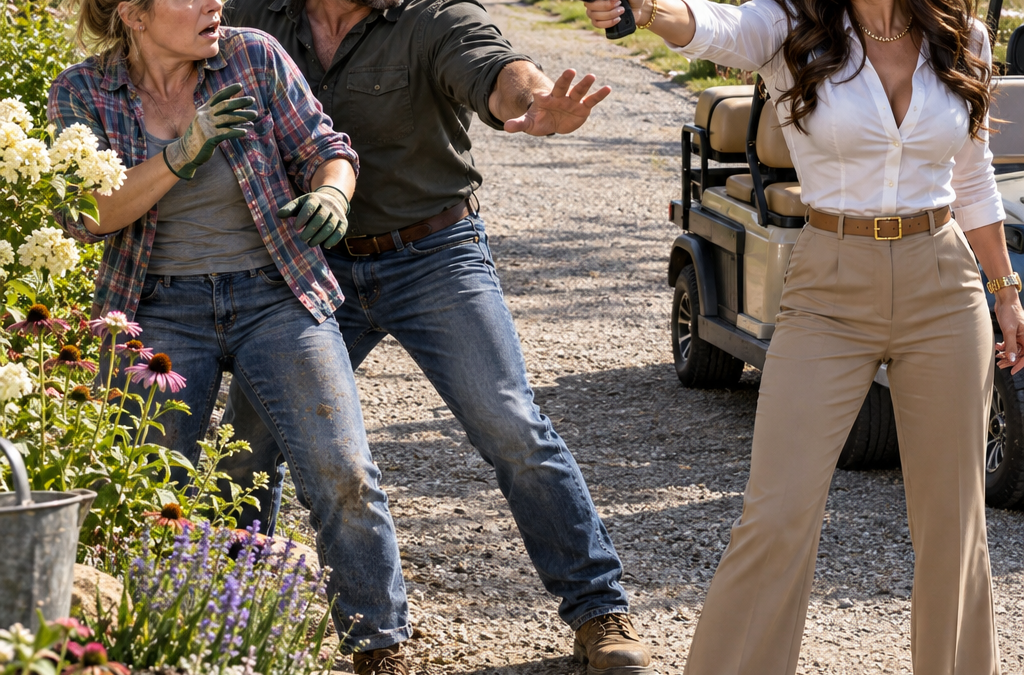
𝗙𝗨𝗟𝗟 𝗦𝗧𝗢𝗥𝗬
Our shed did not need her architectural committee’s approval.
Our gravel did not need to match the subdivision’s driveways.
Our gate existed on our land.
Our grass could be as wild or as trimmed as we wanted it to be, so long as we followed county rules.
But Karen talked like our independence was an error waiting to be corrected.
At first, my wife handled most of the interactions because she worked from home. She was always more patient than I was, and she believed firmly in staying calm as long as possible.
She would stand on the porch and repeat the same sentence.
“We are not part of your HOA.”
Karen would nod, pretend to absorb it, and then return with another complaint days later.
Then the violation notices started.
The first one came in the mail.
“Excessive grass height.”
Fine: $150.
Deadline for compliance: seven days.
I laughed when I read it.
Then I threw it in the trash.
My wife pulled it out.
“Keep it.”
“Why?”
“Because people like her don’t stop at one.”
She was right.
The next notice was for our shed.
“Unapproved accessory structure.”
Fine: $300.
Then our fence.
Then a vehicle parked in the driveway.
Then “non-compliant landscaping.”
Each notice looked official. Each one referenced HOA guidelines we had never agreed to follow. Each one came with an amount due and a warning about escalation.
After the tenth notice, I stopped laughing.
I bought a folder.
Then another.
We started documenting everything.
Dates.
Times.
Letters.
Photos.
Security camera clips from the basic doorbell camera we had installed.
I sent Karen a certified letter explaining, again, that our property was not part of the HOA, that we had no obligation to pay fines, and that any further harassment would result in legal action.
She showed up the next day.
Red-faced.
No fake smile this time.
I opened the door, and she pushed her sunglasses up into her hair.
“How dare you send that letter.”
“How dare you send fake fines.”
“They are not fake.”
“They have no legal basis.”
Karen stepped closer.
She smelled like vanilla and expensive flowers.
“You are bringing down the standards of this entire area.”
“Our home is clean. Our land is maintained. We mind our business.”
“You refuse to cooperate.”
“Because we don’t answer to you.”
Her eyes flashed.
“Everyone answers to community standards.”
“No, Karen. Members answer to HOA rules. We’re not members.”
“You think you’re special?”
“I think I can read a deed.”
She laughed, but her voice was tight.
“Your attitude is exactly why people are concerned.”
“What people?”
“The neighborhood.”
“You mean you.”
Her lips parted.
For a second, I thought she might slap me.
Instead, she leaned in.
“You will regret making this difficult.”
My patience snapped.
“Get off my property.”
Her eyes narrowed.
“You don’t speak to me that way.”
“I just did.”
I closed the door.
My wife stood at the kitchen entrance, pale and silent.
“She’s getting worse,” she said.
“I know.”
That was the day we contacted a real estate attorney.
He reviewed our deed, the subdivision covenants, the parcel history, and the violation notices Karen had been sending.
His conclusion was exactly what we already knew.
We owed the HOA nothing.
The association had no authority over our land.
Any attempt to place a lien on our property would be fraudulent.
He sent Karen and the HOA board a cease-and-desist letter.
For a while, it worked.
Three quiet months passed.
No notices.
No visits.
No golf cart parked at the edge of the drive.
My wife started relaxing again. She spent more time in the front garden. I stopped checking the mailbox with that tight feeling in my stomach. We began to believe that Karen had finally been forced back behind the boundary line where she belonged.
But people like Karen do not always stop when they lose.
Sometimes they simply change tactics.
A friendly neighbor from the subdivision, a man named Carl, stopped by one evening while I was fixing a loose hinge on the gate.
He looked uncomfortable before he even opened his mouth.
“Just thought you should know,” he said, lowering his voice, “Karen’s been talking about you two.”
I wiped grease from my fingers.
“What kind of talking?”
“She’s telling people you’re refusing to follow basic community standards. Says you’re deliberately hurting property values. Says your land is becoming an eyesore.”
I looked back at our property.
Freshly mowed near the house.
Garden beds lined with stone.
Driveway maintained.
Fence repaired.
“An eyesore.”
Carl shrugged.
“Most people don’t care. Honestly, a lot of folks are tired of her. But a few believe whatever she says.”
My wife came outside and heard the rest.
Karen had apparently started calling us “the holdouts.”
She told people our property should always have been included in the subdivision and that we were exploiting a loophole.
A loophole.
As if owning separate land was a trick.
Soon after that, we began catching her near the property line.
At first, she stayed on the subdivision side.
She would stand there in sunglasses with her clipboard, writing things down, occasionally raising her phone to take photos.
Then she started stretching up on her toes to see over our fence.
Then she started walking along the boundary for long stretches.
One afternoon, my wife caught her stepping onto our land to get a better angle on our shed.
My wife opened the front door and shouted, “Karen!”
Karen froze.
“What are you doing?”
Karen straightened like she’d been caught doing nothing more serious than admiring flowers.
“Documenting violations.”
“You’re trespassing.”
“I am performing an inspection.”
“You have no right to inspect anything here.”
Karen smiled.
“Your tone is becoming hostile.”
“Leave, or I’m calling the sheriff.”
That made Karen’s expression curdle.
“You will regret refusing cooperation.”
“You keep saying that.”
“And you keep failing to listen.”
Karen left, but not before taking one more photo.
That night, we installed more cameras.
Not just a doorbell camera.
Real cameras.
Angles on the driveway, the front yard, the side fence, the gate, the garage, and the garden.
At the time, I thought we were being overly cautious.
Later, those cameras would become the reason I stayed free.
The legal attack came six months later.
We were served on a Wednesday morning.
Karen had convinced the HOA board to file a lawsuit claiming our property was historically part of the community and that we were obligated to join, pay back dues, and settle all outstanding fines.
Total claimed amount: over twelve thousand dollars.
My wife sat at the kitchen table with the papers spread in front of her.
Her hands were shaking.
“They’re actually suing us.”
I tried to sound calm.
“They’re going to lose.”
“What if they don’t?”
“They will.”
But I understood her fear.
Court is frightening even when you’re right. Especially when you’re right. Because being right doesn’t stop the bills, the stress, the time, the sleepless nights, or the horrible thought that some technicality you didn’t know about could ruin your life.
Our attorney handled it.
Karen arrived at court dressed like she was attending a country club luncheon—cream blazer, tight skirt, shining heels, red lipstick, and that same expression of offended authority.
She barely looked at us.
The judge reviewed the documents.
It took less than fifteen minutes for the entire thing to collapse.
Our deed had no connection to the subdivision covenants.
There was no legal mechanism forcing us into the HOA.
The fines had no basis.
The lawsuit was dismissed.
The judge also warned the HOA about filing frivolous claims and wasting court resources.
We were awarded legal fees.
My wife cried in the parking lot afterward.
Not dramatically.
Quietly.
Like her body had been holding tension for months and finally let some of it go.
Karen walked past us on her way to her vehicle.
For one moment, she stopped.
Her face was controlled, but her eyes were blazing.
“This isn’t over,” she said.
Our attorney stepped between us.
“It absolutely should be.”
Karen smiled at him.
That smile was almost pretty.
Almost.
Then she looked at my wife.
“You two enjoy this little victory while it lasts.”
If the court loss had humbled her, maybe everything would have ended there.
Instead, it humiliated her.
And Karen did not handle humiliation well.
The stalking began after that.
The cameras caught her golf cart slowing near our property late at night.
Sometimes she stopped at the end of our driveway and sat there.
Once, she remained for twelve minutes.
Twelve minutes of a woman in a golf cart staring toward our dark house after midnight.
She started appearing when my wife was outside.
Not close enough to be arrested immediately.
Not threatening enough to trigger a dramatic police response.
Just there.
Watching.
My wife stopped gardening alone.
She started texting me whenever Karen appeared.
There she is again.
By the fence.
Taking pictures.
I would call, and Karen would usually leave before I got home.
We filed a harassment complaint with the sheriff’s department.
A deputy came out, took our statement, reviewed clips from the cameras, and agreed Karen’s behavior was concerning.
But without explicit threats or a crime he could act on immediately, his options were limited.
He said he would speak with her.
He also told us to keep documenting everything.
The deputy’s visit made Karen worse.
Maybe being warned embarrassed her.
Maybe she had believed her title made her untouchable.
Maybe she was simply too far gone in her obsession with controlling our property to stop.
The next week, our mailbox was knocked over.
A few days later, someone dumped trash near our gate.
Then our gate was left open one evening, and our dog, Daisy, got out.
I still remember my wife’s scream when she realized Daisy was gone.
We searched for nearly two hours.
A neighbor found her wandering along a side road and brought her back unharmed, but that was the night something in my wife changed.
She sat on the floor with Daisy in her lap, shaking.
“She’s going to keep pushing until something terrible happens.”
I had no proof Karen opened the gate.
None.
But we both knew.
We upgraded the cameras again.
Night vision.
Motion-activated floodlights.
Longer storage.
I started coming home earlier from work whenever I could. I checked the gate every evening. I carried my phone everywhere. I kept my firearm on me more often at home than I ever had before.
That is not something I say proudly.
I had grown up around firearms. I had taken training courses. I understood the law in my state regarding self-defense and defense of another person. I also understood that carrying a weapon is not a personality, not a shortcut to courage, and not a way to win an argument.
It is responsibility.
A heavy one.
I hoped I would never need it.
Then came the Saturday.
It was a clear afternoon, warm but not miserable. I was in the garage working on a shelving project I had been putting off for weeks. My wife was in the front yard near the flower beds, wearing gardening gloves and a wide-brimmed hat.
We had left the gate open because we were outside and moving between the yard and driveway.
It was such a small decision.
I have replayed it hundreds of times.
If the gate had been closed, maybe Karen would not have walked in.
If I had been standing beside my wife instead of in the garage, maybe things would have unfolded differently.
If we had moved after the lawsuit, if we had filed more complaints, if we had done a dozen things differently, maybe that afternoon would not exist in my memory the way it does.
I heard shouting.
At first, I thought my wife had called for me.
Then I heard her yell, “Get off our property!”
Every nerve in my body went cold.
I dropped the tool in my hand and ran.
Karen was standing in our driveway about twenty feet from my wife.
She looked nothing like the polished HOA queen from meetings and court. Her hair was loose and slightly messy. Her face was flushed. She wore a fitted sleeveless top and white pants, but there was dirt on one knee, like she had stumbled or pushed through somewhere she shouldn’t have been.
In her hand was a taser.
Not a tiny stun gun.
A real taser.
The kind with prongs.
The kind meant to stop someone from a distance.
She was pointing it at my wife.
My wife had her phone in one hand.
Her other hand was raised slightly, palm out.
“Karen, leave now,” she said, voice shaking. “I’m calling 911.”
Karen screamed back, “You think you’re better than us? You think you can embarrass me and walk away?”
I ran faster.
“Karen!”
She snapped her head toward me.
Her eyes were wild.
Not angry in the ordinary sense.
Untethered.
“You did this!” she shouted. “You and your smug little wife. You ruined everything.”
“Put it down.”
I had already drawn my firearm.
I don’t remember deciding to do it.
Training took over before thought did.
I remember my voice sounding strange to my own ears.
Loud.
Flat.
“Drop the taser, Karen.”
My wife froze.
Karen turned slightly toward me, but the taser remained raised.
“You don’t get to command me on land that should have belonged to the community.”
“This is our land.”
“You stole it from us.”
“No one stole anything.”
“You think court means truth?”
“Drop it.”
Her finger moved.
I saw it tighten.
Maybe people who have never been there imagine that moments like that stretch long enough for strategy.
They do not.
There was no time for a speech.
No time to reason with her.
No time to debate whether a taser can incapacitate someone, whether my wife could fall and hit her head, whether Karen would fire and then keep attacking.
Karen had spent three years escalating.
She had ignored us.
Ignored our attorney.
Ignored a judge.
Ignored the sheriff.
Now she was on my driveway, pointing a weapon at my wife.
I yelled one more time.
“Drop it!”
Karen swung more fully toward me, taser still raised.
I fired once.
The sound split the afternoon.
Karen dropped.
The taser hit the driveway and skidded.
For a moment, there was no sound except my wife’s gasp and the ringing in my ears.
Then Karen started screaming.
She clutched her shoulder, writhing on the gravel, cursing at us, crying, yelling that we had ruined her life.
I kept my weapon trained on her.
Not because I wanted to.
Because the taser was still close to her.
Because the threat had not fully ended until it was secured.
“Call 911!” I shouted.
My wife was already doing it.
Her voice shook so badly she could barely speak to the dispatcher.
“Please send help. She came onto our property. She had a taser. My husband fired. She’s hurt. Please hurry.”
Karen screamed, “I’m going to sue you! I’m going to take everything you have!”
I did not answer.
My entire world narrowed to three things.
Karen.
The taser.
My wife.
Those minutes before the deputies arrived felt endless.
The wound was in Karen’s shoulder. She was bleeding heavily, but she was conscious and loud. She alternated between sobbing and threatening us.
“You shot me,” she kept saying, as if she could not believe consequences had reached her body.
“You shot me.”
My wife stood behind me, still on the phone, crying silently now.
Sirens approached.
The moment the first patrol vehicle came up the driveway, I lowered my firearm, placed it on the ground, stepped away, and raised my hands.
“I’m the homeowner,” I called out. “I fired. My weapon is on the ground.”
The deputy moved quickly but calmly.
Another deputy secured my firearm.
Paramedics arrived right behind them.
They treated Karen while she tried to tell everyone we had attacked her.
“I was invited here,” she sobbed. “I was trying to talk to them. He just shot me.”
One deputy looked toward the taser lying on the driveway.
My wife pointed at it with a shaking hand.
“That’s hers. She aimed it at me.”
The deputy photographed it, then secured it as evidence.
Karen’s face changed when she saw that.
Not pain.
Fear.
For the first time, she seemed to understand this might not become her story just because she shouted it first.
Detectives arrived later.
Our driveway became a crime scene.
Yellow markers appeared.
Photos were taken.
Statements were requested.
My wife was wrapped in a blanket even though it wasn’t cold.
I sat in a chair near the garage while a detective asked me to explain everything from the beginning.
Not just the shooting.
Everything.
The first welcome packet.
The violation notices.
The fake fines.
The certified letter.
The lawsuit.
The dismissal.
The stalking.
The vandalism.
The gate.
The harassment complaint.
The deputy warning.
The taser.
My voice sounded detached as I spoke, like someone else was describing my life.
Then we showed them the camera footage.
That footage saved me.
It showed Karen entering our open gate.
It showed her approaching my wife aggressively.
It showed my wife backing away and holding up her phone.
It showed Karen raising the taser.
It showed me running from the garage.
It captured my voice yelling for her to drop it.
It showed Karen turning with the taser still raised.
It showed the shot.
No dramatic angle.
No interpretation needed.
Just reality.
Plain and brutal.
Karen was transported to the hospital under guard.
Her wound was serious but not life-threatening. The bullet had passed through her shoulder and caused muscle damage that required surgery.
I was not arrested that day.
But that did not mean I was free from fear.
The shooting had to be reviewed.
For three weeks, I lived inside uncertainty.
Three weeks of waking at three in the morning with my heart pounding.
Three weeks of replaying the moment when her finger moved.
Three weeks of wondering whether a prosecutor might look at the same footage and decide I had acted too quickly.
My attorney stayed in contact with investigators.
Everyone told me the footage was strong.
Everyone told me to breathe.
But nobody could promise me anything until the decision came.
I could not focus at work.
My wife barely left the house.
She stopped going into the front yard entirely.
Daisy followed her from room to room like she sensed something had broken.
At night, my wife would sometimes sit straight up in bed, gasping.
“She’s at the driveway,” she would whisper.
But Karen was in a hospital bed, then under police custody.
It didn’t matter.
Fear does not care where danger is.
It only remembers where danger stood.
When my attorney finally called, I was in the kitchen.
I remember the sunlight on the counter.
The half-full coffee mug near the sink.
The way my hand tightened around the phone when I saw his name.
“The shooting has been ruled justified,” he said.
I sat down on the floor.
Just dropped right there in the middle of the kitchen.
He kept talking, explaining the decision, the footage, the defense of another person, the taser, Karen’s history of harassment.
I heard pieces.
Not all of it.
My wife came in and saw my face.
“What happened?”
I covered the phone and said, “No charges.”
She started crying before I finished the sentence.
So did I.
Not happy tears.
Not exactly.
Relief can feel violent when you’ve been holding your breath for weeks.
Karen was arrested after she was medically cleared.
The charges included trespassing, criminal harassment, assault with a dangerous weapon, and menacing.
Her criminal trial came months later.
By then, she had an attorney who tried very hard to turn her into the victim.
According to her defense, Karen was a concerned community leader who had experienced tremendous stress after being unfairly attacked by hostile outsiders. She had gone to our property to discuss neighborhood matters. She had carried the taser only because she felt unsafe due to our supposed aggression.
Her attorney described me as a gun-happy homeowner.
He called the situation a tragic misunderstanding.
He suggested Karen had never intended to use the taser.
Then the prosecutor played the videos.
There are sounds you never want to hear again but can never forget.
Karen screaming at my wife.
My wife telling her to leave.
My own voice ordering Karen to drop the taser.
The shot.
My wife’s cry afterward.
The courtroom was silent.
Karen sat at the defense table, no longer glamorous, no longer in control. Her hair was shorter after surgery and months of stress. She wore a conservative navy dress and minimal makeup. She looked smaller than I remembered.
But when the video played, I did not feel sorry for her.
I looked at my wife.
She was holding my hand so tightly her knuckles had gone white.
The prosecutor then introduced the history.
The violation notices.
The threatening letters.
The dismissed lawsuit.
The judge’s warning.
The security footage of Karen stalking the property line.
The camera clips of her golf cart outside our driveway at night.
The harassment complaint.
The deputy’s warning.
The photos of the vandalism.
Not all of it could be directly pinned on Karen, but together it painted the picture clearly.
This was not a misunderstanding.
This was escalation.
Karen’s attorney tried to argue mental health.
Stress.
Humiliation.
A momentary break.
But several residents testified about her controlling behavior. A former HOA board member admitted people had complained about Karen abusing her authority long before she became obsessed with our property.
One neighbor said, “Karen didn’t want rules followed. She wanted people afraid to cross her.”
That sentence stayed with me.
The jury deliberated for less than four hours.
Guilty on all charges.
At sentencing, Karen’s attorney asked for leniency. He spoke about the shoulder injury, the permanent limitation she might face, the public humiliation, the fact that she had already lost her position and reputation.
The judge listened.
Then he looked at Karen.
“You created this situation,” he said. “You were told no by homeowners, by an attorney, by a court, and by law enforcement. You ignored every boundary until you entered private property armed with a weapon and threatened a woman in her own yard. The fact that you were injured during the commission of that act does not make you the victim.”
Karen cried then.
Maybe from fear.
Maybe from anger.
Maybe because, for once, tears could not get her control of the room.
She was sentenced to four years in state prison, substantial fines, and a permanent no-contact order involving us and our property.
The HOA was shaken apart after that.
Several board members resigned.
Residents demanded records.
It came out that not everyone had supported the lawsuit against us, but Karen had bullied and charmed enough people into believing she could win.
The association’s insurance became involved.
There was a civil settlement later.
The terms are confidential, but it covered our legal costs, property damage, security upgrades, therapy expenses, and more.
Money helped.
It did not fix everything.
My wife still goes to therapy.
For months, she could not garden alone.
She flinched at golf carts, which sounds almost absurd unless you’ve lived it.
She had nightmares where Karen was standing at the edge of the flower bed with that taser raised.
Sometimes she woke up crying and apologizing, though she had nothing to apologize for.
I started therapy too.
Because even justified force leaves a mark.
People online love to talk about what they would do.
They imagine clean lines.
Bad person threatens innocent person, hero acts, credits roll.
Real life is messier.
I know I protected my wife.
I know the law agreed with me.
I know the footage showed I had only seconds to act.
I know Karen chose to walk onto our property armed.
I know all of that.
And still, sometimes, I hear the shot again.
I feel the recoil.
I see Karen fall.
I remember the blood spreading through her white top.
I remember how human she sounded when she screamed.
That is the part people don’t understand unless they’ve been there.
Being right does not make it easy.
Being justified does not make it disappear.
My wife once asked me if I regretted it.
We were sitting on the back porch months after sentencing. Daisy was asleep near her feet. The garden was growing again, though my wife had moved most of her work to the backyard where she felt safer.
I looked out at the trees for a long time before answering.
“I regret that it happened.”
She nodded.
“But do you regret stopping her?”
I looked at her then.
“No.”
Her eyes filled with tears.
“Good.”
We considered moving.
Several times.
After the trial, real estate listings became a strange kind of escape for us. We would look at houses farther away, properties with longer drives, more trees, bigger gates, fewer neighbors.
But every time we imagined packing up, something inside both of us resisted.
This was our home.
Karen had wanted to take that from us long before the taser.
Not by buying it.
Not by proving any legal right.
But by making life so stressful that leaving felt easier than staying.
If we moved, some part of her would still win.
So we stayed.
We repaired the mailbox.
Reinforced the gate.
Kept the cameras.
Planted new flowers in the bed where my wife had been kneeling that day.
That was her idea.
I worried it would be too hard.
She said, “That’s exactly why I need to do it.”
The first time she went back to the front garden alone, I watched from the garage.
She knew I was watching.
After a few minutes, she looked over her shoulder and smiled softly.
“Go inside,” she said. “I’m okay.”
I did not go inside.
But I stepped farther back.
That was progress.
The subdivision changed too.
Without Karen, people seemed relieved. The new HOA president came by once, by appointment, and apologized in person.
He stood at the gate.
He did not come in until invited.
I appreciated that.
He told us the HOA would never again claim authority over our land and that their documents were being updated to make boundaries unmistakably clear.
“We should have stopped her earlier,” he said.
I didn’t disagree.
He looked ashamed.
“Some of us thought it was just Karen being Karen.”
That phrase made my wife stiffen.
I said, “That kind of thinking lets people like her become dangerous.”
He nodded.
“You’re right.”
I hope he meant it.
I still see the subdivision lights at night from certain parts of our property.
For a long time, they made me angry.
Now they mostly remind me how close madness can live to ordinary life.
A neat row of houses.
Trimmed lawns.
Mailboxes in matching colors.
And one woman driving a golf cart with a clipboard, convincing herself that leadership meant ownership.
Karen was not a monster from nowhere.
She was a neighbor.
A president.
A woman people voted for because she seemed organized, confident, attractive, and capable.
Her danger was not obvious at first.
It grew in increments.
A welcome packet we did not ask for.
A comment about standards.
A fine she could not enforce.
A photo at the fence.
A lawsuit she could not win.
A golf cart at midnight.
A gate left open.
A taser in her hand.
That is how escalation works.
It teaches you to tolerate the last step so the next one feels only slightly worse.
My wife and I talk about that often now.
Boundaries are not rude.
Documentation is not paranoia.
Asking someone to leave your property is not overreacting.
Calling an attorney is not being dramatic.
Calling law enforcement before something becomes catastrophic is not weakness.
We did many things right.
We kept records.
We hired counsel.
We installed cameras.
We filed a complaint.
We did not engage in revenge.
We did not trespass on her land.
We did not threaten her.
Still, we sometimes wonder what else we could have done.
More complaints.
More pressure.
A restraining order sooner.
Local media.
County officials.
Maybe something would have stopped her earlier.
Maybe nothing would have.
That uncertainty is one of the hardest parts to live with.
Karen is about a year into her sentence now.
The no-contact order remains.
Her house in the subdivision was sold.
I heard from Carl that some residents still argue about what happened. A few insist Karen was pushed too far. A few say we should have joined the HOA just to keep peace.
I don’t waste energy on those people.
Peace bought through surrender to a bully is not peace.
It is only a delay.
Most neighbors, though, leave us alone in the best possible way.
They wave.
We wave back.
Sometimes Carl brings over extra tomatoes.
My wife trades flowers with another woman from the subdivision who apparently never liked Karen but had been afraid to say so.
Life has slowly become life again.
Not the same as before.
But ours.
I still work in the garage on Saturdays.
The gate is usually closed now.
Daisy is older and lazier, content to sleep in patches of sun.
My wife gardens in the front yard again, though she keeps her phone nearby and sometimes glances toward the driveway when gravel shifts under a tire.
Healing is not a straight line.
Some days, the property feels peaceful again.
Other days, one unexpected sound can pull us both backward.
But the land is still beautiful.
In spring, the wildflowers come up near the fence Karen once inspected like a crime scene.
In summer, the trees fill out enough that the subdivision almost disappears.
In fall, the driveway fills with leaves.
In winter, the whole place goes quiet in a way that reminds me why we bought it.
Karen tried to make these five acres part of her kingdom.
She failed.
The deed never changed.
The boundary lines never moved.
Her bylaws never crossed onto our land.
Her fines became evidence.
Her lawsuit became humiliation.
Her weapon became the proof that finally ended her control over anyone.
I wish the ending had been different.
I wish she had accepted no at the door three years earlier.
I wish the HOA board had stopped her before court.
I wish the sheriff’s warning had been enough.
I wish my wife had never seen that taser pointed at her.
I wish I had never had to fire.
But wishing cannot rewrite what happened.
All we can do is live honestly with the aftermath.
Sometimes, in the evening, my wife and I sit on the porch and watch the sun drop behind the trees. We don’t talk much during those moments. We don’t need to.
The silence means something different now.
Before, it was simply what we wanted.
Now, it is something we defended.
Not perfectly.
Not painlessly.
But fully.
Karen once told us we would regret refusing cooperation.
She was wrong.
What I regret is how far she forced things to go.
What I regret is the fear she put in my wife.
What I regret is that a woman with beauty, charm, money, and influence chose control over decency until control consumed her.
But I do not regret saying no.
I do not regret keeping records.
I do not regret protecting my wife.
And I do not regret staying.
Because every morning when I open the door and step onto land that still belongs only to us, I am reminded of the truth Karen hated most.
She was never the queen here.
She was only a trespasser with a clipboard.
And in the end, our home outlasted her.
𝗧𝗛𝗘 𝗘𝗡𝗗
The HOA Queen Walked Onto My Land With a Taser and Pointed It at My Wife
For three years, Karen tried to make my five acres part of her little kingdom.
She sent fines we did not owe, filed a lawsuit she could not win, stalked our fence line with a clipboard, and told the neighborhood we were ruining their property values.
Then one Saturday afternoon, she walked up my driveway, aimed a taser at my wife, and forced me to make a decision that still wakes me up at night.
My wife and I bought that property because we wanted breathing room.
Not luxury. Not status. Not some picture-perfect suburban life where every blade of grass had to be the same height and every mailbox had to match. We wanted land. We wanted quiet. We wanted a home where we could open the back door and hear birds instead of leaf blowers, where my wife could garden without someone peering over a fence, where I could work in the garage on weekends and leave tools out for an afternoon without getting a warning letter from a board of strangers.
The place was five acres on the edge of a semi-rural community that had been changing slowly over the last decade.
On one side, there were older properties, farmland, and a few houses that had clearly been built by people who valued distance more than symmetry. On the other side, right up against part of our land, sat a newer subdivision of around forty homes.
That subdivision had an HOA.
Our property did not.
I knew that before we bought it. My wife knew that. Our real estate agent knew that. Our attorney knew that. The elderly farmer who sold us the land knew that because his family had owned the larger parcel long before the subdivision existed.
Our deed was separate.
Our property was not included in the subdivision covenants.
We paid no dues.
We signed no HOA documents.
We had no legal connection to that neighborhood except proximity.
At first, I thought that would be obvious to everyone.
I was wrong.
The first time Karen came to our door, we had been moved in for about a week.
My wife was still unpacking dishes in the kitchen, and I was in the living room trying to assemble a bookshelf that had apparently been designed by someone who hated humanity. The doorbell rang, and when I opened the door, there she stood.
Karen.
She was around forty, maybe a little older, but she carried herself like she expected people to notice her before she ever said a word. She was beautiful in a sharp, expensive way—long brunette hair styled in loose waves, full lips painted a glossy red, designer sunglasses pushed on top of her head, a fitted white blouse tucked into high-waisted khaki pants, and gold jewelry that caught the sunlight whenever she moved.
She smiled like she had practiced it in mirrors.
Warm enough to seem friendly.
Perfect enough to feel fake.
In one hand, she held a thick packet of papers. In the other, a clipboard.
“Hi there,” she said, her voice sweet and smooth. “You must be the new owners.”
I wiped my hand on my jeans and nodded.
“That’s us.”
“I’m Karen Whitmore. HOA president.”
She said the title like it should answer every question I might have.
Behind her, on the road, I could see a white golf cart parked near our driveway, even though she could have walked from the subdivision in under five minutes.
“I just wanted to welcome you properly and help you get squared away with the community.”
She held out the packet.
I looked at it.
“What’s this?”
“Welcome materials. Bylaws, community standards, dues schedule, architectural guidelines, landscaping requirements, all that fun stuff.”
I didn’t take it.
Instead, I glanced back at my wife, who had stepped into the hallway with a dish towel in her hand.
Then I looked at Karen again.
“I think there’s been a misunderstanding. We’re not part of the HOA.”
Karen laughed.
Not a real laugh.
A soft, polished little sound, as if I had said something charmingly naïve.
“Oh, honey, everyone in this area falls under the association.”
That word—honey—landed wrong.
My wife’s expression changed slightly behind me.
I kept my voice polite.
“No, our deed is separate. We bought directly from the original farm parcel. We’re outside the subdivision.”
Karen’s smile thinned.
“Well, technically, the subdivision surrounds part of your land.”
“It borders part of our land.”
“Exactly.”
“No. Not exactly.”
For the first time, a flicker of irritation crossed her face.
Then she softened again.
“I understand this can be confusing for new homeowners. That’s why I’m here.”
She pushed the packet toward me.
“This will explain everything.”
I took it only because refusing felt like it would make the conversation longer.
“We’ll look it over, but we’re not joining anything.”
Her eyebrows lifted.
“Joining?”
“Yes.”
“You make it sound optional.”
“It is optional. For us.”
Karen stared at me for a moment.
Then she tilted her head and smiled again.
“Let’s not start off on the wrong foot.”
I should have recognized the warning in that sentence.
PART 2
Karen left the packet on our porch even after I told her we weren’t interested.
My wife picked it up after she drove away in her golf cart.
“She did not like hearing no,” she said.
“No, she did not.”
“Do you think this is going to be a problem?”
I looked out toward the subdivision.
At the time, I still thought normal people eventually accepted reality when presented with paperwork.
So I said, “Probably not.”
That may have been the stupidest sentence I ever spoke.
For a few weeks, Karen did nothing dramatic.
She waved when she passed in her golf cart. She smiled too brightly if she saw us near the fence. Once, she stopped by while I was at work and told my wife she wanted to “answer any lingering questions about membership.”
My wife patiently explained again that we were not joining the HOA.
Karen nodded as if she understood.
Two weeks later, she came back with a new argument.
This time, she said joining would be good for property values.
My wife told her our property value was doing just fine.
Karen smiled through that.
Two weeks after that, she appeared again, saying our fence style was “inconsistent with neighborhood cohesion.”
My wife asked what neighborhood.
Karen pointed vaguely toward the subdivision.
“Our community.”
“My house is not in your community.”
Karen’s smile tightened.
“Legally, perhaps not yet.”
Not yet.
That phrase bothered my wife enough that she called me immediately after Karen left.
“She said legally not yet.”
“What does that even mean?”
“I don’t know. But I don’t like it.”
Neither did I.
Karen’s visits became more frequent.
Always with the clipboard.
Always in fitted clothes that looked too clean for rural roads and grass.
Always with perfume lingering behind her after she left.
She would point out our shed, our driveway gravel, the color of our gate, the height of the grass along the fence line.
None of it mattered.
Our shed did not need her architectural committee’s approval.
Our gravel did not need to match the subdivision’s driveways.
Our gate existed on our land.
Our grass could be as wild or as trimmed as we wanted it to be, so long as we followed county rules.
But Karen talked like our independence was an error waiting to be corrected.
At first, my wife handled most of the interactions because she worked from home. She was always more patient than I was, and she believed firmly in staying calm as long as possible.
She would stand on the porch and repeat the same sentence.
“We are not part of your HOA.”
Karen would nod, pretend to absorb it, and then return with another complaint days later.
Then the violation notices started.
The first one came in the mail.
“Excessive grass height.”
Fine: $150.
Deadline for compliance: seven days.
I laughed when I read it.
Then I threw it in the trash.
My wife pulled it out.
“Keep it.”
“Why?”
“Because people like her don’t stop at one.”
She was right.
The next notice was for our shed.
“Unapproved accessory structure.”
Fine: $300.
Then our fence.
Then a vehicle parked in the driveway.
Then “non-compliant landscaping.”
Each notice looked official. Each one referenced HOA guidelines we had never agreed to follow. Each one came with an amount due and a warning about escalation.
After the tenth notice, I stopped laughing.
I bought a folder.
Then another.
We started documenting everything.
Dates.
Times.
Letters.
Photos.
Security camera clips from the basic doorbell camera we had installed.
I sent Karen a certified letter explaining, again, that our property was not part of the HOA, that we had no obligation to pay fines, and that any further harassment would result in legal action.
She showed up the next day.
Red-faced.
No fake smile this time.
I opened the door, and she pushed her sunglasses up into her hair.
“How dare you send that letter.”
“How dare you send fake fines.”
“They are not fake.”
“They have no legal basis.”
Karen stepped closer.
She smelled like vanilla and expensive flowers.
“You are bringing down the standards of this entire area.”
“Our home is clean. Our land is maintained. We mind our business.”
“You refuse to cooperate.”
“Because we don’t answer to you.”
Her eyes flashed.
“Everyone answers to community standards.”
“No, Karen. Members answer to HOA rules. We’re not members.”
“You think you’re special?”
“I think I can read a deed.”
She laughed, but her voice was tight.
“Your attitude is exactly why people are concerned.”
“What people?”
“The neighborhood.”
“You mean you.”
Her lips parted.
For a second, I thought she might slap me.
Instead, she leaned in.
“You will regret making this difficult.”
My patience snapped.
“Get off my property.”
Her eyes narrowed.
“You don’t speak to me that way.”
“I just did.”
I closed the door.
My wife stood at the kitchen entrance, pale and silent.
“She’s getting worse,” she said.
“I know.”
That was the day we contacted a real estate attorney.
He reviewed our deed, the subdivision covenants, the parcel history, and the violation notices Karen had been sending.
His conclusion was exactly what we already knew.
We owed the HOA nothing.
The association had no authority over our land.
Any attempt to place a lien on our property would be fraudulent.
He sent Karen and the HOA board a cease-and-desist letter.
For a while, it worked.
Three quiet months passed.
No notices.
No visits.
No golf cart parked at the edge of the drive.
My wife started relaxing again. She spent more time in the front garden. I stopped checking the mailbox with that tight feeling in my stomach. We began to believe that Karen had finally been forced back behind the boundary line where she belonged.
But people like Karen do not always stop when they lose.
Sometimes they simply change tactics.
A friendly neighbor from the subdivision, a man named Carl, stopped by one evening while I was fixing a loose hinge on the gate.
He looked uncomfortable before he even opened his mouth.
“Just thought you should know,” he said, lowering his voice, “Karen’s been talking about you two.”
I wiped grease from my fingers.
“What kind of talking?”
“She’s telling people you’re refusing to follow basic community standards. Says you’re deliberately hurting property values. Says your land is becoming an eyesore.”
I looked back at our property.
Freshly mowed near the house.
Garden beds lined with stone.
Driveway maintained.
Fence repaired.
“An eyesore.”
Carl shrugged.
“Most people don’t care. Honestly, a lot of folks are tired of her. But a few believe whatever she says.”
My wife came outside and heard the rest.
Karen had apparently started calling us “the holdouts.”
She told people our property should always have been included in the subdivision and that we were exploiting a loophole.
A loophole.
As if owning separate land was a trick.
Soon after that, we began catching her near the property line.
At first, she stayed on the subdivision side.
She would stand there in sunglasses with her clipboard, writing things down, occasionally raising her phone to take photos.
Then she started stretching up on her toes to see over our fence.
Then she started walking along the boundary for long stretches.
One afternoon, my wife caught her stepping onto our land to get a better angle on our shed.
My wife opened the front door and shouted, “Karen!”
Karen froze.
“What are you doing?”
Karen straightened like she’d been caught doing nothing more serious than admiring flowers.
“Documenting violations.”
“You’re trespassing.”
“I am performing an inspection.”
“You have no right to inspect anything here.”
Karen smiled.
“Your tone is becoming hostile.”
“Leave, or I’m calling the sheriff.”
That made Karen’s expression curdle.
“You will regret refusing cooperation.”
“You keep saying that.”
“And you keep failing to listen.”
Karen left, but not before taking one more photo.
That night, we installed more cameras.
Not just a doorbell camera.
Real cameras.
Angles on the driveway, the front yard, the side fence, the gate, the garage, and the garden.
At the time, I thought we were being overly cautious.
Later, those cameras would become the reason I stayed free.
The legal attack came six months later.
We were served on a Wednesday morning.
Karen had convinced the HOA board to file a lawsuit claiming our property was historically part of the community and that we were obligated to join, pay back dues, and settle all outstanding fines.
Total claimed amount: over twelve thousand dollars.
My wife sat at the kitchen table with the papers spread in front of her.
Her hands were shaking.
“They’re actually suing us.”
I tried to sound calm.
“They’re going to lose.”
“What if they don’t?”
“They will.”
But I understood her fear.
Court is frightening even when you’re right. Especially when you’re right. Because being right doesn’t stop the bills, the stress, the time, the sleepless nights, or the horrible thought that some technicality you didn’t know about could ruin your life.
Our attorney handled it.
Karen arrived at court dressed like she was attending a country club luncheon—cream blazer, tight skirt, shining heels, red lipstick, and that same expression of offended authority.
She barely looked at us.
The judge reviewed the documents.
It took less than fifteen minutes for the entire thing to collapse.
Our deed had no connection to the subdivision covenants.
There was no legal mechanism forcing us into the HOA.
The fines had no basis.
The lawsuit was dismissed.
The judge also warned the HOA about filing frivolous claims and wasting court resources.
We were awarded legal fees.
My wife cried in the parking lot afterward.
Not dramatically.
Quietly.
Like her body had been holding tension for months and finally let some of it go.
Karen walked past us on her way to her vehicle.
For one moment, she stopped.
Her face was controlled, but her eyes were blazing.
“This isn’t over,” she said.
Our attorney stepped between us.
“It absolutely should be.”
Karen smiled at him.
That smile was almost pretty.
Almost.
Then she looked at my wife.
“You two enjoy this little victory while it lasts.”
If the court loss had humbled her, maybe everything would have ended there.
Instead, it humiliated her.
And Karen did not handle humiliation well.
The stalking began after that.
The cameras caught her golf cart slowing near our property late at night.
Sometimes she stopped at the end of our driveway and sat there.
Once, she remained for twelve minutes.
Twelve minutes of a woman in a golf cart staring toward our dark house after midnight.
She started appearing when my wife was outside.
Not close enough to be arrested immediately.
Not threatening enough to trigger a dramatic police response.
Just there.
Watching.
My wife stopped gardening alone.
She started texting me whenever Karen appeared.
There she is again.
By the fence.
Taking pictures.
I would call, and Karen would usually leave before I got home.
We filed a harassment complaint with the sheriff’s department.
A deputy came out, took our statement, reviewed clips from the cameras, and agreed Karen’s behavior was concerning.
But without explicit threats or a crime he could act on immediately, his options were limited.
He said he would speak with her.
He also told us to keep documenting everything.
The deputy’s visit made Karen worse.
Maybe being warned embarrassed her.
Maybe she had believed her title made her untouchable.
Maybe she was simply too far gone in her obsession with controlling our property to stop.
The next week, our mailbox was knocked over.
A few days later, someone dumped trash near our gate.
Then our gate was left open one evening, and our dog, Daisy, got out.
I still remember my wife’s scream when she realized Daisy was gone.
We searched for nearly two hours.
A neighbor found her wandering along a side road and brought her back unharmed, but that was the night something in my wife changed.
She sat on the floor with Daisy in her lap, shaking.
“She’s going to keep pushing until something terrible happens.”
I had no proof Karen opened the gate.
None.
But we both knew.
We upgraded the cameras again.
Night vision.
Motion-activated floodlights.
Longer storage.
I started coming home earlier from work whenever I could. I checked the gate every evening. I carried my phone everywhere. I kept my firearm on me more often at home than I ever had before.
That is not something I say proudly.
I had grown up around firearms. I had taken training courses. I understood the law in my state regarding self-defense and defense of another person. I also understood that carrying a weapon is not a personality, not a shortcut to courage, and not a way to win an argument.
It is responsibility.
A heavy one.
I hoped I would never need it.
Then came the Saturday.
It was a clear afternoon, warm but not miserable. I was in the garage working on a shelving project I had been putting off for weeks. My wife was in the front yard near the flower beds, wearing gardening gloves and a wide-brimmed hat.
We had left the gate open because we were outside and moving between the yard and driveway.
It was such a small decision.
I have replayed it hundreds of times.
If the gate had been closed, maybe Karen would not have walked in.
If I had been standing beside my wife instead of in the garage, maybe things would have unfolded differently.
If we had moved after the lawsuit, if we had filed more complaints, if we had done a dozen things differently, maybe that afternoon would not exist in my memory the way it does.
I heard shouting.
At first, I thought my wife had called for me.
Then I heard her yell, “Get off our property!”
Every nerve in my body went cold.
I dropped the tool in my hand and ran.
Karen was standing in our driveway about twenty feet from my wife.
She looked nothing like the polished HOA queen from meetings and court. Her hair was loose and slightly messy. Her face was flushed. She wore a fitted sleeveless top and white pants, but there was dirt on one knee, like she had stumbled or pushed through somewhere she shouldn’t have been.
In her hand was a taser.
Not a tiny stun gun.
A real taser.
The kind with prongs.
The kind meant to stop someone from a distance.
She was pointing it at my wife.
My wife had her phone in one hand.
Her other hand was raised slightly, palm out.
“Karen, leave now,” she said, voice shaking. “I’m calling 911.”
Karen screamed back, “You think you’re better than us? You think you can embarrass me and walk away?”
I ran faster.
“Karen!”
She snapped her head toward me.
Her eyes were wild.
Not angry in the ordinary sense.
Untethered.
“You did this!” she shouted. “You and your smug little wife. You ruined everything.”
“Put it down.”
I had already drawn my firearm.
I don’t remember deciding to do it.
Training took over before thought did.
I remember my voice sounding strange to my own ears.
Loud.
Flat.
“Drop the taser, Karen.”
My wife froze.
Karen turned slightly toward me, but the taser remained raised.
“You don’t get to command me on land that should have belonged to the community.”
“This is our land.”
“You stole it from us.”
“No one stole anything.”
“You think court means truth?”
“Drop it.”
Her finger moved.
I saw it tighten.
Maybe people who have never been there imagine that moments like that stretch long enough for strategy.
They do not.
There was no time for a speech.
No time to reason with her.
No time to debate whether a taser can incapacitate someone, whether my wife could fall and hit her head, whether Karen would fire and then keep attacking.
Karen had spent three years escalating.
She had ignored us.
Ignored our attorney.
Ignored a judge.
Ignored the sheriff.
Now she was on my driveway, pointing a weapon at my wife.
I yelled one more time.
“Drop it!”
Karen swung more fully toward me, taser still raised.
I fired once.
The sound split the afternoon.
Karen dropped.
The taser hit the driveway and skidded.
For a moment, there was no sound except my wife’s gasp and the ringing in my ears.
Then Karen started screaming.
She clutched her shoulder, writhing on the gravel, cursing at us, crying, yelling that we had ruined her life.
I kept my weapon trained on her.
Not because I wanted to.
Because the taser was still close to her.
Because the threat had not fully ended until it was secured.
“Call 911!” I shouted.
My wife was already doing it.
Her voice shook so badly she could barely speak to the dispatcher.
“Please send help. She came onto our property. She had a taser. My husband fired. She’s hurt. Please hurry.”
Karen screamed, “I’m going to sue you! I’m going to take everything you have!”
I did not answer.
My entire world narrowed to three things.
Karen.
The taser.
My wife.
Those minutes before the deputies arrived felt endless.
The wound was in Karen’s shoulder. She was bleeding heavily, but she was conscious and loud. She alternated between sobbing and threatening us.
“You shot me,” she kept saying, as if she could not believe consequences had reached her body.
“You shot me.”
My wife stood behind me, still on the phone, crying silently now.
Sirens approached.
The moment the first patrol vehicle came up the driveway, I lowered my firearm, placed it on the ground, stepped away, and raised my hands.
“I’m the homeowner,” I called out. “I fired. My weapon is on the ground.”
The deputy moved quickly but calmly.
Another deputy secured my firearm.
Paramedics arrived right behind them.
They treated Karen while she tried to tell everyone we had attacked her.
“I was invited here,” she sobbed. “I was trying to talk to them. He just shot me.”
One deputy looked toward the taser lying on the driveway.
My wife pointed at it with a shaking hand.
“That’s hers. She aimed it at me.”
The deputy photographed it, then secured it as evidence.
Karen’s face changed when she saw that.
Not pain.
Fear.
For the first time, she seemed to understand this might not become her story just because she shouted it first.
Detectives arrived later.
Our driveway became a crime scene.
Yellow markers appeared.
Photos were taken.
Statements were requested.
My wife was wrapped in a blanket even though it wasn’t cold.
I sat in a chair near the garage while a detective asked me to explain everything from the beginning.
Not just the shooting.
Everything.
The first welcome packet.
The violation notices.
The fake fines.
The certified letter.
The lawsuit.
The dismissal.
The stalking.
The vandalism.
The gate.
The harassment complaint.
The deputy warning.
The taser.
My voice sounded detached as I spoke, like someone else was describing my life.
Then we showed them the camera footage.
That footage saved me.
It showed Karen entering our open gate.
It showed her approaching my wife aggressively.
It showed my wife backing away and holding up her phone.
It showed Karen raising the taser.
It showed me running from the garage.
It captured my voice yelling for her to drop it.
It showed Karen turning with the taser still raised.
It showed the shot.
No dramatic angle.
No interpretation needed.
Just reality.
Plain and brutal.
Karen was transported to the hospital under guard.
Her wound was serious but not life-threatening. The bullet had passed through her shoulder and caused muscle damage that required surgery.
I was not arrested that day.
But that did not mean I was free from fear.
The shooting had to be reviewed.
For three weeks, I lived inside uncertainty.
Three weeks of waking at three in the morning with my heart pounding.
Three weeks of replaying the moment when her finger moved.
Three weeks of wondering whether a prosecutor might look at the same footage and decide I had acted too quickly.
My attorney stayed in contact with investigators.
Everyone told me the footage was strong.
Everyone told me to breathe.
But nobody could promise me anything until the decision came.
I could not focus at work.
My wife barely left the house.
She stopped going into the front yard entirely.
Daisy followed her from room to room like she sensed something had broken.
At night, my wife would sometimes sit straight up in bed, gasping.
“She’s at the driveway,” she would whisper.
But Karen was in a hospital bed, then under police custody.
It didn’t matter.
Fear does not care where danger is.
It only remembers where danger stood.
When my attorney finally called, I was in the kitchen.
I remember the sunlight on the counter.
The half-full coffee mug near the sink.
The way my hand tightened around the phone when I saw his name.
“The shooting has been ruled justified,” he said.
I sat down on the floor.
Just dropped right there in the middle of the kitchen.
He kept talking, explaining the decision, the footage, the defense of another person, the taser, Karen’s history of harassment.
I heard pieces.
Not all of it.
My wife came in and saw my face.
“What happened?”
I covered the phone and said, “No charges.”
She started crying before I finished the sentence.
So did I.
Not happy tears.
Not exactly.
Relief can feel violent when you’ve been holding your breath for weeks.
Karen was arrested after she was medically cleared.
The charges included trespassing, criminal harassment, assault with a dangerous weapon, and menacing.
Her criminal trial came months later.
By then, she had an attorney who tried very hard to turn her into the victim.
According to her defense, Karen was a concerned community leader who had experienced tremendous stress after being unfairly attacked by hostile outsiders. She had gone to our property to discuss neighborhood matters. She had carried the taser only because she felt unsafe due to our supposed aggression.
Her attorney described me as a gun-happy homeowner.
He called the situation a tragic misunderstanding.
He suggested Karen had never intended to use the taser.
Then the prosecutor played the videos.
There are sounds you never want to hear again but can never forget.
Karen screaming at my wife.
My wife telling her to leave.
My own voice ordering Karen to drop the taser.
The shot.
My wife’s cry afterward.
The courtroom was silent.
Karen sat at the defense table, no longer glamorous, no longer in control. Her hair was shorter after surgery and months of stress. She wore a conservative navy dress and minimal makeup. She looked smaller than I remembered.
But when the video played, I did not feel sorry for her.
I looked at my wife.
She was holding my hand so tightly her knuckles had gone white.
The prosecutor then introduced the history.
The violation notices.
The threatening letters.
The dismissed lawsuit.
The judge’s warning.
The security footage of Karen stalking the property line.
The camera clips of her golf cart outside our driveway at night.
The harassment complaint.
The deputy’s warning.
The photos of the vandalism.
Not all of it could be directly pinned on Karen, but together it painted the picture clearly.
This was not a misunderstanding.
This was escalation.
Karen’s attorney tried to argue mental health.
Stress.
Humiliation.
A momentary break.
But several residents testified about her controlling behavior. A former HOA board member admitted people had complained about Karen abusing her authority long before she became obsessed with our property.
One neighbor said, “Karen didn’t want rules followed. She wanted people afraid to cross her.”
That sentence stayed with me.
The jury deliberated for less than four hours.
Guilty on all charges.
At sentencing, Karen’s attorney asked for leniency. He spoke about the shoulder injury, the permanent limitation she might face, the public humiliation, the fact that she had already lost her position and reputation.
The judge listened.
Then he looked at Karen.
“You created this situation,” he said. “You were told no by homeowners, by an attorney, by a court, and by law enforcement. You ignored every boundary until you entered private property armed with a weapon and threatened a woman in her own yard. The fact that you were injured during the commission of that act does not make you the victim.”
Karen cried then.
Maybe from fear.
Maybe from anger.
Maybe because, for once, tears could not get her control of the room.
She was sentenced to four years in state prison, substantial fines, and a permanent no-contact order involving us and our property.
The HOA was shaken apart after that.
Several board members resigned.
Residents demanded records.
It came out that not everyone had supported the lawsuit against us, but Karen had bullied and charmed enough people into believing she could win.
The association’s insurance became involved.
There was a civil settlement later.
The terms are confidential, but it covered our legal costs, property damage, security upgrades, therapy expenses, and more.
Money helped.
It did not fix everything.
My wife still goes to therapy.
For months, she could not garden alone.
She flinched at golf carts, which sounds almost absurd unless you’ve lived it.
She had nightmares where Karen was standing at the edge of the flower bed with that taser raised.
Sometimes she woke up crying and apologizing, though she had nothing to apologize for.
I started therapy too.
Because even justified force leaves a mark.
People online love to talk about what they would do.
They imagine clean lines.
Bad person threatens innocent person, hero acts, credits roll.
Real life is messier.
I know I protected my wife.
I know the law agreed with me.
I know the footage showed I had only seconds to act.
I know Karen chose to walk onto our property armed.
I know all of that.
And still, sometimes, I hear the shot again.
I feel the recoil.
I see Karen fall.
I remember the blood spreading through her white top.
I remember how human she sounded when she screamed.
That is the part people don’t understand unless they’ve been there.
Being right does not make it easy.
Being justified does not make it disappear.
My wife once asked me if I regretted it.
We were sitting on the back porch months after sentencing. Daisy was asleep near her feet. The garden was growing again, though my wife had moved most of her work to the backyard where she felt safer.
I looked out at the trees for a long time before answering.
“I regret that it happened.”
She nodded.
“But do you regret stopping her?”
I looked at her then.
“No.”
Her eyes filled with tears.
“Good.”
We considered moving.
Several times.
After the trial, real estate listings became a strange kind of escape for us. We would look at houses farther away, properties with longer drives, more trees, bigger gates, fewer neighbors.
But every time we imagined packing up, something inside both of us resisted.
This was our home.
Karen had wanted to take that from us long before the taser.
Not by buying it.
Not by proving any legal right.
But by making life so stressful that leaving felt easier than staying.
If we moved, some part of her would still win.
So we stayed.
We repaired the mailbox.
Reinforced the gate.
Kept the cameras.
Planted new flowers in the bed where my wife had been kneeling that day.
That was her idea.
I worried it would be too hard.
She said, “That’s exactly why I need to do it.”
The first time she went back to the front garden alone, I watched from the garage.
She knew I was watching.
After a few minutes, she looked over her shoulder and smiled softly.
“Go inside,” she said. “I’m okay.”
I did not go inside.
But I stepped farther back.
That was progress.
The subdivision changed too.
Without Karen, people seemed relieved. The new HOA president came by once, by appointment, and apologized in person.
He stood at the gate.
He did not come in until invited.
I appreciated that.
He told us the HOA would never again claim authority over our land and that their documents were being updated to make boundaries unmistakably clear.
“We should have stopped her earlier,” he said.
I didn’t disagree.
He looked ashamed.
“Some of us thought it was just Karen being Karen.”
That phrase made my wife stiffen.
I said, “That kind of thinking lets people like her become dangerous.”
He nodded.
“You’re right.”
I hope he meant it.
I still see the subdivision lights at night from certain parts of our property.
For a long time, they made me angry.
Now they mostly remind me how close madness can live to ordinary life.
A neat row of houses.
Trimmed lawns.
Mailboxes in matching colors.
And one woman driving a golf cart with a clipboard, convincing herself that leadership meant ownership.
Karen was not a monster from nowhere.
She was a neighbor.
A president.
A woman people voted for because she seemed organized, confident, attractive, and capable.
Her danger was not obvious at first.
It grew in increments.
A welcome packet we did not ask for.
A comment about standards.
A fine she could not enforce.
A photo at the fence.
A lawsuit she could not win.
A golf cart at midnight.
A gate left open.
A taser in her hand.
That is how escalation works.
It teaches you to tolerate the last step so the next one feels only slightly worse.
My wife and I talk about that often now.
Boundaries are not rude.
Documentation is not paranoia.
Asking someone to leave your property is not overreacting.
Calling an attorney is not being dramatic.
Calling law enforcement before something becomes catastrophic is not weakness.
We did many things right.
We kept records.
We hired counsel.
We installed cameras.
We filed a complaint.
We did not engage in revenge.
We did not trespass on her land.
We did not threaten her.
Still, we sometimes wonder what else we could have done.
More complaints.
More pressure.
A restraining order sooner.
Local media.
County officials.
Maybe something would have stopped her earlier.
Maybe nothing would have.
That uncertainty is one of the hardest parts to live with.
Karen is about a year into her sentence now.
The no-contact order remains.
Her house in the subdivision was sold.
I heard from Carl that some residents still argue about what happened. A few insist Karen was pushed too far. A few say we should have joined the HOA just to keep peace.
I don’t waste energy on those people.
Peace bought through surrender to a bully is not peace.
It is only a delay.
Most neighbors, though, leave us alone in the best possible way.
They wave.
We wave back.
Sometimes Carl brings over extra tomatoes.
My wife trades flowers with another woman from the subdivision who apparently never liked Karen but had been afraid to say so.
Life has slowly become life again.
Not the same as before.
But ours.
I still work in the garage on Saturdays.
The gate is usually closed now.
Daisy is older and lazier, content to sleep in patches of sun.
My wife gardens in the front yard again, though she keeps her phone nearby and sometimes glances toward the driveway when gravel shifts under a tire.
Healing is not a straight line.
Some days, the property feels peaceful again.
Other days, one unexpected sound can pull us both backward.
But the land is still beautiful.
In spring, the wildflowers come up near the fence Karen once inspected like a crime scene.
In summer, the trees fill out enough that the subdivision almost disappears.
In fall, the driveway fills with leaves.
In winter, the whole place goes quiet in a way that reminds me why we bought it.
Karen tried to make these five acres part of her kingdom.
She failed.
The deed never changed.
The boundary lines never moved.
Her bylaws never crossed onto our land.
Her fines became evidence.
Her lawsuit became humiliation.
Her weapon became the proof that finally ended her control over anyone.
I wish the ending had been different.
I wish she had accepted no at the door three years earlier.
I wish the HOA board had stopped her before court.
I wish the sheriff’s warning had been enough.
I wish my wife had never seen that taser pointed at her.
I wish I had never had to fire.
But wishing cannot rewrite what happened.
All we can do is live honestly with the aftermath.
Sometimes, in the evening, my wife and I sit on the porch and watch the sun drop behind the trees. We don’t talk much during those moments. We don’t need to.
The silence means something different now.
Before, it was simply what we wanted.
Now, it is something we defended.
Not perfectly.
Not painlessly.
But fully.
Karen once told us we would regret refusing cooperation.
She was wrong.
What I regret is how far she forced things to go.
What I regret is the fear she put in my wife.
What I regret is that a woman with beauty, charm, money, and influence chose control over decency until control consumed her.
But I do not regret saying no.
I do not regret keeping records.
I do not regret protecting my wife.
And I do not regret staying.
Because every morning when I open the door and step onto land that still belongs only to us, I am reminded of the truth Karen hated most.
She was never the queen here.
She was only a trespasser with a clipboard.
And in the end, our home outlasted her.