𝗙𝗨𝗟𝗟 𝗦𝗧𝗢𝗥𝗬 The HOA President Tried to Use Every Agency in the County to Drive Me Off My Family Land—Then She Finally Went Too Far
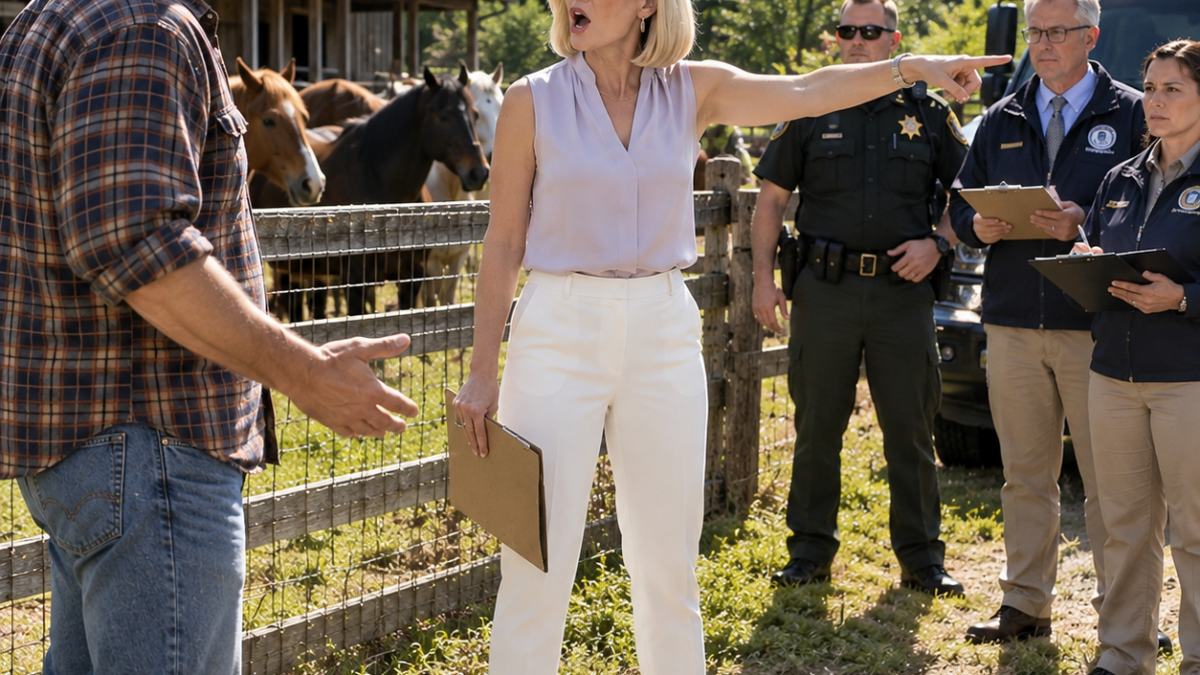
𝗣𝗔𝗥𝗧 𝟮
I leaned against the fence post.
“The agricultural property was here before the residential community.”
Her lips tightened slightly.
“Be that as it may.”
That phrase told me everything I needed to know about the conversation.
She continued.
“Our residents invested substantial amounts in these homes.”
“I’m sure.”
“They have expectations.”
“So do I.”
“The presence of livestock so close to the development affects property values.”
“Then whoever built the development should have noticed the ranch next door.”
She ignored that too.
“We’re hoping you’ll consider relocating the animals.”
I stared at her.
“Relocating them where?”
“Somewhere more appropriate.”
“This is agricultural land.”
“Or reducing the number.”
“From four?”
“Four horses is excessive in a residential area.”
“This isn’t a residential subdivision.”
“It’s adjacent to one.”
“That’s not the same thing.”
Susan pulled out her phone.
She scrolled.
“Our bylaws prohibit livestock operations visible from HOA property.”
I couldn’t help it.
I laughed.
Not loudly.
But genuinely.
She looked offended.
“Something funny?”
“Yes.”
“What?”
“Your bylaws.”
She stared.
“They don’t apply here.”
“Our community standards—”
“I’m not in your community.”
She lowered the phone.
“The development encompasses this area.”
“No.”
“I’m the HOA president.”
“Congratulations.”
Her eyes narrowed.
“My land isn’t in your HOA.”
“You may want to review your documents.”
“I already know my documents.”
“There are standards protecting homeowners from nuisance activity.”
“On HOA property.”
“This is affecting HOA property.”
“Still not HOA property.”
Her smile disappeared entirely.
I continued.
“My family has owned this land since 1974.”
Nothing.
“I’m properly zoned.”
Nothing.
“My horses are legal.”
Nothing.
“I’m not relocating them.”
Susan stared at me for several seconds.
Then said:
“We’ll see about that.”
She turned.
Walked back toward Ashford.
I watched her go.
At the time, I thought the whole thing was ridiculous enough that it would end there.
I had spent twenty-eight years dealing with real emergencies.
A woman upset about four horses beside a subdivision barely registered.
Two weeks later, an envelope arrived.
Ashford Estates HOA letterhead.
Susan’s signature at the bottom.
The letter informed me that I was in violation of HOA restrictions regarding livestock and agricultural activity within view of association residences.
It gave me thirty days to correct the violation.
After that, fines would supposedly begin accumulating.
I read it twice.
Then dropped it into the recycling.
I should probably have kept it.
Old firefighter habits taught me to document things, but retirement had apparently made me optimistic.
Besides, the demand was absurd.
They couldn’t fine property outside their association.
I assumed someone on the board would eventually explain that to Susan.
Instead, about a week later, a county zoning vehicle pulled into my driveway.
The officer got out.
Friendly enough.
“Mr. Carter?”
“That’s me.”
“I’m with county zoning.”
“What can I do for you?”
“We received a complaint.”
Of course.
“What kind?”
“Operating an unlicensed commercial horse-breeding facility.”
I stared at him.
Then looked toward the pasture.
Then back.
“Do those four lazy animals look like a breeding empire?”
He smiled slightly.
“I still have to check.”
“Fair enough.”
I showed him everything.
Property records.
Zoning information.
Basic permits related to the barn work I’d done.
He walked around.
Looked at the pasture.
Checked setbacks.
Asked how many horses I kept.
“Four.”
“Commercial sales?”
“No.”
“Boarding business?”
“No.”
“Breeding?”
“No.”
“Employees?”
“You’re looking at him.”
He closed his folder.
“Everything’s fine.”
“I know.”
“Sorry for taking your time.”
“Not your fault.”
He hesitated.
Then said:
“Neighbor issue?”
“You could say that.”
He left.
I stood in the driveway watching the county truck disappear.
I was irritated.
But still not worried.
One false zoning complaint was annoying.
Then animal control showed up.
Different week.
Different truck.
Different accusation.
Horse neglect.
That one made me angry.
You want to call my barn ugly?
Fine.
You want to complain about smell?
Whatever.
But accusing me of neglecting animals I had spent years caring for was different.
The animal-control officer walked through the pasture.
Looked at water.
Feed.
Stalls.
Hooves.
Body condition.
Barn.
She spent maybe five minutes doing what she needed to do.
Then shook her head.
“These horses are fine.”
“Yes.”
“They’re more than fine.”
“Thank you.”
“Do you know who’s making these complaints?”
“I have a very strong guess.”
She glanced toward Ashford.
“HOA?”
I laughed.
“That obvious?”
She sighed.
“People use complaint systems to fight neighbor wars more than you’d believe.”
“I was a firefighter for twenty-eight years.”
“Then maybe you would believe.”
Fair point.
She left.
A few days later came another government vehicle.
Health department.
Someone had reported improper animal-waste disposal creating a public health hazard.
I walked the inspector through my manure-management setup.
Showed him where material was stored.
How often it was removed.
Drainage.
Distance from neighboring property.
He found nothing.
No violation.
No public-health problem.
No contamination.
Another complaint closed.
Then another inspection.
Another accusation.
Another person walking around my land because Susan had discovered that filing complaints cost her almost nothing while forcing me to spend hours proving the obvious.
That was when the situation stopped feeling ridiculous.
It became harassment.
Every time I saw a county vehicle turn onto the road, my stomach tightened.
Not because I was doing anything wrong.
Because I knew I was about to lose part of another day explaining that I wasn’t doing anything wrong.
That is one of the cruelest parts of weaponized bureaucracy.
Being innocent doesn’t make it painless.
Someone makes an accusation in five minutes.
You spend hours answering it.
Maybe days collecting records.
The agency closes the complaint.
Then the person calls somebody else.
Susan understood that.
I started keeping a file.
Inspection reports.
Dates.
Names.
Findings.
Every one of them said essentially the same thing.
No violation.
Then Ashford’s lawyer got involved.
The first letter was carefully written.
Much better than Susan’s.
It claimed my livestock and ranch activities constituted a nuisance that interfered with residents’ enjoyment of their property.
It mentioned diminished property values.
Odor.
Insects.
Visual impact.
The association reserved its rights to pursue injunctive relief.
That got my attention.
I called a lawyer.
His name was Mark Ellison.
Property attorney.
He’d helped another firefighter I knew with a boundary dispute.
I brought everything.
Deed.
Zoning.
Inspection reports.
HOA letters.
He spent about twenty minutes reading.
Then looked up.
“You’re not in the HOA.”
“I know.”
“Your deed isn’t subject to their covenants.”
“I know.”
“You’re properly zoned.”
“Yes.”
“Any commercial operation?”
“No.”
“Any actual citation from the county?”
“None.”
“Then they’re blowing smoke.”
“Can they sue?”
“Anyone can file something.”
“Can they win?”
“On what you’ve shown me?”
He shook his head.
“They’d have an uphill battle proving a nuisance when you’ve got four horses on historically agricultural land that predates the subdivision.”
He drafted a response.
Professional.
Polite.
Firm.
My property was outside the association.
Their covenants did not apply.
County agencies had already investigated repeated complaints and found no violations.
The association should cease attempting to regulate nonmember property and stop threatening enforcement it lacked authority to impose.
I thought that would finally end it.
Instead, Susan became more personal.
One afternoon I was cleaning stalls in the barn.
I heard someone talking outside.
At first I thought a neighbor had stopped by.
Then I recognized Susan’s voice.
I walked out.
She was near the fence line.
Phone raised.
Taking photographs.
“Susan.”
She didn’t turn.
“What are you doing?”
“Documenting.”
“Documenting what?”
“The violations.”
I looked around.
“What violations?”
She pointed toward the ground.
“Mud.”
I stared.
“It rained yesterday.”
“Exactly.”
“That’s what ground does after rain.”
She ignored me.
“Debris.”
She photographed a small pile of old fence boards I’d stacked beside the barn.
“I’m replacing fencing.”
“Neglect.”
I almost laughed.
“Those boards are waiting to be hauled.”
She kept taking pictures.
“This is all going in my county report.”
“Another one?”
She finally looked at me.
“Your attitude is exactly the problem.”
“My attitude?”
“You have no respect for this community.”
“I’m not in your community.”
“There you go again.”
I took a slow breath.
Twenty-eight years in the fire service teaches you how to speak calmly while every instinct wants to speak differently.
“Susan.”
“What?”
“I’m asking you to leave.”
“I’m standing at the boundary.”
“No.”
I pointed.
“The boundary is behind you.”
She looked down.
“I’m on public space.”
“No.”
“This is an easement.”
“No, it isn’t.”
She looked toward Ashford.
“This entire corridor—”
I cut her off.
“Everything on this side of the fence line belongs to me.”
Her eyes flashed.
“I’m documenting a nuisance.”
“From public property, you’re welcome to take whatever pictures the law allows.”
Nothing.
“But you are on my land.”
I stepped closer.
“Leave.”
Her jaw tightened.
“You don’t intimidate me.”
“I’m not trying to intimidate you.”
“You’re threatening me.”
“No.”
I pointed toward the road.
“I’m asking a trespasser to leave.”
She stared at me.
“Now.”
For several seconds, neither of us moved.
Then she turned.
Stormed toward Ashford.
I thought that might finally convince her I’d had enough.
Instead, she called the police.
It was a Tuesday morning.
I was sitting on the porch with coffee.
One of those retirement mornings I used to dream about.
Cool air.
Horses grazing.
Nothing urgent.
Then I saw flashing lights.
Two patrol cars.
My first thought was that something had happened nearby.
Maybe an accident.
Maybe a welfare check.
Both cruisers turned into my driveway.
That changed things.
Two officers got out.
The first was young.
Mid-twenties.
Professional.
The second looked older.
More experienced.
The young one approached.
“Morning.”
“Morning.”
“You the property owner?”
“That’s right.”
I put down the coffee.
“What’s going on?”
“We received a report of a public-safety hazard.”
I almost laughed.
“What kind?”
“Aggressive animals and unsafe structures.”
I looked toward the pasture.
One horse was standing in the sun doing absolutely nothing.
Another was eating.
The barn had recently been repaired and painted.
The young officer looked too.
His expression said exactly what I was thinking.
“I’m not seeing much aggression.”
“Give them time.”
The older cop smiled slightly.
I said:
“Susan?”
The young officer checked his notes.
“Caller gave that name.”
“HOA president next door.”
The older officer frowned.
“Is this the same property we came to a few weeks ago?”
The younger one flipped through something.
“Noise complaint.”
“That’s right.”
I shook my head.
“I forgot about that one.”
The older officer looked at me.
“Month before too?”
“Probably.”
The younger officer nodded.
“Same caller.”
I sighed.
“This has been going on for months.”
I explained.
HOA.
Not a member.
Horses.
Zoning complaint.
Animal-control complaint.
Health-department complaint.
Lawyer.
Trespassing.
The officers listened.
I said:
“If you want documents, I’ve got everything inside.”
The older one shook his head.
“Let’s just walk the property.”
“Be my guest.”
They checked the barn.
Fencing.
Animals.
Nothing.
Of course.
I showed them fire extinguishers mounted inside the barn.
Clear exits.
Electrical upgrades.
The older officer laughed.
“You really were a firefighter.”
“Twenty-eight years.”
“Explains the extinguishers.”
“I don’t like barns burning.”
We were walking back toward the porch when tires came up the driveway fast.
SUV.
Susan.
She braked.
Door opened.
She stepped out before the engine fully settled.
“Officers!”
She marched toward us.
White fitted jacket.
Phone in hand.
Relief and outrage mixed across her face.
“Thank God you’re here.”
The older officer looked at me.
I said nothing.
Susan continued.
“This man has been operating illegally for months.”
The young officer raised a hand.
“Ma’am—”
“I have filed report after report and nothing is being done.”
“We inspected the property.”
She barely paused.
“Those animals are dangerous.”
The nearest horse continued eating grass.
“And the barn is a fire hazard.”
That one hit a nerve.
I folded my arms.
The young officer said:
“We’ve seen the barn.”
“You didn’t inspect it properly.”
The older officer’s expression changed.
“Ma’am.”
Susan turned.
“There are no violations here.”
“That’s impossible.”
“We’ve looked.”
“I have photographs.”
“Photographs of what?”
“Mud.”
I actually closed my eyes.
The officer continued.
“Any aggressive behavior from the animals?”
“They’re livestock.”
“That’s not an answer.”
She pointed toward the barn.
“Unsafe construction.”
“Based on what?”
“I have resident statements.”
The older officer looked at his partner.
Then back at Susan.
“Ma’am, this is the fourth report from you regarding this address.”
Her posture stiffened.
“Because nobody is doing anything.”
“Because we’re not finding what you’re reporting.”
“It’s there.”
“No.”
His tone sharpened.
“It’s not.”
Susan opened her mouth.
He continued.
“Filing knowingly false reports is a crime.”
That finally stopped her.
Her face changed.
“I am not filing false reports.”
“You reported aggressive animals.”
“They could become aggressive.”
“You reported unsafe structures.”
“The barn—”
“We inspected it.”
“You don’t understand—”
He cut her off.
“You reported a public-safety emergency.”
Susan’s face flushed.
“I’m protecting my community.”
“By giving inaccurate information to police.”
“I didn’t lie.”
The younger officer said:
“Mr. Carter has been cooperative.”
He looked toward me.
“Your last name Carter?”
“Yes.”
“Mr. Carter has documentation from county departments confirming this property is legal.”
Susan glared at me.
The officer continued.
“You need to stop calling emergency services with complaints that aren’t supported by facts.”
Susan’s voice tightened.
“This is not over.”
The older cop stared at her.
“I strongly recommend that it is.”
She turned toward me.
For a second, the hatred on her face surprised even me.
Then she got into the SUV.
Drove away.
The older officer watched her leave.
Then pulled me aside.
“If I were you, I’d file a harassment report.”
“I’ve been considering it.”
“Do it.”
“Think it’ll help?”
“Creates a record.”
That was enough.
I filed.
That evening, I called Albert.
Albert and I went through the fire academy together almost thirty years earlier.
We had been young, stupid, convinced our backs would never hurt and our knees would last forever.
Somehow we both survived long enough to get gray hair.
I retired from active firefighting.
Albert eventually became a fire marshal.
We stayed close.
I didn’t call because I had some plan involving Susan.
Honestly, I just wanted to vent to someone who would understand how insulting it felt to be accused repeatedly of safety violations I wasn’t committing.
Albert answered.
“Retirement treating you well?”
“Depends.”
“Uh-oh.”
I told him everything.
Susan’s first visit.
The letters.
Zoning.
Animal control.
Health department.
Lawyer.
Trespassing.
Police.
He listened without interrupting much.
When I finished, he said:
“That’s frustrating as hell.”
“That’s one word for it.”
“People who weaponize safety complaints usually have a funny relationship with safety.”
“What does that mean?”
“Nothing specific.”
I could hear papers moving on his end.
“Just thirty years of watching people.”
I leaned back.
He continued.
“The loudest person yelling code violation at somebody else is sometimes the same person cutting corners when it’s their project.”
“Wouldn’t surprise me.”
“What subdivision?”
“Ashford Estates.”
More paper rustling.
“Huh.”
“What?”
“They built a clubhouse.”
“I didn’t know that.”
“Opened last month, according to this.”
“Okay.”
“Pool.”
“Good for them.”
“Gym. Event space.”
“Sounds expensive.”
“It was.”
I laughed.
“Why are you looking at it?”
“Inspection schedule.”
That got my attention.
“Your inspection?”
“Eventually.”
He continued.
“New assembly occupancy. We inspect within six months of opening.”
“When?”
“Looks like about six weeks.”
I paused.
“You’re going to inspect Susan’s clubhouse?”
“I am going to inspect a building.”
“Right.”
“Don’t start.”
“I’m not.”
He asked:
“HOA president’s Susan?”
“Yes.”
“Last name?”
I told him.
He found it.
“She signed some of the project documents.”
“That doesn’t surprise me.”
“She’s listed as the HOA representative overseeing construction.”
I smiled despite myself.
Albert immediately said:
“Stop smiling.”
“You can’t see me.”
“I can hear it.”
“I’m not asking you to do anything.”
“Good.”
“Routine inspection.”
“Exactly.”
“Completely normal.”
“Yes.”
“Wouldn’t want you treating them unfairly.”
“Go take care of your horses.”
We changed subjects.
Talked about old crew members.
Someone’s retirement.
One former captain’s terrible golf game.
Then hung up.
I honestly didn’t think much more about it.
Susan disappeared from my life.
For several weeks, nothing.
No letters.
No inspectors.
No police.
No SUV.
No photographs.
Maybe the warning finally reached her.
Maybe the harassment report scared her.
Maybe her lawyer told her to stop.
I didn’t care why.
I enjoyed the silence.
I repaired more fencing.
Took care of the horses.
Worked around the barn.
Had friends over.
Retirement became retirement again.
Through a neighbor named Steve, I heard Susan was focused on the grand opening and operation of Ashford’s new clubhouse.
Steve was one of the few residents there I knew well.
Good guy.
He’d lived near the edge of the subdivision and occasionally stopped to talk when I was outside.
He had no interest in Susan’s little kingdom.
He just wanted a decent house in a quiet neighborhood.
One afternoon, several weeks later, I was cleaning the barn when I heard someone running.
Running.
At my age, when someone runs toward you on a quiet afternoon, you assume something is wrong.
I stepped outside.
Steve was coming across the grass.
Hands on knees by the time he reached me.
“You’ve got to hear this.”
“What happened?”
“Emergency HOA meeting.”
“Okay.”
“Right now.”
“Why aren’t you there?”
“I left.”
“Why?”
He looked like he was trying not to laugh.
“The fire marshal.”
I stopped.
“What about him?”
“Inspected the clubhouse.”
Albert.
I kept my expression still.
“And?”
Steve grinned.
“Susan is screwed.”
I put down what I was holding.
“Slow down.”
“The clubhouse failed inspection.”
“How badly?”
Steve laughed once.
“How much time do you have?”
He began listing problems.
Emergency exits not compliant.
Fire-suppression system improperly installed.
Electrical work without proper permits.
Occupancy numbers too high for the actual exit capacity.
Ventilation problems.
Emergency lighting issues.
Fire-alarm-panel deficiencies.
I felt my firefighter brain switch on automatically.
Those weren’t cosmetic issues.
They weren’t a crooked sign or slightly wrong paint.
Exit capacity matters.
Fire alarms matter.
Suppression systems matter.
Emergency lighting matters.
Those are systems people discover they need only after smoke has already filled a room.
I asked:
“Clubhouse closed?”
“Immediately.”
“Good.”
Steve nodded.
“They’re saying repairs could be fifty thousand.”
He paused.
“Maybe a hundred.”
“Depends what’s actually wrong.”
“Oh, it gets worse.”
“Of course it does.”
“Susan oversaw the project.”
“I know.”
He stared.
“How do you know?”
“Albert mentioned she was listed.”
Steve’s eyes widened.
“Wait.”
“What?”
“You know the fire marshal?”
“We went through the academy together.”
His mouth fell open.
Then he started laughing.
“Don’t.”
“You know him?”
“Yes.”
“Did you send him?”
“No.”
“Come on.”
“I’m serious.”
“After everything she did to you?”
“State inspection schedule.”
Steve stared for a moment.
Then shook his head.
“That’s even better.”
I tried not to agree too enthusiastically.
He continued.
“The board is furious because she hired the contractor.”
“Normal.”
“Brother-in-law recommendation.”
I looked at him.
“There it is.”
“Apparently she didn’t get competitive bids.”
“Bylaws require them?”
“Yep.”
“And she signed off?”
“On everything.”
I felt the pieces settling.
“Inspections?”
“That’s part of the problem.”
Steve lowered his voice.
“Some weren’t done properly.”
I shook my head.
He said:
“They’re talking about suing her personally.”
“That’s serious.”
“You don’t sound surprised.”
“I spent twenty-eight years watching people cut corners.”
Steve pulled out his phone.
“You need to see this.”
He opened an HOA email.
SPECIAL ASSESSMENT.
Eight hundred dollars per household initially estimated.
Due within sixty days.
I whistled.
“That’s going to go over well.”
“It already isn’t.”
“Clubhouse stays closed?”
“Until repairs.”
He put the phone away.
“People are losing their minds.”
I thought about Susan standing beside my barn photographing rain-soaked dirt.
Mud.
Neglect.
Fire hazard.
Then I thought about improperly installed suppression systems in a new clubhouse she had personally overseen.
Albert’s comment came back.
People who weaponize safety complaints sometimes aren’t very concerned about safety when it’s their project.
The irony was almost too clean.
But this wasn’t Albert targeting her.
That mattered.
He had performed a scheduled inspection required for a new assembly building.
The failures were already there.
He simply found them.
And apparently he didn’t find all of them.
The HOA hired an independent engineer.
Probably trying to figure out how bad the situation actually was.
The answer?
Worse.
The engineer found additional construction problems.
More corners cut.
More work needing correction.
Every new finding raised repair costs.
Then came the insurance issue.
The HOA attempted to make a claim related to construction defects.
The carrier reviewed how the project had been managed.
Susan had bypassed procedures.
No proper competitive bidding.
Improper oversight.
Inspection problems.
The claim was denied.
That meant homeowners were paying.
The special assessment became $847 per household.
Not eight hundred.
Eight hundred forty-seven.
Every single home in Ashford got the bill.
And every resident knew exactly why.
Steve became my unofficial news service.
He’d stop by every few days.
“Susan update.”
I’d laugh.
“What now?”
One afternoon he said:
“Board’s suing.”
“Her?”
“Yep.”
“Personally?”
“Negligence. Breach of fiduciary duty. Lawyers are still arguing.”
Another day:
“Three board members resigned.”
“Why?”
“Don’t want their names attached.”
Another:
“Insurance definitely isn’t covering the repairs.”
I shook my head.
Then one evening:
“She mortgaged her house.”
That made me stop.
“What?”
“For legal expenses.”
“How do you know?”
“It’s all anyone in Ashford talks about.”
I didn’t celebrate that.
Not really.
A mortgage taken out to pay lawyers isn’t funny.
But it was hard not to recognize the contrast.
Months earlier, Susan had been threatening to use legal pressure against me because she didn’t like looking at my horses.
Now she was spending her own money defending decisions she had made on a project that actually involved public safety.
I never needed to say anything to her.
Ashford residents were doing enough.
According to Steve, Susan couldn’t go anywhere without hearing about the assessment.
Grocery store.
Gas station.
Mailbox.
Community entrance.
People confronted her.
Not violently.
Not threateningly.
But they wanted answers.
Why did she hire that contractor?
Why weren’t the inspections done?
Why did she sign documents?
Why were residents paying $847?
Why was the clubhouse closed after they had already funded it?
Why hadn’t anyone caught this?
Susan, who had spent years demanding explanations from homeowners over minor rule violations, suddenly lived inside a world of questions.
And she hated it.
I understood one thing better than most Ashford residents probably did.
Fire-code violations can sound annoyingly technical until you’ve watched a crowded building burn.
Exit width.
Emergency lighting.
Alarm panels.
Sprinkler coverage.
Occupant load.
They are not bureaucratic decorations.
I had been inside structures where people couldn’t see the door because smoke turned daylight into blackness.
I’d watched panic transform a familiar room into a maze.
I’d watched seconds matter.
So when Susan reportedly called Albert’s findings “minor technical violations,” I felt something colder than satisfaction.
Anger.
Because she should have known better.
You do not get to accuse my barn of being a fire hazard while signing off on a public building where emergency systems aren’t installed correctly.
Not after people paid for that facility.
Not when families and children were going to use it.
The clubhouse remained closed.
Repair crews came.
Systems were corrected.
Walls reopened.
Electrical work redone.
Suppression components replaced.
Emergency features brought into compliance.
Every repair represented something that should have been done correctly the first time.
About a month after the inspection, Susan resigned.
Steve came by with the news.
“She’s gone.”
“Moved?”
“Board.”
“Resigned?”
“Email this morning.”
He showed me.
Susan wrote that she was stepping down for personal reasons.
No mention of the clubhouse.
No mention of lawsuits.
No mention of the assessment.
No mention of contractor oversight.
Just personal reasons.
I read it once.
Handed the phone back.
Steve said:
“That’s it?”
“What do you want me to say?”
“After everything she did to you?”
I looked toward the horses.
One had wandered near the fence.
“She isn’t my problem anymore.”
Steve laughed.
“You’re a better man than me.”
“No.”
I shook my head.
“I’m retired.”
There is a difference.
Later, I heard Susan was trying to sell her house.
Maybe she wanted to escape the social pressure.
Maybe she needed money.
Maybe she simply couldn’t stand living among hundreds of people who associated her name with an $847 bill.
I never asked.
I never spoke to her again.
The last direct interaction we ever had was the day police told her to stop filing false reports.
That suited me.
I didn’t need a final confrontation.
Didn’t need her at my door apologizing.
Didn’t need some movie scene where I explained karma.
Life had already explained enough.
My property stayed exactly the same.
Same barn.
Same pasture.
Same four horses.
The smell that supposedly threatened Ashford’s property values somehow failed to destroy the subdivision.
The flies did not conquer civilization.
My barn remained standing.
The county still considered everything legal.
Animal control never returned.
Health department never returned.
Police never returned.
HOA letters stopped.
Peace came back quietly.
The way peace usually does.
One morning, I sat on the porch with coffee and realized several months had passed since I’d thought about Susan before breakfast.
That felt like victory.
Not the lawsuit.
Not the assessment.
Not her resignation.
Getting my mind back.
Harassment has a strange way of taking up space in your head.
Every unfamiliar car becomes an inspector.
Every envelope becomes a threat.
Every person near the fence makes you wonder whether another complaint is coming.
Susan had made my retirement feel like another job.
Then suddenly she was gone from it.
Albert called me eventually.
“So.”
“So.”
“You’re hearing about Ashford?”
“I’ve heard a few things.”
“A few.”
He laughed.
“Steve apparently runs a news service.”
“Sounds useful.”
I asked:
“How bad was the clubhouse really?”
Albert became serious.
“Bad enough.”
“Life safety?”
“Some of it.”
“Exit capacity?”
“Yes.”
“Suppression?”
“Yes.”
“Electrical?”
“Yes.”
I shook my head.
He continued.
“Nothing magical about it.”
“What do you mean?”
“Cheap work.”
“Bad oversight?”
“Very.”
“You knew Susan had been bothering me.”
“I knew.”
“Didn’t affect the inspection?”
“No.”
I smiled.
“I know.”
He paused.
Then said:
“That’s what makes it better.”
I laughed.
“Albert.”
“What?”
“I didn’t say that.”
“You didn’t have to.”
We changed subjects.
The older I get, the more I think about consequences differently.
When I was younger, I thought consequences were things one person imposed on another.
Punishment.
Discipline.
Tickets.
Suspensions.
Being fired.
But often the strongest consequences aren’t imposed.
They are uncovered.
Susan had spent months trying to manufacture consequences for me.
Fake HOA fines.
Complaints.
Inspections.
Police.
Legal threats.
She wanted some authority somewhere to declare that my ordinary lawful life was unacceptable.
Nothing stuck because there was nothing wrong.
Then an inspector walked into a building she had actually overseen.
He didn’t invent violations.
Didn’t need to.
They were already there.
That is the difference between harassment and accountability.
Harassment begins with the target and searches for something wrong.
Accountability begins with what is wrong and follows the evidence.
Susan never understood that while she was president.
She decided I was a problem.
Then kept trying agencies until one would punish me.
Zoning found nothing.
Animal control found nothing.
Health department found nothing.
Police found nothing.
My lawyer found no HOA authority.
Every result should have been an opportunity to stop.
Instead, each failure made her escalate.
That tendency eventually caught up with her own work.
She didn’t respect process when process inconvenienced her.
Competitive bids?
Too slow.
Proper inspections?
Apparently flexible.
Contractor scrutiny?
Unnecessary.
Fire-code details?
Technicalities.
Exactly the same mindset she’d used against me.
Rules mattered when she could use them.
They became annoying when they limited her.
That isn’t leadership.
It’s entitlement wearing administrative clothing.
The new HOA board was apparently much quieter.
Steve said meetings became boring.
I told him that was probably good.
They hired professionals.
Reviewed procedures.
Required multiple people to approve major projects.
The clubhouse reopened eventually after all necessary corrections.
I wasn’t invited to the reopening.
Wouldn’t have gone anyway.
I’m not part of the HOA.
Remember?
That was the entire point.
One afternoon, Steve stopped near my fence.
“Clubhouse is finally open.”
“Congratulations.”
“Cost us a fortune.”
“Sorry.”
“At least it’s safe.”
“That’s worth something.”
He nodded.
Then looked at my barn.
“You know something funny?”
“What?”
“Susan once told people your barn was going to make our houses impossible to sell.”
I smiled.
“Did it?”
“House across from mine sold last week.”
“Price?”
“Above asking.”
“Terrible.”
“I know.”
“What about the horses?”
He looked toward them.
“Devastating.”
We both laughed.
Sometimes I think about my first conversation with Susan.
Four horses is excessive.
Visual impact.
Property values.
Relocate them.
She had crossed an open field to tell a man standing on land his family had owned since 1974 that a newly constructed subdivision should determine what happened there.
That level of certainty is almost impressive.
She didn’t ask whether I was legally permitted.
She assumed her preference carried authority.
When I told her it didn’t, she didn’t reconsider.
She mobilized institutions.
That was her real mistake.
Not because those institutions eventually turned against her.
Most of them didn’t.
They simply did their jobs.
And their jobs required facts.
The facts protected me.
The facts later exposed her.
If Susan had simply disliked horses, nothing would have happened.
People are allowed to dislike things.
If she complained about smell to her husband or friends?
Fine.
If Ashford residents wished the old ranch wasn’t visible?
Okay.
You don’t have to enjoy your surroundings.
But when dislike becomes entitlement, and entitlement becomes paperwork, and paperwork becomes repeated false allegations, the conflict changes.
That’s why I finally filed the harassment report.
Not revenge.
Documentation.
One of the best lessons firefighting ever taught me was:
Document the scene.
What did you find?
What did you do?
Who was present?
What changed?
Memory gets emotional.
Paper doesn’t.
After Susan started filing complaints, I applied the same principle.
Inspection reports.
Letters.
Police contacts.
Dates.
Legal correspondence.
If the situation had eventually reached court, I wasn’t going to say:
“Trust me, she’s crazy.”
I was going to say:
“Here are the records.”
Fortunately, I never needed that file in court.
But I kept it anyway.
It’s still in a cabinet.
Every once in a while I see the folder while looking for something else.
HOA.
That’s the label.
Inside are pages representing months of nonsense.
The zoning clearance.
Animal-control note.
Health-department findings.
My lawyer’s response.
Police report.
Harassment complaint.
All because one woman decided four horses should not exist near her subdivision.
The clubhouse report wasn’t in my file.
That wasn’t my fight.
I never asked Albert for a copy.
Never needed it.
The people responsible for Ashford handled Ashford.
I handled my three acres.
That separation was exactly what Susan had refused to accept from the beginning.
Years later, the tree line between our properties grew thicker.
From my porch, I could barely see the nearest Ashford roof during summer.
The great visual catastrophe of my ranch became almost invisible.
I sometimes wondered whether Susan would’ve calmed down if she’d waited for the trees to grow.
Probably not.
People like her rarely need the problem itself.
They need the struggle.
Retirement taught me something firefighting never had time to teach.
Not every fire needs you.
For twenty-eight years, if somebody called, I went.
That was the job.
You see smoke, you move toward it.
You hear someone needs help, you respond.
After retirement, I had to learn that some situations deserve the opposite.
Don’t engage.
Don’t argue.
Don’t run toward every provocation.
Let the proper people handle it.
When zoning arrived?
Show records.
When animal control arrived?
Open the barn.
Health department?
Walk them through.
Police?
Cooperate.
Attorney letter?
Send it to my lawyer.
Susan wanted personal conflict.
I gave her process.
Ironically, process was what eventually ruined her credibility.
Her allegations repeatedly failed.
Then her own project failed inspection.
The difference was evidence.
A few years after all of this, I ran into Albert at a retirement dinner for another firefighter.
Somebody at the table knew the story.
Not sure how.
Probably Albert.
The guy laughed and said:
“So you’re the horse guy.”
I looked at Albert.
He raised both hands.
“Wasn’t me.”
“You’re lying.”
The other guy said:
“Is it true the HOA president called your barn a fire hazard and then built a clubhouse with bad fire alarms?”
I took a drink.
“That’s the short version.”
The table laughed.
I didn’t enjoy the story quite as much as they did.
Because behind the irony was something serious.
If there had been a fire in that clubhouse before inspection?
Crowded event.
Bad alarm panel.
Improper emergency lighting.
Insufficient exit capacity.
People could have been hurt.
Maybe worse.
I spent my career arriving after small mistakes became emergencies.
A blocked exit nobody thought mattered.
A detector someone meant to replace.
An overloaded circuit.
A door chained because “nobody uses it.”
A suppression system not maintained.
Nobody expects the emergency when they’re cutting the corner.
That’s why safety rules exist.
Not to give people like Susan ammunition in neighborhood wars.
To prevent funerals.
So yes, I felt satisfaction that she was finally forced to answer for something real.
But mostly I was glad the clubhouse was inspected before disaster taught the lesson differently.
Albert did his job.
The independent engineer did his.
The board eventually did theirs.
That is how the system is supposed to work.
Susan spent months treating systems like weapons.
In the end, functioning systems became the thing she couldn’t manipulate.
Steve eventually moved out of Ashford.
When he told me, I joked:
“My horses finally destroy your property value?”
He laughed.
“Made a profit.”
“Impossible.”
“Susan lied.”
“Careful. That’s a serious accusation.”
He grinned.
Before leaving, he came by with beer.
We sat on the porch.
Horses in the pasture.
Sun going down.
He said:
“You know, when I moved there, I thought an HOA would mean less drama.”
I laughed.
“Why?”
“Rules.”
“Rules don’t eliminate drama.”
“Clearly.”
“They just give dramatic people paperwork.”
He pointed at me.
“That’s going on a shirt.”
“No.”
We drank.
He asked whether I’d ever consider selling.
I looked over the three acres.
Barn.
Fence.
Pasture.
The house my grandfather had known.
“No.”
“Never?”
“Not planning to.”
“Even after Susan?”
“Especially after Susan.”
That land meant more to me after the fight.
Not because I had won something.
Because I had been reminded why I wanted it.
For twenty-eight years, I belonged to a schedule.
Shift calendar.
Department policies.
Calls.
Chain of command.
When I retired, I wanted a place where my responsibilities were simple.
Feed animals.
Repair what breaks.
Take care of the land.
Help neighbors when they actually need help.
Susan tried to recreate the same feeling of being under somebody else’s authority.
Only hers wasn’t legitimate.
That was why I resisted so strongly.
I had earned quiet.
She didn’t get to invent a jurisdiction over it.
The four horses eventually became three.
Not because Susan won.
One simply aged out and died.
That was years later.
I buried him on the property.
The others grew older too.
Time keeps going, HOA president or not.
The barn still stands.
The fence needs repair more often than I’d like.
My knees complain whenever I crouch too long.
My hands don’t move as quickly as they did when I was a rookie firefighter.
But most mornings still begin the same way.
Coffee.
Porch.
Horses.
Quiet.
Sometimes an Ashford resident walks along the public road and waves.
I wave back.
No hostility.
Most people there were never my enemy.
They simply had a president who convinced herself that representing a neighborhood meant controlling everything visible from it.
The new board never bothered me.
Not once.
That alone proves how unnecessary Susan’s campaign had been.
Years of conflict ended the moment one person stopped creating it.
Whenever someone asks what happened to Susan, I tell them the simple version.
She resigned.
The HOA sued her.
She had serious legal bills.
She tried to sell.
I don’t know how every lawsuit eventually resolved.
I didn’t follow it forever.
It wasn’t my business.
That’s important.
I never wanted Susan’s life.
I wanted mine.
That’s what people sometimes misunderstand about consequences stories.
The most satisfying ending isn’t always watching the antagonist suffer.
Sometimes it’s when they finally stop appearing in your driveway.
When your phone stops ringing.
When inspectors stop showing up.
When your morning coffee becomes boring again.
Boring is underrated.
After twenty-eight years as a firefighter, I can tell you that boring is one of life’s greatest luxuries.
No alarms.
No emergency.
No smoke.
No one shouting.
No flashing lights.
Just four horses grazing behind an old barn on land my grandfather bought before anyone imagined there would someday be an HOA nearby.
Susan thought my ranch was an eyesore.
To me, it was retirement.
She thought my horses hurt property values.
To me, they were family tradition.
She thought my barn was a hazard.
The county disagreed.
Animal control disagreed.
Health inspectors disagreed.
Police disagreed.
My lawyer disagreed.
And when a real fire marshal eventually walked through the building Susan had helped oversee, he found the kind of hazards that actually mattered.
That wasn’t revenge.
That was the part Susan never understood.
Reality doesn’t care who files the most complaints.
It doesn’t care who is HOA president.
It doesn’t care who speaks with the most confidence.
It just sits there waiting for someone qualified to look closely.
Susan spent months trying to make authorities look closely at me.
Eventually, one of them looked closely at her work instead.
And for the first time, there was actually something to find.
𝗧𝗛𝗘 𝗘𝗡𝗗
The HOA President Tried to Use Every Agency in the County to Drive Me Off My Family Land—Then She Finally Went Too Far
I spent twenty-eight years running toward emergencies, so I was not easily intimidated by a woman with a clipboard and a title.
But Susan kept escalating until the same safety rules she weaponized against me came crashing back into her own life.
I retired from the fire department after twenty-eight years.
Twenty-eight years of alarms in the middle of dinner.
House fires.
Vehicle accidents.
Brush fires.
Medical calls.
Chemical spills.
People standing in front yards watching everything they owned disappear through smoke.
You see enough of that and your priorities eventually get very simple.
Family.
Health.
A quiet place to sleep.
And enough distance from other people’s problems that you don’t spend your retirement solving them.
For most of my career, I’d had one picture in my head whenever a shift became particularly ugly.
My grandfather’s land.
Three acres on the edge of town.
A small ranch house.
Old barn.
Pasture.
Horses.
Nothing luxurious.
Nothing impressive.
Just quiet.
My grandfather bought the land in 1974, back when the area around it was mostly farms, open fields, and narrow roads.
He raised horses there.
My father kept a few for a while too.
By the time the property eventually passed to me, the barn had seen better days and some of the fencing was more memory than structure.
But the land was still ours.
When I retired, I finally did what I’d spent years promising myself I would do.
I moved out there permanently.
I repaired the barn.
Replaced rotting boards.
Rewired the lights.
Fixed drainage.
Put up proper fencing.
Cleaned out years of junk.
Reseeded parts of the pasture.
Then I brought in four horses.
Four.
Not forty.
Not a commercial stable.
Not some large breeding operation.
Four horses with enough pasture to be comfortable and a barn that was probably cleaner than several fire stations I’d worked in.
That first year was everything I had wanted.
I would wake early even though I didn’t have to anymore.
Old habits.
Make coffee.
Walk outside.
Listen.
No dispatch radio.
No engines.
No sirens.
Just birds, wind in the trees, and horses shifting around in the pasture.
For the first time since I was a young man, I could let silence be silence instead of wondering what call was coming next.
Then development reached us.
About three years after I settled in, construction started several hundred yards away.
At first, I didn’t care.
Land gets sold.
Towns grow.
That’s life.
The development was called Ashford Estates.
Locally, after everything that happened, several of us developed a less flattering nickname for it.
It was one of those carefully planned communities where every house seemed to have been designed by the same person using slightly different rooflines.
Large garages.
Stone veneers.
Perfect lawns.
Identical mailboxes.
Decorative entrance sign.
And, of course, a homeowners association.
My property wasn’t part of it.
That was never even questionable.
My family had owned the land since 1974.
The subdivision had been built around land assembled decades later.
There was a clear tree line between my pasture and the nearest homes.
My deed was independent.
My zoning was agricultural-residential and grandfathered appropriately for what I was doing.
No HOA covenants.
No shared amenities.
No dues.
No relationship.
I stayed on my three acres.
They stayed in their development.
That should have worked perfectly.
Then Susan became president.
I heard her name before I met her.
One neighbor who lived inside Ashford told me:
“She’s intense.”
I laughed.
“HOA intense?”
He looked at me.
“Worse.”
Susan apparently took the presidency very seriously.
Not public office seriously.
Monarchy seriously.
She was polished, blonde, always impeccably dressed, and carried herself like she expected people to straighten their posture when she approached.
The first time I met her, she wore a fitted white blazer with gold buttons, a tailored skirt, and heels that seemed like a strange choice for walking across uneven ground.
She also had her phone in one hand and an expression that immediately reminded me of certain inspectors I’d dealt with during my career.
Not the good ones.
The ones who arrived already hoping to find something wrong.
I was repairing a fence section when I heard:
“Excuse me!”
I straightened.
Susan was walking toward me.
Not on the subdivision side.
Across the field.
My field.
She stopped near the fence.
“Are you the property owner?”
“That’s right.”
I wiped my hands on my jeans.
“Can I help you?”
“I’m Susan.”
She gave me a smile without warmth.
“President of the Ashford Estates homeowners association.”
“Okay.”
“I wanted to introduce myself and discuss some concerns.”
I glanced toward her development.
“What concerns?”
She looked around my property.
Not admiringly.
Her eyes moved from the barn to the pasture to the horses.
“Your operation.”
I laughed.
“My what?”
“Your livestock operation.”
“I have four horses.”
“Exactly.”
“That’s an operation now?”
She ignored the question.
“Several residents have complained.”
“About what?”
“The smell.”
I looked toward the horses.
“Okay.”
“Flies.”
“Okay.”
“And frankly, the visual impact.”
That one made me pause.
“The visual impact of horses?”
“Of an agricultural property beside a residential community.”
I leaned against the fence post.
“The agricultural property was here before the residential community.”
Her lips tightened slightly.
“Be that as it may.”
That phrase told me everything I needed to know about the conversation.
She continued.
“Our residents invested substantial amounts in these homes.”
“I’m sure.”
“They have expectations.”
“So do I.”
“The presence of livestock so close to the development affects property values.”
“Then whoever built the development should have noticed the ranch next door.”
She ignored that too.
“We’re hoping you’ll consider relocating the animals.”
I stared at her.
“Relocating them where?”
“Somewhere more appropriate.”
“This is agricultural land.”
“Or reducing the number.”
“From four?”
“Four horses is excessive in a residential area.”
“This isn’t a residential subdivision.”
“It’s adjacent to one.”
“That’s not the same thing.”
Susan pulled out her phone.
She scrolled.
“Our bylaws prohibit livestock operations visible from HOA property.”
I couldn’t help it.
I laughed.
Not loudly.
But genuinely.
She looked offended.
“Something funny?”
“Yes.”
“What?”
“Your bylaws.”
She stared.
“They don’t apply here.”
“Our community standards—”
“I’m not in your community.”
She lowered the phone.
“The development encompasses this area.”
“No.”
“I’m the HOA president.”
“Congratulations.”
Her eyes narrowed.
“My land isn’t in your HOA.”
“You may want to review your documents.”
“I already know my documents.”
“There are standards protecting homeowners from nuisance activity.”
“On HOA property.”
“This is affecting HOA property.”
“Still not HOA property.”
Her smile disappeared entirely.
I continued.
“My family has owned this land since 1974.”
Nothing.
“I’m properly zoned.”
Nothing.
“My horses are legal.”
Nothing.
“I’m not relocating them.”
Susan stared at me for several seconds.
Then said:
“We’ll see about that.”
She turned.
Walked back toward Ashford.
I watched her go.
At the time, I thought the whole thing was ridiculous enough that it would end there.
I had spent twenty-eight years dealing with real emergencies.
A woman upset about four horses beside a subdivision barely registered.
Two weeks later, an envelope arrived.
Ashford Estates HOA letterhead.
Susan’s signature at the bottom.
The letter informed me that I was in violation of HOA restrictions regarding livestock and agricultural activity within view of association residences.
It gave me thirty days to correct the violation.
After that, fines would supposedly begin accumulating.
I read it twice.
Then dropped it into the recycling.
I should probably have kept it.
Old firefighter habits taught me to document things, but retirement had apparently made me optimistic.
Besides, the demand was absurd.
They couldn’t fine property outside their association.
I assumed someone on the board would eventually explain that to Susan.
Instead, about a week later, a county zoning vehicle pulled into my driveway.
The officer got out.
Friendly enough.
“Mr. Carter?”
“That’s me.”
“I’m with county zoning.”
“What can I do for you?”
“We received a complaint.”
Of course.
“What kind?”
“Operating an unlicensed commercial horse-breeding facility.”
I stared at him.
Then looked toward the pasture.
Then back.
“Do those four lazy animals look like a breeding empire?”
He smiled slightly.
“I still have to check.”
“Fair enough.”
I showed him everything.
Property records.
Zoning information.
Basic permits related to the barn work I’d done.
He walked around.
Looked at the pasture.
Checked setbacks.
Asked how many horses I kept.
“Four.”
“Commercial sales?”
“No.”
“Boarding business?”
“No.”
“Breeding?”
“No.”
“Employees?”
“You’re looking at him.”
He closed his folder.
“Everything’s fine.”
“I know.”
“Sorry for taking your time.”
“Not your fault.”
He hesitated.
Then said:
“Neighbor issue?”
“You could say that.”
He left.
I stood in the driveway watching the county truck disappear.
I was irritated.
But still not worried.
One false zoning complaint was annoying.
Then animal control showed up.
Different week.
Different truck.
Different accusation.
Horse neglect.
That one made me angry.
You want to call my barn ugly?
Fine.
You want to complain about smell?
Whatever.
But accusing me of neglecting animals I had spent years caring for was different.
The animal-control officer walked through the pasture.
Looked at water.
Feed.
Stalls.
Hooves.
Body condition.
Barn.
She spent maybe five minutes doing what she needed to do.
Then shook her head.
“These horses are fine.”
“Yes.”
“They’re more than fine.”
“Thank you.”
“Do you know who’s making these complaints?”
“I have a very strong guess.”
She glanced toward Ashford.
“HOA?”
I laughed.
“That obvious?”
She sighed.
“People use complaint systems to fight neighbor wars more than you’d believe.”
“I was a firefighter for twenty-eight years.”
“Then maybe you would believe.”
Fair point.
She left.
A few days later came another government vehicle.
Health department.
Someone had reported improper animal-waste disposal creating a public health hazard.
I walked the inspector through my manure-management setup.
Showed him where material was stored.
How often it was removed.
Drainage.
Distance from neighboring property.
He found nothing.
No violation.
No public-health problem.
No contamination.
Another complaint closed.
Then another inspection.
Another accusation.
Another person walking around my land because Susan had discovered that filing complaints cost her almost nothing while forcing me to spend hours proving the obvious.
That was when the situation stopped feeling ridiculous.
It became harassment.
Every time I saw a county vehicle turn onto the road, my stomach tightened.
Not because I was doing anything wrong.
Because I knew I was about to lose part of another day explaining that I wasn’t doing anything wrong.
That is one of the cruelest parts of weaponized bureaucracy.
Being innocent doesn’t make it painless.
Someone makes an accusation in five minutes.
You spend hours answering it.
Maybe days collecting records.
The agency closes the complaint.
Then the person calls somebody else.
Susan understood that.
I started keeping a file.
Inspection reports.
Dates.
Names.
Findings.
Every one of them said essentially the same thing.
No violation.
Then Ashford’s lawyer got involved.
The first letter was carefully written.
Much better than Susan’s.
It claimed my livestock and ranch activities constituted a nuisance that interfered with residents’ enjoyment of their property.
It mentioned diminished property values.
Odor.
Insects.
Visual impact.
The association reserved its rights to pursue injunctive relief.
That got my attention.
I called a lawyer.
His name was Mark Ellison.
Property attorney.
He’d helped another firefighter I knew with a boundary dispute.
I brought everything.
Deed.
Zoning.
Inspection reports.
HOA letters.
He spent about twenty minutes reading.
Then looked up.
“You’re not in the HOA.”
“I know.”
“Your deed isn’t subject to their covenants.”
“I know.”
“You’re properly zoned.”
“Yes.”
“Any commercial operation?”
“No.”
“Any actual citation from the county?”
“None.”
“Then they’re blowing smoke.”
“Can they sue?”
“Anyone can file something.”
“Can they win?”
“On what you’ve shown me?”
He shook his head.
“They’d have an uphill battle proving a nuisance when you’ve got four horses on historically agricultural land that predates the subdivision.”
He drafted a response.
Professional.
Polite.
Firm.
My property was outside the association.
Their covenants did not apply.
County agencies had already investigated repeated complaints and found no violations.
The association should cease attempting to regulate nonmember property and stop threatening enforcement it lacked authority to impose.
I thought that would finally end it.
Instead, Susan became more personal.
One afternoon I was cleaning stalls in the barn.
I heard someone talking outside.
At first I thought a neighbor had stopped by.
Then I recognized Susan’s voice.
I walked out.
She was near the fence line.
Phone raised.
Taking photographs.
“Susan.”
She didn’t turn.
“What are you doing?”
“Documenting.”
“Documenting what?”
“The violations.”
I looked around.
“What violations?”
She pointed toward the ground.
“Mud.”
I stared.
“It rained yesterday.”
“Exactly.”
“That’s what ground does after rain.”
She ignored me.
“Debris.”
She photographed a small pile of old fence boards I’d stacked beside the barn.
“I’m replacing fencing.”
“Neglect.”
I almost laughed.
“Those boards are waiting to be hauled.”
She kept taking pictures.
“This is all going in my county report.”
“Another one?”
She finally looked at me.
“Your attitude is exactly the problem.”
“My attitude?”
“You have no respect for this community.”
“I’m not in your community.”
“There you go again.”
I took a slow breath.
Twenty-eight years in the fire service teaches you how to speak calmly while every instinct wants to speak differently.
“Susan.”
“What?”
“I’m asking you to leave.”
“I’m standing at the boundary.”
“No.”
I pointed.
“The boundary is behind you.”
She looked down.
“I’m on public space.”
“No.”
“This is an easement.”
“No, it isn’t.”
She looked toward Ashford.
“This entire corridor—”
I cut her off.
“Everything on this side of the fence line belongs to me.”
Her eyes flashed.
“I’m documenting a nuisance.”
“From public property, you’re welcome to take whatever pictures the law allows.”
Nothing.
“But you are on my land.”
I stepped closer.
“Leave.”
Her jaw tightened.
“You don’t intimidate me.”
“I’m not trying to intimidate you.”
“You’re threatening me.”
“No.”
I pointed toward the road.
“I’m asking a trespasser to leave.”
She stared at me.
“Now.”
For several seconds, neither of us moved.
Then she turned.
Stormed toward Ashford.
I thought that might finally convince her I’d had enough.
Instead, she called the police.
It was a Tuesday morning.
I was sitting on the porch with coffee.
One of those retirement mornings I used to dream about.
Cool air.
Horses grazing.
Nothing urgent.
Then I saw flashing lights.
Two patrol cars.
My first thought was that something had happened nearby.
Maybe an accident.
Maybe a welfare check.
Both cruisers turned into my driveway.
That changed things.
Two officers got out.
The first was young.
Mid-twenties.
Professional.
The second looked older.
More experienced.
The young one approached.
“Morning.”
“Morning.”
“You the property owner?”
“That’s right.”
I put down the coffee.
“What’s going on?”
“We received a report of a public-safety hazard.”
I almost laughed.
“What kind?”
“Aggressive animals and unsafe structures.”
I looked toward the pasture.
One horse was standing in the sun doing absolutely nothing.
Another was eating.
The barn had recently been repaired and painted.
The young officer looked too.
His expression said exactly what I was thinking.
“I’m not seeing much aggression.”
“Give them time.”
The older cop smiled slightly.
I said:
“Susan?”
The young officer checked his notes.
“Caller gave that name.”
“HOA president next door.”
The older officer frowned.
“Is this the same property we came to a few weeks ago?”
The younger one flipped through something.
“Noise complaint.”
“That’s right.”
I shook my head.
“I forgot about that one.”
The older officer looked at me.
“Month before too?”
“Probably.”
The younger officer nodded.
“Same caller.”
I sighed.
“This has been going on for months.”
I explained.
HOA.
Not a member.
Horses.
Zoning complaint.
Animal-control complaint.
Health-department complaint.
Lawyer.
Trespassing.
The officers listened.
I said:
“If you want documents, I’ve got everything inside.”
The older one shook his head.
“Let’s just walk the property.”
“Be my guest.”
They checked the barn.
Fencing.
Animals.
Nothing.
Of course.
I showed them fire extinguishers mounted inside the barn.
Clear exits.
Electrical upgrades.
The older officer laughed.
“You really were a firefighter.”
“Twenty-eight years.”
“Explains the extinguishers.”
“I don’t like barns burning.”
We were walking back toward the porch when tires came up the driveway fast.
SUV.
Susan.
She braked.
Door opened.
She stepped out before the engine fully settled.
“Officers!”
She marched toward us.
White fitted jacket.
Phone in hand.
Relief and outrage mixed across her face.
“Thank God you’re here.”
The older officer looked at me.
I said nothing.
Susan continued.
“This man has been operating illegally for months.”
The young officer raised a hand.
“Ma’am—”
“I have filed report after report and nothing is being done.”
“We inspected the property.”
She barely paused.
“Those animals are dangerous.”
The nearest horse continued eating grass.
“And the barn is a fire hazard.”
That one hit a nerve.
I folded my arms.
The young officer said:
“We’ve seen the barn.”
“You didn’t inspect it properly.”
The older officer’s expression changed.
“Ma’am.”
Susan turned.
“There are no violations here.”
“That’s impossible.”
“We’ve looked.”
“I have photographs.”
“Photographs of what?”
“Mud.”
I actually closed my eyes.
The officer continued.
“Any aggressive behavior from the animals?”
“They’re livestock.”
“That’s not an answer.”
She pointed toward the barn.
“Unsafe construction.”
“Based on what?”
“I have resident statements.”
The older officer looked at his partner.
Then back at Susan.
“Ma’am, this is the fourth report from you regarding this address.”
Her posture stiffened.
“Because nobody is doing anything.”
“Because we’re not finding what you’re reporting.”
“It’s there.”
“No.”
His tone sharpened.
“It’s not.”
Susan opened her mouth.
He continued.
“Filing knowingly false reports is a crime.”
That finally stopped her.
Her face changed.
“I am not filing false reports.”
“You reported aggressive animals.”
“They could become aggressive.”
“You reported unsafe structures.”
“The barn—”
“We inspected it.”
“You don’t understand—”
He cut her off.
“You reported a public-safety emergency.”
Susan’s face flushed.
“I’m protecting my community.”
“By giving inaccurate information to police.”
“I didn’t lie.”
The younger officer said:
“Mr. Carter has been cooperative.”
He looked toward me.
“Your last name Carter?”
“Yes.”
“Mr. Carter has documentation from county departments confirming this property is legal.”
Susan glared at me.
The officer continued.
“You need to stop calling emergency services with complaints that aren’t supported by facts.”
Susan’s voice tightened.
“This is not over.”
The older cop stared at her.
“I strongly recommend that it is.”
She turned toward me.
For a second, the hatred on her face surprised even me.
Then she got into the SUV.
Drove away.
The older officer watched her leave.
Then pulled me aside.
“If I were you, I’d file a harassment report.”
“I’ve been considering it.”
“Do it.”
“Think it’ll help?”
“Creates a record.”
That was enough.
I filed.
That evening, I called Albert.
Albert and I went through the fire academy together almost thirty years earlier.
We had been young, stupid, convinced our backs would never hurt and our knees would last forever.
Somehow we both survived long enough to get gray hair.
I retired from active firefighting.
Albert eventually became a fire marshal.
We stayed close.
I didn’t call because I had some plan involving Susan.
Honestly, I just wanted to vent to someone who would understand how insulting it felt to be accused repeatedly of safety violations I wasn’t committing.
Albert answered.
“Retirement treating you well?”
“Depends.”
“Uh-oh.”
I told him everything.
Susan’s first visit.
The letters.
Zoning.
Animal control.
Health department.
Lawyer.
Trespassing.
Police.
He listened without interrupting much.
When I finished, he said:
“That’s frustrating as hell.”
“That’s one word for it.”
“People who weaponize safety complaints usually have a funny relationship with safety.”
“What does that mean?”
“Nothing specific.”
I could hear papers moving on his end.
“Just thirty years of watching people.”
I leaned back.
He continued.
“The loudest person yelling code violation at somebody else is sometimes the same person cutting corners when it’s their project.”
“Wouldn’t surprise me.”
“What subdivision?”
“Ashford Estates.”
More paper rustling.
“Huh.”
“What?”
“They built a clubhouse.”
“I didn’t know that.”
“Opened last month, according to this.”
“Okay.”
“Pool.”
“Good for them.”
“Gym. Event space.”
“Sounds expensive.”
“It was.”
I laughed.
“Why are you looking at it?”
“Inspection schedule.”
That got my attention.
“Your inspection?”
“Eventually.”
He continued.
“New assembly occupancy. We inspect within six months of opening.”
“When?”
“Looks like about six weeks.”
I paused.
“You’re going to inspect Susan’s clubhouse?”
“I am going to inspect a building.”
“Right.”
“Don’t start.”
“I’m not.”
He asked:
“HOA president’s Susan?”
“Yes.”
“Last name?”
I told him.
He found it.
“She signed some of the project documents.”
“That doesn’t surprise me.”
“She’s listed as the HOA representative overseeing construction.”
I smiled despite myself.
Albert immediately said:
“Stop smiling.”
“You can’t see me.”
“I can hear it.”
“I’m not asking you to do anything.”
“Good.”
“Routine inspection.”
“Exactly.”
“Completely normal.”
“Yes.”
“Wouldn’t want you treating them unfairly.”
“Go take care of your horses.”
We changed subjects.
Talked about old crew members.
Someone’s retirement.
One former captain’s terrible golf game.
Then hung up.
I honestly didn’t think much more about it.
Susan disappeared from my life.
For several weeks, nothing.
No letters.
No inspectors.
No police.
No SUV.
No photographs.
Maybe the warning finally reached her.
Maybe the harassment report scared her.
Maybe her lawyer told her to stop.
I didn’t care why.
I enjoyed the silence.
I repaired more fencing.
Took care of the horses.
Worked around the barn.
Had friends over.
Retirement became retirement again.
Through a neighbor named Steve, I heard Susan was focused on the grand opening and operation of Ashford’s new clubhouse.
Steve was one of the few residents there I knew well.
Good guy.
He’d lived near the edge of the subdivision and occasionally stopped to talk when I was outside.
He had no interest in Susan’s little kingdom.
He just wanted a decent house in a quiet neighborhood.
One afternoon, several weeks later, I was cleaning the barn when I heard someone running.
Running.
At my age, when someone runs toward you on a quiet afternoon, you assume something is wrong.
I stepped outside.
Steve was coming across the grass.
Hands on knees by the time he reached me.
“You’ve got to hear this.”
“What happened?”
“Emergency HOA meeting.”
“Okay.”
“Right now.”
“Why aren’t you there?”
“I left.”
“Why?”
He looked like he was trying not to laugh.
“The fire marshal.”
I stopped.
“What about him?”
“Inspected the clubhouse.”
Albert.
I kept my expression still.
“And?”
Steve grinned.
“Susan is screwed.”
I put down what I was holding.
“Slow down.”
“The clubhouse failed inspection.”
“How badly?”
Steve laughed once.
“How much time do you have?”
He began listing problems.
Emergency exits not compliant.
Fire-suppression system improperly installed.
Electrical work without proper permits.
Occupancy numbers too high for the actual exit capacity.
Ventilation problems.
Emergency lighting issues.
Fire-alarm-panel deficiencies.
I felt my firefighter brain switch on automatically.
Those weren’t cosmetic issues.
They weren’t a crooked sign or slightly wrong paint.
Exit capacity matters.
Fire alarms matter.
Suppression systems matter.
Emergency lighting matters.
Those are systems people discover they need only after smoke has already filled a room.
I asked:
“Clubhouse closed?”
“Immediately.”
“Good.”
Steve nodded.
“They’re saying repairs could be fifty thousand.”
He paused.
“Maybe a hundred.”
“Depends what’s actually wrong.”
“Oh, it gets worse.”
“Of course it does.”
“Susan oversaw the project.”
“I know.”
He stared.
“How do you know?”
“Albert mentioned she was listed.”
Steve’s eyes widened.
“Wait.”
“What?”
“You know the fire marshal?”
“We went through the academy together.”
His mouth fell open.
Then he started laughing.
“Don’t.”
“You know him?”
“Yes.”
“Did you send him?”
“No.”
“Come on.”
“I’m serious.”
“After everything she did to you?”
“State inspection schedule.”
Steve stared for a moment.
Then shook his head.
“That’s even better.”
I tried not to agree too enthusiastically.
He continued.
“The board is furious because she hired the contractor.”
“Normal.”
“Brother-in-law recommendation.”
I looked at him.
“There it is.”
“Apparently she didn’t get competitive bids.”
“Bylaws require them?”
“Yep.”
“And she signed off?”
“On everything.”
I felt the pieces settling.
“Inspections?”
“That’s part of the problem.”
Steve lowered his voice.
“Some weren’t done properly.”
I shook my head.
He said:
“They’re talking about suing her personally.”
“That’s serious.”
“You don’t sound surprised.”
“I spent twenty-eight years watching people cut corners.”
Steve pulled out his phone.
“You need to see this.”
He opened an HOA email.
SPECIAL ASSESSMENT.
Eight hundred dollars per household initially estimated.
Due within sixty days.
I whistled.
“That’s going to go over well.”
“It already isn’t.”
“Clubhouse stays closed?”
“Until repairs.”
He put the phone away.
“People are losing their minds.”
I thought about Susan standing beside my barn photographing rain-soaked dirt.
Mud.
Neglect.
Fire hazard.
Then I thought about improperly installed suppression systems in a new clubhouse she had personally overseen.
Albert’s comment came back.
People who weaponize safety complaints sometimes aren’t very concerned about safety when it’s their project.
The irony was almost too clean.
But this wasn’t Albert targeting her.
That mattered.
He had performed a scheduled inspection required for a new assembly building.
The failures were already there.
He simply found them.
And apparently he didn’t find all of them.
The HOA hired an independent engineer.
Probably trying to figure out how bad the situation actually was.
The answer?
Worse.
The engineer found additional construction problems.
More corners cut.
More work needing correction.
Every new finding raised repair costs.
Then came the insurance issue.
The HOA attempted to make a claim related to construction defects.
The carrier reviewed how the project had been managed.
Susan had bypassed procedures.
No proper competitive bidding.
Improper oversight.
Inspection problems.
The claim was denied.
That meant homeowners were paying.
The special assessment became $847 per household.
Not eight hundred.
Eight hundred forty-seven.
Every single home in Ashford got the bill.
And every resident knew exactly why.
Steve became my unofficial news service.
He’d stop by every few days.
“Susan update.”
I’d laugh.
“What now?”
One afternoon he said:
“Board’s suing.”
“Her?”
“Yep.”
“Personally?”
“Negligence. Breach of fiduciary duty. Lawyers are still arguing.”
Another day:
“Three board members resigned.”
“Why?”
“Don’t want their names attached.”
Another:
“Insurance definitely isn’t covering the repairs.”
I shook my head.
Then one evening:
“She mortgaged her house.”
That made me stop.
“What?”
“For legal expenses.”
“How do you know?”
“It’s all anyone in Ashford talks about.”
I didn’t celebrate that.
Not really.
A mortgage taken out to pay lawyers isn’t funny.
But it was hard not to recognize the contrast.
Months earlier, Susan had been threatening to use legal pressure against me because she didn’t like looking at my horses.
Now she was spending her own money defending decisions she had made on a project that actually involved public safety.
I never needed to say anything to her.
Ashford residents were doing enough.
According to Steve, Susan couldn’t go anywhere without hearing about the assessment.
Grocery store.
Gas station.
Mailbox.
Community entrance.
People confronted her.
Not violently.
Not threateningly.
But they wanted answers.
Why did she hire that contractor?
Why weren’t the inspections done?
Why did she sign documents?
Why were residents paying $847?
Why was the clubhouse closed after they had already funded it?
Why hadn’t anyone caught this?
Susan, who had spent years demanding explanations from homeowners over minor rule violations, suddenly lived inside a world of questions.
And she hated it.
I understood one thing better than most Ashford residents probably did.
Fire-code violations can sound annoyingly technical until you’ve watched a crowded building burn.
Exit width.
Emergency lighting.
Alarm panels.
Sprinkler coverage.
Occupant load.
They are not bureaucratic decorations.
I had been inside structures where people couldn’t see the door because smoke turned daylight into blackness.
I’d watched panic transform a familiar room into a maze.
I’d watched seconds matter.
So when Susan reportedly called Albert’s findings “minor technical violations,” I felt something colder than satisfaction.
Anger.
Because she should have known better.
You do not get to accuse my barn of being a fire hazard while signing off on a public building where emergency systems aren’t installed correctly.
Not after people paid for that facility.
Not when families and children were going to use it.
The clubhouse remained closed.
Repair crews came.
Systems were corrected.
Walls reopened.
Electrical work redone.
Suppression components replaced.
Emergency features brought into compliance.
Every repair represented something that should have been done correctly the first time.
About a month after the inspection, Susan resigned.
Steve came by with the news.
“She’s gone.”
“Moved?”
“Board.”
“Resigned?”
“Email this morning.”
He showed me.
Susan wrote that she was stepping down for personal reasons.
No mention of the clubhouse.
No mention of lawsuits.
No mention of the assessment.
No mention of contractor oversight.
Just personal reasons.
I read it once.
Handed the phone back.
Steve said:
“That’s it?”
“What do you want me to say?”
“After everything she did to you?”
I looked toward the horses.
One had wandered near the fence.
“She isn’t my problem anymore.”
Steve laughed.
“You’re a better man than me.”
“No.”
I shook my head.
“I’m retired.”
There is a difference.
Later, I heard Susan was trying to sell her house.
Maybe she wanted to escape the social pressure.
Maybe she needed money.
Maybe she simply couldn’t stand living among hundreds of people who associated her name with an $847 bill.
I never asked.
I never spoke to her again.
The last direct interaction we ever had was the day police told her to stop filing false reports.
That suited me.
I didn’t need a final confrontation.
Didn’t need her at my door apologizing.
Didn’t need some movie scene where I explained karma.
Life had already explained enough.
My property stayed exactly the same.
Same barn.
Same pasture.
Same four horses.
The smell that supposedly threatened Ashford’s property values somehow failed to destroy the subdivision.
The flies did not conquer civilization.
My barn remained standing.
The county still considered everything legal.
Animal control never returned.
Health department never returned.
Police never returned.
HOA letters stopped.
Peace came back quietly.
The way peace usually does.
One morning, I sat on the porch with coffee and realized several months had passed since I’d thought about Susan before breakfast.
That felt like victory.
Not the lawsuit.
Not the assessment.
Not her resignation.
Getting my mind back.
Harassment has a strange way of taking up space in your head.
Every unfamiliar car becomes an inspector.
Every envelope becomes a threat.
Every person near the fence makes you wonder whether another complaint is coming.
Susan had made my retirement feel like another job.
Then suddenly she was gone from it.
Albert called me eventually.
“So.”
“So.”
“You’re hearing about Ashford?”
“I’ve heard a few things.”
“A few.”
He laughed.
“Steve apparently runs a news service.”
“Sounds useful.”
I asked:
“How bad was the clubhouse really?”
Albert became serious.
“Bad enough.”
“Life safety?”
“Some of it.”
“Exit capacity?”
“Yes.”
“Suppression?”
“Yes.”
“Electrical?”
“Yes.”
I shook my head.
He continued.
“Nothing magical about it.”
“What do you mean?”
“Cheap work.”
“Bad oversight?”
“Very.”
“You knew Susan had been bothering me.”
“I knew.”
“Didn’t affect the inspection?”
“No.”
I smiled.
“I know.”
He paused.
Then said:
“That’s what makes it better.”
I laughed.
“Albert.”
“What?”
“I didn’t say that.”
“You didn’t have to.”
We changed subjects.
The older I get, the more I think about consequences differently.
When I was younger, I thought consequences were things one person imposed on another.
Punishment.
Discipline.
Tickets.
Suspensions.
Being fired.
But often the strongest consequences aren’t imposed.
They are uncovered.
Susan had spent months trying to manufacture consequences for me.
Fake HOA fines.
Complaints.
Inspections.
Police.
Legal threats.
She wanted some authority somewhere to declare that my ordinary lawful life was unacceptable.
Nothing stuck because there was nothing wrong.
Then an inspector walked into a building she had actually overseen.
He didn’t invent violations.
Didn’t need to.
They were already there.
That is the difference between harassment and accountability.
Harassment begins with the target and searches for something wrong.
Accountability begins with what is wrong and follows the evidence.
Susan never understood that while she was president.
She decided I was a problem.
Then kept trying agencies until one would punish me.
Zoning found nothing.
Animal control found nothing.
Health department found nothing.
Police found nothing.
My lawyer found no HOA authority.
Every result should have been an opportunity to stop.
Instead, each failure made her escalate.
That tendency eventually caught up with her own work.
She didn’t respect process when process inconvenienced her.
Competitive bids?
Too slow.
Proper inspections?
Apparently flexible.
Contractor scrutiny?
Unnecessary.
Fire-code details?
Technicalities.
Exactly the same mindset she’d used against me.
Rules mattered when she could use them.
They became annoying when they limited her.
That isn’t leadership.
It’s entitlement wearing administrative clothing.
The new HOA board was apparently much quieter.
Steve said meetings became boring.
I told him that was probably good.
They hired professionals.
Reviewed procedures.
Required multiple people to approve major projects.
The clubhouse reopened eventually after all necessary corrections.
I wasn’t invited to the reopening.
Wouldn’t have gone anyway.
I’m not part of the HOA.
Remember?
That was the entire point.
One afternoon, Steve stopped near my fence.
“Clubhouse is finally open.”
“Congratulations.”
“Cost us a fortune.”
“Sorry.”
“At least it’s safe.”
“That’s worth something.”
He nodded.
Then looked at my barn.
“You know something funny?”
“What?”
“Susan once told people your barn was going to make our houses impossible to sell.”
I smiled.
“Did it?”
“House across from mine sold last week.”
“Price?”
“Above asking.”
“Terrible.”
“I know.”
“What about the horses?”
He looked toward them.
“Devastating.”
We both laughed.
Sometimes I think about my first conversation with Susan.
Four horses is excessive.
Visual impact.
Property values.
Relocate them.
She had crossed an open field to tell a man standing on land his family had owned since 1974 that a newly constructed subdivision should determine what happened there.
That level of certainty is almost impressive.
She didn’t ask whether I was legally permitted.
She assumed her preference carried authority.
When I told her it didn’t, she didn’t reconsider.
She mobilized institutions.
That was her real mistake.
Not because those institutions eventually turned against her.
Most of them didn’t.
They simply did their jobs.
And their jobs required facts.
The facts protected me.
The facts later exposed her.
If Susan had simply disliked horses, nothing would have happened.
People are allowed to dislike things.
If she complained about smell to her husband or friends?
Fine.
If Ashford residents wished the old ranch wasn’t visible?
Okay.
You don’t have to enjoy your surroundings.
But when dislike becomes entitlement, and entitlement becomes paperwork, and paperwork becomes repeated false allegations, the conflict changes.
That’s why I finally filed the harassment report.
Not revenge.
Documentation.
One of the best lessons firefighting ever taught me was:
Document the scene.
What did you find?
What did you do?
Who was present?
What changed?
Memory gets emotional.
Paper doesn’t.
After Susan started filing complaints, I applied the same principle.
Inspection reports.
Letters.
Police contacts.
Dates.
Legal correspondence.
If the situation had eventually reached court, I wasn’t going to say:
“Trust me, she’s crazy.”
I was going to say:
“Here are the records.”
Fortunately, I never needed that file in court.
But I kept it anyway.
It’s still in a cabinet.
Every once in a while I see the folder while looking for something else.
HOA.
That’s the label.
Inside are pages representing months of nonsense.
The zoning clearance.
Animal-control note.
Health-department findings.
My lawyer’s response.
Police report.
Harassment complaint.
All because one woman decided four horses should not exist near her subdivision.
The clubhouse report wasn’t in my file.
That wasn’t my fight.
I never asked Albert for a copy.
Never needed it.
The people responsible for Ashford handled Ashford.
I handled my three acres.
That separation was exactly what Susan had refused to accept from the beginning.
Years later, the tree line between our properties grew thicker.
From my porch, I could barely see the nearest Ashford roof during summer.
The great visual catastrophe of my ranch became almost invisible.
I sometimes wondered whether Susan would’ve calmed down if she’d waited for the trees to grow.
Probably not.
People like her rarely need the problem itself.
They need the struggle.
Retirement taught me something firefighting never had time to teach.
Not every fire needs you.
For twenty-eight years, if somebody called, I went.
That was the job.
You see smoke, you move toward it.
You hear someone needs help, you respond.
After retirement, I had to learn that some situations deserve the opposite.
Don’t engage.
Don’t argue.
Don’t run toward every provocation.
Let the proper people handle it.
When zoning arrived?
Show records.
When animal control arrived?
Open the barn.
Health department?
Walk them through.
Police?
Cooperate.
Attorney letter?
Send it to my lawyer.
Susan wanted personal conflict.
I gave her process.
Ironically, process was what eventually ruined her credibility.
Her allegations repeatedly failed.
Then her own project failed inspection.
The difference was evidence.
A few years after all of this, I ran into Albert at a retirement dinner for another firefighter.
Somebody at the table knew the story.
Not sure how.
Probably Albert.
The guy laughed and said:
“So you’re the horse guy.”
I looked at Albert.
He raised both hands.
“Wasn’t me.”
“You’re lying.”
The other guy said:
“Is it true the HOA president called your barn a fire hazard and then built a clubhouse with bad fire alarms?”
I took a drink.
“That’s the short version.”
The table laughed.
I didn’t enjoy the story quite as much as they did.
Because behind the irony was something serious.
If there had been a fire in that clubhouse before inspection?
Crowded event.
Bad alarm panel.
Improper emergency lighting.
Insufficient exit capacity.
People could have been hurt.
Maybe worse.
I spent my career arriving after small mistakes became emergencies.
A blocked exit nobody thought mattered.
A detector someone meant to replace.
An overloaded circuit.
A door chained because “nobody uses it.”
A suppression system not maintained.
Nobody expects the emergency when they’re cutting the corner.
That’s why safety rules exist.
Not to give people like Susan ammunition in neighborhood wars.
To prevent funerals.
So yes, I felt satisfaction that she was finally forced to answer for something real.
But mostly I was glad the clubhouse was inspected before disaster taught the lesson differently.
Albert did his job.
The independent engineer did his.
The board eventually did theirs.
That is how the system is supposed to work.
Susan spent months treating systems like weapons.
In the end, functioning systems became the thing she couldn’t manipulate.
Steve eventually moved out of Ashford.
When he told me, I joked:
“My horses finally destroy your property value?”
He laughed.
“Made a profit.”
“Impossible.”
“Susan lied.”
“Careful. That’s a serious accusation.”
He grinned.
Before leaving, he came by with beer.
We sat on the porch.
Horses in the pasture.
Sun going down.
He said:
“You know, when I moved there, I thought an HOA would mean less drama.”
I laughed.
“Why?”
“Rules.”
“Rules don’t eliminate drama.”
“Clearly.”
“They just give dramatic people paperwork.”
He pointed at me.
“That’s going on a shirt.”
“No.”
We drank.
He asked whether I’d ever consider selling.
I looked over the three acres.
Barn.
Fence.
Pasture.
The house my grandfather had known.
“No.”
“Never?”
“Not planning to.”
“Even after Susan?”
“Especially after Susan.”
That land meant more to me after the fight.
Not because I had won something.
Because I had been reminded why I wanted it.
For twenty-eight years, I belonged to a schedule.
Shift calendar.
Department policies.
Calls.
Chain of command.
When I retired, I wanted a place where my responsibilities were simple.
Feed animals.
Repair what breaks.
Take care of the land.
Help neighbors when they actually need help.
Susan tried to recreate the same feeling of being under somebody else’s authority.
Only hers wasn’t legitimate.
That was why I resisted so strongly.
I had earned quiet.
She didn’t get to invent a jurisdiction over it.
The four horses eventually became three.
Not because Susan won.
One simply aged out and died.
That was years later.
I buried him on the property.
The others grew older too.
Time keeps going, HOA president or not.
The barn still stands.
The fence needs repair more often than I’d like.
My knees complain whenever I crouch too long.
My hands don’t move as quickly as they did when I was a rookie firefighter.
But most mornings still begin the same way.
Coffee.
Porch.
Horses.
Quiet.
Sometimes an Ashford resident walks along the public road and waves.
I wave back.
No hostility.
Most people there were never my enemy.
They simply had a president who convinced herself that representing a neighborhood meant controlling everything visible from it.
The new board never bothered me.
Not once.
That alone proves how unnecessary Susan’s campaign had been.
Years of conflict ended the moment one person stopped creating it.
Whenever someone asks what happened to Susan, I tell them the simple version.
She resigned.
The HOA sued her.
She had serious legal bills.
She tried to sell.
I don’t know how every lawsuit eventually resolved.
I didn’t follow it forever.
It wasn’t my business.
That’s important.
I never wanted Susan’s life.
I wanted mine.
That’s what people sometimes misunderstand about consequences stories.
The most satisfying ending isn’t always watching the antagonist suffer.
Sometimes it’s when they finally stop appearing in your driveway.
When your phone stops ringing.
When inspectors stop showing up.
When your morning coffee becomes boring again.
Boring is underrated.
After twenty-eight years as a firefighter, I can tell you that boring is one of life’s greatest luxuries.
No alarms.
No emergency.
No smoke.
No one shouting.
No flashing lights.
Just four horses grazing behind an old barn on land my grandfather bought before anyone imagined there would someday be an HOA nearby.
Susan thought my ranch was an eyesore.
To me, it was retirement.
She thought my horses hurt property values.
To me, they were family tradition.
She thought my barn was a hazard.
The county disagreed.
Animal control disagreed.
Health inspectors disagreed.
Police disagreed.
My lawyer disagreed.
And when a real fire marshal eventually walked through the building Susan had helped oversee, he found the kind of hazards that actually mattered.
That wasn’t revenge.
That was the part Susan never understood.
Reality doesn’t care who files the most complaints.
It doesn’t care who is HOA president.
It doesn’t care who speaks with the most confidence.
It just sits there waiting for someone qualified to look closely.
Susan spent months trying to make authorities look closely at me.
Eventually, one of them looked closely at her work instead.
And for the first time, there was actually something to find.