𝗙𝗨𝗟𝗟 𝗦𝗧𝗢𝗥𝗬 The HOA President Tried to Tow My ATV From My Own Driveway—Because I Refused to Give Her the Keys
𝗙𝗨𝗟𝗟 𝗦𝗧𝗢𝗥𝗬
I stared at her.
No smile.
No wink.
Completely serious.
“You’re joking.”
Her expression hardened.
“No.”
“You want my ATV.”
“I need temporary use of it.”
“For your HOA patrols.”
“Correct.”
I looked toward the street.
Then back at her.
“Absolutely not.”
Her face changed instantly.
The sweet tone disappeared.
“Excuse me?”
“You heard me.”
“I’m HOA president.”
“Congratulations.”
“I require transportation for community operations.”
“Then fix your golf cart.”
Her cheeks flushed.
“The neighborhood benefits from my work.”
“Great.”
“I am entitled to use community assets when necessary.”
I put down the cloth.
“This is not a community asset.”
She stared.
“I paid for it.”
No response.
“It’s my personal vehicle.”
Her jaw tightened.
“It is stored within HOA property.”
“It’s stored on my property.”
“Your property is within the HOA.”
“That doesn’t make everything I own communal.”
Karen planted her hands on her hips.
The fitted jacket pulled tighter across her waist and chest.
“You are being incredibly selfish.”
I laughed.
Couldn’t help it.
“Selfish?”
“Residents are expected to support community operations.”
“That doesn’t mean giving you the keys to a ten-thousand-dollar ATV.”
“I wouldn’t damage it.”
“That’s not the point.”
“What exactly are you afraid of?”
“I’m not afraid of anything.”
I pointed toward the street.
“I’m saying no.”
That word hit her harder than any insult could have.
“No.”
She repeated it.
“Correct.”
“You’re refusing a reasonable request from the board president.”
“This isn’t a board request.”
“You’re splitting hairs.”
“No, I’m protecting my vehicle.”
Her voice rose.
“This attitude is exactly why communities fall apart.”
I looked at the ATV.
Then at her.
“Because residents won’t loan you recreational vehicles?”
“You know what I mean.”
“I don’t think you know what you mean.”
She took a step closer.
“You should think carefully about how you conduct yourself in this neighborhood.”
There it was.
Not quite a threat.
Close enough.
I picked up the cloth.
“Have a nice day, Karen.”
“I’m not finished.”
“I am.”
I walked toward the house.
She called after me.
“You’ll regret being difficult.”
I opened the door.
Before going inside, I looked back.
She still stood in my driveway.
Breathing hard.
Staring.
Then she wrote something on the clipboard.
Of course.
A full minute passed before she finally left.
I watched from the window.
I knew exactly what would happen next.
People like Karen treat refusal as a challenge.
Two days later, the first letter arrived.
HOA letterhead.
Formal language.
NOTICE OF VEHICLE STORAGE VIOLATION
According to the letter, unlicensed off-road recreational vehicles were prohibited from being stored on residential property.
I immediately opened the bylaws.
Read the vehicle section.
No such rule.
Not even close.
The actual restriction applied to street parking and certain oversized vehicles on lawns.
My ATV was under a carport.
Private concrete pad.
Compliant.
I printed the relevant page.
Stapled it to Karen’s letter.
Folder.
The next day, another envelope.
IMPROPER VEHICLE DISPLAY — $50 FINE
Display.
Apparently my driveway was now a showroom.
Folder.
Next day.
Another.
FAILURE TO COOPERATE WITH COMMUNITY OPERATIONS — $100
That one almost impressed me.
She had turned refusing to lend her my ATV into a financial violation.
No section number.
No actual bylaw.
Just authority by imagination.
Folder.
Then every day.
Another envelope.
Another invented category.
Improper storage.
Visual nuisance.
Noncompliant recreational equipment.
Failure to cure.
Administrative penalty.
Continuing violation fee.
Karen was building a stack.
Her logic wasn’t difficult to understand.
Annoy me enough.
Increase the fake balance.
Create stress.
Eventually I would walk across the street, hand over the keys, and ask her to make the problem disappear.
I didn’t.
I didn’t even respond.
I went to work.
Came home.
Used the ATV every weekend.
Loaded it onto my trailer.
Drove to trails.
And every time I passed Karen’s house with the ATV behind my truck, I gave her a friendly wave.
Not a sarcastic one.
That would’ve been too obvious.
Just pleasant.
Neighborly.
Hand up.
Smile.
Karen would stand on her porch glaring.
Maybe that was petty.
I’m comfortable with that.
Weeks passed.
The folder got thick.
Then one Tuesday morning, I woke with a cold.
Nothing serious.
Congestion.
Scratchy throat.
I decided to work from home instead of bringing it into the office.
Around ten-thirty, I was at the kitchen table.
Laptop open.
Tea beside me.
Emails.
The neighborhood was quiet because most people were at work.
Then I heard a diesel engine.
Big one.
Close.
The sound stopped outside my house.
Then came the hiss of hydraulics.
Metal.
A reversing alarm.
I looked toward the window.
A tow truck was backing into my driveway.
Not near it.
Into it.
All the way toward the carport.
For half a second, I thought someone had the wrong address.
Then I saw the driver.
Big guy.
High-visibility vest stained with grease.
He was already pulling chains from the truck.
Walking toward my ATV.
My stomach dropped.
I stood so quickly the chair fell backward.
By the time I reached the front window, he’d looped a chain toward the axle.
“No way.”
I grabbed my phone.
Ran outside in socks.
“HEY!”
The driver looked over.
“What the hell are you doing?”
He returned to the chain.
“Tow order.”
“Drop it.”
“Take it up with management.”
“What management?”
“Property manager.”
“This is private property.”
He shrugged.
“I got paperwork.”
He started working the hydraulic controls.
I pulled out my phone.
Dialed 911.
“I’m the property owner.”
He glanced at me.
“I own the house and the ATV.”
Still nothing.
“You’re trying to remove my vehicle from my driveway.”
That made him hesitate slightly.
I raised the phone.
“I’m calling police for a theft in progress.”
The dispatcher answered.
I gave my address.
Explained clearly.
A tow company was actively attempting to remove a privately owned ATV from my private driveway without my consent.
Units were being sent.
The driver stopped the winch.
Not completely.
Just paused.
He looked uncomfortable now.
Then I heard a voice across the street.
“I warned you.”
I turned.
Karen.
Of course.
She was walking toward us.
White pencil skirt.
White military-style jacket.
Gold buttons.
Deep neckline.
Large sunglasses.
Clipboard.
And the most satisfied smile I’d ever seen on another human being.
She stopped near the end of my driveway.
“As president, I authorized removal.”
The tow driver looked relieved.
Someone else was claiming responsibility.
I stared at her.
“You ordered this?”
“You were given multiple opportunities to comply.”
“With a rule that doesn’t exist.”
She smiled.
“The vehicle is an ongoing nuisance.”
“No.”
“It has accumulated substantial fines.”
“Fake fines.”
“That’s your opinion.”
“The police are coming.”
Karen laughed.
Actually laughed.
Short.
Sharp.
Confident.
“Let them.”
She adjusted the clipboard beneath her arm.
“The bylaws are on my side.”
I almost admired the certainty.
Almost.
“You failed to remove unauthorized recreational equipment.”
“It’s authorized.”
“No.”
“I’ve read the rules.”
“So have I.”
“Then you know you’re lying.”
Her smile vanished for a second.
“Watch your tone.”
“You sent a tow truck onto my driveway.”
“I’m enforcing compliance.”
“You tried asking for the keys first.”
The driver looked at her.
Then me.
Interesting.
Karen’s eyes flashed.
“That has nothing to do with this.”
“It has everything to do with this.”
She turned toward the tow driver.
“Continue.”
He didn’t.
Good instincts.
He looked at my phone.
Then at Karen.
“Police actually coming?”
“Yes.”
Karen said:
“Don’t worry. I’ll explain.”
That sentence did not comfort him.
He left the chains attached but didn’t lift the ATV farther.
We waited.
Maybe six minutes.
Felt longer.
Then two police cruisers turned onto the street.
Lights.
No sirens.
The neighborhood woke instantly.
Curtains moved.
Doors opened.
People stepped onto porches.
Sam from two houses over appeared holding a coffee mug even though it was ten-thirty in the morning.
Another neighbor came outside with his dog and stopped walking entirely.
Karen straightened.
Smoothed her jacket.
She almost looked excited.
This was it.
In her mind, police had arrived to certify her authority.
Two officers stepped out.
One older.
One younger.
Karen moved toward them before I could.
“Officers.”
She lifted the clipboard.
“Thank goodness.”
The older officer held up a hand.
Karen kept talking.
“I’m the HOA president, and I’m supervising a lawful removal of an unauthorized nuisance vehicle.”
The officer looked at the tow truck.
Then the chains.
Then me standing in socks.
He said:
“Who called?”
“I did.”
I raised my hand.
The officers separated us immediately.
Smart.
The younger officer walked toward me.
The older stayed with Karen.
“Sir, what’s going on?”
“I own the house.”
He nodded.
“I own the ATV.”
“Okay.”
“That woman hired this tow company to remove it from my private driveway because I refused to loan it to her.”
His eyebrows rose.
“Loan it?”
“She wanted it for HOA patrols.”
He looked over at Karen.
Then back.
“I’m serious.”
The tow driver cleared his throat.
“I got a signed authorization.”
The officer turned.
“From who?”
“Property manager.”
“Can I see it?”
The driver went to his cab.
Came back with paperwork clipped together.
The officer read.
His expression changed almost immediately.
He read more carefully.
Looked at the address.
Looked at me.
Looked at Karen.
Then asked:
“Who owns this property?”
“I do.”
“Your name?”
I gave it.
He checked the document.
“Her name isn’t on here as owner.”
“No.”
“Do you know what authority she’s claiming?”
“HOA president.”
The officer’s face did something between confusion and exhaustion.
He walked toward Karen.
We followed several steps behind.
The older officer was already listening to her explain community standards.
The younger held up the tow order.
“Ma’am.”
Karen turned.
“Yes.”
“Did you sign this?”
She barely glanced.
“Yes.”
“Why?”
“I’m president.”
He waited.
She added:
“I’m authorized to remove nuisance property.”
The officer pointed toward my driveway.
“From his private property?”
“He’s inside the association.”
“Does the HOA own the driveway?”
Karen’s expression tightened.
“It’s subject to association governance.”
“That wasn’t my question.”
She glanced toward the neighbors.
Audience growing.
“No.”
The officer continued.
“Does the HOA own the ATV?”
“No, but—”
“Do you have a court order authorizing seizure?”
Karen laughed slightly.
“That isn’t necessary.”
The officer sighed.
Long.
Tired.
The exact sound of a man who had just realized the call was much stupider than dispatch had suggested.
“Ma’am.”
His voice slowed.
“An HOA does not have general authority to remove personal property from a privately owned driveway just because the association president wants it gone.”
Karen’s smile froze.
“You don’t understand the covenants.”
The older officer looked at her.
“I’m familiar with property law.”
“HOA rules supersede ordinary parking regulations inside the development.”
“Not ownership.”
“They can regulate vehicle storage.”
“Maybe.”
That word mattered.
“But that does not automatically give you permission to physically take the vehicle.”
Karen opened her mouth.
The younger officer held up the tow authorization.
“You represented yourself here as having control over the property.”
“I do.”
The driver spoke from behind us.
“No.”
Everybody looked at him.
He was pale.
Actually pale.
He walked closer.
“She told dispatch she controlled the property.”
Karen snapped:
“I said managing authority.”
The driver shook his head.
“No, lady.”
“You misunderstood.”
“I didn’t misunderstand.”
He pointed at the paper.
“You signed the owner authorization.”
Karen stared.
The officer looked at the driver.
“What exactly were you told?”
“That she had legal control of the property and the vehicle was unauthorized.”
“Did you verify the homeowner?”
The driver looked embarrassed.
“We were told the HOA managed the property.”
“That’s not the same thing.”
“I know that now.”
He looked toward the ATV.
“I don’t want any part of this.”
Then he moved.
Fast.
Back up the driveway.
Release.
Chains.
Hooks.
He removed everything from my ATV so quickly it would’ve been impressive if the situation weren’t ridiculous.
Karen marched after him two steps.
“You cannot just leave.”
He turned.
“I absolutely can.”
“This tow is authorized.”
“No.”
The driver pointed at her.
“You lied to my dispatcher.”
“I did not.”
“We record calls.”
That stopped her.
The street went quiet.
He continued.
“We have the call.”
Karen’s face changed.
Red to pale.
Then red again.
She tried:
“I said I was managing authority.”
“You said you had legal control.”
“No.”
“You signed the order.”
“I’m president of—”
“I’m done.”
He threw the chain into the truck.
Climbed into the cab.
The diesel roared.
He backed out.
Then drove away.
Black exhaust.
Gone.
Now Karen stood alone facing two officers.
No tow truck.
No vehicle being removed.
No triumphant enforcement scene.
Just her.
The younger officer held the signed paperwork.
“Ma’am, I’m going to advise you very clearly.”
Karen folded her arms.
“If you enter this property again without permission, you can be cited or arrested for trespassing.”
Her mouth dropped open.
“What?”
“If you attempt to remove this vehicle again without lawful authority, there may be criminal consequences.”
“I’m enforcing bylaws.”
“You’ve been told the limits.”
“This is absurd.”
The older officer said:
“No.”
Calm.
“What would be absurd is treating an HOA office like a law-enforcement agency.”
Karen’s face flushed.
Several neighbors openly stared now.
Someone across the street whispered something.
Another person laughed quietly.
Karen heard.
Her chin lifted.
“I have an entire community to manage.”
The officer said:
“Then manage it within the law.”
She pointed at me.
“He has been deliberately antagonistic.”
I laughed.
“How?”
“You know exactly how.”
“By owning an ATV?”
“You refused legitimate board requests.”
“I refused to lend you my vehicle.”
That got the older officer’s attention.
He looked at her.
“You requested to borrow it?”
Karen snapped:
“That’s irrelevant.”
I said:
“She came to my driveway the day after I bought it and told me to leave the keys in the mailbox so she could use it for patrols.”
The younger officer stared at her.
Karen’s face became crimson.
“It was a community-use request.”
I almost couldn’t believe she admitted it.
The officer said:
“And after he declined, the violation notices started?”
“His refusal and his violations are unrelated.”
“Of course.”
Her tone sharpened.
“They are.”
The officer looked at me.
“Do you have those notices?”
“Every one.”
“Keep them.”
“I intend to.”
Then he told Karen one more time:
“Stay off his property unless invited.”
She didn’t answer.
“Do you understand?”
Her jaw clenched.
“Yes.”
“Good.”
The officers spoke with the tow driver by phone.
Took copies.
Took my statement.
Then left.
Karen remained at the edge of the street for a few seconds.
Neighbors watching.
Nobody supporting her.
That was new.
Her whole system depended on other people assuming she was untouchable.
Now everyone had heard police tell her no.
She turned.
Walked home.
Not slowly.
Power walk.
White heels striking pavement.
Then slammed her front door.
I thanked my neighbors for not turning the whole thing into more drama.
Went inside.
Put shoes on.
And stood in my kitchen staring at the folder of letters.
The situation had changed.
Fake fines were one thing.
Annoying.
Petty.
But ordering someone to physically take my ten-thousand-dollar vehicle from private property?
That was different.
I had spent months ignoring Karen because she wanted a reaction.
Now she had created evidence.
The next morning, I took off work.
Made coffee.
Sat at my desk.
Opened the file.
Every notice.
Every envelope.
Dates.
Fake fine totals.
Paver letter.
Lawn mower complaint.
Porch light nonsense.
ATV storage.
Failure to cooperate.
Everything.
I downloaded the front security camera footage.
Fortunately, my camera covered almost the entire driveway.
Karen standing there.
Tow truck backing in.
Driver attaching chains.
Karen directing the situation.
Police arriving.
Clear enough.
Then I went to the local police precinct.
Not angry.
Prepared.
I met with an officer.
Put the binder on the desk.
“What’s this?”
“About a year’s worth of HOA harassment.”
He looked at the thickness.
“All from one person?”
“President.”
I explained the ATV request.
The refusal.
Then the immediate violation notices.
Then escalating fines.
Then the tow.
I gave him the video.
The signed tow authorization was already part of the responding officers’ report.
The tow company had also provided information about the call.
The officer reviewed everything.
“This is going to take time.”
“I understand.”
“You want to make a formal complaint?”
“Yes.”
Not because I wanted to see Karen destroyed.
Because at that point, if I did nothing, the next escalation could involve someone else’s property.
Or mine again.
She had learned nothing from months of being ignored.
She had learned something from police intervention.
But I didn’t trust her to stop.
The investigation wasn’t instant.
Real life usually isn’t.
Nobody ran to her house that afternoon with handcuffs.
Statements had to be collected.
Documents reviewed.
The tow company contacted.
Association records requested.
Signatures confirmed.
Weeks passed.
Karen became quiet.
Too quiet.
No patrol.
No letters.
No eye contact.
Then one early evening, I was eating dinner when two police cruisers entered the neighborhood.
No sirens.
They stopped in front of Karen’s house.
I knew immediately.
So did everyone else.
Doors opened.
Curtains shifted.
People appeared outside.
I stood on my porch.
Not celebrating.
Watching.
The officers walked to Karen’s door.
Knocked.
She answered.
Even from across the street, I could tell she was angry.
Hands moving.
Pointing.
Then, predictably, she pointed toward my house.
One officer remained calm.
The other spoke.
Karen kept gesturing.
Maybe two minutes.
Then one officer turned her around.
Hands behind her back.
Cuffs.
For the first time in the entire year, Karen looked small.
Not physically.
The costume was still there.
White jacket.
Gold buttons.
Styled blonde hair.
But the title couldn’t help her.
The clipboard couldn’t help her.
The board couldn’t help her.
She was walked to the cruiser.
Placed inside.
Door closed.
They drove away.
The charges were more serious than anything I’d expected when she first measured my driveway pavers.
Attempted theft related to the ATV.
Forgery issues related to the authorization paperwork.
The exact wording changed as attorneys got involved.
I deliberately stayed out of the legal play-by-play.
I wasn’t a prosecutor.
I was the complainant.
The board reacted immediately.
Emergency meeting.
Karen removed as president.
Formal audit.
I attended.
The room was packed.
The vice president, a guy named Martin, opened the meeting looking exhausted.
He didn’t waste time.
“The board has identified significant irregularities in enforcement activity over the previous twelve months.”
Someone behind me said:
“No kidding.”
Martin continued.
“A number of notices and fines appear to have been issued without proper board approval or valid citation to governing documents.”
People started murmuring.
He held up several pages.
“Some violation categories do not exist in the bylaws.”
That triggered laughter.
Not happy laughter.
Angry disbelief.
Then residents started speaking.
One after another.
Driveway color.
Planter size.
Porch lights.
Lawn furniture.
Holiday decorations.
Noise.
Trash lids.
Karen had apparently created entire categories of rules from her imagination.
The management company representative stood near the front looking increasingly uncomfortable.
I raised my hand.
When recognized, I asked:
“How did this go on for a year?”
Silence.
Good question.
The representative answered carefully.
“Individual board officers had a degree of administrative discretion.”
“To invent fines?”
“No.”
“Then who reviewed them?”
Pause.
“That process was insufficient.”
Somebody said:
“That’s corporate language for nobody checked.”
Exactly.
The management company had assumed Karen knew what she was doing.
Residents assumed official-looking letters meant something.
Karen existed in the gap between those assumptions.
The board voted to nullify every unsupported fine she had issued over the previous year.
Including mine.
Not that I had paid any.
But the balance disappeared officially.
They also changed procedures.
No single officer could create a new violation category.
Every citation required a specific bylaw reference.
Tow orders required documented legal authority and management review.
Any seizure or entry involving private property required counsel.
Again:
Rules that should never have needed to be written.
Karen created an entire policy manual simply by being Karen.
For months after, the neighborhood felt different.
Not dramatically.
Lighter.
People stopped looking over their shoulders.
No clipboard moving down the street.
No random warning letters.
No tape measure.
The management company actually sent reminders about real things.
Pool schedule.
Trash collection holiday changes.
Annual dues.
Boring.
I loved boring.
The ATV stayed exactly where it had always been.
Under my carport.
Concrete.
Visible.
Legal.
I kept taking it off-road.
Still waved when I drove through the neighborhood.
Karen, obviously, wasn’t on her porch anymore.
Her legal situation dragged on.
Fines.
Court appearances.
Attorney fees.
I heard different versions from different neighbors.
I didn’t repeat most of them because neighborhood gossip becomes fiction quickly.
What I knew for certain was enough.
She lost the presidency.
Lost the fake enforcement power she cared about.
Faced criminal charges tied to the tow attempt and documents.
And the board formally recognized that her violation campaign had been unauthorized.
That was plenty.
One Saturday, several months later, I was loading the ATV onto my trailer when Sam walked over.
He leaned against the fence.
“You know everybody thought you were crazy.”
“For buying this?”
“For not paying her.”
I laughed.
“Why?”
“Because people were terrified she’d put liens on houses.”
“She couldn’t.”
“We know that now.”
“You could’ve read the bylaws.”
Sam gave me a look.
“Some of us have hobbies.”
“Fair.”
He nodded toward my garage.
“You still have that folder?”
“Yep.”
“How thick?”
I showed him with my fingers.
He laughed.
“That’s what got her.”
“Partly.”
“You planning to keep it forever?”
“I might frame it.”
“The whole folder?”
“Coffee table.”
He laughed again.
Then looked toward Karen’s house.
Quiet.
“For what it’s worth,” he said, “I’m glad somebody finally pushed back.”
“I didn’t push.”
“You refused.”
“Same thing to her.”
He nodded.
Exactly.
That’s what the entire story came down to.
No.
Karen asked for something outrageous.
I said no.
She couldn’t accept it.
Everything after that was escalation designed to make the original no disappear.
If she’d shrugged and walked away, nothing happens.
If she’d simply thought I was selfish, fine.
If she’d complained privately that I lacked community spirit, who cares?
But she needed obedience.
Not the ATV.
Obedience.
The ATV was just the object.
Her real problem was that she told me:
Leave the keys.
And I said:
No.
Then she tried paper.
No.
Money.
No.
Pressure.
No.
Tow truck.
Still no.
By then she’d crossed from petty authoritarian behavior into actual criminal territory.
That’s how dangerous people become when nobody has ever taught them the difference between authority and desire.
Karen did have power.
Real HOA power.
She could call meetings.
Vote.
Send legitimate notices.
Administer actual rules.
Help manage common property.
Work with management.
That’s enough responsibility to keep most normal people busy.
But Karen didn’t want limited power.
She wanted personal command.
She wanted residents to respond to her preferences as though they were statutes.
The bylaws became a costume.
Like the white military jackets.
Gold buttons.
Clipboard.
Everything designed to suggest more authority than existed.
The funniest part?
Actual authority was much less theatrical.
The police officers didn’t carry clipboards like swords.
They didn’t shout.
Didn’t brag.
Didn’t call themselves important.
They asked simple questions.
Who owns the house?
Me.
Who owns the ATV?
Me.
Was it on private property?
Yes.
Was there a court order?
No.
Did Karen have consent?
No.
That was it.
Real authority doesn’t need imagination.
It needs facts.
After the incident, I started attending more HOA meetings.
Not because I suddenly loved them.
I don’t.
Nobody should love HOA meetings.
But I realized that absent residents create space for people like Karen.
Most of us had treated the board as something that existed in the background.
Pay dues.
Vote occasionally.
Ignore.
Karen attended everything.
Volunteered.
Positioned herself.
Learned that most people didn’t care enough to challenge procedure.
That gave her room.
The next president was Martin.
Very different.
He wore polo shirts.
Regular ones.
No military gold buttons.
First meeting after his election, he said:
“My goal is for everyone to forget I’m president.”
Perfect.
He kept that promise.
The HOA focused on common areas.
Landscaping.
Pool maintenance.
Real violations.
When somebody parked a broken truck on the grass for three months, they handled it properly.
Written citation.
Actual bylaw section.
Chance to respond.
No drama.
When I later built a small storage shed, I submitted the architectural form.
Approval took four days.
Done.
That’s how a functioning association works.
Rules.
Process.
Limits.
People sometimes ask whether I regret not reporting Karen earlier.
Maybe.
That’s fair criticism.
I had the fake letters for months.
I could’ve gone to the management company sooner.
Could’ve brought them to a board meeting.
Could’ve challenged each one.
Maybe the tow attempt never happens.
Maybe.
But people underestimate how exhausting constant petty conflict becomes.
I had a job.
A life.
Weekends.
Friends.
I didn’t want an HOA battle as a second career.
Each letter was absurd enough to ignore.
Twenty-five dollars.
Fifty.
Another fake rule.
I knew I didn’t owe it.
So I filed it.
Moved on.
That’s exactly how Karen survived so long.
Everyone made the same calculation.
Not worth the time.
When forty people independently decide an abusive person isn’t worth fighting, that abusive person experiences forty victories.
Karen mistook those victories for legitimacy.
The ATV changed the equation because she stopped asking for time.
She tried taking property.
That’s concrete.
Easy to explain.
Tow truck.
Chains.
Private driveway.
Signed order.
Camera footage.
Suddenly the pattern wasn’t a dozen annoying stories.
It was evidence.
That’s another thing I learned.
Patterns become visible when documented.
One fake fine looks stupid.
Thirty fake fines tell a story.
One confrontational conversation becomes my word against hers.
Months of dated letters create a timeline.
Then add video.
Tow documents.
Recorded dispatch call.
Police report.
Now confidence doesn’t matter.
Evidence does.
The tow company eventually contacted me.
Their manager apologized.
Apparently the driver had followed an authorization process that should have been verified more carefully.
They changed internal procedures too.
No private-property HOA tow without proof of ownership authority or appropriate legal documentation.
The driver himself came by once.
I was outside.
Tow truck stopped near the curb.
Different day.
Different call.
He recognized me.
Rolled the window down.
“Hey.”
“Hey.”
“Your lady still around?”
I laughed.
“Not president.”
“Good.”
He shook his head.
“She almost got me arrested.”
“You almost took my ATV.”
“Fair.”
He looked embarrassed.
“Sorry about that.”
“Accepted.”
Then he said:
“For what it’s worth, soon as I heard her tell the cop she was president, I knew something was wrong.”
“You didn’t know before?”
“People tell us all kinds of stuff.”
“Maybe verify next time.”
“We do now.”
He waved.
Drove away.
The ATV became famous.
Not famous famous.
Neighborhood famous.
People walking by would joke:
“Community vehicle available today?”
Or:
“Karen’s patrol starting soon?”
At first I laughed.
Then eventually the jokes faded.
Which was good.
I wanted the machine to go back to being an ATV.
Not evidence.
Not symbol.
Just something I’d bought because riding trails made me happy.
One autumn weekend, I took it out to a state recreation area with two friends.
Mud everywhere.
Cold air.
Leaves turning.
We rode for hours.
At one point, we stopped on a ridge.
My friend Jake looked at the ATV.
“This is the one?”
“The criminal ATV.”
He laughed.
“Does it feel different?”
“No.”
“After all that?”
“It’s a Polaris.”
“Deep.”
I sat on the seat.
Looked across the trail.
Then realized that was exactly what I’d wanted from the beginning.
Ordinary ownership.
I bought something.
I use it.
I maintain it.
Nobody else gets to decide they’re entitled to it because they have a title.
Simple.
Karen had made simple ownership complicated.
The law eventually simplified it again.
Mine.
Not hers.
Years later, I still have the folder.
Moved from my desk to a storage box.
I don’t look at it often.
Sometimes, when cleaning, I see Karen’s first ATV notice.
The invented rule about unlicensed recreational off-road vehicles.
I still remember opening it.
Still remember thinking:
She’s trying to scare me.
At the time, I didn’t know how far she’d go.
The fines.
The letters.
Tow truck.
Police.
Charges.
Removal.
All because she couldn’t handle the word no.
People like to say power corrupts.
Maybe.
I think sometimes power reveals.
Give someone a tiny position and watch what they think it permits.
Most people become HOA president and think:
Great, I need to approve a landscaping budget.
Karen became HOA president and thought:
Every driveway belongs to me.
Every lawn.
Every porch light.
Every planter.
Every recreational vehicle.
Every resident.
The position didn’t create that mindset.
It gave it a badge-shaped excuse.
Except the badge wasn’t real.
That’s why the day with the police mattered so much.
I still remember Karen standing near the driveway, arms folded, white jacket perfect, sunglasses reflecting the patrol cars.
She looked certain.
Utterly certain.
Then the officer said:
“You cannot order personal property removed from a privately owned driveway.”
You could almost watch the mythology break.
Not just for her.
For the neighbors.
They heard it too.
Karen’s authority had a boundary.
The boundary was real.
She had simply spent a year pretending it wasn’t.
Once everybody saw the line, she could never fully regain that power.
Even before the arrest, the atmosphere changed.
Residents started asking for bylaw numbers.
Asked management to review notices.
Demanded board votes.
One person showed up at a meeting with three of Karen’s letters and asked:
“Which of these rules actually exist?”
Two didn’t.
That’s when the tide had already turned.
The tow truck just made the rest unavoidable.
Would I buy another house in an HOA?
Maybe.
People expect me to say absolutely not.
But the truth is more complicated.
Our HOA after Karen was fine.
The documents were fine.
The neighborhood was fine.
The problem was oversight.
A system that lets one personality act unchecked long enough becomes that personality.
You need process.
Transparency.
Residents willing to participate.
A management company that reviews what board officers are doing.
If everyone treats the association like background noise, the loudest person eventually gets the microphone.
Karen had held it too long.
When she finally lost it, neighborhood life became boring again.
Which is exactly what suburban governance should be.
Boring.
Painfully boring.
A forty-five-minute debate about mulch should be the worst thing that happens.
Not a tow truck trying to steal your ATV.
One evening, maybe a year after everything, Martin hosted a neighborhood barbecue near the common pool.
I went.
So did most people.
Kids swimming.
Burgers.
Music.
Normal.
At one point, Sam walked over holding a paper plate.
“Look.”
He pointed toward the parking area.
My ATV was on the trailer behind my truck because I’d been riding that morning.
I looked.
“What?”
“No tow truck.”
“Progress.”
“Want me to borrow it for neighborhood patrol?”
I stared at him.
He immediately held up both hands.
“Too soon.”
I laughed.
“Way too soon.”
Later, as I drove home, I passed Karen’s old house.
Someone else lived there by then.
Different family.
Kids’ bicycles in the driveway.
Porch light probably brighter than mine had ever been.
Blue planter beside the steps.
I smiled.
Not because Karen had suffered.
Not because she’d been arrested.
Not because she’d lost her position.
Because all those ordinary things existed without someone measuring them.
That’s what we’d been fighting for without realizing it.
Not lawlessness.
Normal life.
You can have rules without turning neighbors into subjects.
You can care about property values without believing the entire neighborhood belongs to you.
You can serve on a board without imagining the word president converts private property into shared assets.
Karen never learned that distinction voluntarily.
Eventually, police taught her.
I still own the ATV.
Still park it under the carport.
Still visible from the street.
Still legal.
And every time I see the keys hanging on the hook inside my house, I remember the first day Karen looked at the machine, smiled, and told me to leave them in the mailbox.
Like ownership was a minor technicality.
Like saying no wasn’t an option.
She was wrong about both.
The ATV was never a community asset.
The driveway was never her impound lot.
Her clipboard was never a warrant.
And HOA president was never another word for police officer.
All I had to do was keep saying no long enough for everyone else to see it too.
𝗧𝗛𝗘 𝗘𝗡𝗗
The HOA President Tried to Tow My ATV From My Own Driveway—Because I Refused to Give Her the Keys
The HOA president walked into my driveway, looked at my brand-new ATV, and told me to leave the keys in my mailbox because she had decided she needed it for her neighborhood patrols.
When I said no, she invented violation notices, escalated fake fines, and eventually sent a tow truck onto my property to take it anyway.
What she didn’t realize was that I had been keeping every letter she sent me.
I had been careful about the HOA from the beginning.
Before I signed the closing papers on the house, I read the bylaws front to back.
Not skimmed.
Read.
Every page.
I knew enough people who had bought homes in communities governed by associations and later discovered rules they hadn’t expected.
Paint restrictions.
Parking rules.
Fence height.
Trash bins.
Landscaping.
Satellite dishes.
Holiday decorations.
Sometimes reasonable.
Sometimes ridiculous.
I wanted to know exactly what I was agreeing to before my name went on a thirty-year mortgage.
To my surprise, our rules were pretty ordinary.
Keep the lawn maintained.
Don’t paint the house neon pink.
Don’t leave garbage bins sitting at the curb three days after pickup.
Don’t park recreational vehicles on grass or public streets.
Get approval for certain major exterior modifications.
Nothing extreme.
Nothing that made me nervous.
I was a dues-paying member, attended meetings when I could, voted in elections, and followed the actual rules. The original story specifically established that I had read the bylaws, understood the ATV storage rules, and knew the vehicle was legally parked under my carport on a concrete surface.
For the first few months, the neighborhood was exactly what I’d hoped for.
Quiet.
Clean.
Friendly.
People waved.
Kids rode bikes.
Dogs barked occasionally.
Nobody treated a lawn chair like a constitutional crisis.
Then Karen became HOA president.
Her real name wasn’t Karen, but if ever there were a woman who made that word feel like destiny, it was her.
She was around forty.
Maybe forty-two.
Blonde.
Beautiful in the kind of way that clearly required time, money, and effort.
Perfect makeup.
Perfect nails.
Long styled hair.
Very curvy, with an extremely large chest she seemed perfectly comfortable emphasizing.
And for reasons known only to her, she dressed for HOA business like she had been appointed admiral of a suburban navy.
Tight white military-inspired jackets.
Gold buttons.
Decorative shoulder trim.
Deep necklines.
White fitted trousers or pencil skirts.
Designer sandals or high heels.
Sometimes sunglasses large enough to hide half her face.
And always the clipboard.
That clipboard became almost a neighborhood symbol.
If Karen appeared with it under one arm, somebody was about to have a bad afternoon.
She didn’t walk around the community for exercise.
She patrolled.
Slowly.
Deliberately.
Looking at driveways.
Porches.
Lawns.
Garage doors.
Trash containers.
She would stop.
Stare.
Write something.
Then move on.
At first, some of us joked about it.
“Neighborhood sheriff’s making rounds.”
“Hide the begonias.”
“Everybody check your grass.”
Eventually, people stopped laughing.
Because Karen wasn’t enforcing rules.
She was creating them.
The first time she targeted me, I had decorative pavers along the driveway.
Perfectly normal.
Installed before I bought the house.
One Saturday morning, I was washing my truck when I saw Karen crouched beside them with a tape measure.
I stood there holding the hose.
“Can I help you?”
She didn’t answer immediately.
Measured another gap.
Made a note.
Then stood.
“The spacing is inconsistent.”
I stared.
“Excuse me?”
“Between the pavers.”
I looked down.
“You measured them?”
“Yes.”
“Why?”
She gave me the kind of look teachers give children who ask why they need to learn multiplication.
“Uniform visual standards.”
“Is there a rule?”
“Obviously.”
“Which one?”
Her mouth tightened.
“Section concerning exterior hardscape.”
I knew the rules.
I’d read them.
There was a section requiring approval for new driveway modifications.
Nothing about a quarter-inch spacing difference in old decorative pavers.
“These were here before I bought the house.”
“That doesn’t exempt them.”
“From what?”
She pointed.
“This one is approximately a quarter inch outside consistency.”
I nearly laughed.
“Consistency with what?”
She gave me a long look.
“You can either fix it or receive a notice.”
“Send the notice.”
Her expression changed.
That was probably our first real mistake.
Not on my part.
On hers.
Karen was used to people who wanted the confrontation to end.
She made problems so annoying that residents fixed whatever she complained about simply to get rid of her.
I didn’t.
A week later I received a warning about decorative hardscape uniformity.
No fine.
I filed it.
Literally.
I had a folder in my office where I started keeping her letters.
At the time, I thought it was funny.
Then came the lawn mower.
Electric.
Not gas.
Not some industrial machine.
Quiet enough that I could listen to a podcast while mowing.
Two o’clock on a Saturday afternoon.
Karen submitted a noise complaint.
Her wording was spectacular.
EXCESSIVE MECHANICAL NOISE DISRUPTING ACOUSTIC HARMONY OF THE COMMUNITY.
Acoustic harmony.
I read the phrase twice.
Then three times.
My lawn mower was ruining the neighborhood’s acoustic harmony.
I checked the bylaws again.
Quiet hours began late evening.
There were nuisance provisions, but nothing remotely suggesting normal lawn care at two in the afternoon violated anything.
Into the folder.
Then the porch light.
Standard fixture.
Sixty-watt bulb.
Karen sent a formal notice claiming the light output exceeded acceptable nighttime luminance and could disrupt local nocturnal wildlife.
I wish I were exaggerating.
The neighborhood was full of identical porch fixtures.
Some brighter than mine.
Apparently the local nocturnal wildlife had chosen my house as the center of its environmental crisis.
Into the folder.
By then, other neighbors had their own stories.
Blue planter.
Violation.
Welcome mat too large.
Warning.
Basketball hoop allegedly visible from an unacceptable angle.
Letter.
Trash lid not fully closed.
Fine threat.
One neighbor told me Karen had measured the height of his decorative grass.
Another said she photographed his backyard through the gap beside his fence because she thought his patio furniture wasn’t approved.
Most people didn’t fight.
They nodded.
Apologized.
Moved something.
Changed something.
Paid twenty-five dollars.
Because that was easier than spending three hours arguing with Karen about a planter.
I understood.
But that compliance changed her.
Every time someone obeyed a rule she’d invented, she became more convinced she had the right to invent another.
She didn’t see exhaustion.
She saw authority.
I refused to give her that satisfaction.
If the rule existed, I followed it.
If it didn’t, I ignored her.
I never paid a fake fine.
Never admitted a violation that wasn’t in the documents.
Never gave her an emotional confrontation.
I just saved everything.
Date.
Envelope.
Letter.
Folder.
That drove her crazy.
Then I bought the ATV.
I’d wanted one for years.
Polaris Sportsman.
Heavy-duty utility ATV.
Nothing exotic.
But to me, it was beautiful.
I’d saved for it.
Researched models.
Compared prices.
Found exactly the configuration I wanted.
About ten thousand dollars by the time everything was done.
I used it for weekend trail riding and occasional off-road trips with friends.
When it wasn’t being used, I parked it beneath my carport.
Concrete slab.
Off the street.
Not on grass.
Not blocking anything.
Before buying it, I checked the bylaws.
Twice.
Recreational vehicles couldn’t be stored on public streets.
Couldn’t sit permanently on lawns.
Carport on private driveway?
Allowed.
The day after I brought it home, I was in the driveway wiping dust from the seat.
I heard sandals slapping against pavement.
That specific sound.
Fast.
Angry.
I looked up.
Karen.
White fitted pants.
Tight military-inspired white jacket with gold buttons.
Deep neckline.
Sunglasses.
Clipboard.
She marched up my driveway as though she’d been summoned.
She didn’t say hello.
Didn’t ask how I was.
Didn’t ask about the ATV.
She walked around it once.
Slowly.
Inspected the front rack.
Tires.
Seat.
Then nodded to herself.
“This will be perfect.”
I stopped wiping.
“What?”
She looked at me.
“My golf cart has been acting up.”
I waited.
“And?”
“I need something reliable for perimeter inspections.”
It took my brain a second.
She continued.
“Leave the keys in your mailbox.”
I stared at her.
No smile.
No wink.
Completely serious.
“You’re joking.”
Her expression hardened.
“No.”
“You want my ATV.”
“I need temporary use of it.”
“For your HOA patrols.”
“Correct.”
I looked toward the street.
Then back at her.
“Absolutely not.”
Her face changed instantly.
The sweet tone disappeared.
“Excuse me?”
“You heard me.”
“I’m HOA president.”
“Congratulations.”
“I require transportation for community operations.”
“Then fix your golf cart.”
Her cheeks flushed.
“The neighborhood benefits from my work.”
“Great.”
“I am entitled to use community assets when necessary.”
I put down the cloth.
“This is not a community asset.”
She stared.
“I paid for it.”
No response.
“It’s my personal vehicle.”
Her jaw tightened.
“It is stored within HOA property.”
“It’s stored on my property.”
“Your property is within the HOA.”
“That doesn’t make everything I own communal.”
Karen planted her hands on her hips.
The fitted jacket pulled tighter across her waist and chest.
“You are being incredibly selfish.”
I laughed.
Couldn’t help it.
“Selfish?”
“Residents are expected to support community operations.”
“That doesn’t mean giving you the keys to a ten-thousand-dollar ATV.”
“I wouldn’t damage it.”
“That’s not the point.”
“What exactly are you afraid of?”
“I’m not afraid of anything.”
I pointed toward the street.
“I’m saying no.”
That word hit her harder than any insult could have.
“No.”
She repeated it.
“Correct.”
“You’re refusing a reasonable request from the board president.”
“This isn’t a board request.”
“You’re splitting hairs.”
“No, I’m protecting my vehicle.”
Her voice rose.
“This attitude is exactly why communities fall apart.”
I looked at the ATV.
Then at her.
“Because residents won’t loan you recreational vehicles?”
“You know what I mean.”
“I don’t think you know what you mean.”
She took a step closer.
“You should think carefully about how you conduct yourself in this neighborhood.”
There it was.
Not quite a threat.
Close enough.
I picked up the cloth.
“Have a nice day, Karen.”
“I’m not finished.”
“I am.”
I walked toward the house.
She called after me.
“You’ll regret being difficult.”
I opened the door.
Before going inside, I looked back.
She still stood in my driveway.
Breathing hard.
Staring.
Then she wrote something on the clipboard.
Of course.
A full minute passed before she finally left.
I watched from the window.
I knew exactly what would happen next.
People like Karen treat refusal as a challenge.
Two days later, the first letter arrived.
HOA letterhead.
Formal language.
NOTICE OF VEHICLE STORAGE VIOLATION
According to the letter, unlicensed off-road recreational vehicles were prohibited from being stored on residential property.
I immediately opened the bylaws.
Read the vehicle section.
No such rule.
Not even close.
The actual restriction applied to street parking and certain oversized vehicles on lawns.
My ATV was under a carport.
Private concrete pad.
Compliant.
I printed the relevant page.
Stapled it to Karen’s letter.
Folder.
The next day, another envelope.
IMPROPER VEHICLE DISPLAY — $50 FINE
Display.
Apparently my driveway was now a showroom.
Folder.
Next day.
Another.
FAILURE TO COOPERATE WITH COMMUNITY OPERATIONS — $100
That one almost impressed me.
She had turned refusing to lend her my ATV into a financial violation.
No section number.
No actual bylaw.
Just authority by imagination.
Folder.
Then every day.
Another envelope.
Another invented category.
Improper storage.
Visual nuisance.
Noncompliant recreational equipment.
Failure to cure.
Administrative penalty.
Continuing violation fee.
Karen was building a stack.
Her logic wasn’t difficult to understand.
Annoy me enough.
Increase the fake balance.
Create stress.
Eventually I would walk across the street, hand over the keys, and ask her to make the problem disappear.
I didn’t.
I didn’t even respond.
I went to work.
Came home.
Used the ATV every weekend.
Loaded it onto my trailer.
Drove to trails.
And every time I passed Karen’s house with the ATV behind my truck, I gave her a friendly wave.
Not a sarcastic one.
That would’ve been too obvious.
Just pleasant.
Neighborly.
Hand up.
Smile.
Karen would stand on her porch glaring.
Maybe that was petty.
I’m comfortable with that.
Weeks passed.
The folder got thick.
Then one Tuesday morning, I woke with a cold.
Nothing serious.
Congestion.
Scratchy throat.
I decided to work from home instead of bringing it into the office.
Around ten-thirty, I was at the kitchen table.
Laptop open.
Tea beside me.
Emails.
The neighborhood was quiet because most people were at work.
Then I heard a diesel engine.
Big one.
Close.
The sound stopped outside my house.
Then came the hiss of hydraulics.
Metal.
A reversing alarm.
I looked toward the window.
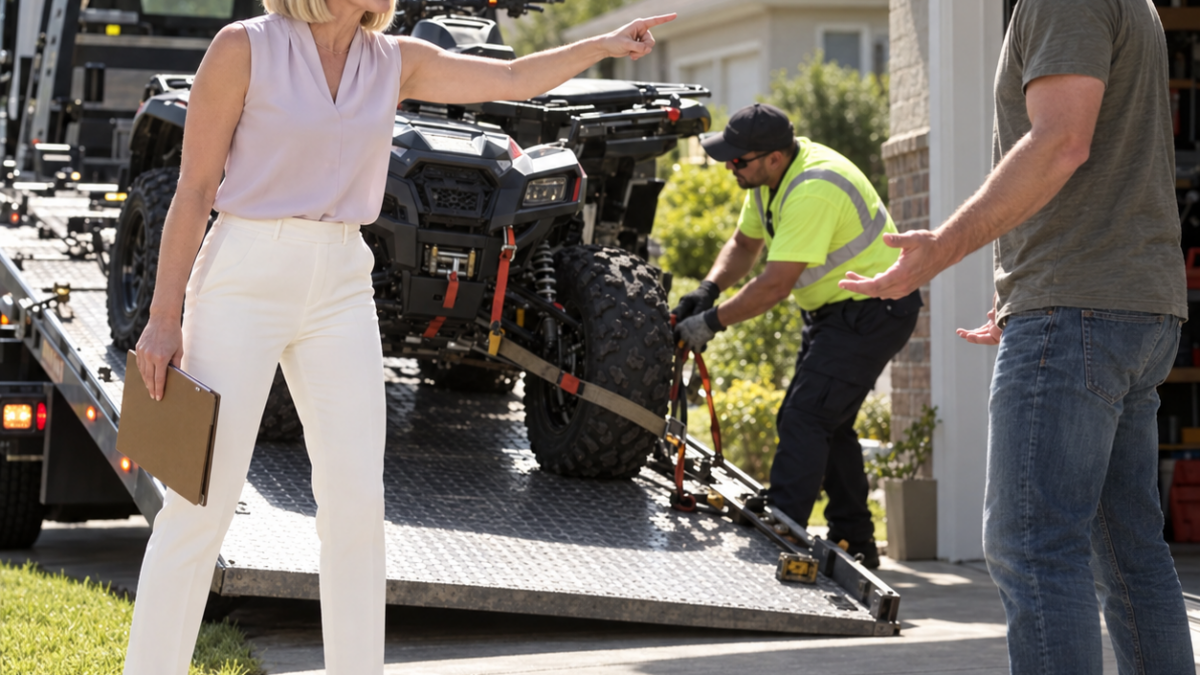
A tow truck was backing into my driveway.
Not near it.
Into it.
All the way toward the carport.
For half a second, I thought someone had the wrong address.
Then I saw the driver.
Big guy.
High-visibility vest stained with grease.
He was already pulling chains from the truck.
Walking toward my ATV.
My stomach dropped.
I stood so quickly the chair fell backward.
By the time I reached the front window, he’d looped a chain toward the axle.
“No way.”
I grabbed my phone.
Ran outside in socks.
“HEY!”
The driver looked over.
“What the hell are you doing?”
He returned to the chain.
“Tow order.”
“Drop it.”
“Take it up with management.”
“What management?”
“Property manager.”
“This is private property.”
He shrugged.
“I got paperwork.”
He started working the hydraulic controls.
I pulled out my phone.
Dialed 911.
“I’m the property owner.”
He glanced at me.
“I own the house and the ATV.”
Still nothing.
“You’re trying to remove my vehicle from my driveway.”
That made him hesitate slightly.
I raised the phone.
“I’m calling police for a theft in progress.”
The dispatcher answered.
I gave my address.
Explained clearly.
A tow company was actively attempting to remove a privately owned ATV from my private driveway without my consent.
Units were being sent.
The driver stopped the winch.
Not completely.
Just paused.
He looked uncomfortable now.
Then I heard a voice across the street.
“I warned you.”
I turned.
Karen.
Of course.
She was walking toward us.
White pencil skirt.
White military-style jacket.
Gold buttons.
Deep neckline.
Large sunglasses.
Clipboard.
And the most satisfied smile I’d ever seen on another human being.
She stopped near the end of my driveway.
“As president, I authorized removal.”
The tow driver looked relieved.
Someone else was claiming responsibility.
I stared at her.
“You ordered this?”
“You were given multiple opportunities to comply.”
“With a rule that doesn’t exist.”
She smiled.
“The vehicle is an ongoing nuisance.”
“No.”
“It has accumulated substantial fines.”
“Fake fines.”
“That’s your opinion.”
“The police are coming.”
Karen laughed.
Actually laughed.
Short.
Sharp.
Confident.
“Let them.”
She adjusted the clipboard beneath her arm.
“The bylaws are on my side.”
I almost admired the certainty.
Almost.
“You failed to remove unauthorized recreational equipment.”
“It’s authorized.”
“No.”
“I’ve read the rules.”
“So have I.”
“Then you know you’re lying.”
Her smile vanished for a second.
“Watch your tone.”
“You sent a tow truck onto my driveway.”
“I’m enforcing compliance.”
“You tried asking for the keys first.”
The driver looked at her.
Then me.
Interesting.
Karen’s eyes flashed.
“That has nothing to do with this.”
“It has everything to do with this.”
She turned toward the tow driver.
“Continue.”
He didn’t.
Good instincts.
He looked at my phone.
Then at Karen.
“Police actually coming?”
“Yes.”
Karen said:
“Don’t worry. I’ll explain.”
That sentence did not comfort him.
He left the chains attached but didn’t lift the ATV farther.
We waited.
Maybe six minutes.
Felt longer.
Then two police cruisers turned onto the street.
Lights.
No sirens.
The neighborhood woke instantly.
Curtains moved.
Doors opened.
People stepped onto porches.
Sam from two houses over appeared holding a coffee mug even though it was ten-thirty in the morning.
Another neighbor came outside with his dog and stopped walking entirely.
Karen straightened.
Smoothed her jacket.
She almost looked excited.
This was it.
In her mind, police had arrived to certify her authority.
Two officers stepped out.
One older.
One younger.
Karen moved toward them before I could.
“Officers.”
She lifted the clipboard.
“Thank goodness.”
The older officer held up a hand.
Karen kept talking.
“I’m the HOA president, and I’m supervising a lawful removal of an unauthorized nuisance vehicle.”
The officer looked at the tow truck.
Then the chains.
Then me standing in socks.
He said:
“Who called?”
“I did.”
I raised my hand.
The officers separated us immediately.
Smart.
The younger officer walked toward me.
The older stayed with Karen.
“Sir, what’s going on?”
“I own the house.”
He nodded.
“I own the ATV.”
“Okay.”
“That woman hired this tow company to remove it from my private driveway because I refused to loan it to her.”
His eyebrows rose.
“Loan it?”
“She wanted it for HOA patrols.”
He looked over at Karen.
Then back.
“I’m serious.”
The tow driver cleared his throat.
“I got a signed authorization.”
The officer turned.
“From who?”
“Property manager.”
“Can I see it?”
The driver went to his cab.
Came back with paperwork clipped together.
The officer read.
His expression changed almost immediately.
He read more carefully.
Looked at the address.
Looked at me.
Looked at Karen.
Then asked:
“Who owns this property?”
“I do.”
“Your name?”
I gave it.
He checked the document.
“Her name isn’t on here as owner.”
“No.”
“Do you know what authority she’s claiming?”
“HOA president.”
The officer’s face did something between confusion and exhaustion.
He walked toward Karen.
We followed several steps behind.
The older officer was already listening to her explain community standards.
The younger held up the tow order.
“Ma’am.”
Karen turned.
“Yes.”
“Did you sign this?”
She barely glanced.
“Yes.”
“Why?”
“I’m president.”
He waited.
She added:
“I’m authorized to remove nuisance property.”
The officer pointed toward my driveway.
“From his private property?”
“He’s inside the association.”
“Does the HOA own the driveway?”
Karen’s expression tightened.
“It’s subject to association governance.”
“That wasn’t my question.”
She glanced toward the neighbors.
Audience growing.
“No.”
The officer continued.
“Does the HOA own the ATV?”
“No, but—”
“Do you have a court order authorizing seizure?”
Karen laughed slightly.
“That isn’t necessary.”
The officer sighed.
Long.
Tired.
The exact sound of a man who had just realized the call was much stupider than dispatch had suggested.
“Ma’am.”
His voice slowed.
“An HOA does not have general authority to remove personal property from a privately owned driveway just because the association president wants it gone.”
Karen’s smile froze.
“You don’t understand the covenants.”
The older officer looked at her.
“I’m familiar with property law.”
“HOA rules supersede ordinary parking regulations inside the development.”
“Not ownership.”
“They can regulate vehicle storage.”
“Maybe.”
That word mattered.
“But that does not automatically give you permission to physically take the vehicle.”
Karen opened her mouth.
The younger officer held up the tow authorization.
“You represented yourself here as having control over the property.”
“I do.”
The driver spoke from behind us.
“No.”
Everybody looked at him.
He was pale.
Actually pale.
He walked closer.
“She told dispatch she controlled the property.”
Karen snapped:
“I said managing authority.”
The driver shook his head.
“No, lady.”
“You misunderstood.”
“I didn’t misunderstand.”
He pointed at the paper.
“You signed the owner authorization.”
Karen stared.
The officer looked at the driver.
“What exactly were you told?”
“That she had legal control of the property and the vehicle was unauthorized.”
“Did you verify the homeowner?”
The driver looked embarrassed.
“We were told the HOA managed the property.”
“That’s not the same thing.”
“I know that now.”
He looked toward the ATV.
“I don’t want any part of this.”
Then he moved.
Fast.
Back up the driveway.
Release.
Chains.
Hooks.
He removed everything from my ATV so quickly it would’ve been impressive if the situation weren’t ridiculous.
Karen marched after him two steps.
“You cannot just leave.”
He turned.
“I absolutely can.”
“This tow is authorized.”
“No.”
The driver pointed at her.
“You lied to my dispatcher.”
“I did not.”
“We record calls.”
That stopped her.
The street went quiet.
He continued.
“We have the call.”
Karen’s face changed.
Red to pale.
Then red again.
She tried:
“I said I was managing authority.”
“You said you had legal control.”
“No.”
“You signed the order.”
“I’m president of—”
“I’m done.”
He threw the chain into the truck.
Climbed into the cab.
The diesel roared.
He backed out.
Then drove away.
Black exhaust.
Gone.
Now Karen stood alone facing two officers.
No tow truck.
No vehicle being removed.
No triumphant enforcement scene.
Just her.
The younger officer held the signed paperwork.
“Ma’am, I’m going to advise you very clearly.”
Karen folded her arms.
“If you enter this property again without permission, you can be cited or arrested for trespassing.”
Her mouth dropped open.
“What?”
“If you attempt to remove this vehicle again without lawful authority, there may be criminal consequences.”
“I’m enforcing bylaws.”
“You’ve been told the limits.”
“This is absurd.”
The older officer said:
“No.”
Calm.
“What would be absurd is treating an HOA office like a law-enforcement agency.”
Karen’s face flushed.
Several neighbors openly stared now.
Someone across the street whispered something.
Another person laughed quietly.
Karen heard.
Her chin lifted.
“I have an entire community to manage.”
The officer said:
“Then manage it within the law.”
She pointed at me.
“He has been deliberately antagonistic.”
I laughed.
“How?”
“You know exactly how.”
“By owning an ATV?”
“You refused legitimate board requests.”
“I refused to lend you my vehicle.”
That got the older officer’s attention.
He looked at her.
“You requested to borrow it?”
Karen snapped:
“That’s irrelevant.”
I said:
“She came to my driveway the day after I bought it and told me to leave the keys in the mailbox so she could use it for patrols.”
The younger officer stared at her.
Karen’s face became crimson.
“It was a community-use request.”
I almost couldn’t believe she admitted it.
The officer said:
“And after he declined, the violation notices started?”
“His refusal and his violations are unrelated.”
“Of course.”
Her tone sharpened.
“They are.”
The officer looked at me.
“Do you have those notices?”
“Every one.”
“Keep them.”
“I intend to.”
Then he told Karen one more time:
“Stay off his property unless invited.”
She didn’t answer.
“Do you understand?”
Her jaw clenched.
“Yes.”
“Good.”
The officers spoke with the tow driver by phone.
Took copies.
Took my statement.
Then left.
Karen remained at the edge of the street for a few seconds.
Neighbors watching.
Nobody supporting her.
That was new.
Her whole system depended on other people assuming she was untouchable.
Now everyone had heard police tell her no.
She turned.
Walked home.
Not slowly.
Power walk.
White heels striking pavement.
Then slammed her front door.
I thanked my neighbors for not turning the whole thing into more drama.
Went inside.
Put shoes on.
And stood in my kitchen staring at the folder of letters.
The situation had changed.
Fake fines were one thing.
Annoying.
Petty.
But ordering someone to physically take my ten-thousand-dollar vehicle from private property?
That was different.
I had spent months ignoring Karen because she wanted a reaction.
Now she had created evidence.
The next morning, I took off work.
Made coffee.
Sat at my desk.
Opened the file.
Every notice.
Every envelope.
Dates.
Fake fine totals.
Paver letter.
Lawn mower complaint.
Porch light nonsense.
ATV storage.
Failure to cooperate.
Everything.
I downloaded the front security camera footage.
Fortunately, my camera covered almost the entire driveway.
Karen standing there.
Tow truck backing in.
Driver attaching chains.
Karen directing the situation.
Police arriving.
Clear enough.
Then I went to the local police precinct.
Not angry.
Prepared.
I met with an officer.
Put the binder on the desk.
“What’s this?”
“About a year’s worth of HOA harassment.”
He looked at the thickness.
“All from one person?”
“President.”
I explained the ATV request.
The refusal.
Then the immediate violation notices.
Then escalating fines.
Then the tow.
I gave him the video.
The signed tow authorization was already part of the responding officers’ report.
The tow company had also provided information about the call.
The officer reviewed everything.
“This is going to take time.”
“I understand.”
“You want to make a formal complaint?”
“Yes.”
Not because I wanted to see Karen destroyed.
Because at that point, if I did nothing, the next escalation could involve someone else’s property.
Or mine again.
She had learned nothing from months of being ignored.
She had learned something from police intervention.
But I didn’t trust her to stop.
The investigation wasn’t instant.
Real life usually isn’t.
Nobody ran to her house that afternoon with handcuffs.
Statements had to be collected.
Documents reviewed.
The tow company contacted.
Association records requested.
Signatures confirmed.
Weeks passed.
Karen became quiet.
Too quiet.
No patrol.
No letters.
No eye contact.
Then one early evening, I was eating dinner when two police cruisers entered the neighborhood.
No sirens.
They stopped in front of Karen’s house.
I knew immediately.
So did everyone else.
Doors opened.
Curtains shifted.
People appeared outside.
I stood on my porch.
Not celebrating.
Watching.
The officers walked to Karen’s door.
Knocked.
She answered.
Even from across the street, I could tell she was angry.
Hands moving.
Pointing.
Then, predictably, she pointed toward my house.
One officer remained calm.
The other spoke.
Karen kept gesturing.
Maybe two minutes.
Then one officer turned her around.
Hands behind her back.
Cuffs.
For the first time in the entire year, Karen looked small.
Not physically.
The costume was still there.
White jacket.
Gold buttons.
Styled blonde hair.
But the title couldn’t help her.
The clipboard couldn’t help her.
The board couldn’t help her.
She was walked to the cruiser.
Placed inside.
Door closed.
They drove away.
The charges were more serious than anything I’d expected when she first measured my driveway pavers.
Attempted theft related to the ATV.
Forgery issues related to the authorization paperwork.
The exact wording changed as attorneys got involved.
I deliberately stayed out of the legal play-by-play.
I wasn’t a prosecutor.
I was the complainant.
The board reacted immediately.
Emergency meeting.
Karen removed as president.
Formal audit.
I attended.
The room was packed.
The vice president, a guy named Martin, opened the meeting looking exhausted.
He didn’t waste time.
“The board has identified significant irregularities in enforcement activity over the previous twelve months.”
Someone behind me said:
“No kidding.”
Martin continued.
“A number of notices and fines appear to have been issued without proper board approval or valid citation to governing documents.”
People started murmuring.
He held up several pages.
“Some violation categories do not exist in the bylaws.”
That triggered laughter.
Not happy laughter.
Angry disbelief.
Then residents started speaking.
One after another.
Driveway color.
Planter size.
Porch lights.
Lawn furniture.
Holiday decorations.
Noise.
Trash lids.
Karen had apparently created entire categories of rules from her imagination.
The management company representative stood near the front looking increasingly uncomfortable.
I raised my hand.
When recognized, I asked:
“How did this go on for a year?”
Silence.
Good question.
The representative answered carefully.
“Individual board officers had a degree of administrative discretion.”
“To invent fines?”
“No.”
“Then who reviewed them?”
Pause.
“That process was insufficient.”
Somebody said:
“That’s corporate language for nobody checked.”
Exactly.
The management company had assumed Karen knew what she was doing.
Residents assumed official-looking letters meant something.
Karen existed in the gap between those assumptions.
The board voted to nullify every unsupported fine she had issued over the previous year.
Including mine.
Not that I had paid any.
But the balance disappeared officially.
They also changed procedures.
No single officer could create a new violation category.
Every citation required a specific bylaw reference.
Tow orders required documented legal authority and management review.
Any seizure or entry involving private property required counsel.
Again:
Rules that should never have needed to be written.
Karen created an entire policy manual simply by being Karen.
For months after, the neighborhood felt different.
Not dramatically.
Lighter.
People stopped looking over their shoulders.
No clipboard moving down the street.
No random warning letters.
No tape measure.
The management company actually sent reminders about real things.
Pool schedule.
Trash collection holiday changes.
Annual dues.
Boring.
I loved boring.
The ATV stayed exactly where it had always been.
Under my carport.
Concrete.
Visible.
Legal.
I kept taking it off-road.
Still waved when I drove through the neighborhood.
Karen, obviously, wasn’t on her porch anymore.
Her legal situation dragged on.
Fines.
Court appearances.
Attorney fees.
I heard different versions from different neighbors.
I didn’t repeat most of them because neighborhood gossip becomes fiction quickly.
What I knew for certain was enough.
She lost the presidency.
Lost the fake enforcement power she cared about.
Faced criminal charges tied to the tow attempt and documents.
And the board formally recognized that her violation campaign had been unauthorized.
That was plenty.
One Saturday, several months later, I was loading the ATV onto my trailer when Sam walked over.
He leaned against the fence.
“You know everybody thought you were crazy.”
“For buying this?”
“For not paying her.”
I laughed.
“Why?”
“Because people were terrified she’d put liens on houses.”
“She couldn’t.”
“We know that now.”
“You could’ve read the bylaws.”
Sam gave me a look.
“Some of us have hobbies.”
“Fair.”
He nodded toward my garage.
“You still have that folder?”
“Yep.”
“How thick?”
I showed him with my fingers.
He laughed.
“That’s what got her.”
“Partly.”
“You planning to keep it forever?”
“I might frame it.”
“The whole folder?”
“Coffee table.”
He laughed again.
Then looked toward Karen’s house.
Quiet.
“For what it’s worth,” he said, “I’m glad somebody finally pushed back.”
“I didn’t push.”
“You refused.”
“Same thing to her.”
He nodded.
Exactly.
That’s what the entire story came down to.
No.
Karen asked for something outrageous.
I said no.
She couldn’t accept it.
Everything after that was escalation designed to make the original no disappear.
If she’d shrugged and walked away, nothing happens.
If she’d simply thought I was selfish, fine.
If she’d complained privately that I lacked community spirit, who cares?
But she needed obedience.
Not the ATV.
Obedience.
The ATV was just the object.
Her real problem was that she told me:
Leave the keys.
And I said:
No.
Then she tried paper.
No.
Money.
No.
Pressure.
No.
Tow truck.
Still no.
By then she’d crossed from petty authoritarian behavior into actual criminal territory.
That’s how dangerous people become when nobody has ever taught them the difference between authority and desire.
Karen did have power.
Real HOA power.
She could call meetings.
Vote.
Send legitimate notices.
Administer actual rules.
Help manage common property.
Work with management.
That’s enough responsibility to keep most normal people busy.
But Karen didn’t want limited power.
She wanted personal command.
She wanted residents to respond to her preferences as though they were statutes.
The bylaws became a costume.
Like the white military jackets.
Gold buttons.
Clipboard.
Everything designed to suggest more authority than existed.
The funniest part?
Actual authority was much less theatrical.
The police officers didn’t carry clipboards like swords.
They didn’t shout.
Didn’t brag.
Didn’t call themselves important.
They asked simple questions.
Who owns the house?
Me.
Who owns the ATV?
Me.
Was it on private property?
Yes.
Was there a court order?
No.
Did Karen have consent?
No.
That was it.
Real authority doesn’t need imagination.
It needs facts.
After the incident, I started attending more HOA meetings.
Not because I suddenly loved them.
I don’t.
Nobody should love HOA meetings.
But I realized that absent residents create space for people like Karen.
Most of us had treated the board as something that existed in the background.
Pay dues.
Vote occasionally.
Ignore.
Karen attended everything.
Volunteered.
Positioned herself.
Learned that most people didn’t care enough to challenge procedure.
That gave her room.
The next president was Martin.
Very different.
He wore polo shirts.
Regular ones.
No military gold buttons.
First meeting after his election, he said:
“My goal is for everyone to forget I’m president.”
Perfect.
He kept that promise.
The HOA focused on common areas.
Landscaping.
Pool maintenance.
Real violations.
When somebody parked a broken truck on the grass for three months, they handled it properly.
Written citation.
Actual bylaw section.
Chance to respond.
No drama.
When I later built a small storage shed, I submitted the architectural form.
Approval took four days.
Done.
That’s how a functioning association works.
Rules.
Process.
Limits.
People sometimes ask whether I regret not reporting Karen earlier.
Maybe.
That’s fair criticism.
I had the fake letters for months.
I could’ve gone to the management company sooner.
Could’ve brought them to a board meeting.
Could’ve challenged each one.
Maybe the tow attempt never happens.
Maybe.
But people underestimate how exhausting constant petty conflict becomes.
I had a job.
A life.
Weekends.
Friends.
I didn’t want an HOA battle as a second career.
Each letter was absurd enough to ignore.
Twenty-five dollars.
Fifty.
Another fake rule.
I knew I didn’t owe it.
So I filed it.
Moved on.
That’s exactly how Karen survived so long.
Everyone made the same calculation.
Not worth the time.
When forty people independently decide an abusive person isn’t worth fighting, that abusive person experiences forty victories.
Karen mistook those victories for legitimacy.
The ATV changed the equation because she stopped asking for time.
She tried taking property.
That’s concrete.
Easy to explain.
Tow truck.
Chains.
Private driveway.
Signed order.
Camera footage.
Suddenly the pattern wasn’t a dozen annoying stories.
It was evidence.
That’s another thing I learned.
Patterns become visible when documented.
One fake fine looks stupid.
Thirty fake fines tell a story.
One confrontational conversation becomes my word against hers.
Months of dated letters create a timeline.
Then add video.
Tow documents.
Recorded dispatch call.
Police report.
Now confidence doesn’t matter.
Evidence does.
The tow company eventually contacted me.
Their manager apologized.
Apparently the driver had followed an authorization process that should have been verified more carefully.
They changed internal procedures too.
No private-property HOA tow without proof of ownership authority or appropriate legal documentation.
The driver himself came by once.
I was outside.
Tow truck stopped near the curb.
Different day.
Different call.
He recognized me.
Rolled the window down.
“Hey.”
“Hey.”
“Your lady still around?”
I laughed.
“Not president.”
“Good.”
He shook his head.
“She almost got me arrested.”
“You almost took my ATV.”
“Fair.”
He looked embarrassed.
“Sorry about that.”
“Accepted.”
Then he said:
“For what it’s worth, soon as I heard her tell the cop she was president, I knew something was wrong.”
“You didn’t know before?”
“People tell us all kinds of stuff.”
“Maybe verify next time.”
“We do now.”
He waved.
Drove away.
The ATV became famous.
Not famous famous.
Neighborhood famous.
People walking by would joke:
“Community vehicle available today?”
Or:
“Karen’s patrol starting soon?”
At first I laughed.
Then eventually the jokes faded.
Which was good.
I wanted the machine to go back to being an ATV.
Not evidence.
Not symbol.
Just something I’d bought because riding trails made me happy.
One autumn weekend, I took it out to a state recreation area with two friends.
Mud everywhere.
Cold air.
Leaves turning.
We rode for hours.
At one point, we stopped on a ridge.
My friend Jake looked at the ATV.
“This is the one?”
“The criminal ATV.”
He laughed.
“Does it feel different?”
“No.”
“After all that?”
“It’s a Polaris.”
“Deep.”
I sat on the seat.
Looked across the trail.
Then realized that was exactly what I’d wanted from the beginning.
Ordinary ownership.
I bought something.
I use it.
I maintain it.
Nobody else gets to decide they’re entitled to it because they have a title.
Simple.
Karen had made simple ownership complicated.
The law eventually simplified it again.
Mine.
Not hers.
Years later, I still have the folder.
Moved from my desk to a storage box.
I don’t look at it often.
Sometimes, when cleaning, I see Karen’s first ATV notice.
The invented rule about unlicensed recreational off-road vehicles.
I still remember opening it.
Still remember thinking:
She’s trying to scare me.
At the time, I didn’t know how far she’d go.
The fines.
The letters.
Tow truck.
Police.
Charges.
Removal.
All because she couldn’t handle the word no.
People like to say power corrupts.
Maybe.
I think sometimes power reveals.
Give someone a tiny position and watch what they think it permits.
Most people become HOA president and think:
Great, I need to approve a landscaping budget.
Karen became HOA president and thought:
Every driveway belongs to me.
Every lawn.
Every porch light.
Every planter.
Every recreational vehicle.
Every resident.
The position didn’t create that mindset.
It gave it a badge-shaped excuse.
Except the badge wasn’t real.
That’s why the day with the police mattered so much.
I still remember Karen standing near the driveway, arms folded, white jacket perfect, sunglasses reflecting the patrol cars.
She looked certain.
Utterly certain.
Then the officer said:
“You cannot order personal property removed from a privately owned driveway.”
You could almost watch the mythology break.
Not just for her.
For the neighbors.
They heard it too.
Karen’s authority had a boundary.
The boundary was real.
She had simply spent a year pretending it wasn’t.
Once everybody saw the line, she could never fully regain that power.
Even before the arrest, the atmosphere changed.
Residents started asking for bylaw numbers.
Asked management to review notices.
Demanded board votes.
One person showed up at a meeting with three of Karen’s letters and asked:
“Which of these rules actually exist?”
Two didn’t.
That’s when the tide had already turned.
The tow truck just made the rest unavoidable.
Would I buy another house in an HOA?
Maybe.
People expect me to say absolutely not.
But the truth is more complicated.
Our HOA after Karen was fine.
The documents were fine.
The neighborhood was fine.
The problem was oversight.
A system that lets one personality act unchecked long enough becomes that personality.
You need process.
Transparency.
Residents willing to participate.
A management company that reviews what board officers are doing.
If everyone treats the association like background noise, the loudest person eventually gets the microphone.
Karen had held it too long.
When she finally lost it, neighborhood life became boring again.
Which is exactly what suburban governance should be.
Boring.
Painfully boring.
A forty-five-minute debate about mulch should be the worst thing that happens.
Not a tow truck trying to steal your ATV.
One evening, maybe a year after everything, Martin hosted a neighborhood barbecue near the common pool.
I went.
So did most people.
Kids swimming.
Burgers.
Music.
Normal.
At one point, Sam walked over holding a paper plate.
“Look.”
He pointed toward the parking area.
My ATV was on the trailer behind my truck because I’d been riding that morning.
I looked.
“What?”
“No tow truck.”
“Progress.”
“Want me to borrow it for neighborhood patrol?”
I stared at him.
He immediately held up both hands.
“Too soon.”
I laughed.
“Way too soon.”
Later, as I drove home, I passed Karen’s old house.
Someone else lived there by then.
Different family.
Kids’ bicycles in the driveway.
Porch light probably brighter than mine had ever been.
Blue planter beside the steps.
I smiled.
Not because Karen had suffered.
Not because she’d been arrested.
Not because she’d lost her position.
Because all those ordinary things existed without someone measuring them.
That’s what we’d been fighting for without realizing it.
Not lawlessness.
Normal life.
You can have rules without turning neighbors into subjects.
You can care about property values without believing the entire neighborhood belongs to you.
You can serve on a board without imagining the word president converts private property into shared assets.
Karen never learned that distinction voluntarily.
Eventually, police taught her.
I still own the ATV.
Still park it under the carport.
Still visible from the street.
Still legal.
And every time I see the keys hanging on the hook inside my house, I remember the first day Karen looked at the machine, smiled, and told me to leave them in the mailbox.
Like ownership was a minor technicality.
Like saying no wasn’t an option.
She was wrong about both.
The ATV was never a community asset.
The driveway was never her impound lot.
Her clipboard was never a warrant.
And HOA president was never another word for police officer.
All I had to do was keep saying no long enough for everyone else to see it too.