𝗙𝗨𝗟𝗟 𝗦𝗧𝗢𝗥𝗬 The HOA President Tried to Drive Me Out of My First Home, but She Never Expected Me to Fight Back
𝗣𝗔𝗥𝗧 𝟮
There was a pause.
“Yes, sir.”
Something about her voice told me this wasn’t the first ridiculous conversation she’d had that day.
I thanked her and hung up.
Then I retrieved the original warning from the recycling bin, cleaned it off, and started collecting evidence.
Weather reports.
Photographs of neighboring lawns.
The HOA’s written restrictions.
Pictures showing exactly where the trash cans sat.
I wasn’t going to pay two hundred dollars without a fight.
The annual meeting took place in the back room of a local community center.
I arrived early, wearing jeans and a clean button-down shirt, carrying a folder full of documents.
I expected a quiet administrative gathering.
Instead, I walked into a room full of angry homeowners.
People stood in small groups comparing violation notices.
One man had been fined because his children left a basketball on the driveway.
A woman had received a warning because her mailbox post was allegedly the wrong shade of white.
Another homeowner was upset about being cited for leaving a garden hose visible beside his garage.
I listened in disbelief.
“Did anybody appeal?” I asked.
A gray-haired man nodded.
“Sure. You can appeal all you want.”
“What happened?”
“They denied it.”
“On what grounds?”
He gave a bitter laugh.
“Whatever grounds they felt like.”
I began to understand what my neighbor had meant.
Near the front of the room stood Karen.
I didn’t know who she was until someone pointed her out.
She was impossible to miss.
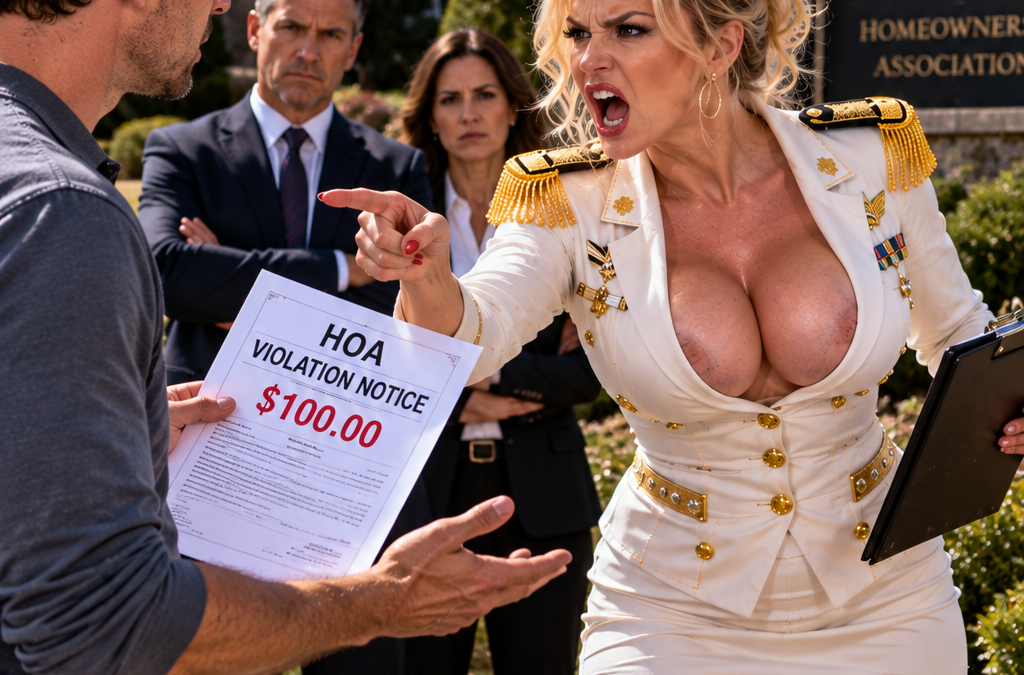
Her white military-style uniform seemed almost luminous beneath the community center’s fluorescent lights. Gold buttons ran down the fitted jacket, its plunging neckline displaying her ample cleavage, and her blonde hair fell in smooth waves over her shoulders.
She wore red lipstick and expensive-looking heels.
A small HOA president’s badge was pinned to her jacket.
She was speaking animatedly to two older homeowners, smiling and laughing while gesturing with a pen.
When I approached, she looked me over.
Her smile became noticeably smaller.
“Can I help you?”
I extended my hand.
“Hi. I’m new to the neighborhood. I wanted to ask about appealing a couple of fines.”
She didn’t shake it.
Instead, she looked at my folder.
“What violations?”
“My lawn and trash cans.”
“What’s wrong with your lawn?”
“It’s brown.”
Her eyebrows rose.
“That sounds like poor maintenance.”
“It’s winter.”
“Winter doesn’t eliminate homeowner responsibilities.”
I stared at her.
“The grass is dormant. Nearly every house in the subdivision has the same thing.”
Karen’s expression hardened.
“Young people like you are exactly why I joined this board.”
“Excuse me?”
“You buy houses, but you don’t understand the responsibility that comes with ownership.”
I felt heat rising in my face.
“I maintain my property.”
“Then you shouldn’t be receiving violations.”
“That assumes the violations are reasonable.”
She stepped closer.
“Be careful how you speak to me.”
I looked at her badge.
Then back at her face.
“I’m asking for clarification.”
“And I’m telling you to become a better homeowner.”
She turned away as though the conversation was finished.
I stood there with my hand still halfway extended.
I’d worked hard to buy that house.
I’d paid my bills.
I’d spent weekends making repairs.
And this woman, who knew absolutely nothing about me, had just spoken as though I were a delinquent child.
That was the moment I stopped thinking about the fine as an inconvenience.
Karen hadn’t simply made an unreasonable decision.
She enjoyed making it.
A few minutes later, the meeting began.
Five board members sat behind folding tables at the front of the room.
Karen took the center seat.
Naturally.
She spoke about community standards, property values, and the importance of consistent rule enforcement.
She delivered every sentence as though she were addressing a military tribunal.
Then the moderator announced that three of the five board seats were up for election.
Existing candidates were introduced.
Homeowners were reminded that additional nominations could be made.
And suddenly, an idea occurred to me.
I’d come to the meeting hoping to convince the board to cancel two fines.
But what if the real problem wasn’t the fines?
What if the problem was the people deciding them?
I looked around the room.
There were dozens of angry homeowners.
People who clearly disliked the way the association operated.
But most of them seemed resigned to complaining and then going home.
Karen, meanwhile, had supporters who attended every meeting.
They knew the procedures.
They knew the voting process.
And they were comfortable because they assumed nothing would change.
I thought about my neighbor’s warning.
Then I raised my hand.
“I’d like to nominate myself.”
Karen stopped writing.
Her head came up slowly.
“You’re nominating yourself?”
“Yes.”
She gave a little laugh.
“Have you even lived here a full year?”
“No.”
“Then perhaps you should spend some time learning how the community operates before trying to run it.”
The moderator checked the governing documents.
“He is an eligible homeowner.”
Karen’s smile tightened.
I stood.
My heart was pounding.
I hadn’t prepared a speech.
I hadn’t even imagined running for the board when I walked through the door.
But I knew exactly what I wanted to say.
“I bought my first home here because this neighborhood seemed affordable and welcoming,” I began. “I liked the reasonable dues and the relatively simple rules.”
A few people nodded.
“But after moving in, I’ve discovered that a lot of homeowners feel like they’re being punished for ordinary things.”
Karen shifted in her chair.
I continued.
“I don’t think a homeowners association should exist to collect fines. I think it should maintain shared property, protect legitimate community interests, and help neighbors solve problems.”
Someone in the back murmured, “Exactly.”
“We should be focused on property values, financial responsibility, and reasonable standards. Not penalizing people because their grass goes dormant in February.”
A few homeowners laughed.
Karen didn’t.
I took a breath.
“If elected, I’ll listen to residents. I’ll read the rules carefully. And I’ll do my best to make sure those rules are applied fairly.”
It wasn’t a brilliant speech.
I didn’t have a campaign slogan.
I didn’t have endorsements.
But I meant every word.
When the votes were counted, I barely won one of the available seats.
Barely.
I remember staring at the result, almost unable to believe it.
Karen looked as though someone had served her spoiled milk.
One of her longtime allies leaned toward her and whispered something.
She didn’t answer.
I had walked into that room as a homeowner disputing a fine.
I was leaving as a member of the board.
But before leaving, I still had to deal with the appeal.
I presented my photographs, weather records, and the exact wording of the neighborhood restrictions.
The trash-can violation was eventually waived.
Apparently, even Karen’s allies had difficulty defending a hundred-dollar penalty over a container extending twelve inches beyond a side wall.
The lawn was another matter.
I explained that the grass had been dormant.
Karen pointed to a clause concerning weeds.
She claimed a small patch in the corner of my yard had turned yellow because I’d treated it with weed killer.
And because the restriction addressed the condition of vegetation, she argued the violation remained valid.
I was stunned.
“So you’re fining me because I treated weeds?”
“You’re being fined for the condition of your lawn,” she replied.
“Which I was trying to improve.”
“Intentions don’t override standards.”
The board upheld the fine.
I lost a hundred dollars.
I paid it.
But when I wrote the check, I made myself a promise.
I wasn’t going to let Karen continue treating this neighborhood like her personal kingdom.
Not if there was something I could do about it.
My first board meeting took place two weeks later.
Karen sat at the head of the conference table in her usual white uniform.
She had a leather binder, a neatly arranged stack of papers, and a little brass desk nameplate identifying her as president.
I couldn’t help noticing that nobody else had a nameplate.
She welcomed me with a smile so artificial it almost looked painful.
“Congratulations on your election.”
“Thank you.”
“I hope you understand that board service involves much more than complaining about fines.”
“I understand.”
“We have procedures.”
“Good. I like procedures.”
Her eyes narrowed slightly.
I was appointed secretary.
That meant recording meeting minutes, reviewing correspondence, and helping maintain association records.
It wasn’t a glamorous position.
But it gave me access to the association’s internal operations.
And I intended to pay attention.
Almost immediately, Karen informed me that I wouldn’t be allowed to propose new policies.
“You may vote on measures brought forward by the president or vice president,” she said, “but policy proposals are reserved for senior board leadership.”
I looked down at the governing documents in front of me.
“I don’t remember reading that.”
“It’s established practice.”
“Is it in the bylaws?”
Karen smiled.
“You’re new. I’d advise you not to challenge procedures you don’t understand.”
I didn’t argue.
Not then.
But later, I checked.
The restriction she described wasn’t supported by our governing rules.
Karen had simply decided that new board members shouldn’t be permitted to challenge her agenda.
It was an early lesson in how she operated.
She didn’t necessarily need a legitimate rule.
She only needed people to believe one existed.
During the next several meetings, I watched carefully.
Karen dominated discussions.
She interrupted anyone who disagreed.
She treated requests for documentation as personal attacks.
And she routinely described the neighborhood as though it belonged to her.
“I’ve built this community into what it is,” she said once.
I looked around the room.
We were discussing whether residents should be fined for decorative planters.
I wondered how much community building was actually happening.
Karen proposed stricter enforcement policies.
I voted against them whenever I reasonably could.
She wanted increased penalties for repeated landscaping violations.
No.
She wanted tighter restrictions on driveway storage.
No.
She wanted additional approval requirements for minor exterior changes.
Again, no.
At first, my votes didn’t matter.
Her allies supported her.
The other members seemed more interested in ending meetings than debating her proposals.
Three votes against two.
Sometimes four against one.
Karen usually got what she wanted.
And whenever I disagreed, she gave me the same patronizing smile.
“You’re learning,” she’d say.
I didn’t respond.
Because I was learning.
Just not what she thought.
I was learning who followed her automatically.
Who disliked confrontation.
Who cared about reputation.
And who might eventually be willing to change sides.
I also learned that replacing Karen wouldn’t be as simple as giving another speech.
She had a dependable group of older homeowners who attended meetings and voted for her preferred candidates.
Many younger residents didn’t participate at all.
Some couldn’t attend because of work.
Others assumed their vote wouldn’t matter.
Karen’s supporters weren’t necessarily the majority of the subdivision.
They were simply the people who showed up.
That was her greatest advantage.
And I knew I had to take it away.
I talked to my next-door neighbor.
We sat on his back patio one Saturday evening.
I explained what I’d seen inside the board meetings.
He listened without interrupting.
When I finished, he shook his head.
“Sounds worse than I thought.”
“She controls every vote.”
“Because the same people always show up.”
“Exactly.”
He looked at me.
“So what are you thinking?”
“Proxy votes.”
He smiled slowly.
“Now you’re talking.”
Under the association’s rules, eligible homeowners who couldn’t attend meetings could authorize another person to vote on their behalf.
Most residents didn’t know that.
Some had never even attended an annual meeting.
We decided to change that.
Over the following months, we went door to door.
Weekend after weekend.
Street after street.
The southern summer heat was miserable.
Some afternoons, the pavement shimmered.
My shirt stuck to my back.
I drank more bottled water than I thought physically possible.
But we kept knocking.
We introduced ourselves.
Explained the board election process.
Asked homeowners what they thought about the HOA.
And, most importantly, listened.
That last part mattered.
People had stories.
One father showed us a violation notice issued because his young son had left a basketball in the driveway.
The ball had been there for approximately two hours.
A retired woman described receiving a warning because her curtains were visible through the front window and weren’t white.
Another homeowner had been threatened with fines over a garden hose.
Someone else complained about the board demanding expensive landscaping changes while neglecting common-area maintenance.
Nearly everyone had a grievance.
But very few believed their opinions could change anything.
“Karen runs that board,” one woman told us.
“Only because people keep letting her,” I replied.
An older man shook his head.
“I can’t sit through those meetings anymore. My knees won’t take it.”
“You don’t have to.”
He looked surprised.
I explained the proxy process.
He read the form.
Then signed it.
A younger couple said they both worked evenings and couldn’t attend.
We helped them understand how they could participate through authorized proxy voting.
A retired homeowner told us she’d stopped going to meetings after Karen publicly embarrassed her over a flower bed.
She signed, too.
By the end of the summer, we had a substantial stack of valid proxy authorizations.
For the first time, Karen’s dependable voting bloc wasn’t guaranteed to control the outcome.
My neighbor and I didn’t celebrate prematurely.
We understood that changing the board would take patience.
And I was still only one vote out of five.
Then Karen’s allies began making mistakes.
The first opportunity came during a regular board discussion.
One of Karen’s closest supporters, a woman who almost never questioned her, brought up a proposed landscaping restriction.
She wanted homeowners prohibited from planting flowers that weren’t neutral in color.
At first, I thought I’d misunderstood.
“Neutral flowers?”
She nodded.
“Yes. White, cream, pale yellow. Colors that don’t interfere with the neighborhood’s appearance.”
I stared at her.
“You’re proposing to fine people for planting colorful flowers?”
“Bright colors can be distracting.”
“Flowers?”
Karen leaned forward.
“It’s about maintaining a consistent aesthetic.”
I looked between them.
“You’re talking about somebody’s garden.”
The board member folded her arms.
“Some homeowners have no taste.”
As the discussion continued, the reason for her proposal became obvious.
She had a personal disagreement with a neighbor who liked vibrant flowers.
Turquoise-colored decorative arrangements had apparently become a particular source of irritation.
The board member wanted to transform her private dislike into an enforceable neighborhood rule.
I could hardly believe it.
But Karen seemed perfectly comfortable with the idea.
After the meeting, I started a written discussion with the other board members.
I asked them to explain the purpose of the proposed restriction.
What legitimate community interest would it protect?
What actual harm were colorful flowers causing?
Why was the board considering a rule apparently designed to target one specific resident?
Two members initially defended the idea.
One argued that consistency protected property values.
Another said the association needed broad discretion over exterior appearance.
I pushed back.
I asked for examples.
Evidence.
Actual complaints.
There weren’t any convincing answers.
Eventually, the discussion shifted.
Even some members who had supported Karen began acknowledging that the proposal went too far.
I then posted a detailed message in the board’s main communication channel.
I explained why using association authority to punish a neighbor over a personal preference was inappropriate.
I argued that the board member’s conduct raised serious concerns about her judgment and suitability to serve.
And I called for the matter to be addressed formally.
She exploded.
The response arrived almost immediately.
She accused me of disrespect.
Claimed I was undermining the board.
Said I didn’t understand the sacrifices she had made for the community.
Karen rushed to her defense.
But this time, the discussion had been documented.
The proposed restriction was there in writing.
The personal motivation was difficult to ignore.
And the other board members could see exactly what had happened.
I requested a formal board session the following week.
The atmosphere was tense.
Karen sat rigidly at the head of the table.
Her ally looked close to tears.
“This neighborhood is my life,” the woman said.
Nobody interrupted.
“I’ve given years to this community. I care about it like it’s my own child.”
I felt a flicker of sympathy.
But then I remembered the homeowners who had been fined or threatened simply because someone in authority disliked their choices.
Caring about a neighborhood didn’t mean owning everyone else’s decisions.
When the matter went to a vote, the other four board members supported removing her under the board’s applicable procedures.
She was out.
Karen stared at the result.
For once, her carefully controlled expression failed.
“You people are making a terrible mistake.”
I remained quiet.
The first member of her inner circle was gone.
My next-door neighbor agreed to fill the vacancy through the association’s established replacement process.
When he took his seat, Karen looked at him.
Then at me.
She understood exactly what had happened.
Her voice was icy.
“How convenient.”
My neighbor smiled.
“Happy to serve.”
For the first time, I wasn’t alone at that table.
But Karen still had two dependable allies.
The treasurer and another director.
Neither seemed particularly passionate about the HOA’s policies.
They mostly followed Karen because doing so was easier than challenging her.
And that made them vulnerable to something Karen couldn’t control.
Public opinion.
By then, I had realized that most homeowners had little idea which board members were supporting the rules that affected their lives.
People complained about “the HOA” as though it were a faceless machine.
Karen encouraged that perception.
It allowed her to present herself as the authority while avoiding accountability for particular decisions.
I wanted residents to start asking individual board members questions.
I also made a decision I’m not especially proud of.
I created an anonymous account on a neighborhood discussion app.
Rather than publicly identifying myself as a board member, I used that account to respond when homeowners complained about violations.
As the spring enforcement notices began arriving, angry messages appeared throughout the app.
People posted photographs of violation letters.
They complained about landscaping citations.
Mailbox regulations.
Small decorative items.
Rules that seemed designed to extract fines rather than solve problems.
I replied to those complaints.
I named the treasurer and the other director as people homeowners should question about the board’s policies.
I encouraged residents to attend the next meeting and demand answers.
The information about their positions was real.
But I knew the situation was more complicated.
Karen was the driving force behind most of those policies.
The other two had supported them, often without much thought.
I was deliberately directing public pressure toward people I believed would break under it.
I told myself it was necessary.
Maybe it was.
But looking back, I can admit that anonymous manipulation isn’t the same thing as transparent leadership.
At the time, I was focused on removing the people who kept Karen in power.
And the strategy worked far better than I expected.
More than fifty angry homeowners showed up at the next meeting.
The room was packed.
People stood along the walls.
Others crowded near the doorway.
The treasurer looked visibly uncomfortable.
The director kept rearranging papers in front of him.
Karen, of course, tried to take control.
“Everyone will have an opportunity to speak,” she announced. “But I will not tolerate disorder.”
A homeowner near the front stood.
“Why are we being fined for things that aren’t hurting anybody?”
Karen began answering.
But the homeowner interrupted.
“I’m asking the treasurer.”
Karen frowned.
Another resident stood.
“I want to know why the board keeps approving these ridiculous policies.”
The director shifted.
“We follow the community’s governing documents.”
“Then explain the basketball fine.”
Someone else shouted about mailbox paint.
Another complained about a garden hose.
For nearly an hour, the treasurer and director faced questions they weren’t prepared to answer.
Karen repeatedly tried to defend them.
But every time she spoke, another homeowner demanded an explanation from the individuals who had voted for the policies.
The two board members looked increasingly miserable.
I watched them realize something important.
Karen’s position might protect Karen.
But it wasn’t protecting them.
At the end of the meeting, the treasurer looked pale.
The director seemed exhausted.
I approached them afterward.
“You know,” I said quietly, “you don’t have to keep doing this.”
The treasurer looked at me.
“What?”
“Serving on the board. If it’s becoming too stressful, there’s nothing wrong with stepping away.”
The director gave a bitter laugh.
“Easy for you to say.”
“Maybe. But homeowners are going to keep asking questions.”
Neither answered.
Within a short time, both resigned.
Just like that, Karen had lost two more allies.
The vacancies were filled through the association’s procedures, and the board’s balance shifted decisively.
Four members now favored rolling back the unreasonable enforcement culture.
Karen was the fifth.
The transformation was extraordinary.
A few months earlier, she had controlled nearly every decision.
Now she couldn’t pass a policy without convincing people who had no intention of automatically agreeing with her.
And she hated it.
At the next meeting, Karen proposed increasing certain violation penalties.
I voted no.
My neighbor voted no.
The others voted no.
The measure failed.
She proposed additional restrictions on lawn ornaments.
No.
She wanted tighter standards for exterior decorations.
No again.
Every defeat made her angrier.
Her smile vanished more frequently.
Her voice became sharper.
Sometimes she stopped bothering to hide her contempt.
“You are all destroying the standards I’ve spent years building,” she snapped during one meeting.
My neighbor leaned back.
“Then maybe those standards needed changing.”
Karen pointed at him.
“Don’t lecture me about this community.”
I spoke calmly.
“Karen, residents elected us to represent them.”
“They elected me, too.”
“Yes. And they didn’t elect you to make every decision alone.”
Her face turned red.
“I built this neighborhood.”
I looked around the room.
“No. The homeowners did.”
She slammed her folder shut.
For a moment, I thought she might walk out.
But she stayed.
That was the problem.
We had taken away much of her power, but Karen had no intention of resigning.
Her identity seemed tied to the title.
President.
She enjoyed the recognition.
The ability to summon meetings.
The authority to speak on behalf of the neighborhood.
And the satisfaction of making other people uncomfortable.
Losing votes frustrated her.
Losing the presidency would have humiliated her.
So she held on.
We tried to encourage her to step aside.
We discussed governance reforms.
We challenged questionable procedures.
We made it clear that her old methods weren’t acceptable anymore.
Nothing worked.
Karen remained stubbornly attached to the chair at the head of the table.
Then, several months later, we changed management companies.
That decision wasn’t primarily about Karen.
The existing company had been expensive and frustrating to work with.
Its records were poorly organized.
Financial information took too long to obtain.
Violation histories were difficult to review.
And whenever we requested detailed explanations, somebody always needed another week.
The new company offered better service, more transparent reporting, and a website where authorized board members could review association records.
There were automated financial summaries.
Property account histories.
Assessment balances.
Outstanding violations.
For a secretary responsible for maintaining accurate records, it was a major improvement.
At our first orientation, the new management representative demonstrated the system.
She showed us how to search property accounts.
Review payments.
Identify overdue balances.
And generate reports.
I remember thinking that this was how a homeowners association should have operated all along.
Then we received our first comprehensive delinquency report.
I opened it at home.
At first, I scanned the numbers without much interest.
A few small overdue amounts.
Late fees.
Outstanding balances.
Nothing particularly surprising.
Then I saw an address I recognized.
Karen’s.
I stopped scrolling.
Her account showed a balance so large that I assumed something had gone wrong during the records transfer.
I looked again.
Over twenty thousand dollars.
I sat back.
That couldn’t be right.
Karen Whitmore, the woman who fined people for the wrong-colored flowers, owed more than twenty thousand dollars to the very association she claimed to protect?
I checked the address.
It was hers.
The property identification matched.
The balance appeared in the system.
I called the management company the next morning.
“There must be an error,” I said.
The representative asked which account I was reviewing.
I gave her the information.
There was a pause.
“Actually, we’ve been reviewing that one.”
My pulse quickened.
“What did you find?”
“We’re still reconciling the historical records, but there are some significant unpaid charges.”
“How significant?”
She hesitated.
“I think we should provide the board with a formal breakdown.”
I agreed.
Then I called my neighbor.
“You’re not going to believe this.”
“What?”
“Karen owes the HOA money.”
He laughed.
“How much? Two hundred bucks?”
I looked at the report.
“Try twenty-one thousand.”
He went silent.
Then he said, “You’re kidding.”
“I wish I were.”
Over the next several days, we reviewed the records with the new management company.
The truth was even more extraordinary than the initial balance suggested.
Years earlier, the HOA had imposed a mandatory special assessment to repave the subdivision’s private roads.
The amount was five thousand dollars per homeowner.
It had been controversial.
Families had struggled to pay it.
Some residents had needed payment plans.
Others had dipped into savings.
Karen had insisted the assessment was necessary.
According to meeting records, she had pushed aggressively for it.
She’d argued that maintaining the roads was essential to property values.
She’d criticized homeowners who complained about the cost.
And she’d reminded everyone that community obligations were not optional.
There was only one problem.
Karen hadn’t paid her own assessment.
Not one cent of it.
Instead, someone at the previous management company had marked her account with a special designation.
Board exempt.
I stared at those words on the screen.
There was no legitimate blanket exemption for the HOA president.
Board members were homeowners.
They were responsible for assessments just like everyone else.
Yet Karen had apparently enjoyed years of special treatment while demanding strict compliance from everybody around her.
The unpaid assessment was five thousand dollars.
Late charges had added another twelve hundred fifty.
But that wasn’t the largest problem.
Behind Karen’s house stood a detached garage and workshop.
I’d seen it from the street.
It was enormous.
Far larger than a typical residential outbuilding.
The structure sat extremely close to the property line, violating the neighborhood’s setback requirements.
And there was no properly approved authorization for it in the records.
The structure had generated violations years earlier.
But those violations had never been collected.
Instead, the previous management company had effectively buried them.
The accumulated charges had continued growing according to the association’s recorded enforcement history.
Six years of ignored violations.
Six years of unpaid penalties.
Six years of the woman who lectured everybody about rules avoiding the consequences of her own.
The formal breakdown arrived the following week.
I printed it and spread the pages across my dining room table.
The numbers were unmistakable.
Unpaid mandatory road assessment: $5,000.
Accrued late fees: $1,250.
Outstanding charges tied to the unpermitted garage and setback violations: $14,600.
Administrative and collection processing: $450.
Total outstanding balance: $21,300.
I stared at the final number.
Twenty-one thousand three hundred dollars.
The woman who had called me an irresponsible young homeowner because my winter grass was yellow had been hiding a debt large enough to buy a decent used car.
I felt anger first.
Then disbelief.
Then something colder.
For months, I’d watched Karen punish people for small infractions.
I’d seen neighbors worry about a hundred-dollar fine.
I’d heard retirees complain about unexpected penalties.
I’d watched her humiliate homeowners who questioned the rules.
All that time, she had been violating those same rules on a scale none of us imagined.
I called my neighbor.
“We need to meet.”
He came over that evening.
We went through the records together.
He read the report slowly.
Then he looked up.
“She’s been doing this for years?”
“Apparently.”
“And the old management company knew?”
“That’s what the records suggest.”
He leaned back.
“Unbelievable.”
I tapped the page.
“Remember when she told me I didn’t know how to maintain property?”
He gave a humorless laugh.
“Yeah.”
“She owes the association twenty-one thousand dollars.”
My neighbor stared at the number.
Then his expression became serious.
“What are you thinking?”
I didn’t answer immediately.
Because I’d started reading the governing documents again.
And I had found something Karen probably never expected anyone to use against her.
Under the association’s rules and the applicable legal process, significant delinquent obligations could support lien enforcement and, where legally permitted, foreclosure proceedings.
The possibility disturbed me.
I had always thought HOA foreclosure powers were excessive.
Losing a home over association debt seemed like an extreme consequence.
Especially in a neighborhood where residents could be fined for minor issues.
But Karen wasn’t facing one disputed hundred-dollar charge.
She had a long history of substantial unpaid obligations.
She’d secured special treatment while forcing others to pay.
And she’d concealed the very violations she had created rules to punish.
Still, I wasn’t interested in acting recklessly.
I knew there were legal requirements.
Notice procedures.
Limits on what charges could support particular remedies.
Rights to contest the debt.
And potentially complicated issues involving lien priority.
I wasn’t going to assume that a balance on a computer screen automatically gave us the right to take somebody’s house.
So I asked the management company to verify every charge.
They reviewed the payment history.
The assessment records.
The old violation notices.
The administrative entries.
And the supporting documents.
The report came back confirmed.
Then we consulted the association’s attorney.
I sat across from him with the financial records stacked neatly in a folder.
He read through the documents.
Asked questions.
Reviewed the governing provisions.
And explained the process that would apply to the delinquent account.
I asked him directly whether the association could begin foreclosure proceedings.
He didn’t give me an immediate yes.
He explained the notices, legal thresholds, and required steps.
He distinguished charges that could support a lien from matters that needed separate treatment.
And he confirmed that, subject to the applicable procedures, the association had a valid enforcement path.
I left that meeting feeling uneasy.
Not because the evidence was weak.
Because I understood what taking the next step could mean.
Karen might actually lose her house.
My neighbor noticed my hesitation.
We were standing beside our driveways later that evening.
“You’re thinking about backing off,” he said.
“I’m thinking about what happens if we go through with it.”
He nodded.
“Foreclosure.”
“That’s somebody’s home.”
He looked across the street.
“And how many people has she threatened with exactly that?”
I didn’t answer.
“Remember the family with the basketball? The woman with the curtains? The people who struggled to pay that road assessment?”
“I remember.”
“Karen didn’t give them special treatment.”
I looked down at the folder in my hands.
He continued.
“She made the rules. She pushed the assessment. Then she secretly exempted herself.”
I knew he was right.
But it still bothered me.
I’d spent months trying to stop the HOA from using its powers unfairly.
Now I was considering the most severe power available to it.
I didn’t want to become another Karen.
That was the line I was afraid of crossing.
In the end, I decided the difference had to be fairness.
We would follow the governing documents.
We would verify the debt.
We would give proper notice.
We would let Karen challenge anything she believed was incorrect.
And we would not invent exemptions simply because the person involved was president.
I requested an emergency board meeting.
Karen arrived in her usual white uniform, looking irritated.
“What is so urgent that we couldn’t wait until next month?”
I placed the report on the table.
“Delinquent association accounts.”
She waved a hand.
“Then let the management company handle collections.”
“This account involves a board member.”
Her expression changed slightly.
“Who?”
I slid the report toward her.
She looked down.
And went completely still.
For several seconds, she said nothing.
Then she looked up.
“Where did you get this?”
“The new management company’s records.”
“This is confidential.”
“We’re the board.”
“These records are inaccurate.”
“The company verified them.”
Karen’s face flushed.
“You’re trying to embarrass me.”
“No. We’re addressing an outstanding balance.”
She pushed the papers away.
“I don’t owe this money.”
“The road assessment was never paid.”
“I was exempt.”
“Under what authority?”
She hesitated.
“The previous management company handled it.”
“That doesn’t answer the question.”
Karen leaned forward.
“I was president when that assessment was approved. I spent countless unpaid hours working for this neighborhood.”
“So did other board members.”
“Not like me.”
“None of that creates an exemption.”
Her eyes narrowed.
“You have no idea what I’ve sacrificed for this community.”
I thought about the families who had sacrificed five thousand dollars because she demanded it.
Then I turned to the second page.
“There’s also the garage.”
She went pale beneath her makeup.
“Don’t you dare.”
“The records show it violates the setback requirements.”
“That building has been there for years.”
“Exactly.”
“It was approved.”
“We have no valid approval in the records.”
“Then your records are incomplete.”
“You’re welcome to provide the authorization.”
Karen stared at me.
I waited.
She didn’t produce anything.
Finally, she stood.
“This is harassment.”
My neighbor spoke.
“Karen, you’ve fined people for a lot less.”
She spun toward him.
“I will not be lectured by you.”
He remained calm.
“Then explain the unpaid balance.”
Her voice rose.
“I built this neighborhood!”
I looked at her.
“You keep saying that.”
“Because it’s true!”
“No, Karen. You were elected to serve it.”
For a moment, she looked genuinely shocked.
Then she began shouting.
She accused us of conspiring against her.
Claimed the new management company was incompetent.
Said the records were fabricated.
Threatened to sue every board member personally.
But none of that changed the documents.
The association attorney had already explained the available enforcement procedures.
The management company had verified the relevant balance.
And the board had a decision to make.
I presented the motion to authorize the lawful collection and foreclosure process.
Karen demanded that the discussion stop.
Nobody agreed.
The vote proceeded.
Four in favor.
One opposed.
Karen.
She stared around the table.
Then she slammed her folder shut so hard that everyone flinched.
“You have no authority to do this!”
The attorney’s written guidance was in front of us.
The governing documents were in front of us.
The vote had been recorded.
Karen grabbed her purse.
“This is not over.”
She stormed toward the door.
Her heels struck the floor like gunshots.
Just before leaving, she turned.
“You’ll all regret this.”
Then she disappeared into the hallway.
The room fell silent.
My neighbor exhaled.
“Well.”
I looked down at the minutes.
The motion had passed.
But I didn’t feel triumphant.
I knew we had crossed into something serious.
The association’s attorney proceeded with the required notices and enforcement steps.
Karen received formal documentation concerning the outstanding obligations and the potential consequences of continued nonpayment.
The process server confirmed delivery.
She couldn’t reasonably claim she had never been informed.
Yet she did almost nothing.
At first, I assumed she would hire an attorney.
Perhaps challenge some of the charges.
Perhaps negotiate payment.
Maybe seek a lawful way to resolve the situation before it escalated further.
She did none of those things in time to stop the process.
Instead, she behaved as though the board would eventually lose its nerve.
She continued attending meetings.
Continued calling herself president.
Continued speaking to homeowners as though nothing had changed.
But something had changed.
Her old allies were gone.
The management company was no longer hiding her account.
The board had authorized enforcement.
And the legal process was moving forward.
She simply refused to believe it.
I saw her one afternoon near the entrance to the subdivision.
She was standing beside her SUV, talking to a landscaping contractor.
When she noticed me, she dismissed him with a wave.
Then she approached.
“I hope you’re enjoying your little power trip.”
I stopped.
“I’m not.”
“Don’t insult my intelligence.”
“Karen, you have a serious legal problem. You should deal with it.”
She laughed.
A sharp, unpleasant sound.
“You think I’m going to lose my home because you discovered some bookkeeping discrepancies?”
“The notices explain the amount and the process.”
“Those notices mean nothing.”
I stared at her.
“You really need to speak to your attorney.”
She stepped closer.
Her perfume was overpowering.
“Listen carefully. I’ve lived here longer than you. I know people you couldn’t dream of knowing. You’re a newcomer who got lucky in one election.”
I said nothing.
“You cannot push me out of my own neighborhood.”
“I’m not asking you to leave.”
“You’re trying to take my house.”
“The association is enforcing an unpaid obligation.”
She smiled coldly.
“And when this ridiculous case falls apart, I’m going to make sure everyone knows what kind of person you are.”
I shook my head.
“Pay what you lawfully owe, Karen.”
Then I walked away.
Behind me, she called out something about disrespectful young men.
I didn’t turn around.
As the weeks passed, the foreclosure process advanced.
The legal notices remained unanswered in the ways necessary to stop it.
Deadlines came and went.
The association attorney continued handling the case.
I followed the updates carefully.
Every new document made the situation feel more real.
What had begun as a hundred-dollar dispute over winter grass had become a legal battle over the HOA president’s home.
I thought about that frequently.
Especially late at night, when the house was quiet.
I had never planned to become involved in neighborhood politics.
I’d wanted to buy a home, mow my lawn, and enjoy my backyard.
Karen had turned that ordinary goal into a fight.
And now I was helping enforce rules against the person who had spent years using those rules to intimidate everyone else.
Eventually, the foreclosure sale was scheduled.
That’s when my neighbor raised an idea I hadn’t seriously considered.
We were standing in his garage, looking over the sale information.
He had recently sold a business and had some investment capital available.
I had savings of my own.
He tapped the paperwork.
“What if we bid?”
I stared at him.
“On Karen’s house?”
“Yes.”
“You’re joking.”
“I’m not.”
I laughed nervously.
“You want us to buy the HOA president’s house?”
“If it’s going to auction, somebody’s going to buy it.”
I looked at the documents.
He continued.
“Why should some random investor get it if we can make a responsible investment ourselves?”
I didn’t answer immediately.
The idea was almost unbelievable.
Months earlier, Karen had told me I was too inexperienced to understand property ownership.
Now the home she had neglected to protect was headed toward a public sale.
And my neighbor was suggesting that we become the buyers.
I had reservations.
Serious ones.
There could be legal complications.
Questions about conflicts of interest.
Title issues.
Lien priority.
Existing obligations.
Potential claims.
And the optics of an HOA board member participating in an auction involving an enforcement action the board had authorized.
I wasn’t willing to walk into that blindly.
So we consulted an independent real estate attorney.
We asked about the auction process.
The nature of the interest being sold.
The risks.
The expenses.
The legal rights of the existing owner.
And whether we could participate lawfully.
The attorney walked us through the specific circumstances.
He warned us not to assume we were purchasing a completely unencumbered property.
We needed to understand what the foreclosure would extinguish, what interests might survive, and what would be required to obtain possession.
We reviewed the documents carefully.
We also made sure the association’s enforcement decision remained separate from our private investment decision.
After considering the risks, we formed a simple limited liability company together.
The LLC would hold any property we acquired.
My neighbor contributed a larger portion of the available capital.
I contributed savings.
We agreed on our ownership interests, expenses, responsibilities, and how eventual proceeds would be divided.
It was a straightforward arrangement.
Nothing fancy.
But signing those documents made the plan feel real.
For the first time, I began imagining what it would be like if we actually won.
Karen would no longer own the house.
The woman who had spent years threatening homeowners would be forced to confront the same legal machinery she’d used against others.
And I might become one of the owners of the property she had considered untouchable.
I wasn’t proud of how satisfying that thought felt.
But I’d be lying if I said it didn’t.
The night before the auction, I barely slept.
I sat at my kitchen table reviewing numbers.
Our maximum bid.
Estimated repairs.
Potential title expenses.
The possibility of unexpected liens.
What we could afford to lose.
My neighbor called around ten.
“Still awake?”
“Obviously.”
He laughed.
“Nervous?”
“Very.”
“Me too.”
There was a pause.
Then he said, “Remember something. If the price gets too high, we walk.”
“I know.”
“We’re not doing this just to beat Karen.”
I looked down at the papers.
“Right.”
“We have to treat it like a real investment.”
That mattered.
Because revenge can make people stupid.
And I had spent enough time watching Karen make decisions based on ego to understand the danger.
We weren’t going to overpay simply because we wanted to see her lose.
We had a number.
We would stick to it.
And if another bidder offered more, we would leave.
The following morning, we drove to the county courthouse.
The sky was overcast.
The air was humid.
I remember the sound of our shoes on the pavement as we approached the building.
A few other people were already waiting.
Investors.
People carrying folders.
Men and women who clearly attended these sales regularly.
They looked relaxed.
Experienced.
I felt like an amateur.
My neighbor glanced at me.
“Ready?”
“No.”
He grinned.
“Good. Me neither.”
We went inside.
The sale process began.
The property information was announced.
The opening figure reflected the applicable obligations and costs associated with the enforcement action.
I listened carefully.
My mouth had gone dry.
Then bidding started.
An investor made the first offer.
Another raised it.
My neighbor looked at me.
I nodded.
We entered the bidding.
The numbers increased.
Not wildly.
But enough that I felt every additional dollar.
One investor dropped out.
Another stayed in.
My neighbor and I exchanged a glance.
We had discussed our limit repeatedly.
I knew exactly where it was.
Another bid came.
We increased ours.
The remaining investor hesitated.
For a moment, the entire room seemed to go quiet.
I could hear someone shifting papers behind me.
The investor looked down at his notes.
Then shook his head.
He was out.
The auction official called for additional bids.
None came.
The final call sounded.
And our bid was accepted.
I stood completely still.
My neighbor turned toward me.
“We got it.”
I looked at him.
“What?”
“We got it.”
For several seconds, I couldn’t make my brain accept what had happened.
We had won the auction.
We had acquired the interest offered through the foreclosure sale, subject to completion of the required legal process.
Karen’s house.
The house of the woman who had tried to punish me for having brown grass.
The house of the woman who had spent years acting as though the subdivision belonged to her.
My neighbor let out a breath.
Then laughed.
I started laughing, too.
Not loudly.
Not enough to draw attention.
Just a stunned, disbelieving laugh.
Because the whole thing felt impossible.
But it wasn’t over.
Winning the bid wasn’t the same as immediately walking into the house.
There were legal steps to complete.
Court-related procedures.
Final documents.
Recording requirements.
And the process of obtaining possession.
We followed our attorney’s instructions carefully.
No shortcuts.
No showing up at Karen’s door demanding keys.
No trying to intimidate her.
We had spent months fighting someone who treated legal authority like a personal weapon.
I refused to become that person.
Eventually, the sale was finalized and the deed transferred in accordance with the process.
Our LLC became the recorded owner of the property interest we had purchased.
Karen no longer owned the house.
She was living in a property that legally belonged to someone else.
And those someone elses happened to be me and my next-door neighbor.
When the required notice to vacate was served, Karen finally seemed to understand that the situation wasn’t going away.
She began calling board members.
Demanding explanations.
Insisting the foreclosure had been improper.
Threatening more lawsuits.
For months, she’d ignored the notices that mattered.
Now she wanted everyone to stop the consequences after the process had reached its conclusion.
We directed anything legitimate through the appropriate attorneys and procedures.
Nobody on the board offered her a private rescue.
Her former allies had resigned.
The new management company had documented the debt.
The court process had advanced.
And the sale had been completed.
Karen had spent years relying on personal influence to escape accountability.
This time, influence wasn’t enough.
I saw her moving truck one afternoon.
It was parked in front of her house.
The same house where she’d lived while lecturing the rest of us about community standards.
Workers were carrying furniture toward the truck.
Boxes stood along the driveway.
The enormous detached garage was open.
Karen was outside wearing dark sunglasses and a white blouse rather than her usual military-style uniform.
She looked exhausted.
For a moment, I almost didn’t recognize her.
Without the gold buttons, the badge, and the performance of authority, she looked like an ordinary person facing a terrible day.
She noticed me across the street.
Her expression changed.
I didn’t smile.
Didn’t wave.
Didn’t celebrate.
I simply stood there.
Karen walked toward the edge of the driveway.
“You must be very proud of yourself.”
Her voice was quieter than I remembered.
I looked at her.
“This wasn’t how it had to end.”
She laughed bitterly.
“Don’t pretend you feel sorry for me.”
I thought about all the times she’d humiliated homeowners.
All the unnecessary fines.
The threats.
The double standards.
The hidden exemptions.
“I think you had plenty of chances to deal with this.”
She removed her sunglasses.
Her eyes were red.
“You wanted my house.”
“No. At first, I wanted you to cancel a ridiculous fine.”
Her expression hardened.
I continued.
“Then I wanted fair rules. Then I wanted honest records. You could have fixed your own account at any point.”
She shook her head.
“You don’t understand what I’ve done for this neighborhood.”
I looked past her at the moving truck.
“Maybe not.”
For a moment, I expected another explosion.
Another lecture.
Another threat.
But Karen just stared at me.
Then she turned away.
I watched her walk back toward the house.
It was the last meaningful conversation I ever had with her.
Eventually, she finished moving out.
The property was turned over through the proper process.
And one Saturday morning, my neighbor and I stood in front of the house holding the keys.
Neither of us said much.
We had walked past this place countless times.
We’d watched Karen enter and leave.
We’d seen her enormous garage from the street.
But neither of us had been inside.
My neighbor unlocked the front door.
We stepped into the foyer.
And immediately understood why the property hadn’t attracted more aggressive bidding.
The interior was badly outdated.
Yellow walls.
Old carpet.
Heavy curtains.
A kitchen that looked as though it hadn’t been renovated in decades.
The air-conditioning system was ancient.
There were stains on the ceiling.
And the entire place smelled faintly of dust and old upholstery.
I walked into the living room.
My shoes sank into worn carpet.
“Wow,” my neighbor said.
I looked around.
“She fined me for my grass.”
He laughed.
“Yep.”
“And this is what her house looked like?”
“Apparently.”
I shook my head.
The irony was almost painful.
Karen had spent years obsessing over visible imperfections in other people’s homes.
Meanwhile, the interior of her own place desperately needed attention.
We inspected the rooms.
Some were in reasonable condition.
Others needed significant work.
The bathrooms were dated.
The kitchen cabinets had seen better days.
Several fixtures needed replacement.
And the air-conditioning unit looked old enough to have stories about the Carter administration.
Then we went into the backyard.
The detached garage was even larger up close.
It sat uncomfortably near the property boundary.
The structure dominated the space.
Inside, we found years of accumulated junk.
Old shelves.
Broken equipment.
Boxes.
Discarded household items.
Dust-covered furniture.
The kind of collection that builds up when someone has too much storage and no interest in throwing anything away.
My neighbor stood in the doorway.
“This thing is enormous.”
I looked toward the boundary line.
“And that’s why it caused all those violations.”
He nodded.
We discussed the work needed to address the property issues and prepare the house for eventual resale.
It wasn’t going to be easy.
But we’d anticipated repairs.
And unlike Karen, we intended to handle the property according to the applicable requirements.
Over the next several weeks, we cleaned and renovated.
We tore out old carpet.
Repainted the walls.
Removed damaged materials.
Repaired neglected fixtures.
Updated the appearance where practical.
Coordinated work on the air-conditioning system.
And spent far too much time hauling junk out of the garage.
Some days, I came home covered in dust.
My shoulders ached.
My hands were scratched.
I would shower, eat dinner, and collapse on the couch.
It reminded me of the first month after buying my own house.
Except this time, the property came with a story I never would have believed if I hadn’t lived through it.
Occasionally, neighbors stopped by.
They asked how the work was going.
Some wanted to see the interior.
Others simply wanted to talk about Karen.
It seemed everybody had a story.
A warning over holiday decorations.
A dispute about a mailbox.
A fine over something placed too close to the sidewalk.
Karen had spent years making herself the center of neighborhood life.
And now that she was gone, people were finally talking openly about how much they’d disliked living under her authority.
I found that strangely sad.
Not because I missed her.
But because the neighborhood could have been such a pleasant place all those years.
Most residents were decent people.
They wanted clean streets.
Maintained common areas.
Reasonable dues.
And freedom to enjoy their own property without feeling watched.
Those weren’t unreasonable expectations.
They were exactly what an HOA should have been protecting.
Instead, Karen had turned the association into a source of constant anxiety.
Once she was gone, the atmosphere changed.
The board began reviewing and rolling back unreasonable enforcement policies.
Residents attended meetings without expecting public humiliation.
Questions about finances received actual answers.
And homeowners started treating the association as something they could participate in rather than something they had to fear.
I wasn’t pretending everything became perfect.
There were still disagreements.
Still maintenance expenses.
Still people who wanted rules stricter or looser than their neighbors did.
But disagreements no longer automatically became battles over authority.
That alone was a major improvement.
My neighbor and I finished the most important work on Karen’s former house.
Then we held the property as an investment.
We didn’t rush to sell.
The market wasn’t ideal immediately, and we wanted to make sure the repairs and ownership arrangements were handled properly.
A few years passed.
Property values in the area rose.
The neighborhood became more attractive.
And eventually, we decided the time was right.
We listed the house.
By then, the interior looked dramatically different.
The yellow walls were gone.
The old carpet had been replaced.
The rooms felt brighter.
The house looked like a place someone could genuinely enjoy living in.
Potential buyers came through.
Offers followed.
And eventually, we accepted one.
The sale closed successfully.
After expenses and the investment costs were accounted for, we made a substantial profit.
My neighbor and I divided the proceeds according to our agreement.
I remember looking at my share and sitting quietly for a moment.
It was more money than I’d expected when we first discussed attending the auction.
Certainly more than the hundred dollars Karen had forced me to pay for my lawn.
I used part of it to renovate my own kitchen.
The same kitchen where I’d once stood furious over the HOA’s violation notices.
New cabinets.
Better countertops.
Updated fixtures.
A space that finally looked the way I’d imagined when I bought the house.
Every morning afterward, when I made coffee, I remembered where the money had come from.
The rest helped pay for a long vacation.
I spent time away from the neighborhood.
Away from board meetings.
Away from violation letters and financial reports.
I sat somewhere warm, watched the water, and enjoyed the simple fact that nobody was telling me my trash cans were twelve inches too visible.
It was the kind of peace I’d wanted when I bought my first home.
And after everything, I’d finally found it.
People have asked whether I think I went too far.
I understand why.
Foreclosure is serious.
Losing a home is devastating.
And there is something uncomfortable about a board member later buying a property that became available through an HOA enforcement process.
I’ve thought about that more than once.
I won’t pretend every decision I made during the fight was admirable.
Using an anonymous account to direct public anger toward two board members wasn’t my proudest moment.
And when I first saw Karen’s enormous unpaid balance, part of me was motivated by anger.
I wanted her to experience consequences.
I wanted her to understand what it felt like when someone else enforced the rules against her.
But I also know what the records showed.
Karen had imposed a five-thousand-dollar assessment on her neighbors and failed to pay it herself.
She had enjoyed an unauthorized exemption.
She had maintained an unpermitted structure that violated the same rules she demanded others follow.
She had ignored years of charges.
And when those problems finally came to light, she was given formal opportunities to address them.
She didn’t.
She treated the process like another confrontation she could win by being louder than everyone else.
For years, that strategy had worked.
It stopped working when the records became transparent, her allies disappeared, and the board began following the rules without granting her special treatment.
I didn’t invent the unpaid assessment.
I didn’t build the garage.
I didn’t create the historical violation records.
And I didn’t force her to disregard the legal notices.
Those decisions were hers.
As for the house, it went through a legally administered sale.
We participated as bidders after obtaining advice and reviewing the risks.
Other investors had the opportunity to bid.
The transaction was completed through the appropriate process.
And we later sold the property like any other real estate investment.
But I don’t tell myself the story was purely about justice.
There was revenge in it, too.
A lot of it.
The hundred-dollar fine may have seemed insignificant to Karen.
To me, it represented something much larger.
It was the moment I learned that a person with a tiny amount of authority could make ordinary people miserable simply because nobody challenged her.
The actual money wasn’t the point.
The contempt was.
Karen looked at me and decided that because I was young, I didn’t deserve to question her.
She believed being HOA president made her more important than the people she was supposed to represent.
She believed the rules existed to control everybody else.
And she believed she would never have to answer for her own conduct.
That last belief was her fatal mistake.
The strange thing is that none of this would have happened if she’d simply treated me respectfully at that first meeting.
If she’d shaken my hand, listened to the appeal, and acknowledged that winter grass was naturally brown, I probably would have gone home.
I would have paid my dues.
Kept my yard clean.
Fixed my leaky sink.
And minded my own business.
I had no desire to become an HOA board member.
I certainly had no ambition to spend weekends gathering proxy votes, reviewing violation histories, or studying foreclosure procedures.
All I wanted was to enjoy my first home.
Karen couldn’t leave that alone.
She needed to make an example of me.
She wanted to prove that my age made me powerless.
And in doing so, she gave me a reason to start paying attention.
Once I looked closely at how the association operated, I discovered the problem wasn’t limited to my lawn.
There were neighbors being punished over basketballs.
Curtains.
Garden hoses.
Flowers.
Trash cans.
Small things that had become opportunities for people like Karen to exercise control.
And once I looked closely at the board’s internal records, I discovered something far worse.
The woman demanding perfect compliance from everyone else had been secretly avoiding obligations worth more than twenty thousand dollars.
That was the real weakness in Karen’s empire.
Not my anger.
Not my election.
Not even the proxy votes.
It was her belief that rules were tools she could use against others while remaining personally exempt from them.
She built her authority on enforcement.
Then ignored the possibility that enforcement might one day reach her own front door.
By the time it did, she had alienated too many people.
She had no loyal majority on the board.
No management company willing to conceal the records.
And no way to dismiss the unpaid balance as a young homeowner’s misunderstanding.
The system she had spent years controlling was finally operating without her protection.
And she discovered that it could be merciless.
Sometimes, when I drive through the neighborhood, I pass the house that used to belong to Karen.
The new owners maintain it beautifully.
The yard looks good.
The driveway is clean.
The house fits naturally into the street.
There’s nothing particularly dramatic about it anymore.
Just a nice home in a quiet subdivision.
I don’t stop.
I don’t stare.
I don’t feel the need to tell the owners who used to live there.
As far as I’m concerned, that chapter is finished.
But every now and then, I remember the day Karen told me I wasn’t responsible enough to own a house.
I remember her white uniform.
Her gold buttons.
Her dismissive smile.
The way she refused to shake my hand.
And the effortless arrogance in her voice when she told me that young people like me were the reason she had joined the board.
I wish I could go back and tell that version of myself what was coming.
Not to spoil the ending.
Just to tell him not to walk away discouraged.
Because the man standing in that community center with a hundred-dollar fine in his hand had no idea how much power one homeowner could have simply by learning the rules, organizing neighbors, and refusing to be intimidated.
He thought the HOA president controlled everything.
He thought the board was untouchable.
He thought his only choice was to pay the fine and hope Karen left him alone.
He was wrong.
Karen wasn’t untouchable.
She was just accustomed to people being too tired, too busy, or too intimidated to challenge her.
And once enough homeowners stopped accepting that arrangement, her control began falling apart.
My first house is still mine.
The kitchen looks fantastic.
The backyard is exactly the place I hoped it would be when I bought it.
I still drink coffee outside when the weather is nice.
Sometimes my neighbor joins me.
We laugh about the absurdity of everything that happened.
How a trash can sticking out one foot helped start a neighborhood rebellion.
How a proposal to ban colorful flowers cost one board member her seat.
How angry homeowners changed the composition of an entire HOA board.
And how an ordinary financial report uncovered years of hidden debt belonging to the woman who had spent her presidency punishing everyone else.
We don’t talk about Karen often anymore.
There isn’t much left to say.
Her presidency ended.
Her allies were gone.
Her hidden obligations were exposed.
The foreclosure process ran its course.
She lost the house she believed nobody could take from her.
And years later, my neighbor and I sold that same property for a substantial profit.
I got my renovated kitchen.
My vacation.
And the peaceful homeownership experience I’d wanted in the first place.
Karen got the consequences of rules she had spent years demanding everyone else obey.
But the most satisfying part wasn’t the money.
It wasn’t the auction.
And it wasn’t even watching her move out.
It was realizing that the neighborhood no longer belonged to a bully.
It belonged to the people who lived there.
Including me.
And every time I walk through my front door, I remember the lesson Karen taught me without ever intending to.
A title can give someone authority.
It cannot make them right.
And no matter how powerful a person appears, they’re still accountable for the rules they demand everyone else follow.