𝗙𝗨𝗟𝗟 𝗦𝗧𝗢𝗥𝗬 The HOA President Threatened to Take My Home Over a Dock—So I Finally Read the Agreement She Never Knew Existed
𝗣𝗔𝗥𝗧 𝟮
Her eyes hardened.
Her voice became clipped.
Her smile disappeared.
And she started talking about rules.
Karen had moved into the subdivision only a few years before becoming president, but she immediately behaved as though she’d founded it.
She reorganized committees.
Introduced stricter landscaping requirements.
Pushed for new parking restrictions.
Started sending violation letters for garbage cans visible from the street before sunset.
She once spent ten minutes at an HOA meeting talking about the “visual damage” caused by a child’s basketball hoop.
People laughed about her at first.
Then she began fining them.
The laughter faded.
My wife noticed Karen’s interest in our property before I did.
“She hates that she can’t control us,” she said one evening.
We were sitting on the porch watching the sun go down over the lake.
“Why would she care?”
“Because she can see our house.”
“So?”
“She can see something she doesn’t own.”
I smiled.
“You think she’s that bad?”
My wife looked at me.
“You haven’t been watching her.”
I should have listened.
Around that same time, our old dock finally reached the end of its life.
Honestly, we should have replaced it several years earlier.
The wooden pilings my grandfather had driven into the lake bed were rotting. Deck boards had warped. Nails were pushing upward in places. After a severe winter storm, the outer section developed a noticeable tilt.
One afternoon I stepped onto it and felt the entire corner shift beneath my weight.
That decided it.
We weren’t going to keep patching Grandpa’s dock until somebody fell through it.
We would rebuild it properly.
I wanted something that might last another fifty years.
Because our property wasn’t part of the HOA, I didn’t need neighborhood approval.
I did, however, need permits.
A lot of them.
The county wanted structural plans.
The environmental office wanted documentation showing we wouldn’t damage protected shoreline.
The state wanted information about the lake bed.
We had surveys done.
Engineering drawings.
Environmental paperwork.
Inspections.
I spent months dealing with agencies.
Every time somebody asked for another form, I provided it.
Every fee they assessed, I paid.
By the time we were approved, I had a folder several inches thick containing permits, plans, stamped drawings, surveys, receipts, and official letters.
We hired a reputable licensed marine contractor.
The construction itself took about three weeks.
They tore out the old dock carefully.
Seeing it come apart affected me more than I expected.
I stood on shore while workers lifted away timbers my grandfather had placed with his own hands.
My wife came beside me.
“You okay?”
“Yeah.”
“You don’t look okay.”
I watched another weathered board being carried away.
“It just feels like we’re erasing him.”
She slipped her hand into mine.
“No. We’re taking care of what he gave us.”
That helped.
The new dock was beautiful.
Steel-reinforced pilings.
Composite decking.
A clean modern shape.
A motorized boat lift.
Safe railings.
Strong enough that I probably wouldn’t live to see it replaced.
When the contractors finished, I walked the entire structure alone.
At the end, I looked back at the house, then across the water.
For the first time in months, I felt like the project was finally over.
Four days later, I found Karen’s letter in my mailbox.
The envelope had the HOA logo printed in the corner.
I almost threw it away unopened.
Then I noticed the words OFFICIAL VIOLATION NOTICE.
I stood beside the mailbox and read it twice.
The HOA claimed my new dock violated community architectural guidelines because it had been installed without board approval.
According to the notice, the materials, design, and placement of the dock were unauthorized.
I was ordered to stop using it immediately.
Then came the part I genuinely thought had to be a clerical mistake.
I had fourteen days to dismantle the entire structure.
If I refused, I would be fined one hundred dollars per day.
Continued noncompliance could lead to legal action.
I actually laughed.
Not because it was funny.
Because sometimes something is so absurd your brain doesn’t know what else to do.
My wife was in the kitchen when I came inside.
She looked at the paper.
Then at me.
“No.”
“Exactly.”
“No, I mean she didn’t.”
“She did.”
My wife read the letter.
By the time she finished, her jaw had tightened.
“Go talk to them.”
“That was my plan.”
“Take the deeds.”
“I will.”
“And the survey.”
“Already thinking it.”
“And don’t let her make you angry.”
That last part turned out to be harder.
The monthly HOA meeting happened three nights later in the neighborhood community center.
Technically, I wasn’t a member.
But meetings were open enough that residents could attend, and I wanted to end the misunderstanding before it became something stupid.
I brought the deed.
The county parcel map.
The subdivision documents.
Our permits.
The shoreline survey.
Everything.
About twenty residents sat in folding chairs.
At the front was a long table with four board members.
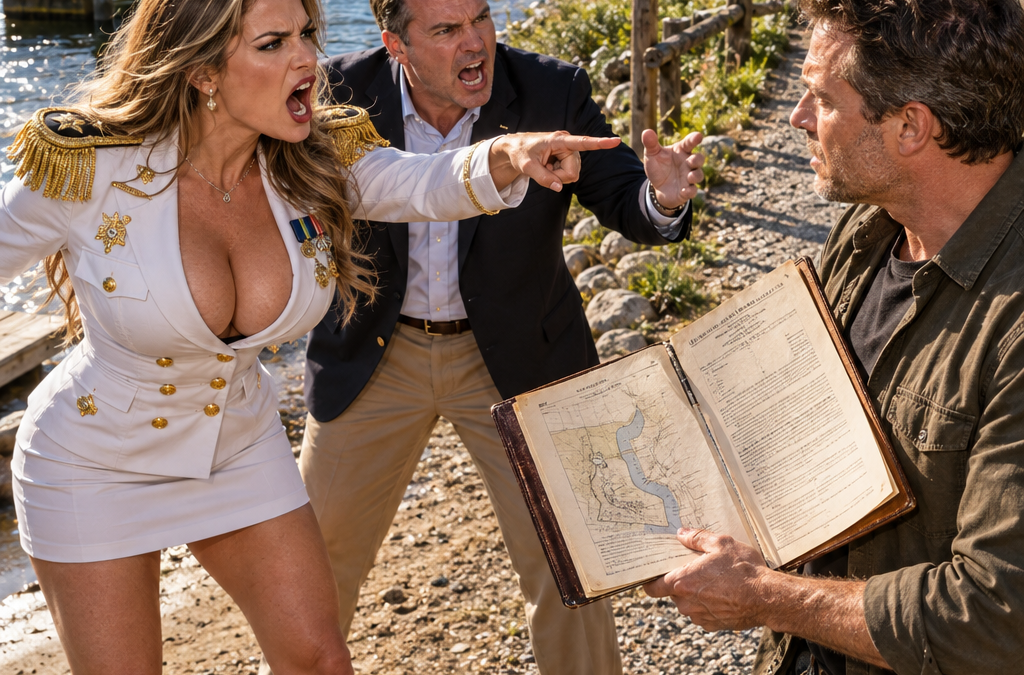
Karen sat in the center wearing the white uniform.
Of course.
The jacket hugged her torso tightly, the deep neckline exposing a dramatic amount of cleavage beneath a thin gold necklace. Her blond hair fell in soft waves over one shoulder. She looked less like an HOA president than someone playing a glamorous admiral in a television show.
The second I entered, she noticed me.
And smiled.
Not pleasantly.
She knew why I was there.
When the floor opened for comments, I walked forward.
“My name is Daniel Mercer. I own the lakefront parcel beside the west loop.”
Karen leaned back in her chair.
“I know who you are.”
Her tone already had an edge.
I placed my folder on the table.
“I received a violation notice concerning my dock. I assume it was sent by mistake.”
“It wasn’t.”
A few heads turned.
I paused.
“Excuse me?”
“The notice was intentional.”
I opened the folder.
“My property isn’t part of your association.”
Karen crossed her arms.
“I am aware that you claim that.”
“I don’t claim it. Here’s the deed.”
I slid the document toward her.
She didn’t touch it.
“The parcel existed before this subdivision. My grandfather refused to join when the neighborhood was developed.”
Karen’s mouth curved into a thin smile.
“Your house is physically located within our community.”
“No. It’s physically surrounded by your community. Legally, it’s independent.”
“You use our roads.”
“The road is municipal.”
“You benefit from our maintenance.”
“I pay county taxes.”
“You visually affect HOA property values.”
That one almost impressed me.
“That’s not how ownership works.”
Karen’s eyes sharpened.
Behind her, one of the older board members shifted uncomfortably.
I pointed at the papers.
“Look at the county map.”
“I don’t need to.”
“Yes, you do.”
Her expression changed.
People like Karen can tolerate disagreement.
What they cannot tolerate is being told what they need to do.
She straightened.
“My responsibility is protecting this community.”
“My responsibility is protecting my property.”
“And your unapproved structure affects the uniform character of the shoreline.”
“My dock is on my land.”
“The board regulates structures that affect the neighborhood’s presentation.”
“You regulate HOA property.”
“We regulate the community.”
“I’m not a member.”
“You live here.”
“I live beside you.”
Several residents looked from me to Karen.
Her cheeks reddened slightly.
Then she leaned forward.
The uniform tightened across her chest as she planted both hands on the table.
“Mr. Mercer, you seem to believe technical paperwork exempts you from basic community standards.”
I actually looked at the deed in front of her.
“Technical paperwork?”
“Yes.”
“This technical paperwork is called property law.”
Someone in the audience coughed to hide a laugh.
Karen heard it.
Her eyes flicked toward the chairs.
Then back to me.
“The board’s decision stands.”
“You haven’t even read the documents.”
“I don’t need to.”
“Then this meeting is pointless.”
“No. This meeting is me informing you, face-to-face, that the fourteen-day deadline will be enforced.”
I stared at her.
“You’re threatening to fine someone who isn’t in your HOA.”
“Yes.”
“Over a dock approved by the county and state.”
“Yes.”
“Built entirely inside surveyed boundaries.”
“Yes.”
I nodded slowly.
“Good. I wanted to make sure I understood.”
Karen smiled.
“There. I’m glad we clarified things.”
I gathered my papers.
As I turned away, she added, “Daniel?”
I stopped.
Her voice had changed.
Soft now.
Almost teasing.
When I looked back, she tilted her head and gave me a smile that might have worked on a different man in a different situation.
“Don’t make this uglier than it has to be.”
I looked at her for several seconds.
“I’m not the one doing that.”
Then I left.
My wife was waiting on the porch when I got home.
“Well?”
“She refused to look at the deed.”
My wife closed her eyes.
“She actually refused?”
“Apparently county records are technical paperwork.”
She laughed once.
There was no humor in it.
“What now?”
“Nothing.”
“Nothing?”
“I gave her proof. She chose not to read it.”
That was my mistake.
I still thought facts would eventually matter to Karen.
Fourteen days passed.
We didn’t remove a single board.
On day fifteen, a second notice arrived.
One hundred dollars.
I put it in the folder.
The next week, another letter.
Seven hundred dollars total.
Then another.
The number crossed into four figures.
At that point, the letters changed tone.
They were no longer warnings.
They were threats.
One stated that if the outstanding balance remained unpaid, the association would seek a lien against my property.
Another mentioned foreclosure remedies.
I read that one standing in the kitchen.
The word foreclosure seemed to lift off the page.
My grandfather’s house.
My father’s house.
My house.
The porch where my grandmother shelled peas in summer.
The dock where three generations had learned to fish.
And this woman was threatening to take it because I wouldn’t let her pretend she owned authority she didn’t possess.
My wife found me still holding the letter.
“What is it?”
I handed it over.
She read.
Her face changed.
Until then, she had been angry.
Now she looked scared.
“Can they do this?”
“No.”
“You sure?”
“They shouldn’t be able to.”
“That’s not what I asked.”
I didn’t answer.
Because the truth was, I didn’t know.
I knew Karen was wrong.
I knew the HOA had no legitimate authority over our parcel.
But legal systems don’t always prevent harm quickly.
Someone can be completely wrong and still force you to spend money proving it.
Someone can file papers.
Create records.
Cloud titles.
Hire lawyers.
Cause problems.
And suddenly our ridiculous argument about a dock didn’t feel ridiculous anymore.
That night, my wife and I barely slept.
Around three in the morning, I went downstairs and stood at the back window.
Moonlight reflected off the lake.
The new dock stretched into the dark water.
Beyond it, the shoreline access path was barely visible.
For thirty years, my family had given those people something for free.
And now the woman leading them was threatening my home.
The next morning, I hired a lawyer.
His name was Mark Ellison.
He specialized in real estate disputes and had the calm expression of someone who had spent twenty years watching grown adults destroy themselves over fences.
I brought him everything.
The deed.
The surveys.
The dock permits.
The violation notices.
The accumulating fines.
The foreclosure threat.
He read quietly.
Occasionally, he made a note.
After about twenty minutes, he leaned back.
“Do you belong to this HOA?”
“No.”
“Did your parents?”
“No.”
“Grandfather?”
“No.”
“Any covenant in the deed?”
“No.”
“You sure?”
“I think so.”
He looked at me.
“Thinking and knowing are different things. But based on what I’m seeing, they have no authority to fine you.”
My shoulders relaxed slightly.
“So we’re done?”
“No.”
That was not the answer I wanted.
“They shouldn’t be able to enforce these notices,” Mark continued. “But because they’re now threatening liens and foreclosure, I want to make this airtight before we respond.”
“What do you need?”
“A full title search. Original subdivision records. Any agreement between your grandfather and the developer.”
I frowned.
“There was something about lake access.”
He looked up.
“What kind of something?”
“I don’t know exactly. Grandpa allowed residents to cross part of our property.”
“Easement?”
“I always assumed it was.”
Mark’s pen stopped moving.
“Don’t assume.”
He leaned forward.
“Do you have a copy?”
“Maybe somewhere in my father’s records.”
“I’ll search the county archive too.”
I left his office feeling better but not comfortable.
Karen’s letters kept coming.
I stopped opening them immediately.
I would place them on the kitchen counter until my wife got home.
We had developed this ridiculous ritual where one of us opened them while the other watched.
Another fine.
Another demand.
Another threat.
Karen also started appearing near our property more often.
One Saturday, I saw her standing on the shoreline path talking with two board members.
She pointed directly at my dock.
When she noticed me watching from the porch, she smiled.
Then she lifted her hand in a little wave.
I didn’t return it.
A few days later, she approached me while I was retrieving mail.
That white uniform again.
Perfect makeup.
Gold buttons flashing in the sun.
“Have you decided to cooperate?”
I kept sorting envelopes.
“My lawyer is handling it.”
Her smile faltered.
“You hired a lawyer?”
“Yes.”
“For this?”
“You threatened foreclosure.”
“Oh, Daniel.”
Her voice became syrupy.
She stepped closer.
“You’re being dramatic.”
I looked up.
“You sent me a letter threatening to take my house.”
“Nobody wants your house.”
“Then why threaten it?”
“Because rules require enforcement.”
“Rules I never agreed to.”
She sighed dramatically.
“You men always turn everything into some territorial contest.”
I almost laughed.
“You ordered me to tear down my dock.”
“Because it violates standards.”
“My lawyer will contact you.”
I started walking away.
She called after me.
“You know lawyers cost money.”
I stopped.
Karen stood beside my mailbox, smiling.
That was when I understood something important.
She wasn’t confused.
This wasn’t a clerical mistake anymore.
She knew I disputed her authority.
She knew I had official documents.
She knew I had permits.
She simply believed that if she made resisting expensive enough, eventually I would surrender.
“You’re right,” I said.
Her smile widened.
“I’m glad you’re finally seeing reason.”
“No. I mean lawyers cost money.”
I looked directly at her.
“So you’d better hope you’re right.”
The smile disappeared.
Two days later, Mark called.
“I found the agreement.”
Something in his voice told me to sit down.
I drove to his office.
He had an old document lying open across his desk.
The paper was yellowed.
My grandfather’s signature was at the bottom.
Seeing it hit me unexpectedly.
Even after all those years, I recognized the handwriting instantly.
Strong, blocky letters.
Mark tapped the middle of the document.
“This is the shoreline access agreement.”
“So it’s an easement?”
“No.”
I looked at him.
He smiled slightly.
“This is where things get interesting.”
He explained the difference carefully.
A permanent easement could attach to the land, surviving changes in ownership.
This document wasn’t written that way.
The original developer’s attorneys had structured the arrangement as a revocable personal land-use license.
Temporary permission.
Not permanent ownership rights.
Not guaranteed access forever.
My grandfather had allowed the developer and subsequent neighborhood residents to use the shoreline path for recreational access.
But the agreement contained a clause stating that the owner of our parcel could revoke permission at any time, for any reason, by providing written notice to the association.
I read the clause twice.
Then a third time.
“You’re telling me they don’t have a permanent right to use that path?”
“Correct.”
“They’ve been using it for thirty years.”
“With permission.”
“They installed benches.”
“On land they were allowed to use.”
“They put up a sign.”
“Still your land.”
“And I can end it?”
Mark folded his hands.
“Legally? Yes.”
I sat back.
For several seconds, neither of us spoke.
Then Mark said, “There’s more.”
He explained that Karen’s HOA letters weren’t merely stupid.
They were dangerous for the association.
By claiming authority over my property while benefiting from an agreement that explicitly recognized our independent ownership, the HOA had created a contradiction.
More importantly, they had escalated from an architectural dispute into threats of fraudulent liens and foreclosure.
Mark wanted to send a formal cease-and-desist and demand cancellation of all fines.
I was barely listening.
My eyes remained on my grandfather’s signature.
Thirty years.
For thirty years, our family had asked for nothing.
No access fee.
No annual payment.
No contribution toward taxes.
No rent.
We gave hundreds of people the best water access in the neighborhood because my grandfather wanted peace.
Karen had mistaken generosity for obligation.
Then she had threatened to take our home.
“What happens,” I asked, “if I revoke it?”
Mark watched me carefully.
“The neighborhood loses legal permission to cross your land.”
“Immediately?”
“Subject to written notice. The document doesn’t require much lead time, but I’d recommend giving them enough to remove their property.”
“The benches?”
“And the sign.”
“What about the gravel path?”
“It’s on your property.”
I looked at him.
He knew exactly what I was thinking.
“Daniel,” he said, “make sure you’re doing this because you understand the consequences.”
“I do.”
“Hundreds of residents use that access.”
“I know.”
“Most of them had nothing to do with Karen.”
“I know.”
“This will make you unpopular.”
“Probably.”
He waited.
I thought of every family walking to the lake.
Children dragging inflatable tubes.
People carrying kayaks.
Old men fishing at sunrise.
Most had never bothered us.
That was true.
Then I remembered my wife asking whether we could lose our house.
I remembered Karen’s smile beside the mailbox.
You know lawyers cost money.
I looked down at Grandpa’s signature again.
“He gave them permission because he wanted good neighbors.”
Mark said nothing.
I continued.
“If the person running the neighborhood is willing to threaten my family because I won’t obey rules that don’t apply to me, then that relationship doesn’t exist anymore.”
“So what do you want?”
I looked up.
“Revoke it.”
Mark studied me for another moment.
“All of it?”
“All of it.”
He nodded once.
“Then we’ll do it correctly.”
The letter he drafted was brutal because it didn’t sound angry.
Angry letters can be ignored.
Mark’s letter read like a machine.
It documented the HOA’s illegal attempts to exercise jurisdiction over a non-member property.
It listed the violation notices.
The fines.
The threat of a lien.
The foreclosure language.
It cited the original land-use agreement.
Then it invoked the revocation clause.
Effective forty-eight hours after confirmed delivery, all HOA permission to use the shoreline path would terminate.
Residents would no longer be authorized to enter our parcel for recreational access.
The HOA had forty-eight hours to remove any benches, signs, or other property placed on our land.
Anything remaining afterward could be considered abandoned.
Mark also demanded immediate cancellation of every fine and written confirmation that the HOA recognized our lot as independent.
Before sending it, he looked at me.
“Last chance.”
“Send it.”
Karen received the letter the next morning.
I know because she called me.
I saw her name on my phone and let it ring.
Then she called again.
And again.
Finally, I answered.
“What?”
Her voice exploded through the speaker.
“What the hell do you think you’re doing?”
“Good morning, Karen.”
“You cannot revoke lake access.”
“My attorney disagrees.”
“Your attorney is an idiot.”
“You should probably tell him that directly.”
“This is retaliation.”
“Yes.”
Silence.
I hadn’t planned to say it that plainly.
Apparently, neither had she.
Then she recovered.
“You just admitted it.”
“I’m revoking permission because your HOA threatened my property while using mine for free.”
“You’re punishing hundreds of innocent homeowners because you’re angry at me.”
“No, Karen. I’m ending my family’s free private-land arrangement because your board has demonstrated that it doesn’t respect the boundaries that made the arrangement possible.”
“The board is the community.”
“Then the community shouldn’t have elected you.”
She sucked in a breath.
“You arrogant bastard.”
“There she is.”
“Excuse me?”
“The real Karen. I was wondering how long the professional voice would last.”
“You have no idea what you’re doing.”
“Actually, I finally do.”
“You’ll reverse this.”
“No.”
“I will make you.”
I laughed.
Not because it was funny.
Because suddenly she sounded small.
For weeks she had been the person sending deadlines.
Now she had one.
Forty-eight hours.
“You have until tomorrow to remove the benches and sign.”
Then I hung up.
My wife stood in the doorway.
“You enjoyed that too much.”
“Probably.”
“Are we really doing this?”
“Yes.”
She looked toward the window facing the lake.
“Good.”
I had already contacted a fencing company before the letter was delivered.
I didn’t want the HOA responding to the revocation by pretending nothing had happened.
I provided the company with certified survey maps and asked for a fence along the relevant boundary, especially across the entrance to the shoreline path.
They agreed to send a crew Saturday morning.
I paid extra for the rush.
Saturday arrived clear and warm.
I woke before sunrise.
For some reason, I couldn’t sleep.
My wife came downstairs and found me drinking coffee.
“Nervous?”
“Yes.”
“Regretting it?”
“No.”
She poured herself a cup.
“Good.”
At seven-thirty, the fencing trucks arrived.
Workers unloaded posts, equipment, and rolls of heavy vinyl-coated chain-link.
The fence would be six feet high.
Not decorative.
Not subtle.
A boundary.
Before they began, I walked down to the shoreline.
The HOA’s two benches sat where they had sat for years.
I brought tools.
The first bolt was rusted.
It took almost ten minutes to loosen.
I remember thinking about how many people had sat there.
Families.
Teenagers.
Fishermen.
Couples watching sunsets.
I wasn’t angry at them.
That made what I was doing harder.
But boundaries only matter when they’re respected.
I removed both benches carefully.
No damage.
No scratches.
No petty destruction.
I carried them across the surveyed line and placed them on HOA property.
Then I removed the wooden neighborhood lake-access sign.
Again, carefully.
I leaned it beside the benches.
By then the fencing crew had started digging.
Metal posts went into the ground.
One after another.
The sound carried across the morning.
Clang.
Drill.
Hammer.
Clang.
Every post felt strangely final.
Within a few hours, the entrance to the gravel path was blocked.
Thirty years of neighborhood access ended behind six feet of steel.
And Karen couldn’t have chosen a worse weekend to make enemies with me.
The following weekend was Lake Day.
I had forgotten about it until my wife reminded me.
Every summer, the HOA organized a large community celebration.
Food trucks.
Inflatables.
Coolers.
Music.
Families.
Boats.
Jet skis.
Kayaks.
For years, the event centered on our shoreline access.
The HOA had advertised that year’s Lake Day for weeks.
Apparently, Karen hadn’t canceled it.
Maybe she thought I would back down.
Maybe she thought the fence was temporary.
Maybe she simply couldn’t bring herself to admit publicly that she had lost access.
Saturday morning, my wife and I sat on our back porch with coffee.
Around eight-thirty, we heard an engine.
A pickup truck appeared towing a large pontoon boat.
The driver swung wide, preparing to reverse toward the path.
Then he saw the fence.
Brake lights flashed.
The truck stopped.
The driver climbed out.
He walked toward the barrier slowly.
Then grabbed the metal links with both hands.
He shook them.
I don’t know why.
Maybe disbelief.
He looked around.
Then toward our house.
My wife raised her mug.
“This is going to get ugly.”
Within fifteen minutes, three more vehicles arrived.
One had jet skis.
Another carried kayaks.
People got out wearing swimsuits and life jackets.
Someone had a cooler on wheels.
A father stood beside the fence explaining something to two confused children.
Cars began stacking along the road.
Phones came out.
Voices rose.
Twenty people became thirty.
Thirty became forty.
A crowd gathered.
Then Karen arrived.
Her white SUV came around the curve much too fast.
She stopped crooked against the curb.
The door flew open.
And there she was.
White uniform.
Blond hair.
Large sunglasses.
High heels completely inappropriate for grass.
She slammed the door and stared at the fence.
Then at the benches.
Then at our house.
Even from the porch, I could see her face turning red.
“Oh boy,” my wife said.
Karen marched across the yard.
The heels sank into soft soil twice, but she didn’t slow down.
She reached our front porch and started pounding on the door.
Not knocking.
Pounding.
I let her do it for several seconds.
Then I opened the door partway.
“What?”
Her chest rose and fell hard beneath the tight uniform.
She pointed toward the road.
“What do you think you’re doing?”
“Good morning.”
“Don’t play games with me.”
“I asked you to leave my property last time we spoke.”
“You’ve created a public hazard!”
“How?”
“There are cars backed up everywhere.”
“Not my cars.”
“You blocked access to the lake.”
“I blocked access across my land.”
“This is a sanctioned HOA event.”
“That sounds like an HOA problem.”
Her eyes widened.
“You deliberately waited until Lake Day.”
“No. You deliberately refused to cancel Lake Day after receiving legal notice.”
“The neighborhood has used that path for thirty years.”
“With permission.”
“You cannot take away thirty years of access because you’re angry.”
“I already did.”
Her voice rose.
“That path belongs to this community.”
I felt something inside me go very still.
That sentence was the entire dispute.
Not the dock.
Not architecture.
Not aesthetics.
Ownership.
“No,” I said. “It doesn’t.”
“Yes, it does.”
“Karen, your attorney has the agreement.”
“I don’t care what some ancient piece of paper says.”
I almost smiled.
“That’s interesting.”
“What?”
“A few weeks ago, you didn’t care what my county deed said either.”
“This is different.”
“No. It’s exactly the same.”
She stepped closer.
Her perfume was strong enough that I could smell it through the screen door.
“We are talking about hundreds of homeowners.”
“You should have considered them before threatening foreclosure against property you don’t control.”
Her jaw tightened.
“The board is going to sue you for every dollar this event costs us.”
“Go ahead.”
“We’ll seek an emergency injunction.”
“Go ahead.”
“We’ll get the sheriff down here with bolt cutters.”
That one made me laugh.
Karen’s face darkened.
“You think this is funny?”
“I think you should absolutely call the sheriff and tell him you want him to cut down a legal fence located entirely on private property.”
“I will.”
“Great. I’ll show him the survey.”
She opened her mouth.
I continued.
“And while he’s here, I’ll also tell him that I’ve repeatedly asked you to leave my property.”
Her eyes flickered.
I pulled out my phone.
“Karen, get off my porch.”
“You wouldn’t dare.”
“Try me.”
For a few seconds, we stared at each other.
Behind her, I could hear angry residents near the road.
Someone shouted her name.
Karen looked back at them.
Then at me.
The situation had reversed.
Weeks earlier, I had stood in an HOA meeting while she controlled the room.
Now forty angry residents were waiting for her to explain why the lake had disappeared behind a fence.
She pointed at me.
“This isn’t over.”
“It is on my property.”
She spun around.
One heel slipped off the porch step.
She caught herself on the railing, swore under her breath, then stormed toward the crowd.
I closed the door.
My wife was in the hallway trying not to laugh.
“What?”
“The great commander almost lost a battle to a porch step.”
I laughed.
Then the reality outside returned.
For the next twenty minutes, Karen stood near the fence surrounded by furious residents.
Her hands moved constantly.
Pointing.
Explaining.
Deflecting.
At one moment she gestured toward our house.
Several people looked our way.
At another, a man towing a jet ski threw both hands into the air and shouted something I couldn’t hear.
Eventually, the crowd began dispersing.
Trucks turned around.
Boats left.
Coolers went back into vehicles.
Children climbed into cars.
Lake Day collapsed before it began.
But losing one party was nothing compared to what happened next.
The neighborhood’s own shoreline was almost useless for launching watercraft.
Without our access, boat owners had to drive roughly three miles to a municipal ramp.
That meant trailers.
Traffic.
A daily launch fee.
Weekend lines.
What had once been a five-minute trip became an hour or more depending on crowds.
Residents were furious.
Then the real estate agents noticed.
The subdivision usually had ten to fifteen houses for sale at any given time.
For decades, listings had proudly advertised neighborhood lake access.
Private water access.
Community beach.
Convenient boat launch.
Those claims suddenly weren’t true.
By Monday, agents were changing listings.
Sellers started calling the HOA.
Buyers under contract asked questions.
Some backed out while their contingency periods were still open.
The issue wasn’t theoretical anymore.
Karen’s decision to harass one independent property owner had touched the value of hundreds of homes.
Tuesday afternoon, an emergency HOA meeting was announced.
The usual boardroom was too small.
They moved the meeting into the community center gymnasium.
My wife looked at the email someone forwarded us.
“You want to go?”
“Absolutely.”
“We’re not members.”
“Observers.”
She smiled.
“Front row?”
“That might be cruel.”
“Second row?”
“Perfect.”
The gymnasium was packed.
Over a hundred residents.
Maybe more.
People stood along the walls.
Some were angry about boats.
Others were worried about property values.
Several sellers had printed copies of updated real estate listings.
The noise was intense.
Then I saw Karen.
For the first time since meeting her, she looked tired.
Still beautiful.
Still dressed in white.
Still carefully made up.
But the perfection was cracking.
Her hair wasn’t quite as controlled.
There were faint shadows beneath her eyes.
And she kept pressing her lips together between conversations.
Beside her sat the HOA attorney.
He was an older man in a dark suit.
He looked like someone who had just been asked to explain gravity to people who had voted against it.
The meeting began.
There was no routine business.
A large man near the center stood almost immediately.
“What is being done about the fence?”
Applause and shouting erupted.
Another resident yelled, “When do we get access back?”
Someone else shouted, “My buyer pulled out yesterday!”
Karen reached for the microphone.
“Please. Everyone needs to calm down.”
That made things worse.
“You calm down!”
“Fix it!”
“You caused this!”
Karen’s face hardened.
There was the old version of her again.
Control through force.
She waited for the room to quiet.
“The board is actively addressing this situation.”
A man shouted, “How?”
“Our legal counsel is reviewing emergency remedies.”
The attorney beside her looked at her.
Karen continued anyway.
“The individual responsible for blocking the path is a rogue property owner who has chosen to act in direct conflict with community standards.”
My wife whispered, “Rogue property owner?”
I leaned closer.
“Apparently I’m a pirate now.”
Karen kept talking.
“We are preparing formal legal action seeking an emergency injunction. The board expects that the unauthorized barrier will be removed—”
The attorney reached over.
And took the microphone from her.
The room quieted.
Karen stared at him.
He adjusted his glasses.
“No,” he said.
One word.
The entire gymnasium changed.
Karen’s eyes narrowed.
The attorney stood.
“There will be no lawsuit seeking removal of the fence.”
People began murmuring.
Karen leaned toward him.
“Thomas—”
He raised one hand.
“I need to explain the situation accurately.”
She leaned back.
I had never seen her look afraid before.
The attorney turned toward the residents.
“I have reviewed the title history, county records, original subdivision documents, and correspondence received from Mr. Mercer’s counsel.”
He pointed toward me.
Heads turned.
I stayed seated.
“The Mercer parcel is not part of this homeowners association.”
Silence.
“Never has been.”
Someone near the back said, “What?”
The attorney continued.
“The association has no jurisdiction over his home, his shoreline, or his dock.”
Karen stared straight ahead.
“The dock in question was properly permitted through the relevant county and state authorities. The HOA had no legal basis to demand its removal.”
The room started buzzing.
A woman stood.
“Then why were fines sent?”
The attorney paused.
“That decision was made by the board leadership.”
Everyone looked at Karen.
Her face flushed.
She grabbed another microphone.
“The dock directly impacts our lakefront presentation—”
Thomas turned toward her.
“That does not create jurisdiction.”
She froze.
He faced the room again.
“The association also had no legal authority to assess monetary penalties against the Mercer property.”
A resident shouted, “What about the lien?”
Thomas’s expression became grim.
“The threatened lien and foreclosure action should never have been issued.”
The noise became explosive.
I saw Karen grip the edge of the table.
Then the attorney raised his voice.
“There is another issue, and it is more serious.”
The room slowly quieted.
“For decades, residents have used a shoreline path across the Mercer parcel to access the lake.”
Nods.
“We believed that access was protected by a permanent property easement.”
My stomach tightened.
Even though I knew what came next, hearing it in that room felt different.
“It is not.”
People stared.
Thomas continued.
“The original agreement signed by the developer and Mr. Mercer’s grandfather created a revocable land-use license.”
A man near the aisle asked, “Meaning what?”
“Meaning the neighborhood was using private land with the owner’s permission.”
The man frowned.
“And he can just stop permission?”
“Yes.”
The word landed heavily.
Thomas glanced at Karen.
“The license explicitly allows the property owner to revoke access.”
Karen spoke without the microphone.
“This interpretation is ridiculous.”
Thomas ignored her.
“After the association issued unauthorized violations, fines, lien threats, and foreclosure language against the very parcel granting us access, Mr. Mercer exercised his contractual right to terminate the license.”
Someone shouted, “Because of her?”
Thomas hesitated.
Then professionalism won over politeness.
“The sequence of events began with the president’s decision to assert HOA authority over property that is not within the association.”
The gym exploded.
People stood.
Voices collided.
“You did this?”
“What the hell were you thinking?”
“You cost us lake access!”
“My house is for sale!”
Karen grabbed the microphone.
“Enough!”
Nobody listened.
“ENOUGH!”
The room slowly quieted.
She stood.
Her white uniform suddenly looked ridiculous.
Not powerful.
Not official.
Just a costume.
Karen pointed toward me.
“He could restore access tomorrow if he wanted.”
I stood.
Not because I planned to speak.
Because she had made me part of it.
Karen continued.
“This is his decision. He is punishing every family in this neighborhood over a disagreement with me.”
I felt every face turn toward me.
For the first time, I understood what Mark meant when he warned me I would become unpopular.
I could have stayed silent.
Instead, I asked for the microphone.
Thomas passed it to me.
Karen’s stare could have cut glass.
I looked around the room.
“I know most of you had nothing to do with this.”
The room quieted.
“My grandfather allowed residents to cross our property thirty years ago. He didn’t charge anyone. My parents continued the arrangement. My wife and I continued it.”
I paused.
“We never had a problem with this neighborhood.”
Someone near the back said, “Then open it.”
I looked toward the voice.
“I might have, if this were only about the dock.”
Karen crossed her arms.
I continued.
“I went to the board with my deed. I brought county maps. Surveys. Permits. Your president refused to even look at them.”
Several people turned toward Karen.
“She told me my property was under HOA authority because it was physically inside the neighborhood. I explained that it wasn’t. She continued fining me.”
I reached into the folder I’d brought.
I held up the foreclosure notice.
“Then your association threatened to put a lien on my family’s home.”
The room went quiet.
“This house belonged to my grandfather before this subdivision existed.”
My voice tightened despite myself.
“He built there when the roads were dirt. He gave this neighborhood lake access because he wanted peaceful relations with the people moving around him.”
I looked at Karen.
“And the current president responded to that generosity by threatening to take the property if I didn’t obey rules that never applied to me.”
Karen’s expression hardened.
“You’re dramatizing—”
Thomas interrupted.
“No, he isn’t.”
That surprised even me.
Karen turned.
Thomas’s voice remained calm.
“The foreclosure language is in the written notice.”
A low murmur moved through the crowd.
I handed the microphone back.
I’d said enough.
Then the vice president stood.
His name was Robert.
He had lived in the subdivision for about twenty years and had always been friendly with my family.
He looked older than I remembered.
And furious.
He took the microphone.
“I’ve served on this board for eleven years.”
Karen stared at him.
“Robert, don’t.”
He looked at her.
“You don’t get to tell me not to.”
She went still.
Robert turned toward the residents.
“The older board members knew the Mercer property was independent. We knew access existed because of the family’s goodwill.”
Karen shook her head.
“You never explained—”
“I told you.”
“No, you didn’t.”
“I told you when you first started talking about shoreline standards.”
Karen’s face changed.
Robert continued.
“You said you would deal with it.”
“I was protecting property values.”
“You just damaged them.”
Applause broke out.
Karen’s breathing became visible again.
Robert raised one hand.
“I am formally calling for an emergency vote of no confidence in the president.”
The room erupted.
Karen stood.
“You can’t do that.”
Thomas, the attorney, answered.
“Yes, they can.”
Her head snapped toward him.
“You work for this board.”
“I work for the association.”
That distinction destroyed something in her expression.
For weeks, Karen had treated the HOA as an extension of herself.
Now the machinery she had used against everyone else was separating from her.
The motion was seconded.
Procedural arguments followed.
Thomas explained the bylaws.
Votes were counted.
Karen tried to speak three times.
People shouted her down twice.
The third time, she said the entire process was being manipulated by “a hostile outsider.”
That did not help.
The vote passed overwhelmingly.
Karen was removed as president.
Then, after another motion, removed from the board entirely.
She sat there motionless.
For the first time since I’d known her, nobody was listening when she spoke.
My wife leaned toward me.
“Are you okay?”
I realized my hands were trembling.
“Yeah.”
But I wasn’t sure.
Winning didn’t feel the way I had imagined.
There was satisfaction.
Absolutely.
But also exhaustion.
Months of tension suddenly had nowhere to go.
Karen stood abruptly.
She gathered her papers.
Someone near the front said, “Nice job, Admiral.”
Laughter rolled through the gym.
Cruel laughter.
Karen’s face went scarlet.
For a second, I thought she might throw something.
Instead, she lifted her chin and walked toward the exit.
As she passed our row, she stopped.
Her perfume reached me before her words.
“This is what you wanted.”
I looked up.
“No.”
“You humiliated me.”
“You did that yourself.”
Her eyes flashed.
“You destroyed this community’s lake access because you couldn’t accept authority.”
I stood.
We were almost the same height with her heels.
“No, Karen. You destroyed it because you couldn’t accept that your authority had a property line.”
For once, she had nothing to say.
She walked out.
The next afternoon, three people came up our driveway.
Robert.
The newly appointed acting president.
And another longtime resident I recognized from earlier years.
My wife and I were on the porch.
They looked uncomfortable.
The acting president held a folder.
“Daniel, do you have a few minutes?”
“Sure.”
They came up.
Nobody wore a white uniform.
That helped.
The acting president handed me the folder.
“First, this is written confirmation that every HOA violation, fine, penalty, and legal threat issued against your property has been canceled.”
I opened it.
Official letterhead.
Board signatures.
Zero balance.
Recognition that our parcel was not subject to HOA governance.
I handed it to my wife.
The acting president continued.
“Second, I want to apologize.”
I looked at him.
“On behalf of the association.”
Robert nodded.
“This never should have happened.”
I believed him.
That made the conversation harder.
The acting president sat in one of our porch chairs.
“We’d also like to discuss the shoreline.”
There it was.
I leaned against the railing.
“What about it?”
“We understand why you revoked the license.”
Robert added, “And nobody is asking you to pretend Karen’s actions were acceptable.”
“But?”
The acting president sighed.
“But losing access is hurting families who had nothing to do with this.”
“I know.”
“Would you consider reopening the path?”
I looked toward the lake.
The fence was visible between trees.
Beyond it, the shoreline was quiet.
Something had changed during the week.
At first, the silence felt strange.
Then wonderful.
No coolers rolling past.
No strangers cutting toward the water.
No boats being dragged across gravel.
No teenagers wandering near our garden.
No cars stopping near the access path.
For the first time in my life, I understood how much of our own property my family had never really experienced privately.
My wife looked at me.
We had already discussed this.
The answer was hers as much as mine.
I turned back to the board members.
“No.”
The acting president’s shoulders dropped.
“Not even with a new agreement?”
“No.”
“We could compensate you.”
“That’s not the issue.”
Robert leaned forward.
“What is?”
“Trust.”
Nobody spoke.
I continued.
“For thirty years, my family let people use that land for free because we trusted the neighborhood to respect that it remained ours.”
I looked at the cancellation letter in my wife’s hands.
“Then one president decided she could threaten our home.”
“We removed her.”
“I know. And I appreciate that.”
“So why punish everyone else?”
It was a fair question.
I thought before answering.
“Because I’m not punishing anyone.”
The acting president frowned.
“You’re losing something you were allowed to use.”
I pointed toward the shoreline.
“That isn’t a community amenity I stole. It’s part of my property.”
He started to respond.
I continued.
“My grandfather was generous. My parents were generous. My wife and I were generous. But somewhere along the way, generosity turned into expectation, and expectation turned into entitlement.”
Robert looked away.
“You all stopped seeing it as something you were given.”
I paused.
“You started seeing it as something you owned.”
Nobody argued.
“And Karen proved how dangerous that had become.”
The acting president nodded slowly.
I softened my voice.
“I don’t hate this neighborhood. I don’t blame every resident. But for the first time in decades, my family has our whole shoreline back.”
I looked at my wife.
She smiled slightly.
“And we like it.”
The acting president rubbed his forehead.
“So the fence stays?”
“The fence stays.”
“Permanently?”
“Yes.”
He looked defeated.
But not angry.
Finally, he stood.
“I understand.”
Robert shook my hand.
“I wish things had gone differently.”
“So do I.”
They thanked us and walked away.
And that was it.
No second agreement.
No reopened path.
No restored Lake Day.
The neighborhood adapted.
People used the public boat ramp.
Some complained for months.
Eventually, fewer did.
Real estate listings stopped advertising private shoreline access.
Prices adjusted.
The world kept moving.
Our dock remained exactly where we built it.
Fully permitted.
Fully legal.
Completely ours.
As for Karen, she stayed in the neighborhood for a while.
I saw her occasionally.
She stopped wearing the white military-style uniform quite so often.
Maybe someone finally told her what everybody had been thinking.
She never apologized.
That wasn’t surprising.
People like Karen rarely apologize because apologizing requires accepting that other people’s boundaries are real.
Her entire identity had been built around crossing them.
I later heard she blamed me for losing the presidency.
Then the attorney.
Then Robert.
Then “weak homeowners.”
Apparently everyone was responsible except the person who ignored a deed, refused to read county records, issued illegal fines, threatened a fraudulent lien, and accidentally destroyed the neighborhood’s thirty-year lake access agreement.
But I no longer cared.
The strangest part was how peaceful everything became afterward.
One summer evening, several months after the emergency meeting, I walked down to the dock alone.
The sun was low.
The lake looked like dark glass streaked with gold.
Our new dock didn’t creak the way Grandpa’s did.
I missed that sound.
For a moment, I could almost see him standing at the end with a fishing rod, wearing the old cap my grandmother hated.
I thought about what he’d done.
He could have refused the developer.
He could have fenced the land thirty years earlier.
He could have charged residents.
He didn’t.
He chose generosity.
For a while, I wondered whether revoking access meant I had betrayed that.
Then I remembered something he used to say whenever someone confused kindness with surrender.
Being a good neighbor doesn’t mean giving someone your front door key.
He believed in helping people.
He also believed a man should know where his land ended and another man’s began.
Karen never understood that.
She thought authority came from confidence.
From letters.
From meetings.
From fines.
From sitting behind a table and speaking louder than everyone else.
She thought if she wore the right clothes, used the right language, and frightened people badly enough, eventually reality would reorganize itself around her.
But reality doesn’t work that way.
Neither does property.
She had spent weeks trying to teach me that the HOA controlled everything around it.
Instead, she forced me to investigate exactly what it controlled.
And exactly what it didn’t.
The answer cost her the presidency.
It cost the neighborhood its lake access.
And it gave my family back a piece of our land we had almost forgotten belonged entirely to us.
My wife came walking down the dock behind me.
“You’re thinking about Grandpa.”
“How do you know?”
“You get the same face every time.”
“What face?”
“Like you’re arguing with a dead man.”
I smiled.
“Do you think he would’ve kept the path open?”
She came beside me.
“Before Karen?”
“Yes.”
“Absolutely.”
“After?”
My wife looked toward the fence.
Then back at the water.
“He would’ve built it higher.”
I laughed.
The sound carried across the lake.
Then we stood there quietly.
No crowds passed behind us.
No boat trailers rolled down the path.
No HOA signs stood on our grass.
No president was deciding what we were allowed to build.
Only our house.
Our dock.
Our shoreline.
And the boundary my grandfather had always understood, even when everyone else forgot it:
Permission is not ownership.
Kindness is not surrender.
And if you threaten a man’s home while standing on land his family let you use for free, you should be very, very certain you’ve read the paperwork first.