𝗙𝗨𝗟𝗟 𝗦𝗧𝗢𝗥𝗬 The HOA President Threatened to Destroy My Life Over One Parked SUV, but She Had No Idea How Far I Was Willing to Fight
𝗣𝗔𝗥𝗧 𝟮
I looked at the mailbox.
Then at her.
“Replacing the mailbox.”
She stared at the new black metal box.
“Why is it black?”
“Because the old one was rusted and this one looks better.”
“The neighborhood standard is gold.”
I almost laughed.
“The rules say mailboxes must be a dark, muted color.”
“Gold is the preferred color.”
“That’s not what the rules say.”
Victoria’s expression hardened.
“The spirit of the rule is that mailboxes should match.”
I looked down the street.
One neighbor had a bronze mailbox.
Another had a dark green one.
Several were black.
They didn’t match at all.
“Half the street has different colors.”
“Those were approved years ago.”
“All of them?”
“Yes.”
“Then black shouldn’t be a problem.”
She leaned toward the open window.
“I am not approving yours.”
I stood up.
“Well, it’s already installed.”
“Then remove it.”
“No.”
For a moment, Victoria appeared genuinely surprised.
I don’t think she was accustomed to hearing that word.
“Excuse me?”
“It’s a standard mailbox. It complies with the written restrictions, and I’m not taking it down.”
Her eyes narrowed.
“You really don’t want to start a fight with me.”
“I don’t want a fight at all.”
“Then learn to cooperate.”
She raised the window before I could respond.
A moment later, she drove away.
I watched the Mercedes disappear around the corner.
Then I looked at my new mailbox.
It was perfectly ordinary.
Black metal.
Straight post.
Clean lines.
I couldn’t imagine why anyone would care enough to argue about it.
That evening, I told my wife what happened.
She looked at me for several seconds.
“Is this woman seriously trying to control the color of our mailbox?”
“Apparently.”
“Did you check the rules?”
“Twice.”
“And we’re allowed to have a black one?”
“Yes.”
My wife shook her head.
“Then she can get over it.”
I agreed.
Unfortunately, Victoria had no intention of getting over anything.
The following week, our first official fine arrived.
It involved our trash cans.
Garbage collection was scheduled for Wednesday mornings.
My wife had an early meeting that week, so she rolled the bins to the curb on Tuesday evening.
That was allowed.
The next day, however, the collection truck ran late.
Instead of arriving in the morning, it didn’t come until Wednesday afternoon.
Both of us were at work.
Neither of us could bring the cans back before the HOA’s noon deadline because the garbage hadn’t even been collected yet.
When I got home that evening, a notice was attached to our front door.
Fifty-dollar violation.
Trash receptacles left at the curb beyond the permitted time.
I stood on the porch reading it.
Then I looked at the empty cans.
Then back at the notice.
The garbage company had been late.
There was nothing we could have done.
I considered contesting it immediately.
But we’d just moved into the neighborhood, and I was already tired of arguing.
Fifty dollars wasn’t going to ruin us.
I told myself that paying it might help calm the situation.
That was another mistake.
I mailed the payment to the management company.
Then, against my wife’s advice, I walked over to Victoria’s house.
I genuinely believed that if I spoke to her calmly, without an audience, we might clear up the misunderstanding.
Her home was one of the largest in the neighborhood.
A sprawling property with immaculate landscaping, a circular driveway, and a garage that could have housed several vehicles.
Her Mercedes sat near the entrance.
I rang the bell.
A few moments later, Victoria opened the door holding a small reddish-brown dog.
She wore an expensive-looking white blouse and fitted pants.
Her blonde hair was perfectly arranged.
Even at home, she looked as though she expected photographers.
“What do you want?”
I kept my voice friendly.
“Hi, Victoria. I wanted to talk about the trash-can fine.”
She shifted the dog against her chest.
“What about it?”
“The collection truck came late. We couldn’t bring the cans in by noon.”
“Rules are rules.”
“I understand, but the rule assumes the garbage has actually been collected.”
“The cans were still out when I checked.”
I frowned.
“When you checked?”
“Yes.”
“You came by our house specifically to inspect our trash cans?”
She lifted her chin.
“I monitor all properties. It’s my responsibility as president.”
I took a slow breath.
“Okay. I already paid the fifty dollars. I’m not here to fight about that.”
“Then why are you here?”
“I wanted to ask about the driveway situation.”
Her expression became impatient.
“We already discussed that.”
“My wife uses the garage as a studio. Is there an exception we can apply for?”
“No.”
“Not even a formal review?”
“No exceptions.”
“But the written rules allow driveway parking when the garage is occupied.”
Victoria gave me a look of theatrical exhaustion.
“I told you. I decide what is allowed.”
“That doesn’t make sense.”
“Then perhaps you shouldn’t have purchased a house in this community.”
I stared at her.
She continued.
“People move here because we maintain standards. If you can’t meet them, you should consider living somewhere more suitable.”
Something in her tone made the message clear.
She didn’t simply dislike our car.
She disliked the fact that we weren’t obeying her.
“We worked hard to buy this house,” I said. “We’re not moving because you don’t like where my wife parks.”
Victoria smiled coldly.
“Then you should prepare to pay for your stubbornness.”
Before I could answer, she shut the door.
I stood there listening to the lock click.
Then I walked home.
My wife was in the kitchen when I came inside.
“Well?”
“She says she’s the president and gets to decide everything.”
My wife put down her glass.
“Are you kidding me?”
“No.”
“That woman is insane.”
“She’s definitely something.”
My wife crossed her arms.
“We should report her.”
“To whom? Her own board?”
“Then we should fight the fines.”
I looked toward the window.
Across the street, the neighborhood was quiet and beautiful.
I couldn’t believe we were already having this conversation.
“Let’s not turn this into a war,” I said.
My wife stared at me.
“She’s already trying to start one.”
I didn’t want to believe that.
I wanted to believe we could ignore Victoria, live our lives, and eventually she’d find someone else to bother.
But my wife was right.
Victoria had already chosen us.
And she wasn’t finished.
Over the following weeks, violation notices began arriving almost constantly.
Our grass was half an inch too tall.
Our sprinkler system allegedly sprayed water onto the sidewalk.
A garden hose was visible from the street.
The mailbox color remained a subject of complaint.
Our driveway parking was mentioned repeatedly.
Every notice carried the same official formatting, the same threatening language, and the same implication that our homeownership depended on Victoria’s approval.
At first, I disputed them one by one.
I photographed the yard.
Measured the grass.
Quoted the bylaws.
Submitted written explanations.
But the board almost always upheld Victoria’s decisions.
The other board members were people she had known for years.
Some were close friends.
Others seemed intimidated by her.
Whenever I attended a meeting, Victoria sat at the front of the room like a judge.
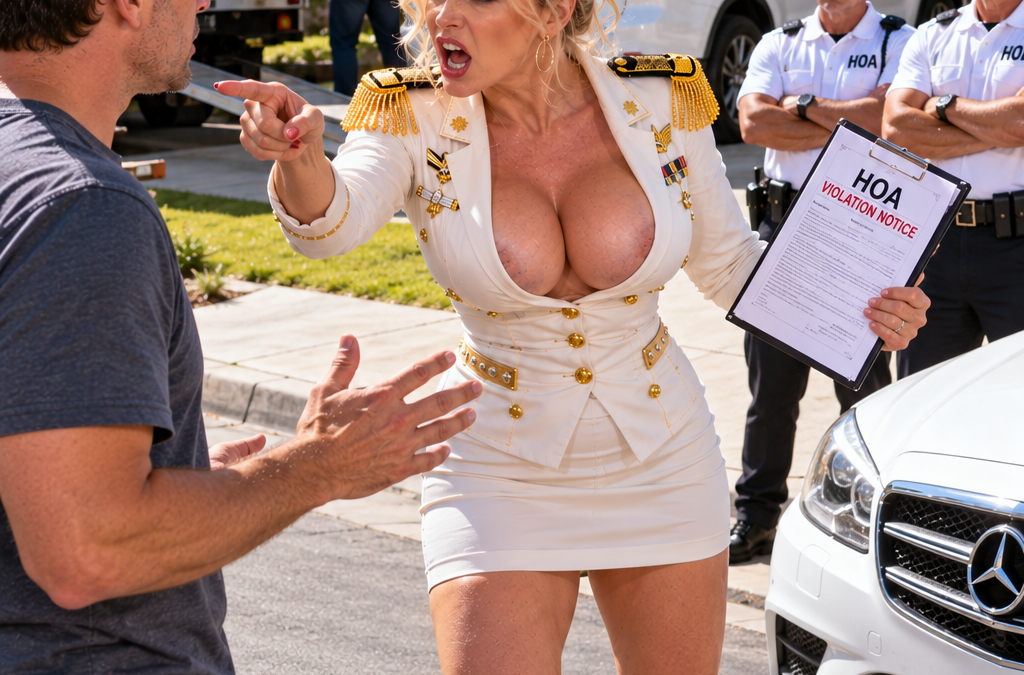
Her immaculate white uniform made her impossible to overlook. The tight jacket, low-cut neckline, gold accents, and polished appearance helped her project the kind of authority she clearly loved.
She controlled the agenda.
Interrupted speakers.
And treated challenges like acts of rebellion.
The board rarely questioned her.
If Victoria said we had violated a rule, the violation was accepted.
If I presented evidence, she dismissed it.
And if I insisted on being heard, she accused me of disrespecting the association.
I began dreading the sound of the mailbox opening.
Every envelope from the HOA felt like another punishment.
My wife started taking photographs before leaving for work, just to document the condition of our yard and driveway.
That wasn’t how we’d imagined living in our dream home.
We had bought the property for peace and privacy.
Instead, we were becoming obsessed with whether a sprinkler head had turned two inches too far.
Then Victoria found a new way to torment us.
She started blocking my wife’s SUV.
Our driveway was wide enough for multiple cars.
There was no reason for Victoria to park there.
But she would occasionally pull her Mercedes behind the SUV, blocking it completely.
Sometimes she stayed in her car.
Other times she walked home, leaving us to track her down.
The first time it happened, I assumed it was an accident.
I walked to her door and rang the bell.
Victoria answered several minutes later.
“Yes?”
“Your car is blocking our driveway.”
She blinked slowly.
“Oh.”
“Could you move it?”
She looked past me toward our house.
“You’re still parking that SUV outside?”
“Yes.”
She gave a theatrical sigh.
“I suppose I’ll have to get my keys.”
Then she disappeared.
I waited.
Five minutes.
Ten.
Fifteen.
By the time she finally emerged, twenty minutes had passed.
She walked slowly toward her Mercedes, looking entirely unbothered.
“Thank you,” I said tightly.
She smiled.
“You’re welcome.”
Then she moved the car.
The next time, my wife was the one who needed to leave.
She had a doctor’s appointment.
An important one that had taken time to schedule.
Victoria’s Mercedes was parked directly behind the SUV.
My wife rang her doorbell.
No answer.
She rang again.
Eventually, Victoria appeared.
“What is it?”
“Your car is blocking mine. I need to leave.”
Victoria glanced toward the driveway.
“Then perhaps you should keep your vehicle in the garage.”
“My garage is being used.”
“That sounds like a personal problem.”
My wife stared at her.
“I’m going to be late for a medical appointment.”
Victoria shrugged.
“Then you should plan better.”
By the time she finally moved the Mercedes, my wife was late.
When she called me afterward, her voice was shaking.
“She did that on purpose.”
I didn’t try to defend Victoria anymore.
“I know.”
“I’m serious. She smiled while I was asking her to move.”
“I believe you.”
“She wants us to feel helpless.”
I sat in my office with the phone pressed against my ear.
For the first time, I felt something worse than anger.
I felt trapped.
Victoria wasn’t simply issuing fines.
She was interfering with our daily lives.
She could block our driveway, waste our time, and then retreat behind her position as HOA president.
And she seemed to enjoy every second.
A few months later, we brought home a golden retriever.
My wife had wanted one for years.
He was a gentle, affectionate dog with soft golden fur, big brown eyes, and absolutely no understanding of personal space.
He believed every visitor had come specifically to meet him.
He loved sleeping on the couch.
He followed my wife around the house.
And he rarely barked.
Most evenings, he’d curl up near us while we watched television.
For the first time since moving in, the house felt warmer.
Happier.
We finally had something to focus on that didn’t involve Victoria or the HOA.
Then the complaints started.
According to Victoria, our dog barked all night.
She also claimed he was leaving waste in her yard.
Both accusations were false.
Our dog slept inside.
We walked him on a leash.
And we picked up after him.
Every single time.
But the HOA sent us a formal warning.
Then another.
Then a notice of fines.
I called the management company.
I explained that the dog was indoors at night.
That the barking accusations were untrue.
That we had never allowed him to relieve himself on Victoria’s property.
The representative sounded uncomfortable.
“The complaints were submitted by the HOA president.”
“That doesn’t make them true.”
“You can appeal at the next board meeting.”
So I went.
The meeting took place in a small clubhouse conference room.
Victoria sat at the front in her white uniform, looking immaculate.
When my turn came, I stood and explained the facts.
“Our dog stays inside at night. We pick up after him on walks. These complaints are false.”
Victoria tapped her pen loudly on the table.
“I personally witnessed the behavior.”
I looked at her.
“You saw our dog barking inside our house all night?”
“I heard him.”
“And you saw him leave waste in your yard?”
“Yes.”
“When?”
“On multiple occasions.”
“Do you have photographs?”
Her eyes narrowed.
“I don’t need photographs. I am a reliable witness.”
I turned toward the other board members.
“We’re being accused of something we haven’t done. Surely there needs to be evidence.”
One board member looked down.
Another shifted uncomfortably.
Victoria tapped her pen again.
“Are you calling me a liar?”
I took a breath.
“I’m saying your accusations are false.”
Her face hardened.
“The board will consider your appeal.”
They deliberated for only a few minutes.
Then upheld the complaints.
Two hundred dollars in fines.
And a warning.
If the alleged problems continued, the association would seek to force us to remove the dog from the property.
I remember the room going strangely quiet after that.
I looked at the board.
“You want to make us get rid of our dog?”
Victoria folded her hands.
“If you cannot control an animal, you shouldn’t own one.”
I felt my jaw tighten.
“He’s not doing what you’re accusing him of.”
“That’s your opinion.”
“No. That’s the truth.”
She lifted her chin.
“The decision has been made.”
I left before I said something that would only make things worse.
When I got home, my wife was waiting in the kitchen.
The dog was lying at her feet, chewing a toy.
She looked up.
“Well?”
I didn’t answer immediately.
Her expression changed.
“What happened?”
“They upheld the fine.”
“How much?”
“Two hundred.”
She exhaled.
“Of course they did.”
Then I told her the rest.
“If it happens again, they’re threatening to make us get rid of him.”
My wife stared at me.
“No.”
I looked down.
Our dog wagged his tail.
“No,” she repeated, her voice breaking. “Absolutely not.”
She knelt beside him and wrapped her arms around his neck.
He licked her cheek.
And she started crying.
I stood there feeling completely powerless.
We had worked for years to afford this home.
We had followed the written rules.
We had tried to be reasonable.
We had paid fines we didn’t deserve just to avoid conflict.
And now Victoria was threatening to take away something my wife loved because she knew it would hurt us.
That evening, my wife sat beside me on the couch.
Our dog was asleep between us.
“Maybe we should sell,” she whispered.
I turned toward her.
She stared straight ahead.
“I know we just moved here. I know how much we wanted this house. But I can’t keep living like this.”
I didn’t answer.
Because part of me had been thinking the same thing.
Every day felt like another test.
Every time I saw Victoria’s Mercedes, my stomach tightened.
Every HOA letter made me angry before I even opened it.
And now my wife was crying in the home that was supposed to make her happy.
“We shouldn’t have to leave,” I said quietly.
“I know.”
“She’s the one doing this.”
“I know.”
I looked at our sleeping dog.
Then at my wife.
“I think we need proof.”
She wiped her eyes.
“Proof of what?”
“Everything.”
The following weekend, I bought a high-quality security camera system.
Not a cheap doorbell camera.
A complete system with continuous recording.
I mounted cameras on the garage overlooking the driveway and front yard.
Another covered the side gate.
I adjusted the angles to capture the property boundaries and areas where Victoria had repeatedly caused problems.
The system recorded twenty-four hours a day.
I tested it.
Checked the timestamps.
Made sure the images were clear enough to identify people and vehicles.
Then I connected the recordings to storage I could review and back up.
My wife watched me finish the installation.
“Do you really think she’ll do something?”
I looked toward the street.
“I think she already has.”
For the first time, I felt like we had a way to defend ourselves.
Not by shouting.
Not by arguing with her friends on the board.
But by documenting what actually happened.
It took less than a week for the cameras to prove their value.
One evening, I was reviewing footage from the front yard.
I saw Victoria walking her small reddish-brown dog past our house.
At first, nothing seemed unusual.
Then she stopped.
She looked up the street.
Then down.
She checked behind her.
And deliberately allowed her dog to relieve itself on our lawn.
She waited until the dog finished.
Then walked away without picking anything up.
I stared at the screen.
For several seconds, I couldn’t believe what I was seeing.
Victoria had accused our golden retriever of leaving waste in her yard.
Meanwhile, she was letting her own dog do exactly that on our property.
I replayed the footage.
Then called my wife into the room.
“Come look at this.”
She watched silently.
When the video ended, she turned toward me.
“She knows exactly what she’s doing.”
I nodded.
“Yes.”
“She’s setting us up.”
I looked at the frozen image of Victoria walking away.
There was no innocent explanation.
She had deliberately checked to see whether anyone was watching.
She had allowed the dog to use our yard.
And she hadn’t cleaned up.
I saved the video immediately.
Then made a backup.
I wasn’t going to give Victoria another opportunity to call me a liar.
The following morning, I reviewed the previous night’s recordings.
That’s when I saw something much worse.
The timestamp read approximately 2:00 a.m.
A figure appeared near the edge of our driveway.
At first, I thought it might be a neighbor.
Then the person moved beneath the exterior lighting.
Victoria.
She wore dark clothing and moved quickly toward my wife’s SUV.
I leaned closer to the monitor.
Victoria stopped beside the driver’s side door.
She looked around.
Then reached toward the paint.
And dragged something sharp along the side of the vehicle.
From near the front wheel toward the rear.
A long, deliberate movement.
I watched her step back.
Look at the damage.
And walk away.
My hands went cold.
For a moment, I couldn’t move.
Then I grabbed my keys and went outside.
The scratch was enormous.
A deep line running along the driver’s side.
The kind of damage that would require professional bodywork.
I stared at it in disbelief.
This wasn’t a fine.
It wasn’t a petty argument.
It wasn’t even an inconvenient parking obstruction.
Victoria had come onto our property in the middle of the night and deliberately damaged my wife’s vehicle.
I went back inside.
My wife was making coffee.
“What’s wrong?”
I held up my phone.
“Victoria keyed your SUV.”
She stared at me.
“What?”
“I have it on video.”
Her face changed.
She followed me to the computer.
We watched the footage together.
At the end, she covered her mouth.
“She did that in the middle of the night?”
“Yes.”
“What if she’d come into the house?”
I didn’t answer.
Because the same thought had crossed my mind.
Victoria was no longer just irritating.
She was becoming unpredictable.
And I was starting to wonder what she might do next.
I called the police.
An officer arrived later that morning.
I showed him the damage.
Then the video.
He watched carefully.
“That’s your HOA president?”
“Yes.”
He looked at the screen again.
“You’re certain?”
“We’ve had problems with her for months. That’s her.”
He shook his head.
Then went to speak with Victoria.
She answered her door wearing a bathrobe and looking offended that a police officer had dared to interrupt her morning.
I couldn’t hear every word from where I stood.
But I saw her gestures.
The dramatic hand movements.
The way she pointed toward our house.
The officer showed her the footage.
Victoria immediately began arguing.
Later, he told me she’d claimed the video was fake.
A deepfake.
She accused me of digitally manipulating the recording to harass her.
The officer wasn’t convinced.
But because of the circumstances, the amount of damage, and how the incident was handled locally, he issued a criminal-mischief citation and warning rather than arresting her immediately.
She was required to deal with the resulting fine and legal consequences.
I wasn’t satisfied.
Not even close.
But at least there was now an official record.
Victoria couldn’t pretend the dispute existed only inside the HOA.
The police knew about her behavior.
And we had footage.
When the officer left, Victoria stood at the edge of her driveway and stared toward our house.
I could see her face from the upstairs window.
She looked furious.
Not ashamed.
Not frightened.
Furious that she’d been caught.
My wife joined me.
“Do you think this will stop her?”
I watched Victoria disappear inside.
“I hope so.”
It didn’t.
The next several months became a nightmare.
Victoria stopped parking her Mercedes directly behind our SUV.
Apparently, even she understood that blocking our driveway would be difficult to deny now that cameras were recording it.
But she found other ways to harass us.
She drove slowly past our house late at night and honked her horn.
Sometimes she did it more than once.
She threw trash onto our lawn.
She continued looking for excuses to report us.
And she began making complaints to city officials.
One claimed we were operating an illegal business out of our garage.
Because my wife used the garage as a home studio, Victoria apparently decided that gave her grounds to involve municipal authorities.
An inspector came to the property.
We showed him the space.
Explained its use.
Provided whatever information he requested.
He found nothing requiring enforcement.
The complaint went nowhere.
But even when Victoria lost, she succeeded in wasting our time.
Every inspection interrupted our work.
Every complaint demanded a response.
Every new letter reminded us that she could make our lives inconvenient whenever she wanted.
The harassment continued for nearly a year.
I kept saving footage.
Every late-night drive-by.
Every suspicious visit.
Every incident involving our yard.
I stored copies on a separate hard drive.
I organized the files by date.
And I kept a written timeline of what happened.
At first, the process made me feel prepared.
Eventually, it made me feel exhausted.
I hated that I had to spend my evenings reviewing surveillance footage of my own front yard.
I hated that I recognized the sound of Victoria’s Mercedes engine.
I hated that my wife sometimes looked through the curtains before taking our dog outside.
And I hated that we had stopped inviting friends over as often because we didn’t want them dragged into another confrontation.
One evening, my wife stood in the kitchen holding another HOA notice.
She looked tired.
Not angry anymore.
Just tired.
“How long are we going to do this?”
I put down my phone.
“What do you mean?”
“Fight her. Document her. Go to meetings. Call inspectors. Talk to lawyers.”
I didn’t answer.
“We bought this house because we thought we’d be happy here.”
“I know.”
“And all we do is talk about Victoria.”
Her voice cracked.
“I don’t want to spend the rest of my life being afraid of what that woman will do next.”
I walked over and wrapped my arms around her.
She leaned against me.
For a long moment, neither of us spoke.
Then she whispered, “Maybe we really should leave.”
I looked around our kitchen.
The beautiful cabinets.
The countertops we’d chosen.
The windows overlooking our carefully maintained yard.
Every room represented something we’d worked for.
And Victoria wanted us to abandon it.
I could see that now.
The parking complaints.
The fines.
The dog accusations.
The damage to the SUV.
None of it was really about community standards.
It was about control.
Victoria wanted to prove she could make us miserable enough to sell.
And if we did, she’d consider herself the winner.
“I don’t want to give her that,” I said quietly.
My wife pulled back.
“I don’t care about winning.”
“Neither do I.”
“Then why won’t you let it go?”
I looked into her eyes.
“Because I don’t think leaving would be the end of it. I think we’d spend years wondering why we let someone bully us out of our own home.”
She looked down.
I continued.
“But I promise you something. If this becomes too dangerous, we’re not going to pretend we can handle it ourselves.”
She nodded slowly.
We agreed to keep documenting the harassment and involve the authorities whenever necessary.
We also tried to reclaim some normal life.
We spent evenings in the backyard.
Took our dog on walks.
Worked on small improvements to the property.
And made an effort not to let Victoria dominate every conversation.
For a while, things seemed to calm down.
Then came the patio.
The existing concrete patio behind our house was old and cracked.
Several sections had shifted unevenly.
One edge had become a tripping hazard.
My wife had nearly stumbled over it while carrying supplies from her studio.
We decided to replace it.
Not expand it.
Not construct an additional outdoor living area.
Just remove the deteriorating concrete and pour a new stamped-concrete surface in exactly the same footprint.
I checked the HOA regulations before scheduling the work.
The governing documents required architectural approval for new structures or substantial changes.
Routine replacement of an existing feature with the same dimensions didn’t require separate approval.
That distinction mattered.
Given everything we’d experienced, I wasn’t about to hand Victoria a legitimate reason to interfere.
I reviewed the language more than once.
Then hired a local contractor with a good reputation.
We discussed the job.
He inspected the damaged patio.
Measured it.
Explained the removal and replacement process.
And gave us a price.
It wasn’t cheap.
But it was necessary.
We scheduled the work for a Saturday.
The contractor and his crew arrived early.
The morning was clear and warm.
A concrete truck pulled up.
Equipment was unloaded.
The crew prepared the area and began working.
I brought out bottled water.
My wife made coffee.
For the first time in months, I felt genuinely excited about improving our property.
The contractor was friendly and professional.
He walked me through the work as it progressed.
By late morning, the fresh concrete had been poured.
The crew was smoothing and finishing the surface.
I stood nearby watching the patio take shape.
It looked fantastic.
Then I heard tires.
Fast.
Too fast for our quiet street.
I turned.
Victoria’s white Mercedes came around the corner like it was entering a racetrack.
She slammed on the brakes in front of our house.
The engine idled aggressively.
Then the driver’s door flew open.
Victoria stepped out.
And I knew immediately that we were in trouble.
She wore her usual tight white, military-style uniform, gold buttons gleaming in the sunlight. Her blonde hair was perfectly styled, her deeply cut jacket showed off her generous figure, and her face was twisted with anger.
She looked less like a neighborhood president than a furious general arriving to inspect an unauthorized invasion.
“What the hell do you think you’re doing?”
The contractor stopped working.
I walked toward the driveway.
“Good morning, Victoria.”
“Don’t you good-morning me!”
She pointed toward the patio.
“You did not get architectural approval!”
“It’s a replacement patio.”
“I don’t care what you call it!”
“The footprint is exactly the same as the old one. The bylaws say replacement work doesn’t require approval.”
Victoria marched toward me.
“I am the president!”
I felt my stomach tighten.
I’d heard that sentence so many times it had become almost meaningless.
“And I’m the homeowner.”
Her eyes widened.
“You are violating the rules.”
“No, we’re not.”
“Stop the work immediately.”
The contractor stepped forward.
“Ma’am, the concrete is already poured.”
Victoria turned toward him.
“Then stop touching it.”
He looked confused.
“I can’t do that.”
“Excuse me?”
“If we stop finishing it now, the concrete will set unevenly. It’ll ruin the job.”
Victoria lifted her chin.
“That’s not my concern.”
The contractor wiped his hands on his work pants.
“With respect, ma’am, I’m responsible for finishing this properly.”
She pointed toward the street.
“Then you can pack up your equipment and leave.”
I stepped between them.
“Victoria, you have no authority to stop a lawful replacement.”
Her face turned red.
“No authority?”
“The rules are clear.”
“You think you can tell me what my authority is?”
“I’m telling you what the bylaws say.”
She laughed sharply.
“You’re going to regret being so arrogant.”
I stared at her.
For nearly a year, we’d endured fines, harassment, false accusations, and property damage.
I was exhausted.
But I wasn’t going to let her destroy another improvement to our home.
“Victoria, the contractor is going to finish his work. You need to leave.”
Her expression changed.
For a moment, she looked almost delighted.
As if I’d finally given her the confrontation she’d been waiting for.
“Oh, really?”
“Yes.”
She stepped close enough that I could see the anger in her eyes.
“I’ll fine you ten thousand dollars.”
I almost laughed.
“For replacing concrete?”
“Ten thousand dollars,” she repeated. “And I’ll put a lien on your house.”
“Then you’ll have to explain what rule we’ve violated.”
“I don’t have to explain anything to you.”
“You do if you’re trying to enforce a fine.”
Victoria turned toward the contractor.
“Stop working!”
He shook his head.
“Ma’am, please step back. This is an active work area.”
She ignored him.
Then started walking directly toward the wet concrete.
I realized what she intended to do a second before she reached it.
She was going to step onto the freshly poured surface.
Ruin it.
Force us to pay to repair it.
“Victoria, don’t!” I shouted.
The contractor moved in front of her.
“Ma’am, stop right there.”
She tried to push past him.
He held his position without striking or grabbing her.
“You cannot walk through wet concrete,” he said firmly. “Someone could get hurt, and you’ll destroy the work.”
Victoria’s eyes flashed.
“Don’t you tell me what to do!”
“Then please move away from the construction area.”
She pulled her arm back.
For one terrible second, I thought she was simply going to shove past him.
Instead, she slapped him.
Hard.
The sound cracked through the morning air.
The contractor’s head jerked slightly to the side.
Everybody froze.
One worker stopped holding his finishing tool.
Another stood near the concrete truck, staring.
I felt my own heart slam against my ribs.
The contractor slowly turned his face back toward Victoria.
His cheek was red.
His expression had gone from surprise to controlled anger.
“You just assaulted me.”
Victoria lifted her chin.
“I did no such thing.”
“We all saw it.”
“You got in my way.”
“Ma’am, you slapped me.”
She waved dismissively.
“Don’t be dramatic.”
I took out my phone.
“That’s enough, Victoria.”
She looked at me.
“You think you’re going to call the police?”
“I think he has every right to.”
Her smile returned.
Cold.
Contemptuous.
“Please. My husband knows everyone who matters in this city.”
The contractor pulled out his phone.
“I’m calling the police.”
Victoria looked from him to me.
Then toward the wet patio.
For a moment, I thought she was finally going to leave.
She turned and walked back toward her Mercedes.
I exhaled.
The contractor was already speaking to the emergency dispatcher.
I looked at the crew.
“Are you guys okay?”
One man nodded.
Another muttered something under his breath.
Then I heard the Mercedes engine rev.
I turned toward the street.
Victoria was behind the wheel.
Her hands gripped the steering wheel.
She looked straight toward the patio.
And something about her expression made every instinct in my body scream.
“Move!” I shouted.
The contractor stepped backward.
Victoria slammed the accelerator.
The Mercedes lurched forward.
For a split second, I couldn’t understand what she was doing.
Then the front wheels jumped the curb.
The car surged onto our property.
My wife screamed from the porch.
The contractor stumbled away from the wet concrete.
And Victoria drove directly across our freshly poured patio.
The tires carved deep trenches through the unfinished surface.
Concrete pushed up around the wheels.
The Mercedes bounced.
Then swerved across our lawn.
Chunks of grass tore free.
The tires left dark tracks through the yard.
The engine roared as she accelerated back toward the street.
I stood frozen.
The entire thing lasted only seconds.
But I remember every sound.
The scrape of the undercarriage.
The heavy splash of tires cutting into wet concrete.
The contractor shouting.
My wife’s scream.
And the violent acceleration as Victoria pulled back onto the road.
She stopped.
Put the car in park.
Then stepped out.
Smiling.
Actually smiling.
I stared at her.
My hands were shaking.
Behind me, the patio was destroyed.
Deep tire ruts ran across the surface.
The edges were crushed.
Our lawn looked as though someone had dragged machinery through it.
Victoria spread her hands.
“There.”
Her voice was almost cheerful.
“Now you’ll have to tear it out anyway.”
For a moment, I couldn’t speak.
I looked toward my wife.
She stood on the porch holding her phone.
Her face was pale.
But she was still recording.
She had captured the entire thing.
The shouting.
The slap.
The Mercedes jumping the curb.
The destruction of the patio.
Everything.
The contractor was still on the phone with police.
Victoria began walking toward me.
Her heels clicked against the pavement.
She looked triumphant.
“Do you think you’re clever?”
I didn’t move.
“You think those cameras make you safe?”
I swallowed.
“Victoria, stay away from me.”
She stepped closer.
“I’m untouchable.”
I stared at her.
She smiled wider.
“My husband is a very powerful man. He’s on the city council. Do you have any idea what that means?”
“It doesn’t mean you can destroy someone’s property.”
“It means I can make your life very unpleasant.”
She was close enough now that I could see her hands trembling with anger.
For nearly a year, she’d tried to force us into submission.
And now she had crossed a line I couldn’t imagine any rational person crossing.
She leaned toward me.
“I’m going to make your life a living hell until you sell this house and get out of my neighborhood.”
I looked at the destroyed patio.
Then at her Mercedes.
Then back at her face.
“You just committed multiple serious crimes.”
Victoria laughed.
“For driving over some mud?”
“You assaulted a contractor and deliberately destroyed private property with your car.”
“You’re delusional.”
She folded her arms.
“Nothing is going to happen to me.”
I glanced toward my wife.
She lowered her phone slightly.
I knew the footage was saved.
For once, I didn’t feel the need to argue.
“Okay,” I said quietly.
Victoria narrowed her eyes.
“Okay?”
“We’ll let the police decide.”
Her smile flickered.
Only for a second.
Then she scoffed.
“Go ahead.”
She walked back toward her Mercedes and stood beside it.
Apparently, she intended to wait for the officers.
She seemed confident that when they arrived, she would talk her way out of everything.
After all, she’d spent years using her social position to escape consequences.
Why should this be different?
The contractor looked at the patio.
He had gone pale.
“All of this has to come out,” he said.
I looked at the ruined surface.
“Everything?”
He nodded.
“The concrete’s compromised. Those ruts aren’t something I can just smooth over. It’ll have to be demolished and poured again.”
I rubbed my forehead.
“How much?”
He shook his head.
“I’ll need to calculate it.”
My wife came down from the porch.
Her hands were trembling.
“Are you okay?” she asked me.
I nodded.
“Are you?”
She looked toward Victoria.
“She could have hit someone.”
I followed her gaze.
The contractor’s crew had been standing near the patio when the Mercedes charged onto the property.
If one of them had moved a second slower, the situation could have been catastrophic.
I looked at my wife.
“Did you get it?”
She held up her phone.
“Every second.”
I pulled her into my arms.
For a moment, I held her so tightly she laughed nervously.
Then she started crying.
Not loudly.
Just a few exhausted tears.
“We can’t keep living like this,” she whispered.
I looked over her shoulder at the wrecked lawn.
“I know.”
A few minutes later, two police cruisers arrived.
Their tires crunched against the pavement as they stopped near our driveway.
Two officers stepped out.
Victoria immediately transformed.
The arrogant smile disappeared.
Her shoulders slumped.
She brought a hand to her face.
And by the time the officers approached, she was crying.
Or pretending to.
It was such an abrupt change that I almost couldn’t believe what I was seeing.
“Officers!” she called.
She hurried toward them.
“Thank God you’re here!”
One officer raised a hand.
“Ma’am, what’s going on?”
Victoria pointed toward me and the contractor.
“Those men attacked me!”
I stared at her.
She continued.
“They threatened me. They tried to run me over with that construction truck!”
The contractor made an angry sound.
The officer held up his hand.
“Everybody calm down.”
Victoria pressed a tissue to her eyes.
“I was terrified. I had to defend myself.”
“Ma’am,” the officer said, “we’re going to speak with everyone.”
She pointed again.
“You need to arrest them!”
The officer looked past her.
Then toward the damaged patio.
He saw the deep tire ruts.
The torn lawn.
The Mercedes parked nearby.
His expression changed.
“Let’s start with what happened here.”
Victoria opened her mouth.
He interrupted.
“Ma’am, please stop talking for a moment.”
For the first time all morning, she obeyed.
The officer approached the contractor.
“What happened?”
The contractor spoke slowly, clearly struggling to control his anger.
“She came onto the job site, demanded we stop finishing wet concrete, slapped me when I wouldn’t let her walk through it, and then drove her car across the patio.”
The officer looked at the contractor’s cheek.
Then at the concrete.
“She drove across that?”
“Yes.”
Victoria shouted from behind him.
“He’s lying!”
The officer turned.
“Ma’am, I asked you to wait.”
I stepped forward.
“Officer, we have video.”
He looked at me.
“Of the incident?”
“All of it.”
My wife raised her phone.
“And our house cameras recorded it, too.”
The officer nodded.
“Let me see.”
We opened the footage.
He watched silently.
Victoria arriving.
Her screaming.
The confrontation near the patio.
The slap.
The contractor stepping back.
The Mercedes accelerating.
The curb.
The concrete.
The lawn.
The officer’s expression grew more serious with every second.
When the video ended, he asked to watch the driving portion again.
My wife replayed it.
He watched without speaking.
Then he looked at the damaged patio.
And finally toward Victoria.
She was standing beside her Mercedes with her arms crossed.
Her confidence had begun to fade.
The officer walked over.
“Ma’am.”
Victoria straightened.
“Yes?”
“I’m placing you under arrest.”
For a moment, she looked as though she’d misheard him.
“What?”
“You’re under arrest.”
Her mouth opened.
Then closed.
Then opened again.
“You’re arresting me?”
The officer explained the suspected offenses, including assault, property damage, and reckless driving.
Victoria stared at him.
“I’m the victim!”
“Turn around and put your hands behind your back.”
She took a step backward.
“You cannot be serious.”
“Ma’am, turn around.”
Her expression turned furious.
“Do you know who my husband is?”
The officer didn’t react.
“Hands behind your back.”
“My husband is on the city council!”
“Ma’am.”
“I can have your badge!”
The second officer moved closer.
Victoria began shouting.
“You are nothing but a glorified security guard!”
The first officer remained calm.
“Turn around.”
“I will have your job!”
The officers took hold of her arms.
She resisted.
Not enough to escape.
Just enough to make everything worse.
She twisted and pulled away while shouting about lawsuits, political connections, and how much money she had.
The officers brought her hands behind her back.
Handcuffs clicked shut.
Victoria screamed.
“You’re ruining my life!”
Nobody answered.
“I’m a millionaire!”
The officers guided her toward the patrol car.
“I can buy this entire police department!”
One officer opened the rear door.
“I’ll have every single one of you fired!”
They seated her in the back.
She continued screaming.
At one point, she kicked against the interior of the vehicle.
I stood beside my wife, watching.
I felt stunned.
For nearly a year, Victoria had treated the HOA presidency like a shield that could protect her from any consequence.
Now she was sitting handcuffed in the back of a police car.
And all the expensive jewelry, political connections, and threatening language in the world hadn’t changed what the camera showed.
The officer returned to us.
“We’ll need copies of all the footage.”
“Of course,” I said.
“I can provide the recordings from the security system and my wife’s phone.”
“Good. Preserve the originals.”
“I will.”
He spoke with the contractor again.
Collected statements.
Looked over the damaged property.
Then explained the next steps.
I nodded, answering questions as clearly as I could.
But part of my mind was still replaying the moment Victoria hit the accelerator.
The sound of the engine.
The crew jumping out of the way.
The possibility that someone could have been seriously injured.
The contractor stood beside the patio with his arms crossed.
“Well,” he said finally, “I’m going to have to tear this whole thing out.”
I looked at the destroyed concrete.
“Send me the detailed bill.”
He glanced toward the police car.
“She’s paying for it, right?”
I looked at Victoria behind the window.
“That’s what I’m going to pursue.”
The officers finished their work.
Then the cruisers drove away.
Victoria was still shouting as they left.
My wife stood beside me.
For several seconds, neither of us moved.
The yard was a disaster.
The patio was ruined.
The concrete crew had lost hours of work.
And our beautiful Saturday morning had turned into something I never wanted to experience again.
But as the police cars disappeared around the corner, I felt an unfamiliar sensation.
Relief.
Not satisfaction.
Not revenge.
Relief.
For the first time in almost a year, Victoria couldn’t simply walk back to her house and issue another violation notice.
There was now a criminal case.
Independent witnesses.
Professional contractors.
Police reports.
And clear video evidence.
Her threats weren’t just words anymore.
They had consequences.
My wife slipped her hand into mine.
“Do you think it’s finally over?”
I looked toward the street.
“I think something finally changed.”
She leaned against me.
We stood there for a long time.
The patio would have to be demolished.
The lawn repaired.
And the legal process was only beginning.
But the fear that had settled over our home for so long had started to loosen its grip.
The weeks after Victoria’s arrest were complicated.
There were meetings with attorneys.
Conversations with investigators.
Estimates for property damage.
Requests for documentation.
We provided the footage from our security cameras and my wife’s phone.
The contractor supplied his statement and the cost of replacing the ruined patio.
We gathered records concerning the earlier damage to the SUV.
I organized the history of harassment we’d documented.
The false dog complaints.
The late-night disturbances.
The trash dumped in our yard.
The previous police report.
Every piece helped explain what had led to that Saturday.
Victoria hired expensive legal representation.
That surprised nobody.
She had spent the entire confrontation bragging about her wealth and connections.
I assumed she would try to use both.
But attorneys couldn’t make the video disappear.
The recording showed exactly what she did.
There was no confusion about whether she’d slapped the contractor.
No uncertainty about who was driving the Mercedes.
No plausible misunderstanding about why the car had crossed the patio.
It wasn’t an accident.
She’d aimed the vehicle at the wet concrete after threatening to ruin the work.
Then she’d stepped out smiling.
Her attorney ultimately negotiated a plea arrangement rather than taking the case through a prolonged contested trial.
Victoria pleaded guilty to assault and vandalism-related charges.
The outcome didn’t erase what she’d done.
But it meant she had to acknowledge criminal responsibility.
The judge sentenced her to sixty days in county jail.
She was also ordered to pay restitution for the destroyed patio, damaged lawn, my wife’s scratched SUV, and other financial consequences addressed in the case.
Additional fines and legal obligations followed.
The court also imposed a protective order requiring her to remain at least five hundred feet away from our house.
When I heard that last part, I sat quietly for a moment.
Five hundred feet.
After nearly a year of seeing Victoria drive past our home, block our driveway, inspect our trash cans, and approach our property whenever she felt like it, those words meant more than I expected.
She was no longer allowed to come near us.
Not because I’d convinced her to be reasonable.
Not because the HOA finally understood our complaints.
But because a court had imposed a boundary she couldn’t simply overrule by announcing she was president.
When I told my wife, she sat beside me on the couch.
Our golden retriever rested his head on her knee.
She stroked his ears.
“Five hundred feet?”
“Yes.”
She nodded slowly.
Then she let out a breath.
A long, shaky breath.
I hadn’t realized how long she’d been holding that fear inside.
“Maybe we can finally relax,” she said.
I put my arm around her.
“Maybe we can.”
Meanwhile, the homeowners association was facing its own crisis.
Victoria had controlled the board for years through intimidation, loyalty, and the sheer force of her personality.
Board members had become accustomed to following her lead.
Questioning her meant inviting an argument.
Disagreeing with her meant becoming a target.
And most people had decided it was easier to stay quiet.
But with Victoria in jail, the balance changed.
The board called an emergency meeting.
This time, she wasn’t there.
There was no woman in a tight white military-style uniform sitting at the front.
No gold buttons.
No expensive perfume.
No sharp voice interrupting every objection.
Just board members facing an increasingly angry community.
News of the arrest had spread quickly.
Residents had heard about the Mercedes driving through wet concrete.
Some had seen photographs of the ruined patio.
Others knew about the video.
People who had previously dismissed our complaints began asking questions.
Why had the association continued supporting Victoria?
Why had our appeals been rejected without serious review?
Why had she been allowed to use HOA authority to pursue what was obviously a personal vendetta?
And why had nobody intervened before the situation became dangerous?
Without Victoria there to intimidate them, the board finally acted.
They voted to remove her as president.
They also reviewed the fines imposed against us during the previous year.
The bogus violations were waived.
The dog-related penalties.
The questionable landscaping citations.
The enforcement actions driven by Victoria’s personal harassment.
One by one, the claims she’d used to punish us were stripped of their authority.
When we received the formal notice, my wife read it twice.
Then she looked up.
“All of them?”
I nodded.
“All the bogus fines.”
She sat down at the kitchen table.
For a moment, she looked as though she might cry again.
But this time, it wasn’t despair.
It was relief.
“She made us feel like we were doing everything wrong,” she whispered.
I sat beside her.
“I know.”
“We weren’t.”
“No.”
She looked toward the window.
Our SUV sat peacefully in the driveway.
Exactly where it had sat when Victoria first arrived.
“All of this because she hated one parked car.”
I shook my head.
“I don’t think it was ever really about the car.”
My wife considered that.
Then nodded.
It had been about control.
Victoria had expected immediate obedience.
When we questioned her interpretation of the rules, she treated our refusal as a personal insult.
When we continued resisting, she escalated.
Every time one tactic failed, she tried something more aggressive.
Fines.
Harassment.
Blocking vehicles.
False animal complaints.
Property damage.
And eventually, violence.
She couldn’t tolerate the idea that someone might live in her neighborhood without submitting to her personal authority.
But that authority had limits.
And she’d finally discovered them.
When Victoria completed her jail sentence, the consequences continued.
Her husband had filed for divorce.
He was a prominent man with a position on the city council, and the arrest had brought humiliating publicity.
The woman who had repeatedly invoked his political status as a threat was now the source of a scandal he apparently wanted no part of.
I didn’t know the private details of their marriage.
I didn’t need to.
What mattered was that Victoria could no longer assume her husband’s position would protect her from consequences.
Her public reputation had collapsed.
Her HOA presidency was gone.
Her criminal conviction was real.
And she was subject to an order requiring her to stay away from our property.
Eventually, Victoria sold her house.
I heard about it through neighbors before I saw the moving activity.
The enormous property she’d once used as the backdrop for her superior attitude was being listed for sale.
The Mercedes disappeared.
Moving trucks came.
Boxes were carried out.
And then she was gone.
She left the neighborhood entirely.
We never saw her again.
I can’t describe how strange that felt.
For nearly a year, Victoria had occupied far too much space in our lives.
She had dictated our mornings.
Ruined evenings.
Interrupted work.
Caused arguments.
Made my wife cry.
And turned the simple act of checking our mailbox into something we dreaded.
Then, suddenly, she was no longer there.
The street felt quieter.
The security gate no longer seemed like the entrance to a territory controlled by someone hostile.
And I could pull into our driveway without wondering whether a white Mercedes would appear behind me.
A few weeks after the legal situation began settling, the contractor returned to replace our patio.
The damaged concrete had been removed.
The ground was prepared again.
Fresh material arrived.
This time, the work proceeded without interference.
I stood outside watching the crew finish the surface.
The contractor glanced at me and smiled.
“Hopefully nobody decides to drive through this one.”
I laughed.
“Please don’t give the universe ideas.”
He chuckled.
Then continued working.
When the patio was finished, it looked beautiful.
Smooth stamped concrete.
Clean edges.
No cracks.
No tire marks.
No damage.
Just the outdoor space we’d wanted.
My wife came outside and stood beside me.
She looked across the backyard.
“It’s perfect.”
I smiled.
“Finally.”
Our golden retriever wandered onto the grass and lay down in the sunshine.
For several minutes, we simply stood there.
No threats.
No shouting.
No police cars.
No HOA president demanding approval for something the rules already allowed.
Just our home.
And for the first time since moving in, it actually felt like the place we’d imagined buying.
We even replaced the mailbox again.
This time, we chose one we liked without worrying about Victoria’s preferences.
Nobody complained.
Nobody issued a warning.
Nobody drove past slowly to inspect the color.
It was just a mailbox.
Which is all it should ever have been.
Over time, the neighborhood began to feel different.
Residents became friendlier.
Some approached us to apologize for not understanding what we’d been experiencing.
Others admitted they’d had their own unpleasant encounters with Victoria but hadn’t known how to challenge her.
One neighbor told me he’d avoided attending HOA meetings for years because she publicly humiliated anyone who questioned her.
Another said he’d paid several questionable fines simply because fighting them seemed more exhausting than writing a check.
I understood that feeling.
I’d done the same thing with our first trash-can fine.
I thought paying fifty dollars would buy peace.
Instead, it taught Victoria that she could impose consequences whenever she wanted.
That was one of the hardest lessons I took from the entire experience.
Bullies often begin with something small.
A minor demand.
An unreasonable interpretation of a rule.
A penalty that seems easier to pay than dispute.
Then they watch how you respond.
If you comply without question, they may push further.
If you resist, they may become angry.
And if they have authority, money, or social influence, they can make that resistance extremely uncomfortable.
Victoria had all three.
She was wealthy.
She controlled the HOA.
And she had spent years building connections that made people reluctant to challenge her.
But she made a critical mistake.
She began believing that influence meant immunity.
That being president meant she could reinterpret rules.
That being rich meant she could damage property.
That having a politically connected husband meant police officers would ignore evidence.
And that intimidating people long enough would eventually make them surrender.
For a while, her methods seemed effective.
We were miserable.
We discussed selling.
My wife cried over the possibility of losing our dog.
I spent evenings reviewing security footage instead of enjoying my home.
And every time Victoria appeared, I wondered what she’d do next.
The cameras didn’t stop her from escalating.
But they preserved the truth.
When she claimed our dog was responsible for waste in her yard, the footage showed her allowing her own dog to use ours.
When she damaged my wife’s SUV, the footage showed her doing it.
When she slapped the contractor and drove through the patio, the recordings documented everything.
And when she tried to tell police officers that we had attacked her, the truth was already saved.
That difference changed everything.
For months, the HOA had accepted her word over ours.
The board had treated her accusations as proof.
But police officers and a court weren’t required to accept her version just because she spoke confidently.
They could watch what happened.
And what happened was undeniable.
I don’t pretend the experience left us completely unchanged.
Even after Victoria moved away, I sometimes glanced toward the driveway when I heard a car slowing down.
My wife occasionally checked the security cameras before going to bed.
For a while, we still tensed when an unfamiliar envelope arrived.
Living under constant harassment had taught us to expect trouble.
It took time to unlearn that.
But gradually, we did.
We invited friends over again.
Hosted dinners.
Spent weekends working in the yard because we wanted to, not because we were afraid of another violation.
My wife enjoyed her studio without worrying that Victoria would summon inspectors.
Our golden retriever grew into a happy, affectionate dog who remained convinced that every guest had come to see him.
And the SUV stayed in the driveway.
Exactly where it belonged.
Sometimes I think back to our first encounter.
The day Victoria blocked the moving truck, stepped out in her immaculate white uniform, and told me she decided what was permitted.
I remember standing there with a box of books in my hands.
Exhausted.
Excited about our new home.
Completely unprepared for the kind of person she was.
If I could speak to that version of myself, I’d tell him to document everything from the beginning.
To keep copies of the bylaws.
To challenge false accusations before they accumulated.
And never assume that somebody with an official title is automatically reasonable.
I’d also tell him not to underestimate how far an angry person might go when their sense of authority is challenged.
Because the most frightening part of this story wasn’t the fifty-dollar parking threat.
It wasn’t the mailbox argument.
It wasn’t even the false complaints about our dog.
It was realizing that Victoria’s anger had become more important to her than anyone’s safety.
She was so determined to punish us that she drove a heavy vehicle through an active construction area while workers stood nearby.
She could have seriously injured someone.
She could have hit my wife.
She could have lost control of the Mercedes.
The consequences could have been far worse than ruined concrete and torn grass.
That thought still bothers me.
Not because I feel sympathy for Victoria.
But because an argument over a driveway never should have reached that point.
A homeowners association is supposed to help maintain a neighborhood.
It isn’t supposed to become the private weapon of someone who enjoys controlling others.
A president is supposed to serve the residents.
Not threaten them.
Not torment them.
And certainly not use wealth or political connections to convince people they’re powerless.
Victoria never seemed to understand that.
Even while officers were putting her in handcuffs, she wasn’t asking what she had done wrong.
She was screaming about who her husband was.
How much money she possessed.
Whose careers she could destroy.
What she could buy.
She genuinely seemed to believe that being wealthy made her more important than the law.
But the handcuffs closed anyway.
The officers took her away anyway.
The court imposed consequences anyway.
And eventually, the neighborhood moved on without her.
That was the real ending.
Not just that Victoria went to jail.
Not just that she lost the HOA presidency.
Not even that her marriage ended and she sold her home.
It was that we got our lives back.
One evening, several weeks after the new patio was completed, my wife and I sat outside as the sun went down.
The concrete still looked perfect.
Our backyard lights had just come on.
The air was warm.
Our golden retriever lay beside the patio, occasionally lifting his head when a bird moved through the grass.
My wife leaned against my shoulder.
“Remember when we first saw this house?”
I smiled.
“Of course.”
“I thought we’d sit out here every evening.”
“We’re sitting here now.”
She looked across the yard.
“I know.”
Then she was quiet for a while.
Eventually, she said, “I almost let her take this away from us.”
I turned toward her.
“She didn’t.”
“No,” my wife whispered. “She didn’t.”
I reached for her hand.
Across the lawn, everything was peaceful.
There were no tire marks.
No scattered trash.
No angry woman in a white uniform marching toward us with another demand.
The only sounds were the evening breeze, distant birds, and our dog shifting comfortably against the grass.
I thought about how close we’d come to selling.
How many times I’d questioned whether standing our ground was worth the stress.
How helpless I’d felt watching my wife cry over an animal that had done absolutely nothing wrong.
And how all of that had changed because the truth was finally impossible to deny.
I didn’t feel triumphant anymore.
The anger had faded.
The desire to prove something to Victoria had disappeared.
I simply felt grateful.
Grateful nobody had been seriously hurt when she drove through the work site.
Grateful my wife had recorded what happened.
Grateful the contractor had stood his ground.
Grateful the legal system had recognized the evidence.
And grateful we still had the home we’d worked so hard to buy.
My wife rested her head against my shoulder.
Our dog closed his eyes.
And I looked around the backyard we had once been afraid to enjoy.
For almost a year, Victoria had convinced us that living here meant living under her control.
But the house had never belonged to her.
The driveway had never belonged to her.
Our dog, our cars, our work, and our happiness had never belonged to her.
They belonged to us.
And as the last sunlight faded over the new patio, I finally understood something I wished I’d known the day she first pulled up in that Mercedes.
You can spend years working to build a beautiful life, and one cruel person can make you forget why you wanted it.
But that doesn’t mean they get to keep it.
Victoria had tried to force us out of our dream home.
She ended up being the one who had to leave.
And when I turned off the patio lights that night and walked inside with my wife and our dog, I knew that the life we’d fought so hard to protect was finally ours to enjoy.