The HOA President Thought My Garage Was Hers to Control, Until Her Son Crossed the One Line I Had Warned Them About
𝗙𝗨𝗟𝗟 𝗦𝗧𝗢𝗥𝗬
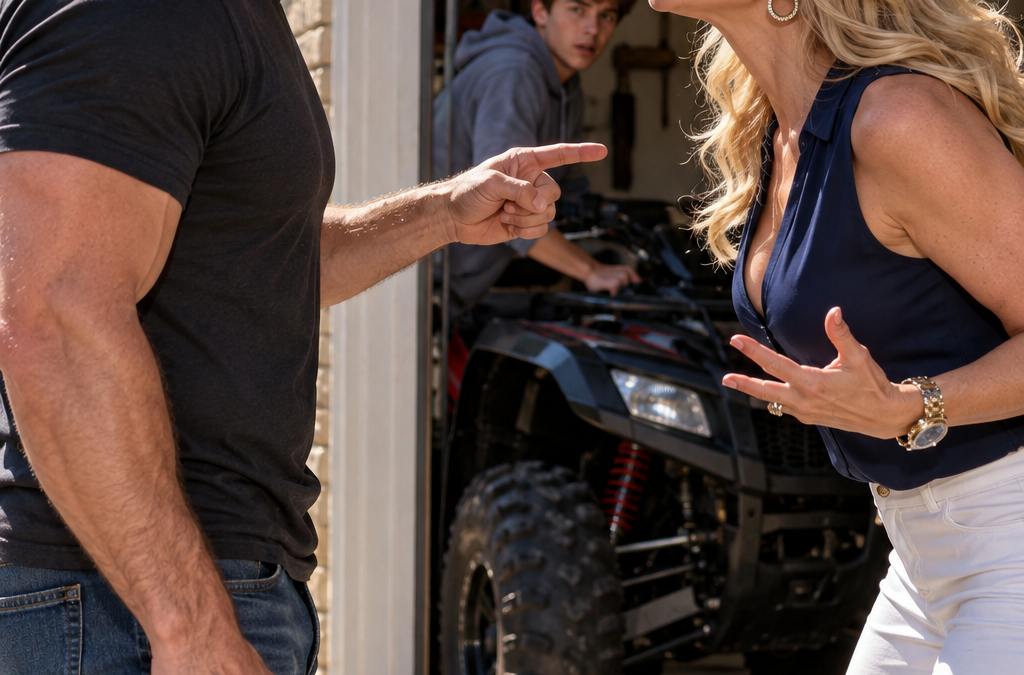
The first few weeks were almost laughable. She would appear whenever the garage door was open too long. It did not matter whether I was unloading lumber, cleaning up after a project, or just moving tools around. If the ATV was visible from the road for more than five minutes, Karen materialized like she had a private alarm system wired directly into my driveway.
Sometimes she came alone. Sometimes she came with another woman from the neighborhood, usually someone quiet and uncomfortable who looked like she had been dragged into Karen’s patrol route against her will. Karen would stand at the edge of my driveway, one hip tilted, sunglasses on, arms crossed just low enough to make sure everyone noticed the expensive watch on her wrist.
“That still needs to be moved,” she said one Saturday morning while I was changing the oil.
“It’s in my garage.”
“It’s visible.”
“The garage is open because I’m working in it.”
“The standards are very clear.”
“My deed is clearer.”
She hated that line.
Every time I said anything about the deed, her face went still. Not blank exactly. More like a woman shutting curtains inside herself.
At first, she acted like I was mistaken. Then she acted like I was lying. After that, she acted like if she repeated herself enough times, the county records would surrender out of exhaustion.
One afternoon, I came home from shift and found a printed notice taped to my front door. Not mailed. Not placed in the mailbox. Taped directly to the painted wood with blue painter’s tape, as if that somehow made it official.
NOTICE OF EXTERIOR NON-COMPLIANCE.
I stood on my porch reading it with one hand still on my duty bag. The notice listed “visible recreational equipment,” “garage clutter,” and “failure to maintain neighborhood visual standards.” At the bottom, Karen had signed it with her full title.
Karen Whitaker
HOA President
There was no HOA letterhead, no property address listed as a member lot, no legal authority cited. Just a title and her confidence.
I took a picture, pulled it off the door, and threw it on the kitchen counter.
My wife, Emily, looked up from unpacking plates.
“Another one?”
“First official fake one,” I said.
She picked it up, read it, then laughed once under her breath.
“She signed it like she’s issuing a royal decree.”
“That’s probably how it felt to her.”
Emily was calmer than I was by nature. She had a way of making people feel ridiculous without raising her voice, which was both a gift and a weapon. At the beginning, she told me not to give Karen too much attention.
“She wants a fight,” Emily said. “Don’t feed it.”
“I’m not feeding it. I’m documenting it.”
That became the pattern.
Karen left notices about lawn standards even though my lawn was fine. She complained about a motion light on the side of the garage that pointed down at my driveway and nowhere else. She claimed my trash bins were visible from “a community approach corridor,” which was a fancy way of saying someone could see them on trash day if they turned their head. She wrote that my workshop in the back might require “architectural review,” even though it had been there before we bought the house and, once again, was none of her business.
Every time, the answer was the same.
This house is not in your HOA.
I said it on the driveway. Emily said it through the screen door. I emailed it once after Karen slipped a notice into our mailbox, which I also warned her not to do again. I said it so often I considered making a sign and hanging it above the garage.
But Karen did not want information.
She wanted submission.
That was what made her dangerous.
Annoying people can waste your time. Entitled people can ruin your day. But people who confuse desire with authority can convince themselves almost anything is justified.
The first time she knocked while I was asleep after a night shift, Emily answered.
I woke up halfway, still heavy with that awful shift-sleep where your body knows it is daytime but your brain does not care. Voices drifted down the hall. Emily’s calm one. Karen’s sharper one.
Then I heard Karen say, “We’ll be conducting an inspection walk this weekend, and this ongoing ATV issue needs to be corrected before then.”
I got out of bed.
By the time I reached the front hall, Emily was standing behind the open door with one hand on the frame.
“This property is not in your association,” she said.
“That has not been properly established,” Karen replied.
“It’s in the deed.”
“I would like a copy.”
Emily blinked at her.
“You would like a copy of our deed?”
“For verification.”
Emily smiled then, but not kindly.
“No.”
Karen’s lips parted.
Emily shut the door.
I stood in the hallway in sweatpants and an old department T-shirt, trying not to laugh because Emily looked furious and satisfied at the same time.
“She wanted our deed,” she said.
“She can go to the county recorder like everybody else.”
“She also said you’ve been hostile.”
“I’ve been accurate.”
Emily looked toward the door.
“She’s not going to stop.”
“No,” I said. “She’s not.”
I wish I could say I was surprised when Karen’s son got involved, but by then, I had started to understand the ecosystem around her. People like Karen rarely operate alone. They recruit. They charm. They bully. They convince weaker people that helping them is easier than disagreeing with them.
Her son, Travis, showed up one afternoon while I was pressure washing the driveway.
He drove a lifted pickup that was too clean to have done any real work, with dark tint and tires that made more noise than the engine deserved. He parked along the curb in front of Karen’s house, climbed out wearing a black tank top, gym shorts, and a backward cap, then wandered over like my driveway was an exhibit.
He was probably twenty-one or twenty-two, old enough to know better and young enough to think consequences were a rumor. He had his mother’s confidence without her polish. Where Karen used smiles like knives, Travis used smirks like shields.
He stood there watching the ATV.
“That yours?” he asked.
I shut off the pressure washer.
“Yeah.”
He nodded, eyes still on it.
“Nice. My mom hates that thing.”
“I know.”
He laughed. “She says it makes your place look trashy.”
“Then she should stop staring into my garage.”
His grin widened, like he thought we were having some kind of guy-to-guy moment.
“I’m just saying, bro, if you kept it out back, there wouldn’t be all this drama.”
“If your mom minded her own business, there wouldn’t be all this drama.”
The smirk faded a little.
“She runs the neighborhood.”
“Good for her.”
“She takes it seriously.”
“I can tell.”
“So maybe don’t make it harder than it has to be.”
I looked at him then, really looked. He was trying to sound casual, but there was something under it. A warning, maybe. Or the borrowed arrogance of someone repeating words he had heard at home.
“Your mother does not run this property,” I said. “Neither do you.”
His jaw shifted.
“Nobody’s trying to start anything.”
“Then don’t.”
He looked back at the ATV and shrugged, but it was fake. Too loose. Too practiced.
“Just seems like a lot of trouble over a toy.”
“It’s my toy.”
He chuckled.
“Yeah, okay.”
Then he walked off, still trying to look amused.
I watched him cross the street and disappear into Karen’s driveway, and for the first time, the situation felt less ridiculous and more like a fuse burning quietly toward something stupid.
The next notice came three days later.
It was taped to my garage.
Not the front door this time. The garage itself, right beside the frame, where I would see it the moment I raised the door. It claimed I had seventy-two hours to remove the ATV from public view or “enforcement action” would be taken, including possible towing at the owner’s expense.
That changed things.
Up to that point, Karen’s campaign had been harassment dressed up as paperwork. Irritating, yes. Inappropriate, absolutely. But this was different. She had put a threat in writing. She was no longer just complaining about my ATV. She was claiming the right to remove it.
I took the notice down, photographed it, and walked across the street.
Karen was outside with two women, moving slowly along the sidewalk in that suburban exercise style where the walk is mostly an excuse to gather information. She wore pale leggings, a fitted zip-up top, and a visor. Even angry, she looked camera-ready.
I held up the paper.
“Did you put this on my garage?”
The two women stopped immediately. One looked down at her shoes. The other suddenly became fascinated by a shrub.
Karen did not even pretend.
“It was posted as a courtesy.”
“You threatened to tow property from land you don’t control.”
“It’s not a threat. It’s the next step.”
“For what?”
“For non-compliance.”
“With rules that don’t apply?”
Her smile tightened.
“You keep saying that.”
“Because it keeps being true.”
She stepped closer. Not much, but enough that the two women behind her shifted uncomfortably.
“Your attitude has made this much more difficult than it needed to be.”
“My attitude is not the issue.”
“No, the issue is that you moved into a community and immediately decided you were above the standards everyone else follows.”
“I moved next to a community.”
“You benefit from our standards.”
“I am not governed by them.”
Her eyes flashed.
“You don’t get to enjoy the value of this neighborhood while refusing to respect it.”
I could see Travis in their open garage behind her, pretending to sort through something on a shelf while listening to every word.
So I raised my voice just enough for him to hear too.
“Listen carefully. My property is not part of your HOA. You have no authority over my house, my driveway, my garage, or anything inside it. If you, your son, or anyone acting for you touches my ATV, I will report it stolen.”
Karen crossed her arms.
“You cannot steal what is being removed under community enforcement.”
“There is no community enforcement here.”
Travis laughed from the garage.
“Relax,” he called. “Nobody’s stealing your four-wheeler.”
I turned toward him.
“If you touch it, you’re going to get arrested.”
He laughed harder.
Actually laughed.
Like I had said something adorable.
“Sure, bro.”
That was the warning.
Clear, direct, and impossible to misunderstand.
After that, small things started happening.
At first, they were minor enough that I questioned myself. The side gate was unlatched when I knew I had latched it. The ATV cover had been pulled crooked even though the garage had been shut. One of my gas cans had shifted from its usual spot near the back wall. A rag I kept on the workbench ended up on the floor.
Could any one of those things have been innocent? Sure.
Wind. Forgetfulness. A mistake.
But all of them, after everything else, pointed in one direction.
Emily noticed too.
One night, after dinner, she stood in the kitchen looking out toward the dark shape of the garage.
“You think she’d really try something?”
“I think she thinks she’s right,” I said. “That’s worse.”
“You think Travis would?”
“I think Travis is dumb enough to believe consequences don’t apply if he doesn’t respect the person warning him.”
The next morning, I bought cameras.
Doorbell. Driveway. Garage. Side yard. Nothing hidden, nothing dramatic, just good cameras with motion alerts and cloud backup. I installed them in plain view. If Karen noticed, she gave no sign. Or maybe she noticed and thought they were another bluff.
People like that often do.
They do not hear warnings the way normal people do. They hear them as challenges. They see boundaries as insults. They think every locked door is a personal attack and every refusal is a negotiation waiting for more pressure.
For a while, the cameras only captured the ordinary life of the house. Me leaving for shift. Emily carrying groceries. Delivery drivers. Squirrels. Karen walking by slower than necessary, her head turning toward our garage like a compass needle.
Then came the day Travis crossed the line.
It was a Saturday. I had the day off, or at least I thought I did. The weather was clear, and I had planned to spend the morning doing maintenance on the ATV. Nothing major. Oil, chain, checking the brakes, cleaning up a few things I had been putting off.
I rolled it toward the front of the garage so I had room to work. The garage door stayed mostly open while I moved between the toolbox and the driveway. Music played low from a speaker on the shelf. For once, Karen had not appeared.
I should have known that quiet did not mean peace.
Around noon, my phone rang.
It was the department. Someone had called out, and they needed short coverage. Not ideal, but not unusual. I looked at the ATV, the tools laid out, the oil pan tucked under the frame, and sighed.
I cleaned up what I could. The ATV was still near the front of the garage, but it was inside. I pulled the garage door mostly down, leaving it just a little short because I had been moving in and out and expected to finish when I got back. It was not latched all the way. That was on me. But an unlatched garage door is not an invitation.
Emily had already left to help her sister, so the house was empty.
I went in.
A few hours later, while I was still in plain clothes finishing paperwork from the short shift, my phone buzzed.
Motion alert.
Driveway camera.
I almost ignored it. Most alerts were nothing. A delivery truck. A neighbor’s dog. A passing shadow.
But something in me opened it.
There was Travis.
He walked up my driveway like he owned it.
For one second, I just stared at the screen. He wore a gray hoodie, shorts, and that same backward cap. He paused near the garage, looked around, and pulled out his phone. His mouth moved like he was talking to someone, maybe recording, maybe checking in. Then he crouched and ducked under the partially lowered garage door.
My stomach went cold.
I switched to the garage camera.
The feed loaded just in time to show him standing inside my garage, looking straight at the ATV.
For a few seconds, he did nothing. He glanced toward the shelves, toward the inside door to the house, toward the camera mounted high in the corner. I do not know if he saw it. Maybe he did and thought it was off. Maybe he saw it and did not care.
Then he grabbed the handlebar.
Another guy entered behind him from the driveway. I recognized him vaguely as one of Travis’s friends, a guy I had seen around Karen’s house once or twice. Bigger than Travis, nervous energy, eyes moving too fast.
They were not there to talk.
I pulled over before calling it in. Even off duty, especially off duty, I knew better than to rush into my own burglary with emotion driving the bus. I called dispatch, gave my address, reported that two men were on my property removing my ATV without permission, described them, and identified Travis by name. I stated clearly that I was the homeowner, off duty, in plain clothes, and would stay clear until marked units arrived.
My voice sounded calmer than I felt.
Then I called Emily.
“Don’t come home yet,” I said.
“What happened?”
“Travis is in the garage.”
There was a pause.
“What?”
“He’s taking the ATV.”
“Oh my God.”
“I’ve called it in. Stay where you are until I tell you it’s clear.”
“Are you going there?”
“I’m heading back, but I’m staying out of the way.”
My hands were steady on the wheel, but my chest felt hollow and hot. Not rage exactly. Rage would have been simpler. This was something colder. The feeling you get when someone has pushed past every reasonable warning and forced the world to become official.
The whole drive back, I thought about every fake notice. Every lecture. Every time Karen tilted her head and smiled like I was a child refusing vegetables. Every time Travis smirked and said “bro” like that word could soften a threat. Every time Emily had to answer our own door and explain our own rights to a woman who refused to hear them.
I had given them the truth.
I had given them warnings.
They had chosen this anyway.
By the time I turned onto my street, the ATV was out of the garage and halfway down the driveway. Travis had managed to start it. His friend’s pickup sat behind him, angled awkwardly like they had planned to follow, load it, hide it, tow it—whatever stupid version of “enforcement” Karen had invented in her head.
Travis climbed onto the ATV like he was doing the most normal thing in the world.
Then the first marked unit came in from the far end of the street and lit him up.
Red and blue flashed across the houses.
The entire scene froze.
Travis jerked his head toward the cruiser, panicked, and the ATV lurched forward a few feet before stalling hard. His friend slammed the pickup’s brakes behind him.
I pulled over farther down, parked, and waited. I knew the responding officers. Not well enough to make this personal, but enough that I was careful. I did not want confusion. I did not want anyone saying I had inserted myself as an officer instead of a homeowner. So I stayed back until they had both men out and the scene under control.
When I walked up, Travis still had that ridiculous belief on his face that this could be talked back into something small.
He pointed at me.
“Tell them this is yours,” he said.
One of the officers looked at him.
“It is his.”
Travis nodded too fast.
“Yeah, exactly. He knows me. I was just moving it.”
I stopped beside the cruiser, keeping my voice even.
“Out of my garage. Without permission.”
Travis’s mouth closed.
That was when Karen came hurrying across the street.
She was dressed like she had been interrupted in the middle of an expensive afternoon—cream sweater, tight dark jeans, hair loose around her shoulders, earrings swinging as she moved. Even then, with police lights reflecting off her face, she looked put together. Beautiful in a way that probably made a lot of people hesitate before calling her what she was.
She did not hesitate at all.
“This is a misunderstanding,” she said, breathless but theatrical. “We’ve been trying to resolve this property issue for months.”
One officer raised a hand.
“Ma’am, stop right there.”
Karen did not stop.
“That vehicle has been in ongoing violation of neighborhood standards, and my son was helping address it before things escalated.”
The officer stared at her.
“Address it how? By taking it from someone else’s garage?”
Karen opened her mouth.
Closed it.
Then said, “That’s not the point.”
“It’s very much the point,” I said.
She turned on me.
“You knew this was an unresolved dispute.”
“There was no dispute.”
“You refused to cooperate.”
“With authority you do not have.”
Her face flushed, but she kept her voice smooth. Karen was good at that. She could wrap poison in velvet and make it sound almost reasonable if you did not listen too closely.
The second officer had moved toward Travis’s friend, who was already babbling.
“I thought we were just towing it,” he kept saying. “I didn’t know it was like this. I thought his mom had it cleared.”
Not helping himself.
Travis tried a different angle.
“Come on,” he said to me. “You seriously called the cops over this?”
I looked at him.
“I told you exactly what would happen if you touched it.”
For the first time, his confidence cracked.
Not all at once. Just a flicker. A small tightening around the eyes. The realization that the script in his head did not match the scene unfolding around him.
“I thought my mom worked it out with you.”
“You mean after I told both of you that this property was not in the HOA and nobody had permission to touch my ATV?”
He looked at Karen.
Karen looked at him.
Neither one had a better version ready.
So Karen did what people like her do when facts become inconvenient.
She attacked my character.
“He has been hostile from the beginning,” she said to the officers. “He moved in with no respect for this community. He has mocked enforcement. He has created an unsafe and antagonistic environment.”
I almost laughed.
Instead, I pulled out my phone.
“I have video.”
Karen’s eyes snapped to mine.
I opened the camera app footage and showed the responding officer the clip of Travis walking up my driveway, looking around, and ducking under my garage door. Then the garage camera angle of him entering, grabbing the ATV, and rolling it backward. Then the second man entering to help. Then an earlier clip from the week before, showing Karen herself stepping onto my property near the garage and lifting the ATV cover enough to look underneath.
I showed photos of the notices too.
The fake violation forms.
The towing threat.
The one taped to my garage.
By the time I was done, the misunderstanding defense had no oxygen left.
Travis changed tactics fast.
“Okay,” he said, voice rising. “But if she told me it was allowed, that’s on her.”
Karen whipped toward him.
“Excuse me?”
“You said the house counted.”
“I said it should count.”
“No, Mom, you said he was part of the community.”
“I said he was benefiting from the community.”
“You told me to move it.”
The officer nearest them cut in sharply.
“Both of you need to stop talking.”
They did not.
Karen’s mask slipped for half a second, and underneath was pure fury. Not fear for her son. Not regret. Fury that he had said the quiet part out loud.
“I told you,” she said through her teeth, “that this had to be handled.”
“You said he couldn’t do anything.”
“I said he wouldn’t.”
That silence lasted maybe two seconds.
It felt longer.
The officer turned to Karen.
“Did you tell him to come onto this property and remove the vehicle?”
Karen’s face changed. She knew what she had just done. You could see her trying to gather the pieces and rebuild herself into the victim.
“Not like that,” she said quickly. “I meant through the enforcement process.”
“What enforcement process?”
“The HOA process.”
“He’s not in your HOA.”
“That is not how this neighborhood works.”
The officer blinked once, slowly.
“Ma’am, that is exactly how property works.”
Neighbors had started coming outside by then. Flashing lights have a gravity of their own. People appeared on porches, behind curtains, near mailboxes, pretending not to watch while watching with their whole bodies.
Karen noticed the audience.
That made her worse.
“This man has been a problem since he arrived,” she announced, louder now. “He has refused every reasonable attempt to maintain standards.”
I turned toward the nearest porch, where an older man named Bill stood with his arms folded.
“Because I won’t follow HOA rules that don’t apply to me,” I said.
Bill shook his head.
“This was bound to happen eventually,” he muttered.
Nobody disagreed.
That hit Karen harder than anything I said. Her eyes moved across the watching neighbors, searching for support and finding mostly exhaustion. That was when I understood something I had only suspected before.
They were not shocked by her behavior.
They were tired of it.
Karen had been doing some version of this for years. Pushing, warning, stretching authority, making people comply just to avoid the headache. She had gotten away with it because most people wanted peace more than they wanted to be right. I understood that. There were days I wanted peace too.
But peace built on someone else’s surrender is not peace.
It is just control with better lighting.
The officers separated everyone and started taking statements. I gave mine plainly. Dates. Notices. Warnings. Camera footage. The direct statement I had made to both Karen and Travis that touching the ATV would result in a theft report. The fact that the ATV had been inside my garage. The fact that Travis and his friend entered without permission and removed it.
Karen kept trying to interrupt.
“This is civil.”
“It’s a community dispute.”
“He’s using his position.”
“This is vindictive.”
Each time, she was told to stop.
Travis, meanwhile, had gone from smug to pale.
“I didn’t damage it,” he said. “I was just moving it. I didn’t even get it off the street.”
“You entered a garage that wasn’t yours,” the officer said.
“My mom said—”
“Turn around.”
That was the moment the last of his confidence fell apart.
“What?”
“Turn around. Hands behind your back.”
For a second, Travis looked almost young. Not innocent. Just young in the worst way, like a boy discovering that the adult world was real only after crashing into it face-first.
“Are you serious?”
“Yes.”
The cuffs clicked shut.
Karen lost it.
“No. Absolutely not. This is ridiculous. He is not a criminal. This is a misunderstanding.”
“Ma’am, step back.”
“He was acting under my direction.”
That did not help her.
The officer looked at her sharply.
“Then I strongly suggest you stop talking until you understand what you’re saying.”
She stepped back, but only physically. Her eyes found me, and the hatred in them was so direct it almost felt intimate.
“You set this up,” she said.
That time, I did laugh once. Not because it was funny, but because my brain refused to accept the absurdity any other way.
“I set this up by parking my ATV in my garage?”
“You knew there was a dispute.”
“There was no dispute. There was you refusing to accept no.”
“You baited us.”
“I warned you.”
She leaned toward me despite the officer between us.
“You have no idea what you’ve done.”
“I know exactly what I’ve done.”
My voice was quiet. Hers was not.
“I protected my property.”
Her face twisted.
“You humiliated my family.”
“No,” I said. “You did.”
That landed. I saw it. She flinched, not with guilt, but with the shock of being spoken to in a way she could not spin into flirtation, charm, or command. Karen was used to people bending around her. Men especially. She knew how to soften her voice, touch an arm, tilt her head, turn pretty into pressure. I had seen her do it with neighbors, with delivery drivers, even with the younger officer during the first few seconds before he realized what was happening.
But beauty does not rewrite a deed.
Charm does not erase a garage camera.
And a title does not turn theft into enforcement.
They put Travis in the back of the cruiser. His friend was detained and questioned beside the pickup, sweating through his T-shirt and repeating that he thought they were just “helping Karen.” The officers photographed the garage, the driveway, the ATV, the half-open door, the notices, everything.
The ATV had minor damage. Nothing catastrophic, but enough. A scraped side panel from where they dragged it awkwardly. A bent bracket near the front rack. The stalled lurch had made it jerk sideways, and one of the tools I had left near the wall had been knocked over and chipped the floor coating. Small things, maybe, but small things matter when someone commits a stupid crime and then tries to call it a misunderstanding.
Emily arrived after I told her it was safe.
She parked down the street and walked over, face pale and tight. When she saw the ATV sitting crooked in the driveway and Travis in the cruiser, she stopped beside me.
“You okay?” she asked.
“Yeah.”
She looked across at Karen, who stood rigid near her own driveway with one officer speaking to her.
Emily’s voice dropped.
“She actually did it.”
“She sent him to do it.”
Emily closed her eyes for a second.
“I knew she was awful. I didn’t think she was that stupid.”
“Entitlement makes people stupid.”
Karen saw Emily and seemed to gather herself for another performance. She walked toward us despite being told to stay put, stopping only when the officer said her name sharply.
“Your husband is escalating this,” Karen called to Emily. “You know this could have been handled privately.”
Emily looked at her for a long moment.
“You came to my door and demanded our deed.”
Karen stiffened.
“That was part of verifying—”
“You taped fake notices to our house.”
“You ignored community standards.”
“You sent your son into our garage.”
Karen’s lips pressed into a thin line.
Emily stepped closer to me, not because she was afraid, but because she wanted Karen to see us standing together.
“You don’t get to call that private,” she said.
For once, Karen had nothing immediate to say.
The cruiser pulled away with Travis still looking out through the back window like he expected someone to reverse time if he appeared regretful enough. His friend’s truck stayed behind for a while longer. More questions. More photographs. More statements.
Then, slowly, the street emptied.
Neighbors drifted back into houses. Curtains fell shut. Garage doors closed. The flashing lights disappeared around the corner, and the afternoon became quiet again.
Not peaceful.
Quiet.
There is a difference.
Peace feels like safety.
That silence felt like a street holding its breath.
Karen crossed to her house without looking at anyone. Her shoulders were stiff, her chin high, but the performance had cracks all through it now. Her kingdom had watched her prince get cuffed over an ATV she had no right to control.
And everyone knew it.
The fallout started almost immediately.
First came the victim act.
By the next day, I heard from Bill that Karen was telling people I had abused my position as a police officer to “criminalize a neighborhood disagreement.” According to her version, Travis had been helping move a nuisance vehicle after months of “failed communication,” and I had chosen to make an example of him because I disliked being corrected by a woman.
That last part was pure Karen.
She loved turning accountability into oppression.
The problem was that her version did not travel very far. Too many people had seen the stop. Too many people had heard her yelling about standards while her son sat in cuffs. Too many people had their own Karen stories tucked away like unpaid bills.
One neighbor told Emily that Karen had threatened fines over a birdbath.
Another said Karen had tried to force them to repaint shutters that were already an approved color, just because she personally preferred a different shade.
Someone else said she had once walked into their backyard during a barbecue to complain about a temporary canopy.
“She’s been like this forever,” Bill told me one evening, standing near the property line with a beer in his hand. “Most people just give in because fighting her takes too much energy.”
“That’s how people like her win.”
He nodded.
“Yeah. But this time she picked the wrong garage.”
A few days later, Karen came to my door with her husband.
I had seen him only in passing before. His name was Mark. He was tall, quiet, and looked like a man who had spent years cleaning up after a storm that kept introducing itself as his wife. His face was tired in a way that had nothing to do with sleep.
Karen stood beside him in a fitted black dress and heels, hair perfect, makeup softer than usual. She had chosen vulnerable beauty for the visit. I recognized the strategy immediately. She was trying to look like a reasonable woman caught in an unfortunate situation.
I did not open the main door all the way.
I stood behind the locked screen.
Mark spoke first.
“We were hoping to talk.”
“There’s nothing private to discuss.”
Karen’s mouth tightened, but Mark nodded like he had expected that.
“Our son made a mistake,” he said.
“After being warned not to touch my property.”
Karen cut in.
“Based on incomplete information.”
That told me everything I needed to know.
Even standing on my porch after her son’s arrest, she could not say, “I was wrong.”
I looked at her.
“He went into my garage and took my ATV. You told him to do it. There is video of the lead-up, the act itself, and your prior harassment. Nothing about this is unclear.”
Her eyes flashed, but then she softened her face. It was almost impressive how quickly she could change masks.
“Surely there is room for neighborly grace.”
Emily, who had been listening from the hallway, stepped beside me.
“Neighborly grace?”
Karen looked at her, relieved maybe, thinking Emily would be easier.
“We all have to live near one another,” Karen said. “Dragging this through the courts helps no one.”
“You threatened us for months,” Emily said. “You harassed us at our door. You taped fake violations to our house. You demanded our deed. Then your son entered our garage.”
Mark looked down at the porch.
He knew.
I could see that he knew. Maybe he had known for years. Maybe he had been apologizing for Karen long before I bought that house.
Karen tried one more angle.
“If you drop this,” she said carefully, “I will make sure the HOA leaves you alone.”
I stared at her.
It took a second to process because the offer was so insane.
“You want me to stop the consequences from the crime your family committed,” I said, “and in exchange you’ll stop harassing me in ways you were never entitled to begin with?”
Her cheeks colored.
“That is not what I said.”
“That is exactly what you said.”
Mark exhaled slowly.
“Karen.”
She shot him a look.
He did not back down.
“Enough.”
It was the first intelligent word I had heard from that side of the street.
Karen turned back to me, eyes wet now, though I could not tell whether it was emotion or strategy.
“Do you really want to ruin a young man’s future over this?”
That question hit something in me, but not the way she wanted.
I thought of all the young men I had seen make one arrogant choice because nobody had ever stopped them earlier. I thought of every parent who arrived after the fact insisting their child was good, misunderstood, influenced, stressed, confused—anything except responsible. I thought of the exact moment Travis had laughed when I warned him.
“I didn’t ruin anything,” I said. “He made a choice. You helped him make it.”
Karen’s face hardened.
Emily reached for the door.
“You need to leave,” she said.
Mark gave a short nod.
“I understand.”
Karen started to argue, but Mark took her elbow gently.
“Let’s go.”
She pulled away from his hand, but she went.
After that, the process became less dramatic and more exhausting. Statements. Follow-up calls. Repairs. Estimates. Copies of footage. Questions about prior threats. The kind of paperwork nobody enjoys but everyone suddenly respects when reality needs a spine.
The footage spoke for itself.
The homemade notices mattered. They showed the pattern. The towing threat mattered. It showed intent. My direct warning mattered because it killed any serious attempt to claim Travis thought he had permission from me. Karen’s own statements at the scene mattered most of all. In trying to justify herself, she had admitted enough to create problems she could not charm her way out of.
Travis ended up facing charges. I will not pretend I celebrated that part the way some people wanted me to. There is nothing joyful about watching a young man realize his mother’s arrogance has helped walk him into handcuffs. But satisfaction and joy are different things.
I was satisfied that the truth held.
I was satisfied that cameras do not care who is popular.
I was satisfied that my property line meant something.
His friend had a better outcome, mostly because he looked like exactly what he was: an idiot dragged into a terrible idea who stopped doubling down once the lights came on. He still had consequences, but he did not try to turn himself into a martyr.
Karen had her own problems.
I will leave some of that vague, because not everything that followed was mine to tell. But I can say this much: admitting in front of officers that you directed someone to remove property from a garage you had no authority over is not a brilliant legal strategy. Neither is months of written harassment signed with your official title.
The fines and repair costs were the simple part.
The social consequences were sharper.
For the first time since we had moved in, people started openly pushing back on Karen. Not all at once, not in some dramatic uprising with pitchforks and petitions on day one. It started quietly. A neighbor refusing to redo landscaping Karen had personally disliked. Another asking for the exact bylaw number behind a warning. Someone else requesting meeting minutes. People comparing notices. People realizing that half of Karen’s authority had been built out of volume, confidence, and the exhaustion of others.
That is the strange power of a bully. They seem untouchable right up until someone touches the myth.
Once Travis got arrested, Karen’s aura cracked.
Residents began asking questions. Why had she been spending HOA time harassing a non-member property? Why had she used official-looking notices outside HOA boundaries? Why had her son been involved at all? How many other “standards” had she enforced based on preference instead of policy?
The next month, there was some kind of HOA meeting that ran long enough for cars to line both sides of the street. I did not attend. I had no reason to. Not my HOA. Not my circus, even if one of the clowns had tried to steal my ATV.
But Bill gave me the summary the next day.
“She’s out,” he said.
I was in my driveway tightening a bolt on the ATV rack.
I looked up.
“Out?”
“President role. Done.”
I paused.
“She resigned?”
Bill snorted.
“That’s one word for it. Pushed hard enough to jump before they shoved her.”
I went back to the bolt, feeling something settle in my chest that I had not realized was still tight.
“She tried to control property she didn’t own,” Bill said. “Ended up losing control of the property she did.”
He was right.
Karen still lived across the street for a while, but she changed. Not completely. People like her do not transform just because life hands them a mirror. But she got quieter. She stopped walking onto my lawn. She stopped leaving notices. She stopped staring openly into my garage.
When she passed our house, she kept her eyes forward.
Travis’s truck disappeared for a while. When he eventually came around again, he did not smirk at me. He did not say “bro.” He did not look at the ATV. Once, months later, we ended up at the same gas station. He saw me near the pump, froze for half a second, then gave a tight nod.
I nodded back.
There was no speech to give.
Consequences had already said enough.
The ATV was repaired. The garage door got a proper latch upgrade, mostly because Emily insisted and because she was right. I kept the cameras. Not out of fear, but because I had learned the value of a silent witness.
Sometimes, when I work in the garage now, I leave the door open.
The ATV sits where it always has, sometimes clean, sometimes dusty, sometimes halfway through maintenance with tools scattered around it. It is visible from the street when the door is up. The world has not ended. Property values have not collapsed. The neighborhood has survived the sight of a recreational vehicle on land outside its HOA.
Funny how that works.
Every now and then, someone from the development waves when they pass. A few stop to talk. Without Karen’s constant patrol energy, the street feels different. Lighter. Less watched. More like a place where people live instead of a stage where one woman performs authority.
Emily once asked me if I regretted not trying harder to keep it from going as far as it did.
I thought about that for a long time.
The truth is, part of me wished it had ended earlier. I wished Karen had accepted the deed. I wished Travis had heard the warning. I wished the fake notices had stayed petty and ridiculous instead of becoming evidence. I wished my wife had never had to stand at our door and defend our home from a woman who believed confidence could replace permission.
But regret?
No.
I did not choose the line Karen crossed.
I only refused to erase it afterward.
There are people who mistake patience for weakness because patience gives them room. They push once, and if you do not explode, they push again. They call your restraint consent. They call your boundaries hostility. They make your peace smaller and smaller until one day you wake up and realize they have been living on land that was never theirs.
Karen wanted my garage to become part of her kingdom.
She wanted my driveway to answer to her standards.
She wanted my wife and me to learn that resistance was more exhausting than obedience.
For a while, maybe it was.
But then her son ducked under my garage door, wrapped his hands around my ATV, and proved on camera what I had been saying from the beginning.
It was my property.
Not hers.
And when the flashing lights came down that quiet street, they did more than stop a theft.
They ended a performance.
Karen had spent months acting untouchable, smiling through threats, dressing harassment up as leadership, and teaching her son that rules only mattered when they belonged to her.
In the end, she lost the title she worshiped, her son learned that arrogance is not a legal defense, and my home finally became what I bought it to be.
Mine.