FULL ENDING The HOA President Thought My Farm Was Easy to Crush Until She Learned I Owned the Land Around Her
𝗙𝗨𝗟𝗟 𝗦𝗧𝗢𝗥𝗬
“For starters,” she said, “you can stop pretending this farm exists in isolation from the community around it.”
I stared at her for a second.
“I’m sorry?”
“Our development is expanding its community standards to include surrounding properties in the immediate area. It’s for everyone’s benefit. We believe your farm should join our HOA.”
I almost laughed.
I wish now that I had. Maybe the sound would have warned me how absurd things were going to get.
“Ma’am,” I said, “this is a working farm.”
“Yes,” she said sharply. “That is exactly the problem.”
The cattle behind me shifted and snorted. One of my older cows, Bessie, lifted her head and stared at Karen with more judgment than I could have managed.
Karen did not appreciate the audience.
“Your property is bringing down our values,” she continued. “The smells, the noise, the equipment, the animals. You have chickens wandering around, tractors operating at unreasonable hours, and fertilizer odor drifting toward homes people paid good money for.”
“I’ve been farming here for more than forty years,” I said. “Everything I do is legal and within county regulations.”
“Legal is not the same as acceptable.”
“It usually matters more.”
Her eyes narrowed.
“We want this handled cooperatively.”
“I’m not joining your HOA.”
Her expression changed then.
Until that moment, she had been condescending. Annoyed. Self-important. But when I said no, something colder moved in behind her eyes.
“This is not really an offer.”
I took my hand off the tailgate.
“Then what is it?”
“A courtesy notice. The HOA has been in contact with county departments. Planning. Zoning. Environmental health.” She smiled. “We have relationships. Connections. Your little farm operation may not be as protected as you think.”
There it was.
The threat.
Not loud. Not crude. Not spoken with a clenched fist.
Wrapped in perfume and white pants.
I looked past her toward the row of luxury houses beyond the fence. Identical roofs. Perfect lawns. A neighborhood built in the middle of farm country by people who apparently thought the countryside was just a backdrop.
“I think this conversation is over,” I said. “You’re on my property. I’d appreciate it if you went back to your side of the fence.”
She blinked like she had never been dismissed in her life.
“You haven’t heard the last of this.”
“I expect not.”
Then I watched her spend five full minutes trying to get back across the pasture without falling in her heels.
When I told Linda about it later, she was in the garden tying tomato plants to stakes.
She shook her head and smiled without much humor.
“Rich people problems.”
“She wants us to join their HOA.”
Linda laughed then.
A real laugh.
“What are they going to do? Fine the cows?”
“I think she might try.”
“She’ll get tired of it.”
But Karen did not get tired.
If anything, refusal made her hungrier.
Over the next few months, the harassment grew like weeds after rain.
More complaints came first. Formal ones. Typed, dated, copied to multiple county offices. Tractor noise. Livestock smell. Agricultural runoff. Roosters. Dust from the gravel road. Irrigation affecting their water pressure, which was nonsense so complete even the inspector laughed when he said it aloud.
Every complaint meant another inspection.
Every inspection meant time away from work.
Every time, the county found nothing wrong.
Then Karen started petitions.
She and a few HOA board members went around town trying to get business owners, neighbors, and other farmers to sign something demanding that my operation be “relocated or modernized to community standards.”
Most locals laughed them out of the room.
One feed store owner told me Karen asked him whether he cared about “regional aesthetic integrity.” He said he told her he cared about getting paid for feed and not much else.
Still, it wore on me.
That was Karen’s gift. Not winning outright. Wearing people down. Turning ordinary life into paperwork and interruptions until peace itself felt expensive.
The breaking point came in early fall.
I was working in the barn one evening when three black SUVs rolled up my driveway like some kind of cheap government raid.
Six people got out wearing matching shirts that said HOA ENFORCEMENT.
I stood in the barn doorway with a wrench in my hand and watched Karen step out last.
She had dressed for intimidation that day. Cream blazer. Gold jewelry. High boots. Hair perfect. Red lipstick sharp enough to cut twine. The men with her were big, thick-necked types who stood with their arms crossed and tried to look like they had authority.
They did not.
But they wanted me to feel like they did.
Karen walked up holding a folder.
“We’re here to serve official notice.”
I looked at the folder.
“Official from who?”
“The Stonebridge Estates HOA.”
“I’m not part of Stonebridge Estates.”
“You are within our expansion zone.”
“No, I’m within my farm.”
One of the men stepped forward.
“Sir, you need to take this seriously.”
I looked at him.
“Son, I was taking things seriously before you learned how to shave.”
His ears went red.
Karen thrust the folder toward me.
“You have forty-eight hours to submit your membership application, a five-hundred-dollar initiation fee, and agreement to monthly dues of two hundred dollars. Failure to comply will result in daily fines of five hundred dollars per violation.”
I opened the folder because curiosity is a dangerous thing.
It was impressive in the way a fake diploma is impressive if you do not know how schools work.
Rules about lawn height. Exterior paint colors. Vehicle storage. Noise limits. Fencing standards. Livestock restrictions. A ban on “malodorous agricultural activity.” A requirement that all visible structures meet “community aesthetic harmony.”
I flipped through it slowly.
Karen watched me with a smug little smile.
“Well?” she said.
“Must have cost a lot to print all this.”
Her smile faltered.
“But I’m not joining your HOA, and I’m not paying fines.”
The big man stepped closer.
“The HOA has authority over this area now.”
“No, it doesn’t.”
“We have support from county planning and zoning.”
“That so?”
Karen’s voice dropped.
“We can make things very difficult for you if you don’t cooperate.”
I closed the folder.
“Is that a threat?”
“It’s a fact.”
The sun was going down behind the barn, throwing long shadows across the driveway. My wife came out onto the porch, drying her hands on a dish towel. I saw her stop when she noticed the SUVs.
Karen noticed too.
Her smile sharpened.
“We know people,” she said. “Important people. Your little farm could be shut down with one phone call if the right violations are found. And trust me, Mr. Walker, we will find violations.”
I handed the folder back.
“You need to leave.”
Karen did not take it.
“Keep it. You’ll need to understand the rules.”
I let the folder fall at her feet.
“No,” I said. “You need to understand something. You are on private agricultural land. You have no authority here. Get off my property before I call the sheriff.”
For a moment, no one moved.
Then Karen laughed softly.
“Enjoy your little farm while you can.”
They left the folder in my gravel and drove away in a cloud of dust.
That night, Linda and I sat at the kitchen table reading through the rules Karen had tried to impose on us.
Linda had a yellow legal pad in front of her and kept writing down the most ridiculous lines.
“No equipment operation before eight a.m.,” she read aloud. “No livestock within view of residential lots. No odor-producing agricultural processes.”
“That one’s going to be tough,” I said. “I’ll tell the manure to smell like lavender.”
She tried to smile, but her eyes were worried.
“What do you want to do?”
“I don’t know yet.”
But I knew one thing.
“I’m not letting people who moved to the country tell me I can’t farm my own land.”
Two days later, I found an official-looking notice taped to my barn door.
It cited me for unauthorized agricultural odor, excessive equipment noise, visible livestock, and failure to comply with Stonebridge community standards.
The fine total was absurd.
Five hundred dollars per day, per violation.
The notice had seals, signatures, reference numbers, and enough formatting to make it look like a government document to anyone who did not know better.
I knew better.
But the intent was clear.
Karen wanted to scare me.
The next morning, my mailbox was spray-painted with red letters.
PAY YOUR FINES.
A week later, someone cut fence posts along the property line shared with the development.
Not broken. Not weather-damaged. Cut clean with a saw.
Three cattle got through and wandered into the HOA’s common area.
Karen filed a formal complaint about uncontrolled livestock before I even finished getting them back.
The county issued a small fine because the cattle had technically left my property. I paid it, but I called the sheriff and reported the cut fence.
Without cameras or witnesses, there was not much they could do.
Karen understood that.
People like her do not always need to avoid suspicion. They only need to avoid proof.
After that, things got worse.
Farm equipment vandalized twice.
Anonymous EPA complaints claiming I was polluting waterways.
Health department reports saying I stored animal waste improperly.
Every accusation was false. Every inspection cleared me. But every one cost time, money, and sleep.
Linda started looking out the window more.
I started locking buildings I had never locked before.
That was the part that made me angriest in ways I could barely explain. A farm is supposed to be hard because weather is hard, markets are hard, animals are unpredictable, machinery breaks. It is not supposed to be hard because some woman in a luxury subdivision has decided your existence offends her property values.
Then came the cattle.
I was in town picking up parts when Linda called.
I knew something was wrong before she spoke because I could hear her breathing.
“Tom,” she said, voice shaking. “You need to come home right now.”
“What happened?”
“Something’s wrong with the cattle.”
I left the parts on the counter and ran.
When I got home, Linda was in the pasture with Dr. Reeves, our veterinarian. She was crying. Not loud. Not dramatic. Just standing there with tears running down her face while the spring wind moved through the grass.
Twelve cattle were dead.
Several more were sick, trembling and foaming, their bodies fighting something they could not understand.
Dr. Reeves looked up at me, and I saw the answer before he said it.
“This looks like poisoning.”
My knees nearly buckled.
He took samples. We separated the sick animals. We worked until dark, then under lights, doing what we could.
The lab results came back later.
Antifreeze mixed with grain.
Someone had fed it to them.
I have seen dead livestock before. Any farmer has. Death is part of the work. Calves die. Old cows go down. Animals get sick, injured, caught in weather. It always hurts, but it is different when nature takes them.
This was not nature.
This was cruelty with a purpose.
Insurance covered most of the financial loss eventually. Between the dead cattle and veterinary care, it came to around thirty-five thousand dollars. But insurance did not cover Linda sitting on the porch that night with her hands wrapped around a mug she never drank from, whispering, “Who does that?”
I did not answer.
Because I knew.
I could not prove it.
But I knew.
Not long after, I woke at two in the morning to the smell of smoke.
At first, I thought I was dreaming.
Then Linda sat bolt upright beside me.
“Tom.”
I was already moving.
The barn was burning.
Flames climbed through the roof, bright orange against the black sky. The heat hit my face before I got halfway across the yard. I could hear popping, cracking, the terrible groan of old beams giving way. Linda called 911 while I ran toward the side entrance, then stopped because even fear has limits. The fire was too far gone.
By the time the fire department arrived, the barn was a total loss.
Most animals were in other pastures, thank God. But feed, equipment, tools, stored supplies—gone.
The fire chief found evidence of accelerant.
Arson.
Another word that changes the air around it.
Standing in the ashes the next morning, I felt older than I had the day before. Linda stood beside me, her face gray with exhaustion.
Then Karen arrived.
She came walking up the driveway in dark sunglasses and a pale blue blouse, looking like she had dressed for brunch and stopped by a tragedy on the way.
“Such a shame,” she said.
Her voice held no sympathy.
I stared at her.
She looked over the blackened beams and twisted metal.
“Accidents happen on farms, don’t they? Especially when people don’t follow proper safety protocols.”
Linda’s hand tightened around mine.
Karen stepped closer.
“Maybe it’s time to reconsider our offer. The HOA could help you rebuild properly. Bring things up to acceptable standards. Prevent future difficulties.”
That was the moment I understood she was no longer just harassing us.
She was dangerous.
Maybe she had not personally struck the match. Maybe she had. I did not know. But she was standing in front of the ashes of my barn and using the fire as leverage.
“Get off my property,” I said.
Her smile disappeared.
“The offer expires at the end of the week.”
“Leave.”
“After that,” she said, “things may get even more difficult.”
I took one step toward her.
Not fast. Not threatening.
Just enough.
For the first time, I saw real fear flicker behind her glasses.
She turned and walked back to her car.
That evening, Linda and I sat at the kitchen table in silence.
The house smelled faintly of smoke even though the barn was gone.
Linda’s hands were folded in front of her.
Finally, she said, “You know what gets me most?”
I looked at her.
“They think we’re poor farmers with no options.”
Her voice did not shake now.
“They think because you wear old boots and drive that truck, because I can tomatoes and mend work shirts, because we don’t live like them, that we don’t matter.”
She was right.
Karen had mistaken modesty for weakness.
She had mistaken patience for fear.
She had looked at our old farmhouse, our practical clothes, our quiet way of living, and decided we were people she could crush.
That was when I decided to show her exactly who she had been trying to crush.
I did not do anything illegal.
That matters.
I did not poison anyone’s animals. I did not burn anything down. I did not threaten her family. I did not sneak around at night.
I made phone calls.
A lot of them.
See, Karen thought Stonebridge Estates was an island of wealth surrounded by backward farmers. What she did not know was that the land around her precious development belonged mostly to me.
Not the houses themselves. Not their little gated streets or clubhouse lawn.
But the odd-shaped parcels beyond their fences. The drainage lots. The pasture strips. The road-access acreage they assumed was worthless because developers had not wanted it.
I owned enough of it to change their lives without stepping one inch outside the law.
I called farmer friends.
Good men. Men who had been dealing with complaints from newcomers for years. Men who understood exactly what it meant when rich people moved beside working land and then tried to regulate it out of existence.
Four of them specialized in hog operations.
If you have never lived near a commercial hog farm, let me be clear.
They smell.
They smell in a way that becomes weather.
They are loud. They are busy. Trucks come early. Feed gets delivered. Waste gets managed. Animals make noise. Fans run. Equipment moves. It is real agriculture, not the decorative kind people like Karen imagine when they say they want “country living.”
I sold parcels to those farmers below market value.
The contracts were clean. Legal. Reviewed by attorneys. Every sale included conditions: the land could never be sold to Stonebridge Estates, the HOA, its board members, or any entity connected to them. The farms had to be operated within legal agricultural limits. Maximum legal capacity was allowed.
The permitting process took time.
Environmental studies. Groundwater testing. Air quality assessments. Waste management plans. Zoning approvals. State agency reviews. County meetings.
Karen, of course, noticed activity.
She left voicemails demanding to know what I was doing. I did not answer.
She sent letters accusing me of retaliation. My lawyer kept them.
She tried to attend one planning meeting and object on behalf of Stonebridge Estates. The county reminded her the land was zoned agricultural and the applicants had met requirements.
It took nearly a year.
But by the following spring, the first hog farm became operational about five hundred yards from the nearest Stonebridge house.
Within a week, Karen called screaming.
“You did this on purpose!”
I listened to the voicemail twice because I wanted Linda to hear it too.
“You have deliberately placed that disgusting pig operation next to our community to harass us! Shut it down immediately!”
Linda raised her eyebrows.
“Can you shut it down?”
“Nope.”
“Do you own it?”
“Nope.”
“Shame.”
The second hog farm came online a month later.
Then the third.
Then the fourth.
By midsummer, nearly two thousand pigs lived legally, noisily, and odorously around Stonebridge Estates.
The wind did the rest.
Property values began to drop.
Not a little.
Dramatically.
Several homes went up for sale. Few got serious offers. Buyers would arrive in expensive cars, step out, smell the air, hear the animals, and suddenly discover they had another showing across town.
Karen tried everything.
Complaints to county offices.
Complaints to the state.
Environmental reports.
Lawyers.
Emergency HOA meetings.
Attempts to change local zoning.
Nothing worked because the hog farms were operating legally. Every permit was in order. Every study had been done. The farmers complied with the law better than Karen complied with basic decency.
That was when she came to my house again.
This time, there were no SUVs. No fake enforcement team. No folder.
Just Karen in a beige designer coat, face tight, standing on my porch while Linda watched from inside.
“I want to buy the land,” Karen said.
“What land?”
“The land those pig farms are on.”
“I don’t own it anymore.”
Her nostrils flared.
“Don’t play games with me.”
“I sold it legally.”
“Then buy it back.”
“No.”
“I will pay twice what it’s worth.”
“No.”
“Three times.”
“Still no.”
“You cannot do this to us,” she snapped. “We have investments to protect.”
“So do farmers.”
Her face reddened.
“You’ve destroyed our community.”
“No,” I said. “You tried to destroy mine. You just didn’t like what grew back.”
She stepped closer.
“If you don’t fix this, I will personally make sure you and your family regret it for the rest of your lives. I have connections all the way to the state level. Licenses can be revoked. Properties can be condemned. Livestock can be seized. Don’t test me.”
I looked at her for a long moment.
Then I smiled.
“Karen,” I said, “you’ve been testing me for over a year. How’s that working out for you?”
She slapped me.
It was not hard. More shocking than painful.
Linda gasped behind the screen door.
Karen seemed shocked too, like her own hand had betrayed her.
I did not move.
I did not raise my voice.
I just said, “Leave before I call the sheriff.”
She left.
By the end of that summer, Stonebridge Estates was falling apart.
Residents blamed Karen for provoking the farmers. Others blamed the developers for not disclosing the agricultural land around them. Some blamed me, naturally, because people will blame the person who refuses to be bullied before they blame the bully for starting the fight.
Three lawsuits began circling the HOA like buzzards.
The HOA tried suing the hog farmers.
Residents sued the HOA for mismanagement.
One homeowner sued the developer for failing to disclose the agricultural character of the surrounding area.
Karen called emergency meetings and posted dramatic messages about preserving community dignity. But dignity is hard to preserve when half your residents are trying to sell and the other half want your head on a platter.
That was when she lost whatever was left of herself.
It happened on a warm afternoon near the end of tomato season.
Linda was in the vegetable garden behind the house, harvesting the last good tomatoes before a forecasted cold snap. I was inside doing paperwork at the kitchen table, sorting insurance documents from the barn fire and legal papers from the ongoing mess.
I heard shouting.
Not from the road.
From the yard.
I went to the window and saw Karen marching across our grass toward the garden.
She was moving fast, not carefully like the first day in the pasture. Her hair was loose, whipping around her face. Her blouse was wrinkled. She looked like she had not slept.
Something was in her hand.
At first, my mind refused to name it.
Then the light caught metal.
I ran.
By the time I reached the garden, Karen was screaming at Linda.
“This is all your fault!”
Linda stood frozen with a basket of tomatoes in her arms.
Karen’s arm was down at her side, but the gun was there.
Small. Dark. Real.
My body went cold.
“Karen,” I said.
She spun toward me.
Her eyes were wild.
“You ruined everything.”
“Put the gun down.”
“Our property values are destroyed. People are leaving. The HOA is collapsing. Do you understand what you’ve done?”
Linda’s face had gone pale.
“Ma’am,” she said carefully, “you need to calm down and leave.”
Karen swung the gun toward her.
“Don’t tell me what to do.”
My heart slammed against my ribs.
“Karen,” I said, forcing my voice low, “look at me. Not her. Me.”
She turned the gun halfway back toward me.
“You’re going to call those pig farmers.”
“I can’t make them leave.”
“Liar!”
“I sold the land.”
“You own everything around us. I know you do. You’ve been playing games from the beginning.”
“She’s right,” Linda whispered, but not loudly enough for Karen to hear.
Karen’s hand shook.
I took one slow step forward.
“Let Linda go inside. You and I can talk.”
“No one goes anywhere until this is fixed.”
“There is no fixing it with a gun.”
“You think you’re so smart,” Karen said, tears suddenly streaking through her makeup. “You think because you had some secret money and some secret land, you could humiliate me.”
“You humiliated yourself.”
Her face twisted.
I regretted saying it the instant the words left my mouth.
Karen pointed the gun directly at Linda.
“Then someone pays.”
“Karen, no!”
The gunshot cracked across the yard.
Linda dropped the basket.
Tomatoes spilled over the dirt like broken red glass.
For one second, I did not understand what I was seeing.
Then Linda fell.
I ran to her.
Blood spread across her shoulder, dark against her shirt. She was conscious, gasping, eyes wide with pain and shock.
“Stay with me,” I said, pressing my hand against the wound. “Linda, stay with me.”
Karen stood a few feet away, staring at the gun like she could not believe it had obeyed her.
“I didn’t mean—” she whispered.
Then sirens sounded in the distance.
A neighbor had heard the argument and called before the shot. Deputies were already coming.
Karen backed away, gun still in hand.
“Put it down!” I shouted. “Put the gun down!”
She looked at Linda bleeding in the dirt.
Something broke in her face.
The gun slipped from her fingers and hit the ground.
When the deputies arrived, Karen did not resist.
They put her in handcuffs while she kept repeating, “I just wanted them to fix it. They ruined everything. I didn’t mean to. I just wanted them to fix it.”
I rode with Linda to the hospital.
The bullet shattered her collarbone and tore through muscle, but it missed the artery. The surgeon told me she was lucky.
Lucky.
I remember standing in the hospital hallway after hearing that word and wanting to punch a hole through the wall.
Lucky that my wife had been shot in the shoulder instead of the chest.
Lucky that Karen’s hand had shaken.
Lucky that our neighbor called when she did.
Lucky is a strange word when your wife is in surgery because an HOA president brought a gun to a vegetable garden.
Linda recovered, though not quickly.
There were surgeries. Physical therapy. Nights when pain woke her. Days when she could not lift her arm without crying. Weather still makes that shoulder stiff, even now.
Karen, meanwhile, finally faced the world she had tried to bend.
Attempted murder.
Armed trespass.
Terroristic threats.
Arson.
Animal cruelty.
Utility of charges tied to the harassment campaign.
At first, her lawyers tried to frame it as stress. A breakdown. A woman overwhelmed by financial pressure. They claimed I had provoked her by surrounding the development with hog farms.
The prosecutor did not buy it.
More importantly, the investigation after the shooting turned up what we had not been able to prove before.
In Karen’s vehicle, deputies found evidence connecting her to the antifreeze used to poison my cattle.
Security footage from a gas station showed her buying gas cans matching the type used in the barn fire.
Phone records placed her near my property during key incidents.
Receipts. Messages. Notes.
Karen had always thought she was too clever to get caught.
What she really was, was arrogant enough to keep souvenirs.
The trial was ugly.
I had to testify.
Linda had to testify too, her shoulder still stiff, her voice steady in a way that made me prouder than I can explain.
Karen sat at the defense table in conservative clothes, hair toned down, makeup softer. She looked smaller without her HOA audience, without her title, without men in matching shirts behind her.
But every so often, when testimony went against her, I saw the old Karen flash through. The tight jaw. The offended stare. The disbelief that anyone had the right to judge her.
Her attorney tried everything.
Extreme emotional distress.
Temporary insanity.
Provocation.
A desperate woman trying to save her community.
But the jury saw the pattern.
Complaints.
Threats.
Fake fines.
Vandalism.
Poisoned cattle.
Arson.
Gun in the garden.
Karen was convicted and sentenced to several years in prison.
Her husband divorced her before sentencing and moved away. I never saw him again.
Stonebridge Estates did not survive her either.
Their HOA had drained reserves fighting the hog farms and paying lawyers. Then came lawsuits from residents, countersuits, insurance disputes, and the public embarrassment of learning their president had poisoned cattle, burned a barn, and shot a farmer’s wife.
At an emergency meeting, the residents voted to dissolve the HOA entirely.
A neighbor I had become friendly with called me afterward.
“You did it,” he said.
“No,” I told him. “Karen did.”
And that was the truth.
I had protected my land.
Karen destroyed her own kingdom.
During the legal aftermath, my lawyer helped us obtain restraining orders against Karen and three other key HOA members who had participated in the harassment. None of them could come within five hundred yards of our property or contact my family.
But I went further.
Every parcel I sold to the hog farmers already included restrictions preventing sale or lease to the HOA, its members, or entities connected to them. After the shooting, I worked with my attorney to put similar restrictions on other properties I owned in the area.
No former HOA leadership could purchase, lease, or hold interest in key agricultural parcels within a two-mile radius of my farm.
Karen had wanted to force me out of my community.
Instead, I made sure she and her worst supporters could never return to power in mine.
Half the houses in Stonebridge sold within the next year, many at painful losses.
The people who stayed changed.
Not overnight. Not magically.
But they learned.
They stopped calling the county every time a tractor started before breakfast. They stopped acting like manure was a personal attack. Some even started buying eggs from nearby farms, including ours. A few apologized. Most did not, but they waved when they drove by, and sometimes that is all you can expect from people too proud to say they were wrong.
The hog farms are still there.
The farmers who bought those parcels run clean, legal operations and provide good jobs. Over time, they added odor-control measures beyond what the law required. The smell is not what it was at first, though anyone who buys near them knows exactly what they are buying near.
That is the point.
No more pretending.
No more luxury countryside fantasy built on the assumption that real farmers should disappear for the comfort of people who arrived last.
Linda and I rebuilt the barn with the insurance settlement and some of our savings.
Bigger. Stronger. Better wiring. Better cameras. Better lighting. Better locks.
The first night after it was finished, we stood inside with the doors open and watched the sunset through the far end.
Linda slipped her good hand into mine.
“Think this one will last?”
“It better,” I said. “Cost enough.”
She smiled.
That smile meant more to me than the barn.
She fully recovered in the way doctors mean when they say fully. She can work, garden, cook, sleep, and live. But her shoulder aches when storms come in. Sometimes I catch her rubbing it without realizing. Sometimes loud bangs still make her flinch.
I do not forgive Karen for that.
I can accept the outcome. I can be grateful my wife survived. I can move forward because farm life does not stop for trauma. But forgiveness is not something anyone gets to demand from the people they hurt.
Karen never understood farmers.
She thought we were simple because we live simply. She thought old clothes meant empty bank accounts. She thought dirty boots meant ignorance. She thought patience meant fear.
She never understood that farming teaches long memory.
You remember drought years. Flood years. Good calves. Bad markets. Which fields hold water. Which neighbors show up when a barn burns. Which people smile while threatening you.
You learn to plan beyond the season in front of you.
You learn that land is not just dirt. It is leverage, legacy, shelter, food, and history.
And if you are lucky, you learn the difference between being peaceful and being weak.
I still drive the same beat-up truck.
I still wear old work shirts.
I still get up before dawn.
The land around us is protected now from the kind of development that brought Karen here in the first place. Agricultural restrictions make sure of that. The farms will remain farms. The open ground will remain working ground. The people who live here now understand what that means.
Sometimes I pass Stonebridge Estates on my way into town.
The sign is still there, though someone removed the word “Luxury” from the entrance after the HOA dissolved. The lawns are not as perfect now. A few houses have gardens. One family keeps chickens, which makes me smile every time I hear the rooster.
Life has a sense of humor if you survive long enough to notice.
A year after Karen went to prison, Linda and I planted a row of apple trees near the rebuilt barn.
She said she wanted something living there that had nothing to do with fire.
So we planted twelve trees.
One for each cow we lost.
Every spring, when they bloom, I think about the animals that died because a woman wanted control more than she valued life. I think about the barn. The smoke. The gunshot. The tomatoes spilled in the dirt.
But I also think about roots.
That is what Karen never had here.
She had a house. A title. A board position. A circle of people willing to follow her because she sounded confident.
But she did not have roots.
She did not understand what it means to belong to land through work, grief, care, and time.
She thought power was walking into my pasture and telling me I had forty-eight hours to submit.
She learned power can also look like an old farmer quietly signing deeds, calling attorneys, working through permits, and waiting.
She thought she could erase us with fines, threats, poison, fire, and fear.
But we are still here.
The HOA is gone.
Karen is in prison.
The hog farms are thriving.
The barn stands new and strong where ashes used to be.
Linda still grows tomatoes.
And every morning, when the first tractor starts before sunrise, I hear it echo across the fields and smile, because it sounds like everything Karen tried to silence and failed.
𝗧𝗛𝗘 𝗘𝗡𝗗
The HOA President Thought My Farm Was Easy to Crush Until She Learned I Owned the Land Around Her
Karen came onto my farm in white pants and high heels, looked me in the eye, and told me my land now belonged under her HOA’s control.
When I refused, my cattle died, my barn burned, and my wife ended up bleeding in our garden.
Karen thought I was just an old farmer with no money, no power, and no way to fight back—but she had no idea how much of her perfect little neighborhood was already surrounded by me.
I have worked the same land for more than forty years.
That sentence sounds simple until you understand what forty years can do to a man’s hands, knees, back, and heart. I was young when my wife, Linda, and I moved onto the first fifty acres my grandfather left me. Young enough to believe hard work could solve anything. Young enough to think a bad season was something you fought through with longer days and tighter spending. Young enough to stand in a field with a broken tractor, a pregnant wife, and an unpaid feed bill and still say, “We’ll figure it out,” like confidence was a form of currency.
Somehow, most of the time, we did.
It was not easy. Farming never is. Anyone who tells you differently has only seen farms from a highway window or a magazine cover. A farm is mud, blood, weather, debt, and hope tied together with baling wire. It is getting up before dawn because animals do not care if your body hurts. It is watching clouds like they are judges. It is fixing equipment with fingers so cold they stop feeling like yours. It is learning that the land gives, but only after it takes.
Linda and I lived modestly. We never had fancy cars. Never took expensive vacations. Never built one of those farmhouse kitchens people photograph for magazines even though we could have afforded one later. We drove old trucks, wore old clothes, and put nearly everything back into the land.
When a neighboring parcel came up for sale, I bought it if I could.
Sometimes the land was ugly on paper. Odd-shaped lots. Drainage issues. Fields other people thought were more trouble than they were worth. But I understood dirt better than developers did. What they called problem land, I saw as pasture, buffer, rotation ground, lease land, future security.
Over the decades, those little purchases added up.
Most folks in town knew me as the farmer down the road. The guy with the cattle. The cornfields. The beat-up truck. The same brown coat every winter. They did not know that I owned close to eight hundred acres spread across several parcels in the area.
I never advertised it.
That was not my way.
Land was not something I showed off. Land was something I protected.
About five years before everything went bad, developers started buying property two miles from our home place. They called it a luxury estate community, which was just a fancy way of saying thirty nearly identical houses for rich people who wanted a countryside view without countryside reality.
Each house cost close to a million dollars, which in our county might as well have been a palace. The homes had stone facades, black-framed windows, wide driveways, little ornamental trees held upright with stakes, and mailboxes that probably cost more than my first pickup.
At first, I did not mind.
They were far enough away that I could not see them from my kitchen window. I figured they would keep to themselves, complain about internet speed, and eventually learn what time farmers start their tractors.
I was wrong.
The complaints started almost as soon as people moved in.
First, it was the smell.
A farm smells like a farm. Fresh-cut hay, manure, diesel, damp earth, cattle, feed, fertilizer. To me, those smells meant work and life. To them, apparently, they meant an emergency.
They called the county about agricultural odors.
Then they complained about my roosters crowing at dawn, even though the roosters had been crowing before their houses existed. They complained about tractors being too loud during planting season. They complained about manure spreading. They complained about cattle standing too close to the fence line, as if cows had signed some agreement to remain visually pleasing.
County inspectors came out.
Every time, they walked the property, checked my records, looked over my operation, and told the complainants the same thing: I was in compliance. This was an agricultural area. Farming activity was protected. The residents knew, or should have known, where they were buying.
I thought that would be the end of it.
It was not.
Because then they formed an HOA.
And that was when Karen Holloway entered my life like a storm wearing perfume.
part2
The first real confrontation happened on a Tuesday morning in late spring.
I was out checking cattle in the pasture that bordered one side of the development. The morning was already warm, the kind of damp heat that makes your shirt cling before breakfast. I had one hand on the fence and the other resting on the tailgate of my truck when I heard a woman yelling behind me.
“Excuse me!”
I turned.
A woman was marching across my pasture from the direction of the development.
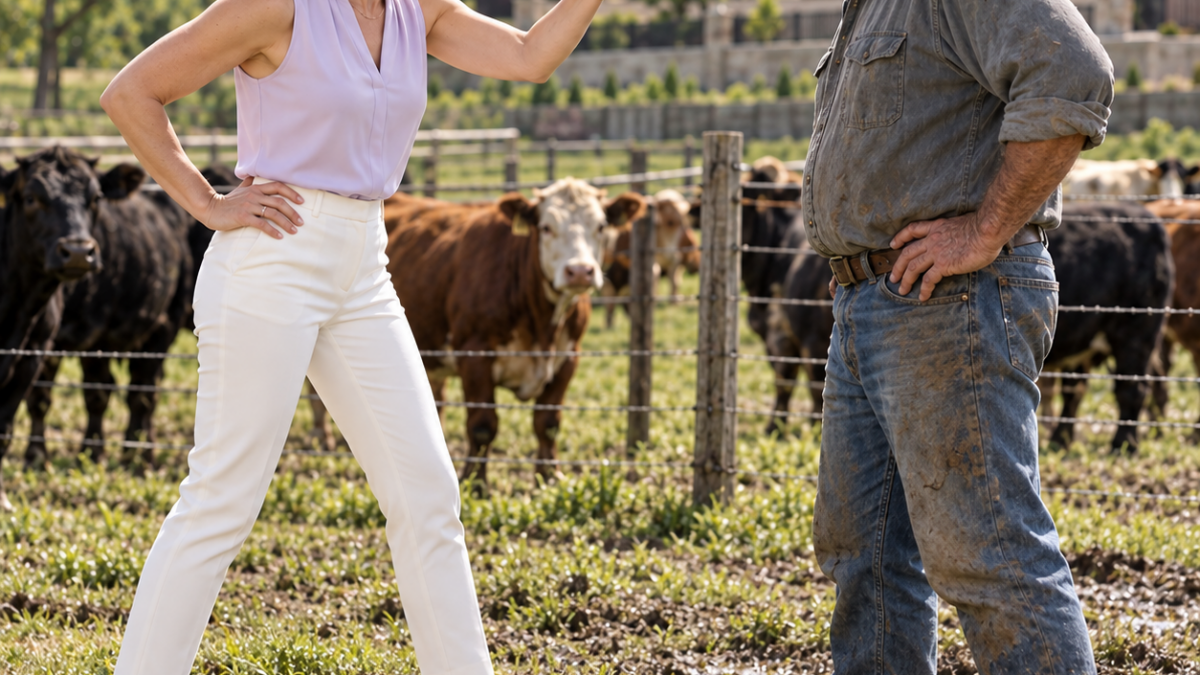
Marching was the wrong word, maybe. She was trying to march. The ground was uneven, and she was wearing white pants and high heels, so every few steps she had to catch herself like the earth itself had insulted her.
She had perfectly styled blond hair, the kind that did not move in the breeze. Her makeup was heavy for a cattle pasture at eight in the morning. A glossy designer purse hung from one elbow. Big sunglasses covered half her face, and her mouth was pressed into a line that told me she had already decided I was beneath her before she got close enough to say hello.
“Excuse me,” she called again. “You need to stop right there.”
I looked around at my own field, my own cattle, my own fence.
Then I waited.
By the time she reached me, her shoes were muddy and her face was flushed.
“Are you the owner of this farm?” she asked, waving one manicured hand as if the land smelled bad enough to touch her skin.
“I am,” I said. “Is there a problem?”
She pushed her sunglasses onto her head.
“I’m Karen Holloway, president of the Stonebridge Estates Homeowners Association.”
She said it like I should have saluted.
I nodded.
“What can I do for you, Mrs. Holloway?”
“For starters,” she said, “you can stop pretending this farm exists in isolation from the community around it.”
I stared at her for a second.
“I’m sorry?”
“Our development is expanding its community standards to include surrounding properties in the immediate area. It’s for everyone’s benefit. We believe your farm should join our HOA.”
I almost laughed.
I wish now that I had. Maybe the sound would have warned me how absurd things were going to get.
“Ma’am,” I said, “this is a working farm.”
“Yes,” she said sharply. “That is exactly the problem.”
The cattle behind me shifted and snorted. One of my older cows, Bessie, lifted her head and stared at Karen with more judgment than I could have managed.
Karen did not appreciate the audience.
“Your property is bringing down our values,” she continued. “The smells, the noise, the equipment, the animals. You have chickens wandering around, tractors operating at unreasonable hours, and fertilizer odor drifting toward homes people paid good money for.”
“I’ve been farming here for more than forty years,” I said. “Everything I do is legal and within county regulations.”
“Legal is not the same as acceptable.”
“It usually matters more.”
Her eyes narrowed.
“We want this handled cooperatively.”
“I’m not joining your HOA.”
Her expression changed then.
Until that moment, she had been condescending. Annoyed. Self-important. But when I said no, something colder moved in behind her eyes.
“This is not really an offer.”
I took my hand off the tailgate.
“Then what is it?”
“A courtesy notice. The HOA has been in contact with county departments. Planning. Zoning. Environmental health.” She smiled. “We have relationships. Connections. Your little farm operation may not be as protected as you think.”
There it was.
The threat.
Not loud. Not crude. Not spoken with a clenched fist.
Wrapped in perfume and white pants.
I looked past her toward the row of luxury houses beyond the fence. Identical roofs. Perfect lawns. A neighborhood built in the middle of farm country by people who apparently thought the countryside was just a backdrop.
“I think this conversation is over,” I said. “You’re on my property. I’d appreciate it if you went back to your side of the fence.”
She blinked like she had never been dismissed in her life.
“You haven’t heard the last of this.”
“I expect not.”
Then I watched her spend five full minutes trying to get back across the pasture without falling in her heels.
When I told Linda about it later, she was in the garden tying tomato plants to stakes.
She shook her head and smiled without much humor.
“Rich people problems.”
“She wants us to join their HOA.”
Linda laughed then.
A real laugh.
“What are they going to do? Fine the cows?”
“I think she might try.”
“She’ll get tired of it.”
But Karen did not get tired.
If anything, refusal made her hungrier.
Over the next few months, the harassment grew like weeds after rain.
More complaints came first. Formal ones. Typed, dated, copied to multiple county offices. Tractor noise. Livestock smell. Agricultural runoff. Roosters. Dust from the gravel road. Irrigation affecting their water pressure, which was nonsense so complete even the inspector laughed when he said it aloud.
Every complaint meant another inspection.
Every inspection meant time away from work.
Every time, the county found nothing wrong.
Then Karen started petitions.
She and a few HOA board members went around town trying to get business owners, neighbors, and other farmers to sign something demanding that my operation be “relocated or modernized to community standards.”
Most locals laughed them out of the room.
One feed store owner told me Karen asked him whether he cared about “regional aesthetic integrity.” He said he told her he cared about getting paid for feed and not much else.
Still, it wore on me.
That was Karen’s gift. Not winning outright. Wearing people down. Turning ordinary life into paperwork and interruptions until peace itself felt expensive.
The breaking point came in early fall.
I was working in the barn one evening when three black SUVs rolled up my driveway like some kind of cheap government raid.
Six people got out wearing matching shirts that said HOA ENFORCEMENT.
I stood in the barn doorway with a wrench in my hand and watched Karen step out last.
She had dressed for intimidation that day. Cream blazer. Gold jewelry. High boots. Hair perfect. Red lipstick sharp enough to cut twine. The men with her were big, thick-necked types who stood with their arms crossed and tried to look like they had authority.
They did not.
But they wanted me to feel like they did.
Karen walked up holding a folder.
“We’re here to serve official notice.”
I looked at the folder.
“Official from who?”
“The Stonebridge Estates HOA.”
“I’m not part of Stonebridge Estates.”
“You are within our expansion zone.”
“No, I’m within my farm.”
One of the men stepped forward.
“Sir, you need to take this seriously.”
I looked at him.
“Son, I was taking things seriously before you learned how to shave.”
His ears went red.
Karen thrust the folder toward me.
“You have forty-eight hours to submit your membership application, a five-hundred-dollar initiation fee, and agreement to monthly dues of two hundred dollars. Failure to comply will result in daily fines of five hundred dollars per violation.”
I opened the folder because curiosity is a dangerous thing.
It was impressive in the way a fake diploma is impressive if you do not know how schools work.
Rules about lawn height. Exterior paint colors. Vehicle storage. Noise limits. Fencing standards. Livestock restrictions. A ban on “malodorous agricultural activity.” A requirement that all visible structures meet “community aesthetic harmony.”
I flipped through it slowly.
Karen watched me with a smug little smile.
“Well?” she said.
“Must have cost a lot to print all this.”
Her smile faltered.
“But I’m not joining your HOA, and I’m not paying fines.”
The big man stepped closer.
“The HOA has authority over this area now.”
“No, it doesn’t.”
“We have support from county planning and zoning.”
“That so?”
Karen’s voice dropped.
“We can make things very difficult for you if you don’t cooperate.”
I closed the folder.
“Is that a threat?”
“It’s a fact.”
The sun was going down behind the barn, throwing long shadows across the driveway. My wife came out onto the porch, drying her hands on a dish towel. I saw her stop when she noticed the SUVs.
Karen noticed too.
Her smile sharpened.
“We know people,” she said. “Important people. Your little farm could be shut down with one phone call if the right violations are found. And trust me, Mr. Walker, we will find violations.”
I handed the folder back.
“You need to leave.”
Karen did not take it.
“Keep it. You’ll need to understand the rules.”
I let the folder fall at her feet.
“No,” I said. “You need to understand something. You are on private agricultural land. You have no authority here. Get off my property before I call the sheriff.”
For a moment, no one moved.
Then Karen laughed softly.
“Enjoy your little farm while you can.”
They left the folder in my gravel and drove away in a cloud of dust.
That night, Linda and I sat at the kitchen table reading through the rules Karen had tried to impose on us.
Linda had a yellow legal pad in front of her and kept writing down the most ridiculous lines.
“No equipment operation before eight a.m.,” she read aloud. “No livestock within view of residential lots. No odor-producing agricultural processes.”
“That one’s going to be tough,” I said. “I’ll tell the manure to smell like lavender.”
She tried to smile, but her eyes were worried.
“What do you want to do?”
“I don’t know yet.”
But I knew one thing.
“I’m not letting people who moved to the country tell me I can’t farm my own land.”
Two days later, I found an official-looking notice taped to my barn door.
It cited me for unauthorized agricultural odor, excessive equipment noise, visible livestock, and failure to comply with Stonebridge community standards.
The fine total was absurd.
Five hundred dollars per day, per violation.
The notice had seals, signatures, reference numbers, and enough formatting to make it look like a government document to anyone who did not know better.
I knew better.
But the intent was clear.
Karen wanted to scare me.
The next morning, my mailbox was spray-painted with red letters.
PAY YOUR FINES.
A week later, someone cut fence posts along the property line shared with the development.
Not broken. Not weather-damaged. Cut clean with a saw.
Three cattle got through and wandered into the HOA’s common area.
Karen filed a formal complaint about uncontrolled livestock before I even finished getting them back.
The county issued a small fine because the cattle had technically left my property. I paid it, but I called the sheriff and reported the cut fence.
Without cameras or witnesses, there was not much they could do.
Karen understood that.
People like her do not always need to avoid suspicion. They only need to avoid proof.
After that, things got worse.
Farm equipment vandalized twice.
Anonymous EPA complaints claiming I was polluting waterways.
Health department reports saying I stored animal waste improperly.
Every accusation was false. Every inspection cleared me. But every one cost time, money, and sleep.
Linda started looking out the window more.
I started locking buildings I had never locked before.
That was the part that made me angriest in ways I could barely explain. A farm is supposed to be hard because weather is hard, markets are hard, animals are unpredictable, machinery breaks. It is not supposed to be hard because some woman in a luxury subdivision has decided your existence offends her property values.
Then came the cattle.
I was in town picking up parts when Linda called.
I knew something was wrong before she spoke because I could hear her breathing.
“Tom,” she said, voice shaking. “You need to come home right now.”
“What happened?”
“Something’s wrong with the cattle.”
I left the parts on the counter and ran.
When I got home, Linda was in the pasture with Dr. Reeves, our veterinarian. She was crying. Not loud. Not dramatic. Just standing there with tears running down her face while the spring wind moved through the grass.
Twelve cattle were dead.
Several more were sick, trembling and foaming, their bodies fighting something they could not understand.
Dr. Reeves looked up at me, and I saw the answer before he said it.
“This looks like poisoning.”
My knees nearly buckled.
He took samples. We separated the sick animals. We worked until dark, then under lights, doing what we could.
The lab results came back later.
Antifreeze mixed with grain.
Someone had fed it to them.
I have seen dead livestock before. Any farmer has. Death is part of the work. Calves die. Old cows go down. Animals get sick, injured, caught in weather. It always hurts, but it is different when nature takes them.
This was not nature.
This was cruelty with a purpose.
Insurance covered most of the financial loss eventually. Between the dead cattle and veterinary care, it came to around thirty-five thousand dollars. But insurance did not cover Linda sitting on the porch that night with her hands wrapped around a mug she never drank from, whispering, “Who does that?”
I did not answer.
Because I knew.
I could not prove it.
But I knew.
Not long after, I woke at two in the morning to the smell of smoke.
At first, I thought I was dreaming.
Then Linda sat bolt upright beside me.
“Tom.”
I was already moving.
The barn was burning.
Flames climbed through the roof, bright orange against the black sky. The heat hit my face before I got halfway across the yard. I could hear popping, cracking, the terrible groan of old beams giving way. Linda called 911 while I ran toward the side entrance, then stopped because even fear has limits. The fire was too far gone.
By the time the fire department arrived, the barn was a total loss.
Most animals were in other pastures, thank God. But feed, equipment, tools, stored supplies—gone.
The fire chief found evidence of accelerant.
Arson.
Another word that changes the air around it.
Standing in the ashes the next morning, I felt older than I had the day before. Linda stood beside me, her face gray with exhaustion.
Then Karen arrived.
She came walking up the driveway in dark sunglasses and a pale blue blouse, looking like she had dressed for brunch and stopped by a tragedy on the way.
“Such a shame,” she said.
Her voice held no sympathy.
I stared at her.
She looked over the blackened beams and twisted metal.
“Accidents happen on farms, don’t they? Especially when people don’t follow proper safety protocols.”
Linda’s hand tightened around mine.
Karen stepped closer.
“Maybe it’s time to reconsider our offer. The HOA could help you rebuild properly. Bring things up to acceptable standards. Prevent future difficulties.”
That was the moment I understood she was no longer just harassing us.
She was dangerous.
Maybe she had not personally struck the match. Maybe she had. I did not know. But she was standing in front of the ashes of my barn and using the fire as leverage.
“Get off my property,” I said.
Her smile disappeared.
“The offer expires at the end of the week.”
“Leave.”
“After that,” she said, “things may get even more difficult.”
I took one step toward her.
Not fast. Not threatening.
Just enough.
For the first time, I saw real fear flicker behind her glasses.
She turned and walked back to her car.
That evening, Linda and I sat at the kitchen table in silence.
The house smelled faintly of smoke even though the barn was gone.
Linda’s hands were folded in front of her.
Finally, she said, “You know what gets me most?”
I looked at her.
“They think we’re poor farmers with no options.”
Her voice did not shake now.
“They think because you wear old boots and drive that truck, because I can tomatoes and mend work shirts, because we don’t live like them, that we don’t matter.”
She was right.
Karen had mistaken modesty for weakness.
She had mistaken patience for fear.
She had looked at our old farmhouse, our practical clothes, our quiet way of living, and decided we were people she could crush.
That was when I decided to show her exactly who she had been trying to crush.
I did not do anything illegal.
That matters.
I did not poison anyone’s animals. I did not burn anything down. I did not threaten her family. I did not sneak around at night.
I made phone calls.
A lot of them.
See, Karen thought Stonebridge Estates was an island of wealth surrounded by backward farmers. What she did not know was that the land around her precious development belonged mostly to me.
Not the houses themselves. Not their little gated streets or clubhouse lawn.
But the odd-shaped parcels beyond their fences. The drainage lots. The pasture strips. The road-access acreage they assumed was worthless because developers had not wanted it.
I owned enough of it to change their lives without stepping one inch outside the law.
I called farmer friends.
Good men. Men who had been dealing with complaints from newcomers for years. Men who understood exactly what it meant when rich people moved beside working land and then tried to regulate it out of existence.
Four of them specialized in hog operations.
If you have never lived near a commercial hog farm, let me be clear.
They smell.
They smell in a way that becomes weather.
They are loud. They are busy. Trucks come early. Feed gets delivered. Waste gets managed. Animals make noise. Fans run. Equipment moves. It is real agriculture, not the decorative kind people like Karen imagine when they say they want “country living.”
I sold parcels to those farmers below market value.
The contracts were clean. Legal. Reviewed by attorneys. Every sale included conditions: the land could never be sold to Stonebridge Estates, the HOA, its board members, or any entity connected to them. The farms had to be operated within legal agricultural limits. Maximum legal capacity was allowed.
The permitting process took time.
Environmental studies. Groundwater testing. Air quality assessments. Waste management plans. Zoning approvals. State agency reviews. County meetings.
Karen, of course, noticed activity.
She left voicemails demanding to know what I was doing. I did not answer.
She sent letters accusing me of retaliation. My lawyer kept them.
She tried to attend one planning meeting and object on behalf of Stonebridge Estates. The county reminded her the land was zoned agricultural and the applicants had met requirements.
It took nearly a year.
But by the following spring, the first hog farm became operational about five hundred yards from the nearest Stonebridge house.
Within a week, Karen called screaming.
“You did this on purpose!”
I listened to the voicemail twice because I wanted Linda to hear it too.
“You have deliberately placed that disgusting pig operation next to our community to harass us! Shut it down immediately!”
Linda raised her eyebrows.
“Can you shut it down?”
“Nope.”
“Do you own it?”
“Nope.”
“Shame.”
The second hog farm came online a month later.
Then the third.
Then the fourth.
By midsummer, nearly two thousand pigs lived legally, noisily, and odorously around Stonebridge Estates.
The wind did the rest.
Property values began to drop.
Not a little.
Dramatically.
Several homes went up for sale. Few got serious offers. Buyers would arrive in expensive cars, step out, smell the air, hear the animals, and suddenly discover they had another showing across town.
Karen tried everything.
Complaints to county offices.
Complaints to the state.
Environmental reports.
Lawyers.
Emergency HOA meetings.
Attempts to change local zoning.
Nothing worked because the hog farms were operating legally. Every permit was in order. Every study had been done. The farmers complied with the law better than Karen complied with basic decency.
That was when she came to my house again.
This time, there were no SUVs. No fake enforcement team. No folder.
Just Karen in a beige designer coat, face tight, standing on my porch while Linda watched from inside.
“I want to buy the land,” Karen said.
“What land?”
“The land those pig farms are on.”
“I don’t own it anymore.”
Her nostrils flared.
“Don’t play games with me.”
“I sold it legally.”
“Then buy it back.”
“No.”
“I will pay twice what it’s worth.”
“No.”
“Three times.”
“Still no.”
“You cannot do this to us,” she snapped. “We have investments to protect.”
“So do farmers.”
Her face reddened.
“You’ve destroyed our community.”
“No,” I said. “You tried to destroy mine. You just didn’t like what grew back.”
She stepped closer.
“If you don’t fix this, I will personally make sure you and your family regret it for the rest of your lives. I have connections all the way to the state level. Licenses can be revoked. Properties can be condemned. Livestock can be seized. Don’t test me.”
I looked at her for a long moment.
Then I smiled.
“Karen,” I said, “you’ve been testing me for over a year. How’s that working out for you?”
She slapped me.
It was not hard. More shocking than painful.
Linda gasped behind the screen door.
Karen seemed shocked too, like her own hand had betrayed her.
I did not move.
I did not raise my voice.
I just said, “Leave before I call the sheriff.”
She left.
By the end of that summer, Stonebridge Estates was falling apart.
Residents blamed Karen for provoking the farmers. Others blamed the developers for not disclosing the agricultural land around them. Some blamed me, naturally, because people will blame the person who refuses to be bullied before they blame the bully for starting the fight.
Three lawsuits began circling the HOA like buzzards.
The HOA tried suing the hog farmers.
Residents sued the HOA for mismanagement.
One homeowner sued the developer for failing to disclose the agricultural character of the surrounding area.
Karen called emergency meetings and posted dramatic messages about preserving community dignity. But dignity is hard to preserve when half your residents are trying to sell and the other half want your head on a platter.
That was when she lost whatever was left of herself.
It happened on a warm afternoon near the end of tomato season.
Linda was in the vegetable garden behind the house, harvesting the last good tomatoes before a forecasted cold snap. I was inside doing paperwork at the kitchen table, sorting insurance documents from the barn fire and legal papers from the ongoing mess.
I heard shouting.
Not from the road.
From the yard.
I went to the window and saw Karen marching across our grass toward the garden.
She was moving fast, not carefully like the first day in the pasture. Her hair was loose, whipping around her face. Her blouse was wrinkled. She looked like she had not slept.
Something was in her hand.
At first, my mind refused to name it.
Then the light caught metal.
I ran.
By the time I reached the garden, Karen was screaming at Linda.
“This is all your fault!”
Linda stood frozen with a basket of tomatoes in her arms.
Karen’s arm was down at her side, but the gun was there.
Small. Dark. Real.
My body went cold.
“Karen,” I said.
She spun toward me.
Her eyes were wild.
“You ruined everything.”
“Put the gun down.”
“Our property values are destroyed. People are leaving. The HOA is collapsing. Do you understand what you’ve done?”
Linda’s face had gone pale.
“Ma’am,” she said carefully, “you need to calm down and leave.”
Karen swung the gun toward her.
“Don’t tell me what to do.”
My heart slammed against my ribs.
“Karen,” I said, forcing my voice low, “look at me. Not her. Me.”
She turned the gun halfway back toward me.
“You’re going to call those pig farmers.”
“I can’t make them leave.”
“Liar!”
“I sold the land.”
“You own everything around us. I know you do. You’ve been playing games from the beginning.”
“She’s right,” Linda whispered, but not loudly enough for Karen to hear.
Karen’s hand shook.
I took one slow step forward.
“Let Linda go inside. You and I can talk.”
“No one goes anywhere until this is fixed.”
“There is no fixing it with a gun.”
“You think you’re so smart,” Karen said, tears suddenly streaking through her makeup. “You think because you had some secret money and some secret land, you could humiliate me.”
“You humiliated yourself.”
Her face twisted.
I regretted saying it the instant the words left my mouth.
Karen pointed the gun directly at Linda.
“Then someone pays.”
“Karen, no!”
The gunshot cracked across the yard.
Linda dropped the basket.
Tomatoes spilled over the dirt like broken red glass.
For one second, I did not understand what I was seeing.
Then Linda fell.
I ran to her.
Blood spread across her shoulder, dark against her shirt. She was conscious, gasping, eyes wide with pain and shock.
“Stay with me,” I said, pressing my hand against the wound. “Linda, stay with me.”
Karen stood a few feet away, staring at the gun like she could not believe it had obeyed her.
“I didn’t mean—” she whispered.
Then sirens sounded in the distance.
A neighbor had heard the argument and called before the shot. Deputies were already coming.
Karen backed away, gun still in hand.
“Put it down!” I shouted. “Put the gun down!”
She looked at Linda bleeding in the dirt.
Something broke in her face.
The gun slipped from her fingers and hit the ground.
When the deputies arrived, Karen did not resist.
They put her in handcuffs while she kept repeating, “I just wanted them to fix it. They ruined everything. I didn’t mean to. I just wanted them to fix it.”
I rode with Linda to the hospital.
The bullet shattered her collarbone and tore through muscle, but it missed the artery. The surgeon told me she was lucky.
Lucky.
I remember standing in the hospital hallway after hearing that word and wanting to punch a hole through the wall.
Lucky that my wife had been shot in the shoulder instead of the chest.
Lucky that Karen’s hand had shaken.
Lucky that our neighbor called when she did.
Lucky is a strange word when your wife is in surgery because an HOA president brought a gun to a vegetable garden.
Linda recovered, though not quickly.
There were surgeries. Physical therapy. Nights when pain woke her. Days when she could not lift her arm without crying. Weather still makes that shoulder stiff, even now.
Karen, meanwhile, finally faced the world she had tried to bend.
Attempted murder.
Armed trespass.
Terroristic threats.
Arson.
Animal cruelty.
Utility of charges tied to the harassment campaign.
At first, her lawyers tried to frame it as stress. A breakdown. A woman overwhelmed by financial pressure. They claimed I had provoked her by surrounding the development with hog farms.
The prosecutor did not buy it.
More importantly, the investigation after the shooting turned up what we had not been able to prove before.
In Karen’s vehicle, deputies found evidence connecting her to the antifreeze used to poison my cattle.
Security footage from a gas station showed her buying gas cans matching the type used in the barn fire.
Phone records placed her near my property during key incidents.
Receipts. Messages. Notes.
Karen had always thought she was too clever to get caught.
What she really was, was arrogant enough to keep souvenirs.
The trial was ugly.
I had to testify.
Linda had to testify too, her shoulder still stiff, her voice steady in a way that made me prouder than I can explain.
Karen sat at the defense table in conservative clothes, hair toned down, makeup softer. She looked smaller without her HOA audience, without her title, without men in matching shirts behind her.
But every so often, when testimony went against her, I saw the old Karen flash through. The tight jaw. The offended stare. The disbelief that anyone had the right to judge her.
Her attorney tried everything.
Extreme emotional distress.
Temporary insanity.
Provocation.
A desperate woman trying to save her community.
But the jury saw the pattern.
Complaints.
Threats.
Fake fines.
Vandalism.
Poisoned cattle.
Arson.
Gun in the garden.
Karen was convicted and sentenced to several years in prison.
Her husband divorced her before sentencing and moved away. I never saw him again.
Stonebridge Estates did not survive her either.
Their HOA had drained reserves fighting the hog farms and paying lawyers. Then came lawsuits from residents, countersuits, insurance disputes, and the public embarrassment of learning their president had poisoned cattle, burned a barn, and shot a farmer’s wife.
At an emergency meeting, the residents voted to dissolve the HOA entirely.
A neighbor I had become friendly with called me afterward.
“You did it,” he said.
“No,” I told him. “Karen did.”
And that was the truth.
I had protected my land.
Karen destroyed her own kingdom.
During the legal aftermath, my lawyer helped us obtain restraining orders against Karen and three other key HOA members who had participated in the harassment. None of them could come within five hundred yards of our property or contact my family.
But I went further.
Every parcel I sold to the hog farmers already included restrictions preventing sale or lease to the HOA, its members, or entities connected to them. After the shooting, I worked with my attorney to put similar restrictions on other properties I owned in the area.
No former HOA leadership could purchase, lease, or hold interest in key agricultural parcels within a two-mile radius of my farm.
Karen had wanted to force me out of my community.
Instead, I made sure she and her worst supporters could never return to power in mine.
Half the houses in Stonebridge sold within the next year, many at painful losses.
The people who stayed changed.
Not overnight. Not magically.
But they learned.
They stopped calling the county every time a tractor started before breakfast. They stopped acting like manure was a personal attack. Some even started buying eggs from nearby farms, including ours. A few apologized. Most did not, but they waved when they drove by, and sometimes that is all you can expect from people too proud to say they were wrong.
The hog farms are still there.
The farmers who bought those parcels run clean, legal operations and provide good jobs. Over time, they added odor-control measures beyond what the law required. The smell is not what it was at first, though anyone who buys near them knows exactly what they are buying near.
That is the point.
No more pretending.
No more luxury countryside fantasy built on the assumption that real farmers should disappear for the comfort of people who arrived last.
Linda and I rebuilt the barn with the insurance settlement and some of our savings.
Bigger. Stronger. Better wiring. Better cameras. Better lighting. Better locks.
The first night after it was finished, we stood inside with the doors open and watched the sunset through the far end.
Linda slipped her good hand into mine.
“Think this one will last?”
“It better,” I said. “Cost enough.”
She smiled.
That smile meant more to me than the barn.
She fully recovered in the way doctors mean when they say fully. She can work, garden, cook, sleep, and live. But her shoulder aches when storms come in. Sometimes I catch her rubbing it without realizing. Sometimes loud bangs still make her flinch.
I do not forgive Karen for that.
I can accept the outcome. I can be grateful my wife survived. I can move forward because farm life does not stop for trauma. But forgiveness is not something anyone gets to demand from the people they hurt.
Karen never understood farmers.
She thought we were simple because we live simply. She thought old clothes meant empty bank accounts. She thought dirty boots meant ignorance. She thought patience meant fear.
She never understood that farming teaches long memory.
You remember drought years. Flood years. Good calves. Bad markets. Which fields hold water. Which neighbors show up when a barn burns. Which people smile while threatening you.
You learn to plan beyond the season in front of you.
You learn that land is not just dirt. It is leverage, legacy, shelter, food, and history.
And if you are lucky, you learn the difference between being peaceful and being weak.
I still drive the same beat-up truck.
I still wear old work shirts.
I still get up before dawn.
The land around us is protected now from the kind of development that brought Karen here in the first place. Agricultural restrictions make sure of that. The farms will remain farms. The open ground will remain working ground. The people who live here now understand what that means.
Sometimes I pass Stonebridge Estates on my way into town.
The sign is still there, though someone removed the word “Luxury” from the entrance after the HOA dissolved. The lawns are not as perfect now. A few houses have gardens. One family keeps chickens, which makes me smile every time I hear the rooster.
Life has a sense of humor if you survive long enough to notice.
A year after Karen went to prison, Linda and I planted a row of apple trees near the rebuilt barn.
She said she wanted something living there that had nothing to do with fire.
So we planted twelve trees.
One for each cow we lost.
Every spring, when they bloom, I think about the animals that died because a woman wanted control more than she valued life. I think about the barn. The smoke. The gunshot. The tomatoes spilled in the dirt.
But I also think about roots.
That is what Karen never had here.
She had a house. A title. A board position. A circle of people willing to follow her because she sounded confident.
But she did not have roots.
She did not understand what it means to belong to land through work, grief, care, and time.
She thought power was walking into my pasture and telling me I had forty-eight hours to submit.
She learned power can also look like an old farmer quietly signing deeds, calling attorneys, working through permits, and waiting.
She thought she could erase us with fines, threats, poison, fire, and fear.
But we are still here.
The HOA is gone.
Karen is in prison.
The hog farms are thriving.
The barn stands new and strong where ashes used to be.
Linda still grows tomatoes.
And every morning, when the first tractor starts before sunrise, I hear it echo across the fields and smile, because it sounds like everything Karen tried to silence and failed.