𝗙𝗨𝗟𝗟 𝗦𝗧𝗢𝗥𝗬 The HOA President Sent Uniformed Men With Handcuffs Onto My Texas Ranch—Then They Told Me They Were Taking Me Away
𝗣𝗔𝗥𝗧 𝟮
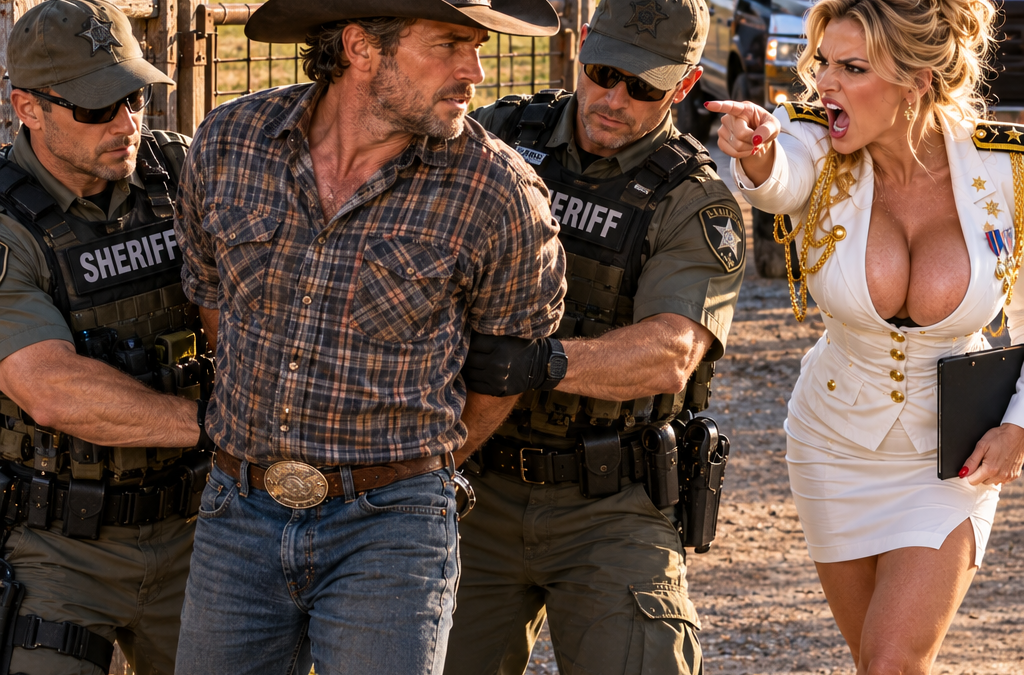
She raised her hand.
Palm out.
Actually put her hand up in my face from across the fence like she was training a dog.
“I don’t think you understand how this works.”
I felt something cold move through me.
“Then explain it.”
“When you live next to a community, you become part of that community.”
“No.”
“Whether you signed paperwork or not.”
“Absolutely not.”
“That’s how neighborhoods function.”
I stared at her.
“That’s how your imagination functions.”
Her eyes narrowed.
“Your property affects our residents.”
“Your residents bought houses next to a ranch.”
“They were promised a premium community.”
“Then somebody lied to them.”
Becky folded her arms.
“You’re bringing down property values.”
“My cattle?”
“Your entire operation.”
She waved one hand toward my land.
The dirt.
The barn.
The equipment.
My cattle.
My home.
My life.
“All of this.”
I took one slow breath.
“All of this existed before your development.”
“That doesn’t mean it has to remain.”
That got my attention.
“What does that mean?”
She smiled.
“The area is changing.”
“My ranch isn’t.”
“Not for long.”
There was something in the way she said it.
Too confident.
Not an idle insult.
“Is that a threat?”
“Don’t be dramatic.”
She turned.
Walked toward the ATV.
Then gave me a little wave over her shoulder.
Like she’d won.
I watched her drive away.
That phrase stayed with me.
Not for long.
I told Sarah that night.
She stopped smiling.
“What do you think she meant?”
“I don’t know.”
“Should we call somebody?”
“My lawyer already knows about the notices.”
“What does he say?”
“Same thing every time.”
“Which is?”
“They have no jurisdiction.”
Sarah looked toward the back window.
“But does Becky know that?”
“She doesn’t care.”
That was the problem.
Someone reasonable changes behavior when shown they’re wrong.
Becky treated being wrong as a challenge to become more aggressive.
Over the next year, she escalated.
Sometimes she’d arrive with other board members.
They stood on the subdivision side of the fence taking pictures.
Barn.
Tractor.
Hay.
Livestock.
Once I watched a man measure the distance between my fence and the hay barn using one of those rolling distance wheels.
I walked closer.
“What’re you measuring?”
He froze.
Then looked toward Becky.
She answered.
“Setbacks.”
“On my property?”
“Potential compliance violations.”
“You’re measuring from the wrong side of the fence.”
“It’s still relevant.”
“To what?”
No answer.
Sarah wanted me to put up a privacy fence.
Six feet tall.
Maybe eight.
Something that would stop them staring.
I refused.
Not because I enjoyed seeing them.
Because it was my ranch.
I wasn’t going to build a wall around my life because a woman in white didn’t like looking at cattle.
They called the county.
Multiple times.
Eventually an inspector came.
He drove around.
Checked the barn.
Looked at the fence.
Asked a few questions.
Then stood beside his truck.
“Everything looks fine.”
“I know.”
“HOA says there are zoning issues.”
“I’m not in the HOA.”
He looked toward the subdivision.
“Yeah.”
I waited.
“Honestly, I don’t see anything.”
That was the only county inspection.
Becky kept telling residents she was “working with authorities.”
One subdivision neighbor later told me she used that phrase constantly at meetings.
“We’re coordinating with county officials.”
“We’re exploring enforcement options.”
“We’re addressing the ranch issue.”
I became the ranch issue.
By the third year, the imaginary fines reached around twenty-six thousand dollars.
Twenty-six thousand dollars.
For cattle.
A rooster.
A barn.
Hay.
Fencing.
A tractor.
And refusing to pretend an HOA owned land it didn’t own.
I still paid nothing.
I also stopped responding.
Every new notice went into the binder.
Date.
Envelope.
File.
Done.
Ignoring Becky made her angrier than fighting.
I realized that eventually.
If I argued, she had an opponent.
If I ignored her, she had no audience.
She couldn’t tolerate that.
Then came the white SUV.
It was an ordinary weekday.
Late afternoon.
Sarah was inside.
I was near the house working on a small repair when I heard tires on the gravel driveway.
Not the county road.
Not the subdivision path.
My driveway.
Private property.
I looked up.
A white SUV had passed through the ranch entrance and was coming toward the house.
Light bar on top.
Official-looking decals.
At first glance, it resembled some kind of patrol unit.
Then I read the door.
Subdivision name.
SECURITY
Below that:
HOA COMMUNITY PATROL
I stood slowly.
The SUV stopped twenty yards from the house.
Two men got out.
They weren’t regular subdivision security guards.
The older one was maybe mid-forties.
Heavy build.
Close-cut hair.
Tan tactical pants.
Black polo shirt.
Patches.
Utility belt.
The younger one wore almost the same outfit.
He had handcuffs hanging from his belt.
Both wore dark wraparound sunglasses.
The older man carried a folder.
The younger one kept his hands near his belt while scanning the property like he was clearing Fallujah instead of looking at cows.
Every instinct I had started warning me.
I didn’t know these men.
They had driven onto private land.
They were dressed to resemble law enforcement.
One had restraints.
And they were walking toward my home.
The older one raised his voice.
“Sir.”
I didn’t move.
“We’re with community enforcement.”
“Stop there.”
They stopped.
For a second.
Then the older man smiled.
“We need you to step over here and answer some questions.”
“No.”
His smile faded.
“Sir, we’ve been authorized—”
“You’re on private property.”
“We are aware.”
“Then turn around.”
The younger guy glanced at the older man.
The older one continued walking.
I raised my voice.
“Stop.”
He stopped again.
I pointed toward the road.
“Get back in your vehicle and leave.”
“We have authorization from the association.”
“The association has no authority here.”
“We’re here to conduct an inspection and serve enforcement documents.”
“Then mail them.”
The man smiled again.
Not friendly.
“You can make this easy or difficult.”
I stared.
“But we’re conducting our business today.”
There are moments when somebody says something that instantly reveals how a situation might go bad.
That was one.
“What business?”
He opened the folder.
“You have accumulated significant outstanding violations.”
“Not valid ones.”
“You’re also refusing property inspection.”
“You don’t have inspection rights.”
“We’ve been authorized.”
“By who?”
“Association management.”
I already knew.
“Becky?”
He didn’t answer.
Instead he said, “If necessary, we’re authorized to escort you to a compliance meeting.”
For a second, the ranch went quiet.
Not literally.
Wind.
Cattle.
Birds.
All still there.
But inside my head, everything stopped.
“Escort me.”
“Yes, sir.”
“Against my will?”
He shifted.
“We’d prefer cooperation.”
“That wasn’t my question.”
The younger man moved slightly closer.
I looked at the handcuffs on his belt.
Then back at the older one.
“Are you telling me you’re authorized to physically take me off my property?”
“Sir, nobody wants things to escalate.”
“Leave.”
“We need to resolve—”
“Leave my property.”
The younger one said, “You need to calm down.”
I almost laughed.
“I’m standing on my ranch.”
The older guy lowered his voice.
“Mr. Dalton, you have been identified as a noncompliant resident. If you continue refusing orders, we can take appropriate action.”
“Resident of what?”
“The community.”
“I’m not in your community.”
“That’s not what our paperwork says.”
“Your paperwork is wrong.”
He took another step.
I felt every alarm in me go off.
Two unknown men.
Fake authority.
Handcuffs.
Private property.
Threatening to remove me.
I could have kept arguing.
But there is a point where argument becomes permission for the situation to continue.
I lifted one hand.
“Stay right there.”
The older guy smiled.
“Going to get your documents?”
“I’m going inside.”
The younger man’s hand moved toward his belt.
Not the cuffs.
Just the belt.
I looked directly at him.
“Do not follow me.”
He stopped.
I walked into the house.
Sarah was near the kitchen.
“Who are they?”
“I don’t know.”
“What do they want?”
“They say they’re taking me to a compliance meeting.”
Her face changed.
“What?”
“Call the sheriff.”
I went to where we kept the shotgun.
That detail requires explanation because I know exactly how it sounds.
On a ranch, a shotgun near the house wasn’t theater.
We had coyotes.
Snakes.
Predators.
And acres between us and immediate help.
The firearm was a tool.
I had no intention of firing it.
I had no intention of pointing it at anyone.
What I did know was that two strangers dressed to resemble police had entered my private property with handcuffs and announced that they believed they could take me somewhere against my will.
I wasn’t going back outside defenseless to discover how serious they were.
I picked up the shotgun.
Kept the muzzle down.
Finger away from the trigger.
Then stepped back onto the porch.
The transformation was immediate.
The younger man’s hands flew away from his belt.
The older guy took such a quick step backward that the folder slipped out from under his arm.
Papers scattered across the gravel.
“Whoa.”
He raised both hands.
“Whoa, whoa, whoa.”
I stayed on the porch.
Muzzle toward the ground.
“There’s no need for that,” he said.
“You’re on my property.”
“Sir, we’re just trying to—”
“You drove through my gate wearing fake police uniforms.”
“We’re security.”
“You told me you’re authorized to take me somewhere.”
“We didn’t mean—”
“You have handcuffs.”
The younger guy looked down at them as though he’d just discovered they were there.
I continued.
“I don’t know who you are.”
The older guy backed toward the SUV.
“We’re community patrol.”
I looked at the younger man.
His face had gone pale.
“Who hired you?”
Silence.
“Who hired you?”
The older guy answered.
“The association.”
“Who specifically?”
“Becky.”
There it was.
“Becky Whitmore?”
“Yes.”
“What did she tell you?”
The men looked at each other.
“She said you were a noncompliant resident.”
“I’m not a resident.”
The older guy swallowed.
“She said you were refusing inspections.”
“I’ve never been subject to inspections.”
“Sir, we were given a work order.”
“For what?”
He looked down at the papers scattered across the driveway.
I didn’t move.
“What did the work order say?”
The younger guy spoke.
“That you were occupying development-adjacent land.”
“That’s a creative phrase.”
The older guy snapped, “Be quiet.”
I looked toward the younger man.
“Keep talking.”
He swallowed.
“She said you were basically squatting.”
I actually laughed.
Not because it was funny.
Because the lie was so enormous my brain couldn’t process it any other way.
“Squatting?”
The younger guy nodded.
“She said there was an ownership dispute.”
“There isn’t.”
“We didn’t know.”
“You didn’t check?”
Silence.
The older man said, “We were told you were refusing to recognize association ownership.”
“My family owned this ranch before your employer poured the first sidewalk.”
He glanced toward the barn.
The cattle.
The equipment.
For the first time, I think he actually saw where he was.
Not some vacant lot beside a subdivision.
A real ranch.
A functioning agricultural property.
“You have identification?”
I asked.
The older guy reached slowly toward his pocket.
“Slow.”
He stopped.
Then pulled out a wallet.
Private security company ID.
Not law enforcement.
No government agency.
Nothing giving him authority to detain me over an HOA argument.
I looked at the younger man.
“And the handcuffs?”
He stared.
“What are those for?”
“Security work.”
“Here?”
“No, sir.”
“Then why bring them onto my property?”
He had no answer.
Then, incredibly, he unclipped the handcuffs.
Held them for a second.
And dropped them into the dirt.
Like they’d burned him.
I almost felt bad for him.
Almost.
The older man started talking quickly.
“We were told this was association-controlled land.”
“It’s not.”
“We were told you were squatting.”
“I’m not.”
“We were told to pressure you into compliance.”
“There’s the first honest sentence you’ve said.”
He swallowed.
“We did not intend to hurt anyone.”
“You told me you could take me somewhere against my will.”
“That was language from the work order.”
“Whose?”
No answer needed.
Becky’s.
Sarah appeared behind the screen door.
“Sheriff’s office is coming.”
The two men exchanged a terrified look.
The older guy raised his hands higher.
“Sir, can we leave?”
I thought about it.
Then looked at their vehicle.
Their fake patches.
The light bar.
The cuffs on the ground.
“Pick up your papers.”
He moved immediately.
Got on his knees.
Started gathering sheets.
“Pick up the cuffs.”
The younger guy grabbed them.
“Get in your vehicle.”
They obeyed.
I stepped off the porch, still keeping distance.
Then said, “You tell Becky something.”
The older man looked at me.
“If anyone from that HOA comes through my gate again pretending to have authority over this ranch, I’m not discussing it with your association.”
He nodded.
“The next people involved will be the real authorities and my attorney.”
“Understood.”
“No. Make sure you understand.”
I pointed toward the road.
“This is private property.”
“Yes.”
“I am not an HOA member.”
“Yes.”
“Nobody from your company has permission to enter.”
“Understood.”
“Now go.”
They moved faster than I’d ever seen two men in tactical pants move.
The older one climbed behind the wheel.
The younger guy practically dove into the passenger seat.
The SUV reversed down the gravel drive.
Too quickly.
Its rear end fishtailed slightly.
Then the vehicle disappeared through the gate.
I lowered the shotgun.
My hands were shaking.
Only then did I realize it.
Sarah came outside.
“What the hell was that?”
“I don’t know.”
“You could’ve been hurt.”
“I know.”
“You should’ve stayed inside.”
“I know.”
“You scared me.”
“I know.”
She looked toward the road.
Then at me.
“We are done ignoring this woman.”
That was exactly what I was thinking.
The sheriff’s deputy arrived shortly afterward.
I explained everything.
Showed him where the men had stood.
Told him about the cuffs.
The threats.
The fake authority.
He took it seriously.
Very seriously.
And when he left, I called my lawyer.
His name was David.
I’d spoken to him several times during the three-year HOA circus.
Every time, David had given me the same advice.
“They don’t have jurisdiction.”
“I know.”
“Don’t pay.”
“I’m not.”
“Keep everything.”
“I am.”
“Eventually they may do something stupid enough to matter.”
That day, they had.
I called.
David answered.
“What did they send now?”
“People.”
Pause.
“What people?”
“Two men in uniforms.”
“What kind of uniforms?”
“Fake cop style.”
Another pause.
“Explain.”
I told him.
SUV.
Light bar.
HOA patrol decals.
Tactical clothes.
Handcuffs.
Compliance order.
Threat of being escorted to a meeting.
Then the part where they admitted Becky described me as a squatter.
David said nothing for several seconds.
“Are you still there?”
“Yes.”
“They sent men dressed like law enforcement onto your property and threatened to detain you.”
“Pretty much.”
“Please tell me you saved everything.”
I looked toward the kitchen.
At the shelf.
Three years of notices.
“I have a folder thicker than the Bible.”
He laughed once.
Not because it was funny.
The kind of laugh a lawyer makes when someone’s opponent has just set themselves on fire.
“Good.”
That afternoon I gave him copies.
Every fine.
Every notice.
Photos I’d taken of Becky and board members standing at my fence.
County complaint records.
Dates.
Correspondence.
The written HOA claims.
Twenty-six thousand dollars in imaginary debt.
And now a report about private security contractors sent onto my land.
David started building a timeline.
First contact.
Fines.
Escalation.
Threats.
“Not for long.”
County reports.
Surveillance from the fence.
Security visit.
False squatter claim.
The pattern looked different when it filled several pages.
Not petty.
Not anymore.
Three years of documented pressure designed to make me surrender authority over property the HOA never controlled.
David sent a formal legal demand.
It was not polite.
It wasn’t rude either.
Lawyers have a special language for sounding calm while explaining that somebody has made a catastrophically bad decision.
The letter demanded immediate withdrawal of every alleged fine.
Immediate cessation of contact.
Written acknowledgment that the ranch was not subject to HOA authority.
Preservation of all communications involving me or my property.
Preservation of board minutes.
Preservation of security contracts.
Preservation of work orders.
Preservation of emails from Becky.
And documentation identifying the two men sent to my ranch.
Then came the sentence that apparently caused panic.
David reserved all rights relating to unlawful trespass, attempted detention, misrepresentation of authority, harassment, and any other civil or criminal issues revealed by the records.
Becky had spent three years pretending her HOA notices were law.
Now actual legal language had arrived.
The security company folded immediately.
I mean immediately.
David contacted them.
Their lawyer contacted him back.
Within days, they produced documents.
Apparently nobody at that little security company wanted to be the defendant explaining to a Texas judge why men wearing badge-shaped patches and handcuffs had driven onto a ranch to remove an owner over HOA violations.
They turned over the contract.
Emails.
And, most importantly, the work order.
David called me.
“You need to see this.”
I drove to his office.
He placed a printed document in front of me.
Subdivision logo.
Security contractor logo.
Authorized by Becky Whitmore.
I read.
The language described me as an unauthorized occupant.
A squatter.
It claimed I was occupying land belonging to or controlled by the planned development.
It said I had repeatedly refused community inspections.
Then came the worst line.
The security team was instructed to remove or detain the occupant if necessary for a compliance interview.
I read it twice.
My stomach turned cold.
“She actually wrote that.”
David nodded.
“Looks like it.”
“She knew I owned the ranch.”
“Yes.”
“I told her directly.”
“Several times.”
“County records show it.”
“Correct.”
I looked at him.
“So she lied.”
“That’s what the documents suggest.”
“To get them to take me.”
“Potentially.”
I leaned back.
For three years, Becky had been ridiculous.
Annoying.
Arrogant.
Absurd.
This wasn’t absurd.
This was dangerous.
She had deliberately described me as a squatter so hired men would treat me like somebody without legitimate rights to the property.
David tapped the document.
“This is more valuable than every fine notice combined.”
“Why?”
“Because this isn’t interpretation.”
He pointed to her name.
“This is instruction.”
I thought about the shotgun.
How close everything had come to becoming much worse.
“What if those guys had been armed?”
David didn’t answer.
He didn’t need to.
The HOA board started panicking almost immediately.
I knew what was happening because of a neighbor named Mike.
Mike lived in the subdivision in a house backing up to my pasture.
Good guy.
We’d become friendly over the fence.
He liked cattle.
I liked hearing what Becky was telling residents.
Mutually beneficial relationship.
Mike called me three days after David’s letter arrived.
“You have any idea what you’ve done?”
“Fed cows?”
“I’m serious.”
“So am I.”
“The board is losing its mind.”
“Why?”
“Nobody knew about the security guys.”
“Nobody?”
“Becky apparently called it enhanced compliance.”
I laughed.
Mike continued.
“They approved some security budget.”
“Okay.”
“But nobody knew she was using it for you.”
That interested me.
“She acted alone?”
“Sounds like it.”
“What is she saying?”
“That you’re dangerous.”
“Of course.”
“She says you threatened security officers with a gun.”
I sighed.
“What else?”
“That she’s been trying to protect property values.”
“Of course.”
Mike lowered his voice.
“There’s a meeting Thursday.”
“About me?”
“About her.”
That was different.
I didn’t attend.
I wasn’t a member.
I had no reason to be there.
Mike called afterward.
I could hear people talking behind him.
“Well?”
“She’s done.”
“What do you mean?”
“They removed her.”
I sat down.
“Tonight?”
“Tonight.”
“What happened?”
Mike sounded delighted.
Apparently Becky entered the meeting wearing one of her dramatic white uniforms.
Tight jacket.
Gold trim.
Deep neckline.
Clipboard.
Still president.
Still acting like everyone else existed to confirm her authority.
The room was packed.
Residents had heard there were legal threats.
People wanted answers.
The board’s attorney was present.
So was the treasurer.
According to Mike, Becky started by framing herself as the victim.
She said she had been protecting the subdivision from an aggressive neighboring landowner.
She said the ranch reduced home values.
She claimed livestock and equipment posed nuisance concerns.
Then she said her security personnel had been “threatened with a firearm while performing legitimate duties.”
That’s when another board member asked the obvious question.
“What legitimate duties?”
Becky apparently froze.
The security contract came out.
Then the work order.
One board member read the sentence describing me as a squatter.
He looked at Becky.
“Is this yours?”
She tried to redirect.
“The situation was more complicated—”
“Did you write this?”
“I prepared the enforcement request.”
“You called him a squatter.”
“He was refusing community integration.”
“He owns the property.”
“The land is adjacent to—”
“He owns it.”
Mike said you could feel the room changing.
Not slowly.
Instantly.
Becky tried again.
“His agricultural operation negatively impacts every homeowner bordering—”
Another board member interrupted.
“That doesn’t make him a squatter.”
“He has rejected every attempt at cooperation.”
“Because he’s not in the HOA.”
“That’s precisely why—”
“No.”
The woman speaking was apparently another board member who had tolerated Becky for years and finally had enough.
“You hired people to take a landowner off property he legally owns.”
Becky snapped.
“I hired security to enforce compliance.”
“Compliance with what?”
“Our standards.”
“He isn’t subject to our standards.”
“Everyone affecting this community—”
“No, Becky.”
Mike said that was the moment her face changed.
She wasn’t used to hearing no inside her own boardroom.
Not from people she’d spent years dominating.
She pointed toward the documents.
“He threatened them with a shotgun.”
The board’s attorney asked, “Were they on his property?”
Becky said nothing.
“Did they have permission to enter?”
Silence.
“Did the HOA have lawful authority to direct his detention?”
More silence.
Then she said, “Somebody had to do something.”
That sentence ended her presidency.
Not legally by itself.
But emotionally.
Everybody heard what it revealed.
This had never been about jurisdiction.
Never really about cattle.
Or barn color.
Or rooster noise.
Becky had decided my ranch didn’t belong beside her ideal subdivision.
So somebody had to do something.
If the law wouldn’t do it, she’d pretend the HOA could.
If the county wouldn’t do it, she’d invent fines.
If fines didn’t work, she’d send men.
The board voted.
Becky was removed as president.
Every fine against me was rescinded.
All twenty-six thousand imaginary dollars vanished in one decision.
The security contract was terminated.
Then the HOA sent David an official letter.
I still have it.
The association acknowledged that my property was a private agricultural parcel outside HOA jurisdiction.
It acknowledged that neither I nor the ranch was subject to their covenants.
It confirmed that HOA representatives would not enter my land without permission.
It confirmed no further enforcement notices would be issued.
Three years.
All of that harassment.
Reduced to a few paragraphs admitting what I’d told Becky the first afternoon.
The fence was the line.
Her authority stopped there.
Becky didn’t take removal well.
I learned that from Mike too.
For several weeks, she apparently blamed everyone.
Me.
The security company.
The board.
The lawyer.
Even residents who questioned her.
Anybody except Becky.
Then one afternoon, months after the settlement, I saw her again.
I was repairing another section of fence.
Same side of the ranch.
Same general area where we’d first met.
An ATV came along the subdivision path.
Not hers.
She was walking.
White trousers.
White fitted jacket.
Gold buttons.
Deep neckline.
Clipboard gone.
That was new.
She stopped across from me.
I kept working.
“Mr. Dalton.”
“Becky.”
Her face tightened.
“I suppose you’re happy.”
I drove a staple into the post.
“About what?”
“You know.”
I stood.
She looked older somehow.
Still beautiful.
Still polished.
But without the presidency around her, the white uniform looked less like authority and more like what it had always been.
A costume.
“The board humiliated me.”
“I wasn’t there.”
“You caused it.”
“No.”
“You had your lawyer threaten everyone.”
“My lawyer responded to what happened.”
“You pulled a shotgun on people working for the association.”
I stared at her.
“They drove onto my ranch and threatened to detain me.”
“They weren’t going to hurt you.”
“You knew that?”
“Of course.”
“How?”
She hesitated.
I stepped closer to the fence.
“How did you know?”
“They were instructed to bring you to a meeting.”
“Against my will.”
“They were supposed to persuade you.”
“With handcuffs?”
Becky rolled her eyes.
“They’re security.”
“You told them I was a squatter.”
Her expression changed.
Just slightly.
“They misunderstood.”
“The work order is in writing.”
“That wording was necessary to explain the dispute.”
“There was no ownership dispute.”
“You refused integration.”
“I’m not in the HOA.”
“Because you’re stubborn.”
“No.”
I shook my head.
“Because I own a ranch.”
“Your ranch affects hundreds of thousands of dollars in property value.”
“Then the developer should’ve disclosed there was a ranch next door.”
“You could have cooperated.”
“How?”
Her lips tightened.
“Improved the fencing.”
“No.”
“Reduced visible equipment.”
“No.”
“Relocated livestock away from the community side.”
“No.”
“Painted the barn.”
I laughed.
She flushed.
“This is exactly your problem.”
“What?”
“You’ve never been willing to compromise.”
“Becky.”
I rested my arms on the fence.
“This isn’t a negotiation.”
Her eyes hardened.
“See?”
“That’s my land.”
“You’re impossible.”
“And you’re still doing it.”
“Doing what?”
“Talking like you have some claim over what happens here.”
She stared at me.
I pointed toward the subdivision.
“You have houses.”
Then the ranch.
“I have this.”
I pointed at the fence between us.
“And this is where your opinion stops mattering.”
For once, Becky didn’t have a response.
She looked toward the barn.
Then the cattle.
A calf was standing near its mother.
My tractor was parked where it had been for years.
The red barn was still red.
The hay was still visible.
The fence still looked like a ranch fence.
Three years of her life had been spent trying to change everything she was looking at.
She had accomplished nothing.
Actually, less than nothing.
She’d lost the presidency.
Cost the HOA legal fees.
Cost herself credibility.
Exposed a security contractor.
And forced the board to put in writing that they had no authority over me.
She turned away.
Then stopped.
“The rooster is still obnoxious.”
I smiled.
“He likes you.”
She walked away.
That was the last real conversation Becky and I ever had.
Life returned to normal.
Real normal.
Not suburban normal.
Ranch normal.
Cattle broke things.
Fences needed repair.
Equipment failed exactly when we needed it most.
Mud appeared where I didn’t want it.
Hay prices went up.
Then down.
Then back up.
The rooster remained committed to violating Becky’s imaginary quiet hours.
The subdivision remained behind us.
And strangely, relations with the people living there actually improved once Becky was removed.
Residents started talking to me without feeling like they were violating foreign policy.
Mike came over sometimes.
A few families brought their kids to see the cattle.
One neighbor apologized.
“For what?”
“I thought you were refusing HOA rules.”
“I was.”
He looked confused.
“Because I’m not in the HOA.”
He laughed.
“Yeah. We figured that out.”
Apparently Becky’s version of events had been very different.
She’d told residents I was exploiting some legal loophole.
That my ranch was technically part of a future HOA expansion.
That ownership boundaries were under review.
That county officials were cooperating with her.
None of it was true.
But when somebody repeats something confidently for three years, people assume there must be something behind it.
There wasn’t.
Just Becky.
The new HOA president was an accountant named Frank.
Older guy.
Soft-spoken.
He contacted me exactly once.
Through my lawyer first.
Then directly after receiving permission.
He wanted to discuss a drainage issue along the shared boundary.
Real issue.
Water from subdivision landscaping was washing against part of my fence.
Frank arrived in jeans and a polo shirt.
No clipboard.
No white uniform.
No threats.
He stood at the fence.
“Think we can fix this?”
“Probably.”
He showed me the drainage plan.
I showed him where water collected.
Their contractor installed a small channel.
Problem solved.
That entire interaction took forty minutes.
When Frank was leaving, I said, “You know, you’re terrible at being HOA president.”
He looked worried.
“Why?”
“You solved a problem.”
He laughed.
“I’ll try to do worse next time.”
That’s how neighbors are supposed to operate.
Not every disagreement requires surrender.
Not every boundary is hostility.
Sometimes somebody says, “That’s my land.”
And the correct answer is, “Understood.”
Becky could never accept that.
For her, a boundary she didn’t control felt like an insult.
My ranch sat outside her jurisdiction.
Therefore the ranch itself became a challenge.
She couldn’t fine me legitimately.
So she invented fines.
Couldn’t enforce them.
So she increased them.
Couldn’t make the county help.
So she pretended the county agreed.
Couldn’t scare me through letters.
So she hired men.
Each failure made her more extreme.
That’s what I remember most when people hear the story and focus on the shotgun.
They ask:
“Weren’t you scared?”
Yes.
“Would you do that again?”
I don’t know.
I hope I’m never put in that exact position again.
There were safer possibilities.
Calling the sheriff and staying inside might have avoided unnecessary risk.
A firearm changes the stakes of any confrontation, even when kept pointed safely at the ground.
I understand that.
What I also understand is what I knew at that moment.
Two unidentified men wearing uniforms designed to resemble law enforcement had driven through my gate without permission.
One carried handcuffs.
They told me they had authority to physically remove me.
They continued approaching after I ordered them to leave.
I didn’t know who they actually were.
I didn’t know whether they were armed.
I didn’t know how far Becky’s lies had gone.
I’m grateful nobody got hurt.
I’m grateful the men backed down.
I’m grateful Sarah called law enforcement.
And I’m grateful the thing that ultimately defeated Becky wasn’t a weapon.
It was paperwork.
That’s the funny part.
The shotgun gets everyone’s attention when I tell the story.
But it didn’t remove Becky.
Documents did.
Three years of notices.
Three years of fines.
Photographs.
County records.
Dates.
Envelopes.
Her security contract.
Her work order.
Her own words describing me as a squatter.
That piece of paper mattered more than anything else.
People like Becky rely on intimidation because intimidation disappears after the conversation.
She could tell me at a fence that my ranch wouldn’t last long.
Then deny what she meant.
She could tell residents county authorities supported her.
Then change the story later.
She could tell board members she was merely pursuing community compliance.
Then blame contractors when things went too far.
But once she wrote down that I was a squatter and instructed men to remove me?
She trapped herself.
Years later, I still have the old HOA binder.
Sarah has asked several times why I keep it.
“Memory.”
“Of Becky?”
“Of paperwork.”
She rolls her eyes.
The binder sits in a cabinet in my office.
Twenty-six thousand dollars in fake fines.
All worthless.
I kept one notice on top.
UNSIGHTLY LIVESTOCK VISIBLE FROM ROADWAY.
Something about that one still makes me laugh.
Sometimes I see the cattle from the kitchen window and wonder whether they’re aware they once nearly destroyed suburban property values through aggressive standing.
One spring, a resident’s little boy came to the fence with his father.
He couldn’t have been more than six.
He stared at one of our cows.
“Does she have a name?”
“That one’s Rosie.”
“Can I pet her?”
“If she comes over.”
Rosie did.
The boy reached through carefully and touched her nose.
His father smiled.
“Thanks.”
“No problem.”
Then the boy pointed toward my barn.
“Why is it red?”
I laughed.
“Because apparently I’m a criminal.”
His father nearly choked.
The boy had no idea why that was funny.
Good.
Children shouldn’t have to understand HOA politics.
I thought about Becky sometimes.
Not often.
Her house eventually went up for sale.
She moved.
Mike told me she relocated somewhere with another HOA.
I wished them luck.
The ranch stayed.
The fence stayed.
The barn stayed red.
The tractor remained visible.
The cattle remained profoundly unconcerned with neighborhood aesthetics.
And every morning, usually before sunrise, the rooster still announced that he was alive.
The subdivision residents got used to him.
Some even told me they liked hearing it.
Imagine that.
The thing Becky had classified as a nuisance became part of the neighborhood sound.
That’s life.
People adapt.
Communities adapt.
The world does not collapse because everything outside your window isn’t under your control.
I wish Becky had learned that before spending three years trying to turn my ranch into something it wasn’t.
I don’t hate her.
That’s another thing people find surprising.
I was angry.
Very angry.
Especially when I saw the work order.
Especially when I realized she had intentionally lied about ownership.
But hate requires energy.
Ranching already consumes enough.
Becky became a story.
A ridiculous chapter.
A reminder.
The lesson wasn’t that HOAs are evil.
I’ve met plenty of perfectly decent HOA board members.
Frank was one.
The lesson was about authority.
Real authority has edges.
Limits.
Jurisdiction.
Procedure.
People with legitimate power generally know where that power ends.
People who crave power hate edges.
They see boundaries as obstacles to overcome.
Becky saw my fence and thought:
How do I get past it?
The county saw my fence and thought:
His property begins there.
That’s the difference.
One afternoon, years after everything ended, I stood almost exactly where Becky and I had first argued.
I had replaced the old fence post.
The subdivision looked older now.
Trees taller.
Roofs weathered.
People had added patio furniture and grills.
The place finally looked lived in rather than staged.
My pasture looked mostly the same.
Cattle.
Barn.
Hay.
A tractor.
Sarah came walking out from the house carrying two glasses of iced tea.
She handed one to me.
“What’re you staring at?”
“The neighborhood.”
“Why?”
“Remember when Becky said the ranch didn’t fit their vision?”
Sarah laughed.
“Unfortunately.”
I looked across the pasture.
“Turns out their vision had to adjust.”
“Most visions do.”
We stood there quietly.
Then the rooster crowed.
Middle of the afternoon.
No reason.
Just because he could.
Sarah looked toward the coop.
“He’s violating quiet hours.”
“Fine him.”
“How much?”
“Twenty-six thousand.”
She laughed.
I did too.
And that was it.
No lawyers.
No fake patrol SUV.
No fines.
No white uniform walking toward my fence.
Just wind moving across grass.
Cattle feeding.
My wife beside me.
Home.
That was all I’d wanted from the beginning.
Becky had spent three years telling me that living beside her subdivision made my ranch part of her community.
She was wrong.
But there was a piece of irony I eventually appreciated.
Over time, the subdivision did become our neighbor.
Not our authority.
Our neighbor.
We helped each other with drainage.
People waved.
Kids watched the cattle.
Nobody tried to redesign my barn.
The ranch remained a ranch.
The neighborhood remained a neighborhood.
Separated by one simple fence everyone finally understood.
A few strands of wire.
Some posts.
And a boundary Becky should never have crossed.
𝗧𝗛𝗘 𝗘𝗡𝗗
The HOA President Sent Uniformed Men With Handcuffs Onto My Texas Ranch—Then They Told Me They Were Taking Me Away
The first time Becky told me my family ranch no longer fit the “vision” for her subdivision, I thought she was just another woman with a clipboard who had confused neighborhood rules with actual law.
Three years later, two men in tactical uniforms drove through my gate with handcuffs on their belts and orders to remove me from my own land.
That was the afternoon the HOA finally pushed far enough that ignoring them was no longer an option.
My family had owned that ranch longer than the subdivision behind it had existed in anyone’s imagination.
Longer than the paved roads.
Longer than the streetlights.
Longer than the decorative stone entrance with the iron letters announcing the development’s name like people were driving into a private country.
My grandfather worked that land.
My father worked it after him.
By the time it became mine, I knew every low spot that turned to mud after a hard rain, every gate that needed lifting slightly before the latch would catch, every section of fence the cattle liked testing when the grass on the other side looked greener.
It wasn’t decorative acreage.
It wasn’t a weekend retreat for somebody from Dallas who wanted cowboy boots in their retirement pictures.
It was a working Texas ranch.
Cattle.
Hay.
Equipment.
Mud.
Diesel.
Fence posts.
A barn that had faded in the sun.
A rooster who believed sunrise required a personal announcement.
The ranch paid our bills.
My wife, Sarah, and I raised our family there.
And for decades, the property had quietly done what ranches do while everything around it changed.
Then a developer bought a large tract along our back fence.
At first I didn’t care.
Developers came and went.
People sold farmland.
Cities spread.
That was life.
But within two years, the empty land behind us became one of those master-planned subdivisions where every house looked like the same house wearing slightly different clothes.
Beige brick.
Gray brick.
Light gray brick.
Dark beige brick.
Perfect lawns.
Identical fences.
Decorative ponds nobody could fish in.
The development came right up to the edge of our property, separated from our cattle by the same kind of ranch fence that had been standing there long before the first foundation was poured.
Then came the homeowners association.
For a while, the HOA and I ignored each other.
Exactly as it should have been.
They had jurisdiction over their subdivision.
I had my ranch.
Their residents waved occasionally over the fence.
A couple of kids liked watching the cattle.
One older man asked me if he could photograph the sunset from his backyard with the cows in the foreground.
Normal neighbor stuff.
Then Becky Whitmore appeared.
She was the HOA president.
Around forty.
Maybe forty-two.
Beautiful in the polished, deliberate way of someone who had spent years learning how to turn appearance into influence.
Long blonde hair.
Sharp blue eyes.
Full lips.
A curvy figure she showed off without apology, especially a very large chest that her favorite clothes seemed specifically designed to emphasize.
And those clothes were something.
Becky had apparently decided that running a suburban HOA required her own private military branch.
She routinely wore fitted white military-inspired outfits—tight white jackets with gold buttons, decorative shoulder pieces, white skirts or fitted trousers, and a deep neckline that would have looked more appropriate at an upscale yacht club than beside a cattle fence.
She wore white boots sometimes.
Other days, heels.
Always immaculate.
Always carrying a clipboard.
The first time I saw her, I was repairing a section of fence near the back pasture.
It was hot.
Texas hot.
The kind of afternoon where the sun doesn’t feel like light so much as weight.
I had gloves on, a post driver beside me, and sweat soaking through my shirt.
I heard an ATV before I saw it.
A little side-by-side rolled along the subdivision’s maintenance path, kicking up dust on their side of the fence.
Becky was driving.
She stopped almost directly across from me.
Turned off the engine.
Then climbed out.
White trousers.
White fitted jacket.
Gold buttons.
Clipboard tucked beneath one arm like a pistol.
She walked toward the fence and looked across my pasture with an expression you’d expect from someone inspecting storm damage.
“Excuse me.”
I stopped working.
“Afternoon.”
“Are you the property owner?”
“I am.”
She smiled.
“I’m Becky Whitmore. President of the homeowners association.”
“Nice to meet you.”
I meant it at the time.
She glanced toward the barn.
Then the cattle.
Then the tractor parked near the equipment shed.
Her face tightened.
“I wanted to speak with you regarding integration.”
I leaned on the fence post.
“Integration of what?”
“Your parcel.”
“My parcel into what?”
“The community.”
I thought she was joking.
I actually smiled.
“What community?”
She pointed vaguely behind her.
“The development.”
I looked past her at the rooftops.
Then back at my cattle.
“I think you’ve got the wrong property.”
Her smile became slightly less friendly.
“No. Your land borders the western residential section.”
“Yes.”
“Which places it within our planning area.”
I laughed.
I didn’t mean to insult her.
It just came out.
“Your planning area?”
“Correct.”
“This ranch has been here three generations.”
“I’m aware it’s an older parcel.”
“Older than your subdivision.”
“That doesn’t prevent regional integration.”
Regional integration.
That phrase stayed with me because it sounded official enough to intimidate somebody who didn’t know better and meaningless enough to survive any challenge.
I rested both arms across the top fence rail.
“Becky, I’m not in your HOA.”
“You haven’t registered.”
“I haven’t registered because I’m not in it.”
She uncapped a pen.
“That will need to be corrected.”
“No.”
Her pen stopped.
“I’m sorry?”
“No.”
She stared.
I pointed toward the pasture.
“This is agricultural land. Always has been.”
“There have been changes in the surrounding area.”
“Not to my deed.”
“We have community standards.”
“Congratulations.”
Her cheeks colored slightly.
“I don’t think you’re understanding me.”
“I understand you perfectly.”
I pointed toward one of my cows.
“Does she need to fill out an application too?”
Becky looked at me as if I’d insulted her mother.
“I’m trying to have a professional conversation.”
“So am I.”
“There is a vision for this area.”
I waited.
She looked across my entire ranch.
The barn.
Hay.
Fence.
Tractor.
Animals.
“Your property currently doesn’t fit that vision.”
I remember looking at her for a long second.
Then at the pasture.
Then back.
“Well, the pasture was here first.”
She wrote something on her clipboard.
I smiled.
“What are you writing?”
“Notes.”
“About what?”
“Compliance concerns.”
That was the moment I realized she wasn’t joking.
I stepped closer to the fence.
“Becky, listen carefully.”
She lifted her chin.
“My family owns this land.”
“I understand.”
“We never joined your association.”
“Not yet.”
“We’re not joining.”
Her lips tightened.
“There are procedures—”
“No.”
I shook my head.
“There are no procedures because there is no relationship between your HOA and my property.”
“You border the development.”
“So does the county road.”
“That’s different.”
“Exactly.”
I pointed behind her.
“Your rules stop at that fence.”
Her smile disappeared.
“You may want to speak to someone who understands community governance.”
“You may want to speak to someone who understands property.”
For a second we just stared at each other.
Then Becky clicked her pen shut.
“Fine.”
She walked back toward the ATV.
I thought we were done.
Before climbing in, she looked over her shoulder.
“You’ll be hearing from us.”
I should have believed her.
One week later, the first notice arrived.
Official-looking envelope.
HOA logo.
My name.
My ranch address.
I opened it at the kitchen table.
Sarah watched me read.
“What?”
I handed it over.
She frowned.
“‘Unsightly livestock visible from community roadway.'”
I nodded.
She looked through the window toward forty head of cattle.
“They’re cows.”
“Apparently offensive cows.”
“How much?”
“Two hundred dollars.”
Sarah stared at me.
Then laughed.
I laughed too.
We put the notice on the refrigerator with a magnet shaped like Texas.
I figured that was the end of it.
Then another arrived.
ODOR NUISANCE.
Apparently cattle smelled like cattle.
Another fine.
Then:
EXCESSIVE ANIMAL NOISE.
That one was about the rooster.
According to the violation, repeated crowing during morning quiet hours disrupted neighborhood enjoyment.
Sarah read it aloud while drinking coffee.
“Think he knows?”
“Who?”
“The rooster.”
“I’ll counsel him.”
“You need to be firm.”
“I’ll put it in writing.”
Next came:
IMPROPER FENCING MATERIAL.
That nearly impressed me.
The same type of wire fence ranchers had used for generations had suddenly become aesthetically incompatible with a subdivision built three years earlier.
Then:
UNAPPROVED BARN COLOR.
Our barn was red.
It had been red longer than Becky had been president of anything.
Then:
AGRICULTURAL EQUIPMENT IN OPEN VIEW.
A tractor.
They fined me because someone could see a tractor on a ranch.
That one went on the fridge too.
By the end of the first year, the HOA claimed I owed more than eleven thousand dollars.
I paid zero.
But I kept everything.
Every notice.
Every envelope.
Every photograph attached to a complaint.
Every threatening sentence.
I created a binder.
Then a second one.
That turned out to be one of the smartest things I ever did.
I did try reasoning with Becky.
Once.
Maybe twice.
The conversation that killed any hope of that happened near the same fence where we’d met.
I was checking a water line.
Her ATV pulled up.
She stepped out wearing another white uniform, this one with a fitted skirt and gold trim across the shoulders.
The neckline plunged low across her chest.
She looked absurdly elegant standing ten feet from cow manure.
“Becky.”
“Mr. Dalton.”
“We need to straighten something out.”
She sighed.
“I really don’t have time to re-explain policy.”
“There is no policy that applies to me.”
She raised her hand.
Palm out.
Actually put her hand up in my face from across the fence like she was training a dog.
“I don’t think you understand how this works.”
I felt something cold move through me.
“Then explain it.”
“When you live next to a community, you become part of that community.”
“No.”
“Whether you signed paperwork or not.”
“Absolutely not.”
“That’s how neighborhoods function.”
I stared at her.
“That’s how your imagination functions.”
Her eyes narrowed.
“Your property affects our residents.”
“Your residents bought houses next to a ranch.”
“They were promised a premium community.”
“Then somebody lied to them.”
Becky folded her arms.
“You’re bringing down property values.”
“My cattle?”
“Your entire operation.”
She waved one hand toward my land.
The dirt.
The barn.
The equipment.
My cattle.
My home.
My life.
“All of this.”
I took one slow breath.
“All of this existed before your development.”
“That doesn’t mean it has to remain.”
That got my attention.
“What does that mean?”
She smiled.
“The area is changing.”
“My ranch isn’t.”
“Not for long.”
There was something in the way she said it.
Too confident.
Not an idle insult.
“Is that a threat?”
“Don’t be dramatic.”
She turned.
Walked toward the ATV.
Then gave me a little wave over her shoulder.
Like she’d won.
I watched her drive away.
That phrase stayed with me.
Not for long.
I told Sarah that night.
She stopped smiling.
“What do you think she meant?”
“I don’t know.”
“Should we call somebody?”
“My lawyer already knows about the notices.”
“What does he say?”
“Same thing every time.”
“Which is?”
“They have no jurisdiction.”
Sarah looked toward the back window.
“But does Becky know that?”
“She doesn’t care.”
That was the problem.
Someone reasonable changes behavior when shown they’re wrong.
Becky treated being wrong as a challenge to become more aggressive.
Over the next year, she escalated.
Sometimes she’d arrive with other board members.
They stood on the subdivision side of the fence taking pictures.
Barn.
Tractor.
Hay.
Livestock.
Once I watched a man measure the distance between my fence and the hay barn using one of those rolling distance wheels.
I walked closer.
“What’re you measuring?”
He froze.
Then looked toward Becky.
She answered.
“Setbacks.”
“On my property?”
“Potential compliance violations.”
“You’re measuring from the wrong side of the fence.”
“It’s still relevant.”
“To what?”
No answer.
Sarah wanted me to put up a privacy fence.
Six feet tall.
Maybe eight.
Something that would stop them staring.
I refused.
Not because I enjoyed seeing them.
Because it was my ranch.
I wasn’t going to build a wall around my life because a woman in white didn’t like looking at cattle.
They called the county.
Multiple times.
Eventually an inspector came.
He drove around.
Checked the barn.
Looked at the fence.
Asked a few questions.
Then stood beside his truck.
“Everything looks fine.”
“I know.”
“HOA says there are zoning issues.”
“I’m not in the HOA.”
He looked toward the subdivision.
“Yeah.”
I waited.
“Honestly, I don’t see anything.”
That was the only county inspection.
Becky kept telling residents she was “working with authorities.”
One subdivision neighbor later told me she used that phrase constantly at meetings.
“We’re coordinating with county officials.”
“We’re exploring enforcement options.”
“We’re addressing the ranch issue.”
I became the ranch issue.
By the third year, the imaginary fines reached around twenty-six thousand dollars.
Twenty-six thousand dollars.
For cattle.
A rooster.
A barn.
Hay.
Fencing.
A tractor.
And refusing to pretend an HOA owned land it didn’t own.
I still paid nothing.
I also stopped responding.
Every new notice went into the binder.
Date.
Envelope.
File.
Done.
Ignoring Becky made her angrier than fighting.
I realized that eventually.
If I argued, she had an opponent.
If I ignored her, she had no audience.
She couldn’t tolerate that.
Then came the white SUV.
It was an ordinary weekday.
Late afternoon.
Sarah was inside.
I was near the house working on a small repair when I heard tires on the gravel driveway.
Not the county road.
Not the subdivision path.
My driveway.
Private property.
I looked up.
A white SUV had passed through the ranch entrance and was coming toward the house.
Light bar on top.
Official-looking decals.
At first glance, it resembled some kind of patrol unit.
Then I read the door.
Subdivision name.
SECURITY
Below that:
HOA COMMUNITY PATROL
I stood slowly.
The SUV stopped twenty yards from the house.
Two men got out.
They weren’t regular subdivision security guards.
The older one was maybe mid-forties.
Heavy build.
Close-cut hair.
Tan tactical pants.
Black polo shirt.
Patches.
Utility belt.
The younger one wore almost the same outfit.
He had handcuffs hanging from his belt.
Both wore dark wraparound sunglasses.
The older man carried a folder.
The younger one kept his hands near his belt while scanning the property like he was clearing Fallujah instead of looking at cows.
Every instinct I had started warning me.
I didn’t know these men.
They had driven onto private land.
They were dressed to resemble law enforcement.
One had restraints.
And they were walking toward my home.
The older one raised his voice.
“Sir.”
I didn’t move.
“We’re with community enforcement.”
“Stop there.”
They stopped.
For a second.
Then the older man smiled.
“We need you to step over here and answer some questions.”
“No.”
His smile faded.
“Sir, we’ve been authorized—”
“You’re on private property.”
“We are aware.”
“Then turn around.”
The younger guy glanced at the older man.
The older one continued walking.
I raised my voice.
“Stop.”
He stopped again.
I pointed toward the road.
“Get back in your vehicle and leave.”
“We have authorization from the association.”
“The association has no authority here.”
“We’re here to conduct an inspection and serve enforcement documents.”
“Then mail them.”
The man smiled again.
Not friendly.
“You can make this easy or difficult.”
I stared.
“But we’re conducting our business today.”
There are moments when somebody says something that instantly reveals how a situation might go bad.
That was one.
“What business?”
He opened the folder.
“You have accumulated significant outstanding violations.”
“Not valid ones.”
“You’re also refusing property inspection.”
“You don’t have inspection rights.”
“We’ve been authorized.”
“By who?”
“Association management.”
I already knew.
“Becky?”
He didn’t answer.
Instead he said, “If necessary, we’re authorized to escort you to a compliance meeting.”
For a second, the ranch went quiet.
Not literally.
Wind.
Cattle.
Birds.
All still there.
But inside my head, everything stopped.
“Escort me.”
“Yes, sir.”
“Against my will?”
He shifted.
“We’d prefer cooperation.”
“That wasn’t my question.”
The younger man moved slightly closer.
I looked at the handcuffs on his belt.
Then back at the older one.
“Are you telling me you’re authorized to physically take me off my property?”
“Sir, nobody wants things to escalate.”
“Leave.”
“We need to resolve—”
“Leave my property.”
The younger one said, “You need to calm down.”
I almost laughed.
“I’m standing on my ranch.”
The older guy lowered his voice.
“Mr. Dalton, you have been identified as a noncompliant resident. If you continue refusing orders, we can take appropriate action.”
“Resident of what?”
“The community.”
“I’m not in your community.”
“That’s not what our paperwork says.”
“Your paperwork is wrong.”
He took another step.
I felt every alarm in me go off.
Two unknown men.
Fake authority.
Handcuffs.
Private property.
Threatening to remove me.
I could have kept arguing.
But there is a point where argument becomes permission for the situation to continue.
I lifted one hand.
“Stay right there.”
The older guy smiled.
“Going to get your documents?”
“I’m going inside.”
The younger man’s hand moved toward his belt.
Not the cuffs.
Just the belt.
I looked directly at him.
“Do not follow me.”
He stopped.
I walked into the house.
Sarah was near the kitchen.
“Who are they?”
“I don’t know.”
“What do they want?”
“They say they’re taking me to a compliance meeting.”
Her face changed.
“What?”
“Call the sheriff.”
I went to where we kept the shotgun.
That detail requires explanation because I know exactly how it sounds.
On a ranch, a shotgun near the house wasn’t theater.
We had coyotes.
Snakes.
Predators.
And acres between us and immediate help.
The firearm was a tool.
I had no intention of firing it.
I had no intention of pointing it at anyone.
What I did know was that two strangers dressed to resemble police had entered my private property with handcuffs and announced that they believed they could take me somewhere against my will.
I wasn’t going back outside defenseless to discover how serious they were.
I picked up the shotgun.
Kept the muzzle down.
Finger away from the trigger.
Then stepped back onto the porch.
The transformation was immediate.
The younger man’s hands flew away from his belt.
The older guy took such a quick step backward that the folder slipped out from under his arm.
Papers scattered across the gravel.
“Whoa.”
He raised both hands.
“Whoa, whoa, whoa.”
I stayed on the porch.
Muzzle toward the ground.
“There’s no need for that,” he said.
“You’re on my property.”
“Sir, we’re just trying to—”
“You drove through my gate wearing fake police uniforms.”
“We’re security.”
“You told me you’re authorized to take me somewhere.”
“We didn’t mean—”
“You have handcuffs.”
The younger guy looked down at them as though he’d just discovered they were there.
I continued.
“I don’t know who you are.”
The older guy backed toward the SUV.
“We’re community patrol.”
I looked at the younger man.
His face had gone pale.
“Who hired you?”
Silence.
“Who hired you?”
The older guy answered.
“The association.”
“Who specifically?”
“Becky.”
There it was.
“Becky Whitmore?”
“Yes.”
“What did she tell you?”
The men looked at each other.
“She said you were a noncompliant resident.”
“I’m not a resident.”
The older guy swallowed.
“She said you were refusing inspections.”
“I’ve never been subject to inspections.”
“Sir, we were given a work order.”
“For what?”
He looked down at the papers scattered across the driveway.
I didn’t move.
“What did the work order say?”
The younger guy spoke.
“That you were occupying development-adjacent land.”
“That’s a creative phrase.”
The older guy snapped, “Be quiet.”
I looked toward the younger man.
“Keep talking.”
He swallowed.
“She said you were basically squatting.”
I actually laughed.
Not because it was funny.
Because the lie was so enormous my brain couldn’t process it any other way.
“Squatting?”
The younger guy nodded.
“She said there was an ownership dispute.”
“There isn’t.”
“We didn’t know.”
“You didn’t check?”
Silence.
The older man said, “We were told you were refusing to recognize association ownership.”
“My family owned this ranch before your employer poured the first sidewalk.”
He glanced toward the barn.
The cattle.
The equipment.
For the first time, I think he actually saw where he was.
Not some vacant lot beside a subdivision.
A real ranch.
A functioning agricultural property.
“You have identification?”
I asked.
The older guy reached slowly toward his pocket.
“Slow.”
He stopped.
Then pulled out a wallet.
Private security company ID.
Not law enforcement.
No government agency.
Nothing giving him authority to detain me over an HOA argument.
I looked at the younger man.
“And the handcuffs?”
He stared.
“What are those for?”
“Security work.”
“Here?”
“No, sir.”
“Then why bring them onto my property?”
He had no answer.
Then, incredibly, he unclipped the handcuffs.
Held them for a second.
And dropped them into the dirt.
Like they’d burned him.
I almost felt bad for him.
Almost.
The older man started talking quickly.
“We were told this was association-controlled land.”
“It’s not.”
“We were told you were squatting.”
“I’m not.”
“We were told to pressure you into compliance.”
“There’s the first honest sentence you’ve said.”
He swallowed.
“We did not intend to hurt anyone.”
“You told me you could take me somewhere against my will.”
“That was language from the work order.”
“Whose?”
No answer needed.
Becky’s.
Sarah appeared behind the screen door.
“Sheriff’s office is coming.”
The two men exchanged a terrified look.
The older guy raised his hands higher.
“Sir, can we leave?”
I thought about it.
Then looked at their vehicle.
Their fake patches.
The light bar.
The cuffs on the ground.
“Pick up your papers.”
He moved immediately.
Got on his knees.
Started gathering sheets.
“Pick up the cuffs.”
The younger guy grabbed them.
“Get in your vehicle.”
They obeyed.
I stepped off the porch, still keeping distance.
Then said, “You tell Becky something.”
The older man looked at me.
“If anyone from that HOA comes through my gate again pretending to have authority over this ranch, I’m not discussing it with your association.”
He nodded.
“The next people involved will be the real authorities and my attorney.”
“Understood.”
“No. Make sure you understand.”
I pointed toward the road.
“This is private property.”
“Yes.”
“I am not an HOA member.”
“Yes.”
“Nobody from your company has permission to enter.”
“Understood.”
“Now go.”
They moved faster than I’d ever seen two men in tactical pants move.
The older one climbed behind the wheel.
The younger guy practically dove into the passenger seat.
The SUV reversed down the gravel drive.
Too quickly.
Its rear end fishtailed slightly.
Then the vehicle disappeared through the gate.
I lowered the shotgun.
My hands were shaking.
Only then did I realize it.
Sarah came outside.
“What the hell was that?”
“I don’t know.”
“You could’ve been hurt.”
“I know.”
“You should’ve stayed inside.”
“I know.”
“You scared me.”
“I know.”
She looked toward the road.
Then at me.
“We are done ignoring this woman.”
That was exactly what I was thinking.
The sheriff’s deputy arrived shortly afterward.
I explained everything.
Showed him where the men had stood.
Told him about the cuffs.
The threats.
The fake authority.
He took it seriously.
Very seriously.
And when he left, I called my lawyer.
His name was David.
I’d spoken to him several times during the three-year HOA circus.
Every time, David had given me the same advice.
“They don’t have jurisdiction.”
“I know.”
“Don’t pay.”
“I’m not.”
“Keep everything.”
“I am.”
“Eventually they may do something stupid enough to matter.”
That day, they had.
I called.
David answered.
“What did they send now?”
“People.”
Pause.
“What people?”
“Two men in uniforms.”
“What kind of uniforms?”
“Fake cop style.”
Another pause.
“Explain.”
I told him.
SUV.
Light bar.
HOA patrol decals.
Tactical clothes.
Handcuffs.
Compliance order.
Threat of being escorted to a meeting.
Then the part where they admitted Becky described me as a squatter.
David said nothing for several seconds.
“Are you still there?”
“Yes.”
“They sent men dressed like law enforcement onto your property and threatened to detain you.”
“Pretty much.”
“Please tell me you saved everything.”
I looked toward the kitchen.
At the shelf.
Three years of notices.
“I have a folder thicker than the Bible.”
He laughed once.
Not because it was funny.
The kind of laugh a lawyer makes when someone’s opponent has just set themselves on fire.
“Good.”
That afternoon I gave him copies.
Every fine.
Every notice.
Photos I’d taken of Becky and board members standing at my fence.
County complaint records.
Dates.
Correspondence.
The written HOA claims.
Twenty-six thousand dollars in imaginary debt.
And now a report about private security contractors sent onto my land.
David started building a timeline.
First contact.
Fines.
Escalation.
Threats.
“Not for long.”
County reports.
Surveillance from the fence.
Security visit.
False squatter claim.
The pattern looked different when it filled several pages.
Not petty.
Not anymore.
Three years of documented pressure designed to make me surrender authority over property the HOA never controlled.
David sent a formal legal demand.
It was not polite.
It wasn’t rude either.
Lawyers have a special language for sounding calm while explaining that somebody has made a catastrophically bad decision.
The letter demanded immediate withdrawal of every alleged fine.
Immediate cessation of contact.
Written acknowledgment that the ranch was not subject to HOA authority.
Preservation of all communications involving me or my property.
Preservation of board minutes.
Preservation of security contracts.
Preservation of work orders.
Preservation of emails from Becky.
And documentation identifying the two men sent to my ranch.
Then came the sentence that apparently caused panic.
David reserved all rights relating to unlawful trespass, attempted detention, misrepresentation of authority, harassment, and any other civil or criminal issues revealed by the records.
Becky had spent three years pretending her HOA notices were law.
Now actual legal language had arrived.
The security company folded immediately.
I mean immediately.
David contacted them.
Their lawyer contacted him back.
Within days, they produced documents.
Apparently nobody at that little security company wanted to be the defendant explaining to a Texas judge why men wearing badge-shaped patches and handcuffs had driven onto a ranch to remove an owner over HOA violations.
They turned over the contract.
Emails.
And, most importantly, the work order.
David called me.
“You need to see this.”
I drove to his office.
He placed a printed document in front of me.
Subdivision logo.
Security contractor logo.
Authorized by Becky Whitmore.
I read.
The language described me as an unauthorized occupant.
A squatter.
It claimed I was occupying land belonging to or controlled by the planned development.
It said I had repeatedly refused community inspections.
Then came the worst line.
The security team was instructed to remove or detain the occupant if necessary for a compliance interview.
I read it twice.
My stomach turned cold.
“She actually wrote that.”
David nodded.
“Looks like it.”
“She knew I owned the ranch.”
“Yes.”
“I told her directly.”
“Several times.”
“County records show it.”
“Correct.”
I looked at him.
“So she lied.”
“That’s what the documents suggest.”
“To get them to take me.”
“Potentially.”
I leaned back.
For three years, Becky had been ridiculous.
Annoying.
Arrogant.
Absurd.
This wasn’t absurd.
This was dangerous.
She had deliberately described me as a squatter so hired men would treat me like somebody without legitimate rights to the property.
David tapped the document.
“This is more valuable than every fine notice combined.”
“Why?”
“Because this isn’t interpretation.”
He pointed to her name.
“This is instruction.”
I thought about the shotgun.
How close everything had come to becoming much worse.
“What if those guys had been armed?”
David didn’t answer.
He didn’t need to.
The HOA board started panicking almost immediately.
I knew what was happening because of a neighbor named Mike.
Mike lived in the subdivision in a house backing up to my pasture.
Good guy.
We’d become friendly over the fence.
He liked cattle.
I liked hearing what Becky was telling residents.
Mutually beneficial relationship.
Mike called me three days after David’s letter arrived.
“You have any idea what you’ve done?”
“Fed cows?”
“I’m serious.”
“So am I.”
“The board is losing its mind.”
“Why?”
“Nobody knew about the security guys.”
“Nobody?”
“Becky apparently called it enhanced compliance.”
I laughed.
Mike continued.
“They approved some security budget.”
“Okay.”
“But nobody knew she was using it for you.”
That interested me.
“She acted alone?”
“Sounds like it.”
“What is she saying?”
“That you’re dangerous.”
“Of course.”
“She says you threatened security officers with a gun.”
I sighed.
“What else?”
“That she’s been trying to protect property values.”
“Of course.”
Mike lowered his voice.
“There’s a meeting Thursday.”
“About me?”
“About her.”
That was different.
I didn’t attend.
I wasn’t a member.
I had no reason to be there.
Mike called afterward.
I could hear people talking behind him.
“Well?”
“She’s done.”
“What do you mean?”
“They removed her.”
I sat down.
“Tonight?”
“Tonight.”
“What happened?”
Mike sounded delighted.
Apparently Becky entered the meeting wearing one of her dramatic white uniforms.
Tight jacket.
Gold trim.
Deep neckline.
Clipboard.
Still president.
Still acting like everyone else existed to confirm her authority.
The room was packed.
Residents had heard there were legal threats.
People wanted answers.
The board’s attorney was present.
So was the treasurer.
According to Mike, Becky started by framing herself as the victim.
She said she had been protecting the subdivision from an aggressive neighboring landowner.
She said the ranch reduced home values.
She claimed livestock and equipment posed nuisance concerns.
Then she said her security personnel had been “threatened with a firearm while performing legitimate duties.”
That’s when another board member asked the obvious question.
“What legitimate duties?”
Becky apparently froze.
The security contract came out.
Then the work order.
One board member read the sentence describing me as a squatter.
He looked at Becky.
“Is this yours?”
She tried to redirect.
“The situation was more complicated—”
“Did you write this?”
“I prepared the enforcement request.”
“You called him a squatter.”
“He was refusing community integration.”
“He owns the property.”
“The land is adjacent to—”
“He owns it.”
Mike said you could feel the room changing.
Not slowly.
Instantly.
Becky tried again.
“His agricultural operation negatively impacts every homeowner bordering—”
Another board member interrupted.
“That doesn’t make him a squatter.”
“He has rejected every attempt at cooperation.”
“Because he’s not in the HOA.”
“That’s precisely why—”
“No.”
The woman speaking was apparently another board member who had tolerated Becky for years and finally had enough.
“You hired people to take a landowner off property he legally owns.”
Becky snapped.
“I hired security to enforce compliance.”
“Compliance with what?”
“Our standards.”
“He isn’t subject to our standards.”
“Everyone affecting this community—”
“No, Becky.”
Mike said that was the moment her face changed.
She wasn’t used to hearing no inside her own boardroom.
Not from people she’d spent years dominating.
She pointed toward the documents.
“He threatened them with a shotgun.”
The board’s attorney asked, “Were they on his property?”
Becky said nothing.
“Did they have permission to enter?”
Silence.
“Did the HOA have lawful authority to direct his detention?”
More silence.
Then she said, “Somebody had to do something.”
That sentence ended her presidency.
Not legally by itself.
But emotionally.
Everybody heard what it revealed.
This had never been about jurisdiction.
Never really about cattle.
Or barn color.
Or rooster noise.
Becky had decided my ranch didn’t belong beside her ideal subdivision.
So somebody had to do something.
If the law wouldn’t do it, she’d pretend the HOA could.
If the county wouldn’t do it, she’d invent fines.
If fines didn’t work, she’d send men.
The board voted.
Becky was removed as president.
Every fine against me was rescinded.
All twenty-six thousand imaginary dollars vanished in one decision.
The security contract was terminated.
Then the HOA sent David an official letter.
I still have it.
The association acknowledged that my property was a private agricultural parcel outside HOA jurisdiction.
It acknowledged that neither I nor the ranch was subject to their covenants.
It confirmed that HOA representatives would not enter my land without permission.
It confirmed no further enforcement notices would be issued.
Three years.
All of that harassment.
Reduced to a few paragraphs admitting what I’d told Becky the first afternoon.
The fence was the line.
Her authority stopped there.
Becky didn’t take removal well.
I learned that from Mike too.
For several weeks, she apparently blamed everyone.
Me.
The security company.
The board.
The lawyer.
Even residents who questioned her.
Anybody except Becky.
Then one afternoon, months after the settlement, I saw her again.
I was repairing another section of fence.
Same side of the ranch.
Same general area where we’d first met.
An ATV came along the subdivision path.
Not hers.
She was walking.
White trousers.
White fitted jacket.
Gold buttons.
Deep neckline.
Clipboard gone.
That was new.
She stopped across from me.
I kept working.
“Mr. Dalton.”
“Becky.”
Her face tightened.
“I suppose you’re happy.”
I drove a staple into the post.
“About what?”
“You know.”
I stood.
She looked older somehow.
Still beautiful.
Still polished.
But without the presidency around her, the white uniform looked less like authority and more like what it had always been.
A costume.
“The board humiliated me.”
“I wasn’t there.”
“You caused it.”
“No.”
“You had your lawyer threaten everyone.”
“My lawyer responded to what happened.”
“You pulled a shotgun on people working for the association.”
I stared at her.
“They drove onto my ranch and threatened to detain me.”
“They weren’t going to hurt you.”
“You knew that?”
“Of course.”
“How?”
She hesitated.
I stepped closer to the fence.
“How did you know?”
“They were instructed to bring you to a meeting.”
“Against my will.”
“They were supposed to persuade you.”
“With handcuffs?”
Becky rolled her eyes.
“They’re security.”
“You told them I was a squatter.”
Her expression changed.
Just slightly.
“They misunderstood.”
“The work order is in writing.”
“That wording was necessary to explain the dispute.”
“There was no ownership dispute.”
“You refused integration.”
“I’m not in the HOA.”
“Because you’re stubborn.”
“No.”
I shook my head.
“Because I own a ranch.”
“Your ranch affects hundreds of thousands of dollars in property value.”
“Then the developer should’ve disclosed there was a ranch next door.”
“You could have cooperated.”
“How?”
Her lips tightened.
“Improved the fencing.”
“No.”
“Reduced visible equipment.”
“No.”
“Relocated livestock away from the community side.”
“No.”
“Painted the barn.”
I laughed.
She flushed.
“This is exactly your problem.”
“What?”
“You’ve never been willing to compromise.”
“Becky.”
I rested my arms on the fence.
“This isn’t a negotiation.”
Her eyes hardened.
“See?”
“That’s my land.”
“You’re impossible.”
“And you’re still doing it.”
“Doing what?”
“Talking like you have some claim over what happens here.”
She stared at me.
I pointed toward the subdivision.
“You have houses.”
Then the ranch.
“I have this.”
I pointed at the fence between us.
“And this is where your opinion stops mattering.”
For once, Becky didn’t have a response.
She looked toward the barn.
Then the cattle.
A calf was standing near its mother.
My tractor was parked where it had been for years.
The red barn was still red.
The hay was still visible.
The fence still looked like a ranch fence.
Three years of her life had been spent trying to change everything she was looking at.
She had accomplished nothing.
Actually, less than nothing.
She’d lost the presidency.
Cost the HOA legal fees.
Cost herself credibility.
Exposed a security contractor.
And forced the board to put in writing that they had no authority over me.
She turned away.
Then stopped.
“The rooster is still obnoxious.”
I smiled.
“He likes you.”
She walked away.
That was the last real conversation Becky and I ever had.
Life returned to normal.
Real normal.
Not suburban normal.
Ranch normal.
Cattle broke things.
Fences needed repair.
Equipment failed exactly when we needed it most.
Mud appeared where I didn’t want it.
Hay prices went up.
Then down.
Then back up.
The rooster remained committed to violating Becky’s imaginary quiet hours.
The subdivision remained behind us.
And strangely, relations with the people living there actually improved once Becky was removed.
Residents started talking to me without feeling like they were violating foreign policy.
Mike came over sometimes.
A few families brought their kids to see the cattle.
One neighbor apologized.
“For what?”
“I thought you were refusing HOA rules.”
“I was.”
He looked confused.
“Because I’m not in the HOA.”
He laughed.
“Yeah. We figured that out.”
Apparently Becky’s version of events had been very different.
She’d told residents I was exploiting some legal loophole.
That my ranch was technically part of a future HOA expansion.
That ownership boundaries were under review.
That county officials were cooperating with her.
None of it was true.
But when somebody repeats something confidently for three years, people assume there must be something behind it.
There wasn’t.
Just Becky.
The new HOA president was an accountant named Frank.
Older guy.
Soft-spoken.
He contacted me exactly once.
Through my lawyer first.
Then directly after receiving permission.
He wanted to discuss a drainage issue along the shared boundary.
Real issue.
Water from subdivision landscaping was washing against part of my fence.
Frank arrived in jeans and a polo shirt.
No clipboard.
No white uniform.
No threats.
He stood at the fence.
“Think we can fix this?”
“Probably.”
He showed me the drainage plan.
I showed him where water collected.
Their contractor installed a small channel.
Problem solved.
That entire interaction took forty minutes.
When Frank was leaving, I said, “You know, you’re terrible at being HOA president.”
He looked worried.
“Why?”
“You solved a problem.”
He laughed.
“I’ll try to do worse next time.”
That’s how neighbors are supposed to operate.
Not every disagreement requires surrender.
Not every boundary is hostility.
Sometimes somebody says, “That’s my land.”
And the correct answer is, “Understood.”
Becky could never accept that.
For her, a boundary she didn’t control felt like an insult.
My ranch sat outside her jurisdiction.
Therefore the ranch itself became a challenge.
She couldn’t fine me legitimately.
So she invented fines.
Couldn’t enforce them.
So she increased them.
Couldn’t make the county help.
So she pretended the county agreed.
Couldn’t scare me through letters.
So she hired men.
Each failure made her more extreme.
That’s what I remember most when people hear the story and focus on the shotgun.
They ask:
“Weren’t you scared?”
Yes.
“Would you do that again?”
I don’t know.
I hope I’m never put in that exact position again.
There were safer possibilities.
Calling the sheriff and staying inside might have avoided unnecessary risk.
A firearm changes the stakes of any confrontation, even when kept pointed safely at the ground.
I understand that.
What I also understand is what I knew at that moment.
Two unidentified men wearing uniforms designed to resemble law enforcement had driven through my gate without permission.
One carried handcuffs.
They told me they had authority to physically remove me.
They continued approaching after I ordered them to leave.
I didn’t know who they actually were.
I didn’t know whether they were armed.
I didn’t know how far Becky’s lies had gone.
I’m grateful nobody got hurt.
I’m grateful the men backed down.
I’m grateful Sarah called law enforcement.
And I’m grateful the thing that ultimately defeated Becky wasn’t a weapon.
It was paperwork.
That’s the funny part.
The shotgun gets everyone’s attention when I tell the story.
But it didn’t remove Becky.
Documents did.
Three years of notices.
Three years of fines.
Photographs.
County records.
Dates.
Envelopes.
Her security contract.
Her work order.
Her own words describing me as a squatter.
That piece of paper mattered more than anything else.
People like Becky rely on intimidation because intimidation disappears after the conversation.
She could tell me at a fence that my ranch wouldn’t last long.
Then deny what she meant.
She could tell residents county authorities supported her.
Then change the story later.
She could tell board members she was merely pursuing community compliance.
Then blame contractors when things went too far.
But once she wrote down that I was a squatter and instructed men to remove me?
She trapped herself.
Years later, I still have the old HOA binder.
Sarah has asked several times why I keep it.
“Memory.”
“Of Becky?”
“Of paperwork.”
She rolls her eyes.
The binder sits in a cabinet in my office.
Twenty-six thousand dollars in fake fines.
All worthless.
I kept one notice on top.
UNSIGHTLY LIVESTOCK VISIBLE FROM ROADWAY.
Something about that one still makes me laugh.
Sometimes I see the cattle from the kitchen window and wonder whether they’re aware they once nearly destroyed suburban property values through aggressive standing.
One spring, a resident’s little boy came to the fence with his father.
He couldn’t have been more than six.
He stared at one of our cows.
“Does she have a name?”
“That one’s Rosie.”
“Can I pet her?”
“If she comes over.”
Rosie did.
The boy reached through carefully and touched her nose.
His father smiled.
“Thanks.”
“No problem.”
Then the boy pointed toward my barn.
“Why is it red?”
I laughed.
“Because apparently I’m a criminal.”
His father nearly choked.
The boy had no idea why that was funny.
Good.
Children shouldn’t have to understand HOA politics.
I thought about Becky sometimes.
Not often.
Her house eventually went up for sale.
She moved.
Mike told me she relocated somewhere with another HOA.
I wished them luck.
The ranch stayed.
The fence stayed.
The barn stayed red.
The tractor remained visible.
The cattle remained profoundly unconcerned with neighborhood aesthetics.
And every morning, usually before sunrise, the rooster still announced that he was alive.
The subdivision residents got used to him.
Some even told me they liked hearing it.
Imagine that.
The thing Becky had classified as a nuisance became part of the neighborhood sound.
That’s life.
People adapt.
Communities adapt.
The world does not collapse because everything outside your window isn’t under your control.
I wish Becky had learned that before spending three years trying to turn my ranch into something it wasn’t.
I don’t hate her.
That’s another thing people find surprising.
I was angry.
Very angry.
Especially when I saw the work order.
Especially when I realized she had intentionally lied about ownership.
But hate requires energy.
Ranching already consumes enough.
Becky became a story.
A ridiculous chapter.
A reminder.
The lesson wasn’t that HOAs are evil.
I’ve met plenty of perfectly decent HOA board members.
Frank was one.
The lesson was about authority.
Real authority has edges.
Limits.
Jurisdiction.
Procedure.
People with legitimate power generally know where that power ends.
People who crave power hate edges.
They see boundaries as obstacles to overcome.
Becky saw my fence and thought:
How do I get past it?
The county saw my fence and thought:
His property begins there.
That’s the difference.
One afternoon, years after everything ended, I stood almost exactly where Becky and I had first argued.
I had replaced the old fence post.
The subdivision looked older now.
Trees taller.
Roofs weathered.
People had added patio furniture and grills.
The place finally looked lived in rather than staged.
My pasture looked mostly the same.
Cattle.
Barn.
Hay.
A tractor.
Sarah came walking out from the house carrying two glasses of iced tea.
She handed one to me.
“What’re you staring at?”
“The neighborhood.”
“Why?”
“Remember when Becky said the ranch didn’t fit their vision?”
Sarah laughed.
“Unfortunately.”
I looked across the pasture.
“Turns out their vision had to adjust.”
“Most visions do.”
We stood there quietly.
Then the rooster crowed.
Middle of the afternoon.
No reason.
Just because he could.
Sarah looked toward the coop.
“He’s violating quiet hours.”
“Fine him.”
“How much?”
“Twenty-six thousand.”
She laughed.
I did too.
And that was it.
No lawyers.
No fake patrol SUV.
No fines.
No white uniform walking toward my fence.
Just wind moving across grass.
Cattle feeding.
My wife beside me.
Home.
That was all I’d wanted from the beginning.
Becky had spent three years telling me that living beside her subdivision made my ranch part of her community.
She was wrong.
But there was a piece of irony I eventually appreciated.
Over time, the subdivision did become our neighbor.
Not our authority.
Our neighbor.
We helped each other with drainage.
People waved.
Kids watched the cattle.
Nobody tried to redesign my barn.
The ranch remained a ranch.
The neighborhood remained a neighborhood.
Separated by one simple fence everyone finally understood.
A few strands of wire.
Some posts.
And a boundary Becky should never have crossed.