FULL ENDING The HOA President Sent Uniformed Men to My Cabin—Then They Tried to Force Their Way Inside
𝗙𝗨𝗟𝗟 𝗦𝗧𝗢𝗥𝗬
Friends and family always called ahead because nobody accidentally ended up at my cabin. You had to drive uphill, follow a narrow road through the trees, and intentionally turn toward my gate.
The bell rang again.
I walked quietly toward the front door and looked through the peephole.
Two men stood outside.
Both wore dark uniforms.
For half a second, I thought they were police officers.
That immediately made my stomach tighten.
Then I looked closer.
There were no police vehicles.
No emergency lights.
The cars behind them looked ordinary.
I opened the door only far enough to speak through it.
“Can I help you?”
The taller one looked at me with the expression of somebody who had already decided I was guilty of something.
“We’re here on behalf of the homeowners association.”
That was almost a relief.
“Oh. Good. Actually, I was about to contact you.”
His expression didn’t change.
“You’ve ignored multiple notices regarding unpaid dues and mandatory meetings.”
“Right. That’s exactly what I wanted to explain. There’s been a mistake.”
The second man crossed his arms.
“What mistake?”
“My property isn’t in your HOA.”
The first man stared at me.
“Yes, it is.”
I almost smiled.
Not because it was funny, but because his confidence was absurd.
“No. It isn’t.”
“We have your address.”
“Congratulations. That doesn’t make me a member.”
His jaw tightened.
“We wouldn’t be here if you weren’t under association jurisdiction.”
“And I wouldn’t be having this conversation if somebody had checked the deed.”
That was when their attitude changed.
Until then, they’d been stiff and official.
Now they became openly hostile.
The shorter man stepped closer.
“You’re trying to avoid paying what you owe.”
“No. I’m telling you I don’t owe anything.”
“You’ve already missed multiple meetings.”
“Because I’m not a member.”
“You don’t get to decide that.”
Actually, I thought, I probably do when it’s my property.
But I tried to stay calm.
“Look, I’m not interested in arguing. I have the paperwork. My deed specifically says this property isn’t part of your association. If somebody made a clerical error, fix it.”
The taller officer gave me a cold smile.
“We know what properties belong to our association.”
“Apparently not.”
We argued for several minutes.
They never produced paperwork.
They never explained how or when my land had supposedly entered their jurisdiction.
They simply repeated the same claim more aggressively every time I challenged it.
Eventually I had enough.
“I think we’re finished.”
“This isn’t finished.”
“It is on my porch.”
I closed the door.
Through the window, I watched them walk back to their vehicle.
Neither looked embarrassed.
Neither looked confused.
They looked angry.
That bothered me more than anything else.
If this had been an administrative mistake, you’d expect uncertainty.
Questions.
Maybe even an apology.
Instead, they acted like I’d challenged their authority.
The letters continued.
Their tone got worse.
Then, a few weeks later, I met Karen.
I heard vehicles outside and looked through the window.
The same two officers had returned.
But this time, they weren’t alone.
A woman stepped out of a polished SUV parked behind them.
She looked to be around forty.
She was striking in a way that made her impossible not to notice—long dark hair styled perfectly despite the humid afternoon, carefully applied makeup, expensive sunglasses, a fitted cream blouse tucked into tailored trousers, and heels that made absolutely no sense on a gravel driveway.
She carried herself like she was arriving at an event rather than walking onto somebody else’s rural property without permission.
There was something practiced about her smile.
Warm from a distance.
Cold up close.
The two officers positioned themselves slightly behind her.
She removed her sunglasses as I opened the door.
“Hello.”
Her voice had a smooth, almost flirtatious confidence to it.
“I’m Karen.”
Of course you are, I thought.
She extended her hand.
I didn’t take it.
She let it hover for a second before withdrawing it.
“I’m president of the homeowners association down the hill.”
“I figured.”
Her smile remained.
“I wanted to personally check in with you because there seems to have been some confusion.”
For a moment, I thought maybe this was finally going to become reasonable.
Then I noticed the way she was looking past me into the cabin.
Not curious.
Assessing.
“You’re the one sending all those letters?”
Something in my tone wiped part of the smile off her face.
“Yes, actually.”
“Then you can stop.”
Her eyebrows lifted.
“Excuse me?”
“I’ve already explained this to your officers. I’m not part of your HOA.”
Karen glanced toward the two men.
One of them gave her a subtle nod.
She looked back at me.
“I understand you’ve been difficult.”
I actually laughed.
“Difficult?”
“You’ve refused to cooperate. You haven’t paid your dues. You’ve ignored mandatory meetings. And apparently you’ve been disrespectful toward association officers.”
“They’re not my association officers.”
Her eyes hardened.
“You need to understand something.”
She moved half a step closer.
I could smell expensive perfume.
“I’m the president of this association. When I tell residents what is expected of them, I expect cooperation.”
“That’s great.”
My voice stayed calm.
“For your residents.”
Her smile disappeared.
I continued.
“I’m not one of them.”
Karen looked genuinely offended.
Not confused.
Offended.
As if I’d insulted her personally by suggesting there were limits to her authority.
“You don’t get to tell me what I can and cannot do.”
“I absolutely get to tell you what you can do on my property.”
“This property falls under our jurisdiction.”
“No, it doesn’t.”
“Yes. It does.”
I folded my arms.
“When I bought this cabin, I specifically checked because I didn’t want to be part of an HOA. The deed states that the property is not included in your association.”
Karen gave me a dismissive little laugh.
“Maybe that was true when you bought it.”
That made me pause.
She saw the reaction and leaned into it.
“Things change.”
“What changed?”
“The boundaries.”
“When?”
She didn’t answer.
“Under what agreement?”
Silence.
“Show me.”
Her expression tightened.
“Show you what?”
“The document putting my property in your HOA.”
“I don’t carry association documents around with me.”
“Then email it.”
“This isn’t a negotiation.”
“It is if you’re demanding money from me.”
Her jaw flexed.
Behind her, one of the officers shifted his weight.
Karen tried another approach.
Her voice softened.
“You know, this doesn’t need to become ugly.”
The sudden sweetness was almost impressive.
She tilted her head slightly.
“You’re obviously someone who values privacy. I understand that. But you’re part of a larger community now whether you like it or not. Cooperation makes life easier for everyone.”
There was something faintly flirtatious in the way she delivered it, like charm had probably worked for her before when intimidation hadn’t.
It didn’t work on me.
“If you can prove my property legally belongs to your HOA, I’ll follow the rules.”
Her expression brightened.
“I’ll pay whatever legitimate dues apply. I’ll attend whatever I’m legally required to attend.”
I pointed toward the driveway.
“But until you prove that, stop sending letters, and keep these two off my land.”
Karen stared at me.
I could practically see her calculating.
Then she smiled again.
This time there was nothing pleasant in it.
“You should be careful about taking this attitude.”
“Is that a threat?”
“It’s advice.”
“Then here’s some advice for you. Don’t claim authority you can’t prove.”
Her cheeks flushed.
For the first time, the polished façade cracked.
“You have absolutely no idea who you’re dealing with.”
“Neither do you.”
She put her sunglasses back on.
“If you continue ignoring our warnings, I’ll have no choice but to take more drastic measures.”
Those words stayed with me.
Drastic measures.
At the time, I assumed she meant more letters.
Maybe fines she couldn’t legally collect.
Maybe some ridiculous administrative complaint.
I watched her walk back to her SUV with the two officers following her.
Before she got inside, she looked over her shoulder at me.
That look told me this had stopped being about dues.
Karen wanted obedience.
And I’d embarrassed her in front of her officers.
From that day forward, the harassment intensified.
The patrol cars appeared more often.
Sometimes they drove slowly past my gate.
Sometimes they stopped nearby.
I began seeing them when I left for groceries or drove to visit family.
At first I wondered whether I was imagining the pattern.
Then one morning, I left early to go into town.
The trip took a couple of hours.
When I returned, one of the HOA vehicles was sitting near my front gate.
The two officers were inside.
Waiting.
I slowed.
One of them got out.
Then the other.
I rolled down my window.
“What do you want?”
“We need to speak with you.”
“No.”
The taller one stepped in front of my vehicle.
I hit the brakes.
“What are you doing?”
“You need to address the violations issued against your property.”
“Move.”
“We’ve been instructed to speak with you.”
“I don’t care who instructed you.”
The second officer walked toward my driver’s-side door.
“Sir, you’re required to cooperate.”
“Required by who?”
“The HOA.”
“I’m not in your HOA.”
“We’ve already been through this.”
“Exactly. So move.”
Neither moved.
I felt anger rising inside me.
Not the dramatic kind.
The dangerous, quiet kind.
I’d spent years saving for this place.
I’d chosen it because I wanted peace.
And now two men hired by a neighborhood organization I didn’t belong to were physically blocking me from entering my own property.
I lowered my voice.
“Move away from my vehicle.”
The taller one stared at me.
“Or what?”
“I call the actual police.”
That changed things.
Not dramatically.
But enough.
He glanced at his partner.
I noticed it immediately.
A hesitation.
I took out my phone.
“I’m calling right now.”
The shorter officer raised his hands.
“There’s no need to escalate.”
“You blocked my gate.”
“We’re doing our job.”
“Then do it somewhere else.”
They finally stepped aside.
I drove through the gate and closed it behind me.
My hands were shaking when I got inside.
That was the moment I stopped treating the situation as an annoyance.
I called an attorney.
I explained everything—the letters, the visits, Karen’s claim that my property was suddenly under HOA jurisdiction, the patrol officers, the threats, and what had happened at my gate.
My attorney asked me to send her copies of every document I had.
My deed.
Closing paperwork.
The HOA letters.
Any photographs.
Any dates I could remember.
We reviewed everything.
Her conclusion was simple.
“They have no jurisdiction over your property.”
Hearing those words should have made me feel relieved.
Instead, it made me angrier.
“So they know this?”
“I can’t tell you what they know. But legally, your property isn’t part of that association.”
“What about these so-called officers?”
“They’re private security or HOA patrol personnel. They aren’t police officers.”
“They’ve acted like they could arrest me.”
“They cannot.”
“Can they come onto my property?”
“Not just because the HOA president tells them to.”
I leaned back in my chair and stared toward the window.
Trees moved gently in the wind outside.
“So what do we do?”
“We document everything and send a formal cease-and-desist letter.”
That was the first time since Karen showed up that I felt like I had something solid under my feet.
My attorney prepared the letter.
It stated clearly that my property was outside the HOA, that their continued demands had no legal basis, and that further harassment or trespassing would be documented and potentially reported.
I thought that would end it.
I underestimated Karen.
Before the letter was finalized and delivered, her officers came back.
At night.
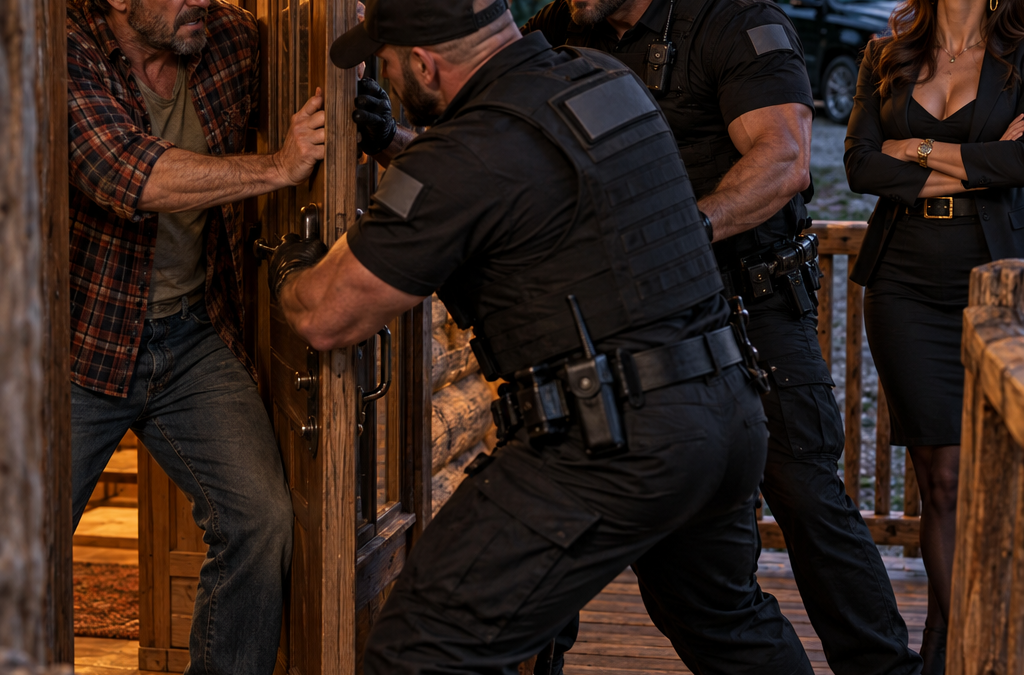
I was sitting inside when I heard pounding on the front door.
Not knocking.
Pounding.
The entire frame seemed to vibrate.
I froze.
Then came shouting.
“Open the door!”
Another heavy knock.
“HOA patrol! Open up!”
I stood slowly.
My heart started beating harder.
It was dark outside except for the porch light and the headlights from their vehicle.
I walked toward the door.
“What do you want?”
“Open the door!”
“I’m not opening anything. Leave my property.”
“You are in violation of association orders.”
I laughed once in disbelief.
“You’re trespassing.”
“Open the door immediately.”
“No.”
The pounding started again.
I unlocked the door only long enough to crack it open several inches.
Both officers were standing there.
Their posture was different from before.
Aggressive.
Charged.
I could smell alcohol on one of them, though I couldn’t tell whether he’d been drinking or whether I was imagining it through adrenaline.
“I’ve told you repeatedly to stay off my property.”
The taller officer pointed at me.
“You’ve ignored official instructions.”
“They aren’t official.”
“You’ve been warned.”
“Get off my land.”
“We can arrest you for refusing to comply.”
That almost made me laugh again.
Almost.
My attorney’s words came back immediately.
They aren’t police officers.
They cannot arrest you.
“You can’t arrest anybody.”
His face changed.
That was when I realized he hadn’t expected me to know.
“Don’t test us.”
I started closing the door.
One of them grabbed it.
I stopped.
“Let go.”
“You need to come outside.”
“No.”
He pulled.
I pulled back.
The second officer stepped forward.
“Stop resisting.”
That phrase made my blood run cold.
Resisting what?
A fake arrest?
On my own property?
I slammed my weight into the door and managed to close it.
The handle jerked immediately.
They were trying to open it from outside.
Then one of them hit the door hard with his shoulder.
I backed away.
“Leave!”
“We’re coming in!”
Everything changed in that second.
Letters were one thing.
Threats were another.
Blocking my gate had been intimidation.
But this?
Two men trying to force their way into my home at night?
This wasn’t an HOA dispute anymore.
I thought about calling the police.
I should have.
But I also knew how far away I lived from town.
Even a fast response wouldn’t be immediate.
Another violent pull rattled the door.
I looked toward the wall.
My shotgun was mounted there.
I had owned firearms for years.
My grandfather had taught me to handle them safely.
I knew exactly what they were and exactly what they weren’t.
A firearm wasn’t something you waved around because you were angry.
It wasn’t a prop.
It wasn’t a way to win an argument.
It was a last-resort responsibility.
I took it from the wall.
My hands were steady now.
Strangely steady.
I didn’t point it at the door.
I didn’t load the situation with threats I couldn’t take back.
I simply held it in a safe position, unlocked the door, and opened it.
The officers froze.
Their expressions changed instantly.
All the authority disappeared.
All the aggression vanished.
I kept the shotgun pointed toward the ground.
“I have asked you to leave repeatedly.”
Neither man spoke.
“You are trespassing on private property.”
The taller officer slowly lifted his hands.
“Okay.”
I stared at him.
“Okay?”
“We’re leaving.”
His partner was already backing away.
I couldn’t resist.
“You said you were going to take drastic measures.”
Neither replied.
“So now I’m telling you exactly what Karen told me. If you refuse to leave my property, I will be forced to take drastic measures.”
I never raised the gun.
I didn’t need to.
The taller man’s face had gone pale.
“We’re sorry.”
That surprised me more than anything.
For months, nobody from that HOA had apologized for anything.
Not the letters.
Not the threats.
Not blocking my vehicle.
But suddenly, with reality standing between us, they discovered manners.
“We didn’t mean for this to get out of hand.”
“You were trying to force open my door.”
“We were just following instructions.”
“Whose?”
Neither answered.
I knew the answer anyway.
Karen.
“Leave.”
They did.
Fast.
I watched their vehicle disappear down the road.
Then I locked the door.
The moment they were gone, the adrenaline hit me.
My hands started shaking so badly I had to sit down.
I placed the shotgun safely away and stared at the floor.
I wasn’t proud of what had happened.
I wasn’t excited.
I wasn’t sitting there feeling victorious.
I was furious.
Because they’d pushed me to the point where I’d felt unsafe inside my own home.
The place that had always represented peace now felt contaminated by somebody else’s aggression.
I called my attorney the next morning.
Her reaction was immediate.
“They tried to force entry?”
“Yes.”
“And threatened to arrest you?”
“Yes.”
“We’re sending the letter today.”
I also made another decision.
I contacted the real police.
I explained the entire situation.
Months of letters.
Repeated trespassing.
Fake authority.
Physical intimidation.
The confrontation at my gate.
And finally, two uniformed HOA patrolmen attempting to force their way into my residence after threatening arrest.
The officer I spoke with became noticeably more serious as the story continued.
“Do you want to file charges?”
I thought about it.
Part of me did.
A very large part.
But what I wanted more than revenge was silence.
Peace.
My life back.
“I don’t want anyone arrested if I can avoid it.”
“Then what do you want?”
“I want them to stop.”
There was a pause.
“We can have the sheriff speak with them.”
“That’s enough for me.”
The cease-and-desist letter went out.
The sheriff contacted the association.
And then something almost miraculous happened.
Nothing.
No letters.
No patrol vehicles.
No strangers standing at my gate.
No Karen.
For the first few days, I kept expecting another escalation.
Every engine I heard made me look toward the road.
Every unexpected sound at night made me tense.
But the HOA stayed away.
A week passed.
Then two.
Then a month.
Silence.
Apparently Karen’s authority worked very differently when someone with actual legal authority asked her to explain it.
I never received an apology.
Not from the officers.
Not from the board.
Certainly not from Karen.
At first, that bothered me.
After everything she’d done, some part of me wanted to see her forced to admit she was wrong.
I pictured her standing on my porch without her entourage, without that arrogant smile, having to say the words.
Your property was never ours.
I had no right.
I’m sorry.
But that moment never happened.
And eventually I realized I didn’t need it.
Her silence was the apology she was too proud to give.
The letters had stopped because she knew she couldn’t legally justify them.
The officers had disappeared because someone had finally reminded them that uniforms didn’t create authority.
The HOA had backed down because the moment lawyers and law enforcement became involved, their bluff collapsed.
I still don’t know exactly why Karen targeted me.
Money is the simplest explanation.
Maybe somebody realized my cabin sat close enough to their neighborhood that they could pressure me into paying dues.
Maybe they thought I wouldn’t know enough about property documents to fight back.
Maybe Karen was trying to expand the association’s influence unofficially.
Maybe she just couldn’t tolerate a house sitting outside her control.
The more I replayed our conversations, the more I suspected it was probably a combination of all of those things.
Karen seemed like the kind of person who enjoyed authority more than responsibility.
She liked being called president.
She liked having men in uniforms behind her.
She liked arriving at somebody else’s home and speaking as though decisions had already been made.
What she hadn’t liked was one person saying no.
For a while, the entire experience made me question whether staying at the cabin was worth it.
That scared me more than I wanted to admit.
I’d wake up and wonder whether selling might be easier.
Find somewhere farther away.
Start over.
Escape the negativity.
One afternoon, I actually opened a real estate website and started looking at properties.
Then I stopped.
Through the window, I could see the small garden beside my cabin.
My grandmother had helped me plant part of it during one of her visits.
She’d walked around the property slowly that day, touching leaves, inspecting soil, smiling at everything I’d built.
My grandfather never got to see the cabin.
But part of the money he’d worked for had helped me buy it.
I remembered those camping trips.
The lake.
The campfire.
His voice singing that ridiculous song.
I remembered the first night I slept in the cabin after buying it.
There had been no furniture except a mattress on the floor.
I had opened a window and listened to the trees.
For the first time in years, I’d felt completely at peace.
Karen hadn’t created that feeling.
The HOA hadn’t paid for this land.
Those patrol officers hadn’t planted a single tree, repaired a single board, paid a single tax bill, or spent a single sleepless night building the life I had here.
Why should they be the reason I abandoned it?
I closed the real estate website.
A few weeks later, my grandmother visited.
I hadn’t told her every detail while the situation was happening because I didn’t want her worrying about me.
But once it was over, we sat on the porch and I explained everything.
She listened quietly.
When I finished, she looked toward the road leading downhill.
“So the woman wanted you to join her neighborhood?”
“More or less.”
“And your paperwork said you didn’t have to?”
“Very clearly.”
She nodded.
“Then why did she keep coming?”
I laughed.
“That’s the question.”
My grandmother thought for a moment.
Then she smiled.
“Some people don’t care whether they’re right. They care whether everyone agrees they’re right.”
That sounded exactly like Karen.
We sat quietly for another minute.
The late-afternoon sunlight came through the trees.
Birds moved somewhere in the branches above us.
My grandmother pointed toward one of the flower beds.
“Those roses need trimming.”
And just like that, the HOA disappeared from the conversation.
Life became normal again.
That might be the most satisfying ending of all.
Not seeing Karen punished dramatically.
Not watching her dragged away.
Not getting revenge.
Just watching her become irrelevant.
Months later, I occasionally saw HOA vehicles when driving through the community downhill.
They never followed me.
Once, I saw one of the same patrol officers standing near the neighborhood entrance.
He recognized my vehicle.
I’m certain of it.
For a second, our eyes met.
He immediately looked away.
I kept driving.
I also saw Karen once.
She was standing outside the HOA clubhouse talking with a small group of residents.
She looked exactly as polished as before—perfect hair, fitted clothes, sunglasses, the same confident posture.
She noticed me passing.
Her mouth tightened.
I lifted two fingers from the steering wheel in a casual wave.
Nothing dramatic.
Nothing hostile.
Just enough to let her know I remembered.
Karen didn’t wave back.
I smiled the rest of the way home.
The whole experience changed the way I think about people who misuse authority.
Before this happened, I assumed situations like mine required some complicated misunderstanding.
Surely nobody would knowingly demand money from someone who wasn’t legally obligated to pay.
Surely nobody would send fake officers to intimidate a homeowner.
Surely two adults wouldn’t stand outside a private residence at night pretending they had arrest powers.
But some people rely on that exact assumption.
They count on you believing nobody would behave that outrageously.
They count on embarrassment.
Confusion.
Fear.
They count on the uniform looking official enough that you won’t ask what authority sits behind it.
They count on letters looking formal enough that you’ll pay first and question later.
And most of all, they count on people wanting peace badly enough to surrender a little at a time.
I wanted peace.
Karen understood that.
What she misunderstood was what peace meant to me.
Peace didn’t mean obedience.
It didn’t mean letting somebody trespass because confronting them would be uncomfortable.
It didn’t mean paying money I didn’t owe because doing so might stop the letters.
The cabin had taught me that.
Or maybe my grandparents had taught me long before I ever bought it.
My grandmother had always said plants would tell you when something was wrong.
My grandfather had taught me that animals reveal themselves before they act.
Karen had done the same thing.
The first time she stood on my porch, smiling with those two men behind her, she told me exactly who she was.
Not with her introduction.
With her attitude.
I couldn’t tell her what to do.
She could do as she pleased.
Her position made her authority absolute.
My disagreement wasn’t evidence that she might be mistaken.
It was insubordination.
Once I understood that, everything afterward made sense.
The letters weren’t about correcting records.
The visits weren’t about solving a misunderstanding.
The officers weren’t there to communicate.
They were there to pressure me until resistance became more exhausting than surrender.
Karen expected me to eventually give in.
She expected a man living alone outside town to decide that a few hundred dollars in dues were cheaper than months of conflict.
Maybe that strategy had worked on other people.
It didn’t work on me.
Not because I’m particularly brave.
There were moments when I was frightened.
The night those men tried to force my door open, I was scared.
When they blocked my gate, I was scared.
When Karen said she would use “drastic measures,” I wondered how far she’d actually go.
And when I considered selling the cabin, I came close to letting that fear make the decision for me.
Courage wasn’t feeling nothing.
It was looking at what I might lose and deciding it mattered enough to defend legally and responsibly.
These days, my routine is wonderfully boring again.
I wake up early.
Make coffee.
Open my laptop for work.
Sometimes I take lunch outside.
I grow vegetables when the season is right.
I still drive into town for groceries.
I still visit family.
And occasionally I camp near the same kind of quiet water my grandfather loved.
The gate stays closed when I’m home.
Not because I’m afraid of Karen anymore.
I simply like the privacy.
Every once in a while, an unfamiliar vehicle turns onto the road and I still feel a small knot form in my stomach.
That may take longer to disappear.
Harassment leaves behind strange little reflexes.
But the feeling passes.
The vehicle keeps going.
The trees stay still.
Nothing happens.
And nothing happening feels incredible.
I sometimes think about that first HOA letter.
If I’d believed it without checking, I might have mailed them money.
Once.
Then again the next month.
Maybe I would have attended meetings.
Accepted rules.
Agreed to fines.
Slowly behaved as if Karen’s lie had become true simply because nobody challenged it.
Instead, the letters stopped.
The patrol stopped.
Karen stopped.
My property remained exactly what it had always been.
Mine.
No HOA dues.
No mandatory meetings.
No association president deciding what I could do.
Just a cabin in the woods that belonged to someone who had wanted it since childhood.
There is an old wooden chair on my porch where I sometimes sit in the evening.
From there, I can see part of the road downhill.
Beyond the trees sits the community Karen governs.
Her rules still exist down there.
Her board still holds meetings.
Those patrol vehicles probably still drive around telling residents what mailbox color they’re allowed to have or where they can park.
That’s their business.
Up here, the forest doesn’t recognize HOA boundaries.
Birds don’t care about monthly dues.
The wind doesn’t ask permission before moving through the trees.
And neither Karen nor anyone else gets to rewrite my deed because they think saying something loudly enough makes it true.
My grandparents wanted me to build a life I could be proud of.
I think I finally understand why this place means so much to me.
It isn’t only the cabin.
It isn’t only the land.
It’s knowing I chose it.
Worked for it.
Protected it.
And refused to let someone else’s greed turn my sanctuary into another place where I had to ask permission to exist.
Karen tried letters.
Then threats.
Then intimidation.
Then men in uniforms.
She even let those men convince themselves they had the authority to threaten arrest and force their way into my house.
None of it changed one simple fact.
She never owned anything here.
Not the cabin.
Not the land.
Not the road behind my gate.
And definitely not me.
Sometimes the strongest victory isn’t watching a bully fall.
It’s standing in the exact place they tried to drive you away from and realizing they’re gone.
I’m still here.
The garden is still here.
The cabin is still here.
The forest is still quiet.
And somewhere downhill, Karen finally learned that being president of an HOA didn’t make her queen of everything she could see.
𝗧𝗛𝗘 𝗘𝗡𝗗
The HOA President Sent Uniformed Men to My Cabin—Then They Tried to Force Their Way Inside
The first time two uniformed men appeared at my cabin, I thought they were police officers.
The night they came back threatening to arrest me and pulling at my front door, I finally understood that Karen wasn’t trying to collect HOA dues anymore—she was trying to prove she could control me on my own land.
And by then, walking away from the home I’d built with the last piece of my grandfather’s legacy felt more frightening than anything she could send up that mountain.
I had wanted a place like that cabin for as long as I could remember.
When I was a kid, my grandparents lived on a modest farmstead surrounded by open fields and scattered stretches of woods. My parents and I lived in the city, so visiting them always felt like crossing into another world. The traffic disappeared. The buildings gave way to trees. Instead of sirens and neighbors arguing through thin walls, I heard chickens fussing in the yard, wind moving through tall grass, and my grandfather’s boots scraping across the porch before sunrise.
My grandmother taught me how to grow things.
Not just how to stick a seed in dirt, but how to understand what it needed. She showed me which vegetables wanted more sunlight, which plants needed richer soil, and how the smallest change in weather could affect an entire growing season.
She also kept a flower garden filled with roses and tulips.
“Plants tell you when something’s wrong,” she used to say. “You just have to pay attention.”
My grandfather taught me a different kind of patience.
He took me fishing at a lake about an hour away. We’d sit there for hours without catching much of anything, and somehow I never got bored. At night, we’d build a campfire, make s’mores, and sing the same ridiculous song he’d probably been singing since before my parents were born.
They had goats and chickens on the farm, and he taught me to watch animals closely.
“Ears, eyes, posture,” he’d say. “Everything living tells you what it’s feeling before it does something.”
At the time, I thought he was only talking about animals.
Years later, standing on the porch of my own cabin while a beautiful woman named Karen smiled at me as if she already owned my property, I would remember those words.
Everything tells you what it’s about to do.
You just have to pay attention.
As I got older, visits to my grandparents became less frequent. Work took over. Responsibilities multiplied. My grandfather eventually passed away, and losing him hit me harder than I expected.
Part of the inheritance he left me became the foundation for the life I’d dreamed about since childhood.
I bought a small cabin in a forested area well outside the nearest city.
It wasn’t completely isolated. I loved nature, but I wasn’t interested in living so deep in the wilderness that discovering a strange noise outside at two in the morning became my personal contribution to an unsolved-mysteries podcast.
There were towns an hour or two away, and downhill from my property sat a small residential community.
That community had an HOA.
Mine did not.
I made absolutely certain of that before buying the cabin.
The real estate agent confirmed it. The property documents confirmed it. My deed confirmed it.
My land had no connection to the neighboring homeowners association.
For two peaceful years, that fact mattered about as much as the color of somebody else’s curtains.
Then the letters started coming.
PART 2
At first, I barely paid attention to them.
The envelopes looked official enough—clean logo, printed return address, neatly typed name—but I assumed somebody in the neighboring community had entered an address incorrectly.
The first one mentioned overdue HOA dues.
I laughed when I read it.
“Wrong house.”
I tossed it aside.
Another came about a week later.
This one reminded me that I had failed to attend a mandatory association meeting.
That was stranger.
Still, mistakes happened.
Then another letter arrived.
And another.
Each one had my full name.
Each one had my correct address.
By the fifth or sixth letter, the language was no longer politely administrative.
It was accusatory.
My “continued failure to comply” would result in additional action.
My “outstanding balance” required immediate attention.
My attendance at future meetings was “mandatory.”
I sat at my kitchen table one afternoon with three of the letters spread in front of me.
Rain tapped softly against the windows.
For the first time, I felt genuinely uneasy.
I pulled out my property documents.
No HOA.
I checked the deed again.
Nothing.
The cabin was outside the association.
I knew that.
The seller had known it.
The agent had known it.
Apparently the only people who didn’t know—or didn’t care—were the people sending me those letters.
I decided I would contact the HOA directly and clear it up.
I actually felt slightly embarrassed that I’d ignored them for so long.
Maybe somebody had accidentally included my parcel in a new mailing list.
Maybe a database had been updated incorrectly.
Maybe there was some completely boring explanation.
Before I could call them, they came to me.
I was working from home one afternoon when the doorbell rang.
Visitors were unusual.
Friends and family always called ahead because nobody accidentally ended up at my cabin. You had to drive uphill, follow a narrow road through the trees, and intentionally turn toward my gate.
The bell rang again.
I walked quietly toward the front door and looked through the peephole.
Two men stood outside.
Both wore dark uniforms.
For half a second, I thought they were police officers.
That immediately made my stomach tighten.
Then I looked closer.
There were no police vehicles.
No emergency lights.
The cars behind them looked ordinary.
I opened the door only far enough to speak through it.
“Can I help you?”
The taller one looked at me with the expression of somebody who had already decided I was guilty of something.
“We’re here on behalf of the homeowners association.”
That was almost a relief.
“Oh. Good. Actually, I was about to contact you.”
His expression didn’t change.
“You’ve ignored multiple notices regarding unpaid dues and mandatory meetings.”
“Right. That’s exactly what I wanted to explain. There’s been a mistake.”
The second man crossed his arms.
“What mistake?”
“My property isn’t in your HOA.”
The first man stared at me.
“Yes, it is.”
I almost smiled.
Not because it was funny, but because his confidence was absurd.
“No. It isn’t.”
“We have your address.”
“Congratulations. That doesn’t make me a member.”
His jaw tightened.
“We wouldn’t be here if you weren’t under association jurisdiction.”
“And I wouldn’t be having this conversation if somebody had checked the deed.”
That was when their attitude changed.
Until then, they’d been stiff and official.
Now they became openly hostile.
The shorter man stepped closer.
“You’re trying to avoid paying what you owe.”
“No. I’m telling you I don’t owe anything.”
“You’ve already missed multiple meetings.”
“Because I’m not a member.”
“You don’t get to decide that.”
Actually, I thought, I probably do when it’s my property.
But I tried to stay calm.
“Look, I’m not interested in arguing. I have the paperwork. My deed specifically says this property isn’t part of your association. If somebody made a clerical error, fix it.”
The taller officer gave me a cold smile.
“We know what properties belong to our association.”
“Apparently not.”
We argued for several minutes.
They never produced paperwork.
They never explained how or when my land had supposedly entered their jurisdiction.
They simply repeated the same claim more aggressively every time I challenged it.
Eventually I had enough.
“I think we’re finished.”
“This isn’t finished.”
“It is on my porch.”
I closed the door.
Through the window, I watched them walk back to their vehicle.
Neither looked embarrassed.
Neither looked confused.
They looked angry.
That bothered me more than anything else.
If this had been an administrative mistake, you’d expect uncertainty.
Questions.
Maybe even an apology.
Instead, they acted like I’d challenged their authority.
The letters continued.
Their tone got worse.
Then, a few weeks later, I met Karen.
I heard vehicles outside and looked through the window.
The same two officers had returned.
But this time, they weren’t alone.
A woman stepped out of a polished SUV parked behind them.
She looked to be around forty.
She was striking in a way that made her impossible not to notice—long dark hair styled perfectly despite the humid afternoon, carefully applied makeup, expensive sunglasses, a fitted cream blouse tucked into tailored trousers, and heels that made absolutely no sense on a gravel driveway.
She carried herself like she was arriving at an event rather than walking onto somebody else’s rural property without permission.
There was something practiced about her smile.
Warm from a distance.
Cold up close.
The two officers positioned themselves slightly behind her.
She removed her sunglasses as I opened the door.
“Hello.”
Her voice had a smooth, almost flirtatious confidence to it.
“I’m Karen.”
Of course you are, I thought.
She extended her hand.
I didn’t take it.
She let it hover for a second before withdrawing it.
“I’m president of the homeowners association down the hill.”
“I figured.”
Her smile remained.
“I wanted to personally check in with you because there seems to have been some confusion.”
For a moment, I thought maybe this was finally going to become reasonable.
Then I noticed the way she was looking past me into the cabin.
Not curious.
Assessing.
“You’re the one sending all those letters?”
Something in my tone wiped part of the smile off her face.
“Yes, actually.”
“Then you can stop.”
Her eyebrows lifted.
“Excuse me?”
“I’ve already explained this to your officers. I’m not part of your HOA.”
Karen glanced toward the two men.
One of them gave her a subtle nod.
She looked back at me.
“I understand you’ve been difficult.”
I actually laughed.
“Difficult?”
“You’ve refused to cooperate. You haven’t paid your dues. You’ve ignored mandatory meetings. And apparently you’ve been disrespectful toward association officers.”
“They’re not my association officers.”
Her eyes hardened.
“You need to understand something.”
She moved half a step closer.
I could smell expensive perfume.
“I’m the president of this association. When I tell residents what is expected of them, I expect cooperation.”
“That’s great.”
My voice stayed calm.
“For your residents.”
Her smile disappeared.
I continued.
“I’m not one of them.”
Karen looked genuinely offended.
Not confused.
Offended.
As if I’d insulted her personally by suggesting there were limits to her authority.
“You don’t get to tell me what I can and cannot do.”
“I absolutely get to tell you what you can do on my property.”
“This property falls under our jurisdiction.”
“No, it doesn’t.”
“Yes. It does.”
I folded my arms.
“When I bought this cabin, I specifically checked because I didn’t want to be part of an HOA. The deed states that the property is not included in your association.”
Karen gave me a dismissive little laugh.
“Maybe that was true when you bought it.”
That made me pause.
She saw the reaction and leaned into it.
“Things change.”
“What changed?”
“The boundaries.”
“When?”
She didn’t answer.
“Under what agreement?”
Silence.
“Show me.”
Her expression tightened.
“Show you what?”
“The document putting my property in your HOA.”
“I don’t carry association documents around with me.”
“Then email it.”
“This isn’t a negotiation.”
“It is if you’re demanding money from me.”
Her jaw flexed.
Behind her, one of the officers shifted his weight.
Karen tried another approach.
Her voice softened.
“You know, this doesn’t need to become ugly.”
The sudden sweetness was almost impressive.
She tilted her head slightly.
“You’re obviously someone who values privacy. I understand that. But you’re part of a larger community now whether you like it or not. Cooperation makes life easier for everyone.”
There was something faintly flirtatious in the way she delivered it, like charm had probably worked for her before when intimidation hadn’t.
It didn’t work on me.
“If you can prove my property legally belongs to your HOA, I’ll follow the rules.”
Her expression brightened.
“I’ll pay whatever legitimate dues apply. I’ll attend whatever I’m legally required to attend.”
I pointed toward the driveway.
“But until you prove that, stop sending letters, and keep these two off my land.”
Karen stared at me.
I could practically see her calculating.
Then she smiled again.
This time there was nothing pleasant in it.
“You should be careful about taking this attitude.”
“Is that a threat?”
“It’s advice.”
“Then here’s some advice for you. Don’t claim authority you can’t prove.”
Her cheeks flushed.
For the first time, the polished façade cracked.
“You have absolutely no idea who you’re dealing with.”
“Neither do you.”
She put her sunglasses back on.
“If you continue ignoring our warnings, I’ll have no choice but to take more drastic measures.”
Those words stayed with me.
Drastic measures.
At the time, I assumed she meant more letters.
Maybe fines she couldn’t legally collect.
Maybe some ridiculous administrative complaint.
I watched her walk back to her SUV with the two officers following her.
Before she got inside, she looked over her shoulder at me.
That look told me this had stopped being about dues.
Karen wanted obedience.
And I’d embarrassed her in front of her officers.
From that day forward, the harassment intensified.
The patrol cars appeared more often.
Sometimes they drove slowly past my gate.
Sometimes they stopped nearby.
I began seeing them when I left for groceries or drove to visit family.
At first I wondered whether I was imagining the pattern.
Then one morning, I left early to go into town.
The trip took a couple of hours.
When I returned, one of the HOA vehicles was sitting near my front gate.
The two officers were inside.
Waiting.
I slowed.
One of them got out.
Then the other.
I rolled down my window.
“What do you want?”
“We need to speak with you.”
“No.”
The taller one stepped in front of my vehicle.
I hit the brakes.
“What are you doing?”
“You need to address the violations issued against your property.”
“Move.”
“We’ve been instructed to speak with you.”
“I don’t care who instructed you.”
The second officer walked toward my driver’s-side door.
“Sir, you’re required to cooperate.”
“Required by who?”
“The HOA.”
“I’m not in your HOA.”
“We’ve already been through this.”
“Exactly. So move.”
Neither moved.
I felt anger rising inside me.
Not the dramatic kind.
The dangerous, quiet kind.
I’d spent years saving for this place.
I’d chosen it because I wanted peace.
And now two men hired by a neighborhood organization I didn’t belong to were physically blocking me from entering my own property.
I lowered my voice.
“Move away from my vehicle.”
The taller one stared at me.
“Or what?”
“I call the actual police.”
That changed things.
Not dramatically.
But enough.
He glanced at his partner.
I noticed it immediately.
A hesitation.
I took out my phone.
“I’m calling right now.”
The shorter officer raised his hands.
“There’s no need to escalate.”
“You blocked my gate.”
“We’re doing our job.”
“Then do it somewhere else.”
They finally stepped aside.
I drove through the gate and closed it behind me.
My hands were shaking when I got inside.
That was the moment I stopped treating the situation as an annoyance.
I called an attorney.
I explained everything—the letters, the visits, Karen’s claim that my property was suddenly under HOA jurisdiction, the patrol officers, the threats, and what had happened at my gate.
My attorney asked me to send her copies of every document I had.
My deed.
Closing paperwork.
The HOA letters.
Any photographs.
Any dates I could remember.
We reviewed everything.
Her conclusion was simple.
“They have no jurisdiction over your property.”
Hearing those words should have made me feel relieved.
Instead, it made me angrier.
“So they know this?”
“I can’t tell you what they know. But legally, your property isn’t part of that association.”
“What about these so-called officers?”
“They’re private security or HOA patrol personnel. They aren’t police officers.”
“They’ve acted like they could arrest me.”
“They cannot.”
“Can they come onto my property?”
“Not just because the HOA president tells them to.”
I leaned back in my chair and stared toward the window.
Trees moved gently in the wind outside.
“So what do we do?”
“We document everything and send a formal cease-and-desist letter.”
That was the first time since Karen showed up that I felt like I had something solid under my feet.
My attorney prepared the letter.
It stated clearly that my property was outside the HOA, that their continued demands had no legal basis, and that further harassment or trespassing would be documented and potentially reported.
I thought that would end it.
I underestimated Karen.
Before the letter was finalized and delivered, her officers came back.
At night.
I was sitting inside when I heard pounding on the front door.
Not knocking.
Pounding.
The entire frame seemed to vibrate.
I froze.
Then came shouting.
“Open the door!”
Another heavy knock.
“HOA patrol! Open up!”
I stood slowly.
My heart started beating harder.
It was dark outside except for the porch light and the headlights from their vehicle.
I walked toward the door.
“What do you want?”
“Open the door!”
“I’m not opening anything. Leave my property.”
“You are in violation of association orders.”
I laughed once in disbelief.
“You’re trespassing.”
“Open the door immediately.”
“No.”
The pounding started again.
I unlocked the door only long enough to crack it open several inches.
Both officers were standing there.
Their posture was different from before.
Aggressive.
Charged.
I could smell alcohol on one of them, though I couldn’t tell whether he’d been drinking or whether I was imagining it through adrenaline.
“I’ve told you repeatedly to stay off my property.”
The taller officer pointed at me.
“You’ve ignored official instructions.”
“They aren’t official.”
“You’ve been warned.”
“Get off my land.”
“We can arrest you for refusing to comply.”
That almost made me laugh again.
Almost.
My attorney’s words came back immediately.
They aren’t police officers.
They cannot arrest you.
“You can’t arrest anybody.”
His face changed.
That was when I realized he hadn’t expected me to know.
“Don’t test us.”
I started closing the door.
One of them grabbed it.
I stopped.
“Let go.”
“You need to come outside.”
“No.”
He pulled.
I pulled back.
The second officer stepped forward.
“Stop resisting.”
That phrase made my blood run cold.
Resisting what?
A fake arrest?
On my own property?
I slammed my weight into the door and managed to close it.
The handle jerked immediately.
They were trying to open it from outside.
Then one of them hit the door hard with his shoulder.
I backed away.
“Leave!”
“We’re coming in!”
Everything changed in that second.
Letters were one thing.
Threats were another.
Blocking my gate had been intimidation.
But this?
Two men trying to force their way into my home at night?
This wasn’t an HOA dispute anymore.
I thought about calling the police.
I should have.
But I also knew how far away I lived from town.
Even a fast response wouldn’t be immediate.
Another violent pull rattled the door.
I looked toward the wall.
My shotgun was mounted there.
I had owned firearms for years.
My grandfather had taught me to handle them safely.
I knew exactly what they were and exactly what they weren’t.
A firearm wasn’t something you waved around because you were angry.
It wasn’t a prop.
It wasn’t a way to win an argument.
It was a last-resort responsibility.
I took it from the wall.
My hands were steady now.
Strangely steady.
I didn’t point it at the door.
I didn’t load the situation with threats I couldn’t take back.
I simply held it in a safe position, unlocked the door, and opened it.
The officers froze.
Their expressions changed instantly.
All the authority disappeared.
All the aggression vanished.
I kept the shotgun pointed toward the ground.
“I have asked you to leave repeatedly.”
Neither man spoke.
“You are trespassing on private property.”
The taller officer slowly lifted his hands.
“Okay.”
I stared at him.
“Okay?”
“We’re leaving.”
His partner was already backing away.
I couldn’t resist.
“You said you were going to take drastic measures.”
Neither replied.
“So now I’m telling you exactly what Karen told me. If you refuse to leave my property, I will be forced to take drastic measures.”
I never raised the gun.
I didn’t need to.
The taller man’s face had gone pale.
“We’re sorry.”
That surprised me more than anything.
For months, nobody from that HOA had apologized for anything.
Not the letters.
Not the threats.
Not blocking my vehicle.
But suddenly, with reality standing between us, they discovered manners.
“We didn’t mean for this to get out of hand.”
“You were trying to force open my door.”
“We were just following instructions.”
“Whose?”
Neither answered.
I knew the answer anyway.
Karen.
“Leave.”
They did.
Fast.
I watched their vehicle disappear down the road.
Then I locked the door.
The moment they were gone, the adrenaline hit me.
My hands started shaking so badly I had to sit down.
I placed the shotgun safely away and stared at the floor.
I wasn’t proud of what had happened.
I wasn’t excited.
I wasn’t sitting there feeling victorious.
I was furious.
Because they’d pushed me to the point where I’d felt unsafe inside my own home.
The place that had always represented peace now felt contaminated by somebody else’s aggression.
I called my attorney the next morning.
Her reaction was immediate.
“They tried to force entry?”
“Yes.”
“And threatened to arrest you?”
“Yes.”
“We’re sending the letter today.”
I also made another decision.
I contacted the real police.
I explained the entire situation.
Months of letters.
Repeated trespassing.
Fake authority.
Physical intimidation.
The confrontation at my gate.
And finally, two uniformed HOA patrolmen attempting to force their way into my residence after threatening arrest.
The officer I spoke with became noticeably more serious as the story continued.
“Do you want to file charges?”
I thought about it.
Part of me did.
A very large part.
But what I wanted more than revenge was silence.
Peace.
My life back.
“I don’t want anyone arrested if I can avoid it.”
“Then what do you want?”
“I want them to stop.”
There was a pause.
“We can have the sheriff speak with them.”
“That’s enough for me.”
The cease-and-desist letter went out.
The sheriff contacted the association.
And then something almost miraculous happened.
Nothing.
No letters.
No patrol vehicles.
No strangers standing at my gate.
No Karen.
For the first few days, I kept expecting another escalation.
Every engine I heard made me look toward the road.
Every unexpected sound at night made me tense.
But the HOA stayed away.
A week passed.
Then two.
Then a month.
Silence.
Apparently Karen’s authority worked very differently when someone with actual legal authority asked her to explain it.
I never received an apology.
Not from the officers.
Not from the board.
Certainly not from Karen.
At first, that bothered me.
After everything she’d done, some part of me wanted to see her forced to admit she was wrong.
I pictured her standing on my porch without her entourage, without that arrogant smile, having to say the words.
Your property was never ours.
I had no right.
I’m sorry.
But that moment never happened.
And eventually I realized I didn’t need it.
Her silence was the apology she was too proud to give.
The letters had stopped because she knew she couldn’t legally justify them.
The officers had disappeared because someone had finally reminded them that uniforms didn’t create authority.
The HOA had backed down because the moment lawyers and law enforcement became involved, their bluff collapsed.
I still don’t know exactly why Karen targeted me.
Money is the simplest explanation.
Maybe somebody realized my cabin sat close enough to their neighborhood that they could pressure me into paying dues.
Maybe they thought I wouldn’t know enough about property documents to fight back.
Maybe Karen was trying to expand the association’s influence unofficially.
Maybe she just couldn’t tolerate a house sitting outside her control.
The more I replayed our conversations, the more I suspected it was probably a combination of all of those things.
Karen seemed like the kind of person who enjoyed authority more than responsibility.
She liked being called president.
She liked having men in uniforms behind her.
She liked arriving at somebody else’s home and speaking as though decisions had already been made.
What she hadn’t liked was one person saying no.
For a while, the entire experience made me question whether staying at the cabin was worth it.
That scared me more than I wanted to admit.
I’d wake up and wonder whether selling might be easier.
Find somewhere farther away.
Start over.
Escape the negativity.
One afternoon, I actually opened a real estate website and started looking at properties.
Then I stopped.
Through the window, I could see the small garden beside my cabin.
My grandmother had helped me plant part of it during one of her visits.
She’d walked around the property slowly that day, touching leaves, inspecting soil, smiling at everything I’d built.
My grandfather never got to see the cabin.
But part of the money he’d worked for had helped me buy it.
I remembered those camping trips.
The lake.
The campfire.
His voice singing that ridiculous song.
I remembered the first night I slept in the cabin after buying it.
There had been no furniture except a mattress on the floor.
I had opened a window and listened to the trees.
For the first time in years, I’d felt completely at peace.
Karen hadn’t created that feeling.
The HOA hadn’t paid for this land.
Those patrol officers hadn’t planted a single tree, repaired a single board, paid a single tax bill, or spent a single sleepless night building the life I had here.
Why should they be the reason I abandoned it?
I closed the real estate website.
A few weeks later, my grandmother visited.
I hadn’t told her every detail while the situation was happening because I didn’t want her worrying about me.
But once it was over, we sat on the porch and I explained everything.
She listened quietly.
When I finished, she looked toward the road leading downhill.
“So the woman wanted you to join her neighborhood?”
“More or less.”
“And your paperwork said you didn’t have to?”
“Very clearly.”
She nodded.
“Then why did she keep coming?”
I laughed.
“That’s the question.”
My grandmother thought for a moment.
Then she smiled.
“Some people don’t care whether they’re right. They care whether everyone agrees they’re right.”
That sounded exactly like Karen.
We sat quietly for another minute.
The late-afternoon sunlight came through the trees.
Birds moved somewhere in the branches above us.
My grandmother pointed toward one of the flower beds.
“Those roses need trimming.”
And just like that, the HOA disappeared from the conversation.
Life became normal again.
That might be the most satisfying ending of all.
Not seeing Karen punished dramatically.
Not watching her dragged away.
Not getting revenge.
Just watching her become irrelevant.
Months later, I occasionally saw HOA vehicles when driving through the community downhill.
They never followed me.
Once, I saw one of the same patrol officers standing near the neighborhood entrance.
He recognized my vehicle.
I’m certain of it.
For a second, our eyes met.
He immediately looked away.
I kept driving.
I also saw Karen once.
She was standing outside the HOA clubhouse talking with a small group of residents.
She looked exactly as polished as before—perfect hair, fitted clothes, sunglasses, the same confident posture.
She noticed me passing.
Her mouth tightened.
I lifted two fingers from the steering wheel in a casual wave.
Nothing dramatic.
Nothing hostile.
Just enough to let her know I remembered.
Karen didn’t wave back.
I smiled the rest of the way home.
The whole experience changed the way I think about people who misuse authority.
Before this happened, I assumed situations like mine required some complicated misunderstanding.
Surely nobody would knowingly demand money from someone who wasn’t legally obligated to pay.
Surely nobody would send fake officers to intimidate a homeowner.
Surely two adults wouldn’t stand outside a private residence at night pretending they had arrest powers.
But some people rely on that exact assumption.
They count on you believing nobody would behave that outrageously.
They count on embarrassment.
Confusion.
Fear.
They count on the uniform looking official enough that you won’t ask what authority sits behind it.
They count on letters looking formal enough that you’ll pay first and question later.
And most of all, they count on people wanting peace badly enough to surrender a little at a time.
I wanted peace.
Karen understood that.
What she misunderstood was what peace meant to me.
Peace didn’t mean obedience.
It didn’t mean letting somebody trespass because confronting them would be uncomfortable.
It didn’t mean paying money I didn’t owe because doing so might stop the letters.
The cabin had taught me that.
Or maybe my grandparents had taught me long before I ever bought it.
My grandmother had always said plants would tell you when something was wrong.
My grandfather had taught me that animals reveal themselves before they act.
Karen had done the same thing.
The first time she stood on my porch, smiling with those two men behind her, she told me exactly who she was.
Not with her introduction.
With her attitude.
I couldn’t tell her what to do.
She could do as she pleased.
Her position made her authority absolute.
My disagreement wasn’t evidence that she might be mistaken.
It was insubordination.
Once I understood that, everything afterward made sense.
The letters weren’t about correcting records.
The visits weren’t about solving a misunderstanding.
The officers weren’t there to communicate.
They were there to pressure me until resistance became more exhausting than surrender.
Karen expected me to eventually give in.
She expected a man living alone outside town to decide that a few hundred dollars in dues were cheaper than months of conflict.
Maybe that strategy had worked on other people.
It didn’t work on me.
Not because I’m particularly brave.
There were moments when I was frightened.
The night those men tried to force my door open, I was scared.
When they blocked my gate, I was scared.
When Karen said she would use “drastic measures,” I wondered how far she’d actually go.
And when I considered selling the cabin, I came close to letting that fear make the decision for me.
Courage wasn’t feeling nothing.
It was looking at what I might lose and deciding it mattered enough to defend legally and responsibly.
These days, my routine is wonderfully boring again.
I wake up early.
Make coffee.
Open my laptop for work.
Sometimes I take lunch outside.
I grow vegetables when the season is right.
I still drive into town for groceries.
I still visit family.
And occasionally I camp near the same kind of quiet water my grandfather loved.
The gate stays closed when I’m home.
Not because I’m afraid of Karen anymore.
I simply like the privacy.
Every once in a while, an unfamiliar vehicle turns onto the road and I still feel a small knot form in my stomach.
That may take longer to disappear.
Harassment leaves behind strange little reflexes.
But the feeling passes.
The vehicle keeps going.
The trees stay still.
Nothing happens.
And nothing happening feels incredible.
I sometimes think about that first HOA letter.
If I’d believed it without checking, I might have mailed them money.
Once.
Then again the next month.
Maybe I would have attended meetings.
Accepted rules.
Agreed to fines.
Slowly behaved as if Karen’s lie had become true simply because nobody challenged it.
Instead, the letters stopped.
The patrol stopped.
Karen stopped.
My property remained exactly what it had always been.
Mine.
No HOA dues.
No mandatory meetings.
No association president deciding what I could do.
Just a cabin in the woods that belonged to someone who had wanted it since childhood.
There is an old wooden chair on my porch where I sometimes sit in the evening.
From there, I can see part of the road downhill.
Beyond the trees sits the community Karen governs.
Her rules still exist down there.
Her board still holds meetings.
Those patrol vehicles probably still drive around telling residents what mailbox color they’re allowed to have or where they can park.
That’s their business.
Up here, the forest doesn’t recognize HOA boundaries.
Birds don’t care about monthly dues.
The wind doesn’t ask permission before moving through the trees.
And neither Karen nor anyone else gets to rewrite my deed because they think saying something loudly enough makes it true.
My grandparents wanted me to build a life I could be proud of.
I think I finally understand why this place means so much to me.
It isn’t only the cabin.
It isn’t only the land.
It’s knowing I chose it.
Worked for it.
Protected it.
And refused to let someone else’s greed turn my sanctuary into another place where I had to ask permission to exist.
Karen tried letters.
Then threats.
Then intimidation.
Then men in uniforms.
She even let those men convince themselves they had the authority to threaten arrest and force their way into my house.
None of it changed one simple fact.
She never owned anything here.
Not the cabin.
Not the land.
Not the road behind my gate.
And definitely not me.
Sometimes the strongest victory isn’t watching a bully fall.
It’s standing in the exact place they tried to drive you away from and realizing they’re gone.
I’m still here.
The garden is still here.
The cabin is still here.
The forest is still quiet.
And somewhere downhill, Karen finally learned that being president of an HOA didn’t make her queen of everything she could see.