𝗙𝗨𝗟𝗟 𝗦𝗧𝗢𝗥𝗬 The HOA President Said My Tractor Belonged to Her Community—Then It Disappeared While I Slept
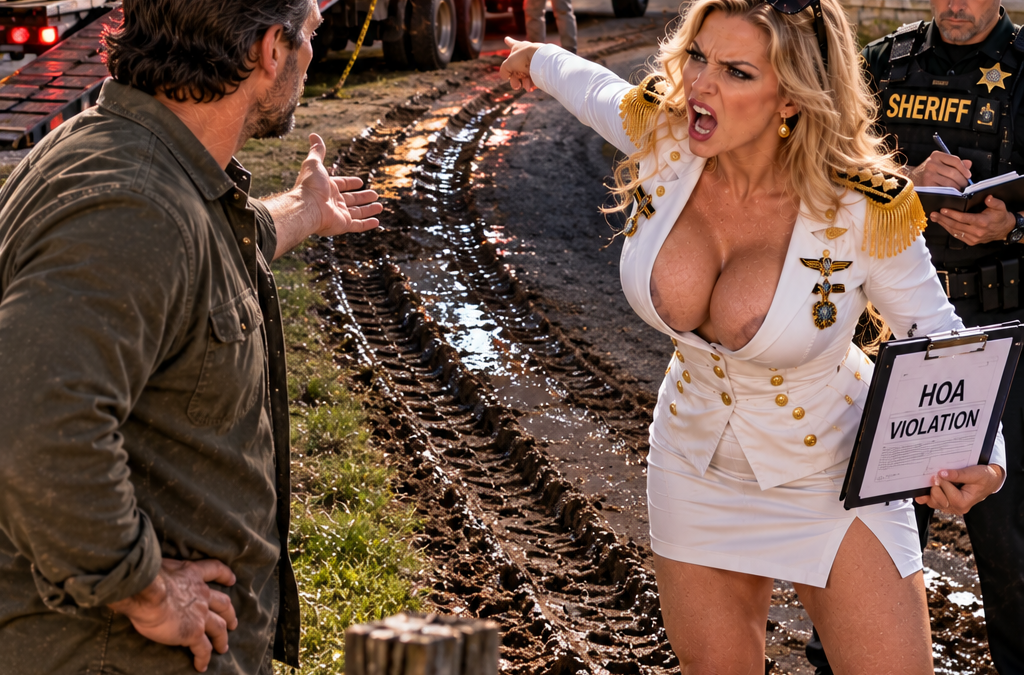
𝗙𝗨𝗟𝗟 𝗦𝗧𝗢𝗥𝗬
He let his cattle graze part of my back acre in exchange, which saved me from mowing and gave the tractor even more work.
I had just finished moving a pile of gravel when I saw Karen approaching.
White jacket.
White trousers.
Gold buttons.
Clipboard.
Heels sinking into soft ground with every step.
I shut down the tractor.
Waited.
She reached me looking slightly annoyed, as though I had deliberately placed my house too far from pavement.
“Are you the owner?”
“Yep.”
She looked at the tractor.
Then toward the pole barn.
Then at me.
“I’m Karen Whitmore.”
She paused.
“HOA president.”
“Nice to meet you.”
She looked toward the subdivision.
“You’ve probably noticed the community adjacent to your property.”
“I’ve seen it.”
“We’ve received concerns regarding equipment storage.”
I thought she was talking about something inside the subdivision.
“Okay.”
She pointed at my tractor.
“That.”
I looked behind me.
Then back.
“My tractor?”
“Yes.”
“What about it?”
“It is visible from one of our cul-de-sacs.”
I waited.
Karen continued.
“Our equipment-storage covenant requires machinery of that size to be screened from common view.”
“That’s probably useful for your residents.”
Her expression changed slightly.
“I am referring to your equipment.”
“I know.”
“So you understand the issue.”
“No.”
She tilted her head.
“You need to construct a screening structure.”
I looked toward my old pole barn.
Then back at her.
“For my tractor.”
“Or enclosed storage.”
“Why?”
“Because the current arrangement violates community standards.”
I smiled.
“I’m not in your community.”
Karen didn’t smile back.
“Your property is visually integrated with the development.”
That’s the exact kind of phrase people invent when the law doesn’t say what they want.
“Visually integrated?”
“Residents can see it.”
“They can see clouds too.”
Her eyes narrowed.
“That’s not comparable.”
“No.”
I leaned against the loader bucket.
“Clouds are probably cheaper to regulate.”
Karen lowered the clipboard.
“I don’t think you’re taking this seriously.”
“I’m not.”
Her cheeks colored slightly.
“Your driveway and equipment are visible from community property.”
“Okay.”
“That effectively places you within the neighborhood aesthetic zone.”
There it was.
Another imaginary concept.
“Aesthetic zone.”
“Yes.”
“Is that on my deed?”
She stared.
“No.”
“County plat?”
“You don’t seem to understand how property values work.”
“I understand how property lines work.”
Karen crossed her arms beneath her chest.
The fitted white jacket tightened around her torso.
“Your property affects our residents.”
“Your residents bought houses next to property they don’t own.”
“That’s overly simplistic.”
“It’s exactly that simple.”
She shifted her clipboard.
“We can work with you on compliance.”
“I’m not complying.”
Her eyebrows rose.
“Excuse me?”
“I’m not in the HOA.”
“You are effectively part of the community.”
“No.”
“The subdivision surrounds—”
“No.”
I pointed toward the fence.
“Your property ends over there.”
She looked.
“Mine begins here.”
“That’s not how modern community planning functions.”
“It’s how deeds work.”
Karen’s face hardened.
“I’ll be in touch.”
“Okay.”
She walked back across the field.
Slowly.
Angrily.
Trying to maintain dignity while her heels sank into pasture.
I watched her go.
Then started the tractor again.
I assumed that was the end.
It wasn’t.
The first violation notice arrived about a week later.
HOA letterhead.
Official-looking envelope.
My full name.
Property address.
UNSCREENED AGRICULTURAL EQUIPMENT
Fine attached.
I laughed.
Put it on the kitchen counter.
Then another arrived.
Then another.
Every letter followed roughly the same pattern.
The HOA’s residents had a right to preserve community appearance.
My tractor was allegedly harming property values.
I was directed to build an approved screening structure.
Failure to comply would result in escalating fines.
At first, the amounts were small enough to be funny.
Fifty dollars.
One hundred.
Two hundred.
Then penalties for failure to correct.
Then administrative charges.
Then additional fines.
I ignored most of them.
But I never threw them away.
That’s a habit from police work.
People lie.
Paper doesn’t forget as easily.
I bought a file box.
Every letter went inside.
Date received.
Envelope.
Document.
Done.
A couple of the more aggressive notices I scanned and emailed to the HOA’s management company.
My message was simple.
I was not a member.
My property had never been included.
I had no contractual relationship with the association.
Their board president was sending enforcement notices to a nonmember property owner.
Please correct the issue.
The response came a few days later.
Something vague.
Thank you for bringing the matter to our attention.
They would review it.
They appreciated my patience.
Nothing changed.
Karen kept writing.
Then I met her son.
His name was Tyler.
Late twenties.
Maybe twenty-eight.
Pickup truck.
Landscaping logo on both doors.
Always at Karen’s house.
I couldn’t tell whether he lived there or simply spent so much time there that the difference no longer mattered.
Tyler ran a landscaping company.
His company also happened to maintain all of the subdivision’s common property.
Clubhouse.
Entrance.
Pond.
Common grass.
Flower beds.
Everything.
I’d eventually learn that contract began around the same period Karen became president.
At the time, I didn’t care.
Their business.
Tyler and I had only two real interactions before the theft.
The first happened when he came flying down the county road in his truck.
Kids walked to a bus stop nearby.
I waved for him to slow down.
He responded by giving me the finger through his open window.
Friendly guy.
The second time, he was standing in Karen’s yard while I mowed near my eastern fence.
The mower was loud.
Apparently he thought that meant normal conversation required shouting.
“HEY, REDNECK.”
I looked over.
He pointed toward my tractor.
“YOU’RE DRAGGING THE WHOLE NEIGHBORHOOD DOWN.”
I waved.
Then kept mowing.
That was worse for him than arguing.
People like Tyler desperately need you to know they’ve insulted you.
Ignoring them wastes all their effort.
The notices continued.
Fourteen months total.
Karen occasionally crossed over to confront me.
Usually about the tractor.
Once about gravel piled near the driveway.
Another time she complained about an old utility trailer behind the pole barn.
I gave the same answer.
“I’m not in your HOA.”
She gave the same answer.
“Your property impacts the community.”
It became a ritual.
Then one afternoon, she added something new.
I was checking fluid in the tractor.
Karen stood near the fence.
White fitted skirt.
Gold-button jacket.
Deep neckline.
Clipboard pressed against her side.
“You realize we’re eventually going to enforce these assessments.”
I wiped my hands.
“How?”
She smiled.
“We have legal remedies.”
“Against members.”
“Against properties affecting the association.”
“That’s not a thing.”
“You aren’t an attorney.”
“Neither are you.”
Her mouth tightened.
“I’ve been advised.”
“By who?”
“Our counsel.”
“Name?”
She paused.
“Association counsel.”
“What’s their name?”
Her eyes hardened.
“That’s privileged.”
I laughed.
“You brought it up.”
“I’m warning you.”
“Okay.”
“These fines don’t disappear because you’re stubborn.”
“They disappear because you have no authority to issue them.”
Karen leaned slightly closer.
“You’re going to regret treating this like a joke.”
That sounded like a threat.
Not enough to do anything with.
But enough that I wrote down the date and conversation when I went inside.
The running total of Karen’s imaginary debt grew into the thousands.
I still paid nothing.
I still kept every notice.
Then came the morning my tractor disappeared.
I’d worked overnight.
Our shift ended around six.
Paperwork kept me another forty-five minutes.
I drove home just after seven.
Showered.
Ate a bowl of cereal while watching half a weather report.
Then went to bed.
Blackout curtains.
Fan running.
Phone on silent except emergency contacts.
Day sleep is never the same as sleeping at night.
Your body knows something is wrong.
But years of shift work taught me to manage.
I woke around two-thirty in the afternoon.
Made coffee.
Still half asleep.
Walked out the back door.
I looked toward the pole barn.
Then stopped.
Something was wrong.
It took my brain a second.
The tractor wasn’t there.
I always parked it beside the pole barn beneath an overhang I’d built.
Same place.
Every time.
Now there was only flattened grass.
I stared.
Put down the coffee.
Walked closer.
Tire impressions.
Fresh.
The tractor had been driven out.
The tracks crossed toward the gravel drive.
I followed them.
Down the driveway.
Toward the county road.
Then turned left.
The subdivision entrance was left.
I stood there for a second.
My first thought wasn’t Karen.
It was my neighbor.
Maybe he’d borrowed it.
Except he never would without asking.
Still, I called.
“Hey.”
“You alive?”
“Apparently. Did you take my tractor?”
Pause.
“What?”
“Tractor.”
“No.”
“You didn’t borrow it?”
“Hell no. Why?”
“It’s gone.”
His voice changed.
“What do you mean gone?”
“I mean the place where a tractor existed this morning currently contains no tractor.”
“You call the sheriff?”
“Not yet.”
Then I remembered the AirTag.
About a year earlier, I’d loaned the tractor to a buddy.
He moved it between his property and his brother’s for nearly three weeks.
I got tired of asking where it was whenever I needed it back.
After he returned it, I dropped a spare AirTag into a compartment under the hood where I kept the manual.
Not because I expected theft.
Mostly because I forgot things and my friends were unreliable communicators.
Eventually I forgot the AirTag existed.
Now I went inside.
Sat at the kitchen table.
Opened Find My.
Waited.
A location appeared.
I stared.
Then started laughing.
Not because I was happy.
Because reality had become too stupid for any other reaction.
The tractor was pinging from the HOA clubhouse.
I drank my coffee.
One long sip.
Then called dispatch on the non-emergency line.
“County communications.”
I gave my name.
The dispatcher recognized it.
“You’re off today?”
“For another few hours.”
“What happened?”
“I need a unit sent to the clubhouse in Retired Dictators Limited.”
“Why?”
“My tractor’s been stolen.”
Pause.
“Your what?”
“Tractor.”
“You’re serious.”
“Twenty-two-thousand-dollar utility tractor.”
“Location?”
“AirTag says clubhouse parking lot.”
She typed.
“Do you want to respond?”
“As victim only.”
“Copy.”
“I don’t want my own scene.”
“Obviously.”
“Send whoever’s close.”
“Two units are nearby.”
I hung up.
Then changed.
I debated whether to wear civilian clothes.
Finally I put on my uniform.
Not because I wanted to intimidate anybody.
Because I had another shift later, and if I was about to spend the afternoon filing a stolen-equipment report, I’d rather already be dressed.
Also, arriving as a recognizable deputy reduced the chance somebody would mistake me for an angry property owner storming into an HOA event.
I drove my personal truck the half mile to the clubhouse.
The subdivision clubhouse was ridiculous.
Columns.
Wide porch.
Circular drive.
Artificial pond with fountain.
The kind of architecture meant to suggest Southern elegance without committing to any specific century.
Two patrol cars were already there.
Then I saw my tractor.
Sitting on the grass beside the ornamental pond.
Loader bucket full of mulch.
And Tyler was driving it.
My stolen tractor.
Karen’s son.
He was using it to landscape the HOA clubhouse.
For money.
I parked.
Sat there for a second.
Just absorbing it.
He hadn’t even hidden it.
Hadn’t taken it somewhere remote.
Hadn’t stripped parts.
Hadn’t tried selling it.
He had driven onto my property while I slept, taken a twenty-two-thousand-dollar machine, driven it half a mile along a public road, and put it to work on his paid landscaping contract.
The arrogance was almost impressive.
I got out.
The two deputies were guys I knew.
Matt and Reynolds.
Matt gave me a small nod.
Reynolds had spent time working civil process before transferring to patrol.
That fact would become extremely entertaining about ten minutes later.
Tyler hadn’t noticed any of us.
Tractor engine loud.
He was dumping mulch near a flower bed.
I walked closer.
Stopped about ten feet away.
Waited.
Eventually he turned.
Saw the patrol cars.
Killed the engine.
Jumped down.
At first he still hadn’t noticed me because I stood slightly off to the side.
He walked toward Matt with a big smile.
Hands raised theatrically.
“Officers. What can I do for you?”
Matt said nothing yet.
Tyler continued.
“This is private community property.”
Then he saw me.
His expression changed three times.
Confusion.
Recognition.
Then fear.
Not full fear.
More like his brain had reached a page in the manual that didn’t exist.
“Hey, man.”
I said nothing.
He looked at my uniform.
Then the other deputies.
Then the tractor.
“What is all this?”
I pointed.
“That’s my tractor.”
“Yeah.”
He laughed nervously.
“No, I know.”
“You took it.”
“Listen.”
“You drove onto my property while I was sleeping and took my tractor.”
“I was bringing it back.”
I stared.
“Around when?”
“What?”
“When were you bringing it back?”
“After the event setup.”
“Did you ask?”
He shrugged.
Then actually said:
“Assets gotta earn their keep, right?”
I have heard many stupid statements during my career.
That one deserves recognition.
I looked at Matt.
Matt looked at Tyler.
Reynolds stared toward the pond as if asking nature for strength.
I turned back.
“It’s my asset.”
“I know.”
“You stole it.”
“It’s not like that.”
“What is it like?”
Tyler opened his mouth.
Matt stepped in.
“Sir, come over here with me.”
Tyler’s smile disappeared.
“Why?”
“We need to talk.”
“This is HOA property.”
I said, “The clubhouse is.”
Tyler looked at me.
“The tractor isn’t.”
He pointed toward it.
“We had authority.”
Matt asked, “Authority from who?”
“The association.”
“To take his tractor?”
“It’s not stolen if it’s seized.”
Reynolds’s eyebrows rose.
He stepped closer.
“Say that again.”
Tyler seemed to believe he’d finally found the winning explanation.
“The HOA seized it.”
“For what?”
“Covenant violations.”
Reynolds looked at me.
I folded my arms.
He knew I wasn’t in the HOA.
Most local deputies knew where I lived.
Before Tyler could dig deeper, the clubhouse door opened.
Karen came out.
Fast.
White heels.
White fitted trousers.
White military-style jacket.
Gold buttons.
Deep neckline.
Folder under her arm.
She saw the patrol cars.
Then saw me.
Still kept coming.
Her voice was already raised before she reached us.
“Officers, I can explain this.”
Matt said, “Ma’am, please slow down.”
“We have lawful possession.”
She held up the folder.
“The association placed a maintenance lien against the equipment because of unresolved covenant violations.”
I stared.
Reynolds did too.
Karen continued.
“We secured the asset for community use until the violations are cured.”
Nobody spoke.
I think all three of us were trying to decide which part to address first.
Karen opened the folder.
Pulled out a document.
HOA logo at the top.
Some title like:
NOTICE OF LIEN AND ASSET SECUREMENT
Legal-sounding paragraphs.
References to governance.
Remedies.
Assessments.
Violation balances.
Date from two days earlier.
Karen’s signature.
Then I saw the notary stamp.
I looked closer.
Karen Whitmore.
Notary.
She had notarized the document herself.
I looked at Reynolds.
Reynolds pressed his lips together.
He had the expression of a man physically fighting laughter during a funeral.
“Karen.”
She looked at me.
“I’m not in your HOA.”
“You are effectively integrated into the community.”
“No.”
“Your property has direct visual impact.”
“Still no.”
“The lien is valid.”
“What lien?”
“The one I’m showing you.”
“You cannot create a lien on my tractor because you don’t like seeing it.”
“We have remedies for unpaid assessments.”
“Against members.”
“The community has been advised—”
“By counsel?”
“Yes.”
“Which counsel?”
She hesitated.
“Association counsel.”
“Name?”
She glared.
I knew then she’d never spoken to an attorney.
Another man came out of the clubhouse.
Older.
Gray hair.
Polo shirt with the community logo.
He looked confused.
“I’m on the board.”
Karen turned.
“Bill, I have this handled.”
He ignored her.
“What happened?”
Matt said, “We’re investigating an allegedly stolen tractor.”
Bill looked at the tractor.
Then at me.
“Whose is it?”
“Mine.”
Karen stepped in.
“The association legally secured it.”
Bill stared.
“What?”
“Under the maintenance lien.”
“What maintenance lien?”
Karen’s face changed slightly.
“The board action.”
Bill frowned.
“What board action?”
“The lien authorization.”
“I was at the meeting.”
“It wasn’t at the regular meeting.”
“Then when?”
“Email vote.”
Bill stared at her.
“We don’t vote by email.”
Karen tightened her grip on the folder.
“It was an emergency presidential action.”
“We don’t have emergency presidential action authority.”
“We absolutely do.”
“Show me.”
She turned away from him.
“That’s not relevant right now.”
Bill laughed once.
Not happily.
“I think it’s extremely relevant.”
The entire discussion was taking place in front of me, two uniformed deputies, Tyler, and a growing audience of residents.
People had started appearing near the clubhouse.
A few stood beside parked cars.
Someone came out onto the porch.
Karen was losing control of the situation.
That made her talk faster.
“The property owner has refused compliance for more than a year.”
“I’m not a member.”
She ignored me.
“The outstanding assessments exceed the threshold for enforcement.”
Reynolds finally spoke.
“Ma’am.”
Karen stopped.
His voice was polite.
Almost too polite.
“Even assuming there were a valid lien.”
“There is.”
He continued.
“Even if there were.”
She frowned.
“You can’t just go onto someone’s property and take personal equipment.”
“We secured an encumbered asset.”
“No.”
He shook his head.
“That’s not how civil enforcement works.”
Karen’s face tightened.
“I’m familiar with lien procedure.”
Reynolds nodded toward the tractor.
“Apparently not.”
A resident nearby coughed into his hand.
I suspect he was hiding a laugh.
Reynolds continued.
“If you believed you had a valid lien, you’d file through the proper civil process and seek lawful remedies.”
Karen crossed her arms.
“The paperwork is valid.”
He looked at the document.
Then at the notary block.
“Did you notarize your own signature?”
Karen didn’t hesitate.
“Yes.”
Reynolds paused.
“You’re the signer.”
“I’m also a notary.”
“You notarized a document you signed as a party.”
“Correct.”
“Do you understand the conflict?”
Her eyes narrowed.
“I’m HOA president.”
That wasn’t an answer.
Reynolds waited.
Karen added:
“I can notarize whatever I deem necessary for official association business.”
Tyler’s face changed.
Up until that exact moment, he’d looked annoyed more than worried.
Arms crossed.
Chin up.
Like his mother had some obscure legal trick that would make everything disappear.
Then she said that.
He looked at her slowly.
I watched realization enter his expression.
Mom might not actually know what she’s doing.
Then Karen looked at me.
Really looked.
Her eyes went from my face to my uniform.
Badge.
Shoulder patch.
Radio.
Duty belt.
Then toward Matt and Reynolds.
The casual way we’d been speaking.
The familiarity.
Something clicked.
“You’re a sheriff’s deputy.”
“Yes, ma’am.”
Her face went still.
“Since when?”
That was possibly the most satisfying question anyone had ever asked me.
“Since before you bought your house.”
Silence.
Tyler looked at the ground.
Bill looked at Karen.
“You didn’t know?”
She didn’t answer.
He turned to me.
“Did she ever ask?”
“No.”
Karen’s face reddened.
“That’s irrelevant.”
“Mostly.”
I nodded toward the tractor.
“The theft part is more relevant.”
“I did not steal anything.”
Bill looked at her.
“Did you authorize Tyler to take it?”
“He acted under my direction.”
Tyler made a small sound.
I don’t know how else to describe it.
Half cough.
Half gasp.
The sound of a man hearing his mother casually volunteer information that might become evidence.
Bill’s eyes widened.
“You directed him?”
“Yes, within my authority.”
Tyler said quietly:
“Mom.”
Karen snapped, “Stop.”
Matt looked at Tyler.
“Sir, turn around.”
Tyler’s face drained.
“What?”
“Turn around and put your hands behind your back.”
“Come on.”
“Turn around.”
“This is a civil issue.”
Reynolds said, “Not anymore.”
Tyler looked at me.
“Seriously?”
I said nothing.
He’d driven onto my property.
Taken my tractor.
Used it commercially.
Without permission.
I wasn’t arresting him.
I wasn’t running the call.
I was the victim.
Matt cuffed him.
Karen’s voice rose.
“This is outrageous.”
Matt guided Tyler toward the patrol car.
“He was acting under association authority.”
Reynolds said, “Ma’am, we’ve already discussed that.”
“You cannot arrest my son for enforcing a lien.”
Bill said, “There was no lien authorization.”
Karen turned on him.
“Don’t you dare.”
That was the first time her polished control broke.
Bill didn’t flinch.
“You did this without the board.”
“I am president.”
“That doesn’t make you the board.”
Several residents heard that.
I saw heads turn.
Karen’s cheeks went deep red.
Then she pointed at me.
“He has refused lawful assessments for fourteen months.”
“I’m not in the HOA.”
“You can’t simply repeat that forever.”
“I can when it’s true.”
“You’ve damaged property values.”
“By owning a tractor.”
“By creating an agricultural eyesore beside a premium development.”
There it was.
The actual issue.
Not law.
Not covenants.
Karen didn’t like seeing my life from her subdivision.
And somewhere along the way, annoyance had mutated into a belief that she had ownership rights over the thing annoying her.
Reynolds took possession of the fake lien paperwork.
Photographed it.
Made notes.
The tractor was returned to me.
I drove it home later that afternoon.
Slowly.
Along the same road Tyler had used.
I parked under the pole barn overhang.
Then stood there for a while.
The situation should have felt finished.
My tractor was back.
Tyler arrested.
Karen exposed.
It wasn’t finished.
Not even close.
Tyler faced charges related to the theft of the heavy machinery, trespass, and unauthorized use.
Karen wasn’t arrested at the clubhouse that afternoon.
There was paperwork to review.
Statements.
Documents.
Questions about the purported lien.
Questions about the notary stamp.
Questions about directing her son.
She eventually faced allegations involving the false instrument, notary misconduct, and her role in what had happened.
I wasn’t part of the investigation beyond being victim and witness.
That mattered to me.
I wanted distance.
I didn’t use my position.
Didn’t call prosecutors.
Didn’t ask colleagues for favors.
The case had to live or die on facts.
And Karen had generously produced a lot of facts.
Signed ones.
The HOA board immediately hired outside counsel.
Then an outside accounting firm.
That was when everything became much worse for Karen.
I first heard about the audit from Bill.
He came to my place about two weeks later.
Stopped at the driveway.
Didn’t enter until I waved him in.
That detail made me like him immediately.
“Can we talk?”
“Sure.”
He looked toward the tractor.
“Glad you got it back.”
“Me too.”
He seemed embarrassed.
“I want to apologize.”
“You didn’t take it.”
“I’m on the board.”
“You also told her she was wrong in front of deputies.”
“Still.”
I leaned against the fence.
“What happened?”
He exhaled.
“We’re auditing everything.”
“Good idea.”
“We found problems.”
I waited.
“Tyler’s landscaping contract.”
I wasn’t surprised.
“What about it?”
“No bids.”
“None?”
“Not that we can find.”
“When was it awarded?”
“The year Karen became president.”
Of course.
Bill continued.
“And the amount is high.”
“How high?”
“Roughly double comparable proposals we’re getting now.”
That was significant.
“Board approve it?”
“Technically.”
“Meaning?”
“Karen presented it as competitive.”
“Was it?”
“Apparently not.”
He looked sick.
“There is more.”
“Okay.”
“Community advisor fee.”
“What is that?”
“That’s what we’re trying to determine.”
He rubbed his face.
“For several years, there’s been a quarterly payment listed as consulting.”
“To who?”
He looked at me.
“Karen.”
I didn’t respond.
Several thousand dollars per quarter.
For years.
Paid from HOA funds into an account associated with her.
The board had apparently seen the line item before, but it had been buried among operating expenses and described vaguely enough that nobody paid much attention.
That was the recurring theme with Karen.
Nobody looked closely because Karen always sounded like she knew what she was doing.
Confidence became camouflage.
After the tractor incident, people finally looked.
The landscaping contract.
The consulting payments.
The fines.
The false lien.
The unauthorized enforcement action.
Everything that had seemed separate suddenly became part of the same picture.
Control.
Money.
Family benefit.
Karen treating an HOA as if it were private property.
The board scheduled an emergency meeting.
I wasn’t an HOA member.
Didn’t attend.
Didn’t need to.
Bill told me afterward that residents packed the room.
Apparently Karen came dressed as always.
White military-inspired suit.
Gold buttons.
Deep neckline.
Perfect blonde hair.
If she was scared, she dressed as if she intended to intimidate fear itself.
She tried to explain the tractor first.
According to Bill, she said she had acted to protect community property values after fourteen months of “legal noncompliance.”
Someone asked:
“Noncompliance with what?”
She said:
“Association standards.”
Someone else:
“But he’s not in the association.”
Karen responded with the same phrase she’d used on me.
“He’s effectively part of the community.”
That didn’t go well.
Then residents started asking about the audit.
Landscaping contract.
Why Tyler’s company had received it.
Why there had been no competing bids.
Why the price was so high.
Karen said continuity mattered.
Someone asked what qualifications her son had that other companies didn’t.
She called the question insulting.
Then the consulting fee came up.
That was the moment the room turned.
“What consulting?”
Karen apparently claimed the payments compensated her for extensive administrative responsibilities.
A resident asked:
“You’re an unpaid board volunteer.”
She said the extra work exceeded normal board duties.
Another asked:
“Who approved paying you?”
Karen said the board had.
Bill said they couldn’t find a recorded vote.
Karen claimed the authorization had been incorporated into annual budget approval.
The treasurer disagreed.
Another board member asked for the contract.
No contract.
Then someone asked how many years she’d been receiving the payments.
Four.
The room became ugly.
Not violent.
Angry.
People realized that while Karen had spent years lecturing everyone about community standards, association dues had been flowing toward her and her son’s business.
The vote to remove her as president was effectively unanimous.
The landscaping contract was terminated.
Karen lost the office she’d treated like a federal appointment.
And once she lost the title, something strange happened.
The neighborhood stopped being afraid of her.
People started comparing stories.
One resident told me Karen had threatened a lien over a shed color.
Another said she’d implied the HOA could force a vehicle sale over unpaid penalties.
Someone else said Tyler had used HOA equipment for private landscaping work.
I couldn’t verify every rumor.
Didn’t try.
That wasn’t my job.
What mattered was the audit.
Documents.
Bank records.
Contracts.
Real evidence.
Within about two months, Tyler’s landscaping company folded.
Maybe losing the HOA contract killed it.
Maybe legal trouble did.
Probably both.
Karen’s problems continued.
The association pursued recovery related to the questionable funds.
Legal expenses climbed.
Her own legal bills climbed.
About six months after the tractor disappeared, a real estate sign appeared in her yard.
I saw it while driving past.
For Sale.
No white-clad HOA president inspecting lawns.
No clipboard.
Just a sign.
A neighbor later told me she was selling because of legal costs and the HOA’s civil action.
I never confirmed every detail personally.
I didn’t need to.
Before the school year began, Karen moved.
The day the moving truck came, I happened to be driving home.
I slowed at the intersection.
Not intentionally.
Traffic.
Karen stood near her driveway.
No military-inspired white jacket.
Jeans.
Plain top.
Hair tied back.
For the first time, she looked like an ordinary person.
She saw me.
I saw her.
Neither of us waved.
I drove on.
That was the last time I ever saw her.
I still had the tractor.
That mattered more.
A few months after everything settled down, I moved where I parked it.
Not because of HOA rules.
Not because anyone asked.
I simply didn’t like looking at the flattened tire tracks near the old spot.
Tracks where Tyler had driven it away.
So I cleared another area behind the pole barn.
More hidden from the road.
Better shade.
Built a stronger overhang.
The AirTag stayed under the hood.
It’s probably unnecessary now.
But every once in a while, I open Find My just to make sure the little dot is where it’s supposed to be.
Home.
People who hear the story usually focus on one thing.
The moment Karen realized I was a sheriff’s deputy.
I’ll admit that part was satisfying.
The look on her face.
The slow recognition.
The question:
“You’re a sheriff’s deputy?”
Then:
“Since when?”
And my answer.
“Since before you bought your house.”
I enjoyed it.
I’m human.
But my job wasn’t why she lost.
That’s important.
If I’d been an accountant, mechanic, teacher, plumber, truck driver, or unemployed guy living on five acres, taking that tractor still would’ve been wrong.
My badge didn’t make me more entitled to property rights.
It just made the moment uncomfortable for someone who had spent fourteen months assuming I was an easy civilian target.
What actually beat Karen was paperwork.
Her paperwork.
Mine.
County records proving I wasn’t in the HOA.
Emails to the management company.
Fourteen months of fake violations.
The false lien.
Her signature.
Her notary stamp.
The security of a real chain of documentation.
People like Karen love paperwork when they think it’s a weapon.
Violation notices.
Assessments.
Warnings.
Forms.
Official-looking headers.
They assume paper itself creates authority.
It doesn’t.
A document can also preserve arrogance.
And once Karen signed a fake lien and used it to justify taking a twenty-two-thousand-dollar tractor, she had documented her own problem better than I ever could.
I think about that first conversation sometimes.
Her walking across my field in white heels.
Telling me my tractor violated equipment-storage rules.
Me saying:
“I’m not in your HOA.”
Everything that followed came from her inability to accept that sentence.
Not the tractor.
Not property values.
Not aesthetics.
The word no.
Karen was used to residents who had signed covenants.
People who, whether they liked the rules or not, had voluntarily purchased property inside that legal framework.
She saw enforcement work on them.
Fine letters.
Warnings.
Architectural approvals.
Then she looked across the fence at me and assumed authority expanded simply because she wanted it to.
My property was visible.
Therefore she could regulate it.
I refused.
So she sent fines.
I refused.
So the fines increased.
I still refused.
Eventually she convinced herself the imaginary debt had become real enough to justify taking real property.
That’s the dangerous part about unchallenged power.
Eventually the person holding it stops remembering where the edges are.
Karen’s authority had boundaries.
Geographic.
Contractual.
Legal.
But she treated every boundary as an inconvenience.
When management didn’t stop her, she assumed they agreed.
When the board didn’t question expenses, she assumed approval.
When residents paid fines without appeals, she assumed every demand was legitimate.
When her son got a landscaping contract, she assumed nobody would examine it.
And when I ignored fourteen months of notices, she didn’t think:
Maybe I don’t have jurisdiction.
She thought:
I need a stronger weapon.
The fake lien was that weapon.
Unfortunately for her, she tried using it on something with an AirTag.
I occasionally wonder what the plan would’ve been if I hadn’t tracked the tractor.
Would Tyler have returned it that evening?
He claimed he would.
Maybe.
Would they have kept using it?
Would Karen have told me it was being held until I paid?
Would they have tried forcing me to sign something?
I don’t know.
What I do know is that when I found it, the loader was already full of HOA mulch.
Tyler wasn’t safeguarding it.
He was making money with it.
My equipment was being used to fulfill a contract his company had with an HOA run by his mother.
That fact still annoys me more than the theft itself.
The entitlement.
“Assets gotta earn their keep.”
I hear that sentence in my head sometimes.
I was repairing the driveway after heavy rain one spring.
Loader bucket full of gravel.
The same tractor.
I stopped near the washed-out section and thought:
Yeah.
It earns its keep.
For me.
The man who bought it.
That’s how ownership works.
A year after Karen moved, the subdivision got a new HOA president.
His name was Paul.
He contacted me once.
By letter.
A real letter.
Not a violation.
He introduced himself and said the board wanted to clarify relations with neighboring non-HOA parcels.
The letter explicitly acknowledged that my land was outside association jurisdiction.
Then he asked whether I’d be willing to meet regarding maintenance of the county easement between our properties.
I appreciated the approach.
We met near the fence.
Paul wore jeans.
No white uniform.
No gold buttons.
No clipboard.
He pointed at a drainage problem.
“I think water from our side is cutting across the easement.”
“It is.”
“We want to fix it without touching your property.”
“That would be great.”
We discussed culverts.
Grading.
The county.
Normal adult conversation.
At the end, Paul looked toward my pole barn.
“Is that the famous tractor?”
I laughed.
“Unfortunately.”
He smiled.
“People still talk about it.”
“I wish they wouldn’t.”
“Karen was… memorable.”
“That’s one word.”
He shook my hand.
Then went back to the subdivision.
No threats.
No fines.
No asset securement.
Problem solved.
That interaction proved something I’d known all along.
The HOA itself wasn’t the issue.
An HOA is paperwork.
A structure.
Rules.
Budgets.
People can run one reasonably.
The problem was a person who treated the structure as permission to dominate.
Karen needed the title.
President.
Needed the official emails.
Needed residents reacting when she spoke.
Needed the white outfits.
Needed the appearance of authority.
Take all that away, and the law was embarrassingly simple.
My five acres were mine.
Her subdivision was theirs.
Fence in between.
Done.
I still work nights occasionally.
Still come home after sunrise.
Still eat terrible cereal at seven-thirty in the morning.
Still sleep behind blackout curtains.
Sometimes, when I wake in the afternoon, I walk outside with coffee.
The tractor is there.
I notice it every time.
Maybe I always will.
Green hood.
Loader bucket.
Tires.
AirTag quietly hiding under the hood.
Exactly where I left it.
One afternoon, the neighbor across the road came over.
He needed help moving a bale.
I climbed onto the tractor.
He laughed.
“You locking it now?”
“Key comes inside.”
“Didn’t before?”
“Used to.”
“What about the tracker?”
“Still there.”
He shook his head.
“Nobody’s stealing that thing again.”
“That is generally the goal.”
We moved the bale.
His cows wandered onto my back acre.
Sun low over the creek.
Nothing dramatic.
That’s what I wanted when I bought the place.
Nothing dramatic.
I didn’t buy five acres so I could fight a homeowners association.
Didn’t become a deputy so I could arrest neighbors.
Didn’t buy a tractor so somebody’s son could use it for discounted municipal cosplay.
I wanted a home.
Space.
Quiet.
Work when I wanted work.
Silence when I wanted silence.
Karen couldn’t understand people who didn’t need her community.
That may have been what bothered her most.
I didn’t want clubhouse access.
Didn’t want their pond.
Didn’t want their landscaping.
Didn’t want voting rights.
Didn’t want a seat on the board.
Didn’t want their “premium aesthetic.”
I wanted to be left outside.
There is a specific arrogance in believing everyone nearby secretly wants to belong to your system.
Karen couldn’t imagine my refusal was genuine.
So she redefined it.
I was effectively part of the community.
My land was visually integrated.
My tractor affected property values.
My unpaid fines became debt.
The debt became a lien.
The lien became supposed ownership rights.
The imaginary ownership became physical theft.
Every step depended on accepting the step before it.
That’s how nonsense becomes dangerous.
So now when someone tells me they’re having trouble with a controlling board, neighbor, landlord, organization—whatever—I usually give the same advice.
Know what you actually agreed to.
Keep the documents.
Don’t confuse confidence with authority.
Don’t throw away threatening letters just because they’re absurd.
Absurd letters can become excellent evidence.
And if somebody starts telling you that your property is “effectively” theirs, check whether your tractor has an AirTag.
The old pole barn still leaks in one corner.
I fixed two of the leaks.
The third appears determined to outlive me.
The double-wide looks better now.
New siding.
Porch rebuilt.
Gravel drive improved.
Fence straightened.
Pasture mostly under control.
The place I bought cheap because nobody wanted it now feels like mine in a way it didn’t at first.
Work does that.
Every repair becomes ownership made physical.
Maybe that’s why the tractor incident angered me so much.
I had spent years saving for that machine.
Hours improving land with it.
Then somebody who had contributed nothing decided she had the right to convert it into “community property.”
Karen used to talk about community constantly.
Community standards.
Community image.
Community value.
Community interests.
The word became camouflage for whatever she wanted.
Actual community isn’t taking things.
It’s boundaries.
Reciprocity.
The neighbor lets his cattle use my back acre.
I move his hay.
Fair.
Paul’s HOA had a drainage issue.
We talked.
Fair.
County maintains the easement.
I maintain my fence.
Fair.
Karen’s version was different.
You have something.
We can see it.
Therefore we can regulate it.
You refuse.
Therefore you owe us.
You don’t pay.
Therefore we can take it.
That’s not community.
That’s theft with letterhead.
The last HOA document I ever received from Karen is still in my file box.
Not the fake lien.
I gave the original of that to investigators and kept a copy.
The one I mean came a few weeks before the theft.
It was another equipment violation.
Same tractor.
Same complaint.
At the bottom, she’d written a note personally.
FINAL NOTICE — FAILURE TO RESOLVE MAY RESULT IN ADDITIONAL REMEDIES AVAILABLE TO THE ASSOCIATION.
I didn’t know what she meant when I first read it.
Now I do.
She was building toward taking the tractor.
Maybe she’d already decided.
Maybe Tyler had already suggested it.
Maybe the fake lien was in her head.
I can’t prove that.
So I won’t pretend.
But every time I read those words now, I remember how confident she sounded.
Additional remedies.
Available to the association.
None of them were actually available.
That’s what the whole story comes down to.
Karen mistook declaring authority for having authority.
Tyler mistook his mother’s confidence for legal protection.
The board mistook her confidence for competence.
Residents mistook her control for leadership.
And for fourteen months, nobody looked closely enough.
Then she took my tractor.
That forced everybody to look.
At the lien.
At the notary stamp.
At the contract.
At the consulting fees.
At the landscaping arrangement.
At everything.
Her son stealing my tractor wasn’t what destroyed her.
It was the loose thread.
Once someone pulled it, the entire thing started coming apart.
I happened to be the guy holding the thread.
Not because I was smarter.
Not because I was a deputy.
Because I kept the paperwork.
And because I spent thirty dollars on an AirTag and forgot it under the hood.
Sometimes justice is noble.
Sometimes it’s a hidden Bluetooth tracker pinging from an HOA clubhouse while the president’s son fills your loader bucket with mulch.
Either way, I got my tractor back.
Karen lost the presidency.
Her son lost the landscaping contract.
The questionable money stopped moving.
And the subdivision finally learned that the fence beside my property wasn’t decorative.
It marked the place where their authority ended.
My tractor still sits on my side of it.
Exactly where it belongs.
𝗧𝗛𝗘 𝗘𝗡𝗗
The HOA President Said My Tractor Belonged to Her Community—Then It Disappeared While I Slept
For fourteen months, Karen tried to convince me that her HOA rules somehow applied to five acres that had never belonged to her subdivision.
Then I woke up after a night shift and found twenty-two thousand dollars’ worth of my equipment missing.
The tire tracks led straight toward the HOA clubhouse.
I bought my place because nobody else wanted it.
That sounds worse than it was.
Five acres isn’t much by rural standards, but it was enough for me.
Mostly cleared pasture.
A creek along the back.
Old wooden fence on two sides.
A double-wide sitting on a permanent foundation.
And a pole barn that looked as if it had been assembled sometime during the Reagan administration by three men who believed measuring tapes were optional.
The previous owner had let everything decline for years.
The pasture was overgrown.
Several fence posts leaned.
The gravel drive became a miniature river every time we had a hard rain.
The pole barn roof leaked in three places.
The bank had finally gotten tired of carrying the property, so I bought it cheap.
Really cheap.
Cheap enough that people assumed there had to be something wrong with it.
There was.
Work.
Lots of it.
That suited me.
I worked for the sheriff’s office.
Road deputy.
Had been doing it long enough that I had stopped counting how many times someone had asked whether the job was “exciting.”
Most of the time, it wasn’t.
Paperwork.
Traffic crashes.
Domestic calls.
Lost property.
Noise complaints.
People doing unbelievably stupid things and then becoming offended when consequences arrived.
What the job gave me, besides a paycheck and an unhealthy relationship with gas-station coffee, was a strong appreciation for quiet.
When I was off duty, I didn’t want people knowing what I did.
If someone asked, I usually said I worked for the county.
Technically true.
I didn’t display police stickers.
Didn’t leave uniforms where neighbors could see them.
Didn’t introduce myself as Deputy Dalton.
I’d seen too many officers create unnecessary off-duty headaches by advertising their job everywhere they went.
Home was home.
I wanted my five acres, my tractor, my coffee, and for everybody else to leave me alone.
The only complication was the neighborhood next door.
The subdivision sat beyond the eastern side of my property.
Nice houses.
Stone entrance.
Clubhouse.
Decorative pond.
Perfect landscaping.
One of those communities where every mailbox matched and somebody had apparently held a three-hour meeting to approve the exact shade of beige used on the entrance monument.
My property was not part of it.
That isn’t my opinion.
It’s a fact.
The plat was clear.
The deed was clear.
County records were clear.
A strip of county easement and a wooden fence separated my land from the subdivision.
No covenant tied my property to theirs.
No HOA membership.
No dues.
No architectural committee.
Nothing.
That simple fact became very difficult for Karen Whitmore to accept.
Karen was the HOA president.
Around forty.
Maybe forty-one.
Attractive.
Actually, that understates it.
Karen was the kind of woman who clearly understood the effect she had on people and had spent years learning how to use it.
Long blonde hair.
Perfectly styled.
Expensive makeup.
Tall.
Curvy.
An extremely large chest she did absolutely nothing to hide.
And she had developed an almost theatrical wardrobe for HOA business.
White military-inspired jackets.
Tight at the waist.
Gold buttons.
Decorative shoulder trim.
Usually a deep neckline.
White fitted pants or pencil skirts.
High heels even when walking across grass.
She dressed less like the unpaid president of a suburban homeowners association and more like someone expecting to inspect a naval fleet from the deck of a billionaire’s yacht.
The outfit would have been funny if her personality hadn’t matched it so perfectly.
Karen didn’t talk to people.
She issued statements.
She didn’t ask questions.
She conducted inquiries.
She didn’t disagree.
She corrected.
The first time I met her, she walked across my field in heels.
I remember that detail because no sane person voluntarily crosses uneven pasture in heels unless they consider discomfort beneath them.
I was outside near the tractor.
My tractor was a used utility model with a front loader and a three-point hitch.
Nothing glamorous.
Green paint faded slightly around the hood.
Scratches on the bucket.
Dust everywhere.
But it was mine.
I’d spent about twenty-two thousand dollars buying it used, which was a lot of money for me.
Years of savings.
I used it constantly.
Moving gravel.
Clearing brush.
Dragging logs out of the creek line.
Moving hay for the neighbor across the road.
He let his cattle graze part of my back acre in exchange, which saved me from mowing and gave the tractor even more work.
I had just finished moving a pile of gravel when I saw Karen approaching.
White jacket.
White trousers.
Gold buttons.
Clipboard.
Heels sinking into soft ground with every step.
I shut down the tractor.
Waited.
She reached me looking slightly annoyed, as though I had deliberately placed my house too far from pavement.
“Are you the owner?”
“Yep.”
She looked at the tractor.
Then toward the pole barn.
Then at me.
“I’m Karen Whitmore.”
She paused.
“HOA president.”
“Nice to meet you.”
She looked toward the subdivision.
“You’ve probably noticed the community adjacent to your property.”
“I’ve seen it.”
“We’ve received concerns regarding equipment storage.”
I thought she was talking about something inside the subdivision.
“Okay.”
She pointed at my tractor.
“That.”
I looked behind me.
Then back.
“My tractor?”
“Yes.”
“What about it?”
“It is visible from one of our cul-de-sacs.”
I waited.
Karen continued.
“Our equipment-storage covenant requires machinery of that size to be screened from common view.”
“That’s probably useful for your residents.”
Her expression changed slightly.
“I am referring to your equipment.”
“I know.”
“So you understand the issue.”
“No.”
She tilted her head.
“You need to construct a screening structure.”
I looked toward my old pole barn.
Then back at her.
“For my tractor.”
“Or enclosed storage.”
“Why?”
“Because the current arrangement violates community standards.”
I smiled.
“I’m not in your community.”
Karen didn’t smile back.
“Your property is visually integrated with the development.”
That’s the exact kind of phrase people invent when the law doesn’t say what they want.
“Visually integrated?”
“Residents can see it.”
“They can see clouds too.”
Her eyes narrowed.
“That’s not comparable.”
“No.”
I leaned against the loader bucket.
“Clouds are probably cheaper to regulate.”
Karen lowered the clipboard.
“I don’t think you’re taking this seriously.”
“I’m not.”
Her cheeks colored slightly.
“Your driveway and equipment are visible from community property.”
“Okay.”
“That effectively places you within the neighborhood aesthetic zone.”
There it was.
Another imaginary concept.
“Aesthetic zone.”
“Yes.”
“Is that on my deed?”
She stared.
“No.”
“County plat?”
“You don’t seem to understand how property values work.”
“I understand how property lines work.”
Karen crossed her arms beneath her chest.
The fitted white jacket tightened around her torso.
“Your property affects our residents.”
“Your residents bought houses next to property they don’t own.”
“That’s overly simplistic.”
“It’s exactly that simple.”
She shifted her clipboard.
“We can work with you on compliance.”
“I’m not complying.”
Her eyebrows rose.
“Excuse me?”
“I’m not in the HOA.”
“You are effectively part of the community.”
“No.”
“The subdivision surrounds—”
“No.”
I pointed toward the fence.
“Your property ends over there.”
She looked.
“Mine begins here.”
“That’s not how modern community planning functions.”
“It’s how deeds work.”
Karen’s face hardened.
“I’ll be in touch.”
“Okay.”
She walked back across the field.
Slowly.
Angrily.
Trying to maintain dignity while her heels sank into pasture.
I watched her go.
Then started the tractor again.
I assumed that was the end.
It wasn’t.
The first violation notice arrived about a week later.
HOA letterhead.
Official-looking envelope.
My full name.
Property address.
UNSCREENED AGRICULTURAL EQUIPMENT
Fine attached.
I laughed.
Put it on the kitchen counter.
Then another arrived.
Then another.
Every letter followed roughly the same pattern.
The HOA’s residents had a right to preserve community appearance.
My tractor was allegedly harming property values.
I was directed to build an approved screening structure.
Failure to comply would result in escalating fines.
At first, the amounts were small enough to be funny.
Fifty dollars.
One hundred.
Two hundred.
Then penalties for failure to correct.
Then administrative charges.
Then additional fines.
I ignored most of them.
But I never threw them away.
That’s a habit from police work.
People lie.
Paper doesn’t forget as easily.
I bought a file box.
Every letter went inside.
Date received.
Envelope.
Document.
Done.
A couple of the more aggressive notices I scanned and emailed to the HOA’s management company.
My message was simple.
I was not a member.
My property had never been included.
I had no contractual relationship with the association.
Their board president was sending enforcement notices to a nonmember property owner.
Please correct the issue.
The response came a few days later.
Something vague.
Thank you for bringing the matter to our attention.
They would review it.
They appreciated my patience.
Nothing changed.
Karen kept writing.
Then I met her son.
His name was Tyler.
Late twenties.
Maybe twenty-eight.
Pickup truck.
Landscaping logo on both doors.
Always at Karen’s house.
I couldn’t tell whether he lived there or simply spent so much time there that the difference no longer mattered.
Tyler ran a landscaping company.
His company also happened to maintain all of the subdivision’s common property.
Clubhouse.
Entrance.
Pond.
Common grass.
Flower beds.
Everything.
I’d eventually learn that contract began around the same period Karen became president.
At the time, I didn’t care.
Their business.
Tyler and I had only two real interactions before the theft.
The first happened when he came flying down the county road in his truck.
Kids walked to a bus stop nearby.
I waved for him to slow down.
He responded by giving me the finger through his open window.
Friendly guy.
The second time, he was standing in Karen’s yard while I mowed near my eastern fence.
The mower was loud.
Apparently he thought that meant normal conversation required shouting.
“HEY, REDNECK.”
I looked over.
He pointed toward my tractor.
“YOU’RE DRAGGING THE WHOLE NEIGHBORHOOD DOWN.”
I waved.
Then kept mowing.
That was worse for him than arguing.
People like Tyler desperately need you to know they’ve insulted you.
Ignoring them wastes all their effort.
The notices continued.
Fourteen months total.
Karen occasionally crossed over to confront me.
Usually about the tractor.
Once about gravel piled near the driveway.
Another time she complained about an old utility trailer behind the pole barn.
I gave the same answer.
“I’m not in your HOA.”
She gave the same answer.
“Your property impacts the community.”
It became a ritual.
Then one afternoon, she added something new.
I was checking fluid in the tractor.
Karen stood near the fence.
White fitted skirt.
Gold-button jacket.
Deep neckline.
Clipboard pressed against her side.
“You realize we’re eventually going to enforce these assessments.”
I wiped my hands.
“How?”
She smiled.
“We have legal remedies.”
“Against members.”
“Against properties affecting the association.”
“That’s not a thing.”
“You aren’t an attorney.”
“Neither are you.”
Her mouth tightened.
“I’ve been advised.”
“By who?”
“Our counsel.”
“Name?”
She paused.
“Association counsel.”
“What’s their name?”
Her eyes hardened.
“That’s privileged.”
I laughed.
“You brought it up.”
“I’m warning you.”
“Okay.”
“These fines don’t disappear because you’re stubborn.”
“They disappear because you have no authority to issue them.”
Karen leaned slightly closer.
“You’re going to regret treating this like a joke.”
That sounded like a threat.
Not enough to do anything with.
But enough that I wrote down the date and conversation when I went inside.
The running total of Karen’s imaginary debt grew into the thousands.
I still paid nothing.
I still kept every notice.
Then came the morning my tractor disappeared.
I’d worked overnight.
Our shift ended around six.
Paperwork kept me another forty-five minutes.
I drove home just after seven.
Showered.
Ate a bowl of cereal while watching half a weather report.
Then went to bed.
Blackout curtains.
Fan running.
Phone on silent except emergency contacts.
Day sleep is never the same as sleeping at night.
Your body knows something is wrong.
But years of shift work taught me to manage.
I woke around two-thirty in the afternoon.
Made coffee.
Still half asleep.
Walked out the back door.
I looked toward the pole barn.
Then stopped.
Something was wrong.
It took my brain a second.
The tractor wasn’t there.
I always parked it beside the pole barn beneath an overhang I’d built.
Same place.
Every time.
Now there was only flattened grass.
I stared.
Put down the coffee.
Walked closer.
Tire impressions.
Fresh.
The tractor had been driven out.
The tracks crossed toward the gravel drive.
I followed them.
Down the driveway.
Toward the county road.
Then turned left.
The subdivision entrance was left.
I stood there for a second.
My first thought wasn’t Karen.
It was my neighbor.
Maybe he’d borrowed it.
Except he never would without asking.
Still, I called.
“Hey.”
“You alive?”
“Apparently. Did you take my tractor?”
Pause.
“What?”
“Tractor.”
“No.”
“You didn’t borrow it?”
“Hell no. Why?”
“It’s gone.”
His voice changed.
“What do you mean gone?”
“I mean the place where a tractor existed this morning currently contains no tractor.”
“You call the sheriff?”
“Not yet.”
Then I remembered the AirTag.
About a year earlier, I’d loaned the tractor to a buddy.
He moved it between his property and his brother’s for nearly three weeks.
I got tired of asking where it was whenever I needed it back.
After he returned it, I dropped a spare AirTag into a compartment under the hood where I kept the manual.
Not because I expected theft.
Mostly because I forgot things and my friends were unreliable communicators.
Eventually I forgot the AirTag existed.
Now I went inside.
Sat at the kitchen table.
Opened Find My.
Waited.
A location appeared.
I stared.
Then started laughing.
Not because I was happy.
Because reality had become too stupid for any other reaction.
The tractor was pinging from the HOA clubhouse.
I drank my coffee.
One long sip.
Then called dispatch on the non-emergency line.
“County communications.”
I gave my name.
The dispatcher recognized it.
“You’re off today?”
“For another few hours.”
“What happened?”
“I need a unit sent to the clubhouse in Retired Dictators Limited.”
“Why?”
“My tractor’s been stolen.”
Pause.
“Your what?”
“Tractor.”
“You’re serious.”
“Twenty-two-thousand-dollar utility tractor.”
“Location?”
“AirTag says clubhouse parking lot.”
She typed.
“Do you want to respond?”
“As victim only.”
“Copy.”
“I don’t want my own scene.”
“Obviously.”
“Send whoever’s close.”
“Two units are nearby.”
I hung up.
Then changed.
I debated whether to wear civilian clothes.
Finally I put on my uniform.
Not because I wanted to intimidate anybody.
Because I had another shift later, and if I was about to spend the afternoon filing a stolen-equipment report, I’d rather already be dressed.
Also, arriving as a recognizable deputy reduced the chance somebody would mistake me for an angry property owner storming into an HOA event.
I drove my personal truck the half mile to the clubhouse.
The subdivision clubhouse was ridiculous.
Columns.
Wide porch.
Circular drive.
Artificial pond with fountain.
The kind of architecture meant to suggest Southern elegance without committing to any specific century.
Two patrol cars were already there.
Then I saw my tractor.
Sitting on the grass beside the ornamental pond.
Loader bucket full of mulch.
And Tyler was driving it.
My stolen tractor.
Karen’s son.
He was using it to landscape the HOA clubhouse.
For money.
I parked.
Sat there for a second.
Just absorbing it.
He hadn’t even hidden it.
Hadn’t taken it somewhere remote.
Hadn’t stripped parts.
Hadn’t tried selling it.
He had driven onto my property while I slept, taken a twenty-two-thousand-dollar machine, driven it half a mile along a public road, and put it to work on his paid landscaping contract.
The arrogance was almost impressive.
I got out.
The two deputies were guys I knew.
Matt and Reynolds.
Matt gave me a small nod.
Reynolds had spent time working civil process before transferring to patrol.
That fact would become extremely entertaining about ten minutes later.
Tyler hadn’t noticed any of us.
Tractor engine loud.
He was dumping mulch near a flower bed.
I walked closer.
Stopped about ten feet away.
Waited.
Eventually he turned.
Saw the patrol cars.
Killed the engine.
Jumped down.
At first he still hadn’t noticed me because I stood slightly off to the side.
He walked toward Matt with a big smile.
Hands raised theatrically.
“Officers. What can I do for you?”
Matt said nothing yet.
Tyler continued.
“This is private community property.”
Then he saw me.
His expression changed three times.
Confusion.
Recognition.
Then fear.
Not full fear.
More like his brain had reached a page in the manual that didn’t exist.
“Hey, man.”
I said nothing.
He looked at my uniform.
Then the other deputies.
Then the tractor.
“What is all this?”
I pointed.
“That’s my tractor.”
“Yeah.”
He laughed nervously.
“No, I know.”
“You took it.”
“Listen.”
“You drove onto my property while I was sleeping and took my tractor.”
“I was bringing it back.”
I stared.
“Around when?”
“What?”
“When were you bringing it back?”
“After the event setup.”
“Did you ask?”
He shrugged.
Then actually said:
“Assets gotta earn their keep, right?”
I have heard many stupid statements during my career.
That one deserves recognition.
I looked at Matt.
Matt looked at Tyler.
Reynolds stared toward the pond as if asking nature for strength.
I turned back.
“It’s my asset.”
“I know.”
“You stole it.”
“It’s not like that.”
“What is it like?”
Tyler opened his mouth.
Matt stepped in.
“Sir, come over here with me.”
Tyler’s smile disappeared.
“Why?”
“We need to talk.”
“This is HOA property.”
I said, “The clubhouse is.”
Tyler looked at me.
“The tractor isn’t.”
He pointed toward it.
“We had authority.”
Matt asked, “Authority from who?”
“The association.”
“To take his tractor?”
“It’s not stolen if it’s seized.”
Reynolds’s eyebrows rose.
He stepped closer.
“Say that again.”
Tyler seemed to believe he’d finally found the winning explanation.
“The HOA seized it.”
“For what?”
“Covenant violations.”
Reynolds looked at me.
I folded my arms.
He knew I wasn’t in the HOA.
Most local deputies knew where I lived.
Before Tyler could dig deeper, the clubhouse door opened.
Karen came out.
Fast.
White heels.
White fitted trousers.
White military-style jacket.
Gold buttons.
Deep neckline.
Folder under her arm.
She saw the patrol cars.
Then saw me.
Still kept coming.
Her voice was already raised before she reached us.
“Officers, I can explain this.”
Matt said, “Ma’am, please slow down.”
“We have lawful possession.”
She held up the folder.
“The association placed a maintenance lien against the equipment because of unresolved covenant violations.”
I stared.
Reynolds did too.
Karen continued.
“We secured the asset for community use until the violations are cured.”
Nobody spoke.
I think all three of us were trying to decide which part to address first.
Karen opened the folder.
Pulled out a document.
HOA logo at the top.
Some title like:
NOTICE OF LIEN AND ASSET SECUREMENT
Legal-sounding paragraphs.
References to governance.
Remedies.
Assessments.
Violation balances.
Date from two days earlier.
Karen’s signature.
Then I saw the notary stamp.
I looked closer.
Karen Whitmore.
Notary.
She had notarized the document herself.
I looked at Reynolds.
Reynolds pressed his lips together.
He had the expression of a man physically fighting laughter during a funeral.
“Karen.”
She looked at me.
“I’m not in your HOA.”
“You are effectively integrated into the community.”
“No.”
“Your property has direct visual impact.”
“Still no.”
“The lien is valid.”
“What lien?”
“The one I’m showing you.”
“You cannot create a lien on my tractor because you don’t like seeing it.”
“We have remedies for unpaid assessments.”
“Against members.”
“The community has been advised—”
“By counsel?”
“Yes.”
“Which counsel?”
She hesitated.
“Association counsel.”
“Name?”
She glared.
I knew then she’d never spoken to an attorney.
Another man came out of the clubhouse.
Older.
Gray hair.
Polo shirt with the community logo.
He looked confused.
“I’m on the board.”
Karen turned.
“Bill, I have this handled.”
He ignored her.
“What happened?”
Matt said, “We’re investigating an allegedly stolen tractor.”
Bill looked at the tractor.
Then at me.
“Whose is it?”
“Mine.”
Karen stepped in.
“The association legally secured it.”
Bill stared.
“What?”
“Under the maintenance lien.”
“What maintenance lien?”
Karen’s face changed slightly.
“The board action.”
Bill frowned.
“What board action?”
“The lien authorization.”
“I was at the meeting.”
“It wasn’t at the regular meeting.”
“Then when?”
“Email vote.”
Bill stared at her.
“We don’t vote by email.”
Karen tightened her grip on the folder.
“It was an emergency presidential action.”
“We don’t have emergency presidential action authority.”
“We absolutely do.”
“Show me.”
She turned away from him.
“That’s not relevant right now.”
Bill laughed once.
Not happily.
“I think it’s extremely relevant.”
The entire discussion was taking place in front of me, two uniformed deputies, Tyler, and a growing audience of residents.
People had started appearing near the clubhouse.
A few stood beside parked cars.
Someone came out onto the porch.
Karen was losing control of the situation.
That made her talk faster.
“The property owner has refused compliance for more than a year.”
“I’m not a member.”
She ignored me.
“The outstanding assessments exceed the threshold for enforcement.”
Reynolds finally spoke.
“Ma’am.”
Karen stopped.
His voice was polite.
Almost too polite.
“Even assuming there were a valid lien.”
“There is.”
He continued.
“Even if there were.”
She frowned.
“You can’t just go onto someone’s property and take personal equipment.”
“We secured an encumbered asset.”
“No.”
He shook his head.
“That’s not how civil enforcement works.”
Karen’s face tightened.
“I’m familiar with lien procedure.”
Reynolds nodded toward the tractor.
“Apparently not.”
A resident nearby coughed into his hand.
I suspect he was hiding a laugh.
Reynolds continued.
“If you believed you had a valid lien, you’d file through the proper civil process and seek lawful remedies.”
Karen crossed her arms.
“The paperwork is valid.”
He looked at the document.
Then at the notary block.
“Did you notarize your own signature?”
Karen didn’t hesitate.
“Yes.”
Reynolds paused.
“You’re the signer.”
“I’m also a notary.”
“You notarized a document you signed as a party.”
“Correct.”
“Do you understand the conflict?”
Her eyes narrowed.
“I’m HOA president.”
That wasn’t an answer.
Reynolds waited.
Karen added:
“I can notarize whatever I deem necessary for official association business.”
Tyler’s face changed.
Up until that exact moment, he’d looked annoyed more than worried.
Arms crossed.
Chin up.
Like his mother had some obscure legal trick that would make everything disappear.
Then she said that.
He looked at her slowly.
I watched realization enter his expression.
Mom might not actually know what she’s doing.
Then Karen looked at me.
Really looked.
Her eyes went from my face to my uniform.
Badge.
Shoulder patch.
Radio.
Duty belt.
Then toward Matt and Reynolds.
The casual way we’d been speaking.
The familiarity.
Something clicked.
“You’re a sheriff’s deputy.”
“Yes, ma’am.”
Her face went still.
“Since when?”
That was possibly the most satisfying question anyone had ever asked me.
“Since before you bought your house.”
Silence.
Tyler looked at the ground.
Bill looked at Karen.
“You didn’t know?”
She didn’t answer.
He turned to me.
“Did she ever ask?”
“No.”
Karen’s face reddened.
“That’s irrelevant.”
“Mostly.”
I nodded toward the tractor.
“The theft part is more relevant.”
“I did not steal anything.”
Bill looked at her.
“Did you authorize Tyler to take it?”
“He acted under my direction.”
Tyler made a small sound.
I don’t know how else to describe it.
Half cough.
Half gasp.
The sound of a man hearing his mother casually volunteer information that might become evidence.
Bill’s eyes widened.
“You directed him?”
“Yes, within my authority.”
Tyler said quietly:
“Mom.”
Karen snapped, “Stop.”
Matt looked at Tyler.
“Sir, turn around.”
Tyler’s face drained.
“What?”
“Turn around and put your hands behind your back.”
“Come on.”
“Turn around.”
“This is a civil issue.”
Reynolds said, “Not anymore.”
Tyler looked at me.
“Seriously?”
I said nothing.
He’d driven onto my property.
Taken my tractor.
Used it commercially.
Without permission.
I wasn’t arresting him.
I wasn’t running the call.
I was the victim.
Matt cuffed him.
Karen’s voice rose.
“This is outrageous.”
Matt guided Tyler toward the patrol car.
“He was acting under association authority.”
Reynolds said, “Ma’am, we’ve already discussed that.”
“You cannot arrest my son for enforcing a lien.”
Bill said, “There was no lien authorization.”
Karen turned on him.
“Don’t you dare.”
That was the first time her polished control broke.
Bill didn’t flinch.
“You did this without the board.”
“I am president.”
“That doesn’t make you the board.”
Several residents heard that.
I saw heads turn.
Karen’s cheeks went deep red.
Then she pointed at me.
“He has refused lawful assessments for fourteen months.”
“I’m not in the HOA.”
“You can’t simply repeat that forever.”
“I can when it’s true.”
“You’ve damaged property values.”
“By owning a tractor.”
“By creating an agricultural eyesore beside a premium development.”
There it was.
The actual issue.
Not law.
Not covenants.
Karen didn’t like seeing my life from her subdivision.
And somewhere along the way, annoyance had mutated into a belief that she had ownership rights over the thing annoying her.
Reynolds took possession of the fake lien paperwork.
Photographed it.
Made notes.
The tractor was returned to me.
I drove it home later that afternoon.
Slowly.
Along the same road Tyler had used.
I parked under the pole barn overhang.
Then stood there for a while.
The situation should have felt finished.
My tractor was back.
Tyler arrested.
Karen exposed.
It wasn’t finished.
Not even close.
Tyler faced charges related to the theft of the heavy machinery, trespass, and unauthorized use.
Karen wasn’t arrested at the clubhouse that afternoon.
There was paperwork to review.
Statements.
Documents.
Questions about the purported lien.
Questions about the notary stamp.
Questions about directing her son.
She eventually faced allegations involving the false instrument, notary misconduct, and her role in what had happened.
I wasn’t part of the investigation beyond being victim and witness.
That mattered to me.
I wanted distance.
I didn’t use my position.
Didn’t call prosecutors.
Didn’t ask colleagues for favors.
The case had to live or die on facts.
And Karen had generously produced a lot of facts.
Signed ones.
The HOA board immediately hired outside counsel.
Then an outside accounting firm.
That was when everything became much worse for Karen.
I first heard about the audit from Bill.
He came to my place about two weeks later.
Stopped at the driveway.
Didn’t enter until I waved him in.
That detail made me like him immediately.
“Can we talk?”
“Sure.”
He looked toward the tractor.
“Glad you got it back.”
“Me too.”
He seemed embarrassed.
“I want to apologize.”
“You didn’t take it.”
“I’m on the board.”
“You also told her she was wrong in front of deputies.”
“Still.”
I leaned against the fence.
“What happened?”
He exhaled.
“We’re auditing everything.”
“Good idea.”
“We found problems.”
I waited.
“Tyler’s landscaping contract.”
I wasn’t surprised.
“What about it?”
“No bids.”
“None?”
“Not that we can find.”
“When was it awarded?”
“The year Karen became president.”
Of course.
Bill continued.
“And the amount is high.”
“How high?”
“Roughly double comparable proposals we’re getting now.”
That was significant.
“Board approve it?”
“Technically.”
“Meaning?”
“Karen presented it as competitive.”
“Was it?”
“Apparently not.”
He looked sick.
“There is more.”
“Okay.”
“Community advisor fee.”
“What is that?”
“That’s what we’re trying to determine.”
He rubbed his face.
“For several years, there’s been a quarterly payment listed as consulting.”
“To who?”
He looked at me.
“Karen.”
I didn’t respond.
Several thousand dollars per quarter.
For years.
Paid from HOA funds into an account associated with her.
The board had apparently seen the line item before, but it had been buried among operating expenses and described vaguely enough that nobody paid much attention.
That was the recurring theme with Karen.
Nobody looked closely because Karen always sounded like she knew what she was doing.
Confidence became camouflage.
After the tractor incident, people finally looked.
The landscaping contract.
The consulting payments.
The fines.
The false lien.
The unauthorized enforcement action.
Everything that had seemed separate suddenly became part of the same picture.
Control.
Money.
Family benefit.
Karen treating an HOA as if it were private property.
The board scheduled an emergency meeting.
I wasn’t an HOA member.
Didn’t attend.
Didn’t need to.
Bill told me afterward that residents packed the room.
Apparently Karen came dressed as always.
White military-inspired suit.
Gold buttons.
Deep neckline.
Perfect blonde hair.
If she was scared, she dressed as if she intended to intimidate fear itself.
She tried to explain the tractor first.
According to Bill, she said she had acted to protect community property values after fourteen months of “legal noncompliance.”
Someone asked:
“Noncompliance with what?”
She said:
“Association standards.”
Someone else:
“But he’s not in the association.”
Karen responded with the same phrase she’d used on me.
“He’s effectively part of the community.”
That didn’t go well.
Then residents started asking about the audit.
Landscaping contract.
Why Tyler’s company had received it.
Why there had been no competing bids.
Why the price was so high.
Karen said continuity mattered.
Someone asked what qualifications her son had that other companies didn’t.
She called the question insulting.
Then the consulting fee came up.
That was the moment the room turned.
“What consulting?”
Karen apparently claimed the payments compensated her for extensive administrative responsibilities.
A resident asked:
“You’re an unpaid board volunteer.”
She said the extra work exceeded normal board duties.
Another asked:
“Who approved paying you?”
Karen said the board had.
Bill said they couldn’t find a recorded vote.
Karen claimed the authorization had been incorporated into annual budget approval.
The treasurer disagreed.
Another board member asked for the contract.
No contract.
Then someone asked how many years she’d been receiving the payments.
Four.
The room became ugly.
Not violent.
Angry.
People realized that while Karen had spent years lecturing everyone about community standards, association dues had been flowing toward her and her son’s business.
The vote to remove her as president was effectively unanimous.
The landscaping contract was terminated.
Karen lost the office she’d treated like a federal appointment.
And once she lost the title, something strange happened.
The neighborhood stopped being afraid of her.
People started comparing stories.
One resident told me Karen had threatened a lien over a shed color.
Another said she’d implied the HOA could force a vehicle sale over unpaid penalties.
Someone else said Tyler had used HOA equipment for private landscaping work.
I couldn’t verify every rumor.
Didn’t try.
That wasn’t my job.
What mattered was the audit.
Documents.
Bank records.
Contracts.
Real evidence.
Within about two months, Tyler’s landscaping company folded.
Maybe losing the HOA contract killed it.
Maybe legal trouble did.
Probably both.
Karen’s problems continued.
The association pursued recovery related to the questionable funds.
Legal expenses climbed.
Her own legal bills climbed.
About six months after the tractor disappeared, a real estate sign appeared in her yard.
I saw it while driving past.
For Sale.
No white-clad HOA president inspecting lawns.
No clipboard.
Just a sign.
A neighbor later told me she was selling because of legal costs and the HOA’s civil action.
I never confirmed every detail personally.
I didn’t need to.
Before the school year began, Karen moved.
The day the moving truck came, I happened to be driving home.
I slowed at the intersection.
Not intentionally.
Traffic.
Karen stood near her driveway.
No military-inspired white jacket.
Jeans.
Plain top.
Hair tied back.
For the first time, she looked like an ordinary person.
She saw me.
I saw her.
Neither of us waved.
I drove on.
That was the last time I ever saw her.
I still had the tractor.
That mattered more.
A few months after everything settled down, I moved where I parked it.
Not because of HOA rules.
Not because anyone asked.
I simply didn’t like looking at the flattened tire tracks near the old spot.
Tracks where Tyler had driven it away.
So I cleared another area behind the pole barn.
More hidden from the road.
Better shade.
Built a stronger overhang.
The AirTag stayed under the hood.
It’s probably unnecessary now.
But every once in a while, I open Find My just to make sure the little dot is where it’s supposed to be.
Home.
People who hear the story usually focus on one thing.
The moment Karen realized I was a sheriff’s deputy.
I’ll admit that part was satisfying.
The look on her face.
The slow recognition.
The question:
“You’re a sheriff’s deputy?”
Then:
“Since when?”
And my answer.
“Since before you bought your house.”
I enjoyed it.
I’m human.
But my job wasn’t why she lost.
That’s important.
If I’d been an accountant, mechanic, teacher, plumber, truck driver, or unemployed guy living on five acres, taking that tractor still would’ve been wrong.
My badge didn’t make me more entitled to property rights.
It just made the moment uncomfortable for someone who had spent fourteen months assuming I was an easy civilian target.
What actually beat Karen was paperwork.
Her paperwork.
Mine.
County records proving I wasn’t in the HOA.
Emails to the management company.
Fourteen months of fake violations.
The false lien.
Her signature.
Her notary stamp.
The security of a real chain of documentation.
People like Karen love paperwork when they think it’s a weapon.
Violation notices.
Assessments.
Warnings.
Forms.
Official-looking headers.
They assume paper itself creates authority.
It doesn’t.
A document can also preserve arrogance.
And once Karen signed a fake lien and used it to justify taking a twenty-two-thousand-dollar tractor, she had documented her own problem better than I ever could.
I think about that first conversation sometimes.
Her walking across my field in white heels.
Telling me my tractor violated equipment-storage rules.
Me saying:
“I’m not in your HOA.”
Everything that followed came from her inability to accept that sentence.
Not the tractor.
Not property values.
Not aesthetics.
The word no.
Karen was used to residents who had signed covenants.
People who, whether they liked the rules or not, had voluntarily purchased property inside that legal framework.
She saw enforcement work on them.
Fine letters.
Warnings.
Architectural approvals.
Then she looked across the fence at me and assumed authority expanded simply because she wanted it to.
My property was visible.
Therefore she could regulate it.
I refused.
So she sent fines.
I refused.
So the fines increased.
I still refused.
Eventually she convinced herself the imaginary debt had become real enough to justify taking real property.
That’s the dangerous part about unchallenged power.
Eventually the person holding it stops remembering where the edges are.
Karen’s authority had boundaries.
Geographic.
Contractual.
Legal.
But she treated every boundary as an inconvenience.
When management didn’t stop her, she assumed they agreed.
When the board didn’t question expenses, she assumed approval.
When residents paid fines without appeals, she assumed every demand was legitimate.
When her son got a landscaping contract, she assumed nobody would examine it.
And when I ignored fourteen months of notices, she didn’t think:
Maybe I don’t have jurisdiction.
She thought:
I need a stronger weapon.
The fake lien was that weapon.
Unfortunately for her, she tried using it on something with an AirTag.
I occasionally wonder what the plan would’ve been if I hadn’t tracked the tractor.
Would Tyler have returned it that evening?
He claimed he would.
Maybe.
Would they have kept using it?
Would Karen have told me it was being held until I paid?
Would they have tried forcing me to sign something?
I don’t know.
What I do know is that when I found it, the loader was already full of HOA mulch.
Tyler wasn’t safeguarding it.
He was making money with it.
My equipment was being used to fulfill a contract his company had with an HOA run by his mother.
That fact still annoys me more than the theft itself.
The entitlement.
“Assets gotta earn their keep.”
I hear that sentence in my head sometimes.
I was repairing the driveway after heavy rain one spring.
Loader bucket full of gravel.
The same tractor.
I stopped near the washed-out section and thought:
Yeah.
It earns its keep.
For me.
The man who bought it.
That’s how ownership works.
A year after Karen moved, the subdivision got a new HOA president.
His name was Paul.
He contacted me once.
By letter.
A real letter.
Not a violation.
He introduced himself and said the board wanted to clarify relations with neighboring non-HOA parcels.
The letter explicitly acknowledged that my land was outside association jurisdiction.
Then he asked whether I’d be willing to meet regarding maintenance of the county easement between our properties.
I appreciated the approach.
We met near the fence.
Paul wore jeans.
No white uniform.
No gold buttons.
No clipboard.
He pointed at a drainage problem.
“I think water from our side is cutting across the easement.”
“It is.”
“We want to fix it without touching your property.”
“That would be great.”
We discussed culverts.
Grading.
The county.
Normal adult conversation.
At the end, Paul looked toward my pole barn.
“Is that the famous tractor?”
I laughed.
“Unfortunately.”
He smiled.
“People still talk about it.”
“I wish they wouldn’t.”
“Karen was… memorable.”
“That’s one word.”
He shook my hand.
Then went back to the subdivision.
No threats.
No fines.
No asset securement.
Problem solved.
That interaction proved something I’d known all along.
The HOA itself wasn’t the issue.
An HOA is paperwork.
A structure.
Rules.
Budgets.
People can run one reasonably.
The problem was a person who treated the structure as permission to dominate.
Karen needed the title.
President.
Needed the official emails.
Needed residents reacting when she spoke.
Needed the white outfits.
Needed the appearance of authority.
Take all that away, and the law was embarrassingly simple.
My five acres were mine.
Her subdivision was theirs.
Fence in between.
Done.
I still work nights occasionally.
Still come home after sunrise.
Still eat terrible cereal at seven-thirty in the morning.
Still sleep behind blackout curtains.
Sometimes, when I wake in the afternoon, I walk outside with coffee.
The tractor is there.
I notice it every time.
Maybe I always will.
Green hood.
Loader bucket.
Tires.
AirTag quietly hiding under the hood.
Exactly where I left it.
One afternoon, the neighbor across the road came over.
He needed help moving a bale.
I climbed onto the tractor.
He laughed.
“You locking it now?”
“Key comes inside.”
“Didn’t before?”
“Used to.”
“What about the tracker?”
“Still there.”
He shook his head.
“Nobody’s stealing that thing again.”
“That is generally the goal.”
We moved the bale.
His cows wandered onto my back acre.
Sun low over the creek.
Nothing dramatic.
That’s what I wanted when I bought the place.
Nothing dramatic.
I didn’t buy five acres so I could fight a homeowners association.
Didn’t become a deputy so I could arrest neighbors.
Didn’t buy a tractor so somebody’s son could use it for discounted municipal cosplay.
I wanted a home.
Space.
Quiet.
Work when I wanted work.
Silence when I wanted silence.
Karen couldn’t understand people who didn’t need her community.
That may have been what bothered her most.
I didn’t want clubhouse access.
Didn’t want their pond.
Didn’t want their landscaping.
Didn’t want voting rights.
Didn’t want a seat on the board.
Didn’t want their “premium aesthetic.”
I wanted to be left outside.
There is a specific arrogance in believing everyone nearby secretly wants to belong to your system.
Karen couldn’t imagine my refusal was genuine.
So she redefined it.
I was effectively part of the community.
My land was visually integrated.
My tractor affected property values.
My unpaid fines became debt.
The debt became a lien.
The lien became supposed ownership rights.
The imaginary ownership became physical theft.
Every step depended on accepting the step before it.
That’s how nonsense becomes dangerous.
So now when someone tells me they’re having trouble with a controlling board, neighbor, landlord, organization—whatever—I usually give the same advice.
Know what you actually agreed to.
Keep the documents.
Don’t confuse confidence with authority.
Don’t throw away threatening letters just because they’re absurd.
Absurd letters can become excellent evidence.
And if somebody starts telling you that your property is “effectively” theirs, check whether your tractor has an AirTag.
The old pole barn still leaks in one corner.
I fixed two of the leaks.
The third appears determined to outlive me.
The double-wide looks better now.
New siding.
Porch rebuilt.
Gravel drive improved.
Fence straightened.
Pasture mostly under control.
The place I bought cheap because nobody wanted it now feels like mine in a way it didn’t at first.
Work does that.
Every repair becomes ownership made physical.
Maybe that’s why the tractor incident angered me so much.
I had spent years saving for that machine.
Hours improving land with it.
Then somebody who had contributed nothing decided she had the right to convert it into “community property.”
Karen used to talk about community constantly.
Community standards.
Community image.
Community value.
Community interests.
The word became camouflage for whatever she wanted.
Actual community isn’t taking things.
It’s boundaries.
Reciprocity.
The neighbor lets his cattle use my back acre.
I move his hay.
Fair.
Paul’s HOA had a drainage issue.
We talked.
Fair.
County maintains the easement.
I maintain my fence.
Fair.
Karen’s version was different.
You have something.
We can see it.
Therefore we can regulate it.
You refuse.
Therefore you owe us.
You don’t pay.
Therefore we can take it.
That’s not community.
That’s theft with letterhead.
The last HOA document I ever received from Karen is still in my file box.
Not the fake lien.
I gave the original of that to investigators and kept a copy.
The one I mean came a few weeks before the theft.
It was another equipment violation.
Same tractor.
Same complaint.
At the bottom, she’d written a note personally.
FINAL NOTICE — FAILURE TO RESOLVE MAY RESULT IN ADDITIONAL REMEDIES AVAILABLE TO THE ASSOCIATION.
I didn’t know what she meant when I first read it.
Now I do.
She was building toward taking the tractor.
Maybe she’d already decided.
Maybe Tyler had already suggested it.
Maybe the fake lien was in her head.
I can’t prove that.
So I won’t pretend.
But every time I read those words now, I remember how confident she sounded.
Additional remedies.
Available to the association.
None of them were actually available.
That’s what the whole story comes down to.
Karen mistook declaring authority for having authority.
Tyler mistook his mother’s confidence for legal protection.
The board mistook her confidence for competence.
Residents mistook her control for leadership.
And for fourteen months, nobody looked closely enough.
Then she took my tractor.
That forced everybody to look.
At the lien.
At the notary stamp.
At the contract.
At the consulting fees.
At the landscaping arrangement.
At everything.
Her son stealing my tractor wasn’t what destroyed her.
It was the loose thread.
Once someone pulled it, the entire thing started coming apart.
I happened to be the guy holding the thread.
Not because I was smarter.
Not because I was a deputy.
Because I kept the paperwork.
And because I spent thirty dollars on an AirTag and forgot it under the hood.
Sometimes justice is noble.
Sometimes it’s a hidden Bluetooth tracker pinging from an HOA clubhouse while the president’s son fills your loader bucket with mulch.
Either way, I got my tractor back.
Karen lost the presidency.
Her son lost the landscaping contract.
The questionable money stopped moving.
And the subdivision finally learned that the fence beside my property wasn’t decorative.
It marked the place where their authority ended.
My tractor still sits on my side of it.
Exactly where it belongs.