𝗙𝗨𝗟𝗟 𝗦𝗧𝗢𝗥𝗬 The HOA President Parked Her SUV Across My Driveway—Then Called 911 When I Refused to Let Her Leave
𝗣𝗔𝗥𝗧 𝟮
I treated the notices according to their legal value.
Most went into the wood stove.
Maybe that wasn’t ideal evidence preservation.
But at the time, I wasn’t worried.
I knew the county records.
I knew my deed.
I knew what an HOA could and could not do to land outside its recorded authority.
And I deal with real disputes for a living.
I had seen enough empty threats to recognize intimidation.
Karen depended on people being afraid of official language.
She printed a balance.
Used words like delinquent and enforcement.
Added bold deadlines.
Most homeowners probably saw that and immediately called someone.
I didn’t.
That made her furious.
Sometimes I would see her driving a golf cart along the subdivision side of the boundary.
She would slow down.
Look toward my deck.
I would raise my coffee.
Or beer, depending on the hour.
Smile.
She hated that.
People like Karen need emotional confirmation.
Fear.
Anger.
Apology.
Something.
Indifference is unbearable.
The second major confrontation happened when I was loading kayaks into my truck.
Karen drove her golf cart partly across the driveway entrance.
Not fully blocking me yet.
Enough to force the conversation.
She stepped out.
White jacket.
White pants.
Gold buttons.
Clipboard.
“You’ve been ignoring official notices.”
I tightened a strap over one kayak.
“Yes.”
Her eyebrows rose.
“Excuse me?”
“I’ve been ignoring them.”
“Those are legal demands.”
“No.”
“The board is preparing to file a lien.”
That got my attention.
Not because she had a valid lien.
Because filing fraudulent documents against someone’s property is more serious than sending stupid letters.
I climbed down from the truck bed.
“Karen.”
She folded her arms.
“You owe community assessments, accumulated penalties, and architectural fines.”
“No.”
“You can’t just say no.”
“I can when you’re asking me to pay debts that don’t exist.”
“The property benefits from our neighborhood.”
“I don’t use anything you maintain.”
“You benefit from values.”
“I didn’t request that benefit.”
Her voice sharpened.
“We have enforcement mechanisms.”
“I know.”
“Then pay.”
I looked directly at her.
“If your board attempts to record a lien against my parcel without lawful authority, you’ll create a much more expensive problem than the fake dues you’re pretending I owe.”
Her expression changed.
“You threatening me?”
“No.”
I pulled the last strap tight.
“I’m explaining consequences.”
“We have attorneys.”
“Good.”
“Very expensive attorneys.”
“Even better.”
Her eyes narrowed.
“Why?”
“Because competent attorneys will tell you not to file fraudulent liens.”
She stepped closer.
“You’re arrogant.”
“Probably.”
“You think you’re above this community.”
“I’m outside this community.”
“Same thing.”
“No.”
She pointed toward my gravel.
“That attitude is exactly why standards exist.”
I climbed into the truck.
Before starting it, I leaned toward the open window.
“One last time.”
She stared.
“Leave me alone.”
Her lips tightened.
“Stop coming onto my property.”
Nothing.
“Stop putting notices in my mailbox.”
She scoffed.
“And stop threatening liens against land your HOA doesn’t control.”
“We’ll see.”
“Okay.”
“We have ways of enforcing standards whether you recognize them or not.”
I started the truck.
“You should move the golf cart.”
She held her position.
I waited.
She didn’t move.
So I eased forward slowly.
Not touching her.
Not touching the cart.
Just making it very clear I intended to leave.
Eventually she had to scramble back into the cart and reverse onto the grass.
I drove away.
In the mirror, she stood beside it glaring after me.
At that point, I thought she’d remain a paper nuisance.
She would send fake fines.
Maybe threaten lawyers.
Maybe bother management companies.
Then she changed tactics.
The first time I found her SUV in my driveway was on a Saturday.
I planned to drive into town for lumber.
A section of dock needed repair.
I walked outside carrying my keys.
Stopped.
A shiny midsize SUV sat directly across the gravel drive.
Empty.
Not partially blocking.
Completely blocking.
No way around without driving through wet grass near the drainage edge.
I walked down.
Checked inside.
Nobody.
Then looked toward the road.
Karen stood near her mailbox.
Pretending to read something.
Watching me.
It was so obvious that I almost admired the childishness.
She had intentionally parked on my land.
Not because she needed the spot.
Not because of an emergency.
To provoke me.
She wanted me to walk up there yelling.
Wanted a confrontation.
Probably wanted video of an “aggressive neighbor.”
Instead, I went inside.
Made coffee.
Sat at my kitchen table.
I had nowhere I desperately needed to be.
Freezer full of food.
Weekend off.
Beautiful lake.
If Karen wanted her SUV sitting in my driveway all afternoon, that affected her more than me.
About an hour later, I watched through the window as she came down.
She looked toward the house several times.
Nothing.
Got into the SUV.
Drove away.
I smiled.
The failure bothered her.
A few days later, she tried again.
That afternoon mattered because I had work.
Evening shift.
I usually changed at the substation.
That day I was wearing jeans, boots, and a dark hoodie.
Badge and credentials were with me.
Duty gear wasn’t.
I stepped outside.
Her SUV was back.
This time she had positioned it carefully across the narrowest point between two large oak trees.
There was technically room to bypass through part of the lawn.
But I’d have to tear up grass and drive dangerously close to drainage.
I looked uphill.
Karen wasn’t pretending to check mail.
She was sitting on her porch.
Holding a mug.
Binoculars.
Actual binoculars.
Watching me.
That was the moment it stopped being funny.
I could not be late to shift briefing because a bored HOA president wanted to play blockade.
I considered calling in immediately.
Could have.
Probably should have.
But another idea occurred to me.
I walked down the driveway.
Got into the F-150.
Started the engine.
Karen lowered the binoculars.
I could see her posture change.
She expected me to drive through the grass.
Instead, I moved forward carefully.
Her SUV was parked sideways enough that the driver’s side faced part of my property.
I pulled my truck close.
Very close.
Stopped before contact.
Then repositioned.
There was a stone retaining edge on one side and trees on the other.
With my truck angled behind her SUV, she no longer had room to reverse out.
I put the Ford in park.
Set the brake.
Locked it.
Walked back to the porch.
Sat on the swing.
Checked my phone.
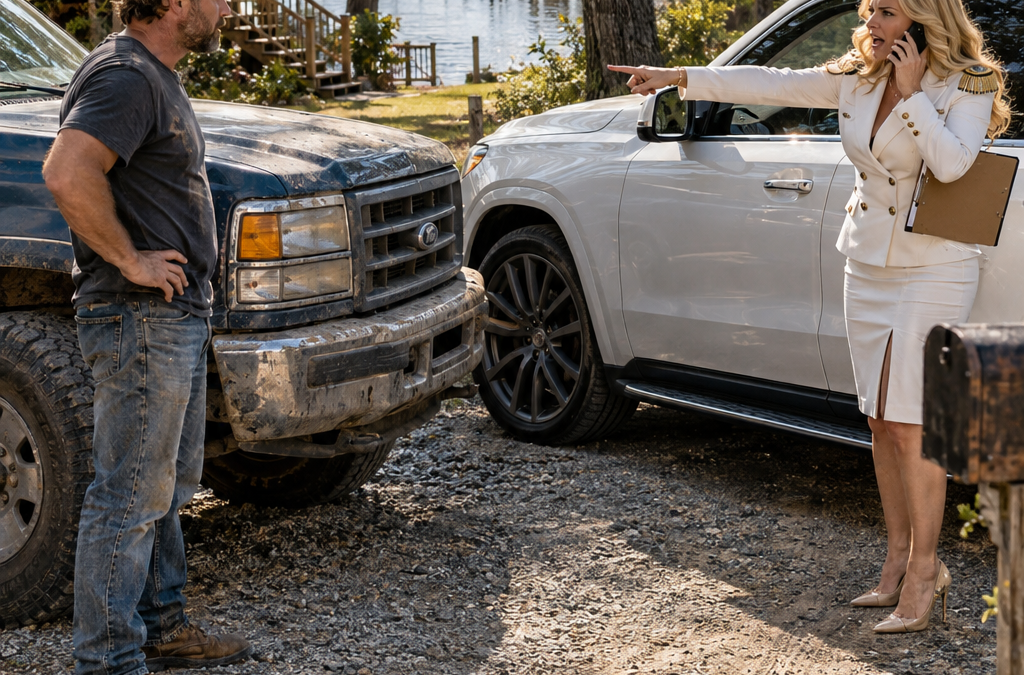
Karen’s SUV had entered my private driveway first and intentionally blocked access; I then parked my own F-150 on my own property in a position that left her vehicle unable to exit, which triggered her 911 call.
I knew exactly what would happen next.
Three minutes.
Maybe less.
Karen dropped the binoculars.
Stood.
Came down her porch steps.
Crossed the road.
By the time she reached my driveway, her face was bright red.
“What do you think you’re doing?”
I looked up from the phone.
“Afternoon.”
“You blocked my vehicle.”
I looked toward both vehicles.
“So it appears.”
“Move that truck.”
“No.”
The word stopped her for half a second.
“Excuse me?”
“It’s parked.”
“Behind my SUV!”
“On my driveway.”
“You cannot trap somebody’s vehicle.”
That was so perfect I almost laughed.
“Interesting.”
“What?”
“You parked your SUV here to trap mine.”
“No, I didn’t.”
“Then why are you here?”
“Community business.”
I looked around.
At my house.
My dock.
My trees.
My gravel.
“Which part?”
She stepped farther into the yard.
“This access area affects the development.”
“This is my driveway.”
“The road is public.”
“The road.”
I pointed.
“Is there.”
Then at the gravel beneath her heels.
“This is not.”
Her voice rose.
“Move the truck.”
“No.”
“I need to leave.”
“You were watching from your porch.”
“That is irrelevant.”
“You parked here intentionally.”
“I have every right to monitor this corridor.”
“No.”
“I’m HOA president.”
“Still no.”
Her chest rose sharply beneath the fitted white jacket.
“I am conducting official business.”
“What business?”
“Compliance.”
“I’m not a member.”
“You refuse to pay dues.”
“Because I don’t owe dues.”
She pointed at my Ford.
“You’re intentionally harassing me because you don’t respect this community.”
“I was getting ready to leave for work.”
“You don’t look like you’re going to work.”
I looked down at myself.
Jeans.
Dark hoodie.
Boots.
“Okay.”
“You think this is funny?”
“A little.”
“You’ve illegally confined my vehicle.”
I leaned back.
“Your vehicle is on my private property.”
“That doesn’t give you the right to hold it hostage.”
“Interesting choice of words.”
“You need to move.”
“I’m comfortable.”
Her eyes widened.
“How long are you planning to leave it there?”
I looked at the truck.
“Weekend sounds good.”
“You wouldn’t.”
“Maybe all week.”
“This is insane.”
“Great parking spot.”
“You will move it now.”
“No.”
Karen was not accustomed to flat refusal.
People usually negotiated with authority figures, even fake ones.
They explained.
Defended.
Compromised.
I didn’t need anything from her.
That left her without a tool.
Then she reached for the one she thought would always work.
Her phone.
“Fine.”
She pulled it out sharply.
“You think you’re above the law?”
“No.”
“We’ll see.”
“Okay.”
“I’m calling the police.”
“Go ahead.”
Her expression flickered.
She expected resistance.
I continued.
“Actually, make sure you tell dispatch exactly where you parked.”
She glared.
“I’m going to have you arrested.”
“Okay.”
“For unlawful confinement.”
I almost smiled.
“Sure.”
“And possibly grand theft auto.”
That one got me.
I laughed.
Her face reddened more.
“You think this is a joke?”
“I think you should make the call.”
She did.
Three digits.
Phone to ear.
Then the transformation happened.
I’d seen it hundreds of times.
The second someone hears a dispatcher answer, their voice becomes whatever version they think will produce the fastest response.
Karen’s hard commanding tone vanished.
She sounded frightened.
Breathless.
Victimized.
“Yes, hello. I need police assistance immediately.”
She turned slightly away but remained close enough that I could hear every word.
“I’m at the lake property next to the subdivision.”
Pause.
“A hostile man has trapped my vehicle.”
I raised my eyebrows.
“He has a huge truck blocking me in and won’t let me leave.”
Pause.
“Yes.”
She looked at me.
Then added:
“He’s threatening me.”
I stopped smiling.
That was a lie with consequences.
“I feel unsafe.”
Pause.
“Please hurry. I’m afraid he’ll become violent.”
I sat still.
She gave the location.
Hung up.
Turned.
And smiled.
Triumphant.
“The police are coming.”
“I heard.”
“I hope you enjoy spending tonight in jail.”
I said nothing.
“This is what happens when you disrespect the community.”
I looked at my watch.
“Good to know.”
Karen paced beside the SUV.
I remained on the porch.
She kept checking the road.
I knew which units were in the sector.
That created a level of awkward anticipation she did not understand yet.
Around ten minutes later, two cruisers appeared.
Karen practically ran toward the first one.
Hands in the air.
“Over here!”
The cruiser stopped.
She reached the driver’s side before the deputy had fully stepped out.
“Thank God.”
The deputy was a veteran named Mike.
We’d worked night shift together for more than three years.
He looked at Karen.
Looked toward the SUV.
Looked at my truck.
Then saw me sitting on the porch.
His face changed.
Not dramatically.
Just recognition.
The second deputy, Eric, was younger.
He got out.
Looked at the house.
Then my Ford.
Then me.
And immediately smiled.
Karen didn’t notice.
She was talking too fast.
“That’s him.”
She pointed.
“He’s the man.”
Mike looked toward me again.
“He trapped my vehicle.”
Mike glanced at the vehicles.
“Okay.”
“He’s been harassing our entire community.”
I almost laughed.
“He refuses HOA regulations, refuses to pay assessments, and now he’s preventing me from leaving.”
Mike took out his notebook.
Karen continued.
“I want him arrested.”
Eric started walking toward the porch.
Karen followed.
“No, he’s right there.”
Eric looked at me.
“Hey.”
I stood.
“Hey.”
Mike came closer.
“Didn’t expect to get dispatched to your place today.”
Karen stopped.
Her head turned toward him.
Mike looked at me.
“Having driveway trouble on your day off, Deputy?”
Silence.
You could practically hear the information entering Karen’s brain and finding nowhere to go.
She stared at Mike.
Then at me.
Then at Eric.
“Deputy?”
Her voice had changed.
Smaller.
Eric grinned.
“Yeah.”
Karen looked at me.
“What does he mean?”
I walked down the steps.
Reached into my pocket.
Pulled out my department identification and badge.
Held them where she could clearly see.
“I’m a deputy with the county sheriff’s office.”
Her face went pale.
“But…”
She looked at my clothes.
“My truck.”
Then the house.
“You drive that.”
I looked toward the Ford.
“Yes.”
“You don’t have a police car.”
“Not today.”
“But you…”
She couldn’t complete the sentence.
“I don’t bring the job home unless I have to.”
Mike looked at me.
“Want to tell us what happened?”
“Sure.”
Karen interrupted.
“He blocked my car.”
Mike raised a hand.
“Ma’am, we’ll get to you.”
That was the first moment she looked genuinely frightened.
Not because I was a deputy.
Because she suddenly realized the people she’d summoned already knew me.
Her victim narrative had lost its advantage.
I explained.
Months of HOA notices.
Not a member.
Threatened lien.
Prior parking incident.
SUV deliberately blocking my driveway earlier that week.
Then today.
I pointed toward the county road.
“She parked the SUV across the narrow section.”
Mike looked at the position.
Eric pulled up parcel information on his tablet.
“My property begins here.”
I pointed.
“I needed to leave.”
“Work?” Mike asked.
“Shift.”
“What time?”
I told him.
He checked his watch.
Karen suddenly said:
“He could have asked me to move.”
I looked at her.
“You were watching with binoculars.”
Eric looked up.
“Binoculars?”
Karen’s face reddened.
“I was outside.”
I continued.
“I parked my truck on my driveway.”
Mike looked at the Ford.
“Touch her vehicle?”
“No.”
“Damage?”
“No.”
“Threats?”
“No.”
Karen stepped forward.
“He told me he might keep me blocked all week.”
Mike looked at me.
“Did you?”
“Yes.”
“Okay.”
He almost smiled.
Karen pointed.
“See!”
Mike remained neutral.
“He also threatened me.”
“No.”
“Yes, you did.”
“What did I say?”
She hesitated.
“You were… intimidating.”
“That’s different.”
“You told me I’d be sorry.”
I stared.
“No, Karen. You told me I’d be sorry.”
Eric looked at her.
“Ma’am, is this property part of your HOA?”
Karen’s eyes moved to the tablet.
“Not technically.”
There it was.
Mike wrote something.
“But it borders the community.”
Eric nodded.
“That wasn’t the question.”
“The appearance affects our homeowners.”
“Is his parcel in your association?”
“No.”
Her voice was quiet.
“But—”
“Does your HOA have a recorded easement over this driveway?”
“I don’t know.”
I answered.
“No.”
Eric checked.
“I’m not seeing one.”
Karen hugged the clipboard against her chest.
“We’re responsible for maintaining standards.”
“On your property,” Mike said.
She turned toward him.
“He refuses dues.”
“If he’s not a member, why would he pay dues?”
“Because he benefits from the neighborhood.”
Mike looked at me.
I shrugged.
Karen continued.
“He has ignored multiple official notices.”
I said:
“Fake notices.”
“They aren’t fake.”
“Do they apply to his parcel?” Eric asked.
Karen hesitated again.
“They apply to visual impact.”
Mike looked tired already.
“Ma’am.”
She stopped.
“You parked your SUV on private property.”
“I was conducting HOA business.”
“That doesn’t authorize trespass.”
“I wasn’t trespassing.”
I pointed toward the gravel beneath her.
“My parcel.”
Mike nodded.
“Looks that way.”
Karen looked toward the SUV.
“But he’s trapping me.”
Eric replied:
“He parked his truck on his own property.”
“Behind my car.”
“Your car was already on his property.”
“I needed to leave.”
“You entered voluntarily.”
“This is false imprisonment.”
Eric shook his head.
“No.”
She looked stunned.
“No?”
“No.”
“But I cannot move my car.”
Mike closed the notebook.
“You created that situation by parking it in his driveway.”
Karen’s eyes widened.
“So you’re taking his side because he’s police?”
There it was.
Mike’s expression hardened.
“I’m looking at the facts.”
She pointed toward me.
“He lied about who he was.”
I almost laughed.
“I never told you what I do.”
“You hid it.”
“I’m not required to display my employment at home.”
She looked at the badge in my hand.
Then back toward the cruisers.
Suddenly the fake 911 report came back into the conversation.
Mike said:
“You told dispatch you were being held hostage.”
Karen froze.
“I said trapped.”
“Dispatch notes say hostage situation.”
Her face changed.
“I was scared.”
“You also reported threats of violence.”
“He was acting threatening.”
“Did he threaten physical harm?”
Silence.
“Ma’am?”
“No.”
“Did he display a weapon?”
“No.”
“Did he attempt to enter your SUV?”
“No.”
“Touch you?”
“No.”
“Prevent you from walking away?”
She looked toward the road.
“No.”
Eric crossed his arms.
“You called an emergency line and reported a violent hostage situation because your SUV was blocked after you parked in someone else’s private driveway.”
“When you say it like that—”
“How else should I say it?”
She stared.
Karen’s confidence was collapsing visibly.
A few minutes earlier, she had been smiling about me spending the night in jail.
Now she was holding the clipboard against her chest like body armor.
Mike looked at me.
“Do you want to pursue trespass?”
She immediately said:
“Please.”
Not to Mike.
To me.
That was the first polite word she’d used in months.
I looked at her.
She swallowed.
“I didn’t mean for this to get out of control.”
I almost couldn’t believe what I was hearing.
“You parked across my driveway twice.”
“I was trying to make a point.”
“You threatened a lien.”
“That was board business.”
“You sent fines.”
“Standard procedure.”
“I’m not in the HOA.”
She said nothing.
“You called 911 and told them I was violent.”
“I was upset.”
Mike stepped in.
“False reporting is serious.”
Karen looked at him.
“I’m sorry.”
“Sorry doesn’t undo the call.”
“I didn’t know he was a deputy.”
The silence after that was perfect.
Mike’s eyebrows rose.
I stared.
Eric actually looked away for a moment.
I said:
“That shouldn’t matter.”
Karen realized what she’d admitted.
“No. That’s not what I meant.”
“It’s exactly what you meant.”
“I meant I didn’t understand the situation.”
“You understood enough to call 911.”
“I thought—”
“You thought you’d use the sheriff’s office to scare me the way you use HOA letters to scare everyone else.”
Her eyes filled slightly.
Anger or panic.
Probably both.
Mike asked me again.
“You want charges?”
I thought about it.
Trespass.
Harassment.
False report.
Could have turned into paperwork.
Statements.
Possibly court.
I had shift starting soon.
And if I’m being completely truthful, I also knew humiliation had already done more than a citation probably would.
I looked at Karen.
“I’m not pursuing it today.”
She exhaled so sharply I heard it.
Mike nodded.
“Your call.”
I raised one finger.
“But.”
Karen stiffened.
“If your vehicle enters this driveway again without permission, I will pursue trespass.”
She nodded rapidly.
“If you come onto the property again after being told to leave, same thing.”
“Yes.”
“If you send me another fake fine or threaten fraudulent liens, I’m documenting everything and sending it directly to counsel.”
She swallowed.
“Okay.”
“And if you ever call 911 with another false story about me being violent because you’re losing an argument…”
I looked at Mike.
Then back at her.
“That won’t be a neighborhood dispute.”
“I understand.”
“Do you?”
“Yes.”
“Good.”
Mike looked at her.
“I would strongly recommend that you stay on the HOA’s actual property.”
Eric added:
“And use non-emergency channels for non-emergencies.”
Karen nodded.
All the swagger was gone.
No visual jurisdiction.
No community standards.
No threats.
Just a woman standing in somebody else’s driveway realizing the authorities she’d tried to weaponize were now explaining how close she had come to leaving in handcuffs.
I walked to the F-150.
Unlocked it.
Climbed in.
Started the engine.
Backed toward the garage.
The moment the path opened, Karen moved.
Fast.
She practically ran to her SUV.
Got inside.
Started it.
Backed down the driveway too quickly.
One rear corner came within inches of an oak.
She corrected.
Reached the county road.
Then drove toward the subdivision without looking back.
Mike watched her leave.
Then looked at me.
“You attract interesting neighbors.”
“Occupational hazard.”
Eric laughed.
“You seriously sat on the porch drinking coffee while she called 911?”
“I had already made coffee.”
Mike shook his head.
“You’re going to be late.”
I checked the time.
“Probably.”
“I’ll tell the sergeant why.”
“Please don’t.”
He laughed.
“We absolutely are.”
They left.
I went inside.
Changed.
Drove to work.
By shift briefing, half the room knew.
Of course they did.
Law enforcement agencies are rumor factories with radios.
Someone had already named the incident “The HOA Hostage Crisis.”
I hated every one of them.
The jokes lasted weeks.
But something much better happened at home.
Silence.
No more notices.
No more golf-cart patrols.
No more HOA envelopes.
No fake dues.
No threats.
No talk of liens.
Karen stopped coming anywhere near my property.
When she drove past the access road, she kept driving.
No slowing.
No staring.
No clipboard inspection.
The lake house became what it had been before she arrived.
Quiet.
One evening several weeks later, I was repairing boards on the dock.
A man from the subdivision walked down the public road.
I’d seen him before but didn’t know his name.
He stopped near the driveway.
“You’re the deputy?”
I sighed.
“Apparently everybody knows now.”
He laughed.
“I’m Tom.”
We shook hands.
He looked toward the development.
“I wanted to thank you.”
“For what?”
“Getting her to calm down.”
“I didn’t do anything for the HOA.”
“I know.”
He lowered his voice.
“She’s been different.”
“How?”
“Less aggressive.”
I shrugged.
“Good.”
“She used to threaten everyone.”
“About what?”
He laughed without humor.
“Everything.”
Trash cans.
Driveway stains.
Basketball hoops.
Parking.
Paint colors.
Holiday decorations.
A child had apparently left a bicycle in a front yard overnight and generated a compliance notice.
Tom said:
“You could ignore her because you’re not part of the HOA.”
“Correct.”
“We can’t.”
“Your bylaws still limit what she can do.”
“Sure.”
He smiled bitterly.
“But most people don’t want to spend thousands proving a fifty-dollar fine is wrong.”
That stayed with me.
Because it explained why Karen had become Karen.
Power doesn’t always grow because somebody has enormous legal authority.
Sometimes it grows because resisting small abuses is exhausting.
A forty-dollar fine isn’t worth a lawyer.
A violation letter isn’t worth losing sleep.
A hostile meeting isn’t worth ruining Wednesday night.
So people comply.
Then the person issuing those demands starts mistaking convenience for obedience.
Eventually, Karen drove onto land she didn’t control because she’d spent too long living in a world where nobody wanted the argument.
She picked the wrong driveway.
Not because I’m tougher than everyone else.
Not because carrying a badge makes me special.
Because I knew exactly what her authority was worth outside the HOA boundary.
Nothing.
And because when she called law enforcement, she accidentally brought in people who understood that line too.
Months later, I finally spoke to the HOA board’s management company.
Not Karen.
The management company.
I wanted something in writing.
I sent the deed information and parcel map.
Their attorney responded.
Short letter.
My parcel was not subject to association covenants.
No assessments due.
No enforcement authority.
No right of access.
Exactly what I’d said from day one.
I saved that letter.
I stopped burning the notices after that.
Experience had reminded me that ridiculous things are still worth documenting.
I kept everything.
Photographs.
Dates.
SUV incidents.
Dispatch record.
The management letter.
You learn.
Karen remained HOA president for a while.
I expected her to resign out of embarrassment.
People like Karen rarely do.
She simply became more careful around me.
I heard residents challenged her more often after the 911 incident leaked.
Not because I gave speeches.
I didn’t.
But once people realize somebody’s authority has limits, they start asking where those limits are.
One resident requested financial records.
Another challenged a parking fine.
Someone else asked the board to cite the exact section allowing a landscaping penalty.
Questions spread.
Apparently the phrase “visual jurisdiction” became a neighborhood joke.
I enjoyed that more than I should have.
Someone had T-shirts printed for a barbecue.
VISUAL JURISDICTION ENFORCEMENT UNIT.
A neighbor sent me a picture.
I laughed for five minutes.
Karen did not attend that barbecue.
I don’t know whether she learned anything deeper from the experience.
Maybe.
Maybe not.
But she learned one practical lesson.
Do not park in my driveway.
That was enough for me.
Years later, I still own the house.
Same gravel driveway.
Never paved it.
Same Ford, though it’s showing its age.
Same lake.
Same porch.
The HOA development is still next door.
Property values survived my gravel.
Miraculously.
The civilization-ending sight of a pickup truck remains visible from the road.
Nobody has died.
The community continues functioning despite my refusal to submit a paint sample for approval.
Sometimes new residents move in and assume I’m part of the development.
They’ll ask about the driveway.
Or whether I use the pool.
I tell them:
“Independent parcel.”
Most say:
“Nice.”
Then move on.
Normal human behavior.
Every once in a while, somebody mentions Karen.
They usually lower their voice first.
That always makes me smile.
The story gets exaggerated, naturally.
In one version, I arrested her personally.
Didn’t happen.
In another, she spent the night in jail.
Didn’t happen.
Someone claimed I towed her SUV into the lake.
Definitely didn’t happen.
The truth was simpler.
She trespassed.
Blocked my driveway.
I parked behind her.
She called 911 and lied about a hostage situation.
My coworkers arrived.
She discovered who I was.
I chose not to pursue charges.
She left.
And never bothered me again.
That’s enough.
People sometimes ask whether I used my position improperly by not telling her I was law enforcement earlier.
No.
My job isn’t a warning label.
Off duty, on my private property, I’m allowed to be a homeowner.
I don’t need to introduce myself as Deputy anything because a neighbor wants my driveway paved.
In fact, I prefer not to.
The badge should not be necessary for someone to respect a boundary.
That’s what bothers me most when people say Karen was foolish because she “picked the wrong target.”
She did pick the wrong target.
But not because I’m law enforcement.
She was wrong before she knew that.
She was wrong if I had been a plumber.
Teacher.
Mechanic.
Retired accountant.
Unemployed.
Twenty-one.
Eighty-one.
The deed would still say the same thing.
Her HOA would still stop at the same line.
Her SUV would still be on someone else’s property.
Her false emergency call would still be false.
The badge didn’t make me right.
It just destroyed her assumption that she could define the law more convincingly than I could.
That’s different.
I thought about pressing charges more than once afterward.
Especially after listening to the 911 audio.
Yes.
I eventually heard it.
Professional curiosity.
She had exaggerated more than I’d realized.
Her voice shook.
She described me as “agitated.”
I was drinking coffee.
Said I had threatened retaliation.
I hadn’t.
Said I was preventing her from leaving.
She could walk away freely.
Claimed there was an escalating confrontation.
For most of the call, I hadn’t spoken to her at all.
Hearing it made me angrier than the actual event.
In person, you can see someone performing.
On audio, stripped of context, she sounded genuinely terrified.
That’s why false reports matter.
A responding deputy doesn’t know which version is true.
They hear possible violence.
Possible confinement.
Possible threat.
They prepare accordingly.
That changes how they arrive.
Where they position.
What risks they anticipate.
Karen had tried to turn a property argument into an emergency because she wanted more authority on scene than she possessed herself.
That was dangerous.
Not just annoying.
If Mike and Eric hadn’t known me, the situation still should have ended based on the facts.
But the opening minutes might have been much more tense.
That’s why, if she had ever done it again, I would absolutely have pursued charges.
One warning was enough.
Fortunately, she believed me.
A year later, I was sitting on the porch when a moving truck entered the subdivision.
A neighbor told me Karen had sold her house.
I didn’t ask why.
Maybe unrelated.
Maybe she wanted somewhere new.
Maybe the HOA presidency wasn’t fun anymore once residents started questioning every claim.
I watched the truck leave two days later.
Karen’s SUV followed.
When she reached the turn near my access road, she slowed.
Just for a second.
I was outside.
Our eyes met.
She didn’t wave.
Neither did I.
Then she drove away.
That was the last time I saw her.
The new owners were a young couple.
A few weeks after moving in, the husband walked toward my mailbox.
“Hey.”
“Hey.”
“You’re the neighbor down by the water?”
“That’s me.”
“I’m Ben.”
We shook hands.
He looked toward my gravel drive.
“Former owner told us not to park anywhere near your property.”
I burst out laughing.
“What?”
“Was that serious?”
“Very.”
He looked confused.
“Long story.”
“Did she park there?”
“Twice.”
He laughed.
“Why?”
“Longer story.”
He pointed toward the lake.
“You mind if we walk down sometime and ask about fishing spots?”
“Ask first.”
He nodded.
“Of course.”
That was it.
No clipboard.
No visual jurisdiction.
No declaration that shoreline proximity created authority.
Just a neighbor asking.
I told him where the bass usually sat in spring.
We got along fine.
That’s how easy it could have been.
Years of conflict reduced to one concept.
Ask.
People who respect boundaries don’t need complicated relationships.
“Can I park here?”
“No.”
“Okay.”
“Can I cross?”
“Not today.”
“Understood.”
“Would you mind?”
“Sure.”
Civilization survives.
Karen didn’t understand consent when authority felt easier.
She believed being HOA president meant she no longer needed other people’s permission.
Her job, in her mind, wasn’t managing association property.
It was deciding what the neighborhood should look like.
My land interrupted that picture.
Gravel.
Old pickup.
Independent house.
No dues.
No permission required.
I think that bothered her more than any actual violation.
I was visible proof that her rules had an edge.
Powerful people often become obsessed with edges.
Because a boundary reminds them their control is conditional.
Karen tried to erase mine with letters.
Didn’t work.
Threats.
Didn’t work.
Fines.
Didn’t work.
Lien threats.
Didn’t work.
Then a vehicle.
That finally created a consequence she couldn’t paper over.
I still have the gravel driveway.
I could pave it now.
Easily.
Sometimes during heavy rain, I think about it.
Then I remember Karen standing there telling me community guidelines required concrete.
And suddenly the gravel looks beautiful.
My truck still sits where it can be seen from the public road.
Not as a protest.
That’s where I park.
But I’d be lying if I said I don’t occasionally appreciate the symbolism.
The house beside the lake remains my sanctuary.
Most evenings are quiet.
Water against the dock.
Wind through the oaks.
Maybe a boat motor far away.
No radios.
No sirens.
No demands.
Exactly what I wanted.
Sometimes I sit on the porch with coffee and think about the moment Karen’s face changed.
Not when the deputies told her she was trespassing.
Earlier.
One word.
Deputy.
She had called 911 expecting the state to become her personal enforcement arm.
Then discovered the man she wanted arrested worked for the department she had just lied to.
The irony was satisfying.
But the lesson was simpler than the irony.
Authority is not contagious.
Living next to private property doesn’t give you control over it.
Leading an HOA doesn’t make surrounding land part of your jurisdiction.
Printing a fine doesn’t create a debt.
Threatening a lien doesn’t create a covenant.
Parking an SUV somewhere doesn’t create an easement.
And calling the police doesn’t make your version true.
Facts survive titles.
Deeds survive clipboards.
Property lines survive opinions.
Karen spent months telling me I was the one who needed to learn that.
In the end, she learned it sitting in an SUV she had deliberately parked on the wrong side of the line.
And when she finally called the “real authorities” to prove me wrong, they didn’t have to teach me where my driveway ended.
They had to teach her.
𝗧𝗛𝗘 𝗘𝗡𝗗
The HOA President Parked Her SUV Across My Driveway—Then Called 911 When I Refused to Let Her Leave
For months, the HOA president threatened fines, liens, and legal action against property her association had never controlled.
Then she parked her SUV across my driveway to prove she could control me anyway—and called 911 when I used my own truck to make sure she stayed long enough to explain herself.
My house sits beside a lake at the end of a narrow county access road.
Nothing fancy.
That’s one of the reasons I love it.
A gravel driveway.
Old oak trees.
A wooden porch facing the water.
A dock I repaired myself.
An aging F-150 that spends more time dusty than clean.
When I’m home, I don’t want uniforms, radios, flashing lights, reports, angry people, domestic calls, wrecks, or arguments between neighbors over things that should have been solved with one calm conversation.
That’s because I’m a sheriff’s deputy.
I’ve worked for the county long enough to know what people look like when they’re scared, angry, lying, embarrassed, drunk, desperate, or convinced the law means whatever they need it to mean that afternoon.
The job can get heavy.
My lake house is where I put that weight down.
I deliberately keep work and home separate.
When I’m off duty, I don’t wear anything remotely official.
Cargo shorts.
Old jeans.
Faded T-shirts.
A dark hoodie when it’s cold.
I rarely bring a marked unit home.
If I do, it goes into the garage.
Most people around the lake know me simply as the guy with the old Ford who fishes too early and grills too late.
That’s exactly how I like it.
My property is also completely independent from the subdivision next door.
That detail matters.
A newer development sits up the road from me.
Large homes.
Uniform landscaping.
Decorative stone entrance.
Private streets branching off the public access.
Golf carts.
Mailboxes that all match.
A clubhouse that probably has more rules than some small countries.
And, naturally, an HOA.
I’m not part of it.
Never have been.
Never signed anything.
My deed has no HOA covenants attached.
My land was there before their development existed.
My driveway connects to a public access easement maintained separately from their private roads.
I don’t use their amenities.
I don’t use their pool.
I don’t use their gate.
I don’t pay dues.
I don’t owe them anything.
For years, nobody cared.
Then Karen moved into the corner house.
Her real name isn’t Karen.
But if you’ve ever met a person who can turn a clipboard into a weapon, you’ll understand why the name fits.
She was around forty, blonde, attractive in a way that looked carefully engineered, and carried herself with the confidence of someone who had never once considered the possibility that another adult might simply tell her no.
Within months of moving in, she became HOA president.
Not because she was universally loved.
From what I eventually heard, she simply wanted the position more than anyone else wanted to fight her for it.
Karen loved authority.
Especially visual authority.
Her favorite outfit was a tight white military-inspired jacket with bright gold buttons, decorative epaulets, a sharply fitted waist, and a very deep neckline that emphasized her large chest. She paired it with a fitted white skirt or tailored pants and high heels, even when she was walking along gravel.
She carried a clipboard constantly.
I don’t know what was on it half the time.
Maybe actual HOA business.
Maybe a grocery list.
But she carried it like a badge.
The first time we spoke, I was clearing brush near my mailbox.
The mailbox sits near the point where the public access road runs past the edge of my land before turning toward the subdivision.
I was in an old shirt, cargo shorts, work gloves, and muddy boots.
Karen came walking toward me.
White fitted jacket.
Gold buttons.
Sunglasses.
Clipboard.
She stopped before crossing onto the gravel.
“Excuse me.”
I looked up from the brush.
“Morning.”
“Are you the owner of this property?”
“I am.”
She looked down my driveway.
Then at my F-150.
Then toward the lake house.
The expression on her face suggested she’d found a stain on an expensive carpet.
“You need to pave this driveway.”
I thought I’d misheard.
“What?”
“The driveway.”
She tapped the clipboard.
“Community guidelines require poured concrete or stamped asphalt.”
I looked at my gravel.
Then at her.
“Okay.”
She seemed pleased.
“Good.”
“No.”
Her face changed.
“I said okay because I understand what you’re saying. I’m not doing it.”
She lowered the clipboard slightly.
“You don’t have an option.”
“I do.”
“The community guidelines—”
“Don’t apply here.”
She stared.
“My property isn’t part of your subdivision.”
Karen gave a short laugh.
Not amused.
Condescending.
“Everyone around the lake is affected by the same visual standards.”
“No.”
“I’m the HOA president.”
“Congratulations.”
“Our association maintains the character of this entire area.”
“Your association maintains whatever property belongs to your association.”
She looked toward my truck.
“Your vehicle is also visible from the main corridor.”
“It usually is.”
“That violates vehicle-storage standards.”
“Not mine.”
Her smile disappeared.
“You seem confused.”
“I deal with confusion professionally.”
“What does that mean?”
“Nothing.”
I put the brush back into the pile.
“Ma’am, my deed isn’t connected to your HOA.”
“You may not understand the development boundaries.”
“I do.”
“Your property affects ours.”
“That’s different from controlling mine.”
She raised her chin.
“We have what I would describe as visual jurisdiction.”
I actually laughed.
She didn’t.
“Visual jurisdiction isn’t a legal concept.”
“I’m not going to debate terminology with you.”
“Good.”
I pulled off my gloves.
“Because there isn’t much to debate.”
Her cheeks reddened slightly.
“I suggest you review your obligations.”
“I have.”
“Then you’ll know I’m right.”
“I’m not paying you dues.”
She stared.
“I’m not paving the driveway.”
Her jaw tightened.
“I’m not hiding my truck.”
Nothing.
“And I’m not submitting anything to your HOA.”
I picked up the brush cutter.
“Have a good day.”
I turned away.
Behind me, Karen said:
“You’re making this harder than it needs to be.”
I looked back.
“No.”
She waited.
“You are.”
That was interaction number one.
I assumed it would end there.
Normal people realize they’ve approached the wrong parcel, maybe feel embarrassed, and move on.
Karen considered embarrassment an invitation to escalate.
Within weeks, envelopes started appearing.
Not one.
Dozens over the next few months.
HOA notices.
Official-looking letterhead.
Violation summaries.
Unpaid assessments.
Landscaping penalties.
Unauthorized vehicle-storage fines.
One accused me of keeping a “commercialized utility vehicle” in open view.
That was my twelve-year-old Ford.
My favorite notice demanded several hundred dollars in overdue community assessments.
I was not a member.
I treated the notices according to their legal value.
Most went into the wood stove.
Maybe that wasn’t ideal evidence preservation.
But at the time, I wasn’t worried.
I knew the county records.
I knew my deed.
I knew what an HOA could and could not do to land outside its recorded authority.
And I deal with real disputes for a living.
I had seen enough empty threats to recognize intimidation.
Karen depended on people being afraid of official language.
She printed a balance.
Used words like delinquent and enforcement.
Added bold deadlines.
Most homeowners probably saw that and immediately called someone.
I didn’t.
That made her furious.
Sometimes I would see her driving a golf cart along the subdivision side of the boundary.
She would slow down.
Look toward my deck.
I would raise my coffee.
Or beer, depending on the hour.
Smile.
She hated that.
People like Karen need emotional confirmation.
Fear.
Anger.
Apology.
Something.
Indifference is unbearable.
The second major confrontation happened when I was loading kayaks into my truck.
Karen drove her golf cart partly across the driveway entrance.
Not fully blocking me yet.
Enough to force the conversation.
She stepped out.
White jacket.
White pants.
Gold buttons.
Clipboard.
“You’ve been ignoring official notices.”
I tightened a strap over one kayak.
“Yes.”
Her eyebrows rose.
“Excuse me?”
“I’ve been ignoring them.”
“Those are legal demands.”
“No.”
“The board is preparing to file a lien.”
That got my attention.
Not because she had a valid lien.
Because filing fraudulent documents against someone’s property is more serious than sending stupid letters.
I climbed down from the truck bed.
“Karen.”
She folded her arms.
“You owe community assessments, accumulated penalties, and architectural fines.”
“No.”
“You can’t just say no.”
“I can when you’re asking me to pay debts that don’t exist.”
“The property benefits from our neighborhood.”
“I don’t use anything you maintain.”
“You benefit from values.”
“I didn’t request that benefit.”
Her voice sharpened.
“We have enforcement mechanisms.”
“I know.”
“Then pay.”
I looked directly at her.
“If your board attempts to record a lien against my parcel without lawful authority, you’ll create a much more expensive problem than the fake dues you’re pretending I owe.”
Her expression changed.
“You threatening me?”
“No.”
I pulled the last strap tight.
“I’m explaining consequences.”
“We have attorneys.”
“Good.”
“Very expensive attorneys.”
“Even better.”
Her eyes narrowed.
“Why?”
“Because competent attorneys will tell you not to file fraudulent liens.”
She stepped closer.
“You’re arrogant.”
“Probably.”
“You think you’re above this community.”
“I’m outside this community.”
“Same thing.”
“No.”
She pointed toward my gravel.
“That attitude is exactly why standards exist.”
I climbed into the truck.
Before starting it, I leaned toward the open window.
“One last time.”
She stared.
“Leave me alone.”
Her lips tightened.
“Stop coming onto my property.”
Nothing.
“Stop putting notices in my mailbox.”
She scoffed.
“And stop threatening liens against land your HOA doesn’t control.”
“We’ll see.”
“Okay.”
“We have ways of enforcing standards whether you recognize them or not.”
I started the truck.
“You should move the golf cart.”
She held her position.
I waited.
She didn’t move.
So I eased forward slowly.
Not touching her.
Not touching the cart.
Just making it very clear I intended to leave.
Eventually she had to scramble back into the cart and reverse onto the grass.
I drove away.
In the mirror, she stood beside it glaring after me.
At that point, I thought she’d remain a paper nuisance.
She would send fake fines.
Maybe threaten lawyers.
Maybe bother management companies.
Then she changed tactics.
The first time I found her SUV in my driveway was on a Saturday.
I planned to drive into town for lumber.
A section of dock needed repair.
I walked outside carrying my keys.
Stopped.
A shiny midsize SUV sat directly across the gravel drive.
Empty.
Not partially blocking.
Completely blocking.
No way around without driving through wet grass near the drainage edge.
I walked down.
Checked inside.
Nobody.
Then looked toward the road.
Karen stood near her mailbox.
Pretending to read something.
Watching me.
It was so obvious that I almost admired the childishness.
She had intentionally parked on my land.
Not because she needed the spot.
Not because of an emergency.
To provoke me.
She wanted me to walk up there yelling.
Wanted a confrontation.
Probably wanted video of an “aggressive neighbor.”
Instead, I went inside.
Made coffee.
Sat at my kitchen table.
I had nowhere I desperately needed to be.
Freezer full of food.
Weekend off.
Beautiful lake.
If Karen wanted her SUV sitting in my driveway all afternoon, that affected her more than me.
About an hour later, I watched through the window as she came down.
She looked toward the house several times.
Nothing.
Got into the SUV.
Drove away.
I smiled.
The failure bothered her.
A few days later, she tried again.
That afternoon mattered because I had work.
Evening shift.
I usually changed at the substation.
That day I was wearing jeans, boots, and a dark hoodie.
Badge and credentials were with me.
Duty gear wasn’t.
I stepped outside.
Her SUV was back.
This time she had positioned it carefully across the narrowest point between two large oak trees.
There was technically room to bypass through part of the lawn.
But I’d have to tear up grass and drive dangerously close to drainage.
I looked uphill.
Karen wasn’t pretending to check mail.
She was sitting on her porch.
Holding a mug.
Binoculars.
Actual binoculars.
Watching me.
That was the moment it stopped being funny.
I could not be late to shift briefing because a bored HOA president wanted to play blockade.
I considered calling in immediately.
Could have.
Probably should have.
But another idea occurred to me.
I walked down the driveway.
Got into the F-150.
Started the engine.
Karen lowered the binoculars.
I could see her posture change.
She expected me to drive through the grass.
Instead, I moved forward carefully.
Her SUV was parked sideways enough that the driver’s side faced part of my property.
I pulled my truck close.
Very close.
Stopped before contact.
Then repositioned.
There was a stone retaining edge on one side and trees on the other.
With my truck angled behind her SUV, she no longer had room to reverse out.
I put the Ford in park.
Set the brake.
Locked it.
Walked back to the porch.
Sat on the swing.
Checked my phone.
Karen’s SUV had entered my private driveway first and intentionally blocked access; I then parked my own F-150 on my own property in a position that left her vehicle unable to exit, which triggered her 911 call.
I knew exactly what would happen next.
Three minutes.
Maybe less.
Karen dropped the binoculars.
Stood.
Came down her porch steps.
Crossed the road.
By the time she reached my driveway, her face was bright red.
“What do you think you’re doing?”
I looked up from the phone.
“Afternoon.”
“You blocked my vehicle.”
I looked toward both vehicles.
“So it appears.”
“Move that truck.”
“No.”
The word stopped her for half a second.
“Excuse me?”
“It’s parked.”
“Behind my SUV!”
“On my driveway.”
“You cannot trap somebody’s vehicle.”
That was so perfect I almost laughed.
“Interesting.”
“What?”
“You parked your SUV here to trap mine.”
“No, I didn’t.”
“Then why are you here?”
“Community business.”
I looked around.
At my house.
My dock.
My trees.
My gravel.
“Which part?”
She stepped farther into the yard.
“This access area affects the development.”
“This is my driveway.”
“The road is public.”
“The road.”
I pointed.
“Is there.”
Then at the gravel beneath her heels.
“This is not.”
Her voice rose.
“Move the truck.”
“No.”
“I need to leave.”
“You were watching from your porch.”
“That is irrelevant.”
“You parked here intentionally.”
“I have every right to monitor this corridor.”
“No.”
“I’m HOA president.”
“Still no.”
Her chest rose sharply beneath the fitted white jacket.
“I am conducting official business.”
“What business?”
“Compliance.”
“I’m not a member.”
“You refuse to pay dues.”
“Because I don’t owe dues.”
She pointed at my Ford.
“You’re intentionally harassing me because you don’t respect this community.”
“I was getting ready to leave for work.”
“You don’t look like you’re going to work.”
I looked down at myself.
Jeans.
Dark hoodie.
Boots.
“Okay.”
“You think this is funny?”
“A little.”
“You’ve illegally confined my vehicle.”
I leaned back.
“Your vehicle is on my private property.”
“That doesn’t give you the right to hold it hostage.”
“Interesting choice of words.”
“You need to move.”
“I’m comfortable.”
Her eyes widened.
“How long are you planning to leave it there?”
I looked at the truck.
“Weekend sounds good.”
“You wouldn’t.”
“Maybe all week.”
“This is insane.”
“Great parking spot.”
“You will move it now.”
“No.”
Karen was not accustomed to flat refusal.
People usually negotiated with authority figures, even fake ones.
They explained.
Defended.
Compromised.
I didn’t need anything from her.
That left her without a tool.
Then she reached for the one she thought would always work.
Her phone.
“Fine.”
She pulled it out sharply.
“You think you’re above the law?”
“No.”
“We’ll see.”
“Okay.”
“I’m calling the police.”
“Go ahead.”
Her expression flickered.
She expected resistance.
I continued.
“Actually, make sure you tell dispatch exactly where you parked.”
She glared.
“I’m going to have you arrested.”
“Okay.”
“For unlawful confinement.”
I almost smiled.
“Sure.”
“And possibly grand theft auto.”
That one got me.
I laughed.
Her face reddened more.
“You think this is a joke?”
“I think you should make the call.”
She did.
Three digits.
Phone to ear.
Then the transformation happened.
I’d seen it hundreds of times.
The second someone hears a dispatcher answer, their voice becomes whatever version they think will produce the fastest response.
Karen’s hard commanding tone vanished.
She sounded frightened.
Breathless.
Victimized.
“Yes, hello. I need police assistance immediately.”
She turned slightly away but remained close enough that I could hear every word.
“I’m at the lake property next to the subdivision.”
Pause.
“A hostile man has trapped my vehicle.”
I raised my eyebrows.
“He has a huge truck blocking me in and won’t let me leave.”
Pause.
“Yes.”
She looked at me.
Then added:
“He’s threatening me.”
I stopped smiling.
That was a lie with consequences.
“I feel unsafe.”
Pause.
“Please hurry. I’m afraid he’ll become violent.”
I sat still.
She gave the location.
Hung up.
Turned.
And smiled.
Triumphant.
“The police are coming.”
“I heard.”
“I hope you enjoy spending tonight in jail.”
I said nothing.
“This is what happens when you disrespect the community.”
I looked at my watch.
“Good to know.”
Karen paced beside the SUV.
I remained on the porch.
She kept checking the road.
I knew which units were in the sector.
That created a level of awkward anticipation she did not understand yet.
Around ten minutes later, two cruisers appeared.
Karen practically ran toward the first one.
Hands in the air.
“Over here!”
The cruiser stopped.
She reached the driver’s side before the deputy had fully stepped out.
“Thank God.”
The deputy was a veteran named Mike.
We’d worked night shift together for more than three years.
He looked at Karen.
Looked toward the SUV.
Looked at my truck.
Then saw me sitting on the porch.
His face changed.
Not dramatically.
Just recognition.
The second deputy, Eric, was younger.
He got out.
Looked at the house.
Then my Ford.
Then me.
And immediately smiled.
Karen didn’t notice.
She was talking too fast.
“That’s him.”
She pointed.
“He’s the man.”
Mike looked toward me again.
“He trapped my vehicle.”
Mike glanced at the vehicles.
“Okay.”
“He’s been harassing our entire community.”
I almost laughed.
“He refuses HOA regulations, refuses to pay assessments, and now he’s preventing me from leaving.”
Mike took out his notebook.
Karen continued.
“I want him arrested.”
Eric started walking toward the porch.
Karen followed.
“No, he’s right there.”
Eric looked at me.
“Hey.”
I stood.
“Hey.”
Mike came closer.
“Didn’t expect to get dispatched to your place today.”
Karen stopped.
Her head turned toward him.
Mike looked at me.
“Having driveway trouble on your day off, Deputy?”
Silence.
You could practically hear the information entering Karen’s brain and finding nowhere to go.
She stared at Mike.
Then at me.
Then at Eric.
“Deputy?”
Her voice had changed.
Smaller.
Eric grinned.
“Yeah.”
Karen looked at me.
“What does he mean?”
I walked down the steps.
Reached into my pocket.
Pulled out my department identification and badge.
Held them where she could clearly see.
“I’m a deputy with the county sheriff’s office.”
Her face went pale.
“But…”
She looked at my clothes.
“My truck.”
Then the house.
“You drive that.”
I looked toward the Ford.
“Yes.”
“You don’t have a police car.”
“Not today.”
“But you…”
She couldn’t complete the sentence.
“I don’t bring the job home unless I have to.”
Mike looked at me.
“Want to tell us what happened?”
“Sure.”
Karen interrupted.
“He blocked my car.”
Mike raised a hand.
“Ma’am, we’ll get to you.”
That was the first moment she looked genuinely frightened.
Not because I was a deputy.
Because she suddenly realized the people she’d summoned already knew me.
Her victim narrative had lost its advantage.
I explained.
Months of HOA notices.
Not a member.
Threatened lien.
Prior parking incident.
SUV deliberately blocking my driveway earlier that week.
Then today.
I pointed toward the county road.
“She parked the SUV across the narrow section.”
Mike looked at the position.
Eric pulled up parcel information on his tablet.
“My property begins here.”
I pointed.
“I needed to leave.”
“Work?” Mike asked.
“Shift.”
“What time?”
I told him.
He checked his watch.
Karen suddenly said:
“He could have asked me to move.”
I looked at her.
“You were watching with binoculars.”
Eric looked up.
“Binoculars?”
Karen’s face reddened.
“I was outside.”
I continued.
“I parked my truck on my driveway.”
Mike looked at the Ford.
“Touch her vehicle?”
“No.”
“Damage?”
“No.”
“Threats?”
“No.”
Karen stepped forward.
“He told me he might keep me blocked all week.”
Mike looked at me.
“Did you?”
“Yes.”
“Okay.”
He almost smiled.
Karen pointed.
“See!”
Mike remained neutral.
“He also threatened me.”
“No.”
“Yes, you did.”
“What did I say?”
She hesitated.
“You were… intimidating.”
“That’s different.”
“You told me I’d be sorry.”
I stared.
“No, Karen. You told me I’d be sorry.”
Eric looked at her.
“Ma’am, is this property part of your HOA?”
Karen’s eyes moved to the tablet.
“Not technically.”
There it was.
Mike wrote something.
“But it borders the community.”
Eric nodded.
“That wasn’t the question.”
“The appearance affects our homeowners.”
“Is his parcel in your association?”
“No.”
Her voice was quiet.
“But—”
“Does your HOA have a recorded easement over this driveway?”
“I don’t know.”
I answered.
“No.”
Eric checked.
“I’m not seeing one.”
Karen hugged the clipboard against her chest.
“We’re responsible for maintaining standards.”
“On your property,” Mike said.
She turned toward him.
“He refuses dues.”
“If he’s not a member, why would he pay dues?”
“Because he benefits from the neighborhood.”
Mike looked at me.
I shrugged.
Karen continued.
“He has ignored multiple official notices.”
I said:
“Fake notices.”
“They aren’t fake.”
“Do they apply to his parcel?” Eric asked.
Karen hesitated again.
“They apply to visual impact.”
Mike looked tired already.
“Ma’am.”
She stopped.
“You parked your SUV on private property.”
“I was conducting HOA business.”
“That doesn’t authorize trespass.”
“I wasn’t trespassing.”
I pointed toward the gravel beneath her.
“My parcel.”
Mike nodded.
“Looks that way.”
Karen looked toward the SUV.
“But he’s trapping me.”
Eric replied:
“He parked his truck on his own property.”
“Behind my car.”
“Your car was already on his property.”
“I needed to leave.”
“You entered voluntarily.”
“This is false imprisonment.”
Eric shook his head.
“No.”
She looked stunned.
“No?”
“No.”
“But I cannot move my car.”
Mike closed the notebook.
“You created that situation by parking it in his driveway.”
Karen’s eyes widened.
“So you’re taking his side because he’s police?”
There it was.
Mike’s expression hardened.
“I’m looking at the facts.”
She pointed toward me.
“He lied about who he was.”
I almost laughed.
“I never told you what I do.”
“You hid it.”
“I’m not required to display my employment at home.”
She looked at the badge in my hand.
Then back toward the cruisers.
Suddenly the fake 911 report came back into the conversation.
Mike said:
“You told dispatch you were being held hostage.”
Karen froze.
“I said trapped.”
“Dispatch notes say hostage situation.”
Her face changed.
“I was scared.”
“You also reported threats of violence.”
“He was acting threatening.”
“Did he threaten physical harm?”
Silence.
“Ma’am?”
“No.”
“Did he display a weapon?”
“No.”
“Did he attempt to enter your SUV?”
“No.”
“Touch you?”
“No.”
“Prevent you from walking away?”
She looked toward the road.
“No.”
Eric crossed his arms.
“You called an emergency line and reported a violent hostage situation because your SUV was blocked after you parked in someone else’s private driveway.”
“When you say it like that—”
“How else should I say it?”
She stared.
Karen’s confidence was collapsing visibly.
A few minutes earlier, she had been smiling about me spending the night in jail.
Now she was holding the clipboard against her chest like body armor.
Mike looked at me.
“Do you want to pursue trespass?”
She immediately said:
“Please.”
Not to Mike.
To me.
That was the first polite word she’d used in months.
I looked at her.
She swallowed.
“I didn’t mean for this to get out of control.”
I almost couldn’t believe what I was hearing.
“You parked across my driveway twice.”
“I was trying to make a point.”
“You threatened a lien.”
“That was board business.”
“You sent fines.”
“Standard procedure.”
“I’m not in the HOA.”
She said nothing.
“You called 911 and told them I was violent.”
“I was upset.”
Mike stepped in.
“False reporting is serious.”
Karen looked at him.
“I’m sorry.”
“Sorry doesn’t undo the call.”
“I didn’t know he was a deputy.”
The silence after that was perfect.
Mike’s eyebrows rose.
I stared.
Eric actually looked away for a moment.
I said:
“That shouldn’t matter.”
Karen realized what she’d admitted.
“No. That’s not what I meant.”
“It’s exactly what you meant.”
“I meant I didn’t understand the situation.”
“You understood enough to call 911.”
“I thought—”
“You thought you’d use the sheriff’s office to scare me the way you use HOA letters to scare everyone else.”
Her eyes filled slightly.
Anger or panic.
Probably both.
Mike asked me again.
“You want charges?”
I thought about it.
Trespass.
Harassment.
False report.
Could have turned into paperwork.
Statements.
Possibly court.
I had shift starting soon.
And if I’m being completely truthful, I also knew humiliation had already done more than a citation probably would.
I looked at Karen.
“I’m not pursuing it today.”
She exhaled so sharply I heard it.
Mike nodded.
“Your call.”
I raised one finger.
“But.”
Karen stiffened.
“If your vehicle enters this driveway again without permission, I will pursue trespass.”
She nodded rapidly.
“If you come onto the property again after being told to leave, same thing.”
“Yes.”
“If you send me another fake fine or threaten fraudulent liens, I’m documenting everything and sending it directly to counsel.”
She swallowed.
“Okay.”
“And if you ever call 911 with another false story about me being violent because you’re losing an argument…”
I looked at Mike.
Then back at her.
“That won’t be a neighborhood dispute.”
“I understand.”
“Do you?”
“Yes.”
“Good.”
Mike looked at her.
“I would strongly recommend that you stay on the HOA’s actual property.”
Eric added:
“And use non-emergency channels for non-emergencies.”
Karen nodded.
All the swagger was gone.
No visual jurisdiction.
No community standards.
No threats.
Just a woman standing in somebody else’s driveway realizing the authorities she’d tried to weaponize were now explaining how close she had come to leaving in handcuffs.
I walked to the F-150.
Unlocked it.
Climbed in.
Started the engine.
Backed toward the garage.
The moment the path opened, Karen moved.
Fast.
She practically ran to her SUV.
Got inside.
Started it.
Backed down the driveway too quickly.
One rear corner came within inches of an oak.
She corrected.
Reached the county road.
Then drove toward the subdivision without looking back.
Mike watched her leave.
Then looked at me.
“You attract interesting neighbors.”
“Occupational hazard.”
Eric laughed.
“You seriously sat on the porch drinking coffee while she called 911?”
“I had already made coffee.”
Mike shook his head.
“You’re going to be late.”
I checked the time.
“Probably.”
“I’ll tell the sergeant why.”
“Please don’t.”
He laughed.
“We absolutely are.”
They left.
I went inside.
Changed.
Drove to work.
By shift briefing, half the room knew.
Of course they did.
Law enforcement agencies are rumor factories with radios.
Someone had already named the incident “The HOA Hostage Crisis.”
I hated every one of them.
The jokes lasted weeks.
But something much better happened at home.
Silence.
No more notices.
No more golf-cart patrols.
No more HOA envelopes.
No fake dues.
No threats.
No talk of liens.
Karen stopped coming anywhere near my property.
When she drove past the access road, she kept driving.
No slowing.
No staring.
No clipboard inspection.
The lake house became what it had been before she arrived.
Quiet.
One evening several weeks later, I was repairing boards on the dock.
A man from the subdivision walked down the public road.
I’d seen him before but didn’t know his name.
He stopped near the driveway.
“You’re the deputy?”
I sighed.
“Apparently everybody knows now.”
He laughed.
“I’m Tom.”
We shook hands.
He looked toward the development.
“I wanted to thank you.”
“For what?”
“Getting her to calm down.”
“I didn’t do anything for the HOA.”
“I know.”
He lowered his voice.
“She’s been different.”
“How?”
“Less aggressive.”
I shrugged.
“Good.”
“She used to threaten everyone.”
“About what?”
He laughed without humor.
“Everything.”
Trash cans.
Driveway stains.
Basketball hoops.
Parking.
Paint colors.
Holiday decorations.
A child had apparently left a bicycle in a front yard overnight and generated a compliance notice.
Tom said:
“You could ignore her because you’re not part of the HOA.”
“Correct.”
“We can’t.”
“Your bylaws still limit what she can do.”
“Sure.”
He smiled bitterly.
“But most people don’t want to spend thousands proving a fifty-dollar fine is wrong.”
That stayed with me.
Because it explained why Karen had become Karen.
Power doesn’t always grow because somebody has enormous legal authority.
Sometimes it grows because resisting small abuses is exhausting.
A forty-dollar fine isn’t worth a lawyer.
A violation letter isn’t worth losing sleep.
A hostile meeting isn’t worth ruining Wednesday night.
So people comply.
Then the person issuing those demands starts mistaking convenience for obedience.
Eventually, Karen drove onto land she didn’t control because she’d spent too long living in a world where nobody wanted the argument.
She picked the wrong driveway.
Not because I’m tougher than everyone else.
Not because carrying a badge makes me special.
Because I knew exactly what her authority was worth outside the HOA boundary.
Nothing.
And because when she called law enforcement, she accidentally brought in people who understood that line too.
Months later, I finally spoke to the HOA board’s management company.
Not Karen.
The management company.
I wanted something in writing.
I sent the deed information and parcel map.
Their attorney responded.
Short letter.
My parcel was not subject to association covenants.
No assessments due.
No enforcement authority.
No right of access.
Exactly what I’d said from day one.
I saved that letter.
I stopped burning the notices after that.
Experience had reminded me that ridiculous things are still worth documenting.
I kept everything.
Photographs.
Dates.
SUV incidents.
Dispatch record.
The management letter.
You learn.
Karen remained HOA president for a while.
I expected her to resign out of embarrassment.
People like Karen rarely do.
She simply became more careful around me.
I heard residents challenged her more often after the 911 incident leaked.
Not because I gave speeches.
I didn’t.
But once people realize somebody’s authority has limits, they start asking where those limits are.
One resident requested financial records.
Another challenged a parking fine.
Someone else asked the board to cite the exact section allowing a landscaping penalty.
Questions spread.
Apparently the phrase “visual jurisdiction” became a neighborhood joke.
I enjoyed that more than I should have.
Someone had T-shirts printed for a barbecue.
VISUAL JURISDICTION ENFORCEMENT UNIT.
A neighbor sent me a picture.
I laughed for five minutes.
Karen did not attend that barbecue.
I don’t know whether she learned anything deeper from the experience.
Maybe.
Maybe not.
But she learned one practical lesson.
Do not park in my driveway.
That was enough for me.
Years later, I still own the house.
Same gravel driveway.
Never paved it.
Same Ford, though it’s showing its age.
Same lake.
Same porch.
The HOA development is still next door.
Property values survived my gravel.
Miraculously.
The civilization-ending sight of a pickup truck remains visible from the road.
Nobody has died.
The community continues functioning despite my refusal to submit a paint sample for approval.
Sometimes new residents move in and assume I’m part of the development.
They’ll ask about the driveway.
Or whether I use the pool.
I tell them:
“Independent parcel.”
Most say:
“Nice.”
Then move on.
Normal human behavior.
Every once in a while, somebody mentions Karen.
They usually lower their voice first.
That always makes me smile.
The story gets exaggerated, naturally.
In one version, I arrested her personally.
Didn’t happen.
In another, she spent the night in jail.
Didn’t happen.
Someone claimed I towed her SUV into the lake.
Definitely didn’t happen.
The truth was simpler.
She trespassed.
Blocked my driveway.
I parked behind her.
She called 911 and lied about a hostage situation.
My coworkers arrived.
She discovered who I was.
I chose not to pursue charges.
She left.
And never bothered me again.
That’s enough.
People sometimes ask whether I used my position improperly by not telling her I was law enforcement earlier.
No.
My job isn’t a warning label.
Off duty, on my private property, I’m allowed to be a homeowner.
I don’t need to introduce myself as Deputy anything because a neighbor wants my driveway paved.
In fact, I prefer not to.
The badge should not be necessary for someone to respect a boundary.
That’s what bothers me most when people say Karen was foolish because she “picked the wrong target.”
She did pick the wrong target.
But not because I’m law enforcement.
She was wrong before she knew that.
She was wrong if I had been a plumber.
Teacher.
Mechanic.
Retired accountant.
Unemployed.
Twenty-one.
Eighty-one.
The deed would still say the same thing.
Her HOA would still stop at the same line.
Her SUV would still be on someone else’s property.
Her false emergency call would still be false.
The badge didn’t make me right.
It just destroyed her assumption that she could define the law more convincingly than I could.
That’s different.
I thought about pressing charges more than once afterward.
Especially after listening to the 911 audio.
Yes.
I eventually heard it.
Professional curiosity.
She had exaggerated more than I’d realized.
Her voice shook.
She described me as “agitated.”
I was drinking coffee.
Said I had threatened retaliation.
I hadn’t.
Said I was preventing her from leaving.
She could walk away freely.
Claimed there was an escalating confrontation.
For most of the call, I hadn’t spoken to her at all.
Hearing it made me angrier than the actual event.
In person, you can see someone performing.
On audio, stripped of context, she sounded genuinely terrified.
That’s why false reports matter.
A responding deputy doesn’t know which version is true.
They hear possible violence.
Possible confinement.
Possible threat.
They prepare accordingly.
That changes how they arrive.
Where they position.
What risks they anticipate.
Karen had tried to turn a property argument into an emergency because she wanted more authority on scene than she possessed herself.
That was dangerous.
Not just annoying.
If Mike and Eric hadn’t known me, the situation still should have ended based on the facts.
But the opening minutes might have been much more tense.
That’s why, if she had ever done it again, I would absolutely have pursued charges.
One warning was enough.
Fortunately, she believed me.
A year later, I was sitting on the porch when a moving truck entered the subdivision.
A neighbor told me Karen had sold her house.
I didn’t ask why.
Maybe unrelated.
Maybe she wanted somewhere new.
Maybe the HOA presidency wasn’t fun anymore once residents started questioning every claim.
I watched the truck leave two days later.
Karen’s SUV followed.
When she reached the turn near my access road, she slowed.
Just for a second.
I was outside.
Our eyes met.
She didn’t wave.
Neither did I.
Then she drove away.
That was the last time I saw her.
The new owners were a young couple.
A few weeks after moving in, the husband walked toward my mailbox.
“Hey.”
“Hey.”
“You’re the neighbor down by the water?”
“That’s me.”
“I’m Ben.”
We shook hands.
He looked toward my gravel drive.
“Former owner told us not to park anywhere near your property.”
I burst out laughing.
“What?”
“Was that serious?”
“Very.”
He looked confused.
“Long story.”
“Did she park there?”
“Twice.”
He laughed.
“Why?”
“Longer story.”
He pointed toward the lake.
“You mind if we walk down sometime and ask about fishing spots?”
“Ask first.”
He nodded.
“Of course.”
That was it.
No clipboard.
No visual jurisdiction.
No declaration that shoreline proximity created authority.
Just a neighbor asking.
I told him where the bass usually sat in spring.
We got along fine.
That’s how easy it could have been.
Years of conflict reduced to one concept.
Ask.
People who respect boundaries don’t need complicated relationships.
“Can I park here?”
“No.”
“Okay.”
“Can I cross?”
“Not today.”
“Understood.”
“Would you mind?”
“Sure.”
Civilization survives.
Karen didn’t understand consent when authority felt easier.
She believed being HOA president meant she no longer needed other people’s permission.
Her job, in her mind, wasn’t managing association property.
It was deciding what the neighborhood should look like.
My land interrupted that picture.
Gravel.
Old pickup.
Independent house.
No dues.
No permission required.
I think that bothered her more than any actual violation.
I was visible proof that her rules had an edge.
Powerful people often become obsessed with edges.
Because a boundary reminds them their control is conditional.
Karen tried to erase mine with letters.
Didn’t work.
Threats.
Didn’t work.
Fines.
Didn’t work.
Lien threats.
Didn’t work.
Then a vehicle.
That finally created a consequence she couldn’t paper over.
I still have the gravel driveway.
I could pave it now.
Easily.
Sometimes during heavy rain, I think about it.
Then I remember Karen standing there telling me community guidelines required concrete.
And suddenly the gravel looks beautiful.
My truck still sits where it can be seen from the public road.
Not as a protest.
That’s where I park.
But I’d be lying if I said I don’t occasionally appreciate the symbolism.
The house beside the lake remains my sanctuary.
Most evenings are quiet.
Water against the dock.
Wind through the oaks.
Maybe a boat motor far away.
No radios.
No sirens.
No demands.
Exactly what I wanted.
Sometimes I sit on the porch with coffee and think about the moment Karen’s face changed.
Not when the deputies told her she was trespassing.
Earlier.
One word.
Deputy.
She had called 911 expecting the state to become her personal enforcement arm.
Then discovered the man she wanted arrested worked for the department she had just lied to.
The irony was satisfying.
But the lesson was simpler than the irony.
Authority is not contagious.
Living next to private property doesn’t give you control over it.
Leading an HOA doesn’t make surrounding land part of your jurisdiction.
Printing a fine doesn’t create a debt.
Threatening a lien doesn’t create a covenant.
Parking an SUV somewhere doesn’t create an easement.
And calling the police doesn’t make your version true.
Facts survive titles.
Deeds survive clipboards.
Property lines survive opinions.
Karen spent months telling me I was the one who needed to learn that.
In the end, she learned it sitting in an SUV she had deliberately parked on the wrong side of the line.
And when she finally called the “real authorities” to prove me wrong, they didn’t have to teach me where my driveway ended.
They had to teach her.