FULL ENDING The HOA President Let Herself Into My House for an Inspection—Then She Saw My Police Badge on the Kitchen Counter
FULL ENDING
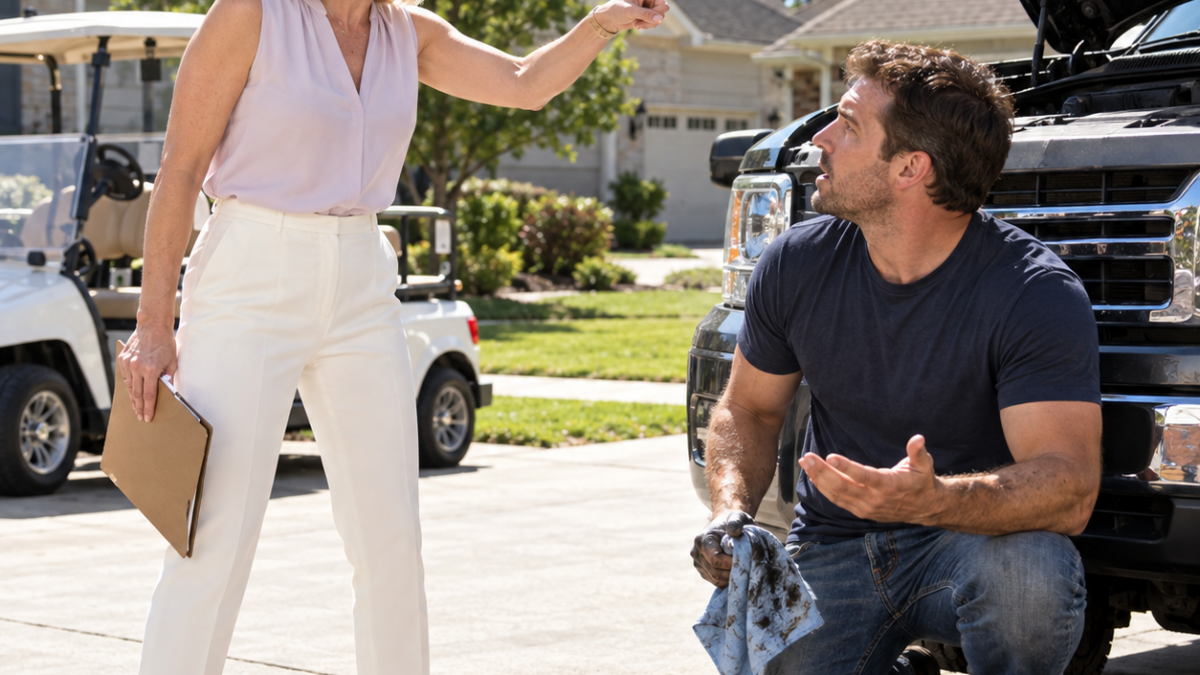
I almost laughed.
“I am literally asking you to apply the written rule.”
Her face turned red.
Then she accelerated away.
I finished the oil change.
Three days later, the fine arrived.
I appealed.
Attached photographs.
Quoted the section.
The board canceled it.
That was the moment I became Karen’s personal project.
Over the next several months, violations arrived at a pace that would have been funny if they weren’t attached to money.
Unapproved mulch color.
Brown.
My mulch was brown.
Improper driveway parking.
My sedan was apparently angled too far relative to the garage.
Excessive decorative items.
Two flowerpots.
Mailbox discoloration.
It had been installed by the original builder.
Temporary obstruction.
A package had been sitting on my porch for approximately four hours while I slept after night shift.
I fought every one.
Calmly.
That part mattered.
My job had trained me not to feed confrontational people emotion.
People who want control often escalate when they can provoke you into shouting.
So I gave Karen facts.
Cold facts.
Every email followed approximately the same structure.
Karen cites Section 7.
Section 7 does not prohibit the condition described.
Attached photograph demonstrates compliance.
Please withdraw the violation.
Thank you.
No insults.
No sarcasm.
No threats.
Karen hated it.
I could tell because her letters became longer.
More dramatic.
Sometimes she added bold text.
I replied with shorter emails.
Eventually one neighbor, Kevin, caught me at the mailbox.
“Karen’s after you.”
“Apparently.”
“What did you do?”
“Changed my oil.”
He laughed.
“No, seriously.”
“That’s seriously what started it.”
Kevin lowered his voice.
“She doesn’t like people challenging her.”
“I’ve noticed.”
“She’ll get bored.”
I looked toward the corner where Karen’s golf cart was slowly approaching.
“I don’t think Karen gets bored.”
He followed my eyes.
“No.”
We both went inside.
Then came the flooring.
I decided to replace the old carpet in the living room and the cheap laminate in my kitchen.
The project was entirely interior cosmetic work.
No walls moved.
No structural changes.
No plumbing relocated.
No exterior impact.
Nothing requiring HOA architectural approval under the documents.
I hired a licensed contractor.
They spent about a week at the house.
Materials came in through the garage.
Old flooring went out.
Karen saw the contractor’s van.
Of course she did.
One afternoon, I woke around four after a night shift and found her golf cart sitting across the street.
She was photographing the van.
I stepped onto my porch.
“Can I help you?”
Karen lowered her iPad.
“What construction are you doing?”
“Flooring.”
“What kind?”
“Interior flooring.”
“Any walls?”
“No.”
“Cabinetry?”
“No.”
“Electrical?”
“No.”
“Structural modification?”
“No.”
She narrowed her eyes.
“I need to inspect.”
“No.”
Karen blinked.
“What?”
“You don’t need to inspect.”
“The HOA has authority to verify compliance.”
“Not inside my house.”
“If work is being performed—”
“Interior cosmetic flooring doesn’t require approval.”
“I’ll determine that.”
“No.”
That word again.
Karen’s least favorite word.
She stepped out of the golf cart.
Her heels clicked against the road.
“I need to see the work.”
“You’re not coming inside.”
Her face became cold.
“Why are you hiding it?”
“I’m not hiding anything.”
“Then why refuse inspection?”
“Because it’s my house.”
“The property belongs to an HOA-governed community.”
“The exterior is subject to architectural rules. My kitchen floor isn’t.”
Karen put one hand on her hip.
“You seem to think you’re some kind of legal expert.”
I almost told her my profession.
Almost.
Instead:
“I can read.”
She smiled without warmth.
“We’ll see.”
The contractors finished.
Floor looked great.
I thought the issue was over.
Several days later, certified mail arrived.
The return address was the HOA.
I opened it at the kitchen counter.
FORMAL DEMAND FOR INTERIOR ARCHITECTURAL INSPECTION.
Karen claimed the visible presence of contractors created “reasonable suspicion” that unapproved structural modifications had occurred.
The notice scheduled an inspection for the following Tuesday at 10:00 a.m.
Not requested.
Scheduled.
I sat at my computer.
Opened the bylaws again.
There was no authority allowing Karen to simply enter the interior of a privately owned single-family house for a speculative inspection.
Emergency access provisions existed for certain common systems and urgent conditions.
This was not that.
I drafted one email.
To Karen.
Management.
Every board member.
It was deliberately short.
I acknowledged receiving the demand.
Denied entry.
Explained that the work was cosmetic flooring.
Cited the governing language.
Then wrote:
Any attempt to enter my home or property without consent or lawful authority will be treated as trespassing.
I sent it.
Karen replied less than fifteen minutes later.
Her response began:
Your hostility is noted.
I didn’t answer.
Then another.
Failure to cooperate may result in escalating fines.
No answer.
Then:
The HOA reserves all legal rights.
I still didn’t respond.
I went to work.
I genuinely believed the problem was finished.
Even controlling people usually understand a locked front door.
I underestimated Karen.
Tuesday morning began with one of the worst shifts I’d worked that month.
I started the night before.
Around midnight, a multi-vehicle crash on the interstate tied us up for hours.
One driver had to be extracted.
Traffic backed up for miles.
Before paperwork was finished, another unit requested assistance on a domestic call.
That became an arrest.
Then near dawn, a suspect ran during a pedestrian stop and we had a foot chase through two apartment complexes.
By the time everything was finished, my body felt like I’d been hit with sandbags.
Fourteen hours.
I drove home after eight.
Parked in the garage.
Walked inside.
Normally, I took my equipment upstairs before sleeping.
That morning, I didn’t have the energy.
I unclipped my duty belt in the kitchen.
Sidearm still holstered.
Taser.
Radio.
Handcuffs.
Flashlight.
Everything.
I placed it on the island.
Took off my uniform jacket.
Dropped it beside the belt.
My badge wallet was in my pocket.
I pulled it out and tossed it onto the counter.
It landed open.
Silver badge.
Department ID.
Clearly visible.
Then I opened the refrigerator.
Grabbed water.
I told myself I’d sit on the couch for one minute.
Just one.
Then I’d shower.
Go upstairs.
Sleep.
I sat.
Closed my eyes.
The next thing I remember was a sound.
Click.
Clack.
My brain recognized it before I was fully awake.
A lock.
Not someone knocking.
Not a door handle rattling.
A key mechanism turning.
My eyes opened.
For maybe half a second, I had no idea where I was.
Then training took over.
Someone was entering my house.
I moved off the couch silently.
The living room was partially out of sight from the front entry.
I positioned myself behind the wall.
Listened.
Door opening.
Footsteps.
Then a voice.
Cheerful.
High.
Infuriatingly familiar.
“Hellooo?”
I froze.
Karen.
Then:
“HOA inspection.”
My exhaustion vanished.
Every nerve in my body became sharp.
Karen continued.
“I know you’re at work, so I’m letting myself in.”
I couldn’t believe what I was hearing.
Not:
Is anyone home?
Not:
Emergency.
Not:
Police.
She knew she didn’t have permission.
She believed I wasn’t there.
And she had entered anyway.
I stayed out of sight.
I wanted to understand exactly what she was doing before confronting her.
Footsteps crossed the entry.
Karen walked into the kitchen.
I could see her through the opening.
White uniform.
Gold buttons.
Clipboard bag over one shoulder.
iPad in hand.
She looked around my home with open curiosity.
Not caution.
Not concern.
Curiosity.
Then she started taking photographs.
Floor.
Snap.
Cabinets.
Snap.
Countertops.
Snap.
She crouched slightly and photographed the trim where the new flooring met the wall.
“Unapproved trim,” she murmured.
Snap.
My anger went cold.
There are different kinds of violation.
Someone walking onto your lawn is one thing.
Someone crossing the threshold of your home when they know you’re absent is different.
Your house is where you sleep.
Where you leave personal paperwork.
Clothing.
Photographs.
Medications.
Weapons.
Your life.
Karen was treating it like an exhibit she had authority to examine.
I stepped into view.
“What the hell are you doing in my house?”
I didn’t shout.
I didn’t need to.
My street voice came out.
Low.
Controlled.
The tone I used when I needed somebody to understand immediately that the situation had become serious.
Karen jumped so violently she almost dropped the iPad.
She spun.
One hand flew to her chest.
“You!”
I stared.
For one second, neither of us spoke.
Then Karen did something extraordinary.
She got angry at me.
“You’re supposed to be at work!”
I almost laughed.
“I’m sorry?”
“You’re supposed to be working.”
I took one step forward.
“How did you get into my house?”
Karen regained some of her confidence.
She lifted her chin.
“I have authorized access.”
“No, you don’t.”
“Yes, I do.”
“How?”
“The emergency lockbox.”
That was when I remembered.
Previous owner.
An elderly man.
During closing, the realtor had mentioned he had a medical access box mounted near the side entrance.
Something first responders could use if he fell or needed assistance.
I had noticed it after moving in and intended to remove it.
Then life happened.
It slipped down the list.
Apparently, Karen knew the code.
I stared at her.
“You used a medical emergency lockbox?”
“The HOA retained the code for community safety.”
“The previous owner gave it to you?”
“He was elderly.”
“That wasn’t my question.”
Karen waved her iPad.
“As HOA president, I have responsibilities.”
“You knew I denied access.”
“You unreasonably refused a lawful inspection.”
“No.”
“You left me no alternative.”
Her confidence returned more with every sentence.
“I had probable cause.”
That almost broke my composure.
“Probable cause?”
“Yes.”
“You’re using the phrase probable cause?”
“I had evidence contractors were performing unauthorized modifications.”
“Karen.”
I stepped closer.
“You’re an HOA president.”
“I know exactly what I am.”
“You’re not a judge.”
“I never claimed to be.”
“You’re not law enforcement.”
“No.”
“You don’t have probable cause authority.”
She rolled her eyes.
“It’s a common phrase.”
“You used an emergency code to unlock my house after being explicitly told you did not have permission.”
“It isn’t breaking and entering if I’m performing official HOA business.”
There it was.
The logic.
Karen believed a title transformed trespass into inspection.
She lifted the iPad.
“And it’s a good thing I came.”
I stared.
“You actually think that?”
“This trim was not submitted for architectural review.”
“It’s interior baseboard.”
“And the flooring—”
“Interior.”
“You may have altered subfloor structure.”
“I did not.”
“I’ll need access to the remainder of the home.”
“No.”
Her eyes widened.
“I am already inside.”
“That is about to change.”
Karen planted one hand on her hip.
“If you obstruct this inspection, I’m issuing a five-hundred-dollar violation.”
I almost smiled.
“Karen, leave.”
“No.”
That surprised even me.
“No?”
“I have not completed the inspection.”
“You’re trespassing.”
“I told you, I have authority.”
“Get out of my house.”
Karen’s face flushed.
“You cannot intimidate me.”
“I’m not intimidating you.”
“You’re interfering with an HOA official.”
“You are not a government official.”
“I represent this community.”
“You represent a homeowners association.”
“Exactly.”
“No.”
She shook her head angrily.
“You people think rules are optional.”
The irony was almost physically painful.
I said:
“Leave.”
Karen pulled out her phone.
“You know what? I’m done with this.”
“Good.”
“I’m calling the police.”
For the first time, I thought maybe exhaustion had made me hallucinate.
“You’re calling the police?”
“Yes.”
She marched toward the kitchen island.
“I’ll have you removed so I can finish the inspection.”
“Removed from where?”
“My inspection area.”
“My house.”
“You are interfering.”
“With you inside my house.”
“I am performing official business!”
“And what exactly are you going to tell police?”
Karen set her iPad on the island.
“That an aggressive homeowner is preventing a lawful HOA inspection.”
She reached for her phone.
Then stopped.
Her eyes fell on my duty belt.
I watched her face.
First confusion.
The holstered pistol.
Taser.
Radio.
Handcuffs.
Flashlight.
Then my uniform jacket beside it.
City police shoulder patch visible.
Then the open wallet.
Badge.
ID.
Karen went completely still.
The transformation was so immediate I almost felt like I’d watched somebody unplug her.
Color drained from her face.
Her eyes moved from badge to belt.
Then to my tactical pants.
Then back to me.
“You’re…”
Silence.
I waited.
“You’re a police officer.”
“Yes.”
Her mouth opened.
Closed.
All the language about HOA authority vanished.
All the threats.
All the fines.
All the legal jargon.
Gone.
Then she whispered:
“Why didn’t you tell me?”
I almost laughed.
“Why would I?”
“This…”
She looked around.
“This is a misunderstanding.”
“No.”
“I thought you worked logistics.”
“That’s what you assumed.”
Karen lifted both hands slightly.
“We don’t need to escalate.”
“You entered my house.”
“For an inspection.”
“Without permission.”
“Under HOA authority.”
“No.”
“The lockbox code was given to the association.”
“For the previous owner’s medical emergencies.”
Karen swallowed.
“I believed it transferred with the property.”
“You believed an emergency code gave you permission to enter whenever I wasn’t home?”
“I had reason.”
“You knew I refused.”
“I thought you were hiding something.”
“That makes this worse.”
Her eyes moved toward the badge again.
Then something in my tone finally landed.
Fear appeared.
Real fear.
Not fear of me physically hurting her.
Fear of consequences.
I said:
“You entered my home after being explicitly denied access.”
Karen shook her head quickly.
“No.”
“You used an emergency access code.”
“Community access.”
“Emergency.”
“I didn’t break anything.”
“You don’t have to break a window for unlawful entry to be unlawful.”
“I had the code.”
“You did not have permission.”
Karen’s breathing accelerated.
“This isn’t burglary.”
I kept my voice calm.
“That’s for the responding agency and prosecutor to determine.”
“Responding agency?”
I reached for my phone.
Karen stepped forward.
“Wait.”
I dialed 911.
“Don’t.”
Dispatcher answered.
I gave my address.
Identified myself as an off-duty city officer.
Reported an unlawful entry/burglary in progress, subject still inside.
Requested county deputies because I lived outside my department’s jurisdiction.
Karen stared at me.
Her breathing became rapid.
When I ended the call, she said:
“You cannot do this.”
“I just did.”
“I am HOA president.”
“That doesn’t matter.”
“You can’t arrest me.”
“I am not arresting you.”
That distinction mattered.
I was off duty.
Outside my jurisdiction.
And emotionally involved because it was my house.
I was not going to play cop.
I was the homeowner.
County deputies would handle it.
Karen reached for her iPad.
“I’m leaving.”
“Sit down.”
“What?”
“Sit at the table.”
“You cannot detain me.”
“Do not leave before deputies arrive.”
“I have somewhere to be.”
“Karen.”
I looked toward the door.
“If you try to flee a reported crime scene after unlawfully entering my home, I’m prepared to physically detain you until local law enforcement arrives.”
Her face twisted.
“You’re threatening me.”
“No.”
“I’ll sue.”
“That’s your choice.”
“You’ll lose your badge.”
“Sit down.”
She sat.
Then she began crying.
Not gently.
Full sobbing.
Hands trembling.
“This is insane.”
I didn’t answer.
“I was trying to protect the neighborhood.”
Silence.
“I thought there were illegal renovations.”
Nothing.
“You could just tell them it was a misunderstanding.”
I stayed where I was.
Her tears stopped almost instantly.
Then anger returned.
“You’ve wanted this.”
No response.
“You hate me.”
Silence.
“You think you’re better than everyone because you’re a cop.”
I had never told her.
“I could have handled this differently if you’d been honest about who you were.”
That sentence made me finally speak.
“Would you have entered if you knew I was a police officer?”
Karen didn’t answer.
“Would you?”
She looked away.
There it was.
She didn’t believe entering was right.
She believed entering was safe because she thought I couldn’t stop her.
That’s different.
The deputies arrived roughly ten minutes later.
Two county sheriff cruisers turned into the driveway.
I saw neighbors opening curtains.
Kevin came onto his porch.
Of course.
Nothing attracts suburban attention like emergency lights.
I opened the door before deputies reached it.
Kept my hands visible.
Identified myself.
Showed credentials.
Then immediately explained:
“This is my residence. I’m off duty. I want you guys to handle everything.”
The lead deputy nodded.
Professional.
Exactly what I wanted.
I showed them the lockbox.
Explained the prior written denial.
Told them Karen admitted using the retained code.
Then brought them inside.
Karen stood the second they entered.
“Thank God!”
She pointed at me.
“Arrest him.”
Both deputies looked at me.
Then her.
Karen continued.
“He’s impersonating a police officer.”
I almost admired the speed of the lie.
The deputy looked at my badge.
Then my uniform.
Then the duty belt.
I said nothing.
Karen pointed wildly.
“He told everyone he was a logistics coordinator.”
“I never told her that,” I said.
The deputy raised a hand.
“Everyone stop.”
Karen kept going.
“He threatened me with a firearm.”
That allegation changed the atmosphere.
The deputies became more serious.
“Did he display the firearm?”
“No, but it’s right there.”
The pistol remained holstered on my belt on the island.
“Did he point it at you?”
“No.”
“Touch it?”
“No.”
“Threaten to shoot you?”
“No, but—”
“Then tell me exactly what happened.”
Karen took a breath.
“I am the HOA president.”
The deputy’s expression didn’t change.
“I came to conduct an authorized inspection.”
“Did the homeowner give permission?”
“I have HOA authority.”
“That wasn’t my question.”
“The association has emergency access.”
“Was there an emergency?”
“There were unauthorized renovations.”
“Was there an emergency?”
Karen’s face reddened.
“No.”
The deputy looked at me.
“You denied entry?”
“Yes.”
“In writing?”
“Yes.”
I handed him my phone.
Email chain.
He read enough.
Then asked Karen:
“How did you unlock the door?”
“The emergency lockbox.”
“Who gave you permission to use it today?”
“I didn’t need individual permission.”
The deputy’s eyebrows rose slightly.
“Ma’am, I’m asking a very simple question.”
Karen crossed her arms.
“I am president of this HOA.”
The deputy said:
“So that’s a no.”
Karen opened her mouth.
He reached for his handcuffs.
“Turn around.”
Her face changed.
“What?”
“Turn around and place your hands behind your back.”
“You’re arresting me?”
“Yes.”
“For doing my job?”
“For entering a residence without permission.”
“You can’t.”
“I can.”
“This man is manipulating you.”
“Turn around.”
“I demand a supervisor.”
“You can request one at the appropriate time.”
“I know the county commissioner.”
“Hands behind your back.”
Karen backed away.
“This is ridiculous.”
The second deputy moved to assist.
“Ma’am.”
Karen suddenly dropped her body weight.
I had seen it a hundred times.
Passive resistance.
Make officers carry you.
She started screaming.
“GET OFF ME!”
The deputies maintained control.
“No one is hurting you.”
“I HAVE RIGHTS!”
“Stop resisting.”
“I’M THE HOA PRESIDENT!”
I stood near the kitchen doorway watching.
Not smiling.
Not gloating.
But I’d be lying if I said there wasn’t satisfaction.
This woman had spent months manufacturing violations against me.
Had used fake authority to enter my house.
Had threatened to call police on me from inside my own kitchen.
Now actual law enforcement was explaining the difference between authority and imagination.
The deputies walked Karen outside.
Neighbors were everywhere now.
Porches.
Driveways.
Windows.
Karen’s white uniform and gold buttons made the entire scene impossible to miss.
She screamed:
“I’LL HAVE YOUR BADGES!”
The lead deputy calmly put her into the cruiser.
Then:
“I WANT THE MAYOR!”
Wrong jurisdiction.
Wrong official.
Wrong everything.
The car door closed.
Silence.
Kevin was standing across the street.
Our eyes met.
He looked at me.
Then at the cruiser.
Then back.
I shrugged.
He slowly gave me a thumbs-up.
I went back inside.
I thought that would be the end.
It wasn’t even close.
A detective contacted me later.
Karen’s iPad had been collected as evidence because she had used it while inside my home.
There were photographs from the entry.
Timestamped.
My kitchen.
Floor.
Cabinets.
That alone supported my account.
Then investigators started reviewing the device.
That’s when the story exploded.
My house was not the first.
Not second.
Not third.
Karen had entered at least six other homes.
Six.
Maybe more.
The evidence was sitting on her own iPad.
Interior photographs.
Bedrooms.
Kitchens.
Closets.
Bathrooms.
Storage rooms.
Personal belongings.
She had apparently been gathering evidence for HOA enforcement cases.
Sometimes old lockbox access.
Sometimes retained spare-key information.
At least once, according to what I later heard, she had found an unlocked rear window.
She entered while homeowners were away.
Photographed conditions inside.
Then cited people for things she could not possibly have seen from public or common areas.
A homeowner named Susan had once received a violation about boxes visible in her garage.
She had always wondered how Karen knew because the garage door had been closed.
Now she knew.
Another neighbor received a warning about “improper storage conditions” in a rear utility area hidden behind a privacy fence.
Karen had been inside.
Kevin eventually learned Karen had photographed his mudroom.
His wife was furious beyond words.
The emergency HOA meeting was unlike any neighborhood gathering I had ever attended.
I didn’t even want to go.
Then Kevin said:
“You need to see this.”
The clubhouse was packed.
Standing room only.
People who hadn’t attended an HOA meeting in ten years showed up.
Karen obviously wasn’t presiding.
The vice president sat at the front looking like he wanted to disappear.
An HOA attorney attended.
So did the management-company representative.
The meeting began with legal language.
Investigation ongoing.
Association cooperating.
Karen acted independently.
Board did not authorize residential entry.
That last sentence mattered.
Residents were furious anyway.
Susan stood.
“Did she have access codes through the HOA?”
The vice president hesitated.
“Some emergency information may have remained in historical records.”
People started shouting.
The attorney took the microphone.
“We are determining what information existed, who had access, and whether retention policies were followed.”
Kevin stood.
“She was in my house.”
The room went silent.
“My wife found photographs through the investigation.”
He looked around.
“She photographed our mudroom and pantry.”
Someone shouted:
“She was in mine too!”
Another homeowner stood.
Then another.
The anger changed.
This was no longer about petty fines.
People felt violated.
Because they were.
An older man near the front said:
“We gave this board power to maintain common standards. We did not give anybody permission to enter our homes.”
Applause.
Then Susan spoke.
“You people let her behave like this for years.”
Vice president tried responding.
“She was elected.”
“So were you.”
The room erupted.
The motion to remove Karen permanently from the presidency was almost redundant.
She was already facing criminal charges.
But residents wanted the record.
A formal vote.
Unanimous.
Removed as president.
Removed from the board.
Then someone proposed reviewing every violation she had issued during her tenure.
That passed too.
An independent committee was created.
Emergency-access practices were changed.
Old lockboxes reviewed.
Codes reset or removed.
Residents changed locks.
Some removed emergency systems entirely.
The neighborhood transformed almost overnight.
But Karen’s consequences went beyond the HOA.
The criminal investigation expanded.
Multiple unlawful entries.
Trespassing.
Burglary-related counts.
Stalking allegations connected with repeated surveillance.
I don’t want to pretend every charge resulted in some dramatic prison sentence.
It didn’t.
Karen had no serious prior criminal record.
Eventually, the case ended without her serving a long prison term.
But she received substantial fines.
Probation.
Restrictions.
And a court order preventing her from holding official authority in community organizations during the relevant period.
The civil cases hurt worse financially.
Several homeowners sued for invasion of privacy.
I participated in the criminal case and explored my own remedies, but three of the neighbors whose homes Karen had repeatedly entered pursued major civil claims aggressively.
Legal fees mounted.
Settlements followed.
Karen’s finances collapsed.
The house she’d spent years claiming to protect the value of eventually had to be sold.
The white golf cart disappeared first.
Kevin texted me a picture when it was loaded onto a trailer.
One sentence:
End of an empire.
I laughed harder than I should have.
For a while, people treated me differently after learning what I did.
Some were curious.
Some embarrassed.
One neighbor said:
“I yelled at you about parking at the block party once.”
“You did?”
“I thought you were ignoring neighborhood rules.”
“I probably was ignoring you.”
He laughed nervously.
Others asked why I kept it secret.
I always gave the same answer.
“I wasn’t hiding it. I just didn’t advertise.”
Karen had apparently assumed I worked in logistics because she once saw a delivery-company polo in my garage.
It belonged to my brother.
From that, she built an entire fictional biography.
Quiet guy.
Odd hours.
Probably some generic job.
Probably easy to intimidate.
That assumption was part of what gave her courage.
But I don’t think being a police officer is why I deserved privacy.
That’s important.
People sometimes hear this story and say:
“She picked the wrong house.”
Yes.
But she picked the wrong house every time she entered any house without permission.
My badge didn’t create my rights.
The other homeowners had exactly the same right to be secure in their homes.
Karen’s real mistake wasn’t breaking into a cop’s house.
It was thinking she could break into anyone’s.
The badge just destroyed her ability to bluff.
I thought about that the first time I returned to work afterward.
We responded to a burglary call.
Normal house.
Normal family.
Nothing dramatic.
The homeowner said:
“It feels weird now.”
I knew exactly what he meant.
After Karen, my own house felt different.
For several weeks, every sound woke me.
I removed the medical lockbox immediately.
Had every exterior lock replaced.
Added cameras.
Changed garage codes.
Checked windows obsessively.
Logically, I knew Karen wasn’t returning.
Emotionally, someone had crossed the line between outside and inside.
That stays with you.
The day I removed the lockbox, Kevin came over.
He watched me unscrew it.
“That how she got in?”
“Yeah.”
“You keeping it?”
“No.”
“Can I smash it?”
I laughed.
“No.”
“Worth asking.”
I threw it away.
Then I checked the new deadbolt three times.
For the first time in months, HOA emails became boring.
Budget.
Landscaping.
Pool maintenance.
Actual association business.
The replacement president was an accountant named Patricia.
Quiet.
Organized.
Almost aggressively normal.
At her first meeting, she said:
“The HOA’s authority ends where the governing documents and law say it ends.”
People applauded.
I almost stood.
Under Patricia, citations dropped dramatically.
Not because standards disappeared.
Because violations became actual violations.
If your grass was too high, you got a notice.
If it wasn’t, you didn’t.
If a trash can was left out for a week, notice.
If it came in at two in the afternoon, nobody cared.
No patrol golf cart.
No secret photographs.
No interior inspections.
No “probable cause.”
The neighborhood became what I’d originally expected.
Boring.
I loved it.
Months later, I saw Karen once.
Not in the neighborhood.
At a grocery store.
I was off duty.
Jeans.
T-shirt.
She was pushing a cart near produce.
For a second, I considered turning down another aisle.
Then she looked up.
Recognition.
Her whole body stiffened.
I kept walking.
Karen spoke first.
“You ruined my life.”
I stopped.
People like Karen always begin with the conclusion most favorable to themselves.
I looked at her.
“I entered your house one time.”
I couldn’t believe she opened with that.
“One time?”
“Yes.”
“You entered at least six houses.”
“That’s what they claim.”
“There were photographs.”
“I was doing HOA work.”
“You still believe that?”
Karen’s face hardened.
“I protected that neighborhood for years.”
“By entering people’s homes?”
“Nobody appreciated how much work I did.”
“That isn’t an answer.”
“You don’t understand what it’s like being responsible for standards.”
I almost laughed.
“I understand responsibility.”
Her eyes narrowed.
“Of course you say that.”
I moved to leave.
Karen said:
“You could have asked me to leave.”
I stopped again.
“What?”
“You didn’t need to call the sheriff.”
“You were inside my house after I explicitly told you not to enter.”
“I wasn’t stealing anything.”
“That doesn’t make it okay.”
“I would have left.”
“I told you to.”
“You escalated.”
I stared at her.
“Karen, you threatened to call police on me.”
She looked away.
“In my own kitchen.”
No answer.
“You said you would have me removed so you could finish inspecting my house.”
“I was upset.”
“You weren’t upset until you saw the badge.”
Her eyes came back.
That landed.
I continued.
“If that badge hadn’t been there, what would you have done?”
Karen said nothing.
“Would you have left?”
Silence.
“Would you have apologized?”
Nothing.
“Or would you have fined me and continued photographing rooms?”
Her mouth tightened.
“You don’t know.”
“I do.”
“You think you’re perfect.”
“No.”
“I made mistakes.”
“That is the closest thing you’ve ever said to an apology.”
She scoffed.
“I shouldn’t have used the lockbox.”
“No.”
“But you destroyed everything over it.”
“No, Karen.”
I kept my voice even.
“The investigation found the other houses because you photographed them.”
“You called the police.”
“Yes.”
“You started it.”
“You entered my home.”
She shook her head.
“Everything is black and white to cops.”
I looked at her.
“Some things are.”
I walked away.
That was the last time we spoke.
I don’t know where Karen lives now.
I heard she moved several counties away.
Maybe that’s true.
Maybe not.
I hope wherever she is, she no longer has access to anyone’s emergency lockbox.
I kept my badge off the kitchen counter after that.
Not because I regretted Karen seeing it.
Because leaving equipment scattered around when exhausted isn’t a habit I wanted.
My job teaches you strange lessons at inconvenient times.
That morning reinforced several.
First, don’t assume someone who talks constantly about rules understands them.
Karen could quote paragraph numbers from HOA bylaws but had apparently never absorbed the concept of private property.
Second, emergency access should remain emergency access.
Codes change.
Owners change.
People forget systems exist.
If you buy a home with old lockboxes, smart locks, keypad entries, garage remotes, hidden keys, or previous emergency access arrangements, reset everything.
Third, documentation matters.
My email denying entry mattered.
Had I only verbally refused, Karen could have tried claiming misunderstanding.
Instead, there it was.
Written.
Sent to her.
Sent to the board.
Any attempt to enter without consent will be treated as trespassing.
She entered anyway.
Karen had spent months building files on everybody else.
In the end, the most damaging document was one she ignored.
I sometimes wonder what went through her mind when she saw the badge.
Fear, obviously.
But there had to be something else.
Recognition.
Not recognition of who I was.
Recognition that authority existed outside her little system.
Karen had built a miniature world where she wrote notices, imposed fines, demanded compliance, and watched residents adjust behavior.
Golf cart.
Clipboard.
iPad.
Board title.
People answered her emails.
People attended her meetings.
People paid dues.
Over time, she stopped seeing those tools as limited administrative authority.
She saw power.
Absolute power.
Then she walked into a kitchen and saw another kind of authority sitting on the counter.
The difference was that my badge did not authorize me to do whatever I wanted either.
That’s the lesson Karen never understood.
Real authority is limited.
My badge does not let me search a neighbor’s house because I’m curious.
It doesn’t let me enter without legal justification.
It doesn’t let me punish someone because they irritate me.
It doesn’t make my personal preferences law.
In fact, the authority comes with restrictions.
Policies.
Constitutional limits.
Supervision.
Reports.
Courts.
Accountability.
Karen wanted authority without limits.
She loved the first half.
Hated the second.
That made her dangerous.
People sometimes ask whether I enjoyed watching her get arrested.
Yes.
I’m not going to pretend otherwise.
There was satisfaction in watching someone who had weaponized fake authority meet actual consequences.
But the satisfaction came after something much darker.
I woke up believing a stranger had entered my home.
For several seconds, I didn’t know it was Karen.
I was an armed, exhausted police officer awakened by an unexplained entry after a fourteen-hour shift.
Think about how badly that could have ended.
Karen knew I wasn’t supposed to be home.
That was why she entered.
But schedules change.
People call in sick.
Take vacation.
Work from home.
Come home early.
Sleep in another room.
Own firearms.
Have dogs.
Have frightened teenagers.
A person secretly entering occupied houses is creating conditions where someone could get killed.
Karen was lucky.
So was I.
I recognized her voice before confronting her.
I had training.
I controlled my response.
Another homeowner might not have.
That thought bothers me more than the flooring.
More than the fines.
More than the photographs.
Karen’s entitlement didn’t merely violate privacy.
It created danger.
After investigators uncovered the other entries, one neighbor told me:
“I keep thinking about what would’ve happened if my daughter had been home.”
His daughter was seventeen.
Sometimes came home from school early.
He kept a shotgun locked upstairs.
He wasn’t accusing anyone of anything.
He was simply imagining the chaos of a teenager hearing someone moving through the house.
Another family had two large dogs.
Karen apparently entered while they were being boarded.
Pure luck.
She had no idea.
That was why I never accepted the argument that pressing charges was excessive.
This wasn’t somebody accidentally stepping across a property line.
It was deliberate.
Repeated.
Secret.
Planned around absence.
She retained access information she should never have used.
She watched schedules.
She entered.
She documented interiors.
Then used information obtained privately to create enforcement cases.
That’s not overenthusiastic volunteering.
That’s obsession with control.
Years later, people still occasionally tell the story at neighborhood gatherings.
Usually the version has become exaggerated.
In some versions, I arrested Karen myself.
I didn’t.
In others, I drew my weapon.
Absolutely not.
One neighbor swore Karen tried to steal my badge.
Never happened.
Another version claims she fainted when she saw the gun.
No.
Reality was strange enough.
Karen entered.
I confronted her.
She threatened me with police.
She saw the badge.
I called the sheriff.
Deputies arrested her.
The investigation uncovered the rest.
That is plenty.
I correct people when they exaggerate because facts are the whole reason I won.
Karen depended on stories.
Her interpretation.
Her authority.
Her suspicion.
Her version of what rules meant.
I depended on facts.
The flooring was cosmetic.
The bylaws did not authorize interior entry.
I denied permission.
Karen acknowledged using the emergency code.
Photographs proved she was inside.
Her device proved other entries.
Facts required no embellishment.
That became something of a personal philosophy afterward.
If you’re dealing with someone like Karen, don’t try to out-yell them.
Document.
Get things in writing.
Read the actual rule.
Save emails.
Take photographs.
Don’t rely on “she said, I said” if you can avoid it.
And never assume confidence means correctness.
Karen was confident about everything.
Trash cans.
Grass length.
Mulch.
Driveway angles.
Oil changes.
Flooring.
Probable cause.
Emergency entry.
Police authority.
Nearly all of it was wrong.
Confidence is theatrical.
Evidence survives the show.
Eventually, I transferred to a different assignment and began working more daytime hours.
That meant neighbors saw me more often.
Patricia once joked:
“Now we know when to schedule HOA inspections.”
I gave her a look.
She laughed.
“Exterior inspections.”
“Good recovery.”
She held both hands up.
“No keys.”
Kevin still lives across the street.
Every now and then, when I pull the trash cans in around noon, he texts:
Karen would be furious.
I usually reply:
Measure my grass.
He once actually did.
Sent me a photograph.
2.75 inches. You’re living dangerously.
Normal neighborhood nonsense.
The kind I wanted from the beginning.
I still change my oil in the driveway.
Nobody cares.
Sometimes a neighbor comes over and talks while I do it.
Once Patricia walked past.
She looked at the truck.
Looked at me.
Then said:
“Twenty minutes?”
“Approximately.”
“Carry on.”
Progress.
The kitchen floor Karen broke into my house to inspect lasted for years.
No structural failure.
No unauthorized construction.
No neighborhood collapse.
Property values somehow survived.
Whenever I looked at that floor, though, I remembered her iPad.
Snap.
Unapproved trim.
That phrase became a joke among friends.
Brother came over.
Looked at my new television.
“Approved by Karen?”
“No.”
“Dangerous.”
I changed a light fixture.
Friend texted:
Better get probable cause.
Humor helps.
Because the alternative is letting the violation own the memory.
Karen had entered my home once.
I wasn’t going to let her live in my head forever.
The strangest part is that I truly believe Karen thought she was the hero of her own story.
I don’t think she woke up saying:
Today I will commit crimes.
She woke up believing:
These homeowners need supervision.
I know better.
Rules matter.
Standards matter.
Nobody respects authority anymore.
That belief allowed her to reinterpret every boundary as obstruction.
No became disrespect.
Privacy became hiding something.
Disagreement became noncompliance.
An unlocked opportunity became authorization.
That is how people drift into dangerous behavior while still telling themselves they are responsible.
They stop asking:
Am I allowed?
And start asking:
Why shouldn’t I be allowed?
Those are not the same question.
Karen had no answer to the first.
So she lived inside the second until deputies put handcuffs on her.
I think about something she said during our grocery-store conversation.
“I was trying to protect the neighborhood.”
Maybe she believed that.
But a community isn’t protected when residents are afraid of the person supposedly enforcing its rules.
A community is protected when boundaries are predictable.
When rules are written.
When they apply consistently.
When authority is transparent.
When entering someone’s house requires actual permission or legal necessity.
Patricia understood that.
Karen never did.
That’s why one president made the neighborhood calmer and the other made everyone change their locks.
I eventually sold that house.
Not because of Karen.
Several years later, work moved me farther away and the commute stopped making sense.
The day before closing, I walked through the empty rooms.
Kitchen.
Living room.
Hallway.
Everything echoed.
The new owner was a young couple.
Before handing over keys, I showed them every security feature.
Garage code.
Alarm.
Cameras.
Smart lock.
Then I pointed at a small repaired patch near the side entrance.
“There used to be an emergency lockbox there.”
The husband asked:
“Why’d you remove it?”
I smiled.
“Long story.”
Then I decided they deserved the short version.
“Previous HOA president used the code to enter without permission.”
His face changed.
“What?”
“She’s gone. Entire system has been changed. But reset every code anyway.”
His wife immediately wrote it down.
Good.
When I drove away, I looked at the house in the mirror.
For a long time, I had thought the defining moment of living there would be watching Karen get put into a sheriff’s cruiser.
It wasn’t.
It was leaving peacefully.
Knowing my home had become a home again after she violated it.
No golf cart.
No clipboard.
No inspection.
Just another house changing hands.
I still work in law enforcement.
I still don’t advertise it much.
When new people ask what I do, I answer honestly now, but I don’t make it my identity.
A badge is a job.
An important job.
A responsibility.
Not a crown.
Maybe that’s why Karen bothered me so deeply.
She had taken a tiny amount of administrative power and turned it into identity.
Without HOA president, who was she?
The criminal case forced her to answer that question.
I never needed the answer.
I only needed her outside my house.
Looking back, the entire story turned on one moment.
Not when I caught her.
Not when she saw the badge.
Earlier.
The email.
I denied the inspection.
Karen could have stopped there.
She could have asked the board attorney whether she had authority.
The attorney probably would have told her no.
She could have requested proof of the flooring work.
I might have provided an invoice.
Could have accepted photographs.
Could have moved on.
Instead, she needed to win.
Winning meant entering.
And entering meant crossing a line no HOA position could protect her from.
The badge on my counter didn’t create that line.
It only made her finally see it.
That’s the part people misunderstand when they hear the story.
They say:
“She didn’t know you were a cop.”
Exactly.
She thought that mattered.
She thought she could treat an ordinary homeowner differently from someone she perceived as connected to law enforcement.
But ordinary homeowners have rights too.
Privacy isn’t a professional perk.
Property doesn’t become less private because its owner drives a delivery truck, teaches school, waits tables, works construction, or spends nights behind a desk.
Karen shouldn’t have needed a badge to understand the word no.
She should have understood the locked door.
She should have understood the email.
She should have understood basic decency.
Instead, the badge was the first thing powerful enough to cut through her entitlement.
And by then, it was already too late.
The deputies were on their way.
The iPad was full of evidence.
Six other families were about to learn what she had been doing.
Her presidency was finished.
Her legal problems were beginning.
All because she couldn’t accept that the inside of my house was none of her business.
For months, Karen had tried to convince me that I was the difficult homeowner.
The disrespectful one.
The man who didn’t understand community standards.
In the end, the most important rule in the entire neighborhood turned out to be simpler than anything printed in the HOA bylaws:
You don’t enter another person’s home without permission.
Karen spent years policing everybody else’s boundaries.
It took one morning in my kitchen for the law to enforce mine.