𝗙𝗨𝗟𝗟 𝗦𝗧𝗢𝗥𝗬 The HOA President Kept Parking Her Tesla on My Private Land—Then She Dared Me to Do Something About It
𝗙𝗨𝗟𝗟 𝗦𝗧𝗢𝗥𝗬
There was something in the way she added that title.
Not casually.
More like a rank.
“Okay.”
“I wanted to introduce myself and give you these.”
She pushed a stack of papers toward me.
I took them.
The top packet was thick.
I flipped it over.
“What is this?”
“Your HOA bylaws.”
I looked at her.
“My what?”
“Bylaws.”
“I heard you.”
Karen smiled.
“Good.”
Underneath the bylaws was another sheet.
NOTICE OF VIOLATION.
My name.
My address.
Description of offense.
GRASS HEIGHT EXCEEDS COMMUNITY STANDARD.
Required corrective action: mow lawn.
Deadline: Friday.
Possible fine.
I looked from the paper to Karen.
Then back down.
Then I laughed.
Not intentionally.
It just came out.
Karen’s smile froze.
“Is something funny?”
“Yeah.”
I held up the violation.
“I’m not in your HOA.”
For a moment, her expression suggested I’d told her I wasn’t subject to gravity.
“Everyone in this neighborhood is part of the HOA.”
“No.”
“Yes.”
“No.”
Her smile disappeared completely.
“My property was excluded when the association formed.”
Karen shifted the clipboard.
“I don’t believe that’s correct.”
“It is.”
“Do you have documentation?”
“Plenty.”
“The neighborhood boundaries encompass your address.”
“The neighborhood does.”
I pointed toward the paperwork.
“The HOA doesn’t.”
She blinked.
“You understand those aren’t necessarily different things.”
“In my case they are.”
Karen looked past me toward the yard.
Her eyes moved over the vegetable garden.
The old stone wall.
The taller grass.
My truck.
I could practically see her discovering new violations.
“You may want to review the bylaws anyway.”
“I won’t.”
Her eyes returned to mine.
“Excuse me?”
“I’m not governed by them.”
“Even if you believe you’re exempt, your property affects the appearance of the entire community.”
“I’m sure it does.”
“Your lawn is substantially above the permitted height.”
“There is no permitted height for my lawn.”
Karen’s nostrils flared slightly.
“Four inches.”
“What?”
“You’re roughly four inches above standard.”
“You measured it?”
She didn’t answer.
That was answer enough.
I handed the packet back.
“Check your records.”
She didn’t take it at first.
“Friday.”
“What about Friday?”
“The lawn needs to be corrected by Friday.”
“No.”
Her eyes narrowed.
“No?”
“No.”
I placed the paperwork on top of her clipboard.
“Have a good day, Karen.”
Then I closed the door.
I stood inside for several seconds waiting.
I half expected her to knock again.
She didn’t.
Through the window, I watched her walk down the path toward her new house.
Her shoulders were stiff.
The white uniform seemed even more ridiculous from behind.
I should have known that wasn’t the end.
Two days later, someone knocked again.
Karen.
This time her husband was with her.
He was maybe mid-forties, quiet-looking, wearing khaki shorts and a polo shirt.
The expression on his face before anybody even spoke made me like him.
It said:
I would rather be almost anywhere else.
Karen wore another fitted white jacket, this one with silver buttons and an even deeper neckline.
She didn’t bother with the introductory smile.
“I checked.”
“Congratulations.”
Her husband looked away.
Karen ignored the comment.
“Our records show your property was excluded from the original association.”
“Great.”
I reached for the door.
“But.”
Of course there was a but.
“The board has updated the community boundaries.”
I stopped.
“What?”
“The HOA boundaries have been modified over time.”
“Okay.”
“Your property is now within the current boundary.”
I stared at her.
“You understand you can’t just announce that, right?”
Karen’s face tightened.
“Announce what?”
“That my private property joined your HOA because you redrew a map.”
“It’s more complicated than that.”
“No, it really isn’t.”
“Our attorney will review it.”
“Excellent.”
“In the meantime, you’re expected to comply with community standards.”
“No.”
Her face went red.
Her husband shifted.
Karen took half a step forward.
“Excuse me?”
“You said your attorney will review it.”
“Yes.”
“Then let your attorney tell you you’re wrong.”
“You are inside HOA boundaries.”
“Geographically, I’m surrounded by HOA houses.”
“Exactly.”
“That does not make me a member.”
Karen crossed her arms beneath her chest.
“You can’t benefit from living in the community while refusing to contribute.”
I almost laughed again.
“What benefits?”
“Maintained streets.”
“Public.”
“Entrance landscaping.”
“I don’t care about your flowers.”
“Property values.”
“I didn’t ask you to raise them.”
Her husband said quietly, “Karen.”
She shot him a look.
He stopped.
She turned back to me.
“You’re making this unnecessarily adversarial.”
“I haven’t done anything.”
“You refuse to cooperate.”
“With an organization I don’t belong to.”
“You live here.”
“I lived here before your HOA existed.”
Technically my grandmother had, but the point stood.
Karen’s jaw tightened.
“Your lawn still needs to be mowed.”
“No.”
“You’re deliberately provoking me.”
“No, Karen.”
I began closing the door.
“I’m deliberately not mowing my grass.”
Her husband made a sound that might have been a suppressed laugh.
Karen turned toward him.
I closed the door before witnessing the argument.
The next week, I received a bill.
Three hundred seventy-five dollars.
Quarterly HOA dues.
Late assessment.
Lawn violation.
Administrative fee.
It looked official.
There was a logo.
Account number.
Due date.
Threatening language about additional penalties.
I stood by my mailbox reading it.
Then I folded the paper.
Walked inside.
And dropped it in the recycling bin.
The calls started after that.
Somehow Karen obtained my number.
The first text:
Your account remains delinquent. Please remit payment immediately to avoid further penalties.
I ignored it.
Then:
Fence requires painting under Section 8.4 of community aesthetic standards.
Then:
Mailbox does not conform to approved style.
Then:
Visible vegetable gardening constitutes an aesthetic concern from roadway.
That one made me stare at my phone.
My tomatoes were now threatening property values.
Then came a message about my chickens.
I blocked her number.
That should have reduced contact.
Karen simply changed tactics.
One morning, I came outside to leave for work and found a Tesla parked in my gravel area.
White Tesla.
Of course.
It sat just inside the old stone boundary wall where I normally parked my truck.
At first I assumed somebody had misunderstood the property line.
Then I recognized it.
Karen’s car.
I stared at it.
Then toward her house.
I wasn’t angry yet.
People make mistakes.
Maybe contractors were using her driveway.
Maybe she had guests.
Maybe she genuinely thought the gravel turnout belonged to the road.
So I walked next door.
Knocked.
Karen opened the door wearing tight black gym clothes and holding a protein shake.
Her blonde hair was tied high.
She looked annoyed to see me.
“Yes?”
“Morning.”
“What is it?”
“Your Tesla is parked on my property.”
She looked past me as if she’d forgotten where she’d left it.
“Oh.”
“Can you move it?”
Karen took a sip from the shake.
“The street was full.”
“Okay.”
“And you’ve got all that empty space.”
I waited.
She smiled.
“I figured you wouldn’t mind.”
“I do.”
Her smile faded.
“It’s just during the day.”
“I still mind.”
“You’re not using it.”
“Karen.”
“What?”
“It’s my parking area.”
“Gravel.”
“Yes.”
“You have two acres.”
“Also yes.”
“And you’re upset over one car?”
“I’m asking you to move it.”
She sighed theatrically.
“Fine.”
“Thank you.”
I went home.
An hour later, the Tesla was still there.
It eventually disappeared sometime that afternoon.
I assumed she’d gotten the message.
The next morning, it was back.
Same place.
I walked over again.
Knocked.
Karen opened the door.
“What now?”
“Your car.”
She rolled her eyes.
“The street parking is full.”
“We had this conversation yesterday.”
“And nothing bad happened.”
“I told you not to park there.”
“You’re not using the space.”
“That’s irrelevant.”
“It’s not.”
“Karen.”
She leaned against the doorframe.
“Do you know how selfish this looks?”
That took me a second.
“I’m selfish?”
“You have two acres of land.”
“My land.”
“You have far more space than anyone else.”
“My land.”
“And you’re getting territorial over a few square feet you’re not even using.”
“Yes.”
She blinked.
“Yes?”
“It’s private property.”
Her lips tightened.
“You know, if you would simply pay your HOA dues and start acting like part of the community, we wouldn’t keep having these conflicts.”
I stared at her.
“So this is about the HOA.”
“No.”
“You just brought it up.”
“I’m saying your attitude creates problems.”
“My attitude isn’t parked in your yard.”
Karen’s face reddened.
“Move the Tesla.”
“I’m working.”
“You work from home.”
“Exactly.”
“So walk outside and move it.”
“I’m in the middle of things.”
“Then I’ll give you ten minutes.”
Her eyebrows rose.
“Or what?”
“Tomorrow, if it’s there again, I’m having it towed.”
Karen laughed.
“You can’t tow somebody for parking on unused land.”
“Watch me.”
She slammed the door.
The Tesla remained another hour.
Then moved.
Next morning?
Back.
The morning after that?
Back.
Then again.
Every day.
For almost two weeks.
At that point, it wasn’t convenience.
It was a challenge.
Karen was proving that I could say no and she could ignore me.
Sometimes her driveway was empty.
Her Tesla was still on my gravel.
Sometimes there were open spaces on the street.
Tesla on my land.
Once I watched her leave her house, walk past her own driveway, cross toward my property, get into the Tesla, and drive away.
She saw me watching from the porch.
She smiled.
That was when I called a tow company.
I explained the situation.
Private property.
Repeated unauthorized parking.
Clearly within my boundary.
The dispatcher told me they could tow but recommended posting visible notice first.
“Private property. No parking. Violators towed.”
“Exactly.”
I bought a sign.
Mounted it beside the gravel.
Large.
Readable.
Impossible to miss.
The following morning, Karen parked directly beside it.
I took a photograph.
Then another showing the stone wall and property line.
Then I called the tow company.
The truck arrived roughly forty minutes later.
The driver stepped out.
He looked at the sign.
Looked at the Tesla.
Looked at me.
“You own this?”
“The land? Yes.”
“You requested the tow?”
“Yes.”
He nodded.
“All right.”
I told him I’d pay the two hundred dollars if necessary.
He began positioning the truck.
The hydraulic equipment had barely started moving when Karen’s front door flew open.
She came running.
Not walking fast.
Running.
She was wearing that white military-inspired uniform again, tight jacket open low at the chest, blonde hair bouncing behind her.
“What are you doing?”
The tow driver kept working.
Karen ran into my gravel area.
“Stop!”
He looked at her.
“That’s my car!”
The driver pointed toward the sign.
“You’re parked on private property, ma’am.”
“This is community land.”
“No.”
I spoke from several feet away.
“It’s mine.”
Karen spun toward me.
“This is harassment.”
“Move your car.”
“You called a tow truck?”
“I warned you.”
“You’re insane.”
“I’ve asked you for two weeks.”
“Because you’re mad about the HOA.”
“I’m mad because you keep parking on my property.”
The driver started positioning the equipment.
Karen moved between him and the Tesla.
“I’m calling the police.”
He shrugged.
“You’re welcome to.”
She pointed at me.
“I will sue you.”
“Go ahead.”
She pulled out her phone.
I folded my arms.
Honestly, I was relieved.
Police documentation sounded useful.
Two officers arrived.
Karen practically ran to them.
She immediately transformed.
Voice softer.
Face distressed.
Hands moving dramatically.
“This man has been harassing me for months.”
One officer looked at me.
Karen continued.
“Now he’s trying to steal my car.”
The tow driver actually laughed.
The officer glanced toward him.
He stopped.
“Sir?”
I explained everything.
My property was excluded from the HOA.
Karen had been sending unauthorized fines.
Then she began parking on my gravel.
I asked repeatedly that she stop.
I posted notice.
Called a licensed tow company.
I showed him the survey.
The old stone boundary.
The sign.
Photographs from previous days.
The officer walked over to the Tesla.
Looked at its position.
Then toward Karen’s house.
He returned.
“Ma’am.”
Karen stepped forward.
“Yes?”
“This is his property.”
Her expression tightened.
“But he’s not using it.”
The officer paused.
“That doesn’t matter.”
“Of course it matters.”
“No.”
Karen pointed toward my yard.
“He has two acres.”
The officer looked.
Then back at her.
“Still his.”
“I’m the HOA president.”
He didn’t react.
Karen seemed genuinely surprised.
“The association has updated—”
“Ma’am, HOA authority doesn’t give you permission to park on private land.”
“This property is within our neighborhood.”
“That isn’t the question.”
She looked at me like the officer was somehow betraying her.
The tow driver said, “If she moves it now, I can unhook.”
The Tesla wasn’t fully connected yet.
Karen crossed her arms.
“I’m not paying him.”
The driver looked at me.
I said, “I’ll cover it.”
Karen snapped, “No.”
Everyone looked at her.
“I am not giving him the satisfaction of having my vehicle towed.”
The officer said, “Then move it.”
Karen stared at him.
Then at me.
Then at the tow truck.
Finally, she paid the driver’s unhook fee and moved the Tesla.
She drove away slowly.
As she passed me, she lowered the window.
“This isn’t over.”
I almost smiled.
“That’s becoming your favorite sentence.”
The officers stayed briefly.
One told me I’d handled the matter correctly from their perspective.
“If she parks here again, document it.”
“I will.”
“Keep the sign up.”
“Definitely.”
I assumed public embarrassment plus police confirmation would finally end the problem.
The next morning, a sheet of paper was taped to my door.
HOA VIOLATION NOTICE.
Unauthorized towing activity on community property.
Fine: three hundred dollars.
I stood there for maybe thirty seconds.
Then started laughing.
I took a photograph.
Sent it to my lawyer.
He called later.
“Is she serious?”
“Very.”
“Save everything.”
“I am.”
“The dues.”
“Saved.”
“Texts?”
“Screenshots.”
“Violations?”
“Folder.”
“Police incident?”
“Report number.”
He laughed.
“Good.”
“What now?”
“Nothing yet.”
“Nothing?”
“If she keeps going, she’s creating our case for us.”
That sentence should probably have worried me.
Instead, it calmed me.
Karen kept going.
The Tesla returned the following week.
I called the tow company.
Karen came running out and moved it before they could hook up.
A few days later, same thing.
Then again.
Each time, she watched.
Waited.
Forced me to make the call.
Then moved the vehicle at the last moment.
It became a game.
And I was getting tired of playing.
More than tired.
I was furious.
But I also understood that anger was exactly what Karen wanted.
She wanted me to yell.
Threaten.
Touch the Tesla.
Do something she could photograph and transform into victimhood.
So I did nothing impulsive.
I waited.
Then my landscaping business created an opportunity.
I owned a small operation.
Nothing huge.
Me and two employees.
Residential work.
Some commercial landscaping.
Mulch.
Planting.
Cleanup.
Stonework.
That sort of thing.
One of our upcoming commercial jobs required a large mulch delivery.
Normally, I’d have it delivered directly to the customer site.
But scheduling made that difficult.
So I arranged for the load to be temporarily dropped at my property.
Specifically, the gravel area.
It was level.
Accessible to a dump truck.
And legally mine.
Delivery morning arrived.
I stepped outside.
Karen’s Tesla was parked there.
Directly beside the NO PARKING sign.
I stared at it.
Then checked the expected delivery time.
Twenty minutes.
My wife wasn’t there.
No witnesses I needed to impress.
No argument.
Just me.
Private property.
A repeatedly unauthorized vehicle.
And several cubic yards of mulch heading toward us.
I could have called Karen.
I didn’t.
I could have called the tow company.
I didn’t.
I had already done both versions of that.
The delivery truck arrived.
Large dump body.
Fresh dark mulch piled high.
The driver rolled down his window.
“Where do you want it?”
I pointed toward the gravel.
“Right there.”
He leaned forward.
“By the stone wall?”
“Yeah.”
He noticed the Tesla.
“There’s a car there.”
“I know.”
He looked at me.
Then the car.
Then me again.
“You sure?”
“Positive.”
“Whose car?”
“My neighbor’s.”
The driver’s eyebrows rose.
“She know you’re getting a delivery?”
“She knows she’s not allowed to park there.”
I pointed toward the sign.
He read it.
“She’s been warned dozens of times.”
“You want me to wait?”
“No.”
The driver slowly smiled.
“Your property.”
“Exactly.”
I need to be precise about what happened next because people always imagine some cartoon scene where a dump truck directly empties tons of material onto a vehicle and crushes it.
That isn’t what I asked for.
The load was dumped in the designated gravel area around and beside the illegally parked Tesla, burying the car behind and within a massive pile of fresh mulch until most of it disappeared from ordinary street view.
By the time the truck pulled away, the Tesla looked less like a car and more like an archaeological discovery.
A small section of roof remained visible.
Part of a side window.
One mirror.
Everything else was surrounded by mulch.
The driver climbed down.
Looked at the pile.
Then at me.
“You’ve got interesting neighbors.”
“You have no idea.”
I paid him.
Then went inside.
I made coffee.
I didn’t have to wait long.
Maybe thirty minutes.
The scream came first.
Not words.
Just a shriek.
I put my mug down.
Another scream.
Then:
“WHAT DID YOU DO?”
I walked outside.
Karen was standing beside the mulch pile in pajamas.
No white uniform this time.
Silk robe.
Slippers.
Blonde hair disheveled.
She pointed at the almost invisible Tesla.
“What did you do to my car?”
I looked at the mulch.
“Had a delivery.”
“You buried my Tesla!”
“No.”
She stared at me.
“No?”
“I had mulch delivered.”
“ON MY CAR.”
“On my property.”
Karen’s face turned red.
“You did this intentionally.”
I decided there was no point lying.
“Yes.”
That shocked her more than denial would have.
“You admit it?”
“Absolutely.”
“You’re insane.”
“Karen, you’ve parked there repeatedly after being told not to.”
She pointed toward the pile.
“THIS IS A SIXTY-THOUSAND-DOLLAR CAR.”
“Then parking it somewhere you don’t have permission seems unwise.”
She stepped toward me.
“You damaged it.”
“I haven’t touched your Tesla.”
“It’s under mulch.”
“Yes.”
“That’s damage.”
“You can call the police.”
Her mouth snapped shut.
I waited.
She pulled out her phone.
“I AM.”
“Great.”
“I’ll have you arrested.”
“Tell them the address.”
She made the call.
I stood there listening while she described the situation.
At least this time she didn’t claim she’d been attacked.
Still, phrases like intentional destruction and malicious property damage featured heavily.
When she finished, she glared at me.
“You finally went too far.”
“Maybe.”
“You think this is funny?”
“Not particularly.”
“You planned this.”
“The mulch delivery? Yes.”
“You knew my car was there.”
“When the truck arrived, yes.”
“And you told him to dump it anyway.”
“Correct.”
She seemed almost disappointed by how little I was trying to defend myself.
“You are going to pay for every scratch.”
“Document them.”
“I’ll sue.”
“You’ve been threatening that for months.”
“This time I’m serious.”
“Okay.”
“You’ll lose your house.”
That one made me laugh.
Karen’s eyes widened.
“What’s funny?”
“The HOA already tried to claim it.”
She looked like she wanted to hit me.
Instead, she paced beside the mulch pile while waiting.
Then the police arrived.
Same two officers.
I couldn’t believe it.
Neither could Karen.
One officer stepped from the cruiser.
He looked toward the mulch.
Stopped.
Looked at me.
Then at Karen.
Then back at the mulch.
His lips pressed together.
The other officer walked around the pile.
“Where’s the car?”
Karen pointed furiously.
“UNDER THERE.”
The officer looked at me.
I lifted one hand.
“Morning.”
The first officer cleared his throat.
“Okay.”
He looked at Karen.
“This is the same Tesla?”
“Yes.”
“Same parking area?”
“Yes, but—”
“His property?”
“That is not the point.”
The officer looked toward the second officer.
Then back at Karen.
“Actually, that seems pretty relevant.”
“He buried my vehicle.”
“I had a mulch delivery.”
Karen shouted, “HE DID IT ON PURPOSE.”
The officer looked at me.
“Did you?”
“I told the delivery driver where to dump material on my property.”
“Knowing her car was there?”
“Yes.”
Karen spread both arms.
“See?”
The officer asked, “Did the truck physically strike the vehicle?”
“No.”
“Did you personally damage it?”
“No.”
“I’ll inspect it when it’s uncovered.”
Karen laughed bitterly.
“When it’s uncovered?”
The officer turned toward her.
“Ma’am, we’ve been here about this parking issue before.”
“So?”
“We told you not to park here.”
“This isn’t about parking anymore.”
“It began with parking.”
“He can’t bury someone’s car because of a parking dispute.”
The officer remained careful.
“I’m not making a civil liability determination for you. If there is actual vehicle damage, document it and pursue whatever appropriate remedies you believe you have.”
Karen looked pleased for half a second.
Then he continued.
“But as far as removing you from the property or arresting him simply because landscaping material was delivered on his own land, that’s not happening based on what we’re seeing.”
Her smile vanished.
“Are you serious?”
“Yes.”
“You expect me to dig out a Tesla?”
The second officer said, “I would recommend getting it moved.”
Karen stared.
The first officer added, “And stop parking here.”
She made a sound between a laugh and a scream.
“This is insane.”
“No,” the officer said.
“This is the second time we’ve personally discussed you parking on property you’ve been told is private.”
Karen pointed toward me.
“He set a trap.”
I said, “The sign has been there for weeks.”
She spun toward me.
“I wasn’t talking to you.”
The officer stepped between us slightly.
“Ma’am.”
She stopped.
For several seconds, nobody spoke.
Then her husband came outside.
He was wearing sweatpants and carrying coffee.
He walked toward the gravel area.
Saw the giant mulch pile.
Stopped.
Looked at Karen.
Looked at me.
Then at the officers.
He slowly turned around and went back into the house.
I nearly lost control.
Even one officer had to look away.
Karen noticed.
“This isn’t funny.”
Nobody answered.
The officers eventually left after making it clear that any actual damage dispute would need to be documented appropriately and that Karen needed to remove her vehicle and stop parking on my property.
She stood beside the pile.
The humiliation seemed to hit harder once the patrol car disappeared.
No authority had rescued her.
No badge had transformed my gravel into HOA land.
No one had ordered me to shovel.
Karen looked at me.
Her voice dropped.
“You’re going to pay for this.”
“No.”
“You think you’ve won?”
“This isn’t a contest.”
“You’ve been attacking me since I moved here.”
I stared at her.
“You came to my door with fake HOA fines.”
“They aren’t fake.”
“You tried to annex my land.”
“We updated our map.”
“You parked on my property.”
“Because you had space.”
“I asked you to stop.”
“You overreacted.”
“I posted a sign.”
“Petty.”
“I called a tow truck.”
“Harassment.”
“The police told you not to park here.”
“They don’t understand HOA law.”
That sentence almost impressed me.
Even now.
Even standing beside her Tesla under a mountain of landscaping material.
Karen still believed the problem was everybody else’s misunderstanding.
I pointed toward the mulch.
“Dig out your car.”
Her eyes narrowed.
“Or what?”
“Or it stays there.”
“You can’t keep my car.”
“I’m not.”
I smiled.
“Take it anytime.”
She hated that answer.
A few hours later, several men arrived with shovels.
I don’t know whether they were landscapers, friends, or people Karen paid on short notice.
They began moving mulch.
Wheelbarrow after wheelbarrow.
Shovel after shovel.
It took most of the afternoon.
I didn’t stand outside watching.
That would have been too much.
I did occasionally walk past a window.
By late afternoon, the Tesla reappeared.
It was filthy.
Covered in dust.
Bits of mulch clung around the wheels and underbody.
But from what I could see, it wasn’t crushed.
Karen inspected every panel like a forensic technician.
Then drove away.
The following morning, there was another notice taped to my door.
Of course there was.
FORMAL HOA VIOLATION.
Public nuisance.
Unsightly landscape materials visible from roadway.
I photographed it.
Texted the image to my lawyer.
Add it to the pile.
He called roughly an hour later.
“I’m done.”
“With what?”
“Her.”
I smiled.
“What are you doing?”
“Cease-and-desist.”
“Today?”
“Today.”
He sounded almost cheerful.
“She’s been formally notified your land isn’t subject to HOA governance?”
“Yes.”
“Repeatedly?”
“Yes.”
“Police report documenting the parking?”
“Yes.”
“Tow records?”
“Yes.”
“Photos?”
“A lot.”
“Unauthorized dues and fines?”
“Every one.”
“Good.”
His voice became serious.
“If she contacts you again demanding HOA dues or issuing violations against this property, we’re escalating.”
“To what?”
“Harassment claim. Trespass issues. Injunctive relief if necessary. Whatever fits the evidence once I’ve organized it.”
“You sound excited.”
“I don’t often get clients whose opposing party keeps mailing us exhibits.”
The cease-and-desist went out.
It was not polite in the social sense.
It was professionally polite.
Which is more frightening.
My lawyer laid out the property’s history.
Its explicit exclusion from the HOA.
The recorded documents.
The lack of contractual authority.
The unauthorized fines.
Repeated unwanted contact.
Repeated parking after notice.
The police involvement.
The towing attempt.
The continuing violation notices.
Then he made the next step painfully clear.
Stop.
Stop claiming authority over my land.
Stop issuing HOA fines.
Stop demanding dues.
Stop parking there.
Stop contacting me about supposed violations.
Any continued conduct could result in immediate legal action.
Karen received the letter.
I knew because her husband saw me at the mailbox two days later.
For a moment, he hesitated.
Then said quietly:
“I told her.”
I looked at him.
“Told her what?”
He gave me a tired smile.
“That your property wasn’t in the HOA.”
I almost felt bad for him.
Almost.
“How long ago?”
“Before we moved.”
I stared at him.
He shrugged helplessly.
“She thought the board could change it.”
“Apparently.”
He looked back toward their house.
“She doesn’t like being told no.”
“I noticed.”
Then he walked away.
The Tesla never appeared on my gravel again.
Not once.
Karen stopped texting.
No more violation notices.
No more quarterly dues.
No more comments about my garden.
No complaints about chickens.
No grass measurements.
Silence.
It was wonderful.
For the first few weeks, I almost didn’t trust it.
I’d step outside and glance toward the gravel area automatically.
Empty.
Then I’d look at my door for paperwork.
Nothing.
At the mailbox.
No HOA envelope.
Eventually, the tension faded.
My property returned to what it had been before Karen moved next door.
Quiet.
Imperfect.
Mine.
I kept the NO PARKING sign.
Not because I thought Karen would try again.
Because every time I saw it, I remembered how much trouble could have been avoided if she’d respected the first sentence I said to her.
I’m not in your HOA.
That was all.
The entire conflict could have ended on day one.
Karen knocks.
Hands me a lawn notice.
I explain.
She checks the documents.
She says:
“You’re right. Sorry about that.”
Done.
We could have been normal neighbors.
Maybe friendly.
Probably not close, but civil.
Instead, being wrong became unacceptable to her.
Once she decided I belonged under her authority, every piece of evidence against that belief became something to overcome rather than something to accept.
My deed?
Outdated.
My exclusion?
Boundaries changed.
My refusal?
Selfishness.
My lawyer?
Hostile.
My parking area?
Unused community space.
My tow sign?
Harassment.
Police telling her she was on private land?
They didn’t understand.
The mulch?
Proof I was unstable.
At no point did Karen consider the possibility that the easiest solution was to stop doing the thing she’d been repeatedly asked not to do.
That was the real conflict.
Not grass.
Not HOA dues.
Not even the Tesla.
Control.
Karen believed her position as president entitled her to decide what happened around her.
Within the HOA, maybe she had legitimate authority over certain rules.
Fine.
People voluntarily purchased property subject to those agreements.
They had governing documents.
Procedures.
Voting.
Whatever.
But my grandmother hadn’t joined.
I hadn’t joined.
A board vote couldn’t erase that history.
Karen couldn’t redraw a line on paper and turn my garden into community property.
She couldn’t convert my gravel parking area into overflow parking because the street was crowded.
And she certainly couldn’t punish me for refusing.
The funniest part was how often Karen accused me of being selfish.
She had two explanations for every boundary.
If it benefited her, it was “community.”
If it limited her, it was “harassment.”
My two acres?
Community appearance.
Her Tesla?
Community parking need.
My garden?
Community eyesore.
My right to tow?
Harassment.
My mulch delivery?
Public nuisance.
The word community became a tool she used whenever she wanted access to something that wasn’t hers.
My grandmother would have hated her.
Sometimes I imagined what Grandma would have done if Karen had shown up in the 1980s telling her the chickens violated Section 6.4 of some neighborhood code.
Actually, I didn’t have to imagine very hard.
Grandma once chased a utility salesman down the driveway with a broom because he wouldn’t leave after she told him no twice.
Compared with her, I had been extremely diplomatic.
The mulch pile disappeared gradually.
I used part of it for jobs.
Some went around my own plants.
The last of it became beds near the vegetable garden.
Every spring afterward, those areas grew beautifully.
Karen probably hated seeing them.
She never said anything.
That was the magic of a lawyer’s letter.
We continued living next door to one another.
She remained HOA president for at least a while.
I don’t know what happened inside their meetings because I didn’t attend.
Not my HOA.
Occasionally, I’d see Karen leaving in the Tesla.
The car remained spotless most of the time.
She kept wearing those bizarre white military-inspired outfits.
She still carried a clipboard.
Still walked like somebody had appointed her commander of the street.
But whenever she passed the old stone wall, she stayed on her side.
That was enough for me.
Once, months later, I was unloading bags of soil from my truck when she slowed near the edge of her driveway.
For a second, I thought she might speak.
Instead, she looked at the NO PARKING sign.
Then at me.
Then drove into her own garage.
I smiled.
Not because I’d beaten her.
I don’t think neighbor disputes really have winners.
Even when you’re right, you lose time.
Sleep.
Patience.
Money.
You start photographing things that should never need photographing.
You call attorneys.
You learn towing regulations.
You save ridiculous pieces of paper because some future court might care about a fine for tomatoes.
Nobody dreams of buying a peaceful home so they can create a legal evidence folder labeled HOA HARASSMENT.
Still, if there was a lesson in all of it, it was simple.
Boundaries only matter if you’re willing to enforce them.
I had tried words first.
“Please move your car.”
Karen ignored them.
I tried repetition.
She ignored that.
I posted a sign.
Ignored.
I called a tow company.
She turned herself into the victim.
Police confirmed the property line and told her to stop.
She responded with another fake fine.
At a certain point, continuing to ask politely doesn’t make you more reasonable.
It teaches the other person that your no has no consequences.
Karen had learned exactly that.
She believed she could keep parking there because every time I objected, eventually I would return to my house and she would still get what she wanted.
That changed the morning the mulch truck arrived.
She had wanted to use my land as though it belonged to her.
So for once, I used my own land exactly the way I intended while her property was sitting where it had no permission to be.
Was it petty?
Absolutely.
Would I recommend everyone do exactly the same thing?
No.
Cars can be damaged.
Property disputes can become lawsuits.
Police responses can vary.
There are smarter ways to solve most conflicts.
I had already tried several of them.
What I do know is that after weeks of warnings, one tow attempt, multiple police conversations, and a lawyer’s eventual cease-and-desist letter, Karen finally understood the sentence she’d refused to accept since the day she walked onto my porch in that tight white uniform.
My property was not hers.
Not because I had more land than I needed.
Not because she thought I should share.
Not because she was HOA president.
Not because she had updated a map.
Not because my lawn was visible from one of her streets.
Mine.
Years later, the stone wall still stands where my grandmother built it in the seventies.
Parts lean slightly now.
A few stones have shifted.
Moss grows in the shaded sections.
It isn’t uniform.
It isn’t HOA approved.
It isn’t supposed to be.
Every time I look at it, I think about how the neighborhood changed while the basic truth underneath everything remained the same.
Associations came.
Rules changed.
Boards changed.
Presidents changed.
My grandmother’s line stayed where it was.
Karen thought authority meant announcing where boundaries should be.
She eventually learned that real boundaries don’t move just because someone with a clipboard dislikes them.
And her Tesla never crossed mine again.
𝗧𝗛𝗘 𝗘𝗡𝗗
The HOA President Kept Parking Her Tesla on My Private Land—Then She Dared Me to Do Something About It
Karen believed being HOA president gave her authority over two acres that had belonged to my family decades before her association even existed.
I tried warnings, signs, a tow truck, and even the police.
When her Tesla appeared on my land again, I finally stopped asking nicely.
I bought my property in 2019, although saying I “bought” it never felt completely accurate.
The land had belonged to my grandmother.
Two acres of slightly stubborn earth tucked inside a neighborhood that had grown around it over the decades.
Long before there were matching mailboxes, architectural committees, landscaping standards, quarterly dues, or people driving around with clipboards measuring grass, my grandmother had lived there.
She planted things wherever she wanted.
She kept chickens.
She built a low stone wall by hand in the 1970s, hauling rock piece by piece until it marked most of the edge of what she considered home.
By the time I inherited the place, the neighborhood around it looked completely different.
Nice houses.
Trimmed lawns.
Uniform fences.
Decorative street signs.
A landscaped entrance with the development’s name carved into stone.
And an HOA.
The important part was that my property wasn’t in it.
Not partially.
Not accidentally.
Not through some forgotten covenant buried in a deed.
When the HOA had been incorporated in the early 2000s, my grandmother’s land had been explicitly excluded.
I had the paperwork.
The recorded documents.
The old survey.
The newer survey.
The legal description.
Everything.
My grandmother had apparently distrusted homeowners associations on principle, and knowing her, I could imagine exactly how the conversation had gone when somebody tried to convince her to join.
Probably short.
Possibly profane.
By the time the neighborhood association formed, she had already been living there for roughly forty years.
There wasn’t much leverage anyone had over her.
So the HOA grew around the property instead.
That made my place look unusual compared with the surrounding homes.
My lawn wasn’t a golf course.
Sometimes I cut it short.
Sometimes I let parts grow because wildflowers came up and bees liked them.
I had a vegetable garden where most of the HOA houses had decorative shrubs.
Tomatoes.
Peppers.
Squash.
Herbs.
There were chickens in the back.
A few fruit trees.
A wooden fence that had weathered naturally instead of being painted whatever approved shade the association had chosen that year.
And inside the old stone boundary wall near the road was a gravel area where I parked my truck.
It wasn’t fancy.
But it was mine.
For years, none of this created a problem.
Most HOA residents knew my property wasn’t included.
A few even seemed jealous.
I’d talk to neighbors while getting the mail.
We’d wave.
Occasionally someone would buy eggs from me.
Nobody cared if my grass was an inch taller than theirs.
Nobody tried to tell me where to park.
Then the house next door sold.
And Karen moved in.
She wasn’t new to the neighborhood.
That was something I learned quickly.
She had apparently owned another property deeper inside the HOA, but after becoming president of the board, she’d purchased the house beside mine.
Whether proximity to my property was intentional, I couldn’t say.
At first, I assumed it was coincidence.
After getting to know Karen, I stopped assuming much of anything was accidental.
She appeared at my front door less than a week after moving in.
I opened it and found a woman around forty standing there with a clipboard pressed against one hip.
Karen was beautiful.
Not casually attractive.
Carefully, deliberately beautiful.
Long blonde hair styled into loose waves.
Blue eyes.
Perfectly applied makeup.
A bright white smile.
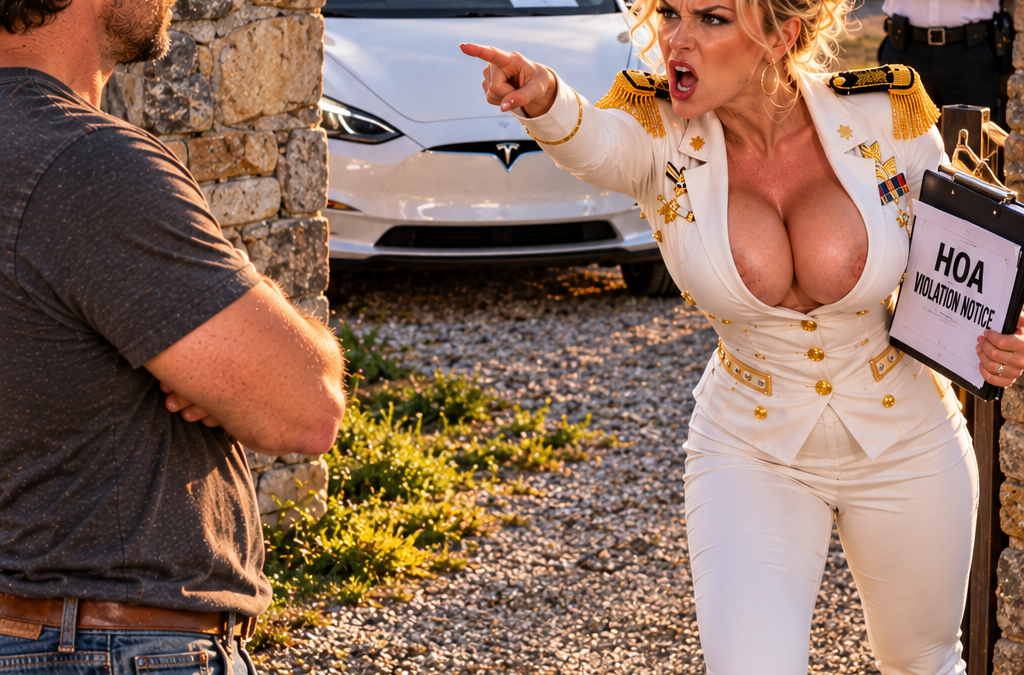
And the strangest outfit I’d ever seen someone wear while delivering neighborhood paperwork.
It looked like a white military dress uniform redesigned by somebody who cared far more about cleavage than combat.
The jacket was tightly tailored through the waist, decorated with polished gold buttons, and cut low enough at the front to emphasize her very large chest.
She wore matching fitted white trousers and heeled white boots.
Not muddy boots.
Not practical boots.
Polished ones.
The whole appearance was somewhere between admiral, luxury yacht owner, and woman about to command a small nation.
Karen’s body language matched the costume.
Back straight.
Chin slightly raised.
Clipboard ready.
Smile professional.
“Hi there.”
“Hi.”
“I’m Karen.”
She extended one hand.
“Your new neighbor.”
I shook it.
“Nice to meet you.”
“And HOA president.”
There was something in the way she added that title.
Not casually.
More like a rank.
“Okay.”
“I wanted to introduce myself and give you these.”
She pushed a stack of papers toward me.
I took them.
The top packet was thick.
I flipped it over.
“What is this?”
“Your HOA bylaws.”
I looked at her.
“My what?”
“Bylaws.”
“I heard you.”
Karen smiled.
“Good.”
Underneath the bylaws was another sheet.
NOTICE OF VIOLATION.
My name.
My address.
Description of offense.
GRASS HEIGHT EXCEEDS COMMUNITY STANDARD.
Required corrective action: mow lawn.
Deadline: Friday.
Possible fine.
I looked from the paper to Karen.
Then back down.
Then I laughed.
Not intentionally.
It just came out.
Karen’s smile froze.
“Is something funny?”
“Yeah.”
I held up the violation.
“I’m not in your HOA.”
For a moment, her expression suggested I’d told her I wasn’t subject to gravity.
“Everyone in this neighborhood is part of the HOA.”
“No.”
“Yes.”
“No.”
Her smile disappeared completely.
“My property was excluded when the association formed.”
Karen shifted the clipboard.
“I don’t believe that’s correct.”
“It is.”
“Do you have documentation?”
“Plenty.”
“The neighborhood boundaries encompass your address.”
“The neighborhood does.”
I pointed toward the paperwork.
“The HOA doesn’t.”
She blinked.
“You understand those aren’t necessarily different things.”
“In my case they are.”
Karen looked past me toward the yard.
Her eyes moved over the vegetable garden.
The old stone wall.
The taller grass.
My truck.
I could practically see her discovering new violations.
“You may want to review the bylaws anyway.”
“I won’t.”
Her eyes returned to mine.
“Excuse me?”
“I’m not governed by them.”
“Even if you believe you’re exempt, your property affects the appearance of the entire community.”
“I’m sure it does.”
“Your lawn is substantially above the permitted height.”
“There is no permitted height for my lawn.”
Karen’s nostrils flared slightly.
“Four inches.”
“What?”
“You’re roughly four inches above standard.”
“You measured it?”
She didn’t answer.
That was answer enough.
I handed the packet back.
“Check your records.”
She didn’t take it at first.
“Friday.”
“What about Friday?”
“The lawn needs to be corrected by Friday.”
“No.”
Her eyes narrowed.
“No?”
“No.”
I placed the paperwork on top of her clipboard.
“Have a good day, Karen.”
Then I closed the door.
I stood inside for several seconds waiting.
I half expected her to knock again.
She didn’t.
Through the window, I watched her walk down the path toward her new house.
Her shoulders were stiff.
The white uniform seemed even more ridiculous from behind.
I should have known that wasn’t the end.
Two days later, someone knocked again.
Karen.
This time her husband was with her.
He was maybe mid-forties, quiet-looking, wearing khaki shorts and a polo shirt.
The expression on his face before anybody even spoke made me like him.
It said:
I would rather be almost anywhere else.
Karen wore another fitted white jacket, this one with silver buttons and an even deeper neckline.
She didn’t bother with the introductory smile.
“I checked.”
“Congratulations.”
Her husband looked away.
Karen ignored the comment.
“Our records show your property was excluded from the original association.”
“Great.”
I reached for the door.
“But.”
Of course there was a but.
“The board has updated the community boundaries.”
I stopped.
“What?”
“The HOA boundaries have been modified over time.”
“Okay.”
“Your property is now within the current boundary.”
I stared at her.
“You understand you can’t just announce that, right?”
Karen’s face tightened.
“Announce what?”
“That my private property joined your HOA because you redrew a map.”
“It’s more complicated than that.”
“No, it really isn’t.”
“Our attorney will review it.”
“Excellent.”
“In the meantime, you’re expected to comply with community standards.”
“No.”
Her face went red.
Her husband shifted.
Karen took half a step forward.
“Excuse me?”
“You said your attorney will review it.”
“Yes.”
“Then let your attorney tell you you’re wrong.”
“You are inside HOA boundaries.”
“Geographically, I’m surrounded by HOA houses.”
“Exactly.”
“That does not make me a member.”
Karen crossed her arms beneath her chest.
“You can’t benefit from living in the community while refusing to contribute.”
I almost laughed again.
“What benefits?”
“Maintained streets.”
“Public.”
“Entrance landscaping.”
“I don’t care about your flowers.”
“Property values.”
“I didn’t ask you to raise them.”
Her husband said quietly, “Karen.”
She shot him a look.
He stopped.
She turned back to me.
“You’re making this unnecessarily adversarial.”
“I haven’t done anything.”
“You refuse to cooperate.”
“With an organization I don’t belong to.”
“You live here.”
“I lived here before your HOA existed.”
Technically my grandmother had, but the point stood.
Karen’s jaw tightened.
“Your lawn still needs to be mowed.”
“No.”
“You’re deliberately provoking me.”
“No, Karen.”
I began closing the door.
“I’m deliberately not mowing my grass.”
Her husband made a sound that might have been a suppressed laugh.
Karen turned toward him.
I closed the door before witnessing the argument.
The next week, I received a bill.
Three hundred seventy-five dollars.
Quarterly HOA dues.
Late assessment.
Lawn violation.
Administrative fee.
It looked official.
There was a logo.
Account number.
Due date.
Threatening language about additional penalties.
I stood by my mailbox reading it.
Then I folded the paper.
Walked inside.
And dropped it in the recycling bin.
The calls started after that.
Somehow Karen obtained my number.
The first text:
Your account remains delinquent. Please remit payment immediately to avoid further penalties.
I ignored it.
Then:
Fence requires painting under Section 8.4 of community aesthetic standards.
Then:
Mailbox does not conform to approved style.
Then:
Visible vegetable gardening constitutes an aesthetic concern from roadway.
That one made me stare at my phone.
My tomatoes were now threatening property values.
Then came a message about my chickens.
I blocked her number.
That should have reduced contact.
Karen simply changed tactics.
One morning, I came outside to leave for work and found a Tesla parked in my gravel area.
White Tesla.
Of course.
It sat just inside the old stone boundary wall where I normally parked my truck.
At first I assumed somebody had misunderstood the property line.
Then I recognized it.
Karen’s car.
I stared at it.
Then toward her house.
I wasn’t angry yet.
People make mistakes.
Maybe contractors were using her driveway.
Maybe she had guests.
Maybe she genuinely thought the gravel turnout belonged to the road.
So I walked next door.
Knocked.
Karen opened the door wearing tight black gym clothes and holding a protein shake.
Her blonde hair was tied high.
She looked annoyed to see me.
“Yes?”
“Morning.”
“What is it?”
“Your Tesla is parked on my property.”
She looked past me as if she’d forgotten where she’d left it.
“Oh.”
“Can you move it?”
Karen took a sip from the shake.
“The street was full.”
“Okay.”
“And you’ve got all that empty space.”
I waited.
She smiled.
“I figured you wouldn’t mind.”
“I do.”
Her smile faded.
“It’s just during the day.”
“I still mind.”
“You’re not using it.”
“Karen.”
“What?”
“It’s my parking area.”
“Gravel.”
“Yes.”
“You have two acres.”
“Also yes.”
“And you’re upset over one car?”
“I’m asking you to move it.”
She sighed theatrically.
“Fine.”
“Thank you.”
I went home.
An hour later, the Tesla was still there.
It eventually disappeared sometime that afternoon.
I assumed she’d gotten the message.
The next morning, it was back.
Same place.
I walked over again.
Knocked.
Karen opened the door.
“What now?”
“Your car.”
She rolled her eyes.
“The street parking is full.”
“We had this conversation yesterday.”
“And nothing bad happened.”
“I told you not to park there.”
“You’re not using the space.”
“That’s irrelevant.”
“It’s not.”
“Karen.”
She leaned against the doorframe.
“Do you know how selfish this looks?”
That took me a second.
“I’m selfish?”
“You have two acres of land.”
“My land.”
“You have far more space than anyone else.”
“My land.”
“And you’re getting territorial over a few square feet you’re not even using.”
“Yes.”
She blinked.
“Yes?”
“It’s private property.”
Her lips tightened.
“You know, if you would simply pay your HOA dues and start acting like part of the community, we wouldn’t keep having these conflicts.”
I stared at her.
“So this is about the HOA.”
“No.”
“You just brought it up.”
“I’m saying your attitude creates problems.”
“My attitude isn’t parked in your yard.”
Karen’s face reddened.
“Move the Tesla.”
“I’m working.”
“You work from home.”
“Exactly.”
“So walk outside and move it.”
“I’m in the middle of things.”
“Then I’ll give you ten minutes.”
Her eyebrows rose.
“Or what?”
“Tomorrow, if it’s there again, I’m having it towed.”
Karen laughed.
“You can’t tow somebody for parking on unused land.”
“Watch me.”
She slammed the door.
The Tesla remained another hour.
Then moved.
Next morning?
Back.
The morning after that?
Back.
Then again.
Every day.
For almost two weeks.
At that point, it wasn’t convenience.
It was a challenge.
Karen was proving that I could say no and she could ignore me.
Sometimes her driveway was empty.
Her Tesla was still on my gravel.
Sometimes there were open spaces on the street.
Tesla on my land.
Once I watched her leave her house, walk past her own driveway, cross toward my property, get into the Tesla, and drive away.
She saw me watching from the porch.
She smiled.
That was when I called a tow company.
I explained the situation.
Private property.
Repeated unauthorized parking.
Clearly within my boundary.
The dispatcher told me they could tow but recommended posting visible notice first.
“Private property. No parking. Violators towed.”
“Exactly.”
I bought a sign.
Mounted it beside the gravel.
Large.
Readable.
Impossible to miss.
The following morning, Karen parked directly beside it.
I took a photograph.
Then another showing the stone wall and property line.
Then I called the tow company.
The truck arrived roughly forty minutes later.
The driver stepped out.
He looked at the sign.
Looked at the Tesla.
Looked at me.
“You own this?”
“The land? Yes.”
“You requested the tow?”
“Yes.”
He nodded.
“All right.”
I told him I’d pay the two hundred dollars if necessary.
He began positioning the truck.
The hydraulic equipment had barely started moving when Karen’s front door flew open.
She came running.
Not walking fast.
Running.
She was wearing that white military-inspired uniform again, tight jacket open low at the chest, blonde hair bouncing behind her.
“What are you doing?”
The tow driver kept working.
Karen ran into my gravel area.
“Stop!”
He looked at her.
“That’s my car!”
The driver pointed toward the sign.
“You’re parked on private property, ma’am.”
“This is community land.”
“No.”
I spoke from several feet away.
“It’s mine.”
Karen spun toward me.
“This is harassment.”
“Move your car.”
“You called a tow truck?”
“I warned you.”
“You’re insane.”
“I’ve asked you for two weeks.”
“Because you’re mad about the HOA.”
“I’m mad because you keep parking on my property.”
The driver started positioning the equipment.
Karen moved between him and the Tesla.
“I’m calling the police.”
He shrugged.
“You’re welcome to.”
She pointed at me.
“I will sue you.”
“Go ahead.”
She pulled out her phone.
I folded my arms.
Honestly, I was relieved.
Police documentation sounded useful.
Two officers arrived.
Karen practically ran to them.
She immediately transformed.
Voice softer.
Face distressed.
Hands moving dramatically.
“This man has been harassing me for months.”
One officer looked at me.
Karen continued.
“Now he’s trying to steal my car.”
The tow driver actually laughed.
The officer glanced toward him.
He stopped.
“Sir?”
I explained everything.
My property was excluded from the HOA.
Karen had been sending unauthorized fines.
Then she began parking on my gravel.
I asked repeatedly that she stop.
I posted notice.
Called a licensed tow company.
I showed him the survey.
The old stone boundary.
The sign.
Photographs from previous days.
The officer walked over to the Tesla.
Looked at its position.
Then toward Karen’s house.
He returned.
“Ma’am.”
Karen stepped forward.
“Yes?”
“This is his property.”
Her expression tightened.
“But he’s not using it.”
The officer paused.
“That doesn’t matter.”
“Of course it matters.”
“No.”
Karen pointed toward my yard.
“He has two acres.”
The officer looked.
Then back at her.
“Still his.”
“I’m the HOA president.”
He didn’t react.
Karen seemed genuinely surprised.
“The association has updated—”
“Ma’am, HOA authority doesn’t give you permission to park on private land.”
“This property is within our neighborhood.”
“That isn’t the question.”
She looked at me like the officer was somehow betraying her.
The tow driver said, “If she moves it now, I can unhook.”
The Tesla wasn’t fully connected yet.
Karen crossed her arms.
“I’m not paying him.”
The driver looked at me.
I said, “I’ll cover it.”
Karen snapped, “No.”
Everyone looked at her.
“I am not giving him the satisfaction of having my vehicle towed.”
The officer said, “Then move it.”
Karen stared at him.
Then at me.
Then at the tow truck.
Finally, she paid the driver’s unhook fee and moved the Tesla.
She drove away slowly.
As she passed me, she lowered the window.
“This isn’t over.”
I almost smiled.
“That’s becoming your favorite sentence.”
The officers stayed briefly.
One told me I’d handled the matter correctly from their perspective.
“If she parks here again, document it.”
“I will.”
“Keep the sign up.”
“Definitely.”
I assumed public embarrassment plus police confirmation would finally end the problem.
The next morning, a sheet of paper was taped to my door.
HOA VIOLATION NOTICE.
Unauthorized towing activity on community property.
Fine: three hundred dollars.
I stood there for maybe thirty seconds.
Then started laughing.
I took a photograph.
Sent it to my lawyer.
He called later.
“Is she serious?”
“Very.”
“Save everything.”
“I am.”
“The dues.”
“Saved.”
“Texts?”
“Screenshots.”
“Violations?”
“Folder.”
“Police incident?”
“Report number.”
He laughed.
“Good.”
“What now?”
“Nothing yet.”
“Nothing?”
“If she keeps going, she’s creating our case for us.”
That sentence should probably have worried me.
Instead, it calmed me.
Karen kept going.
The Tesla returned the following week.
I called the tow company.
Karen came running out and moved it before they could hook up.
A few days later, same thing.
Then again.
Each time, she watched.
Waited.
Forced me to make the call.
Then moved the vehicle at the last moment.
It became a game.
And I was getting tired of playing.
More than tired.
I was furious.
But I also understood that anger was exactly what Karen wanted.
She wanted me to yell.
Threaten.
Touch the Tesla.
Do something she could photograph and transform into victimhood.
So I did nothing impulsive.
I waited.
Then my landscaping business created an opportunity.
I owned a small operation.
Nothing huge.
Me and two employees.
Residential work.
Some commercial landscaping.
Mulch.
Planting.
Cleanup.
Stonework.
That sort of thing.
One of our upcoming commercial jobs required a large mulch delivery.
Normally, I’d have it delivered directly to the customer site.
But scheduling made that difficult.
So I arranged for the load to be temporarily dropped at my property.
Specifically, the gravel area.
It was level.
Accessible to a dump truck.
And legally mine.
Delivery morning arrived.
I stepped outside.
Karen’s Tesla was parked there.
Directly beside the NO PARKING sign.
I stared at it.
Then checked the expected delivery time.
Twenty minutes.
My wife wasn’t there.
No witnesses I needed to impress.
No argument.
Just me.
Private property.
A repeatedly unauthorized vehicle.
And several cubic yards of mulch heading toward us.
I could have called Karen.
I didn’t.
I could have called the tow company.
I didn’t.
I had already done both versions of that.
The delivery truck arrived.
Large dump body.
Fresh dark mulch piled high.
The driver rolled down his window.
“Where do you want it?”
I pointed toward the gravel.
“Right there.”
He leaned forward.
“By the stone wall?”
“Yeah.”
He noticed the Tesla.
“There’s a car there.”
“I know.”
He looked at me.
Then the car.
Then me again.
“You sure?”
“Positive.”
“Whose car?”
“My neighbor’s.”
The driver’s eyebrows rose.
“She know you’re getting a delivery?”
“She knows she’s not allowed to park there.”
I pointed toward the sign.
He read it.
“She’s been warned dozens of times.”
“You want me to wait?”
“No.”
The driver slowly smiled.
“Your property.”
“Exactly.”
I need to be precise about what happened next because people always imagine some cartoon scene where a dump truck directly empties tons of material onto a vehicle and crushes it.
That isn’t what I asked for.
The load was dumped in the designated gravel area around and beside the illegally parked Tesla, burying the car behind and within a massive pile of fresh mulch until most of it disappeared from ordinary street view.
By the time the truck pulled away, the Tesla looked less like a car and more like an archaeological discovery.
A small section of roof remained visible.
Part of a side window.
One mirror.
Everything else was surrounded by mulch.
The driver climbed down.
Looked at the pile.
Then at me.
“You’ve got interesting neighbors.”
“You have no idea.”
I paid him.
Then went inside.
I made coffee.
I didn’t have to wait long.
Maybe thirty minutes.
The scream came first.
Not words.
Just a shriek.
I put my mug down.
Another scream.
Then:
“WHAT DID YOU DO?”
I walked outside.
Karen was standing beside the mulch pile in pajamas.
No white uniform this time.
Silk robe.
Slippers.
Blonde hair disheveled.
She pointed at the almost invisible Tesla.
“What did you do to my car?”
I looked at the mulch.
“Had a delivery.”
“You buried my Tesla!”
“No.”
She stared at me.
“No?”
“I had mulch delivered.”
“ON MY CAR.”
“On my property.”
Karen’s face turned red.
“You did this intentionally.”
I decided there was no point lying.
“Yes.”
That shocked her more than denial would have.
“You admit it?”
“Absolutely.”
“You’re insane.”
“Karen, you’ve parked there repeatedly after being told not to.”
She pointed toward the pile.
“THIS IS A SIXTY-THOUSAND-DOLLAR CAR.”
“Then parking it somewhere you don’t have permission seems unwise.”
She stepped toward me.
“You damaged it.”
“I haven’t touched your Tesla.”
“It’s under mulch.”
“Yes.”
“That’s damage.”
“You can call the police.”
Her mouth snapped shut.
I waited.
She pulled out her phone.
“I AM.”
“Great.”
“I’ll have you arrested.”
“Tell them the address.”
She made the call.
I stood there listening while she described the situation.
At least this time she didn’t claim she’d been attacked.
Still, phrases like intentional destruction and malicious property damage featured heavily.
When she finished, she glared at me.
“You finally went too far.”
“Maybe.”
“You think this is funny?”
“Not particularly.”
“You planned this.”
“The mulch delivery? Yes.”
“You knew my car was there.”
“When the truck arrived, yes.”
“And you told him to dump it anyway.”
“Correct.”
She seemed almost disappointed by how little I was trying to defend myself.
“You are going to pay for every scratch.”
“Document them.”
“I’ll sue.”
“You’ve been threatening that for months.”
“This time I’m serious.”
“Okay.”
“You’ll lose your house.”
That one made me laugh.
Karen’s eyes widened.
“What’s funny?”
“The HOA already tried to claim it.”
She looked like she wanted to hit me.
Instead, she paced beside the mulch pile while waiting.
Then the police arrived.
Same two officers.
I couldn’t believe it.
Neither could Karen.
One officer stepped from the cruiser.
He looked toward the mulch.
Stopped.
Looked at me.
Then at Karen.
Then back at the mulch.
His lips pressed together.
The other officer walked around the pile.
“Where’s the car?”
Karen pointed furiously.
“UNDER THERE.”
The officer looked at me.
I lifted one hand.
“Morning.”
The first officer cleared his throat.
“Okay.”
He looked at Karen.
“This is the same Tesla?”
“Yes.”
“Same parking area?”
“Yes, but—”
“His property?”
“That is not the point.”
The officer looked toward the second officer.
Then back at Karen.
“Actually, that seems pretty relevant.”
“He buried my vehicle.”
“I had a mulch delivery.”
Karen shouted, “HE DID IT ON PURPOSE.”
The officer looked at me.
“Did you?”
“I told the delivery driver where to dump material on my property.”
“Knowing her car was there?”
“Yes.”
Karen spread both arms.
“See?”
The officer asked, “Did the truck physically strike the vehicle?”
“No.”
“Did you personally damage it?”
“No.”
“I’ll inspect it when it’s uncovered.”
Karen laughed bitterly.
“When it’s uncovered?”
The officer turned toward her.
“Ma’am, we’ve been here about this parking issue before.”
“So?”
“We told you not to park here.”
“This isn’t about parking anymore.”
“It began with parking.”
“He can’t bury someone’s car because of a parking dispute.”
The officer remained careful.
“I’m not making a civil liability determination for you. If there is actual vehicle damage, document it and pursue whatever appropriate remedies you believe you have.”
Karen looked pleased for half a second.
Then he continued.
“But as far as removing you from the property or arresting him simply because landscaping material was delivered on his own land, that’s not happening based on what we’re seeing.”
Her smile vanished.
“Are you serious?”
“Yes.”
“You expect me to dig out a Tesla?”
The second officer said, “I would recommend getting it moved.”
Karen stared.
The first officer added, “And stop parking here.”
She made a sound between a laugh and a scream.
“This is insane.”
“No,” the officer said.
“This is the second time we’ve personally discussed you parking on property you’ve been told is private.”
Karen pointed toward me.
“He set a trap.”
I said, “The sign has been there for weeks.”
She spun toward me.
“I wasn’t talking to you.”
The officer stepped between us slightly.
“Ma’am.”
She stopped.
For several seconds, nobody spoke.
Then her husband came outside.
He was wearing sweatpants and carrying coffee.
He walked toward the gravel area.
Saw the giant mulch pile.
Stopped.
Looked at Karen.
Looked at me.
Then at the officers.
He slowly turned around and went back into the house.
I nearly lost control.
Even one officer had to look away.
Karen noticed.
“This isn’t funny.”
Nobody answered.
The officers eventually left after making it clear that any actual damage dispute would need to be documented appropriately and that Karen needed to remove her vehicle and stop parking on my property.
She stood beside the pile.
The humiliation seemed to hit harder once the patrol car disappeared.
No authority had rescued her.
No badge had transformed my gravel into HOA land.
No one had ordered me to shovel.
Karen looked at me.
Her voice dropped.
“You’re going to pay for this.”
“No.”
“You think you’ve won?”
“This isn’t a contest.”
“You’ve been attacking me since I moved here.”
I stared at her.
“You came to my door with fake HOA fines.”
“They aren’t fake.”
“You tried to annex my land.”
“We updated our map.”
“You parked on my property.”
“Because you had space.”
“I asked you to stop.”
“You overreacted.”
“I posted a sign.”
“Petty.”
“I called a tow truck.”
“Harassment.”
“The police told you not to park here.”
“They don’t understand HOA law.”
That sentence almost impressed me.
Even now.
Even standing beside her Tesla under a mountain of landscaping material.
Karen still believed the problem was everybody else’s misunderstanding.
I pointed toward the mulch.
“Dig out your car.”
Her eyes narrowed.
“Or what?”
“Or it stays there.”
“You can’t keep my car.”
“I’m not.”
I smiled.
“Take it anytime.”
She hated that answer.
A few hours later, several men arrived with shovels.
I don’t know whether they were landscapers, friends, or people Karen paid on short notice.
They began moving mulch.
Wheelbarrow after wheelbarrow.
Shovel after shovel.
It took most of the afternoon.
I didn’t stand outside watching.
That would have been too much.
I did occasionally walk past a window.
By late afternoon, the Tesla reappeared.
It was filthy.
Covered in dust.
Bits of mulch clung around the wheels and underbody.
But from what I could see, it wasn’t crushed.
Karen inspected every panel like a forensic technician.
Then drove away.
The following morning, there was another notice taped to my door.
Of course there was.
FORMAL HOA VIOLATION.
Public nuisance.
Unsightly landscape materials visible from roadway.
I photographed it.
Texted the image to my lawyer.
Add it to the pile.
He called roughly an hour later.
“I’m done.”
“With what?”
“Her.”
I smiled.
“What are you doing?”
“Cease-and-desist.”
“Today?”
“Today.”
He sounded almost cheerful.
“She’s been formally notified your land isn’t subject to HOA governance?”
“Yes.”
“Repeatedly?”
“Yes.”
“Police report documenting the parking?”
“Yes.”
“Tow records?”
“Yes.”
“Photos?”
“A lot.”
“Unauthorized dues and fines?”
“Every one.”
“Good.”
His voice became serious.
“If she contacts you again demanding HOA dues or issuing violations against this property, we’re escalating.”
“To what?”
“Harassment claim. Trespass issues. Injunctive relief if necessary. Whatever fits the evidence once I’ve organized it.”
“You sound excited.”
“I don’t often get clients whose opposing party keeps mailing us exhibits.”
The cease-and-desist went out.
It was not polite in the social sense.
It was professionally polite.
Which is more frightening.
My lawyer laid out the property’s history.
Its explicit exclusion from the HOA.
The recorded documents.
The lack of contractual authority.
The unauthorized fines.
Repeated unwanted contact.
Repeated parking after notice.
The police involvement.
The towing attempt.
The continuing violation notices.
Then he made the next step painfully clear.
Stop.
Stop claiming authority over my land.
Stop issuing HOA fines.
Stop demanding dues.
Stop parking there.
Stop contacting me about supposed violations.
Any continued conduct could result in immediate legal action.
Karen received the letter.
I knew because her husband saw me at the mailbox two days later.
For a moment, he hesitated.
Then said quietly:
“I told her.”
I looked at him.
“Told her what?”
He gave me a tired smile.
“That your property wasn’t in the HOA.”
I almost felt bad for him.
Almost.
“How long ago?”
“Before we moved.”
I stared at him.
He shrugged helplessly.
“She thought the board could change it.”
“Apparently.”
He looked back toward their house.
“She doesn’t like being told no.”
“I noticed.”
Then he walked away.
The Tesla never appeared on my gravel again.
Not once.
Karen stopped texting.
No more violation notices.
No more quarterly dues.
No more comments about my garden.
No complaints about chickens.
No grass measurements.
Silence.
It was wonderful.
For the first few weeks, I almost didn’t trust it.
I’d step outside and glance toward the gravel area automatically.
Empty.
Then I’d look at my door for paperwork.
Nothing.
At the mailbox.
No HOA envelope.
Eventually, the tension faded.
My property returned to what it had been before Karen moved next door.
Quiet.
Imperfect.
Mine.
I kept the NO PARKING sign.
Not because I thought Karen would try again.
Because every time I saw it, I remembered how much trouble could have been avoided if she’d respected the first sentence I said to her.
I’m not in your HOA.
That was all.
The entire conflict could have ended on day one.
Karen knocks.
Hands me a lawn notice.
I explain.
She checks the documents.
She says:
“You’re right. Sorry about that.”
Done.
We could have been normal neighbors.
Maybe friendly.
Probably not close, but civil.
Instead, being wrong became unacceptable to her.
Once she decided I belonged under her authority, every piece of evidence against that belief became something to overcome rather than something to accept.
My deed?
Outdated.
My exclusion?
Boundaries changed.
My refusal?
Selfishness.
My lawyer?
Hostile.
My parking area?
Unused community space.
My tow sign?
Harassment.
Police telling her she was on private land?
They didn’t understand.
The mulch?
Proof I was unstable.
At no point did Karen consider the possibility that the easiest solution was to stop doing the thing she’d been repeatedly asked not to do.
That was the real conflict.
Not grass.
Not HOA dues.
Not even the Tesla.
Control.
Karen believed her position as president entitled her to decide what happened around her.
Within the HOA, maybe she had legitimate authority over certain rules.
Fine.
People voluntarily purchased property subject to those agreements.
They had governing documents.
Procedures.
Voting.
Whatever.
But my grandmother hadn’t joined.
I hadn’t joined.
A board vote couldn’t erase that history.
Karen couldn’t redraw a line on paper and turn my garden into community property.
She couldn’t convert my gravel parking area into overflow parking because the street was crowded.
And she certainly couldn’t punish me for refusing.
The funniest part was how often Karen accused me of being selfish.
She had two explanations for every boundary.
If it benefited her, it was “community.”
If it limited her, it was “harassment.”
My two acres?
Community appearance.
Her Tesla?
Community parking need.
My garden?
Community eyesore.
My right to tow?
Harassment.
My mulch delivery?
Public nuisance.
The word community became a tool she used whenever she wanted access to something that wasn’t hers.
My grandmother would have hated her.
Sometimes I imagined what Grandma would have done if Karen had shown up in the 1980s telling her the chickens violated Section 6.4 of some neighborhood code.
Actually, I didn’t have to imagine very hard.
Grandma once chased a utility salesman down the driveway with a broom because he wouldn’t leave after she told him no twice.
Compared with her, I had been extremely diplomatic.
The mulch pile disappeared gradually.
I used part of it for jobs.
Some went around my own plants.
The last of it became beds near the vegetable garden.
Every spring afterward, those areas grew beautifully.
Karen probably hated seeing them.
She never said anything.
That was the magic of a lawyer’s letter.
We continued living next door to one another.
She remained HOA president for at least a while.
I don’t know what happened inside their meetings because I didn’t attend.
Not my HOA.
Occasionally, I’d see Karen leaving in the Tesla.
The car remained spotless most of the time.
She kept wearing those bizarre white military-inspired outfits.
She still carried a clipboard.
Still walked like somebody had appointed her commander of the street.
But whenever she passed the old stone wall, she stayed on her side.
That was enough for me.
Once, months later, I was unloading bags of soil from my truck when she slowed near the edge of her driveway.
For a second, I thought she might speak.
Instead, she looked at the NO PARKING sign.
Then at me.
Then drove into her own garage.
I smiled.
Not because I’d beaten her.
I don’t think neighbor disputes really have winners.
Even when you’re right, you lose time.
Sleep.
Patience.
Money.
You start photographing things that should never need photographing.
You call attorneys.
You learn towing regulations.
You save ridiculous pieces of paper because some future court might care about a fine for tomatoes.
Nobody dreams of buying a peaceful home so they can create a legal evidence folder labeled HOA HARASSMENT.
Still, if there was a lesson in all of it, it was simple.
Boundaries only matter if you’re willing to enforce them.
I had tried words first.
“Please move your car.”
Karen ignored them.
I tried repetition.
She ignored that.
I posted a sign.
Ignored.
I called a tow company.
She turned herself into the victim.
Police confirmed the property line and told her to stop.
She responded with another fake fine.
At a certain point, continuing to ask politely doesn’t make you more reasonable.
It teaches the other person that your no has no consequences.
Karen had learned exactly that.
She believed she could keep parking there because every time I objected, eventually I would return to my house and she would still get what she wanted.
That changed the morning the mulch truck arrived.
She had wanted to use my land as though it belonged to her.
So for once, I used my own land exactly the way I intended while her property was sitting where it had no permission to be.
Was it petty?
Absolutely.
Would I recommend everyone do exactly the same thing?
No.
Cars can be damaged.
Property disputes can become lawsuits.
Police responses can vary.
There are smarter ways to solve most conflicts.
I had already tried several of them.
What I do know is that after weeks of warnings, one tow attempt, multiple police conversations, and a lawyer’s eventual cease-and-desist letter, Karen finally understood the sentence she’d refused to accept since the day she walked onto my porch in that tight white uniform.
My property was not hers.
Not because I had more land than I needed.
Not because she thought I should share.
Not because she was HOA president.
Not because she had updated a map.
Not because my lawn was visible from one of her streets.
Mine.
Years later, the stone wall still stands where my grandmother built it in the seventies.
Parts lean slightly now.
A few stones have shifted.
Moss grows in the shaded sections.
It isn’t uniform.
It isn’t HOA approved.
It isn’t supposed to be.
Every time I look at it, I think about how the neighborhood changed while the basic truth underneath everything remained the same.
Associations came.
Rules changed.
Boards changed.
Presidents changed.
My grandmother’s line stayed where it was.
Karen thought authority meant announcing where boundaries should be.
She eventually learned that real boundaries don’t move just because someone with a clipboard dislikes them.
And her Tesla never crossed mine again.