𝗙𝗨𝗟𝗟 𝗦𝗧𝗢𝗥𝗬 The HOA President Demanded Free Gas From My Station—and Refused to Leave When I Said No
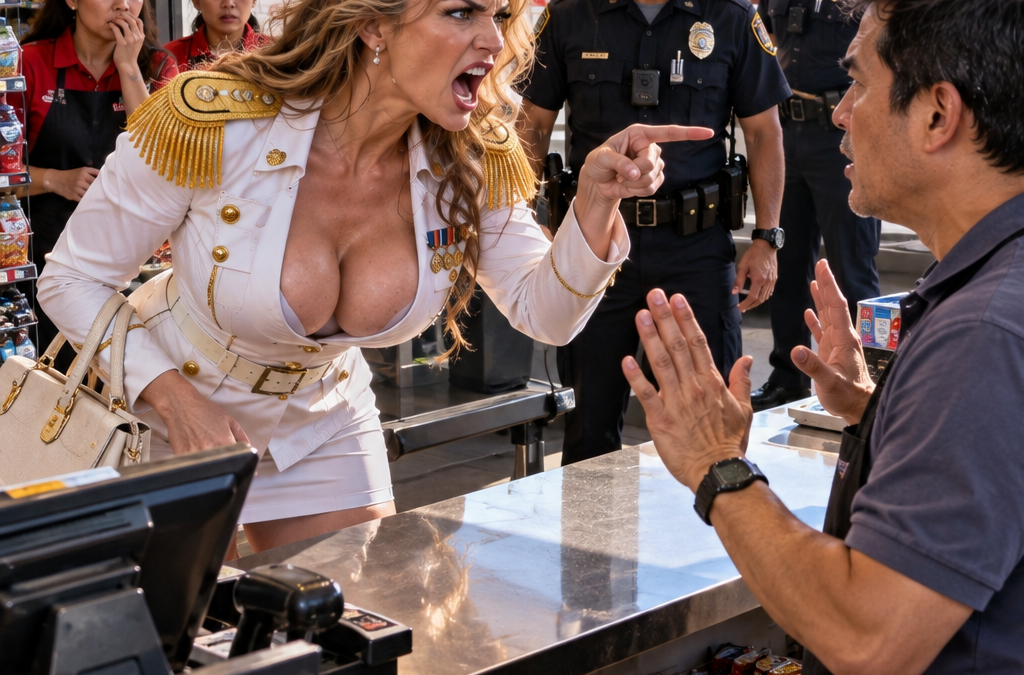
𝗣𝗔𝗥𝗧 𝟮
He was quick, reliable, and so polite that even impatient customers usually calmed down around him.
I was behind the counter helping because the line had started growing.
The sliding glass door opened.
Mary entered.
White heels.
White fitted uniform.
Gold buttons.
Large sunglasses.
Designer purse tucked under one arm.
She looked at the line.
Then walked past it.
Of course.
A man waiting to buy bottled water moved slightly because he assumed she was heading toward another aisle.
She wasn’t.
Mary marched directly to the side of the counter.
Then tapped her purse against the glass display.
Once.
Twice.
“Excuse me.”
Paolo looked up.
“I’ll be with you after these customers, ma’am.”
Her eyes hardened.
“I wasn’t speaking to you.”
Paolo went still.
She looked at me.
“Are you the owner?”
I finished giving change to the customer in front of me.
“Yes, ma’am.”
“Good.”
She removed her sunglasses.
Up close, Mary looked even more carefully constructed than she did from across the store.
Perfect foundation.
Glossy lipstick.
Expensive jewelry.
Every blonde strand in place despite the humidity outside.
I gave her the same neutral smile I gave everybody.
“How can I help?”
She leaned slightly against the counter.
“I’m Mary.”
I waited.
She clearly expected immediate recognition.
When I didn’t give her enough, she added:
“President of the homeowners association for the estate directly behind your property.”
“Okay.”
Her expression tightened almost imperceptibly.
“I assume you’re familiar with us.”
“We have many customers from the subdivision.”
“Exactly.”
She smiled.
That should have warned me.
“I came here to finalize our community integration benefits.”
I stared at her.
“Our what?”
“Community integration benefits.”
I glanced at Paolo.
He looked equally confused.
“I’m not familiar with any arrangement by that name.”
Mary gave a short condescending laugh.
“Of course you’re not. That’s why I’m here.”
The customers in line had started listening.
She continued.
“Our community shares a border with this commercial strip.”
“Yes.”
“Your delivery vehicles use access roads near our perimeter.”
“The public roads.”
She ignored that.
“Your illuminated pricing signs are visible from our main entrance.”
“They’re visible from the highway too.”
“Exactly.”
I had no idea where this was going.
Mary folded her sunglasses and set them on the counter.
“As part of maintaining a cooperative relationship between businesses and our premium residential community, we are establishing certain resident privileges.”
“We?”
“The HOA.”
“Okay.”
“And because your station benefits substantially from our residents’ purchasing power, we expect you to participate.”
There was the word.
Expect.
Not invite.
Not ask.
Expect.
“What kind of participation?”
Mary smiled.
“Complimentary fuel.”
I thought I’d misheard.
“I’m sorry?”
“Free gasoline.”
Paolo stopped scanning a bag of chips.
The man at the register slowly turned toward Mary.
I leaned slightly closer.
“For what?”
“For our registered homeowners.”
The store became remarkably quiet for a place with refrigerators, air conditioning, traffic outside, and half a dozen customers.
I asked the only question my brain could produce.
“You want me to give free gasoline to everyone in your subdivision?”
Mary waved one hand.
“Not everyone.”
I waited.
“Registered property owners.”
That clarification somehow made it worse.
She continued as though explaining a perfectly ordinary corporate program.
“We’ll issue official vehicle decals.”
“Decals.”
“Yes.”
“Our pumps will recognize them?”
“Your attendants will.”
She seemed pleased with herself.
“When a registered homeowner arrives, your staff will simply fill the vehicle.”
“And then?”
“You log the transaction under the community account.”
“What community account?”
“The HOA benefit account.”
“Who pays the account?”
Mary frowned.
“No one.”
I stared at her.
“Then it’s not an account.”
“Don’t be difficult.”
“I’m trying to understand.”
She leaned forward.
“It is a goodwill benefit.”
“For your homeowners.”
“Yes.”
“Paid for by me.”
“Think of it as community investment.”
I genuinely looked around for a camera.
Not our security camera.
Somebody’s phone.
A prank channel.
Anything.
There was no prank.
Mary believed this.
She believed a private gas station should give free fuel to wealthy homeowners because they lived nearby.
“Mary.”
Her smile widened slightly when I used her name.
“I can’t do that.”
The smile vanished.
“Excuse me?”
“Fuel isn’t free.”
She stared.
“I know that.”
“I pay suppliers.”
“Obviously.”
“I pay taxes.”
She rolled her eyes.
“Everybody pays taxes.”
“I pay employees.”
“That isn’t my concern.”
“I pay electricity, maintenance, permits, insurance, equipment repairs, and a lot of other expenses.”
She folded her arms beneath her chest.
“And?”
“And our profit margin on fuel is small.”
“That sounds like poor management.”
Paolo’s eyes widened.
I ignored it.
“Giving away fuel to an entire gated community would cost us an enormous amount of money.”
“You would gain loyalty.”
“We already have customers from your subdivision.”
“Because we allow them to come here.”
I actually paused at that.
“You allow them?”
Mary realized she had said the quiet part slightly too loudly.
She shifted.
“Our residents support nearby businesses.”
“By paying for things.”
“Yes.”
“Which is how businesses function.”
Her face hardened.
“Do you know who I am?”
There it was.
I had been waiting for it.
“You already told me.”
“Then perhaps you don’t understand my influence.”
“I understand that you’re the HOA president.”
“I control the resident communications.”
“Okay.”
“I control vendor recommendations.”
“Okay.”
“I can tell the entire estate to stop patronizing this station.”
“You can.”
Her eyebrows rose.
“I can turn hundreds of wealthy households against you overnight.”
A customer behind her shook his head.
Mary didn’t notice.
“You should be begging for our patronage.”
At that point, I stopped calling her ma’am.
“Mary, the price is on the digital board outside.”
She stared.
“Everybody pays that price.”
“We’re not everybody.”
“Yes, you are.”
Her face changed.
People like Mary can tolerate disagreement more easily when it’s wrapped in apology.
She expected me to say:
I’m sorry.
Unfortunately.
Maybe we can work something out.
Instead I told her the truth.
Her residents were customers.
Nothing more.
Nothing less.
A man driving a fifteen-year-old delivery van paid the same posted rate as a homeowner in a brand-new Mercedes.
Mary leaned closer.
“You’re making a mistake.”
“No.”
“Yes.”
“No.”
Her cheeks flushed.
Then she shifted tactics.
“Fine.”
I waited.
“If you’re going to be stubborn about complimentary fuel, we’ll compromise.”
I almost smiled at the word compromise.
“We’ll accept a thirty-percent resident discount on premium fuel.”
I laughed.
I couldn’t help it.
Mary’s expression turned murderous.
“Something funny?”
“Yes.”
“What?”
“Thirty percent.”
Her lips tightened.
“And forty percent inside the convenience store.”
Now even Paolo looked directly at her.
I said, “No.”
“You didn’t even consider it.”
“I don’t need to.”
“Our residents are loyal customers.”
“Then they can continue paying the same fair price as everyone else.”
“Thirty percent is reasonable.”
“No, it isn’t.”
“Don’t tell me what’s reasonable.”
“Our margin on fuel is nowhere near thirty percent.”
“That isn’t my issue.”
“It becomes your issue when you’re asking me to sell below cost.”
She scoffed.
“You’re exaggerating.”
“No.”
“You mark fuel up tremendously.”
“Mary, I’ve run this station five years. My family built it. I know what the margins are.”
She rolled her eyes.
“You people always claim poverty when wealthy customers ask for basic consideration.”
You people.
That irritated me.
But I kept my voice level.
“This business employs families.”
She looked bored.
“I don’t care.”
“That much is obvious.”
Her head snapped toward me.
“What did you say?”
“I said no.”
The line had stopped moving because Mary was blocking part of the counter and everyone was watching.
I looked past her.
A delivery driver was waiting.
A woman with a child was holding two drinks.
Paolo looked nervous.
Enough.
“Mary, I’m asking you to leave.”
Her mouth fell open.
“What?”
“You’re disrupting the store.”
“I am conducting official HOA business.”
“This isn’t your HOA office.”
“Our community is your biggest customer base.”
“That doesn’t give you control here.”
Her face went red.
“You cannot kick me out.”
“I can.”
“I’m a customer.”
“You haven’t purchased anything.”
A couple customers smiled.
“You walked in, skipped the line, demanded free fuel, then demanded discounts that would cause us to lose money.”
Mary’s hands clenched.
“So please leave.”
She stared at me.
Nobody spoke.
Then she slammed one hand against the counter.
“If you don’t give us the discount, I’ll make your life a living hell.”
Paolo flinched.
I didn’t.
“I’ll report this station.”
“For what?”
“Consumer discrimination.”
“Charging everybody the same price?”
“Harassment.”
“You came here.”
“You’re intimidating me.”
“I haven’t moved from behind the counter.”
Her eyes narrowed.
“I have friends in local government.”
“Then say hello for me.”
“I’ll have inspectors crawling through this place.”
“Our permits are current.”
“I’ll make sure the subdivision boycotts you.”
“That’s their choice.”
“I’ll destroy your reputation.”
I pointed toward the sliding door.
“Do it outside.”
Mary stared at me like she’d never been spoken to that way in her life.
“Goodbye, Mary.”
I thought she would storm out.
I was wrong.
She pulled out her phone.
For a second, I assumed she was calling another HOA board member.
Then I heard what she said.
“Police?”
I looked at Paolo.
His face changed.
Mary put the call on speaker.
“I need officers immediately.”
Her entire voice transformed.
The arrogant tone vanished.
Suddenly she sounded terrified.
Breathless.
Shaking.
“There is a man violently attacking me at the gas station outside our subdivision.”
Several customers visibly reacted.
I stared at her.
She continued.
“He’s screaming at me.”
I hadn’t raised my voice once.
“He cornered me behind the counter.”
I was standing behind the counter.
She was in the customer area.
“He shoved me.”
Nobody had touched her.
“He slammed me into the glass.”
The nearest glass display was several feet away from her.
“I’m trapped.”
She was standing a direct, unobstructed path from the sliding exit.
“I fear for my life.”
Her eyes were on mine the entire time.
Cold.
Triumphant.
“Please send officers right away.”
She gave the address.
Then hung up.
The frightened voice disappeared instantly.
Mary smiled.
“Now look what you’ve done.”
I stared at her.
“The police are coming.”
“I heard.”
“They’ll shut this place down.”
“No, they won’t.”
“You assaulted the wrong woman.”
“Mary.”
“What?”
“You know I never touched you.”
She leaned closer.
“Prove it.”
That was the moment I almost smiled.
Not because false accusations are funny.
They aren’t.
A lie like that can destroy a person.
An arrest.
A reputation.
A business.
A family.
But Mary had made one catastrophic mistake.
She had never looked up.
I glanced at Paolo.
He was pale.
“Sir…”
“It’s fine.”
“She said you hit her.”
“I know.”
The waiting customers were murmuring now.
One man said, “We saw everything.”
I nodded.
“Thank you.”
Then I looked at Paolo.
“Keep serving.”
“What?”
“Keep the line moving.”
“But police—”
“Let them come.”
Mary stood in the center of the store with her arms crossed.
White uniform immaculate.
Heels tapping the tile.
She looked like a general waiting for enemy surrender.
The police arrived about twenty minutes later.
One patrol vehicle.
Two officers.
I recognized both.
Our station was on their regular route.
We had always treated local patrol officers like any other customers, except that on overnight shifts we usually gave them coffee.
Not as a bribe.
Coffee cost almost nothing, and people working long nights appreciate small kindnesses.
The older officer had been on that beat more than a decade.
He’d known my father.
Mary didn’t let them fully enter before launching into her performance.
“Oh, thank God!”
She rushed toward them.
Tears appeared.
I don’t know how she produced them that quickly.
She grabbed the older officer’s arm.
“It was horrible.”
He gently steadied her.
“Ma’am, slow down.”
Mary pointed at me.
“That man attacked me.”
Every customer in the store went silent again.
“I came here peacefully.”
She pressed one hand dramatically against her back.
“He started screaming.”
I leaned against the counter.
“He blocked the exit.”
The officer looked toward the sliding door.
“He grabbed my shoulders and slammed me into that display.”
She pointed toward the glass.
“My back is killing me.”
She looked at him with wide wet eyes.
“I was terrified.”
Then her voice hardened.
“Arrest him.”
The officer looked at me.
Not suspiciously.
More like a man trying to understand why somebody he had known for years was suddenly being accused of an assault in the middle of his own store.
“Chief?”
He called me that casually.
A habit from years of knowing the station.
“What happened?”
“Not that.”
Mary gasped.
“He’s lying!”
The officer raised a hand.
“Ma’am, let him speak.”
I explained.
Mary entered.
Skipped the line.
Demanded free gasoline for the subdivision.
Then demanded a thirty-percent fuel discount and forty-percent store discount.
I refused.
Asked her to leave.
She threatened me.
Then called police and invented the assault.
Mary shouted, “Lies!”
The second officer looked around at the customers.
Several were still there.
One man said, “He never touched her.”
Mary spun toward him.
“Stay out of this!”
The officer’s eyes narrowed.
“Ma’am.”
“He’s one of his people.”
“I’ve never met him,” the customer said.
I almost laughed.
Mary turned back toward the police.
“Look at my arm.”
She held it out.
“I’m already bruising.”
There wasn’t any visible bruise.
The older officer stayed calm.
“We take assault allegations seriously.”
“Good. Then arrest him.”
“We have procedures.”
“You have my statement.”
“We need to verify.”
“My word is verification.”
That sentence hung in the air.
Then I finally pointed upward.
“Actually, officer, we have better verification.”
Mary followed my finger.
For the first time since entering the store, she looked at the ceiling.
Camera.
Then another.
Then she turned.
Camera behind the register.
Our system wasn’t hidden.
Commercial-grade domes were clearly visible.
We had installed it years earlier because a gas station handles cash, fuel, merchandise, and plenty of late-night customers.
One camera covered the counter.
One covered the entrance and sales floor.
Another captured the checkout area from a second angle.
The system also recorded clear audio.
Mary’s face changed.
The tears stopped.
Completely.
Her mouth opened slightly.
I said, “Everything in this store is recorded.”
She stared at me.
“Video and audio.”
Her eyes moved back to the nearest camera.
“Continuous recording.”
Mary’s face lost color.
“The footage is stored on a secure system in my office.”
The older officer nodded.
“Can you pull up the incident?”
“Less than a minute.”
Mary stepped backward.
“Wait.”
Everyone looked at her.
“That isn’t necessary.”
The second officer frowned.
“Why not?”
She laughed nervously.
“This is becoming ridiculous.”
“You reported an assault.”
“I may have been emotional.”
The older officer’s expression hardened slightly.
“We need to determine what happened.”
“The cameras could be inaccurate.”
“Inaccurate?”
“Angles can be misleading.”
I said, “Audio isn’t.”
Her head snapped toward me.
“You edited it.”
“It hasn’t even been reviewed yet.”
Mary looked toward the exit.
“I think we should forget all this.”
The second officer subtly moved between her and the door.
She noticed.
“I’m withdrawing the complaint.”
The older officer said, “You reported a violent assault in progress.”
“It was a misunderstanding.”
“You said you were trapped and feared for your life.”
Mary’s lips trembled.
“I exaggerated.”
“Then we’re going to review the footage.”
I led the older officer into the back office.
The second remained near the front where he could watch Mary and the store.
I logged into the security system.
Selected the timestamp.
Opened the primary counter camera.
Crystal clear.
Mary entered.
Walked past customers.
Asked for the owner.
Demanded free fuel.
The officer watched silently.
“Free gas?”
“Yes.”
“For the whole subdivision?”
“Registered homeowners.”
He shook his head.
We continued.
Thirty-percent fuel discount.
Forty percent inside.
Threats.
I asked her to leave.
No shouting from me.
No physical movement toward her.
No blocking the exit.
Nothing.
Then Mary pulled out her phone.
The audio captured every word.
“There is a man violently attacking me…”
The officer’s expression changed.
“He shoved me…”
On-screen, I remained behind the counter.
“He slammed me…”
Mary remained untouched several feet away.
“I fear for my life…”
Then she hung up.
Her voice returned to normal immediately.
“Now look what you’ve done.”
The officer exhaled slowly.
“Wow.”
I said nothing.
He watched another angle.
Same facts.
There was no ambiguity.
He looked at me.
“You want to make a complaint?”
“Yes.”
“For false reporting?”
“Yes.”
“And disruption to your business?”
“Yes.”
He nodded.
“I don’t blame you.”
We returned to the front.
Mary was pacing.
The moment she saw the officer’s expression, she knew.
She stopped.
He addressed her formally.
“Mrs. Mary.”
She swallowed.
“Yes?”
“We reviewed the surveillance footage.”
Her eyes darted toward me.
“At no time did the owner touch you.”
She opened her mouth.
“At no time did he block your exit.”
“Officer—”
“He did not yell profanities.”
“I felt threatened.”
“The recording shows him repeatedly asking you to leave.”
“You don’t understand the context.”
“It also records you making statements to the dispatcher that were not true.”
Her face went red.
“It was a joke.”
The officer stared at her.
“A joke.”
“I was trying to scare him.”
Silence.
Mary realized what she had just admitted.
She tried again.
“I didn’t mean for you to actually—”
“You called police and reported a violent assault.”
“I pay taxes.”
“That isn’t relevant.”
“I’m the president of the homeowners association.”
“That isn’t relevant either.”
“Do you know how many people I represent?”
The officer reached toward his handcuffs.
“Ma’am, turn around.”
Mary’s eyes widened.
“What?”
“You are being placed under arrest in connection with the false report.”
Her mouth dropped open.
“No.”
“Turn around.”
“No!”
He stepped closer.
Mary backed away.
“This is ridiculous.”
“Ma’am.”
“You cannot arrest me.”
“Turn around.”
“I am the victim!”
The second officer moved closer.
Mary looked around.
Customers watching.
Paolo frozen behind the counter.
Me standing near the office door.
Her entire image—the powerful HOA president, the wealthy subdivision queen, the woman who believed police would carry out her threats—was collapsing in public.
Something inside her snapped.
“Get away from me!”
She lunged sideways.
For half a second, I thought she was trying to run.
Instead, she grabbed one of our display racks.
A metal rack stocked with imported chocolates, biscuits, and gift jars.
She shoved.
Hard.
The rack tipped.
Metal slammed against tile.
Glass containers shattered.
Boxes scattered.
Customers jumped backward.
Paolo shouted.
“Mary!”
She turned toward the coffee station.
There was a freshly brewed glass pot sitting on the warmer.
She grabbed it.
One officer shouted, “Put that down!”
Mary hurled it.
The pot smashed against the wall.
Glass exploded.
Hot coffee splashed across paint, tile, and part of an electrical panel cover.
A woman near the refrigerator screamed.
Mary grabbed bags of snacks from a shelf and threw them.
One hit an officer in the shoulder.
Another burst open against the floor.
“I’ll destroy this place!”
The officers moved.
Mary kicked a stack of beverage crates.
“You ruined my life!”
I stepped back to keep out of their way.
She screamed at me.
“I will burn this business to the ground!”
That threat removed any remaining hesitation from the officers.
They caught her arms.
Mary fought.
Kicking.
Twisting.
Screaming.
One white heel came off.
The other slid through spilled coffee.
The spotless white uniform dragged against the dirty tile as they brought her under control.
The gold-buttoned jacket that had looked so authoritative twenty minutes earlier was stained brown.
Her blonde hair fell across her face.
Makeup streaked.
The first handcuff closed.
Then the second.
“No!”
Mary screamed.
“You cannot do this!”
“Stop resisting.”
“My husband will sue you!”
“Stand up.”
“You don’t know who I am!”
The older officer looked exhausted.
“I know exactly who you are.”
They helped her to her feet.
Now the tears were real.
“Please.”
Her voice cracked.
“This was a mistake.”
Nobody answered.
“I’ll pay.”
The officer guided her toward the door.
“I’ll pay for everything.”
She looked at me.
“I’ll pay for the fuel.”
I couldn’t believe that was still in her head.
“I’ll pay whatever you want.”
They kept walking.
“My reputation!”
Her voice rose again.
“You can’t do this to me. Think about my reputation!”
Outside, people had gathered.
Gas station customers.
Drivers.
A couple attendants.
Someone was already holding up a phone.
Mary saw the audience and began struggling again.
“No cameras!”
The irony was extraordinary.
“Stop filming me!”
The officers placed her into the patrol car.
Door shut.
For the first time since she’d entered, the station became quiet.
Not ordinary quiet.
Shock.
Broken glass everywhere.
Chocolate scattered across the floor.
Coffee dripping down the wall.
A metal rack on its side.
One of my employees standing with his mouth open.
I looked around.
Then at Paolo.
“You okay?”
He nodded slowly.
“Sir…”
“Yes?”
“That woman is crazy.”
I laughed once.
The tension broke.
A couple customers laughed too.
Then everyone started moving again.
We closed part of the convenience store temporarily.
Photographed damage.
Separated broken glass.
Moved customers safely away.
Checked the coffee splash near the electrical area.
Called a cleaner.
Made an inventory list.
By the end of the night, anger had replaced shock.
Mary had walked in asking me to give away my family’s inventory.
When I refused, she tried to turn police into a weapon.
When that failed, she physically destroyed my property.
The following morning, I called our lawyer.
Then I went to the police station.
I provided copies of the surveillance footage.
Multiple angles.
Full audio.
Original files preserved.
We also submitted a detailed damage report.
The display rack.
Broken imported merchandise.
Glass jars.
Coffee equipment.
Cleaning costs.
Wall damage.
Lost business during the disruption.
Additional staff time.
Everything.
Not because I wanted to inflate the total.
Because after someone deliberately damages your business, vague estimates create arguments.
Receipts don’t.
Mary’s lawyers contacted mine quickly.
Expensive firm.
Polished language.
They wanted to discuss resolution.
The basic proposal was obvious.
Money in exchange for cooperation.
They offered to cover the store damage if I softened my position regarding the criminal complaints.
I refused.
This was bigger than chocolate and coffee.
Mary had falsely accused me of assault.
If there had been no cameras, what then?
Two officers walk into a gas station.
A wealthy, well-connected HOA president is crying.
She says a male business owner attacked her.
Maybe customers leave before police arrive.
Maybe an employee gets nervous.
Maybe the officer decides there is enough probable cause to arrest first and sort details later.
My photograph could have been online by evening.
Gas station owner arrested for assaulting woman.
Then what?
My family business?
My parents’ reputation?
Employees?
Customers?
Mary had been willing to risk all of that because I refused to give her free gasoline.
I wasn’t interested in helping her buy her way out of the consequences.
The video made the legal process simple compared with most disputes.
There was nothing to interpret.
Nothing she could reframe.
No he-said-she-said conflict.
She demanded free fuel.
Threatened me.
Called police.
Lied.
Admitted she was trying to scare me.
Then destroyed the store while officers stood there.
Even the best lawyer cannot cross-examine a security camera into forgetting what happened.
Eventually Mary pleaded guilty to multiple offenses arising from the false police report, property damage, malicious misconduct, and resisting the officers.
Because it was her first serious criminal case, she avoided the kind of prison sentence she probably feared during the arrest.
That didn’t mean she escaped consequences.
The court ordered substantial fines.
Community service.
Restitution.
Every peso of documented store damage.
The destroyed merchandise.
Equipment.
Cleaning.
Repairs.
Business losses attributable to the incident.
What she had tried to obtain for free ended up costing her vastly more than simply filling her own tank like everyone else.
But the legal consequences weren’t what hurt Mary most.
The subdivision did that.
People found out almost immediately.
There had been too many witnesses.
Someone outside recorded part of the arrest.
The video reached the neighborhood Facebook group.
I never posted it.
Didn’t need to.
By the next morning, residents were sharing clips of their HOA president being led from my station in handcuffs with coffee stains across her expensive white outfit.
Then details emerged.
Why had she been there?
That was the question homeowners wanted answered.
Mary had apparently told nobody that she was going to negotiate “community integration perks.”
There had been no HOA vote authorizing her to demand free gasoline.
No resident survey.
No board agreement.
She had gone on her own.
Used the subdivision’s name.
Claimed to speak for homeowners.
And demanded free fuel and enormous discounts from a neighboring family business.
People were furious.
Not because they didn’t like discounts.
Everyone likes discounts.
They were furious because Mary made them all look like entitled parasites.
One resident came to the station two days later.
Older man.
Lived near the main subdivision gate.
He bought fuel.
Then came inside.
“Are you the owner?”
“Yes.”
He looked embarrassed.
“I want you to know she didn’t speak for me.”
“I understand.”
“No, really.”
He put both hands on the counter.
“I’ve been buying fuel here for years. I would never expect it for free.”
“I know.”
“She told people she was improving vendor relations.”
I smiled slightly.
“That is not how I would describe it.”
He laughed despite himself.
Then became serious.
“I’m sorry.”
“You didn’t do anything.”
“She used our association name.”
“That isn’t your fault.”
Still, his apology mattered.
Then another homeowner came.
Then another.
A woman told Paolo she was embarrassed.
Someone else deliberately bought snacks while fueling and joked that he wanted to prove subdivision residents knew how money worked.
The station didn’t lose business.
If anything, residents came more often for a while because they wanted to distance themselves from Mary.
Inside the neighborhood, an emergency petition circulated.
A special HOA meeting was called.
I wasn’t there.
It wasn’t my association.
But I heard plenty about it afterward.
Mary apparently arrived prepared to defend herself.
She had always controlled HOA meetings through confidence and intimidation.
People told me she would cut residents off.
Threaten violations.
Dismiss questions.
Use her title like a weapon.
That strategy failed when everyone in the room had seen a video of her being handcuffed after trashing a gas station.
Residents demanded answers.
Did the board authorize the fuel demand?
No.
Did the HOA authorize a thirty-percent discount demand?
No.
Why did Mary tell me she represented the entire subdivision?
No good answer.
Why did she falsely accuse a business owner of assault?
Her lawyer had probably told her not to discuss it.
Why did she destroy property?
Again, no useful answer.
The recall vote was apparently unanimous.
Mary was removed as HOA president.
Not temporarily suspended.
Removed.
Every board authority stripped.
No committee leadership.
No vendor negotiations.
No official communications.
Nothing.
Within two weeks of walking into my station expecting free gas, she lost the title she had used to justify the demand.
The new HOA board sent us a formal letter.
Signed.
Professional.
No excuses.
They apologized for Mary’s conduct.
Confirmed she had acted without board authorization.
Stated clearly that her demands did not reflect the views of the subdivision.
They also assured us there would be no retaliation, boycott, or official action against the station.
I framed nothing.
I’m not sentimental about paperwork.
But I kept that letter.
My father read it.
Then asked one question.
“Free gas?”
“Yes.”
“For every homeowner?”
“Yes.”
He stared at me.
“Maybe I retired too early.”
My mother laughed so hard she had to sit down.
Mary became a different person after the incident.
Not internally, maybe.
I have no idea.
But socially.
Before, she moved around the subdivision like a queen.
Walked her dog slowly.
Stopped security guards to give instructions.
Corrected service workers.
Expected attention.
Afterward, neighbors whispered when she passed.
People had seen the arrest video.
They knew the story.
The white military-style outfits disappeared for a while.
The gold buttons.
The deep neckline.
The HOA badge.
All gone.
When she came near the commercial strip, she avoided my station.
Obviously.
I didn’t see her inside again.
Once, months later, I noticed her SUV passing on the highway.
She glanced toward the pumps.
Our eyes met through her window for maybe one second.
Then she looked away.
I felt nothing.
That surprised me.
For a while, I had been furious.
Not about the demand itself.
Entitled people ask for stupid things.
You say no.
Life continues.
It was the false accusation.
That stayed with me.
Mary was willing to potentially destroy a stranger’s life because she wanted leverage in a commercial disagreement.
She knew I had not touched her.
She knew I had not trapped her.
She knew I had not screamed at her.
Yet she told police those things anyway.
And she did it confidently.
That was what disturbed me.
Imagine how many times a person has to get away with intimidation before calling police with a completely invented assault starts feeling like a reasonable negotiation tactic.
Mary had become used to a world where her version of events carried more weight than other people’s.
Inside the subdivision, she had money.
Position.
Appearance.
Connections.
The title.
People probably backed down simply because arguing with her was exhausting.
Then she brought that mindset into my store.
But my station wasn’t her HOA.
I didn’t depend on her approval.
She couldn’t fine me.
Couldn’t threaten my property.
Couldn’t summon an architectural committee.
So she tried the next level.
Police.
She assumed authority would naturally align with her.
It didn’t.
The cameras mattered.
Obviously.
After the incident, I upgraded the system further.
More cloud backups.
Additional audio coverage.
Better redundancy.
I told every employee why.
Not because customers are enemies.
Because good records protect honest people.
A security system isn’t only there to catch someone stealing cash.
Sometimes it protects you from a story.
And stories can be more dangerous than theft.
If someone steals five thousand pesos from a register, you lose money.
If someone falsely accuses you of violently assaulting them, you can lose your freedom, business, and name.
Paolo understood that lesson better than anyone.
Months later, he was training a new cashier.
I overheard him pointing toward one camera.
“That one gets the whole counter.”
The new employee nodded.
“And that one gets audio.”
“Why?”
Paolo looked toward me.
Then smiled.
“Long story.”
I laughed.
The incident also changed how I trained staff to handle powerful customers.
Before Mary, my advice had been simple.
Stay polite.
Don’t argue.
Give difficult people as little fuel as possible.
I still believe that.
But I added something.
Polite does not mean submissive.
Service workers hear “customer service” so often that some begin thinking they must accept abuse.
No.
You can be respectful and still say no.
You can speak calmly and still remove somebody from private property.
You can serve people without surrendering dignity.
That distinction matters.
Mary had treated my cashiers badly long before she challenged me.
Why?
Because she assumed their jobs placed them beneath her.
That bothered me more after I saw the full extent of her behavior.
She snapped fingers at attendants.
Skipped lines.
Talked over young employees.
Demanded priority.
Why?
Because they needed the job and she believed that made them safe targets.
I started intervening faster after that.
Not dramatically.
Just clearly.
If somebody abused staff, we warned them.
If they continued, they left.
I would rather lose one arrogant customer than teach ten employees that their dignity is part of the product we’re selling.
My parents agreed.
My father said, “People remember how you let them be treated.”
He was right.
The business continued growing.
The area around us developed even more.
Traffic increased.
New shops opened.
The gated subdivision expanded.
Another phase went up.
More residents.
More customers.
The station stayed busy.
Mary’s prediction that denying her would destroy us turned out to be exactly wrong.
Our revenue did not collapse.
The subdivision didn’t boycott us.
People kept buying fuel because we sold fuel.
At the posted price.
Imagine that.
The HOA even eventually approached us properly about a legitimate arrangement.
Different president.
Different tone.
He came in one afternoon.
Waited in line.
That detail alone nearly made me like him.
When his turn came, he introduced himself.
“I’m the new HOA president.”
I smiled.
“That position has history here.”
He laughed nervously.
“I know.”
“What can I do for you?”
“We’re organizing an emergency-preparedness program for residents.”
“Okay.”
“We want to provide members with a list of nearby businesses that remain open during storms, have backup power, basic supplies, things like that.”
“Reasonable.”
“Would you be willing to be listed?”
“Yes.”
“No discount required.”
I laughed.
“Good start.”
He smiled.
“Actually, if there are bulk arrangements that make financial sense for you, we’re open to discussing them.”
That was how adults negotiate.
Not:
Give us free inventory because we’re rich.
But:
Is there an arrangement that benefits both sides?
We eventually created a simple emergency contact process.
Nothing dramatic.
During severe weather, their security office could call our station to check operating status before directing residents toward us.
They gave us access information if our staff ever needed emergency assistance near their gate.
Mutual benefit.
No one threatened anyone.
No police.
No chocolate rack destroyed.
It was almost disappointingly normal.
That’s the point.
Mary had convinced herself that leadership meant extracting concessions.
The next president understood leadership as building relationships.
One creates resentment.
The other creates community.
Years later, customers still occasionally mention Mary.
Someone will laugh and ask whether HOA residents still get free gasoline.
I usually tell them:
“Absolutely. First they pay the posted price, and then they are free to put it in their car.”
That joke gets more use than it deserves.
One regular customer once asked me what I’d do differently if I could replay the day.
I thought about it.
“I’d ask her to leave sooner.”
He laughed.
“No free gas negotiations?”
“No.”
“You wouldn’t try being nicer?”
“I was nice.”
“True.”
I had been.
That’s important to me.
I didn’t scream.
Didn’t insult Mary.
Didn’t touch her.
Didn’t threaten her.
I told her the business couldn’t survive her demand.
Then I said no.
Everything after that was her decision.
She decided refusal was disrespect.
She decided equal pricing was discrimination.
She decided being asked to leave was harassment.
She decided a lie to police was an acceptable weapon.
Then, when evidence exposed her lie, she decided to destroy merchandise while officers watched.
At every stage, there was an exit.
Pay for gas.
Leave the store.
Don’t call police.
Tell the truth.
Accept the camera footage.
Turn around when officers instruct you.
Don’t throw boiling coffee.
Mary ignored every exit.
That is something I’ve noticed about deeply entitled people.
Their disasters often look sudden from the outside.
They aren’t.
They’re staircases.
One bad choice.
Then another.
Each choice exists to defend the one before it.
Mary could not admit her original demand was ridiculous.
So I became uncooperative.
She couldn’t accept my refusal.
So I became discriminatory.
She couldn’t accept being told to leave.
So I became abusive.
Once police were called, she couldn’t admit she had lied.
So the cameras became untrustworthy.
When the officers believed the evidence, the situation became persecution.
When they tried to arrest her, she became destructive.
By the time she sat in the patrol car, she had built her own catastrophe one decision at a time.
No one did that to her.
She did.
The legal restitution eventually covered everything.
We replaced the rack.
Repainted the wall.
Replaced the coffee equipment.
Restocked the damaged goods.
Cleaned every stain.
Within a few weeks, there was almost no physical sign of Mary’s meltdown.
That struck me as strangely satisfying.
Businesses are resilient.
Shelves get rebuilt.
Glass gets replaced.
Coffee wipes off paint.
What lasted was the lesson.
Paolo eventually graduated.
He left the station for a job connected to his degree.
On his last week, we had a small meal for him after closing.
At some point, somebody brought up Mary.
Paolo laughed.
“I thought you were going to jail.”
I looked at him.
“That confident in me?”
“No, sir.”
Everyone laughed.
He shook his head.
“I was twenty years old. This rich lady calls police and says my boss attacked her. I thought that’s it.”
“What changed?”
“The cameras.”
He pointed upward.
“Then when she saw them…”
He started laughing again.
“You remember her face?”
Everybody did.
Then Paolo became serious.
“You know what I learned?”
“What?”
“Don’t lie in a convenience store.”
I shook my head.
“That’s your life lesson?”
“Especially not one with eight cameras.”
“Fair.”
We raised our drinks.
I was proud of him.
Proud of the station too.
My parents built the business through decades of ordinary honesty.
That was almost destroyed, potentially, by one extraordinary lie.
But the same habits that made the station successful protected us.
We documented.
Maintained systems.
Kept records.
Trained staff.
Stayed professional.
There is nothing glamorous about any of that.
Until the day you need it.
People sometimes imagine small business ownership as freedom.
You own the place.
You’re the boss.
Nobody tells you what to do.
That’s only partly true.
Owning a business means responsibility.
If a refrigerator fails at midnight, your problem.
Employee gets sick, your problem.
Supplier is late, your problem.
Government paperwork changes, your problem.
Flooding.
Power.
Theft.
Customer conflict.
All your problem.
The reward is that you build something.
My parents had.
I inherited responsibility for protecting it.
That was why Mary’s demand offended me so deeply.
She looked at decades of sacrifice and saw a free resource for people wealthier than us.
She didn’t see my father repairing pumps in the heat.
My mother balancing books after dinner.
Employees paying tuition.
Families depending on salaries.
Supplier invoices.
Taxes.
She saw gasoline coming from a nozzle and assumed the business must be printing money.
Then she believed her neighborhood status entitled her to a share.
That’s not community.
That’s extraction.
Real community showed up afterward.
Residents apologized even though they didn’t owe me apologies.
The new board corrected the situation.
Customers kept coming.
Police followed evidence rather than status.
Employees stayed calm.
My family repaired the damage.
That’s community.
Not Mary walking into a store in a white military-style jacket and announcing that wealthy people deserved free fuel because they lived behind a gate.
Every now and then, I stand behind the same counter where it happened.
Different cashier.
Different year.
The imported chocolate rack sits in almost the same place.
Coffee machine replaced.
Wall repainted.
Customers come in.
People pay.
People leave.
Sometimes somebody from the subdivision walks through the door wearing expensive clothes.
Nobody panics.
Nobody resents them.
We never turned Mary’s behavior into prejudice against everyone who lived there.
That would have made us no better than her.
Most people are just people.
Some have more money.
Some less.
Some live in gated subdivisions.
Some ride motorcycles from crowded neighborhoods.
At my station, the pump doesn’t care.
That’s one thing Mary never understood.
Fairness isn’t giving important people more.
Fairness is not caring how important they think they are.
Mary walked into my family’s business expecting her HOA title to change the price.
Instead, for the first time in a long while, she found herself somewhere that title meant nothing.
She could threaten.
Demand.
Lie.
Cry.
Scream.
Throw merchandise.
But she could not make free gasoline appear.
And the lie she used when entitlement failed cost her the one thing she valued more than money.
Authority.
She came in expecting tribute.
She left in handcuffs.
Not because I fought harder.
Not because I had more influence.
Because the truth had cameras.
𝗧𝗛𝗘 𝗘𝗡𝗗
The HOA President Demanded Free Gas From My Station—and Refused to Leave When I Said No
The woman who ran the luxury subdivision behind my gas station walked into my store expecting an entire neighborhood to receive free fuel because she said their money and influence kept my family business alive.
When I refused, she didn’t just threaten to destroy my reputation—she picked up her phone, called the police, and told them I had violently assaulted her.
My family had been running that gas station long before the gated subdivision behind us existed.
When my parents started the business, the area outside Manila looked completely different.
The highway was narrower.
There were fewer buildings.
The commercial strip that now stretched along the road was mostly empty land, scattered workshops, roadside food stands, and a few family businesses trying to survive as the suburbs slowly pushed outward from the city.
My father started with two pumps.
That was it.
Two fuel pumps, a tiny office, a handwritten ledger, and a roof that leaked whenever the rain became serious.
My mother handled the books.
My father handled almost everything else.
He cleaned the pumps.
Checked deliveries.
Negotiated with suppliers.
Fixed equipment when he could.
Called somebody when he couldn’t.
They worked absurd hours.
My mother once told me there were entire years when she and my father measured their life according to fuel deliveries.
They didn’t have investors.
They didn’t inherit the station.
They built it.
One customer at a time.
One repair at a time.
One month where revenue barely covered expenses at a time.
Eventually the business grew.
Two pumps became four.
Then more.
The old office was replaced.
A convenience store went up.
We added refrigerated drinks, snacks, basic groceries, automotive supplies, coffee, and prepaid services.
Later, we added a mechanical bay.
Nothing huge.
Oil changes.
Tire work.
Minor repairs.
Enough that regular customers could solve simple problems without driving farther into the city.
By the time I took over day-to-day operations about five years before this happened, the station looked modern.
Bright canopy.
Digital price boards.
Clean restrooms.
Good lighting.
A convenience store I was proud of.
We had built a reputation for being honest.
That mattered more to me than maximizing every peso.
Fuel is already an industry where customers assume somebody is trying to cheat them.
So we calibrated pumps properly.
Displayed prices clearly.
Paid our people decently.
Kept the place clean.
And treated customers the same whether they arrived in a luxury SUV or an old motorcycle held together by hope and cable ties.
That was the business philosophy my parents gave me.
Be fair.
Be respectful.
Don’t look for trouble.
And never forget that the person wearing a uniform behind the counter deserves as much dignity as the person carrying an expensive handbag on the other side.
For most customers, that worked.
Then the gated subdivision was built behind the commercial area.
It was one of those high-end residential developments designed to make the people inside feel separated from the world outside.
Tall walls.
Landscaped gates.
Private security.
Uniformed guards.
Large houses.
Imported cars.
Clubhouse.
Pool.
Manicured streets.
The kind of neighborhood where the marketing brochure uses words like exclusive, prestigious, and elevated lifestyle until you begin wondering whether people are buying houses or membership in a small monarchy.
Still, most residents were fine.
Rich people need fuel too.
They came through the station in SUVs, luxury sedans, sports cars, and family vans.
They bought coffee.
Snacks.
Phone credit.
Sometimes our mechanics checked tires before long trips.
We learned faces.
They learned ours.
Nobody cared that they lived behind guarded gates and we ran a family business beside a highway.
They paid.
We served them.
End of transaction.
Then there was Mary.
Mary was the HOA president.
I knew her reputation before I ever had a real conversation with her.
My staff certainly did.
She was around forty, blonde, beautiful, and carried herself with the kind of aggressive confidence that made people notice her even before she spoke.
She dressed to be noticed too.
Her favorite look was a fitted white military-style uniform with gold buttons, structured shoulders, a narrow waist, and a deep-cut neckline that emphasized her very large chest.
Sometimes she wore a matching white skirt.
Sometimes fitted trousers.
Always expensive shoes.
Always sunglasses.
Always enough perfume that my cashiers joked they could tell Mary was in the store before they saw her.
She clearly liked looking official.
Authority was part of her performance.
The uniform.
The HOA badge she sometimes clipped near her chest.
The expensive handbag.
The sharp walk.
The expectation that people would move when she approached.
My employees warned me about her.
“She doesn’t queue.”
That was one complaint.
“She complains if there’s a delivery truck in front of her.”
Another.
“She asks why we don’t have an express lane for residents.”
That one made me laugh.
One afternoon, my main cashier told me Mary had snapped her fingers at one of the attendants because he was already helping another driver.
“What did you do?”
“I told him to finish with the first customer.”
“And Mary?”
“She said she was HOA president.”
“Did the pump recognize the title?”
My cashier laughed.
“No, sir.”
“Good.”
I told everyone the same thing.
Stay polite.
Don’t argue.
Don’t give her excuses.
Process the transaction.
Move on.
Mary was annoying.
That wasn’t a crime.
I had no idea that in her mind, doing business near her subdivision meant we owed her something.
The afternoon she finally said it was brutally hot.
The kind of heat where the highway seems to shimmer and every person entering the convenience store pauses for half a second under the air-conditioning vents before remembering why they came in.
Thursday.
Afternoon rush beginning.
A delivery truck was fueling at one pump.
Motorcycles were lined up near another.
Inside, there were maybe six or seven customers.
My main cashier was a college student named Paolo.
Good kid.
Worked afternoons and evenings to help pay tuition.
He was quick, reliable, and so polite that even impatient customers usually calmed down around him.
I was behind the counter helping because the line had started growing.
The sliding glass door opened.
Mary entered.
White heels.
White fitted uniform.
Gold buttons.
Large sunglasses.
Designer purse tucked under one arm.
She looked at the line.
Then walked past it.
Of course.
A man waiting to buy bottled water moved slightly because he assumed she was heading toward another aisle.
She wasn’t.
Mary marched directly to the side of the counter.
Then tapped her purse against the glass display.
Once.
Twice.
“Excuse me.”
Paolo looked up.
“I’ll be with you after these customers, ma’am.”
Her eyes hardened.
“I wasn’t speaking to you.”
Paolo went still.
She looked at me.
“Are you the owner?”
I finished giving change to the customer in front of me.
“Yes, ma’am.”
“Good.”
She removed her sunglasses.
Up close, Mary looked even more carefully constructed than she did from across the store.
Perfect foundation.
Glossy lipstick.
Expensive jewelry.
Every blonde strand in place despite the humidity outside.
I gave her the same neutral smile I gave everybody.
“How can I help?”
She leaned slightly against the counter.
“I’m Mary.”
I waited.
She clearly expected immediate recognition.
When I didn’t give her enough, she added:
“President of the homeowners association for the estate directly behind your property.”
“Okay.”
Her expression tightened almost imperceptibly.
“I assume you’re familiar with us.”
“We have many customers from the subdivision.”
“Exactly.”
She smiled.
That should have warned me.
“I came here to finalize our community integration benefits.”
I stared at her.
“Our what?”
“Community integration benefits.”
I glanced at Paolo.
He looked equally confused.
“I’m not familiar with any arrangement by that name.”
Mary gave a short condescending laugh.
“Of course you’re not. That’s why I’m here.”
The customers in line had started listening.
She continued.
“Our community shares a border with this commercial strip.”
“Yes.”
“Your delivery vehicles use access roads near our perimeter.”
“The public roads.”
She ignored that.
“Your illuminated pricing signs are visible from our main entrance.”
“They’re visible from the highway too.”
“Exactly.”
I had no idea where this was going.
Mary folded her sunglasses and set them on the counter.
“As part of maintaining a cooperative relationship between businesses and our premium residential community, we are establishing certain resident privileges.”
“We?”
“The HOA.”
“Okay.”
“And because your station benefits substantially from our residents’ purchasing power, we expect you to participate.”
There was the word.
Expect.
Not invite.
Not ask.
Expect.
“What kind of participation?”
Mary smiled.
“Complimentary fuel.”
I thought I’d misheard.
“I’m sorry?”
“Free gasoline.”
Paolo stopped scanning a bag of chips.
The man at the register slowly turned toward Mary.
I leaned slightly closer.
“For what?”
“For our registered homeowners.”
The store became remarkably quiet for a place with refrigerators, air conditioning, traffic outside, and half a dozen customers.
I asked the only question my brain could produce.
“You want me to give free gasoline to everyone in your subdivision?”
Mary waved one hand.
“Not everyone.”
I waited.
“Registered property owners.”
That clarification somehow made it worse.
She continued as though explaining a perfectly ordinary corporate program.
“We’ll issue official vehicle decals.”
“Decals.”
“Yes.”
“Our pumps will recognize them?”
“Your attendants will.”
She seemed pleased with herself.
“When a registered homeowner arrives, your staff will simply fill the vehicle.”
“And then?”
“You log the transaction under the community account.”
“What community account?”
“The HOA benefit account.”
“Who pays the account?”
Mary frowned.
“No one.”
I stared at her.
“Then it’s not an account.”
“Don’t be difficult.”
“I’m trying to understand.”
She leaned forward.
“It is a goodwill benefit.”
“For your homeowners.”
“Yes.”
“Paid for by me.”
“Think of it as community investment.”
I genuinely looked around for a camera.
Not our security camera.
Somebody’s phone.
A prank channel.
Anything.
There was no prank.
Mary believed this.
She believed a private gas station should give free fuel to wealthy homeowners because they lived nearby.
“Mary.”
Her smile widened slightly when I used her name.
“I can’t do that.”
The smile vanished.
“Excuse me?”
“Fuel isn’t free.”
She stared.
“I know that.”
“I pay suppliers.”
“Obviously.”
“I pay taxes.”
She rolled her eyes.
“Everybody pays taxes.”
“I pay employees.”
“That isn’t my concern.”
“I pay electricity, maintenance, permits, insurance, equipment repairs, and a lot of other expenses.”
She folded her arms beneath her chest.
“And?”
“And our profit margin on fuel is small.”
“That sounds like poor management.”
Paolo’s eyes widened.
I ignored it.
“Giving away fuel to an entire gated community would cost us an enormous amount of money.”
“You would gain loyalty.”
“We already have customers from your subdivision.”
“Because we allow them to come here.”
I actually paused at that.
“You allow them?”
Mary realized she had said the quiet part slightly too loudly.
She shifted.
“Our residents support nearby businesses.”
“By paying for things.”
“Yes.”
“Which is how businesses function.”
Her face hardened.
“Do you know who I am?”
There it was.
I had been waiting for it.
“You already told me.”
“Then perhaps you don’t understand my influence.”
“I understand that you’re the HOA president.”
“I control the resident communications.”
“Okay.”
“I control vendor recommendations.”
“Okay.”
“I can tell the entire estate to stop patronizing this station.”
“You can.”
Her eyebrows rose.
“I can turn hundreds of wealthy households against you overnight.”
A customer behind her shook his head.
Mary didn’t notice.
“You should be begging for our patronage.”
At that point, I stopped calling her ma’am.
“Mary, the price is on the digital board outside.”
She stared.
“Everybody pays that price.”
“We’re not everybody.”
“Yes, you are.”
Her face changed.
People like Mary can tolerate disagreement more easily when it’s wrapped in apology.
She expected me to say:
I’m sorry.
Unfortunately.
Maybe we can work something out.
Instead I told her the truth.
Her residents were customers.
Nothing more.
Nothing less.
A man driving a fifteen-year-old delivery van paid the same posted rate as a homeowner in a brand-new Mercedes.
Mary leaned closer.
“You’re making a mistake.”
“No.”
“Yes.”
“No.”
Her cheeks flushed.
Then she shifted tactics.
“Fine.”
I waited.
“If you’re going to be stubborn about complimentary fuel, we’ll compromise.”
I almost smiled at the word compromise.
“We’ll accept a thirty-percent resident discount on premium fuel.”
I laughed.
I couldn’t help it.
Mary’s expression turned murderous.
“Something funny?”
“Yes.”
“What?”
“Thirty percent.”
Her lips tightened.
“And forty percent inside the convenience store.”
Now even Paolo looked directly at her.
I said, “No.”
“You didn’t even consider it.”
“I don’t need to.”
“Our residents are loyal customers.”
“Then they can continue paying the same fair price as everyone else.”
“Thirty percent is reasonable.”
“No, it isn’t.”
“Don’t tell me what’s reasonable.”
“Our margin on fuel is nowhere near thirty percent.”
“That isn’t my issue.”
“It becomes your issue when you’re asking me to sell below cost.”
She scoffed.
“You’re exaggerating.”
“No.”
“You mark fuel up tremendously.”
“Mary, I’ve run this station five years. My family built it. I know what the margins are.”
She rolled her eyes.
“You people always claim poverty when wealthy customers ask for basic consideration.”
You people.
That irritated me.
But I kept my voice level.
“This business employs families.”
She looked bored.
“I don’t care.”
“That much is obvious.”
Her head snapped toward me.
“What did you say?”
“I said no.”
The line had stopped moving because Mary was blocking part of the counter and everyone was watching.
I looked past her.
A delivery driver was waiting.
A woman with a child was holding two drinks.
Paolo looked nervous.
Enough.
“Mary, I’m asking you to leave.”
Her mouth fell open.
“What?”
“You’re disrupting the store.”
“I am conducting official HOA business.”
“This isn’t your HOA office.”
“Our community is your biggest customer base.”
“That doesn’t give you control here.”
Her face went red.
“You cannot kick me out.”
“I can.”
“I’m a customer.”
“You haven’t purchased anything.”
A couple customers smiled.
“You walked in, skipped the line, demanded free fuel, then demanded discounts that would cause us to lose money.”
Mary’s hands clenched.
“So please leave.”
She stared at me.
Nobody spoke.
Then she slammed one hand against the counter.
“If you don’t give us the discount, I’ll make your life a living hell.”
Paolo flinched.
I didn’t.
“I’ll report this station.”
“For what?”
“Consumer discrimination.”
“Charging everybody the same price?”
“Harassment.”
“You came here.”
“You’re intimidating me.”
“I haven’t moved from behind the counter.”
Her eyes narrowed.
“I have friends in local government.”
“Then say hello for me.”
“I’ll have inspectors crawling through this place.”
“Our permits are current.”
“I’ll make sure the subdivision boycotts you.”
“That’s their choice.”
“I’ll destroy your reputation.”
I pointed toward the sliding door.
“Do it outside.”
Mary stared at me like she’d never been spoken to that way in her life.
“Goodbye, Mary.”
I thought she would storm out.
I was wrong.
She pulled out her phone.
For a second, I assumed she was calling another HOA board member.
Then I heard what she said.
“Police?”
I looked at Paolo.
His face changed.
Mary put the call on speaker.
“I need officers immediately.”
Her entire voice transformed.
The arrogant tone vanished.
Suddenly she sounded terrified.
Breathless.
Shaking.
“There is a man violently attacking me at the gas station outside our subdivision.”
Several customers visibly reacted.
I stared at her.
She continued.
“He’s screaming at me.”
I hadn’t raised my voice once.
“He cornered me behind the counter.”
I was standing behind the counter.
She was in the customer area.
“He shoved me.”
Nobody had touched her.
“He slammed me into the glass.”
The nearest glass display was several feet away from her.
“I’m trapped.”
She was standing a direct, unobstructed path from the sliding exit.
“I fear for my life.”
Her eyes were on mine the entire time.
Cold.
Triumphant.
“Please send officers right away.”
She gave the address.
Then hung up.
The frightened voice disappeared instantly.
Mary smiled.
“Now look what you’ve done.”
I stared at her.
“The police are coming.”
“I heard.”
“They’ll shut this place down.”
“No, they won’t.”
“You assaulted the wrong woman.”
“Mary.”
“What?”
“You know I never touched you.”
She leaned closer.
“Prove it.”
That was the moment I almost smiled.
Not because false accusations are funny.
They aren’t.
A lie like that can destroy a person.
An arrest.
A reputation.
A business.
A family.
But Mary had made one catastrophic mistake.
She had never looked up.
I glanced at Paolo.
He was pale.
“Sir…”
“It’s fine.”
“She said you hit her.”
“I know.”
The waiting customers were murmuring now.
One man said, “We saw everything.”
I nodded.
“Thank you.”
Then I looked at Paolo.
“Keep serving.”
“What?”
“Keep the line moving.”
“But police—”
“Let them come.”
Mary stood in the center of the store with her arms crossed.
White uniform immaculate.
Heels tapping the tile.
She looked like a general waiting for enemy surrender.
The police arrived about twenty minutes later.
One patrol vehicle.
Two officers.
I recognized both.
Our station was on their regular route.
We had always treated local patrol officers like any other customers, except that on overnight shifts we usually gave them coffee.
Not as a bribe.
Coffee cost almost nothing, and people working long nights appreciate small kindnesses.
The older officer had been on that beat more than a decade.
He’d known my father.
Mary didn’t let them fully enter before launching into her performance.
“Oh, thank God!”
She rushed toward them.
Tears appeared.
I don’t know how she produced them that quickly.
She grabbed the older officer’s arm.
“It was horrible.”
He gently steadied her.
“Ma’am, slow down.”
Mary pointed at me.
“That man attacked me.”
Every customer in the store went silent again.
“I came here peacefully.”
She pressed one hand dramatically against her back.
“He started screaming.”
I leaned against the counter.
“He blocked the exit.”
The officer looked toward the sliding door.
“He grabbed my shoulders and slammed me into that display.”
She pointed toward the glass.
“My back is killing me.”
She looked at him with wide wet eyes.
“I was terrified.”
Then her voice hardened.
“Arrest him.”
The officer looked at me.
Not suspiciously.
More like a man trying to understand why somebody he had known for years was suddenly being accused of an assault in the middle of his own store.
“Chief?”
He called me that casually.
A habit from years of knowing the station.
“What happened?”
“Not that.”
Mary gasped.
“He’s lying!”
The officer raised a hand.
“Ma’am, let him speak.”
I explained.
Mary entered.
Skipped the line.
Demanded free gasoline for the subdivision.
Then demanded a thirty-percent fuel discount and forty-percent store discount.
I refused.
Asked her to leave.
She threatened me.
Then called police and invented the assault.
Mary shouted, “Lies!”
The second officer looked around at the customers.
Several were still there.
One man said, “He never touched her.”
Mary spun toward him.
“Stay out of this!”
The officer’s eyes narrowed.
“Ma’am.”
“He’s one of his people.”
“I’ve never met him,” the customer said.
I almost laughed.
Mary turned back toward the police.
“Look at my arm.”
She held it out.
“I’m already bruising.”
There wasn’t any visible bruise.
The older officer stayed calm.
“We take assault allegations seriously.”
“Good. Then arrest him.”
“We have procedures.”
“You have my statement.”
“We need to verify.”
“My word is verification.”
That sentence hung in the air.
Then I finally pointed upward.
“Actually, officer, we have better verification.”
Mary followed my finger.
For the first time since entering the store, she looked at the ceiling.
Camera.
Then another.
Then she turned.
Camera behind the register.
Our system wasn’t hidden.
Commercial-grade domes were clearly visible.
We had installed it years earlier because a gas station handles cash, fuel, merchandise, and plenty of late-night customers.
One camera covered the counter.
One covered the entrance and sales floor.
Another captured the checkout area from a second angle.
The system also recorded clear audio.
Mary’s face changed.
The tears stopped.
Completely.
Her mouth opened slightly.
I said, “Everything in this store is recorded.”
She stared at me.
“Video and audio.”
Her eyes moved back to the nearest camera.
“Continuous recording.”
Mary’s face lost color.
“The footage is stored on a secure system in my office.”
The older officer nodded.
“Can you pull up the incident?”
“Less than a minute.”
Mary stepped backward.
“Wait.”
Everyone looked at her.
“That isn’t necessary.”
The second officer frowned.
“Why not?”
She laughed nervously.
“This is becoming ridiculous.”
“You reported an assault.”
“I may have been emotional.”
The older officer’s expression hardened slightly.
“We need to determine what happened.”
“The cameras could be inaccurate.”
“Inaccurate?”
“Angles can be misleading.”
I said, “Audio isn’t.”
Her head snapped toward me.
“You edited it.”
“It hasn’t even been reviewed yet.”
Mary looked toward the exit.
“I think we should forget all this.”
The second officer subtly moved between her and the door.
She noticed.
“I’m withdrawing the complaint.”
The older officer said, “You reported a violent assault in progress.”
“It was a misunderstanding.”
“You said you were trapped and feared for your life.”
Mary’s lips trembled.
“I exaggerated.”
“Then we’re going to review the footage.”
I led the older officer into the back office.
The second remained near the front where he could watch Mary and the store.
I logged into the security system.
Selected the timestamp.
Opened the primary counter camera.
Crystal clear.
Mary entered.
Walked past customers.
Asked for the owner.
Demanded free fuel.
The officer watched silently.
“Free gas?”
“Yes.”
“For the whole subdivision?”
“Registered homeowners.”
He shook his head.
We continued.
Thirty-percent fuel discount.
Forty percent inside.
Threats.
I asked her to leave.
No shouting from me.
No physical movement toward her.
No blocking the exit.
Nothing.
Then Mary pulled out her phone.
The audio captured every word.
“There is a man violently attacking me…”
The officer’s expression changed.
“He shoved me…”
On-screen, I remained behind the counter.
“He slammed me…”
Mary remained untouched several feet away.
“I fear for my life…”
Then she hung up.
Her voice returned to normal immediately.
“Now look what you’ve done.”
The officer exhaled slowly.
“Wow.”
I said nothing.
He watched another angle.
Same facts.
There was no ambiguity.
He looked at me.
“You want to make a complaint?”
“Yes.”
“For false reporting?”
“Yes.”
“And disruption to your business?”
“Yes.”
He nodded.
“I don’t blame you.”
We returned to the front.
Mary was pacing.
The moment she saw the officer’s expression, she knew.
She stopped.
He addressed her formally.
“Mrs. Mary.”
She swallowed.
“Yes?”
“We reviewed the surveillance footage.”
Her eyes darted toward me.
“At no time did the owner touch you.”
She opened her mouth.
“At no time did he block your exit.”
“Officer—”
“He did not yell profanities.”
“I felt threatened.”
“The recording shows him repeatedly asking you to leave.”
“You don’t understand the context.”
“It also records you making statements to the dispatcher that were not true.”
Her face went red.
“It was a joke.”
The officer stared at her.
“A joke.”
“I was trying to scare him.”
Silence.
Mary realized what she had just admitted.
She tried again.
“I didn’t mean for you to actually—”
“You called police and reported a violent assault.”
“I pay taxes.”
“That isn’t relevant.”
“I’m the president of the homeowners association.”
“That isn’t relevant either.”
“Do you know how many people I represent?”
The officer reached toward his handcuffs.
“Ma’am, turn around.”
Mary’s eyes widened.
“What?”
“You are being placed under arrest in connection with the false report.”
Her mouth dropped open.
“No.”
“Turn around.”
“No!”
He stepped closer.
Mary backed away.
“This is ridiculous.”
“Ma’am.”
“You cannot arrest me.”
“Turn around.”
“I am the victim!”
The second officer moved closer.
Mary looked around.
Customers watching.
Paolo frozen behind the counter.
Me standing near the office door.
Her entire image—the powerful HOA president, the wealthy subdivision queen, the woman who believed police would carry out her threats—was collapsing in public.
Something inside her snapped.
“Get away from me!”
She lunged sideways.
For half a second, I thought she was trying to run.
Instead, she grabbed one of our display racks.
A metal rack stocked with imported chocolates, biscuits, and gift jars.
She shoved.
Hard.
The rack tipped.
Metal slammed against tile.
Glass containers shattered.
Boxes scattered.
Customers jumped backward.
Paolo shouted.
“Mary!”
She turned toward the coffee station.
There was a freshly brewed glass pot sitting on the warmer.
She grabbed it.
One officer shouted, “Put that down!”
Mary hurled it.
The pot smashed against the wall.
Glass exploded.
Hot coffee splashed across paint, tile, and part of an electrical panel cover.
A woman near the refrigerator screamed.
Mary grabbed bags of snacks from a shelf and threw them.
One hit an officer in the shoulder.
Another burst open against the floor.
“I’ll destroy this place!”
The officers moved.
Mary kicked a stack of beverage crates.
“You ruined my life!”
I stepped back to keep out of their way.
She screamed at me.
“I will burn this business to the ground!”
That threat removed any remaining hesitation from the officers.
They caught her arms.
Mary fought.
Kicking.
Twisting.
Screaming.
One white heel came off.
The other slid through spilled coffee.
The spotless white uniform dragged against the dirty tile as they brought her under control.
The gold-buttoned jacket that had looked so authoritative twenty minutes earlier was stained brown.
Her blonde hair fell across her face.
Makeup streaked.
The first handcuff closed.
Then the second.
“No!”
Mary screamed.
“You cannot do this!”
“Stop resisting.”
“My husband will sue you!”
“Stand up.”
“You don’t know who I am!”
The older officer looked exhausted.
“I know exactly who you are.”
They helped her to her feet.
Now the tears were real.
“Please.”
Her voice cracked.
“This was a mistake.”
Nobody answered.
“I’ll pay.”
The officer guided her toward the door.
“I’ll pay for everything.”
She looked at me.
“I’ll pay for the fuel.”
I couldn’t believe that was still in her head.
“I’ll pay whatever you want.”
They kept walking.
“My reputation!”
Her voice rose again.
“You can’t do this to me. Think about my reputation!”
Outside, people had gathered.
Gas station customers.
Drivers.
A couple attendants.
Someone was already holding up a phone.
Mary saw the audience and began struggling again.
“No cameras!”
The irony was extraordinary.
“Stop filming me!”
The officers placed her into the patrol car.
Door shut.
For the first time since she’d entered, the station became quiet.
Not ordinary quiet.
Shock.
Broken glass everywhere.
Chocolate scattered across the floor.
Coffee dripping down the wall.
A metal rack on its side.
One of my employees standing with his mouth open.
I looked around.
Then at Paolo.
“You okay?”
He nodded slowly.
“Sir…”
“Yes?”
“That woman is crazy.”
I laughed once.
The tension broke.
A couple customers laughed too.
Then everyone started moving again.
We closed part of the convenience store temporarily.
Photographed damage.
Separated broken glass.
Moved customers safely away.
Checked the coffee splash near the electrical area.
Called a cleaner.
Made an inventory list.
By the end of the night, anger had replaced shock.
Mary had walked in asking me to give away my family’s inventory.
When I refused, she tried to turn police into a weapon.
When that failed, she physically destroyed my property.
The following morning, I called our lawyer.
Then I went to the police station.
I provided copies of the surveillance footage.
Multiple angles.
Full audio.
Original files preserved.
We also submitted a detailed damage report.
The display rack.
Broken imported merchandise.
Glass jars.
Coffee equipment.
Cleaning costs.
Wall damage.
Lost business during the disruption.
Additional staff time.
Everything.
Not because I wanted to inflate the total.
Because after someone deliberately damages your business, vague estimates create arguments.
Receipts don’t.
Mary’s lawyers contacted mine quickly.
Expensive firm.
Polished language.
They wanted to discuss resolution.
The basic proposal was obvious.
Money in exchange for cooperation.
They offered to cover the store damage if I softened my position regarding the criminal complaints.
I refused.
This was bigger than chocolate and coffee.
Mary had falsely accused me of assault.
If there had been no cameras, what then?
Two officers walk into a gas station.
A wealthy, well-connected HOA president is crying.
She says a male business owner attacked her.
Maybe customers leave before police arrive.
Maybe an employee gets nervous.
Maybe the officer decides there is enough probable cause to arrest first and sort details later.
My photograph could have been online by evening.
Gas station owner arrested for assaulting woman.
Then what?
My family business?
My parents’ reputation?
Employees?
Customers?
Mary had been willing to risk all of that because I refused to give her free gasoline.
I wasn’t interested in helping her buy her way out of the consequences.
The video made the legal process simple compared with most disputes.
There was nothing to interpret.
Nothing she could reframe.
No he-said-she-said conflict.
She demanded free fuel.
Threatened me.
Called police.
Lied.
Admitted she was trying to scare me.
Then destroyed the store while officers stood there.
Even the best lawyer cannot cross-examine a security camera into forgetting what happened.
Eventually Mary pleaded guilty to multiple offenses arising from the false police report, property damage, malicious misconduct, and resisting the officers.
Because it was her first serious criminal case, she avoided the kind of prison sentence she probably feared during the arrest.
That didn’t mean she escaped consequences.
The court ordered substantial fines.
Community service.
Restitution.
Every peso of documented store damage.
The destroyed merchandise.
Equipment.
Cleaning.
Repairs.
Business losses attributable to the incident.
What she had tried to obtain for free ended up costing her vastly more than simply filling her own tank like everyone else.
But the legal consequences weren’t what hurt Mary most.
The subdivision did that.
People found out almost immediately.
There had been too many witnesses.
Someone outside recorded part of the arrest.
The video reached the neighborhood Facebook group.
I never posted it.
Didn’t need to.
By the next morning, residents were sharing clips of their HOA president being led from my station in handcuffs with coffee stains across her expensive white outfit.
Then details emerged.
Why had she been there?
That was the question homeowners wanted answered.
Mary had apparently told nobody that she was going to negotiate “community integration perks.”
There had been no HOA vote authorizing her to demand free gasoline.
No resident survey.
No board agreement.
She had gone on her own.
Used the subdivision’s name.
Claimed to speak for homeowners.
And demanded free fuel and enormous discounts from a neighboring family business.
People were furious.
Not because they didn’t like discounts.
Everyone likes discounts.
They were furious because Mary made them all look like entitled parasites.
One resident came to the station two days later.
Older man.
Lived near the main subdivision gate.
He bought fuel.
Then came inside.
“Are you the owner?”
“Yes.”
He looked embarrassed.
“I want you to know she didn’t speak for me.”
“I understand.”
“No, really.”
He put both hands on the counter.
“I’ve been buying fuel here for years. I would never expect it for free.”
“I know.”
“She told people she was improving vendor relations.”
I smiled slightly.
“That is not how I would describe it.”
He laughed despite himself.
Then became serious.
“I’m sorry.”
“You didn’t do anything.”
“She used our association name.”
“That isn’t your fault.”
Still, his apology mattered.
Then another homeowner came.
Then another.
A woman told Paolo she was embarrassed.
Someone else deliberately bought snacks while fueling and joked that he wanted to prove subdivision residents knew how money worked.
The station didn’t lose business.
If anything, residents came more often for a while because they wanted to distance themselves from Mary.
Inside the neighborhood, an emergency petition circulated.
A special HOA meeting was called.
I wasn’t there.
It wasn’t my association.
But I heard plenty about it afterward.
Mary apparently arrived prepared to defend herself.
She had always controlled HOA meetings through confidence and intimidation.
People told me she would cut residents off.
Threaten violations.
Dismiss questions.
Use her title like a weapon.
That strategy failed when everyone in the room had seen a video of her being handcuffed after trashing a gas station.
Residents demanded answers.
Did the board authorize the fuel demand?
No.
Did the HOA authorize a thirty-percent discount demand?
No.
Why did Mary tell me she represented the entire subdivision?
No good answer.
Why did she falsely accuse a business owner of assault?
Her lawyer had probably told her not to discuss it.
Why did she destroy property?
Again, no useful answer.
The recall vote was apparently unanimous.
Mary was removed as HOA president.
Not temporarily suspended.
Removed.
Every board authority stripped.
No committee leadership.
No vendor negotiations.
No official communications.
Nothing.
Within two weeks of walking into my station expecting free gas, she lost the title she had used to justify the demand.
The new HOA board sent us a formal letter.
Signed.
Professional.
No excuses.
They apologized for Mary’s conduct.
Confirmed she had acted without board authorization.
Stated clearly that her demands did not reflect the views of the subdivision.
They also assured us there would be no retaliation, boycott, or official action against the station.
I framed nothing.
I’m not sentimental about paperwork.
But I kept that letter.
My father read it.
Then asked one question.
“Free gas?”
“Yes.”
“For every homeowner?”
“Yes.”
He stared at me.
“Maybe I retired too early.”
My mother laughed so hard she had to sit down.
Mary became a different person after the incident.
Not internally, maybe.
I have no idea.
But socially.
Before, she moved around the subdivision like a queen.
Walked her dog slowly.
Stopped security guards to give instructions.
Corrected service workers.
Expected attention.
Afterward, neighbors whispered when she passed.
People had seen the arrest video.
They knew the story.
The white military-style outfits disappeared for a while.
The gold buttons.
The deep neckline.
The HOA badge.
All gone.
When she came near the commercial strip, she avoided my station.
Obviously.
I didn’t see her inside again.
Once, months later, I noticed her SUV passing on the highway.
She glanced toward the pumps.
Our eyes met through her window for maybe one second.
Then she looked away.
I felt nothing.
That surprised me.
For a while, I had been furious.
Not about the demand itself.
Entitled people ask for stupid things.
You say no.
Life continues.
It was the false accusation.
That stayed with me.
Mary was willing to potentially destroy a stranger’s life because she wanted leverage in a commercial disagreement.
She knew I had not touched her.
She knew I had not trapped her.
She knew I had not screamed at her.
Yet she told police those things anyway.
And she did it confidently.
That was what disturbed me.
Imagine how many times a person has to get away with intimidation before calling police with a completely invented assault starts feeling like a reasonable negotiation tactic.
Mary had become used to a world where her version of events carried more weight than other people’s.
Inside the subdivision, she had money.
Position.
Appearance.
Connections.
The title.
People probably backed down simply because arguing with her was exhausting.
Then she brought that mindset into my store.
But my station wasn’t her HOA.
I didn’t depend on her approval.
She couldn’t fine me.
Couldn’t threaten my property.
Couldn’t summon an architectural committee.
So she tried the next level.
Police.
She assumed authority would naturally align with her.
It didn’t.
The cameras mattered.
Obviously.
After the incident, I upgraded the system further.
More cloud backups.
Additional audio coverage.
Better redundancy.
I told every employee why.
Not because customers are enemies.
Because good records protect honest people.
A security system isn’t only there to catch someone stealing cash.
Sometimes it protects you from a story.
And stories can be more dangerous than theft.
If someone steals five thousand pesos from a register, you lose money.
If someone falsely accuses you of violently assaulting them, you can lose your freedom, business, and name.
Paolo understood that lesson better than anyone.
Months later, he was training a new cashier.
I overheard him pointing toward one camera.
“That one gets the whole counter.”
The new employee nodded.
“And that one gets audio.”
“Why?”
Paolo looked toward me.
Then smiled.
“Long story.”
I laughed.
The incident also changed how I trained staff to handle powerful customers.
Before Mary, my advice had been simple.
Stay polite.
Don’t argue.
Give difficult people as little fuel as possible.
I still believe that.
But I added something.
Polite does not mean submissive.
Service workers hear “customer service” so often that some begin thinking they must accept abuse.
No.
You can be respectful and still say no.
You can speak calmly and still remove somebody from private property.
You can serve people without surrendering dignity.
That distinction matters.
Mary had treated my cashiers badly long before she challenged me.
Why?
Because she assumed their jobs placed them beneath her.
That bothered me more after I saw the full extent of her behavior.
She snapped fingers at attendants.
Skipped lines.
Talked over young employees.
Demanded priority.
Why?
Because they needed the job and she believed that made them safe targets.
I started intervening faster after that.
Not dramatically.
Just clearly.
If somebody abused staff, we warned them.
If they continued, they left.
I would rather lose one arrogant customer than teach ten employees that their dignity is part of the product we’re selling.
My parents agreed.
My father said, “People remember how you let them be treated.”
He was right.
The business continued growing.
The area around us developed even more.
Traffic increased.
New shops opened.
The gated subdivision expanded.
Another phase went up.
More residents.
More customers.
The station stayed busy.
Mary’s prediction that denying her would destroy us turned out to be exactly wrong.
Our revenue did not collapse.
The subdivision didn’t boycott us.
People kept buying fuel because we sold fuel.
At the posted price.
Imagine that.
The HOA even eventually approached us properly about a legitimate arrangement.
Different president.
Different tone.
He came in one afternoon.
Waited in line.
That detail alone nearly made me like him.
When his turn came, he introduced himself.
“I’m the new HOA president.”
I smiled.
“That position has history here.”
He laughed nervously.
“I know.”
“What can I do for you?”
“We’re organizing an emergency-preparedness program for residents.”
“Okay.”
“We want to provide members with a list of nearby businesses that remain open during storms, have backup power, basic supplies, things like that.”
“Reasonable.”
“Would you be willing to be listed?”
“Yes.”
“No discount required.”
I laughed.
“Good start.”
He smiled.
“Actually, if there are bulk arrangements that make financial sense for you, we’re open to discussing them.”
That was how adults negotiate.
Not:
Give us free inventory because we’re rich.
But:
Is there an arrangement that benefits both sides?
We eventually created a simple emergency contact process.
Nothing dramatic.
During severe weather, their security office could call our station to check operating status before directing residents toward us.
They gave us access information if our staff ever needed emergency assistance near their gate.
Mutual benefit.
No one threatened anyone.
No police.
No chocolate rack destroyed.
It was almost disappointingly normal.
That’s the point.
Mary had convinced herself that leadership meant extracting concessions.
The next president understood leadership as building relationships.
One creates resentment.
The other creates community.
Years later, customers still occasionally mention Mary.
Someone will laugh and ask whether HOA residents still get free gasoline.
I usually tell them:
“Absolutely. First they pay the posted price, and then they are free to put it in their car.”
That joke gets more use than it deserves.
One regular customer once asked me what I’d do differently if I could replay the day.
I thought about it.
“I’d ask her to leave sooner.”
He laughed.
“No free gas negotiations?”
“No.”
“You wouldn’t try being nicer?”
“I was nice.”
“True.”
I had been.
That’s important to me.
I didn’t scream.
Didn’t insult Mary.
Didn’t touch her.
Didn’t threaten her.
I told her the business couldn’t survive her demand.
Then I said no.
Everything after that was her decision.
She decided refusal was disrespect.
She decided equal pricing was discrimination.
She decided being asked to leave was harassment.
She decided a lie to police was an acceptable weapon.
Then, when evidence exposed her lie, she decided to destroy merchandise while officers watched.
At every stage, there was an exit.
Pay for gas.
Leave the store.
Don’t call police.
Tell the truth.
Accept the camera footage.
Turn around when officers instruct you.
Don’t throw boiling coffee.
Mary ignored every exit.
That is something I’ve noticed about deeply entitled people.
Their disasters often look sudden from the outside.
They aren’t.
They’re staircases.
One bad choice.
Then another.
Each choice exists to defend the one before it.
Mary could not admit her original demand was ridiculous.
So I became uncooperative.
She couldn’t accept my refusal.
So I became discriminatory.
She couldn’t accept being told to leave.
So I became abusive.
Once police were called, she couldn’t admit she had lied.
So the cameras became untrustworthy.
When the officers believed the evidence, the situation became persecution.
When they tried to arrest her, she became destructive.
By the time she sat in the patrol car, she had built her own catastrophe one decision at a time.
No one did that to her.
She did.
The legal restitution eventually covered everything.
We replaced the rack.
Repainted the wall.
Replaced the coffee equipment.
Restocked the damaged goods.
Cleaned every stain.
Within a few weeks, there was almost no physical sign of Mary’s meltdown.
That struck me as strangely satisfying.
Businesses are resilient.
Shelves get rebuilt.
Glass gets replaced.
Coffee wipes off paint.
What lasted was the lesson.
Paolo eventually graduated.
He left the station for a job connected to his degree.
On his last week, we had a small meal for him after closing.
At some point, somebody brought up Mary.
Paolo laughed.
“I thought you were going to jail.”
I looked at him.
“That confident in me?”
“No, sir.”
Everyone laughed.
He shook his head.
“I was twenty years old. This rich lady calls police and says my boss attacked her. I thought that’s it.”
“What changed?”
“The cameras.”
He pointed upward.
“Then when she saw them…”
He started laughing again.
“You remember her face?”
Everybody did.
Then Paolo became serious.
“You know what I learned?”
“What?”
“Don’t lie in a convenience store.”
I shook my head.
“That’s your life lesson?”
“Especially not one with eight cameras.”
“Fair.”
We raised our drinks.
I was proud of him.
Proud of the station too.
My parents built the business through decades of ordinary honesty.
That was almost destroyed, potentially, by one extraordinary lie.
But the same habits that made the station successful protected us.
We documented.
Maintained systems.
Kept records.
Trained staff.
Stayed professional.
There is nothing glamorous about any of that.
Until the day you need it.
People sometimes imagine small business ownership as freedom.
You own the place.
You’re the boss.
Nobody tells you what to do.
That’s only partly true.
Owning a business means responsibility.
If a refrigerator fails at midnight, your problem.
Employee gets sick, your problem.
Supplier is late, your problem.
Government paperwork changes, your problem.
Flooding.
Power.
Theft.
Customer conflict.
All your problem.
The reward is that you build something.
My parents had.
I inherited responsibility for protecting it.
That was why Mary’s demand offended me so deeply.
She looked at decades of sacrifice and saw a free resource for people wealthier than us.
She didn’t see my father repairing pumps in the heat.
My mother balancing books after dinner.
Employees paying tuition.
Families depending on salaries.
Supplier invoices.
Taxes.
She saw gasoline coming from a nozzle and assumed the business must be printing money.
Then she believed her neighborhood status entitled her to a share.
That’s not community.
That’s extraction.
Real community showed up afterward.
Residents apologized even though they didn’t owe me apologies.
The new board corrected the situation.
Customers kept coming.
Police followed evidence rather than status.
Employees stayed calm.
My family repaired the damage.
That’s community.
Not Mary walking into a store in a white military-style jacket and announcing that wealthy people deserved free fuel because they lived behind a gate.
Every now and then, I stand behind the same counter where it happened.
Different cashier.
Different year.
The imported chocolate rack sits in almost the same place.
Coffee machine replaced.
Wall repainted.
Customers come in.
People pay.
People leave.
Sometimes somebody from the subdivision walks through the door wearing expensive clothes.
Nobody panics.
Nobody resents them.
We never turned Mary’s behavior into prejudice against everyone who lived there.
That would have made us no better than her.
Most people are just people.
Some have more money.
Some less.
Some live in gated subdivisions.
Some ride motorcycles from crowded neighborhoods.
At my station, the pump doesn’t care.
That’s one thing Mary never understood.
Fairness isn’t giving important people more.
Fairness is not caring how important they think they are.
Mary walked into my family’s business expecting her HOA title to change the price.
Instead, for the first time in a long while, she found herself somewhere that title meant nothing.
She could threaten.
Demand.
Lie.
Cry.
Scream.
Throw merchandise.
But she could not make free gasoline appear.
And the lie she used when entitlement failed cost her the one thing she valued more than money.
Authority.
She came in expecting tribute.
She left in handcuffs.
Not because I fought harder.
Not because I had more influence.
Because the truth had cameras.