FULL ENDING The HOA President Called the Police on My Boat, Not Realizing I Owned the Marina Beneath It
part2
The neighborhood was called Bayview Pointe, which annoyed me from the start because most of the houses did not have a real bay view unless you stood on the second floor, leaned over a balcony, and ignored my marina in the foreground.
It was one of those wealthy waterfront-adjacent developments where everything looked tasteful in the same expensive way. Stone entrances. Decorative lanterns. Matching mailboxes. Wide driveways. Landscaping that seemed designed by someone who believed nature should behave like a hotel lobby. Every house looked different enough to claim individuality and similar enough to reassure people that no one was doing anything weird with paint.
Of course, there was an HOA.
There is always an HOA.
Bayview Pointe came after the marina. Long after. My family’s property existed before their roads, before their gate signs, before their clubhouse, before any committee started deciding what color beige counted as coastal neutral. Our land was separate. Our zoning was separate. Our business license was separate. We were not part of their association, never had been, and never would be.
For years, that mostly did not matter.
A few residents rented slips from me properly. Some bought fuel. Some walked by and waved. Some complained about gulls as if I had trained them personally. But the relationship stayed harmless enough.
Then I bought the boat.
My old personal boat had been with me too long. That was the problem. Sentiment can turn into denial if you let it. She had leaks I kept patching, engine noises I kept pretending were “personality,” and a steering issue that made every turn feel like a negotiation. I loved that boat because she had carried me through half my life, but love does not keep you from getting stranded.
So earlier that year, I finally did what I had been putting off.
I saved up and bought a clean, reliable personal boat.
Nothing outrageous. Nothing designed to impress rich people. Just a solid, sharp-looking vessel that started when it should, handled well, and did not sound like it was digesting gravel when I turned the engine. To me, it was beautiful. To my father, who came by to inspect it with the seriousness of a man judging livestock, it was “decent enough,” which from him counted as poetry.
I parked it in the same spot I had always used.
My dock.
My slip.
Behind my home.
On land I owned.
That should have been the end of the story.
Then Karen appeared.
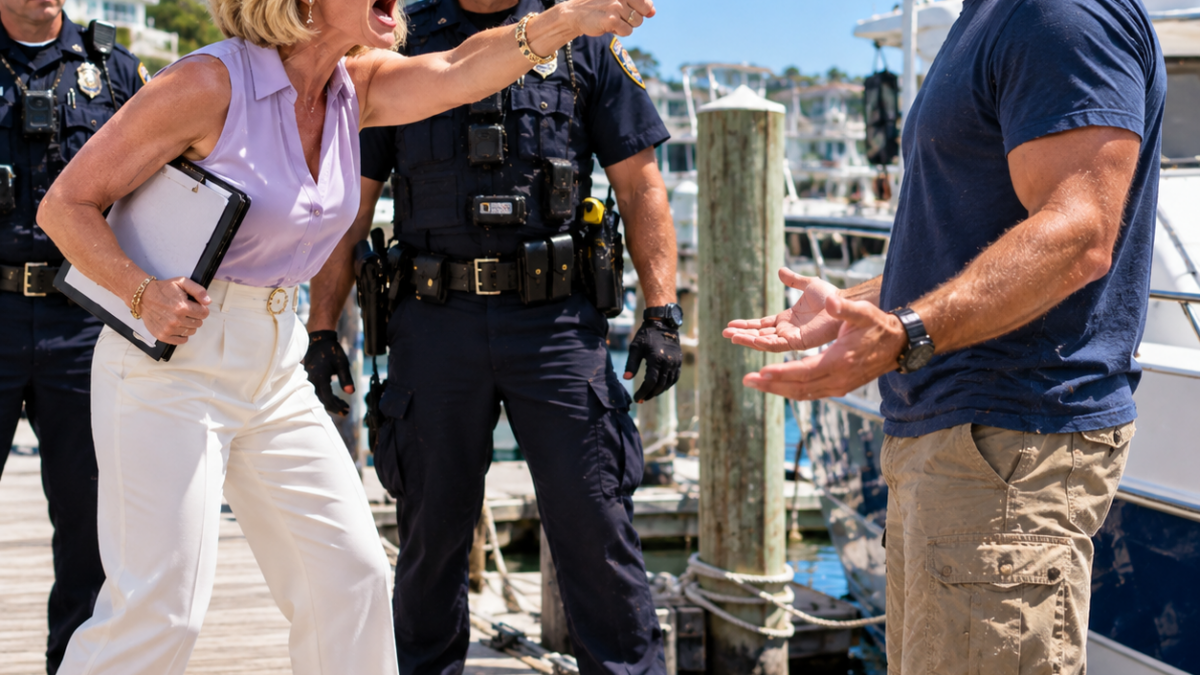
I first saw her standing by the gate to my dock on a bright morning when I was inside the old office-turned-house trying to make myself something that almost qualified as breakfast. Through the window, I noticed a woman in white pants, a pale blue blouse, and oversized sunglasses standing at the gate like she expected the gate to apologize for being closed.
She was in her late forties, maybe early fifties, with a sharp blonde bob cut just below her jaw and a posture that could turn a sidewalk into a boardroom. She held a leather folder against her chest. Her sandals had little gold buckles. Her nails were coral pink. Everything about her looked expensive, arranged, and deeply uncomfortable near actual marina dirt.
She called out, “Excuse me?”
I considered pretending not to hear her.
Instead, because I was raised with manners that have caused me nothing but trouble, I went outside and tried to look presentable. In hindsight, I regret wasting even that much effort.
“Can I help you?” I asked.
She pointed toward my new boat. “Is that yours?”
“Yes.”
“And this dock?”
“Also mine.”
“And the land?”
I looked down at the boards under my feet, then back at her. “Mine too.”
Her smile did not change, but something behind it tightened.
“I’m Karen Whitcomb,” she said. “President of the Bayview Pointe Homeowners Association.”
Of course she was.
Some women introduce themselves. Karen announced a jurisdiction.
“I’m not in your HOA,” I said, because experience had taught me to save time.
Her smile sharpened. “That is actually what I wanted to discuss.”
“No.”
Her eyebrows lifted. “Excuse me?”
“No, if this is about me joining anything.”
“It is about your boat.”
I glanced at it. The boat sat where it belonged, tied cleanly, sun catching the windshield, hull rocking gently with the water.
“What about it?”
“It is causing concern.”
“To who?”
“To residents.”
“What kind of concern?”
Karen looked past me toward the row of Bayview houses rising behind the landscaped slope. “It is highly visible from several homes and from the walking path. It appears out of place.”
I waited for the punchline.
None came.
“It’s a boat,” I said. “At a marina.”
“It is not in keeping with the aesthetic standards of Bayview Pointe.”
“This is not Bayview Pointe.”
“We all share this waterfront.”
“No,” I said. “We all look at the same water. That is different.”
Her jaw flexed.
“The boat is blocking views.”
“It’s docked at a dock.”
“You need to move it.”
“No.”
She blinked again, as if the word no had arrived without paperwork.
“Perhaps you do not understand. Bayview Pointe has bylaws governing visible watercraft.”
“Bayview Pointe can govern visible watercraft inside Bayview Pointe.”
“This affects our community.”
“This predates your community.”
She gave a small laugh, the kind people use when they want to signal patience they do not actually possess.
“Mr…?”
“Dawson.”
“Mr. Dawson, I am trying to be neighborly.”
“You’re standing at my dock telling me to move my boat.”
“I am informing you that failure to comply may result in fines.”
I looked at her for a long moment.
Then I pointed to the sign mounted beside the gate.
PRIVATE MARINA.
NO HOA ACCESS.
CUSTOMERS AND SLIP HOLDERS ONLY.
“I don’t know how to make it clearer than that.”
Karen glanced at the sign and dismissed it with her eyes.
“Signs do not override community standards.”
“They do when the sign is on private property that is not part of your community.”
Her smile disappeared.
“You’ll be hearing from us.”
“I can barely wait.”
She turned and walked away, heels clicking on the path like punctuation.
I watched her go and thought, Well, that was annoying.
I did not know yet that annoyance was the shallow end.
A few days later, two police officers came to the marina.
I was in the workshop replacing a fuel line when I saw the cruiser pull in. My first thought was that someone had gotten hurt on the road. My second was that one of my regulars had done something stupid with a trailer again. Police did not usually come to my property unless there was an accident, a drunk boater, or a missing kayak that turned out to be exactly where the owner left it.
The officers stepped out, polite but puzzled.
“Are you the owner?” one asked.
“Yes.”
“We got a report of a boat parked illegally on residential property.”
I looked past them at my dock.
At my boat.
At the marina sign.
“At the marina?” I asked.
The younger officer looked embarrassed already. “The caller said it violated HOA bylaws and was being stored on property connected to Bayview Pointe.”
I laughed before I could stop myself.
The older officer smiled slightly. “I take it that’s not accurate.”
“No. Not even close.”
I brought them into the office and showed them everything. Deed. Business license. Marina permits. Boat registration. Property map. The whole boring stack that keeps small businesses alive and bureaucrats from developing appetites.
They looked it over.
The older officer handed the papers back and said, “You’re good.”
“Figured.”
“Sorry for the inconvenience.”
“Was the caller Karen Whitcomb?”
He gave me a professional non-answer, which was answer enough.
“We’ll note that this is not HOA property,” he said.
They left.
I thought that would be the end of it.
That was the first time Karen made me feel stupid for underestimating her.
Over the next month, inspections started.
Not normal inspections. Not scheduled renewals. Surprise visits.
A county guy came because someone had reported improper fuel storage.
Everything was compliant.
A building inspector came because someone claimed I had constructed a dock without permits.
The dock had existed longer than Bayview Pointe.
A licensing officer came because someone alleged I was operating an unlicensed marina out of a residence.
My business license was current, framed, and hanging beside a photo of my grandfather holding a fish he swore was bigger before the picture.
A fire safety official came about hazardous materials.
A zoning representative came about commercial activity in a residential area.
One after another, people showed up with clipboards, forms, and that tone officials use when they expect trouble but hope for coffee. One by one, they left apologizing.
One even sighed and said, “You know, we’ve been getting a lot of calls about this place.”
“I can guess from who.”
He looked toward Bayview Pointe and said nothing.
That was irritating.
Then my customers started disappearing.
At first, I told myself it was seasonal. Weather had been strange. Fuel prices annoyed everyone. People got busy. One slow week did not mean anything. Two slow weeks meant I checked my books more often. By the third, I was walking the dock counting empty spaces and pretending not to worry.
A regular named Marlene finally told me what was happening.
She was in her sixties, owned a little fishing boat named Second Wind, and had been coming to our marina since my father still wore his old red cap every day. She found me standing by the fuel pump one afternoon and said, “You know they’re telling people not to come here, right?”
My stomach sank.
“Who?”
“That HOA woman.”
Karen.
Of course.
Marlene pulled out her phone and showed me an email forwarded from a friend inside Bayview Pointe. It warned residents and “community partners” that Dawson Marina was under investigation and that community members should avoid interacting with the business until safety and legal concerns were resolved. It mentioned unverified reports of improper licensing, structural issues, and unsafe dock access.
It was written carefully.
Just vague enough to sound responsible.
Just specific enough to scare people.
I read it twice.
My hands shook the second time.
“She sent this to residents?” I asked.
“And some slip holders, apparently. I got it from Janet, who got it from someone else. You know how emails travel.”
Unfortunately, I did.
Another regular told me Karen had described my marina as “a questionable business operating from a converted residence.” Someone else said she warned that my new boat was “the most visible symptom of broader noncompliance.” One man admitted he almost moved to another marina because his wife thought we might be shut down.
That was when irritation turned into anger.
Bothering me was one thing.
Sending inspectors was one thing.
Hurting my business was different.
My marina was not a hobby. It was not a cute backdrop for their walking path. It was my livelihood, my home, and my family’s work. Karen had stepped beyond being annoying and started cutting into money that paid bills.
Still, I hesitated.
I am not confrontational by nature. That surprises people because marina work can involve a lot of firm conversations, but there is a difference between telling a drunk man he cannot take his boat out and entering a legal fight with a rich HOA president who has time, resources, and an entire neighborhood email list.
I told myself she would get bored.
I told myself the inspectors had cleared me.
I told myself my regulars knew me.
I told myself the storm would pass.
Then people from Bayview Pointe started showing up at weird times.
Not customers.
Not regulars.
Residents.
They wandered near the dock gate and stared. They peered through fences. They asked questions that made no sense.
One man in expensive deck shoes came by on a Saturday morning while I was cleaning filters.
“I’m here for the kayak rack key,” he said.
I wiped my hands on a rag. “The what?”
“The kayak rack key.”
“I don’t have a kayak rack.”
His face shifted from annoyance to confusion. “It’s included in my HOA fees.”
“No, it isn’t.”
“Yes, it is. Marina access.”
I stared at him.
He stared back.
I explained that Dawson Marina was private property, not part of Bayview Pointe, and that I had no agreement with the HOA for kayak storage or access. He looked genuinely baffled, then embarrassed. He apologized and left.
Two days later, a woman appeared asking where residents were supposed to check in for their “community boating hours.”
The next week, a man came holding a printed receipt.
He had paid the HOA an extra fee to reserve a boat slip for the summer.
My boat slip.
He pointed at it like a man trying to understand a magic trick.
“They said this one was mine for July.”
“No,” I said, my voice going very still. “It is not.”
He showed me the receipt.
Bayview Pointe HOA.
Seasonal Marina Access Fee.
Slip Reservation: Dock A-3.
Dock A-3 was where my personal boat sat.
My boat.
My dock.
My marina.
That was when I realized Karen was not just trying to scare my customers away.
She was selling what she did not own.
I should have gone straight to a lawyer then.
I know that now.
But legal fees scared me. Small business owners understand that fear. Even when you are right, being right can cost more than you have. I thought maybe a cease-and-desist letter would be enough. Maybe an email with legal citations. Maybe a meeting with the board, if Karen had not poisoned them completely.
I was still trying to find the least explosive way out.
Then I lost a regular.
His name was Ted, and he had kept a small cruiser with us for years. One afternoon, he told me he would be moving to another marina at the end of the month.
I tried to keep my face neutral. “Can I ask why?”
He frowned. “Because you’re closing.”
“I’m what?”
“The HOA president emailed people saying this marina is being absorbed into Bayview Pointe and will be exclusive to residents. I figured you’d sold or something.”
For a second, I could not speak.
Ted saw my face and said, “You didn’t know.”
“No.”
He forwarded me the email.
There it was.
Karen claimed Dawson Marina was “transitioning” into a private amenity for Bayview Pointe homeowners and that nonresident users would no longer have access after the season. The email encouraged residents to contact the board about access packages, slip reservations, and “coastal maintenance contributions.”
I stood in my office and read it with a kind of cold disbelief.
Then I opened my laptop.
That was when the digging began.
I searched Bayview Pointe listings first, because something in Ted’s email made me wonder how far the lie had traveled. It took less than fifteen minutes to find the house ad.
Beautiful Bayview Pointe home with exclusive private marina access.
There was a photo beneath the description.
My dock.
Not a similar dock.
Mine.
Same weathered posts. Same fuel station in the background. Same blue storage box near the office. My new boat sat clearly visible in the shot, tied in its slip like it had agreed to participate in fraud.
I called the listing agent.
To her credit, she sounded confused rather than defensive.
“The HOA provided the amenity information,” she said. “They told us residents have access to the private marina.”
“They do not.”
“I’m sorry?”
“I own that marina. It is not part of Bayview Pointe. No one from the HOA has authority to advertise it as an amenity.”
There was silence.
Then she said, “I’ll remove that language immediately.”
“Please also remove the photo of my property.”
She did.
But the damage was already done.
After that, I stopped worrying about being dramatic.
I started building a file.
Emails from regulars.
Screenshots of newsletters.
Receipts from residents who had paid fake marina fees.
The house listing.
Statements from people Karen had misled.
Copies of inspection reports showing all complaints were unfounded.
Photos of my signage, property map, deed, and permits.
Then I needed HOA financial records, which were not public to me.
I got them from a resident named Paul, the man whose fake slip receipt I had seen. He was furious by then. Not at me. At the board. He had planned family visits around supposed marina access. He had paid fees. He had invited relatives. He had been made to look foolish.
“I’ll send what I have,” he said.
What he had made my stomach turn.
Screenshots from HOA budget summaries showing line items like “coastal maintenance,” “marina improvement,” and “dock access administration.” Hundreds of dollars here. Thousands there. Payments tied not to a marina vendor, not to my business, not to any real contractor.
Payments routed to Karen.
Not always directly labeled in a way a prosecutor would love at first glance, but obvious enough once you knew the marina did not belong to them.
I sat at my desk for a long time after printing everything.
The marina was quiet outside. Evening light moved across the water. A gull screamed from the roof because gulls are incapable of reading the room. My father’s old photo hung on the wall above the filing cabinet. In it, he stood beside my grandfather, both of them sunburned and smiling, the old marina sign behind them.
Don’t let anyone make it into something it isn’t.
I thought about emailing Karen.
I drafted it in my head. Attach the evidence. Tell her she had forty-eight hours to stop, refund everyone, resign, and send corrections, or I would expose her. A private resolution. A quiet exit. A way to end the bleeding without dragging the whole neighborhood into it.
Then I realized what that really was.
It was me giving Karen one more chance to control the story.
No.
She had called the police on me.
She had sent inspectors.
She had scared customers.
She had charged residents for access she could not sell.
She had used pictures of my property to increase home values and HOA revenue.
She had done all of it while smiling behind words like safety and community.
So I sent the entire packet to the state consumer protection agency.
Then I sent it to every Bayview Pointe board member whose email I could find.
Not just Karen.
All of them.
The subject line was simple:
Unauthorized Sale and Advertising of Private Marina Access
My message was shorter than the attachment list.
I own Dawson Marina. Bayview Pointe HOA has no ownership interest, easement, lease, access agreement, or management rights involving my property. Attached are documents showing that residents have been charged fees for access to my marina, that my property has been advertised as a Bayview Pointe amenity, and that false safety and licensing claims have been circulated to harm my business. I am requesting immediate correction, refunds to affected residents, preservation of all related records, and cessation of all unauthorized claims regarding my property.
Then I hit send.
My hands shook afterward.
Not because I regretted it.
Because I knew the quiet part was over.
The board reacted faster than I expected.
Within a day, two members replied separately. Their messages had the same tone: confusion turning into panic. One asked if I could confirm I had never signed any agreement with the HOA. Another asked whether Karen had ever contacted me about a lease arrangement. I answered clearly.
No.
No agreement.
No lease.
No authorization.
No access rights.
No permission to advertise my marina.
By the end of the week, Bayview Pointe held an emergency meeting.
Karen did not attend.
That alone told everyone plenty.
Residents packed the clubhouse, according to Paul, who called me afterward sounding equal parts angry and energized. People demanded answers. Some had paid access fees. Some had bought homes believing the marina was part of the neighborhood. Some had invited guests, planned summers, or bragged to relatives about boat slips that never existed.
The board claimed they had no knowledge of Karen’s personal handling of the marina-related funds.
Maybe that was true.
Maybe it was convenient.
I did not care much which.
What mattered was that the lie could no longer stand.
A few days later, a FOR SALE sign appeared in Karen’s yard.
I saw it when I drove past Bayview Pointe to pick up parts in town. Her house sat near the front of the development, all pale stone and manicured shrubs. The sign was crisp and new. For a moment, I just slowed down and stared.
Then I laughed.
Not loudly.
Not kindly either.
Karen moved out not long after.
The HOA sent a message to residents acknowledging “financial irregularities” related to marina access fees. They announced refunds for anyone who had paid unauthorized charges. They clarified that Dawson Marina was privately owned and not an HOA amenity. They did not name Karen in the first email, but they did not need to. Everyone knew.
The county started looking into the money.
Then, from what I heard, the matter went to people with prosecutor in their job title. I was not privy to every step after that. Investigations move slowly, and I learned not to expect movie endings from government agencies. But Karen’s reputation was done. Her credibility was gone. Her place in Bayview Pointe collapsed so fast it was almost impressive.
Residents came by to apologize.
Some were sincere.
Some were embarrassed.
Some were angry at me in the strange way people get angry at the person who proves they were fooled.
Paul came in person with a folder of his own records and stood by the dock, staring at the water.
“I feel stupid,” he said.
“You believed what your HOA president told you.”
“Still.”
“Yeah,” I said. “Still.”
He looked toward the slip where my boat rocked gently.
“My brother was flying in with his kids. I told them we had marina access. I reserved that slip.” He shook his head. “My wife bought boat shoes.”
That startled a laugh out of me.
He laughed too, but his eyes were tired.
“Sorry,” I said.
“No, it’s ridiculous. That’s why it hurts.”
I understood that.
Fraud does not only take money.
It makes people feel foolish for trusting what should have been trustworthy.
The new board reached out to me about a month later.
Very politely.
Painfully politely.
They asked if I would be willing to discuss a legitimate agreement allowing a limited number of residents to rent slips through proper channels. No claims of ownership. No fake amenities. No exclusive access. Just a written arrangement between my marina and individual residents, with the HOA helping communicate availability.
My first instinct was to say no.
A loud no.
A satisfying no.
A no that carried every inspection, every lost customer, every fake newsletter, every receipt for my stolen dock.
But Karen was gone.
The new board had refunded residents.
The marina needed business.
And my father’s voice, practical as ever, reminded me not to punish paying customers for one woman’s fraud if the terms protected me.
So I met with them.
Not at their clubhouse.
At my marina.
My table.
My coffee.
My property.
They came with a lawyer, which I appreciated because it meant everyone understood paper mattered now. We worked out a limited rental process. Residents could apply like anyone else. I controlled availability. Payments went to Dawson Marina. Rules came from Dawson Marina. The HOA could share information but could not sell, promise, reserve, advertise, imply, suggest, hint, whisper, or dream access without my written approval.
The lawyer smiled when I insisted on including “imply.”
I did not smile back.
We signed.
It has worked fine since.
That is the funny part.
If Karen had simply come to me at the beginning and asked like a normal human being, we might have built something useful. A few resident slips. A little extra business for me. A real perk for them. Clear agreements. Everybody happy.
But people like Karen do not ask when they think they can claim.
She saw my marina and decided it solved a problem for her. Bayview Pointe wanted waterfront prestige. Their homes wanted better listings. Their residents wanted amenities. Karen wanted money and status. My family’s marina was right there, small enough that she thought I would be easy to pressure, old enough that she thought she could rewrite its place in the neighborhood story.
She mistook quiet for weak.
That is a common mistake around people who live by the water.
Quiet does not mean empty.
Sometimes quiet means deep.
Things are peaceful now.
Mostly.
Peace at a marina is relative. There is always something breaking, leaking, rotting, clogging, or being decorated by seagulls with biological enthusiasm. My boat still sits in the same slip behind my home. I still wake early, drink coffee on the dock, and inspect lines before storms. I still scrape gull droppings off the deck while questioning every life choice that led me to that moment.
Some Bayview Pointe residents rent from me now.
Properly.
With contracts.
A few have become good customers. One older couple brings me muffins every Friday even though I told them once that baked goods are not a recognized marine currency. Paul eventually did get a legitimate slip, though not mine. His wife wears the boat shoes without shame.
Sometimes I see residents walking along the path stop and look toward my marina. Maybe they are remembering the scandal. Maybe they are deciding whether to rent a slip. Maybe they are just looking at the water because, to be fair, the water is worth looking at.
I like to believe some of them see my boat and remember that not everything beautiful near their neighborhood belongs to them.
That is sentimental of me.
I allow myself sentiment before nine in the morning.
The old marina sign still hangs near the office, repainted but original. Dawson Marina. My grandfather helped build it. My father maintained it. I keep it up because some things should survive people trying to rename them for convenience.
A few months after Karen left, my father came by for coffee.
He moves slower now. Retirement did not make him softer, but it did make him more willing to sit. We stood on the dock, watching a customer struggle to back a trailer with the confidence of a man about to damage both pride and fiberglass.
Dad nodded toward Bayview Pointe.
“Heard you had some trouble.”
“That’s one way to describe fraud.”
He grunted.
That was Dad’s version of sympathy.
I told him the whole story. The boat complaint. The police. The inspectors. The newsletters. The fake fees. The house listing with my dock in the photo. The evidence packet. Karen vanishing. The new agreement.
He listened without interrupting.
When I finished, he looked at my boat.
“Nice boat,” he said.
“You already inspected it.”
“Still nice.”
I waited.
He looked down at the dock boards, then out over the slips, then back toward the office where I lived now.
“You did right,” he said.
That was all.
It was enough.
Later, after he left, I sat on the edge of the dock with my feet hanging over the water. The afternoon sun hit the marina in that golden way that makes even old fuel pumps look nostalgic. A breeze moved through the rigging. Somewhere behind me, Bayview Pointe sprinklers ticked in perfect rhythm over lawns that never got too tall.
I thought about how close I had come to staying quiet.
How easy it would have been to hope Karen stopped.
How tempting it was to avoid conflict when conflict threatened to become expensive, public, and exhausting.
But quiet would not have protected me.
It would have helped her.
That is something I have had to learn more than once in life. Keeping peace with someone who is stealing from you is not peace. It is cooperation. Karen was not confused. She did not misunderstand a boundary. She did not make one bad assumption and correct it when shown facts. She ignored facts because the lie paid better.
She called the cops over my boat.
Then sold my dock.
Then warned people my business was unsafe while charging them fake fees to access it.
That is not neighbor drama.
That is a scheme.
And schemes survive only until enough light reaches them.
My marina is not huge. It is not fancy. It will never appear in luxury magazines unless the article is about places that smell faintly like diesel and stubbornness. But it is real. It has deeds, permits, history, weather stains, family fingerprints, and customers who know where to find me if the pump acts up.
Karen tried to make it into an HOA amenity.
She failed.
Now, when I walk past my boat in the morning, I sometimes touch the rail just because I can. It is still there. My dock. My slip. My marina. My life, not as large or glamorous as Bayview Pointe’s brochures wanted, but honest in a way Karen never understood.
The water does not care who has a clipboard.
The dock does not care who chairs a board.
And ownership, real ownership, is not created by newsletters, rumors, fake fees, or a woman in sunglasses pointing at a view and saying, “We all share this.”
No, Karen.
We do not.
Some things can be shared by agreement.
Some things can be rented with a contract.
Some things can be admired from a distance.
But not everything within sight is yours.
That was the lesson.
It cost her a house, a title, and probably much more once the county finished looking through the money.
It cost me sleep, customers, legal nerves, and a month of feeling like my family’s business was being slowly stolen in broad daylight.
But in the end, the marina stayed what it had always been.
Small.
Stubborn.
Private.
Mine.
And every morning, when the sun comes up over the water and my boat rocks gently in the slip Karen tried to sell to someone else, I drink my coffee, listen to the gulls scream like unpaid lawyers, and feel the deepest satisfaction a quiet man can feel.
The dock is still here.
So am I.
𝗧𝗛𝗘 𝗘𝗡𝗗
The HOA President Called the Police on My Boat, Not Realizing I Owned the Marina Beneath It
Karen thought my dock was part of her neighborhood because her brochures needed it to be.
By the time I found out she was selling access to my marina behind my back, the police call about my boat was the smallest lie she had told.
I love boats.
That is not the kind of thing I say casually, like some people say they love coffee or old movies or dogs in sweaters. Boats are stitched into the earliest parts of my memory. I grew up around the smell of lake water, fuel, old rope, sun-warmed wood, and engine grease. I knew the sound of a tired outboard coughing itself awake before I knew how to spell half the words my teachers wanted me to learn. I could tie a bowline before I could write in cursive. My father used to joke that I learned dock lines before shoelaces, and honestly, he was probably right.
My family ran a marina for decades.
Not one of those sleek luxury places with champagne events and polished teak decks. Ours was small, practical, and a little weather-beaten in the way honest waterfront businesses tend to be. We had slips for local fishermen, weekend boaters, a few retired guys who loved their vessels like grandchildren, and families who came every summer with coolers, towels, sunscreen, and arguments about who forgot the life jackets. There was a tiny fuel station, a workshop that always smelled like oil and sawdust, and a main office with a coffee pot that had probably violated several health codes by the time I was ten.
As a kid, I abused every boating privilege available to me.
If there was a boat being moved, I wanted to ride in it. If there was a rope to coil, I turned it into a snake first. If my father patched a leak, I was beside him asking too many questions. If my uncle had time to run out along the lake, I climbed in before anyone could tell me no. I was a menace, but I was a useful menace. My dad made sure of that.
He believed there was no such thing as “just hanging around” a marina.
If I was there, I worked.
I swept docks, carried tools, wiped seats, helped patch fiberglass, learned basic engine repair, checked lines before storms, and ran messages between adults who were too busy to walk twenty feet. By high school, I could fix small engines better than some grown men who liked to pretend they knew what they were doing. I knew which regulars tipped, which ones lied about damage, and which ones would spend three hours complaining about fuel prices before buying exactly the same amount.
The marina was family.
Not metaphorically.
Literally.
My aunt handled receipts for years. My uncle did repairs. My cousin worked summers at the fuel dock. My grandmother sat in the office on weekends and acted like she was only visiting, even though everyone knew she was really making sure nobody overcharged or underpaid. The business was small, but it fed us, shaped us, and gave our family a place that felt more permanent than any house ever did.
Eventually, my father retired and passed the marina down to me.
Legally, it had always been his. Spiritually, it had always belonged to all of us. But when he finally admitted his knees were bad enough and his patience was thin enough, he signed the papers, handed me the keys, and said, “Don’t let anyone make it into something it isn’t.”
At the time, I did not understand how important that sentence would become.
For a while, I tried living away from the coast.
I went to college far enough inland that the air felt wrong. I worked a desk job for about a year after that, sitting under fluorescent lights, answering emails, wearing shoes that never got wet unless it rained. It was fine. That was the worst part. Not terrible. Not dramatic. Just fine. I made decent money and hated how clean my hands stayed.
I missed the marina more than I expected.
I missed the gulls screaming like criminals. I missed the old dock boards shifting under my feet. I missed customers who knew me by name and engines that made more sense than office politics. So I came home.
By then, the marina was smaller than it had been when I was a kid. Many of the family members who once worked there had retired or moved away, and I never had the heart to replace all of them with strangers. Maybe that was bad business. Maybe a sharper person would have expanded, modernized, hired aggressively, and turned the place into something glossy.
I did not want glossy.
I wanted mine.
So the marina settled into a simpler version of itself. About twenty boat slips. A little fuel station. A few short-term spaces for people passing through. A workshop. The office, which I eventually converted into my home because downsizing made the space unnecessary and because living right there by the water made me happier than any suburban house ever could.
I woke up to lake light through old windows.
I drank coffee on the dock.
I knew every regular by boat, truck, and complaint.
It was not rich living, but it was good living.
Then the fancy neighborhood next door started acting like my life was a feature in their brochure.
part2
The neighborhood was called Bayview Pointe, which annoyed me from the start because most of the houses did not have a real bay view unless you stood on the second floor, leaned over a balcony, and ignored my marina in the foreground.
It was one of those wealthy waterfront-adjacent developments where everything looked tasteful in the same expensive way. Stone entrances. Decorative lanterns. Matching mailboxes. Wide driveways. Landscaping that seemed designed by someone who believed nature should behave like a hotel lobby. Every house looked different enough to claim individuality and similar enough to reassure people that no one was doing anything weird with paint.
Of course, there was an HOA.
There is always an HOA.
Bayview Pointe came after the marina. Long after. My family’s property existed before their roads, before their gate signs, before their clubhouse, before any committee started deciding what color beige counted as coastal neutral. Our land was separate. Our zoning was separate. Our business license was separate. We were not part of their association, never had been, and never would be.
For years, that mostly did not matter.
A few residents rented slips from me properly. Some bought fuel. Some walked by and waved. Some complained about gulls as if I had trained them personally. But the relationship stayed harmless enough.
Then I bought the boat.
My old personal boat had been with me too long. That was the problem. Sentiment can turn into denial if you let it. She had leaks I kept patching, engine noises I kept pretending were “personality,” and a steering issue that made every turn feel like a negotiation. I loved that boat because she had carried me through half my life, but love does not keep you from getting stranded.
So earlier that year, I finally did what I had been putting off.
I saved up and bought a clean, reliable personal boat.
Nothing outrageous. Nothing designed to impress rich people. Just a solid, sharp-looking vessel that started when it should, handled well, and did not sound like it was digesting gravel when I turned the engine. To me, it was beautiful. To my father, who came by to inspect it with the seriousness of a man judging livestock, it was “decent enough,” which from him counted as poetry.
I parked it in the same spot I had always used.
My dock.
My slip.
Behind my home.
On land I owned.
That should have been the end of the story.
Then Karen appeared.
I first saw her standing by the gate to my dock on a bright morning when I was inside the old office-turned-house trying to make myself something that almost qualified as breakfast. Through the window, I noticed a woman in white pants, a pale blue blouse, and oversized sunglasses standing at the gate like she expected the gate to apologize for being closed.
She was in her late forties, maybe early fifties, with a sharp blonde bob cut just below her jaw and a posture that could turn a sidewalk into a boardroom. She held a leather folder against her chest. Her sandals had little gold buckles. Her nails were coral pink. Everything about her looked expensive, arranged, and deeply uncomfortable near actual marina dirt.
She called out, “Excuse me?”
I considered pretending not to hear her.
Instead, because I was raised with manners that have caused me nothing but trouble, I went outside and tried to look presentable. In hindsight, I regret wasting even that much effort.
“Can I help you?” I asked.
She pointed toward my new boat. “Is that yours?”
“Yes.”
“And this dock?”
“Also mine.”
“And the land?”
I looked down at the boards under my feet, then back at her. “Mine too.”
Her smile did not change, but something behind it tightened.
“I’m Karen Whitcomb,” she said. “President of the Bayview Pointe Homeowners Association.”
Of course she was.
Some women introduce themselves. Karen announced a jurisdiction.
“I’m not in your HOA,” I said, because experience had taught me to save time.
Her smile sharpened. “That is actually what I wanted to discuss.”
“No.”
Her eyebrows lifted. “Excuse me?”
“No, if this is about me joining anything.”
“It is about your boat.”
I glanced at it. The boat sat where it belonged, tied cleanly, sun catching the windshield, hull rocking gently with the water.
“What about it?”
“It is causing concern.”
“To who?”
“To residents.”
“What kind of concern?”
Karen looked past me toward the row of Bayview houses rising behind the landscaped slope. “It is highly visible from several homes and from the walking path. It appears out of place.”
I waited for the punchline.
None came.
“It’s a boat,” I said. “At a marina.”
“It is not in keeping with the aesthetic standards of Bayview Pointe.”
“This is not Bayview Pointe.”
“We all share this waterfront.”
“No,” I said. “We all look at the same water. That is different.”
Her jaw flexed.
“The boat is blocking views.”
“It’s docked at a dock.”
“You need to move it.”
“No.”
She blinked again, as if the word no had arrived without paperwork.
“Perhaps you do not understand. Bayview Pointe has bylaws governing visible watercraft.”
“Bayview Pointe can govern visible watercraft inside Bayview Pointe.”
“This affects our community.”
“This predates your community.”
She gave a small laugh, the kind people use when they want to signal patience they do not actually possess.
“Mr…?”
“Dawson.”
“Mr. Dawson, I am trying to be neighborly.”
“You’re standing at my dock telling me to move my boat.”
“I am informing you that failure to comply may result in fines.”
I looked at her for a long moment.
Then I pointed to the sign mounted beside the gate.
PRIVATE MARINA.
NO HOA ACCESS.
CUSTOMERS AND SLIP HOLDERS ONLY.
“I don’t know how to make it clearer than that.”
Karen glanced at the sign and dismissed it with her eyes.
“Signs do not override community standards.”
“They do when the sign is on private property that is not part of your community.”
Her smile disappeared.
“You’ll be hearing from us.”
“I can barely wait.”
She turned and walked away, heels clicking on the path like punctuation.
I watched her go and thought, Well, that was annoying.
I did not know yet that annoyance was the shallow end.
A few days later, two police officers came to the marina.
I was in the workshop replacing a fuel line when I saw the cruiser pull in. My first thought was that someone had gotten hurt on the road. My second was that one of my regulars had done something stupid with a trailer again. Police did not usually come to my property unless there was an accident, a drunk boater, or a missing kayak that turned out to be exactly where the owner left it.
The officers stepped out, polite but puzzled.
“Are you the owner?” one asked.
“Yes.”
“We got a report of a boat parked illegally on residential property.”
I looked past them at my dock.
At my boat.
At the marina sign.
“At the marina?” I asked.
The younger officer looked embarrassed already. “The caller said it violated HOA bylaws and was being stored on property connected to Bayview Pointe.”
I laughed before I could stop myself.
The older officer smiled slightly. “I take it that’s not accurate.”
“No. Not even close.”
I brought them into the office and showed them everything. Deed. Business license. Marina permits. Boat registration. Property map. The whole boring stack that keeps small businesses alive and bureaucrats from developing appetites.
They looked it over.
The older officer handed the papers back and said, “You’re good.”
“Figured.”
“Sorry for the inconvenience.”
“Was the caller Karen Whitcomb?”
He gave me a professional non-answer, which was answer enough.
“We’ll note that this is not HOA property,” he said.
They left.
I thought that would be the end of it.
That was the first time Karen made me feel stupid for underestimating her.
Over the next month, inspections started.
Not normal inspections. Not scheduled renewals. Surprise visits.
A county guy came because someone had reported improper fuel storage.
Everything was compliant.
A building inspector came because someone claimed I had constructed a dock without permits.
The dock had existed longer than Bayview Pointe.
A licensing officer came because someone alleged I was operating an unlicensed marina out of a residence.
My business license was current, framed, and hanging beside a photo of my grandfather holding a fish he swore was bigger before the picture.
A fire safety official came about hazardous materials.
A zoning representative came about commercial activity in a residential area.
One after another, people showed up with clipboards, forms, and that tone officials use when they expect trouble but hope for coffee. One by one, they left apologizing.
One even sighed and said, “You know, we’ve been getting a lot of calls about this place.”
“I can guess from who.”
He looked toward Bayview Pointe and said nothing.
That was irritating.
Then my customers started disappearing.
At first, I told myself it was seasonal. Weather had been strange. Fuel prices annoyed everyone. People got busy. One slow week did not mean anything. Two slow weeks meant I checked my books more often. By the third, I was walking the dock counting empty spaces and pretending not to worry.
A regular named Marlene finally told me what was happening.
She was in her sixties, owned a little fishing boat named Second Wind, and had been coming to our marina since my father still wore his old red cap every day. She found me standing by the fuel pump one afternoon and said, “You know they’re telling people not to come here, right?”
My stomach sank.
“Who?”
“That HOA woman.”
Karen.
Of course.
Marlene pulled out her phone and showed me an email forwarded from a friend inside Bayview Pointe. It warned residents and “community partners” that Dawson Marina was under investigation and that community members should avoid interacting with the business until safety and legal concerns were resolved. It mentioned unverified reports of improper licensing, structural issues, and unsafe dock access.
It was written carefully.
Just vague enough to sound responsible.
Just specific enough to scare people.
I read it twice.
My hands shook the second time.
“She sent this to residents?” I asked.
“And some slip holders, apparently. I got it from Janet, who got it from someone else. You know how emails travel.”
Unfortunately, I did.
Another regular told me Karen had described my marina as “a questionable business operating from a converted residence.” Someone else said she warned that my new boat was “the most visible symptom of broader noncompliance.” One man admitted he almost moved to another marina because his wife thought we might be shut down.
That was when irritation turned into anger.
Bothering me was one thing.
Sending inspectors was one thing.
Hurting my business was different.
My marina was not a hobby. It was not a cute backdrop for their walking path. It was my livelihood, my home, and my family’s work. Karen had stepped beyond being annoying and started cutting into money that paid bills.
Still, I hesitated.
I am not confrontational by nature. That surprises people because marina work can involve a lot of firm conversations, but there is a difference between telling a drunk man he cannot take his boat out and entering a legal fight with a rich HOA president who has time, resources, and an entire neighborhood email list.
I told myself she would get bored.
I told myself the inspectors had cleared me.
I told myself my regulars knew me.
I told myself the storm would pass.
Then people from Bayview Pointe started showing up at weird times.
Not customers.
Not regulars.
Residents.
They wandered near the dock gate and stared. They peered through fences. They asked questions that made no sense.
One man in expensive deck shoes came by on a Saturday morning while I was cleaning filters.
“I’m here for the kayak rack key,” he said.
I wiped my hands on a rag. “The what?”
“The kayak rack key.”
“I don’t have a kayak rack.”
His face shifted from annoyance to confusion. “It’s included in my HOA fees.”
“No, it isn’t.”
“Yes, it is. Marina access.”
I stared at him.
He stared back.
I explained that Dawson Marina was private property, not part of Bayview Pointe, and that I had no agreement with the HOA for kayak storage or access. He looked genuinely baffled, then embarrassed. He apologized and left.
Two days later, a woman appeared asking where residents were supposed to check in for their “community boating hours.”
The next week, a man came holding a printed receipt.
He had paid the HOA an extra fee to reserve a boat slip for the summer.
My boat slip.
He pointed at it like a man trying to understand a magic trick.
“They said this one was mine for July.”
“No,” I said, my voice going very still. “It is not.”
He showed me the receipt.
Bayview Pointe HOA.
Seasonal Marina Access Fee.
Slip Reservation: Dock A-3.
Dock A-3 was where my personal boat sat.
My boat.
My dock.
My marina.
That was when I realized Karen was not just trying to scare my customers away.
She was selling what she did not own.
I should have gone straight to a lawyer then.
I know that now.
But legal fees scared me. Small business owners understand that fear. Even when you are right, being right can cost more than you have. I thought maybe a cease-and-desist letter would be enough. Maybe an email with legal citations. Maybe a meeting with the board, if Karen had not poisoned them completely.
I was still trying to find the least explosive way out.
Then I lost a regular.
His name was Ted, and he had kept a small cruiser with us for years. One afternoon, he told me he would be moving to another marina at the end of the month.
I tried to keep my face neutral. “Can I ask why?”
He frowned. “Because you’re closing.”
“I’m what?”
“The HOA president emailed people saying this marina is being absorbed into Bayview Pointe and will be exclusive to residents. I figured you’d sold or something.”
For a second, I could not speak.
Ted saw my face and said, “You didn’t know.”
“No.”
He forwarded me the email.
There it was.
Karen claimed Dawson Marina was “transitioning” into a private amenity for Bayview Pointe homeowners and that nonresident users would no longer have access after the season. The email encouraged residents to contact the board about access packages, slip reservations, and “coastal maintenance contributions.”
I stood in my office and read it with a kind of cold disbelief.
Then I opened my laptop.
That was when the digging began.
I searched Bayview Pointe listings first, because something in Ted’s email made me wonder how far the lie had traveled. It took less than fifteen minutes to find the house ad.
Beautiful Bayview Pointe home with exclusive private marina access.
There was a photo beneath the description.
My dock.
Not a similar dock.
Mine.
Same weathered posts. Same fuel station in the background. Same blue storage box near the office. My new boat sat clearly visible in the shot, tied in its slip like it had agreed to participate in fraud.
I called the listing agent.
To her credit, she sounded confused rather than defensive.
“The HOA provided the amenity information,” she said. “They told us residents have access to the private marina.”
“They do not.”
“I’m sorry?”
“I own that marina. It is not part of Bayview Pointe. No one from the HOA has authority to advertise it as an amenity.”
There was silence.
Then she said, “I’ll remove that language immediately.”
“Please also remove the photo of my property.”
She did.
But the damage was already done.
After that, I stopped worrying about being dramatic.
I started building a file.
Emails from regulars.
Screenshots of newsletters.
Receipts from residents who had paid fake marina fees.
The house listing.
Statements from people Karen had misled.
Copies of inspection reports showing all complaints were unfounded.
Photos of my signage, property map, deed, and permits.
Then I needed HOA financial records, which were not public to me.
I got them from a resident named Paul, the man whose fake slip receipt I had seen. He was furious by then. Not at me. At the board. He had planned family visits around supposed marina access. He had paid fees. He had invited relatives. He had been made to look foolish.
“I’ll send what I have,” he said.
What he had made my stomach turn.
Screenshots from HOA budget summaries showing line items like “coastal maintenance,” “marina improvement,” and “dock access administration.” Hundreds of dollars here. Thousands there. Payments tied not to a marina vendor, not to my business, not to any real contractor.
Payments routed to Karen.
Not always directly labeled in a way a prosecutor would love at first glance, but obvious enough once you knew the marina did not belong to them.
I sat at my desk for a long time after printing everything.
The marina was quiet outside. Evening light moved across the water. A gull screamed from the roof because gulls are incapable of reading the room. My father’s old photo hung on the wall above the filing cabinet. In it, he stood beside my grandfather, both of them sunburned and smiling, the old marina sign behind them.
Don’t let anyone make it into something it isn’t.
I thought about emailing Karen.
I drafted it in my head. Attach the evidence. Tell her she had forty-eight hours to stop, refund everyone, resign, and send corrections, or I would expose her. A private resolution. A quiet exit. A way to end the bleeding without dragging the whole neighborhood into it.
Then I realized what that really was.
It was me giving Karen one more chance to control the story.
No.
She had called the police on me.
She had sent inspectors.
She had scared customers.
She had charged residents for access she could not sell.
She had used pictures of my property to increase home values and HOA revenue.
She had done all of it while smiling behind words like safety and community.
So I sent the entire packet to the state consumer protection agency.
Then I sent it to every Bayview Pointe board member whose email I could find.
Not just Karen.
All of them.
The subject line was simple:
Unauthorized Sale and Advertising of Private Marina Access
My message was shorter than the attachment list.
I own Dawson Marina. Bayview Pointe HOA has no ownership interest, easement, lease, access agreement, or management rights involving my property. Attached are documents showing that residents have been charged fees for access to my marina, that my property has been advertised as a Bayview Pointe amenity, and that false safety and licensing claims have been circulated to harm my business. I am requesting immediate correction, refunds to affected residents, preservation of all related records, and cessation of all unauthorized claims regarding my property.
Then I hit send.
My hands shook afterward.
Not because I regretted it.
Because I knew the quiet part was over.
The board reacted faster than I expected.
Within a day, two members replied separately. Their messages had the same tone: confusion turning into panic. One asked if I could confirm I had never signed any agreement with the HOA. Another asked whether Karen had ever contacted me about a lease arrangement. I answered clearly.
No.
No agreement.
No lease.
No authorization.
No access rights.
No permission to advertise my marina.
By the end of the week, Bayview Pointe held an emergency meeting.
Karen did not attend.
That alone told everyone plenty.
Residents packed the clubhouse, according to Paul, who called me afterward sounding equal parts angry and energized. People demanded answers. Some had paid access fees. Some had bought homes believing the marina was part of the neighborhood. Some had invited guests, planned summers, or bragged to relatives about boat slips that never existed.
The board claimed they had no knowledge of Karen’s personal handling of the marina-related funds.
Maybe that was true.
Maybe it was convenient.
I did not care much which.
What mattered was that the lie could no longer stand.
A few days later, a FOR SALE sign appeared in Karen’s yard.
I saw it when I drove past Bayview Pointe to pick up parts in town. Her house sat near the front of the development, all pale stone and manicured shrubs. The sign was crisp and new. For a moment, I just slowed down and stared.
Then I laughed.
Not loudly.
Not kindly either.
Karen moved out not long after.
The HOA sent a message to residents acknowledging “financial irregularities” related to marina access fees. They announced refunds for anyone who had paid unauthorized charges. They clarified that Dawson Marina was privately owned and not an HOA amenity. They did not name Karen in the first email, but they did not need to. Everyone knew.
The county started looking into the money.
Then, from what I heard, the matter went to people with prosecutor in their job title. I was not privy to every step after that. Investigations move slowly, and I learned not to expect movie endings from government agencies. But Karen’s reputation was done. Her credibility was gone. Her place in Bayview Pointe collapsed so fast it was almost impressive.
Residents came by to apologize.
Some were sincere.
Some were embarrassed.
Some were angry at me in the strange way people get angry at the person who proves they were fooled.
Paul came in person with a folder of his own records and stood by the dock, staring at the water.
“I feel stupid,” he said.
“You believed what your HOA president told you.”
“Still.”
“Yeah,” I said. “Still.”
He looked toward the slip where my boat rocked gently.
“My brother was flying in with his kids. I told them we had marina access. I reserved that slip.” He shook his head. “My wife bought boat shoes.”
That startled a laugh out of me.
He laughed too, but his eyes were tired.
“Sorry,” I said.
“No, it’s ridiculous. That’s why it hurts.”
I understood that.
Fraud does not only take money.
It makes people feel foolish for trusting what should have been trustworthy.
The new board reached out to me about a month later.
Very politely.
Painfully politely.
They asked if I would be willing to discuss a legitimate agreement allowing a limited number of residents to rent slips through proper channels. No claims of ownership. No fake amenities. No exclusive access. Just a written arrangement between my marina and individual residents, with the HOA helping communicate availability.
My first instinct was to say no.
A loud no.
A satisfying no.
A no that carried every inspection, every lost customer, every fake newsletter, every receipt for my stolen dock.
But Karen was gone.
The new board had refunded residents.
The marina needed business.
And my father’s voice, practical as ever, reminded me not to punish paying customers for one woman’s fraud if the terms protected me.
So I met with them.
Not at their clubhouse.
At my marina.
My table.
My coffee.
My property.
They came with a lawyer, which I appreciated because it meant everyone understood paper mattered now. We worked out a limited rental process. Residents could apply like anyone else. I controlled availability. Payments went to Dawson Marina. Rules came from Dawson Marina. The HOA could share information but could not sell, promise, reserve, advertise, imply, suggest, hint, whisper, or dream access without my written approval.
The lawyer smiled when I insisted on including “imply.”
I did not smile back.
We signed.
It has worked fine since.
That is the funny part.
If Karen had simply come to me at the beginning and asked like a normal human being, we might have built something useful. A few resident slips. A little extra business for me. A real perk for them. Clear agreements. Everybody happy.
But people like Karen do not ask when they think they can claim.
She saw my marina and decided it solved a problem for her. Bayview Pointe wanted waterfront prestige. Their homes wanted better listings. Their residents wanted amenities. Karen wanted money and status. My family’s marina was right there, small enough that she thought I would be easy to pressure, old enough that she thought she could rewrite its place in the neighborhood story.
She mistook quiet for weak.
That is a common mistake around people who live by the water.
Quiet does not mean empty.
Sometimes quiet means deep.
Things are peaceful now.
Mostly.
Peace at a marina is relative. There is always something breaking, leaking, rotting, clogging, or being decorated by seagulls with biological enthusiasm. My boat still sits in the same slip behind my home. I still wake early, drink coffee on the dock, and inspect lines before storms. I still scrape gull droppings off the deck while questioning every life choice that led me to that moment.
Some Bayview Pointe residents rent from me now.
Properly.
With contracts.
A few have become good customers. One older couple brings me muffins every Friday even though I told them once that baked goods are not a recognized marine currency. Paul eventually did get a legitimate slip, though not mine. His wife wears the boat shoes without shame.
Sometimes I see residents walking along the path stop and look toward my marina. Maybe they are remembering the scandal. Maybe they are deciding whether to rent a slip. Maybe they are just looking at the water because, to be fair, the water is worth looking at.
I like to believe some of them see my boat and remember that not everything beautiful near their neighborhood belongs to them.
That is sentimental of me.
I allow myself sentiment before nine in the morning.
The old marina sign still hangs near the office, repainted but original. Dawson Marina. My grandfather helped build it. My father maintained it. I keep it up because some things should survive people trying to rename them for convenience.
A few months after Karen left, my father came by for coffee.
He moves slower now. Retirement did not make him softer, but it did make him more willing to sit. We stood on the dock, watching a customer struggle to back a trailer with the confidence of a man about to damage both pride and fiberglass.
Dad nodded toward Bayview Pointe.
“Heard you had some trouble.”
“That’s one way to describe fraud.”
He grunted.
That was Dad’s version of sympathy.
I told him the whole story. The boat complaint. The police. The inspectors. The newsletters. The fake fees. The house listing with my dock in the photo. The evidence packet. Karen vanishing. The new agreement.
He listened without interrupting.
When I finished, he looked at my boat.
“Nice boat,” he said.
“You already inspected it.”
“Still nice.”
I waited.
He looked down at the dock boards, then out over the slips, then back toward the office where I lived now.
“You did right,” he said.
That was all.
It was enough.
Later, after he left, I sat on the edge of the dock with my feet hanging over the water. The afternoon sun hit the marina in that golden way that makes even old fuel pumps look nostalgic. A breeze moved through the rigging. Somewhere behind me, Bayview Pointe sprinklers ticked in perfect rhythm over lawns that never got too tall.
I thought about how close I had come to staying quiet.
How easy it would have been to hope Karen stopped.
How tempting it was to avoid conflict when conflict threatened to become expensive, public, and exhausting.
But quiet would not have protected me.
It would have helped her.
That is something I have had to learn more than once in life. Keeping peace with someone who is stealing from you is not peace. It is cooperation. Karen was not confused. She did not misunderstand a boundary. She did not make one bad assumption and correct it when shown facts. She ignored facts because the lie paid better.
She called the cops over my boat.
Then sold my dock.
Then warned people my business was unsafe while charging them fake fees to access it.
That is not neighbor drama.
That is a scheme.
And schemes survive only until enough light reaches them.
My marina is not huge. It is not fancy. It will never appear in luxury magazines unless the article is about places that smell faintly like diesel and stubbornness. But it is real. It has deeds, permits, history, weather stains, family fingerprints, and customers who know where to find me if the pump acts up.
Karen tried to make it into an HOA amenity.
She failed.
Now, when I walk past my boat in the morning, I sometimes touch the rail just because I can. It is still there. My dock. My slip. My marina. My life, not as large or glamorous as Bayview Pointe’s brochures wanted, but honest in a way Karen never understood.
The water does not care who has a clipboard.
The dock does not care who chairs a board.
And ownership, real ownership, is not created by newsletters, rumors, fake fees, or a woman in sunglasses pointing at a view and saying, “We all share this.”
No, Karen.
We do not.
Some things can be shared by agreement.
Some things can be rented with a contract.
Some things can be admired from a distance.
But not everything within sight is yours.
That was the lesson.
It cost her a house, a title, and probably much more once the county finished looking through the money.
It cost me sleep, customers, legal nerves, and a month of feeling like my family’s business was being slowly stolen in broad daylight.
But in the end, the marina stayed what it had always been.
Small.
Stubborn.
Private.
Mine.
And every morning, when the sun comes up over the water and my boat rocks gently in the slip Karen tried to sell to someone else, I drink my coffee, listen to the gulls scream like unpaid lawyers, and feel the deepest satisfaction a quiet man can feel.
The dock is still here.
So am I.