𝗙𝗨𝗟𝗟 𝗦𝗧𝗢𝗥𝗬 The HOA President Called the Police on Me for Fishing, Then Walked Straight Into the Party That Ruined Her
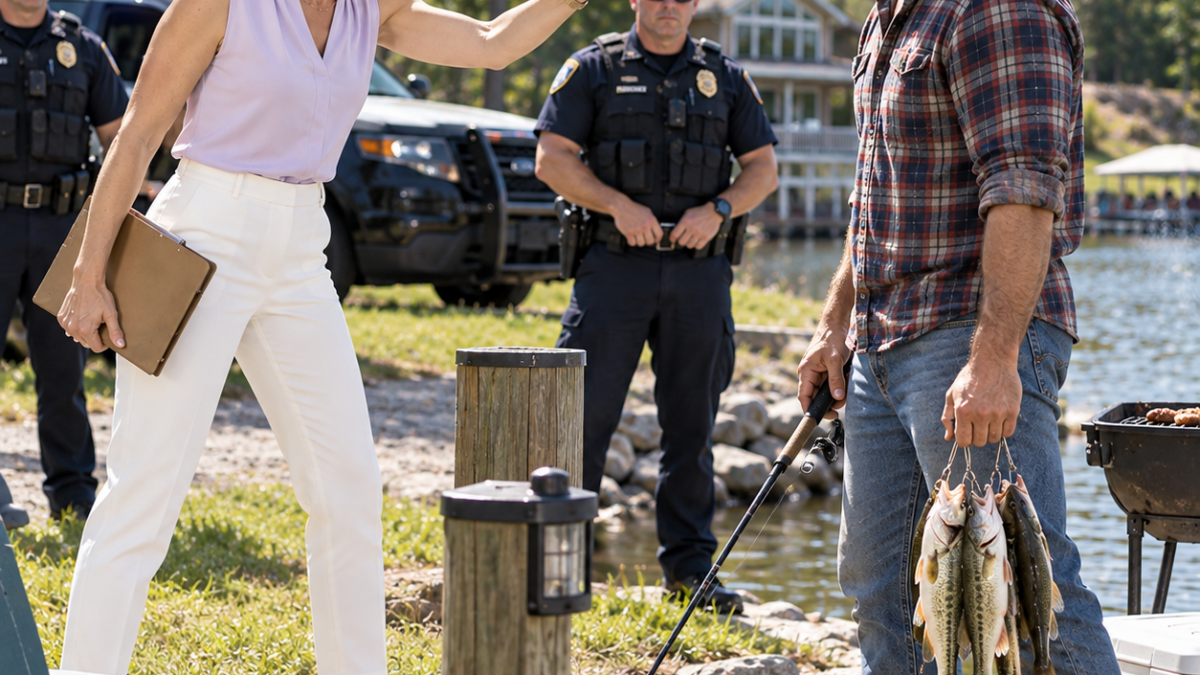
𝗙𝗨𝗟𝗟 𝗦𝗧𝗢𝗥𝗬
A little pink rose in her cheeks.
The flyer was printed on thick paper with a photograph of a golden retriever on one side and a fish on the other. Across the top, in bold letters, it asked:
IF YOU WOULD NOT HOOK A DOG, WHY HOOK A FISH?
I stared at it.
Then I stared at Karen.
“Did you make this?”
“I helped draft it.”
“That tracks.”
Her nostrils flared. “Fishing is cruelty.”
“Fishing is legal.”
“Legal and moral are not the same thing.”
“No,” I said. “But legal and none of your business are pretty close in this case.”
That was the first time I saw what Karen looked like when someone refused to pretend she had authority. It was not anger exactly. It was insult. As if my disagreement had not challenged her opinion but violated the natural order of things.
She folded her arms. “Willow Creek is committed to maintaining a humane, environmentally respectful community. Many of our residents are disturbed by the killing of sentient creatures so close to their homes.”
“Their homes are close to my lake because someone built them there.”
“The lake is part of the character of the area.”
“It is part of my property.”
“Water should not be owned.”
“Take that up with the county assessor. They seem pretty convinced.”
Her eyes dropped to the fish again.
I lifted the stringer slightly. “Dinner.”
She actually recoiled.
“You are disgusting.”
I laughed once, more out of surprise than amusement. “Lady, you’re standing on my porch calling me disgusting because I caught fish on land my family owns.”
“You people always hide behind ownership.”
“You people?”
“People who think tradition excuses cruelty.”
I stepped past her and pulled the flyer off the door. The tape left a sticky mark in the paint.
“Do not tape things to my house again.”
She lifted her chin. “We will not be silent.”
“I wasn’t asking for silence. I was asking you to stay off my porch.”
Karen left that day in a silver hybrid SUV with a green “Be Kind to All Beings” sticker on the back bumper.
For about a week, I thought that might be the end of it.
It was not.
The flyers kept coming.
Sometimes they showed up under a rock on the dock steps. Sometimes tucked into the gate. Once, one was tied to the handle of my grill with a piece of twine, which felt both creepy and wildly overdramatic. They compared fish to dogs, fish to children, fish to “aquatic neighbors.” One flyer claimed that grilling fish outdoors created “psychological harm” for nearby residents who valued compassionate living.
I started saving them in a drawer.
Not because I planned to do anything yet.
Because some part of me knew Karen was not the kind of person who stopped when ignored.
My family thought it was hilarious at first.
My cousin Bobby read one flyer out loud at Sunday dinner in a voice so solemn it nearly made my aunt choke on potato salad.
“‘Imagine the terror of being dragged from your home by a hook,’” he said, pressing one hand to his chest. “Well, now I feel bad for every worm we’ve betrayed.”
My uncle Ray snorted. “Tell her we’ll hold a memorial service before frying them.”
Even my mother, who generally believed manners could solve most things, shook her head and said, “That woman needs a hobby that isn’t you.”
But the jokes started feeling less funny when Karen began approaching relatives.
She caught my nephew and two of his friends near the dock one afternoon and told them they were participating in violence. My nephew was twelve. He came inside pale and confused, holding his fishing rod like it had become something shameful.
That was the first time I got truly angry.
I found Karen at the edge of the property line, standing just beyond the posted sign as if she had memorized exactly where she could hover without technically trespassing.
“You don’t talk to the kids,” I said.
She turned slowly. “Children should be taught compassion.”
“They are. By their parents. Not by a stranger yelling at them near a dock.”
“I didn’t yell.”
“You scared him.”
“If the truth scares him, perhaps that says something about the activity.”
I took a breath through my nose. “Karen, listen carefully. You can think whatever you want. You can eat whatever you want. You can run your HOA however your residents tolerate. But you do not own this lake, you do not control my property, and you absolutely do not approach children in my family to shame them for fishing.”
Her eyes flashed. “Your family is killing animals for recreation.”
“My family is eating what we catch.”
“That does not make it better.”
“It makes it dinner.”
She pointed at me with one red-painted nail. “This lake is now under HOA protection.”
I stared at her for a second.
Then I laughed.
I should not have. I know that. Sometimes silence is wiser. But she had said it with such clean, polished certainty, as if the universe itself had held a board meeting and voted in her favor.
“Under HOA protection?” I said.
“Yes.”
“You held a meeting and annexed my lake with vibes?”
Her mouth opened.
I kept going. “Did the fish sign up? Was there a ballot? Did the turtles reach quorum?”
“This is not a joke.”
“You’re right. It’s trespassing with stationery.”
Karen’s face tightened into something ugly. “We have rules.”
“You have rules for people who agreed to them.”
“Our community surrounds this area.”
“It does not surround my deed.”
“Then perhaps law enforcement can explain it to you.”
I smiled.
That was my mistake, or maybe hers, depending on how you look at it.
“Please call them,” I said.
She blinked. “Excuse me?”
“Call the police. Tell them a man is fishing legally on his own private lake and you’re upset about it. I would love to hear that conversation.”
For a moment, I thought even Karen would recognize the cliff before stepping off it.
Instead, she pulled out her phone.
She called 911.
Not the non-emergency line. Not animal control. Emergency services.
She stood there, voice high and dramatic, saying there was “illegal animal killing” happening on “protected community water.”
I folded my arms and waited.
Twenty minutes later, a patrol car pulled into my gravel drive.
Officer Daniel Morales stepped out, and I recognized him only vaguely from town. He was broad-shouldered, calm-faced, and looked like he had already decided this call was going to waste his afternoon.
Karen rushed toward him before he had both feet on the ground.
“Officer, thank God. This man is killing fish in violation of community protections.”
Officer Morales looked past her at me.
I lifted one hand. “Afternoon.”
He looked at the dock, the rods, the posted private property sign, then back at Karen.
“What exactly is the emergency?”
Karen’s mouth tightened. “Illegal fishing.”
“Is this public water?”
“No, but—”
“Is he on your property?”
“It affects our community.”
“That wasn’t my question.”
I walked over slowly, keeping my hands visible mostly out of habit and respect.
“This is private family property,” I said. “I own the lake and the house. Fishing is legal here. Willow Creek Estates has no ownership interest and no access rights.”
“Do you have documentation?”
“In the house.”
I brought out a folder I kept in the kitchen with copies of the deed, survey, and lake rights. I had made the folder after the third flyer, because Karen gave me the kind of feeling that makes a man organize paperwork.
Officer Morales scanned the pages. His eyebrows rose slightly.
Then he turned to Karen.
“Ma’am, this appears to be private property. If you have a civil dispute, you need to handle that through the proper channels. You cannot call 911 because you disagree with lawful fishing.”
Karen’s face went red. “So you’re just going to allow cruelty?”
“I’m going to clear a non-emergency call.”
“He is killing living beings.”
“Fishing is legal.”
“That does not make it right.”
“Maybe not to you,” he said, and his voice stayed even, “but 911 is not for moral disagreements. Further misuse can result in a citation or fine.”
I should have stopped there.
I truly should have.
But when you have a smart mouth and a woman like Karen has spent weeks taping fish propaganda to your house, self-control becomes a limited resource.
I looked at Officer Morales. “If anyone at the station wants fresh fillets, tell them to swing by. No charge.”
Officer Morales pressed his lips together like he was fighting a smile.
Karen looked at me as if I had slapped her.
“You are vile,” she said.
“No,” I said. “I’m generous.”
She stormed off muttering about murder, corruption, and blood money.
Officer Morales waited until her SUV disappeared down the road before he looked at me.
“You enjoy poking bears?”
“Only when they trespass.”
He handed the folder back. “Keep your paperwork handy. People like that don’t usually quit after one bad call.”
He was right.
Three days later, the first official HOA letter arrived.
It was addressed to me by full name, which meant Karen had done some digging. The letter was printed on Willow Creek Estates letterhead and signed by Karen as president. It demanded that I immediately cease all activity on “HOA-adjacent protected waters,” including but not limited to fishing, fish cleaning, fish grilling, dock gatherings, and “public displays of animal consumption.”
Public displays of animal consumption.
That phrase lived rent-free in my head for a week.
The letter warned that continued violations could result in legal escalation, community sanctions, and referral to “appropriate environmental authorities.”
I sat at my kitchen table and read it twice.
Then I wrote back.
Dear Ms. Whitcomb,
I am not a member of your HOA. My property is not part of your HOA. My lake is not HOA water, protected or otherwise. Your board has no authority over my private property, my dock, my grill, my family traditions, or my dinner.
If Willow Creek Estates ever obtains a lake of its own, feel free to contact me. As an actual lake owner, I would be happy to offer basic guidance.
Respectfully,
I almost signed it “Aquatic Murderer,” but my mother had raised me better than that, barely.
Karen did not appreciate my response.
The board came in person the following Saturday.
There were four of them.
Karen led the group, of course, wearing white jeans, a pale green blouse, and a straw hat that looked too expensive to be near water. Beside her was a man named Preston, the HOA treasurer, who had a soft face and anxious hands. Behind them came Linda, secretary of something or other, carrying a folder against her chest like a shield. The last was Gary, vice president, tall, red-faced, and already sweating through his polo.
They marched down the gravel path toward my dock while I was sitting in a folding chair, cleaning a reel.
All four began talking before they even stopped walking.
Karen said, “This cannot continue.”
Gary said, “You are creating a nuisance.”
Linda said, “Residents are concerned.”
Preston said, “There may be liability issues.”
It sounded like a flock of geese had discovered bylaws.
I held up one finger.
They kept talking.
I stood, walked to the edge of the dock, and pointed at the sign nailed to a post beside the path.
NO TRESPASSING.
PRIVATE LAKE PROPERTY.
NO HOA ACCESS.
I kept pointing.
Karen talked for another ten seconds before realizing no one was responding. Then Gary stopped. Then Linda. Preston, who looked like he had wanted to stop before they arrived, went quiet last.
“Thank you,” I said.
Karen’s jaw was tight. “We are here to discuss your continued violence against aquatic life.”
“Then you’re here without permission.”
“This lake impacts our residents.”
“So does weather. You writing letters to clouds?”
Gary stepped forward. “You need to take this seriously.”
“I took it seriously when she called 911 on me for fishing.”
Karen’s eyes narrowed. “The officer was mistaken.”
“The officer read the deed.”
“Our legal understanding differs.”
“Your legal understanding appears to be whatever you wish were true.”
Linda opened her folder. “The board has adopted a resolution recognizing this lake as a protected natural feature adjacent to Willow Creek Estates.”
“That’s adorable.”
“It means we have standing to object to harmful conduct.”
“No,” I said. “It means you had a meeting.”
Karen’s voice sharpened. “The fish are crying for justice.”
That stopped me.
I looked at her.
Then I looked out at the lake, calm under the afternoon sun.
“They seem pretty quiet to me,” I said. “Also, I don’t think you speak fish.”
Gary’s face turned a deeper red. Preston looked at the ground. Linda whispered, “Karen.”
Karen pointed toward my cooler. “Every dead animal in there is evidence of your cruelty.”
“No,” I said. “It’s evidence of dinner planning.”
“You are mocking us.”
“Only because you make it impossible not to.”
She stepped onto the first board of the dock.
I pointed again, this time at her feet. “Off.”
She froze.
“This dock is private property. You were not invited. Leave.”
For a moment, I thought Gary might try something. He shifted his weight forward, shoulders squaring. But he glanced at the sign, then at my phone sitting on the chair beside me, and thought better of it.
Karen retreated one step.
“This will have consequences.”
“I hope one of them is fewer visits.”
They left, but not quietly. Karen announced that the board would “explore all enforcement pathways.” Gary told me I was alienating the community. Linda said history would not look kindly on me, which felt like a lot for panfish. Preston said nothing.
That night, I sat on the porch and thought about hiring a lawyer.
I could have.
Maybe I should have.
A lawyer could have sent a stern letter, maybe threatened action, maybe ended the whole thing cleanly. But Karen did not just want compliance. She wanted a performance. She wanted me embarrassed. Isolated. Painted as the unreasonable man hurting her gentle little community.
A private legal letter would stop the paperwork, maybe.
It would not stop the story she was telling.
And if Karen wanted theater, I decided I could give her theater.
Just not the kind she wanted.
The idea came to me while I was scraping the grill the next morning.
My family had always held casual lake cookouts. Nothing formal, just whoever showed up, whatever fish we caught, too many side dishes, somebody’s kid dropping a hot dog into the dirt, laughter carrying over the water after sunset. But we had not done a big one since I moved in. Everyone was busy. Life scattered people.
Karen, however, had given us a reason.
I made a list.
Family first.
Then friends.
Then a few older neighbors who lived outside the HOA and had watched Willow Creek grow like an expensive fungus. Then I invited some non-HOA people Karen had annoyed with her flyers and lectures. Then, because I am petty but not reckless, I invited a couple of off-duty firefighters I knew from town and told them I would appreciate someone making sure the fire pit setup was safe.
I also told Officer Morales, when I ran into him at the hardware store.
“You inviting me as a cop or as a guy who likes potato salad?” he asked.
“As a guy who likes fish.”
“Good,” he said. “Because as a cop, I’d tell you not to antagonize people.”
“And as a guy who likes fish?”
“As a guy who likes fish, what time?”
By the end of the week, the cookout had become bigger than I expected. Cousins invited cousins. My aunt insisted on making hush puppies. Bobby promised to bring three folding tables and no emotional maturity. A retired firefighter named Stan offered to supervise the fire pit, then invited two more guys. Somebody told somebody in Willow Creek, and suddenly I had people I barely knew asking if they could come because they had “heard about the fish lady.”
I did not call it revenge.
Officially, it was a family cookout.
Unofficially, it was the loudest legal tradition I could possibly host.
The morning of the party dawned bright and warm, the kind of late-summer day that makes the lake look kinder than it is. Mist lifted off the water at sunrise. I stood on the dock with coffee in one hand and a rod in the other, listening to the first trucks crunch up the drive.
By noon, the place was alive.
Kids ran between the house and the shore with juice boxes and marshmallow sticks. Folding chairs lined the grass. Coolers sat under a canopy. My uncle Ray held court near the cleaning table, exaggerating the size of every fish he had ever caught. My mother and aunts took over the kitchen like an organized militia. Bobby tried to teach three children how to cast and nearly hooked his own hat.
The dock filled with people fishing shoulder to shoulder.
The fire pit crackled under Stan’s watchful eye. He had arranged it so safely that I suspected it could survive an inspection by NASA. The first fish hit the grill around one. Butter hissed on foil. Lemon and smoke filled the air. Someone put on music low enough not to annoy neighbors but loud enough to make the day feel like a celebration.
I counted forty people at one point.
Maybe fifty by midafternoon.
A few off-duty cops came. Morales showed up in shorts with his new wife, Elena, carrying potato salad like a man entering neutral territory with tribute. Two firefighters wandered down with lawn chairs and immediately got recruited into helping kids roast marshmallows without setting their sleeves on fire.
And through it all, I kept glancing toward the road.
Waiting.
I knew Karen would come.
People like her can ignore private happiness only if they believe they are still controlling it from a distance. A whole crowd eating fish beside the lake she had declared spiritually protected? She was not built to withstand that.
At three-twenty, Bobby nudged me with an elbow.
“Incoming.”
Karen’s silver SUV rolled slowly past the driveway, stopped, reversed, and pulled near the edge of the property. Behind her came Gary’s truck and Linda’s sedan. Preston was not present, which raised my opinion of Preston considerably.
Karen got out like a storm in white linen.
She had brought backup. Not just Gary and Linda, but three Willow Creek residents I recognized vaguely from previous shoreline stares. All of them wore expressions suggesting they expected to witness justice and were instead smelling fried fish.
Karen’s face was already flushed.
I walked toward the property edge before she could step over it. Officer Morales, who had been sitting under a canopy with a plate of food, stood and followed at an easy distance.
Not in uniform. Not acting official.
But present.
Karen saw him and hesitated.
Good.
I stopped on my side of the sign.
“Karen,” I said. “Private party.”
“This is obscene.”
“It’s actually going pretty well.”
“You are slaughtering animals in front of families.”
“Most of these families are eating.”
Behind me, as if on cue, Bobby yelled, “Who wants seconds?”
Several people cheered.
Karen’s eyes flashed. “You did this deliberately.”
“I hosted a cookout on my property.”
“You invited half the county to provoke us.”
“I invited people who enjoy fishing, food, and not being yelled at by an HOA they don’t belong to.”
Gary stepped forward. “This gathering is disruptive to Willow Creek residents.”
A little boy behind me shrieked with laughter as his marshmallow caught fire.
I looked at Gary. “That? That’s called childhood.”
Linda clutched her folder. “There are concerns about smoke, noise, animal remains, and emotional distress.”
“My aunt is emotionally distressed when people insult her hush puppies,” I said. “Should I file that somewhere?”
Karen pointed toward the grill. “This is murder.”
The party quieted a little then.
Not completely. Plates still moved. Kids still whispered. But enough people heard her that heads turned.
Karen seemed to notice she had an audience, and instead of shrinking, she expanded into it.
“You should all be ashamed,” she called. “Every single one of you. These creatures feel pain. They wanted to live. This man has turned suffering into entertainment.”
For a second, I felt anger rise. Real anger. Hot, protective, sharp. Not because she was attacking me—I had expected that—but because she was trying to shame children again. Kids stood frozen with paper plates in their hands, looking from Karen to the adults, trying to decide whether they had done something wrong by eating lunch.
Officer Morales stepped beside me. Quietly, he said, “Careful.”
I nodded.
Then I smiled at Karen.
“You want a plate?”
Her mouth opened.
I turned and raised my voice. “Aunt Diane, do we still have fried fish inside?”
My aunt, God bless her, did not miss a beat.
“Plenty!”
I looked back at Karen. “We’ve got fried fish, grilled fish, hush puppies, potato salad, corn, and I think somebody brought coleslaw. I can make you a plate to go.”
The silence lasted half a second.
Then Bobby lost it.
His laugh cracked open the whole yard. Other people followed. Not cruel laughter exactly, but the kind that comes when tension finally finds somewhere to go.
Karen’s face went scarlet.
“How dare you mock me.”
“I’m being hospitable.”
“You are a monster.”
“No,” Officer Morales said suddenly, and his voice cut cleanly through the air. “He is a property owner hosting a lawful gathering. You are standing at the edge of his property yelling at invited guests.”
Karen turned on him. “You’re off duty.”
“Yes,” he said. “Which is why I’m saying this as a guest before someone else has to say it officially. Do not step onto this property. Do not harass the children. Do not create a disturbance. If you have a legal complaint, use legal channels.”
Gary puffed up. “Are you threatening us?”
Morales looked at him with the tired patience of a man who had heard worse from drunk people outside bars.
“I am explaining consequences.”
Karen’s group faltered.
Behind me, someone splashed into the lake. Then another. A few teenagers had decided, possibly from boredom and possibly from genius, to jump off the far side of the dock fully clothed. Water flew up in glittering sheets. The younger kids screamed with delight. My uncle Ray yelled that if they scared the fish, they had to personally apologize to dinner.
The party resumed around Karen’s outrage like a river flowing around a rock.
That, more than anything, broke her.
She wanted everyone to stop. She needed the event to become about her anger. She needed her disgust to control the temperature of the day. Instead, people kept eating. Laughing. Casting lines. Roasting marshmallows. Passing plates.
Her meltdown became background noise.
Karen shouted for another minute about cruelty, community values, and the moral emergency of public fish consumption. Gary added something about liability. Linda tried to film, but Bobby noticed and started posing in the background with a marshmallow stick like a sword.
Finally, Karen pointed at me.
“You will regret humiliating this board.”
I looked at her, then at the crowd behind me, then at Officer Morales, who was trying very hard not to smile.
“Karen,” I said, “you brought the board to a fish fry.”
She made a sound somewhere between a gasp and a growl, spun around, and marched back to her SUV.
Gary and Linda followed. Their extra witnesses trailed behind them looking less righteous than when they had arrived.
As Karen drove off, my cousin shouted, “Does this mean she doesn’t want a plate?”
My aunt smacked him with a dish towel.
The rest of the day was perfect.
Not quiet. Not peaceful in the delicate way Karen pretended to value. But alive.
The kind of alive that makes a place belong to the people who love it.
At sunset, the lake turned orange and gold. Kids sat sticky-fingered near the fire pit. My mother wrapped leftovers. Officer Morales and Elena stayed later than I expected, talking with my uncle about fishing spots. Stan declared the fire pit “beautifully controlled,” which from him was practically poetry. Bobby fell into a lawn chair and said, “Same time next year?”
I looked around.
At the dock.
At the grill.
At the people.
At the water my family had loved for generations.
“Same time next year,” I said.
I thought the cookout would be the end of it.
In one way, it was.
In another, it was the beginning of Karen losing the story.
People talked.
They talked inside Willow Creek first. Then outside it. The version Karen wanted to spread was simple: hostile lake owner throws cruel animal-killing party to mock compassionate HOA. But there were too many witnesses, too many videos, too many people who had seen the truth with their own eyes.
They had seen kids fishing with grandparents.
They had seen off-duty first responders eating potato salad.
They had seen Karen screaming at families from the property line.
They had seen me offer her a plate.
That last part, apparently, traveled far.
Within two weeks, I heard from three different people that potential Willow Creek buyers had started asking whether the HOA really tried to police a private lake it did not own. One couple backed out before closing. Another refused to join any optional community programs. Residents who had been irritated with Karen but quiet began mentioning her flyers, her lectures, her habit of treating personal beliefs like enforceable covenants.
The dog-fish flyer became infamous.
Someone inside Willow Creek scanned it and posted it in a neighborhood thread with the caption, Is this really what our dues are paying for?
Karen denied authorizing it.
Then someone produced a copy with her email at the bottom.
That did not help her.
Gary tried to defend the board at a meeting by saying the lake dispute was about “community identity.” According to one neighbor who attended, an older man stood up and asked, “Why is our identity based on property we don’t own?”
No one had a good answer.
Then Preston resigned as treasurer.
I received that news from a woman named Marcy, who lived near the subdivision entrance and had started walking her old beagle along the public road by my property. She was not in the HOA either, but Karen had once told her that her dog’s bark disrupted the “tone” of Willow Creek.
“What does that even mean?” Marcy asked me.
“It means Karen learned English from complaint templates.”
Marcy laughed so hard the beagle startled.
Preston’s resignation apparently included a statement about “mission drift” and “inappropriate allocation of board resources.” I respected the man for using HOA language to say Karen had lost her mind.
The letters stopped after that.
No more demands about protected water.
No more references to animal consumption displays.
No more threats of environmental escalation.
For the first time in months, my mailbox held only bills, grocery coupons, and one postcard from my cousin in Arizona that said, Fish fear me, Karen fears me too.
I put that one on the fridge.
The following spring, I wondered if the annual cookout had been a joke people would forget.
They did not.
By April, family members were texting me dates. Bobby designed an invitation featuring a cartoon fish wearing sunglasses, which I immediately told him not to distribute anywhere Karen could accuse us of targeted harassment. He distributed it anyway, but only to relatives, which in my family meant roughly half the county.
Morales asked if Elena could bring dessert.
Stan asked if we wanted the fire pit in the same location.
Marcy asked if non-fishing guests were welcome.
My aunt Diane declared that she would not be making half portions “just because some people lack commitment.”
So we held it again.
Bigger this time, but better organized. More chairs. More shade. More coolers. A designated cleaning station. A separate table for people who did not eat fish but still wanted to come, because contrary to Karen’s worldview, nobody in my family cared what someone else chose not to eat as long as they were not screaming at children about it.
That second year, Karen did not show up.
Not at first.
Her SUV rolled by twice in the afternoon, slow enough for people to notice. The first time, Bobby waved with a hush puppy. The second time, my mother gave him a look so powerful he lowered his hand like a scolded child.
Karen did not stop.
That felt like victory.
Not because she was afraid of me.
Because she had finally understood the line.
Over time, the cookout became what it had accidentally started as: a tradition.
Every year, we gathered at the lake. Every year, someone made a joke about Karen. Every year, Officer Morales showed up if his schedule allowed, usually with Elena and usually with potato salad because by then people expected it. The first officer who had been called to stop me from fishing became a regular guest at the fishing party. There was something beautifully circular about that.
Willow Creek changed too.
Not overnight. HOAs do not transform into temples of humility because one president gets embarrassed at a fish fry. But membership in optional committees dropped. New residents asked sharper questions. The board stopped advertising the lake as if it belonged to them. The developer quietly changed the wording on the sign from near beautiful private lake to near scenic wooded area.
That made me laugh every time I drove past.
Karen stayed president for a while, but her power shrank.
People still called her Mega Karen behind her back. I did not start that nickname, but I did nothing to stop it. She had earned it with interest. She remained vegan, which was never the problem. Plenty of vegans are kind, reasonable people who manage to go through life without taping emotional blackmail to strangers’ doors. Karen’s issue was not what she ate. It was what she wanted to control.
She did not want compassion.
She wanted obedience dressed up as compassion.
If she had come to me at the beginning and said, “Hey, seeing fish cleaned by the shore bothers some residents. Could you keep it less visible from the road?” I might have worked with her. Not because I had to, but because being neighborly costs less than being stubborn. I could have moved a table. Shifted the grill. Planted a screen of shrubs. Found some compromise that protected my rights and spared her residents a sight they disliked.
But Karen did not ask.
She declared.
She accused.
She called the police.
She tried to convert her personal beliefs into law and her HOA title into ownership.
And when that failed, she walked straight into a party full of witnesses and showed everyone exactly who she was.
That was the part she never recovered from.
Bullies survive best in private. A letter can sound official. A flyer can seem righteous. A lecture at the property line can be framed later as concern. But a public meltdown in front of families, neighbors, police officers, firefighters, children with marshmallow sticks, and a man offering you fried fish with a straight face? That is harder to edit.
I still have the first flyer.
The dog and the fish.
The big bold question.
IF YOU WOULD NOT HOOK A DOG, WHY HOOK A FISH?
It sits in the back of a drawer with the HOA letter and the first cookout invitation Bobby made. Every now and then, when someone new hears the story and thinks I am exaggerating, I show them the flyer.
They always read it twice.
Then they look at me and say some version of, “She really did this?”
Yes.
She really did.
She really stood on my porch and called me disgusting.
She really called 911 because I was fishing legally on my own lake.
She really brought the HOA board to my dock to lecture me about crying fish.
She really screamed murder at a cookout while my aunt was passing around hush puppies.
And somehow, after all that, she still believed she was the reasonable one.
The lake is quiet this morning as I think about it.
There is a mist over the far bank, thin and silver. The dock boards are damp under my boots. A heron stands in the shallows like it has secrets. My tackle box sits open beside me, old and scratched, smelling faintly of rubber worms and rust. Somewhere behind the house, my grill waits under its cover for another season, another crowd, another year of cousins arguing about who caught the biggest fish.
Willow Creek is visible through the trees if you know where to look.
Same neat houses.
Same trimmed lawns.
Same decorative lanterns.
But the lake is still mine.
Not because I shouted louder than Karen.
Not because I won some grand legal battle.
Because it was mine all along, and I refused to act like her imaginary authority had more weight than my actual rights.
That is the strange thing about people like Karen. They make you defend things that should not need defending. A deed. A tradition. A quiet afternoon. A child’s right to learn from his family without being shamed by a stranger. A man’s right to sit on his own dock and cast a line into water his family has cared for longer than any HOA has existed nearby.
They exhaust you by forcing reality to prove itself.
But sometimes reality gets help.
Sometimes it arrives in the form of a bored police officer explaining what 911 is for.
Sometimes it arrives as a crowd of relatives with fishing rods and paper plates.
Sometimes it arrives as laughter when a bully expects fear.
I cast my line, and the lure lands with a soft plunk near the reeds.
For a while, nothing happens.
That is fine with me.
Fishing teaches patience better than almost anything. You wait. You breathe. You let the water settle. You understand that not everything worth having comes because you demanded it loudly enough.
Karen never learned that.
Maybe she never will.
But every summer, when the cookout smoke rises over the lake and children run barefoot through the grass and someone inevitably asks whether Karen wants a plate, I remember the day she called the police on me for fishing.
And I remember that the best revenge was never the joke.
It was everyone seeing the truth.
It was my family still gathering.
It was the lake still shining.
It was the sound of laughter carrying over water Karen never owned.
𝗧𝗛𝗘 𝗘𝗡𝗗
The HOA President Called the Police on Me for Fishing, Then Walked Straight Into the Party That Ruined Her
Karen believed her HOA could control my lake, my dock, and even what my family put on the grill.
She called the police to stop me from fishing on my own property, but by the end of summer, everyone knew exactly who the real problem was.
My family had owned the lake long before anyone thought to build matching houses around it.
That was the part Karen never seemed able to understand.
To her, land became important when a committee named it. A lake became valuable when a subdivision brochure placed it in the background of a sunset photo. A neighborhood became respectable when every mailbox matched and every lawn obeyed the same two-and-a-half-inch rule. She believed authority was something you could print on letterhead, laminate, and wave in someone’s face until they got tired enough to surrender.
But that lake was not hers.
It was not Willow Creek Estates property, no matter how many times their sales flyers pretended otherwise. It was not an amenity. It was not a community feature. It was not “protected water,” “shared natural space,” or any of the other soft little phrases Karen liked using when she wanted to make theft sound tasteful.
It was ours.
Technically, it was mine.
The deed had my name on it by then, though I still thought of it the way everyone in my family always had—as the family lake. Nobody could remember the first owner clearly. Depending on which aunt you asked, it had come through my grandfather’s cousin, my great-uncle’s in-laws, or some relative who had won a card game in 1948 and somehow walked away with land. The truth was probably less exciting. All I knew was that the lake house had passed from one generation to the next until it landed with me, mostly because I was the one who loved it enough to live there and stubborn enough to keep paying the taxes.
I had loved that place since I was five years old.
Some families teach kids to ride bikes in empty school parking lots. Mine taught kids to bait hooks off an old wooden dock that smelled like sun, wet rope, and fish scales. I learned to cast before I learned long division. I learned patience from a bobber sitting still on a glassy morning. I learned loss from snapping lines, laughter from cousins falling backward into shallow water, and pride from the first bluegill I carried to my grandmother like I had dragged a whale from the deep.
Fishing was never just fishing to us.
It was birthdays with folding chairs by the shore. Memorial weekends with smoke from the grill drifting through the pines. Quiet afternoons with my dad when neither of us had much to say but both of us knew exactly why we were there. It was my uncles arguing about bait. My cousins pretending not to compete. My mother wrapping fish in foil with lemon, butter, and more pepper than any doctor would approve of.
By the time I moved into the lake house more permanently, I knew every bend of that shoreline. I knew where the bass hid when the water got warm. I knew which boards on the dock groaned but held. I knew the sound of rain coming across the water before it reached the roof.
What I did not know was that a woman named Karen Whitcomb would decide my family tradition was a crime against her personal sense of order.
Willow Creek Estates appeared slowly, then all at once.
First came survey flags in the field beyond the eastern tree line. Then machines. Then roads. Then houses in neat rows with stone fronts, black shutters, white trim, and decorative lanterns that all looked like they had been chosen by one nervous person with a clipboard. The subdivision did not touch most of my property, but it came close enough that the developer started using the lake in advertising.
I saw the sign one afternoon on my way back from town.
Luxury homes near beautiful private lake.
I pulled over and stared at it.
Near was doing a lot of work in that sentence.
The photo on the sign showed water sparkling behind a smiling family that definitely did not live there. The angle made it look as if the new neighborhood opened right onto my lake. It did not. There was a tree buffer, a fence line, and very clear property records saying otherwise.
At first, I figured buyers would learn the truth before closing.
I underestimated how much people believe a brochure when it tells them what they want to hear.
For a while, the new neighbors were harmless. A few wandered too close and apologized when I pointed out the private property signs. Some asked politely whether fishing access was available, and I told them no, sorry, family only. Most accepted it. A couple grumbled. One man in golf shorts told me the developer had implied the lake would be “part of the lifestyle,” and I told him he should take that up with the developer.
Then the HOA formed.
Then Karen took charge.
And suddenly, my lake became her mission.
part2
Karen Whitcomb looked exactly like the kind of woman who introduced herself with her title before her name.
She was probably in her late forties, tall and narrow, with a sharp blonde bob that never moved even when the wind came off the lake hard enough to rattle the dock chairs. She wore white linen pants in summer, quilted vests in fall, and sunglasses so large they made every conversation feel like a deposition. Her nails were always perfect. Her smile was not. It was too flat, too controlled, a thing she placed on her face when she wanted to seem reasonable while saying something ridiculous.
The first time I met her, she was taping a flyer to my front door.
Not slipping it under the mat.
Not leaving it in the mailbox.
Taping it to the old blue door my grandfather had painted himself, like she wanted me to know she had touched my house.
I had been coming up from the dock with a tackle box in one hand and a stringer of perch in the other. My boots were muddy. My shirt smelled like lake water. It had been a good morning.
Karen turned when she heard my steps.
“You must be the owner,” she said.
“I am.”
She looked at the fish, and her mouth tightened like I had dragged up evidence from a murder scene.
“My name is Karen Whitcomb. I’m president of the Willow Creek Estates Homeowners Association.”
I waited for the part where that became my problem.
She gestured to the flyer. “We’re distributing educational materials about ethical treatment of animals and community expectations around the lake.”
“The lake isn’t in your community.”
Her smile thinned. “It is adjacent to our community.”
“So is the county road. You don’t get to manage that either.”
A little pink rose in her cheeks.
The flyer was printed on thick paper with a photograph of a golden retriever on one side and a fish on the other. Across the top, in bold letters, it asked:
IF YOU WOULD NOT HOOK A DOG, WHY HOOK A FISH?
I stared at it.
Then I stared at Karen.
“Did you make this?”
“I helped draft it.”
“That tracks.”
Her nostrils flared. “Fishing is cruelty.”
“Fishing is legal.”
“Legal and moral are not the same thing.”
“No,” I said. “But legal and none of your business are pretty close in this case.”
That was the first time I saw what Karen looked like when someone refused to pretend she had authority. It was not anger exactly. It was insult. As if my disagreement had not challenged her opinion but violated the natural order of things.
She folded her arms. “Willow Creek is committed to maintaining a humane, environmentally respectful community. Many of our residents are disturbed by the killing of sentient creatures so close to their homes.”
“Their homes are close to my lake because someone built them there.”
“The lake is part of the character of the area.”
“It is part of my property.”
“Water should not be owned.”
“Take that up with the county assessor. They seem pretty convinced.”
Her eyes dropped to the fish again.
I lifted the stringer slightly. “Dinner.”
She actually recoiled.
“You are disgusting.”
I laughed once, more out of surprise than amusement. “Lady, you’re standing on my porch calling me disgusting because I caught fish on land my family owns.”
“You people always hide behind ownership.”
“You people?”
“People who think tradition excuses cruelty.”
I stepped past her and pulled the flyer off the door. The tape left a sticky mark in the paint.
“Do not tape things to my house again.”
She lifted her chin. “We will not be silent.”
“I wasn’t asking for silence. I was asking you to stay off my porch.”
Karen left that day in a silver hybrid SUV with a green “Be Kind to All Beings” sticker on the back bumper.
For about a week, I thought that might be the end of it.
It was not.
The flyers kept coming.
Sometimes they showed up under a rock on the dock steps. Sometimes tucked into the gate. Once, one was tied to the handle of my grill with a piece of twine, which felt both creepy and wildly overdramatic. They compared fish to dogs, fish to children, fish to “aquatic neighbors.” One flyer claimed that grilling fish outdoors created “psychological harm” for nearby residents who valued compassionate living.
I started saving them in a drawer.
Not because I planned to do anything yet.
Because some part of me knew Karen was not the kind of person who stopped when ignored.
My family thought it was hilarious at first.
My cousin Bobby read one flyer out loud at Sunday dinner in a voice so solemn it nearly made my aunt choke on potato salad.
“‘Imagine the terror of being dragged from your home by a hook,’” he said, pressing one hand to his chest. “Well, now I feel bad for every worm we’ve betrayed.”
My uncle Ray snorted. “Tell her we’ll hold a memorial service before frying them.”
Even my mother, who generally believed manners could solve most things, shook her head and said, “That woman needs a hobby that isn’t you.”
But the jokes started feeling less funny when Karen began approaching relatives.
She caught my nephew and two of his friends near the dock one afternoon and told them they were participating in violence. My nephew was twelve. He came inside pale and confused, holding his fishing rod like it had become something shameful.
That was the first time I got truly angry.
I found Karen at the edge of the property line, standing just beyond the posted sign as if she had memorized exactly where she could hover without technically trespassing.
“You don’t talk to the kids,” I said.
She turned slowly. “Children should be taught compassion.”
“They are. By their parents. Not by a stranger yelling at them near a dock.”
“I didn’t yell.”
“You scared him.”
“If the truth scares him, perhaps that says something about the activity.”
I took a breath through my nose. “Karen, listen carefully. You can think whatever you want. You can eat whatever you want. You can run your HOA however your residents tolerate. But you do not own this lake, you do not control my property, and you absolutely do not approach children in my family to shame them for fishing.”
Her eyes flashed. “Your family is killing animals for recreation.”
“My family is eating what we catch.”
“That does not make it better.”
“It makes it dinner.”
She pointed at me with one red-painted nail. “This lake is now under HOA protection.”
I stared at her for a second.
Then I laughed.
I should not have. I know that. Sometimes silence is wiser. But she had said it with such clean, polished certainty, as if the universe itself had held a board meeting and voted in her favor.
“Under HOA protection?” I said.
“Yes.”
“You held a meeting and annexed my lake with vibes?”
Her mouth opened.
I kept going. “Did the fish sign up? Was there a ballot? Did the turtles reach quorum?”
“This is not a joke.”
“You’re right. It’s trespassing with stationery.”
Karen’s face tightened into something ugly. “We have rules.”
“You have rules for people who agreed to them.”
“Our community surrounds this area.”
“It does not surround my deed.”
“Then perhaps law enforcement can explain it to you.”
I smiled.
That was my mistake, or maybe hers, depending on how you look at it.
“Please call them,” I said.
She blinked. “Excuse me?”
“Call the police. Tell them a man is fishing legally on his own private lake and you’re upset about it. I would love to hear that conversation.”
For a moment, I thought even Karen would recognize the cliff before stepping off it.
Instead, she pulled out her phone.
She called 911.
Not the non-emergency line. Not animal control. Emergency services.
She stood there, voice high and dramatic, saying there was “illegal animal killing” happening on “protected community water.”
I folded my arms and waited.
Twenty minutes later, a patrol car pulled into my gravel drive.
Officer Daniel Morales stepped out, and I recognized him only vaguely from town. He was broad-shouldered, calm-faced, and looked like he had already decided this call was going to waste his afternoon.
Karen rushed toward him before he had both feet on the ground.
“Officer, thank God. This man is killing fish in violation of community protections.”
Officer Morales looked past her at me.
I lifted one hand. “Afternoon.”
He looked at the dock, the rods, the posted private property sign, then back at Karen.
“What exactly is the emergency?”
Karen’s mouth tightened. “Illegal fishing.”
“Is this public water?”
“No, but—”
“Is he on your property?”
“It affects our community.”
“That wasn’t my question.”
I walked over slowly, keeping my hands visible mostly out of habit and respect.
“This is private family property,” I said. “I own the lake and the house. Fishing is legal here. Willow Creek Estates has no ownership interest and no access rights.”
“Do you have documentation?”
“In the house.”
I brought out a folder I kept in the kitchen with copies of the deed, survey, and lake rights. I had made the folder after the third flyer, because Karen gave me the kind of feeling that makes a man organize paperwork.
Officer Morales scanned the pages. His eyebrows rose slightly.
Then he turned to Karen.
“Ma’am, this appears to be private property. If you have a civil dispute, you need to handle that through the proper channels. You cannot call 911 because you disagree with lawful fishing.”
Karen’s face went red. “So you’re just going to allow cruelty?”
“I’m going to clear a non-emergency call.”
“He is killing living beings.”
“Fishing is legal.”
“That does not make it right.”
“Maybe not to you,” he said, and his voice stayed even, “but 911 is not for moral disagreements. Further misuse can result in a citation or fine.”
I should have stopped there.
I truly should have.
But when you have a smart mouth and a woman like Karen has spent weeks taping fish propaganda to your house, self-control becomes a limited resource.
I looked at Officer Morales. “If anyone at the station wants fresh fillets, tell them to swing by. No charge.”
Officer Morales pressed his lips together like he was fighting a smile.
Karen looked at me as if I had slapped her.
“You are vile,” she said.
“No,” I said. “I’m generous.”
She stormed off muttering about murder, corruption, and blood money.
Officer Morales waited until her SUV disappeared down the road before he looked at me.
“You enjoy poking bears?”
“Only when they trespass.”
He handed the folder back. “Keep your paperwork handy. People like that don’t usually quit after one bad call.”
He was right.
Three days later, the first official HOA letter arrived.
It was addressed to me by full name, which meant Karen had done some digging. The letter was printed on Willow Creek Estates letterhead and signed by Karen as president. It demanded that I immediately cease all activity on “HOA-adjacent protected waters,” including but not limited to fishing, fish cleaning, fish grilling, dock gatherings, and “public displays of animal consumption.”
Public displays of animal consumption.
That phrase lived rent-free in my head for a week.
The letter warned that continued violations could result in legal escalation, community sanctions, and referral to “appropriate environmental authorities.”
I sat at my kitchen table and read it twice.
Then I wrote back.
Dear Ms. Whitcomb,
I am not a member of your HOA. My property is not part of your HOA. My lake is not HOA water, protected or otherwise. Your board has no authority over my private property, my dock, my grill, my family traditions, or my dinner.
If Willow Creek Estates ever obtains a lake of its own, feel free to contact me. As an actual lake owner, I would be happy to offer basic guidance.
Respectfully,
I almost signed it “Aquatic Murderer,” but my mother had raised me better than that, barely.
Karen did not appreciate my response.
The board came in person the following Saturday.
There were four of them.
Karen led the group, of course, wearing white jeans, a pale green blouse, and a straw hat that looked too expensive to be near water. Beside her was a man named Preston, the HOA treasurer, who had a soft face and anxious hands. Behind them came Linda, secretary of something or other, carrying a folder against her chest like a shield. The last was Gary, vice president, tall, red-faced, and already sweating through his polo.
They marched down the gravel path toward my dock while I was sitting in a folding chair, cleaning a reel.
All four began talking before they even stopped walking.
Karen said, “This cannot continue.”
Gary said, “You are creating a nuisance.”
Linda said, “Residents are concerned.”
Preston said, “There may be liability issues.”
It sounded like a flock of geese had discovered bylaws.
I held up one finger.
They kept talking.
I stood, walked to the edge of the dock, and pointed at the sign nailed to a post beside the path.
NO TRESPASSING.
PRIVATE LAKE PROPERTY.
NO HOA ACCESS.
I kept pointing.
Karen talked for another ten seconds before realizing no one was responding. Then Gary stopped. Then Linda. Preston, who looked like he had wanted to stop before they arrived, went quiet last.
“Thank you,” I said.
Karen’s jaw was tight. “We are here to discuss your continued violence against aquatic life.”
“Then you’re here without permission.”
“This lake impacts our residents.”
“So does weather. You writing letters to clouds?”
Gary stepped forward. “You need to take this seriously.”
“I took it seriously when she called 911 on me for fishing.”
Karen’s eyes narrowed. “The officer was mistaken.”
“The officer read the deed.”
“Our legal understanding differs.”
“Your legal understanding appears to be whatever you wish were true.”
Linda opened her folder. “The board has adopted a resolution recognizing this lake as a protected natural feature adjacent to Willow Creek Estates.”
“That’s adorable.”
“It means we have standing to object to harmful conduct.”
“No,” I said. “It means you had a meeting.”
Karen’s voice sharpened. “The fish are crying for justice.”
That stopped me.
I looked at her.
Then I looked out at the lake, calm under the afternoon sun.
“They seem pretty quiet to me,” I said. “Also, I don’t think you speak fish.”
Gary’s face turned a deeper red. Preston looked at the ground. Linda whispered, “Karen.”
Karen pointed toward my cooler. “Every dead animal in there is evidence of your cruelty.”
“No,” I said. “It’s evidence of dinner planning.”
“You are mocking us.”
“Only because you make it impossible not to.”
She stepped onto the first board of the dock.
I pointed again, this time at her feet. “Off.”
She froze.
“This dock is private property. You were not invited. Leave.”
For a moment, I thought Gary might try something. He shifted his weight forward, shoulders squaring. But he glanced at the sign, then at my phone sitting on the chair beside me, and thought better of it.
Karen retreated one step.
“This will have consequences.”
“I hope one of them is fewer visits.”
They left, but not quietly. Karen announced that the board would “explore all enforcement pathways.” Gary told me I was alienating the community. Linda said history would not look kindly on me, which felt like a lot for panfish. Preston said nothing.
That night, I sat on the porch and thought about hiring a lawyer.
I could have.
Maybe I should have.
A lawyer could have sent a stern letter, maybe threatened action, maybe ended the whole thing cleanly. But Karen did not just want compliance. She wanted a performance. She wanted me embarrassed. Isolated. Painted as the unreasonable man hurting her gentle little community.
A private legal letter would stop the paperwork, maybe.
It would not stop the story she was telling.
And if Karen wanted theater, I decided I could give her theater.
Just not the kind she wanted.
The idea came to me while I was scraping the grill the next morning.
My family had always held casual lake cookouts. Nothing formal, just whoever showed up, whatever fish we caught, too many side dishes, somebody’s kid dropping a hot dog into the dirt, laughter carrying over the water after sunset. But we had not done a big one since I moved in. Everyone was busy. Life scattered people.
Karen, however, had given us a reason.
I made a list.
Family first.
Then friends.
Then a few older neighbors who lived outside the HOA and had watched Willow Creek grow like an expensive fungus. Then I invited some non-HOA people Karen had annoyed with her flyers and lectures. Then, because I am petty but not reckless, I invited a couple of off-duty firefighters I knew from town and told them I would appreciate someone making sure the fire pit setup was safe.
I also told Officer Morales, when I ran into him at the hardware store.
“You inviting me as a cop or as a guy who likes potato salad?” he asked.
“As a guy who likes fish.”
“Good,” he said. “Because as a cop, I’d tell you not to antagonize people.”
“And as a guy who likes fish?”
“As a guy who likes fish, what time?”
By the end of the week, the cookout had become bigger than I expected. Cousins invited cousins. My aunt insisted on making hush puppies. Bobby promised to bring three folding tables and no emotional maturity. A retired firefighter named Stan offered to supervise the fire pit, then invited two more guys. Somebody told somebody in Willow Creek, and suddenly I had people I barely knew asking if they could come because they had “heard about the fish lady.”
I did not call it revenge.
Officially, it was a family cookout.
Unofficially, it was the loudest legal tradition I could possibly host.
The morning of the party dawned bright and warm, the kind of late-summer day that makes the lake look kinder than it is. Mist lifted off the water at sunrise. I stood on the dock with coffee in one hand and a rod in the other, listening to the first trucks crunch up the drive.
By noon, the place was alive.
Kids ran between the house and the shore with juice boxes and marshmallow sticks. Folding chairs lined the grass. Coolers sat under a canopy. My uncle Ray held court near the cleaning table, exaggerating the size of every fish he had ever caught. My mother and aunts took over the kitchen like an organized militia. Bobby tried to teach three children how to cast and nearly hooked his own hat.
The dock filled with people fishing shoulder to shoulder.
The fire pit crackled under Stan’s watchful eye. He had arranged it so safely that I suspected it could survive an inspection by NASA. The first fish hit the grill around one. Butter hissed on foil. Lemon and smoke filled the air. Someone put on music low enough not to annoy neighbors but loud enough to make the day feel like a celebration.
I counted forty people at one point.
Maybe fifty by midafternoon.
A few off-duty cops came. Morales showed up in shorts with his new wife, Elena, carrying potato salad like a man entering neutral territory with tribute. Two firefighters wandered down with lawn chairs and immediately got recruited into helping kids roast marshmallows without setting their sleeves on fire.
And through it all, I kept glancing toward the road.
Waiting.
I knew Karen would come.
People like her can ignore private happiness only if they believe they are still controlling it from a distance. A whole crowd eating fish beside the lake she had declared spiritually protected? She was not built to withstand that.
At three-twenty, Bobby nudged me with an elbow.
“Incoming.”
Karen’s silver SUV rolled slowly past the driveway, stopped, reversed, and pulled near the edge of the property. Behind her came Gary’s truck and Linda’s sedan. Preston was not present, which raised my opinion of Preston considerably.
Karen got out like a storm in white linen.
She had brought backup. Not just Gary and Linda, but three Willow Creek residents I recognized vaguely from previous shoreline stares. All of them wore expressions suggesting they expected to witness justice and were instead smelling fried fish.
Karen’s face was already flushed.
I walked toward the property edge before she could step over it. Officer Morales, who had been sitting under a canopy with a plate of food, stood and followed at an easy distance.
Not in uniform. Not acting official.
But present.
Karen saw him and hesitated.
Good.
I stopped on my side of the sign.
“Karen,” I said. “Private party.”
“This is obscene.”
“It’s actually going pretty well.”
“You are slaughtering animals in front of families.”
“Most of these families are eating.”
Behind me, as if on cue, Bobby yelled, “Who wants seconds?”
Several people cheered.
Karen’s eyes flashed. “You did this deliberately.”
“I hosted a cookout on my property.”
“You invited half the county to provoke us.”
“I invited people who enjoy fishing, food, and not being yelled at by an HOA they don’t belong to.”
Gary stepped forward. “This gathering is disruptive to Willow Creek residents.”
A little boy behind me shrieked with laughter as his marshmallow caught fire.
I looked at Gary. “That? That’s called childhood.”
Linda clutched her folder. “There are concerns about smoke, noise, animal remains, and emotional distress.”
“My aunt is emotionally distressed when people insult her hush puppies,” I said. “Should I file that somewhere?”
Karen pointed toward the grill. “This is murder.”
The party quieted a little then.
Not completely. Plates still moved. Kids still whispered. But enough people heard her that heads turned.
Karen seemed to notice she had an audience, and instead of shrinking, she expanded into it.
“You should all be ashamed,” she called. “Every single one of you. These creatures feel pain. They wanted to live. This man has turned suffering into entertainment.”
For a second, I felt anger rise. Real anger. Hot, protective, sharp. Not because she was attacking me—I had expected that—but because she was trying to shame children again. Kids stood frozen with paper plates in their hands, looking from Karen to the adults, trying to decide whether they had done something wrong by eating lunch.
Officer Morales stepped beside me. Quietly, he said, “Careful.”
I nodded.
Then I smiled at Karen.
“You want a plate?”
Her mouth opened.
I turned and raised my voice. “Aunt Diane, do we still have fried fish inside?”
My aunt, God bless her, did not miss a beat.
“Plenty!”
I looked back at Karen. “We’ve got fried fish, grilled fish, hush puppies, potato salad, corn, and I think somebody brought coleslaw. I can make you a plate to go.”
The silence lasted half a second.
Then Bobby lost it.
His laugh cracked open the whole yard. Other people followed. Not cruel laughter exactly, but the kind that comes when tension finally finds somewhere to go.
Karen’s face went scarlet.
“How dare you mock me.”
“I’m being hospitable.”
“You are a monster.”
“No,” Officer Morales said suddenly, and his voice cut cleanly through the air. “He is a property owner hosting a lawful gathering. You are standing at the edge of his property yelling at invited guests.”
Karen turned on him. “You’re off duty.”
“Yes,” he said. “Which is why I’m saying this as a guest before someone else has to say it officially. Do not step onto this property. Do not harass the children. Do not create a disturbance. If you have a legal complaint, use legal channels.”
Gary puffed up. “Are you threatening us?”
Morales looked at him with the tired patience of a man who had heard worse from drunk people outside bars.
“I am explaining consequences.”
Karen’s group faltered.
Behind me, someone splashed into the lake. Then another. A few teenagers had decided, possibly from boredom and possibly from genius, to jump off the far side of the dock fully clothed. Water flew up in glittering sheets. The younger kids screamed with delight. My uncle Ray yelled that if they scared the fish, they had to personally apologize to dinner.
The party resumed around Karen’s outrage like a river flowing around a rock.
That, more than anything, broke her.
She wanted everyone to stop. She needed the event to become about her anger. She needed her disgust to control the temperature of the day. Instead, people kept eating. Laughing. Casting lines. Roasting marshmallows. Passing plates.
Her meltdown became background noise.
Karen shouted for another minute about cruelty, community values, and the moral emergency of public fish consumption. Gary added something about liability. Linda tried to film, but Bobby noticed and started posing in the background with a marshmallow stick like a sword.
Finally, Karen pointed at me.
“You will regret humiliating this board.”
I looked at her, then at the crowd behind me, then at Officer Morales, who was trying very hard not to smile.
“Karen,” I said, “you brought the board to a fish fry.”
She made a sound somewhere between a gasp and a growl, spun around, and marched back to her SUV.
Gary and Linda followed. Their extra witnesses trailed behind them looking less righteous than when they had arrived.
As Karen drove off, my cousin shouted, “Does this mean she doesn’t want a plate?”
My aunt smacked him with a dish towel.
The rest of the day was perfect.
Not quiet. Not peaceful in the delicate way Karen pretended to value. But alive.
The kind of alive that makes a place belong to the people who love it.
At sunset, the lake turned orange and gold. Kids sat sticky-fingered near the fire pit. My mother wrapped leftovers. Officer Morales and Elena stayed later than I expected, talking with my uncle about fishing spots. Stan declared the fire pit “beautifully controlled,” which from him was practically poetry. Bobby fell into a lawn chair and said, “Same time next year?”
I looked around.
At the dock.
At the grill.
At the people.
At the water my family had loved for generations.
“Same time next year,” I said.
I thought the cookout would be the end of it.
In one way, it was.
In another, it was the beginning of Karen losing the story.
People talked.
They talked inside Willow Creek first. Then outside it. The version Karen wanted to spread was simple: hostile lake owner throws cruel animal-killing party to mock compassionate HOA. But there were too many witnesses, too many videos, too many people who had seen the truth with their own eyes.
They had seen kids fishing with grandparents.
They had seen off-duty first responders eating potato salad.
They had seen Karen screaming at families from the property line.
They had seen me offer her a plate.
That last part, apparently, traveled far.
Within two weeks, I heard from three different people that potential Willow Creek buyers had started asking whether the HOA really tried to police a private lake it did not own. One couple backed out before closing. Another refused to join any optional community programs. Residents who had been irritated with Karen but quiet began mentioning her flyers, her lectures, her habit of treating personal beliefs like enforceable covenants.
The dog-fish flyer became infamous.
Someone inside Willow Creek scanned it and posted it in a neighborhood thread with the caption, Is this really what our dues are paying for?
Karen denied authorizing it.
Then someone produced a copy with her email at the bottom.
That did not help her.
Gary tried to defend the board at a meeting by saying the lake dispute was about “community identity.” According to one neighbor who attended, an older man stood up and asked, “Why is our identity based on property we don’t own?”
No one had a good answer.
Then Preston resigned as treasurer.
I received that news from a woman named Marcy, who lived near the subdivision entrance and had started walking her old beagle along the public road by my property. She was not in the HOA either, but Karen had once told her that her dog’s bark disrupted the “tone” of Willow Creek.
“What does that even mean?” Marcy asked me.
“It means Karen learned English from complaint templates.”
Marcy laughed so hard the beagle startled.
Preston’s resignation apparently included a statement about “mission drift” and “inappropriate allocation of board resources.” I respected the man for using HOA language to say Karen had lost her mind.
The letters stopped after that.
No more demands about protected water.
No more references to animal consumption displays.
No more threats of environmental escalation.
For the first time in months, my mailbox held only bills, grocery coupons, and one postcard from my cousin in Arizona that said, Fish fear me, Karen fears me too.
I put that one on the fridge.
The following spring, I wondered if the annual cookout had been a joke people would forget.
They did not.
By April, family members were texting me dates. Bobby designed an invitation featuring a cartoon fish wearing sunglasses, which I immediately told him not to distribute anywhere Karen could accuse us of targeted harassment. He distributed it anyway, but only to relatives, which in my family meant roughly half the county.
Morales asked if Elena could bring dessert.
Stan asked if we wanted the fire pit in the same location.
Marcy asked if non-fishing guests were welcome.
My aunt Diane declared that she would not be making half portions “just because some people lack commitment.”
So we held it again.
Bigger this time, but better organized. More chairs. More shade. More coolers. A designated cleaning station. A separate table for people who did not eat fish but still wanted to come, because contrary to Karen’s worldview, nobody in my family cared what someone else chose not to eat as long as they were not screaming at children about it.
That second year, Karen did not show up.
Not at first.
Her SUV rolled by twice in the afternoon, slow enough for people to notice. The first time, Bobby waved with a hush puppy. The second time, my mother gave him a look so powerful he lowered his hand like a scolded child.
Karen did not stop.
That felt like victory.
Not because she was afraid of me.
Because she had finally understood the line.
Over time, the cookout became what it had accidentally started as: a tradition.
Every year, we gathered at the lake. Every year, someone made a joke about Karen. Every year, Officer Morales showed up if his schedule allowed, usually with Elena and usually with potato salad because by then people expected it. The first officer who had been called to stop me from fishing became a regular guest at the fishing party. There was something beautifully circular about that.
Willow Creek changed too.
Not overnight. HOAs do not transform into temples of humility because one president gets embarrassed at a fish fry. But membership in optional committees dropped. New residents asked sharper questions. The board stopped advertising the lake as if it belonged to them. The developer quietly changed the wording on the sign from near beautiful private lake to near scenic wooded area.
That made me laugh every time I drove past.
Karen stayed president for a while, but her power shrank.
People still called her Mega Karen behind her back. I did not start that nickname, but I did nothing to stop it. She had earned it with interest. She remained vegan, which was never the problem. Plenty of vegans are kind, reasonable people who manage to go through life without taping emotional blackmail to strangers’ doors. Karen’s issue was not what she ate. It was what she wanted to control.
She did not want compassion.
She wanted obedience dressed up as compassion.
If she had come to me at the beginning and said, “Hey, seeing fish cleaned by the shore bothers some residents. Could you keep it less visible from the road?” I might have worked with her. Not because I had to, but because being neighborly costs less than being stubborn. I could have moved a table. Shifted the grill. Planted a screen of shrubs. Found some compromise that protected my rights and spared her residents a sight they disliked.
But Karen did not ask.
She declared.
She accused.
She called the police.
She tried to convert her personal beliefs into law and her HOA title into ownership.
And when that failed, she walked straight into a party full of witnesses and showed everyone exactly who she was.
That was the part she never recovered from.
Bullies survive best in private. A letter can sound official. A flyer can seem righteous. A lecture at the property line can be framed later as concern. But a public meltdown in front of families, neighbors, police officers, firefighters, children with marshmallow sticks, and a man offering you fried fish with a straight face? That is harder to edit.
I still have the first flyer.
The dog and the fish.
The big bold question.
IF YOU WOULD NOT HOOK A DOG, WHY HOOK A FISH?
It sits in the back of a drawer with the HOA letter and the first cookout invitation Bobby made. Every now and then, when someone new hears the story and thinks I am exaggerating, I show them the flyer.
They always read it twice.
Then they look at me and say some version of, “She really did this?”
Yes.
She really did.
She really stood on my porch and called me disgusting.
She really called 911 because I was fishing legally on my own lake.
She really brought the HOA board to my dock to lecture me about crying fish.
She really screamed murder at a cookout while my aunt was passing around hush puppies.
And somehow, after all that, she still believed she was the reasonable one.
The lake is quiet this morning as I think about it.
There is a mist over the far bank, thin and silver. The dock boards are damp under my boots. A heron stands in the shallows like it has secrets. My tackle box sits open beside me, old and scratched, smelling faintly of rubber worms and rust. Somewhere behind the house, my grill waits under its cover for another season, another crowd, another year of cousins arguing about who caught the biggest fish.
Willow Creek is visible through the trees if you know where to look.
Same neat houses.
Same trimmed lawns.
Same decorative lanterns.
But the lake is still mine.
Not because I shouted louder than Karen.
Not because I won some grand legal battle.
Because it was mine all along, and I refused to act like her imaginary authority had more weight than my actual rights.
That is the strange thing about people like Karen. They make you defend things that should not need defending. A deed. A tradition. A quiet afternoon. A child’s right to learn from his family without being shamed by a stranger. A man’s right to sit on his own dock and cast a line into water his family has cared for longer than any HOA has existed nearby.
They exhaust you by forcing reality to prove itself.
But sometimes reality gets help.
Sometimes it arrives in the form of a bored police officer explaining what 911 is for.
Sometimes it arrives as a crowd of relatives with fishing rods and paper plates.
Sometimes it arrives as laughter when a bully expects fear.
I cast my line, and the lure lands with a soft plunk near the reeds.
For a while, nothing happens.
That is fine with me.
Fishing teaches patience better than almost anything. You wait. You breathe. You let the water settle. You understand that not everything worth having comes because you demanded it loudly enough.
Karen never learned that.
Maybe she never will.
But every summer, when the cookout smoke rises over the lake and children run barefoot through the grass and someone inevitably asks whether Karen wants a plate, I remember the day she called the police on me for fishing.
And I remember that the best revenge was never the joke.
It was everyone seeing the truth.
It was my family still gathering.
It was the lake still shining.
It was the sound of laughter carrying over water Karen never owned.