𝗙𝗨𝗟𝗟 𝗦𝗧𝗢𝗥𝗬 The HOA President Called the Cops to Seize My Parking Lot—So I Turned Her Complaint Into a Business That Charged Her Neighborhood Every Day
𝗣𝗔𝗥𝗧 𝟮
If the story had ended there, I’d probably still be giving away parking today.
Then Linda became HOA president.
I won’t use her real name.
Linda is good enough.
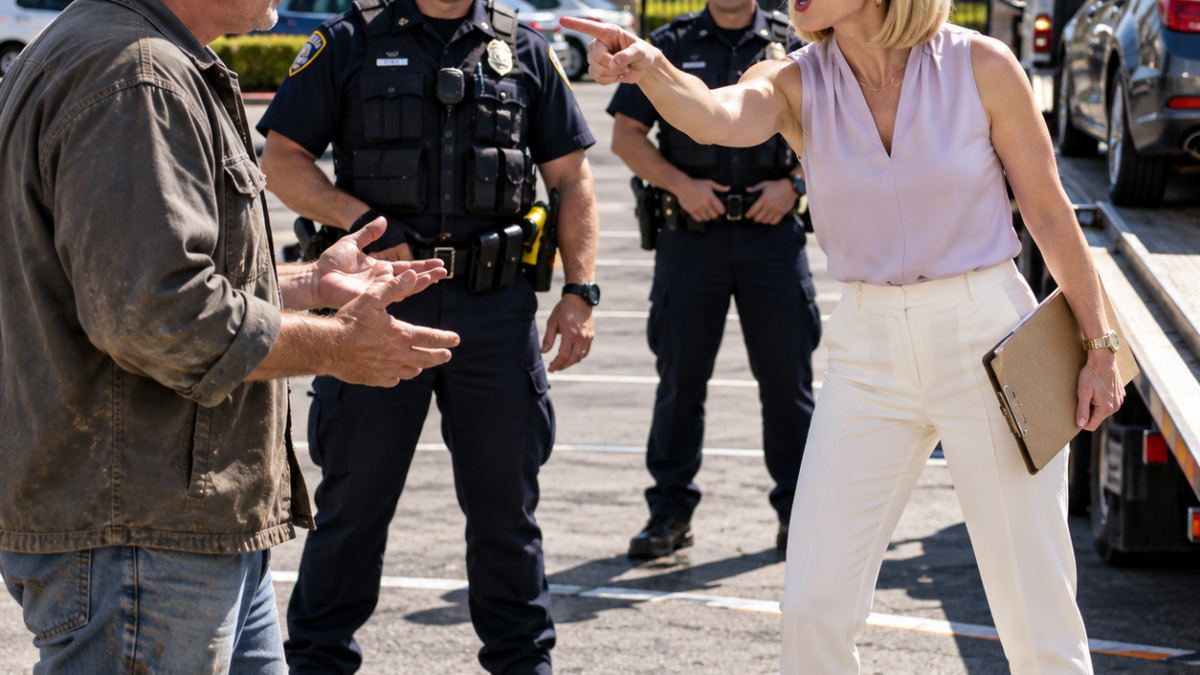
She was around forty, blonde, glamorous, and had the kind of appearance that suggested she was determined to make “HOA president” look like an elected federal office.
Perfect makeup.
Long styled hair.
Large sunglasses.
White fitted military-style jackets with gold buttons.
Very tight white trousers.
Deep necklines.
A very large chest that she clearly had no interest in disguising.
She often carried a leather portfolio or clipboard.
The first time I saw her in person, she looked like a yacht-club admiral who had gotten lost and wandered into suburban government.
Her personality matched the costume.
She had lived in the neighborhood around five years.
From what residents later told me, she’d wanted the presidency almost from the moment she moved in.
She attended every meeting.
Volunteered for committees.
Corrected people.
Quoted rules.
Argued about landscaping.
Eventually, she ran for board president.
Apparently, nobody opposed her.
Not because she was beloved.
Nobody else wanted the job.
Three weeks after taking office, Linda mailed me a letter.
Official envelope.
HOA logo.
Formal formatting.
It said my lot was in violation of several neighborhood covenants.
At first I thought they had mailed the wrong address.
Then I read the violations.
Unapproved surface material.
The asphalt.
The same asphalt that had existed since my grandfather’s repair business.
Unapproved signage.
My handwritten FEEL FREE TO PARK HERE sign.
Failure to submit architectural review request for lot modifications.
What modifications?
Painted lines?
Pothole repairs?
I read the letter twice.
Then laughed.
At the bottom, I was instructed to appear at the next HOA board meeting to discuss bringing my property into compliance.
I called the management company.
A woman answered.
“Hi. I received a violation notice.”
She asked for the property address.
I gave it.
There was a pause.
“Oh.”
That pause told me something.
“What’s wrong?”
“Let me pull the parcel.”
I waited.
She came back.
“You’re the commercial lot by the entrance?”
“Yes.”
“You’re not actually one of our residential parcels.”
“Correct.”
“Okay.”
She sounded embarrassed.
“I think the board may have made an error.”
“That’s what I thought.”
“I’ll forward this to them.”
“Appreciate it.”
She was pleasant.
Reasonable.
I assumed that was it.
One week later, another letter came.
This one was personally signed by Linda.
Her letter stated that all properties within the neighborhood community boundaries were subject to HOA governance.
That was already nonsense.
Then she included a map.
The HOA subdivision was shaded green.
My parking lot was also shaded green.
Like that settled ownership.
I stood in my kitchen staring at it.
I had my grandfather’s deed.
County records.
Tax documents.
Parcel number.
Commercial zoning.
Everything.
Linda had a green highlighter.
I almost admired the confidence.
I responded properly.
Copies of my deed.
Parcel records.
A map showing the commercial property separately.
Then I highlighted part of the HOA’s own governing documents.
Their CC&Rs listed the parcel numbers subject to association authority.
My parcel wasn’t included.
Never had been.
Why?
Because my grandfather’s lot existed before the subdivision.
Simple.
I sent the packet certified.
That should have ended everything.
Linda apparently took it personally.
One month later, I drove by the lot and found a notice taped to my handwritten sign.
FINAL WARNING.
I had fifteen days to remove “unauthorized signage” and submit the property to architectural review.
Otherwise:
Fifty dollars per day in fines.
I took a photograph.
Removed the notice.
Saved it.
Ignored everything else.
Then came month two.
This one mattered.
The city contacted me.
Code enforcement.
Someone had filed a complaint alleging that I was operating an:
UNLICENSED COMMERCIAL PARKING OPERATION.
Those exact words.
I remember reading the complaint language and saying:
“What?”
The officer asked when he could inspect.
“Anytime.”
He came out.
Nice guy.
Walked around the lot.
Looked at the sign.
Looked at the cars.
“How much are you charging?”
“Nothing.”
He stopped.
“Nothing?”
“Free.”
“Monthly pass?”
“No.”
“Daily fee?”
“No.”
“Event parking?”
“No.”
“Any commercial agreement?”
“No.”
He looked confused.
“Then what are we doing here?”
“Apparently somebody thinks I’m running a parking business.”
“Are you?”
“No.”
I showed him the deed.
Commercial zoning.
Explained the history.
Grandfather.
Neighborhood.
Free overflow parking.
The officer walked around for maybe ten minutes.
Then said:
“There’s nothing commercial here.”
“That’s what I’ve been saying.”
He closed the case.
Before leaving, he lowered his voice.
“Off the record?”
“Sure.”
“This looks like somebody has an axe to grind.”
“I have a guess.”
“HOA?”
I smiled.
He sighed.
“We see it.”
He left.
I later requested the complaint under public records procedures.
I wanted the exact language.
The form again said:
Unlicensed commercial parking operation.
I saved it.
At the time, it was just evidence.
Later, it became something much more useful.
Month three.
Flyers started appearing on cars parked in my lot.
I didn’t put them there.
Residents called.
One woman sounded panicked.
“Are they towing now?”
“What?”
“The HOA notice.”
“What notice?”
She sent a picture.
The flyer warned that parking on the lot was “at the vehicle owner’s own risk” and that the HOA could not guarantee the “safety or legality” of vehicles parked on “noncompliant properties.”
It sounded official enough to scare people without actually making any enforceable claim.
Classic intimidation.
I drove over.
Several cars had flyers.
I removed what I could.
Then posted another sign:
THIS IS PRIVATE PROPERTY. HOA HAS NO AUTHORITY OVER THIS LOT. PARKING REMAINS PERMITTED BY OWNER.
Linda responded a month later with a lawyer.
Certified letter.
Real law firm.
The HOA maintained that my lot fell within the “community boundary.”
Therefore, according to them, I had two choices.
One:
Bring the lot into compliance with HOA covenants.
Two:
Cease allowing HOA residents to use the property for vehicle parking.
Comply.
Or stop letting residents park.
I called my buddy from college.
He practices real-estate law.
I emailed the letter.
Five minutes later, he called.
“Did you send me the right document?”
“Yes.”
“This is ridiculous.”
“Good.”
“Your lot isn’t in the HOA.”
“I know.”
“Not remotely.”
“I know.”
“The parcel’s separate.”
“I know.”
“The CC&Rs don’t include it.”
“I highlighted that for them.”
He laughed.
“How much are they paying this attorney?”
“Residents’ money, apparently.”
“If they actually sue you, they’re going to have a bad day.”
“How bad?”
“Depending on how stupid they get, possibly your fees.”
“So ignore?”
“Document.”
“Always?”
“Always.”
Month five, I learned Linda had allocated five thousand dollars from HOA funds for legal expenses related to my property.
Five thousand dollars.
To fight over land they didn’t own.
Against a guy letting their residents use it for free.
I heard about it from a homeowner.
He stopped by while I was touching up some parking lines.
“You know they’re spending money on this, right?”
“How much?”
“Five grand budgeted.”
I stopped painting.
“For what?”
“Lawyer.”
“Why?”
He laughed.
“I’ve been asking that too.”
That was my first clue that Linda wasn’t telling residents the full story.
Months six and seven were quiet.
No letters.
No flyers.
No code complaints.
I assumed somebody on the board had finally told Linda to stop.
Maybe the lawyer had explained the concept of separate ownership.
Maybe management stepped in.
Maybe residents objected to burning dues.
I relaxed.
Month eight changed everything.
Saturday morning.
I drove over to do maintenance.
Nothing special.
Sweep glass.
Patch potholes.
Pick up trash.
As I approached the entrance, I slowed.
Then stopped.
There was a chain across my lot.
Heavy steel.
Padlocked.
Connected to two metal posts.
Not temporary posts.
Not traffic cones.
Metal posts had been cemented into the asphalt on both sides of the entrance.
Hanging from the chain was a laminated sign.
LOT CLOSED BY ORDER OF HOA BOARD OF DIRECTORS.
NO UNAUTHORIZED ACCESS.
I sat in my truck.
Five minutes.
Maybe longer.
I genuinely couldn’t process it.
They had installed permanent hardware.
On my property.
They had drilled or cut into my asphalt.
Poured concrete.
Mounted posts.
Then chained me out.
I was still staring when I noticed movement near the neighborhood entrance.
Linda.
Of course.
Her house was one of the first inside the subdivision.
She could see much of my lot from her front windows.
She must have been watching.
She walked toward me.
White fitted jacket.
Gold buttons.
White trousers.
Sunglasses.
Clipboard tucked under one arm.
Arms crossed by the time she reached the truck.
She smiled.
Not friendly.
Victory.
I lowered the window.
“Linda.”
“The board has closed the lot.”
I looked at the chain.
“So I noticed.”
“Until you’re willing to cooperate.”
“Cooperate with what?”
“Community regulations.”
I opened the door.
Stepped out.
I had promised myself for months not to lose my temper.
That morning took effort.
“Linda.”
She stared.
“This is private property.”
“The board has addressed that.”
“No.”
“Yes.”
“You installed posts in my asphalt.”
“For community safety.”
“You chained my property closed.”
“Because you’re operating it outside association guidelines.”
“I’m not in your association.”
Her expression tightened.
“We’re not having that argument again.”
I almost laughed.
“Apparently we are.”
Linda opened her folder.
“The board formally designated this lot as HOA common-use property at the last meeting.”
For a second, I honestly wondered whether I’d heard correctly.
“You what?”
“Common area.”
“You voted?”
“Yes.”
“To take my land?”
She sighed dramatically.
“No one is taking anything.”
“You designated privately owned commercial property as your common area.”
“The lot functions as part of the neighborhood.”
“Because I allowed people to park here.”
“Exactly.”
That word told me everything.
Linda believed repeated generosity had created community ownership.
I stared at her.
“So you’re telling me I need HOA permission to enter my own property?”
“Until the board resolves compliance, yes.”
I laughed.
Couldn’t help it.
“Remove this chain.”
“No.”
“Remove the posts.”
“No.”
“Today.”
“The board’s decision is final.”
Then Linda pulled out her phone.
Right in front of me.
“What are you doing?”
“Calling the police.”
I almost smiled.
“Please do.”
She dialed.
When dispatch answered, Linda turned away slightly.
“There is a man trespassing on HOA property.”
I looked around.
My property.
My deed.
My truck.
My grandfather’s lot.
And Linda was reporting me for trespassing.
She continued:
“He refuses to leave.”
I leaned against my truck.
Waited.
The officer who arrived looked familiar.
He had dealt with an earlier call connected to the lot after the code complaint.
He recognized me.
Stepped out.
Looked at the chain.
Looked at Linda.
Looked at me.
Then back at the chain.
“What happened?”
Linda started first.
Of course.
“This individual is refusing to comply with an HOA closure order.”
The officer looked at me.
I handed him my documents.
Deed.
Parcel map.
Tax record.
He looked.
Then asked Linda:
“Do you have ownership documentation?”
“The board voted—”
“Ma’am.”
He held up a hand.
“Ownership.”
Linda’s face tightened.
“This parcel is within our community boundaries.”
“Do you own it?”
“The HOA has governance authority.”
The officer looked at the deed again.
Then walked toward the posts.
He crouched.
Examined the concrete.
“Who installed these?”
Linda crossed her arms.
“The association.”
“With his permission?”
“We didn’t require—”
“Did he give permission?”
“No.”
The officer stood.
He looked at me.
“You want to file a report?”
Linda’s head snapped toward him.
“For what?”
He answered her.
“Potential criminal mischief. Property damage. Possibly vandalism depending on the circumstances.”
Her face drained.
“But the board voted.”
The officer looked almost tired.
“A board vote doesn’t give you permission to install structures on property you don’t own.”
“The lot is a community safety concern.”
“That’s civil.”
“He is trespassing.”
“On land documented in his name?”
Linda opened her mouth.
Closed it.
The officer continued.
“This appears to be a civil dispute regarding HOA claims, but the property damage is another issue.”
He pointed toward the posts.
“He has documentation indicating ownership.”
Then to Linda:
“I strongly recommend you speak with your attorney before taking further action.”
Linda started talking about common area designation.
The officer just looked at her.
That was enough.
She didn’t pursue the trespassing complaint.
I filed a vandalism/property-damage report.
That afternoon, I went home.
Got bolt cutters.
Returned.
Cut the chain.
Photographed everything first.
The posts.
Fresh concrete.
Damage around them.
The sign.
Chain.
Padlock.
Then I opened my lot.
But something had changed.
For almost a year, I’d been reasonable.
Polite.
Patient.
Linda sent fake violations.
I documented.
Linda called code enforcement.
I cooperated.
Linda distributed flyers.
I reassured people.
Linda hired lawyers with residents’ money.
I called my friend.
Linda physically chained my property.
Then called police on me.
That night, I spread every document across my kitchen table.
Not because I was planning revenge.
At least not initially.
I wanted to understand the pattern.
Violation letters.
Maps.
Code complaint.
Flyers.
Attorney letter.
Police report.
Then two documents caught my attention.
The city complaint.
UNLICENSED COMMERCIAL PARKING OPERATION.
And the lawyer’s letter.
Bring the property into compliance or cease allowing HOA residents to park.
I read them side by side.
Then again.
Something clicked.
Linda had insisted I was running a commercial parking operation.
She was wrong.
Because I wasn’t charging.
But the lot was zoned commercial.
My grandfather had operated a business there for decades.
The land use hadn’t disappeared.
Then her attorney had demanded I stop providing parking to HOA residents unless I accepted HOA rules.
Well.
I wasn’t joining the HOA.
Which left their second instruction.
Stop free parking.
I sat there staring at the paperwork.
Then I started laughing.
Linda wanted a commercial parking lot.
Fine.
I’d give her one.
She wanted it licensed.
Absolutely.
She wanted me to stop letting HOA residents park for free.
Gladly.
I called my lawyer friend the next morning.
“I have an idea.”
“That sentence worries me.”
“Commercial parking.”
Silence.
“What?”
“I’m zoned commercial.”
“Yes.”
“They complained I was operating an unlicensed parking business.”
“You weren’t.”
“I know.”
“And?”
“What if I actually do?”
Another pause.
Then:
“That is extremely petty.”
“Legal?”
“Probably, if permits check out.”
“I’d get everything.”
“You’d need business registration, permits, insurance, signage, compliance.”
“Fine.”
“Potential accessibility requirements.”
“Fine.”
“Local parking-lot standards.”
“Fine.”
He started laughing.
“What are you charging?”
“I haven’t decided.”
“Don’t discriminate illegally.”
“Obviously.”
“I’m serious.”
“So am I.”
I went to the city.
Filed an application.
The process took around six weeks.
Government speed.
Forms.
Inspection.
Fees.
Business license.
Operating permit.
Liability coverage.
The commercial zoning already existed.
The lot already met most requirements because it had served my grandfather’s business.
I fixed a few small issues.
Updated markings.
Handled paperwork.
Every box.
Every inspection.
Every fee.
I wanted nothing Linda could challenge.
Eventually, I received approval.
Licensed commercial parking facility.
I stared at the document.
Then ordered a sign.
Professional.
Large.
Impossible to miss.
I mounted it at the entrance where Linda’s chain had been.
PRIVATE PARKING LOT
LICENSED COMMERCIAL PARKING FACILITY
HOA RESIDENTS: $10 PER DAY
NON-HOA RESIDENTS: FREE WITH REGISTRATION
UNAUTHORIZED VEHICLES SUBJECT TO TOW
The words LICENSED COMMERCIAL PARKING FACILITY were large enough that I hoped Linda could read them from her front window.
I set up an online parking management system.
Vehicle information.
Registration.
Address.
If your residential address fell inside the HOA boundary?
Ten dollars per day.
If you lived outside?
Free with registration.
I wasn’t charging based on some protected category.
Just residency status tied directly to the organization whose lawyer had demanded I stop giving its residents free parking.
I installed cameras at the entrance and exit.
Set up a towing contract.
Anyone parked without registration got a warning first.
After that?
Tow.
Everything legal.
Everything documented.
Everything Linda had accused me of being?
I became.
Commercial parking operator?
Yes.
Licensed?
Yes.
Charging HOA residents?
Now I was.
Her complaint had become accurate.
The reaction was immediate.
Residents called.
“What’s happening?”
“Why is it ten dollars now?”
“Didn’t we park free?”
“You did.”
“What changed?”
“Your HOA.”
I told everyone the truth.
Not dramatically.
Just the timeline.
I had been happy to let them park for nothing.
For two years.
I maintained it myself.
Their president sent bogus violations.
Reported me to the city as an unlicensed commercial operation.
Hired an attorney using HOA funds.
The attorney told me to either comply with HOA rules or stop allowing HOA residents to use the lot.
Then Linda chained the property shut.
Cemented posts into my asphalt.
Called police and claimed I was trespassing.
“So yes,” I told one resident.
“The free arrangement is over.”
He was quiet.
Then said:
“I had no idea.”
Most people didn’t.
That was key.
Linda had apparently presented the issue as a difficult outside owner refusing reasonable community regulation.
She had not told everyone she was trying to take control of independent commercial property.
She definitely hadn’t announced the police incident.
The chain went up and came down so quickly that many residents never saw it.
A few people got angry with me.
I understood.
Yesterday parking cost zero.
Today ten dollars.
Nobody enjoys that.
But most became angry with Linda once they understood why.
And they still needed parking.
That’s what made the whole thing work.
The HOA’s rules hadn’t changed.
No overnight street parking.
Limited guest parking.
Commercial-vehicle restrictions.
Short driveways.
Teenagers with cars.
Families with three drivers.
Visitors.
Boat trailers.
Residents could choose alternatives.
Some did.
Garages suddenly got cleaned.
People rearranged driveways.
Some families coordinated vehicles better.
But many had no practical alternative.
Within weeks, I was seeing twenty to thirty HOA cars per day.
More on weekends.
At ten dollars each.
I did the math.
Then did it again.
I had been sitting on real income for years.
Spending money to provide the service for free.
Grandpa would’ve laughed.
Actually, he probably would have called me an idiot first.
Then laughed.
A typical day:
Twenty-five cars.
$250.
Busy weekend:
More.
Week after week.
Month after month.
The lot wasn’t making me rich.
But it was generating meaningful money.
Income I had never expected.
Enough to cover maintenance easily.
Then more.
All because Linda had insisted it was commercial.
Residents started talking.
The emergency HOA meeting happened not long afterward.
I wasn’t there.
I wasn’t a member.
But several residents told me what happened.
One man apparently brought the code-enforcement complaint.
He stood up.
Read Linda’s words aloud.
Unlicensed commercial parking operation.
Then held up his phone showing my new facility.
“Well, congratulations.”
People looked at him.
“It’s licensed now.”
Apparently, laughter started.
Then anger.
He continued.
“She told the city this was a parking business.”
He pointed toward Linda.
“She was wrong.”
Then pointed at the parking app.
“Now she’s right.”
Someone else raised their phone.
“I’ve spent a hundred fifty dollars in two weeks.”
That changed the room.
People started talking over one another.
“Why did we spend five thousand dollars on lawyers?”
“Why were police involved?”
“Who approved the chain?”
“What chain?”
That last question opened another problem.
Some homeowners hadn’t known about it.
Residents who did started explaining.
The board had physically installed posts and chained private property.
People became furious.
Not abstractly.
Financially.
Before Linda:
Parking cost them zero.
After Linda:
Some residents were spending $200.
$250.
$300 per month.
Someone calculated the collective monthly cost.
I don’t know the exact number they came up with.
But with twenty or thirty cars daily, it wasn’t small.
Then someone asked the obvious question.
“Why were we trying to take this lot in the first place?”
Linda defended herself.
She said she was protecting community interests.
She said the lot should rightfully be part of the HOA common areas.
She said she’d been trying to bring a “noncompliant property” under the association umbrella.
Apparently, she even said:
“I was right to file the code complaint.”
The room went silent.
Then exploded.
Because now residents were literally paying every day because that complaint had pushed me toward licensing.
One man reportedly said:
“You made yourself right and made all of us pay for it.”
I wish I’d heard that firsthand.
The meeting ended with a vote of no confidence.
Eighty-five percent voted to remove Linda.
Gone.
Two of her closest board allies resigned that same night.
The ones who had apparently approved the chain installation.
The HOA had spent months trying to control my property.
Instead, they lost free parking and their president.
I assumed that was the end.
Then the new president contacted me.
He didn’t send a demand letter.
Didn’t bring a clipboard.
Didn’t shade my property green on a homemade map.
He drove to the lot one evening.
Got out.
Walked over.
Extended his hand.
“I’m sorry.”
That was his first meaningful sentence.
I liked him immediately.
Not because he apologized.
Because he didn’t qualify it.
No:
“Both sides made mistakes.”
No:
“Miscommunication.”
No:
“Linda may have been overzealous.”
He said:
“The previous board was completely out of line.”
I shook his hand.
“Thank you.”
“What they did to you was wrong.”
“Agreed.”
“The lot is yours.”
“Yes.”
“Always was.”
“Yes.”
He nodded.
“And I’m embarrassed the association behaved otherwise.”
That mattered.
Then he asked:
“Would you be willing to talk about a parking arrangement?”
I crossed my arms.
“What kind?”
“One that’s actually voluntary.”
I laughed.
“That’s a good start.”
We met several times.
We worked out numbers.
Responsibilities.
Maintenance.
Insurance.
Resident access.
Eventually, we reached a lease agreement.
The HOA would pay me a flat monthly fee for dedicated resident use of the parking lot.
They’d handle communication.
Residents would no longer need to pay daily through the app.
I wouldn’t monitor individual registrations.
No day-to-day enforcement headaches.
No checking camera logs.
No dealing with somebody forgetting payment.
The HOA paid a guaranteed monthly amount.
Comfortable four figures.
The exact number isn’t important.
What mattered was predictability.
The agreement gets reviewed annually.
I handle major maintenance.
They get reliable overflow parking.
Everybody understands the land remains mine.
The lease doesn’t create ownership.
Doesn’t change boundaries.
Doesn’t create HOA membership.
All of that is written clearly.
My lawyer friend insisted.
“After Linda?”
He said.
“Spell out everything.”
We did.
The arrangement has worked.
Beautifully.
Residents are happy.
New board is reasonable.
I’m happy.
The monthly lease income became substantial enough that I quit the weekend side job I’d been doing for years.
That’s the ending I still find funniest.
I inherited the lot from my grandfather.
For years, I treated it like a burden mixed with a memory.
Something I didn’t want to sell because I wasn’t emotionally ready.
Something I maintained mostly out of respect for him.
I let his old neighbors use it because generosity felt appropriate.
Linda saw free use and interpreted it as weakness.
She thought:
If the neighborhood uses the land, maybe the neighborhood should control it.
She drew maps.
Sent violations.
Used legal threats.
Called code enforcement.
Spent residents’ money.
Installed posts.
Chained the entrance.
Called police.
At every step, she tried to transform informal goodwill into authority.
Instead, she monetized my property for me.
I sometimes stand near the entrance and look at the asphalt.
Same basic pavement.
Same parcel.
Same road.
But my relationship with it is completely different.
Before Linda, I saw Grandpa’s old shop.
Now I see that too.
But I also see an asset.
Something with real economic value.
Grandpa knew that.
Maybe that’s why he refused to sell.
He saw what development was coming.
Maybe he understood that sixty paved commercial spaces beside a restrictive residential neighborhood would eventually become useful.
If so, he was smarter than all of us.
There was one afternoon after the lease started when an older resident stopped while I was filling a crack.
He had known my grandfather.
He watched me work.
Then said:
“Your granddad would get a kick out of this.”
I smiled.
“Linda?”
“The whole thing.”
He pointed toward the neighborhood.
“People used to park here when your grandfather still had the shop, remember?”
“A little.”
“He never charged if the lot was empty.”
“Sounds like him.”
The man nodded.
“But he wasn’t stupid.”
I laughed.
“I’ve been told.”
“He would’ve let them use it until they got greedy.”
I looked toward the entrance.
“Then what?”
The old man smiled.
“Probably exactly this.”
That stayed with me.
I don’t regret letting residents park for free.
People sometimes hear the story and say:
“You should’ve charged from day one.”
Maybe financially.
But that’s not how I see it.
Those two free years meant something.
They were peaceful.
Neighbors appreciated it.
I was honoring Grandpa.
The fact that Linda destroyed the arrangement doesn’t make the generosity foolish.
It makes her behavior foolish.
There’s a difference.
Goodwill isn’t weakness.
It’s conditional trust.
When someone abuses it, you stop offering it.
That’s what happened.
I didn’t wake up wanting revenge.
I didn’t search for a way to punish hundreds of residents.
Actually, I tried hard not to.
For months, I gave Linda opportunities to stop.
First violation?
Corrected her.
Second letter?
Sent documentation.
Final warning?
Ignored it.
Code complaint?
Cooperated.
Flyers?
Reassured residents.
Lawyer?
Had mine review it.
Months of silence?
I accepted it.
Then she physically chained me out of my own property.
That crossed the line.
The police call made it worse.
I can still picture Linda standing beside the chain telling an officer that I was trespassing.
That’s a special kind of arrogance.
Not misunderstanding.
Not bad paperwork.
She believed a board vote had converted ownership.
Think about that.
Nine people, or however many sat on their board, had a meeting.
Voted.
And Linda walked away believing they had acquired rights over land none of them owned.
Why?
Because residents used it.
Because it sat near the entrance.
Because she had colored it green.
By that logic, if a neighborhood uses the grocery store down the road long enough, the HOA can annex the produce section.
The officer’s reaction mattered.
He didn’t arrest Linda.
Didn’t magically resolve ownership.
But he reminded her that HOA rules stop where actual property law begins.
The posts in my asphalt weren’t a board-policy issue.
They were unauthorized physical damage.
That was the first moment Linda seemed to realize she wasn’t playing with imaginary violation points anymore.
Yet even then, she didn’t apologize.
She simply retreated.
By then, I was done waiting for her to become reasonable.
The commercial license was malicious compliance in the purest sense.
Not because I broke rules.
Because I followed them.
Linda said commercial.
Fine.
Commercial.
Linda said unlicensed.
Fine.
Licensed.
Her attorney said stop giving HOA residents free parking.
Fine.
No more free parking.
Every accusation became an instruction.
And once everything was legal, documented, insured, and permitted, what could she complain about?
The answer turned out to be:
The cost.
But that wasn’t my problem.
That’s the beautiful thing about charging a fair market rate for something people had received as a favor.
The service itself didn’t change much.
Same lot.
Same spaces.
Same cars.
The thing that changed was entitlement.
Residents had previously parked because I allowed it.
After Linda, they parked because somebody paid me.
Consent became explicit.
Linda had accidentally turned community goodwill into a contract.
Contracts are much harder to steal.
I also learned something about HOA politics.
Most residents had no idea what their board was doing.
That’s important.
It’s easy to say:
“The HOA did this.”
Really, Linda and a small number of board members did.
Most homeowners were busy.
Jobs.
Kids.
Mortgages.
Dinner.
Life.
They weren’t reading every legal invoice.
They didn’t know about the code complaint.
Didn’t know the full attorney correspondence.
Some didn’t know the chain had happened at all.
Once they learned, they were furious.
Not just because parking cost money.
Because their dues had financed the campaign that caused it.
Imagine paying an HOA every month.
Then learning the president spent five thousand dollars of your money trying to seize control of property that wasn’t yours.
Then her efforts cause you to lose a free service.
Then you personally pay another hundred or two hundred dollars per month for the exact same parking.
I’d be angry too.
That’s why Linda’s “I was right” comment apparently destroyed whatever support she had left.
She could have apologized.
Could have said:
“I misread the documents.”
Could have blamed counsel.
Could have resigned gracefully.
Instead, she defended the complaint that had created the commercial lot.
Sometimes people aren’t defeated by evidence.
They’re defeated by being unable to stop talking.
Linda talked herself out of office.
The new president taught me what competence looked like.
He didn’t need an army of lawyers.
He needed one conversation.
“Your land.”
“Yes.”
“We need parking.”
“Yes.”
“What would make that worthwhile?”
Money.
Simple.
Negotiation works when both sides acknowledge reality.
Linda never did.
She began with the conclusion that the HOA deserved control.
Every action after that was designed to force reality to match.
The new president began with facts.
You own the lot.
We need access.
What arrangement works?
That approach took a few meetings and a contract.
Done.
No cops.
No code complaints.
No chains.
No lawsuits.
No five-thousand-dollar legal budget.
Just adults.
The lot still looks pretty ordinary.
People hear “commercial parking facility” and imagine a downtown garage.
It’s not.
Paved rectangle.
Painted lines.
Lighting.
Cameras.
Some signage.
Nothing dramatic.
But every month, the lease payment arrives.
I still smile sometimes.
Linda wanted control over something she never owned.
Instead, she taught me exactly how valuable ownership was.
Before her, I measured the lot emotionally.
Grandpa’s place.
After her, I learned to measure it economically too.
That doesn’t cheapen the memory.
I think Grandpa would have approved.
He ran a business there for thirty years.
He understood value.
Maybe better than I did.
I kept one thing from the old free-parking period.
The handwritten sign.
FEEL FREE TO PARK HERE.
I took it down when the commercial sign went up.
I couldn’t throw it away.
It’s in my garage now.
Faded.
Cheap.
A little warped from weather.
Sometimes I look at it and remember how simple things were before Linda.
People parked.
I cleaned.
Nobody argued.
Then I look at the lease agreement.
The revenue.
And I laugh.
Goodwill had value.
Linda simply forced me to put a price on it.
There are people who hear this story and ask:
“Why charge only HOA residents and let others park free?”
Because the arrangement was specifically created in response to the HOA attorney’s instruction that I cease allowing HOA residents to use the lot freely.
I complied.
People outside that organization hadn’t spent a year claiming the land.
Hadn’t sent notices.
Hadn’t funded legal threats.
Hadn’t chained the entrance.
The rate wasn’t secret.
No deception.
You registered.
Saw the price.
Chose whether to park.
Simple.
Eventually the lease replaced all of that anyway.
Now residents don’t individually deal with me.
The association pays for access.
That might be the cleanest part of the ending.
Linda tried to force the lot into the HOA without paying for it.
The new board got access by paying for it.
Exactly how property should work.
Ask.
Negotiate.
Agree.
Pay.
Respect boundaries.
That’s it.
I never saw Linda much after she was removed.
Occasionally near the neighborhood entrance.
She stopped coming near the lot.
No more white jacket marching toward me.
No more clipboard.
No more letters.
I heard she remained in the neighborhood for a while.
Some residents avoided her.
Others were openly hostile.
I didn’t care.
I wasn’t interested in extending the fight beyond my land.
She lost the board position.
Her policies were reversed.
Her allies resigned.
That was enough.
I got what I wanted.
Actually, I got far more than I wanted.
I wanted to be left alone.
Instead, I got a profitable lease.
Sometimes life has a strange sense of humor.
One day, maybe I’ll develop the lot.
Commercial building.
Storage.
Something else.
Maybe I’ll sell.
For now, parking works.
Low overhead.
Steady income.
Useful to the community.
And unlike before, everyone knows exactly whose land it is.
The lease says so.
The deed says so.
The tax records say so.
The county map says so.
Even the HOA says so now.
No green marker required.
I still do some maintenance myself.
Habit.
Every few months, I walk the lot.
Inspect cracks.
Check striping.
Pick up trash.
There is something satisfying about caring for it.
Not because it’s just an investment.
Because it’s Grandpa’s.
The auto shop is gone.
The lift is gone.
The office where he drank terrible coffee is gone.
But the property remains.
And every car parked there now contributes to keeping it useful.
One evening, I was repainting a faded line when I found a small piece of old metal embedded near the edge of the pavement.
Probably something left from the repair shop.
I dug it out.
Rusty bolt.
Nothing special.
I stood there looking at it.
Then put it in my pocket.
Sentimental nonsense.
But I thought about my grandfather refusing the developer’s offers.
Everybody probably told him to sell.
Take the money.
Move on.
He didn’t.
Decades later, the HOA that grew around his property tried to claim what the developer couldn’t buy.
They failed too.
The land stayed ours.
The difference is that Linda accidentally proved something Grandpa already knew.
Location matters.
Ownership matters.
And sometimes saying no for long enough creates value nobody else sees yet.
If Linda had left me alone, residents would probably still be parking free.
She could have taken credit for a wonderful neighborhood amenity that cost the HOA nothing.
Imagine that.
Sixty spaces near the entrance.
Maintained by someone else.
No dues required.
No legal liability to the association.
Residents happy.
Her only job was not to interfere.
She couldn’t do it.
Her need for control was stronger than common sense.
She looked at something working perfectly and thought:
How do I regulate this?
Then:
How do I own it?
Then:
How do I punish the person who won’t obey?
By the end, she had turned a zero-dollar parking benefit into a four-figure monthly association expense.
That’s an impressive achievement.
Not good.
But impressive.
And every time that lease payment hits my account, I remember the phrase on her code complaint.
Unlicensed commercial parking operation.
She was wrong.
Completely wrong.
But she worked so hard to prove it that eventually I decided to help her.
I got the license.
Opened the business.
Stopped giving the HOA free parking.
And turned the lot my grandfather left me into the income stream I had never realized it could be.
So in a strange way, Linda did accomplish exactly what she set out to do.
She transformed my parking lot.
Just not into HOA property.
Into my business.
𝗧𝗛𝗘 𝗘𝗡𝗗
The HOA President Called the Cops to Seize My Parking Lot—So I Turned Her Complaint Into a Business That Charged Her Neighborhood Every Day
For two years, I let my grandfather’s old neighbors park on my property for free.
I paid to maintain the asphalt, filled the potholes myself, cleaned up their trash, and never asked for a dollar because I thought I was continuing something my grandfather would have wanted.
Then a new HOA president decided my generosity meant the land belonged to her community.
By the time she called the police and accused me of trespassing on my own parking lot, I was finished being generous.
My grandfather owned an auto repair shop for almost thirty years.
It was never a glamorous business.
No polished showroom.
No corporate logo.
No waiting room with leather furniture and espresso machines.
Just a concrete-block shop, several service bays, an old hydraulic lift that somehow outlived everything around it, and a paved lot where customers left cars waiting for repairs.
But that shop mattered to him.
He opened it when he was still young enough to work twelve-hour days without complaining.
By the time I was a kid, everyone in the area seemed to know him.
People brought him cars their dealerships had given up on.
He fixed neighbors’ trucks.
Helped teenagers buy their first used cars without getting ripped off.
Occasionally accepted payment late from families who were struggling.
He wasn’t a saint.
He swore at stripped bolts.
Threw tools when something snapped at the worst possible moment.
Complained about customers who ignored warning lights until engines exploded.
But he believed being part of a neighborhood meant something.
That mattered later.
When my grandfather first opened the shop, there wasn’t much around it.
A main road.
Some older houses.
Open land.
His commercial parcel sat in a good location with road access and enough room for dozens of cars.
Then, in the early 2000s, developers started buying property nearby.
They had plans for a large residential community.
Rows of houses.
Decorative entrance.
Private amenities.
An HOA.
They bought almost everything surrounding my grandfather’s lot.
Almost.
They wanted his land too.
He refused.
They offered more.
He still refused.
One of my earliest memories of hearing him talk about the development was him sitting at the kitchen table with my dad, shaking his head.
“They think because they put a number on paper, I have to want it.”
Apparently the developer kept raising the offer.
My grandfather kept saying no.
He liked the location.
He liked his customers.
He had no interest in retiring.
Eventually the developers gave up.
They built the neighborhood around him.
Literally.
The commercial lot ended up directly beside the main entrance to the subdivision.
If you drove from the main road toward the neighborhood entrance, you passed my grandfather’s property before reaching the first houses.
It looked slightly strange.
Decorative brick signs.
Landscaped medians.
Matching streetlights.
Then an old mechanic’s shop.
Grandpa loved that.
He said it kept the neighborhood humble.
Over the years, the development expanded.
The HOA became more established.
People moved in.
Children grew up.
My grandfather knew a lot of residents by name.
They weren’t his HOA.
They were just neighbors.
Some were customers.
Some stopped at the shop to talk.
If someone’s battery died nearby, Grandpa usually helped.
If a kid’s bicycle tire went flat, he’d sometimes patch it.
That was how he lived.
Then age caught up with him.
The shop building became harder to maintain.
Business slowed.
Eventually, several years before his death, the building was torn down because repairs no longer made financial sense.
The lot stayed.
Large paved rectangle.
Roughly sixty parking spaces if people parked sensibly.
Commercial zoning.
Road access.
Separate deed.
Completely independent from the HOA.
When Grandpa died in 2019, he left the property to me.
I wasn’t prepared for that.
Not emotionally.
I knew he had assets.
I knew the old lot remained.
But inheriting something from someone you love doesn’t feel like receiving a gift.
It feels like being handed evidence that they’re gone.
For the first few months, I didn’t want to decide what to do with the property.
Develop it?
Sell?
Lease?
Build something?
I had no idea.
Every option felt too permanent.
So I left it alone.
The neighborhood had a problem, though.
Parking.
A serious one.
The HOA had rules against overnight street parking.
Rules about parking in front of somebody else’s house for more than a limited period.
Restrictions on commercial vehicles.
Restrictions on trailers.
Most houses had two-car garages and short driveways.
That sounds like plenty until you have two parents, a teenager with a car, a visiting relative, or a work vehicle.
Guests made everything worse.
Holiday weekends were ridiculous.
People had started using my grandfather’s empty lot before I formally inherited it.
At first only a few.
Then more.
When I took over, one neighbor asked me directly.
“Do you mind if we park there?”
I looked at the lot.
“No.”
“Really?”
“Just don’t block anything.”
Word spread.
I spent one weekend cleaning it up.
Weeds.
Trash.
Broken glass.
I filled some potholes with cold patch.
Bought paint.
Repainted basic parking lines.
Nothing fancy.
Just enough to keep people from parking diagonally like they’d abandoned vehicles during an evacuation.
Eventually, I put up a small sign.
Handwritten.
FEEL FREE TO PARK HERE.
That was it.
No fees.
No permit.
No attendant.
No towing contract.
No business.
Nothing.
People used it respectfully.
For about two years, the arrangement worked beautifully.
I paid for maintenance.
Not much.
Crack sealer.
Paint.
Trash bags.
Occasional repairs.
Every now and then, somebody would leave garbage.
I’d clean it.
Residents parked.
I didn’t worry about it.
Some people thanked me.
Others probably assumed the arrangement had existed forever.
I didn’t care.
To me, it was a way to preserve a little of what my grandfather had been to the neighborhood.
He spent decades helping these people.
The lot wasn’t earning anything.
Why not let them use it?
If the story had ended there, I’d probably still be giving away parking today.
Then Linda became HOA president.
I won’t use her real name.
Linda is good enough.
She was around forty, blonde, glamorous, and had the kind of appearance that suggested she was determined to make “HOA president” look like an elected federal office.
Perfect makeup.
Long styled hair.
Large sunglasses.
White fitted military-style jackets with gold buttons.
Very tight white trousers.
Deep necklines.
A very large chest that she clearly had no interest in disguising.
She often carried a leather portfolio or clipboard.
The first time I saw her in person, she looked like a yacht-club admiral who had gotten lost and wandered into suburban government.
Her personality matched the costume.
She had lived in the neighborhood around five years.
From what residents later told me, she’d wanted the presidency almost from the moment she moved in.
She attended every meeting.
Volunteered for committees.
Corrected people.
Quoted rules.
Argued about landscaping.
Eventually, she ran for board president.
Apparently, nobody opposed her.
Not because she was beloved.
Nobody else wanted the job.
Three weeks after taking office, Linda mailed me a letter.
Official envelope.
HOA logo.
Formal formatting.
It said my lot was in violation of several neighborhood covenants.
At first I thought they had mailed the wrong address.
Then I read the violations.
Unapproved surface material.
The asphalt.
The same asphalt that had existed since my grandfather’s repair business.
Unapproved signage.
My handwritten FEEL FREE TO PARK HERE sign.
Failure to submit architectural review request for lot modifications.
What modifications?
Painted lines?
Pothole repairs?
I read the letter twice.
Then laughed.
At the bottom, I was instructed to appear at the next HOA board meeting to discuss bringing my property into compliance.
I called the management company.
A woman answered.
“Hi. I received a violation notice.”
She asked for the property address.
I gave it.
There was a pause.
“Oh.”
That pause told me something.
“What’s wrong?”
“Let me pull the parcel.”
I waited.
She came back.
“You’re the commercial lot by the entrance?”
“Yes.”
“You’re not actually one of our residential parcels.”
“Correct.”
“Okay.”
She sounded embarrassed.
“I think the board may have made an error.”
“That’s what I thought.”
“I’ll forward this to them.”
“Appreciate it.”
She was pleasant.
Reasonable.
I assumed that was it.
One week later, another letter came.
This one was personally signed by Linda.
Her letter stated that all properties within the neighborhood community boundaries were subject to HOA governance.
That was already nonsense.
Then she included a map.
The HOA subdivision was shaded green.
My parking lot was also shaded green.
Like that settled ownership.
I stood in my kitchen staring at it.
I had my grandfather’s deed.
County records.
Tax documents.
Parcel number.
Commercial zoning.
Everything.
Linda had a green highlighter.
I almost admired the confidence.
I responded properly.
Copies of my deed.
Parcel records.
A map showing the commercial property separately.
Then I highlighted part of the HOA’s own governing documents.
Their CC&Rs listed the parcel numbers subject to association authority.
My parcel wasn’t included.
Never had been.
Why?
Because my grandfather’s lot existed before the subdivision.
Simple.
I sent the packet certified.
That should have ended everything.
Linda apparently took it personally.
One month later, I drove by the lot and found a notice taped to my handwritten sign.
FINAL WARNING.
I had fifteen days to remove “unauthorized signage” and submit the property to architectural review.
Otherwise:
Fifty dollars per day in fines.
I took a photograph.
Removed the notice.
Saved it.
Ignored everything else.
Then came month two.
This one mattered.
The city contacted me.
Code enforcement.
Someone had filed a complaint alleging that I was operating an:
UNLICENSED COMMERCIAL PARKING OPERATION.
Those exact words.
I remember reading the complaint language and saying:
“What?”
The officer asked when he could inspect.
“Anytime.”
He came out.
Nice guy.
Walked around the lot.
Looked at the sign.
Looked at the cars.
“How much are you charging?”
“Nothing.”
He stopped.
“Nothing?”
“Free.”
“Monthly pass?”
“No.”
“Daily fee?”
“No.”
“Event parking?”
“No.”
“Any commercial agreement?”
“No.”
He looked confused.
“Then what are we doing here?”
“Apparently somebody thinks I’m running a parking business.”
“Are you?”
“No.”
I showed him the deed.
Commercial zoning.
Explained the history.
Grandfather.
Neighborhood.
Free overflow parking.
The officer walked around for maybe ten minutes.
Then said:
“There’s nothing commercial here.”
“That’s what I’ve been saying.”
He closed the case.
Before leaving, he lowered his voice.
“Off the record?”
“Sure.”
“This looks like somebody has an axe to grind.”
“I have a guess.”
“HOA?”
I smiled.
He sighed.
“We see it.”
He left.
I later requested the complaint under public records procedures.
I wanted the exact language.
The form again said:
Unlicensed commercial parking operation.
I saved it.
At the time, it was just evidence.
Later, it became something much more useful.
Month three.
Flyers started appearing on cars parked in my lot.
I didn’t put them there.
Residents called.
One woman sounded panicked.
“Are they towing now?”
“What?”
“The HOA notice.”
“What notice?”
She sent a picture.
The flyer warned that parking on the lot was “at the vehicle owner’s own risk” and that the HOA could not guarantee the “safety or legality” of vehicles parked on “noncompliant properties.”
It sounded official enough to scare people without actually making any enforceable claim.
Classic intimidation.
I drove over.
Several cars had flyers.
I removed what I could.
Then posted another sign:
THIS IS PRIVATE PROPERTY. HOA HAS NO AUTHORITY OVER THIS LOT. PARKING REMAINS PERMITTED BY OWNER.
Linda responded a month later with a lawyer.
Certified letter.
Real law firm.
The HOA maintained that my lot fell within the “community boundary.”
Therefore, according to them, I had two choices.
One:
Bring the lot into compliance with HOA covenants.
Two:
Cease allowing HOA residents to use the property for vehicle parking.
Comply.
Or stop letting residents park.
I called my buddy from college.
He practices real-estate law.
I emailed the letter.
Five minutes later, he called.
“Did you send me the right document?”
“Yes.”
“This is ridiculous.”
“Good.”
“Your lot isn’t in the HOA.”
“I know.”
“Not remotely.”
“I know.”
“The parcel’s separate.”
“I know.”
“The CC&Rs don’t include it.”
“I highlighted that for them.”
He laughed.
“How much are they paying this attorney?”
“Residents’ money, apparently.”
“If they actually sue you, they’re going to have a bad day.”
“How bad?”
“Depending on how stupid they get, possibly your fees.”
“So ignore?”
“Document.”
“Always?”
“Always.”
Month five, I learned Linda had allocated five thousand dollars from HOA funds for legal expenses related to my property.
Five thousand dollars.
To fight over land they didn’t own.
Against a guy letting their residents use it for free.
I heard about it from a homeowner.
He stopped by while I was touching up some parking lines.
“You know they’re spending money on this, right?”
“How much?”
“Five grand budgeted.”
I stopped painting.
“For what?”
“Lawyer.”
“Why?”
He laughed.
“I’ve been asking that too.”
That was my first clue that Linda wasn’t telling residents the full story.
Months six and seven were quiet.
No letters.
No flyers.
No code complaints.
I assumed somebody on the board had finally told Linda to stop.
Maybe the lawyer had explained the concept of separate ownership.
Maybe management stepped in.
Maybe residents objected to burning dues.
I relaxed.
Month eight changed everything.
Saturday morning.
I drove over to do maintenance.
Nothing special.
Sweep glass.
Patch potholes.
Pick up trash.
As I approached the entrance, I slowed.
Then stopped.
There was a chain across my lot.
Heavy steel.
Padlocked.
Connected to two metal posts.
Not temporary posts.
Not traffic cones.
Metal posts had been cemented into the asphalt on both sides of the entrance.
Hanging from the chain was a laminated sign.
LOT CLOSED BY ORDER OF HOA BOARD OF DIRECTORS.
NO UNAUTHORIZED ACCESS.
I sat in my truck.
Five minutes.
Maybe longer.
I genuinely couldn’t process it.
They had installed permanent hardware.
On my property.
They had drilled or cut into my asphalt.
Poured concrete.
Mounted posts.
Then chained me out.
I was still staring when I noticed movement near the neighborhood entrance.
Linda.
Of course.
Her house was one of the first inside the subdivision.
She could see much of my lot from her front windows.
She must have been watching.
She walked toward me.
White fitted jacket.
Gold buttons.
White trousers.
Sunglasses.
Clipboard tucked under one arm.
Arms crossed by the time she reached the truck.
She smiled.
Not friendly.
Victory.
I lowered the window.
“Linda.”
“The board has closed the lot.”
I looked at the chain.
“So I noticed.”
“Until you’re willing to cooperate.”
“Cooperate with what?”
“Community regulations.”
I opened the door.
Stepped out.
I had promised myself for months not to lose my temper.
That morning took effort.
“Linda.”
She stared.
“This is private property.”
“The board has addressed that.”
“No.”
“Yes.”
“You installed posts in my asphalt.”
“For community safety.”
“You chained my property closed.”
“Because you’re operating it outside association guidelines.”
“I’m not in your association.”
Her expression tightened.
“We’re not having that argument again.”
I almost laughed.
“Apparently we are.”
Linda opened her folder.
“The board formally designated this lot as HOA common-use property at the last meeting.”
For a second, I honestly wondered whether I’d heard correctly.
“You what?”
“Common area.”
“You voted?”
“Yes.”
“To take my land?”
She sighed dramatically.
“No one is taking anything.”
“You designated privately owned commercial property as your common area.”
“The lot functions as part of the neighborhood.”
“Because I allowed people to park here.”
“Exactly.”
That word told me everything.
Linda believed repeated generosity had created community ownership.
I stared at her.
“So you’re telling me I need HOA permission to enter my own property?”
“Until the board resolves compliance, yes.”
I laughed.
Couldn’t help it.
“Remove this chain.”
“No.”
“Remove the posts.”
“No.”
“Today.”
“The board’s decision is final.”
Then Linda pulled out her phone.
Right in front of me.
“What are you doing?”
“Calling the police.”
I almost smiled.
“Please do.”
She dialed.
When dispatch answered, Linda turned away slightly.
“There is a man trespassing on HOA property.”
I looked around.
My property.
My deed.
My truck.
My grandfather’s lot.
And Linda was reporting me for trespassing.
She continued:
“He refuses to leave.”
I leaned against my truck.
Waited.
The officer who arrived looked familiar.
He had dealt with an earlier call connected to the lot after the code complaint.
He recognized me.
Stepped out.
Looked at the chain.
Looked at Linda.
Looked at me.
Then back at the chain.
“What happened?”
Linda started first.
Of course.
“This individual is refusing to comply with an HOA closure order.”
The officer looked at me.
I handed him my documents.
Deed.
Parcel map.
Tax record.
He looked.
Then asked Linda:
“Do you have ownership documentation?”
“The board voted—”
“Ma’am.”
He held up a hand.
“Ownership.”
Linda’s face tightened.
“This parcel is within our community boundaries.”
“Do you own it?”
“The HOA has governance authority.”
The officer looked at the deed again.
Then walked toward the posts.
He crouched.
Examined the concrete.
“Who installed these?”
Linda crossed her arms.
“The association.”
“With his permission?”
“We didn’t require—”
“Did he give permission?”
“No.”
The officer stood.
He looked at me.
“You want to file a report?”
Linda’s head snapped toward him.
“For what?”
He answered her.
“Potential criminal mischief. Property damage. Possibly vandalism depending on the circumstances.”
Her face drained.
“But the board voted.”
The officer looked almost tired.
“A board vote doesn’t give you permission to install structures on property you don’t own.”
“The lot is a community safety concern.”
“That’s civil.”
“He is trespassing.”
“On land documented in his name?”
Linda opened her mouth.
Closed it.
The officer continued.
“This appears to be a civil dispute regarding HOA claims, but the property damage is another issue.”
He pointed toward the posts.
“He has documentation indicating ownership.”
Then to Linda:
“I strongly recommend you speak with your attorney before taking further action.”
Linda started talking about common area designation.
The officer just looked at her.
That was enough.
She didn’t pursue the trespassing complaint.
I filed a vandalism/property-damage report.
That afternoon, I went home.
Got bolt cutters.
Returned.
Cut the chain.
Photographed everything first.
The posts.
Fresh concrete.
Damage around them.
The sign.
Chain.
Padlock.
Then I opened my lot.
But something had changed.
For almost a year, I’d been reasonable.
Polite.
Patient.
Linda sent fake violations.
I documented.
Linda called code enforcement.
I cooperated.
Linda distributed flyers.
I reassured people.
Linda hired lawyers with residents’ money.
I called my friend.
Linda physically chained my property.
Then called police on me.
That night, I spread every document across my kitchen table.
Not because I was planning revenge.
At least not initially.
I wanted to understand the pattern.
Violation letters.
Maps.
Code complaint.
Flyers.
Attorney letter.
Police report.
Then two documents caught my attention.
The city complaint.
UNLICENSED COMMERCIAL PARKING OPERATION.
And the lawyer’s letter.
Bring the property into compliance or cease allowing HOA residents to park.
I read them side by side.
Then again.
Something clicked.
Linda had insisted I was running a commercial parking operation.
She was wrong.
Because I wasn’t charging.
But the lot was zoned commercial.
My grandfather had operated a business there for decades.
The land use hadn’t disappeared.
Then her attorney had demanded I stop providing parking to HOA residents unless I accepted HOA rules.
Well.
I wasn’t joining the HOA.
Which left their second instruction.
Stop free parking.
I sat there staring at the paperwork.
Then I started laughing.
Linda wanted a commercial parking lot.
Fine.
I’d give her one.
She wanted it licensed.
Absolutely.
She wanted me to stop letting HOA residents park for free.
Gladly.
I called my lawyer friend the next morning.
“I have an idea.”
“That sentence worries me.”
“Commercial parking.”
Silence.
“What?”
“I’m zoned commercial.”
“Yes.”
“They complained I was operating an unlicensed parking business.”
“You weren’t.”
“I know.”
“And?”
“What if I actually do?”
Another pause.
Then:
“That is extremely petty.”
“Legal?”
“Probably, if permits check out.”
“I’d get everything.”
“You’d need business registration, permits, insurance, signage, compliance.”
“Fine.”
“Potential accessibility requirements.”
“Fine.”
“Local parking-lot standards.”
“Fine.”
He started laughing.
“What are you charging?”
“I haven’t decided.”
“Don’t discriminate illegally.”
“Obviously.”
“I’m serious.”
“So am I.”
I went to the city.
Filed an application.
The process took around six weeks.
Government speed.
Forms.
Inspection.
Fees.
Business license.
Operating permit.
Liability coverage.
The commercial zoning already existed.
The lot already met most requirements because it had served my grandfather’s business.
I fixed a few small issues.
Updated markings.
Handled paperwork.
Every box.
Every inspection.
Every fee.
I wanted nothing Linda could challenge.
Eventually, I received approval.
Licensed commercial parking facility.
I stared at the document.
Then ordered a sign.
Professional.
Large.
Impossible to miss.
I mounted it at the entrance where Linda’s chain had been.
PRIVATE PARKING LOT
LICENSED COMMERCIAL PARKING FACILITY
HOA RESIDENTS: $10 PER DAY
NON-HOA RESIDENTS: FREE WITH REGISTRATION
UNAUTHORIZED VEHICLES SUBJECT TO TOW
The words LICENSED COMMERCIAL PARKING FACILITY were large enough that I hoped Linda could read them from her front window.
I set up an online parking management system.
Vehicle information.
Registration.
Address.
If your residential address fell inside the HOA boundary?
Ten dollars per day.
If you lived outside?
Free with registration.
I wasn’t charging based on some protected category.
Just residency status tied directly to the organization whose lawyer had demanded I stop giving its residents free parking.
I installed cameras at the entrance and exit.
Set up a towing contract.
Anyone parked without registration got a warning first.
After that?
Tow.
Everything legal.
Everything documented.
Everything Linda had accused me of being?
I became.
Commercial parking operator?
Yes.
Licensed?
Yes.
Charging HOA residents?
Now I was.
Her complaint had become accurate.
The reaction was immediate.
Residents called.
“What’s happening?”
“Why is it ten dollars now?”
“Didn’t we park free?”
“You did.”
“What changed?”
“Your HOA.”
I told everyone the truth.
Not dramatically.
Just the timeline.
I had been happy to let them park for nothing.
For two years.
I maintained it myself.
Their president sent bogus violations.
Reported me to the city as an unlicensed commercial operation.
Hired an attorney using HOA funds.
The attorney told me to either comply with HOA rules or stop allowing HOA residents to use the lot.
Then Linda chained the property shut.
Cemented posts into my asphalt.
Called police and claimed I was trespassing.
“So yes,” I told one resident.
“The free arrangement is over.”
He was quiet.
Then said:
“I had no idea.”
Most people didn’t.
That was key.
Linda had apparently presented the issue as a difficult outside owner refusing reasonable community regulation.
She had not told everyone she was trying to take control of independent commercial property.
She definitely hadn’t announced the police incident.
The chain went up and came down so quickly that many residents never saw it.
A few people got angry with me.
I understood.
Yesterday parking cost zero.
Today ten dollars.
Nobody enjoys that.
But most became angry with Linda once they understood why.
And they still needed parking.
That’s what made the whole thing work.
The HOA’s rules hadn’t changed.
No overnight street parking.
Limited guest parking.
Commercial-vehicle restrictions.
Short driveways.
Teenagers with cars.
Families with three drivers.
Visitors.
Boat trailers.
Residents could choose alternatives.
Some did.
Garages suddenly got cleaned.
People rearranged driveways.
Some families coordinated vehicles better.
But many had no practical alternative.
Within weeks, I was seeing twenty to thirty HOA cars per day.
More on weekends.
At ten dollars each.
I did the math.
Then did it again.
I had been sitting on real income for years.
Spending money to provide the service for free.
Grandpa would’ve laughed.
Actually, he probably would have called me an idiot first.
Then laughed.
A typical day:
Twenty-five cars.
$250.
Busy weekend:
More.
Week after week.
Month after month.
The lot wasn’t making me rich.
But it was generating meaningful money.
Income I had never expected.
Enough to cover maintenance easily.
Then more.
All because Linda had insisted it was commercial.
Residents started talking.
The emergency HOA meeting happened not long afterward.
I wasn’t there.
I wasn’t a member.
But several residents told me what happened.
One man apparently brought the code-enforcement complaint.
He stood up.
Read Linda’s words aloud.
Unlicensed commercial parking operation.
Then held up his phone showing my new facility.
“Well, congratulations.”
People looked at him.
“It’s licensed now.”
Apparently, laughter started.
Then anger.
He continued.
“She told the city this was a parking business.”
He pointed toward Linda.
“She was wrong.”
Then pointed at the parking app.
“Now she’s right.”
Someone else raised their phone.
“I’ve spent a hundred fifty dollars in two weeks.”
That changed the room.
People started talking over one another.
“Why did we spend five thousand dollars on lawyers?”
“Why were police involved?”
“Who approved the chain?”
“What chain?”
That last question opened another problem.
Some homeowners hadn’t known about it.
Residents who did started explaining.
The board had physically installed posts and chained private property.
People became furious.
Not abstractly.
Financially.
Before Linda:
Parking cost them zero.
After Linda:
Some residents were spending $200.
$250.
$300 per month.
Someone calculated the collective monthly cost.
I don’t know the exact number they came up with.
But with twenty or thirty cars daily, it wasn’t small.
Then someone asked the obvious question.
“Why were we trying to take this lot in the first place?”
Linda defended herself.
She said she was protecting community interests.
She said the lot should rightfully be part of the HOA common areas.
She said she’d been trying to bring a “noncompliant property” under the association umbrella.
Apparently, she even said:
“I was right to file the code complaint.”
The room went silent.
Then exploded.
Because now residents were literally paying every day because that complaint had pushed me toward licensing.
One man reportedly said:
“You made yourself right and made all of us pay for it.”
I wish I’d heard that firsthand.
The meeting ended with a vote of no confidence.
Eighty-five percent voted to remove Linda.
Gone.
Two of her closest board allies resigned that same night.
The ones who had apparently approved the chain installation.
The HOA had spent months trying to control my property.
Instead, they lost free parking and their president.
I assumed that was the end.
Then the new president contacted me.
He didn’t send a demand letter.
Didn’t bring a clipboard.
Didn’t shade my property green on a homemade map.
He drove to the lot one evening.
Got out.
Walked over.
Extended his hand.
“I’m sorry.”
That was his first meaningful sentence.
I liked him immediately.
Not because he apologized.
Because he didn’t qualify it.
No:
“Both sides made mistakes.”
No:
“Miscommunication.”
No:
“Linda may have been overzealous.”
He said:
“The previous board was completely out of line.”
I shook his hand.
“Thank you.”
“What they did to you was wrong.”
“Agreed.”
“The lot is yours.”
“Yes.”
“Always was.”
“Yes.”
He nodded.
“And I’m embarrassed the association behaved otherwise.”
That mattered.
Then he asked:
“Would you be willing to talk about a parking arrangement?”
I crossed my arms.
“What kind?”
“One that’s actually voluntary.”
I laughed.
“That’s a good start.”
We met several times.
We worked out numbers.
Responsibilities.
Maintenance.
Insurance.
Resident access.
Eventually, we reached a lease agreement.
The HOA would pay me a flat monthly fee for dedicated resident use of the parking lot.
They’d handle communication.
Residents would no longer need to pay daily through the app.
I wouldn’t monitor individual registrations.
No day-to-day enforcement headaches.
No checking camera logs.
No dealing with somebody forgetting payment.
The HOA paid a guaranteed monthly amount.
Comfortable four figures.
The exact number isn’t important.
What mattered was predictability.
The agreement gets reviewed annually.
I handle major maintenance.
They get reliable overflow parking.
Everybody understands the land remains mine.
The lease doesn’t create ownership.
Doesn’t change boundaries.
Doesn’t create HOA membership.
All of that is written clearly.
My lawyer friend insisted.
“After Linda?”
He said.
“Spell out everything.”
We did.
The arrangement has worked.
Beautifully.
Residents are happy.
New board is reasonable.
I’m happy.
The monthly lease income became substantial enough that I quit the weekend side job I’d been doing for years.
That’s the ending I still find funniest.
I inherited the lot from my grandfather.
For years, I treated it like a burden mixed with a memory.
Something I didn’t want to sell because I wasn’t emotionally ready.
Something I maintained mostly out of respect for him.
I let his old neighbors use it because generosity felt appropriate.
Linda saw free use and interpreted it as weakness.
She thought:
If the neighborhood uses the land, maybe the neighborhood should control it.
She drew maps.
Sent violations.
Used legal threats.
Called code enforcement.
Spent residents’ money.
Installed posts.
Chained the entrance.
Called police.
At every step, she tried to transform informal goodwill into authority.
Instead, she monetized my property for me.
I sometimes stand near the entrance and look at the asphalt.
Same basic pavement.
Same parcel.
Same road.
But my relationship with it is completely different.
Before Linda, I saw Grandpa’s old shop.
Now I see that too.
But I also see an asset.
Something with real economic value.
Grandpa knew that.
Maybe that’s why he refused to sell.
He saw what development was coming.
Maybe he understood that sixty paved commercial spaces beside a restrictive residential neighborhood would eventually become useful.
If so, he was smarter than all of us.
There was one afternoon after the lease started when an older resident stopped while I was filling a crack.
He had known my grandfather.
He watched me work.
Then said:
“Your granddad would get a kick out of this.”
I smiled.
“Linda?”
“The whole thing.”
He pointed toward the neighborhood.
“People used to park here when your grandfather still had the shop, remember?”
“A little.”
“He never charged if the lot was empty.”
“Sounds like him.”
The man nodded.
“But he wasn’t stupid.”
I laughed.
“I’ve been told.”
“He would’ve let them use it until they got greedy.”
I looked toward the entrance.
“Then what?”
The old man smiled.
“Probably exactly this.”
That stayed with me.
I don’t regret letting residents park for free.
People sometimes hear the story and say:
“You should’ve charged from day one.”
Maybe financially.
But that’s not how I see it.
Those two free years meant something.
They were peaceful.
Neighbors appreciated it.
I was honoring Grandpa.
The fact that Linda destroyed the arrangement doesn’t make the generosity foolish.
It makes her behavior foolish.
There’s a difference.
Goodwill isn’t weakness.
It’s conditional trust.
When someone abuses it, you stop offering it.
That’s what happened.
I didn’t wake up wanting revenge.
I didn’t search for a way to punish hundreds of residents.
Actually, I tried hard not to.
For months, I gave Linda opportunities to stop.
First violation?
Corrected her.
Second letter?
Sent documentation.
Final warning?
Ignored it.
Code complaint?
Cooperated.
Flyers?
Reassured residents.
Lawyer?
Had mine review it.
Months of silence?
I accepted it.
Then she physically chained me out of my own property.
That crossed the line.
The police call made it worse.
I can still picture Linda standing beside the chain telling an officer that I was trespassing.
That’s a special kind of arrogance.
Not misunderstanding.
Not bad paperwork.
She believed a board vote had converted ownership.
Think about that.
Nine people, or however many sat on their board, had a meeting.
Voted.
And Linda walked away believing they had acquired rights over land none of them owned.
Why?
Because residents used it.
Because it sat near the entrance.
Because she had colored it green.
By that logic, if a neighborhood uses the grocery store down the road long enough, the HOA can annex the produce section.
The officer’s reaction mattered.
He didn’t arrest Linda.
Didn’t magically resolve ownership.
But he reminded her that HOA rules stop where actual property law begins.
The posts in my asphalt weren’t a board-policy issue.
They were unauthorized physical damage.
That was the first moment Linda seemed to realize she wasn’t playing with imaginary violation points anymore.
Yet even then, she didn’t apologize.
She simply retreated.
By then, I was done waiting for her to become reasonable.
The commercial license was malicious compliance in the purest sense.
Not because I broke rules.
Because I followed them.
Linda said commercial.
Fine.
Commercial.
Linda said unlicensed.
Fine.
Licensed.
Her attorney said stop giving HOA residents free parking.
Fine.
No more free parking.
Every accusation became an instruction.
And once everything was legal, documented, insured, and permitted, what could she complain about?
The answer turned out to be:
The cost.
But that wasn’t my problem.
That’s the beautiful thing about charging a fair market rate for something people had received as a favor.
The service itself didn’t change much.
Same lot.
Same spaces.
Same cars.
The thing that changed was entitlement.
Residents had previously parked because I allowed it.
After Linda, they parked because somebody paid me.
Consent became explicit.
Linda had accidentally turned community goodwill into a contract.
Contracts are much harder to steal.
I also learned something about HOA politics.
Most residents had no idea what their board was doing.
That’s important.
It’s easy to say:
“The HOA did this.”
Really, Linda and a small number of board members did.
Most homeowners were busy.
Jobs.
Kids.
Mortgages.
Dinner.
Life.
They weren’t reading every legal invoice.
They didn’t know about the code complaint.
Didn’t know the full attorney correspondence.
Some didn’t know the chain had happened at all.
Once they learned, they were furious.
Not just because parking cost money.
Because their dues had financed the campaign that caused it.
Imagine paying an HOA every month.
Then learning the president spent five thousand dollars of your money trying to seize control of property that wasn’t yours.
Then her efforts cause you to lose a free service.
Then you personally pay another hundred or two hundred dollars per month for the exact same parking.
I’d be angry too.
That’s why Linda’s “I was right” comment apparently destroyed whatever support she had left.
She could have apologized.
Could have said:
“I misread the documents.”
Could have blamed counsel.
Could have resigned gracefully.
Instead, she defended the complaint that had created the commercial lot.
Sometimes people aren’t defeated by evidence.
They’re defeated by being unable to stop talking.
Linda talked herself out of office.
The new president taught me what competence looked like.
He didn’t need an army of lawyers.
He needed one conversation.
“Your land.”
“Yes.”
“We need parking.”
“Yes.”
“What would make that worthwhile?”
Money.
Simple.
Negotiation works when both sides acknowledge reality.
Linda never did.
She began with the conclusion that the HOA deserved control.
Every action after that was designed to force reality to match.
The new president began with facts.
You own the lot.
We need access.
What arrangement works?
That approach took a few meetings and a contract.
Done.
No cops.
No code complaints.
No chains.
No lawsuits.
No five-thousand-dollar legal budget.
Just adults.
The lot still looks pretty ordinary.
People hear “commercial parking facility” and imagine a downtown garage.
It’s not.
Paved rectangle.
Painted lines.
Lighting.
Cameras.
Some signage.
Nothing dramatic.
But every month, the lease payment arrives.
I still smile sometimes.
Linda wanted control over something she never owned.
Instead, she taught me exactly how valuable ownership was.
Before her, I measured the lot emotionally.
Grandpa’s place.
After her, I learned to measure it economically too.
That doesn’t cheapen the memory.
I think Grandpa would have approved.
He ran a business there for thirty years.
He understood value.
Maybe better than I did.
I kept one thing from the old free-parking period.
The handwritten sign.
FEEL FREE TO PARK HERE.
I took it down when the commercial sign went up.
I couldn’t throw it away.
It’s in my garage now.
Faded.
Cheap.
A little warped from weather.
Sometimes I look at it and remember how simple things were before Linda.
People parked.
I cleaned.
Nobody argued.
Then I look at the lease agreement.
The revenue.
And I laugh.
Goodwill had value.
Linda simply forced me to put a price on it.
There are people who hear this story and ask:
“Why charge only HOA residents and let others park free?”
Because the arrangement was specifically created in response to the HOA attorney’s instruction that I cease allowing HOA residents to use the lot freely.
I complied.
People outside that organization hadn’t spent a year claiming the land.
Hadn’t sent notices.
Hadn’t funded legal threats.
Hadn’t chained the entrance.
The rate wasn’t secret.
No deception.
You registered.
Saw the price.
Chose whether to park.
Simple.
Eventually the lease replaced all of that anyway.
Now residents don’t individually deal with me.
The association pays for access.
That might be the cleanest part of the ending.
Linda tried to force the lot into the HOA without paying for it.
The new board got access by paying for it.
Exactly how property should work.
Ask.
Negotiate.
Agree.
Pay.
Respect boundaries.
That’s it.
I never saw Linda much after she was removed.
Occasionally near the neighborhood entrance.
She stopped coming near the lot.
No more white jacket marching toward me.
No more clipboard.
No more letters.
I heard she remained in the neighborhood for a while.
Some residents avoided her.
Others were openly hostile.
I didn’t care.
I wasn’t interested in extending the fight beyond my land.
She lost the board position.
Her policies were reversed.
Her allies resigned.
That was enough.
I got what I wanted.
Actually, I got far more than I wanted.
I wanted to be left alone.
Instead, I got a profitable lease.
Sometimes life has a strange sense of humor.
One day, maybe I’ll develop the lot.
Commercial building.
Storage.
Something else.
Maybe I’ll sell.
For now, parking works.
Low overhead.
Steady income.
Useful to the community.
And unlike before, everyone knows exactly whose land it is.
The lease says so.
The deed says so.
The tax records say so.
The county map says so.
Even the HOA says so now.
No green marker required.
I still do some maintenance myself.
Habit.
Every few months, I walk the lot.
Inspect cracks.
Check striping.
Pick up trash.
There is something satisfying about caring for it.
Not because it’s just an investment.
Because it’s Grandpa’s.
The auto shop is gone.
The lift is gone.
The office where he drank terrible coffee is gone.
But the property remains.
And every car parked there now contributes to keeping it useful.
One evening, I was repainting a faded line when I found a small piece of old metal embedded near the edge of the pavement.
Probably something left from the repair shop.
I dug it out.
Rusty bolt.
Nothing special.
I stood there looking at it.
Then put it in my pocket.
Sentimental nonsense.
But I thought about my grandfather refusing the developer’s offers.
Everybody probably told him to sell.
Take the money.
Move on.
He didn’t.
Decades later, the HOA that grew around his property tried to claim what the developer couldn’t buy.
They failed too.
The land stayed ours.
The difference is that Linda accidentally proved something Grandpa already knew.
Location matters.
Ownership matters.
And sometimes saying no for long enough creates value nobody else sees yet.
If Linda had left me alone, residents would probably still be parking free.
She could have taken credit for a wonderful neighborhood amenity that cost the HOA nothing.
Imagine that.
Sixty spaces near the entrance.
Maintained by someone else.
No dues required.
No legal liability to the association.
Residents happy.
Her only job was not to interfere.
She couldn’t do it.
Her need for control was stronger than common sense.
She looked at something working perfectly and thought:
How do I regulate this?
Then:
How do I own it?
Then:
How do I punish the person who won’t obey?
By the end, she had turned a zero-dollar parking benefit into a four-figure monthly association expense.
That’s an impressive achievement.
Not good.
But impressive.
And every time that lease payment hits my account, I remember the phrase on her code complaint.
Unlicensed commercial parking operation.
She was wrong.
Completely wrong.
But she worked so hard to prove it that eventually I decided to help her.
I got the license.
Opened the business.
Stopped giving the HOA free parking.
And turned the lot my grandfather left me into the income stream I had never realized it could be.
So in a strange way, Linda did accomplish exactly what she set out to do.
She transformed my parking lot.
Just not into HOA property.
Into my business.