𝗙𝗨𝗟𝗟 𝗦𝗧𝗢𝗥𝗬 The HOA President Called Police to Seize My Tractor—Then She Learned I Owned the Company Managing Her Entire Neighborhood
𝗙𝗨𝗟𝗟 𝗦𝗧𝗢𝗥𝗬
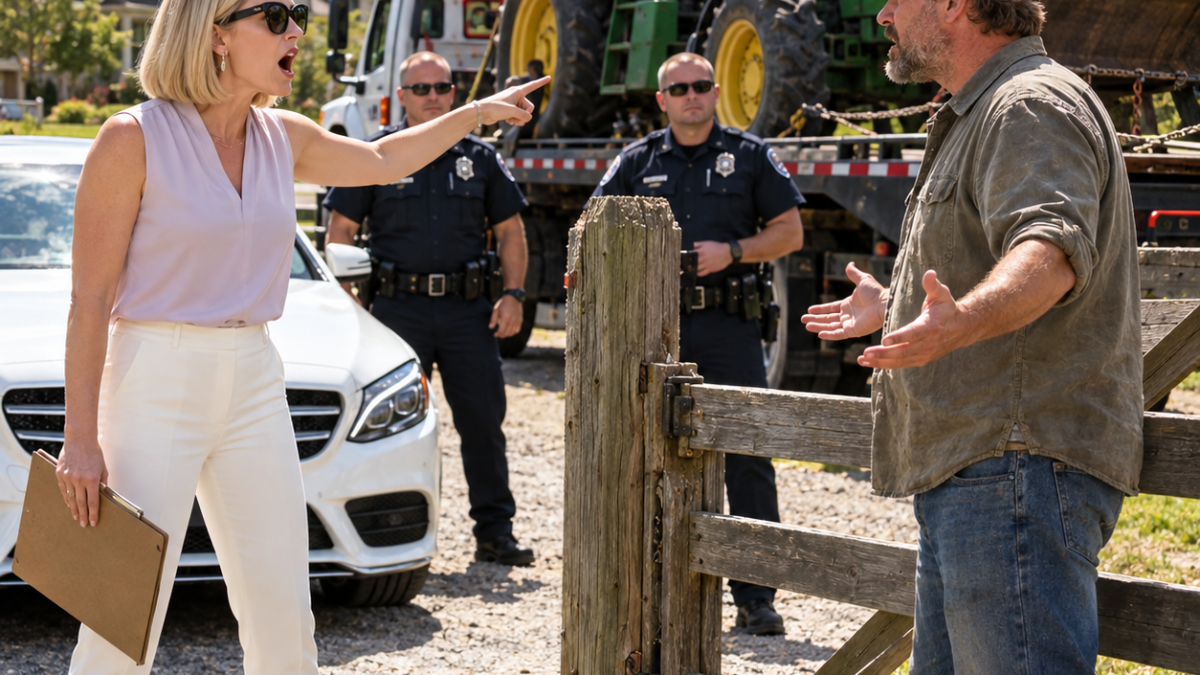
I rested one hand on the fence.
“It’s a farm.”
“I can see that.”
“So agricultural equipment tends to be involved.”
She ignored the comment.
“That green machine is visible from Willow Crest Drive.”
“Okay.”
“And several homeowners have concerns.”
“About seeing a tractor beside a farm?”
Her expression changed.
Not much.
Just enough to tell me she was already irritated.
“It lowers the visual quality of the area.”
“No, it looks like a tractor.”
“Exactly.”
I almost laughed.
Karen noticed.
“I don’t find this amusing.”
“I do.”
She raised the clipboard.
“I am Karen Whitmore, the newly elected president of the Willow Crest Homeowners Association.”
“Congratulations.”
“That association represents more than two hundred property owners.”
“Also congratulations.”
“And I am asking you, professionally, to relocate the equipment.”
“No.”
Her eyebrows lifted.
“No?”
“No.”
The word apparently offended her more than any profanity could have.
“This isn’t optional.”
“It is from where I’m standing.”
Karen’s voice sharpened.
“Your farm is directly adjacent to association property.”
“Correct.”
“That means activities here can affect our community standards.”
“Sure.”
She seemed encouraged.
Then I added, “But your standards don’t control this property.”
Her expression hardened again.
“The management company may have a different opinion.”
That nearly made me smile.
She had no idea.
I decided not to mention my company yet.
Not because I was planning some elaborate trap.
At that point, I genuinely expected the issue to resolve itself.
Our assigned manager would look at the property map, tell Karen the farm wasn’t in the HOA, and that would be the end of it.
So I said, “You’re welcome to check.”
Karen lifted her phone.
Then she started taking photographs.
The tractor.
The equipment shed.
Part of the barn.
My compost pile.
Me.
I stared.
“What are you doing?”
“Documenting.”
“Documenting what?”
“Noncompliant conditions.”
I laughed.
That was my mistake.
Her face flushed.
“You think this is funny?”
“A little.”
“We’ll see.”
She turned on her heel and walked back toward the subdivision.
I watched her leave.
Then went back to repairing the gate.
That should have been the end.
It wasn’t.
Over the next several weeks, Karen became a recurring feature at my fence.
First the tractor.
Then the compost pile.
Apparently, compost constituted a possible “odor nuisance.”
It was properly maintained and didn’t smell beyond a few feet.
That didn’t matter.
Then the chickens.
She objected to the sight of agricultural livestock from neighboring residential lots.
I told her chickens were legally permitted.
She told me community expectations were higher than minimum county standards.
I told her community expectations were welcome to stop at my fence.
Then she complained about hay bales.
Then the gravel access road.
Then the fact that parts of my fence were weathered wood instead of painted white vinyl.
Every interaction followed the same pattern.
Karen arrived.
Issued a demand.
I explained she lacked jurisdiction.
Karen told me she would escalate through the management company.
I told her to do whatever she felt necessary.
What I didn’t realize was that our employees were missing something.
Karen was contacting the company through routine channels.
Complaints about “adjacent agricultural property.”
Questions about violations.
Requests for enforcement.
My staff apparently assumed she was referring to a parcel within or legally tied to her association.
Nobody recognized the property address as mine because I didn’t use the farm address for corporate records.
And Karen either failed to explain clearly that the farm sat outside association boundaries or simply didn’t care.
The result was bureaucratic confusion.
Not actual enforcement.
But enough vague responses apparently reached Karen that she convinced herself the management company supported her.
That became dangerous.
One Friday evening, I came home and found several sheets of paper stuffed into the wire fence near the gate.
Not mailed.
Not properly served.
Just shoved there.
I pulled them out.
HOA VIOLATION NOTICE.
Fifty dollars.
Unsightly equipment storage.
Next page.
Fifty dollars.
Unauthorized livestock.
Next.
One hundred dollars.
Failure to maintain landscaping standards.
I stood there reading.
Then laughed.
My laughter stopped when I reached the bottom.
Repeated noncompliance may result in escalating penalties and further enforcement through the association’s contracted management company.
Now my own company was being invoked against me.
That irritated me.
I called our general office.
Didn’t identify myself to the person answering beyond my name.
I wanted to hear how the normal process worked.
“I’m calling about violation notices from Willow Crest.”
The employee asked for the property address.
I gave it.
There was a pause.
“I don’t see that address in the association roster.”
“Because it isn’t in the HOA.”
Another pause.
“What kind of notice did you receive?”
I explained.
She sounded confused.
“I’ll need to send this to the property manager.”
“Please do.”
“We’ll look into it.”
Nobody called back immediately.
That was a failure on our side.
I would deal with it later.
But before our office untangled anything, Karen decided to escalate again.
The confrontation happened on a Tuesday morning.
I had taken the morning away from the office because I needed to move hay bales from the back field.
The weather forecast called for rain later in the week, and I wanted them under cover.
I was outside shortly after seven.
Coffee in a travel mug.
Work gloves in one pocket.
I walked toward the equipment area.
Then stopped.
A black Mercedes was parked directly across my main agricultural gate.
Not near it.
Not partially blocking it.
Completely across it.
My gate was wide enough for tractors, trailers, feed deliveries, and service vehicles.
Karen had positioned the Mercedes sideways enough that nothing larger than a bicycle could pass.
She sat in the driver’s seat.
Window down.
Phone to her ear.
I stood there for a second wondering whether the placement was accidental.
Then she saw me.
And smiled.
Not a friendly smile.
A smug one.
I walked over.
“Morning.”
Karen lowered the phone.
“Oh.”
She looked toward the gate.
“Am I in your way?”
There was no ambiguity now.
“Yes.”
She smiled more.
“I didn’t realize.”
“You parked directly across the entrance.”
She looked around theatrically.
“I don’t see any no-parking signs.”
“There is a private property sign six feet from your front bumper.”
Karen glanced at it.
“Well, I assumed this was some kind of shared easement.”
“It isn’t.”
I pointed toward the road.
“Move the car.”
She crossed one arm over the open window.
“I don’t think so.”
I stared.
“Karen.”
“Yes?”
“I have work to do.”
“So do I.”
“Your work does not involve blocking access to my farm.”
“Actually, I’m waiting for law enforcement.”
That made me pause.
“Why?”
“Because your violation situation has gone too far.”
I almost admired the confidence.
“What violation situation?”
She gestured toward the tractor.
“Illegal agricultural equipment storage.”
“Illegal where?”
“Within the community impact area.”
“That isn’t a legal designation.”
She ignored me.
“I’ve already contacted the appropriate authorities.”
Then she picked up her phone again.
“And the towing company.”
I thought I had misunderstood.
“The what?”
“Towing company.”
“For what?”
“To remove the abandoned agricultural equipment.”
I looked past her toward my John Deere.
Parked on my land.
Behind my fence.
Near my barn.
Then back at her.
“You called a tow truck for my tractor.”
“Yes.”
“From my farm.”
“Yes.”
“You understand how ridiculous that sounds.”
“No.”
She turned slightly in the seat.
“What I understand is that you’ve repeatedly refused legitimate enforcement.”
“There has been no legitimate enforcement.”
“The management company told me I could handle violations.”
“Did they?”
“Yes.”
Now I was interested.
“Who?”
She waved one hand.
“Your little technicalities aren’t going to save you.”
My little technicalities.
Like ownership.
Property boundaries.
Law.
Karen dialed again.
I listened.
“Yes, this is Karen Whitmore, HOA president for Willow Crest.”
Pause.
“Yes, I have an abandoned equipment situation.”
I nearly spit out my coffee.
“A John Deere tractor.”
Pause.
“Correct. Heavy-duty flatbed.”
She looked directly at me while speaking.
“It needs immediate removal.”
Another pause.
“Yes, community safety issue.”
She nodded.
“The management company has authorized HOA enforcement.”
That part caught my attention.
I knew our company.
No legitimate employee should have authorized towing equipment from non-HOA property without documentation.
Either Karen was lying, exaggerating, or one of my staff had said something dangerously unclear.
Then Karen ended the call and dialed another number.
This one was police.
Her voice changed.
Suddenly breathless.
Concerned.
Professional victim.
“Yes, I’m the president of a homeowners association and we have a hostile property owner interfering with lawful community enforcement.”
I stared at her.
Karen turned slightly away.
“He has been argumentative.”
I hadn’t raised my voice.
“He’s refusing to cooperate.”
Correct.
“With association safety standards.”
Imaginary ones.
She gave the location.
Then hung up.
“The police are coming.”
“Good.”
That answer unsettled her.
“You don’t seem concerned.”
“Should I be?”
“You’ve been hostile.”
“I asked you to move your car.”
“You’ve refused every reasonable request I’ve made for months.”
“Because you have no authority here.”
Karen opened the Mercedes door.
She stepped out.
White fitted uniform.
Gold buttons.
Deep neckline.
High heels.
At seven in the morning beside a muddy farm gate.
The visual was incredible.
She lifted her clipboard.
“You’re about to learn that private ownership doesn’t mean you can do anything you want.”
I looked at the tractor.
“Parking farm equipment on a farm is a strange hill for you to die on.”
She glared.
“I would watch your tone.”
I checked my watch.
“I’m going to lose half my morning because of this.”
“Maybe inconvenience will finally teach you respect.”
That sentence stayed with me.
About twenty minutes later, I heard two vehicles approaching.
First the police cruiser.
Then the diesel rumble of a heavy flatbed tow truck.
I recognized the truck before it stopped.
Bennett Towing.
We had used them for years.
My property management company contracted Bennett for parking enforcement and removal work at several properties.
The driver was Jimmy.
I’d known him maybe five years.
Good guy.
Calm.
Never touched a vehicle without proper authorization.
Jimmy climbed out.
Then saw me.
His eyebrows rose.
Karen practically rushed toward the police officer.
She moved as though she’d been waiting to assume command of a battlefield.
“Officer.”
The officer stepped out.
Middle-aged guy.
Tired expression.
The expression of a person who had probably handled three neighborhood disputes before breakfast.
Karen pointed toward me.
“This is the individual.”
The officer looked at me.
I nodded.
“Morning.”
Karen continued.
“He has repeatedly refused HOA compliance orders, and this morning he became aggressive when I attempted to document violations.”
The officer looked at her.
Then me.
“Sir?”
“I asked her to move her Mercedes because she’s blocking my farm gate.”
The officer glanced toward the car.
Then the sign.
PRIVATE FARM ACCESS
DO NOT BLOCK GATE
He looked back at Karen.
“Ma’am, is that your vehicle?”
“Yes.”
“Why is it blocking this entrance?”
“This is a community access area.”
“No, it isn’t,” I said.
Karen snapped, “Please stop interrupting.”
The officer looked toward the property.
“Whose land is this?”
“Mine.”
Karen said, “It sits on our community boundary.”
“That wasn’t my question.”
The officer turned to me.
“Do you have proof of ownership?”
“Absolutely.”
I pointed toward the farmhouse.
“Deed, tax records, agricultural registration. Whatever you need.”
Karen sighed dramatically.
“This is exactly what he does. He hides behind technicalities.”
The officer raised an eyebrow.
“Property ownership isn’t usually considered a technicality.”
I almost smiled.
Karen didn’t.
She pointed toward the tractor.
“That is the equipment I’ve reported.”
The officer walked several yards toward the gate.
He looked.
Then back at her.
“The tractor?”
“Yes.”
“It’s on the other side of the private property fence.”
“Correct.”
“On his land.”
“It is visible from association property.”
The officer stared at her.
For several seconds.
Then said, “Visibility doesn’t make it illegally parked.”
Karen’s face reddened.
“I don’t care whose property it’s technically on.”
There was that word again.
Technically.
“I am president of the HOA responsible for this community, and that equipment violates our aesthetic standards.”
The officer said, “Is this farm part of your HOA?”
Karen hesitated.
“It is surrounded by our community.”
“That wasn’t the question.”
She crossed her arms.
“It impacts our neighborhood.”
The officer looked at me.
“You a member?”
“No.”
“Pay dues?”
“No.”
“Recorded covenants?”
“No.”
Karen interrupted.
“Our management company has been handling this.”
That was when Jimmy walked closer.
He had been listening while pretending to check something on his truck.
Karen turned toward him.
“Good. I need you to load that tractor.”
Jimmy looked at the tractor.
Then Karen.
Then me.
“Ma’am, I need authorization paperwork.”
“I called dispatch.”
“Dispatch said you requested a removal. That’s not the same as legal authorization.”
“I am the HOA president.”
“Okay.”
Jimmy waited.
Karen’s eyes widened.
“Okay?”
“Do you have a tow order?”
“I just gave you one.”
“Do you have documentation showing you have legal authority over that property?”
Karen pointed toward me.
“He’s in violation.”
Jimmy looked at the farm.
“Is the tractor stolen?”
“No.”
“Abandoned on HOA property?”
“It is abandoned equipment affecting HOA property.”
“That isn’t what I asked.”
Karen’s voice climbed.
“The management company authorized me to handle violations.”
Jimmy shrugged.
“Then show me something from the management company authorizing removal.”
She looked down at her clipboard.
Nothing.
Jimmy continued.
“Or a court order.”
Nothing.
“Lien paperwork.”
Nothing.
“Property authorization from the owner.”
I raised my hand slightly.
“Owner says no.”
Jimmy laughed.
Karen snapped.
“This isn’t funny.”
“No, ma’am.”
Jimmy straightened.
“But I can’t drag a tractor off somebody’s private farm because a neighborhood president doesn’t like looking at it.”
Karen’s face had turned bright red.
“You will do what you’re contracted to do.”
Jimmy glanced at me.
Then back at Karen.
That’s when I decided the circus had lasted long enough.
“Actually, Jimmy.”
“Yeah?”
I pointed toward the Mercedes.
“Can you tow that?”
Karen blinked.
“What?”
Jimmy looked at the Mercedes.
Then the gate.
“Blocking access?”
“Completely.”
“You want it removed?”
“Yes.”
Karen laughed in disbelief.
“You cannot be serious.”
I looked at her.
“Very.”
“You can’t order him around.”
Jimmy started smiling.
“Actually…”
Karen turned.
“What?”
Jimmy gestured toward me.
“His company gives us a lot of work.”
Karen frowned.
“What company?”
I let the silence last a second.
Then took out my phone.
Karen looked between us.
“I don’t understand.”
“No,” I said. “You really don’t.”
I called David, our regional operations director.
He handled several major association accounts.
Including Willow Crest.
He answered quickly.
“Morning, boss.”
Karen heard that word.
Her expression shifted.
“David, I need you on speaker.”
“Okay.”
I tapped the screen.
“We have a situation at my farm.”
“Everything okay?”
“The Willow Crest HOA president is here.”
Silence.
Then:
“Karen?”
Karen’s face changed.
“Yes,” I said.
“She has been issuing violation notices against the farm.”
“What?”
“She currently has her Mercedes parked across my agricultural access gate.”
Another pause.
“She also called police and Bennett Towing because she wants my tractor removed as abandoned HOA equipment.”
David didn’t answer for a few seconds.
Then said very slowly:
“She did what?”
Karen stepped forward.
“Who is that?”
I looked at her.
“Our regional operations director.”
Her face tightened.
“Your?”
“The company that manages Willow Crest.”
She stared.
David spoke through the phone.
“Karen, are you there?”
She moved closer.
“Yes.”
Her confidence tried to return.
“David, thank God. Please explain to these people that the HOA has enforcement authority over exterior violations affecting the neighborhood.”
David said, “Not on property outside the HOA.”
Karen froze.
“This property affects the association.”
“Is the farm parcel part of Willow Crest?”
She didn’t answer.
David continued.
“Because according to our maps, it is not.”
The officer looked at her.
Jimmy looked increasingly entertained.
Karen said, “I was told I could handle community violations.”
David’s voice hardened.
“You can report suspected violations to our office.”
“Exactly.”
“You cannot independently issue fines.”
Silence.
“You definitely cannot order private property towed.”
Karen swallowed.
“And you cannot extend HOA restrictions to non-member land.”
Her face was losing color.
I said, “She put notices on my fence. Fifty dollars for equipment, fifty for chickens, a hundred for landscaping.”
David cursed quietly.
Karen looked furious.
“You don’t need to discuss internal association business in front of him.”
I almost admired that one.
David answered before I could.
“Karen, he owns the management company.”
Silence.
The police officer looked at me.
Jimmy bit his lip to stop smiling.
Karen stared.
“What?”
David repeated it.
“The farm owner standing in front of you is the CEO and majority owner of the company contracted to manage your HOA.”
Her mouth opened.
Nothing came out.
I gave a small wave.
Karen looked at Jimmy.
Then the officer.
Then me.
“You’re lying.”
I unlocked my phone.
“No.”
“You…”
She gestured vaguely toward my clothes.
“I’m farming.”
“But you…”
“What?”
No answer.
David continued through the speaker.
“Boss, I need copies of every notice she’s issued.”
“You’ll get them.”
“And anything she claimed came from our office.”
“Absolutely.”
Karen suddenly found her voice.
“This is completely inappropriate.”
I looked at her.
“Which part?”
“You intentionally withheld your identity.”
“I told you the farm wasn’t under the HOA.”
“You knew I was dealing with your company.”
“You kept threatening me with my company.”
“That is deceptive.”
“No.”
I slipped the phone slightly closer.
“What’s deceptive is telling police and a towing contractor that my company authorized you to seize property when apparently we didn’t.”
Her eyes widened.
“I never said seize.”
Jimmy spoke.
“You told dispatch it was abandoned equipment and needed immediate removal.”
Karen glared at him.
“You’re misrepresenting the conversation.”
Jimmy shrugged.
“Our calls are recorded.”
That hurt.
David said through the phone, “They are.”
Karen seemed to shrink.
Then David added:
“I am documenting this incident and contacting the Willow Crest board chair immediately.”
“You don’t have authority to suspend me.”
“I don’t need authority to suspend you.”
David’s tone remained controlled.
“But our company can recommend immediate suspension of your enforcement access while the board investigates.”
Karen’s hands began moving.
Fast.
Agitated.
“This is insane.”
The officer stepped closer.
“Ma’am, I also need identification.”
Karen turned.
“For what?”
“You called emergency services.”
“Yes.”
“And reported a hostile individual interfering with HOA enforcement.”
“He was hostile.”
The officer looked at me.
I had barely moved during the entire conversation.
“Sir, have you threatened her?”
“No.”
“Touched her?”
“No.”
“Raised your voice?”
“No.”
Karen snapped.
“He was intimidating.”
The officer looked at me again.
Then at her Mercedes.
Then the private gate.
“By asking you to move your vehicle?”
“You weren’t here earlier.”
“What happened earlier?”
Karen paused.
The officer waited.
She didn’t have much.
Finally:
“He was dismissive.”
The officer’s expression did not change.
“I need your ID.”
Karen reached into her purse.
While she did, Jimmy walked back toward his truck.
Karen noticed.
“What are you doing?”
“Getting ready to move the Mercedes.”
“No.”
Jimmy stopped.
“No?”
“You are not touching my car.”
He pointed toward the gate.
“It’s blocking private agricultural access.”
“I parked there temporarily.”
I said, “You’ve been asked repeatedly to move it.”
“I was waiting for police.”
“The police are here.”
Karen turned toward the officer.
“Tell him he cannot tow my car.”
The officer looked toward the posted sign.
“Ma’am, you’ve been notified you’re obstructing private access.”
“I’ll move it myself.”
Jimmy looked at me.
I looked at the officer.
The officer said, “If the owner wants it removed and it is obstructing lawful access, that’s a civil towing matter. I’m not going to order the tow canceled.”
Karen lunged toward the Mercedes.
“I’ll move it.”
I shook my head.
“No.”
She spun around.
“What?”
“Too late.”
“You can’t do that.”
“You deliberately parked there to prevent me from using my property.”
“I was waiting for enforcement.”
“There is no enforcement.”
She looked at Jimmy.
“Do not touch my Mercedes.”
Jimmy said, “Ma’am, step away from the vehicle.”
Her face became scarlet.
“This is harassment!”
Nobody answered.
“This is targeted retaliation!”
I folded my arms.
“You called a tow truck to take my tractor.”
“Because you’re violating standards.”
“On my farm.”
“You’re doing this because I’m a woman.”
The officer actually closed his eyes for half a second.
Karen continued.
“I’m being discriminated against for protecting neighborhood values.”
I said, “You’re being towed because your Mercedes is blocking my gate.”
“That is not the same thing!”
“No. Mine is legal.”
Jimmy started lowering the flatbed.
Hydraulics whined.
Karen moved toward him.
The officer stepped between them.
“Ma’am.”
“You need to stop him.”
“You need to step back.”
“But that’s my car.”
“Yes.”
“This is theft.”
“No.”
Karen pointed at me.
“He is abusing his corporate position!”
That was when I finally lost patience.
Not my temper.
My patience.
“Karen.”
She looked at me.
“You tried to have your boss’s boss arrested.”
Her mouth tightened.
“You tried to have his tractor removed from his own land.”
Her eyes moved toward the officer.
“And you invented authority your own management agreement doesn’t give you.”
Her confidence shattered completely.
The officer began taking notes.
David was still on speaker.
He said, “I just sent a message to the board chair.”
Karen turned toward the phone.
“You had no right.”
“I absolutely have the right to notify a client board that their president may be creating liability.”
“I was enforcing rules.”
“Unauthorized fines aren’t enforcement.”
“They were warnings.”
“You put dollar amounts on them.”
Karen looked at me.
“You kept ignoring me.”
That sentence almost explained everything.
It wasn’t about the tractor.
Or chickens.
Or compost.
Karen couldn’t tolerate being ignored.
Most HOA homeowners had to react when she sent letters.
They had to attend hearings.
Appeal fines.
Ask permission.
I didn’t.
That made my farm unbearable to her.
A visible place at the edge of the neighborhood where she had no power.
Jimmy began hooking up the Mercedes.
Karen stared as straps went around the wheels.
Then her phone rang.
She answered.
“Hello?”
Her expression changed instantly.
“Wait.”
She walked several feet away.
“No, that’s not what happened.”
Pause.
“I was acting within my responsibilities.”
Another pause.
“Who told you that?”
Her eyes moved toward me.
“No.”
Then:
“You cannot call an emergency meeting without me.”
Pause.
“I am the president.”
Her voice rose.
“What do you mean suspended?”
There it was.
David said quietly through my phone, “Board chair moves fast.”
Karen turned away from her call.
Her shoulders seemed to collapse.
When she finished, she stared at the ground.
Then my phone rang.
David.
I took him off speaker.
“Yeah?”
“Board chair wants an emergency session this afternoon.”
“Good.”
“He’s furious.”
“I imagine.”
“He says pending review, they’re restricting Karen from directing vendors or issuing any enforcement communications.”
“Smart.”
“We’re also auditing every violation she’s sent since becoming president.”
“That could be fun.”
“Probably not for her.”
I ended the call.
Jimmy had the Mercedes secured.
Karen stood on the roadside staring.
“This can’t be happening.”
Nobody answered.
“This is all over a stupid tractor.”
I looked at the John Deere.
Then at her.
“No.”
She looked up.
“This is over you believing being HOA president lets you control people who never agreed to your authority.”
Her eyes filled.
Not enough to make me sympathetic.
The officer walked over.
“Ma’am, we need to discuss your emergency call.”
Her face tightened.
“I was concerned for my safety.”
“Your dispatch report described a hostile individual actively interfering with lawful HOA enforcement.”
“He was.”
“We’ve established there was no lawful HOA enforcement here.”
“That doesn’t mean I didn’t feel threatened.”
The officer stayed professional.
“Feeling uncomfortable and reporting active hostility are different things.”
Karen crossed her arms.
“This is retaliation.”
“We’re documenting the call.”
“You’re not arresting me?”
“At this point, I’m not arresting anyone.”
She seemed relieved for about two seconds.
“But making false or misleading emergency reports can carry consequences. Someone from our department may follow up after we review the call.”
The relief disappeared.
Jimmy climbed into the truck.
The Mercedes rose.
Karen’s eyes widened.
“Wait!”
Too late.
The tow truck started forward.
She stood beside the road watching her luxury car disappear.
I would be lying if I said that part wasn’t satisfying.
Then came the most surreal moment of the morning.
Karen pulled out her phone.
Dialed.
Waited.
Her voice changed.
Not authoritative.
Not presidential.
Not corporate.
Small.
“Mom?”
I looked away.
“Can you come pick me up?”
Pause.
“No, I don’t have the car.”
Longer pause.
“I can’t explain right now.”
I walked toward the gate.
Karen hung up.
“Are you happy?”
I stopped.
“No.”
She looked surprised.
“You humiliated me.”
“No.”
I pointed toward the road where the tow truck had disappeared.
“You parked your own car there.”
She said nothing.
“You called police.”
Nothing.
“You called Jimmy.”
Nothing.
“You issued fake fines.”
Her jaw tightened.
“You humiliated yourself.”
Then I opened my gate.
Started the tractor.
And went to work.
The entire incident consumed roughly three hours.
Three hours I should have spent moving hay.
By lunchtime, I had decided that whatever entertainment value the situation had provided was gone.
Now I had a professional problem.
My company had managed Willow Crest.
Karen had invoked us repeatedly while doing things we hadn’t authorized.
That created liability.
So that afternoon, I went to the office.
Not the farm office.
Corporate.
I called David in.
Then the property manager assigned to Willow Crest.
Then compliance.
Then our in-house counsel.
We reviewed everything.
My fake fines.
Karen’s emails.
Vendor contacts.
Requests.
Her statements about enforcement.
Our property manager looked sick.
“I never authorized this.”
“I believe you.”
“She asked whether the board could document exterior concerns.”
“What did you say?”
“That they could report suspected violations to us.”
“And she interpreted that as authority to fine a farm outside the association.”
“I guess.”
David shook his head.
I asked, “Did anyone verify the farm address when she started complaining?”
Silence.
That was our failure.
Not Karen’s overreach.
Ours.
We should have caught it.
I made that clear.
“We’re fixing the process.”
The property manager nodded.
“No board officer should be able to generate enforcement documents without our system flagging them.”
Counsel added, “And if they’re using unofficial documents carrying the HOA name but bypassing our management process, the board needs to know immediately.”
They would.
The emergency HOA meeting happened that evening.
I didn’t attend.
I didn’t need to.
This wasn’t a revenge trial.
Willow Crest belonged to its homeowners.
They elected Karen.
They could decide what to do with her.
David called afterward.
“She got removed.”
“That fast?”
“Immediate removal from the presidency.”
“Board vote?”
“Yep.”
“What happened?”
“They’d already been getting complaints.”
That surprised me less than it should have.
“About what?”
“Unauthorized fines.”
There it was.
Karen hadn’t started with me.
I was simply the first person she couldn’t intimidate.
David continued.
“She had issued penalties outside the management process. Threatened towing. Threatened legal action without board approval.”
“How many?”
“We’re still counting.”
I leaned back.
“The board knew none of this?”
“Some members knew pieces.”
“And?”
“Apparently they assumed she was working through us.”
Exactly the kind of ambiguity that lets bad leadership thrive.
Nobody verifies because everyone assumes somebody else already did.
“What about my farm?”
“They’re installing signage.”
I laughed.
“Signage?”
“Clear markers where HOA jurisdiction ends.”
“That’s almost adorable.”
David laughed too.
“They’re also sending you a written acknowledgment that the farm is outside the association.”
“Good.”
“And counsel is reviewing whether they can recover some costs from Karen if they end up paying legal or administrative expenses tied to unauthorized actions.”
“I don’t care if they do.”
“Figured.”
“I just don’t want my tractor to become a defendant again.”
He laughed.
“Understood.”
The next few weeks were interesting.
The HOA installed two professionally made signs near the boundary.
PRIVATE AGRICULTURAL PROPERTY
NOT PART OF WILLOW CREST HOA
I took a picture.
Sent it to my father.
He replied:
Frame it.
Neighbors told me Karen was furious.
She insisted she’d been targeted.
Claimed the board panicked.
Claimed my company had abused its power because I owned the farm.
Claimed the police officer had been biased.
Claimed Jimmy should lose his towing contract.
He didn’t.
She threatened lawsuits.
Against the board.
Against my company.
Against me.
Against the towing contractor.
Possibly against the police department.
People started asking her one inconvenient question:
For what?
Her answers apparently changed depending on the audience.
One version claimed she had been given verbal authorization.
Another said HOA presidents inherently had broad enforcement power.
Another said the farm was effectively part of the neighborhood even if not technically included.
Technically.
She loved that word.
The board investigation found more.
Karen had issued fines without required inspections.
Threatened homeowners with liens before the association had followed its own notice procedure.
Contacted vendors directly to order work without proper approval.
Used her title to pressure residents into compliance outside normal appeal processes.
In one case, she apparently told a family she could force them to repaint their house immediately even though the color had previously been approved.
Another homeowner showed messages where Karen threatened towing over a guest’s vehicle even though parking rules didn’t apply where it was parked.
Patterns.
That is what destroys people like Karen.
One confrontation can be dismissed as misunderstanding.
Ten show character.
The HOA board eventually sent a formal correction to residents.
Unauthorized fines were rescinded.
Enforcement authority was clarified.
Our company tightened procedures.
Vendor authorization requirements were updated.
Property managers received additional training on board-member overreach.
And I reviewed our internal account personally.
Not because I wanted to micromanage.
Because my company had nearly been used as a weapon against its own owner without realizing it.
That was funny once.
Professionally, it was unacceptable.
Months passed.
Willow Crest settled down.
A new president took over.
Older guy.
Retired engineer.
Our first conversation lasted maybe thirty seconds.
He walked up to the farm fence one morning.
I was loading feed.
“You’re the farm guy.”
“I’ve been called worse.”
He nodded toward the tractor.
“That’s the infamous machine?”
“The criminal mastermind itself.”
He laughed.
“Karen hated that thing.”
“I noticed.”
He looked at it.
“Nice tractor.”
“Thank you.”
Then he pointed toward one of the new boundary signs.
“I just wanted you to know we aren’t bothering you.”
“Appreciate it.”
“We might ask once in a while if you’ll sell eggs.”
“That can be arranged.”
That was the relationship I wanted.
Normal.
Sometimes people from the subdivision bought produce.
Sometimes I helped with storm cleanup near the boundary.
Once their community trail drainage failed and water started cutting toward my fence.
The new board called first.
Asked permission before entering.
We worked it out.
Amazing what can happen when people behave like adults.
I still run the property management company.
We still manage HOAs.
People sometimes assume this story made me hate them.
It didn’t.
I’ve seen good associations.
I’ve seen terrible ones.
A well-run HOA can maintain shared infrastructure, negotiate services, protect reserves, and solve problems that individual homeowners couldn’t handle efficiently.
The problem isn’t the existence of a board.
It’s what happens when a title attracts someone who mistakes delegated administrative responsibility for personal sovereignty.
Karen didn’t become unreasonable because HOAs exist.
She used the HOA because it gave her an excuse to be unreasonable.
The clipboard mattered to her.
The white uniform mattered.
Being addressed as “Madam President” mattered.
But what mattered most was the moment other people obeyed.
She mistook compliance for respect.
Those are not the same thing.
People comply with power because fighting it is expensive.
Respect has to be earned.
She had none by the time she confronted me.
The tractor incident became almost legendary among my employees.
For months, someone would see me arrive at the office and ask whether I’d brought the dangerous agricultural equipment.
Jimmy sent me a framed photograph of the John Deere.
Under it he printed:
ABANDONED COMMUNITY HAZARD
I put it in my office.
Even David laughed every time he saw it.
But underneath the jokes was an important lesson for my company.
Never let a client representative’s confidence substitute for verification.
Karen sounded certain.
She carried herself like someone authorized.
She used official vocabulary.
Violations.
Compliance.
Community standards.
Enforcement.
Management approval.
Liability.
None of those words created actual authority.
Our employees needed to ask:
Is this property within the association?
Does the board have authority?
Has proper procedure been followed?
Is the vendor request lawful?
Is this enforcement action documented?
That became part of our training.
Karen accidentally made my company better.
I’m not sure she’d appreciate that.
My farm stayed exactly what it was.
Working land.
Chickens.
Compost.
Hay.
Mud.
The John Deere remains parked in the main equipment area.
Visible from parts of Willow Crest.
No property values collapsed.
No civilization ended.
People still buy the houses.
They still mow their lawns.
Their children still use the pool.
And nobody has reported emotional trauma from seeing green agricultural machinery.
Sometimes, on Saturday mornings, I drive the tractor near the boundary.
Not to make a point.
Because that’s where the work is.
But every now and then, I remember Karen pointing at it and calling it inappropriate.
Then I remember her Mercedes riding away on Jimmy’s flatbed.
Life has a sense of symmetry.
I ran into Karen once about a year later.
Not at the farm.
A local hardware store.
I was buying fence staples.
She was in the garden section.
No white uniform.
Just jeans, boots, and a sweater.
She looked almost normal.
I considered avoiding her.
Then she saw me.
Her expression tightened.
“You.”
“Me.”
She looked at my cart.
“Still playing farmer?”
The sentence told me immediately how the conversation would go.
“Still farming.”
She crossed her arms.
“I hope you’re proud of yourself.”
“About what?”
“You used your company to destroy me.”
I sighed.
“Karen.”
“You knew who I was.”
“Yes.”
“You knew your company managed the HOA.”
“Yes.”
“And you never told me.”
“I told you your HOA didn’t control my property.”
“You could have said who you were.”
“What difference should that have made?”
She stopped.
I waited.
“If I had told you on day one that I owned the management company, would you have treated me differently?”
Karen looked away.
There was my answer.
“So the issue wasn’t whether I was right.”
“I didn’t say that.”
“It was whether I was powerful enough for you to care.”
Her eyes came back to mine.
“You let me embarrass myself.”
“I asked you to stop.”
“You enjoyed it.”
I thought about that.
“Parts of the towing were pretty funny.”
Her face reddened.
“At least you’re honest.”
“But I didn’t make you park the Mercedes.”
Silence.
“I didn’t make you call police.”
Silence.
“I didn’t make you issue fake fines.”
Silence.
“I didn’t tell Jimmy to come for my tractor.”
She opened her mouth.
I continued.
“And I definitely didn’t force you to tell a police officer you didn’t care whose land the equipment was technically sitting on.”
She looked around, embarrassed that someone might hear.
“Keep your voice down.”
I hadn’t raised it.
“I lost everything over one morning.”
“No.”
I shook my head.
“You lost the presidency because the board investigated what you’d been doing for months.”
“They would never have investigated if not for you.”
“Probably not.”
That answer surprised her.
“You admit it?”
“Yes.”
“Then how can you act like you had nothing to do with it?”
“I had something to do with exposing it.”
I picked up the box of fence staples from my cart.
“You had everything to do with creating it.”
Karen stared.
I could see the same frustration from our first conversation.
She still wanted some statement that would make her the victim and me the aggressor.
I couldn’t give her that.
Finally, she said, “I was trying to protect property values.”
I looked at her.
“With fake fines?”
No answer.
“By threatening livestock on a farm?”
Nothing.
“By calling a legal tractor abandoned?”
Her jaw tightened.
“I thought I had authority.”
“That was the problem.”
She looked away.
I softened my voice.
“You never stopped to ask whether you did.”
For a moment, the anger disappeared from her face.
She just looked tired.
Then she said quietly, “Everyone used to listen to me.”
I almost felt sorry for her.
Almost.
“Listening isn’t the same as agreeing.”
She gave a bitter laugh.
“Easy for you to say.”
“Maybe.”
I pushed the cart forward.
“Take care, Karen.”
She didn’t answer.
That was the last time we spoke.
Today, the farm still serves the same purpose it always has.
When corporate life becomes too loud, I go there.
I fix fences.
Move hay.
Check the chickens.
Turn compost.
Drink coffee on the porch.
Sometimes I sit in the old barn and think about Grandpa.
He would have loved the tractor.
He would also have enjoyed the story far too much.
Especially the tow truck.
I can almost hear him.
“So she came to the farm to tow your tractor?”
“Yes, Grandpa.”
“And lost her Mercedes?”
“Yes.”
“She wasn’t very bright, was she?”
Probably something like that.
But the older I get, the less I think intelligence was Karen’s real problem.
Karen wasn’t stupid.
She could organize meetings.
Read budgets.
Persuade people.
She understood systems well enough to get elected.
Her problem was that she confused position with permission.
That mistake is surprisingly common.
Give someone a title and they start believing the title travels with them everywhere.
HOA president inside the association becomes HOA president of the road.
Then neighborhood.
Then adjacent farm.
Then, apparently, forty acres of land someone else’s grandfather bought before the subdivision existed.
Karen kept extending the invisible borders of her authority until she finally reached somebody who knew exactly where the actual border was.
Me.
If she’d stopped after the first conversation, nothing would have happened.
If she’d checked the map, nothing would have happened.
If she’d called the management company and accurately said, “There’s an independent farm beside us with a visible tractor. Can we regulate it?” the answer would have been no, and that would have ended everything.
Instead, each no became personal.
No, I won’t move the tractor.
No, I won’t remove the chickens.
No, I won’t hide the compost.
No, I won’t pay your fake fine.
No, you can’t tow equipment from my land.
Karen heard disrespect.
What she should have heard was jurisdiction.
That’s what the whole story really came down to.
Boundaries.
Not just fences.
Authority has boundaries.
Contracts have boundaries.
Management agreements have boundaries.
Property lines have boundaries.
Even power has boundaries.
People like Karen become dangerous when nobody reminds them of that.
She thought calling police would prove she was in charge.
The officer checked the property.
She thought the towing contractor would prove she was in charge.
Jimmy asked for documents.
She thought my management company would prove she was in charge.
My operations director told her she had exceeded her authority.
Every system she tried to use against me did the same thing.
It asked the question Karen never had.
What legal right do you actually have?
The answer was none.
Sometimes people ask why I didn’t identify myself earlier.
Why not tell her immediately?
“I own the management company.”
Maybe I should have.
It might have saved everybody time.
But I keep coming back to one uncomfortable point.
My identity shouldn’t have mattered.
If I had been a retired farmer living on Social Security, Karen still would have been wrong.
If I had been unemployed, she would have been wrong.
If I had been twenty-five and barely paying the mortgage, she would have been wrong.
Property rights don’t become stronger because the owner has corporate connections.
And basic respect shouldn’t depend on discovering the person you’re bullying can affect your position.
Karen’s biggest shock wasn’t that she lacked authority.
I’d told her that repeatedly.
Her biggest shock was realizing I had authority she respected.
That’s different.
And that’s why I never felt bad about letting the truth arrive when it did.
She had every opportunity to behave correctly before knowing who I was.
She chose not to.
The farm taught me that lesson long before corporate life did.
A fence works because everyone understands where one person’s land ends and another person’s begins.
You can stand beside it.
Talk across it.
Help each other repair it.
Open the gate when invited.
But you don’t simply climb over because you dislike what the other person is doing.
Karen spent months trying to climb an invisible fence.
Eventually, she found the real one.
These days, the sign near my gate is impossible to miss.
PRIVATE AGRICULTURAL PROPERTY
NOT PART OF WILLOW CREST HOA
DO NOT BLOCK ACCESS
The board installed the first version.
I replaced it later with something sturdier.
Jimmy suggested adding:
TRACTORS MAY BE PRESENT.
I considered it.
My wife vetoed the idea.
She’s probably right.
The John Deere sits behind that sign.
Green paint still bright.
A little scratched now.
Working machines shouldn’t stay perfect.
Whenever I climb into it, start the diesel, and hear the engine settle into that deep steady rumble, I think about that Tuesday morning.
Karen in white.
Mercedes across the gate.
Police cruiser.
Jimmy’s flatbed.
My phone on speaker.
The exact second her expression changed when David said:
“He owns the management company.”
That was satisfying.
But it wasn’t the best part.
The best part came later.
After the signs.
After the board removed her.
After the fake fines were canceled.
One Saturday, I was repairing fencing near the subdivision when a family walked by.
Young couple.
Two kids.
One child pointed at my tractor.
“Can we see it?”
The father looked embarrassed.
“Sorry.”
I waved them over.
The kids stood outside the fence staring.
I opened the gate.
Their faces lit up.
They climbed onto the stationary tractor one at a time while I showed them the controls.
The father thanked me.
Then he looked toward the neighborhood.
“You know, the old president would’ve had a heart attack.”
I smiled.
“Probably.”
His wife laughed.
“New board’s better.”
“Good.”
They left.
I shut the gate.
And for some reason, that simple moment stayed with me.
Karen had looked at the farm and seen something ugly.
A threat to standards.
A tractor ruining the view.
Chickens lowering property values.
Compost violating aesthetics.
The kids saw the same place and thought it was wonderful.
Maybe that says something about what happens when people become too obsessed with control.
They stop seeing things for what they are.
A tractor isn’t an eyesore.
It’s a tool.
A farm isn’t failed suburbia.
It’s a farm.
A fence isn’t an insult.
It’s a boundary.
And someone saying no isn’t automatically challenging your dignity.
Sometimes no just means no.
Karen spent months trying to teach me that being next to an HOA meant answering to it.
In the end, she learned something far more useful.
Authority stops where the paperwork says it stops.
Her jurisdiction ended at my property line.
Her presidency ended when her own board saw what she had done.
Her Mercedes ended up at an impound lot because she decided my private gate was the perfect place to demonstrate control.
And my tractor?
My supposedly abandoned, illegal, unsightly, community-destroying tractor?
It’s still exactly where I parked it.
On my farm.
Where it belonged the entire time.