The HOA President Called 911 on Me and Told Police I Might Have Kidnapped My Own Children
PART 2
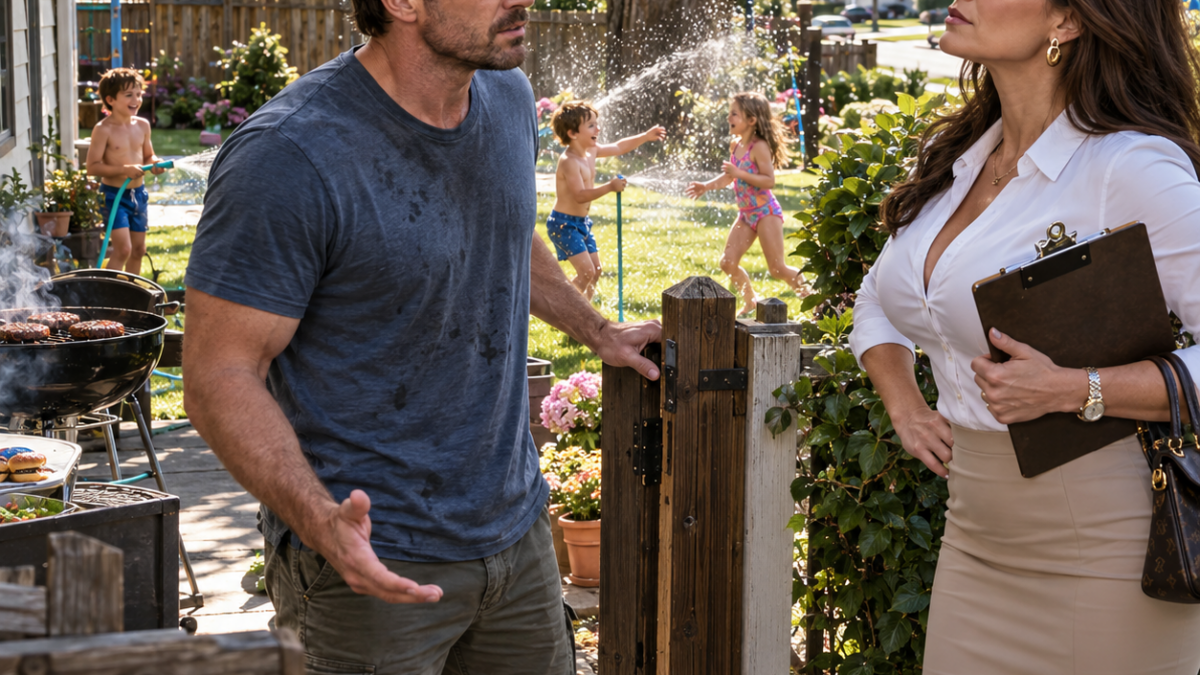
“That house?”
Karen shifted the clipboard against her hip.
“The grandfathered property.”
“I suppose.”
“I had wondered when someone would finally buy it.”
She looked past me again.
Not at the children this time.
At the yard.
The fence.
The house.
It felt less like a neighbor looking around and more like an inspector taking inventory.
“Well,” she said, “even though you’re technically outside the association, you’re still part of the neighborhood.”
“Sure.”
“And obviously what happens on your property affects everyone around you.”
I understood where this was going.
“My kids are playing outside.”
“Yes.”
“In the middle of the day.”
“I’m aware.”
“Then I think we’re done.”
Her eyes narrowed slightly.
“There’s no reason to be hostile.”
“I’m not hostile.”
I pointed gently toward the street.
“I’m making burgers with my kids. You came to my gate.”
Karen smiled again.
This time there was something colder beneath it.
“I was simply trying to be neighborly.”
“Then we’re good.”
I closed the gate.
I figured that would be the end of it.
It wasn’t even the beginning of the end.
Within a month, I had received four printed complaints.
The first one concerned noise.
The second said my front landscaping was “inconsistent with community aesthetic standards.”
The third suggested my home needed fresh exterior paint.
The fourth informed me that leaving children’s toys visible from neighboring properties created “visual clutter.”
Each notice carried the Brookstone Hills HOA logo.
Each was signed by Karen Whitmore, President.
The first time I got one, I called the HOA office.
A man named Richard answered.
“Hi,” I said. “I think I’m receiving notices by mistake.”
He asked for my address.
There was a pause.
“Oh.”
That did not inspire confidence.
“Oh what?”
“You’re the Miller property.”
“I don’t know what that means.”
“Your parcel isn’t actually part of the association.”
“I know.”
“Then these shouldn’t be enforcement notices.”
“They’re signed by your president.”
Another pause.
“I’ll speak with her.”
“Great.”
I thought that solved it.
Three days later, a brochure appeared taped to my front door.
BECOME PART OF THE BROOKSTONE HILLS COMMUNITY.
Inside were several paragraphs about unity, protecting property values, shared standards, and “the advantages of voluntary integration.”
At the bottom, Karen had handwritten:
We should discuss this. It would benefit everyone.
I threw it away.
The next afternoon she caught me checking the mail.
She crossed the street toward me, sunglasses pushed on top of her head.
“I assume you saw the membership information.”
“I did.”
“What did you think?”
“I’m not interested.”
Her smile remained.
“Have you considered what membership would mean for your children?”
That stopped me.
“What does my membership in your HOA have to do with my children?”
“Access to community events. Greater integration. A sense of belonging.”
“They have friends. They’re doing fine.”
“I’ve noticed they spend a lot of time outside.”
“They’re kids.”
“My children prefer quieter activities.”
“I’ve noticed.”
Her two sons seemed permanently attached to tablets.
I immediately regretted saying it.
Karen’s expression sharpened.
“I don’t appreciate comments about my parenting.”
“Then maybe don’t comment on mine.”
She took a breath.
Then that charming version of Karen returned.
She stepped closer.
“I don’t think you understand me.”
“I think I do.”
“I’m actually trying to help you.”
“I don’t need help.”
“Single parents sometimes don’t realize how much community support can matter.”
Something inside me tightened.
I kept my voice calm.
“My wife died.”
Karen blinked.
Clearly, she hadn’t expected the directness.
“I’m sorry.”
“Thank you.”
I took my mail from the box.
“But my kids aren’t a community project.”
“I wasn’t suggesting—”
“Have a good afternoon, Karen.”
I walked away.
After that, the notices increased.
So did the gossip.
At first it came back to me indirectly.
A neighbor named Melissa apologized one morning while I was walking my daughter to the school bus.
“I’m sorry about what happened with your wife.”
I thanked her.
Then she hesitated.
“Karen told some people she left you.”
I stared at her.
“She died.”
Melissa’s face turned red.
“Oh my God.”
“Yeah.”
“I’m sorry. I shouldn’t have repeated—”
“It’s okay.”
It wasn’t.
Then another neighbor asked whether I had moved because of “legal issues.”
Someone else had apparently heard my wife had lost custody before disappearing.
Another rumor said I had problems with drugs.
I didn’t confront Karen.
That might have been what she wanted.
I had two children who had already gone through enough.
I wasn’t turning our new home into a war zone because an insecure HOA president needed entertainment.
So I ignored her.
For a while.
That only seemed to make her more determined.
Summer arrived early that year.
By late May, temperatures were already climbing into the nineties.
My kids started begging me for a pool.
Not an in-ground pool.
Not some luxury installation.
One of those above-ground backyard pools big enough for kids to splash around in.
I checked county requirements.
Measured the yard.
Made sure setbacks were correct.
Installed the required barriers.
Got the permit.
I even had an electrician confirm the outdoor electrical setup was safe.
I did everything properly.
The day we filled it, my kids acted like I had built Disneyland behind the house.
My daughter wore goggles for six straight hours.
My son invented a game involving pool noodles and a plastic basketball hoop that apparently had seventeen rules, all of which changed whenever he was losing.
I sat on the patio watching them.
For a few hours, life felt normal.
Not perfect.
Normal.
That meant more to me than perfect ever had.
Karen noticed the pool the next morning.
Of course she did.
I was skimming leaves when I heard her voice over the fence.
“Excuse me.”
I looked up.
Karen stood in the alley behind my property, staring through the spaces between the fence boards.
“Morning.”
“What is that?”
I looked at the pool.
Then back at her.
“A helicopter.”
She didn’t smile.
“The pool.”
“It’s a pool.”
“Pools are prohibited.”
“Not here.”
“They are not permitted under Brookstone Hills bylaws.”
I rested the skimmer pole against the fence.
“Karen, how many times are we going to have this conversation?”
“You live within the neighborhood.”
“I live next to your HOA.”
“Your property borders multiple member homes.”
“Still not an HOA member.”
“Water features create liability issues.”
“It’s permitted by the county.”
“That isn’t the point.”
“Actually, it’s exactly the point.”
She stepped closer to the fence.
“Pools are not something I allow in this neighborhood.”
There was something so absurdly confident about the sentence that I couldn’t stop myself.
“I didn’t realize we were living in North Korea.”
Her lips parted.
“Excuse me?”
“Do you want me to drain the pool, or should I salute you first?”
“Are you trying to insult me?”
I nodded thoughtfully.
“I’m surprised you picked up on that. I thought I was being subtle.”
Her face flushed.
Behind me, my daughter started giggling.
I immediately regretted letting the conversation happen in front of them.
“Kids,” I called, “inside for a minute.”
“But Dad—”
“Popsicles.”
They disappeared toward the house.
I turned back.
“Now you can say whatever you’re planning to say.”
Karen’s pleasant mask disappeared completely.
“You think you’re clever.”
“No. I think I own this house.”
“Your attitude is exactly why people have concerns.”
“What people?”
“Parents.”
“About what?”
“About you.”
That landed differently.
I crossed my arms.
“What exactly are you saying?”
Karen’s eyes flicked toward the house.
“You’ve created a lot of disruption since arriving.”
“My children laugh outside.”
“People hear things.”
“What things?”
“Shouting.”
“They’re playing.”
“That’s your explanation.”
For a moment I just stared at her.
Then I understood.
“Get away from my property.”
“Don’t speak to me like that.”
“Get away from my property, Karen.”
“I am standing in a public alley.”
“Then keep walking.”
She did.
But the look she gave me before leaving stayed with me.
Two days later, police knocked on my door.
Two officers.
Professional.
Calm.
Embarrassed almost immediately.
“We received a noise complaint involving children screaming.”
I stepped aside enough for them to see the backyard.
My son and daughter were sitting at the patio table with wet hair, eating popsicles.
My daughter waved.
One officer waved back.
“Is everyone okay?”
“Apparently we’re dangerous popsicle criminals.”
The younger officer almost smiled.
The older one looked toward the pool.
“Any injuries today?”
“No.”
“Argument?”
“No.”
“How long were they outside?”
“Maybe an hour.”
He nodded.
“We just had to check.”
“I understand.”
He lowered his voice.
“Has somebody been calling about you before?”
“The HOA president.”
“You’re in the HOA?”
“No.”
That got his attention.
I explained.
The older officer sighed.
“If calls continue without legitimate emergencies, we’ll address misuse with the caller.”
“Thank you.”
They left.
The kids thought it was funny.
I didn’t.
That was the first time Karen used the police.
The second time was much worse.
About ten days later, I was making dinner when someone knocked.
Again, two officers.
Different ones.
This time, their expressions were serious.
“Are you Mr. Daniel Mercer?”
“Yes.”
“Can we come in?”
Something in the way he asked made my stomach drop.
“What’s this about?”
“We received a report concerning the welfare of two children believed to be living at this address.”
Every muscle in my body tightened.
“My children?”
“We need to verify they’re safe.”
“From what?”
The officers exchanged a glance.
“Sir, the caller reported possible physical abuse.”
For a second, I couldn’t breathe.
“What?”
“And there was also a statement questioning whether you’re their legal guardian.”
I just stared.
Then everything clicked.
Karen.
I stepped back.
“Come in.”
My daughter was coloring at the dining table.
My son was upstairs.
The officers were gentle.
I’ll give them that.
One crouched beside my daughter and asked her about school.
The other asked whether she felt safe at home.
Then they spoke to my son.
They checked identification.
I found birth certificates.
Family records.
They asked about my wife.
I told them she was dead.
Saying that to strangers in uniform while proving my children belonged to me did something inside me I don’t know how to describe.
Humiliation wasn’t enough.
Anger wasn’t enough.
Fear wasn’t enough.
It was all of them twisted together.
My daughter eventually asked, “Daddy, are we in trouble?”
That nearly broke me.
“No, sweetheart.”
The officer immediately said, “Nobody’s in trouble.”
She looked worried anyway.
The report had specifically claimed bruises had been seen on my son.
He had one bruise.
On his shin.
From falling off his bike.
The officer asked him about it privately.
He explained.
Then talked for five straight minutes about how he had almost landed the jump.
When the officers finished, the older one pulled me aside.
“Everything appears fine.”
“I know.”
“We’re required to check.”
“I know.”
His expression softened.
“You know who may have called?”
“Yes.”
I told him everything.
The HOA.
The pool.
The previous complaint.
The rumors.
The fact that my property wasn’t even part of the association.
He wrote it down.
“This is the second questionable report connected with the same situation?”
“Yes.”
“We’ll document that.”
“Can you tell me who called?”
“Not directly.”
“I already know.”
He nodded.
“If someone knowingly provides false information repeatedly, that’s something that can create consequences.”
“What kind?”
“That depends on the circumstances.”
They left.
I closed the door.
Then I leaned against it.
My hands were shaking.
My son came downstairs.
“Dad?”
I looked at him.
“Yeah?”
“Are you mad?”
“Not at you.”
He nodded.
Then both kids hugged me.
That night, after they went to sleep, I sat alone in the kitchen.
I wanted to walk across the neighborhood and confront Karen.
I imagined pounding on her door.
I imagined screaming until every person who had repeated her rumors could hear me.
Instead, I opened my laptop.
Created a folder.
KAREN.
Then I started saving everything.
The HOA notices.
Photographs of pamphlets.
Screenshots of messages neighbors had forwarded.
Dates of confrontations.
Police incident numbers.
The pool permit.
The survey showing my property outside HOA jurisdiction.
Every single thing.
If Karen wanted documentation, she was going to get documentation.
For several weeks, I said nothing.
That silence bothered her.
I could tell.
She started walking past my house more often.
Sometimes I saw her stop near the alley.
Once I caught her photographing the pool from the public path behind my fence.
I walked outside.
“Can I help you?”
Karen lowered her phone.
“Documenting safety concerns.”
“On property you don’t control.”
“If those children are injured, nobody is going to say I ignored the warning signs.”
My stomach tightened.
“What warning signs?”
“An unsupervised pool.”
“My children aren’t unsupervised.”
“You can’t watch them every second.”
“Neither can any parent.”
She smiled faintly.
“Some people manage.”
There was that implication again.
That I was inadequate.
That being a father alone meant something must be missing.
I stepped closer to the fence.
“Do not photograph my children.”
“I’m photographing the property.”
“Do not photograph my children.”
“You’re very defensive.”
“And you’re very close to discovering exactly how much documentation I’ve been keeping.”
For the first time, Karen’s confidence flickered.
Then she smiled.
“Is that supposed to frighten me?”
“No.”
I met her eyes.
“It’s supposed to inform you.”
She walked away.
Three days later, I came home from work and found a bright notice taped to my front door.
POOL SAFETY VIOLATION.
It looked official.
It wasn’t.
Karen had printed the HOA logo across the top.
Below it were photographs of my backyard.
My pool.
My fence.
Measurements.
Arrows.
Notes.
Alleged violations.
One picture had clearly been taken from the alley.
Another appeared to have been taken from higher up.
Possibly a second-floor window from an HOA house behind me.
I stood on my porch staring at the paper.
That was the moment my frustration became something else.
Karen genuinely believed she had authority over me.
Not metaphorically.
Not socially.
Legally.
She had created paperwork, photographed my private backyard, and declared my permitted pool illegal because it violated rules that didn’t apply to my land.
A neighbor named Kevin walked past while I was reading it.
He stopped.
“She put another one up?”
“Another?”
His face changed.
“Forget I said that.”
“No. What do you mean?”
He hesitated.
Then sighed.
“She’s been talking about you at board meetings.”
“I’m not even in the HOA.”
“I know.”
“Does the board?”
“Yes.”
That surprised me.
Kevin shoved his hands into his pockets.
“Look, man, I’m sorry.”
“For what?”
“I believed some of it.”
The honesty stopped me.
He continued.
“At first. About your wife. The kids. She made it sound like there was all this suspicious stuff happening.”
“Such as?”
“That you moved here suddenly. That nobody knew where their mother was. That the kids screamed a lot.”
“They laugh.”
“I know that now.”
He looked embarrassed.
“My wife talked to your daughter at the school bus stop. We’ve seen you guys around. You’re just… normal.”
I laughed without humor.
“That’s a disappointing diagnosis.”
Kevin smiled weakly.
“Karen isn’t right.”
“I’ve figured that out.”
“No. I mean lately she’s getting worse.”
He looked toward the subdivision.
“Some board members have been telling her to leave you alone.”
“Seriously?”
“Yeah.”
“Then why hasn’t she?”
Kevin gave me a look that answered the question.
Because Karen didn’t believe anyone could tell Karen what to do.
The real turning point came two weeks later.
Someone put an HOA newsletter in my mailbox.
It wasn’t addressed to me.
A sticky note was attached.
Thought you should see this.
I took it inside.
Most of the newsletter was exactly what you’d expect.
Pool hours.
Landscaping reminders.
Fence-color approvals.
A warning about leaving trash cans visible.
Then halfway down page three, I found a section titled:
COMMUNITY SAFETY REMINDER.
The paragraph referred to “certain non-member properties adjacent to Brookstone Hills.”
Plural.
But there was only one property fitting that description with a backyard pool.
Mine.
It warned of “unapproved water features.”
“Inadequate supervision of minors.”
“Persistent noise concerns.”
Then came the line that made my blood run cold.
Residents were encouraged to report “behavior suggesting possible danger to children.”
Beside the paragraph was a grainy photograph.
My backyard.
My pool.
My children were not visible.
Thank God.
But the photograph had clearly been taken from an elevated location.
I sat at my kitchen table for a long time.
Karen had finally made one critical mistake.
She had put it in writing.
Until then, people could deny rumors.
They could say I misunderstood conversations.
Karen could say the police reports came from concerned citizens.
But this?
This was official HOA communication.
Using association resources.
Targeting a non-member.
Reinforcing the exact accusations that had brought police to my door.
I opened the folder I’d been building.
Printed everything.
Then I wrote an email.
Not to Karen.
To every board member.
The subject was simple:
FORMAL NOTICE REGARDING HARASSMENT OF NON-HOA PROPERTY.
I kept the tone calm.
No insults.
No sarcasm.
No North Korea jokes.
I explained that my property was legally outside the Brookstone Hills HOA.
I attached the parcel map.
The survey.
The deed information.
Then I created a timeline.
First noise complaint.
Unsolicited landscaping and paint notices.
Membership pressure.
Pool demands.
Police complaint.
Second police welfare check involving false allegations of child abuse and possible kidnapping.
Photographs of my backyard.
Fake pool violation notice.
Newsletter.
I attached copies.
Then I wrote one final paragraph.
Karen Whitmore’s conduct is no longer merely irritating. Her repeated attempts to assert HOA authority over property outside the association, publication of statements implying that my children are endangered, photography of my private backyard, and apparent connection to repeated unfounded police reports have created a documented pattern of harassment. If this behavior continues, I will have no choice but to explore legal remedies, and because Ms. Whitmore has repeatedly acted under the title of HOA president and used HOA materials, I will consider whether the association itself bears responsibility.
I read it twice.
Then I added:
I am not asking for money.
I am not asking to join your HOA.
I am asking to be left alone.
Then I sent it.
Karen did not reply.
The other board members did.
The first response came forty minutes later.
Daniel,
I am deeply sorry. I was not aware that the situation had reached this level.
Another arrived ten minutes later.
For the record, I understood your property to be outside HOA boundaries and never approved enforcement action against you.
Then Richard, the man I’d spoken with months earlier, emailed.
Mr. Mercer,
Several members of the board previously instructed Ms. Whitmore that the association had no jurisdiction over your parcel and that she should discontinue communications represented as official enforcement.
I read that sentence three times.
Karen had been warned.
Repeatedly.
And she had continued anyway.
That changed everything.
By evening, five board members had responded.
One called me.
His name was David.
“I owe you an apology.”
“You personally haven’t done anything to me.”
“I sat in meetings and didn’t stop her.”
I didn’t know what to say.
David continued.
“Karen has a way of making every disagreement sound like a crisis.”
“I’ve noticed.”
“She told us there were legitimate child-safety concerns.”
“Did she tell you she called the police?”
“No.”
“Did she tell you they cleared me?”
“No.”
He went quiet.
“Jesus.”
“Yeah.”
“We’re calling an emergency board meeting.”
“I don’t need to be there.”
“You have the right to submit anything else.”
“You have everything.”
“Then we’ll handle it.”
For the first time since meeting Karen, I let myself believe the situation might actually end.
The meeting was held three nights later.
I didn’t attend.
Partly because I wasn’t a member.
Mostly because I didn’t want Karen to turn it into another performance about me.
I stayed home.
Made macaroni and cheese.
Helped my daughter with spelling homework.
Then watched a movie with both kids on the couch.
Around nine, my phone started vibrating.
Kevin texted first.
Holy crap.
Then Melissa.
I think it’s over.
Then David.
Call me when you have a moment.
I waited until the kids were asleep.
Then I called.
David answered immediately.
“What happened?”
He exhaled.
“Karen is no longer president.”
I sat down.
“You removed her?”
“Technically she was removed from officer status pending a broader board process, but yes. She has no presidential authority.”
“What happened?”
“Everything.”
Apparently, the meeting had been packed.
Word about my email spread among board members and residents.
Parents were furious about the allegations involving my children.
Some had believed Karen because she presented everything as if she had direct knowledge.
When they discovered she had never entered my house, never witnessed abuse, never had evidence that my children weren’t mine, and had continued spreading claims after police found nothing wrong, people turned on her.
Karen tried to defend herself.
She claimed she had been acting out of concern.
One mother reportedly stood up and said:
“Concern is calling once when you genuinely think a child is in danger. Concern isn’t starting rumors about kidnapping because somebody won’t drain a swimming pool.”
Karen argued that my refusal to cooperate made me suspicious.
That did not help.
Then the board confronted her about the notices.
She insisted that adjacent properties could be asked to voluntarily comply with HOA standards.
Richard asked why she had printed them as official violations.
Karen said the difference was “semantic.”
Then they brought up the newsletter.
According to David, Karen became furious.
She accused whoever had given me a copy of betraying the community.
That was apparently the moment she lost whatever support remained.
Not:
I shouldn’t have written it.
Not:
I went too far.
Her complaint was that I had found out.
The board voted.
Karen was removed as president.
Then they did something I hadn’t expected.
Every board member signed a written statement confirming that my property was not part of Brookstone Hills HOA.
The association had no authority to regulate my home.
My yard.
My pool.
My children’s activities.
No dues.
No fines.
No inspection rights.
No aesthetic obligations.
Nothing.
The letter also apologized for communications made under HOA branding that implied otherwise.
David emailed me a scanned copy that night.
The original arrived by certified mail two days later.
I put it in the same folder as Karen’s notices.
One week after the meeting, I found a handwritten envelope in my mailbox.
No stamp.
Inside was a single sheet.
Daniel,
I apologize for any misunderstanding or distress caused to your family. My intention was always to protect neighborhood safety.
Karen.
I stared at the note.
Any misunderstanding.
Not lies.
Not harassment.
Not false accusations.
Misunderstanding.
I almost threw it away.
Then I added it to the folder.
Not because I needed revenge anymore.
Because I had learned something from Karen.
Keep the paperwork.
The change in the neighborhood happened faster than I expected.
Police stopped coming.
Nobody mentioned kidnapping.
Nobody whispered when my children played outside.
The pool became what it had always been.
A pool.
My daughter did cannonballs.
My son continued inventing increasingly complicated games with pool noodles.
Sometimes neighbor kids came over.
Their parents did too.
Melissa brought lemonade one afternoon.
Kevin helped me replace a loose fence panel.
People apologized.
Not everyone.
Enough.
One couple told me they had believed Karen’s story at first because she always spoke with such certainty.
“She made everything sound official,” the husband said.
His wife looked embarrassed.
“We should have asked you.”
“Probably.”
“I’m sorry.”
“Thank you.”
I accepted the apology.
I didn’t forget.
But I accepted it.
The hardest thing to understand was how quickly ordinary people could be persuaded to treat someone differently once authority gave them permission.
Karen had a title.
Clipboard.
Newsletters.
An HOA email address.
That was apparently enough to make ridiculous claims sound plausible.
Widower becomes abandoned husband.
Children laughing become children screaming.
Private pool becomes illegal water feature.
Father protecting his property becomes dangerous outsider.
Then, just as quickly, when Karen lost the title, the spell broke.
I began seeing her around less.
Before, she walked through the subdivision almost every evening.
Always dressed perfectly.
Clipboard tucked under one arm.
Stopping to inspect lawns.
Talking to contractors.
Looking at houses as if they were personally accountable to her.
After the removal, that disappeared.
She still lived there.
But she stopped patrolling.
If she walked her dog, she kept her head down.
The sunglasses remained.
The confidence didn’t.
One Saturday morning, I was cutting grass when she passed my house.
My son was in the driveway drawing with sidewalk chalk.
Karen looked over.
For a second, we made eye contact.
She looked away first.
That was enough for me.
I never wanted to destroy her.
I never wanted her house.
Her money.
Her humiliation.
I wanted one thing.
For her to stop frightening my children and leave us alone.
And she finally did.
Months passed.
Summer ended.
I drained the pool for winter.
Nobody issued a violation.
Nobody photographed it.
Nobody called police.
Normal life returned so gradually that one day I realized I hadn’t thought about Karen in weeks.
Then the HOA election came around.
Kevin knocked on my door one evening.
“You hear?”
“About what?”
“Karen’s running for the board.”
I actually laughed.
“Seriously?”
“Apparently she says the previous board acted emotionally and the neighborhood needs experienced leadership.”
“How’s that going?”
Kevin grinned.
“Not well.”
A few days later, somebody left an election flyer on my mailbox.
Karen’s photograph was on the front.
She looked polished and confident.
RESTORE STANDARDS. RESTORE SAFETY. RESTORE TRUST.
I had to admire the audacity.
She campaigned hard.
Door to door.
Emails.
Promises.
She talked about declining standards.
Poor enforcement.
Threats to property values.
But people remembered.
They remembered the police reports.
The rumors.
The newsletter.
They remembered that she had tried using HOA authority against someone who wasn’t even a member.
Election night came.
Karen lost.
Badly.
Not close enough to challenge.
Not respectable enough to reinterpret.
A landslide.
Kevin texted me the result.
I didn’t celebrate.
At least, not much.
I put my phone down and helped my daughter build a blanket fort in the living room.
That felt more satisfying anyway.
The next spring, I put the pool back up.
Before filling it, I stood in the yard checking the liner.
My son came outside carrying the hose.
“Can we start?”
“In a second.”
My daughter ran past him wearing goggles even though there wasn’t any water yet.
I laughed.
For a moment, I thought about the first summer.
Karen standing in the alley.
Pools are not something I allow in this neighborhood.
The police at my door.
The question about whether my children belonged to me.
My daughter asking if we were in trouble.
That memory still hurt.
Probably always would.
But when I looked around now, I didn’t see Karen’s neighborhood.
I saw our home.
The maple tree had a swing hanging from it.
My son’s soccer goal sat near the fence.
Chalk drawings covered the patio.
A bicycle lay on its side near the garage.
The house probably still wasn’t painted the color Karen preferred.
The front garden definitely wasn’t landscaped according to HOA standards.
And none of it mattered.
“Dad!”
My son waved the hose.
“Now?”
I smiled.
“Now.”
He turned it on.
Water rushed into the pool.
My daughter cheered.
Later that afternoon, several neighborhood kids came over.
Their parents stood near the patio talking.
Some were HOA members.
I wasn’t.
Nobody cared.
Karen drove past once.
Slowly.
For an instant, that old instinct returned.
The one that expected trouble.
I watched her car.
It continued down the street.
No stop.
No clipboard.
No photographs.
Nothing.
My daughter splashed me.
“Dad!”
I turned.
“What?”
“You’re not watching!”
She jumped.
Water exploded over the side.
Everyone laughed.
And that was when I understood what Karen had really taken from us during those months.
Not money.
Not property.
Peace.
She had made normal life feel suspicious.
She had made laughter sound dangerous.
She had made me look at every passing car and wonder whether someone was documenting my children.
She had made my kids ask whether the police were coming because they had done something wrong.
And when her power disappeared, peace didn’t come back with some dramatic victory.
It came back quietly.
Children laughing.
Wet towels on patio chairs.
Popsicle wrappers.
Neighbors talking over a fence.
A father standing in his own backyard without feeling watched.
I still have the folder.
Every notice.
Every photograph.
Police incident numbers.
Karen’s apology.
The board’s signed statement.
I probably don’t need any of it anymore.
But I keep it.
Because people like Karen depend on everyone else doubting their own memory.
Was it really that bad?
Did she actually say that?
Maybe I misunderstood.
Maybe it wasn’t official.
Paper doesn’t doubt.
The board letter is especially important.
My property is not part of Brookstone Hills Homeowners Association.
One sentence.
So simple.
Yet Karen spent months pretending it wasn’t true because reality interfered with the authority she wanted.
I never joined that HOA.
I never will.
The current board has been perfectly respectful.
One of their newer members even stopped me outside last year and apologized again for everything.
“We’ve changed procedures because of what happened,” she said.
“That’s good.”
“No notices can go to non-member properties now without a jurisdiction check.”
I smiled.
“Seems like something that should’ve existed already.”
She laughed.
“You’re not wrong.”
There are worse HOAs.
Probably better ones too.
I don’t spend much time thinking about them anymore.
My responsibility isn’t managing their community.
It’s raising two kids.
Making breakfast.
Getting them to school.
Helping with homework.
Fixing bicycles.
Learning which argument between siblings requires intervention and which one will disappear if I wait thirty seconds.
There are mornings when being their only parent still scares me.
There are nights when I wish their mother were here so badly that it physically hurts.
Karen managed to exploit exactly that vulnerable place.
She looked at a widowed father and decided absence must mean guilt.
Then she tried turning grief into suspicion.
That is what I will never forgive.
But I don’t need to forgive her to move on.
My children are older now.
They remember Karen mostly as “the weird HOA lady.”
I’m glad.
I hope that’s all she ever becomes to them.
Not the woman who brought police to our door.
Not the woman who made their father dig through documents proving they were his.
Not the woman who made neighbors look at them differently.
Just the weird HOA lady.
A small, ridiculous character from childhood.
Sometimes justice isn’t dramatic.
Karen didn’t go to prison.
She didn’t lose her house.
Nobody marched her down the street.
She lost the thing she valued most.
Authority.
She had spent years building an identity around being HOA president.
She liked being the person who could knock on someone’s door and demand an explanation.
She liked sending notices.
She liked being consulted.
Feared.
Obeyed.
Then she went after somebody she had no authority over.
And when I finally put everything in front of the people who actually gave her that authority, they took it away.
She even tried to get it back.
The neighborhood said no.
That’s the part that still makes me smile.
Karen never learned how to accept the word no when it came from me.
Eventually, she had to accept it from everyone.
𝗧𝗛𝗘 𝗘𝗡𝗗
The HOA President Called 911 on Me and Told Police I Might Have Kidnapped My Own Children
The first time Karen complained about my kids, I thought she was just another bored HOA president looking for something to control.
The day two police officers stood on my porch asking whether the children laughing behind me were actually mine, I realized she was willing to destroy my family just to prove she had power over a house that wasn’t even in her HOA.
I never planned on becoming a single father.
Nobody plans for that.
My wife died when our son was seven and our daughter was five, and afterward there was a stretch of time when every room in our old house seemed to contain some small reminder that she wasn’t coming back.
Her coffee mug.
Her side of the closet.
A jacket behind the bedroom door.
A grocery list written in her handwriting and stuck to the refrigerator with a magnet.
Even the silence felt like it belonged to her.
For months, I tried convincing myself that staying there was good for the kids because it was familiar.
Eventually I understood that familiarity wasn’t helping any of us.
We weren’t living there.
We were surviving there.
So when I found an older house in a quiet neighborhood about forty minutes away, I took the chance.
The house wasn’t anything extravagant.
Three bedrooms.
A decent kitchen.
A detached garage.
A big backyard with enough room for my kids to run without me worrying about traffic every thirty seconds.
What sold me was the old maple tree near the back fence.
My daughter looked at it during our first showing and immediately said she wanted a swing there.
My son found a patch of yard he announced would become a soccer field.
For the first time since their mother died, both of them sounded excited about something that involved the future.
That was enough for me.
The interesting part was that our property wasn’t part of the HOA surrounding us.
The house had been built decades before most of the subdivision.
When developers later built newer homes around the area and formed an HOA, my parcel remained outside its boundaries.
My closing attorney explained that clearly.
The survey confirmed it.
The deed confirmed it.
I signed no HOA agreement because there was no HOA agreement for me to sign.
I didn’t think much about it.
Why would I?
The association had authority over its properties.
I had mine.
That arrangement seemed simple.
Then I met Karen Whitmore.
Karen was forty-one, maybe forty-two, with long dark-brown hair, bright green eyes, a curvy figure she seemed to take considerable pride in, and the kind of carefully polished beauty that made people notice when she entered a room.
She usually dressed as if she were heading to a real-estate closing instead of walking around a suburban neighborhood—fitted white blouses, slim skirts, expensive sunglasses, gold earrings, heels that clicked against sidewalks.
She could be charming when she wanted something.
Her smile would soften.
Her voice would become warm and almost flirtatious.
Then, the instant someone said no, the warmth vanished.
Karen was president of the HOA.
And Karen did not enjoy hearing no.
I discovered that about three weeks after we moved in.
My kids were playing in the backyard one Saturday afternoon.
They had a sprinkler running.
My daughter was screaming because my son had aimed the hose at her.
My son was laughing so hard he could barely stand.
I was grilling burgers on the patio when someone knocked on the side gate.
Karen stood there holding a clipboard.
“Can I help you?”
She glanced past me toward the children.
“There’s been a noise complaint.”
I looked behind me.
At my kids.
Then back at her.
“They’re playing.”
“I understand that.”
She smiled.
“But some residents are concerned about excessive noise.”
“At two in the afternoon?”
“The HOA does have standards.”
“I’m not in your HOA.”
Her smile froze.
Only for a second.
Then she laughed lightly.
“Oh. You’re that house.”
I didn’t know it then.
But those four words were the beginning of everything.
PART 2
“That house?”
Karen shifted the clipboard against her hip.
“The grandfathered property.”
“I suppose.”
“I had wondered when someone would finally buy it.”
She looked past me again.
Not at the children this time.
At the yard.
The fence.
The house.
It felt less like a neighbor looking around and more like an inspector taking inventory.
“Well,” she said, “even though you’re technically outside the association, you’re still part of the neighborhood.”
“Sure.”
“And obviously what happens on your property affects everyone around you.”
I understood where this was going.
“My kids are playing outside.”
“Yes.”
“In the middle of the day.”
“I’m aware.”
“Then I think we’re done.”
Her eyes narrowed slightly.
“There’s no reason to be hostile.”
“I’m not hostile.”
I pointed gently toward the street.
“I’m making burgers with my kids. You came to my gate.”
Karen smiled again.
This time there was something colder beneath it.
“I was simply trying to be neighborly.”
“Then we’re good.”
I closed the gate.
I figured that would be the end of it.
It wasn’t even the beginning of the end.
Within a month, I had received four printed complaints.
The first one concerned noise.
The second said my front landscaping was “inconsistent with community aesthetic standards.”
The third suggested my home needed fresh exterior paint.
The fourth informed me that leaving children’s toys visible from neighboring properties created “visual clutter.”
Each notice carried the Brookstone Hills HOA logo.
Each was signed by Karen Whitmore, President.
The first time I got one, I called the HOA office.
A man named Richard answered.
“Hi,” I said. “I think I’m receiving notices by mistake.”
He asked for my address.
There was a pause.
“Oh.”
That did not inspire confidence.
“Oh what?”
“You’re the Miller property.”
“I don’t know what that means.”
“Your parcel isn’t actually part of the association.”
“I know.”
“Then these shouldn’t be enforcement notices.”
“They’re signed by your president.”
Another pause.
“I’ll speak with her.”
“Great.”
I thought that solved it.
Three days later, a brochure appeared taped to my front door.
BECOME PART OF THE BROOKSTONE HILLS COMMUNITY.
Inside were several paragraphs about unity, protecting property values, shared standards, and “the advantages of voluntary integration.”
At the bottom, Karen had handwritten:
We should discuss this. It would benefit everyone.
I threw it away.
The next afternoon she caught me checking the mail.
She crossed the street toward me, sunglasses pushed on top of her head.
“I assume you saw the membership information.”
“I did.”
“What did you think?”
“I’m not interested.”
Her smile remained.
“Have you considered what membership would mean for your children?”
That stopped me.
“What does my membership in your HOA have to do with my children?”
“Access to community events. Greater integration. A sense of belonging.”
“They have friends. They’re doing fine.”
“I’ve noticed they spend a lot of time outside.”
“They’re kids.”
“My children prefer quieter activities.”
“I’ve noticed.”
Her two sons seemed permanently attached to tablets.
I immediately regretted saying it.
Karen’s expression sharpened.
“I don’t appreciate comments about my parenting.”
“Then maybe don’t comment on mine.”
She took a breath.
Then that charming version of Karen returned.
She stepped closer.
“I don’t think you understand me.”
“I think I do.”
“I’m actually trying to help you.”
“I don’t need help.”
“Single parents sometimes don’t realize how much community support can matter.”
Something inside me tightened.
I kept my voice calm.
“My wife died.”
Karen blinked.
Clearly, she hadn’t expected the directness.
“I’m sorry.”
“Thank you.”
I took my mail from the box.
“But my kids aren’t a community project.”
“I wasn’t suggesting—”
“Have a good afternoon, Karen.”
I walked away.
After that, the notices increased.
So did the gossip.
At first it came back to me indirectly.
A neighbor named Melissa apologized one morning while I was walking my daughter to the school bus.
“I’m sorry about what happened with your wife.”
I thanked her.
Then she hesitated.
“Karen told some people she left you.”
I stared at her.
“She died.”
Melissa’s face turned red.
“Oh my God.”
“Yeah.”
“I’m sorry. I shouldn’t have repeated—”
“It’s okay.”
It wasn’t.
Then another neighbor asked whether I had moved because of “legal issues.”
Someone else had apparently heard my wife had lost custody before disappearing.
Another rumor said I had problems with drugs.
I didn’t confront Karen.
That might have been what she wanted.
I had two children who had already gone through enough.
I wasn’t turning our new home into a war zone because an insecure HOA president needed entertainment.
So I ignored her.
For a while.
That only seemed to make her more determined.
Summer arrived early that year.
By late May, temperatures were already climbing into the nineties.
My kids started begging me for a pool.
Not an in-ground pool.
Not some luxury installation.
One of those above-ground backyard pools big enough for kids to splash around in.
I checked county requirements.
Measured the yard.
Made sure setbacks were correct.
Installed the required barriers.
Got the permit.
I even had an electrician confirm the outdoor electrical setup was safe.
I did everything properly.
The day we filled it, my kids acted like I had built Disneyland behind the house.
My daughter wore goggles for six straight hours.
My son invented a game involving pool noodles and a plastic basketball hoop that apparently had seventeen rules, all of which changed whenever he was losing.
I sat on the patio watching them.
For a few hours, life felt normal.
Not perfect.
Normal.
That meant more to me than perfect ever had.
Karen noticed the pool the next morning.
Of course she did.
I was skimming leaves when I heard her voice over the fence.
“Excuse me.”
I looked up.
Karen stood in the alley behind my property, staring through the spaces between the fence boards.
“Morning.”
“What is that?”
I looked at the pool.
Then back at her.
“A helicopter.”
She didn’t smile.
“The pool.”
“It’s a pool.”
“Pools are prohibited.”
“Not here.”
“They are not permitted under Brookstone Hills bylaws.”
I rested the skimmer pole against the fence.
“Karen, how many times are we going to have this conversation?”
“You live within the neighborhood.”
“I live next to your HOA.”
“Your property borders multiple member homes.”
“Still not an HOA member.”
“Water features create liability issues.”
“It’s permitted by the county.”
“That isn’t the point.”
“Actually, it’s exactly the point.”
She stepped closer to the fence.
“Pools are not something I allow in this neighborhood.”
There was something so absurdly confident about the sentence that I couldn’t stop myself.
“I didn’t realize we were living in North Korea.”
Her lips parted.
“Excuse me?”
“Do you want me to drain the pool, or should I salute you first?”
“Are you trying to insult me?”
I nodded thoughtfully.
“I’m surprised you picked up on that. I thought I was being subtle.”
Her face flushed.
Behind me, my daughter started giggling.
I immediately regretted letting the conversation happen in front of them.
“Kids,” I called, “inside for a minute.”
“But Dad—”
“Popsicles.”
They disappeared toward the house.
I turned back.
“Now you can say whatever you’re planning to say.”
Karen’s pleasant mask disappeared completely.
“You think you’re clever.”
“No. I think I own this house.”
“Your attitude is exactly why people have concerns.”
“What people?”
“Parents.”
“About what?”
“About you.”
That landed differently.
I crossed my arms.
“What exactly are you saying?”
Karen’s eyes flicked toward the house.
“You’ve created a lot of disruption since arriving.”
“My children laugh outside.”
“People hear things.”
“What things?”
“Shouting.”
“They’re playing.”
“That’s your explanation.”
For a moment I just stared at her.
Then I understood.
“Get away from my property.”
“Don’t speak to me like that.”
“Get away from my property, Karen.”
“I am standing in a public alley.”
“Then keep walking.”
She did.
But the look she gave me before leaving stayed with me.
Two days later, police knocked on my door.
Two officers.
Professional.
Calm.
Embarrassed almost immediately.
“We received a noise complaint involving children screaming.”
I stepped aside enough for them to see the backyard.
My son and daughter were sitting at the patio table with wet hair, eating popsicles.
My daughter waved.
One officer waved back.
“Is everyone okay?”
“Apparently we’re dangerous popsicle criminals.”
The younger officer almost smiled.
The older one looked toward the pool.
“Any injuries today?”
“No.”
“Argument?”
“No.”
“How long were they outside?”
“Maybe an hour.”
He nodded.
“We just had to check.”
“I understand.”
He lowered his voice.
“Has somebody been calling about you before?”
“The HOA president.”
“You’re in the HOA?”
“No.”
That got his attention.
I explained.
The older officer sighed.
“If calls continue without legitimate emergencies, we’ll address misuse with the caller.”
“Thank you.”
They left.
The kids thought it was funny.
I didn’t.
That was the first time Karen used the police.
The second time was much worse.
About ten days later, I was making dinner when someone knocked.
Again, two officers.
Different ones.
This time, their expressions were serious.
“Are you Mr. Daniel Mercer?”
“Yes.”
“Can we come in?”
Something in the way he asked made my stomach drop.
“What’s this about?”
“We received a report concerning the welfare of two children believed to be living at this address.”
Every muscle in my body tightened.
“My children?”
“We need to verify they’re safe.”
“From what?”
The officers exchanged a glance.
“Sir, the caller reported possible physical abuse.”
For a second, I couldn’t breathe.
“What?”
“And there was also a statement questioning whether you’re their legal guardian.”
I just stared.
Then everything clicked.
Karen.
I stepped back.
“Come in.”
My daughter was coloring at the dining table.
My son was upstairs.
The officers were gentle.
I’ll give them that.
One crouched beside my daughter and asked her about school.
The other asked whether she felt safe at home.
Then they spoke to my son.
They checked identification.
I found birth certificates.
Family records.
They asked about my wife.
I told them she was dead.
Saying that to strangers in uniform while proving my children belonged to me did something inside me I don’t know how to describe.
Humiliation wasn’t enough.
Anger wasn’t enough.
Fear wasn’t enough.
It was all of them twisted together.
My daughter eventually asked, “Daddy, are we in trouble?”
That nearly broke me.
“No, sweetheart.”
The officer immediately said, “Nobody’s in trouble.”
She looked worried anyway.
The report had specifically claimed bruises had been seen on my son.
He had one bruise.
On his shin.
From falling off his bike.
The officer asked him about it privately.
He explained.
Then talked for five straight minutes about how he had almost landed the jump.
When the officers finished, the older one pulled me aside.
“Everything appears fine.”
“I know.”
“We’re required to check.”
“I know.”
His expression softened.
“You know who may have called?”
“Yes.”
I told him everything.
The HOA.
The pool.
The previous complaint.
The rumors.
The fact that my property wasn’t even part of the association.
He wrote it down.
“This is the second questionable report connected with the same situation?”
“Yes.”
“We’ll document that.”
“Can you tell me who called?”
“Not directly.”
“I already know.”
He nodded.
“If someone knowingly provides false information repeatedly, that’s something that can create consequences.”
“What kind?”
“That depends on the circumstances.”
They left.
I closed the door.
Then I leaned against it.
My hands were shaking.
My son came downstairs.
“Dad?”
I looked at him.
“Yeah?”
“Are you mad?”
“Not at you.”
He nodded.
Then both kids hugged me.
That night, after they went to sleep, I sat alone in the kitchen.
I wanted to walk across the neighborhood and confront Karen.
I imagined pounding on her door.
I imagined screaming until every person who had repeated her rumors could hear me.
Instead, I opened my laptop.
Created a folder.
KAREN.
Then I started saving everything.
The HOA notices.
Photographs of pamphlets.
Screenshots of messages neighbors had forwarded.
Dates of confrontations.
Police incident numbers.
The pool permit.
The survey showing my property outside HOA jurisdiction.
Every single thing.
If Karen wanted documentation, she was going to get documentation.
For several weeks, I said nothing.
That silence bothered her.
I could tell.
She started walking past my house more often.
Sometimes I saw her stop near the alley.
Once I caught her photographing the pool from the public path behind my fence.
I walked outside.
“Can I help you?”
Karen lowered her phone.
“Documenting safety concerns.”
“On property you don’t control.”
“If those children are injured, nobody is going to say I ignored the warning signs.”
My stomach tightened.
“What warning signs?”
“An unsupervised pool.”
“My children aren’t unsupervised.”
“You can’t watch them every second.”
“Neither can any parent.”
She smiled faintly.
“Some people manage.”
There was that implication again.
That I was inadequate.
That being a father alone meant something must be missing.
I stepped closer to the fence.
“Do not photograph my children.”
“I’m photographing the property.”
“Do not photograph my children.”
“You’re very defensive.”
“And you’re very close to discovering exactly how much documentation I’ve been keeping.”
For the first time, Karen’s confidence flickered.
Then she smiled.
“Is that supposed to frighten me?”
“No.”
I met her eyes.
“It’s supposed to inform you.”
She walked away.
Three days later, I came home from work and found a bright notice taped to my front door.
POOL SAFETY VIOLATION.
It looked official.
It wasn’t.
Karen had printed the HOA logo across the top.
Below it were photographs of my backyard.
My pool.
My fence.
Measurements.
Arrows.
Notes.
Alleged violations.
One picture had clearly been taken from the alley.
Another appeared to have been taken from higher up.
Possibly a second-floor window from an HOA house behind me.
I stood on my porch staring at the paper.
That was the moment my frustration became something else.
Karen genuinely believed she had authority over me.
Not metaphorically.
Not socially.
Legally.
She had created paperwork, photographed my private backyard, and declared my permitted pool illegal because it violated rules that didn’t apply to my land.
A neighbor named Kevin walked past while I was reading it.
He stopped.
“She put another one up?”
“Another?”
His face changed.
“Forget I said that.”
“No. What do you mean?”
He hesitated.
Then sighed.
“She’s been talking about you at board meetings.”
“I’m not even in the HOA.”
“I know.”
“Does the board?”
“Yes.”
That surprised me.
Kevin shoved his hands into his pockets.
“Look, man, I’m sorry.”
“For what?”
“I believed some of it.”
The honesty stopped me.
He continued.
“At first. About your wife. The kids. She made it sound like there was all this suspicious stuff happening.”
“Such as?”
“That you moved here suddenly. That nobody knew where their mother was. That the kids screamed a lot.”
“They laugh.”
“I know that now.”
He looked embarrassed.
“My wife talked to your daughter at the school bus stop. We’ve seen you guys around. You’re just… normal.”
I laughed without humor.
“That’s a disappointing diagnosis.”
Kevin smiled weakly.
“Karen isn’t right.”
“I’ve figured that out.”
“No. I mean lately she’s getting worse.”
He looked toward the subdivision.
“Some board members have been telling her to leave you alone.”
“Seriously?”
“Yeah.”
“Then why hasn’t she?”
Kevin gave me a look that answered the question.
Because Karen didn’t believe anyone could tell Karen what to do.
The real turning point came two weeks later.
Someone put an HOA newsletter in my mailbox.
It wasn’t addressed to me.
A sticky note was attached.
Thought you should see this.
I took it inside.
Most of the newsletter was exactly what you’d expect.
Pool hours.
Landscaping reminders.
Fence-color approvals.
A warning about leaving trash cans visible.
Then halfway down page three, I found a section titled:
COMMUNITY SAFETY REMINDER.
The paragraph referred to “certain non-member properties adjacent to Brookstone Hills.”
Plural.
But there was only one property fitting that description with a backyard pool.
Mine.
It warned of “unapproved water features.”
“Inadequate supervision of minors.”
“Persistent noise concerns.”
Then came the line that made my blood run cold.
Residents were encouraged to report “behavior suggesting possible danger to children.”
Beside the paragraph was a grainy photograph.
My backyard.
My pool.
My children were not visible.
Thank God.
But the photograph had clearly been taken from an elevated location.
I sat at my kitchen table for a long time.
Karen had finally made one critical mistake.
She had put it in writing.
Until then, people could deny rumors.
They could say I misunderstood conversations.
Karen could say the police reports came from concerned citizens.
But this?
This was official HOA communication.
Using association resources.
Targeting a non-member.
Reinforcing the exact accusations that had brought police to my door.
I opened the folder I’d been building.
Printed everything.
Then I wrote an email.
Not to Karen.
To every board member.
The subject was simple:
FORMAL NOTICE REGARDING HARASSMENT OF NON-HOA PROPERTY.
I kept the tone calm.
No insults.
No sarcasm.
No North Korea jokes.
I explained that my property was legally outside the Brookstone Hills HOA.
I attached the parcel map.
The survey.
The deed information.
Then I created a timeline.
First noise complaint.
Unsolicited landscaping and paint notices.
Membership pressure.
Pool demands.
Police complaint.
Second police welfare check involving false allegations of child abuse and possible kidnapping.
Photographs of my backyard.
Fake pool violation notice.
Newsletter.
I attached copies.
Then I wrote one final paragraph.
Karen Whitmore’s conduct is no longer merely irritating. Her repeated attempts to assert HOA authority over property outside the association, publication of statements implying that my children are endangered, photography of my private backyard, and apparent connection to repeated unfounded police reports have created a documented pattern of harassment. If this behavior continues, I will have no choice but to explore legal remedies, and because Ms. Whitmore has repeatedly acted under the title of HOA president and used HOA materials, I will consider whether the association itself bears responsibility.
I read it twice.
Then I added:
I am not asking for money.
I am not asking to join your HOA.
I am asking to be left alone.
Then I sent it.
Karen did not reply.
The other board members did.
The first response came forty minutes later.
Daniel,
I am deeply sorry. I was not aware that the situation had reached this level.
Another arrived ten minutes later.
For the record, I understood your property to be outside HOA boundaries and never approved enforcement action against you.
Then Richard, the man I’d spoken with months earlier, emailed.
Mr. Mercer,
Several members of the board previously instructed Ms. Whitmore that the association had no jurisdiction over your parcel and that she should discontinue communications represented as official enforcement.
I read that sentence three times.
Karen had been warned.
Repeatedly.
And she had continued anyway.
That changed everything.
By evening, five board members had responded.
One called me.
His name was David.
“I owe you an apology.”
“You personally haven’t done anything to me.”
“I sat in meetings and didn’t stop her.”
I didn’t know what to say.
David continued.
“Karen has a way of making every disagreement sound like a crisis.”
“I’ve noticed.”
“She told us there were legitimate child-safety concerns.”
“Did she tell you she called the police?”
“No.”
“Did she tell you they cleared me?”
“No.”
He went quiet.
“Jesus.”
“Yeah.”
“We’re calling an emergency board meeting.”
“I don’t need to be there.”
“You have the right to submit anything else.”
“You have everything.”
“Then we’ll handle it.”
For the first time since meeting Karen, I let myself believe the situation might actually end.
The meeting was held three nights later.
I didn’t attend.
Partly because I wasn’t a member.
Mostly because I didn’t want Karen to turn it into another performance about me.
I stayed home.
Made macaroni and cheese.
Helped my daughter with spelling homework.
Then watched a movie with both kids on the couch.
Around nine, my phone started vibrating.
Kevin texted first.
Holy crap.
Then Melissa.
I think it’s over.
Then David.
Call me when you have a moment.
I waited until the kids were asleep.
Then I called.
David answered immediately.
“What happened?”
He exhaled.
“Karen is no longer president.”
I sat down.
“You removed her?”
“Technically she was removed from officer status pending a broader board process, but yes. She has no presidential authority.”
“What happened?”
“Everything.”
Apparently, the meeting had been packed.
Word about my email spread among board members and residents.
Parents were furious about the allegations involving my children.
Some had believed Karen because she presented everything as if she had direct knowledge.
When they discovered she had never entered my house, never witnessed abuse, never had evidence that my children weren’t mine, and had continued spreading claims after police found nothing wrong, people turned on her.
Karen tried to defend herself.
She claimed she had been acting out of concern.
One mother reportedly stood up and said:
“Concern is calling once when you genuinely think a child is in danger. Concern isn’t starting rumors about kidnapping because somebody won’t drain a swimming pool.”
Karen argued that my refusal to cooperate made me suspicious.
That did not help.
Then the board confronted her about the notices.
She insisted that adjacent properties could be asked to voluntarily comply with HOA standards.
Richard asked why she had printed them as official violations.
Karen said the difference was “semantic.”
Then they brought up the newsletter.
According to David, Karen became furious.
She accused whoever had given me a copy of betraying the community.
That was apparently the moment she lost whatever support remained.
Not:
I shouldn’t have written it.
Not:
I went too far.
Her complaint was that I had found out.
The board voted.
Karen was removed as president.
Then they did something I hadn’t expected.
Every board member signed a written statement confirming that my property was not part of Brookstone Hills HOA.
The association had no authority to regulate my home.
My yard.
My pool.
My children’s activities.
No dues.
No fines.
No inspection rights.
No aesthetic obligations.
Nothing.
The letter also apologized for communications made under HOA branding that implied otherwise.
David emailed me a scanned copy that night.
The original arrived by certified mail two days later.
I put it in the same folder as Karen’s notices.
One week after the meeting, I found a handwritten envelope in my mailbox.
No stamp.
Inside was a single sheet.
Daniel,
I apologize for any misunderstanding or distress caused to your family. My intention was always to protect neighborhood safety.
Karen.
I stared at the note.
Any misunderstanding.
Not lies.
Not harassment.
Not false accusations.
Misunderstanding.
I almost threw it away.
Then I added it to the folder.
Not because I needed revenge anymore.
Because I had learned something from Karen.
Keep the paperwork.
The change in the neighborhood happened faster than I expected.
Police stopped coming.
Nobody mentioned kidnapping.
Nobody whispered when my children played outside.
The pool became what it had always been.
A pool.
My daughter did cannonballs.
My son continued inventing increasingly complicated games with pool noodles.
Sometimes neighbor kids came over.
Their parents did too.
Melissa brought lemonade one afternoon.
Kevin helped me replace a loose fence panel.
People apologized.
Not everyone.
Enough.
One couple told me they had believed Karen’s story at first because she always spoke with such certainty.
“She made everything sound official,” the husband said.
His wife looked embarrassed.
“We should have asked you.”
“Probably.”
“I’m sorry.”
“Thank you.”
I accepted the apology.
I didn’t forget.
But I accepted it.
The hardest thing to understand was how quickly ordinary people could be persuaded to treat someone differently once authority gave them permission.
Karen had a title.
Clipboard.
Newsletters.
An HOA email address.
That was apparently enough to make ridiculous claims sound plausible.
Widower becomes abandoned husband.
Children laughing become children screaming.
Private pool becomes illegal water feature.
Father protecting his property becomes dangerous outsider.
Then, just as quickly, when Karen lost the title, the spell broke.
I began seeing her around less.
Before, she walked through the subdivision almost every evening.
Always dressed perfectly.
Clipboard tucked under one arm.
Stopping to inspect lawns.
Talking to contractors.
Looking at houses as if they were personally accountable to her.
After the removal, that disappeared.
She still lived there.
But she stopped patrolling.
If she walked her dog, she kept her head down.
The sunglasses remained.
The confidence didn’t.
One Saturday morning, I was cutting grass when she passed my house.
My son was in the driveway drawing with sidewalk chalk.
Karen looked over.
For a second, we made eye contact.
She looked away first.
That was enough for me.
I never wanted to destroy her.
I never wanted her house.
Her money.
Her humiliation.
I wanted one thing.
For her to stop frightening my children and leave us alone.
And she finally did.
Months passed.
Summer ended.
I drained the pool for winter.
Nobody issued a violation.
Nobody photographed it.
Nobody called police.
Normal life returned so gradually that one day I realized I hadn’t thought about Karen in weeks.
Then the HOA election came around.
Kevin knocked on my door one evening.
“You hear?”
“About what?”
“Karen’s running for the board.”
I actually laughed.
“Seriously?”
“Apparently she says the previous board acted emotionally and the neighborhood needs experienced leadership.”
“How’s that going?”
Kevin grinned.
“Not well.”
A few days later, somebody left an election flyer on my mailbox.
Karen’s photograph was on the front.
She looked polished and confident.
RESTORE STANDARDS. RESTORE SAFETY. RESTORE TRUST.
I had to admire the audacity.
She campaigned hard.
Door to door.
Emails.
Promises.
She talked about declining standards.
Poor enforcement.
Threats to property values.
But people remembered.
They remembered the police reports.
The rumors.
The newsletter.
They remembered that she had tried using HOA authority against someone who wasn’t even a member.
Election night came.
Karen lost.
Badly.
Not close enough to challenge.
Not respectable enough to reinterpret.
A landslide.
Kevin texted me the result.
I didn’t celebrate.
At least, not much.
I put my phone down and helped my daughter build a blanket fort in the living room.
That felt more satisfying anyway.
The next spring, I put the pool back up.
Before filling it, I stood in the yard checking the liner.
My son came outside carrying the hose.
“Can we start?”
“In a second.”
My daughter ran past him wearing goggles even though there wasn’t any water yet.
I laughed.
For a moment, I thought about the first summer.
Karen standing in the alley.
Pools are not something I allow in this neighborhood.
The police at my door.
The question about whether my children belonged to me.
My daughter asking if we were in trouble.
That memory still hurt.
Probably always would.
But when I looked around now, I didn’t see Karen’s neighborhood.
I saw our home.
The maple tree had a swing hanging from it.
My son’s soccer goal sat near the fence.
Chalk drawings covered the patio.
A bicycle lay on its side near the garage.
The house probably still wasn’t painted the color Karen preferred.
The front garden definitely wasn’t landscaped according to HOA standards.
And none of it mattered.
“Dad!”
My son waved the hose.
“Now?”
I smiled.
“Now.”
He turned it on.
Water rushed into the pool.
My daughter cheered.
Later that afternoon, several neighborhood kids came over.
Their parents stood near the patio talking.
Some were HOA members.
I wasn’t.
Nobody cared.
Karen drove past once.
Slowly.
For an instant, that old instinct returned.
The one that expected trouble.
I watched her car.
It continued down the street.
No stop.
No clipboard.
No photographs.
Nothing.
My daughter splashed me.
“Dad!”
I turned.
“What?”
“You’re not watching!”
She jumped.
Water exploded over the side.
Everyone laughed.
And that was when I understood what Karen had really taken from us during those months.
Not money.
Not property.
Peace.
She had made normal life feel suspicious.
She had made laughter sound dangerous.
She had made me look at every passing car and wonder whether someone was documenting my children.
She had made my kids ask whether the police were coming because they had done something wrong.
And when her power disappeared, peace didn’t come back with some dramatic victory.
It came back quietly.
Children laughing.
Wet towels on patio chairs.
Popsicle wrappers.
Neighbors talking over a fence.
A father standing in his own backyard without feeling watched.
I still have the folder.
Every notice.
Every photograph.
Police incident numbers.
Karen’s apology.
The board’s signed statement.
I probably don’t need any of it anymore.
But I keep it.
Because people like Karen depend on everyone else doubting their own memory.
Was it really that bad?
Did she actually say that?
Maybe I misunderstood.
Maybe it wasn’t official.
Paper doesn’t doubt.
The board letter is especially important.
My property is not part of Brookstone Hills Homeowners Association.
One sentence.
So simple.
Yet Karen spent months pretending it wasn’t true because reality interfered with the authority she wanted.
I never joined that HOA.
I never will.
The current board has been perfectly respectful.
One of their newer members even stopped me outside last year and apologized again for everything.
“We’ve changed procedures because of what happened,” she said.
“That’s good.”
“No notices can go to non-member properties now without a jurisdiction check.”
I smiled.
“Seems like something that should’ve existed already.”
She laughed.
“You’re not wrong.”
There are worse HOAs.
Probably better ones too.
I don’t spend much time thinking about them anymore.
My responsibility isn’t managing their community.
It’s raising two kids.
Making breakfast.
Getting them to school.
Helping with homework.
Fixing bicycles.
Learning which argument between siblings requires intervention and which one will disappear if I wait thirty seconds.
There are mornings when being their only parent still scares me.
There are nights when I wish their mother were here so badly that it physically hurts.
Karen managed to exploit exactly that vulnerable place.
She looked at a widowed father and decided absence must mean guilt.
Then she tried turning grief into suspicion.
That is what I will never forgive.
But I don’t need to forgive her to move on.
My children are older now.
They remember Karen mostly as “the weird HOA lady.”
I’m glad.
I hope that’s all she ever becomes to them.
Not the woman who brought police to our door.
Not the woman who made their father dig through documents proving they were his.
Not the woman who made neighbors look at them differently.
Just the weird HOA lady.
A small, ridiculous character from childhood.
Sometimes justice isn’t dramatic.
Karen didn’t go to prison.
She didn’t lose her house.
Nobody marched her down the street.
She lost the thing she valued most.
Authority.
She had spent years building an identity around being HOA president.
She liked being the person who could knock on someone’s door and demand an explanation.
She liked sending notices.
She liked being consulted.
Feared.
Obeyed.
Then she went after somebody she had no authority over.
And when I finally put everything in front of the people who actually gave her that authority, they took it away.
She even tried to get it back.
The neighborhood said no.
That’s the part that still makes me smile.
Karen never learned how to accept the word no when it came from me.
Eventually, she had to accept it from everyone.