FULL ENDING The HOA President Bulldozed My Garden While I Was Away and Never Asked What I Did for a Living
part2
The first letters were polite.
Almost friendly.
They welcomed me to the community, informed me of local events, mentioned town cleanups, seasonal gatherings, and meetings I was “invited” to attend. I did not mind those. A person could be neighborly without joining an association. I even considered attending one of the public events just to meet more people.
Then the tone changed.
The letters began suggesting I apply for HOA membership. Not asking, exactly. Suggesting with pressure behind it. Karen wrote that joining would help me become “fully integrated” into the community. She said it would give me access to important decision-making. She said it would ensure my property contributed to the shared beauty and safety of the area.
I wrote back once, politely.
I thanked her for the invitation and declined. I explained that my property was outside the HOA boundaries and that I had no intention of joining. I added, truthfully, that I cared deeply about maintaining my land and would continue keeping it clean, safe, and pleasant.
I thought that would be enough.
Karen responded with three more letters in two weeks.
The language became less neighborly each time.
She said refusing to join could create “social distance.” She said non-members who benefited from the community should contribute to its standards. She said my refusal might be interpreted as a lack of cooperation. One letter used the word ostracized, which would have been funny if it had not been so revealing.
I showed the letters to Mateo one afternoon while we sat outside his house drinking coffee.
He read them with a grim little smile.
“I would not join if I were you,” he said.
“I wasn’t planning to.”
“Good.”
“You sound like you know something.”
He looked down the road before answering, as if Karen might appear simply because we spoke her name.
“They tried with the last family who owned your place.”
“The previous owners?”
He nodded. “They refused too.”
“And?”
“They moved.”
I leaned back. “Because of pressure from the HOA?”
“Because of Karen,” he said. “There is a difference.”
That was when the town began making more sense to me. The way people lowered their voices. The way the mayor smiled too stiffly when her name came up. The way neighbors complained privately but never openly. The HOA was not just annoying. It had become a small government of fear, and Karen sat at the center of it like she had been born behind a desk with a stamp in her hand.
“What can she actually do?” I asked.
Mateo gave a humorless laugh. “That depends on how far she thinks she can go.”
A week later, she approached me at the market.
I was buying eggplant and tomatoes from a stall near the fruit vendors when I heard a woman say my name as if she had practiced it.
“Gabriel?”
I turned.
Karen stood behind me with a woven bag over one arm and sunglasses pushed up onto her hair. She was dressed too neatly for the heat, wearing a white blouse tucked into navy pants, gold earrings, and sandals that looked like they had never touched mud.
“That’s me,” I said.
She smiled and extended her hand. “I’m Karen, your HOA president.”
Your.
I noticed that immediately.
Not the HOA president.
Your HOA president.
I shook her hand anyway. “Nice to meet you.”
For a few minutes, she played pleasant. She asked how I liked the town. Asked whether the commute was manageable. Asked if I had found good produce vendors. Her tone was warm enough that, if Mateo had not warned me, I might have wondered whether people had exaggerated.
Then she said, “So, when will you be joining the HOA?”
I paused with tomatoes in my hand.
“I won’t be.”
The warmth vanished.
Not slowly.
Instantly.
“So the letters were not misunderstood.”
“No. I was clear in my reply.”
Her smile returned, but the edges were wrong now.
“You must understand, Gabriel, we do not extend invitations lightly.”
“I appreciate that, but I’m not interested.”
“It is a wonderful opportunity.”
“I’m sure it is for people who want it.”
“You would be more integrated.”
“I already feel pretty integrated.”
Her eyes flicked to the vendor, who was suddenly very interested in arranging fruit.
Karen lowered her voice. “There are benefits.”
“I have neighbors. I have my work. I have my garden. I have enough.”
“The HOA is relaxed,” she said. “People misunderstand us.”
“I would be willing to read the rules.”
That stopped her.
“The rules?”
“Yes. If you want me to consider joining, show me the handbook.”
Her nostrils flared slightly. “Only members have access to the rulebook.”
“Then I cannot consider joining.”
“That is not how this works.”
“It is how my decision works.”
I already had a copy.
Mateo had shown me the rules the week before. They were not relaxed. They were extensive, invasive, and constantly expanding. Restrictions on paint, fences, plants, animals, gatherings, shed sizes, lawn ornaments, laundry, vehicle placement, and enough other details that membership looked less like community and more like renting your own life from a committee.
“I am under no obligation to join,” I said calmly. “So I won’t.”
Karen’s eyes hardened.
For a moment, I thought she would argue right there in front of the stalls. But several people were watching now, pretending not to. She seemed to notice at the same time I did.
Her smile snapped back on.
“Think about it,” she said.
“I have.”
She turned and walked away.
The fruit vendor let out a soft breath.
“That won’t be the end of that,” he said.
“No one seems to think so.”
He gave me a sympathetic look. “No one knows her better than us.”
After that, Karen became part of my routine in the worst possible way.
For two weeks, nothing happened. Then the letters started again, sharper than before. She stopped me near the market. Near the town hall. Once outside church, though I was only passing by. She repeated the same phrases until they sounded rehearsed: integration, community standards, safety, property values, shared responsibility.
I repeated the same answer.
No.
Eventually, she began coming to my house.
The first time, she stood at my gate and called my name instead of ringing or knocking. I was in the garden, trimming herbs, wearing old clothes and enjoying the rare feeling of being fully off duty. My three chickens scratched near their coop, muttering to themselves like tiny old women gossiping.
“Gabriel,” Karen called.
I looked up, already tired.
“Can I help you?”
She stood with a folder pressed to her chest.
“I need to discuss the condition of this property.”
I looked around.
The garden beds were neat. The shed I had built myself stood near the back, painted dark green with a corrugated roof and shelves inside for tools. The chicken coop was clean. The path was swept. Flowering plants lined one side of the yard. I was proud of that space in a way I had not expected. In the city, I had never had soil of my own. Here, I had poured hundreds of hours into making the land feel alive.
“What condition?” I asked.
“It is becoming a hazard.”
I almost laughed. “Where?”
She pointed vaguely. “The general presentation.”
“That is not a hazard.”
“It is an eyesore.”
Now I did laugh once, but there was no humor in it.
“My garden?”
“The shed. The crops. The chickens. The inconsistent plantings.”
“Inconsistent plantings,” I repeated.
“Your land affects the community.”
“My land is outside your HOA.”
“But visible from it.”
“Then close your eyes.”
Her face tightened.
Several neighbors had stepped outside by then. I saw Mateo near his fence. An older woman across the lane watched from her porch. Their faces held sympathy and fear in equal measure.
Karen noticed them too, but this time the audience did not stop her.
“Just join the HOA,” she said, her voice rising. “Let us help fix this before it becomes a bigger problem.”
“You mean let you control it.”
“I mean bring it up to standard.”
“My standard is fine.”
“Your standard is selfish.”
I set down the shears.
“Karen, please stop harassing me.”
Her mouth opened slightly. I think the word harassing offended her more than anything else I had said.
“I am trying to protect this community.”
“From vegetables?”
“From people who think rules do not apply to them.”
“Your rules do not apply to me.”
She leaned closer to the gate.
“They will.”
That was the first time I felt the old city instinct rise in me—the one that listens beneath words for threat, intent, escalation. Karen was not merely annoying anymore. She was warning me.
I could have told her then.
I could have said, “Karen, I am a police officer. I know the law. I know exactly where your authority begins and ends.”
But I did not.
Partly because I did not want to use my job like a shield in a personal dispute. Partly because I wanted to see how far she would go when she thought I was just another homeowner. And partly because, if I am honest, I underestimated her.
A few weeks later, I took a vacation to the coast.
It sounds ridiculous now. Leaving because I needed peace from the place I had bought for peace. But that was exactly how it felt. Work had been relatively calm that month, which meant I had enough days free to get away. I told myself a week by the water would clear my head, and maybe Karen would lose interest once she had no one to provoke.
I asked Mateo to keep an eye on the property.
He also took my chickens into his own coop while I was gone, which I appreciated more than he knew. I did not like leaving them unattended with Karen growing more unstable. I locked the shed, checked the house, took pictures of the property before I left out of habit, and drove toward the coast with the strange sadness of a man escaping his own home.
For five days, I almost relaxed.
Almost.
The sea helped. So did sleep. So did not hearing Karen’s voice. I walked along the shore, ate grilled fish, and sat under shade with no folder-carrying HOA president in sight. By the sixth day, I began thinking maybe I had been too tense. Maybe the town was right that Karen loved pressure but avoided actual risk. Maybe she would keep sending letters until she got bored.
Then Mateo messaged me.
Call me.
Nothing good begins with that text.
I called immediately.
He answered on the first ring, breathing hard.
“Gabriel.”
“What happened?”
“I am so sorry.”
My grip tightened on the phone.
“Tell me.”
“There was a bulldozer.”
For a moment, I thought I had misheard him.
“A what?”
“A bulldozer. Men came in the night. Karen was there. They destroyed the garden. The shed too. I tried to stop them.”
The world around me went quiet, even though waves were breaking nearby.
“My house?”
“The house is still standing. But the yard—Gabriel, the yard is gone.”
I drove back the next morning because driving at night angry is a good way to become a case file yourself.
When I pulled up, I did not recognize my own land.
That is not dramatic language.
I truly did not recognize it.
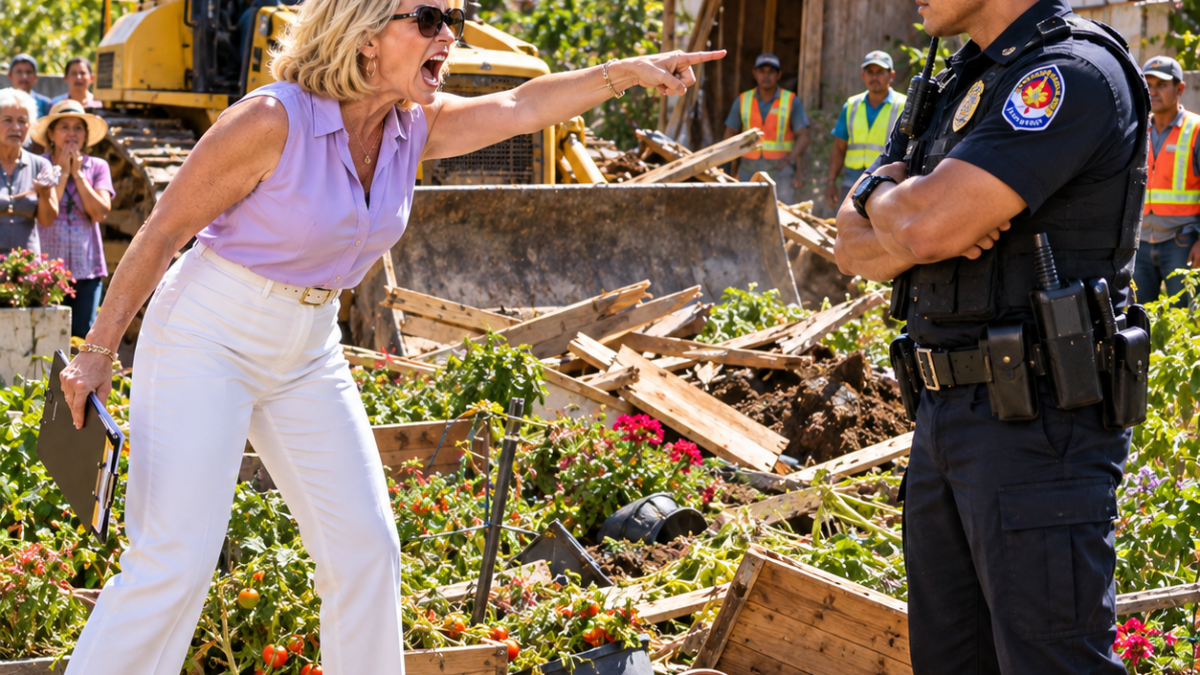
The garden beds were ripped apart. Plants crushed into mud. Rows I had tended for months were flattened under tracks. The flowers along the side path were gone, ground into broken stems and torn roots. The shed had been demolished, its green boards splintered and scattered across the dirt. Tools lay damaged in the wreckage. The chicken coop area was torn open, though thankfully the chickens were still safe at Mateo’s. The small stone path I had laid by hand was churned into the soil like it had never mattered.
My house still stood in the middle of it all.
That almost made it worse.
It stood like a witness.
I got out of the car and walked into the ruins of the place I had built for peace.
For a few minutes, I was not a police officer.
I was not calm.
I was not strategic.
I was a man standing where his garden had been, crying like something inside him had finally run out of strength.
People sometimes underestimate what a garden can mean.
It was not just plants. It was time. Care. Hope. Recovery from city noise. Proof that I could come home from hard shifts and grow something instead of only responding to what others destroyed. Every bed had my hands in it. Every corner had been chosen. The shed had taken me weekends to build. The coop had been adjusted three times until I was satisfied the chickens had enough space and safety.
Karen had not bulldozed weeds.
She had bulldozed peace.
Neighbors came slowly, as if approaching grief.
Mateo looked devastated.
“I tried,” he said. “I heard noise around midnight. By the time I came out, the machine was already inside. Karen was overseeing it. She told me it was community beautification.”
I looked over the torn land.
“Beautification.”
“She said she was teaching you a lesson.”
That brought my tears to an end.
Not my grief.
The tears.
Something colder replaced them.
Another neighbor, Mrs. Reyes, spoke from behind him. “I heard her say you would not retaliate. That you did not have it in you.”
I turned toward her.
“She said that?”
Mrs. Reyes nodded. “To two women near the market. She said you were soft. That you would complain, but do nothing.”
Karen thought she knew me.
That was the moment she lost.
I took a deep breath and wiped my face.
“Mateo, I need you to tell me everything from the beginning.”
He did.
I recorded it with his permission. Then I photographed everything. Wide shots. Close-ups. Track marks. Broken shed pieces. Damaged tools. Destroyed plants. Fence damage where the machine had entered. Every footprint, tire mark, scrap, and board. I cataloged the destruction methodically because emotion is powerful, but evidence wins.
Then I went to town hall and pulled property records.
Again.
Not because I doubted what I knew, but because good cases are built with fresh copies, official stamps, and no gaps for arrogant people to slip through. My property line sat outside the HOA jurisdiction. Clear as day. My land. My garden. My shed. No authority from them. No emergency order. No municipal directive. No safety finding. Nothing.
Karen had sent people onto private land and destroyed property because I had told her no.
A few days later, the community meeting took place.
I usually avoided those meetings because they were tedious and, frankly, because Karen made them feel like lectures delivered by someone who enjoyed the sound of compliance. This time, I went.
The room was crowded, which helped. Karen sat near the front beside the mayor, a nervous-looking man who always seemed to shrink slightly when she spoke. I had already learned by then that he was her brother, though no one had told me directly at first. That explained much. Not everything, but enough.
Karen saw me enter and smiled.
Not a guilty smile.
A victorious one.
“Nice of you to join us,” she called. “Usually only HOA members attend.”
I sat down slowly.
“There is no law saying non-members cannot attend a community meeting.”
Her smile twitched.
The meeting went through its usual items. Road maintenance. Noise complaints. Fence paint. Some new rule about approved exterior lighting. I listened, hands folded, waiting. At the end, the mayor asked if anyone had anything else to raise.
I stood.
Karen’s eyes narrowed.
I walked to the front.
“I would like to inform everyone of what happened to my property while I was away.”
The room shifted.
Some people already knew. Some had heard rumors. Some looked at Karen before I said another word, which told me plenty.
I spoke clearly.
I explained that my property was outside HOA authority. That I had refused membership repeatedly. That Karen had continued pressuring me. That while I was on vacation, a demolition crew entered my land with a bulldozer and destroyed my garden and shed. I displayed the photos I had printed: the garden before and after, the shed before and after, the tracks, the damage, the property records.
Gasps moved through the room.
People stared.
The mayor looked down at his papers.
Karen began slow clapping.
At first, I thought I imagined it.
But no.
She leaned back in her chair and clapped slowly, smiling as if I had performed for her.
“What was that supposed to do?” she asked. “Intimidate us?”
The room went silent.
I turned toward her.
“No. I am presenting facts.”
“You are presenting drama.”
“You hired people to destroy my property.”
“I removed hazards.”
Several people whispered.
I kept my voice level. “Do you have any legal documentation giving you authority to enter my land and destroy my property?”
She smiled wider.
“Nope.”
The way she popped the word made my skin go cold.
Not because she had won.
Because she had just admitted everything in front of a room full of witnesses.
I smiled back.
“Thank you.”
That confused her.
Good.
I returned to my seat.
The man beside me leaned closer and whispered, “The mayor is her brother.”
“I know,” I said.
Karen kept looking at me like she expected anger, shouting, a public breakdown. I gave her nothing. She did not understand that people who work in law enforcement learn the value of letting arrogant people talk. The more she enjoyed herself, the more she helped me.
The next morning, I went to my police district.
Not the town precinct.
My district.
I spoke with my supervisor, who listened with the expression of a man hearing a problem become a case. He already knew I was thorough, but I was more thorough than usual. Photographs. Witness statements. Property records. Copies of letters. My written refusals. The market encounters. The community meeting admission. Names of the demolition crew if we could get them. The mayor’s conflict.
We built the report carefully.
Trespassing.
Destruction of private property.
Vandalism.
Harassment.
Criminal misconduct.
Antisocial behavior, given the pattern and public intimidation.
I also contacted the demolition company.
At first, they did not want to talk. Once they realized police involvement was real and that Karen had possibly lied to them about authority, they became much more cooperative. They provided receipts, job details, the name on the order, payment information, and witness statements. They confirmed Karen had overseen the job personally and represented herself as having the right to authorize it.
Thank you, Karen.
I also contacted a local media group.
I did not release everything immediately. Timing matters. Evidence matters. I gave an interview explaining the broader issue: abuse of HOA power, fear in small communities, private property destruction, and the danger of local officials protecting family instead of law. I asked the reporter to hold the video until I gave the go-ahead.
Then I waited.
That was the hardest part.
For two weeks, I left the destroyed garden mostly as it was.
It killed me.
Every morning, I saw the torn land and wanted to start repairing it. Every evening, I came home from work and felt grief all over again. But I wanted Karen to think she had won. I wanted to see what she did with victory, because people like her rarely stop after one crime if they believe there were no consequences.
She did exactly what I expected.
She gloated.
At the market, she approached me beside the fish vendor.
“Your garden looks terrible,” she said brightly.
I looked at her. “Yes. Someone destroyed it.”
She shrugged. “It was already an eyesore. Now at least you have a chance to fix it properly.”
“Do I?”
“If you join the HOA, we can guide the restoration.”
“No, thank you.”
Her smile faded. “You have to clean it up.”
“Why?”
“Because it is unsightly.”
“You made it that way.”
“And now you must correct it.”
I nodded slowly. “Interesting.”
She frowned. “What is?”
“You destroyed my garden for community beautification, and now you are upset that your beautification is ugly.”
Her face flushed.
“You are playing games.”
“I learned from the best.”
She followed me around the market for nearly half an hour, switching between smugness and threats. At one point, she said if I did not sign the HOA documents, the rest of my property could be “corrected” too.
I let her talk.
My phone recorded every word.
A week later, she sent landscapers.
That surprised even me.
Apparently, the destroyed land bothered her reputation more than her conscience. Without permission, she hired a landscaping crew to enter my property and begin cleaning and repairing the mess she had caused. It was another illegal entry, another unauthorized act, another piece of evidence.
But I admit something.
I let them work.
I did not interfere because they were improving the damage on Karen’s money, and the workers themselves seemed to know little beyond the job they had been hired for. I documented them, spoke politely, collected company information, and let them repair what they could. The garden was nowhere near what it had been, and my shed was still gone, but the land no longer looked like a battlefield.
Karen came at night to inspect progress.
I saw her on the cameras I installed after the bulldozing. She would walk along the edge of the property, arms folded, examining the work like she owned it. Sometimes she stepped onto the land, looked around, and left. Each time, the cameras captured her.
More evidence.
Then came the letters again.
This time, they were no longer just pressure.
They were threats.
Join the HOA or face further corrective action.
Failure to integrate may result in additional property modification.
Community standards will be enforced.
She was creating a paper trail of her own arrogance.
I ignored the letters.
Then, at the market one morning, I gave her what she wanted.
Or at least, I let her think I did.
I found her near the vegetable stalls, examining produce as if even carrots needed HOA approval.
“Karen,” I said.
She looked up, suspicious.
“I’ve been thinking.”
Her face sharpened with interest.
“You were right,” I continued. “This conflict has gone too far. Maybe joining the HOA would help me become a better part of the community.”
Her eyes lit up before she could hide it.
“You mean that?”
“I do.”
She lifted her chin, trying to look unsurprised. “I knew you would come around.”
“I’m sorry for causing trouble.”
“Oh, Gabriel,” she said, smiling with pure satisfaction. “Some people simply need guidance.”
I nearly laughed in her face.
Instead, I nodded.
“I hope I can become an invaluable member.”
“I’m sure you can,” she said, already victorious in her mind. “Come to the next committee meeting. We will prepare the documents.”
“Perfect.”
She walked away with a bounce in her step.
I watched her go, thinking of my destroyed garden, my shed in pieces, my neighbors too afraid to speak, and the mayor twitching behind his stand while his sister admitted to a crime.
Perfect was exactly the word.
The interview went live just before the HOA meeting.
I made sure of that.
By the time I arrived, phones were already buzzing. People were whispering. Karen stood at the front of the room wearing a cream blouse and a smile that looked slightly strained. She had not yet understood how quickly the ground was moving under her.
I sat through the meeting.
All of it.
Every tedious rule. Every complaint about paint colors. Every smug comment from Karen about unity and responsibility. I watched her perform leadership for people who were beginning, perhaps for the first time openly, to see the rot beneath it.
At the end, she invited me forward to sign the membership papers.
I walked to the front.
The documents waited on a table.
Karen held out a pen.
“Welcome to the community,” she said.
I did not take it.
Instead, I turned to the room.
“I have a few things to say before I sign anything.”
Karen frowned. “This is not necessary.”
“It is.”
I began with the same facts I had shared before, but this time, I brought everything.
Photos.
Property records.
Letters.
Audio transcript from the market threat.
Camera stills of Karen entering my property at night.
Statements from neighbors.
Statements from the demolition company.
Receipts showing Karen authorized the destruction.
The media interview, now public.
Murmurs rose with each piece.
Karen rolled her eyes at first, still trying to look bored. Then the room began turning against her. You could feel it. A shift in air. People sitting straighter. People whispering less and staring more.
She scoffed when the video ended.
“This still does nothing,” she said. “You have no power here and never will.”
I smiled.
Then I walked toward her.
“Karen,” I said, “you have the right to remain silent.”
Her eyebrows lifted in confusion.
A few people gasped before she did.
“Anything you say can and will be used against you.”
“What are you doing?” she snapped.
I reached into my pocket and lifted my badge.
“You are under arrest.”
For the first time since I met her, Karen had no immediate answer.
She stared at the badge as if she could make it fake by sheer force of hatred. Her eyes moved from the badge to my face, then back to the badge.
“You can’t do this,” she said.
“I can.”
“I am the HOA president.”
“You are under arrest for trespassing, vandalism of private property, harassment, and related offenses connected to the destruction of my land.”
She looked around the room, searching for support.
None came.
In fact, someone in the back said, “Finally.”
Then another voice: “About time.”
Karen’s face flushed dark red.
“You are all ungrateful,” she shouted. “I built this community.”
“You frightened this community,” Mateo said from his seat.
She spun toward him. “You stay out of this.”
“No,” he said, standing slowly. “Not anymore.”
That broke something.
People began speaking all at once. Years of swallowed resentment came loose in fragments. Fines. Threats. Inspections. Public humiliation. Selective enforcement. Fear. Karen shouted over them, then at me, then toward the door as if the mayor might burst in and save her.
“He will fix this,” she said. “My brother will sort this out.”
“I considered that,” I said. “That is why you are not being taken to his jurisdiction.”
Her confidence flickered.
“You can’t.”
“I can.”
I had no desire to make a scene beyond what was necessary. I gave her a choice.
“You can come peacefully, or I can handcuff you here.”
Her lips pressed together so tightly they went pale.
For one second, I thought she might try to run.
She did not.
Pride can be heavier than fear.
She lifted her chin and walked with me, stiff-backed, furious, and finally silent.
The silence was my favorite part.
She began panicking only after we reached the precinct outside her brother’s reach. She demanded to be taken back to town. Demanded to call the mayor. Demanded to speak to someone “appropriate.” She claimed I had abused my authority. She claimed the HOA had rights. She claimed everything she had done was community service.
But evidence does not care how loudly you rename it.
The criminal case moved forward.
So did the civil suit.
Karen’s brother did try to defend her. In court, he looked less like a mayor and more like a man realizing family loyalty had dragged him into deep water. The judge was patient at first. Then less so.
Karen insisted I had violated HOA guidelines.
The judge repeated, more than once, that I was not part of the HOA.
Karen claimed the shed was unauthorized.
The judge asked authorized by whom.
Karen said the property was a hazard.
The judge asked for official documentation.
Karen had none.
She argued that community standards gave her authority to act.
The judge leaned forward and said, “Even if he had been part of your HOA, which he was not, an association does not have the right to destroy private property because it dislikes a shed.”
Karen called that ridiculous.
Then she made the mistake of insulting the judge.
I almost felt sorry for her attorney.
Almost.
By the end, the result was exactly what her arrogance had earned. Karen was ordered to pay me ten thousand dollars directly for damages. The HOA was fined five thousand dollars. The judge called for a full restructuring of the organization and regular community review of its actions. Karen received five years in prison for the criminal side of what she had done and was banned from holding any significant role in an HOA again.
When the sentence was read, she looked stunned.
Not sorry.
Stunned.
There is a difference.
She had spent so long bending a town around her will that consequences felt like a foreign language. She looked at the room, at me, at her brother, at the judge, waiting for the world to correct itself and return her power.
It did not.
A few weeks later, the town felt different.
Not perfect. Places do not heal overnight. People who lived under Karen’s thumb for years did not suddenly become fearless because one woman was gone. But they began to speak more freely. Neighbors who had avoided meetings attended them. The HOA board was replaced, and to my surprise and relief, Mateo became part of the new leadership. He did not want control. That made him exactly the kind of person who should have some responsibility.
He visited one evening while I was clearing the last of the broken shed pieces.
“You know,” he said, “some people are calling you a hero.”
I snorted. “They should raise their standards.”
He smiled. “Too late. You are already famous.”
“I just wanted a garden.”
“That is usually how trouble starts,” he said. “Someone wants something simple, and someone else wants power over it.”
He helped me carry boards to the pile.
After the trial, I also filed a report regarding the mayor’s conduct. His protection of Karen, his failure to act, his behavior in court—none of it stayed hidden once the media and the case records made the situation public. Pressure built quickly. It did not take long before the town began calling for new elections.
That part mattered almost as much as Karen’s arrest.
Because Karen had been the face of the problem, but she had not operated in a vacuum. People like her thrive when others look away, benefit quietly, or fear conflict more than injustice. Removing Karen was one thing. Examining the system that protected her was another.
With the money I received, I began rebuilding.
Slowly.
The garden came first.
Not because it was practical, though it was. Because I needed to put life back into the ground she had torn apart. I bought new soil, new seedlings, new tools. Neighbors brought cuttings. Mrs. Reyes gave me flowering plants from her yard. Mateo helped rebuild the stone path. Someone donated wood for the shed frame. Even people from inside the HOA came by, awkward but sincere, asking how they could help.
One man apologized while holding a shovel.
“I should have spoken up years ago,” he said.
I looked at him, then at the half-dug bed.
“Speak with the shovel for now.”
He did.
My chickens returned to a better coop than before. I expanded it with part of the settlement money, giving them more space to scratch and roam safely. They walked around like they had personally defeated tyranny, which, in their defense, they had survived it.
The shed took longer.
I could have hired someone to build it quickly, but I wanted my hands in it again. The first one had been mine. The second would be too. I salvaged one board from the wreckage, sanded it, and built it into the inside wall where only I could see it. Not as a wound. As a reminder.
Peace is not fragile because it is weak.
Peace is fragile because it is valuable.
You protect valuable things.
Months later, when the garden began to grow again, I noticed something unexpected. It was not the same as before, and at first that hurt. The old layout was gone. Certain plants I had loved did not survive. The shed stood slightly farther back. The new path curved differently.
But the garden was alive.
Different, yes.
Still mine.
That became enough.
One evening, after a long shift, I came home to find Mateo sitting near the front with a basket of mangoes. My chickens were making unnecessary noise, the sky was turning gold, and the new garden beds were damp from recent watering. The town was quieter than usual, or maybe I was finally quiet enough inside to hear it.
“You look tired,” Mateo said.
“I work in the city. That is my natural state.”
He laughed and handed me a mango.
“Meeting next week,” he said. “Actual community meeting. Not Karen theater.”
“I might attend.”
“You should. People listen when you talk.”
“I spend all day making reports. I moved here to stop talking so much.”
“You failed.”
I smiled.
Maybe I had.
But not completely.
Because that night, after he left, I sat on my porch and did nothing. No letters. No threats. No Karen standing at my gate calling my vegetables a hazard. No bulldozer tracks. No mayor pretending not to see. Just insects, chickens, damp soil, and the soft dark settling over land that still belonged to me.
That was the peace I had wanted.
Not untouched peace.
Earned peace.
There is a difference.
I sometimes think about the moment Karen saw my badge. Her face frozen, her certainty cracking, the room shifting around her. It would be easy to say that was the best moment, the perfect revenge. And yes, I would be lying if I said I did not enjoy it.
But it was not the best moment.
The best moment came later, when Mrs. Reyes brought me a small pot of basil and said, “For the new garden.”
Or when Mateo’s children helped scatter seeds and argued about who made the straightest row.
Or when the first egg came from the upgraded coop and I cooked it for breakfast like a small celebration.
Or when I walked outside one morning and realized I had not thought about Karen before stepping into my own yard.
That was victory.
Not her fall.
My return.
People like Karen believe power is the ability to make others afraid. They mistake silence for agreement, patience for weakness, kindness for surrender. They build little kingdoms out of paperwork, family connections, and the exhaustion of decent people who just want to live quietly.
But quiet people are not always helpless.
Sometimes they are gathering evidence.
Sometimes they are waiting for the right room.
Sometimes they are letting you clap slowly in front of witnesses because you are too arrogant to understand you just confessed.
Karen wanted me in her HOA.
Instead, she got a criminal record, a civil judgment, five years behind bars, the collapse of her influence, and a town finally brave enough to breathe without asking her permission.
I got my garden back.
Not the same garden.
Maybe something better.
Because now, every plant in it grows in soil that has been fought for twice.
Once when I bought it.
And once when I refused to let someone else decide it was hers to destroy.
𝗧𝗛𝗘 𝗘𝗡𝗗
The HOA President Bulldozed My Garden While I Was Away and Never Asked What I Did for a Living
Karen thought I was just another quiet homeowner she could scare into obedience.
While I was on vacation, she sent a bulldozer through my garden, destroyed my shed, and told the town I would never fight back.
She should have asked one question before touching my land: what badge was I carrying?
For years, I believed peace was something other people talked about because they did not know what noise really was.
I worked as a police officer in Quezon City, in the Philippines, long enough for the city’s rhythm to become part of my nervous system. Traffic horns before sunrise. Motorcycle engines whining between lanes. Vendors calling from sidewalks. Radios crackling. Arguments spilling from narrow streets into humid air. Rain hammering rooftops so hard it sounded like applause from an angry crowd. Sirens, dogs, laughter, shouting, construction, karaoke at midnight, and the endless human thunder of a place that never seemed to sleep.
When I was younger, I loved it.
The city had teeth, but it also had life. Every shift felt like stepping into a story already in progress. Some days were routine. Some were ugly. Some were the kind you carried home even after you took off the uniform. But I understood the movement, the urgency, the constant sense that something needed doing and someone had to do it.
Then one day, without any dramatic moment to mark the change, I realized I was tired.
Not sleepy.
Tired.
Tired in the bones. Tired in the eyes. Tired of hearing noise even when the room was quiet. Tired of coming home from long shifts and feeling like the city had followed me inside, hiding in my shoulders, in my jaw, in the way I woke at small sounds. I still loved my work. I still believed in it. But I no longer wanted to live surrounded by the same pressure I faced every day.
So I started looking outside the city.
Not far enough to make work impossible, but far enough that I could breathe when I came home. Eventually, I found a small property in a rural town about thirty minutes away from Quezon City on a good day, longer when traffic decided to punish everyone equally. The house was modest. One story, pale walls, a tiled roof, and a little porch that looked out over a patch of land just large enough to feel like freedom.
It was not fancy.
That was exactly why I loved it.
I had saved for years, and buying that place felt like taking a piece of my future back from exhaustion. The house sat near the center of the property, with enough space around it for a garden, a small chicken coop, and a shed I planned to build myself. There were neighbors nearby, but not pressed close the way they were in the city. The air smelled different there. Soil, grass, smoke from cooking fires, fruit ripening somewhere beyond a fence. At night, I could hear insects instead of engines.
For the first few weeks, I would come home from work, park, step out of the car, and just stand there.
Listening to nothing.
Nothing became my favorite sound.
The town itself was close-knit in that rural way where everybody seemed to know everybody’s cousins, debts, illnesses, celebrations, grudges, and preferred market stalls. At first, I was the outsider. The police officer from the city. The man who bought the old house near the edge of the homeowners association but was not actually part of it. People watched me with curiosity, but most were kind. A neighbor named Mateo brought over mangoes from his tree. An elderly woman across the lane gave me cuttings from her herbs. Another neighbor taught me which vendor at the market sold the best feed for chickens.
Slowly, I became less of a stranger.
I traded vegetables when my garden began producing. I shared eggs once my three hens settled into their coop. I sat with neighbors in the late afternoon, drinking coffee too strong for the weather and listening to stories about the town from long before I arrived. I was still new, yes, but not unwelcome.
At least not to most people.
Then there was Karen.
Her real name was not Karen, of course, but I will call her that because no other name fits the role she chose for herself. She was the president of the local homeowners association, a woman in her late forties with perfectly styled hair, a collection of crisp blouses, and the kind of smile that looked like it had been sharpened before use. She moved through town like she owned not only the sidewalks and roads, but the air above them. People lowered their voices when she passed. They smiled too quickly. They agreed too easily.
That was my first warning.
Fear can look like respect if you do not know what you are seeing.
My property sat just outside the HOA’s jurisdiction. I knew that before I bought it. I had checked maps, property boundaries, records, and documents. I had no interest in moving from a loud city into a quiet town just to let a committee tell me what shade my fence should be or whether my chickens were aesthetically acceptable. I was not against neighbors having rules if they had freely agreed to them, but I had not. My land was mine. Their organization ended before my boundary began.
For a while, I thought that fact would protect me.
I should have known better.
Facts protect you only when the other side respects reality.
Karen preferred control.
part2
The first letters were polite.
Almost friendly.
They welcomed me to the community, informed me of local events, mentioned town cleanups, seasonal gatherings, and meetings I was “invited” to attend. I did not mind those. A person could be neighborly without joining an association. I even considered attending one of the public events just to meet more people.
Then the tone changed.
The letters began suggesting I apply for HOA membership. Not asking, exactly. Suggesting with pressure behind it. Karen wrote that joining would help me become “fully integrated” into the community. She said it would give me access to important decision-making. She said it would ensure my property contributed to the shared beauty and safety of the area.
I wrote back once, politely.
I thanked her for the invitation and declined. I explained that my property was outside the HOA boundaries and that I had no intention of joining. I added, truthfully, that I cared deeply about maintaining my land and would continue keeping it clean, safe, and pleasant.
I thought that would be enough.
Karen responded with three more letters in two weeks.
The language became less neighborly each time.
She said refusing to join could create “social distance.” She said non-members who benefited from the community should contribute to its standards. She said my refusal might be interpreted as a lack of cooperation. One letter used the word ostracized, which would have been funny if it had not been so revealing.
I showed the letters to Mateo one afternoon while we sat outside his house drinking coffee.
He read them with a grim little smile.
“I would not join if I were you,” he said.
“I wasn’t planning to.”
“Good.”
“You sound like you know something.”
He looked down the road before answering, as if Karen might appear simply because we spoke her name.
“They tried with the last family who owned your place.”
“The previous owners?”
He nodded. “They refused too.”
“And?”
“They moved.”
I leaned back. “Because of pressure from the HOA?”
“Because of Karen,” he said. “There is a difference.”
That was when the town began making more sense to me. The way people lowered their voices. The way the mayor smiled too stiffly when her name came up. The way neighbors complained privately but never openly. The HOA was not just annoying. It had become a small government of fear, and Karen sat at the center of it like she had been born behind a desk with a stamp in her hand.
“What can she actually do?” I asked.
Mateo gave a humorless laugh. “That depends on how far she thinks she can go.”
A week later, she approached me at the market.
I was buying eggplant and tomatoes from a stall near the fruit vendors when I heard a woman say my name as if she had practiced it.
“Gabriel?”
I turned.
Karen stood behind me with a woven bag over one arm and sunglasses pushed up onto her hair. She was dressed too neatly for the heat, wearing a white blouse tucked into navy pants, gold earrings, and sandals that looked like they had never touched mud.
“That’s me,” I said.
She smiled and extended her hand. “I’m Karen, your HOA president.”
Your.
I noticed that immediately.
Not the HOA president.
Your HOA president.
I shook her hand anyway. “Nice to meet you.”
For a few minutes, she played pleasant. She asked how I liked the town. Asked whether the commute was manageable. Asked if I had found good produce vendors. Her tone was warm enough that, if Mateo had not warned me, I might have wondered whether people had exaggerated.
Then she said, “So, when will you be joining the HOA?”
I paused with tomatoes in my hand.
“I won’t be.”
The warmth vanished.
Not slowly.
Instantly.
“So the letters were not misunderstood.”
“No. I was clear in my reply.”
Her smile returned, but the edges were wrong now.
“You must understand, Gabriel, we do not extend invitations lightly.”
“I appreciate that, but I’m not interested.”
“It is a wonderful opportunity.”
“I’m sure it is for people who want it.”
“You would be more integrated.”
“I already feel pretty integrated.”
Her eyes flicked to the vendor, who was suddenly very interested in arranging fruit.
Karen lowered her voice. “There are benefits.”
“I have neighbors. I have my work. I have my garden. I have enough.”
“The HOA is relaxed,” she said. “People misunderstand us.”
“I would be willing to read the rules.”
That stopped her.
“The rules?”
“Yes. If you want me to consider joining, show me the handbook.”
Her nostrils flared slightly. “Only members have access to the rulebook.”
“Then I cannot consider joining.”
“That is not how this works.”
“It is how my decision works.”
I already had a copy.
Mateo had shown me the rules the week before. They were not relaxed. They were extensive, invasive, and constantly expanding. Restrictions on paint, fences, plants, animals, gatherings, shed sizes, lawn ornaments, laundry, vehicle placement, and enough other details that membership looked less like community and more like renting your own life from a committee.
“I am under no obligation to join,” I said calmly. “So I won’t.”
Karen’s eyes hardened.
For a moment, I thought she would argue right there in front of the stalls. But several people were watching now, pretending not to. She seemed to notice at the same time I did.
Her smile snapped back on.
“Think about it,” she said.
“I have.”
She turned and walked away.
The fruit vendor let out a soft breath.
“That won’t be the end of that,” he said.
“No one seems to think so.”
He gave me a sympathetic look. “No one knows her better than us.”
After that, Karen became part of my routine in the worst possible way.
For two weeks, nothing happened. Then the letters started again, sharper than before. She stopped me near the market. Near the town hall. Once outside church, though I was only passing by. She repeated the same phrases until they sounded rehearsed: integration, community standards, safety, property values, shared responsibility.
I repeated the same answer.
No.
Eventually, she began coming to my house.
The first time, she stood at my gate and called my name instead of ringing or knocking. I was in the garden, trimming herbs, wearing old clothes and enjoying the rare feeling of being fully off duty. My three chickens scratched near their coop, muttering to themselves like tiny old women gossiping.
“Gabriel,” Karen called.
I looked up, already tired.
“Can I help you?”
She stood with a folder pressed to her chest.
“I need to discuss the condition of this property.”
I looked around.
The garden beds were neat. The shed I had built myself stood near the back, painted dark green with a corrugated roof and shelves inside for tools. The chicken coop was clean. The path was swept. Flowering plants lined one side of the yard. I was proud of that space in a way I had not expected. In the city, I had never had soil of my own. Here, I had poured hundreds of hours into making the land feel alive.
“What condition?” I asked.
“It is becoming a hazard.”
I almost laughed. “Where?”
She pointed vaguely. “The general presentation.”
“That is not a hazard.”
“It is an eyesore.”
Now I did laugh once, but there was no humor in it.
“My garden?”
“The shed. The crops. The chickens. The inconsistent plantings.”
“Inconsistent plantings,” I repeated.
“Your land affects the community.”
“My land is outside your HOA.”
“But visible from it.”
“Then close your eyes.”
Her face tightened.
Several neighbors had stepped outside by then. I saw Mateo near his fence. An older woman across the lane watched from her porch. Their faces held sympathy and fear in equal measure.
Karen noticed them too, but this time the audience did not stop her.
“Just join the HOA,” she said, her voice rising. “Let us help fix this before it becomes a bigger problem.”
“You mean let you control it.”
“I mean bring it up to standard.”
“My standard is fine.”
“Your standard is selfish.”
I set down the shears.
“Karen, please stop harassing me.”
Her mouth opened slightly. I think the word harassing offended her more than anything else I had said.
“I am trying to protect this community.”
“From vegetables?”
“From people who think rules do not apply to them.”
“Your rules do not apply to me.”
She leaned closer to the gate.
“They will.”
That was the first time I felt the old city instinct rise in me—the one that listens beneath words for threat, intent, escalation. Karen was not merely annoying anymore. She was warning me.
I could have told her then.
I could have said, “Karen, I am a police officer. I know the law. I know exactly where your authority begins and ends.”
But I did not.
Partly because I did not want to use my job like a shield in a personal dispute. Partly because I wanted to see how far she would go when she thought I was just another homeowner. And partly because, if I am honest, I underestimated her.
A few weeks later, I took a vacation to the coast.
It sounds ridiculous now. Leaving because I needed peace from the place I had bought for peace. But that was exactly how it felt. Work had been relatively calm that month, which meant I had enough days free to get away. I told myself a week by the water would clear my head, and maybe Karen would lose interest once she had no one to provoke.
I asked Mateo to keep an eye on the property.
He also took my chickens into his own coop while I was gone, which I appreciated more than he knew. I did not like leaving them unattended with Karen growing more unstable. I locked the shed, checked the house, took pictures of the property before I left out of habit, and drove toward the coast with the strange sadness of a man escaping his own home.
For five days, I almost relaxed.
Almost.
The sea helped. So did sleep. So did not hearing Karen’s voice. I walked along the shore, ate grilled fish, and sat under shade with no folder-carrying HOA president in sight. By the sixth day, I began thinking maybe I had been too tense. Maybe the town was right that Karen loved pressure but avoided actual risk. Maybe she would keep sending letters until she got bored.
Then Mateo messaged me.
Call me.
Nothing good begins with that text.
I called immediately.
He answered on the first ring, breathing hard.
“Gabriel.”
“What happened?”
“I am so sorry.”
My grip tightened on the phone.
“Tell me.”
“There was a bulldozer.”
For a moment, I thought I had misheard him.
“A what?”
“A bulldozer. Men came in the night. Karen was there. They destroyed the garden. The shed too. I tried to stop them.”
The world around me went quiet, even though waves were breaking nearby.
“My house?”
“The house is still standing. But the yard—Gabriel, the yard is gone.”
I drove back the next morning because driving at night angry is a good way to become a case file yourself.
When I pulled up, I did not recognize my own land.
That is not dramatic language.
I truly did not recognize it.
The garden beds were ripped apart. Plants crushed into mud. Rows I had tended for months were flattened under tracks. The flowers along the side path were gone, ground into broken stems and torn roots. The shed had been demolished, its green boards splintered and scattered across the dirt. Tools lay damaged in the wreckage. The chicken coop area was torn open, though thankfully the chickens were still safe at Mateo’s. The small stone path I had laid by hand was churned into the soil like it had never mattered.
My house still stood in the middle of it all.
That almost made it worse.
It stood like a witness.
I got out of the car and walked into the ruins of the place I had built for peace.
For a few minutes, I was not a police officer.
I was not calm.
I was not strategic.
I was a man standing where his garden had been, crying like something inside him had finally run out of strength.
People sometimes underestimate what a garden can mean.
It was not just plants. It was time. Care. Hope. Recovery from city noise. Proof that I could come home from hard shifts and grow something instead of only responding to what others destroyed. Every bed had my hands in it. Every corner had been chosen. The shed had taken me weekends to build. The coop had been adjusted three times until I was satisfied the chickens had enough space and safety.
Karen had not bulldozed weeds.
She had bulldozed peace.
Neighbors came slowly, as if approaching grief.
Mateo looked devastated.
“I tried,” he said. “I heard noise around midnight. By the time I came out, the machine was already inside. Karen was overseeing it. She told me it was community beautification.”
I looked over the torn land.
“Beautification.”
“She said she was teaching you a lesson.”
That brought my tears to an end.
Not my grief.
The tears.
Something colder replaced them.
Another neighbor, Mrs. Reyes, spoke from behind him. “I heard her say you would not retaliate. That you did not have it in you.”
I turned toward her.
“She said that?”
Mrs. Reyes nodded. “To two women near the market. She said you were soft. That you would complain, but do nothing.”
Karen thought she knew me.
That was the moment she lost.
I took a deep breath and wiped my face.
“Mateo, I need you to tell me everything from the beginning.”
He did.
I recorded it with his permission. Then I photographed everything. Wide shots. Close-ups. Track marks. Broken shed pieces. Damaged tools. Destroyed plants. Fence damage where the machine had entered. Every footprint, tire mark, scrap, and board. I cataloged the destruction methodically because emotion is powerful, but evidence wins.
Then I went to town hall and pulled property records.
Again.
Not because I doubted what I knew, but because good cases are built with fresh copies, official stamps, and no gaps for arrogant people to slip through. My property line sat outside the HOA jurisdiction. Clear as day. My land. My garden. My shed. No authority from them. No emergency order. No municipal directive. No safety finding. Nothing.
Karen had sent people onto private land and destroyed property because I had told her no.
A few days later, the community meeting took place.
I usually avoided those meetings because they were tedious and, frankly, because Karen made them feel like lectures delivered by someone who enjoyed the sound of compliance. This time, I went.
The room was crowded, which helped. Karen sat near the front beside the mayor, a nervous-looking man who always seemed to shrink slightly when she spoke. I had already learned by then that he was her brother, though no one had told me directly at first. That explained much. Not everything, but enough.
Karen saw me enter and smiled.
Not a guilty smile.
A victorious one.
“Nice of you to join us,” she called. “Usually only HOA members attend.”
I sat down slowly.
“There is no law saying non-members cannot attend a community meeting.”
Her smile twitched.
The meeting went through its usual items. Road maintenance. Noise complaints. Fence paint. Some new rule about approved exterior lighting. I listened, hands folded, waiting. At the end, the mayor asked if anyone had anything else to raise.
I stood.
Karen’s eyes narrowed.
I walked to the front.
“I would like to inform everyone of what happened to my property while I was away.”
The room shifted.
Some people already knew. Some had heard rumors. Some looked at Karen before I said another word, which told me plenty.
I spoke clearly.
I explained that my property was outside HOA authority. That I had refused membership repeatedly. That Karen had continued pressuring me. That while I was on vacation, a demolition crew entered my land with a bulldozer and destroyed my garden and shed. I displayed the photos I had printed: the garden before and after, the shed before and after, the tracks, the damage, the property records.
Gasps moved through the room.
People stared.
The mayor looked down at his papers.
Karen began slow clapping.
At first, I thought I imagined it.
But no.
She leaned back in her chair and clapped slowly, smiling as if I had performed for her.
“What was that supposed to do?” she asked. “Intimidate us?”
The room went silent.
I turned toward her.
“No. I am presenting facts.”
“You are presenting drama.”
“You hired people to destroy my property.”
“I removed hazards.”
Several people whispered.
I kept my voice level. “Do you have any legal documentation giving you authority to enter my land and destroy my property?”
She smiled wider.
“Nope.”
The way she popped the word made my skin go cold.
Not because she had won.
Because she had just admitted everything in front of a room full of witnesses.
I smiled back.
“Thank you.”
That confused her.
Good.
I returned to my seat.
The man beside me leaned closer and whispered, “The mayor is her brother.”
“I know,” I said.
Karen kept looking at me like she expected anger, shouting, a public breakdown. I gave her nothing. She did not understand that people who work in law enforcement learn the value of letting arrogant people talk. The more she enjoyed herself, the more she helped me.
The next morning, I went to my police district.
Not the town precinct.
My district.
I spoke with my supervisor, who listened with the expression of a man hearing a problem become a case. He already knew I was thorough, but I was more thorough than usual. Photographs. Witness statements. Property records. Copies of letters. My written refusals. The market encounters. The community meeting admission. Names of the demolition crew if we could get them. The mayor’s conflict.
We built the report carefully.
Trespassing.
Destruction of private property.
Vandalism.
Harassment.
Criminal misconduct.
Antisocial behavior, given the pattern and public intimidation.
I also contacted the demolition company.
At first, they did not want to talk. Once they realized police involvement was real and that Karen had possibly lied to them about authority, they became much more cooperative. They provided receipts, job details, the name on the order, payment information, and witness statements. They confirmed Karen had overseen the job personally and represented herself as having the right to authorize it.
Thank you, Karen.
I also contacted a local media group.
I did not release everything immediately. Timing matters. Evidence matters. I gave an interview explaining the broader issue: abuse of HOA power, fear in small communities, private property destruction, and the danger of local officials protecting family instead of law. I asked the reporter to hold the video until I gave the go-ahead.
Then I waited.
That was the hardest part.
For two weeks, I left the destroyed garden mostly as it was.
It killed me.
Every morning, I saw the torn land and wanted to start repairing it. Every evening, I came home from work and felt grief all over again. But I wanted Karen to think she had won. I wanted to see what she did with victory, because people like her rarely stop after one crime if they believe there were no consequences.
She did exactly what I expected.
She gloated.
At the market, she approached me beside the fish vendor.
“Your garden looks terrible,” she said brightly.
I looked at her. “Yes. Someone destroyed it.”
She shrugged. “It was already an eyesore. Now at least you have a chance to fix it properly.”
“Do I?”
“If you join the HOA, we can guide the restoration.”
“No, thank you.”
Her smile faded. “You have to clean it up.”
“Why?”
“Because it is unsightly.”
“You made it that way.”
“And now you must correct it.”
I nodded slowly. “Interesting.”
She frowned. “What is?”
“You destroyed my garden for community beautification, and now you are upset that your beautification is ugly.”
Her face flushed.
“You are playing games.”
“I learned from the best.”
She followed me around the market for nearly half an hour, switching between smugness and threats. At one point, she said if I did not sign the HOA documents, the rest of my property could be “corrected” too.
I let her talk.
My phone recorded every word.
A week later, she sent landscapers.
That surprised even me.
Apparently, the destroyed land bothered her reputation more than her conscience. Without permission, she hired a landscaping crew to enter my property and begin cleaning and repairing the mess she had caused. It was another illegal entry, another unauthorized act, another piece of evidence.
But I admit something.
I let them work.
I did not interfere because they were improving the damage on Karen’s money, and the workers themselves seemed to know little beyond the job they had been hired for. I documented them, spoke politely, collected company information, and let them repair what they could. The garden was nowhere near what it had been, and my shed was still gone, but the land no longer looked like a battlefield.
Karen came at night to inspect progress.
I saw her on the cameras I installed after the bulldozing. She would walk along the edge of the property, arms folded, examining the work like she owned it. Sometimes she stepped onto the land, looked around, and left. Each time, the cameras captured her.
More evidence.
Then came the letters again.
This time, they were no longer just pressure.
They were threats.
Join the HOA or face further corrective action.
Failure to integrate may result in additional property modification.
Community standards will be enforced.
She was creating a paper trail of her own arrogance.
I ignored the letters.
Then, at the market one morning, I gave her what she wanted.
Or at least, I let her think I did.
I found her near the vegetable stalls, examining produce as if even carrots needed HOA approval.
“Karen,” I said.
She looked up, suspicious.
“I’ve been thinking.”
Her face sharpened with interest.
“You were right,” I continued. “This conflict has gone too far. Maybe joining the HOA would help me become a better part of the community.”
Her eyes lit up before she could hide it.
“You mean that?”
“I do.”
She lifted her chin, trying to look unsurprised. “I knew you would come around.”
“I’m sorry for causing trouble.”
“Oh, Gabriel,” she said, smiling with pure satisfaction. “Some people simply need guidance.”
I nearly laughed in her face.
Instead, I nodded.
“I hope I can become an invaluable member.”
“I’m sure you can,” she said, already victorious in her mind. “Come to the next committee meeting. We will prepare the documents.”
“Perfect.”
She walked away with a bounce in her step.
I watched her go, thinking of my destroyed garden, my shed in pieces, my neighbors too afraid to speak, and the mayor twitching behind his stand while his sister admitted to a crime.
Perfect was exactly the word.
The interview went live just before the HOA meeting.
I made sure of that.
By the time I arrived, phones were already buzzing. People were whispering. Karen stood at the front of the room wearing a cream blouse and a smile that looked slightly strained. She had not yet understood how quickly the ground was moving under her.
I sat through the meeting.
All of it.
Every tedious rule. Every complaint about paint colors. Every smug comment from Karen about unity and responsibility. I watched her perform leadership for people who were beginning, perhaps for the first time openly, to see the rot beneath it.
At the end, she invited me forward to sign the membership papers.
I walked to the front.
The documents waited on a table.
Karen held out a pen.
“Welcome to the community,” she said.
I did not take it.
Instead, I turned to the room.
“I have a few things to say before I sign anything.”
Karen frowned. “This is not necessary.”
“It is.”
I began with the same facts I had shared before, but this time, I brought everything.
Photos.
Property records.
Letters.
Audio transcript from the market threat.
Camera stills of Karen entering my property at night.
Statements from neighbors.
Statements from the demolition company.
Receipts showing Karen authorized the destruction.
The media interview, now public.
Murmurs rose with each piece.
Karen rolled her eyes at first, still trying to look bored. Then the room began turning against her. You could feel it. A shift in air. People sitting straighter. People whispering less and staring more.
She scoffed when the video ended.
“This still does nothing,” she said. “You have no power here and never will.”
I smiled.
Then I walked toward her.
“Karen,” I said, “you have the right to remain silent.”
Her eyebrows lifted in confusion.
A few people gasped before she did.
“Anything you say can and will be used against you.”
“What are you doing?” she snapped.
I reached into my pocket and lifted my badge.
“You are under arrest.”
For the first time since I met her, Karen had no immediate answer.
She stared at the badge as if she could make it fake by sheer force of hatred. Her eyes moved from the badge to my face, then back to the badge.
“You can’t do this,” she said.
“I can.”
“I am the HOA president.”
“You are under arrest for trespassing, vandalism of private property, harassment, and related offenses connected to the destruction of my land.”
She looked around the room, searching for support.
None came.
In fact, someone in the back said, “Finally.”
Then another voice: “About time.”
Karen’s face flushed dark red.
“You are all ungrateful,” she shouted. “I built this community.”
“You frightened this community,” Mateo said from his seat.
She spun toward him. “You stay out of this.”
“No,” he said, standing slowly. “Not anymore.”
That broke something.
People began speaking all at once. Years of swallowed resentment came loose in fragments. Fines. Threats. Inspections. Public humiliation. Selective enforcement. Fear. Karen shouted over them, then at me, then toward the door as if the mayor might burst in and save her.
“He will fix this,” she said. “My brother will sort this out.”
“I considered that,” I said. “That is why you are not being taken to his jurisdiction.”
Her confidence flickered.
“You can’t.”
“I can.”
I had no desire to make a scene beyond what was necessary. I gave her a choice.
“You can come peacefully, or I can handcuff you here.”
Her lips pressed together so tightly they went pale.
For one second, I thought she might try to run.
She did not.
Pride can be heavier than fear.
She lifted her chin and walked with me, stiff-backed, furious, and finally silent.
The silence was my favorite part.
She began panicking only after we reached the precinct outside her brother’s reach. She demanded to be taken back to town. Demanded to call the mayor. Demanded to speak to someone “appropriate.” She claimed I had abused my authority. She claimed the HOA had rights. She claimed everything she had done was community service.
But evidence does not care how loudly you rename it.
The criminal case moved forward.
So did the civil suit.
Karen’s brother did try to defend her. In court, he looked less like a mayor and more like a man realizing family loyalty had dragged him into deep water. The judge was patient at first. Then less so.
Karen insisted I had violated HOA guidelines.
The judge repeated, more than once, that I was not part of the HOA.
Karen claimed the shed was unauthorized.
The judge asked authorized by whom.
Karen said the property was a hazard.
The judge asked for official documentation.
Karen had none.
She argued that community standards gave her authority to act.
The judge leaned forward and said, “Even if he had been part of your HOA, which he was not, an association does not have the right to destroy private property because it dislikes a shed.”
Karen called that ridiculous.
Then she made the mistake of insulting the judge.
I almost felt sorry for her attorney.
Almost.
By the end, the result was exactly what her arrogance had earned. Karen was ordered to pay me ten thousand dollars directly for damages. The HOA was fined five thousand dollars. The judge called for a full restructuring of the organization and regular community review of its actions. Karen received five years in prison for the criminal side of what she had done and was banned from holding any significant role in an HOA again.
When the sentence was read, she looked stunned.
Not sorry.
Stunned.
There is a difference.
She had spent so long bending a town around her will that consequences felt like a foreign language. She looked at the room, at me, at her brother, at the judge, waiting for the world to correct itself and return her power.
It did not.
A few weeks later, the town felt different.
Not perfect. Places do not heal overnight. People who lived under Karen’s thumb for years did not suddenly become fearless because one woman was gone. But they began to speak more freely. Neighbors who had avoided meetings attended them. The HOA board was replaced, and to my surprise and relief, Mateo became part of the new leadership. He did not want control. That made him exactly the kind of person who should have some responsibility.
He visited one evening while I was clearing the last of the broken shed pieces.
“You know,” he said, “some people are calling you a hero.”
I snorted. “They should raise their standards.”
He smiled. “Too late. You are already famous.”
“I just wanted a garden.”
“That is usually how trouble starts,” he said. “Someone wants something simple, and someone else wants power over it.”
He helped me carry boards to the pile.
After the trial, I also filed a report regarding the mayor’s conduct. His protection of Karen, his failure to act, his behavior in court—none of it stayed hidden once the media and the case records made the situation public. Pressure built quickly. It did not take long before the town began calling for new elections.
That part mattered almost as much as Karen’s arrest.
Because Karen had been the face of the problem, but she had not operated in a vacuum. People like her thrive when others look away, benefit quietly, or fear conflict more than injustice. Removing Karen was one thing. Examining the system that protected her was another.
With the money I received, I began rebuilding.
Slowly.
The garden came first.
Not because it was practical, though it was. Because I needed to put life back into the ground she had torn apart. I bought new soil, new seedlings, new tools. Neighbors brought cuttings. Mrs. Reyes gave me flowering plants from her yard. Mateo helped rebuild the stone path. Someone donated wood for the shed frame. Even people from inside the HOA came by, awkward but sincere, asking how they could help.
One man apologized while holding a shovel.
“I should have spoken up years ago,” he said.
I looked at him, then at the half-dug bed.
“Speak with the shovel for now.”
He did.
My chickens returned to a better coop than before. I expanded it with part of the settlement money, giving them more space to scratch and roam safely. They walked around like they had personally defeated tyranny, which, in their defense, they had survived it.
The shed took longer.
I could have hired someone to build it quickly, but I wanted my hands in it again. The first one had been mine. The second would be too. I salvaged one board from the wreckage, sanded it, and built it into the inside wall where only I could see it. Not as a wound. As a reminder.
Peace is not fragile because it is weak.
Peace is fragile because it is valuable.
You protect valuable things.
Months later, when the garden began to grow again, I noticed something unexpected. It was not the same as before, and at first that hurt. The old layout was gone. Certain plants I had loved did not survive. The shed stood slightly farther back. The new path curved differently.
But the garden was alive.
Different, yes.
Still mine.
That became enough.
One evening, after a long shift, I came home to find Mateo sitting near the front with a basket of mangoes. My chickens were making unnecessary noise, the sky was turning gold, and the new garden beds were damp from recent watering. The town was quieter than usual, or maybe I was finally quiet enough inside to hear it.
“You look tired,” Mateo said.
“I work in the city. That is my natural state.”
He laughed and handed me a mango.
“Meeting next week,” he said. “Actual community meeting. Not Karen theater.”
“I might attend.”
“You should. People listen when you talk.”
“I spend all day making reports. I moved here to stop talking so much.”
“You failed.”
I smiled.
Maybe I had.
But not completely.
Because that night, after he left, I sat on my porch and did nothing. No letters. No threats. No Karen standing at my gate calling my vegetables a hazard. No bulldozer tracks. No mayor pretending not to see. Just insects, chickens, damp soil, and the soft dark settling over land that still belonged to me.
That was the peace I had wanted.
Not untouched peace.
Earned peace.
There is a difference.
I sometimes think about the moment Karen saw my badge. Her face frozen, her certainty cracking, the room shifting around her. It would be easy to say that was the best moment, the perfect revenge. And yes, I would be lying if I said I did not enjoy it.
But it was not the best moment.
The best moment came later, when Mrs. Reyes brought me a small pot of basil and said, “For the new garden.”
Or when Mateo’s children helped scatter seeds and argued about who made the straightest row.
Or when the first egg came from the upgraded coop and I cooked it for breakfast like a small celebration.
Or when I walked outside one morning and realized I had not thought about Karen before stepping into my own yard.
That was victory.
Not her fall.
My return.
People like Karen believe power is the ability to make others afraid. They mistake silence for agreement, patience for weakness, kindness for surrender. They build little kingdoms out of paperwork, family connections, and the exhaustion of decent people who just want to live quietly.
But quiet people are not always helpless.
Sometimes they are gathering evidence.
Sometimes they are waiting for the right room.
Sometimes they are letting you clap slowly in front of witnesses because you are too arrogant to understand you just confessed.
Karen wanted me in her HOA.
Instead, she got a criminal record, a civil judgment, five years behind bars, the collapse of her influence, and a town finally brave enough to breathe without asking her permission.
I got my garden back.
Not the same garden.
Maybe something better.
Because now, every plant in it grows in soil that has been fought for twice.
Once when I bought it.
And once when I refused to let someone else decide it was hers to destroy.