𝗙𝗨𝗟𝗟 𝗦𝗧𝗢𝗥𝗬 The HOA President Blocked My Driveway and Called 911 to Have Me Arrested—She Had No Idea Who She Had Just Reported
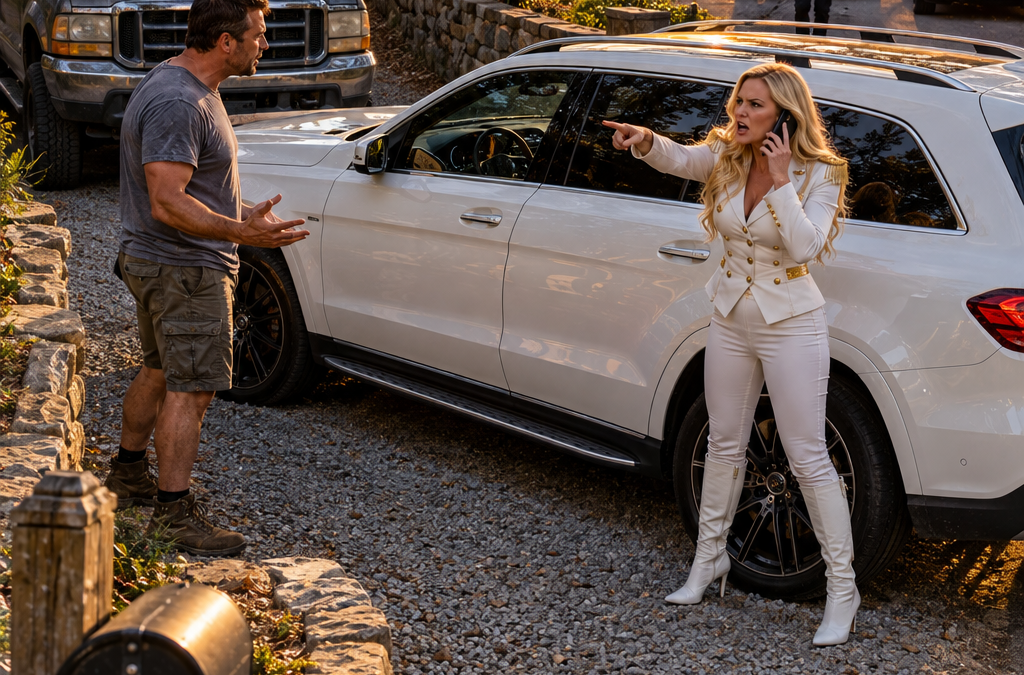
𝗣𝗔𝗥𝗧 𝟮
That was simply Karen.
She carried a clipboard like it was a badge.
She walked like every sidewalk belonged to her.
She also had a smile that looked friendly until you listened to what she was saying.
Our first conversation happened beside my mailbox.
I was clearing brush around the edge of the public road.
Nothing exciting.
Just cutting back weeds and small branches that had begun growing over the shoulder.
I heard shoes clicking on pavement.
Then a voice behind me.
“Excuse me.”
I turned.
Karen was walking toward me.
Clipboard tucked against one side.
White fitted jacket.
Gold buttons.
Blonde hair falling over her shoulders.
She stopped at the edge of my gravel drive and looked around.
First at my driveway.
Then at my truck.
Then at me.
The expression on her face was immediate.
Disapproval.
Not curiosity.
Not uncertainty.
She looked at my property like she’d discovered something unfinished.
“Are you the owner here?”
“I am.”
I rested one hand on the tool I’d been using.
“Can I help you?”
She smiled.
“I’m Karen.”
“Nice to meet you.”
“I’m president of the homeowners association.”
There was a pause.
I waited for the part where that mattered.
Karen tapped her clipboard.
“I wanted to speak with you about several compliance issues.”
I almost asked whether she’d taken a wrong turn.
Instead I said:
“What compliance issues?”
She pointed at my driveway.
“That needs to be paved.”
I looked down at the gravel.
Then back at her.
“Why?”
“The community standards require all visible driveways to be poured concrete or approved stamped asphalt.”
I stared at her for a second.
Then she pointed toward my F-150.
“Also, commercial or utility-style vehicles cannot remain visible from the main corridor.”
I looked at the truck.
“It’s a pickup.”
“It’s inconsistent with the visual standards.”
“Okay.”
Karen smiled again.
“So you’ll need to address both.”
“No.”
Her smile stayed in place, but something behind it changed.
“I’m sorry?”
“I’m not in your HOA.”
She gave a tiny laugh.
“Everyone around the lake is subject to community standards.”
“No.”
“Yes.”
“No.”
Her eyes narrowed slightly.
I continued.
“My property is independent. Always has been.”
“The development encompasses this area.”
“The development borders my property.”
Karen tapped the clipboard.
“The board has visual jurisdiction over properties affecting the appearance of the neighborhood.”
I almost laughed.
“Visual jurisdiction?”
“Correct.”
“That’s not a legal thing.”
Her smile disappeared.
“The standards are very clear.”
“So is my deed.”
“You live directly beside the subdivision.”
“Still not in it.”
“If your property looks neglected, it lowers surrounding values.”
I looked around.
Nothing about my place was neglected.
Grass cut.
Brush being cleared.
House maintained.
Truck parked legally.
The real problem was that it didn’t look like their houses.
“I appreciate your concern.”
Karen nodded, apparently thinking she’d won something.
“But I’m not paving the driveway.”
Her expression froze.
“I’m also keeping the truck.”
She crossed her arms beneath her chest.
“You don’t seem to understand how this community operates.”
“I understand exactly how my property operates.”
I pointed toward the gravel.
“My land.”
Then toward the subdivision.
“Your HOA.”
Karen’s face began turning pink.
“You benefit from the community.”
“How?”
“Property values.”
“Didn’t ask for that.”
“Road maintenance.”
“Public road.”
“Neighborhood appearance.”
“Definitely didn’t ask for that.”
Her jaw tightened.
“You’re being unnecessarily difficult.”
“No, ma’am.”
I turned back toward the brush.
“I’m continuing what I was doing before you walked over here.”
“You can’t simply ignore the association.”
I looked over my shoulder.
“I can when I’m not a member.”
Then I went back to cutting brush.
Karen stood there another few seconds.
I could feel her staring.
Finally, she turned and walked back toward the development.
I honestly believed that would be the end.
I’ve handled enough property disputes at work to know that many begin because people misunderstand boundaries or paperwork.
Someone assumes a fence is legal.
Someone thinks a driveway is shared.
Someone hears something from a realtor and takes it as law.
Usually, once actual documents come out, reasonable people adjust.
Karen wasn’t interested in documents.
She was interested in obedience.
Within two weeks, I started receiving letters.
Not regular mail, exactly.
Envelopes tucked into my mailbox or left near the property entrance.
HOA logo.
Violation notice.
Assessment notice.
Compliance warning.
The first claimed I owed several hundred dollars in unpaid association dues.
I laughed.
The second fined me for an “unapproved gravel driveway.”
The third cited “commercial vehicle storage.”
Then landscaping.
Then exterior appearance.
Then failure to respond.
Every notice became more dramatic.
LATE FEE.
FINAL WARNING.
PENDING LEGAL REVIEW.
One threatened collection action.
Another mentioned property lien procedures.
That one got my attention.
Not because I believed Karen could place a valid lien.
Because attempting to file a fraudulent one would take the conflict from annoying to expensive.
I saved a copy.
Then burned the rest in the wood stove.
I’d occasionally see Karen driving around the edge of the development in a golf cart.
Clipboard beside her.
She would slow near my property.
Sometimes she’d stop.
Watch.
Take notes.
One Saturday I was grilling on the deck.
She paused near the road and stared at me.
I lifted my drink.
Smiled.
Karen drove away.
My lack of reaction seemed to make things worse.
That’s something I’ve seen plenty of times in law enforcement.
People who rely on intimidation often need feedback.
Fear.
Anger.
Argument.
Something proving they still control your emotional state.
When you don’t give it to them, they escalate.
Karen did.
A few weeks later, I was loading two kayaks into my truck.
She arrived in the golf cart.
This time she deliberately stopped across part of my driveway entrance.
I kept tightening a strap.
“Good afternoon.”
Karen didn’t return the greeting.
“You’ve ignored the board’s notices.”
“Correct.”
Her eyes narrowed.
“That wasn’t a question.”
“Then I answered efficiently.”
She stepped out of the cart.
White fitted pants.
White jacket.
Clipboard.
The usual costume.
“You owe substantial unpaid assessments.”
“No.”
“You also have outstanding violation fines.”
“No.”
“The board is now considering a lien.”
I finished tightening the strap.
“Karen.”
“What?”
“Don’t.”
Her face stiffened.
“Don’t what?”
“Attempt to file anything against my property.”
“You don’t dictate board procedure.”
“I don’t need to.”
I looked directly at her.
“You have no legal claim.”
“You’ve been informed repeatedly that your property falls within community visual standards.”
“Visual jurisdiction isn’t real.”
“That’s your interpretation.”
“No.”
I shook my head.
“That’s law.”
Karen stepped closer.
“Do you think you’re an attorney?”
“No.”
“Then perhaps you shouldn’t lecture me.”
I almost smiled.
“I don’t need a law degree to read my own deed.”
She lifted the clipboard.
“If you continue refusing payment, the board has remedies.”
“If you attempt to file a fraudulent lien against independent property, your board is going to learn an expensive lesson.”
Her face flushed.
“Are you threatening me?”
“I’m warning you.”
“There’s no difference.”
“There is.”
I tied down the second kayak.
Then faced her fully.
“Last time.”
She stared.
“Stay off my property.”
Her eyes widened.
“Excuse me?”
“Stop putting HOA notices in my mailbox.”
“Those are official communications.”
“Not to me.”
“Stop coming down here to enforce rules that do not apply.”
“We have jurisdiction—”
“No.”
My voice stayed calm.
“Leave me alone.”
Karen laughed bitterly.
“We’ll see about that.”
Then she pointed at me.
“You have a very arrogant attitude.”
I almost said something about mirrors.
Didn’t.
“You will learn to respect the standards of this neighborhood.”
“I don’t live in your neighborhood.”
“You know exactly what I mean.”
I climbed into my truck.
Karen was still standing near the golf cart, which blocked enough of the driveway that I couldn’t leave cleanly.
I started the engine.
She didn’t move.
I waited.
Karen folded her arms.
I rolled down the window.
“You going somewhere?”
“I’m standing on community property.”
“You’re blocking my driveway.”
“There’s room.”
“Barely.”
She smiled.
I slowly rolled forward.
Eventually, she realized I was actually leaving and scrambled back into the golf cart.
She had to reverse partly onto the grass to clear my path.
I drove by.
She glared at me the entire time.
Still, I thought the lien threats were mostly bluster.
People like Karen throw around legal words because they intimidate people who aren’t familiar with them.
Lien.
Citation.
Fine.
Violation.
Enforcement.
Collection.
Hearing.
They sound frightening even when they’re meaningless.
I knew enough to know that Karen had no legal authority over me.
I also knew actual enforcement systems have procedures.
Paperwork.
Jurisdiction.
Evidence.
She had none of that.
What she did have was time and entitlement.
When the fake legal pressure failed, she moved to physical interference.
The first driveway incident happened on a weekend.
I was planning to head into town for lumber.
There was a repair I wanted to finish before the weather changed.
I walked out carrying my keys.
Then stopped.
A shiny midsized SUV was parked directly in the middle of my gravel driveway.
Not near the edge.
Not partly blocking it.
Right across the narrowest section leading to the public road.
I walked closer.
Empty.
I recognized it.
Karen’s SUV.
I looked up toward the main road.
There she was.
Standing near her mailbox.
Pretending to check something.
Watching me.
The entire setup became obvious.
She had intentionally parked on my property to block me.
She expected confrontation.
Probably expected me to march up the road.
Yell.
Demand.
Threaten towing.
Something.
Instead, I looked at the SUV.
Then at Karen.
Then walked back inside.
I made coffee.
Sat at the kitchen table.
Read a little.
Checked my phone.
The lumber could wait.
I wasn’t due at work for days.
There was food in the freezer.
If Karen wanted to park her own vehicle where she couldn’t use it, that was her decision.
About an hour later, I heard a car door.
I looked through the window.
Karen walked down.
She glanced toward my house.
I stayed inside.
She got into the SUV.
Backed out.
Drove home.
That was it.
No argument.
No satisfaction.
I laughed to myself.
I thought maybe she’d gotten bored.
Three days later, she did it again.
This time, the timing mattered.
I had an evening shift.
I planned to leave early, drive to the substation, change into uniform, attend briefing, and start work.
I was still home in jeans and a dark hoodie when I stepped outside.
There was the SUV.
Same place.
Except this time, Karen had parked even more carefully.
The driveway narrows between two large oak trees and part of the stone retaining wall.
Her SUV sat across it perfectly.
There was technically enough room for my truck to move on part of the lawn.
But not without tearing things up.
I looked uphill.
Karen wasn’t near the mailbox.
Then sunlight flashed from her porch.
I squinted.
Binoculars.
She was sitting there watching me through binoculars.
That changed my mood.
The first incident had been childish.
This one interfered with my job.
I had somewhere I actually needed to be.
Shift briefing wasn’t optional because the HOA president wanted entertainment.
I checked the time.
Then looked at my truck.
Then back at Karen’s SUV.
And had an idea.
Not complicated.
Not destructive.
Just geometry.
I walked to the F-150.
Started it.
Pulled forward.
Karen’s SUV was positioned with the driver’s side toward the open portion of my drive.
I stopped my front bumper only a couple inches from her driver’s door.
Then I repositioned slightly.
Angled the truck so the rear end blocked the remaining exit.
Now the SUV was boxed in.
Front movement was limited by the oak trees and stone wall.
Back movement was blocked by the F-150.
Driver’s door couldn’t open because my bumper was too close.
Could she theoretically climb in through another door?
Probably.
Could she drive away?
No.
I set the parking brake.
Locked the truck.
Then walked back to the porch.
My work schedule problem was solved another way.
I’d call in, explain, and handle whatever adjustment was necessary.
But first?
I wanted to see what happened.
It took Karen less than three minutes.
From the porch, I saw the binoculars drop.
Then she came marching down the road.
White military-style jacket.
Tight white trousers.
Heeled boots hitting the pavement hard.
Clipboard in one hand.
Her face already red.
By the time she reached my driveway, she looked ready to declare war.
“What do you think you’re doing?”
I stayed on the porch swing.
“Afternoon.”
“You blocked my car!”
She pointed at the F-150.
“Move that monstrosity right now.”
I looked toward it.
“My truck?”
“YES.”
“Why?”
Karen stared at me.
“Why?”
“Yeah.”
“Because I can’t leave.”
“That’s unfortunate.”
Her eyes widened.
“You trapped my vehicle.”
I leaned back.
“Interesting choice of words.”
“What is wrong with you?”
“Nothing that I’m aware of.”
Karen stomped farther onto my property.
“This is illegal.”
“What’s illegal?”
“Blocking someone from leaving.”
I nodded thoughtfully.
“You’re right.”
Her face brightened for a fraction of a second.
Then I continued.
“Kind of ironic, considering you parked across my driveway first.”
“This isn’t about you.”
“It is literally my driveway.”
Karen pointed toward my truck again.
“Move it.”
“No.”
The word landed hard.
People like Karen don’t hear no enough.
You can tell.
Their brains almost pause.
“No?”
“No.”
“I’m telling you to move it.”
“I heard you.”
“You cannot keep me here.”
“I’m not keeping you anywhere.”
“MY CAR.”
“Is parked on my private property.”
“I parked there for HOA business.”
I laughed.
“You don’t have HOA business here.”
“I have every right to monitor areas affecting the community.”
“Monitor from the road.”
“I’m president of the board.”
“Still not relevant.”
Her voice climbed.
“You deliberately boxed me in.”
“I parked my truck on my driveway.”
“Don’t play stupid.”
“I’m not.”
“You knew my car was there.”
“Hard to miss.”
Karen clutched the clipboard against her chest.
“You are harassing me because you refuse to pay your dues.”
“I don’t owe dues.”
“You owe months.”
“No.”
“You owe fines.”
“No.”
“You owe—”
“Karen.”
She stopped.
“You have been told repeatedly that I am not a member.”
“You benefit from this neighborhood.”
“We’ve done this conversation.”
“You think you’re above everyone.”
“I think I own my property.”
“You are unbelievably arrogant.”
I looked at her SUV.
“Whose car is blocking whose driveway?”
Her face went crimson.
“You know what?”
“What?”
“I’m done talking to you.”
“Excellent.”
“I’m calling the police.”
That nearly made me smile.
Nearly.
Karen pulled her phone from her pocket.
“You think I’m joking?”
“No.”
“I’ll have you arrested.”
“For parking?”
“For unlawful confinement.”
I raised my eyebrows.
“Really?”
“And vehicle theft.”
I actually laughed.
“What vehicle theft?”
“You’ve taken control of my vehicle.”
“Your SUV hasn’t moved.”
“Because you trapped it.”
“That’s not auto theft.”
“Don’t tell me the law.”
That one almost broke me.
I took a breath.
She continued.
“You’ll spend the night in jail.”
“If you say so.”
“I’ll have this truck impounded.”
“Okay.”
“I’ll make sure charges are filed.”
“Karen.”
“What?”
“Go ahead.”
She blinked.
“Call.”
Her confidence returned.
“Fine.”
I gestured toward the phone.
“Make sure you explain exactly where you parked first.”
She gave me a look of pure contempt.
Then dialed 911.
I could hear enough of the call from the porch.
Her voice changed immediately.
This happens more often than people realize.
Somebody can scream at you like they’re trying to peel paint off the walls, then a dispatcher answers and suddenly they’re weak, frightened, trembling.
“Yes, hello.”
Karen’s voice rose into a shaky near-whisper.
“I need police immediately.”
I looked at the lake.
Tried not to laugh.
“I’m at the property near the development at the end of the access road.”
Pause.
“I’m being held against my will.”
I looked back at her.
Karen turned slightly away.
“A hostile resident blocked my vehicle.”
Pause.
“Yes, intentionally.”
Another pause.
“He refuses to let me leave.”
Then:
“He’s threatening me.”
That made me sit straighter.
I hadn’t threatened her once.
Karen continued.
“I feel extremely unsafe.”
I said loudly enough for her to hear:
“Tell them you’re standing in my driveway.”
She glared at me.
Then moved farther away.
“Please hurry before he becomes violent.”
That was serious.
Not because I feared the responding deputies.
Because Karen had just escalated a property dispute into a fake violence call.
Dispatch information matters.
Officers respond differently to “my neighbor parked behind me” versus “a hostile man is holding me hostage and may become violent.”
Luckily for everyone involved, I knew the people coming.
I also knew exactly how this would end.
Karen finished the call.
Turned.
And smiled.
Triumphant.
“The police are coming.”
“Good.”
“I hope you enjoy spending the night in jail.”
“Appreciate the warning.”
“This is what happens when you disrespect the community.”
I lifted my coffee.
“I’ll keep that in mind.”
She paced.
Checked the road.
Checked her watch.
Looked at me.
Then back at the road.
I was almost relaxed.
Almost.
The false claim bothered me.
“Hostage.”
“Violent.”
Those weren’t harmless words.
But I decided to let the responding deputies hear everything directly.
About ten minutes later, two county cruisers turned down the access road.
Karen practically transformed.
She ran toward them.
Waving.
“OVER HERE!”
The first cruiser stopped.
Then the second.
Karen rushed toward the driver’s door before the deputy was fully out.
“Thank God.”
She pointed toward me.
“That’s him.”
I stayed seated.
“He trapped my vehicle.”
The deputy stepping out of the first cruiser was someone I’d worked night shift with for years.
Experienced.
Calm.
Hard to surprise.
I’ll call him Mike.
He looked at Karen.
Then at the SUV.
Then at my F-150.
Then toward the porch.
His eyes found me.
There was a pause.
The second deputy stepped out.
Younger guy.
I’ll call him Ryan.
Ryan looked toward my house.
Recognition hit instantly.
A grin started spreading across his face.
Karen didn’t notice.
“You need to arrest him.”
Mike looked at her.
“For what?”
“He has been harassing our neighborhood for months.”
She pointed toward the truck.
“He blocked my car and refuses to release me.”
Mike’s eyes moved toward the SUV again.
Then to me.
“Release you?”
“I’m being detained against my will.”
Ryan walked past her.
“Afternoon.”
I stood.
“Hey.”
He nodded toward the vehicles.
“Driveway trouble?”
“Little bit.”
Karen froze.
She looked from Ryan to me.
Then at Mike.
“Do you know him?”
Mike gave me a tired half-smile.
“Unfortunately.”
I laughed.
Karen’s mouth opened.
Ryan called toward me:
“What happened, Deputy?”
That word hit her like she’d been slapped.
Karen went completely still.
“Deputy?”
I walked down the porch steps.
Her face had gone pale.
“What do you mean deputy?”
I pulled my badge case and department identification from my pocket.
Not dramatically.
Just enough to show her.
“I’m a county sheriff’s deputy.”
Karen stared.
Then looked at Mike’s uniform.
Ryan’s uniform.
Back at my badge.
Her mouth moved before sound came out.
“But…”
I waited.
“You drive that truck.”
Ryan looked at the F-150.
“Pretty sure deputies are allowed to own pickups.”
Karen ignored him.
“You don’t have a police car.”
“I don’t bring work home.”
“You never said—”
“You never asked.”
Her face changed.
Not remorse.
Calculation.
She was trying to rebuild the story fast enough to survive what she’d just learned.
Mike opened his notebook.
“All right.”
His tone became professional.
“Let’s start at the beginning.”
Karen immediately spoke.
“This man has been antagonistic toward the homeowners association for months.”
I said nothing.
“He refuses lawful compliance.”
Mike looked at her.
“What does that have to do with the vehicles?”
Karen hesitated.
“He owes dues.”
“Does this property belong to your HOA?”
She shifted.
“It affects the HOA.”
“That’s not what I asked.”
She looked toward me.
I stayed quiet.
Mike repeated:
“Is his parcel legally part of your association?”
Karen’s voice dropped.
“Not technically.”
Ryan raised an eyebrow.
“Not technically means no.”
Karen tightened her grip on the clipboard.
“Our jurisdiction includes community appearance.”
Mike looked at me.
I could tell he wanted to ask whether “visual jurisdiction” was real, but professionalism won.
Instead:
“Whose SUV?”
“Mine.”
“Where is it parked?”
Karen pointed.
“In the driveway.”
“Whose driveway?”
Silence.
Mike waited.
Finally:
“His.”
“Did he give you permission?”
Karen’s jaw tightened.
“I was conducting HOA business.”
“That’s not permission.”
She took a breath.
“I needed to speak with him.”
“Did you need to park in a way that blocked the driveway?”
“I wasn’t blocking—”
Ryan walked toward the vehicles.
He looked at the space.
Then at Karen.
“Ma’am, you parked sideways across the narrow section.”
Karen changed direction instantly.
“He retaliated.”
Ryan nodded toward my truck.
“By parking on his property?”
“He trapped my SUV.”
“After you blocked his driveway.”
“That’s false imprisonment.”
Mike looked at me.
“Did she ask you to move the truck?”
“Yes.”
“And?”
“I said no.”
Karen pointed.
“See?”
Mike continued.
“Did you threaten her?”
“No.”
Karen jumped in.
“His entire attitude was threatening.”
Mike’s pen stopped.
“Did he say he would hurt you?”
“No.”
“Did he display a weapon?”
“No.”
“Did he touch you?”
“No.”
“Did he tell you that you couldn’t walk away?”
Karen hesitated.
“No.”
Mike looked around.
“Are you physically prevented from leaving the property?”
She gestured angrily.
“My CAR is.”
“That’s different.”
Karen’s face reddened.
“I called because I was afraid.”
Ryan walked back toward us.
“Dispatch said you reported an active hostage-type situation.”
“I felt trapped.”
“Your vehicle was trapped.”
“I need my vehicle.”
“That’s still not a hostage situation.”
Karen looked at me.
Then suddenly remembered the HOA argument.
“He has been ignoring official notices.”
Mike glanced at me.
“Official notices from the HOA you’re not in?”
“That’s correct.”
Karen interrupted.
“He benefits from our development.”
Ryan actually blinked.
“What?”
“He uses the access road.”
I said:
“Public easement.”
Mike nodded.
Karen’s confidence kept collapsing.
She tried another direction.
“He parks a commercial truck where residents can see it.”
Ryan looked toward the F-150 again.
“That’s his personal truck.”
“It violates our visual standards.”
“He’s not in your HOA.”
“That’s not the point.”
Mike closed his notebook halfway.
“Ma’am.”
His voice was calm.
“This is private property.”
Karen said nothing.
“You knowingly parked your vehicle here?”
“I had business.”
“Were you told previously to stay off the property?”
I answered:
“Multiple times.”
Karen glared at me.
Mike looked toward her.
“Is that true?”
“I have authority as HOA president.”
“Not here.”
She started to speak.
Mike raised one hand.
“Your association does not extend onto this parcel.”
Her lips pressed together.
“You entered private property and intentionally blocked the homeowner’s driveway.”
Karen crossed her arms.
“I wasn’t hurting anyone.”
“And then called 911 claiming you were being held hostage.”
“I WAS trapped.”
Ryan shook his head.
“Because you parked where you’d been told not to park.”
Karen looked as though the universe itself had betrayed her.
Then Mike said the word that finally got through.
“Trespass.”
Her posture changed.
“What?”
“You were previously told not to come onto this property.”
She looked at me.
Then back at him.
“This could support a criminal trespass complaint.”
Her face went pale again.
Ryan added:
“And the accuracy of your 911 report is a separate issue.”
“I didn’t lie.”
“You reported a violent hostile confinement.”
“He refused to move his truck.”
“On his land.”
Karen’s eyes widened.
“But that doesn’t give him the right—”
“Ma’am.”
Ryan’s voice stayed controlled.
“You’re the person who placed your vehicle here.”
Her mouth closed.
He continued:
“If he wants to press charges for trespass, we’re dealing with that.”
Karen looked toward me.
For the first time since I’d met her, the arrogance disappeared.
Not fully.
But enough.
Her voice became quiet.
“You’re not going to do that.”
It wasn’t quite a question.
I looked at Mike.
Then Ryan.
Then at Karen.
Part of me wanted to.
Months of fake fines.
Lien threats.
Trespassing.
Blocking the driveway.
A deliberately false emergency call.
She had pushed far beyond simple annoyance.
But I also knew what criminal complaints meant.
Reports.
Statements.
Follow-up.
Possible court.
Time.
And frankly, I wanted Karen out of my life more than I wanted her in a holding cell.
So I said:
“No.”
Her shoulders loosened instantly.
“Thank—”
I held up a hand.
“I’m not finished.”
Karen stopped.
“I’m not pressing formal charges today.”
She nodded quickly.
“Okay.”
“But listen carefully.”
She clutched the clipboard to her chest.
“If I see you on this property again without permission, I will file.”
Her eyes widened.
“If your SUV enters my driveway again, I will file.”
She swallowed.
“If you continue putting fake HOA notices in my mailbox, threatening fraudulent liens, or trying to interfere with my property, I document everything and we handle it through the proper channels.”
Karen nodded.
“Yes.”
“I want you to understand something else.”
She waited.
“My job has nothing to do with why you’re wrong.”
Her face changed slightly.
“You didn’t suddenly become a trespasser because you found out I’m a deputy.”
Silence.
“You were wrong before you knew what I did for a living.”
Mike gave the smallest nod.
I continued.
“You don’t get to treat ordinary homeowners however you want because you think they don’t understand the law.”
Karen looked down.
“I was only doing my job.”
“No.”
I kept my voice level.
“You were doing what you wanted.”
She didn’t answer.
I looked toward the vehicles.
“Here’s what’s going to happen.”
Karen followed my eyes.
“I’m moving my truck.”
She nodded.
“You’re getting into your SUV.”
Another quick nod.
“You’re backing out carefully.”
“Yes.”
“You’re going home.”
“Okay.”
“And from now on, you’re leaving me alone.”
Her voice was barely audible.
“Okay.”
“Do we understand each other?”
“Yes.”
Mike opened his notebook again.
“I’d like a clear answer.”
Karen looked at him.
“Yes.”
Ryan added:
“And no more emergency calls unless there’s an actual emergency.”
Karen’s face flushed.
“Yes.”
I walked to the F-150.
Unlocked it.
Started the engine.
Backed toward my garage enough to clear the SUV.
The second she had space, Karen moved.
Fast.
Almost too fast.
She hurried to the SUV, climbed in, shut the door, and started the engine.
She reversed down the gravel.
For a second, I thought she was going to clip one of the oak trees.
She corrected.
Swung onto the public road.
Then drove back toward the subdivision without looking at any of us.
Ryan watched until she disappeared.
Then looked at me.
“Visual jurisdiction?”
I finally laughed.
“Apparently.”
Mike shook his head.
“You attract interesting people.”
“I was sitting here minding my own business.”
“Everyone says that.”
“Difference is I’m telling the truth.”
He glanced toward the empty driveway.
“She really threaten a lien?”
“Repeatedly.”
“You save the paperwork?”
“Some.”
“Save all of it.”
“I know.”
“Deputy.”
“Yes, Dad.”
Ryan laughed.
Then they left.
I changed plans for the evening and eventually made it to work.
By the time I arrived, of course, the story had already spread through the shift.
It always does.
Law enforcement agencies are terrible at keeping funny stories quiet.
Not confidential information.
Funny stories.
Those travel at light speed.
Somebody looked at me during briefing.
“Hostage situation?”
I ignored him.
Another deputy asked:
“You been released?”
“Unfortunately.”
“Need a rescue team?”
“Keep talking.”
They laughed.
I laughed too.
Because once the immediate situation was over, the absurdity became impossible to ignore.
Karen had spent months threatening me with imaginary HOA authority.
Then she physically blocked my driveway.
Then, after I parked my truck on my own land, she called the actual sheriff’s office.
My sheriff’s office.
And reported me as a violent man holding her hostage.
If I’d written the incident as fiction, somebody would have told me it was too convenient.
But life doesn’t care whether irony is subtle.
The real change became noticeable over the next few weeks.
The notices stopped.
Completely.
No violation letters.
No dues statements.
No fake penalties.
No lien threats.
My mailbox returned to containing normal mail.
Karen stopped patrolling near my property in her golf cart.
I still occasionally saw her farther up the development road.
She no longer slowed near my entrance.
If I happened to be outside, she looked straight ahead.
That was fine with me.
I didn’t want an apology.
Didn’t want a friendship.
Didn’t want revenge.
I wanted the same thing I’d wanted before she moved into the nearby house.
Peace.
The gravel driveway stayed gravel.
My F-150 remained visible.
I never paid one cent of HOA dues.
The brush grew until I decided to cut it.
The association somehow survived.
Property values did not collapse because one deputy owned an old truck.
The lake continued existing without Karen’s supervision.
It should have ended there.
For practical purposes, it did.
But I thought about the incident for a long time afterward because of something that bothered me more than her behavior toward me personally.
Karen only backed down completely after learning I was law enforcement.
That mattered.
The badge shouldn’t have been the reason she respected my boundary.
My deed should have been enough.
“No” should have been enough.
“I’m not in your HOA” should have been enough.
Private property should have been enough.
The deputies arriving shouldn’t have transformed the rules.
They didn’t.
Karen had simply assumed that I was an ordinary homeowner she could intimidate.
Someone who might panic when an official-looking notice arrived.
Someone who might pay fake assessments rather than risk conflict.
Someone who would pave a driveway because a woman with a clipboard said “community standards.”
Someone who would move his truck because she threatened a lien.
Someone who would beg her to move her SUV rather than confront what she was doing.
That’s how people like Karen accumulate power.
Not necessarily because they legally have it.
Because most normal people have jobs.
Families.
Bills.
Things to do.
They don’t want a two-hour argument about whether their mailbox is the correct shade of beige.
They don’t want certified letters.
They don’t want hearings.
They don’t want to spend money on attorneys over grass height.
So they compromise.
Then compromise again.
Eventually, somebody like Karen starts confusing avoidance with obedience.
And obedience with authority.
By the time she reached me, she had probably been told yes enough times that my no felt like an offense.
I wasn’t special because I carried a badge.
If anything, my job just made me more familiar with the difference between authority and performance.
Real authority has limits.
Police have jurisdiction.
Procedures.
Standards.
Probable cause.
Documentation.
Review.
We don’t get to invent rules because a property looks ugly.
A badge doesn’t let me walk into somebody’s yard and demand they repaint their fence.
It definitely doesn’t let an HOA president do it.
Karen didn’t understand limits.
To her, authority meant being the person everyone listened to.
That was why the driveway confrontation mattered so much to her.
She wasn’t stranded.
She could walk home.
Her house was right up the road.
She wasn’t being held hostage.
She wasn’t being threatened.
Her SUV was simply stuck because she’d intentionally parked it in someone else’s driveway and the owner had chosen to park behind her.
What terrified Karen wasn’t confinement.
It was losing control.
She had created a situation designed to inconvenience me.
Then I changed the geometry.
Suddenly, the inconvenience belonged to her.
She couldn’t handle it.
So she reached for what she considered the ultimate authority.
That decision could have gone differently if the circumstances had been different.
That’s something people should understand.
False reports of violence are not funny.
Dispatchers don’t know your personality.
Responding officers don’t know whether you’re exaggerating.
If Karen had reported a weapon, threats, or active violence, the response would have reflected that information.
Fortunately, she mostly invented confinement and hostility.
Fortunately, the responding deputies knew me.
Fortunately, nobody overreacted.
But there was still nothing harmless about telling 911 that somebody is violent because you’re losing a parking argument.
That was the part I had the least patience for.
Not the fines.
Not even the SUV.
Using emergency services as a personal enforcement arm.
That’s dangerous.
Mike was right to mention it.
Those deputies could have been responding to an actual emergency somewhere else.
Domestic violence.
A crash.
A missing child.
A medical emergency requiring law enforcement support.
Instead, two cruisers drove down to my lake house because Karen couldn’t accept the consequences of where she’d parked.
I sometimes wondered whether I should have pressed charges.
People I’ve told the story to usually split into two groups.
One says:
“Absolutely. She would have deserved it.”
The other says:
“You made the right call. Better to end it.”
I’m still not completely sure.
From a professional standpoint, repeated trespass plus a knowingly exaggerated 911 call isn’t nothing.
Consequences matter.
Documentation matters.
Patterns matter.
But at that moment, I made the choice that seemed most likely to restore what I actually wanted.
My home.
Quiet.
No Karen.
And it worked.
She never parked there again.
Never walked down the driveway.
Never handed me another notice.
Never threatened a lien.
Never mentioned visual jurisdiction.
Months later, I was outside working near the truck when an HOA resident I’d spoken with occasionally walked down the road.
He stopped.
“Can I ask you something?”
“Sure.”
“Did Karen really call the sheriff’s department on you?”
I smiled.
“Apparently.”
He laughed.
“I heard she didn’t know.”
“She didn’t.”
He shook his head.
“That’s incredible.”
“Wasn’t that exciting from where I was sitting.”
He hesitated.
Then said something interesting.
“You know she’s different at meetings now.”
“How?”
“Less aggressive.”
I looked toward the development.
“Maybe she discovered limits.”
“Maybe.”
Then he laughed.
“She hasn’t threatened anybody with visual jurisdiction lately.”
That one got me.
I laughed harder than I expected.
He walked home.
I went back to work.
I don’t know whether Karen truly learned anything.
People like her often don’t.
Sometimes they simply learn which person they can’t bully.
That’s not the same as understanding why bullying is wrong.
But I hope something stuck.
Not because I need her transformed into a better human being.
Because everybody living inside that HOA deserved a president who understood that the title wasn’t a crown.
I had the luxury of being outside their rules.
Actual HOA members didn’t.
If Karen behaved toward me this aggressively when she had zero jurisdiction, I could only imagine what she did to homeowners who were contractually bound by association rules.
A garbage bin left visible too long.
A mailbox.
Paint color.
A garden hose.
Parking.
Grass.
Holiday decorations.
Small things become weapons when somebody enjoys enforcement more than community.
That was never going to become my problem.
And after the driveway incident, Karen finally accepted that.
My property returned to normal.
I kept the gravel.
Actually, I added more gravel later.
Not to be petty.
Mostly because it needed it.
Although I admit I thought about Karen while spreading it.
The F-150 stayed where I liked parking it.
I repaired the dock.
Used the lumber I’d been trying to buy the first time Karen blocked me.
Loaded kayaks.
Fished.
Sat on the porch.
Worked.
Came home.
The lake remained what I had purchased it to be.
A place where work stayed somewhere else.
Every now and then, one of my coworkers would make a joke.
“Any hostage situations at home?”
“No.”
“HOA SWAT team come by?”
“Not today.”
“Visual jurisdiction inspection?”
“Shut up.”
Eventually even those stopped.
Life moves on.
That’s the ending I prefer.
Not Karen crying.
Not somebody being hauled away.
Not a dramatic lawsuit.
Nothing exploding.
She simply stopped.
No more letters.
No more threats.
No more SUV.
No more imaginary authority.
Silence.
People underestimate how satisfying silence can be after months of harassment.
The first Saturday after everything settled, I woke up early.
Made coffee.
Walked onto the porch.
Mist was lifting from the lake.
The truck sat in the gravel drive.
No SUV blocking it.
No golf cart parked near the road.
No woman marching toward me with a clipboard.
No fake violation notice in the mailbox.
Just water.
Trees.
Birds.
Coffee.
I sat there for maybe an hour.
And I remember thinking that Karen had fought incredibly hard to control something that had absolutely nothing to do with her.
My driveway.
My truck.
My land.
She had wasted months of energy because another adult refused to obey her.
Then, when she finally tried to weaponize actual law enforcement, she discovered something she’d never understood about real authority.
Real authority has boundaries.
Her HOA had boundaries too.
They ended long before my gravel driveway.
The only person who had ever pretended otherwise was Karen.
And after the afternoon she called 911 claiming I was holding her hostage, she finally learned exactly where the line was.
𝗧𝗛𝗘 𝗘𝗡𝗗
The HOA President Blocked My Driveway and Called 911 to Have Me Arrested—She Had No Idea Who She Had Just Reported
Karen thought her HOA title gave her the right to control land that had never belonged to her association.
When intimidation failed, she parked her SUV across my driveway, trapped me at my own house, and then called 911 claiming I was holding her hostage.
She was smiling when the cruisers arrived.
That smile didn’t survive the first thirty seconds.
My lake house was supposed to be the place where nothing followed me home.
No radio calls.
No domestic disputes.
No traffic stops.
No paperwork.
No people screaming at each other while I stood between them trying to convince everyone that punching a neighbor over a garbage can was not a reasonable life choice.
I work as a sheriff’s deputy for the county.
I’ve done it long enough to know that most people don’t call law enforcement on the best day of their lives.
You see people when marriages are breaking apart.
When somebody has stolen something.
When tempers have run too hot.
When a kid hasn’t come home.
When an argument that should have ended with somebody walking away turns into flashing lights and handcuffs.
I like the work.
Most days.
But it gets inside your head if you don’t have somewhere to put it down.
For me, that place was the lake.
My property sits on a good-sized piece of land at the end of a public access road near the water.
The road itself runs alongside a relatively new residential development before continuing down toward my place.
The development has an HOA.
My property does not.
That distinction is the beginning, middle, and end of what should have been an extremely short story.
I never joined their HOA.
My deed contains no HOA covenants.
I never signed a membership agreement.
I never paid dues.
Nobody who owned my land before me agreed to anything either.
The property had existed independently long before the development beside it was built.
The access road was public.
My driveway and the land beyond it were private.
Simple.
At least I thought so.
I had paid the place off years earlier.
It wasn’t extravagant.
That was part of why I loved it.
An old porch facing the water.
A gravel driveway.
Several large oak trees.
A stone retaining wall near one side of the entrance.
A garage big enough for tools, kayaks, and occasionally my department vehicle if I ever had to bring it home.
Most of the time I drove an older F-150.
Nothing fancy.
It had dents.
The paint had faded in places.
The bed had carried lumber, fishing gear, wet dogs, coolers, gravel, and things I probably should have used a trailer for.
That truck fit the property.
More importantly, it helped me separate work from home.
When I was off duty, I didn’t want to look like a deputy.
No uniform.
No badge on my belt.
No marked cruiser sitting where neighbors could see it.
I wanted cargo shorts, an old T-shirt, maybe a hoodie if it was cold, and a quiet afternoon on the porch.
Most people in the HOA development didn’t know what I did for a living.
That was intentional.
Some knew me by sight.
We waved.
A few stopped to talk if I was near the mailbox.
Nobody bothered me.
Then Karen moved into the house near the corner where the main road turned toward the easement leading down to my land.
She had apparently already lived somewhere else inside the development, but this new house put her much closer to me.
And shortly after moving, she became president of the HOA board.
From what I later gathered, she hadn’t exactly been drafted reluctantly into community service.
Karen wanted that position.
Badly.
She was around forty, blonde, attractive, and so carefully put together that even when she was supposedly taking a casual walk through the neighborhood she looked ready to be photographed.
Her clothes were always dramatic.
White fitted jackets with gold buttons.
Structured shoulders.
Tight white trousers.
High boots.
Deep necklines that emphasized a very large chest.
The style reminded me of a military dress uniform designed by somebody who cared far more about seduction than regulations.
The first time I saw her, I thought she might be going to some kind of themed event.
Then I saw her dressed almost exactly the same way a week later.
And again after that.
That was simply Karen.
She carried a clipboard like it was a badge.
She walked like every sidewalk belonged to her.
She also had a smile that looked friendly until you listened to what she was saying.
Our first conversation happened beside my mailbox.
I was clearing brush around the edge of the public road.
Nothing exciting.
Just cutting back weeds and small branches that had begun growing over the shoulder.
I heard shoes clicking on pavement.
Then a voice behind me.
“Excuse me.”
I turned.
Karen was walking toward me.
Clipboard tucked against one side.
White fitted jacket.
Gold buttons.
Blonde hair falling over her shoulders.
She stopped at the edge of my gravel drive and looked around.
First at my driveway.
Then at my truck.
Then at me.
The expression on her face was immediate.
Disapproval.
Not curiosity.
Not uncertainty.
She looked at my property like she’d discovered something unfinished.
“Are you the owner here?”
“I am.”
I rested one hand on the tool I’d been using.
“Can I help you?”
She smiled.
“I’m Karen.”
“Nice to meet you.”
“I’m president of the homeowners association.”
There was a pause.
I waited for the part where that mattered.
Karen tapped her clipboard.
“I wanted to speak with you about several compliance issues.”
I almost asked whether she’d taken a wrong turn.
Instead I said:
“What compliance issues?”
She pointed at my driveway.
“That needs to be paved.”
I looked down at the gravel.
Then back at her.
“Why?”
“The community standards require all visible driveways to be poured concrete or approved stamped asphalt.”
I stared at her for a second.
Then she pointed toward my F-150.
“Also, commercial or utility-style vehicles cannot remain visible from the main corridor.”
I looked at the truck.
“It’s a pickup.”
“It’s inconsistent with the visual standards.”
“Okay.”
Karen smiled again.
“So you’ll need to address both.”
“No.”
Her smile stayed in place, but something behind it changed.
“I’m sorry?”
“I’m not in your HOA.”
She gave a tiny laugh.
“Everyone around the lake is subject to community standards.”
“No.”
“Yes.”
“No.”
Her eyes narrowed slightly.
I continued.
“My property is independent. Always has been.”
“The development encompasses this area.”
“The development borders my property.”
Karen tapped the clipboard.
“The board has visual jurisdiction over properties affecting the appearance of the neighborhood.”
I almost laughed.
“Visual jurisdiction?”
“Correct.”
“That’s not a legal thing.”
Her smile disappeared.
“The standards are very clear.”
“So is my deed.”
“You live directly beside the subdivision.”
“Still not in it.”
“If your property looks neglected, it lowers surrounding values.”
I looked around.
Nothing about my place was neglected.
Grass cut.
Brush being cleared.
House maintained.
Truck parked legally.
The real problem was that it didn’t look like their houses.
“I appreciate your concern.”
Karen nodded, apparently thinking she’d won something.
“But I’m not paving the driveway.”
Her expression froze.
“I’m also keeping the truck.”
She crossed her arms beneath her chest.
“You don’t seem to understand how this community operates.”
“I understand exactly how my property operates.”
I pointed toward the gravel.
“My land.”
Then toward the subdivision.
“Your HOA.”
Karen’s face began turning pink.
“You benefit from the community.”
“How?”
“Property values.”
“Didn’t ask for that.”
“Road maintenance.”
“Public road.”
“Neighborhood appearance.”
“Definitely didn’t ask for that.”
Her jaw tightened.
“You’re being unnecessarily difficult.”
“No, ma’am.”
I turned back toward the brush.
“I’m continuing what I was doing before you walked over here.”
“You can’t simply ignore the association.”
I looked over my shoulder.
“I can when I’m not a member.”
Then I went back to cutting brush.
Karen stood there another few seconds.
I could feel her staring.
Finally, she turned and walked back toward the development.
I honestly believed that would be the end.
I’ve handled enough property disputes at work to know that many begin because people misunderstand boundaries or paperwork.
Someone assumes a fence is legal.
Someone thinks a driveway is shared.
Someone hears something from a realtor and takes it as law.
Usually, once actual documents come out, reasonable people adjust.
Karen wasn’t interested in documents.
She was interested in obedience.
Within two weeks, I started receiving letters.
Not regular mail, exactly.
Envelopes tucked into my mailbox or left near the property entrance.
HOA logo.
Violation notice.
Assessment notice.
Compliance warning.
The first claimed I owed several hundred dollars in unpaid association dues.
I laughed.
The second fined me for an “unapproved gravel driveway.”
The third cited “commercial vehicle storage.”
Then landscaping.
Then exterior appearance.
Then failure to respond.
Every notice became more dramatic.
LATE FEE.
FINAL WARNING.
PENDING LEGAL REVIEW.
One threatened collection action.
Another mentioned property lien procedures.
That one got my attention.
Not because I believed Karen could place a valid lien.
Because attempting to file a fraudulent one would take the conflict from annoying to expensive.
I saved a copy.
Then burned the rest in the wood stove.
I’d occasionally see Karen driving around the edge of the development in a golf cart.
Clipboard beside her.
She would slow near my property.
Sometimes she’d stop.
Watch.
Take notes.
One Saturday I was grilling on the deck.
She paused near the road and stared at me.
I lifted my drink.
Smiled.
Karen drove away.
My lack of reaction seemed to make things worse.
That’s something I’ve seen plenty of times in law enforcement.
People who rely on intimidation often need feedback.
Fear.
Anger.
Argument.
Something proving they still control your emotional state.
When you don’t give it to them, they escalate.
Karen did.
A few weeks later, I was loading two kayaks into my truck.
She arrived in the golf cart.
This time she deliberately stopped across part of my driveway entrance.
I kept tightening a strap.
“Good afternoon.”
Karen didn’t return the greeting.
“You’ve ignored the board’s notices.”
“Correct.”
Her eyes narrowed.
“That wasn’t a question.”
“Then I answered efficiently.”
She stepped out of the cart.
White fitted pants.
White jacket.
Clipboard.
The usual costume.
“You owe substantial unpaid assessments.”
“No.”
“You also have outstanding violation fines.”
“No.”
“The board is now considering a lien.”
I finished tightening the strap.
“Karen.”
“What?”
“Don’t.”
Her face stiffened.
“Don’t what?”
“Attempt to file anything against my property.”
“You don’t dictate board procedure.”
“I don’t need to.”
I looked directly at her.
“You have no legal claim.”
“You’ve been informed repeatedly that your property falls within community visual standards.”
“Visual jurisdiction isn’t real.”
“That’s your interpretation.”
“No.”
I shook my head.
“That’s law.”
Karen stepped closer.
“Do you think you’re an attorney?”
“No.”
“Then perhaps you shouldn’t lecture me.”
I almost smiled.
“I don’t need a law degree to read my own deed.”
She lifted the clipboard.
“If you continue refusing payment, the board has remedies.”
“If you attempt to file a fraudulent lien against independent property, your board is going to learn an expensive lesson.”
Her face flushed.
“Are you threatening me?”
“I’m warning you.”
“There’s no difference.”
“There is.”
I tied down the second kayak.
Then faced her fully.
“Last time.”
She stared.
“Stay off my property.”
Her eyes widened.
“Excuse me?”
“Stop putting HOA notices in my mailbox.”
“Those are official communications.”
“Not to me.”
“Stop coming down here to enforce rules that do not apply.”
“We have jurisdiction—”
“No.”
My voice stayed calm.
“Leave me alone.”
Karen laughed bitterly.
“We’ll see about that.”
Then she pointed at me.
“You have a very arrogant attitude.”
I almost said something about mirrors.
Didn’t.
“You will learn to respect the standards of this neighborhood.”
“I don’t live in your neighborhood.”
“You know exactly what I mean.”
I climbed into my truck.
Karen was still standing near the golf cart, which blocked enough of the driveway that I couldn’t leave cleanly.
I started the engine.
She didn’t move.
I waited.
Karen folded her arms.
I rolled down the window.
“You going somewhere?”
“I’m standing on community property.”
“You’re blocking my driveway.”
“There’s room.”
“Barely.”
She smiled.
I slowly rolled forward.
Eventually, she realized I was actually leaving and scrambled back into the golf cart.
She had to reverse partly onto the grass to clear my path.
I drove by.
She glared at me the entire time.
Still, I thought the lien threats were mostly bluster.
People like Karen throw around legal words because they intimidate people who aren’t familiar with them.
Lien.
Citation.
Fine.
Violation.
Enforcement.
Collection.
Hearing.
They sound frightening even when they’re meaningless.
I knew enough to know that Karen had no legal authority over me.
I also knew actual enforcement systems have procedures.
Paperwork.
Jurisdiction.
Evidence.
She had none of that.
What she did have was time and entitlement.
When the fake legal pressure failed, she moved to physical interference.
The first driveway incident happened on a weekend.
I was planning to head into town for lumber.
There was a repair I wanted to finish before the weather changed.
I walked out carrying my keys.
Then stopped.
A shiny midsized SUV was parked directly in the middle of my gravel driveway.
Not near the edge.
Not partly blocking it.
Right across the narrowest section leading to the public road.
I walked closer.
Empty.
I recognized it.
Karen’s SUV.
I looked up toward the main road.
There she was.
Standing near her mailbox.
Pretending to check something.
Watching me.
The entire setup became obvious.
She had intentionally parked on my property to block me.
She expected confrontation.
Probably expected me to march up the road.
Yell.
Demand.
Threaten towing.
Something.
Instead, I looked at the SUV.
Then at Karen.
Then walked back inside.
I made coffee.
Sat at the kitchen table.
Read a little.
Checked my phone.
The lumber could wait.
I wasn’t due at work for days.
There was food in the freezer.
If Karen wanted to park her own vehicle where she couldn’t use it, that was her decision.
About an hour later, I heard a car door.
I looked through the window.
Karen walked down.
She glanced toward my house.
I stayed inside.
She got into the SUV.
Backed out.
Drove home.
That was it.
No argument.
No satisfaction.
I laughed to myself.
I thought maybe she’d gotten bored.
Three days later, she did it again.
This time, the timing mattered.
I had an evening shift.
I planned to leave early, drive to the substation, change into uniform, attend briefing, and start work.
I was still home in jeans and a dark hoodie when I stepped outside.
There was the SUV.
Same place.
Except this time, Karen had parked even more carefully.
The driveway narrows between two large oak trees and part of the stone retaining wall.
Her SUV sat across it perfectly.
There was technically enough room for my truck to move on part of the lawn.
But not without tearing things up.
I looked uphill.
Karen wasn’t near the mailbox.
Then sunlight flashed from her porch.
I squinted.
Binoculars.
She was sitting there watching me through binoculars.
That changed my mood.
The first incident had been childish.
This one interfered with my job.
I had somewhere I actually needed to be.
Shift briefing wasn’t optional because the HOA president wanted entertainment.
I checked the time.
Then looked at my truck.
Then back at Karen’s SUV.
And had an idea.
Not complicated.
Not destructive.
Just geometry.
I walked to the F-150.
Started it.
Pulled forward.
Karen’s SUV was positioned with the driver’s side toward the open portion of my drive.
I stopped my front bumper only a couple inches from her driver’s door.
Then I repositioned slightly.
Angled the truck so the rear end blocked the remaining exit.
Now the SUV was boxed in.
Front movement was limited by the oak trees and stone wall.
Back movement was blocked by the F-150.
Driver’s door couldn’t open because my bumper was too close.
Could she theoretically climb in through another door?
Probably.
Could she drive away?
No.
I set the parking brake.
Locked the truck.
Then walked back to the porch.
My work schedule problem was solved another way.
I’d call in, explain, and handle whatever adjustment was necessary.
But first?
I wanted to see what happened.
It took Karen less than three minutes.
From the porch, I saw the binoculars drop.
Then she came marching down the road.
White military-style jacket.
Tight white trousers.
Heeled boots hitting the pavement hard.
Clipboard in one hand.
Her face already red.
By the time she reached my driveway, she looked ready to declare war.
“What do you think you’re doing?”
I stayed on the porch swing.
“Afternoon.”
“You blocked my car!”
She pointed at the F-150.
“Move that monstrosity right now.”
I looked toward it.
“My truck?”
“YES.”
“Why?”
Karen stared at me.
“Why?”
“Yeah.”
“Because I can’t leave.”
“That’s unfortunate.”
Her eyes widened.
“You trapped my vehicle.”
I leaned back.
“Interesting choice of words.”
“What is wrong with you?”
“Nothing that I’m aware of.”
Karen stomped farther onto my property.
“This is illegal.”
“What’s illegal?”
“Blocking someone from leaving.”
I nodded thoughtfully.
“You’re right.”
Her face brightened for a fraction of a second.
Then I continued.
“Kind of ironic, considering you parked across my driveway first.”
“This isn’t about you.”
“It is literally my driveway.”
Karen pointed toward my truck again.
“Move it.”
“No.”
The word landed hard.
People like Karen don’t hear no enough.
You can tell.
Their brains almost pause.
“No?”
“No.”
“I’m telling you to move it.”
“I heard you.”
“You cannot keep me here.”
“I’m not keeping you anywhere.”
“MY CAR.”
“Is parked on my private property.”
“I parked there for HOA business.”
I laughed.
“You don’t have HOA business here.”
“I have every right to monitor areas affecting the community.”
“Monitor from the road.”
“I’m president of the board.”
“Still not relevant.”
Her voice climbed.
“You deliberately boxed me in.”
“I parked my truck on my driveway.”
“Don’t play stupid.”
“I’m not.”
“You knew my car was there.”
“Hard to miss.”
Karen clutched the clipboard against her chest.
“You are harassing me because you refuse to pay your dues.”
“I don’t owe dues.”
“You owe months.”
“No.”
“You owe fines.”
“No.”
“You owe—”
“Karen.”
She stopped.
“You have been told repeatedly that I am not a member.”
“You benefit from this neighborhood.”
“We’ve done this conversation.”
“You think you’re above everyone.”
“I think I own my property.”
“You are unbelievably arrogant.”
I looked at her SUV.
“Whose car is blocking whose driveway?”
Her face went crimson.
“You know what?”
“What?”
“I’m done talking to you.”
“Excellent.”
“I’m calling the police.”
That nearly made me smile.
Nearly.
Karen pulled her phone from her pocket.
“You think I’m joking?”
“No.”
“I’ll have you arrested.”
“For parking?”
“For unlawful confinement.”
I raised my eyebrows.
“Really?”
“And vehicle theft.”
I actually laughed.
“What vehicle theft?”
“You’ve taken control of my vehicle.”
“Your SUV hasn’t moved.”
“Because you trapped it.”
“That’s not auto theft.”
“Don’t tell me the law.”
That one almost broke me.
I took a breath.
She continued.
“You’ll spend the night in jail.”
“If you say so.”
“I’ll have this truck impounded.”
“Okay.”
“I’ll make sure charges are filed.”
“Karen.”
“What?”
“Go ahead.”
She blinked.
“Call.”
Her confidence returned.
“Fine.”
I gestured toward the phone.
“Make sure you explain exactly where you parked first.”
She gave me a look of pure contempt.
Then dialed 911.
I could hear enough of the call from the porch.
Her voice changed immediately.
This happens more often than people realize.
Somebody can scream at you like they’re trying to peel paint off the walls, then a dispatcher answers and suddenly they’re weak, frightened, trembling.
“Yes, hello.”
Karen’s voice rose into a shaky near-whisper.
“I need police immediately.”
I looked at the lake.
Tried not to laugh.
“I’m at the property near the development at the end of the access road.”
Pause.
“I’m being held against my will.”
I looked back at her.
Karen turned slightly away.
“A hostile resident blocked my vehicle.”
Pause.
“Yes, intentionally.”
Another pause.
“He refuses to let me leave.”
Then:
“He’s threatening me.”
That made me sit straighter.
I hadn’t threatened her once.
Karen continued.
“I feel extremely unsafe.”
I said loudly enough for her to hear:
“Tell them you’re standing in my driveway.”
She glared at me.
Then moved farther away.
“Please hurry before he becomes violent.”
That was serious.
Not because I feared the responding deputies.
Because Karen had just escalated a property dispute into a fake violence call.
Dispatch information matters.
Officers respond differently to “my neighbor parked behind me” versus “a hostile man is holding me hostage and may become violent.”
Luckily for everyone involved, I knew the people coming.
I also knew exactly how this would end.
Karen finished the call.
Turned.
And smiled.
Triumphant.
“The police are coming.”
“Good.”
“I hope you enjoy spending the night in jail.”
“Appreciate the warning.”
“This is what happens when you disrespect the community.”
I lifted my coffee.
“I’ll keep that in mind.”
She paced.
Checked the road.
Checked her watch.
Looked at me.
Then back at the road.
I was almost relaxed.
Almost.
The false claim bothered me.
“Hostage.”
“Violent.”
Those weren’t harmless words.
But I decided to let the responding deputies hear everything directly.
About ten minutes later, two county cruisers turned down the access road.
Karen practically transformed.
She ran toward them.
Waving.
“OVER HERE!”
The first cruiser stopped.
Then the second.
Karen rushed toward the driver’s door before the deputy was fully out.
“Thank God.”
She pointed toward me.
“That’s him.”
I stayed seated.
“He trapped my vehicle.”
The deputy stepping out of the first cruiser was someone I’d worked night shift with for years.
Experienced.
Calm.
Hard to surprise.
I’ll call him Mike.
He looked at Karen.
Then at the SUV.
Then at my F-150.
Then toward the porch.
His eyes found me.
There was a pause.
The second deputy stepped out.
Younger guy.
I’ll call him Ryan.
Ryan looked toward my house.
Recognition hit instantly.
A grin started spreading across his face.
Karen didn’t notice.
“You need to arrest him.”
Mike looked at her.
“For what?”
“He has been harassing our neighborhood for months.”
She pointed toward the truck.
“He blocked my car and refuses to release me.”
Mike’s eyes moved toward the SUV again.
Then to me.
“Release you?”
“I’m being detained against my will.”
Ryan walked past her.
“Afternoon.”
I stood.
“Hey.”
He nodded toward the vehicles.
“Driveway trouble?”
“Little bit.”
Karen froze.
She looked from Ryan to me.
Then at Mike.
“Do you know him?”
Mike gave me a tired half-smile.
“Unfortunately.”
I laughed.
Karen’s mouth opened.
Ryan called toward me:
“What happened, Deputy?”
That word hit her like she’d been slapped.
Karen went completely still.
“Deputy?”
I walked down the porch steps.
Her face had gone pale.
“What do you mean deputy?”
I pulled my badge case and department identification from my pocket.
Not dramatically.
Just enough to show her.
“I’m a county sheriff’s deputy.”
Karen stared.
Then looked at Mike’s uniform.
Ryan’s uniform.
Back at my badge.
Her mouth moved before sound came out.
“But…”
I waited.
“You drive that truck.”
Ryan looked at the F-150.
“Pretty sure deputies are allowed to own pickups.”
Karen ignored him.
“You don’t have a police car.”
“I don’t bring work home.”
“You never said—”
“You never asked.”
Her face changed.
Not remorse.
Calculation.
She was trying to rebuild the story fast enough to survive what she’d just learned.
Mike opened his notebook.
“All right.”
His tone became professional.
“Let’s start at the beginning.”
Karen immediately spoke.
“This man has been antagonistic toward the homeowners association for months.”
I said nothing.
“He refuses lawful compliance.”
Mike looked at her.
“What does that have to do with the vehicles?”
Karen hesitated.
“He owes dues.”
“Does this property belong to your HOA?”
She shifted.
“It affects the HOA.”
“That’s not what I asked.”
She looked toward me.
I stayed quiet.
Mike repeated:
“Is his parcel legally part of your association?”
Karen’s voice dropped.
“Not technically.”
Ryan raised an eyebrow.
“Not technically means no.”
Karen tightened her grip on the clipboard.
“Our jurisdiction includes community appearance.”
Mike looked at me.
I could tell he wanted to ask whether “visual jurisdiction” was real, but professionalism won.
Instead:
“Whose SUV?”
“Mine.”
“Where is it parked?”
Karen pointed.
“In the driveway.”
“Whose driveway?”
Silence.
Mike waited.
Finally:
“His.”
“Did he give you permission?”
Karen’s jaw tightened.
“I was conducting HOA business.”
“That’s not permission.”
She took a breath.
“I needed to speak with him.”
“Did you need to park in a way that blocked the driveway?”
“I wasn’t blocking—”
Ryan walked toward the vehicles.
He looked at the space.
Then at Karen.
“Ma’am, you parked sideways across the narrow section.”
Karen changed direction instantly.
“He retaliated.”
Ryan nodded toward my truck.
“By parking on his property?”
“He trapped my SUV.”
“After you blocked his driveway.”
“That’s false imprisonment.”
Mike looked at me.
“Did she ask you to move the truck?”
“Yes.”
“And?”
“I said no.”
Karen pointed.
“See?”
Mike continued.
“Did you threaten her?”
“No.”
Karen jumped in.
“His entire attitude was threatening.”
Mike’s pen stopped.
“Did he say he would hurt you?”
“No.”
“Did he display a weapon?”
“No.”
“Did he touch you?”
“No.”
“Did he tell you that you couldn’t walk away?”
Karen hesitated.
“No.”
Mike looked around.
“Are you physically prevented from leaving the property?”
She gestured angrily.
“My CAR is.”
“That’s different.”
Karen’s face reddened.
“I called because I was afraid.”
Ryan walked back toward us.
“Dispatch said you reported an active hostage-type situation.”
“I felt trapped.”
“Your vehicle was trapped.”
“I need my vehicle.”
“That’s still not a hostage situation.”
Karen looked at me.
Then suddenly remembered the HOA argument.
“He has been ignoring official notices.”
Mike glanced at me.
“Official notices from the HOA you’re not in?”
“That’s correct.”
Karen interrupted.
“He benefits from our development.”
Ryan actually blinked.
“What?”
“He uses the access road.”
I said:
“Public easement.”
Mike nodded.
Karen’s confidence kept collapsing.
She tried another direction.
“He parks a commercial truck where residents can see it.”
Ryan looked toward the F-150 again.
“That’s his personal truck.”
“It violates our visual standards.”
“He’s not in your HOA.”
“That’s not the point.”
Mike closed his notebook halfway.
“Ma’am.”
His voice was calm.
“This is private property.”
Karen said nothing.
“You knowingly parked your vehicle here?”
“I had business.”
“Were you told previously to stay off the property?”
I answered:
“Multiple times.”
Karen glared at me.
Mike looked toward her.
“Is that true?”
“I have authority as HOA president.”
“Not here.”
She started to speak.
Mike raised one hand.
“Your association does not extend onto this parcel.”
Her lips pressed together.
“You entered private property and intentionally blocked the homeowner’s driveway.”
Karen crossed her arms.
“I wasn’t hurting anyone.”
“And then called 911 claiming you were being held hostage.”
“I WAS trapped.”
Ryan shook his head.
“Because you parked where you’d been told not to park.”
Karen looked as though the universe itself had betrayed her.
Then Mike said the word that finally got through.
“Trespass.”
Her posture changed.
“What?”
“You were previously told not to come onto this property.”
She looked at me.
Then back at him.
“This could support a criminal trespass complaint.”
Her face went pale again.
Ryan added:
“And the accuracy of your 911 report is a separate issue.”
“I didn’t lie.”
“You reported a violent hostile confinement.”
“He refused to move his truck.”
“On his land.”
Karen’s eyes widened.
“But that doesn’t give him the right—”
“Ma’am.”
Ryan’s voice stayed controlled.
“You’re the person who placed your vehicle here.”
Her mouth closed.
He continued:
“If he wants to press charges for trespass, we’re dealing with that.”
Karen looked toward me.
For the first time since I’d met her, the arrogance disappeared.
Not fully.
But enough.
Her voice became quiet.
“You’re not going to do that.”
It wasn’t quite a question.
I looked at Mike.
Then Ryan.
Then at Karen.
Part of me wanted to.
Months of fake fines.
Lien threats.
Trespassing.
Blocking the driveway.
A deliberately false emergency call.
She had pushed far beyond simple annoyance.
But I also knew what criminal complaints meant.
Reports.
Statements.
Follow-up.
Possible court.
Time.
And frankly, I wanted Karen out of my life more than I wanted her in a holding cell.
So I said:
“No.”
Her shoulders loosened instantly.
“Thank—”
I held up a hand.
“I’m not finished.”
Karen stopped.
“I’m not pressing formal charges today.”
She nodded quickly.
“Okay.”
“But listen carefully.”
She clutched the clipboard to her chest.
“If I see you on this property again without permission, I will file.”
Her eyes widened.
“If your SUV enters my driveway again, I will file.”
She swallowed.
“If you continue putting fake HOA notices in my mailbox, threatening fraudulent liens, or trying to interfere with my property, I document everything and we handle it through the proper channels.”
Karen nodded.
“Yes.”
“I want you to understand something else.”
She waited.
“My job has nothing to do with why you’re wrong.”
Her face changed slightly.
“You didn’t suddenly become a trespasser because you found out I’m a deputy.”
Silence.
“You were wrong before you knew what I did for a living.”
Mike gave the smallest nod.
I continued.
“You don’t get to treat ordinary homeowners however you want because you think they don’t understand the law.”
Karen looked down.
“I was only doing my job.”
“No.”
I kept my voice level.
“You were doing what you wanted.”
She didn’t answer.
I looked toward the vehicles.
“Here’s what’s going to happen.”
Karen followed my eyes.
“I’m moving my truck.”
She nodded.
“You’re getting into your SUV.”
Another quick nod.
“You’re backing out carefully.”
“Yes.”
“You’re going home.”
“Okay.”
“And from now on, you’re leaving me alone.”
Her voice was barely audible.
“Okay.”
“Do we understand each other?”
“Yes.”
Mike opened his notebook again.
“I’d like a clear answer.”
Karen looked at him.
“Yes.”
Ryan added:
“And no more emergency calls unless there’s an actual emergency.”
Karen’s face flushed.
“Yes.”
I walked to the F-150.
Unlocked it.
Started the engine.
Backed toward my garage enough to clear the SUV.
The second she had space, Karen moved.
Fast.
Almost too fast.
She hurried to the SUV, climbed in, shut the door, and started the engine.
She reversed down the gravel.
For a second, I thought she was going to clip one of the oak trees.
She corrected.
Swung onto the public road.
Then drove back toward the subdivision without looking at any of us.
Ryan watched until she disappeared.
Then looked at me.
“Visual jurisdiction?”
I finally laughed.
“Apparently.”
Mike shook his head.
“You attract interesting people.”
“I was sitting here minding my own business.”
“Everyone says that.”
“Difference is I’m telling the truth.”
He glanced toward the empty driveway.
“She really threaten a lien?”
“Repeatedly.”
“You save the paperwork?”
“Some.”
“Save all of it.”
“I know.”
“Deputy.”
“Yes, Dad.”
Ryan laughed.
Then they left.
I changed plans for the evening and eventually made it to work.
By the time I arrived, of course, the story had already spread through the shift.
It always does.
Law enforcement agencies are terrible at keeping funny stories quiet.
Not confidential information.
Funny stories.
Those travel at light speed.
Somebody looked at me during briefing.
“Hostage situation?”
I ignored him.
Another deputy asked:
“You been released?”
“Unfortunately.”
“Need a rescue team?”
“Keep talking.”
They laughed.
I laughed too.
Because once the immediate situation was over, the absurdity became impossible to ignore.
Karen had spent months threatening me with imaginary HOA authority.
Then she physically blocked my driveway.
Then, after I parked my truck on my own land, she called the actual sheriff’s office.
My sheriff’s office.
And reported me as a violent man holding her hostage.
If I’d written the incident as fiction, somebody would have told me it was too convenient.
But life doesn’t care whether irony is subtle.
The real change became noticeable over the next few weeks.
The notices stopped.
Completely.
No violation letters.
No dues statements.
No fake penalties.
No lien threats.
My mailbox returned to containing normal mail.
Karen stopped patrolling near my property in her golf cart.
I still occasionally saw her farther up the development road.
She no longer slowed near my entrance.
If I happened to be outside, she looked straight ahead.
That was fine with me.
I didn’t want an apology.
Didn’t want a friendship.
Didn’t want revenge.
I wanted the same thing I’d wanted before she moved into the nearby house.
Peace.
The gravel driveway stayed gravel.
My F-150 remained visible.
I never paid one cent of HOA dues.
The brush grew until I decided to cut it.
The association somehow survived.
Property values did not collapse because one deputy owned an old truck.
The lake continued existing without Karen’s supervision.
It should have ended there.
For practical purposes, it did.
But I thought about the incident for a long time afterward because of something that bothered me more than her behavior toward me personally.
Karen only backed down completely after learning I was law enforcement.
That mattered.
The badge shouldn’t have been the reason she respected my boundary.
My deed should have been enough.
“No” should have been enough.
“I’m not in your HOA” should have been enough.
Private property should have been enough.
The deputies arriving shouldn’t have transformed the rules.
They didn’t.
Karen had simply assumed that I was an ordinary homeowner she could intimidate.
Someone who might panic when an official-looking notice arrived.
Someone who might pay fake assessments rather than risk conflict.
Someone who would pave a driveway because a woman with a clipboard said “community standards.”
Someone who would move his truck because she threatened a lien.
Someone who would beg her to move her SUV rather than confront what she was doing.
That’s how people like Karen accumulate power.
Not necessarily because they legally have it.
Because most normal people have jobs.
Families.
Bills.
Things to do.
They don’t want a two-hour argument about whether their mailbox is the correct shade of beige.
They don’t want certified letters.
They don’t want hearings.
They don’t want to spend money on attorneys over grass height.
So they compromise.
Then compromise again.
Eventually, somebody like Karen starts confusing avoidance with obedience.
And obedience with authority.
By the time she reached me, she had probably been told yes enough times that my no felt like an offense.
I wasn’t special because I carried a badge.
If anything, my job just made me more familiar with the difference between authority and performance.
Real authority has limits.
Police have jurisdiction.
Procedures.
Standards.
Probable cause.
Documentation.
Review.
We don’t get to invent rules because a property looks ugly.
A badge doesn’t let me walk into somebody’s yard and demand they repaint their fence.
It definitely doesn’t let an HOA president do it.
Karen didn’t understand limits.
To her, authority meant being the person everyone listened to.
That was why the driveway confrontation mattered so much to her.
She wasn’t stranded.
She could walk home.
Her house was right up the road.
She wasn’t being held hostage.
She wasn’t being threatened.
Her SUV was simply stuck because she’d intentionally parked it in someone else’s driveway and the owner had chosen to park behind her.
What terrified Karen wasn’t confinement.
It was losing control.
She had created a situation designed to inconvenience me.
Then I changed the geometry.
Suddenly, the inconvenience belonged to her.
She couldn’t handle it.
So she reached for what she considered the ultimate authority.
That decision could have gone differently if the circumstances had been different.
That’s something people should understand.
False reports of violence are not funny.
Dispatchers don’t know your personality.
Responding officers don’t know whether you’re exaggerating.
If Karen had reported a weapon, threats, or active violence, the response would have reflected that information.
Fortunately, she mostly invented confinement and hostility.
Fortunately, the responding deputies knew me.
Fortunately, nobody overreacted.
But there was still nothing harmless about telling 911 that somebody is violent because you’re losing a parking argument.
That was the part I had the least patience for.
Not the fines.
Not even the SUV.
Using emergency services as a personal enforcement arm.
That’s dangerous.
Mike was right to mention it.
Those deputies could have been responding to an actual emergency somewhere else.
Domestic violence.
A crash.
A missing child.
A medical emergency requiring law enforcement support.
Instead, two cruisers drove down to my lake house because Karen couldn’t accept the consequences of where she’d parked.
I sometimes wondered whether I should have pressed charges.
People I’ve told the story to usually split into two groups.
One says:
“Absolutely. She would have deserved it.”
The other says:
“You made the right call. Better to end it.”
I’m still not completely sure.
From a professional standpoint, repeated trespass plus a knowingly exaggerated 911 call isn’t nothing.
Consequences matter.
Documentation matters.
Patterns matter.
But at that moment, I made the choice that seemed most likely to restore what I actually wanted.
My home.
Quiet.
No Karen.
And it worked.
She never parked there again.
Never walked down the driveway.
Never handed me another notice.
Never threatened a lien.
Never mentioned visual jurisdiction.
Months later, I was outside working near the truck when an HOA resident I’d spoken with occasionally walked down the road.
He stopped.
“Can I ask you something?”
“Sure.”
“Did Karen really call the sheriff’s department on you?”
I smiled.
“Apparently.”
He laughed.
“I heard she didn’t know.”
“She didn’t.”
He shook his head.
“That’s incredible.”
“Wasn’t that exciting from where I was sitting.”
He hesitated.
Then said something interesting.
“You know she’s different at meetings now.”
“How?”
“Less aggressive.”
I looked toward the development.
“Maybe she discovered limits.”
“Maybe.”
Then he laughed.
“She hasn’t threatened anybody with visual jurisdiction lately.”
That one got me.
I laughed harder than I expected.
He walked home.
I went back to work.
I don’t know whether Karen truly learned anything.
People like her often don’t.
Sometimes they simply learn which person they can’t bully.
That’s not the same as understanding why bullying is wrong.
But I hope something stuck.
Not because I need her transformed into a better human being.
Because everybody living inside that HOA deserved a president who understood that the title wasn’t a crown.
I had the luxury of being outside their rules.
Actual HOA members didn’t.
If Karen behaved toward me this aggressively when she had zero jurisdiction, I could only imagine what she did to homeowners who were contractually bound by association rules.
A garbage bin left visible too long.
A mailbox.
Paint color.
A garden hose.
Parking.
Grass.
Holiday decorations.
Small things become weapons when somebody enjoys enforcement more than community.
That was never going to become my problem.
And after the driveway incident, Karen finally accepted that.
My property returned to normal.
I kept the gravel.
Actually, I added more gravel later.
Not to be petty.
Mostly because it needed it.
Although I admit I thought about Karen while spreading it.
The F-150 stayed where I liked parking it.
I repaired the dock.
Used the lumber I’d been trying to buy the first time Karen blocked me.
Loaded kayaks.
Fished.
Sat on the porch.
Worked.
Came home.
The lake remained what I had purchased it to be.
A place where work stayed somewhere else.
Every now and then, one of my coworkers would make a joke.
“Any hostage situations at home?”
“No.”
“HOA SWAT team come by?”
“Not today.”
“Visual jurisdiction inspection?”
“Shut up.”
Eventually even those stopped.
Life moves on.
That’s the ending I prefer.
Not Karen crying.
Not somebody being hauled away.
Not a dramatic lawsuit.
Nothing exploding.
She simply stopped.
No more letters.
No more threats.
No more SUV.
No more imaginary authority.
Silence.
People underestimate how satisfying silence can be after months of harassment.
The first Saturday after everything settled, I woke up early.
Made coffee.
Walked onto the porch.
Mist was lifting from the lake.
The truck sat in the gravel drive.
No SUV blocking it.
No golf cart parked near the road.
No woman marching toward me with a clipboard.
No fake violation notice in the mailbox.
Just water.
Trees.
Birds.
Coffee.
I sat there for maybe an hour.
And I remember thinking that Karen had fought incredibly hard to control something that had absolutely nothing to do with her.
My driveway.
My truck.
My land.
She had wasted months of energy because another adult refused to obey her.
Then, when she finally tried to weaponize actual law enforcement, she discovered something she’d never understood about real authority.
Real authority has boundaries.
Her HOA had boundaries too.
They ended long before my gravel driveway.
The only person who had ever pretended otherwise was Karen.
And after the afternoon she called 911 claiming I was holding her hostage, she finally learned exactly where the line was.