𝗙𝗨𝗟𝗟 𝗦𝗧𝗢𝗥𝗬 The HOA Patrol Had No Idea Who Lived Behind the Door They Kept Threatening
𝗙𝗨𝗟𝗟 𝗦𝗧𝗢𝗥𝗬
I thanked him and watched his truck disappear down the street.
Then I went back inside.
I was angry, but not at him.
He had done his job.
I was angry because I couldn’t make sense of what was happening.
By the time another oversized bill arrived, the mystery had become a constant irritation.
I checked the amount more than once, hoping I’d read it incorrectly.
I hadn’t.
Three months.
Three bills that made no sense.
Two professional inspections.
And no explanation.
The money bothered me, of course.
I worked hard for it.
But the uncertainty bothered me more.
I was beginning to question my own judgment.
Maybe I really was overlooking something obvious.
Maybe I had been careless.
Maybe there was an appliance drawing power without showing any visible signs of trouble.
I tried to put the situation out of my mind.
I had other responsibilities.
Work was busy, and my son’s baseball team was having an unusually good season.
They had been playing hard for months, and now they were approaching the state finals.
He was excited in that wonderful, exhausting way teenagers can be when something they care about starts going right.
At dinner, he talked about batting averages, pitchers, and the teams they might face.
I listened to every word.
It was a relief to focus on something that had nothing to do with electricity bills or broken equipment.
One weekend, he was staying with me.
It was a quiet afternoon.
He was home in his room, and I needed to pick up a prescription from the pharmacy.
I asked whether he wanted to come.
He looked up from what he was doing.
“Do I have to?”
“No.”
“Then I’m good.”
I smiled.
“All right. I won’t be long.”
At fourteen, he was perfectly capable of staying home alone for a short period.
We had rules, of course.
He knew not to open the door to strangers.
He knew how to call me.
He knew what to do in an emergency.
I reminded him that my phone would be on.
He gave me the exaggerated look teenagers reserve for parents who repeat information they already know.
“Dad. I know.”
“Just checking.”
I grabbed my keys and left.
There was nothing unusual about the afternoon.
The weather was pleasant.
Traffic was light.
I remember standing in the pharmacy, waiting for my prescription, when my phone started ringing.
It was my son.
I answered casually.
“Hey, buddy.”
His voice was quiet.
Too quiet.
“Dad?”
I immediately straightened.
“What’s wrong?”
“There are guys outside.”
I moved away from the pharmacy counter.
“What guys?”
“I don’t know. They’re outside my window.”
Something in his voice made every muscle in my body tighten.
My son wasn’t a kid who panicked easily.
He could be nervous before a baseball game, but he usually handled himself well.
Now he sounded frightened.
“Are they trying to get inside?”
“I don’t think so.”
“Where exactly are they?”
“By the side of the house. They’re doing something with tools.”
I stopped walking.
“Tools?”
“Yeah.”
“How many?”
He hesitated.
“I can see a few of them.”
“Listen to me carefully,” I said. “Don’t go outside. Don’t open a window. Don’t let them know you’re watching.”
“Okay.”
“Can you see what they’re doing without moving closer?”
There was a pause.
Then he whispered something that I would remember long afterward.
“Dad, I think they’re messing with our electricity.”
For a moment, I didn’t say anything.
“What makes you think that?”
“They’ve got stuff connected over there. Near the electrical box.”
I felt a cold sensation move through my chest.
“What are they wearing?”
“Uniforms.”
“What kind of uniforms?”
He looked again.
“They say HOA patrol.”
I stood perfectly still.
The pharmacy noises seemed to fade into the background.
The fluorescent lights hummed above me.
Somebody behind the counter called out a customer’s name.
But all I could hear was my son’s breathing.
The HOA patrol.
At my house.
Working around my electrical equipment.
Suddenly, three months of impossible bills began to make sense.
I forced myself to speak calmly.
“Okay, buddy. You’re doing fine.”
“Should I go tell them to leave?”
“No.”
My answer came out sharper than I intended.
I lowered my voice.
“Absolutely not. Stay inside.”
“Are they stealing something?”
“I don’t know yet.”
I suspected I knew.
But I wasn’t about to tell my fourteen-year-old son something that would make him more frightened.
“Can you take pictures from where you are?”
“Yeah.”
“Only if you can do it without them seeing you. Don’t move closer. Don’t make any noise.”
“Okay.”
“Then stay away from the window and wait for me.”
“Are you coming home?”
“I’m on my way.”
I ended the call and headed for my car.
I don’t remember much of the drive.
I remember stopping at traffic lights and feeling that every red light lasted an eternity.
I remember keeping both hands on the steering wheel because I was so angry that I wanted to grip something.
And I remember one thought repeating itself over and over.
My son was alone.
There were men outside my house.
And I had no idea how long they had been coming onto my property.
As a police officer, I had seen people do reckless things when they believed they were being protected by authority.
I knew better than to assume a uniform made somebody trustworthy.
But I had never expected that lesson to become personal in quite this way.
When I turned onto my street, I scanned the area.
No patrol vehicle.
No men standing near the house.
No obvious sign that anything unusual had happened.
I pulled into the driveway and hurried inside.
My son came out of his room almost immediately.
“Dad.”
I put a hand on his shoulder.
“You okay?”
He nodded, but his expression told me he was still shaken.
“They left.”
“When?”
“Just a few minutes ago.”
“Did they see you?”
“I don’t think so.”
“Good.”
I looked him over.
He wasn’t hurt.
Nothing appeared disturbed inside the house.
I felt the first real wave of relief since answering his call.
Then he handed me his phone.
“I got pictures.”
I examined them carefully.
There they were.
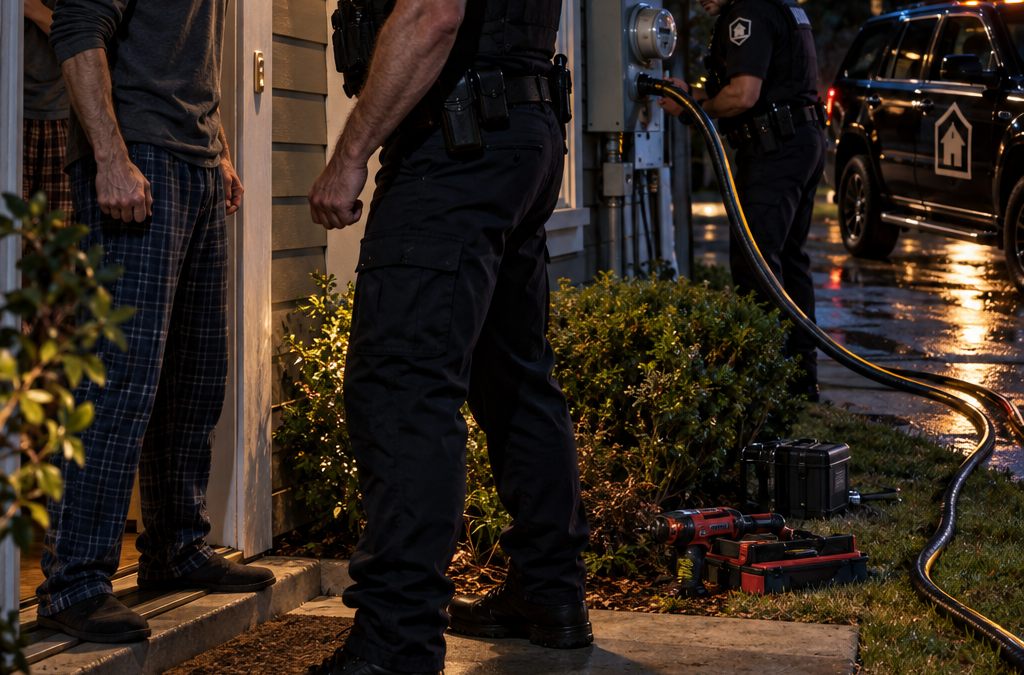
The dark uniforms.
The HOA patrol markings.
The men standing near the side of my house.
Equipment and cables near the electrical connection.
The images were clear enough that I could recognize the patrol personnel I had seen driving around the neighborhood.
I zoomed in.
Looked again.
Then looked at my son.
“That was smart, buddy.”
He seemed relieved.
“So they weren’t breaking into the house?”
“No.”
I paused.
“They were doing something they had no business doing.”
“Why?”
“That’s what I’m going to find out.”
He sat down on the couch.
I sat beside him.
For a few moments, neither of us spoke.
Then he asked, “Were they stealing our power?”
I looked at the photographs again.
“I think that’s exactly what they were doing.”
His eyes widened.
“Seriously?”
“Yeah.”
“But why would they do that?”
It was a fair question.
I didn’t have an answer.
I could imagine why somebody might illegally connect to another person’s electricity.
What I couldn’t understand was why men associated with a homeowners association would do it to a house outside their own community.
And why they would do it repeatedly.
Had they assumed nobody would notice?
Had they decided the house was an easy target?
Had they mistaken me for somebody who wouldn’t fight back?
I didn’t know.
My son watched me for a moment.
“Are you going to arrest them?”
I almost laughed.
Not because it was funny.
Because the question reminded me how simple justice sometimes looks from a child’s perspective.
Somebody does something wrong.
The police find out.
The police arrest them.
Real life isn’t always that straightforward.
“I’m going to handle it,” I told him.
“How?”
“The right way.”
That answer seemed to satisfy him.
It didn’t satisfy me.
Later that evening, after he had settled down, I stood outside near the electrical equipment and looked at the area where the men had been working.
I didn’t touch anything.
The photographs were evidence of what my son had observed, and I didn’t want to interfere with something that might need further examination.
I thought about the electricians.
The money I had spent hiring them.
The calls to the utility company.
The time I had wasted questioning my own common sense.
Then I thought about my son whispering into the phone because strangers were outside his bedroom.
That was the part I couldn’t get past.
If the men had been stealing electricity, it was already unacceptable.
But they had also made my child feel unsafe in his own home.
And I couldn’t simply put a dollar amount on that.
I had a decision to make.
I could report everything immediately.
I knew how serious unauthorized access to electrical equipment could be, especially when it involved someone else’s property.
But I also didn’t like using my professional connections to handle personal disputes.
I worked in a different jurisdiction.
I didn’t want to call colleagues and ask them to take care of something just because I was one of their own.
More importantly, I wanted to be fair.
The photographs showed the patrol personnel at my house, and they provided a strong reason to investigate the electricity theft.
But I still didn’t know whether the association itself was aware of what those men had been doing.
Maybe these were rogue employees.
Maybe somebody had given them instructions without understanding what was happening.
Maybe management would be horrified when they learned about it.
So I decided to contact the HOA first.
That evening, I sat at my computer and wrote an email.
I kept it professional.
I explained that I lived outside the association’s jurisdiction, that I had discovered HOA patrol personnel working near my electrical equipment without permission, and that I had reason to believe they were responsible for the unexplained increases in my electricity usage.
I stated that I had photographic evidence.
I also made something clear.
I wasn’t interested in creating a public confrontation.
I wanted the situation investigated and resolved.
I expected the association to take appropriate action against whoever was responsible.
And I wanted reimbursement for the electricity that had been stolen.
Before sending the message, I read it several times.
I removed anything that sounded too emotional.
No accusations about the board’s character.
No angry threats.
No mention of my occupation.
Just the facts and a request to resolve the problem.
Then I clicked Send.
I remember sitting back in my chair and feeling a small sense of relief.
For the first time in months, I had an explanation for what had been happening.
Surely, once the HOA understood the situation, somebody would apologize.
Maybe the patrol employees would be fired.
Maybe the association would offer to cover the excess electricity charges.
I wasn’t expecting flowers or a handwritten thank-you note.
I just wanted accountability.
I had dealt with unreasonable people before.
But I was not prepared for how unreasonable these people were about to become.
A short time after I sent the email, somebody knocked on my front door.
It wasn’t a polite knock.
It was the kind of pounding that made it sound as though the person outside expected immediate obedience.
I looked through the window.
Two HOA patrol men stood on my porch.
The same dark uniforms.
The same exaggerated posture.
For a moment, I thought they had come to apologize.
I opened the door.
“Can I help you?”
One of them looked at me without smiling.
“We’re here about some fines you’ve accumulated.”
I stared at him.
I genuinely thought I’d misheard.
“Some what?”
“Fines.”
I leaned against the doorframe.
“That’s a strange way to say you’re sorry.”
He ignored the comment.
The second man held out a sheet of paper.
“We have a list here. You can pay by check or cash.”
I took the paper and looked at it.
There were several alleged violations listed.
Things involving the appearance of my lawn and property.
Typical HOA complaints.
Except there was one rather important problem.
My house wasn’t in the HOA.
I looked up.
“You’re joking.”
Neither man laughed.
“These need to be paid.”
I studied their faces.
They weren’t embarrassed.
They weren’t confused.
They looked completely certain that they had the right to stand on my porch and demand money.
I held up the paper.
“I don’t belong to your homeowners association.”
The first man shrugged.
“These are the fines.”
“They’re not legitimate fines.”
“That’s not for you to decide.”
I felt my patience begin to thin.
“Actually, when somebody tries to collect money from me for rules that don’t apply to my property, I have quite a lot to say about it.”
He crossed his arms.
“Are you refusing to pay?”
“Yes.”
The answer seemed to surprise him.
I continued.
“I’m not paying you a dime. And while we’re discussing things that don’t belong to you, I’d still like an explanation for what your people were doing with my electricity.”
His expression tightened.
The second man glanced toward him.
Neither offered an explanation.
Instead, the first one said, “We’ll see about that.”
Then they turned and walked away.
I watched them go.
A few seconds later, their vehicle pulled away from the curb.
I closed the door and stood in the hallway.
There was a moment when I genuinely couldn’t decide whether to laugh or get angry.
I had contacted the HOA about suspected electricity theft.
And instead of investigating, their patrol personnel had arrived at my house with a demand for money.
It was so absurd that it almost felt scripted.
But I had seen enough situations in my career to understand a dangerous pattern when it appeared.
Somebody had been challenged.
Instead of addressing the complaint, that person had decided to intimidate the complainant.
The fabricated fines were likely meant to turn the situation around.
Make me defensive.
Make me pay.
Make me regret asking questions.
I knew the strategy.
I also knew it sometimes worked.
People get frightened by official-looking paperwork.
They worry about liens, lawsuits, court appearances, and legal expenses.
Sometimes paying a questionable fine seems easier than fighting it.
That was what worried me.
Not the possibility that I would pay.
I knew I had no obligation to satisfy their demands.
What worried me was how comfortable those men seemed doing it.
Their behavior suggested this wasn’t the first time they’d approached somebody that way.
And I wondered how many people had simply handed over money because they didn’t know what else to do.
I saved the violation notice.
I kept the email.
I backed up my son’s photographs.
Then life moved forward.
My son’s baseball team continued its run toward the state finals.
Work became especially demanding.
There were long shifts, paperwork, and the usual emergencies that filled my days.
I had intended to follow up with the HOA quickly, but other responsibilities pushed the issue into the background.
That doesn’t mean I forgot.
I still watched the street more carefully.
I checked the side of the house when I came home.
And whenever I saw one of the HOA patrol vehicles, I paid attention.
But weeks passed without another confrontation.
Part of me hoped the situation had ended.
Maybe somebody in management had finally realized the patrol men had gone too far.
Maybe the ridiculous fines would simply disappear.
Maybe the electricity theft had stopped.
I wanted to believe that.
Mostly because I was tired.
I was tired of thinking about people who had no business being part of my life.
Tired of wondering whether somebody was entering my property when I wasn’t home.
Tired of spending mental energy on an organization I had never agreed to join.
Then, one afternoon, the men returned.
This time, there were three of them.
I saw them through the front window before they knocked.
Two wore their usual patrol uniforms.
The third wasn’t wearing one.
He had on a sleeveless shirt that showed off his arms, and he stood slightly behind the others with the expression of somebody who had been brought along to look intimidating.
I looked at the three men for a moment.
Then I opened the door.
“Afternoon.”
The first patrolman didn’t return the greeting.
“We didn’t get your payment.”
I nodded slowly.
“That would be because I didn’t send it.”
He frowned.
“Your fines are still outstanding.”
“They were never valid to begin with.”
“We already explained this to you.”
“And I already explained that I don’t live in your HOA.”
The man in the sleeveless shirt shifted his weight.
The second patrolman stepped closer.
I stayed where I was.
There was no reason for me to retreat, and there was no reason to escalate the situation.
But I was becoming increasingly curious about how far they intended to take this.
The first man pointed at me.
“You need to learn some respect.”
I looked at him.
“Respect?”
“Yeah. Respect.”
He touched the front of his uniform.
“Look at this.”
I glanced down.
Dark fabric.
Patch.
Insignia.
The usual costume.
“Okay,” I said.
“Do you know what this uniform means?”
I paused.
Then, against my better judgment, I answered with the first thing that came to mind.
“Everything else was in the laundry?”
The man stared at me.
The second patrolman looked offended.
The third man’s jaw tightened.
I know sarcasm isn’t always helpful.
Sometimes I use it when I should keep my mouth shut.
But there was something deeply ridiculous about a man standing on my porch, pointing at an HOA patrol patch, and demanding that I recognize his authority.
The humor disappeared when he stepped closer.
“This means I’m in charge around here.”
I stopped smiling.
He continued.
“This means I’m the law.”
For a moment, I simply looked at him.
I had heard plenty of foolish things during my career.
People pretending they understood laws they had never read.
People inventing legal authority because they wanted somebody else to obey them.
People confusing a position of minor responsibility with unlimited power.
But there was something particularly unsettling about hearing a private neighborhood patrolman declare himself the law.
On my property.
Outside his association’s boundaries.
While demanding payment for fines that had no legal basis.
And after his patrol had been photographed interfering with my electricity.
I kept my voice even.
“You’re the law?”
He nodded.
“That’s right.”
I looked at the other two.
Neither corrected him.
Neither seemed uncomfortable.
That told me something.
He wasn’t making a joke.
And his companions weren’t treating it like one.
He leaned forward.
“If you don’t obey the law, bad things can happen.”
I let the silence hang for a moment.
“What kind of bad things?”
“You don’t want the law against you.”
It was an obvious threat.
Vague enough that he might later try to deny what he meant.
Clear enough that he expected me to understand.
I felt a familiar change inside myself.
The irritation was still there, but it moved aside.
What replaced it was the focused calm I had learned to rely on at work.
I began noticing details.
Where each man stood.
How they reacted to one another.
Who was speaking.
Who appeared to be following.
Whether anyone was reaching toward a pocket or moving closer to the doorway.
Not because I intended to fight them.
Because I understood that an intimidating conversation could become something else very quickly.
And now I had a more serious concern.
These men weren’t merely being obnoxious.
They were using the appearance of law enforcement to threaten somebody into handing over money.
That was far beyond a disagreement about lawn maintenance.
I thought about my son.
About how frightened he had sounded on the phone.
About what might happen if these men appeared while he was home alone again.
And about other residents who might not recognize the difference between a legitimate officer and someone pretending to possess police authority.
I could imagine an elderly homeowner standing exactly where I stood, listening to the same threats and wondering whether refusing to pay would result in an arrest.
I could imagine somebody reaching for a checkbook simply to make the men leave.
The first patrolman was still watching me.
“Well?”
I looked at him.
“All right.”
His expression changed.
He seemed pleased.
“Finally.”
I nodded toward the inside of the house.
“Let me get my wallet.”
All three men relaxed.
I saw it happen almost immediately.
Their shoulders loosened.
The tension in their faces gave way to smug satisfaction.
They thought the intimidation had worked.
They thought they’d won.
The man in the sleeveless shirt actually smiled.
For a brief moment, I almost felt sorry for them.
Almost.
I reached into my pocket.
The first man extended his hand slightly, as though expecting cash.
Instead, I pulled out my badge.
I held it where all three could see it.
Nobody spoke.
The smiles disappeared so quickly it was almost impressive.
I watched the first man’s eyes move from the badge to my face.
Then back to the badge.
His mouth opened.
Nothing came out.
I kept my voice calm.
“You were saying something about respect for the law.”
He stared at me.
“And something about bad things happening if I don’t obey.”
The second patrolman shifted backward.
I continued.
“Could you explain exactly what you meant by that?”
The first man swallowed.
“I… uh…”
“And while we’re discussing the law,” I said, “I’d be interested in hearing your explanation for why your patrol was photographed connecting equipment to my electrical supply without permission.”
The man in the sleeveless shirt stopped smiling.
The second patrolman looked as if he’d suddenly remembered an urgent appointment somewhere else.
I didn’t raise my voice.
I didn’t threaten to arrest anyone.
I didn’t need to.
The badge had changed their understanding of the situation completely.
A moment earlier, they’d believed they were intimidating an ordinary homeowner who could be pressured into paying.
Now they were standing in front of someone who actually understood the authority they had been pretending to possess.
And they knew it.
I looked directly at the first man.
“I think the local police department would be very interested in hearing about unauthorized access to my electricity and the threats you just made.”
He began speaking, then stopped.
The second man muttered something that sounded vaguely like an apology.
I waited.
Nobody offered a coherent explanation.
Nobody showed me legitimate paperwork.
Nobody tried to defend the fines.
The confident men who had arrived demanding money were suddenly unable to finish a sentence.
The first patrolman backed away.
“We didn’t know…”
He stopped.
I raised an eyebrow.
“Didn’t know what?”
He didn’t answer.
His companions were already moving toward the driveway.
Within moments, all three men were retreating from my porch.
One of them said something about a misunderstanding.
Another apologized again.
Then they hurried to their vehicle.
I watched them leave.
There was no dramatic confrontation.
No shouting.
No physical struggle.
Just three men who had arrived pretending to be powerful and departed looking as though the ground had disappeared beneath their feet.
I closed the door.
For several seconds, I stood there with my badge still in my hand.
Then I put it away.
I would be lying if I said there wasn’t a small part of me that found the whole thing satisfying.
Their expressions had been extraordinary.
But the satisfaction didn’t last long.
Because I couldn’t stop thinking about what would have happened if I hadn’t been a police officer.
What if I’d been somebody who didn’t understand the boundaries of HOA authority?
What if I had believed their threats?
What if I’d handed them cash?
Worse, what if I had argued with them, and the man in the sleeveless shirt had decided to turn the confrontation physical?
My occupation had given me knowledge and confidence that other homeowners might not have.
That didn’t make me better than them.
It made the patrolmen’s behavior even more disturbing.
I thought about the difference between how those men had behaved before seeing my badge and how they had behaved afterward.
They hadn’t suddenly realized their actions were wrong.
They had realized they might face consequences.
That distinction stayed with me.
I knew I couldn’t leave things there.
At the same time, I didn’t want to turn the situation into a personal crusade.
I wasn’t interested in headlines.
I didn’t need to humiliate anyone publicly.
And I didn’t want to spend the next year dealing with attorneys over a dispute that should never have happened.
What I wanted was simple.
The electricity theft needed to stop.
The false fines needed to disappear.
The patrol personnel needed to be held accountable.
And whoever had encouraged them to behave this way needed to lose the ability to do it again.
The next step was to contact the HOA management company directly.
This time, I wasn’t going to rely on an unanswered email.
I made the call.
When someone answered, I introduced myself.
I explained that I was a police officer, but that I was calling as a homeowner concerning conduct affecting my private property.
I made sure the distinction was clear.
I wasn’t conducting an official investigation.
I was reporting what had happened to me.
The representative listened.
I told her about the electric bills.
About the electricians.
About my son’s photographs.
About the first visit from the patrolmen, when they tried to collect fines despite my house being outside the HOA.
And then I described the second visit.
Three men.
A demand for payment.
A uniformed patrolman claiming to be the law.
Threats about bad things happening if I refused to cooperate.
There was a long silence on the line.
Then the representative asked me to confirm my address.
I gave it to her.
I heard typing.
Another pause.
“Sir, your address isn’t within the association.”
“I know.”
“You shouldn’t have received HOA violation notices.”
“I know that, too.”
She sounded uncomfortable.
I didn’t enjoy that.
I didn’t want somebody in an office feeling personally responsible for decisions she might have had nothing to do with.
But I needed the company to understand how serious the situation had become.
She assured me the fines were not valid.
She told me I should not pay anything.
I asked for that confirmation in writing.
She agreed.
Then she requested copies of my electricity bills.
I explained the three months of unusually high charges and told her I had already spent money on professional inspections trying to identify the cause.
She listened carefully.
I could hear the concern in her voice growing as the conversation continued.
At one point, she apologized.
It was the first apology I’d received from anyone connected to the association.
I appreciated it.
But I told her an apology wasn’t enough.
The company needed to investigate.
Not just the theft from my home.
The patrol’s use of intimidation.
The apparent fabrication of fines.
And the possibility that other people had been treated the same way.
She assured me the matter would be reviewed.
Before ending the call, I asked one more question.
“Who supervises these patrol employees?”
There was a hesitation.
She explained that a board member had been overseeing the patrol operation and the violation process.
I didn’t know that board member.
I didn’t know what instructions she’d given.
But for the first time, I had a reason to believe the problem might extend beyond three men who had decided to act important.
I thanked the representative and ended the call.
Then I gathered everything.
Copies of the bills.
The photographs my son had taken.
The violation notice.
My earlier email.
A written account of both visits.
I organized the material carefully and sent it to the management company.
There was something almost therapeutic about putting the evidence in order.
For months, I’d been living with a problem I couldn’t explain.
Now I had a timeline.
I had names and descriptions.
I had documents.
And I had people who were finally taking the complaint seriously.
But I still had questions.
I wondered whether the patrolmen had been stealing from other properties.
I wondered whether they’d been instructed to target me after the first complaint.
And I wondered how many people had received threatening visits and simply remained silent.
I didn’t have answers.
All I could do was wait for the association to investigate.
In the meantime, life continued.
My son still had baseball practices.
I still went to work.
There were groceries to buy, laundry to fold, and ordinary responsibilities that didn’t disappear just because something upsetting had happened.
But I noticed changes in myself.
I became more aware of vehicles slowing near the house.
I looked at the side yard more often.
I checked the windows before bed.
I didn’t tell my son everything about the threats.
He knew the patrolmen had come back.
He knew I had confronted them.
But I didn’t want him carrying fears that belonged to adults.
One evening, while we were cleaning up after dinner, he asked whether the men would return.
I turned toward him.
“I don’t think so.”
He looked down at the dish in his hands.
“Are you sure?”
I wanted to say yes.
I wanted to promise that nobody wearing those uniforms would ever come near our house again.
But I had spent too many years seeing promises broken to make one I couldn’t guarantee.
“I’ve reported what happened to the people responsible for supervising them,” I said. “And I’ve made it clear they’re not allowed to interfere with our property.”
He thought about that.
“Did they know you were a cop?”
“Not at first.”
“What happened when they found out?”
I smiled a little.
“They got a lot quieter.”
He laughed.
It was a small laugh, but it mattered to me.
He had been genuinely scared the day he saw those men outside his bedroom.
I didn’t want that memory to turn our home into a place where he felt he always needed to look over his shoulder.
I put a hand on his shoulder.
“You did exactly the right thing that day.”
He looked up.
“Taking pictures?”
“Staying inside. Calling me. Not confronting them. All of it.”
He shrugged.
“I was pretty scared.”
“I know.”
For a moment, I considered saying that he shouldn’t have been scared.
But that wouldn’t have been true.
He had every reason to feel frightened.
There were strangers with tools outside his home, interfering with equipment they had no permission to touch.
Fear was a normal response.
What mattered was how he’d handled it.
“You can be scared and still make good decisions,” I told him.
He nodded.
Then he asked whether we could watch the baseball highlights.
Just like that, the conversation moved on.
I was grateful.
He deserved ordinary evenings.
He deserved to worry about baseball games and homework instead of adults who couldn’t distinguish a neighborhood patrol position from police authority.
The management company didn’t resolve everything overnight.
I hadn’t expected it to.
Investigations take time, especially when they involve employees, a board member, financial issues, and potential misconduct.
Weeks passed.
Then more weeks.
I received occasional communications confirming that the matter was being reviewed.
I kept every message.
During that period, I did not receive another visit demanding money.
The patrolmen who had previously seemed so comfortable knocking on my door were suddenly nowhere to be found.
Whenever I drove near the HOA entrance, I noticed the patrol presence seemed less prominent.
Eventually, I began seeing different faces.
I didn’t know whether the original employees had been suspended, dismissed, or simply reassigned.
But something was changing.
A couple of months after my complaint, I finally learned more about what had been happening behind the scenes.
The information explained a great deal.
The HOA had placed one board member in a position of oversight involving patrol activities and violation enforcement.
Over time, she had allowed that responsibility to become something far more aggressive.
She had encouraged the patrolmen to believe they possessed broad authority.
She had supported the use of fines and intimidation to pressure residents.
Instead of acting as a limited neighborhood watch or security presence, the patrol operation had become a tool for enforcing compliance through fear.
That was how the situation had developed.
The board member had treated the patrol as though it were her own private enforcement squad.
And the men working under that arrangement had apparently been only too willing to enjoy the power they believed they’d been given.
I thought back to the patrolman standing on my porch.
“This means I’m the law.”
At the time, the statement had sounded like the absurd boasting of an insecure man.
Now it sounded like the natural result of a system that had repeatedly told him he could act that way.
The board member had given them permission to feel powerful.
The uniforms had helped them look powerful.
And residents who didn’t know their rights may have helped convince them they actually were powerful.
Until they came to the wrong house.
That was the part that bothered me most.
Not that they had encountered a police officer.
But that they had treated me entirely differently once they discovered my profession.
Before seeing my badge, I had been someone they believed they could threaten.
Afterward, I became someone they feared.
A person’s right to be safe in their own home shouldn’t depend on what they do for a living.
It shouldn’t depend on whether they understand legal procedures.
And it certainly shouldn’t depend on whether they carry a badge.
I had chosen my house partly because I wanted distance from the kind of arguments and conflicts that filled my working days.
Yet the very people who claimed to protect the neighborhood had brought intimidation to my doorstep.
I kept thinking about the association’s ordinary residents.
Most of them probably just wanted what I wanted.
A peaceful place to live.
Safe streets.
A clean neighborhood.
Neighbors who treated one another with basic consideration.
They paid dues expecting services that would improve their community.
Instead, some of that money had helped fund people who behaved as though they had authority over everyone around them.
And that included people who weren’t even members of the association.
Eventually, I learned that the board had held several meetings concerning the patrol operation and the board member responsible for supervising it.
The details of those meetings weren’t all shared with me, and I wasn’t going to pretend I knew every discussion that took place.
But the outcome was clear.
The board member was removed from her position.
The woman who had apparently encouraged the aggressive enforcement system no longer had the authority to direct it.
When I heard that, I felt something I hadn’t expected.
Relief.
Not excitement.
Not triumph.
Relief.
I had wondered whether the association would simply protect its own people and dismiss my complaint as an inconvenience.
Instead, its leadership had finally recognized that something had gone badly wrong.
Removing one person couldn’t erase everything that had happened.
But it was an acknowledgment that the problem was real.
And sometimes, after months of being treated as though you’re the unreasonable one, that acknowledgment matters more than people realize.
The patrolmen were gone even sooner.
I never received a detailed explanation of every personnel decision.
I didn’t need one.
The men who had been demanding cash at my door were no longer patrolling the neighborhood.
The uniforms disappeared.
The exaggerated attempts to look like police officers stopped.
Eventually, the association brought in new personnel.
The difference was obvious.
The replacements did not wear clothing that could easily be mistaken for law enforcement uniforms.
As far as I could tell, they had simple neighborhood watch identification.
They weren’t wandering around pretending to be police officers.
They weren’t coming to my house with violation notices.
They seemed to have a much narrower purpose: helping the neighborhood remain safe.
I don’t believe they were even authorized to issue fines.
That was exactly how it should have been.
A neighborhood watch program can serve a useful purpose when it understands its limits.
People can keep an eye out for suspicious activity.
They can report genuine concerns.
They can help residents feel more secure.
But the moment such a program starts treating ordinary homeowners as subjects who must obey orders, something has gone terribly wrong.
A patch does not grant police powers.
A uniform does not turn intimidation into law.
And a homeowners association cannot extend its private rules over somebody else’s property simply because it finds doing so convenient.
I had understood those distinctions all along.
What surprised me was how long it had taken the association to enforce them.
Then one afternoon, another envelope arrived in my mailbox.
It was from the HOA.
For a second, I felt the old irritation return.
I wondered whether somebody had made another mistake.
Maybe another fine.
Another demand.
Another official-looking letter written by people who still hadn’t understood that my property was outside their authority.
I carried the envelope into the kitchen and opened it.
Inside was a letter.
And a check.
I read the letter first.
It was a formal apology.
The association acknowledged what had happened and expressed regret for the conduct of its patrol personnel.
The letter addressed the situation with my electricity and the improper fines.
The check was compensation for the electricity that had been taken from my property.
I sat down at the kitchen table.
For a moment, I simply looked at the papers.
I thought about the first electricity bill.
How confused I’d been.
How much time I’d spent trying to find a fault in my house.
How foolish I’d felt when two electricians couldn’t identify anything wrong.
I thought about my son calling from his bedroom.
The fear in his voice.
The way he’d whispered because he didn’t want the men outside to hear him.
I thought about the patrolmen standing on my porch, telling me that bad things could happen if I refused to pay them.
And then I thought about how suddenly all their confidence had disappeared when I showed them my badge.
I didn’t know whether the apology came from genuine remorse or from a desire to avoid a lawsuit.
Maybe it was a little of both.
Organizations often become very apologetic when they realize their mistakes could become expensive.
But I didn’t need to know what was in the minds of every board member.
The result mattered.
The invalid fines were gone.
The patrolmen were gone.
The board member who had encouraged the intimidation was gone.
The association had changed how its neighborhood watch operated.
And I had been reimbursed for the electricity.
I had gotten what I’d originally asked for.
Accountability.
There were people who probably would have wanted more.
They might have argued that I should have sued the association.
They might have wanted criminal charges against everyone involved.
And I understood why.
The theft was serious.
The threats were serious.
The misuse of apparent authority was serious.
I wasn’t excusing any of it.
But I had to decide what outcome I wanted for myself and my family.
I didn’t want my son spending the next several years watching me fight a prolonged legal battle over our home.
I didn’t want every evening to become a discussion about attorneys, hearings, and evidence.
I wanted our house to be peaceful again.
And by the time the apology and check arrived, the most important changes had already happened.
The people responsible had lost the positions that allowed them to behave that way.
The association had acknowledged the wrongdoing.
The financial loss had been addressed.
I chose not to pursue a lawsuit.
That decision wasn’t about fear.
It wasn’t about accepting the patrolmen’s behavior.
It was about understanding that sometimes the most satisfying outcome isn’t the most dramatic one.
Sometimes it’s simply making sure a problem has stopped and the people responsible can no longer continue hurting others in the same way.
I placed the letter and check on the table and called my son into the kitchen.
He came in carrying his phone.
“What’s up?”
I held up the envelope.
“Remember those guys who were messing with our electricity?”
He gave me a look.
“Obviously.”
“Well, the homeowners association sent us an apology.”
He frowned.
“Really?”
“Really.”
I showed him the check.
“And they’re paying us back.”
His expression changed.
“Wait. They actually were stealing our electricity?”
“Yes.”
He stared at me.
“That’s crazy.”
I nodded.
“It is.”
He looked at the check again.
“Does that mean they’re not coming back?”
“The men who came here aren’t working patrol anymore.”
He seemed to absorb that.
Then he asked something that caught me off guard.
“Did I help catch them?”
I looked at him.
For a moment, I remembered his voice on the phone.
How carefully he had listened.
How he’d followed my instructions even though he was scared.
How he’d taken photographs from a safe place instead of confronting men who were bigger and older than he was.
“Yeah, buddy,” I said. “You did.”
He smiled.
Not a huge smile.
Just the quiet, proud expression of a fourteen-year-old who had discovered he’d done something important.
I felt a tightness in my throat that had nothing to do with electricity bills.
My son hadn’t asked to become involved in any of this.
He’d been doing exactly what a kid should have been doing on a quiet weekend afternoon.
Staying home.
Relaxing.
Enjoying his free time.
Then strangers had shown up outside his bedroom window and turned an ordinary day into something frightening.
Yet he’d handled himself better than many adults might have.
I was proud of him.
More than that, I was grateful.
Without his call and photographs, I might have continued paying those enormous bills.
I might have hired another electrician.
I might have spent months looking for a mechanical problem that didn’t exist.
The people stealing from me might have continued believing their uniforms protected them from scrutiny.
My son had changed that.
I think that realization mattered to him.
He looked at the check once more.
“Can we order pizza?”
I laughed.
“That’s what you’re thinking about?”
“Well, we got the money back.”
“Most of that money already went toward the electric bills.”
He shrugged.
“Still seems like a pizza situation.”
I smiled.
“You know what? I think you’re right.”
So we ordered pizza.
We sat in the living room with the television on.
He talked about baseball.
I complained about something that had happened at work without giving him details he didn’t need.
For the first time in a long while, I didn’t think about the side of the house.
I didn’t wonder whether strangers might be working near the electrical equipment.
I didn’t feel the urge to check the street every time a vehicle slowed down.
It was just an ordinary evening with my son.
And that ordinary feeling was worth more than the check.
Over the following weeks, I noticed how much the atmosphere around the neighborhood had changed.
The old HOA patrol vehicles no longer moved through the area with that exaggerated air of authority.
The men I saw now looked like what they were supposed to be.
Neighborhood watch personnel.
Not police officers.
Not private enforcers.
Just people performing a limited safety role.
I occasionally wondered what had happened to the three men who had stood on my porch.
Did they still believe they’d done nothing wrong?
Did they blame the board member who had encouraged them?
Did they tell their friends some exaggerated story about an unreasonable homeowner who had ruined their jobs?
I didn’t know.
And eventually, I stopped caring.
I had enough experience with human behavior to understand that not everybody learns the lesson you hope they will learn.
Some people recognize their mistakes.
Others simply resent the consequences.
What mattered was that those men were no longer in a position to intimidate residents on behalf of that association.
I also wondered about the board member.
I tried to imagine the thought process that had led her to treat a homeowners association patrol as a private police force.
Maybe she had started with a genuine belief that the neighborhood needed stricter enforcement.
Maybe residents had complained about violations and she wanted to prove she could solve the problem.
Maybe she simply enjoyed having people follow her instructions.
I wasn’t interested in diagnosing her personality.
But I had seen variations of the same behavior throughout my career.
Give somebody a small amount of authority.
Fail to establish boundaries.
Reward aggressive behavior.
Ignore complaints.
And eventually, that person may start confusing control with leadership.
The problem rarely begins with someone openly declaring that they intend to abuse power.
It begins with small decisions.
A warning that becomes a threat.
A fine that becomes punishment.
A patrol that becomes intimidation.
A person who believes being in charge means nobody is allowed to question them.
When people stop challenging those decisions, the behavior can become normal.
Until somebody finally says no.
I had said no.
But I knew that I had been able to do so from a position of unusual security.
I understood the law.
I knew the difference between a legal order and an empty threat.
I had been trained to stay calm when people attempted to intimidate me.
And when the patrolmen became openly threatening, I had something in my pocket that immediately changed their behavior.
Most people don’t have that.
And they shouldn’t need it.
A retired couple shouldn’t have to understand the intricacies of property law to resist an unlawful fine.
A single parent shouldn’t have to wonder whether refusing an aggressive patrolman could put their family at risk.
A teenager shouldn’t have to watch strangers in uniforms interfere with his home’s electricity.
The responsibility belongs to the people exercising authority.
They are the ones who should know their boundaries.
They are the ones who should be held accountable when they cross them.
That was the larger issue hidden inside my ridiculous electric bills.
It wasn’t simply about money.
It was about what happens when people put on uniforms, claim power they don’t possess, and discover that frightening others can be easier than earning their respect.
For a while, those patrolmen had gotten away with it.
They had knocked on doors.
Issued questionable fines.
Made demands.
And, in my case, interfered with electrical equipment they had absolutely no right to touch.
They seemed to believe the appearance of authority was enough.
And maybe, for some residents, it had been.
Then they came to my house.
A modest home outside their jurisdiction.
Owned by a skinny guy with glasses who looked more like a computer technician than a police officer.
They didn’t know anything about me.
They didn’t know I spent my working days dealing with people who sometimes lied, threatened, or tried to manipulate their way out of consequences.
They didn’t know I’d been trained to recognize when somebody was attempting to establish control through intimidation.
They didn’t know I had a badge in my pocket.
And they certainly didn’t know my fourteen-year-old son had already photographed their colleagues tampering with the electricity.
They only saw an ordinary homeowner.
Somebody they believed could be frightened into paying.
That was their biggest mistake.
Not because I was a police officer.
Because they believed an ordinary homeowner deserved less respect than one.
I never forgot the moment their expressions changed.
One second, the patrolman was telling me he was the law.
The next, he couldn’t finish a sentence.
And that told me everything I needed to know about the authority he had been pretending to possess.
Real authority doesn’t disappear the moment somebody questions it.
Legitimate authority can explain itself.
It has rules.
Limits.
Responsibilities.
And consequences for misuse.
What those men had wasn’t authority.
It was intimidation dressed up to look official.
Months after the incident, I was sitting in my living room one evening when I heard my son laughing at something on his phone.
He was staying with me that week.
His baseball equipment was near the garage.
There were dishes in the sink.
The television was playing quietly in the background.
The house looked exactly like an ordinary home should.
I glanced toward the front window.
Outside, the street was peaceful.
No patrol vehicle.
No men in uniforms coming up the walkway.
No strangers pretending they had the power to control my property.
Just a few neighbors arriving home and the familiar glow of porch lights along the street.
I thought about how close I’d come to missing what had been happening.
If my son hadn’t been home that afternoon, I might never have seen those men.
If he hadn’t looked through the window, there might have been no photographs.
If I’d believed the first patrolmen’s threats, I might have paid fines I didn’t owe.
And if I hadn’t contacted the management company, the same people might still have been patrolling the neighborhood, frightening others into compliance.
A great deal had depended on one fourteen-year-old boy noticing something wrong and making a phone call.
I looked toward the hallway.
“Hey, buddy.”
He looked up.
“Yeah?”
“Thanks again for what you did that day.”
He gave me a puzzled expression.
“What day?”
“When you saw those guys outside.”
He shrugged.
“Dad, that was forever ago.”
I smiled.
“I know.”
He went back to his phone.
For him, the story was already becoming an old memory.
Something strange that had happened and eventually been resolved.
For me, it remained a reminder of how quickly an ordinary life can be disrupted by people who believe power gives them permission to do whatever they want.
I had spent years trying to keep my professional life separate from my personal one.
I still believed that was important.
I didn’t want my badge to define every interaction.
I didn’t want people treating me differently simply because of my occupation.
And I certainly didn’t want to use my position to win petty arguments.
To this day, that confrontation remains the only time I’ve felt compelled to reveal my badge to someone who was threatening me in my private life.
I hope it remains the last.
I didn’t become a police officer so I could have special rights at home.
I became one because I believed people deserved to feel safe.
That includes people who don’t have badges.
People who don’t know lawyers.
People who can’t afford to spend thousands of dollars challenging questionable fines.
People who are frightened when a uniformed stranger knocks on their door and tells them they have no choice.
I hope the changes at that HOA protected some of those people.
Maybe the residents who had been intimidated finally felt comfortable questioning improper demands.
Maybe the association learned to supervise its employees more carefully.
Maybe the new neighborhood watch personnel understood that their job was to protect the community, not dominate it.
I can’t know everything that happened afterward.
But I know what happened at my house.
The electricity theft stopped.
The fake fines disappeared.
The men who threatened me lost their patrol positions.
The board member responsible for encouraging the intimidation was removed.
The association apologized and paid me back.
And my son no longer had to worry about strange men working outside his bedroom window.
That was enough for me.
Sometimes, when I come home after a difficult shift, I still pause for a moment in the driveway before going inside.
I look at the front porch.
The lawn.
The windows.
The small, ordinary things I worked hard to provide for my family.
Then I think about how easily those things can be taken for granted.
Home isn’t supposed to be another place where you have to defend yourself.
It’s supposed to be where you finally feel safe enough to stop looking over your shoulder.
For three months, someone stole electricity from that home.
For one frightening afternoon, strangers made my son afraid inside it.
And for two confrontations, men with no legitimate authority tried to convince me that I had to surrender to their demands.
They failed.
Not because I shouted louder.
Not because I threatened them.
And not because a badge makes me more deserving of respect than anyone else.
They failed because their claims couldn’t survive the truth.
I never wanted a confrontation with the HOA.
I never wanted to expose anyone or become involved in neighborhood politics.
All I wanted was to pay my bills, raise my son, do my job, and enjoy the quiet life I’d worked to build.
In the end, that’s exactly what I got back.
And whenever I remember those three men standing on my porch, smiling because they thought I was about to hand them money, I remember how quickly those smiles disappeared when they realized what I was actually reaching for.
They had spent months pretending to be the law.
They just never imagined that the man whose electricity they were stealing understood the law far better than they did.
But the part of the story that matters most to me isn’t the moment I showed them my badge.
It’s the moment my son finally stopped being afraid.
Because the real victory wasn’t watching three bullies run away.
It was being able to close my front door, sit down beside my boy, and know that our home belonged to us again.