FULL ENDING The HOA Fined Me $1,000 for Chickens on Land They Didn’t Control—So I Turned My 15 Acres Into a Hog Farm
𝗣𝗔𝗥𝗧 𝟮
I read it twice.
Then a third time.
Sarah came into the kitchen.
“What?”
I handed her the paper.
She read it.
Then looked toward the window.
“The chickens?”
“Apparently.”
“They’re not in Briarwood.”
“I know.”
“The goats aren’t either.”
“I know.”
“The garden is across a public road.”
“I’m aware.”
She handed it back.
“Throw it away.”
I should have.
Instead, I said:
“I want to know what they’re thinking.”
“That assumes thinking is involved.”
I called the management office.
After several transfers, I reached a property manager named Denise.
She pulled up my address.
“Yes, Mr. Parker. I see the livestock violation.”
“The livestock isn’t on my HOA property.”
“Livestock and agricultural uses are prohibited.”
“Inside the HOA.”
“Yes.”
“My animals are not inside the HOA.”
There was a pause.
“We’ve received complaints.”
“About what?”
“Agricultural activity visible from the community.”
“That isn’t what your rule says.”
“The board takes community standards seriously.”
“I take property boundaries seriously.”
Another pause.
“Mr. Parker, the violation has already been issued.”
“And it was issued incorrectly.”
“If you disagree, you may submit a written response.”
“Can you pull up the subdivision parcel map?”
“That isn’t necessary.”
“It is literally the entire issue.”
“The board has determined that your agricultural operation violates community standards.”
“My farm is on another deed.”
“You are the owner.”
“Yes.”
“And you are an HOA member.”
“For my house.”
“Then you’re subject to the governing documents.”
“On the property governed by them.”
Denise’s tone became sharp.
“If you fail to comply, the fines will continue.”
I actually laughed.
Not loudly.
More from disbelief.
“You’re telling me that because I own a house inside Briarwood, you believe the HOA controls another parcel I own outside Briarwood?”
“I am telling you the board has issued a violation.”
“That isn’t an answer.”
“Submit documentation if you dispute it.”
Then she ended the call.
Sarah looked at me.
“How’d that go?”
“They’re apparently going with the legal theory that owning one HOA house makes every piece of land I own subject to them.”
She frowned.
“What if you owned a cabin in another state?”
“Probably they’d tell me what color to paint it.”
I pulled out the property documents that evening.
The deed.
The survey.
County maps.
Tax records.
Everything.
I wrote a polite letter.
No sarcasm.
No threats.
I explained that all agricultural activity occurred on a separate fifteen-acre parcel outside Briarwood’s legal boundary.
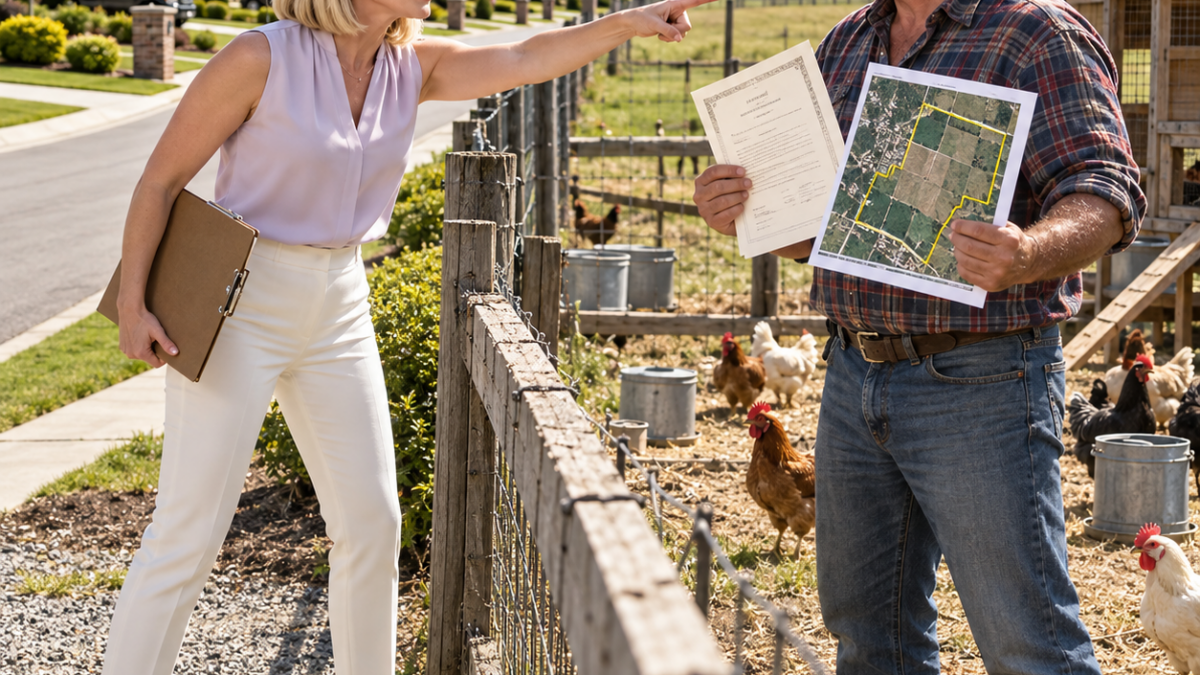
I attached a highlighted county parcel map.
Red line around the subdivision.
Blue line around my farm.
The county road in between.
I attached the deed.
Then I asked them to withdraw the violation.
I sent it certified mail and by email.
Problem solved.
At least that was what any rational person would have thought.
Two weeks later, the second notice arrived.
Fine: $500.
This one introduced a new theory.
The association claimed that properties “adjacent to or visible from” Briarwood could fall within the HOA’s enforcement interest if uses negatively affected community aesthetics or property values.
I stood in the kitchen reading that sentence several times.
Sarah looked over my shoulder.
“They made that up.”
“Seems like it.”
“Visible from?”
“Yes.”
“So if someone owns a barn half a mile away and I can see it, Karen gets to regulate it?”
“Apparently she has expanded jurisdiction.”
The letter threatened collections.
Attorney fees.
All available remedies.
And possible enforcement against my residential property.
That included the phrase that finally made the situation serious.
Lien.
They were threatening to put a lien on our home over fines generated by activity occurring on completely separate land.
Could they legally succeed?
I didn’t think so.
But that wasn’t the same as wanting to spend months cleaning up their stupidity.
I wrote again.
This time, I asked for the specific recorded covenant granting the HOA authority over adjacent non-HOA land.
I asked them to explain how my agricultural parcel had become subject to Briarwood restrictions without any recorded annexation.
I demanded they withdraw both fines.
No meaningful answer came.
Instead, Karen arrived.
Saturday morning.
I was washing my truck in the driveway when a white SUV stopped near the curb.
Three people got out.
Two board members.
And Karen Whitmore.
Karen was forty-one or forty-two.
Blonde.
Beautiful.
Very polished.
Very aware that people noticed her.
She had a dramatic hourglass figure and a particularly full chest that she emphasized with a fitted white military-style uniform she seemed to consider appropriate HOA attire.
Gold decorative buttons.
Structured shoulders.
Deep neckline.
Tight waist.
White heels.
It was an absurd outfit for walking up a residential driveway, but Karen wore it with the confidence of a decorated general arriving to inspect conquered territory.
She had sunglasses pushed into her hair.
Clipboard in one hand.
Phone in the other.
She didn’t introduce herself.
“We need to discuss your little farm project.”
I turned off the hose.
“Good morning.”
“I assume you’ve received our letters.”
“I have.”
“And yet the animals are still there.”
“Yes.”
Karen looked almost amused.
“So you’re refusing to comply?”
“I explained why the notice doesn’t apply.”
Her eyebrows rose.
“You think the land isn’t covered?”
“I don’t think. I know.”
She laughed.
Actually laughed.
“Do you think we’re stupid?”
I looked at the two board members.
One of them looked uncomfortable.
The other stared at me.
I said:
“I wasn’t going to phrase it that way.”
Karen’s smile disappeared.
“That land is right there.”
She pointed toward the back of the neighborhood.
“Everyone can see it.”
“Yes.”
“It affects us.”
“That doesn’t make it yours.”
“You’re part of Briarwood.”
“My house is.”
“You own the farm.”
“Yes.”
“Therefore your use of that land affects community standards.”
“That conclusion doesn’t follow.”
Karen stepped closer.
“The smell is unacceptable.”
I almost looked behind me for hidden cameras.
“What smell?”
“The livestock.”
“Eight hens and two goats?”
“You may be accustomed to it.”
“They barely smell ten feet away.”
One board member, Robert, stepped forward.
“Residents are complaining.”
“Which residents?”
“We’re not required to disclose that.”
“Convenient.”
Karen folded her arms.
“The complaints aren’t the issue. The issue is compliance.”
“With rules that don’t apply?”
“You keep saying that.”
“Because you’ve been given the deed.”
Karen waved her hand dismissively.
“We’ve reviewed your documents.”
“Good.”
“And?”
“And the board disagrees with your interpretation.”
I laughed.
“My interpretation of the property line?”
“Community standards aren’t limited by whatever technical boundary you’re hiding behind.”
That sentence told me everything I needed to know.
The boundary wasn’t unclear.
She simply didn’t respect it.
“Property lines are fairly technical by nature.”
Karen’s jaw tightened.
Robert said:
“We have property values to protect.”
“Then protect them on property you control.”
Karen moved even closer.
Her voice softened.
Almost flirtatious.
“Let’s not turn this into something ugly.”
I looked at her.
“I agree.”
“Good.”
“Withdraw the fines.”
Her smile vanished.
“No.”
“Then we’re already there.”
She took off her sunglasses.
“I’m trying to give you an opportunity.”
“To do what?”
“Remove the animals.”
“No.”
“Stop farming.”
“No.”
“Restore the land to open green space.”
There it was.
Something about the way she said green space caught my attention.
Not pasture.
Not unused land.
Green space.
I filed that away.
Karen continued.
“You could still use it recreationally.”
“Thank you for telling me how I can use my property.”
Her eyes narrowed.
“You’re being sarcastic.”
“Yes.”
“Let me be very clear.”
Her voice sharpened.
“You will remove those animals and cease agricultural activity.”
“No.”
“Or we will take legal action.”
“Go ahead.”
“We can send these assessments to collections.”
“Go ahead.”
“We can seek attorney fees.”
“Go ahead.”
Robert added:
“And put a lien on the house.”
Sarah had been watching from the front doorway.
I could feel her attention sharpen at that.
I looked at Robert.
“You’re threatening to lien my house because of chickens on a separate agricultural parcel?”
“If necessary.”
Karen smiled.
“Don’t test us.”
That was the sentence that changed the entire tone for me.
Until then, I had been trying to solve a bureaucratic mistake.
Now someone with no jurisdiction over my farm was standing in my driveway threatening my home.
I set down the hose.
“Karen.”
She raised her chin.
“You’ve received the deed.”
“Yes.”
“You’ve received the parcel map.”
“Yes.”
“You know the farmland isn’t in Briarwood.”
Her eyes held mine.
“I know it affects Briarwood.”
“That wasn’t what I asked.”
Silence.
“You know it’s outside the HOA.”
Karen smiled again.
“We’ll let our attorneys decide.”
“Great.”
I pointed toward the street.
“Now leave.”
Her eyebrows rose.
“Excuse me?”
“You heard me.”
“This conversation isn’t finished.”
“It is on my driveway.”
Robert muttered something.
Karen put her sunglasses back on.
“You’re going to regret being this difficult.”
“Maybe.”
I picked up the hose.
“But I’m still keeping the chickens.”
Karen stared at me another few seconds.
Then turned sharply.
The three of them walked back toward the SUV.
Sarah waited until they drove away.
Then she came over.
“They really threatened a lien.”
“Yes.”
“They’re serious.”
“So am I.”
“What are you going to do?”
I looked toward the back fence line.
“I don’t know yet.”
Then I smiled.
“But I’m definitely not getting rid of the chickens.”
For the rest of the day, something bothered me.
Not the threat itself.
The motivation.
Eight hens.
Two goats.
A vegetable garden.
That did not justify this level of obsession.
Why did Karen care so much?
Why did she use the phrase open green space?
Why was the board willing to invent authority it obviously did not have?
So I started digging.
Not metaphorically.
Records.
Old board minutes.
County filings.
Conversations with longtime residents.
One older neighbor, Tom, had lived in Briarwood almost since construction began.
When I asked whether the HOA had ever tried controlling the farmland before, he laughed.
“Oh.”
That wasn’t a promising sound.
“What?”
“They tried to buy it.”
“When?”
“Years ago.”
“Who?”
“The board.”
“Why?”
“They wanted a park.”
That explained a lot.
Tom told me the HOA had approached the previous owner roughly eight years earlier.
They wanted the fifteen acres for a community greenbelt.
Walking trails.
Maybe a playground.
Possibly a small sports area.
Something to advertise as preserved community open space.
They offered far below market value.
The owner refused.
The HOA increased the offer slightly.
Still refused.
According to Tom, negotiations became unpleasant.
The owner eventually told them he would never sell to Briarwood.
Apparently, several board members took that personally.
Karen wasn’t president yet.
But she was involved.
Committee member.
Future board candidate.
One of the loudest advocates for acquiring the parcel.
That was the real story.
The HOA had wanted my land before I ever owned it.
Couldn’t buy it.
Then I acquired both an HOA house and the separate parcel.
They apparently thought that gave them indirect leverage.
The chickens were just an excuse.
This wasn’t about smell.
It was about control.
I came home and told Sarah.
She stared at me.
“So they’ve wanted that land for years.”
“Yes.”
“And now they’re pretending they can regulate it because you live here.”
“Exactly.”
“That’s insane.”
“Yep.”
“What now?”
I smiled.
“Now I learn farming law.”
Sarah stared at me.
“Oh no.”
“What?”
“That smile.”
“What smile?”
“The one you get when somebody annoys you enough that you become organized.”
I spent the next several days learning more about agricultural regulation than I had ever expected to know.
The parcel was zoned agricultural.
Always had been.
I verified it with the county.
Then I read the state’s right-to-farm statutes.
The exact details were technical, but the practical point was clear.
Legitimate agricultural operations conducted lawfully on appropriately zoned property received strong protection from nuisance complaints.
Neighbors couldn’t simply decide ordinary farm sounds or odors were unacceptable because they preferred suburban aesthetics.
I called the county agricultural extension office.
Asked about permitted livestock.
Setbacks.
Waste requirements.
Water.
Structures.
Commercial operations.
Inspection.
Environmental compliance.
I wanted zero ambiguity.
Then I started considering what legal agricultural use made sense.
More goats?
Too cute.
Cattle?
Expensive infrastructure.
Sheep?
Not particularly offensive.
Poultry?
Could scale, but noise might become an issue and I genuinely didn’t want to create something annoying just for the sake of annoyance.
Then I remembered hogs.
I grew up in a rural area.
My uncle had raised pigs commercially for years.
A properly run hog operation could be productive, profitable, and completely lawful.
It could also produce one thing Briarwood’s carefully scented entrance landscaping could not hide.
Odor.
A lot of odor.
The more I thought about it, the more practical the idea became.
The land was suitable.
There was market demand for locally raised pork.
I didn’t want to quit my job and become a full-time farmer.
But I didn’t have to.
I called my uncle.
“Got a question.”
“Usually means trouble.”
“What would it take to run hogs on fifteen acres?”
Pause.
“How many hogs?”
“Maybe a hundred to start.”
Longer pause.
“You getting divorced?”
I laughed.
“No.”
“Then why do you suddenly want a hundred pigs?”
“HOA.”
He laughed for almost thirty seconds after I explained.
Then he got serious.
“Revenge aside, it can make money.”
“That’s the idea.”
“You can’t half-ass it.”
“I know.”
“Waste management matters.”
“I know.”
“Feed costs.”
“Yep.”
“Veterinary stuff.”
“Yep.”
“Fencing.”
“I’ve been researching.”
My uncle eventually connected me with a farmer named Bill Mason.
Bill had been raising hogs for more than twenty years.
He wanted to expand but didn’t want to purchase more land.
We met at the property.
Bill walked the acreage.
Looked at drainage.
Road access.
Elevation.
Water availability.
Then said:
“This could work.”
We structured a partnership.
The land stayed mine.
Bill handled most daily operations.
He brought expertise, equipment connections, livestock procurement, feed contracts, and market relationships.
After expenses, we split profits sixty-forty in his favor because he would be doing most of the actual farming.
Fair deal.
Before signing anything, I checked zoning again.
County.
Agricultural extension.
Attorney.
Insurance.
Every permit.
Every environmental requirement.
Every setback.
Everything.
I wanted the operation so clean legally that Karen could hire three attorneys and find nothing.
Sarah watched me spread paperwork across the dining table.
“You’re really doing this.”
“Yes.”
“One hundred pigs.”
“About one hundred twenty initially.”
Her eyes widened.
“One hundred twenty?”
“Bill wants room to grow toward two hundred.”
Sarah slowly sat down.
“You know this is insane.”
“Yes.”
“You’re enjoying this.”
“A little.”
“A lot.”
“Probably.”
She started laughing.
Then shook her head.
“They threatened a lien over eight chickens.”
“Exactly.”
“I can’t say they didn’t ask for it.”
Construction began quietly.
Proper pens.
Water systems.
Feed storage.
Waste-management setup.
Drainage.
Fencing.
Everything permitted.
Everything inspected.
People inside Briarwood noticed trucks coming and going.
Nobody knew exactly what was happening.
Karen sent one email asking what construction was occurring.
I replied:
Agricultural improvements on non-HOA property.
She demanded plans.
I replied:
The HOA has no authority to review them.
No further response.
Then the hogs arrived.
One hundred twenty.
The chickens looked confused.
The goats looked delighted that something finally existed noisier than they were.
Bill knew exactly what he was doing.
The animals were healthy.
Facilities clean by farm standards.
Feed managed properly.
Waste managed legally.
The operation was professional.
For the first several days, nothing dramatic happened.
Then nature took over.
Hogs eat.
Hogs drink.
Hogs produce waste.
And waste produces odor.
Not all the time.
Not everywhere.
But when the temperature rose and the wind moved east?
Briarwood learned the agricultural meaning of prevailing wind.
My property sat slightly west and a little higher than the development.
Most warm-weather wind moved west to east.
Farm to subdivision.
The first day I really noticed it, I was working with Bill near the feed area.
He sniffed the air.
“Wind shifted.”
I looked toward Briarwood.
“Oh.”
Bill smiled.
“Your neighbors are about to know we’re here.”
He was right.
The smell moved.
Not apocalyptic.
Not toxic.
Just unmistakably agricultural.
The kind of odor that tells anyone within range:
There are pigs nearby.
Two weeks later, I received another HOA letter.
Fine: $1,000.
The wording was almost emotional.
OFFENSIVE LIVESTOCK OPERATION.
NUISANCE ODORS.
NEGATIVE IMPACT ON PROPERTY VALUES.
DEMAND FOR IMMEDIATE CESSATION.
I laughed out loud.
Sarah took the paper.
“One thousand?”
“Apparently inflation hit imaginary jurisdiction.”
“Are you paying it?”
“No.”
“What are you going to write?”
I smiled.
“Something educational.”
My response was polite.
Painfully polite.
I explained that the livestock operation was located on properly zoned agricultural property.
That all required county permits had been obtained.
That the farm was operating in compliance with agricultural regulations.
That state right-to-farm protections applied.
That the HOA had no authority over the parcel.
And that their purported fine was disputed in full.
For convenience, I attached excerpts from the relevant agricultural statutes.
Then I mailed and emailed everything.
Three days later, Karen came back.
Alone this time.
No backup.
I was near the garage when her SUV stopped hard at the curb.
Karen climbed out wearing another white military-style outfit.
This one tighter than the last.
Gold buttons.
Deep neckline.
White heels.
But there was nothing seductive about her expression.
She was furious.
“What the hell do you think you’re doing?”
No greeting.
I folded my arms.
“Which thing?”
“You know exactly what I’m talking about.”
“The hogs?”
“Those disgusting animals!”
“Running a farm.”
“This is retaliation.”
“This is agriculture.”
“Do not play games with me.”
“I’m not.”
“You intentionally did this.”
“I intentionally started a legitimate agricultural business on agricultural land.”
Karen marched closer.
“You researched the most offensive possible use.”
“Did I?”
“You know what those animals smell like.”
“So do farmers.”
Her face turned red.
“You’re destroying property values.”
“That sounds like something you should have considered before threatening me over chickens.”
“You are punishing hundreds of innocent residents because you’re angry at the board.”
“No.”
I shook my head.
“I’m using my property.”
“Because of us.”
“You gave me motivation.”
“You smug little—”
She stopped herself.
I almost smiled.
Karen pointed toward the farm.
“Remove them.”
“No.”
“I am ordering you—”
“No.”
“This is not funny.”
“I agree.”
“We will bury you in legal fees.”
I stared at her.
“You should really talk to an attorney before saying things like that.”
“I have attorneys.”
“Then use them.”
Karen stepped closer.
“We can make your life hell.”
“You already tried.”
Her jaw tightened.
“It didn’t work.”
I continued.
“Your fines are meaningless outside the HOA. The farm is legal. The county approved it. The state protects agricultural use. There isn’t much left for you to threaten.”
“This is not over.”
“I think it is.”
She actually stomped her foot.
A grown woman.
Forty-something.
Standing in white heels on my driveway.
Stomped.
“You think you’re clever.”
“I think I own the farm.”
Karen turned sharply and walked away.
Before reaching her SUV, she spun back.
“You’re going to regret this.”
“I really don’t think I will.”
She slammed the door.
For about a month, I heard nothing directly.
The farm grew.
Bill added infrastructure.
We settled into a routine.
The business started generating money.
Not enormous amounts at first.
But real profit.
Then Karen caught me at the mailbox.
Her entire approach had changed.
No yelling.
No threats.
No clipboard.
She wore a cream blouse and fitted skirt instead of the white uniform.
Her hair was loose.
She smiled.
Charm mode.
“Can we talk?”
I almost laughed.
“Sure.”
She stepped closer.
“I think this situation has become unnecessarily adversarial.”
“Interesting.”
“I don’t want to relitigate the past.”
“Convenient.”
Karen ignored that.
“The board is willing to make an offer.”
“For?”
“The livestock operation.”
“What about it?”
“We understand you have certain rights.”
That was the first honest sentence I’d heard from her.
“And?”
“We would compensate you if you scaled it back.”
“To what?”
“Your original use.”
“Chickens and goats?”
“Yes.”
I crossed my arms.
“How much?”
Karen smiled.
“Five thousand dollars.”
I laughed.
Her smile faltered.
“What’s funny?”
“You fined me a thousand dollars for chickens.”
“That is unrelated.”
“And now you’re offering five thousand to go back to the chickens.”
“We’re trying to solve the problem.”
“The hog operation is profitable.”
“We understand.”
“No, I don’t think you do.”
“Then give me a number.”
“There isn’t one.”
Karen blinked.
“Everyone has a number.”
“Not for this.”
“You’d rather harm your own neighborhood?”
“My neighborhood is on this side of the road?”
“You live in Briarwood.”
“My house does.”
“You’re intentionally hurting your own property value too.”
I shrugged.
“We aren’t selling.”
Karen’s pleasant expression disappeared.
“This is spite.”
“No.”
I smiled.
“The farm makes money.”
“You started it because of us.”
“You inspired me.”
“That is spite.”
“The spite is a bonus.”
Karen stared at me.
For several seconds, I could almost see her running through options.
Threats hadn’t worked.
Fines hadn’t worked.
Lien threats hadn’t worked.
Legal intimidation hadn’t worked.
Five thousand dollars hadn’t worked.
Finally, she said:
“You will regret this.”
“You keep saying that.”
“One day you’ll need the board’s cooperation.”
“Maybe.”
“And we’ll remember.”
I nodded.
“So will I.”
She walked away.
That was our last real conversation.
The fallout inside Briarwood became more entertaining than anything I could have planned.
The neighborhood had always marketed itself as upscale suburban living.
Clean.
Quiet.
Exclusive.
High standards.
Then suddenly prospective buyers could stand in a perfectly staged backyard and, under the right weather conditions, catch the unmistakable scent of a commercial hog operation.
Homes closest to the rear boundary were hit hardest.
I heard about one showing where the buyer’s agent walked onto a patio, stopped, sniffed, and asked:
“What is that?”
The listing agent supposedly tried saying:
“Occasional agricultural activity.”
Technically true.
Not particularly persuasive.
Another resident told me his realtor started scheduling showings for early morning because the air was usually cooler and more stable.
A couple contracts fell through.
I can’t prove odor alone caused every one.
Real estate deals fail for many reasons.
But the farm became part of the conversation.
Homes sat longer.
Sellers became frustrated.
Then something predictable happened.
More people listed.
Some families already thinking about moving decided it was time.
More inventory hit the market while some buyers became cautious.
Prices didn’t collapse.
Nothing that dramatic.
But residents reported noticeable softness.
Especially near the back edge of Briarwood.
Estimates floated around.
Five percent.
Seven percent.
Maybe ten for the closest homes.
I didn’t track every sale.
I didn’t need to.
The HOA meetings told the story.
My friend Daniel lived three streets away.
He thought the entire situation was hilarious from the beginning.
He started attending meetings purely to report back.
One evening, he called me.
“You need to hear this.”
“What happened?”
“They spent forty minutes talking about your pigs.”
“Hogs.”
“Apparently that distinction was made during the meeting.”
I laughed.
“What did Karen say?”
“She looked like she wanted to kill someone.”
“Me?”
“Everyone.”
According to Daniel, residents demanded action.
One woman wanted the county called.
Karen had to admit the county had already approved the operation.
Another wanted an injunction.
The HOA attorney apparently explained they had no direct authority over my parcel.
Someone asked whether state nuisance law could shut it down.
The attorney brought up right-to-farm protections.
Then somebody asked the obvious question:
“Why don’t we just buy the land?”
Daniel paused dramatically.
“And?”
“That was beautiful.”
Karen had to explain that the HOA had attempted to buy the parcel years earlier.
Residents hadn’t known.
“How much did they offer?”
Daniel said people asked.
Karen refused to answer.
Then someone asked:
“Why didn’t we buy it when it was empty?”
Another person replied:
“Maybe because the board lowballed the owner.”
Apparently that started shouting.
Then a man near the back said:
“Well, maybe we shouldn’t have started a fight with someone who owns fifteen acres of farmland.”
Daniel laughed while recounting it.
“What happened after that?”
“Chaos.”
Residents accused the board of mismanagement.
People wanted to know why legal threats were sent against property outside HOA jurisdiction.
Some demanded to see attorney bills.
Others asked whether dues had been spent trying to enforce invalid fines.
Then came talk of recalling board members.
Karen reportedly tried regaining control by insisting she had been protecting property values.
Someone shouted:
“How’s that working?”
Daniel said even he felt bad for her for about three seconds.
Then he remembered why everyone was there.
The board’s power started cracking.
People requested records.
Minutes.
Legal invoices.
Correspondence involving my property.
Karen stopped looking invincible.
The funny part was that I didn’t have to do anything.
No petitions.
No campaign.
No angry letters to neighbors.
The pigs handled public relations.
Seven months into the operation, it had become a legitimate business I would have been foolish to shut down purely because the original motivation had included revenge.
Bill handled most daily work.
He was excellent.
Healthy animals.
Clean records.
Strong buyer relationships.
We expanded carefully.
Not recklessly.
Revenue increased.
After expenses and Bill’s sixty percent share, my forty percent produced a respectable monthly profit.
Not quit-my-job money.
But far more than the empty acreage had ever generated.
The land that once cost me taxes and mowing now paid for itself and then some.
One evening, Sarah and I sat on our patio.
Wind had shifted away from the neighborhood.
She asked:
“Do you actually like being a pig farmer?”
“Part-time pig landlord.”
She laughed.
“You know what I mean.”
I looked across the road.
“Actually, yes.”
“Would you have done this without Karen?”
“Probably not.”
“That might be the funniest part.”
“She accidentally turned the farm into a business.”
Sarah raised her drink.
“To Karen.”
I clinked mine against hers.
“To agricultural entrepreneurship.”
The HOA eventually stopped sending letters.
Completely.
No more fines.
No threats.
No certified envelopes.
Nothing.
My guess is their attorney finally sat everyone down and said something like:
Stop creating evidence against yourselves.
The $1,000 fine never went anywhere.
Neither did the earlier ones.
No collections.
No lien.
No lawsuit.
Silence.
Beautiful silence.
I still attended HOA meetings occasionally because I owned a house inside Briarwood and wanted to know what was happening.
Karen’s demeanor changed.
She no longer looked at me.
The first meeting I attended after the hog operation became fully established, she sat at the front in her white military-style uniform, gold buttons gleaming beneath fluorescent clubhouse lights.
Normally she commanded the room.
That night, residents kept interrupting her.
“Why did the board send fines outside its jurisdiction?”
“We believed—”
“You believed wrong.”
“What did legal counsel say before you sent the second letter?”
“I don’t recall.”
“Did the board vote?”
“That’s privileged.”
“It’s in the minutes.”
Karen’s face tightened.
People who had once been intimidated by her suddenly realized they could ask questions.
That may have been the real revenge.
The smell hurt.
The property-value anxiety hurt.
The embarrassment hurt.
But losing unquestioned authority hurt Karen most.
At one point an older homeowner named Frank stood.
“I’ve lived here twelve years.”
Karen tried interrupting.
“Frank—”
“No.”
That single word silenced her.
He continued.
“We pay this board to manage Briarwood, not land across county roads.”
Applause.
Karen looked furious.
Frank continued.
“If you had left that man alone, we’d have eight chickens and two goats.”
More applause.
“Instead, we have over a hundred pigs.”
Somebody shouted:
“Closer to two hundred now!”
Laughter erupted.
Even I laughed.
Karen didn’t.
Frank pointed toward the board.
“This isn’t his mistake. It’s yours.”
That meeting ended with a formal petition circulating for board recall.
Not every director was removed immediately.
HOA politics move slowly.
But Karen’s influence collapsed.
She eventually resigned the presidency before a full removal vote could take place.
The official announcement said she wanted to “focus on family and personal priorities.”
Nobody believed that was the reason.
A quieter president replaced her.
One of his first actions was sending me a letter.
For a second, I thought:
Here we go again.
Then I opened it.
It acknowledged that the prior agricultural fines were void and formally removed from my account.
One paragraph.
Professional.
No drama.
I framed it.
Sarah thought that was excessive.
I disagreed.
Karen still lived in Briarwood for a while.
That created occasional awkward moments.
I once saw her at the community mailbox pavilion.
She was alone.
No white uniform.
Jeans and a sweater.
She looked almost ordinary.
I considered ignoring her.
Then she spoke.
“Happy now?”
I stopped.
“About what?”
She stared toward me.
“You know what.”
“The farm?”
“The board.”
“I didn’t remove you.”
“You caused it.”
“No.”
“Don’t pretend.”
“You sent fines outside HOA jurisdiction.”
“We were protecting residents.”
“You threatened my house.”
“We were enforcing standards.”
“Standards on another parcel.”
Karen’s mouth tightened.
“You exploited a loophole.”
That made me laugh.
“Ownership isn’t a loophole.”
“You intentionally built the most offensive operation possible.”
“I built a lawful farm.”
“You did it to hurt people.”
“I did it after you threatened me over eight chickens.”
“So you admit it.”
“I’ve never hidden why I started looking into commercial agriculture.”
Karen shook her head.
“You affected families who never did anything to you.”
That part had always bothered me more than I liked admitting.
She wasn’t completely wrong.
Regular homeowners suffered consequences from a fight many of them didn’t know existed.
But responsibility wasn’t as simple as Karen wanted.
I said:
“You could have stopped.”
She scoffed.
“When?”
“After the first letter.”
Silence.
“After I gave you the deed.”
Nothing.
“After I gave you the parcel map.”
Nothing.
“After you learned the land wasn’t under the covenants.”
She crossed her arms.
“You escalated.”
“So did you.”
“You could have ignored us.”
“You threatened a lien.”
“We were never actually going to—”
She stopped.
I stared.
“You weren’t?”
Karen realized what she’d admitted.
“You threatened my house with something you knew you couldn’t enforce?”
“I didn’t say that.”
“You just did.”
“No. I said—”
“You wanted to scare me.”
Karen looked away.
That was the entire story.
Not enforcement.
Fear.
She expected me to surrender because challenging an HOA sounded expensive.
She believed threats would accomplish what ownership never had.
I continued.
“You weren’t trying to protect Briarwood. You wanted the farmland.”
“That land should have been community green space.”
There it was.
Finally.
“Should have?”
“The development would have benefited.”
“The owner refused to sell.”
“He was unreasonable.”
“So you thought you’d control it through me.”
Karen didn’t answer.
“You still think it belongs to Briarwood.”
“It should.”
“That’s your problem.”
She looked at me.
“You could sell it.”
“No.”
“The HOA might reconsider buying.”
“No.”
“You haven’t even heard a number.”
“There isn’t one.”
Her face hardened.
“You enjoy this.”
“I enjoy my farm.”
“You enjoy what it does to us.”
I thought about it.
“Sometimes.”
At least I was honest.
Karen shook her head.
“You’re an awful person.”
“Maybe.”
I started walking away.
Then turned.
“But I’m an awful person with agricultural zoning.”
She hated that.
I won’t pretend the revenge had no collateral effects.
It did.
People living near the farm smelled pigs.
People trying to sell had one more obstacle.
People who never signed the letters still paid HOA dues to a board that made stupid decisions.
That part made the story messier than the simple version.
But there is another side.
Briarwood was built next to agricultural land.
That fact existed before most homeowners bought.
The land had legal rights before the subdivision had architectural guidelines.
Nobody had guaranteed residents that the parcel would remain empty forever.
They had simply gotten used to emptiness and started treating it as entitlement.
The HOA’s mistake was believing unused land was somehow reserved for their comfort.
It wasn’t.
Land isn’t obligated to remain visually convenient because expensive houses were later built nearby.
And the irony is that if Karen had simply left me alone, the parcel probably would have remained what it was.
Eight hens.
Two goats.
A vegetable garden.
Maybe a small orchard eventually.
Instead, her intimidation forced me to learn exactly what I was legally allowed to do.
The answer turned out to be much more than she wanted.
That lesson stayed with me.
Never threaten someone into researching their rights.
You may not like what they discover.
The farm continued.
Bill and I improved waste handling.
Rotated areas.
Kept inspections current.
Stayed fully compliant.
I wasn’t interested in giving Karen or anyone else a legitimate complaint.
The operation had to be real.
Not a stunt.
That mattered.
Had I dumped manure beside the property line just to create odor, I would have been the problem.
We didn’t.
Had I ignored environmental standards, I would have deserved enforcement.
We didn’t.
Had I intentionally mistreated animals or run an unsafe operation, revenge would have crossed a line.
We didn’t.
We simply ran a hog farm.
Hogs smell.
Agriculture happens.
That reality was enough.
By summer, Bill warned me:
“Warm weather is going to make the smell stronger.”
I laughed.
“How much stronger?”
He gave me a look.
“You’ll know.”
He was right.
July arrived.
Hot afternoons.
Humid evenings.
The west wind sometimes carried the full agricultural experience straight into Briarwood.
I was working in the garden one Saturday when Daniel walked across the road.
He stopped halfway.
“Oh my God.”
I laughed.
“Bad?”
He covered his nose theatrically.
“Karen’s house is downwind today.”
I looked toward the development.
“That’s unfortunate.”
“No.”
He lowered his hand.
“That’s poetry.”
Another year passed.
The real estate market normalized somewhat.
People adjusted.
The farm became known.
Buyers who didn’t like it chose other neighborhoods.
Buyers who didn’t care bought anyway.
The dramatic fears of Briarwood becoming worthless never came true.
Homes still sold.
People still moved in.
The HOA survived.
Life continued.
That’s another reason I never bought Karen’s argument that I had destroyed the community.
Briarwood wasn’t destroyed.
Its illusion of absolute control was.
There’s a difference.
The development had spent years acting as though every variable could be regulated.
Grass height.
Paint shade.
Fence style.
Mailbox.
Parking.
Landscaping.
Trash cans.
Then a legal hog farm appeared beyond the fence, and suddenly the board had to face something it could not regulate.
That was intolerable to Karen.
Not because of the smell alone.
Because the smell represented a limit.
She could stand at the back fence with a clipboard and still have no power one inch beyond it.
For someone like Karen, that was almost existential.
Eventually she sold her house.
I heard about it from Daniel.
“Guess who’s moving.”
“Who?”
He smiled.
“White uniform.”
I laughed.
“Karen?”
“Sign went up today.”
“Seriously?”
“Seriously.”
I didn’t celebrate.
At least not openly.
Her house sat on the far side of the neighborhood from the farm, so odor wasn’t usually terrible there.
It sold after a few months.
I never learned the final price.
Didn’t care.
The day the moving truck arrived, I happened to be feeding the chickens.
Same little flock area that had started everything.
I looked across the road.
A white SUV pulled out of Briarwood.
Karen was driving.
For one second, she slowed near the farm entrance.
Our eyes met through the windshield.
She looked toward the hog pens.
Then at me.
No wave.
No final argument.
She drove away.
I never saw her again.
Sarah joined me later.
“She gone?”
“Looks like it.”
“Think she’ll miss the smell?”
“Probably not.”
She looked at the chickens.
“They really started all of this?”
“Eight tiny criminals.”
One hen pecked at my boot.
Sarah laughed.
“Worth a thousand-dollar fine apparently.”
I picked up the egg basket.
“Most expensive chickens in the county.”
Years later, the operation is still one of the best accidental business decisions I’ve made.
Bill eventually bought into additional equipment.
We expanded carefully.
Not past what the land could support.
The garden stayed.
So did the goats.
Sarah got her fruit trees.
I eventually built the workshop.
The fifteen acres that once did nothing now produce food, income, and enough stories to last the rest of my life.
Sometimes I imagine the alternate timeline.
The first HOA letter arrives.
I call.
Someone checks the map.
They realize the mistake.
The board sends a short apology.
Mr. Parker, we apologize. The agricultural parcel is outside HOA jurisdiction. The violation has been withdrawn.
That’s it.
I keep eight chickens.
Two goats.
Vegetables.
Maybe twenty fruit trees.
Briarwood keeps its polished suburban atmosphere.
Nobody argues.
Nobody talks about recalls.
Nobody schedules home showings around wind direction.
Karen keeps her presidency.
Instead, she couldn’t tolerate being told no.
That’s what really caused everything.
Not chickens.
Not pigs.
No.
No, you do not control this land.
No, you cannot fine me here.
No, you cannot threaten my home to get what you want.
No, your board title doesn’t expand across county roads.
Karen heard those boundaries as challenges.
She kept escalating until I finally stopped trying to convince her.
Once I did that, everything became much easier.
I didn’t need Karen’s approval.
I needed the county’s.
I didn’t need the board’s permission.
I needed agricultural compliance.
I didn’t need to win an argument.
I simply needed to use my property lawfully.
That’s why the ending still satisfies me.
I never hacked anything.
Never trespassed.
Never vandalized her home.
Never lied.
Never forged documents.
Never threatened anyone.
Never touched HOA property.
I didn’t even stop paying dues on my residential house.
I followed every legitimate Briarwood rule that actually applied to me.
And across the road, I followed every legitimate agricultural rule that applied to the farm.
The HOA demanded rules.
I gave them rules.
Just not theirs.
Sometimes people hear the story and say:
“You weaponized pigs.”
I won’t deny that the idea amused me.
But the pigs weren’t fake.
The farm wasn’t fake.
The income wasn’t fake.
The permits weren’t fake.
The zoning wasn’t fake.
The only imaginary thing in the entire dispute was Karen’s belief that her authority extended onto my land.
That illusion cost her far more than the original chickens ever would have.
A few years ago, Daniel and I were having coffee when he brought it up again.
“You know what the funniest part is?”
“What?”
“If they’d gotten that land eight years earlier, there’d be a park there.”
“Probably.”
“If they’d offered the original owner enough, he might have sold.”
“Maybe.”
“If Karen had offered you a serious price before going insane, would you have sold?”
I thought about it.
Before the farm?
Maybe.
Fifteen acres wasn’t emotionally important to me then.
A good enough offer might have tempted me.
After?
Absolutely not.
I told him that.
Daniel laughed.
“So she didn’t just create the hog farm.”
“No.”
“She also guaranteed Briarwood will never get the land.”
“Pretty much.”
He raised his coffee.
“To Karen.”
I smiled.
“To strategic leadership.”
The chickens are still my favorite animals on the property.
That’s probably sentimental.
They were first.
The original eight are long gone now, but I keep a small laying flock.
Quiet.
Easy.
Fresh eggs.
Sometimes I stand beside the coop while the hogs make noise farther down the property and think about the first $250 violation.
Agricultural activity prohibited.
The letter looked so serious.
Official seal.
Violation number.
Compliance deadline.
Back then, I briefly wondered whether I had overlooked something.
Whether maybe the HOA could somehow reach across property lines.
That uncertainty was what Karen depended on.
People in positions of petty authority often rely on others not knowing where the edges are.
They speak confidently.
Use formal letters.
Mention attorneys.
Collections.
Liens.
Most people get scared.
Understandably.
Legal fights are expensive.
Bureaucracy is exhausting.
Karen believed the threat itself would be enough.
What she failed to account for was that threatening me made me curious.
Curiosity led to records.
Records led to agricultural law.
Agricultural law led to Bill.
Bill led to one hundred twenty hogs.
And one hundred twenty hogs led to Karen standing at HOA meetings explaining to furious residents that the smell rolling over their manicured fences was completely legal.
Sometimes revenge doesn’t require breaking your enemy’s rules.
Sometimes it means discovering they never had the right to make rules for you in the first place.
I still own the house inside Briarwood.
The newer board is reasonable.
Almost boring.
Which is exactly how an HOA should be.
I once received a notice because our trash can stayed visible for three days after pickup while we were traveling.
Legitimate violation.
I moved it.
No argument.
Another time, I submitted plans before replacing our front fence.
Approved in four days.
Professional.
Simple.
Nobody threatened liens over livestock across the road.
Nobody wore a military-style uniform to confront me.
Nobody pretended visible land belonged to them.
Amazing what happens when adults understand boundaries.
The farm continues making money.
The wind continues blowing west to east.
And every summer, when the heat settles over the fields and Bill tells me odor will be particularly noticeable that week, I still remember Karen’s face when she said:
Don’t test us.
I tested the property records instead.
Turns out the records won.
If anyone from the old Briarwood board still thinks I went too far, I understand.
They wanted eight chickens gone.
Instead, they got a commercial hog farm.
That’s a dramatic escalation.
But they had several chances to stop before it reached that point.
They could have checked the deed.
Could have checked the map.
Could have asked their attorney.
Could have withdrawn the fines.
Could have apologized.
Could have simply left me alone.
They chose intimidation instead.
So if there’s a lesson in any of this, it’s probably not “start a pig farm whenever your HOA annoys you.”
It’s simpler.
Know what you own.
Know what you signed.
Know which rules actually apply.
And when someone with a clipboard starts threatening property they have no legal authority over, don’t automatically assume their confidence means they’re right.
Sometimes the most powerful word a bully can hear is no.
And sometimes, if they refuse to accept it, the next answer has four legs, eats a lot of feed, and smells absolutely terrible in July.