The HOA Fenced Off My Family’s Land While I Was Overseas and Charged People to Use My Road
part2
When I got home, I started searching.
HOA notices. Social media posts. Resident complaints. Anything I could find online.
It did not take long.
Residents had been complaining for nearly a year about “green belt maintenance fees” and “road maintenance assessments.” At first, the posts were vague. People asking why fees had increased. Others complaining that the board had not explained the new charges clearly. Then I saw references to access control, private road upkeep, gate improvements, and neighborhood beautification.
My road.
My land.
Their fees.
I sat at my desk and read everything twice, feeling each piece click into place.
The HOA had built a fence on my property, put up a gate, declared the area under its control, charged residents maintenance fees for the road, and apparently collected money for work they had never done on a road they did not own.
I found one resident comment that made my blood pressure jump.
“Why are we paying a green belt fee and road access fee if the road still has potholes near the old pasture curve?”
The old pasture curve was mine.
They were charging people for my road.
A road I had allowed them to use for years under an easement agreement.
A road they had not maintained with a single cent.
I found the HOA president’s number and called.
No answer.
I called the vice president.
No answer.
Treasurer.
No answer.
Secretary.
Finally, someone picked up.
Her name was Linda, and she sounded immediately nervous once I introduced myself.
“I’m calling about the fence your HOA installed on my property.”
A little silence.
“Oh,” she said. “The green belt project.”
“It is not a green belt project. It is my land.”
“The president said she spoke with you.”
“She did not.”
“She said there was an agreement.”
“There was no agreement.”
Linda became flustered then. I could hear papers moving.
“Well, my understanding was that the easement was expiring, and since you were abroad, Karen said you agreed to let us assume maintenance responsibilities.”
“Karen said that?”
“Yes. She said you were happy to have the HOA handle the area because it had become burdensome for you.”
I laughed.
I could not help it.
Linda went quiet.
“I am not laughing at you,” I said. “But that is a complete lie.”
“She told the board she met with you.”
“I was in the Philippines.”
“She said it was before you left.”
“I never met with her. I never gave permission. I never transferred land. I never authorized a fence, a gate, signs, fees, or anything else.”
Linda sounded smaller when she answered.
“I’m sorry. I only know what we were told.”
That was the first useful thing anyone from the HOA said to me.
I thanked her and ended the call.
I did not have every piece yet, but I had enough to know the shape of the fraud.
Karen had lied to her own board. She had lied to residents. She had lied to my property manager. She had invented permission where none existed, claimed authority where none applied, and turned my absence into a revenue stream.
I gathered documents.
The deed. Recent surveys. Older surveys. Tax records. The easement agreement. Correspondence with the management company. Photos of the fence. Screenshots of resident complaints about fees. Everything.
Then I drove to Karen’s house.
I did not call again. I did not wait for a polite meeting. She had put a locked gate on my land while I was overseas. The time for courtesy had passed.
Her house sat near the center of the subdivision, larger than most, with perfect shrubs, white columns, and a driveway so clean it looked unused. She opened the door wearing a cream blouse and pearl earrings, looking at me like she had been interrupted while being important.
“Yes?”
“Karen Whitmore?”
Her eyes narrowed. “Who’s asking?”
I gave my name.
The change was immediate.
Her face did not show surprise, exactly. More like irritation that an inconvenience had found her doorstep.
“I need to talk to you about the fence and gate your HOA installed on my property.”
“I do not appreciate aggressive visits to my home.”
“My voice is calm.”
“Your presence is aggressive.”
I almost smiled. “My land has a locked gate on it. That feels aggressive too.”
She glanced at the folder in my hand.
“I will call security if necessary.”
“Security can look at the deed with us.”
I held out the survey and deed copies.
She did not take them.
“I know what you’re trying to do,” she said.
“Then you’re ahead of me, because I still don’t know what you thought you were doing.”
Her nostrils flared.
“We exercised our rights.”
“You built on my land.”
“The land was abandoned.”
I stared at her.
I had prepared for denial. Maybe excuses. Maybe claims of misunderstanding. I had not prepared for abandoned.
“Abandoned?”
“You were overseas for two years.”
“I hired a company to manage the property.”
“A negligent one, clearly.”
“Absence is not abandonment.”
She smiled slightly, as if she had been waiting for me to say that.
“We improved the land. We maintained it. We secured it. We integrated it into the community green belt. Under the circumstances, the HOA has a claim.”
“A claim.”
“Yes.”
“To my land.”
“To neglected land the HOA improved.”
I felt reality tilt for a second.
“You think installing a fence on land you don’t own makes it yours?”
“I think you should speak to a lawyer before embarrassing yourself.”
I opened the folder again.
“I brought the deed. Survey. Tax records. Easement agreement.”
She waved a hand. “Old documents.”
“They are current documents.”
“The HOA has lawyers.”
“I’m sure.”
“They eat little landowners like you for breakfast.”
There are insults that make a person angry because they hurt.
That one almost made me laugh because it was so theatrical.
She mistook my silence for fear.
Her confidence grew.
“In fact,” she said, stepping closer, “our lawyers will be contacting you. You owe us fifteen thousand dollars for improvements made to the green belt.”
I looked down as her finger pressed against my chest.
She actually poked me.
“Fifteen thousand.”
“At minimum.”
“For a fence I did not authorize on land you do not own.”
“For improvements.”
“And the road fees?”
Her eyes flickered.
There it was.
The first crack.
“What road fees?” she asked, too quickly.
“The maintenance fees you charged residents for my road.”
She recovered fast.
“The HOA maintains community access.”
“You have never maintained that road.”
“We manage access.”
“You monetize access.”
“Careful.”
That word came out low.
Not a warning from a lawyer.
A threat from someone used to people backing down before things became official.
I stepped back from her finger.
“You have made a serious mistake.”
She laughed.
A small, sharp sound.
“No,” she said. “You did. You disappeared for two years and expected the world to wait for you.”
I looked past her toward the perfect street behind me, the trimmed hedges, the matching homes, the residents who had paid fees for a road they did not know had been stolen from under them.
“The world did wait,” I said. “My land did not move.”
Then I turned and left.
She shouted after me until I reached my truck.
Threats. Insults. Something about property values. Something about overgrown land making the subdivision look bad. Something about how I would regret taking on the HOA.
I did not answer.
I was too busy planning.
The county planning office was my first stop.
I reported the unauthorized construction and brought photos, parcel maps, and survey documents. The official who reviewed everything started with the mild expression of someone expecting a routine complaint and ended with both eyebrows raised.
“They built this where?”
I pointed.
He checked the map again.
“That is not HOA property.”
“I know.”
“Did they have permits?”
“That is one of my questions.”
It turned out they had filed paperwork for certain “boundary improvements” and “green belt access control,” but the description was vague enough to be misleading and specific enough to incriminate them once compared to the actual property lines. The county official told me the matter would need review and likely enforcement action.
Good.
Then I pulled public records.
I wanted the easement details fresh in my hands, not just the copy I had inherited. What I found surprised me.
The easement had expired while I was abroad.
It had not been renewed.
That meant the HOA did not currently have permission to use my road at all.
For years, I had allowed the road use under the agreement. When renewal came due, the HOA board should have contacted me, negotiated terms, and informed residents if access changed. Instead, Karen had decided to pretend she owned the land and charge fees.
I found the road maintenance assessment filing too.
Fifty dollars per HOA household.
That added up fast.
More than thirty thousand dollars collected, according to the records and resident posts I could piece together.
Thirty thousand dollars for maintenance they had not performed, on a road they did not own, under an easement they had let expire.
At that point, I stopped feeling merely angry.
I began feeling fascinated.
There is a strange clarity that comes when someone else’s wrongdoing becomes so large it stops being confusing. Karen had not made a mistake. She had built a scheme, wrapped it in HOA language, and assumed nobody would challenge her until the money was collected and the facts felt too settled to reverse.
She was wrong.
I contacted a lawyer.
Then I revoked access.
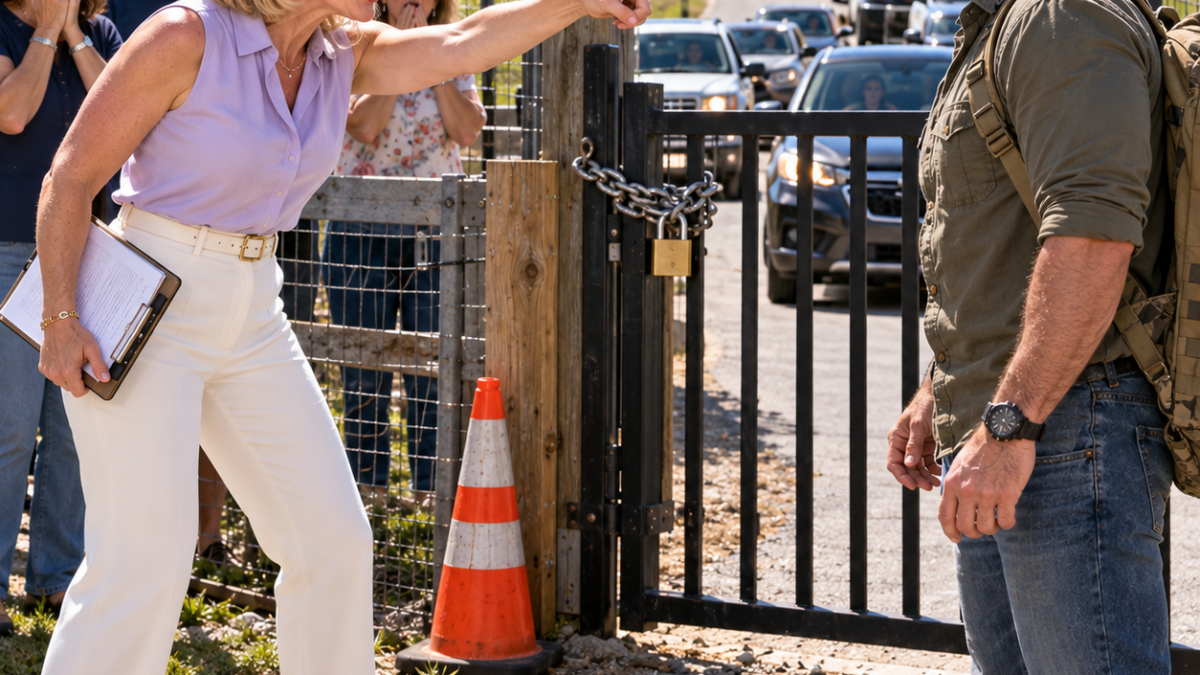
Legally. Properly. With signage filed where necessary and instructions drafted with help. I installed a heavy-duty gate with cameras on my road, positioned just behind the HOA’s absurd gate. It was a petty placement, I admit. Their gate could open, but mine stood behind it, blocking actual passage. A locked symbol of cause and effect.
Then I put up a large sign.
PRIVATE PROPERTY.
ROAD ACCESS REVOKED DUE TO TRESPASSING AND FRAUDULENT CLAIMS.
NO ENTRY WITHOUT WRITTEN PERMISSION.
I made sure it was impossible to miss.
That evening, residents began returning home through their usual shortcut.
They opened the HOA gate.
Then stopped.
My gate was there.
Cars backed up. People got out. Some stared at the sign. Some took pictures. Several made phone calls. I watched it all through the cameras from home, feeling no joy exactly, but a deep satisfaction.
For years, they had saved time using my land.
Now, because Karen had tried to steal it, everyone got to understand the value of what she had risked.
Fifteen minutes passed before Karen arrived.
She came storming into view with bolt cutters.
Bolt cutters.
I leaned back in my chair and laughed for the first time that day.
She marched straight to my gate, shouting before she even reached it.
“You made a terrible mistake!”
“Do you know who I am?”
“My lawyers will destroy you!”
She attacked the chain and lock with the bolt cutters, struggling, grunting, pulling, trying to perform power in front of the growing crowd of irritated residents who had just learned their commute had become much longer.
The gate held.
The cameras recorded.
The sheriff’s deputy arrived while she was still trying.
That timing remains one of the most satisfying moments of my life.
I had called as soon as she showed up with tools. The deputy stepped from his vehicle and told her to stop. She turned toward him, red-faced, holding the bolt cutters like a cartoon burglar caught mid-scene.
“This man is blocking community access!” she yelled.
The deputy looked at the sign.
Then at the gate.
Then at her.
“Ma’am, put the tool down.”
“You don’t understand. This is HOA property.”
“No,” he said. “It isn’t.”
She froze.
I do not know what surprised her more—the deputy knowing that or saying it in front of everyone.
“I am the HOA president,” she said.
“Put the bolt cutters down.”
She tried to argue.
Of course she did.
But even Karen could not argue her way out of being filmed attacking a gate on private property with a crowd watching and a deputy telling her to stop.
She was arrested for attempted destruction of property and trespassing.
On camera.
In front of her residents.
The same people she had charged for access to my road had to watch her get placed in handcuffs beside the gate she had no right to touch.
As the cruiser drove away, I could hear muffled yelling through the camera audio.
The residents stood around for a few more minutes, then turned their cars around and drove home the long way.
That was the beginning of the end for Karen.
But not the end of the letters.
The next day, I received a stack of threats from the HOA.
Damages.
Lost property value.
Interference.
Entrapment, somehow.
Compensation demand: fifty thousand dollars.
Apparently fifteen thousand was no longer ambitious enough.
The letters were formally from the board, but I could feel Karen’s fingerprints on every sentence. Whether she typed them herself or bullied someone into doing it while still dealing with her arrest, I do not know. Either way, my lawyer found them hilarious in the professional way lawyers do when the other side keeps making their own case worse.
“Well,” he said after reading them, “yesterday I thought you were almost guaranteed to win. Now I would say absolutely guaranteed.”
I liked him immediately.
We prepared for several things at once.
Unauthorized construction.
Trespass.
Fraudulent fee collection.
Damage to my land.
Interference with property rights.
Potential criminal complaints.
County enforcement.
Possible claims against individual board members.
While that moved forward, the HOA began eating itself.
I did not have to do much.
Karen tried to rally the community against me. She told residents I was petty, spiteful, dishonest, and trying to ruin their lives by blocking access. She claimed I had gone back on my word. She claimed I was using the road to extort the HOA.
But the arrest changed the audience.
People who might have accepted her version before had watched her attack a private gate with bolt cutters. They had seen the deputy correct her. They had spent extra time driving the long route home. And then, quietly, a few friendly residents learned the rest from me.
The easement had expired.
The road was mine.
The fence was on my land.
The HOA had collected more than thirty thousand dollars for maintenance it never performed.
That last part spread fastest.
Nothing turns residents against an HOA board like realizing their inconvenience came with a bill.
Online discussion exploded.
People posted screenshots. Old notices. Fee statements. Meeting minutes. Questions nobody on the board wanted to answer. Why had they paid road maintenance fees if the HOA did not own the road? Where had the money gone? Why had the easement not been renewed? Why had Karen claimed she had spoken to me? Why had the board believed her? Why was the HOA spending money on legal threats instead of fixing the problem?
Then came complaints to the attorney general’s office.
One homeowner filed.
Then another.
Then more.
Maybe each complaint alone would not have done much, but together they formed a paper trail the board could not ignore.
The subdivision’s property values began to dip.
That was deeply ironic.
Karen had accused my “overgrown” land of lowering values. In reality, her greed had done what grass and trees never could. She had turned a convenient neighborhood into a scandal with a longer commute, uncertain access, legal risk, and an HOA reputation so bad potential buyers started asking questions before touring homes.
The shortcut had mattered more than she understood.
Or maybe she understood exactly—that was why she tried to control it.
At the next HOA meeting, Karen and the board expected to blame me.
They never got the chance.
From what I heard, the room was packed. Karen arrived with prepared remarks about unity, legal action, and protecting community interests. The board sat at the front, trying to look serious. Then residents demanded a recall vote.
Not politely.
Not eventually.
Immediately.
They did it by the book too, which I appreciated. Karen had spent years hiding behind rules. Her own community used the rules to remove her.
The entire board was recalled.
Some members stepped down quietly, hoping low profiles would save them from worse consequences.
It did not.
Fraud allegations followed. Financial records were reviewed. County investigators and attorneys began asking questions. The road fee money had not gone where residents were told it would go. The HOA finances, despite all the new assessments and fees, were in terrible shape. Legal expenses, mismanagement, and whatever else Karen’s board had been doing had left the association close to broke.
I was invited to attend a meeting with the new board.
I accepted.
I will admit, walking into that room felt good.
Not because I wanted power over them. I did not. I wanted my land restored and my road respected. But there was a certain satisfaction in sitting across from people who now understood they had to deal with me as the owner, not an obstacle.
The new board looked exhausted and embarrassed.
Their acting president, a man named David, began with an apology.
A real one.
Not perfect. Not poetic. But direct.
“The previous board was wrong,” he said. “Your land belongs to you. The fence should never have been installed. The road fees should never have been collected under false pretenses. We want to fix this.”
I looked at him for a long moment.
“That would make you the first person from this HOA to say that clearly.”
He nodded. “Then I’m glad to be first.”
We negotiated.
Not casually. Not on trust alone. With lawyers. With documents. With maps. With deadlines.
The final agreement included thirty-five thousand dollars in restitution to me, full removal of the unauthorized fence and gate at HOA expense, a concrete renewed easement agreement with strict terms, acknowledgement in writing that the land and road belonged to me, oversight requirements, maintenance responsibilities, and remedies if they ever tried anything similar again.
The HOA finances were awful, so I wondered whether they could pay.
David was honest.
“It will hurt,” he said. “But losing access hurts everyone more.”
He was right.
The residents had tasted life without the shortcut. An extra half hour each way on bad days. More fuel. More time. More inconvenience. If the HOA had to cut other luxuries to pay me and secure lawful access, so be it.
They paid.
The fence came down.
Watching it being removed was quieter than I expected.
No dramatic music. No cheering crowd. Just workers pulling posts from land where they never should have stood, loading sections of fence onto a truck while I watched from near my own gate.
The scar through the pasture remained for a while.
Flattened grass. Disturbed soil. Post holes.
But land heals if you let it.
People are slower.
Karen ended up facing serious charges. So did several others connected to the scheme. I do not know every detail, and some of it moved beyond my direct involvement, but fraud was no longer just a word angry residents used online. It became something investigators took seriously. A few board members ended up behind bars, including Karen herself.
That surprised me at first.
I expected fines. Maybe settlements. Maybe resignations. Maybe civil penalties large enough to hurt.
Prison felt almost unreal.
Then I remembered her standing on her porch, finger in my chest, telling me her lawyers ate little landowners like me for breakfast.
I stopped feeling surprised.
A few former board members had to sell their homes quickly to cover fines and legal costs. Unfortunately for them, the neighborhood’s property values had dipped because of the very scandal they caused. They became victims of the market damage they created. There was justice in that, though not the clean kind people imagine. More like irony wearing work boots.
Karen never contacted me again.
No angry letters.
No phone calls.
No final confrontation.
I suspect she had too many legal and financial problems to waste time on me. I also suspect that once she fell, nobody in the HOA wanted to be her messenger anymore. Bullies look powerful when they have an audience willing to clap. They look much smaller when the room empties.
Life slowly returned to normal.
Better than normal, in some ways.
My relationship with the new HOA board became cautious but functional. I do not trust institutions just because they change letterhead, and I do not trust an HOA simply because the latest board knows how to apologize. But I can work with people who respect documents, boundaries, and consequences.
David and I spoke several times after the agreement.
He seemed decent.
Tired, but decent.
“We are walking on eggshells with you,” he admitted once.
“You should be.”
He laughed nervously.
I did not.
Then I smiled a little so he would know I was not planning to destroy him over a misplaced comma.
“I don’t want war,” I said. “I want people to stop confusing access with ownership.”
He nodded. “Understood.”
That became the guiding principle.
Access is not ownership.
Convenience is not entitlement.
An easement is not a blank check.
A shortcut through my family’s land is not community property just because people got used to driving on it.
The renewed agreement made everything explicit. Maintenance obligations. Limits. Use. Notices. Renewal procedures. Enforcement. No fees collected by the HOA unless properly disclosed and tied to actual obligations. No construction. No gates. No signs. No “green belt” nonsense.
Every clause existed because Karen had taught me what arrogance will try when ambiguity gives it room.
The road itself became strangely valuable in everyone’s eyes after that.
Before, it was just a shortcut. Something people used without thinking. After access was revoked, after commutes doubled, after property values dipped, residents finally understood what that strip of pavement meant. It was not ornamental. It was not incidental. It was infrastructure running across land my family had preserved for generations.
My land rose in value too.
Not because I intended to sell. I still do not.
But knowing its worth felt good.
For years, the property had been treated like leftover rural space beside “real” development. Karen had called it ugly, overgrown, and damaging to property values. In the end, the community learned that my land held one of the most valuable routes they had.
My grandfather would have laughed himself breathless.
Sometimes now, I drive that road slowly in the evening.
Not because I need to.
Because I can.
The pasture has recovered where the fence cut through. Grass covers most of the scar. If you know where to look, you can still see slight unevenness in the ground, a faint line where posts once stood. I leave it alone. Not out of neglect. Out of memory.
Some scars are useful.
They remind you where someone crossed a line.
The old HOA gate is gone. Mine remains, though it stands open under the terms of the easement during approved access. The cameras remain too. The sign has been replaced with something less confrontational but equally clear.
PRIVATE PROPERTY.
AUTHORIZED ROAD ACCESS ONLY.
That is enough.
Most residents are polite now. Some wave. Some look embarrassed. A few have stopped to apologize, though most of them were not personally responsible. I appreciate the apologies, but I do not need them from everyone. People were misled. People paid fees they should not have paid. People trusted a board that lied. Their anger was redirected where it belonged.
At Karen.
At the old board.
At the system that let one woman turn convenience into control.
As for the property management company, I replaced them.
That should be obvious.
Their failure to challenge the HOA properly did not cause Karen’s fraud, but it allowed it to go further than it should have. Boundary confusion is one thing. A fence installed on my land is another. If I hire someone to watch property while I am overseas, I expect them to recognize the difference between a minor dispute and a land grab.
They apologized.
I accepted the apology.
Then I ended the contract.
Experience is expensive. I try to make sure I get something for the price.
Now, when I travel, I have a better system. Multiple contacts. Cameras. Direct alerts. A lawyer with copies of key documents. A local caretaker who understands that any construction, fence, gate, sign, or person with an HOA clipboard requires immediate escalation. No more assuming that absurdity cannot happen because it is absurd.
That assumption is how absurd people win.
I still think about Karen’s phrase sometimes.
Little landowners like you.
She meant it as an insult.
I have come to enjoy it.
Because little landowners, apparently, can be very inconvenient when they have deeds, surveys, cameras, lawyers, county records, and the only road your subdivision wants to use.
She thought power came from a board title.
She thought ownership could be faked with signs.
She thought if she improved land without permission, she could claim it.
She thought collecting fees made theft official.
She thought I would come home from two years abroad, see her fence, hear the word lawyers, and decide surrender was cheaper than fighting.
She misread me completely.
My family did not keep that land through generations because we were easily frightened by paperwork.
We kept it because somebody, over and over, decided it was worth the trouble.
Now it was my turn.
In the end, I did not get everything back exactly as it was.
No one ever does.
The time was gone. The stress happened. The legal bills, the meetings, the anger, the hours spent untangling lies, the frustration of seeing my own land fenced off by strangers—all of that became part of the property’s story.
But I got the land restored.
I got restitution.
I got a stronger easement.
I got the fence removed.
I got Karen and her board exposed.
I got the road recognized for what it had always been: mine.
And maybe most satisfying of all, the residents who once drove across my land without thinking now understand that permission is not weakness.
It is trust.
Karen broke that trust.
The new board gets to maintain it carefully.
As for me, I still consider myself a private person. I still prefer a low profile. I still do not enjoy conflict for its own sake. If Karen had approached me honestly when the easement expired, I probably would have renewed it with reasonable terms. If she had respected the land, I would have continued letting people use the shortcut without much fuss.
Instead, she tried to steal what my family had preserved.
So I reminded her, the HOA, and every resident who had unknowingly paid for my road that land does not become yours because you are bold enough to lie about it.
The deed matters.
The boundary matters.
The truth matters.
And sometimes, when someone builds a gate where they have no right to build one, the best answer is to build a stronger gate behind it and let them explain the traffic jam.
𝗧𝗛𝗘 𝗘𝗡𝗗
The HOA Fenced Off My Family’s Land While I Was Overseas and Charged People to Use My Road
The HOA president put a fence through my land, locked my private road, and charged her neighbors fees for using property my family had owned for generations.
When I came home from two years overseas, she told me her lawyers ate “little landowners” like me for breakfast.
She did not realize the road she had stolen was the only shortcut her entire neighborhood could not live without.
My family’s land was never beautiful in the way developers use that word.
It was not manicured. It was not staged. It did not have ornamental lights, matching mailboxes, or a fountain at the entrance with a stone sign announcing a community name chosen by people who had never dug a fence post in their lives. It was uneven, stubborn, mostly undeveloped land that had been passed from one generation to the next until it landed in my hands with all the weight that comes from inheriting something people before you refused to let go.
Some parts were pasture. Some were wooded. Some were just open ground that turned green in spring, brown in late summer, and muddy whenever the weather decided to remind me who was really in charge. There were old fence lines that needed constant attention, drainage issues that made me curse my grandfather’s optimism, and a private paved road that ran through the property like a secret the world had finally started to notice.
If I am being honest, the land was a pain.
A beautiful pain, maybe, but still a pain.
Taxes. Maintenance. Trespassers. Fallen branches. Occasional dumped trash from people who thought rural land meant nobody cared. Every year, I told myself I should simplify my life, maybe sell part of it, maybe lease more of it, maybe stop treating old family pride like a second job.
Then I would walk the road at sunset, hear wind moving through grass that had known my grandfather’s boots, and feel ashamed for even thinking it.
So I kept it.
Out of obligation, yes.
Out of pride, definitely.
And because some things matter precisely because they are inconvenient.
For most of my life, the area around the land remained rural enough that nobody paid much attention to us. A few farmers used the area. Some ecologists had once studied parts of the property because of the trees and low wet areas near the back. My family used the paved road, and occasionally a neighbor would ask permission to pass through. It was quiet. Functional. Almost invisible.
Then the nearest city began expanding.
At first, it happened slowly enough that I could ignore it. A gas station appeared where there had been scrubland. A road widened. A billboard went up. Then came survey flags, construction equipment, new drainage pipes, and the neat, repetitive skeletons of suburban houses rising beyond one edge of my property.
Within a few years, there was a full subdivision next door.
Then a homeowners association.
I tried not to judge the people who moved there. Growth happens. Families need homes. Not everybody wants acreage and headaches. Some people want a clean neighborhood, a trimmed lawn, and a board that tells them what color their shutters can be. That is their business.
My problem began when their board decided my business belonged to them too.
At first, the HOA was mostly tolerable.
We had a few disagreements. Minor things. Residents wandering off the road and onto my land. Someone complaining that my pasture looked “overgrown” when it was, in fact, pasture. A letter once asking whether I would “consider cooperative beautification near the community border,” which I threw away after laughing for a full minute. Annoying, yes. Dangerous, no.
The one thing connecting us was the road.
Years before the subdivision grew to its current size, a family member who owned the land before me had signed an easement agreement with the HOA. Back then, the community was much smaller. The road through my property offered a shortcut to the city, saving time for residents traveling in either direction. It was not the only possible route, but it was the best one. Depending on traffic, it could save fifteen minutes one way, sometimes more.
I inherited that agreement along with the land.
I never loved the traffic, but I tolerated it. The road was paved. The use was legal under the agreement. People mostly stayed on the road. They did not damage my property. And I am a private person by nature. I preferred letting them pass quietly over turning every inconvenience into a war.
That was before Karen Whitmore became HOA president.
I did not know Karen well before everything happened. I knew her reputation. That was enough.
She was the kind of woman who turned a committee position into a throne. Late forties, maybe early fifties. Sharp blond bob, expensive sunglasses, fitted jackets, and a smile that always looked like it had been issued with a warning label. She moved through the subdivision like she owned every blade of grass inside it and had ambitions beyond the border.
I saw her at a county planning meeting once, arguing with a man from the drainage office as if stormwater runoff were personally insulting her. She did not speak loudly at first. She spoke precisely. That was worse. Loud people sometimes burn out. Karen seemed like the type who could file paperwork forever.
Still, she was the HOA’s problem.
Or so I thought.
Then I went overseas for work.
The contract was in the Philippines, and it was supposed to last two years. That was not unusual for me. My work had taken me abroad before, and I already had systems in place for handling the land during long absences. I hired a local property management company to check the property, handle taxes, report damage, deal with trespassers, and keep an eye on anything that needed attention.
They had worked with me before.
They were competent.
Or at least competent enough for the problems I expected.
Fallen limbs. Fence repairs. Maybe a payment issue. Maybe someone dumping tires.
I did not expect to return home and find that an HOA had tried to annex part of my family’s land like a tiny suburban empire with a newsletter.
The two years in the Philippines were good years.
Hard work, but satisfying. I liked the people I worked with. I liked the country more than I expected. I got used to the heat, the food, the rhythm of life there. The property management company sent regular reports, and nothing seemed wrong. Taxes were handled. No major damage. No serious trespass issues. Nothing about the HOA beyond ordinary road use.
When the contract ended, I came home tired, proud, and ready to walk my own land again.
I remember driving out there from the airport with that particular feeling you get when you have been away from home too long. The roads looked both familiar and strange. New stores had appeared. The city had crept farther outward. Traffic was worse. The subdivision beside my land looked bigger, cleaner, and more smug than when I left.
Then I reached my property.
And saw the fence.
For a moment, I genuinely wondered if I was in the wrong place.
There was a long fence cutting across my land near the subdivision side, complete with a gate, metal posts, and signs that said NO TRESPASSING. It was not a temporary barrier. It was not a few stakes and wire. Someone had installed a real fence, aggressively, confidently, as if no one imagined the owner might object.
I got out of my truck and stood there staring.
The first thought I had was that the property management company had lost its mind.
Maybe they had decided to “secure” the border without asking me. Maybe they planned to bill me some outrageous amount for unauthorized improvements. Maybe someone in their office had misunderstood the parcel line and hired a contractor. I was annoyed, but at that first moment, I still believed I was dealing with incompetence.
Incompetence would have been refreshing.
I called the property management company from the side of the road.
The manager answered cheerfully until I asked why there was a fence on my land.
There was a pause.
“A fence?”
“Yes. A fence. With a gate. On my property.”
Another pause.
Then, less cheerfully, “You mean the HOA fence?”
My stomach sank.
“What HOA fence?”
He exhaled. “We thought you knew.”
“I just got back from the Philippines. Explain.”
He did.
Not smoothly. Not confidently. Because he was almost as confused as I was.
According to him, the HOA had installed the fence months earlier. When the management company questioned them, HOA representatives insisted the land belonged to the association or fell under its authority. They apparently produced bylaws, maps, and some internal documents claiming the area was a “green belt” connected to the community. At one point, they also claimed I had given permission, which made no sense because they were simultaneously claiming ownership.
“Why didn’t you call me?” I asked.
“We did email about some boundary confusion.”
“Boundary confusion is not a fence.”
“I know.”
“Did you verify the parcel?”
“We asked for documentation. They claimed their attorney had reviewed it.”
I closed my eyes.
“Did you check the deed?”
Silence.
That was enough.
I ended the call before I said something that would cost both of us more time.
Then I walked the fence line myself.
The more I saw, the angrier I became.
It did not sit on the border. Not even close. It cut into my pasture, stealing a meaningful section of my land and pretending the theft was geometry. The gate had a lock. The signs had small print at the bottom stating the area was under the authority of the local HOA. Someone had claimed my property with metal, paper, and confidence.
I stood there with one hand on the gate and thought, Surely this cannot be legal.
That sentence would become the unofficial theme of the next several months.
part2
When I got home, I started searching.
HOA notices. Social media posts. Resident complaints. Anything I could find online.
It did not take long.
Residents had been complaining for nearly a year about “green belt maintenance fees” and “road maintenance assessments.” At first, the posts were vague. People asking why fees had increased. Others complaining that the board had not explained the new charges clearly. Then I saw references to access control, private road upkeep, gate improvements, and neighborhood beautification.
My road.
My land.
Their fees.
I sat at my desk and read everything twice, feeling each piece click into place.
The HOA had built a fence on my property, put up a gate, declared the area under its control, charged residents maintenance fees for the road, and apparently collected money for work they had never done on a road they did not own.
I found one resident comment that made my blood pressure jump.
“Why are we paying a green belt fee and road access fee if the road still has potholes near the old pasture curve?”
The old pasture curve was mine.
They were charging people for my road.
A road I had allowed them to use for years under an easement agreement.
A road they had not maintained with a single cent.
I found the HOA president’s number and called.
No answer.
I called the vice president.
No answer.
Treasurer.
No answer.
Secretary.
Finally, someone picked up.
Her name was Linda, and she sounded immediately nervous once I introduced myself.
“I’m calling about the fence your HOA installed on my property.”
A little silence.
“Oh,” she said. “The green belt project.”
“It is not a green belt project. It is my land.”
“The president said she spoke with you.”
“She did not.”
“She said there was an agreement.”
“There was no agreement.”
Linda became flustered then. I could hear papers moving.
“Well, my understanding was that the easement was expiring, and since you were abroad, Karen said you agreed to let us assume maintenance responsibilities.”
“Karen said that?”
“Yes. She said you were happy to have the HOA handle the area because it had become burdensome for you.”
I laughed.
I could not help it.
Linda went quiet.
“I am not laughing at you,” I said. “But that is a complete lie.”
“She told the board she met with you.”
“I was in the Philippines.”
“She said it was before you left.”
“I never met with her. I never gave permission. I never transferred land. I never authorized a fence, a gate, signs, fees, or anything else.”
Linda sounded smaller when she answered.
“I’m sorry. I only know what we were told.”
That was the first useful thing anyone from the HOA said to me.
I thanked her and ended the call.
I did not have every piece yet, but I had enough to know the shape of the fraud.
Karen had lied to her own board. She had lied to residents. She had lied to my property manager. She had invented permission where none existed, claimed authority where none applied, and turned my absence into a revenue stream.
I gathered documents.
The deed. Recent surveys. Older surveys. Tax records. The easement agreement. Correspondence with the management company. Photos of the fence. Screenshots of resident complaints about fees. Everything.
Then I drove to Karen’s house.
I did not call again. I did not wait for a polite meeting. She had put a locked gate on my land while I was overseas. The time for courtesy had passed.
Her house sat near the center of the subdivision, larger than most, with perfect shrubs, white columns, and a driveway so clean it looked unused. She opened the door wearing a cream blouse and pearl earrings, looking at me like she had been interrupted while being important.
“Yes?”
“Karen Whitmore?”
Her eyes narrowed. “Who’s asking?”
I gave my name.
The change was immediate.
Her face did not show surprise, exactly. More like irritation that an inconvenience had found her doorstep.
“I need to talk to you about the fence and gate your HOA installed on my property.”
“I do not appreciate aggressive visits to my home.”
“My voice is calm.”
“Your presence is aggressive.”
I almost smiled. “My land has a locked gate on it. That feels aggressive too.”
She glanced at the folder in my hand.
“I will call security if necessary.”
“Security can look at the deed with us.”
I held out the survey and deed copies.
She did not take them.
“I know what you’re trying to do,” she said.
“Then you’re ahead of me, because I still don’t know what you thought you were doing.”
Her nostrils flared.
“We exercised our rights.”
“You built on my land.”
“The land was abandoned.”
I stared at her.
I had prepared for denial. Maybe excuses. Maybe claims of misunderstanding. I had not prepared for abandoned.
“Abandoned?”
“You were overseas for two years.”
“I hired a company to manage the property.”
“A negligent one, clearly.”
“Absence is not abandonment.”
She smiled slightly, as if she had been waiting for me to say that.
“We improved the land. We maintained it. We secured it. We integrated it into the community green belt. Under the circumstances, the HOA has a claim.”
“A claim.”
“Yes.”
“To my land.”
“To neglected land the HOA improved.”
I felt reality tilt for a second.
“You think installing a fence on land you don’t own makes it yours?”
“I think you should speak to a lawyer before embarrassing yourself.”
I opened the folder again.
“I brought the deed. Survey. Tax records. Easement agreement.”
She waved a hand. “Old documents.”
“They are current documents.”
“The HOA has lawyers.”
“I’m sure.”
“They eat little landowners like you for breakfast.”
There are insults that make a person angry because they hurt.
That one almost made me laugh because it was so theatrical.
She mistook my silence for fear.
Her confidence grew.
“In fact,” she said, stepping closer, “our lawyers will be contacting you. You owe us fifteen thousand dollars for improvements made to the green belt.”
I looked down as her finger pressed against my chest.
She actually poked me.
“Fifteen thousand.”
“At minimum.”
“For a fence I did not authorize on land you do not own.”
“For improvements.”
“And the road fees?”
Her eyes flickered.
There it was.
The first crack.
“What road fees?” she asked, too quickly.
“The maintenance fees you charged residents for my road.”
She recovered fast.
“The HOA maintains community access.”
“You have never maintained that road.”
“We manage access.”
“You monetize access.”
“Careful.”
That word came out low.
Not a warning from a lawyer.
A threat from someone used to people backing down before things became official.
I stepped back from her finger.
“You have made a serious mistake.”
She laughed.
A small, sharp sound.
“No,” she said. “You did. You disappeared for two years and expected the world to wait for you.”
I looked past her toward the perfect street behind me, the trimmed hedges, the matching homes, the residents who had paid fees for a road they did not know had been stolen from under them.
“The world did wait,” I said. “My land did not move.”
Then I turned and left.
She shouted after me until I reached my truck.
Threats. Insults. Something about property values. Something about overgrown land making the subdivision look bad. Something about how I would regret taking on the HOA.
I did not answer.
I was too busy planning.
The county planning office was my first stop.
I reported the unauthorized construction and brought photos, parcel maps, and survey documents. The official who reviewed everything started with the mild expression of someone expecting a routine complaint and ended with both eyebrows raised.
“They built this where?”
I pointed.
He checked the map again.
“That is not HOA property.”
“I know.”
“Did they have permits?”
“That is one of my questions.”
It turned out they had filed paperwork for certain “boundary improvements” and “green belt access control,” but the description was vague enough to be misleading and specific enough to incriminate them once compared to the actual property lines. The county official told me the matter would need review and likely enforcement action.
Good.
Then I pulled public records.
I wanted the easement details fresh in my hands, not just the copy I had inherited. What I found surprised me.
The easement had expired while I was abroad.
It had not been renewed.
That meant the HOA did not currently have permission to use my road at all.
For years, I had allowed the road use under the agreement. When renewal came due, the HOA board should have contacted me, negotiated terms, and informed residents if access changed. Instead, Karen had decided to pretend she owned the land and charge fees.
I found the road maintenance assessment filing too.
Fifty dollars per HOA household.
That added up fast.
More than thirty thousand dollars collected, according to the records and resident posts I could piece together.
Thirty thousand dollars for maintenance they had not performed, on a road they did not own, under an easement they had let expire.
At that point, I stopped feeling merely angry.
I began feeling fascinated.
There is a strange clarity that comes when someone else’s wrongdoing becomes so large it stops being confusing. Karen had not made a mistake. She had built a scheme, wrapped it in HOA language, and assumed nobody would challenge her until the money was collected and the facts felt too settled to reverse.
She was wrong.
I contacted a lawyer.
Then I revoked access.
Legally. Properly. With signage filed where necessary and instructions drafted with help. I installed a heavy-duty gate with cameras on my road, positioned just behind the HOA’s absurd gate. It was a petty placement, I admit. Their gate could open, but mine stood behind it, blocking actual passage. A locked symbol of cause and effect.
Then I put up a large sign.
PRIVATE PROPERTY.
ROAD ACCESS REVOKED DUE TO TRESPASSING AND FRAUDULENT CLAIMS.
NO ENTRY WITHOUT WRITTEN PERMISSION.
I made sure it was impossible to miss.
That evening, residents began returning home through their usual shortcut.
They opened the HOA gate.
Then stopped.
My gate was there.
Cars backed up. People got out. Some stared at the sign. Some took pictures. Several made phone calls. I watched it all through the cameras from home, feeling no joy exactly, but a deep satisfaction.
For years, they had saved time using my land.
Now, because Karen had tried to steal it, everyone got to understand the value of what she had risked.
Fifteen minutes passed before Karen arrived.
She came storming into view with bolt cutters.
Bolt cutters.
I leaned back in my chair and laughed for the first time that day.
She marched straight to my gate, shouting before she even reached it.
“You made a terrible mistake!”
“Do you know who I am?”
“My lawyers will destroy you!”
She attacked the chain and lock with the bolt cutters, struggling, grunting, pulling, trying to perform power in front of the growing crowd of irritated residents who had just learned their commute had become much longer.
The gate held.
The cameras recorded.
The sheriff’s deputy arrived while she was still trying.
That timing remains one of the most satisfying moments of my life.
I had called as soon as she showed up with tools. The deputy stepped from his vehicle and told her to stop. She turned toward him, red-faced, holding the bolt cutters like a cartoon burglar caught mid-scene.
“This man is blocking community access!” she yelled.
The deputy looked at the sign.
Then at the gate.
Then at her.
“Ma’am, put the tool down.”
“You don’t understand. This is HOA property.”
“No,” he said. “It isn’t.”
She froze.
I do not know what surprised her more—the deputy knowing that or saying it in front of everyone.
“I am the HOA president,” she said.
“Put the bolt cutters down.”
She tried to argue.
Of course she did.
But even Karen could not argue her way out of being filmed attacking a gate on private property with a crowd watching and a deputy telling her to stop.
She was arrested for attempted destruction of property and trespassing.
On camera.
In front of her residents.
The same people she had charged for access to my road had to watch her get placed in handcuffs beside the gate she had no right to touch.
As the cruiser drove away, I could hear muffled yelling through the camera audio.
The residents stood around for a few more minutes, then turned their cars around and drove home the long way.
That was the beginning of the end for Karen.
But not the end of the letters.
The next day, I received a stack of threats from the HOA.
Damages.
Lost property value.
Interference.
Entrapment, somehow.
Compensation demand: fifty thousand dollars.
Apparently fifteen thousand was no longer ambitious enough.
The letters were formally from the board, but I could feel Karen’s fingerprints on every sentence. Whether she typed them herself or bullied someone into doing it while still dealing with her arrest, I do not know. Either way, my lawyer found them hilarious in the professional way lawyers do when the other side keeps making their own case worse.
“Well,” he said after reading them, “yesterday I thought you were almost guaranteed to win. Now I would say absolutely guaranteed.”
I liked him immediately.
We prepared for several things at once.
Unauthorized construction.
Trespass.
Fraudulent fee collection.
Damage to my land.
Interference with property rights.
Potential criminal complaints.
County enforcement.
Possible claims against individual board members.
While that moved forward, the HOA began eating itself.
I did not have to do much.
Karen tried to rally the community against me. She told residents I was petty, spiteful, dishonest, and trying to ruin their lives by blocking access. She claimed I had gone back on my word. She claimed I was using the road to extort the HOA.
But the arrest changed the audience.
People who might have accepted her version before had watched her attack a private gate with bolt cutters. They had seen the deputy correct her. They had spent extra time driving the long route home. And then, quietly, a few friendly residents learned the rest from me.
The easement had expired.
The road was mine.
The fence was on my land.
The HOA had collected more than thirty thousand dollars for maintenance it never performed.
That last part spread fastest.
Nothing turns residents against an HOA board like realizing their inconvenience came with a bill.
Online discussion exploded.
People posted screenshots. Old notices. Fee statements. Meeting minutes. Questions nobody on the board wanted to answer. Why had they paid road maintenance fees if the HOA did not own the road? Where had the money gone? Why had the easement not been renewed? Why had Karen claimed she had spoken to me? Why had the board believed her? Why was the HOA spending money on legal threats instead of fixing the problem?
Then came complaints to the attorney general’s office.
One homeowner filed.
Then another.
Then more.
Maybe each complaint alone would not have done much, but together they formed a paper trail the board could not ignore.
The subdivision’s property values began to dip.
That was deeply ironic.
Karen had accused my “overgrown” land of lowering values. In reality, her greed had done what grass and trees never could. She had turned a convenient neighborhood into a scandal with a longer commute, uncertain access, legal risk, and an HOA reputation so bad potential buyers started asking questions before touring homes.
The shortcut had mattered more than she understood.
Or maybe she understood exactly—that was why she tried to control it.
At the next HOA meeting, Karen and the board expected to blame me.
They never got the chance.
From what I heard, the room was packed. Karen arrived with prepared remarks about unity, legal action, and protecting community interests. The board sat at the front, trying to look serious. Then residents demanded a recall vote.
Not politely.
Not eventually.
Immediately.
They did it by the book too, which I appreciated. Karen had spent years hiding behind rules. Her own community used the rules to remove her.
The entire board was recalled.
Some members stepped down quietly, hoping low profiles would save them from worse consequences.
It did not.
Fraud allegations followed. Financial records were reviewed. County investigators and attorneys began asking questions. The road fee money had not gone where residents were told it would go. The HOA finances, despite all the new assessments and fees, were in terrible shape. Legal expenses, mismanagement, and whatever else Karen’s board had been doing had left the association close to broke.
I was invited to attend a meeting with the new board.
I accepted.
I will admit, walking into that room felt good.
Not because I wanted power over them. I did not. I wanted my land restored and my road respected. But there was a certain satisfaction in sitting across from people who now understood they had to deal with me as the owner, not an obstacle.
The new board looked exhausted and embarrassed.
Their acting president, a man named David, began with an apology.
A real one.
Not perfect. Not poetic. But direct.
“The previous board was wrong,” he said. “Your land belongs to you. The fence should never have been installed. The road fees should never have been collected under false pretenses. We want to fix this.”
I looked at him for a long moment.
“That would make you the first person from this HOA to say that clearly.”
He nodded. “Then I’m glad to be first.”
We negotiated.
Not casually. Not on trust alone. With lawyers. With documents. With maps. With deadlines.
The final agreement included thirty-five thousand dollars in restitution to me, full removal of the unauthorized fence and gate at HOA expense, a concrete renewed easement agreement with strict terms, acknowledgement in writing that the land and road belonged to me, oversight requirements, maintenance responsibilities, and remedies if they ever tried anything similar again.
The HOA finances were awful, so I wondered whether they could pay.
David was honest.
“It will hurt,” he said. “But losing access hurts everyone more.”
He was right.
The residents had tasted life without the shortcut. An extra half hour each way on bad days. More fuel. More time. More inconvenience. If the HOA had to cut other luxuries to pay me and secure lawful access, so be it.
They paid.
The fence came down.
Watching it being removed was quieter than I expected.
No dramatic music. No cheering crowd. Just workers pulling posts from land where they never should have stood, loading sections of fence onto a truck while I watched from near my own gate.
The scar through the pasture remained for a while.
Flattened grass. Disturbed soil. Post holes.
But land heals if you let it.
People are slower.
Karen ended up facing serious charges. So did several others connected to the scheme. I do not know every detail, and some of it moved beyond my direct involvement, but fraud was no longer just a word angry residents used online. It became something investigators took seriously. A few board members ended up behind bars, including Karen herself.
That surprised me at first.
I expected fines. Maybe settlements. Maybe resignations. Maybe civil penalties large enough to hurt.
Prison felt almost unreal.
Then I remembered her standing on her porch, finger in my chest, telling me her lawyers ate little landowners like me for breakfast.
I stopped feeling surprised.
A few former board members had to sell their homes quickly to cover fines and legal costs. Unfortunately for them, the neighborhood’s property values had dipped because of the very scandal they caused. They became victims of the market damage they created. There was justice in that, though not the clean kind people imagine. More like irony wearing work boots.
Karen never contacted me again.
No angry letters.
No phone calls.
No final confrontation.
I suspect she had too many legal and financial problems to waste time on me. I also suspect that once she fell, nobody in the HOA wanted to be her messenger anymore. Bullies look powerful when they have an audience willing to clap. They look much smaller when the room empties.
Life slowly returned to normal.
Better than normal, in some ways.
My relationship with the new HOA board became cautious but functional. I do not trust institutions just because they change letterhead, and I do not trust an HOA simply because the latest board knows how to apologize. But I can work with people who respect documents, boundaries, and consequences.
David and I spoke several times after the agreement.
He seemed decent.
Tired, but decent.
“We are walking on eggshells with you,” he admitted once.
“You should be.”
He laughed nervously.
I did not.
Then I smiled a little so he would know I was not planning to destroy him over a misplaced comma.
“I don’t want war,” I said. “I want people to stop confusing access with ownership.”
He nodded. “Understood.”
That became the guiding principle.
Access is not ownership.
Convenience is not entitlement.
An easement is not a blank check.
A shortcut through my family’s land is not community property just because people got used to driving on it.
The renewed agreement made everything explicit. Maintenance obligations. Limits. Use. Notices. Renewal procedures. Enforcement. No fees collected by the HOA unless properly disclosed and tied to actual obligations. No construction. No gates. No signs. No “green belt” nonsense.
Every clause existed because Karen had taught me what arrogance will try when ambiguity gives it room.
The road itself became strangely valuable in everyone’s eyes after that.
Before, it was just a shortcut. Something people used without thinking. After access was revoked, after commutes doubled, after property values dipped, residents finally understood what that strip of pavement meant. It was not ornamental. It was not incidental. It was infrastructure running across land my family had preserved for generations.
My land rose in value too.
Not because I intended to sell. I still do not.
But knowing its worth felt good.
For years, the property had been treated like leftover rural space beside “real” development. Karen had called it ugly, overgrown, and damaging to property values. In the end, the community learned that my land held one of the most valuable routes they had.
My grandfather would have laughed himself breathless.
Sometimes now, I drive that road slowly in the evening.
Not because I need to.
Because I can.
The pasture has recovered where the fence cut through. Grass covers most of the scar. If you know where to look, you can still see slight unevenness in the ground, a faint line where posts once stood. I leave it alone. Not out of neglect. Out of memory.
Some scars are useful.
They remind you where someone crossed a line.
The old HOA gate is gone. Mine remains, though it stands open under the terms of the easement during approved access. The cameras remain too. The sign has been replaced with something less confrontational but equally clear.
PRIVATE PROPERTY.
AUTHORIZED ROAD ACCESS ONLY.
That is enough.
Most residents are polite now. Some wave. Some look embarrassed. A few have stopped to apologize, though most of them were not personally responsible. I appreciate the apologies, but I do not need them from everyone. People were misled. People paid fees they should not have paid. People trusted a board that lied. Their anger was redirected where it belonged.
At Karen.
At the old board.
At the system that let one woman turn convenience into control.
As for the property management company, I replaced them.
That should be obvious.
Their failure to challenge the HOA properly did not cause Karen’s fraud, but it allowed it to go further than it should have. Boundary confusion is one thing. A fence installed on my land is another. If I hire someone to watch property while I am overseas, I expect them to recognize the difference between a minor dispute and a land grab.
They apologized.
I accepted the apology.
Then I ended the contract.
Experience is expensive. I try to make sure I get something for the price.
Now, when I travel, I have a better system. Multiple contacts. Cameras. Direct alerts. A lawyer with copies of key documents. A local caretaker who understands that any construction, fence, gate, sign, or person with an HOA clipboard requires immediate escalation. No more assuming that absurdity cannot happen because it is absurd.
That assumption is how absurd people win.
I still think about Karen’s phrase sometimes.
Little landowners like you.
She meant it as an insult.
I have come to enjoy it.
Because little landowners, apparently, can be very inconvenient when they have deeds, surveys, cameras, lawyers, county records, and the only road your subdivision wants to use.
She thought power came from a board title.
She thought ownership could be faked with signs.
She thought if she improved land without permission, she could claim it.
She thought collecting fees made theft official.
She thought I would come home from two years abroad, see her fence, hear the word lawyers, and decide surrender was cheaper than fighting.
She misread me completely.
My family did not keep that land through generations because we were easily frightened by paperwork.
We kept it because somebody, over and over, decided it was worth the trouble.
Now it was my turn.
In the end, I did not get everything back exactly as it was.
No one ever does.
The time was gone. The stress happened. The legal bills, the meetings, the anger, the hours spent untangling lies, the frustration of seeing my own land fenced off by strangers—all of that became part of the property’s story.
But I got the land restored.
I got restitution.
I got a stronger easement.
I got the fence removed.
I got Karen and her board exposed.
I got the road recognized for what it had always been: mine.
And maybe most satisfying of all, the residents who once drove across my land without thinking now understand that permission is not weakness.
It is trust.
Karen broke that trust.
The new board gets to maintain it carefully.
As for me, I still consider myself a private person. I still prefer a low profile. I still do not enjoy conflict for its own sake. If Karen had approached me honestly when the easement expired, I probably would have renewed it with reasonable terms. If she had respected the land, I would have continued letting people use the shortcut without much fuss.
Instead, she tried to steal what my family had preserved.
So I reminded her, the HOA, and every resident who had unknowingly paid for my road that land does not become yours because you are bold enough to lie about it.
The deed matters.
The boundary matters.
The truth matters.
And sometimes, when someone builds a gate where they have no right to build one, the best answer is to build a stronger gate behind it and let them explain the traffic jam.