FULL ENDING The HOA Cut Through My Ranch Fence While I Was in Surgery, Then Learned Why My Family Had Held That Line for Four Generations
part2
Karen Whitcomb was an American woman in her late forties who looked like she had been designed by a committee to make complaints look official.
She had stiff blonde hair cut into a sharp bob, skin tanned the color of expensive foundation, sunglasses that stayed on even in shade, and a smile that showed plenty of teeth but no warmth. She wore clean white pants, navy blouses, wedge sandals, and enough perfume to compete with diesel. Her nails were always polished. Her jaw was always clenched. She carried a clipboard everywhere, not because she needed it, but because it gave her something to hold while she acted like the world was already under her jurisdiction.
The first time she came to the ranch, my mother met her by the garage.
Karen smiled like we had invited her. “Hi. I’m Karen Whitcomb, president of the Anson Estates Homeowners Association.”
My mother wiped her hands on her jeans. “We’re not part of your HOA.”
Karen’s smile widened. “Not yet.”
Those two words told us everything we needed to know.
My father stepped out of the shop behind Mom, grease on his forearms and his hat pushed low. “Not ever.”
Karen blinked like that answer had not appeared in her prepared notes.
“We really think joining would benefit you,” she said. “Shared resources, neighborhood watch, trash services. We’re negotiating a snow removal contractor that could cover your entire access road.”
“Our road,” Dad said.
He had a way of making two words sound like a gate closing.
Karen tapped her pen against her clipboard. “Yes, the east access road that connects to County 12. We’ve had residents using it, and we’ve been discussing maintenance obligations.”
I almost laughed.
We had been grading that road since before I could reach the clutch on the old tractor. We filled potholes ourselves. Cut brush ourselves. Cleared snow when we had to. Our family had always let neighbors use it because back then neighbors understood permission without needing a lawyer to explain it.
Dad said, “We maintain our road.”
Karen looked down at her clipboard. “We have invoices.”
That was Karen’s method. Say something false in the tone of a person reading a fact. Make it sound like the argument had already been decided somewhere else. See if the other person flinched.
My mother did not flinch.
“We won’t be joining any association,” she said. “This ranch has been here longer than your development has existed. We don’t need your services.”
Karen’s jaw tightened, but the smile stayed. “There is also the matter of the north fence.”
Emily, who had been leaning against the horse trailer, looked up.
Karen continued. “Our survey indicates your fence may encroach on common land intended for future pedestrian access.”
My mother’s eyes went flat.
Anyone who knew her would have taken one look at that expression and backed slowly toward their vehicle.
Karen did not know her.
“That fence sits on the line,” Mom said. “The county plat shows it. Your builders’ plan shows it. It has been there for fifty years.”
“Our bylaws require uniform fencing along HOA-facing boundaries.”
Dad gave a dry laugh. “Our cattle don’t do uniform.”
Karen did not laugh.
She made a note.
That was how it began. Not with shouting. Not with a lawsuit. Just a woman with a clipboard standing in our driveway, looking at a fourth-generation ranch like it was a mistake her board intended to correct.
After that, they came often.
Sometimes Karen came herself. Sometimes she sent a man in loafers who said things like synergy and property values. Sometimes flyers appeared in the mailbox, glossy and smug, explaining the benefits of “community alignment.” They wanted us to pave the road. They wanted us to repaint our fencing to match their white vinyl trails. They wanted an easement across the north pasture so residents could walk dogs down to the creek. They wanted our hay bales moved because the smell drifted south. They wanted our roosters quiet at dawn. They wanted cows to stop being cows.
We told them no so many times the word became muscle memory.
Karen hated that.
She hated it because no was the one thing her title could not digest.
The county knew our land. Our deed was older than half their houses. The creek boundary had been recorded before Anson Estates was a developer’s dream. The east road was private, documented in old ink and new filings. But Karen and her board had a talent for treating records like obstacles instead of facts.
They filed complaints.
Untidy property.
Vegetation overgrowth.
Animal noise.
Unsafe fencing.
The county inspector came out, looked around, shook my father’s hand, and said, “Looks like a ranch.”
That became one of Dad’s favorite stories.
For a while, the HOA was just annoying. We locked the gate more often. We ignored the letters. We kept working.
Then everything changed.
My parents died in late November two years ago.
There are sentences a person writes that still do not feel real after years of living with them. That is one of mine.
They were coming back from town at dusk, that dangerous time of year when deer get jumpy and the light turns strange. My dad was driving. My mom had texted Emily a photo of the sunset over the west pasture minutes before it happened. A buck came out of the ditch on County 12. Dad swerved. The truck hit a cottonwood.
They did not make it.
People talk about grief like a wave, but for me it was heavier than water. It was the air itself turning thick. Every room in the house became a place where someone was missing. Dad’s hat by the door. Mom’s grocery list on the counter. Her coffee mug in the sink. His jacket still hanging in the mudroom. Ordinary objects became traps.
Emily and I moved through those first weeks like ghosts with chore lists.
There were animals to feed, bills to sort, funeral decisions to make, casseroles to accept, paperwork to sign, people to hug, people to call, people to forgive for saying stupid things because grief makes everyone clumsy.
Karen sent a sympathy card.
It had a watercolor bird on the front and a business card stapled inside.
We are so sorry for your loss. Please let the HOA know how we can support you during this difficult time.
Emily read it, stared at the business card, and dropped the whole thing into the trash.
“Vultures,” she said.
I did not argue.
A week after the funeral, Karen came with two board members and a covered dish.
That alone should tell you everything.
She stood on our porch, soft voice, clipboard lowered like she had dressed her ambition in mourning clothes.
“We just want to help,” she said.
A man beside her, smooth-haired and smooth-handed, nodded. “Running a property this size is a lot for two young people. The association could assist with road maintenance, security, snow removal, and boundary management.”
Boundary management.
At my parents’ house.
Before the dirt had settled over them.
Emily’s face went white in a way that scared me. I stepped forward before she could speak.
“We can handle it.”
Karen tilted her head. “No one is questioning your strength.”
“You are standing on our porch trying to sell us services after our parents’ funeral.”
Her mouth tightened. “That is not fair.”
“No,” Emily said quietly. “It’s not.”
Karen looked at my sister and must have seen something there she did not like, because she left the casserole and retreated.
We threw away the folder.
We ate the casserole.
Grief makes practical hypocrites of people.
Winter came hard. Snow filled the ruts. Pipes froze. Cows calved at terrible hours because cows have no respect for human suffering. Emily and I worked because work was the only thing that made sense. I fixed what broke. She fed before sunrise. We cried in different rooms and pretended we did not know.
By spring, the grass came back.
That first green after winter always feels like mercy. Calves bounced on stiff legs. Prairie chickens did their ridiculous dance in the upper field. Emily and I sat on the tailgate one evening, drinking gas station coffee, and for the first time since November, she laughed.
It sounded like a door opening.
“We should go to the lake this summer,” she said.
“The one by Mill Creek?”
“Yeah. Mom always said we should take a day and never did.”
“We will,” I said.
She looked at me and smiled. “Try again, slowpoke.”
Two months later, the river took her.
I will not dress that sentence up.
She drove out at night. Took the curve by the old bridge too fast. Maybe gravel caught her tires. Maybe she was tired. Maybe she was crying. Maybe none of the maybes matter because the result was still a guardrail twisted open and her truck in the water before dawn.
The sheriff who came to my door had known us since we were kids.
He took off his hat before he said my name.
After Emily died, I stopped feeling like a person and started feeling like the last post in a fence line after a wildfire. Still standing, technically. Charred. Useless. Exposed to every wind.
The house became unbearable. The barn was worse. The fields were too wide. The creek sounded wrong. I hated silence. I hated noise. I hated the way people looked at me like my grief might spill on them if they stood too close.
Real neighbors came anyway.
Old ranchers. Farmers. The retired teacher from down the road. The hunter who helped with coyotes. People who brought food, fixed things without asking, sat quietly when words were impossible.
Karen sent another card.
I did not open it.
Then she came again.
This time, she brought muffins and an agenda.
She stood outside the gate in a pale blue blouse, sunglasses on despite the clouds.
“We are convening a special meeting,” she said. “We’re concerned about your safety.”
I had slept maybe three hours in two days. “Please go.”
She softened her voice. “You have been through unimaginable loss. No one expects you to manage all of this alone.”
“Go.”
“The HOA can help with road security, fence maintenance, and property oversight. There have been concerns about trespassers and break-ins. We can handle the paperwork.”
I remember looking at her and feeling something cold move under the grief.
“You want me to sign something.”
Her smile trembled at the edges. “We want to help you.”
“No,” I said. “You want the ranch.”
Her expression hardened for half a second before she recovered.
“You’re grieving,” she said.
“And you’re leaving.”
She left, but the letters started again.
Fence encroachment.
Mandatory access consideration.
Noise compliance.
Emergency safety easements.
Mandatory was a bold word for a person who had no authority over me.
I took the letters to Mr. Dalton, the lawyer who had handled my parents’ estate paperwork and the water rights filings and the weird old cattle agreement my dad had with a man who owed him half a tractor and apparently paid in heifers.
Mr. Dalton read Karen’s letter, snorted, and said, “They don’t have a root to stand on.”
“That stop them?”
“No. People without roots often make the most noise.”
He filed updated notices with the county. We refreshed every recorded boundary, easement, and private-road document tied to the ranch. The east access road had always been ours, recorded in 1973, cleaned up again in 1999, and now reinforced with fresh filings. We clarified in writing that public or neighborhood use had been permissive only.
Permission.
Not right.
That distinction later mattered more than anything.
For a few weeks, paper seemed to slow them down.
Then my appendix tried to kill me.
It started as stomach pain I ignored because ranchers are sometimes very good at being idiots. I told myself it was bad food, stress, grief, anything except something that required a hospital. After two days of vomiting water, sweating through sheets, and seeing sparks when I stood, my neighbor Walt drove over, looked at me once, and said, “Get in the truck.”
Turned out, I had appendicitis.
Then complications.
Then a week in the hospital, fogged with pain meds and fever, worrying more about animals than myself.
I told Walt and the retired teacher, Mrs. Bell, where the feed instructions were. They checked the stock. Fed the horses. Locked the gate.
We thought that was enough.
Karen must have noticed my truck was not moving.
I still do not know how she found out I was gone. A gossiping neighbor. A board member who watched too closely. Someone who saw Walt feeding. It does not matter. Somehow, she knew.
I came home weak, stitched, and stupid with exhaustion.
The first thing I noticed was sawdust by the north fence.
At first, my brain refused to understand it.
Then I saw tire tracks. Small SUV tracks with a stupid chevron pattern pressed into the dust. Then boot prints. Then the fence itself.
They had cut six posts and fifty yards of wire.
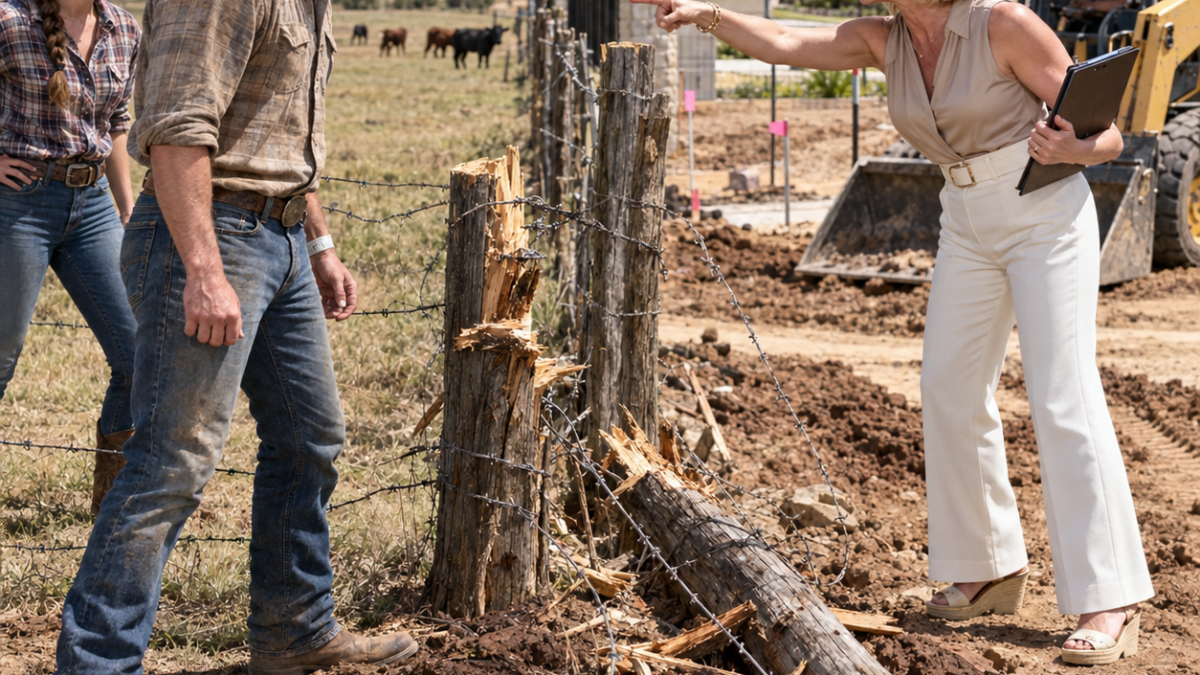
Not snipped one strand to pass through like a careless hunter. Not damaged by accident. Cut. Cleared. Opened like someone had decided to create a gate where none existed. Four posts lay inward. Wire curled in the grass. On the HOA side, two lawn chairs sat crooked like someone had watched the work happen. On my side, a discarded Gatorade bottle lay near a hoofprint.
For a moment, all I could hear was my own pulse.
Then I called the sheriff.
Sheriff Grady came out himself.
He was the same man who had pulled Emily from the river. Seeing him walk toward me across that torn fence line nearly took my legs out from under me.
He looked at the cut posts. The tracks. The boot marks. The chairs.
Then he said, “We got a call last week.”
I turned slowly. “From who?”
“A woman from the HOA. Said there was a dangerous livestock situation along their trail. Claimed cattle were threatening residents and emergency access was needed.”
I stared at him.
“What livestock?”
“Your cows, apparently.”
“My cows are Angus with the personalities of bread loaves.”
His mouth twitched, but he did not smile.
“She said your animals looked aggressive and that they had to create emergency egress through the fence.”
“They brought a chainsaw.”
“Yes.”
“While I was in the hospital.”
“Yes.”
“They destroyed my property.”
He nodded. “Do you want to press charges?”
There are moments when the dead speak inside you.
Not like ghosts.
Like training.
I heard Dad telling me to think long-term. Keep peace where you can. Do not act mad when calm will cost the other side more. Then I heard Mom, sharp and certain: This is about the line. Then Emily, forever laughing, forever daring me forward: Try again.
“Yes,” I said. “I want to press charges.”
Sheriff Grady wrote it down.
“Fix the fence today if you can,” he said. “If your stock wanders over there, they’ll use it.”
Walt came with his post driver. He did not ask questions. He just started setting T-posts like every strike was meant for someone’s face. I reran wire with one hand pressed to my sore side, sweat chilling under my shirt. It hurt. Good. Pain was simpler than grief. Pain had edges.
The next afternoon, Karen arrived with two board members.
No muffins.
No sympathy voice.
Just sunglasses, clipboard, and the smug posture of a woman who believed she had found leverage.
“We created temporary emergency access due to aggressive livestock,” she said.
I laughed once. It came out ugly.
“You trespassed. You cut my fence.”
“We acted for resident safety.”
“You’re lucky my horses didn’t get out and die on County 12.”
“We did not see any horses.”
That was Karen. If reality did not help her, she edited it.
I held up a folder. “Sheriff took the report. I’m pressing charges.”
Her smile vanished.
“I think that is a mistake.”
“I don’t.”
“It will make you very unpopular.”
“I’m already unpopular with you.”
Her jaw flexed. “We are improving the trail system, and we need access to the creek. Your fence is an eyesore, and the developer guaranteed residents creek access.”
“The developer cannot grant what he does not own.”
“We have an easement.”
“No,” I said. “You have a lie.”
One board member shifted behind her.
Karen stepped closer. “You need us.”
That did it.
Maybe it was the words. Maybe it was the fence. Maybe it was my stitches pulling under my shirt. Maybe it was months of watching her circle grief like a coyote circles a weak calf. Whatever held me back finally snapped into place, not out of control, but into focus.
“No,” I said. “You need my road.”
She blinked.
“The east access road,” I said. “The shortcut your residents use every day to save seven minutes. The road you claim you maintain. The road you keep treating like a community asset.”
Her eyes narrowed. “It is an established access route.”
“It is private ranch property used by permission. And as of right now, permission is withdrawn from Anson Estates, its HOA, its board, its members, its officers, and its agents.”
“You cannot do that.”
“I can,” I said. “I just did.”
She laughed, but it was thin.
“You’ll hear from our attorney.”
“I hope he reads better than you do.”
For two days, I worked like something possessed.
Mr. Dalton sent notices. I called the county. I confirmed the filings. I bought every PRIVATE ROAD, NO THROUGH TRAFFIC, NO TRESPASSING, and VIOLATORS WILL BE PROSECUTED sign the hardware store had in stock. The clerk asked, “Trouble?”
“Nuisance.”
He nodded like he recognized the species.
Walt helped me set posts along the road. I ordered a ranch gate wide enough for hay deliveries and mounted it where our private road met County 12. Heavy chain. Heavy lock. I made keys for the real neighbors who had used the road respectfully for years: Walt, Mrs. Bell, the old farm south of us, the hunter who helped with coyotes.
No HOA members.
At the gate, I posted a letter in a plastic sleeve:
ACCESS BY PERMISSION ONLY. PERMISSION IS WITHDRAWN FROM ANSON ESTATES HOA, ITS MEMBERS, OFFICERS, AND AGENTS DUE TO TRESPASS, PROPERTY DAMAGE, AND ATTEMPTED ADVERSE CLAIMS.
Copies went to the sheriff, county attorney, Mr. Dalton, and the HOA by certified mail.
The first morning after the gate went up, I sat in my truck with coffee and watched seven minutes become the most valuable thing in Anson Estates.
SUVs rolled up, stopped, idled, stared, and then performed angry twelve-point turns in the ditch. Minivans reversed with the panic of people who had not budgeted extra time for soccer practice. A teenager in a convertible shouted, “This is public!”
“It is not,” I shouted back.
He flipped me off and stalled.
Around noon, Karen arrived with three vehicles behind her.
She got out first, sunglasses on, clipboard tucked under one arm. A man in a blazer trailed her, looking at his phone with the desperate concentration of someone hoping the law might appear in his email. Another board member filmed me on an iPad.
Karen gestured at the gate. “What is this?”
“A gate.”
“You are obstructing an established easement.”
“Show me the recorded easement.”
She glanced at the blazer man.
He cleared his throat. “There may be a prescriptive claim based on long-term use.”
“No,” I said. “There may not. Use was permissive. Recorded. Repeatedly.”
He looked back at his phone.
Karen crossed her arms. “We maintained that road.”
“You sent invoices to yourselves and called it maintenance.”
“We will sue.”
“Do it.”
Her stare was designed to wilt people.
I had buried my parents and my sister. I had found my fence cut open after surgery. A woman with expensive sunglasses no longer ranked high on my fear list.
“You’re making enemies,” she said.
“I’ve got enough.”
They left angry.
I expected emails. I got them.
I expected Facebook lies. I got those too.
Selfish rancher cuts off emergency access.
Dangerous livestock threatens children.
Local farmer refuses community cooperation.
They used farmer like an insult because they did not know enough to know better.
What I did not expect was the semi.
Two mornings later, a diesel engine woke me before sunrise.
I stepped outside in boots, sweatpants, and an unzipped jacket and found a full-size red semi-truck parked sideways across my gate, its trailer blocking access completely. It was not on the county road. Even Karen knew better than that. It had backed into my ditch on my property, leaving deep ruts in the soft shoulder.
Karen stood on the far side of the gate with a smirk so satisfied I wanted to frame it and send it to her lawyer.
The driver leaned out of his window, cap backward. “Nice place.”
“Get off my property,” I said.
Karen lifted her chin. “We are exercising our right to protest. You blocked a major community thoroughfare. We are making a point.”
I looked at the truck. Then the ditch. Then Karen.
For one wild second, I imagined hooking a chain to the semi with the tractor and letting physics settle the matter.
Then I heard Dad in my head: Use the law when it’s on your side.
I called Sheriff Grady.
He arrived faster than I expected, took one look, removed his sunglasses, and said, “No. No, no, no.”
Karen smiled. “Sheriff, we are peacefully protesting.”
“You’re trespassing.”
“We’re on the road.”
“This is not a public road. Move the truck.”
Karen launched into a speech about emergency access, established use, HOA safety obligations, and community rights. Sheriff Grady let it wash over him like rain on a barn roof.
Then he turned to the driver.
“If you don’t move this truck, I’m having it towed and cited. If you resist, I’ll arrest you.”
The driver’s grin vanished.
“Hey, I’m just here because she hired me.”
Karen spun toward him. “Do not move that truck.”
He held up both hands. “Lady, I’m not getting arrested for your HOA.”
He started the engine.
Karen stepped in front of the wheel.
The driver did not move.
The sheriff pinched the bridge of his nose. A deputy I had not noticed came up beside him.
“Ma’am,” the deputy said, “step aside.”
Karen’s voice rose. “Do not touch me. I am the president of the HOA.”
The deputy did what deputies do when patience has been offered and refused. He took her arm in that careful grip meant to move a person without hurting them.
She jerked away.
“This is harassment!”
“Move,” Sheriff Grady said, “or be arrested.”
Karen did not move.
The deputy cuffed her.
She went very still then, like a cat pretending it had chosen to be carried. The board member filming made a sound like a tea kettle. The driver backed the semi out of my ditch with impressive skill and left. Karen sat stiff in the back of the cruiser, sunglasses still on, jaw locked hard enough to crack teeth.
She was not charged with much that stuck. The county attorney muttered words like de-escalation and community relations. I did not fight to put her in jail.
I wanted reports.
Paper mattered.
The truck driver texted me an apology later. Said Karen told him it was a protest on HOA-managed access property. Said he would never work for them again. I believed him.
The ditch, however, stayed torn open.
So did my patience.
For a few days, things quieted.
Then I caught two HOA board members in my pasture.
They were near the horse paddock with a bucket and rope, trying to coax my mares toward the fence with grain. My horses stood five feet back, ears sideways, looking at them with the deep suspicion horses reserve for plastic bags, snakes, and idiots.
“What are you doing?” I called.
One woman flinched, then pasted on a smile. “We’re checking on the animals.”
“On my land?”
“We got a report.”
“From who?”
“The HOA.”
I stared at her.
She lifted the bucket. “These horses look neglected.”
My mares were sleek, fed, watered, brushed, hooves trimmed, and visibly offended by the quality of the grain being offered.
“Get out,” I said.
The women huffed their way back over the fence. One snagged her yoga pants on barbed wire and yelped. I had the uncharitable thought that the fence had better instincts than half the county.
That night, I sat at the kitchen table with cold coffee and understood something.
Calling the sheriff helped.
Letters helped.
Signs helped.
But none of it gave me peace.
I could not sit guard over every fence line. I could not heal from surgery, grieve three people, run cattle, repair roads, and babysit grown adults determined to trespass until something terrible happened. I needed the land itself to teach the lesson when I could not be everywhere.
So I installed electric fencing.
Nothing exotic. Nothing illegal. Ranchers use hot wire all the time. It teaches animals respect without doing real harm. It also teaches people respect if they ignore six warning signs and grab it anyway.
I called the feed store and ordered a charger strong enough to make a bull reconsider life choices. I bought insulators, poly wire, ground rods, and bright yellow ELECTRIC FENCE signs in English and Spanish. Walt helped me run it along the north fence where the HOA kept causing problems: one wire chest-high for humans, one lower for dogs.
I did everything right.
Manufacturer-rated livestock fence.
Proper grounding.
Clear warning signs.
Legal voltage.
I called Sheriff Grady and told him.
“Good,” he said.
I told the real neighbors.
I slept that night better than I had in months.
Two afternoons later, I was in the barn fixing a cracked shovel handle when one of the horses snorted hard.
Then I heard a yell.
I stepped outside and saw two HOA men standing near the north fence. One was the smooth-haired polo guy from the first sympathy pitch. The other was a red-faced man with a belly hanging over his belt and the confidence of someone who had never learned caution from livestock.
Polo Guy held his hand like it had betrayed him.
Beer Belly looked at the wire, then reached out and grabbed it full palm.
He screamed and fell backward into the grass.
I walked over slowly.
“It’s electric,” I said.
Polo Guy glared. “You can’t have an electric fence.”
I pointed at the nearest yellow sign. “The fence disagrees.”
Beer Belly sat up, shaking his hand. “You assaulted us.”
“No,” I said. “Physics did.”
“We’re suing.”
“Please do.”
They went to the ER, which I knew because their wives posted online about my “dangerous electrified booby trap.” Sheriff Grady called that evening and asked for photos of the signs, fence, and manufacturer specs. I emailed everything.
“You’re good,” he said.
“They keep coming over here.”
“That’s probably why you installed it.”
The HOA tried to turn the electric fence into a scandal.
They posted photos of the warning signs as if the signs made me look worse instead of better. They wrote about public safety, hidden hazards, and hostile ranch practices. Then people started asking obvious questions.
Why were board members at his fence?
Why did they touch it?
Why are we still fighting over land we don’t own?
The more Karen’s board talked, the worse they looked.
They had cut my fence while I was in the hospital.
They had blocked my gate with a semi.
They had tried to lure my horses with grain.
They had touched a clearly marked electric fence and discovered electricity.
Facts are stubborn when enough people finally see them.
Life inside Anson Estates got harder without my road. Seven minutes turned out to matter when residents were late to work, late to school, late to yoga, late to pretending Maple Lane had maples. Delivery trucks had to reroute. Garbage service renegotiated. Traffic doubled on streets that were never designed for everyone avoiding the long way around.
Residents started asking questions at HOA meetings.
Real questions.
Not the polite kind Karen could swat away with a committee update.
Why did we claim the ranch road?
Who authorized cutting the fence?
Why did the board hire a semi?
How much are legal letters costing?
Do we actually have an easement?
Why are we fighting a ranch that predates the subdivision?
Karen did not handle scrutiny well.
Bullies rarely do when the audience changes.
I filed claims through my lawyer. Not lawsuits yet. Claims. Fence repair costs. Labor. Ditch damage. Replacement posts. Wire. Gate expenses. Mr. Dalton sent formal demand letters and copied their insurance.
The HOA ignored them until the insurance adjuster called me.
“What is the minimum payment that makes this go away?” he asked.
“The number in the letter.”
They paid for the fence.
They argued over the ditch.
I sent more photos.
They paid half.
Fine.
Paper mattered.
Then came the election.
Apparently, Karen getting gently escorted into a cruiser had made its way online. Someone captioned it: When HOA Karen Meets the Real World. It did numbers in the small, embarrassing way local videos do. Not celebrity-level. Feed-store-level. Enough that people at the hardware store stopped me to ask whether the sunglasses stayed on in the cruiser.
They did.
The video did what facts alone had not done. It made residents inside Anson Estates realize their board was not protecting them from the ranch. Their board was making them a county joke.
A group of residents organized.
They printed flyers that said RESTORE SANITY. They ran two candidates against Karen’s slate: a retired school principal named Marla Jensen and a landscaping contractor named Tom Rivera. Marla had the kind of voice that could silence a cafeteria without raising it. Tom had sun lines around his eyes, dirt under his fingernails, and no patience for nonsense.
Their platform was simple.
Stop trying to claim land the HOA did not own.
Fix internal traffic.
Stop harassing the ranch.
Stop embarrassing everyone.
They won.
Karen did not step down gracefully. People like her never do. She accused residents of betrayal, misinformation, emotional voting, and “anti-community sentiment.” But when the votes were counted, her clipboard no longer made decisions.
The first letter from the new board came two weeks later.
It was plain.
No glossy letterhead.
No threats.
No passive-aggressive phrasing.
Mr. Harlan,
We apologize for the actions of the previous board. We acknowledge that the ranch property, creek boundary, north fence, and east access road are not HOA property and are not subject to HOA control. We will cease all attempts to claim, access, or regulate your property. We will instruct residents not to use your road.
We would like to request a meeting to discuss emergency access for fire and medical services only, to be used only in actual emergencies, with your permission and proper safeguards.
I read it twice.
Then I called Mr. Dalton.
He read it and said, “This is what reasonable looks like.”
“I barely remember.”
“Me neither.”
We met at the coffee shop in town with bad muffins and good coffee.
Marla brought a binder. Tom brought a legal pad and hands rough enough that I trusted him a little before he even spoke. They did not bring Karen. They did not bring a lawyer. They did not bring a clipboard.
Marla apologized first.
Not corporate-apology words.
Real ones.
“We cannot undo what was done,” she said. “But we can stop doing harm now.”
Tom slid a check across the table for the remaining ditch damage.
I looked at it, then at him.
“No argument?”
“No,” he said. “Our people tore it up.”
That nearly knocked me back more than Karen’s worst lie.
They asked about emergency access. Asked, not demanded. The fire chief had apparently told them the north end of the development could be hard to reach if County 12 was blocked. They proposed paying for a Knox box at my gate so emergency services could open it only in real emergencies.
I did not agree that day.
I told them I would think about it.
For two weeks, I walked the ranch at dusk.
Past the repaired north fence.
Past the place where the wire had been cut.
Down toward the creek boundary that had existed before Karen, before Anson Estates, before streets named after imaginary trees. I stood where Emily and I used to race and listened to wind move through cottonwoods.
Holding a line is not the same as hardening your heart.
My parents knew that. They let neighbors use the road for years because neighbor used to mean something. The mistake was not generosity. The mistake was allowing people like Karen to confuse generosity with weakness.
The fire department was not Karen.
Real emergencies were not HOA convenience.
So I called the fire chief.
He was an old boy with a belly made of pie and hands made of winter hose lines. He said, “I’d appreciate the access. Emergencies only.”
“Then that’s what it’ll be.”
The Knox box went in. Anson Estates paid for it. The new board sent a notice to every resident explaining that the road was private ranch property, permission was permanently withdrawn except for emergency services, and trespass would be reported. They posted it online. They removed the old angry posts. They banned repeat agitators from the group after Karen tried to stir everyone up again.
Most importantly, they told their residents the truth.
The ranch was there first.
The ranch was not the enemy.
The ranch was not theirs.
I did not forgive everything.
People love forgiveness in stories because it makes endings feel clean. Real life is messier. The north fence still has newer posts that look too pale beside the old ones. My ditch still holds the scar of that semi. Some days, when I hear a chainsaw in the distance, my stomach still tightens before my brain catches up. And grief does not leave because an HOA election goes your way.
My parents are still gone.
Emily is still gone.
There are mornings I reach for my phone to text her something stupid and remember all over again. There are evenings when the barn light hits dust in the air and I see my father’s outline where no one stands. Sometimes I swear I hear Mom call from the kitchen that a cow is having trouble, and for one bright, terrible second, I turn to answer.
But the line holds.
The gate still stands at County 12.
The signs remain.
The electric fence hums along the north boundary with its yellow warnings bright in the sun.
Anson Estates residents take the long way now. Their packages arrive later. Their shortcut is gone. That is not revenge anymore. It is consequence. A seven-minute price for years of entitlement.
Karen sold her house the following spring.
I heard she moved to another planned community two counties over. God help them.
The day the moving truck came, I was repairing a hinge on the hay barn door. I saw her silver SUV pause at the end of what used to be her favorite shortcut. She could not use it, of course. The gate was locked.
For a moment, through the windshield, I saw her sunglasses turn toward the ranch.
I lifted one hand.
Not a wave exactly.
More of an acknowledgment.
She drove away without returning it.
I went back to the hinge.
A week later, I found something near the north fence that nearly undid me.
A smooth flat stone by the creek, one of the kind Emily used to skip when we were kids. Someone had scratched two words into the dirt beside it with a stick.
Try again.
Maybe I wrote it myself in some tired moment and forgot. Maybe Walt did it. Maybe Mrs. Bell. Maybe it was just the land handing me back my own memory.
I do not know.
I kept the stone.
It sits on the kitchen windowsill now, beside Mom’s old mug and Dad’s pocketknife. In the mornings, when the sun comes up over the east pasture, light hits all three. The dead do not come back. But sometimes what they taught you stays where you can see it.
People ask why I fought so hard over a fence, a road, a strip of creek, and seven minutes.
They do not understand.
It was never just fence wire.
It was my father teaching me how to twist a splice tight enough to hold through winter.
It was my mother standing at the kitchen sink, knowing the land by instinct.
It was Emily racing me to the creek, laughing over her shoulder.
It was every neighbor who had used that road with respect and every new resident who thought respect was optional if convenience was on their side.
It was Karen standing in my driveway after cutting my fence while I was recovering from surgery, telling me my ranch would belong to her community eventually.
No.
Some lines are legal.
Some lines are personal.
The strongest ones are both.
I still work the ranch. I still mend fence. I still curse when equipment breaks. Calves still arrive at the worst possible hours. Roosters still offend anyone delicate enough to be offended by morning. Cows still act like bread loaves with legs. The wind still turns west in the late afternoon, exactly like Emily said it would.
And every time I drive through my gate, unlock my chain, and look down that private road stretching across land my family held through drought, debt, death, and Karen Whitcomb, I feel something settle in me.
Not peace exactly.
Something older.
A promise kept.
My family held that line for four generations.
When Karen tried to cut through it, she learned that wire can be repaired, gates can be locked, roads can be closed, and sometimes the quietest person left standing is the one with the deepest roots.
The line holds.
And so do I.
𝗧𝗛𝗘 𝗘𝗡𝗗
The HOA Cut Through My Ranch Fence While I Was in Surgery, Then Learned Why My Family Had Held That Line for Four Generations
Karen thought grief had made me weak enough to surrender the ranch.
She was wrong about the fence, wrong about the road, and dead wrong about what happens when a fourth-generation rancher finally stops being polite.
I grew up on land that taught you to listen before it taught you to speak.
Our ranch was not enormous by Texas standards, though people from the new subdivision liked to call it that whenever they needed us to sound greedy. It was big enough that you could ride out to check the south fence and lose sight of the house. Big enough that morning chores started in the dark and still somehow ran late. Big enough that every gate, creek bend, fence post, and cattle trail had a story attached to it if you stood still long enough for my father to tell it.
My family had been there for four generations.
That meant something to us.
It did not mean we were rich. Most ranch families I know are land-rich and cash-tired, and we were no different. Fences broke. Tractors coughed. Water lines froze. Hay prices went up when rain went down. My parents worked every inch of that place like it was both a blessing and a debt. My father taught me how to mend wire, read hoof prints in mud, and tell by the pitch of a cow’s bawl whether she was annoyed, hungry, or in trouble. My mother kept the books, handled hay deliveries, remembered every vaccine schedule, and somehow knew when a calf was coming breach before the cow knew it herself.
She would be washing dishes, stop mid-scrub, look out the kitchen window, and say, “Something’s wrong with Number 42.”
By the time the rest of us got to the barn, she already had the vet on the phone.
My sister, Emily, was three years younger than me and twice as stubborn. She could outwalk grown men by fifteen and outargue them by twelve. When we were kids, we raced down the section road to the creek, skipped stones, and fought over who had to carry the tackle box back. She always won the races. Always. She would toss her braid over her shoulder, grin like she had stolen the sun, and say, “Try again, slowpoke.”
She said that all our lives.
Bad season?
Try again.
Broken fence?
Try again.
Calf died?
Cry, bury it, try again.
That was ranch life. You lost things. You fixed things. You got up before dawn because animals did not care that your heart hurt.
The ranch sat on the edge of the county where pasture met progress, though I never liked calling it progress. When I was little, the land north of us was open prairie. At night, you heard cattle lowing through the cottonwoods, coyotes yipping out past the draw, and wind moving through grass like water. Then came the survey flags.
Bright pink.
Ugly as a rash against the prairie.
I was home from college that summer, stacking square bales and pretending cafeteria food had not made me soft. My dad sat in the barn shade with a bottle of water pressed to his knee.
“They’re putting in a planned community north of us,” he said.
He said planned like the word tasted bad.
My mother stood beside him, staring toward the rise where the flags cut the skyline. Emily climbed up on the fence rail, squinted, and said, “Those people don’t know the wind turns west in the late afternoon.”
That was Emily’s way of saying they were building dreams for people who did not understand the place.
First came trucks.
Then roads.
Then square lots laid out like graph paper. They named the streets after trees that did not grow anywhere near us. Maple Lane. Birch Court. Cedar Hollow. I had never seen a maple within seventy miles, but that did not stop them from printing it on signs.
Then came the model homes.
Then the clubhouse.
Then the pool.
Then the HOA.
And then Karen walked up our driveway with a clipboard like she had discovered us.
part2
Karen Whitcomb was an American woman in her late forties who looked like she had been designed by a committee to make complaints look official.
She had stiff blonde hair cut into a sharp bob, skin tanned the color of expensive foundation, sunglasses that stayed on even in shade, and a smile that showed plenty of teeth but no warmth. She wore clean white pants, navy blouses, wedge sandals, and enough perfume to compete with diesel. Her nails were always polished. Her jaw was always clenched. She carried a clipboard everywhere, not because she needed it, but because it gave her something to hold while she acted like the world was already under her jurisdiction.
The first time she came to the ranch, my mother met her by the garage.
Karen smiled like we had invited her. “Hi. I’m Karen Whitcomb, president of the Anson Estates Homeowners Association.”
My mother wiped her hands on her jeans. “We’re not part of your HOA.”
Karen’s smile widened. “Not yet.”
Those two words told us everything we needed to know.
My father stepped out of the shop behind Mom, grease on his forearms and his hat pushed low. “Not ever.”
Karen blinked like that answer had not appeared in her prepared notes.
“We really think joining would benefit you,” she said. “Shared resources, neighborhood watch, trash services. We’re negotiating a snow removal contractor that could cover your entire access road.”
“Our road,” Dad said.
He had a way of making two words sound like a gate closing.
Karen tapped her pen against her clipboard. “Yes, the east access road that connects to County 12. We’ve had residents using it, and we’ve been discussing maintenance obligations.”
I almost laughed.
We had been grading that road since before I could reach the clutch on the old tractor. We filled potholes ourselves. Cut brush ourselves. Cleared snow when we had to. Our family had always let neighbors use it because back then neighbors understood permission without needing a lawyer to explain it.
Dad said, “We maintain our road.”
Karen looked down at her clipboard. “We have invoices.”
That was Karen’s method. Say something false in the tone of a person reading a fact. Make it sound like the argument had already been decided somewhere else. See if the other person flinched.
My mother did not flinch.
“We won’t be joining any association,” she said. “This ranch has been here longer than your development has existed. We don’t need your services.”
Karen’s jaw tightened, but the smile stayed. “There is also the matter of the north fence.”
Emily, who had been leaning against the horse trailer, looked up.
Karen continued. “Our survey indicates your fence may encroach on common land intended for future pedestrian access.”
My mother’s eyes went flat.
Anyone who knew her would have taken one look at that expression and backed slowly toward their vehicle.
Karen did not know her.
“That fence sits on the line,” Mom said. “The county plat shows it. Your builders’ plan shows it. It has been there for fifty years.”
“Our bylaws require uniform fencing along HOA-facing boundaries.”
Dad gave a dry laugh. “Our cattle don’t do uniform.”
Karen did not laugh.
She made a note.
That was how it began. Not with shouting. Not with a lawsuit. Just a woman with a clipboard standing in our driveway, looking at a fourth-generation ranch like it was a mistake her board intended to correct.
After that, they came often.
Sometimes Karen came herself. Sometimes she sent a man in loafers who said things like synergy and property values. Sometimes flyers appeared in the mailbox, glossy and smug, explaining the benefits of “community alignment.” They wanted us to pave the road. They wanted us to repaint our fencing to match their white vinyl trails. They wanted an easement across the north pasture so residents could walk dogs down to the creek. They wanted our hay bales moved because the smell drifted south. They wanted our roosters quiet at dawn. They wanted cows to stop being cows.
We told them no so many times the word became muscle memory.
Karen hated that.
She hated it because no was the one thing her title could not digest.
The county knew our land. Our deed was older than half their houses. The creek boundary had been recorded before Anson Estates was a developer’s dream. The east road was private, documented in old ink and new filings. But Karen and her board had a talent for treating records like obstacles instead of facts.
They filed complaints.
Untidy property.
Vegetation overgrowth.
Animal noise.
Unsafe fencing.
The county inspector came out, looked around, shook my father’s hand, and said, “Looks like a ranch.”
That became one of Dad’s favorite stories.
For a while, the HOA was just annoying. We locked the gate more often. We ignored the letters. We kept working.
Then everything changed.
My parents died in late November two years ago.
There are sentences a person writes that still do not feel real after years of living with them. That is one of mine.
They were coming back from town at dusk, that dangerous time of year when deer get jumpy and the light turns strange. My dad was driving. My mom had texted Emily a photo of the sunset over the west pasture minutes before it happened. A buck came out of the ditch on County 12. Dad swerved. The truck hit a cottonwood.
They did not make it.
People talk about grief like a wave, but for me it was heavier than water. It was the air itself turning thick. Every room in the house became a place where someone was missing. Dad’s hat by the door. Mom’s grocery list on the counter. Her coffee mug in the sink. His jacket still hanging in the mudroom. Ordinary objects became traps.
Emily and I moved through those first weeks like ghosts with chore lists.
There were animals to feed, bills to sort, funeral decisions to make, casseroles to accept, paperwork to sign, people to hug, people to call, people to forgive for saying stupid things because grief makes everyone clumsy.
Karen sent a sympathy card.
It had a watercolor bird on the front and a business card stapled inside.
We are so sorry for your loss. Please let the HOA know how we can support you during this difficult time.
Emily read it, stared at the business card, and dropped the whole thing into the trash.
“Vultures,” she said.
I did not argue.
A week after the funeral, Karen came with two board members and a covered dish.
That alone should tell you everything.
She stood on our porch, soft voice, clipboard lowered like she had dressed her ambition in mourning clothes.
“We just want to help,” she said.
A man beside her, smooth-haired and smooth-handed, nodded. “Running a property this size is a lot for two young people. The association could assist with road maintenance, security, snow removal, and boundary management.”
Boundary management.
At my parents’ house.
Before the dirt had settled over them.
Emily’s face went white in a way that scared me. I stepped forward before she could speak.
“We can handle it.”
Karen tilted her head. “No one is questioning your strength.”
“You are standing on our porch trying to sell us services after our parents’ funeral.”
Her mouth tightened. “That is not fair.”
“No,” Emily said quietly. “It’s not.”
Karen looked at my sister and must have seen something there she did not like, because she left the casserole and retreated.
We threw away the folder.
We ate the casserole.
Grief makes practical hypocrites of people.
Winter came hard. Snow filled the ruts. Pipes froze. Cows calved at terrible hours because cows have no respect for human suffering. Emily and I worked because work was the only thing that made sense. I fixed what broke. She fed before sunrise. We cried in different rooms and pretended we did not know.
By spring, the grass came back.
That first green after winter always feels like mercy. Calves bounced on stiff legs. Prairie chickens did their ridiculous dance in the upper field. Emily and I sat on the tailgate one evening, drinking gas station coffee, and for the first time since November, she laughed.
It sounded like a door opening.
“We should go to the lake this summer,” she said.
“The one by Mill Creek?”
“Yeah. Mom always said we should take a day and never did.”
“We will,” I said.
She looked at me and smiled. “Try again, slowpoke.”
Two months later, the river took her.
I will not dress that sentence up.
She drove out at night. Took the curve by the old bridge too fast. Maybe gravel caught her tires. Maybe she was tired. Maybe she was crying. Maybe none of the maybes matter because the result was still a guardrail twisted open and her truck in the water before dawn.
The sheriff who came to my door had known us since we were kids.
He took off his hat before he said my name.
After Emily died, I stopped feeling like a person and started feeling like the last post in a fence line after a wildfire. Still standing, technically. Charred. Useless. Exposed to every wind.
The house became unbearable. The barn was worse. The fields were too wide. The creek sounded wrong. I hated silence. I hated noise. I hated the way people looked at me like my grief might spill on them if they stood too close.
Real neighbors came anyway.
Old ranchers. Farmers. The retired teacher from down the road. The hunter who helped with coyotes. People who brought food, fixed things without asking, sat quietly when words were impossible.
Karen sent another card.
I did not open it.
Then she came again.
This time, she brought muffins and an agenda.
She stood outside the gate in a pale blue blouse, sunglasses on despite the clouds.
“We are convening a special meeting,” she said. “We’re concerned about your safety.”
I had slept maybe three hours in two days. “Please go.”
She softened her voice. “You have been through unimaginable loss. No one expects you to manage all of this alone.”
“Go.”
“The HOA can help with road security, fence maintenance, and property oversight. There have been concerns about trespassers and break-ins. We can handle the paperwork.”
I remember looking at her and feeling something cold move under the grief.
“You want me to sign something.”
Her smile trembled at the edges. “We want to help you.”
“No,” I said. “You want the ranch.”
Her expression hardened for half a second before she recovered.
“You’re grieving,” she said.
“And you’re leaving.”
She left, but the letters started again.
Fence encroachment.
Mandatory access consideration.
Noise compliance.
Emergency safety easements.
Mandatory was a bold word for a person who had no authority over me.
I took the letters to Mr. Dalton, the lawyer who had handled my parents’ estate paperwork and the water rights filings and the weird old cattle agreement my dad had with a man who owed him half a tractor and apparently paid in heifers.
Mr. Dalton read Karen’s letter, snorted, and said, “They don’t have a root to stand on.”
“That stop them?”
“No. People without roots often make the most noise.”
He filed updated notices with the county. We refreshed every recorded boundary, easement, and private-road document tied to the ranch. The east access road had always been ours, recorded in 1973, cleaned up again in 1999, and now reinforced with fresh filings. We clarified in writing that public or neighborhood use had been permissive only.
Permission.
Not right.
That distinction later mattered more than anything.
For a few weeks, paper seemed to slow them down.
Then my appendix tried to kill me.
It started as stomach pain I ignored because ranchers are sometimes very good at being idiots. I told myself it was bad food, stress, grief, anything except something that required a hospital. After two days of vomiting water, sweating through sheets, and seeing sparks when I stood, my neighbor Walt drove over, looked at me once, and said, “Get in the truck.”
Turned out, I had appendicitis.
Then complications.
Then a week in the hospital, fogged with pain meds and fever, worrying more about animals than myself.
I told Walt and the retired teacher, Mrs. Bell, where the feed instructions were. They checked the stock. Fed the horses. Locked the gate.
We thought that was enough.
Karen must have noticed my truck was not moving.
I still do not know how she found out I was gone. A gossiping neighbor. A board member who watched too closely. Someone who saw Walt feeding. It does not matter. Somehow, she knew.
I came home weak, stitched, and stupid with exhaustion.
The first thing I noticed was sawdust by the north fence.
At first, my brain refused to understand it.
Then I saw tire tracks. Small SUV tracks with a stupid chevron pattern pressed into the dust. Then boot prints. Then the fence itself.
They had cut six posts and fifty yards of wire.
Not snipped one strand to pass through like a careless hunter. Not damaged by accident. Cut. Cleared. Opened like someone had decided to create a gate where none existed. Four posts lay inward. Wire curled in the grass. On the HOA side, two lawn chairs sat crooked like someone had watched the work happen. On my side, a discarded Gatorade bottle lay near a hoofprint.
For a moment, all I could hear was my own pulse.
Then I called the sheriff.
Sheriff Grady came out himself.
He was the same man who had pulled Emily from the river. Seeing him walk toward me across that torn fence line nearly took my legs out from under me.
He looked at the cut posts. The tracks. The boot marks. The chairs.
Then he said, “We got a call last week.”
I turned slowly. “From who?”
“A woman from the HOA. Said there was a dangerous livestock situation along their trail. Claimed cattle were threatening residents and emergency access was needed.”
I stared at him.
“What livestock?”
“Your cows, apparently.”
“My cows are Angus with the personalities of bread loaves.”
His mouth twitched, but he did not smile.
“She said your animals looked aggressive and that they had to create emergency egress through the fence.”
“They brought a chainsaw.”
“Yes.”
“While I was in the hospital.”
“Yes.”
“They destroyed my property.”
He nodded. “Do you want to press charges?”
There are moments when the dead speak inside you.
Not like ghosts.
Like training.
I heard Dad telling me to think long-term. Keep peace where you can. Do not act mad when calm will cost the other side more. Then I heard Mom, sharp and certain: This is about the line. Then Emily, forever laughing, forever daring me forward: Try again.
“Yes,” I said. “I want to press charges.”
Sheriff Grady wrote it down.
“Fix the fence today if you can,” he said. “If your stock wanders over there, they’ll use it.”
Walt came with his post driver. He did not ask questions. He just started setting T-posts like every strike was meant for someone’s face. I reran wire with one hand pressed to my sore side, sweat chilling under my shirt. It hurt. Good. Pain was simpler than grief. Pain had edges.
The next afternoon, Karen arrived with two board members.
No muffins.
No sympathy voice.
Just sunglasses, clipboard, and the smug posture of a woman who believed she had found leverage.
“We created temporary emergency access due to aggressive livestock,” she said.
I laughed once. It came out ugly.
“You trespassed. You cut my fence.”
“We acted for resident safety.”
“You’re lucky my horses didn’t get out and die on County 12.”
“We did not see any horses.”
That was Karen. If reality did not help her, she edited it.
I held up a folder. “Sheriff took the report. I’m pressing charges.”
Her smile vanished.
“I think that is a mistake.”
“I don’t.”
“It will make you very unpopular.”
“I’m already unpopular with you.”
Her jaw flexed. “We are improving the trail system, and we need access to the creek. Your fence is an eyesore, and the developer guaranteed residents creek access.”
“The developer cannot grant what he does not own.”
“We have an easement.”
“No,” I said. “You have a lie.”
One board member shifted behind her.
Karen stepped closer. “You need us.”
That did it.
Maybe it was the words. Maybe it was the fence. Maybe it was my stitches pulling under my shirt. Maybe it was months of watching her circle grief like a coyote circles a weak calf. Whatever held me back finally snapped into place, not out of control, but into focus.
“No,” I said. “You need my road.”
She blinked.
“The east access road,” I said. “The shortcut your residents use every day to save seven minutes. The road you claim you maintain. The road you keep treating like a community asset.”
Her eyes narrowed. “It is an established access route.”
“It is private ranch property used by permission. And as of right now, permission is withdrawn from Anson Estates, its HOA, its board, its members, its officers, and its agents.”
“You cannot do that.”
“I can,” I said. “I just did.”
She laughed, but it was thin.
“You’ll hear from our attorney.”
“I hope he reads better than you do.”
For two days, I worked like something possessed.
Mr. Dalton sent notices. I called the county. I confirmed the filings. I bought every PRIVATE ROAD, NO THROUGH TRAFFIC, NO TRESPASSING, and VIOLATORS WILL BE PROSECUTED sign the hardware store had in stock. The clerk asked, “Trouble?”
“Nuisance.”
He nodded like he recognized the species.
Walt helped me set posts along the road. I ordered a ranch gate wide enough for hay deliveries and mounted it where our private road met County 12. Heavy chain. Heavy lock. I made keys for the real neighbors who had used the road respectfully for years: Walt, Mrs. Bell, the old farm south of us, the hunter who helped with coyotes.
No HOA members.
At the gate, I posted a letter in a plastic sleeve:
ACCESS BY PERMISSION ONLY. PERMISSION IS WITHDRAWN FROM ANSON ESTATES HOA, ITS MEMBERS, OFFICERS, AND AGENTS DUE TO TRESPASS, PROPERTY DAMAGE, AND ATTEMPTED ADVERSE CLAIMS.
Copies went to the sheriff, county attorney, Mr. Dalton, and the HOA by certified mail.
The first morning after the gate went up, I sat in my truck with coffee and watched seven minutes become the most valuable thing in Anson Estates.
SUVs rolled up, stopped, idled, stared, and then performed angry twelve-point turns in the ditch. Minivans reversed with the panic of people who had not budgeted extra time for soccer practice. A teenager in a convertible shouted, “This is public!”
“It is not,” I shouted back.
He flipped me off and stalled.
Around noon, Karen arrived with three vehicles behind her.
She got out first, sunglasses on, clipboard tucked under one arm. A man in a blazer trailed her, looking at his phone with the desperate concentration of someone hoping the law might appear in his email. Another board member filmed me on an iPad.
Karen gestured at the gate. “What is this?”
“A gate.”
“You are obstructing an established easement.”
“Show me the recorded easement.”
She glanced at the blazer man.
He cleared his throat. “There may be a prescriptive claim based on long-term use.”
“No,” I said. “There may not. Use was permissive. Recorded. Repeatedly.”
He looked back at his phone.
Karen crossed her arms. “We maintained that road.”
“You sent invoices to yourselves and called it maintenance.”
“We will sue.”
“Do it.”
Her stare was designed to wilt people.
I had buried my parents and my sister. I had found my fence cut open after surgery. A woman with expensive sunglasses no longer ranked high on my fear list.
“You’re making enemies,” she said.
“I’ve got enough.”
They left angry.
I expected emails. I got them.
I expected Facebook lies. I got those too.
Selfish rancher cuts off emergency access.
Dangerous livestock threatens children.
Local farmer refuses community cooperation.
They used farmer like an insult because they did not know enough to know better.
What I did not expect was the semi.
Two mornings later, a diesel engine woke me before sunrise.
I stepped outside in boots, sweatpants, and an unzipped jacket and found a full-size red semi-truck parked sideways across my gate, its trailer blocking access completely. It was not on the county road. Even Karen knew better than that. It had backed into my ditch on my property, leaving deep ruts in the soft shoulder.
Karen stood on the far side of the gate with a smirk so satisfied I wanted to frame it and send it to her lawyer.
The driver leaned out of his window, cap backward. “Nice place.”
“Get off my property,” I said.
Karen lifted her chin. “We are exercising our right to protest. You blocked a major community thoroughfare. We are making a point.”
I looked at the truck. Then the ditch. Then Karen.
For one wild second, I imagined hooking a chain to the semi with the tractor and letting physics settle the matter.
Then I heard Dad in my head: Use the law when it’s on your side.
I called Sheriff Grady.
He arrived faster than I expected, took one look, removed his sunglasses, and said, “No. No, no, no.”
Karen smiled. “Sheriff, we are peacefully protesting.”
“You’re trespassing.”
“We’re on the road.”
“This is not a public road. Move the truck.”
Karen launched into a speech about emergency access, established use, HOA safety obligations, and community rights. Sheriff Grady let it wash over him like rain on a barn roof.
Then he turned to the driver.
“If you don’t move this truck, I’m having it towed and cited. If you resist, I’ll arrest you.”
The driver’s grin vanished.
“Hey, I’m just here because she hired me.”
Karen spun toward him. “Do not move that truck.”
He held up both hands. “Lady, I’m not getting arrested for your HOA.”
He started the engine.
Karen stepped in front of the wheel.
The driver did not move.
The sheriff pinched the bridge of his nose. A deputy I had not noticed came up beside him.
“Ma’am,” the deputy said, “step aside.”
Karen’s voice rose. “Do not touch me. I am the president of the HOA.”
The deputy did what deputies do when patience has been offered and refused. He took her arm in that careful grip meant to move a person without hurting them.
She jerked away.
“This is harassment!”
“Move,” Sheriff Grady said, “or be arrested.”
Karen did not move.
The deputy cuffed her.
She went very still then, like a cat pretending it had chosen to be carried. The board member filming made a sound like a tea kettle. The driver backed the semi out of my ditch with impressive skill and left. Karen sat stiff in the back of the cruiser, sunglasses still on, jaw locked hard enough to crack teeth.
She was not charged with much that stuck. The county attorney muttered words like de-escalation and community relations. I did not fight to put her in jail.
I wanted reports.
Paper mattered.
The truck driver texted me an apology later. Said Karen told him it was a protest on HOA-managed access property. Said he would never work for them again. I believed him.
The ditch, however, stayed torn open.
So did my patience.
For a few days, things quieted.
Then I caught two HOA board members in my pasture.
They were near the horse paddock with a bucket and rope, trying to coax my mares toward the fence with grain. My horses stood five feet back, ears sideways, looking at them with the deep suspicion horses reserve for plastic bags, snakes, and idiots.
“What are you doing?” I called.
One woman flinched, then pasted on a smile. “We’re checking on the animals.”
“On my land?”
“We got a report.”
“From who?”
“The HOA.”
I stared at her.
She lifted the bucket. “These horses look neglected.”
My mares were sleek, fed, watered, brushed, hooves trimmed, and visibly offended by the quality of the grain being offered.
“Get out,” I said.
The women huffed their way back over the fence. One snagged her yoga pants on barbed wire and yelped. I had the uncharitable thought that the fence had better instincts than half the county.
That night, I sat at the kitchen table with cold coffee and understood something.
Calling the sheriff helped.
Letters helped.
Signs helped.
But none of it gave me peace.
I could not sit guard over every fence line. I could not heal from surgery, grieve three people, run cattle, repair roads, and babysit grown adults determined to trespass until something terrible happened. I needed the land itself to teach the lesson when I could not be everywhere.
So I installed electric fencing.
Nothing exotic. Nothing illegal. Ranchers use hot wire all the time. It teaches animals respect without doing real harm. It also teaches people respect if they ignore six warning signs and grab it anyway.
I called the feed store and ordered a charger strong enough to make a bull reconsider life choices. I bought insulators, poly wire, ground rods, and bright yellow ELECTRIC FENCE signs in English and Spanish. Walt helped me run it along the north fence where the HOA kept causing problems: one wire chest-high for humans, one lower for dogs.
I did everything right.
Manufacturer-rated livestock fence.
Proper grounding.
Clear warning signs.
Legal voltage.
I called Sheriff Grady and told him.
“Good,” he said.
I told the real neighbors.
I slept that night better than I had in months.
Two afternoons later, I was in the barn fixing a cracked shovel handle when one of the horses snorted hard.
Then I heard a yell.
I stepped outside and saw two HOA men standing near the north fence. One was the smooth-haired polo guy from the first sympathy pitch. The other was a red-faced man with a belly hanging over his belt and the confidence of someone who had never learned caution from livestock.
Polo Guy held his hand like it had betrayed him.
Beer Belly looked at the wire, then reached out and grabbed it full palm.
He screamed and fell backward into the grass.
I walked over slowly.
“It’s electric,” I said.
Polo Guy glared. “You can’t have an electric fence.”
I pointed at the nearest yellow sign. “The fence disagrees.”
Beer Belly sat up, shaking his hand. “You assaulted us.”
“No,” I said. “Physics did.”
“We’re suing.”
“Please do.”
They went to the ER, which I knew because their wives posted online about my “dangerous electrified booby trap.” Sheriff Grady called that evening and asked for photos of the signs, fence, and manufacturer specs. I emailed everything.
“You’re good,” he said.
“They keep coming over here.”
“That’s probably why you installed it.”
The HOA tried to turn the electric fence into a scandal.
They posted photos of the warning signs as if the signs made me look worse instead of better. They wrote about public safety, hidden hazards, and hostile ranch practices. Then people started asking obvious questions.
Why were board members at his fence?
Why did they touch it?
Why are we still fighting over land we don’t own?
The more Karen’s board talked, the worse they looked.
They had cut my fence while I was in the hospital.
They had blocked my gate with a semi.
They had tried to lure my horses with grain.
They had touched a clearly marked electric fence and discovered electricity.
Facts are stubborn when enough people finally see them.
Life inside Anson Estates got harder without my road. Seven minutes turned out to matter when residents were late to work, late to school, late to yoga, late to pretending Maple Lane had maples. Delivery trucks had to reroute. Garbage service renegotiated. Traffic doubled on streets that were never designed for everyone avoiding the long way around.
Residents started asking questions at HOA meetings.
Real questions.
Not the polite kind Karen could swat away with a committee update.
Why did we claim the ranch road?
Who authorized cutting the fence?
Why did the board hire a semi?
How much are legal letters costing?
Do we actually have an easement?
Why are we fighting a ranch that predates the subdivision?
Karen did not handle scrutiny well.
Bullies rarely do when the audience changes.
I filed claims through my lawyer. Not lawsuits yet. Claims. Fence repair costs. Labor. Ditch damage. Replacement posts. Wire. Gate expenses. Mr. Dalton sent formal demand letters and copied their insurance.
The HOA ignored them until the insurance adjuster called me.
“What is the minimum payment that makes this go away?” he asked.
“The number in the letter.”
They paid for the fence.
They argued over the ditch.
I sent more photos.
They paid half.
Fine.
Paper mattered.
Then came the election.
Apparently, Karen getting gently escorted into a cruiser had made its way online. Someone captioned it: When HOA Karen Meets the Real World. It did numbers in the small, embarrassing way local videos do. Not celebrity-level. Feed-store-level. Enough that people at the hardware store stopped me to ask whether the sunglasses stayed on in the cruiser.
They did.
The video did what facts alone had not done. It made residents inside Anson Estates realize their board was not protecting them from the ranch. Their board was making them a county joke.
A group of residents organized.
They printed flyers that said RESTORE SANITY. They ran two candidates against Karen’s slate: a retired school principal named Marla Jensen and a landscaping contractor named Tom Rivera. Marla had the kind of voice that could silence a cafeteria without raising it. Tom had sun lines around his eyes, dirt under his fingernails, and no patience for nonsense.
Their platform was simple.
Stop trying to claim land the HOA did not own.
Fix internal traffic.
Stop harassing the ranch.
Stop embarrassing everyone.
They won.
Karen did not step down gracefully. People like her never do. She accused residents of betrayal, misinformation, emotional voting, and “anti-community sentiment.” But when the votes were counted, her clipboard no longer made decisions.
The first letter from the new board came two weeks later.
It was plain.
No glossy letterhead.
No threats.
No passive-aggressive phrasing.
Mr. Harlan,
We apologize for the actions of the previous board. We acknowledge that the ranch property, creek boundary, north fence, and east access road are not HOA property and are not subject to HOA control. We will cease all attempts to claim, access, or regulate your property. We will instruct residents not to use your road.
We would like to request a meeting to discuss emergency access for fire and medical services only, to be used only in actual emergencies, with your permission and proper safeguards.
I read it twice.
Then I called Mr. Dalton.
He read it and said, “This is what reasonable looks like.”
“I barely remember.”
“Me neither.”
We met at the coffee shop in town with bad muffins and good coffee.
Marla brought a binder. Tom brought a legal pad and hands rough enough that I trusted him a little before he even spoke. They did not bring Karen. They did not bring a lawyer. They did not bring a clipboard.
Marla apologized first.
Not corporate-apology words.
Real ones.
“We cannot undo what was done,” she said. “But we can stop doing harm now.”
Tom slid a check across the table for the remaining ditch damage.
I looked at it, then at him.
“No argument?”
“No,” he said. “Our people tore it up.”
That nearly knocked me back more than Karen’s worst lie.
They asked about emergency access. Asked, not demanded. The fire chief had apparently told them the north end of the development could be hard to reach if County 12 was blocked. They proposed paying for a Knox box at my gate so emergency services could open it only in real emergencies.
I did not agree that day.
I told them I would think about it.
For two weeks, I walked the ranch at dusk.
Past the repaired north fence.
Past the place where the wire had been cut.
Down toward the creek boundary that had existed before Karen, before Anson Estates, before streets named after imaginary trees. I stood where Emily and I used to race and listened to wind move through cottonwoods.
Holding a line is not the same as hardening your heart.
My parents knew that. They let neighbors use the road for years because neighbor used to mean something. The mistake was not generosity. The mistake was allowing people like Karen to confuse generosity with weakness.
The fire department was not Karen.
Real emergencies were not HOA convenience.
So I called the fire chief.
He was an old boy with a belly made of pie and hands made of winter hose lines. He said, “I’d appreciate the access. Emergencies only.”
“Then that’s what it’ll be.”
The Knox box went in. Anson Estates paid for it. The new board sent a notice to every resident explaining that the road was private ranch property, permission was permanently withdrawn except for emergency services, and trespass would be reported. They posted it online. They removed the old angry posts. They banned repeat agitators from the group after Karen tried to stir everyone up again.
Most importantly, they told their residents the truth.
The ranch was there first.
The ranch was not the enemy.
The ranch was not theirs.
I did not forgive everything.
People love forgiveness in stories because it makes endings feel clean. Real life is messier. The north fence still has newer posts that look too pale beside the old ones. My ditch still holds the scar of that semi. Some days, when I hear a chainsaw in the distance, my stomach still tightens before my brain catches up. And grief does not leave because an HOA election goes your way.
My parents are still gone.
Emily is still gone.
There are mornings I reach for my phone to text her something stupid and remember all over again. There are evenings when the barn light hits dust in the air and I see my father’s outline where no one stands. Sometimes I swear I hear Mom call from the kitchen that a cow is having trouble, and for one bright, terrible second, I turn to answer.
But the line holds.
The gate still stands at County 12.
The signs remain.
The electric fence hums along the north boundary with its yellow warnings bright in the sun.
Anson Estates residents take the long way now. Their packages arrive later. Their shortcut is gone. That is not revenge anymore. It is consequence. A seven-minute price for years of entitlement.
Karen sold her house the following spring.
I heard she moved to another planned community two counties over. God help them.
The day the moving truck came, I was repairing a hinge on the hay barn door. I saw her silver SUV pause at the end of what used to be her favorite shortcut. She could not use it, of course. The gate was locked.
For a moment, through the windshield, I saw her sunglasses turn toward the ranch.
I lifted one hand.
Not a wave exactly.
More of an acknowledgment.
She drove away without returning it.
I went back to the hinge.
A week later, I found something near the north fence that nearly undid me.
A smooth flat stone by the creek, one of the kind Emily used to skip when we were kids. Someone had scratched two words into the dirt beside it with a stick.
Try again.
Maybe I wrote it myself in some tired moment and forgot. Maybe Walt did it. Maybe Mrs. Bell. Maybe it was just the land handing me back my own memory.
I do not know.
I kept the stone.
It sits on the kitchen windowsill now, beside Mom’s old mug and Dad’s pocketknife. In the mornings, when the sun comes up over the east pasture, light hits all three. The dead do not come back. But sometimes what they taught you stays where you can see it.
People ask why I fought so hard over a fence, a road, a strip of creek, and seven minutes.
They do not understand.
It was never just fence wire.
It was my father teaching me how to twist a splice tight enough to hold through winter.
It was my mother standing at the kitchen sink, knowing the land by instinct.
It was Emily racing me to the creek, laughing over her shoulder.
It was every neighbor who had used that road with respect and every new resident who thought respect was optional if convenience was on their side.
It was Karen standing in my driveway after cutting my fence while I was recovering from surgery, telling me my ranch would belong to her community eventually.
No.
Some lines are legal.
Some lines are personal.
The strongest ones are both.
I still work the ranch. I still mend fence. I still curse when equipment breaks. Calves still arrive at the worst possible hours. Roosters still offend anyone delicate enough to be offended by morning. Cows still act like bread loaves with legs. The wind still turns west in the late afternoon, exactly like Emily said it would.
And every time I drive through my gate, unlock my chain, and look down that private road stretching across land my family held through drought, debt, death, and Karen Whitcomb, I feel something settle in me.
Not peace exactly.
Something older.
A promise kept.
My family held that line for four generations.
When Karen tried to cut through it, she learned that wire can be repaired, gates can be locked, roads can be closed, and sometimes the quietest person left standing is the one with the deepest roots.
The line holds.
And so do I.