𝗣𝗔𝗥𝗧 𝟮 The HOA Came Onto My Farm With Weapons and Learned Too Late That My Family Was Not One of Their Bylaws
part2
Four days later, I got another letter.
Then another.
Then a packet.
The language became colder each time. Karen claimed my refusal to “cooperate with community integration standards” created safety and aesthetic concerns. She fined me for livestock. Fined me for fencing. Fined me for “visible agricultural activity.” Fined me for a tractor parked near my barn. Fined me for “odor impact.” Fined me for “excessive garden scale,” which was apparently what she called my crop fields, also known as my job.
By the end of April, the HOA claimed I owed more than nine thousand dollars.
I kept the letters in a folder labeled HOA NONSENSE.
At first, I tried to treat it like exactly that.
Nonsense.
Farm life does not stop because someone with a binder misunderstands property law. Cows still need feeding. Fences still need mending. The kids still need rides to school. The fields still need work. My wife still needs a husband who is present instead of standing in the driveway yelling at paper.
But the letters were only the beginning.
Soon, cars from the subdivision began driving slowly past the farm.
Not ordinary passing. Slow passing. Creeping by with windows down and phones raised. I would be loading feed and see a silver SUV crawl along the road while a woman in the passenger seat recorded my pasture. I would be checking irrigation and see a pickup pause near the driveway, someone photographing my barn. Once, my daughter came inside pale-faced because a car had stopped while she was walking back from the mailbox.
“They were taking pictures,” she said.
My wife went quiet in the way she does when fear arrives before words.
I called the HOA number from the letters.
Karen answered.
“This is Karen Whitmore, community director.”
“This is Daniel Mercer from the farm.”
A pause.
Then, coolly, “Mr. Mercer.”
“You need to stop sending people to photograph my property.”
“We have a right to document violations.”
“No, you don’t.”
“We absolutely do.”
“You have no authority over my land.”
“That is your interpretation.”
“It is the county’s interpretation.”
“County offices can make mistakes.”
I nearly laughed. “So can HOA presidents.”
Her voice sharpened. “Careful, Mr. Mercer. You are already in significant violation.”
“I’m in violation of rules I never agreed to, for a neighborhood I don’t belong to, on land your HOA doesn’t control.”
“You live adjacent to our community.”
“I live adjacent to a road.”
“Your farm affects property values.”
“My farm was here first.”
“And now there are families nearby who deserve safety, cleanliness, and standards.”
I stood in the mudroom, staring out at the fields my father had worked until his hands twisted with arthritis.
“Karen, listen carefully. If anyone from your HOA steps onto my land without permission, I’ll call the police.”
She gave a small laugh.
Not nervous.
Amused.
“Escalation is unnecessary.”
“Then stop escalating.”
“Comply, and this becomes much easier.”
“No.”
“You farmers always make things harder than they need to be.”
That sentence ended whatever politeness I had left.
“You don’t know anything about farmers.”
“I know enough.”
“No,” I said. “You don’t. But you’re going to learn the difference between a farm and a flower bed if you keep this up.”
I hung up.
Emily was standing in the hallway, arms folded.
“What did she say?”
“That she’s insane.”
“That’s not comforting.”
“No,” I said. “It isn’t.”
Then Frank started coming around.
Frank Bell was an HOA board member, though if you asked me, “enforcer” was the title he wanted. He was a thick-necked man with a red face, a shaved head, and a permanent squint like the world had been built slightly below his standards. He drove a black pickup with oversized tires, HOA parking decals, and a flag sticker on the back window. He liked to park at the edge of my driveway and sit there staring at the house.
The first time he came to the door, I was at the feed store.
Emily answered.
That still makes me angry.
Not because she is weak. My wife is stronger than most people I know. But Frank knew what he was doing when he banged on the door while my truck was gone. He wanted her startled. He wanted her alone. He wanted to stand on my porch with his shoulders squared and his voice loud enough to shake the glass.
When I got home, Emily was sitting at the kitchen table with both hands wrapped around a mug she had not drunk from.
“What happened?”
She looked up, and I saw fear before she could hide it.
“A man from the HOA came by.”
My whole body went still.
“What man?”
“Frank something. He said if you don’t comply, they’re going to force you.”
“Force me how?”
“He wouldn’t say. He just kept leaning in like…” She swallowed. “Like he wanted me scared.”
I felt heat climb the back of my neck.
“Did he touch you?”
“No.”
“Did he come inside?”
“No. I didn’t let him.”
I walked outside before I could say something that would scare the kids.
There are kinds of anger that burn fast and vanish. This one settled deep. I wrote everything down. Time. What Emily said. Frank’s name. His threat. Then I sent my own certified letter to Karen, the entire HOA board, and their management contact.
It stated that Frank had trespassed onto my property after written notice that they had no authority to inspect or enter. It demanded that all HOA representatives stay off my land. It warned that future trespassing would be reported to law enforcement.
Karen responded by sending another fine.
Failure to permit inspection.
I nearly framed that one because of how stupid it was.
The harassment kept climbing.
Footprints appeared near the barn after rain.
A gate latch was left open.
Someone taped an anonymous flyer to our mailbox claiming my animals were dangerous, improperly confined, and at risk of disease. It urged “concerned residents” to report animal abuse and demand county intervention.
I knew Frank had done it.
I could not prove it.
Then one night, I heard a noise outside just after midnight.
Not coyotes. Not wind. Not the normal shifting of old boards in changing temperature. This was metal against metal. A latch.
I grabbed a flashlight and stepped onto the back porch.
“Daniel?” Emily whispered behind me.
“Stay inside.”
I moved toward the barn with the flashlight low.
The main barn door was cracked open.
It should not have been.
Inside, several interior pen doors had been unlatched. None of the animals had gotten loose, thank God, but only because the outer barriers held. One spooked steer was pressed against the far rail. The goats were restless. The chickens had gone silent in the way animals do when something has disturbed them badly.
I stood in that barn with my flashlight beam shaking over open latches and felt the situation change.
Letters were one thing.
Pictures were one thing.
Banging on my door was one thing.
Messing with livestock pens at night was something else entirely.
The next morning, I called the police.
A deputy came, took notes, looked at the footprints, looked at the open latches, and listened while I explained the HOA harassment. He was polite. He said they would speak with the board. He said without video or a witness, proving who had opened the barn would be hard.
Hard.
That word kept coming up.
Hard to prove trespassing.
Hard to prove vandalism.
Hard to prove harassment.
Hard to make people stop before somebody got hurt.
The deputy did talk to Karen and Frank.
For four days, the harassment stopped.
Four whole days.
Then a county inspector showed up because someone had reported my animals as neglected and dangerous.
I walked him through everything. Clean stalls. Feed records. Water. Fencing. Vet paperwork. He was professional, fair, and visibly annoyed by the end.
“Your animals look well cared for,” he said.
“I know.”
“I’ll note that in the report.”
“Can I ask who made the complaint?”
He gave me the look government employees give when they cannot say what both of you already know.
“I think you have an idea.”
I did.
After he left, Frank drove by slowly.
He smiled from his truck.
That was the day I stopped being calm.
I wish I could tell you I stayed perfectly composed through all of this. I did not. I yelled. I shouted across the road. I told Frank exactly where he could shove the fines, the letters, and every fake rule Karen printed on HOA letterhead. When he stepped onto my gravel drive again and told me he had inspection rights, I got in his face and told him he had ten seconds to leave before I dragged him back to the road by his belt.
I am not proud of all of that.
But I will not lie and pretend I spent months being saintly while strangers terrorized my wife, photographed my children, and opened my barn at night.
The worst argument before the final confrontation happened on a Tuesday afternoon.
Emily screamed from inside the house.
Not a startled shout.
A real scream.
I dropped the fence tool in my hand and ran.
She was standing in the living room, pointing toward the side window, pale and shaking.
Frank was outside, close to the glass, peering in.
Looking through my window.
At my wife.
At my home.
At the private inside of our life.
I do not remember crossing the yard.
I only remember Frank turning as I came around the side of the house and his smug expression falling for half a second.
“What the hell are you doing?” I shouted.
He stepped back, trying to recover his authority. “Conducting a visual inspection.”
“You were looking through my window.”
“This property is under review.”
“This property is not yours.”
He held up his phone. “You threaten me, and I’ll have you arrested.”
I pointed toward the road.
“If I catch you looking through my windows again, I’ll make sure you never see anything on this farm again.”
His face changed.
So did mine, probably.
I knew the second after I said it that I had given him something. A quote. A threat. A piece of anger he could carry back to Karen and twist into proof that I was dangerous.
But at that moment, with my wife crying inside because some overgrown HOA thug decided bylaws gave him the right to spy into our home, I meant every word.
Frank left.
But he left smiling.
That night, Emily and I argued.
Not about whether Frank was wrong. He was. Not about whether the HOA was insane. They were. We argued because she was scared, and my rage scared her too.
“You can’t meet crazy with crazy,” she said.
“I’m protecting us.”
“You’re letting them pull you into something.”
“They’re on our land.”
“I know.”
“They’re scaring our kids.”
“I know.”
“They opened the barn.”
“I know, Daniel.”
Her voice cracked on my name, and that stopped me.
She sat on the edge of the bed, face tired, hands folded in her lap.
“I need you here,” she said. “Not in jail. Not shot. Not so angry you stop thinking.”
That one landed.
I sat beside her.
For a few minutes, we said nothing.
Then I took her hand and promised I would be careful.
I meant it.
The next day, I installed more cameras.
Driveway. Barn. side pasture. Front porch. Back of the house. I upgraded locks. I put up more NO TRESPASSING signs. I sent copies of everything to a lawyer. The lawyer told me exactly what I expected: I was right about the HOA, but civil action took time. Keep documenting. Avoid confrontation. Call police.
Good advice.
Slow advice.
The kind of advice that assumes the other side is at least sane enough to fear consequences.
Karen and Frank did not.
The final day began hot and bright.
Too bright.
The kind of afternoon where the air shimmers above the fields and tempers dry out along with the grass. I was working near the equipment shed when my youngest came running from the house.
“Dad,” he called. “Mom says a truck is coming.”
I looked toward the road.
Frank’s black pickup turned into my driveway.
Behind it came another truck I did not recognize.
Every muscle in my body tightened.
“Go inside,” I told my son.
He hesitated.
“Now.”
He ran.
I wiped my hands on my jeans and started toward the house. Halfway there, I saw Frank get out.
He had a baseball bat.
Not tucked away. Not leaning inside the truck. In his hand.
The second man climbed out of the other truck. Bigger than Frank, heavier through the shoulders, wearing a sleeveless shirt and a cap pulled low. He held a crossbow.
A crossbow.
For people who do not live around hunters, maybe that sounds strange. Out here, it did not. Plenty of people hunt deer with bows or crossbows. They are quieter than guns. They are powerful enough to kill. And he was standing in my driveway with one pointed toward the general direction of my house.
My wife and children were inside.
That was the only thought that mattered.
I went into the mudroom, opened the gun safe, and took out my firearm.
I am not going to dress that up.
I did not go outside looking for a fight. I did not go outside wanting to shoot anyone. But two men were on my property after months of threats, one with a bat and one with a crossbow, and my family was in the house behind me.
When I stepped onto the porch, the gun was pointed down.
Emily was behind me in the hallway, whispering, “Daniel, don’t.”
“Call 911,” I said.
“I already am.”
Good woman.
I moved off the porch, not toward them directly, but angled enough that if the crossbow fired, the line would not be toward the house.
Frank smiled when he saw me.
It was not a sane smile.
“Well, look at that,” he called. “Farmer finally wants to talk.”
“Get off my property.”
The second man shifted the crossbow in his hands.
I kept my firearm down but visible.
“I said get off my property.”
Frank lifted the bat and rested it on one shoulder.
“You don’t give orders anymore.”
“This is your last warning.”
Frank laughed. “Or what? You going to shoot an HOA board member?”
I looked at the man with the crossbow.
“You too. Leave it on the ground and get off my land.”
He glanced at Frank, unsure.
Frank took a step forward.
“This ends today,” he said. “You’re going to comply, or we’re going to make you comply.”
“With what?” I shouted. “Fake fines? Pet licenses for cows? Crop permits from a neighborhood I don’t live in?”
His face twisted.
“You think this is funny?”
“I think you’re trespassing with weapons.”
“You threatened me.”
“You looked through my windows.”
“You threatened my life.”
“You scared my wife.”
“She screamed because she’s dramatic.”
Something in me went quiet.
Dead quiet.
The kind of quiet I felt once when a bull lowered its head at me from ten yards away.
Frank took another step.
“Leave,” I said.
He raised the bat.
The bigger man’s crossbow tilted.
I did not know whether he meant to aim it or simply shifted because Frank moved. I did know that the weapon pointed closer to my house than I could live with.
I moved farther left.
“Daniel!” Emily screamed from behind the door.
Frank charged.
People have asked me since whether I had time to think.
The honest answer is yes and no.
No, I did not stand there weighing philosophy, morality, public opinion, church gossip, or what people might say about me later.
Yes, I thought.
I thought: bat raised.
I thought: crossbow behind him.
I thought: family in the house.
I thought: too close.
I thought: stop him.
I fired once.
Frank went down hard, the bat flying from his hand as he hit the gravel and screamed. The shot struck his knee. He rolled onto his side, clutching his leg, his voice tearing across the yard.
The man with the crossbow dropped it immediately and raised both hands.
“Don’t shoot!” he yelled.
“Get on the ground,” I said.
He did.
I did not fire again.
Emily was still on the phone with 911. I put the firearm down when deputies arrived. I raised my hands. I answered every question. I told them where the cameras were. I told them my wife had called. I told them about the no-trespass notices, the letters, the barn, the threats, the window, everything.
Frank went to the hospital.
The other man went into custody.
Both were arrested for trespassing, armed intimidation, and intent to commit violence. The knives were found later. One on Frank. One on the bigger man.
I was not arrested.
That fact did not stop people from judging me.
The story spread faster than fire through dry hay.
By morning, everyone had a version.
The farmer shot an HOA guy.
The farmer defended his family.
The farmer went crazy.
The HOA attacked him.
The farmer was waiting for an excuse.
Frank charged him with a bat.
Frank was unarmed.
Frank had a bat but he wasn’t going to use it.
Frank deserved worse.
The crossbow was loaded.
The crossbow was just for intimidation.
Nobody cared much about truth at first. They cared about the shape of the story that made them feel right.
The subdivision split down the middle. Some homeowners said the HOA had gone too far and finally met someone who could not be bullied. Others said I should have stayed inside, called police, waited. Some called me dangerous. Some called me a hero. I did not feel like either.
I felt tired.
And angry.
And scared in ways I did not admit out loud.
Frank survived. He also never walked the same again.
That fact follows me.
I will not pretend it doesn’t.
I can say I acted legally. I can say I gave warnings. I can say he charged with a bat while another man stood with a crossbow on my land after months of harassment. All of that is true.
It is also true that a man’s knee is not a small thing to destroy.
Two truths can stand in the same field.
That was the part the community did not want. They wanted me monster or martyr. They wanted Frank victim or villain. Real life, unfortunately, is messier. Frank chose violence. I chose force. The law said I was justified. My conscience said survival does not always feel clean.
Then Karen made the mistake of trying to blame me for everything.
She stood in front of HOA members at an emergency meeting and said my “aggressive noncompliance” had led to the incident. She claimed Frank and the other man had gone to “serve final notice.” She insisted the weapons were for personal protection because I had threatened them.
That might have worked if the story ended at the driveway.
It did not.
Because once the lawyers got involved, once homeowners started questioning why board members were walking onto farms with weapons, once reporters smelled blood in the water, people began looking into the HOA itself.
I helped.
I will admit that.
I was done being a target. If Karen wanted scrutiny, she could have it.
I started pulling public records. Talked to homeowners who had quietly hated the board for years. Compared fines. Compared invoices. Looked at meeting minutes. Requested documents through people who actually belonged to the HOA. The more we found, the uglier it got.
Fake consulting fees.
Landscaping bills for projects that had never happened.
“Security assessments” paid to companies tied to board members’ relatives.
Unexplained transfers.
Fines collected for rules that did not exist in the bylaws.
Karen had built her little kingdom on intimidation and paperwork, and somewhere along the way, she had apparently realized fear could be profitable.
I gave everything I found to the homeowners already suing the HOA.
Their lawyers ran with it.
Within weeks, the whole thing was in the local paper.
HOA Board Under Investigation After Armed Confrontation at Farm.
That headline hung over the county like a storm cloud.
Karen tried to spin it, of course. She claimed she was being targeted because she was a strong female leader. She said rural extremists were trying to undermine community standards. She said I had corrupted public opinion through “violence and manipulation.”
Then the invoices came out.
Then the bank records.
Then the fake fines.
Strength began looking a lot like theft.
Karen resigned before they could remove her.
Two other board members followed.
The HOA was restructured under outside supervision, which is a fancy way of saying grown-ups finally took the matches away from children who had already burned half the room.
Frank and the other man were prosecuted.
Both eventually went to prison.
I thought that would make people see things more clearly.
I was wrong.
Some did.
Many apologized quietly. Homeowners came by and told me they had been bullied too. One woman cried in my driveway because the HOA had fined her seven hundred dollars over a ramp built for her disabled husband. Another man showed me letters threatening liens over weeds that were not even on his property. People had been paying because Karen made fear cheaper than fighting.
But others blamed me for all of it.
The lawsuits.
The restructuring.
The newspaper stories.
The board collapse.
Frank’s prison sentence.
The fact that the subdivision now had to confront what its leadership had been doing.
In their minds, I was not the man who had been harassed. I was the man who made the ugliness visible.
People do not always thank you for that.
We live in a religious area. Church matters here. Reputation matters. Forgiveness is preached loudly, sometimes by people who confuse forgiveness with pretending nothing happened.
For weeks, church was hard.
People stared.
Some stopped talking when I entered. One man I had known for years told me he was praying for my soul in a tone that made it clear he had already made up his mind about where it was headed. My kids heard things too.
That was the part I hated most.
My daughter came home from a youth group gathering with red eyes.
“What happened?” Emily asked.
She tried to say nothing.
Then she broke.
“Someone said Dad is a devil worshipper because he shot someone.”
I had been standing near the sink.
I turned away because my first expression was not one a child should have to see.
Emily held her. I stood there with water running over my hands, unable to wash off the feeling that defending my family had made my children inherit my consequences.
That night, I sat on the porch long after everyone went to bed.
The fields were dark. The barn lights glowed soft yellow. A cow lowed once, then settled. Somewhere far off, a dog barked.
I thought about all the moments that could have gone differently.
What if I had hired a lawyer sooner?
What if I had never yelled back?
What if I had not threatened Frank after he looked through the window?
What if I had stayed inside that day and waited?
What if Frank had fired first?
What if the crossbow bolt had gone toward the house?
What if I had aimed somewhere else?
There is no peace in what-if.
Only loops.
Emily came out around midnight and sat beside me.
“You’re doing it again,” she said.
“What?”
“Putting yourself on trial.”
I laughed without humor. “Seems like everyone else is.”
“You protected us.”
“I also scared people.”
“You scared men who came here with weapons.”
“I scared our kids too.”
She was quiet for a long moment.
Then she said, “They’re alive because you took it seriously.”
I looked at her.
She did not say it gently. She said it like a fact she needed me to stop arguing with.
“They came armed,” she continued. “They came to our door. They had months to stop. Karen had months to stop. Frank had months to stop. The board had months to stop. The police warned them. Your letters warned them. The signs warned them. The cameras warned them. They kept coming.”
I looked out at the dark driveway where Frank had fallen.
“I could have handled some things better.”
“Yes,” she said.
I looked at her again.
She took my hand.
“But that doesn’t mean this was your fault.”
That was the kind of love Emily gives. Not blind. Not flattering. Honest enough to trust.
Months passed before life began to feel normal again.
The new HOA leadership sent one letter.
A real one.
It stated that the association recognized my property was outside its jurisdiction and that no representative would contact me regarding compliance, inspection, dues, fines, or standards again. It also apologized for “prior overreach.”
Prior overreach.
That phrase almost made me laugh.
There should be stronger language for trying to force a farmer into registering cows as pets, sending men to peer through windows, opening barn pens at night, and arriving armed at his front door.
But I kept the letter anyway.
The harassment stopped.
No more cars crawling by.
No more phones pointed at my fields.
No more fake fines.
No more anonymous flyers.
No one has stepped onto my property since without permission.
The farm changed after that, though.
Not visibly. The fences still need repairs. The animals still complain at feeding time. The fields still demand more than my back wants to give. But the feeling of the place shifted for a while. My wife checked locks more often. My children watched the road when trucks slowed. I kept the cameras and added more lights. I hated that.
I hated that Karen and Frank had made my family feel like our own land had edges we had to patrol.
Slowly, the fear loosened.
Not all at once.
A day without thinking about it.
A week where no one mentioned Frank.
A Sunday when church felt less like a courtroom.
A morning when my son walked to the mailbox without looking back at the house first.
Peace returned the way crops grow—quietly, after enough time, with more patience than you think you have.
As for Karen, she lost more than her title.
Once the investigation into HOA funds deepened, she became the name nobody in the subdivision wanted attached to them. People who had once smiled beside her at meetings suddenly claimed they had always been suspicious. That is how it goes. Power attracts loyalty until consequences arrive; then loyalty remembers it had concerns all along.
She moved eventually.
Not far at first, then farther. I heard she tried to blame Frank for everything, then the other board members, then me, then “anti-HOA radicals,” which would have been funny if it had not all been so exhausting. She never apologized. Not to me. Not to my wife. Not to my kids. Not to the homeowners she bled with fake fines.
People like Karen rarely apologize because apology requires standing in the truth without a weapon.
She preferred weapons.
Paper ones, mostly.
Until the day she sent men with real ones.
I still think about Frank sometimes.
I do not miss him.
I do not forgive him in the clean, easy way people talk about from church pews. Maybe someday. Maybe not. Forgiveness is not a crop you can force by shouting at the ground. But I think about him because he became the face of the moment people judged me for, while Karen was the hand behind months of pressure that led us there.
Frank charged.
Frank fell.
Frank went to prison.
Karen built the road.
That matters.
The community remembers the shot because shots are loud. They echo. They leave scars visible enough for gossip. But before the shot came letters, fines, threats, trespassing, stalking, window-peeping, barn latches opened in the dark, and a wife who could no longer feel safe in her own living room.
Violence does not begin when a gun fires.
Sometimes it begins when a person decides your “no” is not real.
I have replayed the day enough to know what I regret and what I do not.
I regret yelling as much as I did.
I regret giving Frank words he could twist.
I regret stepping outside instead of forcing them to come no closer while we waited for police, though I also know I stepped outside because the crossbow was facing my house and my family was inside.
I regret that my children had to learn adults can be dangerous in suits, pickup trucks, board meetings, and church pews.
I do not regret protecting them.
I do not regret refusing to join an HOA I was never part of.
I do not regret keeping my livestock, my fields, my fences, and my farm exactly what they were.
I do not regret saying no.
The farm feels like itself again now.
This morning, before I sat down to write this, I walked the fence line with coffee in one hand and pliers in the other. The eastern field was silver with dew. The cows lifted their heads as I passed, chewing with that blank patience animals have when humans are being dramatic somewhere else. The barn door was closed. The latches were secure. The gravel driveway was empty except for my truck and my daughter’s old bicycle leaning against the porch steps.
Emily came out as I was heading back, wearing her robe and boots, hair messy, face soft with sleep.
“Everything good?” she asked.
I looked toward the road.
No slow cars.
No Frank.
No Karen.
No letters waiting in the mailbox, no fines, no threats, no men with weapons.
“Yeah,” I said. “Everything’s good.”
She smiled.
For a long time, that was all I wanted.
Not victory.
Not revenge.
Not to be called right by every person who had an opinion about something they did not live through.
Just good.
Good means my kids are not being hassled anymore.
Good means my wife does not flinch at every truck.
Good means the animals stay in their pens because I closed the latches, not because I have to check whether someone opened them out of spite.
Good means the HOA has gone back to arguing about mulch colors inside its own borders and leaving my farm alone.
Good means I can stand in my own field without feeling like I am waiting for the next trespasser.
That is enough.
The world will keep debating what happened because people like clean moral stories. They want to know if I was the villain or the victim, the hothead or the protector, the man who went too far or the man who did what rural response times and armed trespassers forced him to do.
Maybe the honest answer is more uncomfortable.
I was a husband and father pushed too far by people who believed rules were tools for control and boundaries were weaknesses to exploit. I made mistakes. I lost my temper. I said things I should not have said. And when two armed men came onto my property after months of harassment, I stopped one of them before he reached me or my family.
The law called it self-defense.
Some neighbors called it sin.
My wife calls it the reason our children still sleep safely in their beds.
I live with all three.
But when the sun goes down over the back pasture, and the house lights glow warm behind me, and the quiet rolls across the fields the way it did before Karen ever learned my name, I know one thing with absolute certainty.
My farm was never theirs.
My family was never theirs.
My peace was never theirs.
And no HOA letter, fake fine, clipboard, badge, bat, or crossbow will ever change that.
𝗧𝗛𝗘 𝗘𝗡𝗗
The HOA Came Onto My Farm With Weapons and Learned Too Late That My Family Was Not One of Their Bylaws
The HOA thought my farm was just another yard they could control.
They sent fines, threats, inspectors, and finally two armed men to my front door.
By the time the dust settled, one man would never walk the same again, the board would collapse, and my family would learn the price of defending peace.
I was born on land that never asked permission from anybody.
Before the subdivision existed, before their perfect mailboxes and identical lawns and little white HOA-approved fences, my family’s farm was already there, stretching across open ground with barns, fields, livestock pens, a weather-beaten farmhouse, and a gravel drive that turned to mud every spring no matter how much rock I spread over it.
My grandfather had worked that soil with hands so rough they could tear burlap without trying. My father had raised me to fix fence before breakfast, pull calves in freezing rain, and respect animals because they did not care about your mood, your excuses, or your ego. By the time the land became mine, I knew every low spot that flooded, every board in the barn that creaked, every section of fence that needed checking after a hard wind.
It was not picturesque in the way city people imagine farms.
It smelled like hay, manure, diesel, wet dirt, and honest work. There were mornings when the sunrise looked like God had spilled gold over the fields, and there were nights when I came inside so tired I ate dinner without tasting it. It was beautiful, yes, but it was not decorative.
It was my livelihood.
It was my family’s home.
And it was not part of any homeowners association.
That should have been the end of the story.
Unfortunately, the people running the subdivision down the road did not understand endings. Or boundaries. Or county maps. Or the basic difference between a rural farm that had existed for generations and a group of newly built houses that came with bylaws about mailbox colors.
The subdivision went up about a decade after my wife and I took over the farm full-time. At first, I did not care. Land gets sold. Fields become neighborhoods. People move where they want. Their houses were not on my property, and my property was not in their neighborhood. I knew some of the families over there. A few were decent. Some bought eggs from us. Some waved when they drove by. Some complained about the smell of manure in spring, and I learned to ignore them because complaining about farm smells beside a farm is like buying oceanfront property and complaining about waves.
Then their HOA changed leadership.
That was when Karen Whitmore appeared.
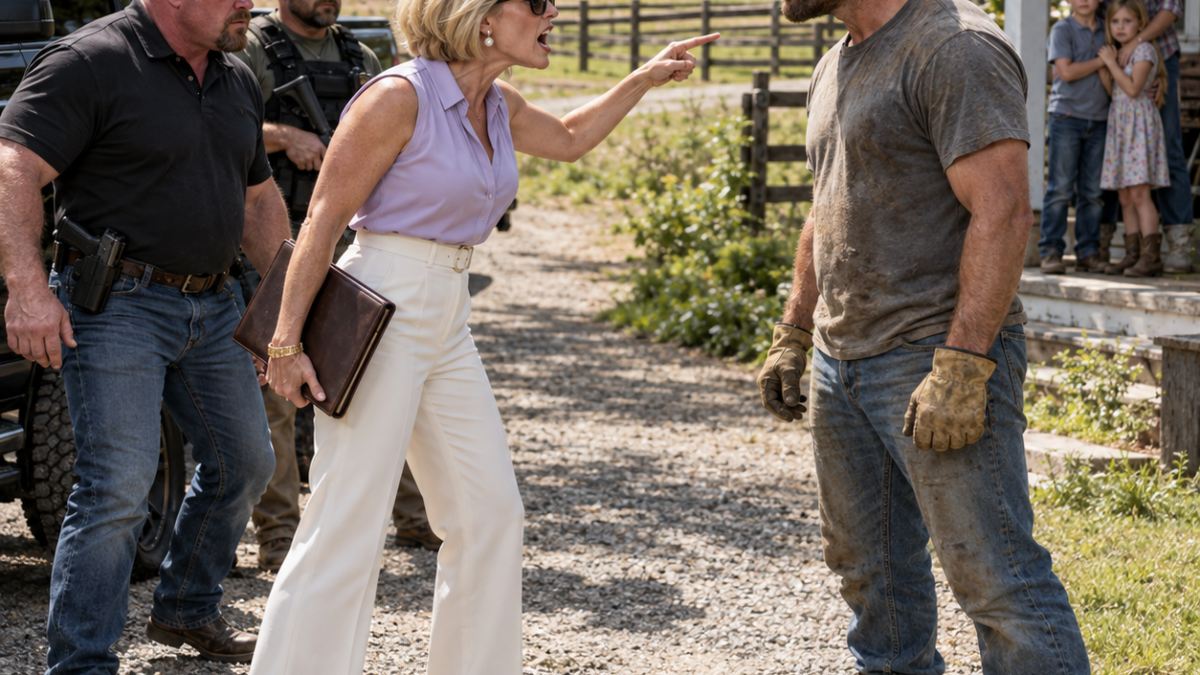
Karen was the new HOA president, though she preferred to call herself “community director,” as if she had been elected queen of civilization instead of placed in charge of lawn notices and pool rules. She was a white American woman in her late forties, always dressed like she was headed to a real estate seminar: stiff blazers, expensive sunglasses, blond hair sprayed into a helmet, and a leather binder pressed to her chest like it contained the Ten Commandments. She smiled without warmth and spoke with the slow, sharp confidence of someone who believed repetition could turn nonsense into law.
The first certified letter came in March.
It stated that my farm was “out of compliance with community standards” and that I was required to join the HOA because my property “affected the visual and environmental character” of their subdivision. According to Karen’s letter, my fences were improper, my livestock violated pet restrictions, my crop fields counted as “unapproved garden expansion,” and my barn needed exterior review.
I read it at the kitchen table while my wife, Emily, packed lunches for our two kids.
At first, I laughed.
Emily looked over. “What?”
“The subdivision thinks our cows need to be registered as pets.”
She stopped spreading peanut butter. “Excuse me?”
I slid the letter over.
She read it once, then again, her eyebrows rising higher with every line.
“Can they do that?”
“No.”
“Are you sure?”
“Absolutely.”
I had the deed. The title. County maps. Agricultural exemption records. Grandfathered land-use documentation. Everything. Our farm sat outside the HOA boundary by distance, by parcel lines, by history, and by common sense. No one could force me into their neighborhood association just because they disliked the view from their cul-de-sac.
So I wrote back politely.
That was my first mistake.
I explained that my land was not within their jurisdiction. I included copies of county map sections. I cited the parcel number. I reminded them that the farm existed before the subdivision was developed and that I had never signed any HOA agreement, paid any dues, or accepted any HOA authority.
I ended with one clear sentence.
Do not contact me again regarding HOA compliance, as my property is not subject to your rules.
I thought that settled it.
part2
Four days later, I got another letter.
Then another.
Then a packet.
The language became colder each time. Karen claimed my refusal to “cooperate with community integration standards” created safety and aesthetic concerns. She fined me for livestock. Fined me for fencing. Fined me for “visible agricultural activity.” Fined me for a tractor parked near my barn. Fined me for “odor impact.” Fined me for “excessive garden scale,” which was apparently what she called my crop fields, also known as my job.
By the end of April, the HOA claimed I owed more than nine thousand dollars.
I kept the letters in a folder labeled HOA NONSENSE.
At first, I tried to treat it like exactly that.
Nonsense.
Farm life does not stop because someone with a binder misunderstands property law. Cows still need feeding. Fences still need mending. The kids still need rides to school. The fields still need work. My wife still needs a husband who is present instead of standing in the driveway yelling at paper.
But the letters were only the beginning.
Soon, cars from the subdivision began driving slowly past the farm.
Not ordinary passing. Slow passing. Creeping by with windows down and phones raised. I would be loading feed and see a silver SUV crawl along the road while a woman in the passenger seat recorded my pasture. I would be checking irrigation and see a pickup pause near the driveway, someone photographing my barn. Once, my daughter came inside pale-faced because a car had stopped while she was walking back from the mailbox.
“They were taking pictures,” she said.
My wife went quiet in the way she does when fear arrives before words.
I called the HOA number from the letters.
Karen answered.
“This is Karen Whitmore, community director.”
“This is Daniel Mercer from the farm.”
A pause.
Then, coolly, “Mr. Mercer.”
“You need to stop sending people to photograph my property.”
“We have a right to document violations.”
“No, you don’t.”
“We absolutely do.”
“You have no authority over my land.”
“That is your interpretation.”
“It is the county’s interpretation.”
“County offices can make mistakes.”
I nearly laughed. “So can HOA presidents.”
Her voice sharpened. “Careful, Mr. Mercer. You are already in significant violation.”
“I’m in violation of rules I never agreed to, for a neighborhood I don’t belong to, on land your HOA doesn’t control.”
“You live adjacent to our community.”
“I live adjacent to a road.”
“Your farm affects property values.”
“My farm was here first.”
“And now there are families nearby who deserve safety, cleanliness, and standards.”
I stood in the mudroom, staring out at the fields my father had worked until his hands twisted with arthritis.
“Karen, listen carefully. If anyone from your HOA steps onto my land without permission, I’ll call the police.”
She gave a small laugh.
Not nervous.
Amused.
“Escalation is unnecessary.”
“Then stop escalating.”
“Comply, and this becomes much easier.”
“No.”
“You farmers always make things harder than they need to be.”
That sentence ended whatever politeness I had left.
“You don’t know anything about farmers.”
“I know enough.”
“No,” I said. “You don’t. But you’re going to learn the difference between a farm and a flower bed if you keep this up.”
I hung up.
Emily was standing in the hallway, arms folded.
“What did she say?”
“That she’s insane.”
“That’s not comforting.”
“No,” I said. “It isn’t.”
Then Frank started coming around.
Frank Bell was an HOA board member, though if you asked me, “enforcer” was the title he wanted. He was a thick-necked man with a red face, a shaved head, and a permanent squint like the world had been built slightly below his standards. He drove a black pickup with oversized tires, HOA parking decals, and a flag sticker on the back window. He liked to park at the edge of my driveway and sit there staring at the house.
The first time he came to the door, I was at the feed store.
Emily answered.
That still makes me angry.
Not because she is weak. My wife is stronger than most people I know. But Frank knew what he was doing when he banged on the door while my truck was gone. He wanted her startled. He wanted her alone. He wanted to stand on my porch with his shoulders squared and his voice loud enough to shake the glass.
When I got home, Emily was sitting at the kitchen table with both hands wrapped around a mug she had not drunk from.
“What happened?”
She looked up, and I saw fear before she could hide it.
“A man from the HOA came by.”
My whole body went still.
“What man?”
“Frank something. He said if you don’t comply, they’re going to force you.”
“Force me how?”
“He wouldn’t say. He just kept leaning in like…” She swallowed. “Like he wanted me scared.”
I felt heat climb the back of my neck.
“Did he touch you?”
“No.”
“Did he come inside?”
“No. I didn’t let him.”
I walked outside before I could say something that would scare the kids.
There are kinds of anger that burn fast and vanish. This one settled deep. I wrote everything down. Time. What Emily said. Frank’s name. His threat. Then I sent my own certified letter to Karen, the entire HOA board, and their management contact.
It stated that Frank had trespassed onto my property after written notice that they had no authority to inspect or enter. It demanded that all HOA representatives stay off my land. It warned that future trespassing would be reported to law enforcement.
Karen responded by sending another fine.
Failure to permit inspection.
I nearly framed that one because of how stupid it was.
The harassment kept climbing.
Footprints appeared near the barn after rain.
A gate latch was left open.
Someone taped an anonymous flyer to our mailbox claiming my animals were dangerous, improperly confined, and at risk of disease. It urged “concerned residents” to report animal abuse and demand county intervention.
I knew Frank had done it.
I could not prove it.
Then one night, I heard a noise outside just after midnight.
Not coyotes. Not wind. Not the normal shifting of old boards in changing temperature. This was metal against metal. A latch.
I grabbed a flashlight and stepped onto the back porch.
“Daniel?” Emily whispered behind me.
“Stay inside.”
I moved toward the barn with the flashlight low.
The main barn door was cracked open.
It should not have been.
Inside, several interior pen doors had been unlatched. None of the animals had gotten loose, thank God, but only because the outer barriers held. One spooked steer was pressed against the far rail. The goats were restless. The chickens had gone silent in the way animals do when something has disturbed them badly.
I stood in that barn with my flashlight beam shaking over open latches and felt the situation change.
Letters were one thing.
Pictures were one thing.
Banging on my door was one thing.
Messing with livestock pens at night was something else entirely.
The next morning, I called the police.
A deputy came, took notes, looked at the footprints, looked at the open latches, and listened while I explained the HOA harassment. He was polite. He said they would speak with the board. He said without video or a witness, proving who had opened the barn would be hard.
Hard.
That word kept coming up.
Hard to prove trespassing.
Hard to prove vandalism.
Hard to prove harassment.
Hard to make people stop before somebody got hurt.
The deputy did talk to Karen and Frank.
For four days, the harassment stopped.
Four whole days.
Then a county inspector showed up because someone had reported my animals as neglected and dangerous.
I walked him through everything. Clean stalls. Feed records. Water. Fencing. Vet paperwork. He was professional, fair, and visibly annoyed by the end.
“Your animals look well cared for,” he said.
“I know.”
“I’ll note that in the report.”
“Can I ask who made the complaint?”
He gave me the look government employees give when they cannot say what both of you already know.
“I think you have an idea.”
I did.
After he left, Frank drove by slowly.
He smiled from his truck.
That was the day I stopped being calm.
I wish I could tell you I stayed perfectly composed through all of this. I did not. I yelled. I shouted across the road. I told Frank exactly where he could shove the fines, the letters, and every fake rule Karen printed on HOA letterhead. When he stepped onto my gravel drive again and told me he had inspection rights, I got in his face and told him he had ten seconds to leave before I dragged him back to the road by his belt.
I am not proud of all of that.
But I will not lie and pretend I spent months being saintly while strangers terrorized my wife, photographed my children, and opened my barn at night.
The worst argument before the final confrontation happened on a Tuesday afternoon.
Emily screamed from inside the house.
Not a startled shout.
A real scream.
I dropped the fence tool in my hand and ran.
She was standing in the living room, pointing toward the side window, pale and shaking.
Frank was outside, close to the glass, peering in.
Looking through my window.
At my wife.
At my home.
At the private inside of our life.
I do not remember crossing the yard.
I only remember Frank turning as I came around the side of the house and his smug expression falling for half a second.
“What the hell are you doing?” I shouted.
He stepped back, trying to recover his authority. “Conducting a visual inspection.”
“You were looking through my window.”
“This property is under review.”
“This property is not yours.”
He held up his phone. “You threaten me, and I’ll have you arrested.”
I pointed toward the road.
“If I catch you looking through my windows again, I’ll make sure you never see anything on this farm again.”
His face changed.
So did mine, probably.
I knew the second after I said it that I had given him something. A quote. A threat. A piece of anger he could carry back to Karen and twist into proof that I was dangerous.
But at that moment, with my wife crying inside because some overgrown HOA thug decided bylaws gave him the right to spy into our home, I meant every word.
Frank left.
But he left smiling.
That night, Emily and I argued.
Not about whether Frank was wrong. He was. Not about whether the HOA was insane. They were. We argued because she was scared, and my rage scared her too.
“You can’t meet crazy with crazy,” she said.
“I’m protecting us.”
“You’re letting them pull you into something.”
“They’re on our land.”
“I know.”
“They’re scaring our kids.”
“I know.”
“They opened the barn.”
“I know, Daniel.”
Her voice cracked on my name, and that stopped me.
She sat on the edge of the bed, face tired, hands folded in her lap.
“I need you here,” she said. “Not in jail. Not shot. Not so angry you stop thinking.”
That one landed.
I sat beside her.
For a few minutes, we said nothing.
Then I took her hand and promised I would be careful.
I meant it.
The next day, I installed more cameras.
Driveway. Barn. side pasture. Front porch. Back of the house. I upgraded locks. I put up more NO TRESPASSING signs. I sent copies of everything to a lawyer. The lawyer told me exactly what I expected: I was right about the HOA, but civil action took time. Keep documenting. Avoid confrontation. Call police.
Good advice.
Slow advice.
The kind of advice that assumes the other side is at least sane enough to fear consequences.
Karen and Frank did not.
The final day began hot and bright.
Too bright.
The kind of afternoon where the air shimmers above the fields and tempers dry out along with the grass. I was working near the equipment shed when my youngest came running from the house.
“Dad,” he called. “Mom says a truck is coming.”
I looked toward the road.
Frank’s black pickup turned into my driveway.
Behind it came another truck I did not recognize.
Every muscle in my body tightened.
“Go inside,” I told my son.
He hesitated.
“Now.”
He ran.
I wiped my hands on my jeans and started toward the house. Halfway there, I saw Frank get out.
He had a baseball bat.
Not tucked away. Not leaning inside the truck. In his hand.
The second man climbed out of the other truck. Bigger than Frank, heavier through the shoulders, wearing a sleeveless shirt and a cap pulled low. He held a crossbow.
A crossbow.
For people who do not live around hunters, maybe that sounds strange. Out here, it did not. Plenty of people hunt deer with bows or crossbows. They are quieter than guns. They are powerful enough to kill. And he was standing in my driveway with one pointed toward the general direction of my house.
My wife and children were inside.
That was the only thought that mattered.
I went into the mudroom, opened the gun safe, and took out my firearm.
I am not going to dress that up.
I did not go outside looking for a fight. I did not go outside wanting to shoot anyone. But two men were on my property after months of threats, one with a bat and one with a crossbow, and my family was in the house behind me.
When I stepped onto the porch, the gun was pointed down.
Emily was behind me in the hallway, whispering, “Daniel, don’t.”
“Call 911,” I said.
“I already am.”
Good woman.
I moved off the porch, not toward them directly, but angled enough that if the crossbow fired, the line would not be toward the house.
Frank smiled when he saw me.
It was not a sane smile.
“Well, look at that,” he called. “Farmer finally wants to talk.”
“Get off my property.”
The second man shifted the crossbow in his hands.
I kept my firearm down but visible.
“I said get off my property.”
Frank lifted the bat and rested it on one shoulder.
“You don’t give orders anymore.”
“This is your last warning.”
Frank laughed. “Or what? You going to shoot an HOA board member?”
I looked at the man with the crossbow.
“You too. Leave it on the ground and get off my land.”
He glanced at Frank, unsure.
Frank took a step forward.
“This ends today,” he said. “You’re going to comply, or we’re going to make you comply.”
“With what?” I shouted. “Fake fines? Pet licenses for cows? Crop permits from a neighborhood I don’t live in?”
His face twisted.
“You think this is funny?”
“I think you’re trespassing with weapons.”
“You threatened me.”
“You looked through my windows.”
“You threatened my life.”
“You scared my wife.”
“She screamed because she’s dramatic.”
Something in me went quiet.
Dead quiet.
The kind of quiet I felt once when a bull lowered its head at me from ten yards away.
Frank took another step.
“Leave,” I said.
He raised the bat.
The bigger man’s crossbow tilted.
I did not know whether he meant to aim it or simply shifted because Frank moved. I did know that the weapon pointed closer to my house than I could live with.
I moved farther left.
“Daniel!” Emily screamed from behind the door.
Frank charged.
People have asked me since whether I had time to think.
The honest answer is yes and no.
No, I did not stand there weighing philosophy, morality, public opinion, church gossip, or what people might say about me later.
Yes, I thought.
I thought: bat raised.
I thought: crossbow behind him.
I thought: family in the house.
I thought: too close.
I thought: stop him.
I fired once.
Frank went down hard, the bat flying from his hand as he hit the gravel and screamed. The shot struck his knee. He rolled onto his side, clutching his leg, his voice tearing across the yard.
The man with the crossbow dropped it immediately and raised both hands.
“Don’t shoot!” he yelled.
“Get on the ground,” I said.
He did.
I did not fire again.
Emily was still on the phone with 911. I put the firearm down when deputies arrived. I raised my hands. I answered every question. I told them where the cameras were. I told them my wife had called. I told them about the no-trespass notices, the letters, the barn, the threats, the window, everything.
Frank went to the hospital.
The other man went into custody.
Both were arrested for trespassing, armed intimidation, and intent to commit violence. The knives were found later. One on Frank. One on the bigger man.
I was not arrested.
That fact did not stop people from judging me.
The story spread faster than fire through dry hay.
By morning, everyone had a version.
The farmer shot an HOA guy.
The farmer defended his family.
The farmer went crazy.
The HOA attacked him.
The farmer was waiting for an excuse.
Frank charged him with a bat.
Frank was unarmed.
Frank had a bat but he wasn’t going to use it.
Frank deserved worse.
The crossbow was loaded.
The crossbow was just for intimidation.
Nobody cared much about truth at first. They cared about the shape of the story that made them feel right.
The subdivision split down the middle. Some homeowners said the HOA had gone too far and finally met someone who could not be bullied. Others said I should have stayed inside, called police, waited. Some called me dangerous. Some called me a hero. I did not feel like either.
I felt tired.
And angry.
And scared in ways I did not admit out loud.
Frank survived. He also never walked the same again.
That fact follows me.
I will not pretend it doesn’t.
I can say I acted legally. I can say I gave warnings. I can say he charged with a bat while another man stood with a crossbow on my land after months of harassment. All of that is true.
It is also true that a man’s knee is not a small thing to destroy.
Two truths can stand in the same field.
That was the part the community did not want. They wanted me monster or martyr. They wanted Frank victim or villain. Real life, unfortunately, is messier. Frank chose violence. I chose force. The law said I was justified. My conscience said survival does not always feel clean.
Then Karen made the mistake of trying to blame me for everything.
She stood in front of HOA members at an emergency meeting and said my “aggressive noncompliance” had led to the incident. She claimed Frank and the other man had gone to “serve final notice.” She insisted the weapons were for personal protection because I had threatened them.
That might have worked if the story ended at the driveway.
It did not.
Because once the lawyers got involved, once homeowners started questioning why board members were walking onto farms with weapons, once reporters smelled blood in the water, people began looking into the HOA itself.
I helped.
I will admit that.
I was done being a target. If Karen wanted scrutiny, she could have it.
I started pulling public records. Talked to homeowners who had quietly hated the board for years. Compared fines. Compared invoices. Looked at meeting minutes. Requested documents through people who actually belonged to the HOA. The more we found, the uglier it got.
Fake consulting fees.
Landscaping bills for projects that had never happened.
“Security assessments” paid to companies tied to board members’ relatives.
Unexplained transfers.
Fines collected for rules that did not exist in the bylaws.
Karen had built her little kingdom on intimidation and paperwork, and somewhere along the way, she had apparently realized fear could be profitable.
I gave everything I found to the homeowners already suing the HOA.
Their lawyers ran with it.
Within weeks, the whole thing was in the local paper.
HOA Board Under Investigation After Armed Confrontation at Farm.
That headline hung over the county like a storm cloud.
Karen tried to spin it, of course. She claimed she was being targeted because she was a strong female leader. She said rural extremists were trying to undermine community standards. She said I had corrupted public opinion through “violence and manipulation.”
Then the invoices came out.
Then the bank records.
Then the fake fines.
Strength began looking a lot like theft.
Karen resigned before they could remove her.
Two other board members followed.
The HOA was restructured under outside supervision, which is a fancy way of saying grown-ups finally took the matches away from children who had already burned half the room.
Frank and the other man were prosecuted.
Both eventually went to prison.
I thought that would make people see things more clearly.
I was wrong.
Some did.
Many apologized quietly. Homeowners came by and told me they had been bullied too. One woman cried in my driveway because the HOA had fined her seven hundred dollars over a ramp built for her disabled husband. Another man showed me letters threatening liens over weeds that were not even on his property. People had been paying because Karen made fear cheaper than fighting.
But others blamed me for all of it.
The lawsuits.
The restructuring.
The newspaper stories.
The board collapse.
Frank’s prison sentence.
The fact that the subdivision now had to confront what its leadership had been doing.
In their minds, I was not the man who had been harassed. I was the man who made the ugliness visible.
People do not always thank you for that.
We live in a religious area. Church matters here. Reputation matters. Forgiveness is preached loudly, sometimes by people who confuse forgiveness with pretending nothing happened.
For weeks, church was hard.
People stared.
Some stopped talking when I entered. One man I had known for years told me he was praying for my soul in a tone that made it clear he had already made up his mind about where it was headed. My kids heard things too.
That was the part I hated most.
My daughter came home from a youth group gathering with red eyes.
“What happened?” Emily asked.
She tried to say nothing.
Then she broke.
“Someone said Dad is a devil worshipper because he shot someone.”
I had been standing near the sink.
I turned away because my first expression was not one a child should have to see.
Emily held her. I stood there with water running over my hands, unable to wash off the feeling that defending my family had made my children inherit my consequences.
That night, I sat on the porch long after everyone went to bed.
The fields were dark. The barn lights glowed soft yellow. A cow lowed once, then settled. Somewhere far off, a dog barked.
I thought about all the moments that could have gone differently.
What if I had hired a lawyer sooner?
What if I had never yelled back?
What if I had not threatened Frank after he looked through the window?
What if I had stayed inside that day and waited?
What if Frank had fired first?
What if the crossbow bolt had gone toward the house?
What if I had aimed somewhere else?
There is no peace in what-if.
Only loops.
Emily came out around midnight and sat beside me.
“You’re doing it again,” she said.
“What?”
“Putting yourself on trial.”
I laughed without humor. “Seems like everyone else is.”
“You protected us.”
“I also scared people.”
“You scared men who came here with weapons.”
“I scared our kids too.”
She was quiet for a long moment.
Then she said, “They’re alive because you took it seriously.”
I looked at her.
She did not say it gently. She said it like a fact she needed me to stop arguing with.
“They came armed,” she continued. “They came to our door. They had months to stop. Karen had months to stop. Frank had months to stop. The board had months to stop. The police warned them. Your letters warned them. The signs warned them. The cameras warned them. They kept coming.”
I looked out at the dark driveway where Frank had fallen.
“I could have handled some things better.”
“Yes,” she said.
I looked at her again.
She took my hand.
“But that doesn’t mean this was your fault.”
That was the kind of love Emily gives. Not blind. Not flattering. Honest enough to trust.
Months passed before life began to feel normal again.
The new HOA leadership sent one letter.
A real one.
It stated that the association recognized my property was outside its jurisdiction and that no representative would contact me regarding compliance, inspection, dues, fines, or standards again. It also apologized for “prior overreach.”
Prior overreach.
That phrase almost made me laugh.
There should be stronger language for trying to force a farmer into registering cows as pets, sending men to peer through windows, opening barn pens at night, and arriving armed at his front door.
But I kept the letter anyway.
The harassment stopped.
No more cars crawling by.
No more phones pointed at my fields.
No more fake fines.
No more anonymous flyers.
No one has stepped onto my property since without permission.
The farm changed after that, though.
Not visibly. The fences still need repairs. The animals still complain at feeding time. The fields still demand more than my back wants to give. But the feeling of the place shifted for a while. My wife checked locks more often. My children watched the road when trucks slowed. I kept the cameras and added more lights. I hated that.
I hated that Karen and Frank had made my family feel like our own land had edges we had to patrol.
Slowly, the fear loosened.
Not all at once.
A day without thinking about it.
A week where no one mentioned Frank.
A Sunday when church felt less like a courtroom.
A morning when my son walked to the mailbox without looking back at the house first.
Peace returned the way crops grow—quietly, after enough time, with more patience than you think you have.
As for Karen, she lost more than her title.
Once the investigation into HOA funds deepened, she became the name nobody in the subdivision wanted attached to them. People who had once smiled beside her at meetings suddenly claimed they had always been suspicious. That is how it goes. Power attracts loyalty until consequences arrive; then loyalty remembers it had concerns all along.
She moved eventually.
Not far at first, then farther. I heard she tried to blame Frank for everything, then the other board members, then me, then “anti-HOA radicals,” which would have been funny if it had not all been so exhausting. She never apologized. Not to me. Not to my wife. Not to my kids. Not to the homeowners she bled with fake fines.
People like Karen rarely apologize because apology requires standing in the truth without a weapon.
She preferred weapons.
Paper ones, mostly.
Until the day she sent men with real ones.
I still think about Frank sometimes.
I do not miss him.
I do not forgive him in the clean, easy way people talk about from church pews. Maybe someday. Maybe not. Forgiveness is not a crop you can force by shouting at the ground. But I think about him because he became the face of the moment people judged me for, while Karen was the hand behind months of pressure that led us there.
Frank charged.
Frank fell.
Frank went to prison.
Karen built the road.
That matters.
The community remembers the shot because shots are loud. They echo. They leave scars visible enough for gossip. But before the shot came letters, fines, threats, trespassing, stalking, window-peeping, barn latches opened in the dark, and a wife who could no longer feel safe in her own living room.
Violence does not begin when a gun fires.
Sometimes it begins when a person decides your “no” is not real.
I have replayed the day enough to know what I regret and what I do not.
I regret yelling as much as I did.
I regret giving Frank words he could twist.
I regret stepping outside instead of forcing them to come no closer while we waited for police, though I also know I stepped outside because the crossbow was facing my house and my family was inside.
I regret that my children had to learn adults can be dangerous in suits, pickup trucks, board meetings, and church pews.
I do not regret protecting them.
I do not regret refusing to join an HOA I was never part of.
I do not regret keeping my livestock, my fields, my fences, and my farm exactly what they were.
I do not regret saying no.
The farm feels like itself again now.
This morning, before I sat down to write this, I walked the fence line with coffee in one hand and pliers in the other. The eastern field was silver with dew. The cows lifted their heads as I passed, chewing with that blank patience animals have when humans are being dramatic somewhere else. The barn door was closed. The latches were secure. The gravel driveway was empty except for my truck and my daughter’s old bicycle leaning against the porch steps.
Emily came out as I was heading back, wearing her robe and boots, hair messy, face soft with sleep.
“Everything good?” she asked.
I looked toward the road.
No slow cars.
No Frank.
No Karen.
No letters waiting in the mailbox, no fines, no threats, no men with weapons.
“Yeah,” I said. “Everything’s good.”
She smiled.
For a long time, that was all I wanted.
Not victory.
Not revenge.
Not to be called right by every person who had an opinion about something they did not live through.
Just good.
Good means my kids are not being hassled anymore.
Good means my wife does not flinch at every truck.
Good means the animals stay in their pens because I closed the latches, not because I have to check whether someone opened them out of spite.
Good means the HOA has gone back to arguing about mulch colors inside its own borders and leaving my farm alone.
Good means I can stand in my own field without feeling like I am waiting for the next trespasser.
That is enough.
The world will keep debating what happened because people like clean moral stories. They want to know if I was the villain or the victim, the hothead or the protector, the man who went too far or the man who did what rural response times and armed trespassers forced him to do.
Maybe the honest answer is more uncomfortable.
I was a husband and father pushed too far by people who believed rules were tools for control and boundaries were weaknesses to exploit. I made mistakes. I lost my temper. I said things I should not have said. And when two armed men came onto my property after months of harassment, I stopped one of them before he reached me or my family.
The law called it self-defense.
Some neighbors called it sin.
My wife calls it the reason our children still sleep safely in their beds.
I live with all three.
But when the sun goes down over the back pasture, and the house lights glow warm behind me, and the quiet rolls across the fields the way it did before Karen ever learned my name, I know one thing with absolute certainty.
My farm was never theirs.
My family was never theirs.
My peace was never theirs.
And no HOA letter, fake fine, clipboard, badge, bat, or crossbow will ever change that.