The HOA Built Four Houses on My Land While I Was Overseas, Then Called Me a Squatter When I Came Home
part2
My grandmother had raised me almost as much as my parents had.
When I was little and both my parents worked long shifts, she was the one who walked me to the bus stop. She made sure I knew my multiplication tables. She taught me how to fold fitted sheets, though I still cannot do it correctly and suspect the entire thing is a scam. She made biscuits without measuring anything, just flour, Crisco, buttermilk, and some mysterious ancestral knowledge in her fingers.
The night before I bought the land, she sat with me at her kitchen table while I spread out the plat map and closing documents like I was planning an expedition.
“Are you sure?” she asked.
That was her way. She never doubted me cruelly. She just believed a person ought to test a dream before trusting it.
“I think so,” I said.
She studied the map, then the photo I had taken of the tree line and sunset.
“That looks like a place where you can hear yourself think.”
Years later, those words would haunt me.
The cancer had been quiet at first. She brushed off the symptoms as age. By the time doctors found it, it had settled into her lungs, liver, and bones like an invader that had already unpacked. They gave her six months. She lasted four.
I flew home on an emergency flight that felt like it took years.
I went straight from the airport to hospice.
No matter how prepared you think you are, nothing prepares you for seeing someone strong reduced to a bed, a whiteboard full of medications, and hands thin as paper. Her room smelled like antiseptic trying and failing to hide sadness. There were flowers from church ladies on the windowsill. A quilt from her sister folded at her feet. Blinds that would not close all the way.
When she saw me, her eyes lit up.
“You came back,” she whispered.
“Of course I came back.”
My voice broke so badly I had to sit down.
I stayed through the end.
At night, she wanted me close because, as she put it, I did not “hover like a hummingbird.” I knew when to talk and when to sit quietly. Around two or three in the morning, when the fear got too big in the dark, she would call for me. I would sit beside her bed and hold her hand, feeling every fragile bone under the skin, and she would tell stories I had heard a hundred times, plus a few she had saved for the edge of goodbye.
She told me about her first car.
About my grandfather.
About the time she almost left him before they married because he spent their furniture money on a hunting dog.
She told me she was proud of me for taking the overseas job.
Proud of me for buying the land.
Proud of me for wanting something of my own.
One night, her breathing was rough and uneven, and I thought she had drifted off. Then she squeezed my hand.
“Don’t let it just sit there,” she whispered.
I leaned closer. “What?”
“Your land.” Her eyes opened, cloudy but still hers. “Don’t let it sit there like a dream you’re scared to touch.”
“I won’t,” I said.
I meant it.
She died three days later, early in the morning before the birds started.
There is a silence after someone dies that is not like any other silence. It has weight. The room changes. The air changes. The person is still there and already gone, and your brain cannot hold both truths at once.
We sat with her for a while.
Then came the calls.
The funeral home.
Family.
Church.
Neighbors.
Then the funeral, the reception, the casseroles, the sympathy cards, the awful work of sorting a person’s entire life into boxes labeled keep, donate, throw away. I kept her recipe box. Her coffee mug that said WORLD’S BEST GRANDMA in peeling letters. A quilt. A photo of her and my grandfather on their wedding day, young and impossibly hopeful.
My company extended my leave.
For a while, I considered not going back overseas. Grief made everything feel pointless. But then I thought about what she had said. Do not let it sit there like a dream you are scared to touch. The land was still waiting. The taxes were still paid. The job was still an opportunity. And somehow, going back felt less like leaving her behind than trying to become the person she believed I could be.
So I went.
Another assignment. Another country. Another year that became more than a year.
When I finally came home for good, the first place I wanted to go was the land.
I did not even unpack properly.
I grabbed coffee, found the old folder, and drove out expecting weeds, maybe new wildflowers, maybe my tree line looking a little rougher than before. I expected quiet. I expected dirt. I expected the place where my grandmother said I could hear myself think.
Instead, I found a stone entrance monument.
Fresh landscaping.
A paved street.
Streetlights.
Matching mailboxes.
A banner that said WELCOME TO HAWTHORNE RIDGE HOA.
Hawthorne Ridge did not exist when I left.
I slowed down, thinking GPS had betrayed me. The old two-lane road was wider now, with a turn lane and decorative signs. Construction trucks were parked along the curb. There were two-story Craftsman-style houses with crisp siding, black-framed windows, and cute little porches designed to look nostalgic for a life no one there had lived.
And where my quiet rectangle of dirt should have been, there were four finished houses.
Four.
Finished.
Houses.
Two more under construction stood nearby, wrapped in Tyvek, like half-opened Christmas presents from someone who hated me.
I pulled onto the shoulder because signs said RESIDENTS ONLY and NO CONSTRUCTION PARKING, and I was too shocked to risk being towed on land I might still own.
For a while, I just sat there.
My coffee went cold in my hand.
The houses were arranged along a curve, neat and confident and wrong. One driveway cut across where my north boundary should have been. The cul-de-sac sat near the place I used to park my old pickup when I came out to watch sunsets. I knew the land well enough to feel the old corners in my body.
This was not adjacent to my parcel.
This was my parcel.
A man in a safety vest approached with a clipboard and a fake-friendly smile.
“Can I help you?”
“I own land here,” I said, my voice sounding strange. “Or I did. I’m looking for parcel 16B-32.”
He checked his clipboard.
“We don’t have that. Lots one through nineteen. You might be looking for the older subdivision up the hill.”
I pulled up the scan of my plat on my phone.
“No. Parcel 16B-32. Metes and bounds starting at the iron pin at the northeast corner—”
He actually laughed.
Not kindly.
“Buddy, if you’ve got metes and bounds, you’re probably talking about the east side of the highway. This is Hawthorne Ridge Phase One. All recorded.”
I stared at him.
“If you’re not a worker or homeowner,” he added, “I can’t have you wandering around. Liability.”
Liability.
I left without arguing because the man in the vest was not the one who had stolen my land. Or maybe he was part of it. I did not know yet. I only knew that if I stayed, I might start yelling, and yelling without documents is just noise.
So I drove straight to the county recorder’s office.
If there is one thing I learned from my father and grandmother, it is this: paper beats confidence.
The recorder’s office smelled exactly the same as it had years before—old paper, floor polish, and government patience. I gave the clerk my parcel number and asked for the full chain of title, recent subdivision plats, and anything recorded in that quarter township over the last few years.
She looked at my folder.
Then at my face.
Then back at the folder.
“Long day?”
“Getting longer.”
She helped me pull records.
For hours, I compared my deed, my original plat, the county GIS maps, and the new Hawthorne Ridge subdivision plat. I used the laminated map. I used the highlighter still tucked in the folder from closing. I traced lines until my eyes hurt.
The truth emerged slowly, then all at once.
The developer had purchased land adjacent to mine.
Then they recorded a subdivision plat that extended their boundary line over my parcel as if everything were one continuous piece. One corner had shifted about fifteen feet on paper, which cascaded into a distorted trapezoid of chaos that swallowed my rectangle.
If you are not a map person, imagine your neighbor sliding a fence post just a little, then using that new fake corner to redraw an entire yard, pave roads, pour driveways, and sell houses.
That was what they had done.
I asked the clerk if anyone had challenged the plat.
“No objections on file,” she said.
That made sense in the worst possible way.
I had been overseas. My mailing address was a P.O. box with forwarding. If notices came buried in junk mail from a subdivision I had never heard of, maybe I missed them. Maybe I thought they were marketing flyers. Maybe they never came properly at all.
That might have been on me administratively.
But legally?
You cannot erase a recorded deed by sketching a new map over it.
My next stop was a real estate attorney.
His name was Daniel Mercer, and I walked into his office with my red folder, laminated plat, and the exhausted expression of a man asking the most important question of his life.
“I need to know if I’m crazy.”
Daniel reviewed everything.
He looked at my deed. The subdivision plat. The county GIS. The chain of title. He squinted at bearings, chewed on his glasses, made notes, and spent a long time not saying anything.
Finally, he leaned back.
“You’re not crazy.”
I exhaled for what felt like the first time all day.
“Your deed predates their plat,” he said. “They built on your land.”
Hearing it said plainly did not make me feel better.
It made the ground drop away.
“What do I do?”
“That depends,” Daniel said. “We can file a quiet title action to confirm ownership. We can seek an injunction to stop further construction. We can file trespass and ejectment, which means removal. We can pursue damages. But first you need to decide what outcome you want.”
“What outcome I want?”
“Yes. Do you want to sell them the land? Do you want compensation? Do you want the houses removed?”
My first reaction was scorched earth.
Bulldoze it all.
Every porch, every driveway, every fake charming little window sitting on my dirt.
Then I thought about families. Buyers. People who might have walked through those model homes imagining nurseries, Thanksgiving dinners, and Christmas mornings. They had not redrawn the plat. They had not ignored my deed. They might be victims too.
“I don’t want to destroy someone’s dream home if this can be fixed,” I said.
Daniel nodded.
“That’s reasonable.”
Then he called the HOA’s attorney.
My sympathy lasted about two minutes.
The HOA attorney was not technically the developer’s attorney, but at that stage the HOA was still controlled by developer people. Different letterhead, same arrogance. Daniel sent documents. My deed. My plat. The overlay. A demand that they stop all construction on disputed parcels until the boundary issue was resolved.
The response came back fast.
No.
A whole lot of no.
They claimed the recorded Hawthorne Ridge plat controlled.
They claimed my deed was vague.
They claimed county approval validated their boundaries.
They claimed I was confused.
They claimed that even if there were an overlap, it was de minimis—a small issue.
Small.
They had put houses on my land and called it small.
Daniel forwarded the response with a note: They think you’re bluffing.
I was not bluffing.
We discussed a temporary restraining order to stop construction immediately. I asked how fast we could get a hearing. He told me. I asked whether the developer might just shift framing, claim partial compliance, and keep pushing. Daniel sighed.
“Sometimes developers operate on act first, ask forgiveness later.”
“What makes the strongest case?”
He paused.
“Honestly?”
“Yes.”
“Let them keep going long enough that there’s no way they can claim mistake, confusion, or lack of substantial harm. Document everything. Record notice. Then we ask for the remedy the law provides. If someone builds on land they don’t own, without permission and without good-faith belief that it’s theirs, the structure is a trespass. A court can order removal.”
That was a hard thing to sit with.
For a week, I drove past Hawthorne Ridge like a ghost haunting the place where his life used to be. I did not trespass inside houses. I stayed on public sidewalks, taking photos from legal places. I watched workers pour driveways where my weeds had been. I watched sales agents chirp at prospective buyers about community amenities. I watched a landscaper plant a maple tree near where my iron pin should have been.
Every time I thought about filing immediately, I remembered the HOA’s response.
Confused.
Small.
No.
They were daring me to prove it.
So I did.
I photographed construction progress. Saved screenshots from the builder’s website listing lots and addresses. Printed MLS listings when they appeared. Noted pending offers. Wrote down moving truck dates. Downloaded marketing materials. Saved every public representation that described the lots as clean, buildable, HOA-governed, and theirs.
Then we filed.
Quiet title.
Trespass.
Ejectment.
Injunctive relief.
Damages.
And, critically, we recorded a lis pendens—a notice to the world that a lawsuit affected the property.
The moment that lis pendens hit the records, closings froze.
Title companies do not like lawsuits clouding title. Buyers got nervous. Realtors panicked. The HOA sent a furious email accusing me of extortion.
We were not extorting anyone.
We were trying to stop innocent people from buying houses built on a legal landmine.
That was when Karen entered the story.
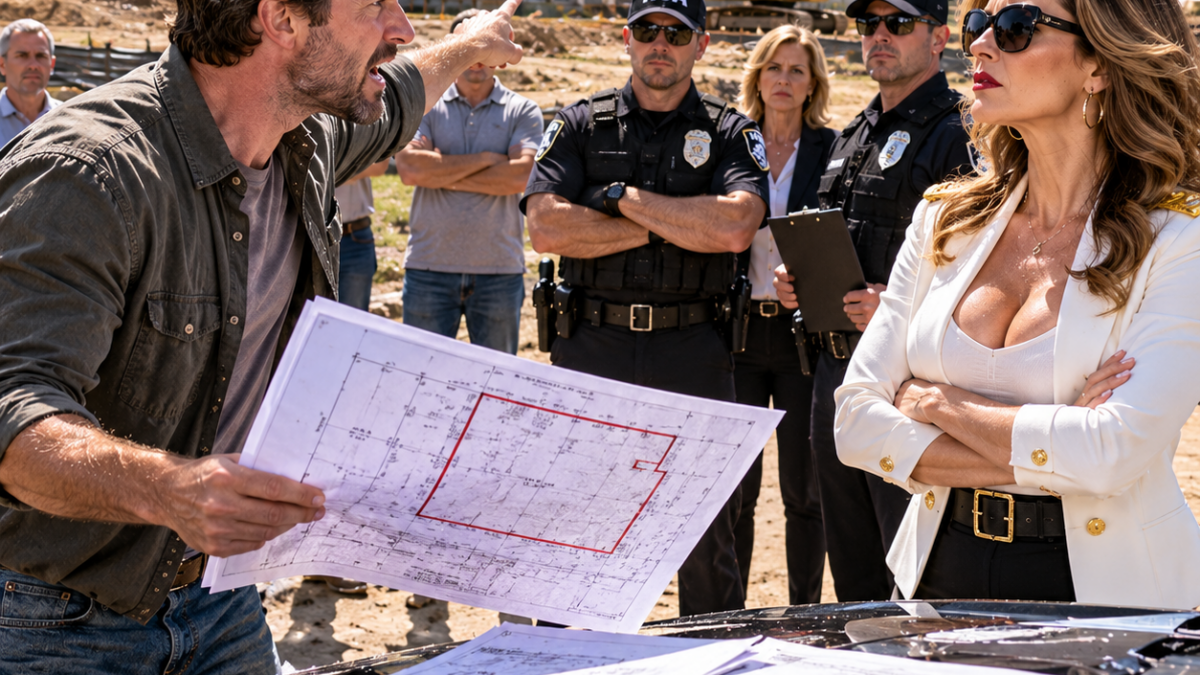
Karen Blake, president of the Hawthorne Ridge HOA, though really she was more of a developer-installed queen with a clipboard and a wardrobe built for intimidation.
She was about forty, with long caramel-blonde hair, a gym-sculpted body, bright lipstick, and the kind of expensive beauty that made certain people forgive her tone before understanding her words. She wore fitted dresses to board meetings, high heels to construction sites, and perfume strong enough to arrive before she did. She could be charming when she wanted something. A hand on a forearm. A tilted head. A breathy little laugh. But when charm failed, the mask dropped fast, and what showed underneath was pure control.
Karen emailed me directly.
That was her first mistake.
Mr. Hayes,
You are interfering with the growth of a lawful residential community and causing harm to families who invested in good faith. Your claims are opportunistic, your behavior is obstructionist, and your refusal to cooperate suggests you are attempting to squat on progress you neither created nor deserve.
Squat.
On my own land.
She continued.
The association is prepared to resolve this matter by offering a fair price for any minor strip you believe overlaps with your alleged parcel.
The number she offered was less than I had paid years earlier.
Not less than market value.
Less than my original purchase price.
I forwarded the email to Daniel.
Do not respond, he wrote back.
So I did not.
A week later, a certified letter arrived from the HOA’s law firm accusing me of slander for allegedly telling residents they had built on my land. I had told no one. I had not posted on social media. I had not gone door to door. The recorded lawsuit was doing the talking.
They were bluffing.
Fishing for a reaction.
We ignored the threat and served them formally.
They were served at a board meeting.
I heard later that it was very awkward.
Good.
The developer finally emerged from behind its layers of LLCs.
Hawthorne Development LLC.
Hawthorne Builders LLC.
Hawthorne Holdings.
Different names. Same people. Same P.O. box addresses. Same shell-game smell.
They hired a large regional firm and came in swinging.
Their survey was correct.
Mine was vague.
The county approved the plat.
They had acted in good faith.
Adverse possession.
That one made Daniel actually laugh.
“You don’t adverse possess recorded land owned by someone paying taxes because he works overseas,” he said. “That’s not how this works.”
They dragged the county in as a third party for approving the plat. The county, predictably, said its approval was administrative, not a field verification. They filed documents. The HOA tried to distance itself, claiming it merely managed common areas.
That might have worked if Karen had not been sending emails calling me a squatter, collecting dues from houses on my land, and enforcing covenants over property the HOA had no authority to touch.
At one point, someone suggested I simply join the HOA.
I laughed out loud.
Hard pass.
People later assumed I had endless money to fight this.
I did not.
Legal fees were brutal. Stress does not show up as a line item, but it costs plenty. The only reason I survived financially was title insurance. My policy covered legal defense to protect my title, and that became the lifeline under everything.
We were not fighting on vibes.
We had recorded documents.
We had title insurance.
We had my original surveyor, who came back out with equipment, staked the original corners, confirmed everything to the inch, photographed the markers, and signed an affidavit.
Then we found the iron pin at the northwest corner.
Exactly where my deed said it would be.
Buried under three inches of mulch beside a model home’s landscaping bed.
When the surveyor uncovered it, I almost cried.
It was just a piece of metal in the ground.
But to me, it felt like my grandmother reaching up through the dirt to say, See? You weren’t crazy.
The first major hearing was for temporary injunctive relief.
The courtroom was cold and quiet, the kind of place where whispers sound guilty. The judge had the tired patience of someone who had watched too many adults pretend not to understand simple things.
The developer’s attorney talked about jobs, progress, investment, hardship, and the public interest.
The HOA attorney talked about community reliance, families, good faith, and how I was trying to exploit a technicality.
Daniel stood and said one sentence that changed the air.
“Your Honor, we are not here to extort anyone. We are here to assert a property right recorded years before any of this. These houses are trespasses.”
The judge asked questions.
Good questions.
He asked the developer why they did not obtain a boundary-line agreement when their survey conflicted with prior records.
They danced.
He asked the HOA whether it held title to any of the land in question.
They said no.
He asked the county whether plat approval included a field check.
The county attorney said no. Administrative review for form, not substance.
The judge warned the developer that continued work on disputed parcels could result in sanctions if they lost.
They kept building anyway.
Not on the worst overlapping sections, but everywhere else, like speed could outrun title. They rushed closings on the four finished houses, but title companies had seen the lis pendens and were not suicidal.
Three closings stopped.
Buyers got nervous.
One prospective buyer reached out through Daniel because he had seen the notice and did not want to buy anything that might get bulldozed. He was polite. Scared. Angry at the builder, not me.
I felt bad for him.
That mattered later, because people tried to paint me as heartless.
I did not hate the buyers.
My problem was with the people who paved over my deed and then told me to be reasonable.
Then one house closed anyway.
I found out because a new deed appeared in the recorder’s index, transferring title from Hawthorne Builders LLC to a family trust. The title company had insured around the lis pendens by tying the legal description to the HOA plat number rather than my metes-and-bounds description, taking the position that the notice did not specifically describe that lot.
It was bold.
It was reckless.
It was stupid.
Daniel’s face when he read it belonged in a museum.
The judge’s eyebrows climbed when he saw it.
Any possibility of a clean, quiet settlement evaporated.
We amended the complaint to add the buyers as necessary parties because their house now physically sat on land I held title to. I hated that. I truly did. They were just trying to buy a home. But legally, they had to be included if the court was going to decide what happened to the structure.
The buyers lawyered up immediately.
Then they turned their fire on the developer and title company.
As they should have.
They countersued for fraud and negligence. Suddenly, in their eyes, I was not the villain anymore. I was the guy who had uncovered the bomb hidden under their closing documents.
Karen tried to manage the narrative.
The HOA sent out a newsletter calling the lawsuit “an attack on neighborhood stability” and “an opportunistic attempt to exploit a minor mapping discrepancy.”
Daniel sent them a cease-and-desist letter about mischaracterizing active litigation.
The next newsletter was much shorter.
We mediated once.
The developer offered to buy my parcel at pre-development market value.
Pre-development.
As if they could take my land, build houses on it, create a legal disaster, and then pay me what empty dirt might have been worth before they weaponized it.
The HOA offered to waive my dues forever if I deeded the overlapping strips to the association.
I looked at Karen across the table.
She was wearing a fitted navy dress and pearl earrings, every hair in place, fingers folded elegantly over a leather notebook. She smiled like she was being generous.
I said, calmly, “I am not joining your HOA.”
Her smile tightened.
I continued.
“Any offer needs to cover removal of unauthorized structures, loss of use, attorney fees, title damage, survey costs, risk premium, and compensation for years of trespass.”
The developer countered with a number that would not buy a decent used pickup.
Daniel closed his folder.
“We’ll see you in court.”
The trial phase was slow, technical, and exhausting.
Surveys entered evidence.
Experts explained bearings, baselines, iron pins, plats, and why using a different basis of bearing without reconciling prior records is the mapping equivalent of changing rulers mid-measure.
The developer’s surveyor tried to cast doubt, but every time Daniel asked why he had not located existing markers before platting over prior recorded land, he became less confident.
My surveyor was calm.
Precise.
Almost boring.
That helped.
Boring truth beats dramatic nonsense.
The judge listened. Asked sharp questions. Took it under advisement.
The decision came on an ordinary weekday.
I was doing laundry when Daniel called.
“Sit down,” he said.
I sat on the edge of the bed with a towel in my hand.
“We won title.”
For a second, I could not speak.
“My deed controls,” he continued. “The Hawthorne plat is void as to the portion overlaying your parcel. The court found the developer had actual or constructive notice of your title.”
I closed my eyes.
“There’s more,” Daniel said.
The court granted injunctive relief.
Ordered ejectment of structures encroaching on my land.
Awarded costs and attorney fees against the developer, with the HOA liable for parts of the mess because it had enforced covenants over property it had no authority to govern.
The county was ordered to correct its plat records.
The opinion was dry, like legal opinions always are, but one phrase lodged in my chest.
Reckless disregard for recorded property rights.
Reckless disregard.
That was exactly what it had been.
They filed an emergency motion to stay the ejectment, arguing that removal would cause irreparable harm to families.
The judge denied it.
His response, in polished legal language, amounted to: You should have thought of that before pouring foundations.
He did allow a brief grace period for occupants to move out and for belongings to be stored properly. That was humane. It did not make the next part less brutal.
The HOA held a special meeting.
Their notice said CRISIS in capital letters.
Someone sent me a copy because, by then, half the neighborhood seemed to have chosen sides. Karen wrote that the community was under attack by a land speculator trying to profit from technicalities.
Land speculator.
I still had the same deed I bought before their stone monument existed.
They proposed an emergency assessment to fund appeals.
It failed.
Enough homeowners were furious at the developer, the title company, and the HOA board that they refused to pay for someone else’s arrogance. Karen’s control started cracking in public. I heard she screamed at one homeowner in the clubhouse parking lot and called him disloyal. The story spread quickly.
Demolition day was surreal.
I still feel it in my hands when I think about it.
It started early. Gray sky. Damp air. News vans parked across the street because nothing draws cameras like expensive houses being knocked down under court order. A sheriff’s deputy was there. The developer had exhausted emergency motions. The writ was posted. The judge had made it clear the order was not a suggestion.
The family that had closed on one of the houses had already moved out. The title company was paying for temporary housing by then, scrambling to reduce the damage it had helped create. Other buyers had backed away. The under-construction houses stood empty.
Neighbors gathered at a distance.
Some looked angry.
Some looked sad.
Some looked like they were watching a car accident in slow motion.
Karen arrived in white slacks, heels, and sunglasses, looking like she had dressed for a yacht and accidentally walked into consequences. She went straight to the crew and tried to block them with her body.
A deputy told her to move.
She argued.
He told her again.
She moved.
Then she saw me.
Her stare could have stripped paint.
I said nothing.
The excavator rolled in like an elephant.
The operator was calm, professional, and clearly uninterested in anyone’s feelings. He positioned the machine beside the first house. The boom rose. The bucket touched the roofline gently at first, almost carefully.
Then pushed.
The sound was awful.
Wood cracked. Siding snapped. Glass spiderwebbed. The house did not collapse like movies. It folded slowly, resisting, then surrendering in sections. One bite opened the living room wall. I saw a fireplace, pale drywall, the ghost of a room someone had imagined decorating.
A woman near me made a strangled sound.
I did not smile.
I could not.
Was it satisfying? Yes, in a grim way. The law was finally speaking in a language the developer could not ignore.
But joyful?
No.
A family had been hurt. Buyers had been lied to. Workers had built something that should never have been started. A house is not just lumber and drywall once someone has imagined living in it.
But if someone can build on your land and keep it because removing it is inconvenient, then property rights are not rights.
They are suggestions.
Karen sidled closer while the first house came apart.
“You didn’t have to do this,” she hissed.
I looked at her.
It was the only full sentence I said to her in person during the entire saga.
“You could have checked a map.”
Her mouth opened.
Closed.
A neighbor behind me muttered, “Good.”
Karen walked away.
The second house came down faster. The third and fourth faster still. The unfinished houses were reduced to frames, then piles, then slabs. The slabs were jackhammered. The lots were scraped back toward grade. Water mist kept the dust down, turning everything into a gray paste that smelled like wet drywall and hubris.
The developer stood nearby with a phone glued to his ear, arguing with someone about cost.
He looked smaller than he had in court.
Most arrogant men do when machinery starts translating their mistakes.
A week later, one developer entity filed for bankruptcy.
Nobody was surprised. Daniel had anticipated shell games and tied liability to related entities where possible. The title company was already bracing for a massive payout. The surveyor’s insurance company got involved. The county updated the plat and added notations so no one could pretend the voided section had never existed.
The HOA unraveled quickly.
Their budget assumed dues from homes that no longer existed. Landscaping bills bounced. The entrance fountain stopped running, and algae bloomed until the water looked like soup. Weeds grew around the stone sign. The perfect little monument started to look like a warning.
Hawthorne Ridge filed notice that it was insolvent and seeking to wind up.
Karen resigned before she could be removed, though everyone knew which it really was. Later I heard she and her husband sold and moved to another county. I do not know whether she joined another HOA. I hope, for everyone’s sake, she took up a hobby that does not involve property lines.
The aftermath took longer than the demolition.
A special master helped untangle the mess. The buyers who had closed received buybacks and damages through title insurance and lawsuits. Buyers under contract got earnest money returned, plus some. The lender took losses. The developer’s related entities fought among themselves. The surveyor’s insurer wrote checks large enough to make grown executives stare out windows.
We went back to court one final time to settle fees and damages.
The court awarded costs for the years my land was tied up, attorney fees, survey expenses, and damages tied to loss of use. It did not make me rich. It did not give back the years. But it restored the legal truth.
My quiet rectangle was mine.
People still ask whether I could have sold them the land under the houses.
Maybe.
There are legal structures like ground leases. There are settlements. There are ways to turn trespass into money if everyone behaves rationally early enough.
But by the time they called me a squatter, froze me out, lied to buyers, insured around the lawsuit, and tried to bully me into taking less than I had paid years earlier, that road was gone.
I did not want to become a landlord to houses built on theft.
I did not want to join Karen’s HOA.
I did not want to spend the rest of my life negotiating with people who had already shown me what their promises were worth.
The cleanest solution legally was to reset the land.
Not the easiest emotionally.
But the cleanest.
If that makes me the villain in someone else’s version, I can live with that.
I never wanted HOA destruction on my resume. I never wanted news cameras. I never wanted to stand beside a sheriff while an excavator chewed through someone’s almost-home. I wanted dirt. Quiet. A sunset. A place where I could hear myself think.
And eventually, after the rubble was gone, after the trucks stopped hauling away debris, after the county corrected the records and the last legal invoice arrived, that is what I had again.
The land looked wounded for a while.
Scraped flat. Muddy after rain. No longer wild in the same way. Tire tracks cut through places where grass used to grow. The tree line survived, though. So did the gully. And one evening, months after the demolition, I drove out with coffee and stood where the cul-de-sac had been.
The sunset was still there.
That surprised me.
Not that the sun set, obviously, but that it could still look beautiful over ground that had held so much conflict. The sky turned orange and pink behind the ragged tree line, and for a moment, I heard my grandmother’s voice.
That sounds like a place where you can hear yourself think.
I thought about her hospice room.
Her hand in mine.
Don’t let it sit there like a dream you’re scared to touch.
So I didn’t.
I put up a simple gate first.
Then proper boundary signs.
Then I brought in a surveyor one more time, not because I needed convincing but because I wanted fresh markers after everything. Pink tape snapped in the wind like the old neon ribbons had years before. I walked the line slowly, touching each marker, committing them to memory again.
Mine.
Not because I wanted to keep everyone out of spite.
Because keeping what is yours should not require apology.
The following spring, I planted wildflowers where one driveway had been.
I did not build immediately. I needed time to want again without anger leading. But I cleared brush. Brought in gravel for a small parking area. Set a bench near the gully. My neighbor—the original one, the trailer guy—came by and helped me pull a stubborn piece of construction debris from the dirt.
“Hell of a mess,” he said.
“Yeah.”
“You okay?”
I looked around.
At the tree line.
The markers.
The sunset.
The place where four houses had stood and then disappeared because arrogance met a deed it could not erase.
“I’m getting there,” I said.
And I was.
Karen’s HOA is gone now, or close enough to gone that nobody with sense says its name like it has power. The developer’s shiny signs came down. The stone monument was eventually removed. The street remains, awkwardly truncated, a reminder of a plan that overreached. Some homeowners nearby still glare when they see me. Others wave. A few have quietly apologized.
One man walking his dog stopped near the edge one evening and said, “For what it’s worth, they lied to us too.”
I nodded.
“I know.”
He looked at the field.
“Still. Must feel good.”
I thought about the demolition. The lawsuits. The grief. The years. My grandmother.
“It feels right,” I said. “Good is more complicated.”
That is still the truth.
I feel bad for the families misled by a developer’s greed and an HOA’s pride.
I do not feel bad for Karen.
I do not feel bad for the board members who called me a squatter.
I do not feel bad for the attorneys who tried to bury a recorded deed under expensive words.
I do not feel bad for the developer who ignored an iron pin because it stood in the way of profit.
They made it personal because they thought I was alone.
Out of the country.
Grieving.
Confused.
Small.
But I had a deed.
I had insurance.
I had a survey.
I had a grandmother’s voice in my head telling me not to be afraid of touching the dream.
And in the end, that was enough.
The land is quiet again now.
Not untouched.
Not innocent.
But quiet.
Sometimes I take coffee out there in the morning and stand where the model home’s porch once faced a street that never should have crossed my dirt. The air smells like grass and damp earth. Birds move through the tree line. The gully fills after storms exactly the way it used to. The wildflowers are starting to take.
I still have the laminated plat map.
It is worn at the edges now, smudged from courtrooms, offices, and too many angry nights spread across kitchen tables. I keep it in the same red folder with the deed, the judgment, and a photo of my grandmother on her porch, smiling like she knows something everyone else has forgotten.
Maybe she did.
People think land is just dirt until someone tries to steal it.
Then you learn it is memory.
Choice.
Work.
Future.
A place you bought before anyone else saw value in it.
A place where someone who loved you imagined you becoming more yourself.
Karen saw a rectangle on a map and decided it was expendable.
The developer saw an inconvenience.
The HOA saw leverage.
I saw the place my grandmother told me not to abandon.
So when they called me a squatter, I let the records answer.
When they called it progress, I let the court answer.
And when the excavator came, I watched the houses fall on the exact land they never should have touched, knowing the truth had been there the whole time, buried under mulch beside an iron pin, waiting for someone stubborn enough to dig it back up.
the end
The HOA Built Four Houses on My Land While I Was Overseas, Then Called Me a Squatter When I Came Home
I left the country with a deed, a recorded survey, and a quiet rectangle of dirt I thought would someday become my home.
When I came back, four brand-new houses were standing where my land used to be, and Karen’s HOA told me I was the problem.
They called me a squatter, offered me less than I had paid years earlier, and dared me to prove what every map already knew.
Before everything went wrong, the land was just a place where I could breathe.
That sounds dramatic, but if you have ever lived too long between traffic, apartment walls, late-night sirens, and neighbors whose televisions seemed to share your living room, you understand what I mean. I did not want a mansion. I did not want a showpiece. I did not want a gated entrance, a golf course, or one of those neighborhoods where every mailbox looks like it came from the same catalog page. I wanted space. Not much. Just enough that I could stand outside with a cup of coffee and not immediately become part of someone else’s life.
The parcel was small by rural standards, but to me it felt enormous.
A little rectangle of dirt just outside of town.
No utilities. No structures. No driveway worth bragging about. Just scrub grass, a scraggly tree line on one side, a shallow gully that filled after heavy rain, and a sunset view that made the whole place look like a promise. The first time I walked it, there were neon ribbons tied to the survey stakes, snapping in the wind like they were excited to be found.
I bought it outright with savings.
That mattered to me. I did not finance it. I did not inherit it. I did not gamble on it. I worked, saved, waited, and signed every document with a nervous hand because owning land felt like something grown-ups did, and part of me still expected someone at the title company to look across the table and say, “Are you sure you’re allowed?”
They did not.
They gave me a deed.
They gave me title insurance.
They gave me a plat map, laminated because the woman handling the closing said, “Trust me, keep this clean.”
My legal description looked like it had been written by a geometry teacher trying to punish someone. Metes and bounds. Bearings. Distances. Iron pins. Degrees. References to corners and lines I could barely picture until the title agent pulled out a highlighter and walked me through it.
“This is yours,” she said, tapping the little shape on the map.
Mine.
I remember sitting in my truck afterward, looking at the folder in the passenger seat, and feeling something settle inside me.
A few months later, I had to leave the country for work.
It was supposed to be a long-term assignment, the kind of opportunity you do not turn down unless you have a very good reason. Housing covered. Stipend. Career growth. A chance to see a part of the world I had only read about. I was not ready to build on the land anyway. I had taxes on autopay. The parcel was unimproved, so the taxes were low. I gave a neighbor I trusted permission to park his trailer near the edge if he ever needed to, mostly so someone local had a reason to glance that way now and then.
Then I packed my bags and left.
For a while, everything was fine.
I worked. I traveled. I sent postcards. I ate food I still miss. Every so often, a county tax notice came through my email. I verified the amount, saved the receipt in a folder labeled DO NOT MESS UP, and moved on. My neighbor sent occasional photos after storms. Your tree survived. Gully’s full again. Nothing looked wrong. Nothing hinted that while I was building a life overseas, somebody back home was building a disaster over mine.
Then my grandmother got sick.
part2
My grandmother had raised me almost as much as my parents had.
When I was little and both my parents worked long shifts, she was the one who walked me to the bus stop. She made sure I knew my multiplication tables. She taught me how to fold fitted sheets, though I still cannot do it correctly and suspect the entire thing is a scam. She made biscuits without measuring anything, just flour, Crisco, buttermilk, and some mysterious ancestral knowledge in her fingers.
The night before I bought the land, she sat with me at her kitchen table while I spread out the plat map and closing documents like I was planning an expedition.
“Are you sure?” she asked.
That was her way. She never doubted me cruelly. She just believed a person ought to test a dream before trusting it.
“I think so,” I said.
She studied the map, then the photo I had taken of the tree line and sunset.
“That looks like a place where you can hear yourself think.”
Years later, those words would haunt me.
The cancer had been quiet at first. She brushed off the symptoms as age. By the time doctors found it, it had settled into her lungs, liver, and bones like an invader that had already unpacked. They gave her six months. She lasted four.
I flew home on an emergency flight that felt like it took years.
I went straight from the airport to hospice.
No matter how prepared you think you are, nothing prepares you for seeing someone strong reduced to a bed, a whiteboard full of medications, and hands thin as paper. Her room smelled like antiseptic trying and failing to hide sadness. There were flowers from church ladies on the windowsill. A quilt from her sister folded at her feet. Blinds that would not close all the way.
When she saw me, her eyes lit up.
“You came back,” she whispered.
“Of course I came back.”
My voice broke so badly I had to sit down.
I stayed through the end.
At night, she wanted me close because, as she put it, I did not “hover like a hummingbird.” I knew when to talk and when to sit quietly. Around two or three in the morning, when the fear got too big in the dark, she would call for me. I would sit beside her bed and hold her hand, feeling every fragile bone under the skin, and she would tell stories I had heard a hundred times, plus a few she had saved for the edge of goodbye.
She told me about her first car.
About my grandfather.
About the time she almost left him before they married because he spent their furniture money on a hunting dog.
She told me she was proud of me for taking the overseas job.
Proud of me for buying the land.
Proud of me for wanting something of my own.
One night, her breathing was rough and uneven, and I thought she had drifted off. Then she squeezed my hand.
“Don’t let it just sit there,” she whispered.
I leaned closer. “What?”
“Your land.” Her eyes opened, cloudy but still hers. “Don’t let it sit there like a dream you’re scared to touch.”
“I won’t,” I said.
I meant it.
She died three days later, early in the morning before the birds started.
There is a silence after someone dies that is not like any other silence. It has weight. The room changes. The air changes. The person is still there and already gone, and your brain cannot hold both truths at once.
We sat with her for a while.
Then came the calls.
The funeral home.
Family.
Church.
Neighbors.
Then the funeral, the reception, the casseroles, the sympathy cards, the awful work of sorting a person’s entire life into boxes labeled keep, donate, throw away. I kept her recipe box. Her coffee mug that said WORLD’S BEST GRANDMA in peeling letters. A quilt. A photo of her and my grandfather on their wedding day, young and impossibly hopeful.
My company extended my leave.
For a while, I considered not going back overseas. Grief made everything feel pointless. But then I thought about what she had said. Do not let it sit there like a dream you are scared to touch. The land was still waiting. The taxes were still paid. The job was still an opportunity. And somehow, going back felt less like leaving her behind than trying to become the person she believed I could be.
So I went.
Another assignment. Another country. Another year that became more than a year.
When I finally came home for good, the first place I wanted to go was the land.
I did not even unpack properly.
I grabbed coffee, found the old folder, and drove out expecting weeds, maybe new wildflowers, maybe my tree line looking a little rougher than before. I expected quiet. I expected dirt. I expected the place where my grandmother said I could hear myself think.
Instead, I found a stone entrance monument.
Fresh landscaping.
A paved street.
Streetlights.
Matching mailboxes.
A banner that said WELCOME TO HAWTHORNE RIDGE HOA.
Hawthorne Ridge did not exist when I left.
I slowed down, thinking GPS had betrayed me. The old two-lane road was wider now, with a turn lane and decorative signs. Construction trucks were parked along the curb. There were two-story Craftsman-style houses with crisp siding, black-framed windows, and cute little porches designed to look nostalgic for a life no one there had lived.
And where my quiet rectangle of dirt should have been, there were four finished houses.
Four.
Finished.
Houses.
Two more under construction stood nearby, wrapped in Tyvek, like half-opened Christmas presents from someone who hated me.
I pulled onto the shoulder because signs said RESIDENTS ONLY and NO CONSTRUCTION PARKING, and I was too shocked to risk being towed on land I might still own.
For a while, I just sat there.
My coffee went cold in my hand.
The houses were arranged along a curve, neat and confident and wrong. One driveway cut across where my north boundary should have been. The cul-de-sac sat near the place I used to park my old pickup when I came out to watch sunsets. I knew the land well enough to feel the old corners in my body.
This was not adjacent to my parcel.
This was my parcel.
A man in a safety vest approached with a clipboard and a fake-friendly smile.
“Can I help you?”
“I own land here,” I said, my voice sounding strange. “Or I did. I’m looking for parcel 16B-32.”
He checked his clipboard.
“We don’t have that. Lots one through nineteen. You might be looking for the older subdivision up the hill.”
I pulled up the scan of my plat on my phone.
“No. Parcel 16B-32. Metes and bounds starting at the iron pin at the northeast corner—”
He actually laughed.
Not kindly.
“Buddy, if you’ve got metes and bounds, you’re probably talking about the east side of the highway. This is Hawthorne Ridge Phase One. All recorded.”
I stared at him.
“If you’re not a worker or homeowner,” he added, “I can’t have you wandering around. Liability.”
Liability.
I left without arguing because the man in the vest was not the one who had stolen my land. Or maybe he was part of it. I did not know yet. I only knew that if I stayed, I might start yelling, and yelling without documents is just noise.
So I drove straight to the county recorder’s office.
If there is one thing I learned from my father and grandmother, it is this: paper beats confidence.
The recorder’s office smelled exactly the same as it had years before—old paper, floor polish, and government patience. I gave the clerk my parcel number and asked for the full chain of title, recent subdivision plats, and anything recorded in that quarter township over the last few years.
She looked at my folder.
Then at my face.
Then back at the folder.
“Long day?”
“Getting longer.”
She helped me pull records.
For hours, I compared my deed, my original plat, the county GIS maps, and the new Hawthorne Ridge subdivision plat. I used the laminated map. I used the highlighter still tucked in the folder from closing. I traced lines until my eyes hurt.
The truth emerged slowly, then all at once.
The developer had purchased land adjacent to mine.
Then they recorded a subdivision plat that extended their boundary line over my parcel as if everything were one continuous piece. One corner had shifted about fifteen feet on paper, which cascaded into a distorted trapezoid of chaos that swallowed my rectangle.
If you are not a map person, imagine your neighbor sliding a fence post just a little, then using that new fake corner to redraw an entire yard, pave roads, pour driveways, and sell houses.
That was what they had done.
I asked the clerk if anyone had challenged the plat.
“No objections on file,” she said.
That made sense in the worst possible way.
I had been overseas. My mailing address was a P.O. box with forwarding. If notices came buried in junk mail from a subdivision I had never heard of, maybe I missed them. Maybe I thought they were marketing flyers. Maybe they never came properly at all.
That might have been on me administratively.
But legally?
You cannot erase a recorded deed by sketching a new map over it.
My next stop was a real estate attorney.
His name was Daniel Mercer, and I walked into his office with my red folder, laminated plat, and the exhausted expression of a man asking the most important question of his life.
“I need to know if I’m crazy.”
Daniel reviewed everything.
He looked at my deed. The subdivision plat. The county GIS. The chain of title. He squinted at bearings, chewed on his glasses, made notes, and spent a long time not saying anything.
Finally, he leaned back.
“You’re not crazy.”
I exhaled for what felt like the first time all day.
“Your deed predates their plat,” he said. “They built on your land.”
Hearing it said plainly did not make me feel better.
It made the ground drop away.
“What do I do?”
“That depends,” Daniel said. “We can file a quiet title action to confirm ownership. We can seek an injunction to stop further construction. We can file trespass and ejectment, which means removal. We can pursue damages. But first you need to decide what outcome you want.”
“What outcome I want?”
“Yes. Do you want to sell them the land? Do you want compensation? Do you want the houses removed?”
My first reaction was scorched earth.
Bulldoze it all.
Every porch, every driveway, every fake charming little window sitting on my dirt.
Then I thought about families. Buyers. People who might have walked through those model homes imagining nurseries, Thanksgiving dinners, and Christmas mornings. They had not redrawn the plat. They had not ignored my deed. They might be victims too.
“I don’t want to destroy someone’s dream home if this can be fixed,” I said.
Daniel nodded.
“That’s reasonable.”
Then he called the HOA’s attorney.
My sympathy lasted about two minutes.
The HOA attorney was not technically the developer’s attorney, but at that stage the HOA was still controlled by developer people. Different letterhead, same arrogance. Daniel sent documents. My deed. My plat. The overlay. A demand that they stop all construction on disputed parcels until the boundary issue was resolved.
The response came back fast.
No.
A whole lot of no.
They claimed the recorded Hawthorne Ridge plat controlled.
They claimed my deed was vague.
They claimed county approval validated their boundaries.
They claimed I was confused.
They claimed that even if there were an overlap, it was de minimis—a small issue.
Small.
They had put houses on my land and called it small.
Daniel forwarded the response with a note: They think you’re bluffing.
I was not bluffing.
We discussed a temporary restraining order to stop construction immediately. I asked how fast we could get a hearing. He told me. I asked whether the developer might just shift framing, claim partial compliance, and keep pushing. Daniel sighed.
“Sometimes developers operate on act first, ask forgiveness later.”
“What makes the strongest case?”
He paused.
“Honestly?”
“Yes.”
“Let them keep going long enough that there’s no way they can claim mistake, confusion, or lack of substantial harm. Document everything. Record notice. Then we ask for the remedy the law provides. If someone builds on land they don’t own, without permission and without good-faith belief that it’s theirs, the structure is a trespass. A court can order removal.”
That was a hard thing to sit with.
For a week, I drove past Hawthorne Ridge like a ghost haunting the place where his life used to be. I did not trespass inside houses. I stayed on public sidewalks, taking photos from legal places. I watched workers pour driveways where my weeds had been. I watched sales agents chirp at prospective buyers about community amenities. I watched a landscaper plant a maple tree near where my iron pin should have been.
Every time I thought about filing immediately, I remembered the HOA’s response.
Confused.
Small.
No.
They were daring me to prove it.
So I did.
I photographed construction progress. Saved screenshots from the builder’s website listing lots and addresses. Printed MLS listings when they appeared. Noted pending offers. Wrote down moving truck dates. Downloaded marketing materials. Saved every public representation that described the lots as clean, buildable, HOA-governed, and theirs.
Then we filed.
Quiet title.
Trespass.
Ejectment.
Injunctive relief.
Damages.
And, critically, we recorded a lis pendens—a notice to the world that a lawsuit affected the property.
The moment that lis pendens hit the records, closings froze.
Title companies do not like lawsuits clouding title. Buyers got nervous. Realtors panicked. The HOA sent a furious email accusing me of extortion.
We were not extorting anyone.
We were trying to stop innocent people from buying houses built on a legal landmine.
That was when Karen entered the story.
Karen Blake, president of the Hawthorne Ridge HOA, though really she was more of a developer-installed queen with a clipboard and a wardrobe built for intimidation.
She was about forty, with long caramel-blonde hair, a gym-sculpted body, bright lipstick, and the kind of expensive beauty that made certain people forgive her tone before understanding her words. She wore fitted dresses to board meetings, high heels to construction sites, and perfume strong enough to arrive before she did. She could be charming when she wanted something. A hand on a forearm. A tilted head. A breathy little laugh. But when charm failed, the mask dropped fast, and what showed underneath was pure control.
Karen emailed me directly.
That was her first mistake.
Mr. Hayes,
You are interfering with the growth of a lawful residential community and causing harm to families who invested in good faith. Your claims are opportunistic, your behavior is obstructionist, and your refusal to cooperate suggests you are attempting to squat on progress you neither created nor deserve.
Squat.
On my own land.
She continued.
The association is prepared to resolve this matter by offering a fair price for any minor strip you believe overlaps with your alleged parcel.
The number she offered was less than I had paid years earlier.
Not less than market value.
Less than my original purchase price.
I forwarded the email to Daniel.
Do not respond, he wrote back.
So I did not.
A week later, a certified letter arrived from the HOA’s law firm accusing me of slander for allegedly telling residents they had built on my land. I had told no one. I had not posted on social media. I had not gone door to door. The recorded lawsuit was doing the talking.
They were bluffing.
Fishing for a reaction.
We ignored the threat and served them formally.
They were served at a board meeting.
I heard later that it was very awkward.
Good.
The developer finally emerged from behind its layers of LLCs.
Hawthorne Development LLC.
Hawthorne Builders LLC.
Hawthorne Holdings.
Different names. Same people. Same P.O. box addresses. Same shell-game smell.
They hired a large regional firm and came in swinging.
Their survey was correct.
Mine was vague.
The county approved the plat.
They had acted in good faith.
Adverse possession.
That one made Daniel actually laugh.
“You don’t adverse possess recorded land owned by someone paying taxes because he works overseas,” he said. “That’s not how this works.”
They dragged the county in as a third party for approving the plat. The county, predictably, said its approval was administrative, not a field verification. They filed documents. The HOA tried to distance itself, claiming it merely managed common areas.
That might have worked if Karen had not been sending emails calling me a squatter, collecting dues from houses on my land, and enforcing covenants over property the HOA had no authority to touch.
At one point, someone suggested I simply join the HOA.
I laughed out loud.
Hard pass.
People later assumed I had endless money to fight this.
I did not.
Legal fees were brutal. Stress does not show up as a line item, but it costs plenty. The only reason I survived financially was title insurance. My policy covered legal defense to protect my title, and that became the lifeline under everything.
We were not fighting on vibes.
We had recorded documents.
We had title insurance.
We had my original surveyor, who came back out with equipment, staked the original corners, confirmed everything to the inch, photographed the markers, and signed an affidavit.
Then we found the iron pin at the northwest corner.
Exactly where my deed said it would be.
Buried under three inches of mulch beside a model home’s landscaping bed.
When the surveyor uncovered it, I almost cried.
It was just a piece of metal in the ground.
But to me, it felt like my grandmother reaching up through the dirt to say, See? You weren’t crazy.
The first major hearing was for temporary injunctive relief.
The courtroom was cold and quiet, the kind of place where whispers sound guilty. The judge had the tired patience of someone who had watched too many adults pretend not to understand simple things.
The developer’s attorney talked about jobs, progress, investment, hardship, and the public interest.
The HOA attorney talked about community reliance, families, good faith, and how I was trying to exploit a technicality.
Daniel stood and said one sentence that changed the air.
“Your Honor, we are not here to extort anyone. We are here to assert a property right recorded years before any of this. These houses are trespasses.”
The judge asked questions.
Good questions.
He asked the developer why they did not obtain a boundary-line agreement when their survey conflicted with prior records.
They danced.
He asked the HOA whether it held title to any of the land in question.
They said no.
He asked the county whether plat approval included a field check.
The county attorney said no. Administrative review for form, not substance.
The judge warned the developer that continued work on disputed parcels could result in sanctions if they lost.
They kept building anyway.
Not on the worst overlapping sections, but everywhere else, like speed could outrun title. They rushed closings on the four finished houses, but title companies had seen the lis pendens and were not suicidal.
Three closings stopped.
Buyers got nervous.
One prospective buyer reached out through Daniel because he had seen the notice and did not want to buy anything that might get bulldozed. He was polite. Scared. Angry at the builder, not me.
I felt bad for him.
That mattered later, because people tried to paint me as heartless.
I did not hate the buyers.
My problem was with the people who paved over my deed and then told me to be reasonable.
Then one house closed anyway.
I found out because a new deed appeared in the recorder’s index, transferring title from Hawthorne Builders LLC to a family trust. The title company had insured around the lis pendens by tying the legal description to the HOA plat number rather than my metes-and-bounds description, taking the position that the notice did not specifically describe that lot.
It was bold.
It was reckless.
It was stupid.
Daniel’s face when he read it belonged in a museum.
The judge’s eyebrows climbed when he saw it.
Any possibility of a clean, quiet settlement evaporated.
We amended the complaint to add the buyers as necessary parties because their house now physically sat on land I held title to. I hated that. I truly did. They were just trying to buy a home. But legally, they had to be included if the court was going to decide what happened to the structure.
The buyers lawyered up immediately.
Then they turned their fire on the developer and title company.
As they should have.
They countersued for fraud and negligence. Suddenly, in their eyes, I was not the villain anymore. I was the guy who had uncovered the bomb hidden under their closing documents.
Karen tried to manage the narrative.
The HOA sent out a newsletter calling the lawsuit “an attack on neighborhood stability” and “an opportunistic attempt to exploit a minor mapping discrepancy.”
Daniel sent them a cease-and-desist letter about mischaracterizing active litigation.
The next newsletter was much shorter.
We mediated once.
The developer offered to buy my parcel at pre-development market value.
Pre-development.
As if they could take my land, build houses on it, create a legal disaster, and then pay me what empty dirt might have been worth before they weaponized it.
The HOA offered to waive my dues forever if I deeded the overlapping strips to the association.
I looked at Karen across the table.
She was wearing a fitted navy dress and pearl earrings, every hair in place, fingers folded elegantly over a leather notebook. She smiled like she was being generous.
I said, calmly, “I am not joining your HOA.”
Her smile tightened.
I continued.
“Any offer needs to cover removal of unauthorized structures, loss of use, attorney fees, title damage, survey costs, risk premium, and compensation for years of trespass.”
The developer countered with a number that would not buy a decent used pickup.
Daniel closed his folder.
“We’ll see you in court.”
The trial phase was slow, technical, and exhausting.
Surveys entered evidence.
Experts explained bearings, baselines, iron pins, plats, and why using a different basis of bearing without reconciling prior records is the mapping equivalent of changing rulers mid-measure.
The developer’s surveyor tried to cast doubt, but every time Daniel asked why he had not located existing markers before platting over prior recorded land, he became less confident.
My surveyor was calm.
Precise.
Almost boring.
That helped.
Boring truth beats dramatic nonsense.
The judge listened. Asked sharp questions. Took it under advisement.
The decision came on an ordinary weekday.
I was doing laundry when Daniel called.
“Sit down,” he said.
I sat on the edge of the bed with a towel in my hand.
“We won title.”
For a second, I could not speak.
“My deed controls,” he continued. “The Hawthorne plat is void as to the portion overlaying your parcel. The court found the developer had actual or constructive notice of your title.”
I closed my eyes.
“There’s more,” Daniel said.
The court granted injunctive relief.
Ordered ejectment of structures encroaching on my land.
Awarded costs and attorney fees against the developer, with the HOA liable for parts of the mess because it had enforced covenants over property it had no authority to govern.
The county was ordered to correct its plat records.
The opinion was dry, like legal opinions always are, but one phrase lodged in my chest.
Reckless disregard for recorded property rights.
Reckless disregard.
That was exactly what it had been.
They filed an emergency motion to stay the ejectment, arguing that removal would cause irreparable harm to families.
The judge denied it.
His response, in polished legal language, amounted to: You should have thought of that before pouring foundations.
He did allow a brief grace period for occupants to move out and for belongings to be stored properly. That was humane. It did not make the next part less brutal.
The HOA held a special meeting.
Their notice said CRISIS in capital letters.
Someone sent me a copy because, by then, half the neighborhood seemed to have chosen sides. Karen wrote that the community was under attack by a land speculator trying to profit from technicalities.
Land speculator.
I still had the same deed I bought before their stone monument existed.
They proposed an emergency assessment to fund appeals.
It failed.
Enough homeowners were furious at the developer, the title company, and the HOA board that they refused to pay for someone else’s arrogance. Karen’s control started cracking in public. I heard she screamed at one homeowner in the clubhouse parking lot and called him disloyal. The story spread quickly.
Demolition day was surreal.
I still feel it in my hands when I think about it.
It started early. Gray sky. Damp air. News vans parked across the street because nothing draws cameras like expensive houses being knocked down under court order. A sheriff’s deputy was there. The developer had exhausted emergency motions. The writ was posted. The judge had made it clear the order was not a suggestion.
The family that had closed on one of the houses had already moved out. The title company was paying for temporary housing by then, scrambling to reduce the damage it had helped create. Other buyers had backed away. The under-construction houses stood empty.
Neighbors gathered at a distance.
Some looked angry.
Some looked sad.
Some looked like they were watching a car accident in slow motion.
Karen arrived in white slacks, heels, and sunglasses, looking like she had dressed for a yacht and accidentally walked into consequences. She went straight to the crew and tried to block them with her body.
A deputy told her to move.
She argued.
He told her again.
She moved.
Then she saw me.
Her stare could have stripped paint.
I said nothing.
The excavator rolled in like an elephant.
The operator was calm, professional, and clearly uninterested in anyone’s feelings. He positioned the machine beside the first house. The boom rose. The bucket touched the roofline gently at first, almost carefully.
Then pushed.
The sound was awful.
Wood cracked. Siding snapped. Glass spiderwebbed. The house did not collapse like movies. It folded slowly, resisting, then surrendering in sections. One bite opened the living room wall. I saw a fireplace, pale drywall, the ghost of a room someone had imagined decorating.
A woman near me made a strangled sound.
I did not smile.
I could not.
Was it satisfying? Yes, in a grim way. The law was finally speaking in a language the developer could not ignore.
But joyful?
No.
A family had been hurt. Buyers had been lied to. Workers had built something that should never have been started. A house is not just lumber and drywall once someone has imagined living in it.
But if someone can build on your land and keep it because removing it is inconvenient, then property rights are not rights.
They are suggestions.
Karen sidled closer while the first house came apart.
“You didn’t have to do this,” she hissed.
I looked at her.
It was the only full sentence I said to her in person during the entire saga.
“You could have checked a map.”
Her mouth opened.
Closed.
A neighbor behind me muttered, “Good.”
Karen walked away.
The second house came down faster. The third and fourth faster still. The unfinished houses were reduced to frames, then piles, then slabs. The slabs were jackhammered. The lots were scraped back toward grade. Water mist kept the dust down, turning everything into a gray paste that smelled like wet drywall and hubris.
The developer stood nearby with a phone glued to his ear, arguing with someone about cost.
He looked smaller than he had in court.
Most arrogant men do when machinery starts translating their mistakes.
A week later, one developer entity filed for bankruptcy.
Nobody was surprised. Daniel had anticipated shell games and tied liability to related entities where possible. The title company was already bracing for a massive payout. The surveyor’s insurance company got involved. The county updated the plat and added notations so no one could pretend the voided section had never existed.
The HOA unraveled quickly.
Their budget assumed dues from homes that no longer existed. Landscaping bills bounced. The entrance fountain stopped running, and algae bloomed until the water looked like soup. Weeds grew around the stone sign. The perfect little monument started to look like a warning.
Hawthorne Ridge filed notice that it was insolvent and seeking to wind up.
Karen resigned before she could be removed, though everyone knew which it really was. Later I heard she and her husband sold and moved to another county. I do not know whether she joined another HOA. I hope, for everyone’s sake, she took up a hobby that does not involve property lines.
The aftermath took longer than the demolition.
A special master helped untangle the mess. The buyers who had closed received buybacks and damages through title insurance and lawsuits. Buyers under contract got earnest money returned, plus some. The lender took losses. The developer’s related entities fought among themselves. The surveyor’s insurer wrote checks large enough to make grown executives stare out windows.
We went back to court one final time to settle fees and damages.
The court awarded costs for the years my land was tied up, attorney fees, survey expenses, and damages tied to loss of use. It did not make me rich. It did not give back the years. But it restored the legal truth.
My quiet rectangle was mine.
People still ask whether I could have sold them the land under the houses.
Maybe.
There are legal structures like ground leases. There are settlements. There are ways to turn trespass into money if everyone behaves rationally early enough.
But by the time they called me a squatter, froze me out, lied to buyers, insured around the lawsuit, and tried to bully me into taking less than I had paid years earlier, that road was gone.
I did not want to become a landlord to houses built on theft.
I did not want to join Karen’s HOA.
I did not want to spend the rest of my life negotiating with people who had already shown me what their promises were worth.
The cleanest solution legally was to reset the land.
Not the easiest emotionally.
But the cleanest.
If that makes me the villain in someone else’s version, I can live with that.
I never wanted HOA destruction on my resume. I never wanted news cameras. I never wanted to stand beside a sheriff while an excavator chewed through someone’s almost-home. I wanted dirt. Quiet. A sunset. A place where I could hear myself think.
And eventually, after the rubble was gone, after the trucks stopped hauling away debris, after the county corrected the records and the last legal invoice arrived, that is what I had again.
The land looked wounded for a while.
Scraped flat. Muddy after rain. No longer wild in the same way. Tire tracks cut through places where grass used to grow. The tree line survived, though. So did the gully. And one evening, months after the demolition, I drove out with coffee and stood where the cul-de-sac had been.
The sunset was still there.
That surprised me.
Not that the sun set, obviously, but that it could still look beautiful over ground that had held so much conflict. The sky turned orange and pink behind the ragged tree line, and for a moment, I heard my grandmother’s voice.
That sounds like a place where you can hear yourself think.
I thought about her hospice room.
Her hand in mine.
Don’t let it sit there like a dream you’re scared to touch.
So I didn’t.
I put up a simple gate first.
Then proper boundary signs.
Then I brought in a surveyor one more time, not because I needed convincing but because I wanted fresh markers after everything. Pink tape snapped in the wind like the old neon ribbons had years before. I walked the line slowly, touching each marker, committing them to memory again.
Mine.
Not because I wanted to keep everyone out of spite.
Because keeping what is yours should not require apology.
The following spring, I planted wildflowers where one driveway had been.
I did not build immediately. I needed time to want again without anger leading. But I cleared brush. Brought in gravel for a small parking area. Set a bench near the gully. My neighbor—the original one, the trailer guy—came by and helped me pull a stubborn piece of construction debris from the dirt.
“Hell of a mess,” he said.
“Yeah.”
“You okay?”
I looked around.
At the tree line.
The markers.
The sunset.
The place where four houses had stood and then disappeared because arrogance met a deed it could not erase.
“I’m getting there,” I said.
And I was.
Karen’s HOA is gone now, or close enough to gone that nobody with sense says its name like it has power. The developer’s shiny signs came down. The stone monument was eventually removed. The street remains, awkwardly truncated, a reminder of a plan that overreached. Some homeowners nearby still glare when they see me. Others wave. A few have quietly apologized.
One man walking his dog stopped near the edge one evening and said, “For what it’s worth, they lied to us too.”
I nodded.
“I know.”
He looked at the field.
“Still. Must feel good.”
I thought about the demolition. The lawsuits. The grief. The years. My grandmother.
“It feels right,” I said. “Good is more complicated.”
That is still the truth.
I feel bad for the families misled by a developer’s greed and an HOA’s pride.
I do not feel bad for Karen.
I do not feel bad for the board members who called me a squatter.
I do not feel bad for the attorneys who tried to bury a recorded deed under expensive words.
I do not feel bad for the developer who ignored an iron pin because it stood in the way of profit.
They made it personal because they thought I was alone.
Out of the country.
Grieving.
Confused.
Small.
But I had a deed.
I had insurance.
I had a survey.
I had a grandmother’s voice in my head telling me not to be afraid of touching the dream.
And in the end, that was enough.
The land is quiet again now.
Not untouched.
Not innocent.
But quiet.
Sometimes I take coffee out there in the morning and stand where the model home’s porch once faced a street that never should have crossed my dirt. The air smells like grass and damp earth. Birds move through the tree line. The gully fills after storms exactly the way it used to. The wildflowers are starting to take.
I still have the laminated plat map.
It is worn at the edges now, smudged from courtrooms, offices, and too many angry nights spread across kitchen tables. I keep it in the same red folder with the deed, the judgment, and a photo of my grandmother on her porch, smiling like she knows something everyone else has forgotten.
Maybe she did.
People think land is just dirt until someone tries to steal it.
Then you learn it is memory.
Choice.
Work.
Future.
A place you bought before anyone else saw value in it.
A place where someone who loved you imagined you becoming more yourself.
Karen saw a rectangle on a map and decided it was expendable.
The developer saw an inconvenience.
The HOA saw leverage.
I saw the place my grandmother told me not to abandon.
So when they called me a squatter, I let the records answer.
When they called it progress, I let the court answer.
And when the excavator came, I watched the houses fall on the exact land they never should have touched, knowing the truth had been there the whole time, buried under mulch beside an iron pin, waiting for someone stubborn enough to dig it back up.