𝗙𝗨𝗟𝗟 𝗦𝗧𝗢𝗥𝗬 The HOA Board Member Tried to Force Her Way Into My House—Then Called the Police When I Locked Her Out
𝗣𝗔𝗥𝗧 𝟮
I looked at her.
Then the wet grass.
Then the hose still in my hand.
“I’m using it.”
“You’re finished.”
“I literally just turned the water off.”
She opened her notebook.
“I’m giving you a verbal warning.”
That got my attention.
“For watering?”
“For leaving equipment visible.”
“I haven’t left anything.”
Her mouth tightened.
“Excuses don’t matter to the board.”
I almost laughed.
“The board?”
“Community standards exist for everyone.”
“I’m standing here holding the hose.”
“Then you should put it away.”
I stared at her.
There are moments when you have to decide whether an argument is worth twenty minutes of your life.
That wasn’t.
I smiled.
“Sure.”
I coiled the hose.
Put it in the garage.
Victoria nodded as though she’d supervised a successful compliance operation.
“Thank you.”
Then she walked away.
I watched her.
Emily opened the front door behind me.
“What was that?”
“Apparently the hose attempted a coup.”
“What?”
“Nothing.”
We went inside.
But the interaction bothered me.
Not because she’d said something about the hose.
Because of the certainty.
Excuses don’t matter to the board.
So that evening, I pulled out the HOA documents.
Read them again.
Searched electronically.
Hoses.
Garden equipment.
Street view.
Temporary use.
Nothing.
Absolutely nothing said I couldn’t have a hose visible while actively watering.
The next morning, I emailed Mark.
Very casually.
“Hey, weird question. Is there some rule about hoses needing to be concealed while you’re using them?”
He replied twenty minutes later.
“No.”
That was it.
No explanation.
No hidden amendment.
Just:
“No.”
Interesting.
A couple weeks later, our next-door neighbor, Sam, had his own Victoria encounter.
Sam and his wife had a big ceramic planter beside their front door.
Blue.
Nice-looking thing.
One Saturday, I was washing my truck when Victoria marched up their walkway.
I didn’t mean to listen.
Hard not to when she talked like someone addressing a public meeting.
“That planter isn’t on the approved color palette.”
Sam was kneeling near the flower bed.
He looked up.
“What?”
“The blue.”
Sam stared at the planter.
Then at Victoria.
“It’s a pot.”
“It’s visible from the street.”
“Yes.”
“The exterior standards specify earth tones.”
Sam stood.
“Does the rule mention flowerpots?”
Victoria opened her mouth.
Sam didn’t wait.
He walked inside.
Closed the door.
Victoria stood there for five seconds.
Then wrote something in her notebook.
I had to turn away because I was smiling.
That became the pattern.
Victoria saw the HOA board as a license to interfere.
Trash cans.
Potted plants.
Driveway basketball hoops.
Door wreaths.
Patio furniture visible through a side gate.
Half the time, she cited things that weren’t actually prohibited.
Most people simply ignored her.
Some argued.
A few complied because fighting was more exhausting than moving a pot.
Victoria seemed to interpret every act of compliance as proof her authority was real.
Then Emily and I decided to repaint the guest bathroom.
That was how everything finally exploded.
The bathroom was ugly.
Previous owner had painted it a color somewhere between mustard and old nicotine.
Emily had hated it from the first showing.
One Friday afternoon, we bought paint.
Light gray.
A couple brushes.
Rollers.
Drop cloth.
We also bought two new hallway light fixtures because the old ones looked like upside-down salad bowls.
That was the entire renovation.
No walls moved.
No pipes changed.
No wiring beyond replacing fixtures.
No permit required.
No HOA approval required.
Nothing visible from outside.
Saturday morning, we started painting.
Sunday, I changed one light fixture.
Normal homeowner stuff.
Apparently, Victoria saw us carrying the paint cans from the car.
By Monday afternoon, she had invented a construction project.
I was in the living room watching television.
Emily was in the kitchen making sandwiches.
The dogs were asleep near the back door.
Then somebody hammered on our front door.
Not knocked.
Pounded.
BAM.
BAM.
BAM.
Emily looked around the kitchen.
“Who is that?”
“No idea.”
Another pounding.
I stood.
The doorbell camera had already activated.
I opened the door.
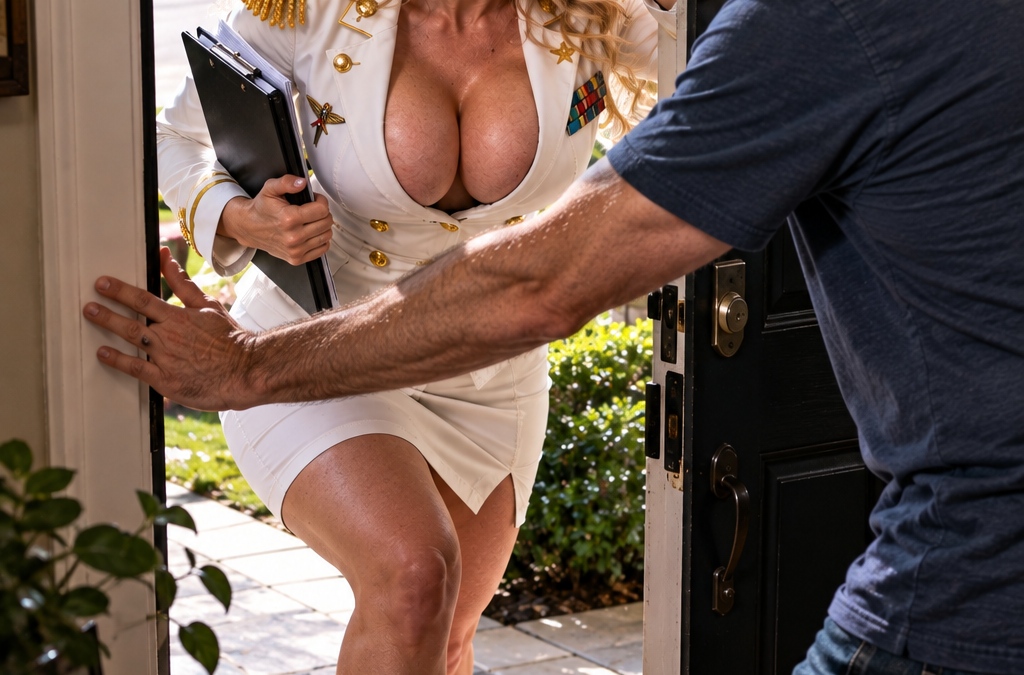
Victoria stood on the porch.
White pencil skirt.
Fitted white jacket with gold buttons.
Deep neckline.
Blonde hair perfect.
Notebook in one hand.
Phone in the other.
She had the expression of someone arriving to execute a search warrant.
“Victoria.”
“I’m here to inspect the property.”
No hello.
No explanation.
Just that.
“What?”
She stepped forward.
Actually tried to step through the door.
I shifted immediately and blocked the opening with my body.
“What are you doing?”
She looked offended.
“Excuse me.”
“No. What are you doing?”
“I just told you.”
She raised the notebook slightly.
“I’m conducting an interior inspection.”
For a second, I honestly thought this had to be some elaborate joke.
“You want to inspect the inside of my house.”
“Correct.”
“Why?”
“I observed construction materials being brought onto the property.”
“Paint.”
“And electrical fixtures.”
“Light fixtures.”
“Which may indicate unauthorized renovation.”
I stared.
“We painted the guest bathroom.”
“I need to verify that.”
“No.”
Her eyebrows lifted.
“No?”
“No.”
I started closing the door slightly.
She planted one heel toward the threshold.
“I am a sitting member of the HOA board.”
“I know.”
“So you’re required to cooperate.”
“I’m not required to let you into my house.”
Her cheeks began coloring.
“I need to verify that you’re not altering load-bearing walls.”
“I’m not.”
“Or conducting unauthorized plumbing.”
“I’m not.”
“Then there shouldn’t be a problem with inspection.”
“There is.”
“What?”
“It’s my house.”
Victoria stared at me as if that answer hadn’t been considered.
I continued.
“You don’t get to come inside because you saw paint.”
“That’s not how this works.”
“It is exactly how this works.”
She raised her voice.
“Board members have inspection rights.”
“Outside?”
“All property.”
“Show me.”
Her expression hardened.
“I don’t have to stand here and educate you about the covenants.”
“I’m asking for the section.”
“You’re obstructing official board activity.”
I almost laughed.
“Official?”
“Yes.”
“You came here alone.”
“I don’t require an escort.”
“Did Mark authorize this?”
That hesitation told me everything.
Very small.
Maybe half a second.
But there.
“This is a compliance matter.”
“So no.”
“Don’t put words in my mouth.”
“Did the president authorize you to inspect the inside of my house?”
Victoria’s face flushed.
“As a board member, I have independent responsibility for compliance.”
I shook my head.
“No.”
“You don’t understand your obligations.”
“I understand my door.”
She took another little step forward.
I didn’t move.
“If you continue blocking me, I’ll document obstruction.”
“Document whatever you want.”
“The fine can be substantial.”
“Great.”
“You could face continuing daily penalties.”
“Wonderful.”
“Are you being sarcastic?”
“Victoria.”
I kept my voice calm.
“You’re not entering my house.”
Her eyes narrowed.
“We’ll see.”
“No, we won’t.”
I pointed toward the driveway.
“Leave my porch.”
That changed the atmosphere.
She lowered the notebook.
“You cannot order a board member off association property.”
“This porch isn’t association property.”
“The home is within the association.”
“The association doesn’t own my porch.”
She scoffed.
“Now you’re being ridiculous.”
“You’re demanding entry into my house.”
“Because I’m investigating.”
“No.”
I opened the door slightly wider just enough to make my position clear.
“I’m telling you directly. You do not have permission to enter. If you try to push past me, I’ll consider you trespassing.”
Victoria stared at me.
Then smiled.
Not friendly.
“You’ll regret making this difficult.”
“Okay.”
She started writing.
I waited.
“What are you doing?”
“Documenting your refusal.”
“Perfect.”
“You’ll receive a formal violation.”
“Send it.”
“This isn’t funny.”
“I agree.”
I gently closed the door.
Right in front of her.
Click.
Deadbolt.
For two seconds, nothing.
Then:
BAM.
She hit the door with her hand.
“OPEN THIS DOOR.”
Emily appeared from the kitchen.
“What the hell?”
I pointed toward the door.
“Victoria wants to inspect our bathroom.”
Emily stared.
“What?”
“Apparently we’re running an illegal renovation ring.”
From outside:
“I CAN HEAR YOU.”
Emily whispered:
“Is she serious?”
“Completely.”
We listened.
Victoria muttered something.
Then walked away.
I checked the doorbell app.
Recording saved automatically.
Good.
I had no idea how important that would become twenty minutes later.
Emily went back to making lunch.
I returned to the couch.
We joked about getting a secret tunnel permit.
Then flashing lights reflected across the living room wall.
I sat forward.
Emily came around the corner.
“Please tell me that’s not for us.”
I looked through the blinds.
Police cruiser.
Parked in front of our driveway.
Victoria stood beside it.
Talking rapidly to an officer.
Pointing at our house.
“You have got to be kidding me.”
Emily looked over my shoulder.
“She called the police?”
Apparently.
I opened the front door.
Stepped onto the porch.
Victoria saw me.
Her expression became triumphant.
That’s the only word.
Triumphant.
She started walking up the driveway behind the officer like she’d personally brought reinforcements.
The officer looked maybe mid-forties.
Tired.
Calm.
Professional.
He stopped several feet from the porch.
“Afternoon.”
“Afternoon.”
“Are you the homeowner?”
“Yes.”
Victoria interrupted.
“He is.”
The officer glanced back at her.
Then to me.
“Sir, we received a call regarding unauthorized construction and a dispute involving access.”
I folded my arms.
“Okay.”
“Caller stated there may be dangerous structural work occurring inside and that you prevented a neighborhood official from performing a lawful inspection.”
Victoria nodded dramatically.
“Exactly.”
I looked at the officer.
“We painted a bathroom.”
He blinked.
“I’m sorry?”
“Our guest bathroom.”
Emily stepped onto the porch.
“Light gray.”
The officer looked between us.
I continued.
“We also replaced a hallway light fixture.”
Victoria cut in.
“He carried construction materials into the house.”
“Paint.”
“There were electrical supplies.”
“A light fixture.”
“You don’t know what else they’ve done.”
The officer raised one hand.
“Ma’am.”
Victoria stopped.
He looked at me.
“And she came to the door?”
“Yes.”
“Asked to enter?”
“Demanded.”
“Did you let her?”
“No.”
Victoria jumped in.
“He obstructed me.”
The officer turned toward her.
“Obstructed you from what?”
“My official inspection.”
“Are you a government building inspector?”
Her face tightened.
“No. HOA board.”
“Okay.”
“But our covenants grant inspection authority.”
“Do you have a warrant?”
Victoria stared.
“A what?”
“A warrant.”
“I don’t need one.”
The officer exhaled.
Long.
Patient.
“Why don’t you believe you need one?”
“Because I’m on the HOA board.”
I will never forget the look on his face.
Not mocking.
Not angry.
Just tired.
Like he had suddenly understood exactly how unnecessary the last twenty minutes of his life had been.
“Ma’am.”
He spoke slowly.
“An HOA board is a private organization.”
“I know that.”
“You are a private citizen.”
“I am an elected board member.”
“Still a private citizen.”
Her posture stiffened.
“We have enforcement powers.”
“Maybe contractual enforcement powers under association documents.”
“Exactly.”
“That does not give you the authority to enter somebody’s home without consent.”
Victoria’s expression shifted.
Just slightly.
First crack.
“But he agreed to the covenants.”
The officer looked toward me.
“Do your HOA rules actually allow board members to inspect the interior?”
“No.”
Victoria snapped:
“Yes, they do.”
That was my cue.
I pulled out my phone.
I’d already opened the PDF while they were talking.
“I checked.”
I walked down the porch steps slowly.
Held the phone so the officer could see.
“Here are the covenants.”
I showed him the relevant sections.
Architectural control applied to exterior modifications.
Certain structural changes affecting shared systems in attached units had provisions.
We weren’t attached.
Nothing gave an individual board member blanket entry rights into a private home.
The officer scrolled.
Victoria hovered.
“That’s not the complete policy.”
“It’s the current version.”
“There are board procedures.”
“Show them.”
“I don’t carry every document.”
The officer handed my phone back.
Then I said:
“There’s more.”
Victoria’s eyes moved toward me.
“My doorbell camera recorded the entire interaction.”
Her expression changed.
That was the moment.
Not when the officer explained private-property law.
Not when I showed the rules.
The camera.
Because until then, Victoria still had room to reshape the story.
Aggressive homeowner.
Concerned board member.
Routine inspection.
Misunderstanding.
But video doesn’t negotiate with memory.
The officer looked interested.
“You have footage?”
“Yes.”
Victoria said quickly:
“That’s unnecessary.”
I looked at her.
“Why?”
“It doesn’t change the underlying issue.”
The officer said:
“I’d like to see it.”
I opened the app.
Pulled up the recording.
Turned the volume up.
There was Victoria.
Standing at the door.
“Interior inspection.”
Me asking why.
Her trying to step forward.
Me blocking the doorway.
Her claiming absolute authority.
Me asking whether Mark authorized it.
Her avoiding the question.
My clear refusal.
My explicit statement that she was not allowed inside.
My trespass warning.
Her fine threat.
Then me closing the door.
No yelling from me.
No threats.
No aggression.
Just no.
The officer watched the entire thing.
Victoria’s face became progressively redder.
When the video ended, he looked at her.
“Did you attempt to step into the house when he opened the door?”
She opened her mouth.
“I was conducting—”
“Did you?”
“I approached the threshold.”
The officer waited.
Victoria tried again.
“I was attempting to inspect—”
“So yes.”
Her eyes narrowed.
“He deliberately blocked me.”
“Because you did not have permission to enter.”
“He has obligations.”
“Not to let you into his home.”
Her voice rose.
“You don’t understand HOA law.”
That was probably the worst possible thing she could have said to the police officer after calling him there.
He didn’t react emotionally.
He simply said:
“I understand trespass.”
Victoria’s confidence collapsed into panic.
She began talking faster.
“I’m trying to protect property values.”
The officer said nothing.
“There have been unapproved modifications in this neighborhood before.”
Nothing.
“I’m the only person on the board willing to actually enforce anything.”
The officer still said nothing.
“I spend hours every week doing this for free.”
Then her eyes started watering.
It happened quickly.
One second angry.
Next second wounded.
“I work so hard for this community.”
She wiped beneath one eye.
“Nobody appreciates anything.”
Emily looked at me.
I looked at her.
Victoria kept going.
“People are constantly disrespecting me.”
The officer’s expression didn’t change.
“I try to keep standards high, and I’m treated like I’m some kind of criminal.”
“Ma’am.”
His voice was firm.
She stopped.
“You called police because a homeowner wouldn’t let you enter his house.”
“I called because he was obstructing—”
“No.”
The word landed hard.
“You called alleging dangerous construction and unlawful obstruction.”
“He could be hiding—”
“We don’t have evidence of dangerous construction.”
“There are paint cans.”
The officer stared at her.
“Paint cans.”
Victoria realized how that sounded.
“They could indicate—”
“Ma’am, painting a bathroom isn’t a police matter.”
She folded her arms.
“This isn’t just about paint.”
“What law was broken?”
Silence.
The officer continued.
“What specific offense did you call us to enforce?”
Victoria looked at me.
Then at Emily.
Then toward neighboring houses.
People had started coming outside.
Of course they had.
A police cruiser in a peaceful HOA subdivision is basically a neighborhood push notification.
Sam stood on his porch.
A couple across the street pretended to check their mailbox.
Another man walked his dog at roughly one quarter normal speed.
Victoria saw the audience.
That made her more desperate.
“He was hostile.”
The officer looked at me.
Then back.
“I saw the video.”
“He closed the door in my face.”
“He’s allowed to close his door.”
“He threatened me with trespassing.”
“He told you not to enter his property.”
“He doesn’t have the right to prevent HOA enforcement.”
The officer sighed.
Then his tone changed.
No more explanations.
Authority.
“Listen carefully.”
Victoria went still.
“You do not have permission to enter this man’s home.”
Her lips tightened.
“You do not have police authority.”
Silence.
“If you return to his property after being told not to, you may be subject to trespass enforcement.”
Her mouth opened.
“And if you knowingly make a false emergency report or misuse emergency resources because someone refuses to let you inspect their bathroom, that can create additional problems for you.”
Victoria’s face went pale.
“I did not make a false report.”
“I’m warning you.”
“I believed—”
“I’m telling you how to avoid another issue.”
She looked toward me.
Tears still visible.
“He made this into something it wasn’t.”
The officer said:
“The doorbell footage shows exactly what happened.”
That ended it.
There was nowhere left for the story to move.
The officer looked at me.
“Sir, sorry for the disturbance.”
“No problem.”
“Call if there are further issues.”
“I will.”
He returned to the cruiser.
Victoria remained on the sidewalk.
Alone.
Notebook pressed against her chest.
Several neighbors watching.
For the first time since I’d met her, she looked unsure what to do.
No one had obeyed.
No one had backed down.
The police hadn’t treated her title as authority.
And there was an audience.
Her cheeks turned deep red.
She lowered her head.
Walked away quickly.
White heels striking pavement.
Emily waited until she was halfway down the street.
Then whispered:
“Bathroom inspection unsuccessful.”
I laughed.
But once we went inside, I stopped laughing.
Because the incident was funny only from a distance.
In reality, a board member had tried to enter our home.
Then called police when I said no.
That wasn’t quirky.
It wasn’t neighborhood drama.
It was harassment wearing a title.
I sat at my computer immediately.
Opened email.
Addressed it to Mark and the general board account.
Then wrote everything.
Not angry.
Not insulting.
Professional.
Date.
Time.
Victoria’s arrival.
Demand for interior access.
Her attempt to step through the doorway.
Her unsupported claim of board authority.
My refusal.
Her threats.
Police call.
Officer’s warning.
Then I attached the video clip.
I ended with:
My wife and I are no longer comfortable with Ms. Whitmore acting toward us in any official HOA capacity. We consider today’s conduct harassment and an attempted invasion of our private residence. We request immediate board review and written clarification regarding the limits of individual board authority.
Send.
Less than an hour later, my phone rang.
Mark.
“Hey.”
His voice sounded different.
No relaxed neighbor tone.
Mortified.
“I just watched the video.”
“Yeah.”
“I am so sorry.”
“Did you authorize an inspection?”
“No.”
Immediate.
Strong.
“Absolutely not.”
“Does the HOA have any rule allowing interior inspections?”
“No.”
“That’s what I thought.”
“We don’t care what color you paint your bathroom.”
I smiled despite myself.
“Good. It’s gray.”
Mark exhaled.
“I’m serious. Nobody approved this.”
“What about structural work?”
“If you were changing something requiring permits or exterior approval, there are processes.”
“Right.”
“But Victoria cannot walk into people’s homes.”
“She thinks she can.”
“I know.”
That caught my attention.
“You know?”
Silence.
Small.
Then Mark said:
“We’ve had issues.”
Of course.
“What kind?”
“Overreach.”
“That’s a polite word.”
“I know.”
“Then why is she still on the board?”
Another pause.
“We’re going to deal with it.”
“I’d appreciate that.”
“No.”
His voice hardened.
“We should have dealt with it sooner.”
That surprised me.
Then he said there would be a board meeting.
Soon.
Formal.
He asked whether Emily and I would attend.
We did.
The community room was more crowded than I’d ever seen.
People we’d barely spoken to were there.
Sam.
The couple across the street.
An older woman from around the corner.
A young family whose basketball hoop Victoria had apparently complained about.
Victoria sat at the front.
White military-style jacket.
Gold buttons.
White skirt.
Deep neckline.
Perfect blonde hair.
But she looked tense.
No notebook.
Mark opened the meeting.
No small talk.
No pool update.
No landscaping budget.
He went directly to the issue.
“A serious incident occurred this week involving a board member.”
Victoria shifted.
Mark continued.
“That individual attempted to enter a resident’s home without authorization, claimed board authority that does not exist, and subsequently contacted police after the homeowner refused access.”
The room stayed silent.
Victoria raised her hand.
“Mark.”
“I’m speaking.”
That was the first public no.
Her mouth closed.
Mark continued.
“This conduct was not authorized by the board.”
He looked around.
“It is not supported by our governing documents.”
Then:
“And it does not represent how this association operates.”
Victoria stood.
“I need to respond.”
Mark sighed.
“You’ll have an opportunity.”
“I need to correct several inaccuracies.”
People started murmuring.
Mark looked at her.
“What inaccuracies?”
Victoria turned toward the room.
Her posture changed instantly.
Performance mode.
“I was acting in good faith.”
Someone near the back muttered:
“Here we go.”
Victoria ignored it.
“There were clear indicators that unauthorized work was being performed.”
I said:
“Paint.”
She turned toward me.
“And electrical materials.”
“One light fixture.”
“You cannot know the full scope of renovation without inspection.”
Mark said:
“Neither can you.”
Victoria snapped toward him.
“That is exactly why inspection is necessary.”
“No.”
His voice stayed calm.
“You do not have that authority.”
Her face hardened.
“I’m a board member.”
“So am I.”
That got a few laughs.
Victoria flushed.
“I take my responsibilities seriously.”
Mark nodded.
“That doesn’t expand them.”
Then he asked me to explain what happened.
I kept it short.
She came.
Demanded entry.
Tried to step in.
I blocked her.
Asked her to leave.
She threatened fines.
I closed the door.
She called police.
Mark asked whether I had video.
I said yes.
Several people already knew.
He played it.
On a television mounted at the front.
Victoria watched herself.
Everyone did.
The room saw exactly what the officer had seen.
The attempt to step forward.
The claims.
The threats.
The refusal to cite authority.
The final warning.
The door closing.
When the video ended, the room went quiet.
Then Sam spoke.
“She did the same thing to us.”
Victoria turned.
“No, I didn’t.”
Sam laughed.
“Not inside.”
He looked at Mark.
“But she threatened my wife over a flowerpot.”
The blue one.
Someone else raised a hand.
Victoria had threatened fines over a wreath.
Another resident:
Basketball hoop.
Another:
Trash bins while they were actively washing them.
Another:
Patio chair color.
Someone else said Victoria had photographed their backyard through the side fence.
The stories came one after another.
Not catastrophic individually.
That’s why nobody had forced the issue before.
Tiny intrusions.
Invented rules.
Threats.
Condescension.
One homeowner said:
“I thought she was speaking for the board.”
Mark looked toward Victoria.
“No.”
That one word mattered.
The homeowner continued.
“Then why did nobody tell us?”
Mark looked ashamed.
Fair question.
Victoria stood again.
“This is turning into a witch hunt.”
Nobody responded.
“I have spent years protecting property values.”
Sam said:
“From blue pots?”
A laugh moved through the room.
Victoria’s face reddened.
She pointed.
“This is exactly what I mean. Nobody respects the work that goes into maintaining standards.”
An older woman near the aisle said:
“You don’t maintain anything.”
Victoria stared.
The woman continued.
“You harass people.”
A few people nodded.
Victoria’s eyes filled again.
The tears returned.
“I’m misunderstood.”
Mark looked exhausted.
“This isn’t about whether people understand your intentions.”
“It absolutely is.”
“No.”
He pointed toward the screen.
“It’s about your actions.”
“I believed there was a serious violation.”
“You tried to enter someone’s home.”
“I was investigating.”
“You called police.”
“Because he was hostile.”
“The video shows he wasn’t.”
Victoria turned toward me.
“You knew exactly what you were doing by recording me.”
I laughed before I could stop myself.
“It’s a doorbell camera.”
She opened her mouth.
Nothing came out.
Mark leaned forward.
“Victoria, I’m asking you to resign from the board.”
The room became completely silent.
She stared at him.
“What?”
“I am asking you to resign effective immediately.”
“You cannot be serious.”
“I am.”
“After everything I’ve done?”
“This incident crossed a line.”
Her face changed.
Not just anger.
Shock.
The title mattered to her.
More than I had realized.
She looked around the room expecting support.
Nobody offered any.
Not one person.
“You all benefit from my work.”
Silence.
“The neighborhood would look completely different if I hadn’t enforced standards.”
Silence.
“I’ve protected your property values.”
Silence.
Her voice cracked.
“And this is how you repay me?”
Someone behind us whispered:
“Repay?”
Victoria grabbed her purse.
“I will not sit here and be humiliated.”
Mark said:
“Victoria—”
“No.”
She pointed at him.
“You’ll see what happens without me.”
Then she pointed at me.
“And this started because he refuses to respect authority.”
I looked at her.
“No.”
She glared.
“You tried to walk into my house.”
“You made it confrontational.”
“I said no.”
“You slammed the door.”
“I closed it.”
“You called me a trespasser.”
“I told you you’d be trespassing if you entered after being denied permission.”
Her chest rose sharply.
“Same thing.”
“No.”
I kept my voice level.
“The problem is you think being told no is aggression.”
That shut her up.
For a second.
Then she picked up her purse.
Stormed toward the exit.
The community-room door slammed hard enough to rattle the glass.
Everyone sat quietly.
Mark rubbed his forehead.
Then said:
“Well.”
Someone laughed.
Tension broke.
The board voted formally.
Victoria was removed.
Immediately.
They also passed a motion clarifying that individual board members could not conduct unauthorized inspections, threaten fines outside approved procedures, or represent themselves as having authority beyond the governing documents.
Frankly, none of that should have needed clarification.
But apparently one Victoria was enough to create new paragraphs.
The board sent us a written apology.
They also sent a notice to the whole neighborhood explaining how enforcement was supposed to work.
Complaints.
Documentation.
Written citations.
Appeal rights.
No random interior inspections.
No board member entering property without permission.
The kind of boring procedural explanation that should have existed from the beginning.
The neighborhood changed immediately.
Not dramatically.
Quietly.
Victoria stopped patrolling.
That was the first thing everyone noticed.
No white outfit moving slowly down the sidewalk every afternoon.
No notebook.
No photographs.
No stopping near driveways.
She still lived there.
We saw her.
Sometimes at the mailbox.
Sometimes driving.
Sometimes getting packages.
But she kept her head down.
People stopped worrying about her appearing.
Sam put his blue planter back exactly where it had been.
I left the garden hose on the driveway one afternoon while I went inside for water.
Nothing happened.
That felt weirdly liberating.
Mark came by a few weeks after the meeting.
No six-pack this time.
Just himself.
“Everything okay?”
“Quiet.”
“Good.”
He looked embarrassed.
“I’m still sorry.”
“You didn’t try to inspect the bathroom.”
“No.”
“But we should have handled her sooner.”
“Probably.”
He nodded.
“We kept thinking she was annoying, not dangerous.”
I understood.
That’s how people like Victoria operate.
Each individual incident stays just below the threshold that forces action.
A rude comment.
A fake rule.
A little intimidation.
Too small to call a lawyer.
Too small to rally the neighborhood.
Too exhausting to fight.
So everyone adapts.
Moves the planter.
Puts away the hose.
Takes down the wreath.
Stops asking questions.
Then the person causing it interprets that accommodation as consent.
Authority grows inside their own head.
Until eventually they stand on someone’s porch and truly believe a volunteer board position gives them the right to walk into a private home.
Mark looked toward the front door.
“How’s the bathroom?”
I laughed.
“Still gray.”
“Any load-bearing walls harmed?”
“Several.”
His eyes widened.
“I’m kidding.”
“Don’t do that.”
We laughed.
That was the end of the official part.
But I did see Victoria alone a few months later.
I was checking the mail.
She came around the corner.
White fitted trousers.
White jacket.
Gold buttons.
Deep neckline.
Still polished.
Still striking.
But the outfit looked different without the notebook.
Less like authority.
More like costume.
She reached her mailbox.
I reached mine.
We both pretended the other didn’t exist.
Then she said:
“You must be pleased.”
I looked over.
“About what?”
“You know.”
I really did.
But I wanted her to say it.
“My removal.”
“Oh.”
Her jaw tightened.
“Yes.”
“I’m glad you can’t threaten people with board authority anymore.”
“That’s exactly the attitude.”
“What attitude?”
“You never respected the association.”
“I respect the association.”
She laughed sharply.
“Right.”
“I like Mark.”
“Mark is weak.”
“The pool looks good.”
Her eyes narrowed.
“You think this is funny.”
“Not especially.”
“You embarrassed me.”
I closed my mailbox.
“I wasn’t the one who called police.”
“You manipulated the situation.”
“How?”
“You knew the camera was recording.”
“It’s a doorbell camera.”
“I didn’t consent.”
“You were on my porch.”
“You deliberately refused cooperation.”
“Correct.”
“You could have let me inside for two minutes and none of this would have happened.”
There it was.
Still.
Months later.
She still believed the problem was that I had said no.
I looked at her.
“Victoria.”
“What?”
“You didn’t have the right to come in.”
“That’s your opinion.”
“No.”
I shook my head.
“The HOA president said it.”
Silence.
“The governing documents said it.”
Silence.
“The police officer said it.”
She looked away.
“The board said it.”
Nothing.
“And you’re still standing here telling me I should’ve just let you in.”
Her cheeks colored.
“I was trying to protect the neighborhood.”
“From light gray paint.”
“From unauthorized construction.”
“There wasn’t any.”
“You know that now.”
“I knew it then.”
“You didn’t provide proof.”
I actually laughed.
“Because I don’t have to prove to you that I’m innocent of remodeling my own bathroom.”
Victoria stared at me.
Then said something that finally explained everything.
“If everyone behaved like you, the board would have no control.”
I stopped smiling.
There it was.
Control.
Not maintenance.
Not community.
Control.
I nodded slowly.
“Exactly.”
She looked confused.
“The board shouldn’t control people’s private lives.”
“That’s naive.”
“No.”
I pointed toward the houses.
“You’re supposed to maintain common areas and enforce actual covenants.”
“You don’t understand governance.”
“And you don’t understand boundaries.”
She looked furious.
I continued.
“That’s why you’re not on the board anymore.”
Victoria’s face went still.
I regretted the cruelty slightly.
Only slightly.
She turned away.
I thought the conversation was over.
Then she said:
“People used to respect me.”
I looked at her.
That sounded different.
Not angry.
Almost sad.
I said:
“Some of them were afraid you’d fine them.”
Her eyes returned to mine.
“That’s not respect.”
For once, she didn’t answer.
She took her mail.
Walked home.
That was the last conversation we ever had.
The HOA returned to being boring.
Which is exactly what I wanted.
Pool maintenance.
Landscaping.
Annual budget.
A debate about whether to replace three benches near the playground.
One meeting spent forty minutes discussing mulch color.
I nearly fell asleep.
Perfect.
No police.
No fake inspections.
No white-clad neighborhood commander.
Emily and I finished the bathroom.
New paint.
New mirror.
Better light fixture.
We kept joking about the “illegal renovation.”
Any time I picked up a screwdriver, Emily would whisper:
“Hide it. The board might see.”
When I changed an outlet cover:
“Sir, do you have a permit?”
When I brought home another paint can:
“Get inside. Quickly.”
Eventually the joke became less funny because we stopped thinking about Victoria.
That’s how you know a problem is actually over.
Not when consequences happen.
When the person stops occupying space in your mind.
Months passed.
Then a year.
Our dogs destroyed part of the lawn.
We repaired it.
Sam bought a second blue planter.
Nobody died.
Someone put up a basketball hoop.
Children played.
Mark organized a neighborhood cookout.
The HOA sent an email reminding people not to bring glass containers near the pool.
Normal.
One afternoon, I was watering again.
Same green hose.
Same front lawn.
I finished.
Turned off the spigot.
For a second, I looked down at the hose.
Then toward the street.
No Victoria.
No notebook.
No warning.
I almost put the hose away immediately.
Habit.
Instead, I left it there.
Went inside.
Made coffee.
Came back ten minutes later.
The world had somehow survived.
I coiled it.
Put it in the garage.
Not because an HOA board member ordered me to.
Because I was done watering.
Small difference.
Important difference.
People joke about HOA power trips because the arguments sound ridiculous.
Hose.
Flowerpot.
Paint.
Trash bin.
But what happened with Victoria taught me something about the way small authority can distort people.
Real authority usually knows its limits.
Police officers need legal justification.
Inspectors need statutory authority.
Courts need jurisdiction.
Even governments have procedures.
Victoria had something much smaller.
A seat on a volunteer board.
But because nobody had challenged her consistently, she started treating the lack of resistance as proof that her power had no boundary.
She could comment on a hose.
Then dictate flowerpot colors.
Then invent warnings.
Then threaten fines.
Then decide she could inspect the inside of a private house.
Then summon police when denied.
At no point did she stop and ask:
Do I actually have the authority to do this?
She asked a different question.
Will anyone stop me?
For a long time, the answer had been no.
Until my front door.
The funny thing is that I didn’t do anything clever.
No legal trap.
No revenge plan.
No elaborate setup.
I just read the rules.
Kept the door closed.
Had a camera that came with the house.
That’s all.
Victoria destroyed her own position.
She made the demand.
She stepped forward.
She threatened fines.
She called police.
She changed her story.
She cried.
She forced the board to confront behavior they’d been avoiding.
All I did was say no.
I think that was why the incident mattered so much to other neighbors.
Once one person said no successfully, everybody realized they could.
Sam told me that later at a cookout.
We were standing near the grill.
He nodded toward his house.
“You know she fined us.”
“For the pot?”
“Not officially.”
“What?”
“She emailed something that looked like a violation.”
“Did you pay?”
“No.”
“Good.”
“I almost did.”
“Why?”
He shrugged.
“Fifty bucks. I figured it was easier.”
There it was.
Easier.
He continued.
“Then after your thing, I asked Mark.”
“And?”
“No violation existed.”
I shook my head.
Sam smiled.
“So thanks.”
“I didn’t do anything.”
“You closed a door.”
“Pretty basic homeowner skill.”
“Apparently revolutionary.”
We laughed.
But he was right.
Sometimes boundaries don’t need speeches.
Sometimes they’re a door.
You can stand outside.
I can stand inside.
And unless you have a legal right to cross, that’s where the discussion ends.
I still have the doorbell video saved.
Not because I watch it.
I haven’t in a long time.
But I kept it.
Every once in a while, I scroll through old security clips and see the thumbnail.
Victoria in white.
Notebook.
Standing on the porch.
I remember her face when she said:
“I have absolute authority.”
Absolute.
That’s the word.
Nobody with actual understanding of authority uses that word lightly.
She thought her board title put her above privacy.
Above consent.
Above property.
Then she called someone who actually understood legal authority.
That was the worst decision she could have made.
The officer didn’t yell at her.
Didn’t humiliate her intentionally.
Didn’t mock her.
He just asked simple questions.
Do you have a warrant?
No.
Do you have permission?
No.
Are you law enforcement?
No.
Do the rules allow this?
No.
Did you try to enter anyway?
Yes.
Everything collapsed under ordinary questions.
That’s the thing about fake authority.
It looks powerful until somebody asks it to identify itself.
Several years from now, I’ll probably remember the whole story mainly because it was absurd.
The woman who tried to inspect bathroom paint.
The board member who summoned police because a door closed.
The white military jacket.
The gold buttons.
The officer’s exhausted sigh.
But at the time, it didn’t feel absurd.
It felt invasive.
When somebody tries to push past you into the place where you sleep, eat, relax, and feel safe, even a small attempt feels different.
Home is the line.
Victoria crossed it emotionally before she ever crossed the threshold physically.
She wanted me to accept that my ownership came second to her title.
It didn’t.
And once the board finally made that clear, everything improved.
Not because rules disappeared.
We still had an HOA.
Still paid dues.
Still followed covenants.
I submitted an architectural request when we later replaced part of the front fence.
Approved.
No problem.
We got a legitimate reminder once because we forgot the trash cans overnight.
Fair.
I moved them.
No argument.
That’s the difference between rules and control.
A legitimate rule can be pointed to.
Explained.
Appealed.
Applied consistently.
Control sounds like:
“Because I said so.”
Victoria had mistaken one for the other.
The neighborhood eventually forgot most of the drama.
New families moved in who had never heard the story.
Victoria became just another resident.
Mark eventually stepped down from the HOA presidency.
Another normal person replaced him.
The pool kept functioning.
Grass got cut.
Dues got paid.
Life continued.
Exactly how it should.
The guest bathroom still has the same gray paint.
We never changed it again.
Emily once asked if we should repaint.
I said no.
“Why?”
“Historical preservation.”
She laughed.
“The site of the Great HOA Inspection Crisis?”
“Exactly.”
She shook her head.
“We should put up a plaque.”
Maybe we should.
Something simple.
NO BOARD MEMBERS BEYOND THIS POINT WITHOUT PERMISSION.
Although after everything that happened, nobody in that neighborhood needed the reminder.
Especially Victoria.
𝗧𝗛𝗘 𝗘𝗡𝗗
The HOA Board Member Tried to Force Her Way Into My House—Then Called the Police When I Locked Her Out
The woman from my HOA tried to push past me into my own house because she thought a few cans of bathroom paint meant I was hiding illegal construction.
When I blocked the doorway, she threatened me with fines, demanded I let her conduct an “interior inspection,” and finally called the police to have me arrested.
What she didn’t know was that my doorbell camera had recorded every second.
When my wife, Emily, and I bought the house, we genuinely thought we’d gotten lucky.
Not just house lucky.
HOA lucky.
Anybody who’s ever bought into a neighborhood with an association knows that’s almost its own category.
The house itself was exactly what we wanted.
Three bedrooms.
Big backyard.
A kitchen open enough that Emily could cook while still talking to someone in the living room.
Short commute for both of us.
Enough grass for our two dogs to sprint around until they exhausted themselves.
And the neighborhood was quiet.
Not dead quiet.
Healthy quiet.
Kids riding bikes.
People walking dogs.
Somebody mowing every Saturday morning.
The occasional basketball bouncing in a driveway.
Normal suburban life.
We knew the house was part of an HOA before we signed anything.
That didn’t bother us automatically.
I’d heard enough horror stories to be cautious, though, so before closing I read everything they gave us.
Covenants.
Architectural rules.
Parking restrictions.
Common-area policies.
Exterior maintenance requirements.
Nothing seemed insane.
Keep the yard reasonably maintained.
Don’t park a broken vehicle on the lawn.
Get approval before making major exterior changes.
Keep trash containers put away when they weren’t being collected.
Basic stuff.
Nothing in the rules suggested board members could march into a resident’s home and inspect bathroom paint, and at the beginning the association itself seemed unusually relaxed.
The HOA president, Mark, actually came over during our first week.
He was probably in his fifties.
Short gray hair.
Cargo shorts.
Old college T-shirt.
He brought a folder with pool information in one hand and a six-pack of local beer in the other.
“Welcome to the neighborhood.”
That’s how normal he was.
No clipboard.
No speech about compliance.
No measuring tape.
No mention of approved flower colors.
He explained that the board mostly handled the community pool, landscaping near the entrance, contracts for the common areas, and the occasional real dispute.
“Honestly,” he said, “if we don’t hear from anybody, it’s usually because everything’s going fine.”
Emily smiled.
“That’s what we like to hear.”
Mark looked toward our dogs rolling in the grass.
“Only thing I’ll warn you about is the pool closes at ten.”
“Noted.”
“And the gate sticks sometimes.”
“That’s the kind of authoritarianism I can live with.”
He laughed.
We liked him immediately.
For the first few months, the neighborhood was exactly as peaceful as we’d hoped.
Then we started noticing Victoria.
Her real name wasn’t Victoria, but I’m calling her that because somehow it fits.
She was on the HOA board.
Not president.
Not vice president.
Not even treasurer as far as I knew.
Just a regular board member.
You would never have guessed that from the way she carried herself.
Victoria was somewhere around forty.
Maybe forty-two.
Blonde.
Beautiful in a polished, intimidating way.
Perfect hair.
Perfect makeup.
Tall.
Very curvy, with a particularly large chest she seemed perfectly comfortable emphasizing.
And her clothes were unforgettable.
She had apparently decided suburban HOA administration required military pageantry.
White fitted jackets.
Gold buttons.
Decorative shoulder trim.
Deep necklines.
White pencil skirts or tight white trousers.
Sometimes heels.
Sometimes tall white boots.
If you saw her from a distance, you’d think she was about to inspect a yacht crew rather than write someone up for leaving a recycling bin beside the garage.
And she patrolled.
That’s the only word for it.
Every afternoon, usually around the same time, she’d walk slowly through the neighborhood.
No dog.
No headphones.
No exercise clothes.
Just Victoria in one of her immaculate white outfits carrying either a little notebook or her phone.
She’d stop.
Look at a house.
Write something.
Walk.
Stop.
Look.
Write.
Emily noticed it first.
We were eating dinner near the front window.
“She’s doing it again.”
I looked outside.
Victoria stood across the street staring at someone’s yard.
“Maybe she’s bird-watching.”
“With a notebook?”
“Serious birds.”
Emily watched her.
“She’s taking a picture of their mailbox.”
“Rare species.”
“You’re an idiot.”
Probably.
The first time Victoria actually confronted me, I was watering the front lawn.
That’s it.
No illegal structure.
No bonfire.
No livestock.
Garden hose.
The afternoon was hot.
I’d watered one patch of grass, turned the spigot off, and was about to coil the hose.
I heard an exaggerated throat clear behind me.
“Ahem.”
I turned.
Victoria stood halfway up our driveway.
White pants.
White fitted jacket.
Gold buttons.
Deep neckline.
Sunglasses resting on top of her blonde hair.
Hands planted on her hips.
“Hi.”
She didn’t say hi.
She pointed.
“That needs to be removed.”
I looked at the hose.
“The hose?”
“Yes.”
“I’m putting it away.”
“Hoses can’t remain visible from the street.”
I looked at her.
Then the wet grass.
Then the hose still in my hand.
“I’m using it.”
“You’re finished.”
“I literally just turned the water off.”
She opened her notebook.
“I’m giving you a verbal warning.”
That got my attention.
“For watering?”
“For leaving equipment visible.”
“I haven’t left anything.”
Her mouth tightened.
“Excuses don’t matter to the board.”
I almost laughed.
“The board?”
“Community standards exist for everyone.”
“I’m standing here holding the hose.”
“Then you should put it away.”
I stared at her.
There are moments when you have to decide whether an argument is worth twenty minutes of your life.
That wasn’t.
I smiled.
“Sure.”
I coiled the hose.
Put it in the garage.
Victoria nodded as though she’d supervised a successful compliance operation.
“Thank you.”
Then she walked away.
I watched her.
Emily opened the front door behind me.
“What was that?”
“Apparently the hose attempted a coup.”
“What?”
“Nothing.”
We went inside.
But the interaction bothered me.
Not because she’d said something about the hose.
Because of the certainty.
Excuses don’t matter to the board.
So that evening, I pulled out the HOA documents.
Read them again.
Searched electronically.
Hoses.
Garden equipment.
Street view.
Temporary use.
Nothing.
Absolutely nothing said I couldn’t have a hose visible while actively watering.
The next morning, I emailed Mark.
Very casually.
“Hey, weird question. Is there some rule about hoses needing to be concealed while you’re using them?”
He replied twenty minutes later.
“No.”
That was it.
No explanation.
No hidden amendment.
Just:
“No.”
Interesting.
A couple weeks later, our next-door neighbor, Sam, had his own Victoria encounter.
Sam and his wife had a big ceramic planter beside their front door.
Blue.
Nice-looking thing.
One Saturday, I was washing my truck when Victoria marched up their walkway.
I didn’t mean to listen.
Hard not to when she talked like someone addressing a public meeting.
“That planter isn’t on the approved color palette.”
Sam was kneeling near the flower bed.
He looked up.
“What?”
“The blue.”
Sam stared at the planter.
Then at Victoria.
“It’s a pot.”
“It’s visible from the street.”
“Yes.”
“The exterior standards specify earth tones.”
Sam stood.
“Does the rule mention flowerpots?”
Victoria opened her mouth.
Sam didn’t wait.
He walked inside.
Closed the door.
Victoria stood there for five seconds.
Then wrote something in her notebook.
I had to turn away because I was smiling.
That became the pattern.
Victoria saw the HOA board as a license to interfere.
Trash cans.
Potted plants.
Driveway basketball hoops.
Door wreaths.
Patio furniture visible through a side gate.
Half the time, she cited things that weren’t actually prohibited.
Most people simply ignored her.
Some argued.
A few complied because fighting was more exhausting than moving a pot.
Victoria seemed to interpret every act of compliance as proof her authority was real.
Then Emily and I decided to repaint the guest bathroom.
That was how everything finally exploded.
The bathroom was ugly.
Previous owner had painted it a color somewhere between mustard and old nicotine.
Emily had hated it from the first showing.
One Friday afternoon, we bought paint.
Light gray.
A couple brushes.
Rollers.
Drop cloth.
We also bought two new hallway light fixtures because the old ones looked like upside-down salad bowls.
That was the entire renovation.
No walls moved.
No pipes changed.
No wiring beyond replacing fixtures.
No permit required.
No HOA approval required.
Nothing visible from outside.
Saturday morning, we started painting.
Sunday, I changed one light fixture.
Normal homeowner stuff.
Apparently, Victoria saw us carrying the paint cans from the car.
By Monday afternoon, she had invented a construction project.
I was in the living room watching television.
Emily was in the kitchen making sandwiches.
The dogs were asleep near the back door.
Then somebody hammered on our front door.
Not knocked.
Pounded.
BAM.
BAM.
BAM.
Emily looked around the kitchen.
“Who is that?”
“No idea.”
Another pounding.
I stood.
The doorbell camera had already activated.
I opened the door.
Victoria stood on the porch.
White pencil skirt.
Fitted white jacket with gold buttons.
Deep neckline.
Blonde hair perfect.
Notebook in one hand.
Phone in the other.
She had the expression of someone arriving to execute a search warrant.
“Victoria.”
“I’m here to inspect the property.”
No hello.
No explanation.
Just that.
“What?”
She stepped forward.
Actually tried to step through the door.
I shifted immediately and blocked the opening with my body.
“What are you doing?”
She looked offended.
“Excuse me.”
“No. What are you doing?”
“I just told you.”
She raised the notebook slightly.
“I’m conducting an interior inspection.”
For a second, I honestly thought this had to be some elaborate joke.
“You want to inspect the inside of my house.”
“Correct.”
“Why?”
“I observed construction materials being brought onto the property.”
“Paint.”
“And electrical fixtures.”
“Light fixtures.”
“Which may indicate unauthorized renovation.”
I stared.
“We painted the guest bathroom.”
“I need to verify that.”
“No.”
Her eyebrows lifted.
“No?”
“No.”
I started closing the door slightly.
She planted one heel toward the threshold.
“I am a sitting member of the HOA board.”
“I know.”
“So you’re required to cooperate.”
“I’m not required to let you into my house.”
Her cheeks began coloring.
“I need to verify that you’re not altering load-bearing walls.”
“I’m not.”
“Or conducting unauthorized plumbing.”
“I’m not.”
“Then there shouldn’t be a problem with inspection.”
“There is.”
“What?”
“It’s my house.”
Victoria stared at me as if that answer hadn’t been considered.
I continued.
“You don’t get to come inside because you saw paint.”
“That’s not how this works.”
“It is exactly how this works.”
She raised her voice.
“Board members have inspection rights.”
“Outside?”
“All property.”
“Show me.”
Her expression hardened.
“I don’t have to stand here and educate you about the covenants.”
“I’m asking for the section.”
“You’re obstructing official board activity.”
I almost laughed.
“Official?”
“Yes.”
“You came here alone.”
“I don’t require an escort.”
“Did Mark authorize this?”
That hesitation told me everything.
Very small.
Maybe half a second.
But there.
“This is a compliance matter.”
“So no.”
“Don’t put words in my mouth.”
“Did the president authorize you to inspect the inside of my house?”
Victoria’s face flushed.
“As a board member, I have independent responsibility for compliance.”
I shook my head.
“No.”
“You don’t understand your obligations.”
“I understand my door.”
She took another little step forward.
I didn’t move.
“If you continue blocking me, I’ll document obstruction.”
“Document whatever you want.”
“The fine can be substantial.”
“Great.”
“You could face continuing daily penalties.”
“Wonderful.”
“Are you being sarcastic?”
“Victoria.”
I kept my voice calm.
“You’re not entering my house.”
Her eyes narrowed.
“We’ll see.”
“No, we won’t.”
I pointed toward the driveway.
“Leave my porch.”
That changed the atmosphere.
She lowered the notebook.
“You cannot order a board member off association property.”
“This porch isn’t association property.”
“The home is within the association.”
“The association doesn’t own my porch.”
She scoffed.
“Now you’re being ridiculous.”
“You’re demanding entry into my house.”
“Because I’m investigating.”
“No.”
I opened the door slightly wider just enough to make my position clear.
“I’m telling you directly. You do not have permission to enter. If you try to push past me, I’ll consider you trespassing.”
Victoria stared at me.
Then smiled.
Not friendly.
“You’ll regret making this difficult.”
“Okay.”
She started writing.
I waited.
“What are you doing?”
“Documenting your refusal.”
“Perfect.”
“You’ll receive a formal violation.”
“Send it.”
“This isn’t funny.”
“I agree.”
I gently closed the door.
Right in front of her.
Click.
Deadbolt.
For two seconds, nothing.
Then:
BAM.
She hit the door with her hand.
“OPEN THIS DOOR.”
Emily appeared from the kitchen.
“What the hell?”
I pointed toward the door.
“Victoria wants to inspect our bathroom.”
Emily stared.
“What?”
“Apparently we’re running an illegal renovation ring.”
From outside:
“I CAN HEAR YOU.”
Emily whispered:
“Is she serious?”
“Completely.”
We listened.
Victoria muttered something.
Then walked away.
I checked the doorbell app.
Recording saved automatically.
Good.
I had no idea how important that would become twenty minutes later.
Emily went back to making lunch.
I returned to the couch.
We joked about getting a secret tunnel permit.
Then flashing lights reflected across the living room wall.
I sat forward.
Emily came around the corner.
“Please tell me that’s not for us.”
I looked through the blinds.
Police cruiser.
Parked in front of our driveway.
Victoria stood beside it.
Talking rapidly to an officer.
Pointing at our house.
“You have got to be kidding me.”
Emily looked over my shoulder.
“She called the police?”
Apparently.
I opened the front door.
Stepped onto the porch.
Victoria saw me.
Her expression became triumphant.
That’s the only word.
Triumphant.
She started walking up the driveway behind the officer like she’d personally brought reinforcements.
The officer looked maybe mid-forties.
Tired.
Calm.
Professional.
He stopped several feet from the porch.
“Afternoon.”
“Afternoon.”
“Are you the homeowner?”
“Yes.”
Victoria interrupted.
“He is.”
The officer glanced back at her.
Then to me.
“Sir, we received a call regarding unauthorized construction and a dispute involving access.”
I folded my arms.
“Okay.”
“Caller stated there may be dangerous structural work occurring inside and that you prevented a neighborhood official from performing a lawful inspection.”
Victoria nodded dramatically.
“Exactly.”
I looked at the officer.
“We painted a bathroom.”
He blinked.
“I’m sorry?”
“Our guest bathroom.”
Emily stepped onto the porch.
“Light gray.”
The officer looked between us.
I continued.
“We also replaced a hallway light fixture.”
Victoria cut in.
“He carried construction materials into the house.”
“Paint.”
“There were electrical supplies.”
“A light fixture.”
“You don’t know what else they’ve done.”
The officer raised one hand.
“Ma’am.”
Victoria stopped.
He looked at me.
“And she came to the door?”
“Yes.”
“Asked to enter?”
“Demanded.”
“Did you let her?”
“No.”
Victoria jumped in.
“He obstructed me.”
The officer turned toward her.
“Obstructed you from what?”
“My official inspection.”
“Are you a government building inspector?”
Her face tightened.
“No. HOA board.”
“Okay.”
“But our covenants grant inspection authority.”
“Do you have a warrant?”
Victoria stared.
“A what?”
“A warrant.”
“I don’t need one.”
The officer exhaled.
Long.
Patient.
“Why don’t you believe you need one?”
“Because I’m on the HOA board.”
I will never forget the look on his face.
Not mocking.
Not angry.
Just tired.
Like he had suddenly understood exactly how unnecessary the last twenty minutes of his life had been.
“Ma’am.”
He spoke slowly.
“An HOA board is a private organization.”
“I know that.”
“You are a private citizen.”
“I am an elected board member.”
“Still a private citizen.”
Her posture stiffened.
“We have enforcement powers.”
“Maybe contractual enforcement powers under association documents.”
“Exactly.”
“That does not give you the authority to enter somebody’s home without consent.”
Victoria’s expression shifted.
Just slightly.
First crack.
“But he agreed to the covenants.”
The officer looked toward me.
“Do your HOA rules actually allow board members to inspect the interior?”
“No.”
Victoria snapped:
“Yes, they do.”
That was my cue.
I pulled out my phone.
I’d already opened the PDF while they were talking.
“I checked.”
I walked down the porch steps slowly.
Held the phone so the officer could see.
“Here are the covenants.”
I showed him the relevant sections.
Architectural control applied to exterior modifications.
Certain structural changes affecting shared systems in attached units had provisions.
We weren’t attached.
Nothing gave an individual board member blanket entry rights into a private home.
The officer scrolled.
Victoria hovered.
“That’s not the complete policy.”
“It’s the current version.”
“There are board procedures.”
“Show them.”
“I don’t carry every document.”
The officer handed my phone back.
Then I said:
“There’s more.”
Victoria’s eyes moved toward me.
“My doorbell camera recorded the entire interaction.”
Her expression changed.
That was the moment.
Not when the officer explained private-property law.
Not when I showed the rules.
The camera.
Because until then, Victoria still had room to reshape the story.
Aggressive homeowner.
Concerned board member.
Routine inspection.
Misunderstanding.
But video doesn’t negotiate with memory.
The officer looked interested.
“You have footage?”
“Yes.”
Victoria said quickly:
“That’s unnecessary.”
I looked at her.
“Why?”
“It doesn’t change the underlying issue.”
The officer said:
“I’d like to see it.”
I opened the app.
Pulled up the recording.
Turned the volume up.
There was Victoria.
Standing at the door.
“Interior inspection.”
Me asking why.
Her trying to step forward.
Me blocking the doorway.
Her claiming absolute authority.
Me asking whether Mark authorized it.
Her avoiding the question.
My clear refusal.
My explicit statement that she was not allowed inside.
My trespass warning.
Her fine threat.
Then me closing the door.
No yelling from me.
No threats.
No aggression.
Just no.
The officer watched the entire thing.
Victoria’s face became progressively redder.
When the video ended, he looked at her.
“Did you attempt to step into the house when he opened the door?”
She opened her mouth.
“I was conducting—”
“Did you?”
“I approached the threshold.”
The officer waited.
Victoria tried again.
“I was attempting to inspect—”
“So yes.”
Her eyes narrowed.
“He deliberately blocked me.”
“Because you did not have permission to enter.”
“He has obligations.”
“Not to let you into his home.”
Her voice rose.
“You don’t understand HOA law.”
That was probably the worst possible thing she could have said to the police officer after calling him there.
He didn’t react emotionally.
He simply said:
“I understand trespass.”
Victoria’s confidence collapsed into panic.
She began talking faster.
“I’m trying to protect property values.”
The officer said nothing.
“There have been unapproved modifications in this neighborhood before.”
Nothing.
“I’m the only person on the board willing to actually enforce anything.”
The officer still said nothing.
“I spend hours every week doing this for free.”
Then her eyes started watering.
It happened quickly.
One second angry.
Next second wounded.
“I work so hard for this community.”
She wiped beneath one eye.
“Nobody appreciates anything.”
Emily looked at me.
I looked at her.
Victoria kept going.
“People are constantly disrespecting me.”
The officer’s expression didn’t change.
“I try to keep standards high, and I’m treated like I’m some kind of criminal.”
“Ma’am.”
His voice was firm.
She stopped.
“You called police because a homeowner wouldn’t let you enter his house.”
“I called because he was obstructing—”
“No.”
The word landed hard.
“You called alleging dangerous construction and unlawful obstruction.”
“He could be hiding—”
“We don’t have evidence of dangerous construction.”
“There are paint cans.”
The officer stared at her.
“Paint cans.”
Victoria realized how that sounded.
“They could indicate—”
“Ma’am, painting a bathroom isn’t a police matter.”
She folded her arms.
“This isn’t just about paint.”
“What law was broken?”
Silence.
The officer continued.
“What specific offense did you call us to enforce?”
Victoria looked at me.
Then at Emily.
Then toward neighboring houses.
People had started coming outside.
Of course they had.
A police cruiser in a peaceful HOA subdivision is basically a neighborhood push notification.
Sam stood on his porch.
A couple across the street pretended to check their mailbox.
Another man walked his dog at roughly one quarter normal speed.
Victoria saw the audience.
That made her more desperate.
“He was hostile.”
The officer looked at me.
Then back.
“I saw the video.”
“He closed the door in my face.”
“He’s allowed to close his door.”
“He threatened me with trespassing.”
“He told you not to enter his property.”
“He doesn’t have the right to prevent HOA enforcement.”
The officer sighed.
Then his tone changed.
No more explanations.
Authority.
“Listen carefully.”
Victoria went still.
“You do not have permission to enter this man’s home.”
Her lips tightened.
“You do not have police authority.”
Silence.
“If you return to his property after being told not to, you may be subject to trespass enforcement.”
Her mouth opened.
“And if you knowingly make a false emergency report or misuse emergency resources because someone refuses to let you inspect their bathroom, that can create additional problems for you.”
Victoria’s face went pale.
“I did not make a false report.”
“I’m warning you.”
“I believed—”
“I’m telling you how to avoid another issue.”
She looked toward me.
Tears still visible.
“He made this into something it wasn’t.”
The officer said:
“The doorbell footage shows exactly what happened.”
That ended it.
There was nowhere left for the story to move.
The officer looked at me.
“Sir, sorry for the disturbance.”
“No problem.”
“Call if there are further issues.”
“I will.”
He returned to the cruiser.
Victoria remained on the sidewalk.
Alone.
Notebook pressed against her chest.
Several neighbors watching.
For the first time since I’d met her, she looked unsure what to do.
No one had obeyed.
No one had backed down.
The police hadn’t treated her title as authority.
And there was an audience.
Her cheeks turned deep red.
She lowered her head.
Walked away quickly.
White heels striking pavement.
Emily waited until she was halfway down the street.
Then whispered:
“Bathroom inspection unsuccessful.”
I laughed.
But once we went inside, I stopped laughing.
Because the incident was funny only from a distance.
In reality, a board member had tried to enter our home.
Then called police when I said no.
That wasn’t quirky.
It wasn’t neighborhood drama.
It was harassment wearing a title.
I sat at my computer immediately.
Opened email.
Addressed it to Mark and the general board account.
Then wrote everything.
Not angry.
Not insulting.
Professional.
Date.
Time.
Victoria’s arrival.
Demand for interior access.
Her attempt to step through the doorway.
Her unsupported claim of board authority.
My refusal.
Her threats.
Police call.
Officer’s warning.
Then I attached the video clip.
I ended with:
My wife and I are no longer comfortable with Ms. Whitmore acting toward us in any official HOA capacity. We consider today’s conduct harassment and an attempted invasion of our private residence. We request immediate board review and written clarification regarding the limits of individual board authority.
Send.
Less than an hour later, my phone rang.
Mark.
“Hey.”
His voice sounded different.
No relaxed neighbor tone.
Mortified.
“I just watched the video.”
“Yeah.”
“I am so sorry.”
“Did you authorize an inspection?”
“No.”
Immediate.
Strong.
“Absolutely not.”
“Does the HOA have any rule allowing interior inspections?”
“No.”
“That’s what I thought.”
“We don’t care what color you paint your bathroom.”
I smiled despite myself.
“Good. It’s gray.”
Mark exhaled.
“I’m serious. Nobody approved this.”
“What about structural work?”
“If you were changing something requiring permits or exterior approval, there are processes.”
“Right.”
“But Victoria cannot walk into people’s homes.”
“She thinks she can.”
“I know.”
That caught my attention.
“You know?”
Silence.
Small.
Then Mark said:
“We’ve had issues.”
Of course.
“What kind?”
“Overreach.”
“That’s a polite word.”
“I know.”
“Then why is she still on the board?”
Another pause.
“We’re going to deal with it.”
“I’d appreciate that.”
“No.”
His voice hardened.
“We should have dealt with it sooner.”
That surprised me.
Then he said there would be a board meeting.
Soon.
Formal.
He asked whether Emily and I would attend.
We did.
The community room was more crowded than I’d ever seen.
People we’d barely spoken to were there.
Sam.
The couple across the street.
An older woman from around the corner.
A young family whose basketball hoop Victoria had apparently complained about.
Victoria sat at the front.
White military-style jacket.
Gold buttons.
White skirt.
Deep neckline.
Perfect blonde hair.
But she looked tense.
No notebook.
Mark opened the meeting.
No small talk.
No pool update.
No landscaping budget.
He went directly to the issue.
“A serious incident occurred this week involving a board member.”
Victoria shifted.
Mark continued.
“That individual attempted to enter a resident’s home without authorization, claimed board authority that does not exist, and subsequently contacted police after the homeowner refused access.”
The room stayed silent.
Victoria raised her hand.
“Mark.”
“I’m speaking.”
That was the first public no.
Her mouth closed.
Mark continued.
“This conduct was not authorized by the board.”
He looked around.
“It is not supported by our governing documents.”
Then:
“And it does not represent how this association operates.”
Victoria stood.
“I need to respond.”
Mark sighed.
“You’ll have an opportunity.”
“I need to correct several inaccuracies.”
People started murmuring.
Mark looked at her.
“What inaccuracies?”
Victoria turned toward the room.
Her posture changed instantly.
Performance mode.
“I was acting in good faith.”
Someone near the back muttered:
“Here we go.”
Victoria ignored it.
“There were clear indicators that unauthorized work was being performed.”
I said:
“Paint.”
She turned toward me.
“And electrical materials.”
“One light fixture.”
“You cannot know the full scope of renovation without inspection.”
Mark said:
“Neither can you.”
Victoria snapped toward him.
“That is exactly why inspection is necessary.”
“No.”
His voice stayed calm.
“You do not have that authority.”
Her face hardened.
“I’m a board member.”
“So am I.”
That got a few laughs.
Victoria flushed.
“I take my responsibilities seriously.”
Mark nodded.
“That doesn’t expand them.”
Then he asked me to explain what happened.
I kept it short.
She came.
Demanded entry.
Tried to step in.
I blocked her.
Asked her to leave.
She threatened fines.
I closed the door.
She called police.
Mark asked whether I had video.
I said yes.
Several people already knew.
He played it.
On a television mounted at the front.
Victoria watched herself.
Everyone did.
The room saw exactly what the officer had seen.
The attempt to step forward.
The claims.
The threats.
The refusal to cite authority.
The final warning.
The door closing.
When the video ended, the room went quiet.
Then Sam spoke.
“She did the same thing to us.”
Victoria turned.
“No, I didn’t.”
Sam laughed.
“Not inside.”
He looked at Mark.
“But she threatened my wife over a flowerpot.”
The blue one.
Someone else raised a hand.
Victoria had threatened fines over a wreath.
Another resident:
Basketball hoop.
Another:
Trash bins while they were actively washing them.
Another:
Patio chair color.
Someone else said Victoria had photographed their backyard through the side fence.
The stories came one after another.
Not catastrophic individually.
That’s why nobody had forced the issue before.
Tiny intrusions.
Invented rules.
Threats.
Condescension.
One homeowner said:
“I thought she was speaking for the board.”
Mark looked toward Victoria.
“No.”
That one word mattered.
The homeowner continued.
“Then why did nobody tell us?”
Mark looked ashamed.
Fair question.
Victoria stood again.
“This is turning into a witch hunt.”
Nobody responded.
“I have spent years protecting property values.”
Sam said:
“From blue pots?”
A laugh moved through the room.
Victoria’s face reddened.
She pointed.
“This is exactly what I mean. Nobody respects the work that goes into maintaining standards.”
An older woman near the aisle said:
“You don’t maintain anything.”
Victoria stared.
The woman continued.
“You harass people.”
A few people nodded.
Victoria’s eyes filled again.
The tears returned.
“I’m misunderstood.”
Mark looked exhausted.
“This isn’t about whether people understand your intentions.”
“It absolutely is.”
“No.”
He pointed toward the screen.
“It’s about your actions.”
“I believed there was a serious violation.”
“You tried to enter someone’s home.”
“I was investigating.”
“You called police.”
“Because he was hostile.”
“The video shows he wasn’t.”
Victoria turned toward me.
“You knew exactly what you were doing by recording me.”
I laughed before I could stop myself.
“It’s a doorbell camera.”
She opened her mouth.
Nothing came out.
Mark leaned forward.
“Victoria, I’m asking you to resign from the board.”
The room became completely silent.
She stared at him.
“What?”
“I am asking you to resign effective immediately.”
“You cannot be serious.”
“I am.”
“After everything I’ve done?”
“This incident crossed a line.”
Her face changed.
Not just anger.
Shock.
The title mattered to her.
More than I had realized.
She looked around the room expecting support.
Nobody offered any.
Not one person.
“You all benefit from my work.”
Silence.
“The neighborhood would look completely different if I hadn’t enforced standards.”
Silence.
“I’ve protected your property values.”
Silence.
Her voice cracked.
“And this is how you repay me?”
Someone behind us whispered:
“Repay?”
Victoria grabbed her purse.
“I will not sit here and be humiliated.”
Mark said:
“Victoria—”
“No.”
She pointed at him.
“You’ll see what happens without me.”
Then she pointed at me.
“And this started because he refuses to respect authority.”
I looked at her.
“No.”
She glared.
“You tried to walk into my house.”
“You made it confrontational.”
“I said no.”
“You slammed the door.”
“I closed it.”
“You called me a trespasser.”
“I told you you’d be trespassing if you entered after being denied permission.”
Her chest rose sharply.
“Same thing.”
“No.”
I kept my voice level.
“The problem is you think being told no is aggression.”
That shut her up.
For a second.
Then she picked up her purse.
Stormed toward the exit.
The community-room door slammed hard enough to rattle the glass.
Everyone sat quietly.
Mark rubbed his forehead.
Then said:
“Well.”
Someone laughed.
Tension broke.
The board voted formally.
Victoria was removed.
Immediately.
They also passed a motion clarifying that individual board members could not conduct unauthorized inspections, threaten fines outside approved procedures, or represent themselves as having authority beyond the governing documents.
Frankly, none of that should have needed clarification.
But apparently one Victoria was enough to create new paragraphs.
The board sent us a written apology.
They also sent a notice to the whole neighborhood explaining how enforcement was supposed to work.
Complaints.
Documentation.
Written citations.
Appeal rights.
No random interior inspections.
No board member entering property without permission.
The kind of boring procedural explanation that should have existed from the beginning.
The neighborhood changed immediately.
Not dramatically.
Quietly.
Victoria stopped patrolling.
That was the first thing everyone noticed.
No white outfit moving slowly down the sidewalk every afternoon.
No notebook.
No photographs.
No stopping near driveways.
She still lived there.
We saw her.
Sometimes at the mailbox.
Sometimes driving.
Sometimes getting packages.
But she kept her head down.
People stopped worrying about her appearing.
Sam put his blue planter back exactly where it had been.
I left the garden hose on the driveway one afternoon while I went inside for water.
Nothing happened.
That felt weirdly liberating.
Mark came by a few weeks after the meeting.
No six-pack this time.
Just himself.
“Everything okay?”
“Quiet.”
“Good.”
He looked embarrassed.
“I’m still sorry.”
“You didn’t try to inspect the bathroom.”
“No.”
“But we should have handled her sooner.”
“Probably.”
He nodded.
“We kept thinking she was annoying, not dangerous.”
I understood.
That’s how people like Victoria operate.
Each individual incident stays just below the threshold that forces action.
A rude comment.
A fake rule.
A little intimidation.
Too small to call a lawyer.
Too small to rally the neighborhood.
Too exhausting to fight.
So everyone adapts.
Moves the planter.
Puts away the hose.
Takes down the wreath.
Stops asking questions.
Then the person causing it interprets that accommodation as consent.
Authority grows inside their own head.
Until eventually they stand on someone’s porch and truly believe a volunteer board position gives them the right to walk into a private home.
Mark looked toward the front door.
“How’s the bathroom?”
I laughed.
“Still gray.”
“Any load-bearing walls harmed?”
“Several.”
His eyes widened.
“I’m kidding.”
“Don’t do that.”
We laughed.
That was the end of the official part.
But I did see Victoria alone a few months later.
I was checking the mail.
She came around the corner.
White fitted trousers.
White jacket.
Gold buttons.
Deep neckline.
Still polished.
Still striking.
But the outfit looked different without the notebook.
Less like authority.
More like costume.
She reached her mailbox.
I reached mine.
We both pretended the other didn’t exist.
Then she said:
“You must be pleased.”
I looked over.
“About what?”
“You know.”
I really did.
But I wanted her to say it.
“My removal.”
“Oh.”
Her jaw tightened.
“Yes.”
“I’m glad you can’t threaten people with board authority anymore.”
“That’s exactly the attitude.”
“What attitude?”
“You never respected the association.”
“I respect the association.”
She laughed sharply.
“Right.”
“I like Mark.”
“Mark is weak.”
“The pool looks good.”
Her eyes narrowed.
“You think this is funny.”
“Not especially.”
“You embarrassed me.”
I closed my mailbox.
“I wasn’t the one who called police.”
“You manipulated the situation.”
“How?”
“You knew the camera was recording.”
“It’s a doorbell camera.”
“I didn’t consent.”
“You were on my porch.”
“You deliberately refused cooperation.”
“Correct.”
“You could have let me inside for two minutes and none of this would have happened.”
There it was.
Still.
Months later.
She still believed the problem was that I had said no.
I looked at her.
“Victoria.”
“What?”
“You didn’t have the right to come in.”
“That’s your opinion.”
“No.”
I shook my head.
“The HOA president said it.”
Silence.
“The governing documents said it.”
Silence.
“The police officer said it.”
She looked away.
“The board said it.”
Nothing.
“And you’re still standing here telling me I should’ve just let you in.”
Her cheeks colored.
“I was trying to protect the neighborhood.”
“From light gray paint.”
“From unauthorized construction.”
“There wasn’t any.”
“You know that now.”
“I knew it then.”
“You didn’t provide proof.”
I actually laughed.
“Because I don’t have to prove to you that I’m innocent of remodeling my own bathroom.”
Victoria stared at me.
Then said something that finally explained everything.
“If everyone behaved like you, the board would have no control.”
I stopped smiling.
There it was.
Control.
Not maintenance.
Not community.
Control.
I nodded slowly.
“Exactly.”
She looked confused.
“The board shouldn’t control people’s private lives.”
“That’s naive.”
“No.”
I pointed toward the houses.
“You’re supposed to maintain common areas and enforce actual covenants.”
“You don’t understand governance.”
“And you don’t understand boundaries.”
She looked furious.
I continued.
“That’s why you’re not on the board anymore.”
Victoria’s face went still.
I regretted the cruelty slightly.
Only slightly.
She turned away.
I thought the conversation was over.
Then she said:
“People used to respect me.”
I looked at her.
That sounded different.
Not angry.
Almost sad.
I said:
“Some of them were afraid you’d fine them.”
Her eyes returned to mine.
“That’s not respect.”
For once, she didn’t answer.
She took her mail.
Walked home.
That was the last conversation we ever had.
The HOA returned to being boring.
Which is exactly what I wanted.
Pool maintenance.
Landscaping.
Annual budget.
A debate about whether to replace three benches near the playground.
One meeting spent forty minutes discussing mulch color.
I nearly fell asleep.
Perfect.
No police.
No fake inspections.
No white-clad neighborhood commander.
Emily and I finished the bathroom.
New paint.
New mirror.
Better light fixture.
We kept joking about the “illegal renovation.”
Any time I picked up a screwdriver, Emily would whisper:
“Hide it. The board might see.”
When I changed an outlet cover:
“Sir, do you have a permit?”
When I brought home another paint can:
“Get inside. Quickly.”
Eventually the joke became less funny because we stopped thinking about Victoria.
That’s how you know a problem is actually over.
Not when consequences happen.
When the person stops occupying space in your mind.
Months passed.
Then a year.
Our dogs destroyed part of the lawn.
We repaired it.
Sam bought a second blue planter.
Nobody died.
Someone put up a basketball hoop.
Children played.
Mark organized a neighborhood cookout.
The HOA sent an email reminding people not to bring glass containers near the pool.
Normal.
One afternoon, I was watering again.
Same green hose.
Same front lawn.
I finished.
Turned off the spigot.
For a second, I looked down at the hose.
Then toward the street.
No Victoria.
No notebook.
No warning.
I almost put the hose away immediately.
Habit.
Instead, I left it there.
Went inside.
Made coffee.
Came back ten minutes later.
The world had somehow survived.
I coiled it.
Put it in the garage.
Not because an HOA board member ordered me to.
Because I was done watering.
Small difference.
Important difference.
People joke about HOA power trips because the arguments sound ridiculous.
Hose.
Flowerpot.
Paint.
Trash bin.
But what happened with Victoria taught me something about the way small authority can distort people.
Real authority usually knows its limits.
Police officers need legal justification.
Inspectors need statutory authority.
Courts need jurisdiction.
Even governments have procedures.
Victoria had something much smaller.
A seat on a volunteer board.
But because nobody had challenged her consistently, she started treating the lack of resistance as proof that her power had no boundary.
She could comment on a hose.
Then dictate flowerpot colors.
Then invent warnings.
Then threaten fines.
Then decide she could inspect the inside of a private house.
Then summon police when denied.
At no point did she stop and ask:
Do I actually have the authority to do this?
She asked a different question.
Will anyone stop me?
For a long time, the answer had been no.
Until my front door.
The funny thing is that I didn’t do anything clever.
No legal trap.
No revenge plan.
No elaborate setup.
I just read the rules.
Kept the door closed.
Had a camera that came with the house.
That’s all.
Victoria destroyed her own position.
She made the demand.
She stepped forward.
She threatened fines.
She called police.
She changed her story.
She cried.
She forced the board to confront behavior they’d been avoiding.
All I did was say no.
I think that was why the incident mattered so much to other neighbors.
Once one person said no successfully, everybody realized they could.
Sam told me that later at a cookout.
We were standing near the grill.
He nodded toward his house.
“You know she fined us.”
“For the pot?”
“Not officially.”
“What?”
“She emailed something that looked like a violation.”
“Did you pay?”
“No.”
“Good.”
“I almost did.”
“Why?”
He shrugged.
“Fifty bucks. I figured it was easier.”
There it was.
Easier.
He continued.
“Then after your thing, I asked Mark.”
“And?”
“No violation existed.”
I shook my head.
Sam smiled.
“So thanks.”
“I didn’t do anything.”
“You closed a door.”
“Pretty basic homeowner skill.”
“Apparently revolutionary.”
We laughed.
But he was right.
Sometimes boundaries don’t need speeches.
Sometimes they’re a door.
You can stand outside.
I can stand inside.
And unless you have a legal right to cross, that’s where the discussion ends.
I still have the doorbell video saved.
Not because I watch it.
I haven’t in a long time.
But I kept it.
Every once in a while, I scroll through old security clips and see the thumbnail.
Victoria in white.
Notebook.
Standing on the porch.
I remember her face when she said:
“I have absolute authority.”
Absolute.
That’s the word.
Nobody with actual understanding of authority uses that word lightly.
She thought her board title put her above privacy.
Above consent.
Above property.
Then she called someone who actually understood legal authority.
That was the worst decision she could have made.
The officer didn’t yell at her.
Didn’t humiliate her intentionally.
Didn’t mock her.
He just asked simple questions.
Do you have a warrant?
No.
Do you have permission?
No.
Are you law enforcement?
No.
Do the rules allow this?
No.
Did you try to enter anyway?
Yes.
Everything collapsed under ordinary questions.
That’s the thing about fake authority.
It looks powerful until somebody asks it to identify itself.
Several years from now, I’ll probably remember the whole story mainly because it was absurd.
The woman who tried to inspect bathroom paint.
The board member who summoned police because a door closed.
The white military jacket.
The gold buttons.
The officer’s exhausted sigh.
But at the time, it didn’t feel absurd.
It felt invasive.
When somebody tries to push past you into the place where you sleep, eat, relax, and feel safe, even a small attempt feels different.
Home is the line.
Victoria crossed it emotionally before she ever crossed the threshold physically.
She wanted me to accept that my ownership came second to her title.
It didn’t.
And once the board finally made that clear, everything improved.
Not because rules disappeared.
We still had an HOA.
Still paid dues.
Still followed covenants.
I submitted an architectural request when we later replaced part of the front fence.
Approved.
No problem.
We got a legitimate reminder once because we forgot the trash cans overnight.
Fair.
I moved them.
No argument.
That’s the difference between rules and control.
A legitimate rule can be pointed to.
Explained.
Appealed.
Applied consistently.
Control sounds like:
“Because I said so.”
Victoria had mistaken one for the other.
The neighborhood eventually forgot most of the drama.
New families moved in who had never heard the story.
Victoria became just another resident.
Mark eventually stepped down from the HOA presidency.
Another normal person replaced him.
The pool kept functioning.
Grass got cut.
Dues got paid.
Life continued.
Exactly how it should.
The guest bathroom still has the same gray paint.
We never changed it again.
Emily once asked if we should repaint.
I said no.
“Why?”
“Historical preservation.”
She laughed.
“The site of the Great HOA Inspection Crisis?”
“Exactly.”
She shook her head.
“We should put up a plaque.”
Maybe we should.
Something simple.
NO BOARD MEMBERS BEYOND THIS POINT WITHOUT PERMISSION.
Although after everything that happened, nobody in that neighborhood needed the reminder.
Especially Victoria.