𝗙𝗨𝗟𝗟 𝗦𝗧𝗢𝗥𝗬 The Dying War Dog Barked Once, and Everyone at the Table Stopped Breathing
𝗙𝗨𝗟𝗟 𝗦𝗧𝗢𝗥𝗬
The question slipped out before I could stop it.
I regretted it immediately.
But Nora did not get angry. She only gave a small, sad smile that told me the question had landed somewhere old.
“Same table,” she said. “Same week. Every year. Always alone.”
She looked past me toward the window, where the city lights blurred against the dark.
“I’m not sure I can explain it.”
At the next table, the man in the tailored suit was still staring at her leg. His mouth was tight, not with sympathy, but with something more tangled. Disgust, maybe. Or grief turned sour. I noted it and let it sit. Not every fight needs to be picked the moment it presents itself.
A waiter arrived, pale and overly polite.
“Are we… ready to order?”
I ordered a strip steak, cut small, for Atlas.
Nora asked for soup.
The waiter nodded too quickly and left.
Nora looked at me after he was gone.
“Why this restaurant?” she asked. “Why tonight?”
I stroked Atlas’s ears.
His fur was thinner than it used to be. White had spread around his muzzle, across his eyebrows, down the broad bridge of his nose. His body had been built for work once. Search grids. Patrol routes. Aircraft noise. Long nights. Now he tired after stairs.
“Six days ago,” I said, “a veterinary cardiologist turned an ultrasound screen toward me and told me his heart is failing.”
Nora’s hand flew to her mouth.
“Weeks,” I said. “Maybe less.”
I looked down at him, and for a moment the elegant restaurant disappeared. I saw him younger, all muscle and focus, leaping from a transport like gravity had given him permission to ignore it. I saw him asleep on concrete with his head on my boot. I saw him pulling me through smoke toward men I could not hear.
“That night,” I continued, “I made him a promise. He’s eaten from metal bowls on every kind of ground you can imagine. I wanted him to have one perfect dinner at a real table.”
Nora looked at Atlas, then back at me.
Under the table, Atlas pressed harder against her prosthetic leg, not with force, but with the steady insistence of a hand reaching for another hand in the dark.
The soup came in a white bowl.
Nora did not touch it.
Atlas’s steak arrived chopped neatly on a small plate. I set it on the floor, expecting at least some interest. Steak had once been the only thing that could make Atlas look temporarily less disciplined.
He did not eat.
He stayed against Nora’s foot, watching her face.
“I’ve been a nurse for eleven years,” Nora said slowly. “Trauma, ICU, flight.”
I went still.
“Flight?”
Her eyes dropped to the purse.
“Navy Reserve,” she said. “Medevac crew. Forward base in the mountains.”
She swallowed.
“I don’t talk about it.”
“You don’t have to.”
“I think I do.”
Her fingers moved to the zipper of her purse.
“Something in here has been waiting a very long time.”
When she opened the bag, her hands shook so badly the metal inside jingled again.
Atlas lifted his head.
His ears snapped upright.
Nora reached inside and drew out a small object on a faded cord.
Dull.
Scratched.
Worn smooth in places by years of being touched.
A military dog tag.
She laid it on the white tablecloth between the candle and the water glasses.
The stamping was faint, but I could read it from where I sat because I had known those numbers by heart for nine years.
ATLAS.
Service number beneath it.
A number I had stamped myself in a kennel office under fluorescent lights, laughing because Atlas had tried to steal the cord before I could attach it to his collar.
The world tilted.
I gripped the edge of the table.
“That’s impossible.”
My voice sounded unfamiliar.
Nora looked at the tag like it might burn through the cloth.
“Atlas lost that tag on a mountain nine years ago,” I said. “On the worst day of my life.”
“I know,” she whispered.
My eyes lifted to hers.
“I took it off him.”
The restaurant blurred at the edges.
“What?”
“He was bleeding badly,” she said. “Shrapnel in his chest. The tag was snagging in the wreckage. I cut it from his collar so I could move him without choking him.”
Her voice trembled, but she did not look away.
“I put it in my pocket. I’ve kept it ever since.”
I could not breathe properly.
The candle flame stretched tall, then settled again.
“Every year,” she said, “I bring it to this table during the same week. I never understood why. I think I was waiting for someone to tell me what to do with it.”
The sound of the dining room faded beneath a roar I knew too well.
Memory.
Not gentle memory.
The kind that kicks open doors.
“Which mountain?” I asked, though some part of me already knew.
Nora closed her eyes.
“Anvil Ridge. Medevac Seven.”
For nine years, the words Medevac Seven had lived inside me like shrapnel no surgeon could remove.
That was the helicopter that went down trying to reach us.
That was the crew they told me was lost.
All four.
For nine years, I had carried their deaths as part of the price of my survival. Not officially. Official reports use cleaner words. Weather. Fire. Impact. Casualties. Unrecoverable. But men who survive know when someone else did not, and we build private monuments out of guilt.
Medevac Seven had been one of mine.
“They told me nobody walked away,” I said.
“Nobody did.”
Nora lifted her chin.
“I was carried.”
Across the room, people had gone quiet again. Not the judgmental quiet from before. This was different. The whole restaurant leaned toward us, though no one admitted it. Even the waiter had stopped several yards away with a tray in his hands.
I looked at Atlas.
He was gazing at Nora with an expression I knew better than my own reflection.
Recognition.
Pure, absolute recognition.
Not of the leg.
Not of the purse.
Not even of the tag.
Of her.
“Nora,” I said, but I did not know what came after.
Her eyes filled.
“I think I’m the nurse,” she said, “and I think you’re the man I couldn’t wake.”
Before I could answer, something crashed behind me.
China shattered.
Crystal scattered.
A heavy body hit the floor.
The room exploded into gasps and screams.
I spun.
At the next table, the silver-haired man who had accused Atlas of wearing a costume lay flat on his back among broken plates. His face had turned the color of ash. His eyes were open.
He was not breathing.
For one frozen second, nobody moved.
Then Nora was on the floor.
Not carefully. Not slowly. Not like a woman protecting a prosthetic leg or a tired body after a double shift. She dropped beside him with the clean, immediate certainty of someone whose training lived deeper than pain.
She tore open his collar and put two fingers to his neck.
Her eyes found mine.
“No pulse. Not breathing. Call 911.”
My phone was already in my hand.
I pressed the button and set it on the carpet on speaker.
“911. What is the address of your emergency?”
The dispatcher’s voice was calm, middle-aged, steady as a rail.
“Alverson’s restaurant, roof level, Meridian Hotel, Harbor Point,” I said. “Male in cardiac arrest. Nurse starting compressions.”
“Understood, sir. My name is Paula. Help is on the way. Is the patient breathing?”
“No,” Nora said, leaning over the phone. Her voice had changed. Whatever grief had been shaking her at our table was gone now, locked behind the emergency. “Unresponsive, pulseless, apneic. Starting CPR. Paula, I need an AED and I need a count.”
There was half a second of surprise on the line.
Then Paula’s voice sharpened.
A professional recognizing another professional.
“Copy, nurse. I’ll count with you. Medics are four minutes out. Begin compressions.”
Nora locked her elbows.
Her hands settled on the center of the man’s chest.
She pushed hard and fast.
His ribs gave beneath her palms.
“One, two, three, four,” Paula counted.
The crowd backed away in a wide, terrified ring.
Pruitt stood frozen, his face white as the tablecloths.
“Pruitt!” I barked. “Where’s your AED?”
“Our… I’m not certain we have one.”
Nora did not stop compressions.
“Find it!” she shouted. “Someone find it now.”
Voices overlapped.
A waiter ran toward the kitchen. Someone said it might be in the lobby. Another person said the lobby was two floors down. A woman started crying. A man shouted for a doctor, though the nurse on the floor was already doing the work death had no patience for.
Two floors was too far.
I knew the numbers.
Every minute without defibrillation stole roughly a tenth of a man’s chance. Four minutes could become forty percent gone before help reached us.
Then I looked down at Atlas.
My old dog stood rigid.
Nose lifted.
Ears forward.
He was not looking at the man on the floor.
He was looking at the wall behind the host stand, where a tall potted palm stood in front of a plain white panel.
I knew that stance.
I had seen it across rubble, brush, buildings, and snow.
“Atlas,” I said. “Find it.”
His body tightened.
“Go.”
The dying war dog moved like age had never touched him.
He tore across the dining room. Diners dove out of his way. Chairs scraped. Someone yelped. Atlas skidded at the palm, shoved his muzzle through the leaves, and gave the loudest find bark of his life.
I ran.
Behind the palm, mounted against the wall, was a white box marked with a red heart.
AED.
“Got it!”
I ripped the box open, tore the machine free, and ran back.
Nora never stopped.
Sweat ran down her temples. Her prosthetic foot slid on the carpet, but she corrected without losing rhythm. Her face had gone pale, yet her hands drove compressions into the man’s chest with brutal mercy.
“Pads,” she ordered. “Right upper chest, left lower ribs. Clear everyone out of reach.”
My hands moved from old memory.
Open kit.
Tear packaging.
Expose chest.
Press pads.
The AED woke with a calm electronic voice that sounded obscene in the middle of all that human terror.
“Analyzing heart rhythm. Do not touch the patient.”
Nora lifted her hands.
For the first time, her body shook.
Atlas moved beside her and pressed his shoulder against her hip, a warm living wall.
The screen flashed.
SHOCK ADVISED.
Charging.
The restaurant held one breath.
“Stand clear,” the machine said.
“Clear,” Nora called.
I hit the button.
The man’s body jerked once against the carpet.
Silence.
Then Nora resumed compressions without a pause.
“Come on, sir,” she said. “Come on.”
Paula’s voice returned from the phone.
“Medics are in the elevator. Keep going, nurse. You’re doing it right.”
Atlas lay beside the man’s head now, perfectly still, eyes on Nora.
He did not bark.
He simply stayed.
The AED analyzed again.
“Shock advised.”
“Clear.”
Second shock.
A pause followed.
Long.
Terrible.
The kind of pause that opens and opens until you think the whole world might fall through it.
Then the man’s chest rose on its own.
A rattling breath dragged itself into him.
Then another.
His fingers twitched against the carpet.
Nora leaned back on her heels, gasping.
“He has a pulse,” she said, almost like she did not believe mercy could arrive that quickly. “Paula, he has a pulse.”
The dispatcher’s professional voice cracked.
“Beautiful work, nurse. Whoever you are, beautiful work.”
The elevator doors burst open.
Paramedics poured into the dining room with a stretcher, monitor, and bags. The lead medic was broad, in his fifties, gray crew cut, captain’s bars on his collar. He dropped beside the patient and took over with clean speed.
Then he glanced up.
He saw Atlas first.
Then the dog tag still lying on our tablecloth.
Then Nora.
His hands paused for less than half a second, but I saw it.
“Lieutenant Faulkner.”
Nora stared at him.
“Elliot?”
“Captain Elliot Marsh now,” he said.
A strange smile broke across his face, though his hands kept moving with the team. Monitor leads. Airway. Blood pressure. Instructions snapped out and obeyed.
Then he looked at me.
“You’re the handler,” he said. “And that’s Atlas.”
My mouth went dry.
“You know us?”
Marsh did not stop working.
“Mr. Vance, nine years ago on Anvil Ridge, I was the corpsman on the rescue helicopter that came after Medevac Seven went down.”
The room seemed to tilt again.
“We found your wreck by the sound of one dog,” he said. “Atlas barked at the sky for two hours and never stopped.”
I looked at Atlas.
My old dog’s head rested between his paws.
He remembered.
God help me, he remembered all of it.
“When we landed,” Marsh continued, “we found Lieutenant Faulkner pinned under the fuselage. Left leg crushed. She was awake.”
Nora had gone white.
“One hand was on your chest,” Marsh said to me. “Her mouth was on yours. She gave you breaths every few seconds for two hours because your airway kept closing.”
My knees weakened.
I reached for the table and missed. Somehow I stayed upright.
Nora looked at me.
“I didn’t know if you lived,” she whispered. “They flew me out unconscious. When I woke up, no one would tell me anything.”
“They told me you were all gone,” I said.
My voice broke on the last word.
“I thought I lived because you died.”
Marsh’s expression softened.
“We tried to cut her free first,” he said. “She refused.”
Nora closed her eyes.
“She told us, ‘Take the handler. Take the dog.’ Her leg stayed trapped for two more hours because she made us wait. The surgeons couldn’t save it.”
The restaurant had gone utterly silent.
Not polite silent.
Sacred silent.
I looked down at her prosthetic, at the polished metal ankle Atlas had chosen for his pillow. For nine years, I had carried the cost of my life without ever knowing who paid it.
The paramedics lifted Gerald Ashby onto the stretcher.
Marsh stood and rested a hand on Nora’s shoulder.
“Welcome home, Lieutenant.”
Atlas rose, walked to Nora, and set his heavy head in her lap.
That was when I broke.
Not loudly.
Not dramatically.
I sat back in the chair, put my face in my hands, and wept for the first time in nine years.
They carried Ashby out alive.
His wife, a trembling woman in pearls who had been sitting at another table, caught Nora’s hands near the doorway. She tried to speak but could not manage words.
On the stretcher, Gerald Ashby opened his eyes once.
He looked at Atlas.
Then at Nora’s leg.
Then away.
His lips moved.
I did not hear what he said.
Nora did.
She only nodded.
The ambulance left.
For a long time, no one in the restaurant moved.
Then Pruitt crossed the floor.
His perfect suit looked smaller now. So did he.
He stopped beside our table and bowed his head.
“Mr. Vance. Miss Faulkner. Please forgive me.”
Nora said nothing.
Neither did I.
“This table is yours for as long as you wish,” he continued. “Dinner is on the house. And that AED panel behind the palm will never be hidden again.”
His voice shook.
“Every employee will be trained in CPR.”
I looked at the doorway through which Ashby had been taken.
“Not for us,” I said. “For the next man who falls.”
Pruitt nodded.
His eyes were wet.
“Then for him.”
When the staff finally moved away, Nora and I sat again.
The candle had burned low. Wax pooled around its base. Atlas lay under the table with his head across Nora’s shoes. His steak was gone at last, though I had not seen him eat it. Maybe Nora had fed him. Maybe he had taken it when no one was looking. He deserved the mystery.
Nora held the dog tag in both hands.
“I’ve come here for nine years,” she said. “I thought I was mourning you. The man I couldn’t save.”
Her thumb traced the worn letters.
“Instead, I was sitting in the room where you’d someday walk in.”
I stared at the tag.
“I carried the weight of a crew I thought died for me. I never knew the one who lived was the one who kept me breathing.”
She looked at me then.
Not as a stranger.
Not as a nurse.
As someone who had been trapped inside the same mountain from a different angle.
“I didn’t save everyone,” she said.
I knew that sentence.
Every survivor does.
“No,” I said. “But you saved me.”
Her face trembled.
“And Atlas.”
At the sound of his name, his tail thumped once beneath the table.
I picked up the tag and slid it toward myself.
For one second, I thought I would keep it. It had his name. His number. His history. It belonged to him.
Then I pushed it gently back toward her.
“Keep it.”
She looked startled.
“It belongs to Atlas.”
“Atlas belongs to both of us now,” I said.
My voice was rough.
“He told us so in front of eighty people.”
Nora closed her hand around the tag.
Her shoulders dropped, as if a pack she had carried up an entire mountain had finally slipped to the ground.
“May I ask something?” she said.
“Anything.”
“The doctor gave him weeks?”
I looked down at Atlas.
His breathing was slow. He had earned more rest than the world had given him.
“Yes.”
Nora swallowed.
“May I spend them with him?”
Atlas lifted his head and looked at me.
That was answer enough.
“He would never forgive me if I said no.”
So that was how it went.
Every morning before her shift, Nora drove to my small house at the edge of town. At first she knocked. After the third day, I told her the door would be open. She came in with coffee for herself and half a biscuit for Atlas, though she pretended the biscuit was for me until Atlas gave her the stare that had broken stronger people.
She sat on the porch while the sun came up, and Atlas slept with his chin on her prosthetic foot.
The first morning, she apologized for it.
“I don’t know why he keeps doing that.”
I handed her a mug.
“He knows where he wants to be.”
She stopped apologizing after that.
On Sundays, he ate steak.
Not the cheap kind. Nora insisted on buying cuts that made my grocery bill look like a mistake. She said a dog who had once identified a hidden AED in a rooftop restaurant and solved a nine-year mystery deserved better than kibble.
I did not argue.
Atlas was never alone again.
Some days he had energy. He would patrol the yard slowly, nose down, pretending the squirrels were of tactical importance. Other days, he barely lifted his head except when Nora arrived. Then his tail would thump against the floor once or twice, and his cloudy eyes would find her as if counting her into the room.
Nora and I did not talk about Anvil Ridge every day.
You might think we would.
We didn’t.
Grief does not like being dragged into the light before it is ready. Some mornings we talked about nothing. Coffee. Weather. Hospital nonsense. The way Atlas refused to eat the expensive joint supplements unless they were hidden in roast chicken.
Other mornings, pieces surfaced.
Small pieces.
She told me about waking in Germany after surgery, asking about the handler and the dog until the nurse stopped meeting her eyes.
I told her about waking stateside and being handed a version of events that left her dead and me alive.
She told me she had kept Atlas’s tag because it was the only proof she had that the mountain had not been a nightmare.
I told her I had avoided helicopters for two years after.
She told me she came to Alverson’s every year because Medevac Seven had been en route from a nearby staging area before the mission, and the restaurant overlooked the flight path.
I told her I chose Alverson’s because Atlas deserved to see the city from somewhere high before he left it.
That made her cry.
Not loudly.
Nora did not cry loudly.
She cried the way nurses do, like someone trying not to inconvenience the room.
A week after the restaurant, a letter came from Gerald Ashby.
Cream envelope. Shaky handwriting.
I opened it on the porch with Nora beside me and Atlas asleep across both our feet.
Mr. Vance and Lieutenant Faulkner,
I was staring at your leg because my son lost his in a motorcycle accident three years ago. I have been angry at the world and too proud to say I was grieving. That does not excuse my cruelty. I am alive because you did not hesitate.
Thank you.
Gerald Ashby.
Nora took the letter from me and read it again.
Then she folded it carefully.
For a long time, she said nothing.
Atlas opened one eye.
Finally, she whispered, “People carry strange wounds.”
I looked at her prosthetic.
Then at my dog.
Then at the porch steps where the morning light had pooled.
“Yes,” I said. “They do.”
Atlas lived five more weeks.
Not enough.
More than we were promised.
That is the cruel arithmetic of love near the end. Every extra day feels like theft and mercy at the same time. You thank God for it in the morning and resent time for taking credit by night.
On his last evening, the house was quiet.
Rain tapped softly against the windows. The living room lamp was low. Atlas lay on the rug between us, no longer pretending he might get up. His breathing had become shallow, then slower, then strangely peaceful.
I sat with his head in my lap.
Nora sat on the other side, holding his paw.
The old dog looked from my face to hers.
His eyes were tired.
But clear.
“You did good, buddy,” I whispered.
The words were too small.
All words are too small at the end.
“You found them,” I said. “Every lost child. Every wounded man. Every missing piece. You found us too.”
Nora pressed his paw to her cheek.
“Thank you for barking,” she whispered.
Atlas’s tail thumped once against the floor.
Like a salute.
Then the great heart that had carried him through war, airports, hospital rooms, mountains, guilt, and one perfect dinner finally rested.
The silence afterward was not empty.
It was full of him.
We buried him beneath the oak in my backyard.
I folded his American flag patch and placed it against his chest before the earth covered him. Nora hung the old tag on a thin chain around her neck. It rested there, just below her throat, where I could see his name when the light touched it.
Afterward, we stood together in the grass.
Neither of us spoke for a while.
The wind moved through the oak leaves.
At last, I said, “Everyone thinks a good dog barks to warn you.”
Nora looked at me.
“Atlas barked to tell us something else.”
My throat tightened.
“You were never alone out there, Nora. You were never the one who failed. You were the one who was found.”
Her face crumpled.
Not from weakness.
From release.
She leaned her head against my shoulder.
I put my arm around her carefully, not because she was fragile, but because some grief deserves gentleness after holding itself upright for too long.
Above us, the oak moved in the wind.
For nine years, that mountain had lived inside me as the place where people died so I could live.
For nine years, it had lived inside Nora as the place where she failed to save a man who was sitting beside her the whole time in memory, breathing because she had refused to stop.
Atlas had carried the truth longer than either of us.
He had waited until his last weeks to give it back.
The city kept moving. The hospital kept filling. Alverson’s trained its staff. Gerald Ashby recovered enough to send a second letter, this one with a photograph of his son standing beside him, both of them awkwardly smiling. Nora returned to the ICU, where people knew her as the quiet nurse with a steady voice. I returned to my small house, where the porch felt too wide without Atlas’s body stretched across it.
But grief had changed shape.
It was no longer only a stone.
It had become a bridge.
Some evenings, Nora came by after work, and we sat beneath the oak without saying much. She wore Atlas’s tag around her neck. I kept his leash hanging beside the door. Neither of us called it healing. That word was too clean for something so uneven.
But the mountain grew quieter.
Not gone.
Never gone.
Just quieter.
And sometimes, when the wind moved through the oak in a certain way, I could almost hear him.
Not barking.
Not searching.
Resting.
The dog who had spent his life finding the lost had found us at the end of his own.
And because of him, Nora and I finally understood the truth we had both been too wounded to see.
We had not survived instead of the dead.
We had survived carrying them.
And somewhere between a rooftop restaurant, a worn dog tag, a saved heartbeat, and a grave beneath an oak tree, we finally learned how to set part of that weight down.
𝗧𝗛𝗘 𝗘𝗡𝗗
The Dying War Dog Barked Once, and Everyone at the Table Stopped Breathing
Atlas had been trained to stay silent through gunfire, chaos, and fear.
So when he barked at the nurse standing beside our table, I knew he had found something I had lost.
I just didn’t know it was a piece of my own life.
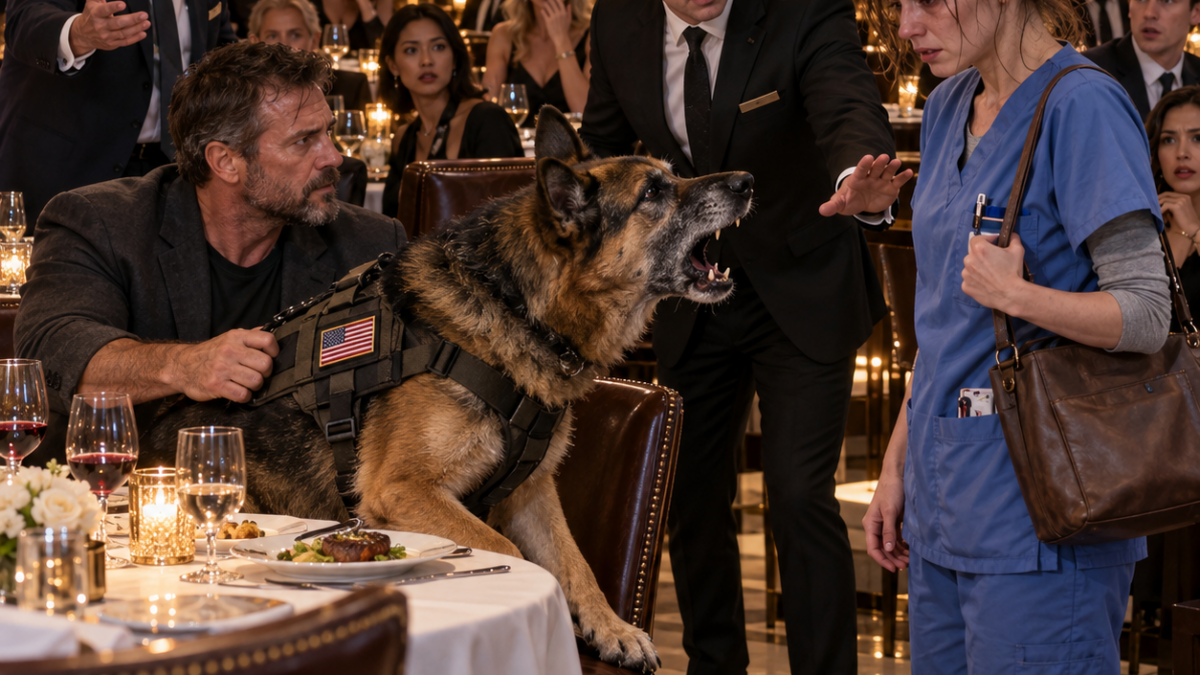
The bark hit the dining room like a shot fired too close.
Forks stopped halfway to mouths. Wineglasses froze in polished hands. Conversations died so quickly the silence seemed to have weight. Eighty diners turned toward our table by the window, toward the old German Shepherd sitting in the leather chair across from me, toward the young woman in blue scrubs standing beside us with one hand clenched around the strap of her purse.
Seconds earlier, she had whispered four small words.
“May I sit here?”
That was all.
A quiet question from a tired woman who looked as if she had been carrying the whole day on her shoulders and had finally reached the place where she needed to set it down.
Then Atlas barked.
Not a startled bark. Not a warning snap. Not the kind of sound people expect from a dog in a crowded place.
This was deep, sharp, trained, and final.
A find bark.
My hand was on his shoulder when he did it, and I felt the tremor running through his body. Not fear. Atlas did not tremble from fear. I had seen him lie still under incoming fire while men around him forgot their own names. I had seen him track through smoke, rain, darkness, and blood without breaking pace. I had seen him ignore crowds, airports, helicopters, explosions, children reaching for his ears, drunk men shouting too close.
In ten years, Atlas had never barked at a stranger.
Not once.
Now he sat upright in that polished leather chair, tactical vest strapped around his broad chest, a small American flag patch on his side, his cloudy brown eyes fixed on the nurse as if the rest of the room had disappeared.
The woman went pale.
“I am so sorry,” she whispered. “I’ll go. I didn’t mean to cause trouble.”
I found my voice too late.
“Ma’am, wait. Please.”
Nobody believed me.
I could feel the room judging us. A woman in a black dress pressed her fingers to her lips. A man in a gray suit shook his head slowly, as if he had seen everything he needed to see and had already decided who was wrong. Somewhere behind me, a waiter stopped breathing through his nose.
I kept my hand on Atlas.
“That wasn’t aggression.”
The nurse looked at me with eyes too exhausted to hope.
Her scrubs were wrinkled from a long shift. Her dark hair was pinned badly at the back of her head, strands slipping loose around her face. She had the hollowed-out look ICU nurses get after too many hours standing between machines and grief. A paper takeout menu stuck halfway out of her purse, bent at the corner. She looked as though all she wanted was soup, silence, and a corner where no one needed anything from her.
Instead, she had become the center of a room full of strangers.
Atlas barked again.
Shorter this time.
Sharper.
Then he did something I had seen him do only once before in his life.
He climbed down from the chair.
Slowly, because his hips hurt now. Because his heart was failing. Because age had turned his once-powerful body into something careful and dignified. But his eyes never left her.
He crossed the carpet on stiff legs and took the strap of her purse gently between his teeth.
He did not pull.
He did not growl.
He simply held on.
As if he were afraid she might vanish.
Inside the purse, something small jingled.
Metal against metal.
The nurse froze.
Every bit of color drained from her face.
And I understood that the sound had changed something in my dog.
Atlas stopped trembling.
Now he was listening.
The manager arrived at our table with the speed of a man trying to rescue a reputation before it bled onto white tablecloths.
His name was Pruitt. Tall, narrow, perfect suit, smile as thin as a paper cut. He had already been uncomfortable when I made the reservation and mentioned Atlas. Alverson’s was the kind of restaurant that believed elegance could be ruined by a single unexpected sound. Rooftop dining. Candlelight. Linen folded like origami. The whole city glittering beyond the windows below us.
It was not a place for barking dogs.
It was also not a place for dying ones, but I had brought Atlas anyway.
“Sir,” Pruitt said in a low, tight voice, “I must ask you to control your animal.”
“He is under control.”
“He barked at a guest.”
“He alerted.”
Pruitt’s mouth tightened.
“To what?”
I looked at the nurse.
She looked back.
For one second, she seemed on the edge of tears.
Before I could answer, a man at the next table rose to his feet.
Silver hair. Tailored suit. Expensive watch. The kind of man who seemed offended by anything he could not own.
“I pay four hundred dollars a plate for peace and quiet,” he announced. “Real service dogs don’t bark. That vest is a costume.”
Old heat climbed my chest.
The old me would have stepped closer.
The older me, the one shaped by twenty years in the Navy as a master-at-arms and K-9 handler, kept my voice level.
“That vest,” I said, “has seen more than your whole evening.”
A few diners murmured.
Some in agreement. Some in outrage. Most in the cowardly middle, where people hide while deciding which side will cost them less.
The nurse tugged slightly at her purse strap.
“I’ll go,” she said again. “Really. It’s fine.”
Atlas still held the strap.
“Atlas,” I said quietly. “Release.”
He let go at once.
Then he lowered himself to the carpet and stretched out across her feet.
His chin came to rest on the polished metal ankle of her left leg.
She looked down.
So did I.
Below the knee, her leg was carbon fiber and steel.
Her scrub pants were loose, maybe deliberately, but the fabric had ridden up when Atlas moved against her. She grabbed for it quickly, hands shaking, trying to cover what the room had already seen.
“Oh,” she breathed. “I’m sorry. It’s only a leg. I’m fine.”
Something cracked open in me.
Not pity.
I hated pity.
It was recognition.
The reflexive apology of someone who had spent too long managing other people’s discomfort about her own body.
“Ma’am,” I said, “you have nothing to apologize for. Nothing.”
She swallowed.
“Please sit with us.”
Her eyes moved around the room.
Eighty strangers still watched. Some openly. Some pretending to adjust napkins or sip water. The man in the gray suit snorted loudly, and my hands curled under the table.
The nurse hesitated another moment.
Then, very slowly, she pulled out the empty chair Atlas had left behind and sat.
The room breathed again.
Whispers crept back along the edges.
Pruitt remained beside us, uncertain now. He had expected a confrontation he could control. Instead, something had shifted outside the rules printed in his staff handbook.
“I’m Nora,” the nurse said softly. “Nora Faulkner. I work in the ICU across the street at St. Bridget’s. I just finished a double shift. I only wanted soup in a quiet corner.”
“Dominic Vance,” I said. “And this is Atlas.”
Atlas thumped his tail once against her shoe.
Nora looked down at him, and her face changed.
“He’s beautiful,” she whispered.
Her eyes filled.
“I don’t know why I’m crying.”
“Atlas does that to people.”
I meant it lightly, but I was watching her hands.
They were pressed over her purse like she was guarding something inside it. Her fingers trembled against the leather. Every so often, the faint metallic jingle came again, and each time Atlas’s ears shifted toward the sound.
I chose my next words carefully.
“Atlas has a trained bark. We call it the find.”
Nora looked at me.
“He gives it only when he locates a missing person,” I said. “Lost hiker. Child in the woods. Wounded sailor separated from a unit. In ten years, he’s used it fourteen times.”
Her breath caught.
“A missing person?”
Her voice cracked on the second word.
“Yes, ma’am.”
I looked at my old dog, his head still resting against her prosthetic foot.
“And he just used it on you.”
The candle between us flickered.
“I’m not missing,” Nora said too quickly. “I live ten minutes from here. I work in a unit full of people.”
“Then why eat alone in a place this loud?”
The question slipped out before I could stop it.
I regretted it immediately.
But Nora did not get angry. She only gave a small, sad smile that told me the question had landed somewhere old.
“Same table,” she said. “Same week. Every year. Always alone.”
She looked past me toward the window, where the city lights blurred against the dark.
“I’m not sure I can explain it.”
At the next table, the man in the tailored suit was still staring at her leg. His mouth was tight, not with sympathy, but with something more tangled. Disgust, maybe. Or grief turned sour. I noted it and let it sit. Not every fight needs to be picked the moment it presents itself.
A waiter arrived, pale and overly polite.
“Are we… ready to order?”
I ordered a strip steak, cut small, for Atlas.
Nora asked for soup.
The waiter nodded too quickly and left.
Nora looked at me after he was gone.
“Why this restaurant?” she asked. “Why tonight?”
I stroked Atlas’s ears.
His fur was thinner than it used to be. White had spread around his muzzle, across his eyebrows, down the broad bridge of his nose. His body had been built for work once. Search grids. Patrol routes. Aircraft noise. Long nights. Now he tired after stairs.
“Six days ago,” I said, “a veterinary cardiologist turned an ultrasound screen toward me and told me his heart is failing.”
Nora’s hand flew to her mouth.
“Weeks,” I said. “Maybe less.”
I looked down at him, and for a moment the elegant restaurant disappeared. I saw him younger, all muscle and focus, leaping from a transport like gravity had given him permission to ignore it. I saw him asleep on concrete with his head on my boot. I saw him pulling me through smoke toward men I could not hear.
“That night,” I continued, “I made him a promise. He’s eaten from metal bowls on every kind of ground you can imagine. I wanted him to have one perfect dinner at a real table.”
Nora looked at Atlas, then back at me.
Under the table, Atlas pressed harder against her prosthetic leg, not with force, but with the steady insistence of a hand reaching for another hand in the dark.
The soup came in a white bowl.
Nora did not touch it.
Atlas’s steak arrived chopped neatly on a small plate. I set it on the floor, expecting at least some interest. Steak had once been the only thing that could make Atlas look temporarily less disciplined.
He did not eat.
He stayed against Nora’s foot, watching her face.
“I’ve been a nurse for eleven years,” Nora said slowly. “Trauma, ICU, flight.”
I went still.
“Flight?”
Her eyes dropped to the purse.
“Navy Reserve,” she said. “Medevac crew. Forward base in the mountains.”
She swallowed.
“I don’t talk about it.”
“You don’t have to.”
“I think I do.”
Her fingers moved to the zipper of her purse.
“Something in here has been waiting a very long time.”
When she opened the bag, her hands shook so badly the metal inside jingled again.
Atlas lifted his head.
His ears snapped upright.
Nora reached inside and drew out a small object on a faded cord.
Dull.
Scratched.
Worn smooth in places by years of being touched.
A military dog tag.
She laid it on the white tablecloth between the candle and the water glasses.
The stamping was faint, but I could read it from where I sat because I had known those numbers by heart for nine years.
ATLAS.
Service number beneath it.
A number I had stamped myself in a kennel office under fluorescent lights, laughing because Atlas had tried to steal the cord before I could attach it to his collar.
The world tilted.
I gripped the edge of the table.
“That’s impossible.”
My voice sounded unfamiliar.
Nora looked at the tag like it might burn through the cloth.
“Atlas lost that tag on a mountain nine years ago,” I said. “On the worst day of my life.”
“I know,” she whispered.
My eyes lifted to hers.
“I took it off him.”
The restaurant blurred at the edges.
“What?”
“He was bleeding badly,” she said. “Shrapnel in his chest. The tag was snagging in the wreckage. I cut it from his collar so I could move him without choking him.”
Her voice trembled, but she did not look away.
“I put it in my pocket. I’ve kept it ever since.”
I could not breathe properly.
The candle flame stretched tall, then settled again.
“Every year,” she said, “I bring it to this table during the same week. I never understood why. I think I was waiting for someone to tell me what to do with it.”
The sound of the dining room faded beneath a roar I knew too well.
Memory.
Not gentle memory.
The kind that kicks open doors.
“Which mountain?” I asked, though some part of me already knew.
Nora closed her eyes.
“Anvil Ridge. Medevac Seven.”
For nine years, the words Medevac Seven had lived inside me like shrapnel no surgeon could remove.
That was the helicopter that went down trying to reach us.
That was the crew they told me was lost.
All four.
For nine years, I had carried their deaths as part of the price of my survival. Not officially. Official reports use cleaner words. Weather. Fire. Impact. Casualties. Unrecoverable. But men who survive know when someone else did not, and we build private monuments out of guilt.
Medevac Seven had been one of mine.
“They told me nobody walked away,” I said.
“Nobody did.”
Nora lifted her chin.
“I was carried.”
Across the room, people had gone quiet again. Not the judgmental quiet from before. This was different. The whole restaurant leaned toward us, though no one admitted it. Even the waiter had stopped several yards away with a tray in his hands.
I looked at Atlas.
He was gazing at Nora with an expression I knew better than my own reflection.
Recognition.
Pure, absolute recognition.
Not of the leg.
Not of the purse.
Not even of the tag.
Of her.
“Nora,” I said, but I did not know what came after.
Her eyes filled.
“I think I’m the nurse,” she said, “and I think you’re the man I couldn’t wake.”
Before I could answer, something crashed behind me.
China shattered.
Crystal scattered.
A heavy body hit the floor.
The room exploded into gasps and screams.
I spun.
At the next table, the silver-haired man who had accused Atlas of wearing a costume lay flat on his back among broken plates. His face had turned the color of ash. His eyes were open.
He was not breathing.
For one frozen second, nobody moved.
Then Nora was on the floor.
Not carefully. Not slowly. Not like a woman protecting a prosthetic leg or a tired body after a double shift. She dropped beside him with the clean, immediate certainty of someone whose training lived deeper than pain.
She tore open his collar and put two fingers to his neck.
Her eyes found mine.
“No pulse. Not breathing. Call 911.”
My phone was already in my hand.
I pressed the button and set it on the carpet on speaker.
“911. What is the address of your emergency?”
The dispatcher’s voice was calm, middle-aged, steady as a rail.
“Alverson’s restaurant, roof level, Meridian Hotel, Harbor Point,” I said. “Male in cardiac arrest. Nurse starting compressions.”
“Understood, sir. My name is Paula. Help is on the way. Is the patient breathing?”
“No,” Nora said, leaning over the phone. Her voice had changed. Whatever grief had been shaking her at our table was gone now, locked behind the emergency. “Unresponsive, pulseless, apneic. Starting CPR. Paula, I need an AED and I need a count.”
There was half a second of surprise on the line.
Then Paula’s voice sharpened.
A professional recognizing another professional.
“Copy, nurse. I’ll count with you. Medics are four minutes out. Begin compressions.”
Nora locked her elbows.
Her hands settled on the center of the man’s chest.
She pushed hard and fast.
His ribs gave beneath her palms.
“One, two, three, four,” Paula counted.
The crowd backed away in a wide, terrified ring.
Pruitt stood frozen, his face white as the tablecloths.
“Pruitt!” I barked. “Where’s your AED?”
“Our… I’m not certain we have one.”
Nora did not stop compressions.
“Find it!” she shouted. “Someone find it now.”
Voices overlapped.
A waiter ran toward the kitchen. Someone said it might be in the lobby. Another person said the lobby was two floors down. A woman started crying. A man shouted for a doctor, though the nurse on the floor was already doing the work death had no patience for.
Two floors was too far.
I knew the numbers.
Every minute without defibrillation stole roughly a tenth of a man’s chance. Four minutes could become forty percent gone before help reached us.
Then I looked down at Atlas.
My old dog stood rigid.
Nose lifted.
Ears forward.
He was not looking at the man on the floor.
He was looking at the wall behind the host stand, where a tall potted palm stood in front of a plain white panel.
I knew that stance.
I had seen it across rubble, brush, buildings, and snow.
“Atlas,” I said. “Find it.”
His body tightened.
“Go.”
The dying war dog moved like age had never touched him.
He tore across the dining room. Diners dove out of his way. Chairs scraped. Someone yelped. Atlas skidded at the palm, shoved his muzzle through the leaves, and gave the loudest find bark of his life.
I ran.
Behind the palm, mounted against the wall, was a white box marked with a red heart.
AED.
“Got it!”
I ripped the box open, tore the machine free, and ran back.
Nora never stopped.
Sweat ran down her temples. Her prosthetic foot slid on the carpet, but she corrected without losing rhythm. Her face had gone pale, yet her hands drove compressions into the man’s chest with brutal mercy.
“Pads,” she ordered. “Right upper chest, left lower ribs. Clear everyone out of reach.”
My hands moved from old memory.
Open kit.
Tear packaging.
Expose chest.
Press pads.
The AED woke with a calm electronic voice that sounded obscene in the middle of all that human terror.
“Analyzing heart rhythm. Do not touch the patient.”
Nora lifted her hands.
For the first time, her body shook.
Atlas moved beside her and pressed his shoulder against her hip, a warm living wall.
The screen flashed.
SHOCK ADVISED.
Charging.
The restaurant held one breath.
“Stand clear,” the machine said.
“Clear,” Nora called.
I hit the button.
The man’s body jerked once against the carpet.
Silence.
Then Nora resumed compressions without a pause.
“Come on, sir,” she said. “Come on.”
Paula’s voice returned from the phone.
“Medics are in the elevator. Keep going, nurse. You’re doing it right.”
Atlas lay beside the man’s head now, perfectly still, eyes on Nora.
He did not bark.
He simply stayed.
The AED analyzed again.
“Shock advised.”
“Clear.”
Second shock.
A pause followed.
Long.
Terrible.
The kind of pause that opens and opens until you think the whole world might fall through it.
Then the man’s chest rose on its own.
A rattling breath dragged itself into him.
Then another.
His fingers twitched against the carpet.
Nora leaned back on her heels, gasping.
“He has a pulse,” she said, almost like she did not believe mercy could arrive that quickly. “Paula, he has a pulse.”
The dispatcher’s professional voice cracked.
“Beautiful work, nurse. Whoever you are, beautiful work.”
The elevator doors burst open.
Paramedics poured into the dining room with a stretcher, monitor, and bags. The lead medic was broad, in his fifties, gray crew cut, captain’s bars on his collar. He dropped beside the patient and took over with clean speed.
Then he glanced up.
He saw Atlas first.
Then the dog tag still lying on our tablecloth.
Then Nora.
His hands paused for less than half a second, but I saw it.
“Lieutenant Faulkner.”
Nora stared at him.
“Elliot?”
“Captain Elliot Marsh now,” he said.
A strange smile broke across his face, though his hands kept moving with the team. Monitor leads. Airway. Blood pressure. Instructions snapped out and obeyed.
Then he looked at me.
“You’re the handler,” he said. “And that’s Atlas.”
My mouth went dry.
“You know us?”
Marsh did not stop working.
“Mr. Vance, nine years ago on Anvil Ridge, I was the corpsman on the rescue helicopter that came after Medevac Seven went down.”
The room seemed to tilt again.
“We found your wreck by the sound of one dog,” he said. “Atlas barked at the sky for two hours and never stopped.”
I looked at Atlas.
My old dog’s head rested between his paws.
He remembered.
God help me, he remembered all of it.
“When we landed,” Marsh continued, “we found Lieutenant Faulkner pinned under the fuselage. Left leg crushed. She was awake.”
Nora had gone white.
“One hand was on your chest,” Marsh said to me. “Her mouth was on yours. She gave you breaths every few seconds for two hours because your airway kept closing.”
My knees weakened.
I reached for the table and missed. Somehow I stayed upright.
Nora looked at me.
“I didn’t know if you lived,” she whispered. “They flew me out unconscious. When I woke up, no one would tell me anything.”
“They told me you were all gone,” I said.
My voice broke on the last word.
“I thought I lived because you died.”
Marsh’s expression softened.
“We tried to cut her free first,” he said. “She refused.”
Nora closed her eyes.
“She told us, ‘Take the handler. Take the dog.’ Her leg stayed trapped for two more hours because she made us wait. The surgeons couldn’t save it.”
The restaurant had gone utterly silent.
Not polite silent.
Sacred silent.
I looked down at her prosthetic, at the polished metal ankle Atlas had chosen for his pillow. For nine years, I had carried the cost of my life without ever knowing who paid it.
The paramedics lifted Gerald Ashby onto the stretcher.
Marsh stood and rested a hand on Nora’s shoulder.
“Welcome home, Lieutenant.”
Atlas rose, walked to Nora, and set his heavy head in her lap.
That was when I broke.
Not loudly.
Not dramatically.
I sat back in the chair, put my face in my hands, and wept for the first time in nine years.
They carried Ashby out alive.
His wife, a trembling woman in pearls who had been sitting at another table, caught Nora’s hands near the doorway. She tried to speak but could not manage words.
On the stretcher, Gerald Ashby opened his eyes once.
He looked at Atlas.
Then at Nora’s leg.
Then away.
His lips moved.
I did not hear what he said.
Nora did.
She only nodded.
The ambulance left.
For a long time, no one in the restaurant moved.
Then Pruitt crossed the floor.
His perfect suit looked smaller now. So did he.
He stopped beside our table and bowed his head.
“Mr. Vance. Miss Faulkner. Please forgive me.”
Nora said nothing.
Neither did I.
“This table is yours for as long as you wish,” he continued. “Dinner is on the house. And that AED panel behind the palm will never be hidden again.”
His voice shook.
“Every employee will be trained in CPR.”
I looked at the doorway through which Ashby had been taken.
“Not for us,” I said. “For the next man who falls.”
Pruitt nodded.
His eyes were wet.
“Then for him.”
When the staff finally moved away, Nora and I sat again.
The candle had burned low. Wax pooled around its base. Atlas lay under the table with his head across Nora’s shoes. His steak was gone at last, though I had not seen him eat it. Maybe Nora had fed him. Maybe he had taken it when no one was looking. He deserved the mystery.
Nora held the dog tag in both hands.
“I’ve come here for nine years,” she said. “I thought I was mourning you. The man I couldn’t save.”
Her thumb traced the worn letters.
“Instead, I was sitting in the room where you’d someday walk in.”
I stared at the tag.
“I carried the weight of a crew I thought died for me. I never knew the one who lived was the one who kept me breathing.”
She looked at me then.
Not as a stranger.
Not as a nurse.
As someone who had been trapped inside the same mountain from a different angle.
“I didn’t save everyone,” she said.
I knew that sentence.
Every survivor does.
“No,” I said. “But you saved me.”
Her face trembled.
“And Atlas.”
At the sound of his name, his tail thumped once beneath the table.
I picked up the tag and slid it toward myself.
For one second, I thought I would keep it. It had his name. His number. His history. It belonged to him.
Then I pushed it gently back toward her.
“Keep it.”
She looked startled.
“It belongs to Atlas.”
“Atlas belongs to both of us now,” I said.
My voice was rough.
“He told us so in front of eighty people.”
Nora closed her hand around the tag.
Her shoulders dropped, as if a pack she had carried up an entire mountain had finally slipped to the ground.
“May I ask something?” she said.
“Anything.”
“The doctor gave him weeks?”
I looked down at Atlas.
His breathing was slow. He had earned more rest than the world had given him.
“Yes.”
Nora swallowed.
“May I spend them with him?”
Atlas lifted his head and looked at me.
That was answer enough.
“He would never forgive me if I said no.”
So that was how it went.
Every morning before her shift, Nora drove to my small house at the edge of town. At first she knocked. After the third day, I told her the door would be open. She came in with coffee for herself and half a biscuit for Atlas, though she pretended the biscuit was for me until Atlas gave her the stare that had broken stronger people.
She sat on the porch while the sun came up, and Atlas slept with his chin on her prosthetic foot.
The first morning, she apologized for it.
“I don’t know why he keeps doing that.”
I handed her a mug.
“He knows where he wants to be.”
She stopped apologizing after that.
On Sundays, he ate steak.
Not the cheap kind. Nora insisted on buying cuts that made my grocery bill look like a mistake. She said a dog who had once identified a hidden AED in a rooftop restaurant and solved a nine-year mystery deserved better than kibble.
I did not argue.
Atlas was never alone again.
Some days he had energy. He would patrol the yard slowly, nose down, pretending the squirrels were of tactical importance. Other days, he barely lifted his head except when Nora arrived. Then his tail would thump against the floor once or twice, and his cloudy eyes would find her as if counting her into the room.
Nora and I did not talk about Anvil Ridge every day.
You might think we would.
We didn’t.
Grief does not like being dragged into the light before it is ready. Some mornings we talked about nothing. Coffee. Weather. Hospital nonsense. The way Atlas refused to eat the expensive joint supplements unless they were hidden in roast chicken.
Other mornings, pieces surfaced.
Small pieces.
She told me about waking in Germany after surgery, asking about the handler and the dog until the nurse stopped meeting her eyes.
I told her about waking stateside and being handed a version of events that left her dead and me alive.
She told me she had kept Atlas’s tag because it was the only proof she had that the mountain had not been a nightmare.
I told her I had avoided helicopters for two years after.
She told me she came to Alverson’s every year because Medevac Seven had been en route from a nearby staging area before the mission, and the restaurant overlooked the flight path.
I told her I chose Alverson’s because Atlas deserved to see the city from somewhere high before he left it.
That made her cry.
Not loudly.
Nora did not cry loudly.
She cried the way nurses do, like someone trying not to inconvenience the room.
A week after the restaurant, a letter came from Gerald Ashby.
Cream envelope. Shaky handwriting.
I opened it on the porch with Nora beside me and Atlas asleep across both our feet.
Mr. Vance and Lieutenant Faulkner,
I was staring at your leg because my son lost his in a motorcycle accident three years ago. I have been angry at the world and too proud to say I was grieving. That does not excuse my cruelty. I am alive because you did not hesitate.
Thank you.
Gerald Ashby.
Nora took the letter from me and read it again.
Then she folded it carefully.
For a long time, she said nothing.
Atlas opened one eye.
Finally, she whispered, “People carry strange wounds.”
I looked at her prosthetic.
Then at my dog.
Then at the porch steps where the morning light had pooled.
“Yes,” I said. “They do.”
Atlas lived five more weeks.
Not enough.
More than we were promised.
That is the cruel arithmetic of love near the end. Every extra day feels like theft and mercy at the same time. You thank God for it in the morning and resent time for taking credit by night.
On his last evening, the house was quiet.
Rain tapped softly against the windows. The living room lamp was low. Atlas lay on the rug between us, no longer pretending he might get up. His breathing had become shallow, then slower, then strangely peaceful.
I sat with his head in my lap.
Nora sat on the other side, holding his paw.
The old dog looked from my face to hers.
His eyes were tired.
But clear.
“You did good, buddy,” I whispered.
The words were too small.
All words are too small at the end.
“You found them,” I said. “Every lost child. Every wounded man. Every missing piece. You found us too.”
Nora pressed his paw to her cheek.
“Thank you for barking,” she whispered.
Atlas’s tail thumped once against the floor.
Like a salute.
Then the great heart that had carried him through war, airports, hospital rooms, mountains, guilt, and one perfect dinner finally rested.
The silence afterward was not empty.
It was full of him.
We buried him beneath the oak in my backyard.
I folded his American flag patch and placed it against his chest before the earth covered him. Nora hung the old tag on a thin chain around her neck. It rested there, just below her throat, where I could see his name when the light touched it.
Afterward, we stood together in the grass.
Neither of us spoke for a while.
The wind moved through the oak leaves.
At last, I said, “Everyone thinks a good dog barks to warn you.”
Nora looked at me.
“Atlas barked to tell us something else.”
My throat tightened.
“You were never alone out there, Nora. You were never the one who failed. You were the one who was found.”
Her face crumpled.
Not from weakness.
From release.
She leaned her head against my shoulder.
I put my arm around her carefully, not because she was fragile, but because some grief deserves gentleness after holding itself upright for too long.
Above us, the oak moved in the wind.
For nine years, that mountain had lived inside me as the place where people died so I could live.
For nine years, it had lived inside Nora as the place where she failed to save a man who was sitting beside her the whole time in memory, breathing because she had refused to stop.
Atlas had carried the truth longer than either of us.
He had waited until his last weeks to give it back.
The city kept moving. The hospital kept filling. Alverson’s trained its staff. Gerald Ashby recovered enough to send a second letter, this one with a photograph of his son standing beside him, both of them awkwardly smiling. Nora returned to the ICU, where people knew her as the quiet nurse with a steady voice. I returned to my small house, where the porch felt too wide without Atlas’s body stretched across it.
But grief had changed shape.
It was no longer only a stone.
It had become a bridge.
Some evenings, Nora came by after work, and we sat beneath the oak without saying much. She wore Atlas’s tag around her neck. I kept his leash hanging beside the door. Neither of us called it healing. That word was too clean for something so uneven.
But the mountain grew quieter.
Not gone.
Never gone.
Just quieter.
And sometimes, when the wind moved through the oak in a certain way, I could almost hear him.
Not barking.
Not searching.
Resting.
The dog who had spent his life finding the lost had found us at the end of his own.
And because of him, Nora and I finally understood the truth we had both been too wounded to see.
We had not survived instead of the dead.
We had survived carrying them.
And somewhere between a rooftop restaurant, a worn dog tag, a saved heartbeat, and a grave beneath an oak tree, we finally learned how to set part of that weight down.