FULL ENDING The Drunk Woman Who Hit My Motorcycle Said I Ruined Her Life, but Her Own Lies Put Her Behind Bars
𝗣𝗔𝗥𝗧 𝟮
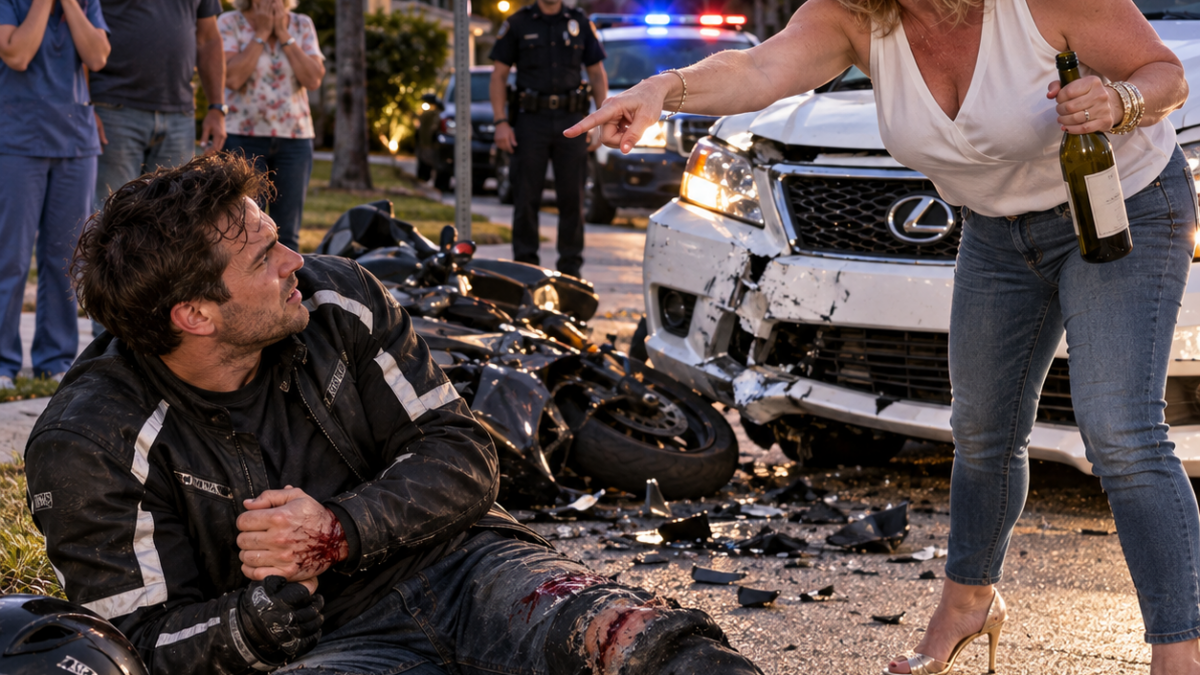
Three sheriff’s cruisers arrived first, lights painting the houses red and blue. Then the ambulance.
A deputy went to Karen while another came to me. The paramedics cut part of my glove off because my wrist had swollen too much. When they cleaned the road rash, it burned like they were pouring fire into my skin.
But I stayed clearheaded enough to give my statement.
“I stopped,” I told the deputy. “I had the right of way. She came from the right and never stopped. I swerved, but she clipped my rear wheel.”
He looked toward the intersection. “Did you hear brakes?”
“No.”
Tom said from behind him, “There weren’t any.”
Lisa added, “She was weaving before the intersection. I saw her coming down the street. She almost clipped Mrs. Carter’s mailbox.”
Karen was trying to perform the field sobriety test by then.
Trying badly.
She swayed. She argued. She forgot instructions before the deputy finished giving them. When they asked her to walk a straight line, she wobbled like the line itself had insulted her. Her words smeared together.
“I’m stressed,” she kept saying. “He stressed me out. That’s why this happened.”
Then came the breathalyzer.
I watched from the stretcher while a deputy held it out.
Karen blew.
The deputy looked at the result.
His face changed just enough.
Later, I found out it was .14.
Almost twice Florida’s legal limit.
They cuffed her.
She lost what little control she had left.
“This is his fault!” she screamed while they guided her toward the cruiser. “He ruined my life! He came out of nowhere! Motorcycles shouldn’t be legal!”
The paramedic tightened the strap across my chest.
“Try not to move your wrist,” he said.
I looked at my bike in the ditch.
Then at Karen being put into the back of the cruiser.
Then at the stop sign she had ignored.
“I was one block from home,” I said.
The paramedic’s face softened.
“I know, man.”
At the hospital, they told me I had a hairline fracture in my left wrist and nasty road rash down both legs. I was lucky, which is a strange thing to hear when you are wrapped in bandages, braced, sore everywhere, and trying not to think about how close your head came to the pavement.
But they were right.
My gear saved me.
Without the jacket, gloves, boots, and helmet, I would have been in much worse shape.
Still, lucky did not mean fine.
I was out of work for three weeks. Warehouse work and fractured wrists do not mix. The medical bills started piling up almost immediately. ER visit, imaging, follow-up, brace, wound care, prescriptions. By the time the first wave settled, I was looking at around $6,500.
Then came the bike estimate.
$7,800.
Front wheel. Forks. Handlebars. Engine case repair. Paint. Labor. More damage than I first thought because the impact had cracked part of the engine casing.
I stood in the repair shop staring at my MT-10, feeling like someone had kicked me in the chest.
The mechanic, a guy named Luis, put one hand on the tank gently.
“She’ll come back,” he said.
I nodded.
But I did not fully believe him yet.
Karen made bail the same night, thanks to her sister from Tampa. Some real estate type with money and a hard face, according to Tom, who saw them pull into Karen’s driveway after midnight. I hoped she would disappear into shame, legal advice, or at least silence.
She did not.
Three days after I came home from the hospital, I hobbled to the mailbox with my wrist in a brace and bandages under loose sweatpants.
Karen was waiting.
Not accidentally.
Waiting.
She leaned against her mailbox in oversized sunglasses, hair messy, face pale, lips tight. Even from a few feet away, I smelled wine.
“You need to drop this,” she said.
I stared at her. “Drop what?”
“The lies.”
I almost laughed.
Then I realized she meant it.
“You hit me.”
“You’re ruining my life.”
“The state is charging you, Karen. Not me.”
“You told them I was drunk.”
“You were drunk.”
Her mouth twisted.
“You faked those injuries.”
I looked down at my brace. “This is a pretty committed performance.”
“You bikers are all scammers. Insurance chasers.”
I stepped back toward my driveway.
“Do not talk to me again.”
“You don’t get to destroy someone and walk away!”
That sentence nearly made me turn around.
Instead, I went inside, locked the door, and bought a notebook online.
It arrived the next day.
Black cover. Hard spine.
I wrote the date, time, and what she said.
Then I started documenting everything.
At first, I felt ridiculous.
Then she made it necessary.
Karen began telling neighbors I had caused the crash. That I was speeding. That I had cut her off. That I had exaggerated a scratch into a financial scam. Lisa caught her at a neighborhood barbecue whispering to Mrs. Carter that I was “milking a little road rash for a payout.”
Mrs. Carter, bless her, told Karen, “Honey, I saw the ambulance.”
Karen started making comments whenever she saw me outside.
“Loser biker.”
“Insurance fraud.”
“Still limping for attention?”
One night around eleven, she stood near the sidewalk outside my house and shouted, “You’re a liar, Mark! This is all BS!”
I called the sheriff’s office.
When the deputy arrived, Karen claimed she was just walking her dog.
She did not have a dog.
The deputy looked down the empty sidewalk, then back at her.
“Ma’am, where’s the dog?”
Karen blinked.
Then said, “Inside.”
The deputy wrote a report.
I added it to the notebook with the report number.
She left notes too.
The first one was tucked under my door.
Hope you learned your lesson.
I photographed it before touching it.
The second was taped to my mailbox.
Stop lying before karma finds you.
The third was just one sentence written in thick black marker.
Motorcycles kill people.
I kept all of them.
Lisa told me to install a camera.
Tom offered to install it for me because my wrist still hurt.
By the end of that week, I had a doorbell camera, one pointed at the driveway, and one catching the mailbox.
Karen kept digging.
A buddy of mine who worked near the courthouse did some public-records searching and found out Karen had a prior DUI from a few years earlier that had been pleaded down to reckless driving. That mattered. A lot. With injury involved, this new case was not some simple traffic mess. In Florida, DUI with injury could become serious, especially with prior impaired-driving history.
My lawyer explained it more clearly.
Yes, I got a lawyer.
Not because I wanted to get rich. I wanted my medical bills paid, my bike fixed, my lost wages covered, and Karen stopped. If you have never dealt with insurance after a crash, let me tell you something: being obviously not at fault does not stop people from trying to make you share blame.
Karen’s insurance company fought everything.
They suggested I might have been speeding. That my injuries might not be that serious. That motorcycles are inherently risky. That my gear showed I knew danger was possible. That the intersection visibility was poor. That maybe I had entered too fast.
My lawyer, Dana, was a small woman with a quiet voice and the terrifying patience of someone who enjoys watching liars build their own traps.
“Do not talk to Karen,” she told me.
“I’m trying not to.”
“Do not talk to her insurance.”
“I won’t.”
“Document every contact, every note, every witness statement, every bill, every missed shift.”
“I already started.”
Dana looked at my notebook.
Then she smiled.
“Good.”
The criminal case took months.
During that time, Karen deteriorated in public.
The parties stopped, mostly because nobody wanted to be seen at her house while her name circulated through police reports and court dates. Her lawn went patchy. Her Lexus disappeared for stretches, then reappeared with front-end damage still visible. She wore sunglasses even at dusk. Some mornings I saw her standing on her porch with coffee—or something darker—staring at the street like the whole neighborhood had betrayed her by remembering what happened.
At the first court appearance I attended, she looked nothing like the woman who used to strut around the cul-de-sac.
Her hair was messy. Her eyes were puffy. Her face had that gray look people get when sleep, stress, and alcohol have been taking turns. Her sister sat beside her in a sharp blazer, whispering angrily. Karen’s lawyer tried to create fog around the facts.
Work stress.
Poor visibility.
Motorcycle speed.
Panic.
Confusion.
No malicious intent.
But evidence has a way of sounding louder than excuses when it is stacked correctly.
There were my medical records.
Photos of the bike.
The crash report.
No skid marks from Karen’s tires.
The breathalyzer.
The field sobriety observations.
Tom’s statement.
Lisa’s statement.
Mrs. Carter’s statement about Karen nearly hitting her mailbox.
The deputy report from the harassment incident.
Photos of the notes.
Video from my doorbell camera showing Karen at my door late at night, slurring insults.
The prosecutor used all of it to paint a picture Karen hated.
Not one mistake.
A pattern.
A drunk driver who injured someone, blamed him, harassed him, and showed no remorse.
When the judge spoke, the courtroom went still.
“You injured another person while driving under the influence,” he said. “The evidence indicates you failed to stop, failed to brake, and then attempted to shift blame to the victim. Your conduct after the incident demonstrates continued poor judgment and a lack of accountability.”
Karen stared at the table.
Her lawyer leaned in and whispered to her.
She took the plea.
Guilty to felony DUI with injury.
The sentence was fourteen months in state prison, three-year license suspension, $3,200 in fines, and restitution. The initial restitution amount was set at $14,300 based on the medical bills and motorcycle damage already documented, with the possibility of adjustment if additional costs came in.
When the judge said state prison, Karen made a sound under her breath.
Her sister closed her eyes.
I did not feel joy.
People expect you to feel joy when someone who hurt you faces consequences. Maybe sometimes people do. I felt something more complicated. Relief, yes. Validation, yes. Anger still, absolutely. But also a heavy kind of sadness, because none of it had needed to happen.
She could have called a ride.
She could have stopped at the sign.
She could have checked if I was alive.
She could have told the truth.
At every point, there had been a better choice.
She made the wrong one every time.
The civil insurance case dragged on longer.
That was its own slow grind.
Medical evaluations. Repair estimates. Lost wage documentation. Expert review of the crash. Dana pushed. The insurance company resisted. Dana pushed harder. I learned that patience in legal matters is not passive. It is active endurance. It is sending documents, answering questions, refusing bad offers, and not letting exhaustion make decisions for you.
Eventually, they settled for $28,500.
It covered the medical bills, the bike repairs, lost wages, and a little extra for pain, aggravation, and the weeks I spent sleeping badly because every intersection felt like a threat.
It was not winning the lottery.
It was being made closer to whole.
Closer, not fully.
My wrist healed.
The road rash faded into pale scars on my legs.
The MT-10 came back from Luis’s shop looking almost better than before. Fresh black paint gleaming in the sun. New parts where old ones had been scraped or bent. When I saw it rolled out, I ran my hand over the tank and felt my throat tighten.
Luis tossed me the key.
“Careful first ride,” he said.
“Always.”
That first ride back was not easy.
Anyone who says you just hop on like nothing happened is either lying or made of something different than me. My hands were steady, but my chest was tight. Every car at a side street looked suspicious. Every stop sign felt brighter. Every SUV made me track its wheels.
But then the road opened.
The engine settled under me.
The wind pressed against my jacket.
The fear did not disappear.
It moved over.
I kept riding.
Karen served eleven months before getting out early for good behavior.
By then, her life in the cul-de-sac had collapsed.
Her Lexus was repossessed while she was inside. Her landlord evicted her for nonpayment. Her sister came with a moving van and hauled away what was left: cheap furniture, cardboard boxes, patio chairs, and a few garbage bags of clothes. I watched from my garage, not hiding, not celebrating.
Tom stood at the edge of his driveway beside me.
“Hell of a thing,” he said.
“Yeah.”
“You okay?”
I looked at the MT-10, parked clean and whole beside my toolbox.
“Getting there.”
Karen never came back to live on our street.
From what Lisa heard through some friend-of-a-friend chain, Karen moved in with family up north. I did not ask where. I did not care. The harassment stopped completely.
The neighborhood changed after she left.
Not dramatically. No parade. No banner. No one stood in the street chanting that the villain was gone. Life just relaxed.
Tom parked his truck without being yelled at.
Lisa slept during the day without music thumping through her walls.
Mrs. Carter tended her garden in peace.
The cul-de-sac returned to the kind of quiet you do not fully appreciate until someone takes it from you.
A few weeks after Karen’s belongings disappeared, Tom hosted a cookout.
He said it was just because the weather was good.
Nobody believed him.
Lisa brought potato salad. Mrs. Carter brought cookies. I brought drinks and sat in a folding chair with my legs stretched out, scars visible below my shorts. At one point, Tom raised his soda and said, “To quiet streets.”
Nobody mentioned Karen’s name.
We didn’t need to.
The sun went down slowly. Kids rode bikes near the curb. Someone’s dog barked twice and then gave up. The smell of charcoal drifted over the lawns. My MT-10 sat in my driveway, black paint catching the last orange light.
Mrs. Carter sat beside me for a while.
“You scared us that night,” she said.
“I scared myself.”
“I’m glad you still ride.”
I looked at her, surprised.
She smiled. “Don’t let someone else’s bad choices steal what you love.”
That sentence stayed with me.
Because that was the real fight after the court dates and the insurance settlement and the repairs.
Not proving Karen wrong.
That had been done.
The harder part was refusing to let her become the reason I gave up something that made me feel alive.
I still stop fully at that four-way stop.
I check left, right, left again.
Sometimes I pause a second longer than I need to.
Sometimes, if a white SUV approaches from the right, my body remembers before my mind does. My wrist aches in certain weather. The scars on my legs catch my eye when I put on riding gear. The sound of tires braking hard still sends a spike up my spine.
But I ride.
Every day I can.
To work. Home. Along the coast when the weather is clear. Out past the places where the city thins and the air smells like salt, grass, and hot pavement.
I ride because I am careful.
I ride because I survived.
I ride because Karen blamed me for existing, and continuing to exist loudly, safely, and freely is the best answer I can give.
There is a lesson in all this, though it is not the one Karen shouted over me while I was bleeding on the road.
Motorcycles are not the problem.
Consequences are not harassment.
Documentation is not revenge.
And telling the truth is not ruining someone’s life.
Karen ruined her own life one choice at a time.
She chose to drink.
She chose to drive.
She chose to run the stop sign.
She chose to hit me.
She chose to scream instead of help.
She chose to lie.
She chose to harass me.
She chose to leave notes, spread rumors, and stand outside my house at night because she could not accept that the crash was hers.
All I did was survive, document, and let the process work.
Slowly.
Imperfectly.
But in the end, it worked.
Sometimes justice does not arrive like thunder.
Sometimes it arrives as a notebook full of dates, a breathalyzer result, witness statements from good neighbors, a judge who sees through excuses, and a motorcycle rebuilt piece by piece until it gleams again in the sun.
Karen said I ruined her life.
She was wrong.
I just happened to be there when her choices finally caught up with her.
𝗧𝗛𝗘 𝗘𝗡𝗗
The Drunk Woman Who Hit My Motorcycle Said I Ruined Her Life, but Her Own Lies Put Her Behind Bars
I was almost home when Karen blew through the stop sign in her white Lexus and clipped my rear wheel. While I was bleeding on the asphalt with a fractured wrist, she stood over me smelling like wine and screamed that motorcycles should not exist. Then she tried to turn the whole neighborhood against me, not realizing every lie she told was becoming evidence.
I have loved motorcycles since before I was old enough to reach the pegs.
Some kids grew up staring at baseball cards or video games. I grew up staring at my uncle’s old Harley in his garage like it was a sleeping dragon. He never let me touch it when I was little, but he would let me stand there while he wiped the chrome, checked the cables, and told me what every part did. I remember the smell of oil, leather, dust, and gasoline. I remember the way his voice changed when he talked about riding, like the road had taught him something nobody else could explain.
By the time I bought my first bike, I already understood the deal.
Motorcycles are freedom, yes.
But they are also responsibility.
You do not get metal doors, airbags, crumple zones, or the luxury of assuming other people see you. You get your eyes, your hands, your judgment, your gear, and the constant knowledge that one careless driver can turn a normal commute into sirens.
So I rode carefully.
Always had.
At thirty-two, I was not some reckless kid trying to impress strangers at stoplights. I worked a warehouse job in Sarasota, Florida, paid my bills, kept to myself, and treated my Yamaha MT-10 like the beautiful, loud, black beast it was. That bike was my pride. My therapy. My way of clearing my head after a long shift under fluorescent lights and forklifts beeping all day.
I wore full gear every ride.
Helmet.
Armored jacket.
Gloves.
Boots.
No exceptions.
Even in Florida heat that made the air feel like wet laundry, I wore it. People teased me sometimes. Said I looked ready for battle just riding to work. I always told them the same thing: if I ever needed the gear, I would need all of it.
I just never expected to need it one block from home.
Our cul-de-sac used to be quiet.
That was one of the reasons I liked it. Nothing fancy. Single-story houses, trimmed lawns, palm shadows in the afternoon, retirees who waved from porches, young families with bikes in driveways, and dogs that mostly barked out of duty rather than rage. People knew each other’s names. Not best friends, maybe, but close enough to notice when someone’s trash bin got blown over or when Mrs. Carter needed help carrying groceries inside.
Across the street lived Tom, a retired firefighter with forearms like fence posts and the kind of calm that came from decades of walking toward things other people ran away from. Next door to him was Lisa, an ER nurse who worked nights and somehow still found time to check on everyone. Mrs. Carter lived near the corner, sweet as sugar and tough as old rope, always in her garden with a sunhat and a basket of clippings.
It was a good street.
Then Karen moved in.
Her real name was Karen Hayes, though within a month half the neighborhood was calling her Kay because it sounded less exhausting. She was in her late forties, white American, divorced if the stories were true, and always dressed like she wanted witnesses. Yoga pants that had never seen yoga. Oversized sunglasses. Bright lipstick. Long blond hair with dark roots she flipped over one shoulder whenever she wanted to make a point. Gold bracelets. Expensive sandals. A white Lexus SUV that she drove like traffic laws were suggestions meant for people without confidence.
From the day she arrived, she treated the cul-de-sac like a stage.
She yelled at Tom for parking his truck “too close” to her driveway, even though it was legally parked and still left enough room for a moving van. She told Lisa she was “too involved” in other people’s business after Lisa politely asked her to turn down music at midnight. She complained that Mrs. Carter’s garden attracted bees, as if flowers had personally betrayed the neighborhood.
But Karen’s real talent was parties.
Every other weekend, sometimes more, her house lit up like a cheap club. Cars lined the street. Music thumped until two in the morning. People shouted on her patio. Empty wine bottles and beer cans overflowed her recycling bin. More than once, I came home from a late shift and saw her standing barefoot in the driveway, glass in hand, laughing too loudly at nothing.
I stayed out of it.
That was my rule.
Keep my head down.
Ride safely.
Be polite.
Don’t feed drama.
Karen did not respect that rule.
She hated my motorcycle from the first week.
The first time she saw me rolling into my driveway, she stood on her lawn with a wineglass and wrinkled her nose.
“That thing is obnoxious,” she called.
I shut off the engine and took off my helmet. “Good evening to you too.”
“Motorcycles are death traps.”
“Only if you ride stupid or drive around them stupid.”
She did not like that.
“You people think the road belongs to you.”
“You people?”
“Bikers.”
I looked down at my jacket, gloves, boots, and helmet.
“Responsible riders?”
She rolled her eyes. “Whatever makes you feel better.”
After that, she made comments whenever she saw me. Death machine. Noise toy. Midlife crisis bike, even though I was thirty-two. Once, while I was checking tire pressure in my garage, she said, “One day that thing is going to get you hurt.”
I looked at her and said, “I worry more about cars.”
She laughed.
The accident happened on a muggy evening around 7:30.
I was coming home from work, tired but in a good mood. The air was thick, the sky bruised purple near the horizon, and the MT-10 had that deep growl beneath me that made the whole day feel like it was finally shaking loose. I was maybe two minutes from my driveway.
There was a four-way stop one block before our cul-de-sac.
I was always careful there.
Everyone in the neighborhood knew that intersection attracted idiots. People rolled through. People looked at phones. People treated stop signs like decorations. So I slowed early, downshifted, checked left, right, left again, and eased forward when it was clear.
Then the white Lexus came screaming from the right.
No stop.
No brake lights.
No hesitation.
Just Karen’s SUV blasting through the sign like she had never seen it.
I had maybe half a second.
I swerved hard left.
Not enough.
Her front bumper clipped my rear wheel.
The world snapped sideways.
There is a special sound when a motorcycle goes down. Metal scraping asphalt. Plastic cracking. Your own breath leaving your body. The violent grind of gear doing exactly what you bought it to do while your brain struggles to understand why the sky is where the street should be.
I hit the asphalt and slid.
My jacket tore against the road. My gloves sparked pain through my palms. My left wrist bent wrong and something inside it popped with a sharp, sickening crack. My legs burned as denim shredded and road rash opened across my thighs and shins.
Then I stopped.
For a second, there was only ringing.
I was lying on my side, helmet still on, heart hammering so hard it felt like it might crack my ribs. My bike had slid into the ditch near the curb. The front wheel was mangled, handlebars twisted, one side scraped raw. Seeing it hurt almost as much as my wrist.
Then Karen’s door opened.
She stumbled out of the Lexus.
Not rushed.
Not worried.
Not horrified that she had hit a human being.
Angry.
She pointed at me before she even reached the front of her SUV.
“You moron!” she screamed.
Her voice was slurred.
Loud.
Wet around the edges.
She smelled like alcohol from ten feet away.
“Motorcycles are dangerous!” she shouted. “You shouldn’t even be on the road!”
I tried to push myself up and nearly blacked out from the pain in my wrist.
“You hit me,” I said through my helmet.
“What?”
I ripped the helmet off with my good hand, wincing so hard I tasted metal.
“You blew the stop sign, Karen. You hit me.”
Her face was red, her eyes glassy, her hair coming loose around her cheeks.
“This is your fault for existing!” she screamed. “I didn’t do anything wrong!”
That sentence burned itself into my memory.
Your fault for existing.
Tom was already running across his yard.
Lisa came sprinting from the other direction with her phone in hand.
“Mark!” Tom shouted. “Don’t move, man. Stay still.”
“I’m okay,” I lied.
“No, you’re not.”
Lisa was already talking to 911. “Motorcycle crash. One injured. Driver appears intoxicated. Four-way stop near Palmetto Court. Send ambulance and deputies.”
Karen spun toward her.
“I am not intoxicated!”
Lisa looked at her with the dead calm of an ER nurse who had seen every possible version of denial.
“You smell like a bar floor.”
Karen pointed at me again.
“He cut me off!”
Tom stepped between her and me.
“No, he didn’t. You ran the stop sign.”
“You didn’t see anything!”
“I saw plenty.”
Mrs. Carter had come out to her porch, one hand pressed to her mouth.
Neighbors began appearing in doorways, on lawns, at windows. The whole quiet street was waking up around the crash.
Karen kept shouting.
I remember flashes.
Lisa kneeling beside me, asking where it hurt.
Tom telling Karen to back up.
My wrist swelling.
Blood soaking through torn jeans.
The MT-10 lying in the ditch like an animal that had been shot.
Karen’s voice rising over everything.
“He’s lying! He came out of nowhere! These bikers all speed!”
Three sheriff’s cruisers arrived first, lights painting the houses red and blue. Then the ambulance.
A deputy went to Karen while another came to me. The paramedics cut part of my glove off because my wrist had swollen too much. When they cleaned the road rash, it burned like they were pouring fire into my skin.
But I stayed clearheaded enough to give my statement.
“I stopped,” I told the deputy. “I had the right of way. She came from the right and never stopped. I swerved, but she clipped my rear wheel.”
He looked toward the intersection. “Did you hear brakes?”
“No.”
Tom said from behind him, “There weren’t any.”
Lisa added, “She was weaving before the intersection. I saw her coming down the street. She almost clipped Mrs. Carter’s mailbox.”
Karen was trying to perform the field sobriety test by then.
Trying badly.
She swayed. She argued. She forgot instructions before the deputy finished giving them. When they asked her to walk a straight line, she wobbled like the line itself had insulted her. Her words smeared together.
“I’m stressed,” she kept saying. “He stressed me out. That’s why this happened.”
Then came the breathalyzer.
I watched from the stretcher while a deputy held it out.
Karen blew.
The deputy looked at the result.
His face changed just enough.
Later, I found out it was .14.
Almost twice Florida’s legal limit.
They cuffed her.
She lost what little control she had left.
“This is his fault!” she screamed while they guided her toward the cruiser. “He ruined my life! He came out of nowhere! Motorcycles shouldn’t be legal!”
The paramedic tightened the strap across my chest.
“Try not to move your wrist,” he said.
I looked at my bike in the ditch.
Then at Karen being put into the back of the cruiser.
Then at the stop sign she had ignored.
“I was one block from home,” I said.
The paramedic’s face softened.
“I know, man.”
At the hospital, they told me I had a hairline fracture in my left wrist and nasty road rash down both legs. I was lucky, which is a strange thing to hear when you are wrapped in bandages, braced, sore everywhere, and trying not to think about how close your head came to the pavement.
But they were right.
My gear saved me.
Without the jacket, gloves, boots, and helmet, I would have been in much worse shape.
Still, lucky did not mean fine.
I was out of work for three weeks. Warehouse work and fractured wrists do not mix. The medical bills started piling up almost immediately. ER visit, imaging, follow-up, brace, wound care, prescriptions. By the time the first wave settled, I was looking at around $6,500.
Then came the bike estimate.
$7,800.
Front wheel. Forks. Handlebars. Engine case repair. Paint. Labor. More damage than I first thought because the impact had cracked part of the engine casing.
I stood in the repair shop staring at my MT-10, feeling like someone had kicked me in the chest.
The mechanic, a guy named Luis, put one hand on the tank gently.
“She’ll come back,” he said.
I nodded.
But I did not fully believe him yet.
Karen made bail the same night, thanks to her sister from Tampa. Some real estate type with money and a hard face, according to Tom, who saw them pull into Karen’s driveway after midnight. I hoped she would disappear into shame, legal advice, or at least silence.
She did not.
Three days after I came home from the hospital, I hobbled to the mailbox with my wrist in a brace and bandages under loose sweatpants.
Karen was waiting.
Not accidentally.
Waiting.
She leaned against her mailbox in oversized sunglasses, hair messy, face pale, lips tight. Even from a few feet away, I smelled wine.
“You need to drop this,” she said.
I stared at her. “Drop what?”
“The lies.”
I almost laughed.
Then I realized she meant it.
“You hit me.”
“You’re ruining my life.”
“The state is charging you, Karen. Not me.”
“You told them I was drunk.”
“You were drunk.”
Her mouth twisted.
“You faked those injuries.”
I looked down at my brace. “This is a pretty committed performance.”
“You bikers are all scammers. Insurance chasers.”
I stepped back toward my driveway.
“Do not talk to me again.”
“You don’t get to destroy someone and walk away!”
That sentence nearly made me turn around.
Instead, I went inside, locked the door, and bought a notebook online.
It arrived the next day.
Black cover. Hard spine.
I wrote the date, time, and what she said.
Then I started documenting everything.
At first, I felt ridiculous.
Then she made it necessary.
Karen began telling neighbors I had caused the crash. That I was speeding. That I had cut her off. That I had exaggerated a scratch into a financial scam. Lisa caught her at a neighborhood barbecue whispering to Mrs. Carter that I was “milking a little road rash for a payout.”
Mrs. Carter, bless her, told Karen, “Honey, I saw the ambulance.”
Karen started making comments whenever she saw me outside.
“Loser biker.”
“Insurance fraud.”
“Still limping for attention?”
One night around eleven, she stood near the sidewalk outside my house and shouted, “You’re a liar, Mark! This is all BS!”
I called the sheriff’s office.
When the deputy arrived, Karen claimed she was just walking her dog.
She did not have a dog.
The deputy looked down the empty sidewalk, then back at her.
“Ma’am, where’s the dog?”
Karen blinked.
Then said, “Inside.”
The deputy wrote a report.
I added it to the notebook with the report number.
She left notes too.
The first one was tucked under my door.
Hope you learned your lesson.
I photographed it before touching it.
The second was taped to my mailbox.
Stop lying before karma finds you.
The third was just one sentence written in thick black marker.
Motorcycles kill people.
I kept all of them.
Lisa told me to install a camera.
Tom offered to install it for me because my wrist still hurt.
By the end of that week, I had a doorbell camera, one pointed at the driveway, and one catching the mailbox.
Karen kept digging.
A buddy of mine who worked near the courthouse did some public-records searching and found out Karen had a prior DUI from a few years earlier that had been pleaded down to reckless driving. That mattered. A lot. With injury involved, this new case was not some simple traffic mess. In Florida, DUI with injury could become serious, especially with prior impaired-driving history.
My lawyer explained it more clearly.
Yes, I got a lawyer.
Not because I wanted to get rich. I wanted my medical bills paid, my bike fixed, my lost wages covered, and Karen stopped. If you have never dealt with insurance after a crash, let me tell you something: being obviously not at fault does not stop people from trying to make you share blame.
Karen’s insurance company fought everything.
They suggested I might have been speeding. That my injuries might not be that serious. That motorcycles are inherently risky. That my gear showed I knew danger was possible. That the intersection visibility was poor. That maybe I had entered too fast.
My lawyer, Dana, was a small woman with a quiet voice and the terrifying patience of someone who enjoys watching liars build their own traps.
“Do not talk to Karen,” she told me.
“I’m trying not to.”
“Do not talk to her insurance.”
“I won’t.”
“Document every contact, every note, every witness statement, every bill, every missed shift.”
“I already started.”
Dana looked at my notebook.
Then she smiled.
“Good.”
The criminal case took months.
During that time, Karen deteriorated in public.
The parties stopped, mostly because nobody wanted to be seen at her house while her name circulated through police reports and court dates. Her lawn went patchy. Her Lexus disappeared for stretches, then reappeared with front-end damage still visible. She wore sunglasses even at dusk. Some mornings I saw her standing on her porch with coffee—or something darker—staring at the street like the whole neighborhood had betrayed her by remembering what happened.
At the first court appearance I attended, she looked nothing like the woman who used to strut around the cul-de-sac.
Her hair was messy. Her eyes were puffy. Her face had that gray look people get when sleep, stress, and alcohol have been taking turns. Her sister sat beside her in a sharp blazer, whispering angrily. Karen’s lawyer tried to create fog around the facts.
Work stress.
Poor visibility.
Motorcycle speed.
Panic.
Confusion.
No malicious intent.
But evidence has a way of sounding louder than excuses when it is stacked correctly.
There were my medical records.
Photos of the bike.
The crash report.
No skid marks from Karen’s tires.
The breathalyzer.
The field sobriety observations.
Tom’s statement.
Lisa’s statement.
Mrs. Carter’s statement about Karen nearly hitting her mailbox.
The deputy report from the harassment incident.
Photos of the notes.
Video from my doorbell camera showing Karen at my door late at night, slurring insults.
The prosecutor used all of it to paint a picture Karen hated.
Not one mistake.
A pattern.
A drunk driver who injured someone, blamed him, harassed him, and showed no remorse.
When the judge spoke, the courtroom went still.
“You injured another person while driving under the influence,” he said. “The evidence indicates you failed to stop, failed to brake, and then attempted to shift blame to the victim. Your conduct after the incident demonstrates continued poor judgment and a lack of accountability.”
Karen stared at the table.
Her lawyer leaned in and whispered to her.
She took the plea.
Guilty to felony DUI with injury.
The sentence was fourteen months in state prison, three-year license suspension, $3,200 in fines, and restitution. The initial restitution amount was set at $14,300 based on the medical bills and motorcycle damage already documented, with the possibility of adjustment if additional costs came in.
When the judge said state prison, Karen made a sound under her breath.
Her sister closed her eyes.
I did not feel joy.
People expect you to feel joy when someone who hurt you faces consequences. Maybe sometimes people do. I felt something more complicated. Relief, yes. Validation, yes. Anger still, absolutely. But also a heavy kind of sadness, because none of it had needed to happen.
She could have called a ride.
She could have stopped at the sign.
She could have checked if I was alive.
She could have told the truth.
At every point, there had been a better choice.
She made the wrong one every time.
The civil insurance case dragged on longer.
That was its own slow grind.
Medical evaluations. Repair estimates. Lost wage documentation. Expert review of the crash. Dana pushed. The insurance company resisted. Dana pushed harder. I learned that patience in legal matters is not passive. It is active endurance. It is sending documents, answering questions, refusing bad offers, and not letting exhaustion make decisions for you.
Eventually, they settled for $28,500.
It covered the medical bills, the bike repairs, lost wages, and a little extra for pain, aggravation, and the weeks I spent sleeping badly because every intersection felt like a threat.
It was not winning the lottery.
It was being made closer to whole.
Closer, not fully.
My wrist healed.
The road rash faded into pale scars on my legs.
The MT-10 came back from Luis’s shop looking almost better than before. Fresh black paint gleaming in the sun. New parts where old ones had been scraped or bent. When I saw it rolled out, I ran my hand over the tank and felt my throat tighten.
Luis tossed me the key.
“Careful first ride,” he said.
“Always.”
That first ride back was not easy.
Anyone who says you just hop on like nothing happened is either lying or made of something different than me. My hands were steady, but my chest was tight. Every car at a side street looked suspicious. Every stop sign felt brighter. Every SUV made me track its wheels.
But then the road opened.
The engine settled under me.
The wind pressed against my jacket.
The fear did not disappear.
It moved over.
I kept riding.
Karen served eleven months before getting out early for good behavior.
By then, her life in the cul-de-sac had collapsed.
Her Lexus was repossessed while she was inside. Her landlord evicted her for nonpayment. Her sister came with a moving van and hauled away what was left: cheap furniture, cardboard boxes, patio chairs, and a few garbage bags of clothes. I watched from my garage, not hiding, not celebrating.
Tom stood at the edge of his driveway beside me.
“Hell of a thing,” he said.
“Yeah.”
“You okay?”
I looked at the MT-10, parked clean and whole beside my toolbox.
“Getting there.”
Karen never came back to live on our street.
From what Lisa heard through some friend-of-a-friend chain, Karen moved in with family up north. I did not ask where. I did not care. The harassment stopped completely.
The neighborhood changed after she left.
Not dramatically. No parade. No banner. No one stood in the street chanting that the villain was gone. Life just relaxed.
Tom parked his truck without being yelled at.
Lisa slept during the day without music thumping through her walls.
Mrs. Carter tended her garden in peace.
The cul-de-sac returned to the kind of quiet you do not fully appreciate until someone takes it from you.
A few weeks after Karen’s belongings disappeared, Tom hosted a cookout.
He said it was just because the weather was good.
Nobody believed him.
Lisa brought potato salad. Mrs. Carter brought cookies. I brought drinks and sat in a folding chair with my legs stretched out, scars visible below my shorts. At one point, Tom raised his soda and said, “To quiet streets.”
Nobody mentioned Karen’s name.
We didn’t need to.
The sun went down slowly. Kids rode bikes near the curb. Someone’s dog barked twice and then gave up. The smell of charcoal drifted over the lawns. My MT-10 sat in my driveway, black paint catching the last orange light.
Mrs. Carter sat beside me for a while.
“You scared us that night,” she said.
“I scared myself.”
“I’m glad you still ride.”
I looked at her, surprised.
She smiled. “Don’t let someone else’s bad choices steal what you love.”
That sentence stayed with me.
Because that was the real fight after the court dates and the insurance settlement and the repairs.
Not proving Karen wrong.
That had been done.
The harder part was refusing to let her become the reason I gave up something that made me feel alive.
I still stop fully at that four-way stop.
I check left, right, left again.
Sometimes I pause a second longer than I need to.
Sometimes, if a white SUV approaches from the right, my body remembers before my mind does. My wrist aches in certain weather. The scars on my legs catch my eye when I put on riding gear. The sound of tires braking hard still sends a spike up my spine.
But I ride.
Every day I can.
To work. Home. Along the coast when the weather is clear. Out past the places where the city thins and the air smells like salt, grass, and hot pavement.
I ride because I am careful.
I ride because I survived.
I ride because Karen blamed me for existing, and continuing to exist loudly, safely, and freely is the best answer I can give.
There is a lesson in all this, though it is not the one Karen shouted over me while I was bleeding on the road.
Motorcycles are not the problem.
Consequences are not harassment.
Documentation is not revenge.
And telling the truth is not ruining someone’s life.
Karen ruined her own life one choice at a time.
She chose to drink.
She chose to drive.
She chose to run the stop sign.
She chose to hit me.
She chose to scream instead of help.
She chose to lie.
She chose to harass me.
She chose to leave notes, spread rumors, and stand outside my house at night because she could not accept that the crash was hers.
All I did was survive, document, and let the process work.
Slowly.
Imperfectly.
But in the end, it worked.
Sometimes justice does not arrive like thunder.
Sometimes it arrives as a notebook full of dates, a breathalyzer result, witness statements from good neighbors, a judge who sees through excuses, and a motorcycle rebuilt piece by piece until it gleams again in the sun.
Karen said I ruined her life.
She was wrong.
I just happened to be there when her choices finally caught up with her.