𝗙𝗨𝗟𝗟 𝗦𝗧𝗢𝗥𝗬 The Dog Wouldn’t Let Us Touch Him Until I Showed the Mark I Had Hidden for Eight Years
𝗙𝗨𝗟𝗟 𝗦𝗧𝗢𝗥𝗬
The room went quiet.
My sleeve suddenly felt too tight against my wrist.
Atlas gave a short, low whine and looked directly at me.
Then the monitor changed.
Heart rate 72 became 88.
The blood pressure dipped slightly.
Nobody else noticed.
I did.
I took one slow step toward the tape and lifted my hands, palms open, low and empty.
“Atlas,” I said softly.
The dog’s head snapped toward me.
The room gasped.
Doyle’s mouth fell open.
“How do you know his name?” he whispered. “It isn’t on the harness. It isn’t in any record.”
I looked at him.
“Loosen the chain.”
My voice did not sound like the voice my coworkers knew.
It was flat.
Certain.
Old.
“One link at a time, Petty Officer.”
“Ma’am, if I loosen it—”
“He won’t.”
Doyle looked to Alcott.
Alcott gave the smallest nod.
The chain slipped a few inches.
Atlas shifted his weight, ears flat, eyes locked on my hands.
Albright exploded.
“Callahan, step back. You are not authorized to approach a hostile animal. Security, get her out of that zone.”
Two guards moved.
Alcott raised one palm.
“Doctor, if you want your patient alive, you will let her finish.”
“Alive?” Albright spat. “His heart rate is seventy-two.”
“Then why,” Alcott asked, “is the dog begging for help?”
Silence.
I knelt on the wet tile three feet from Atlas.
My knees trembled.
Not from fear of the dog.
From what I knew I had to do.
For eight years, I had pulled my sleeves down every morning like armor. I had hidden the mark from coworkers, patients, dates that never became relationships, therapists who knew better than to push, and myself most of all.
I gripped the cuff of my left sleeve.
My fingers shook.
“I never wanted to show this again,” I whispered.
I rolled the sleeve to my elbow.
The room saw the ink.
The faded trident.
The winged serpent staff.
The words beneath it.
Harrow Medical.
Someone cursed under their breath.
A nurse covered her mouth.
One of the residents took a full step backward as if the tattoo itself had reached out and struck him.
Alcott’s voice cracked.
“Harrow Medical,” he said. “I haven’t seen that mark in eight years. I was told nobody wore it anymore.”
“One person does,” I said.
Atlas stopped growling.
It happened all at once.
His lips lowered. His shoulders sagged. The tension ran out of him so suddenly he seemed older, almost fragile. He let out a long, shaking sound—half whine, half sigh—and stepped toward me carefully.
Then he pressed his forehead against my bare forearm, right over the tattoo.
He trembled.
I closed my eyes.
A single tear slipped down my cheek and disappeared into his fur.
“Hey, old boy,” I whispered. “I’m here.”
My voice broke.
“I’m sorry it took me so long.”
Monica was crying openly behind me.
The residents stood frozen.
Even Albright’s hand had slowly dropped to his side.
Alcott knelt beside me on the wet tile.
His eyes were wet.
“Doc,” he said. “You’re Doc. The corpsman from Harrow.”
I opened my eyes.
All I could think of was the last time I had seen Atlas, stretched across Danny Quinn’s chest in the dust.
“Where is Danny, Commander?” I asked. “Tell me he made it.”
Alcott’s jaw tightened.
“Danny is gone. You know that.”
“I know,” I said. “I know exactly where I left him.”
“No, ma’am.”
He shook his head.
“That is not what the senior chief came here to tell you.”
I stared at him.
“He has spent eight years looking for you, and you still don’t know why.”
Atlas pushed his nose against my wrist.
Then he turned and pointed his snout at Trent’s left side.
Held there.
Unmoving.
Steady as a compass.
The nurse in me took over.
Thank God.
I pressed two fingers against Trent’s neck, then his wrist.
The pulse was there, but it was wrong—fast and thin beneath numbers that had not yet admitted the truth.
I lifted the edge of his vest and placed my palm against the left side of his abdomen.
Rigid.
Boardlike.
My stomach dropped.
“He’s compensating,” I said. “He’s bleeding inside.”
Albright’s face tightened.
“The monitor says otherwise.”
“The monitor says what a strong body wants it to say. He is losing blood, and his body is hiding it. When the pressure drops, it will drop all at once.”
My hands moved faster now.
“I need a bedside ultrasound.”
“I am the attending here,” Albright said stiffly.
“Yes, doctor.”
I looked up and held his eyes.
“And you can run the scan yourself in thirty seconds, please.”
I think it was the please that got through.
Not because it was submissive.
Because I was not challenging his authority. I was trying to save his patient.
He stared at me for one more second.
Then he turned.
“Bring the ultrasound.”
The room began moving.
Monica cleared a path with one sharp command. The residents snapped out of their paralysis. Someone adjusted the light. Someone pulled the curtain. Brandon Ellis, our tech, wheeled in the ultrasound with shaking hands.
Atlas let him pass.
But he never moved his nose from Trent’s left flank.
Albright pressed the probe against the senior chief’s side.
The screen filled with shifting gray.
Ten seconds.
Nobody breathed.
Then a dark shadow spread beneath the spleen like ink in water.
Albright’s voice dropped.
“Free fluid. A lot of it.”
“Left upper side,” I said. “Near the old fragment.”
He froze.
“What old fragment? There’s nothing in his chart.”
“There wouldn’t be,” I said.
The record stopped at a riverbed.
I didn’t say that out loud.
Not yet.
But my mind had already gone back.
Dusk.
Dust.
Smoke from a burning truck.
The metallic taste of fear.
Two men down.
Senior Chief Mason Trent on his back with a wound that looked too small for the damage it had done.
Petty Officer Danny Quinn twenty yards away, blood spreading beneath him, Atlas stretched over his chest, refusing to leave him.
A helicopter inbound.
Room for one stretcher.
One minute to load.
I remembered Danny’s face, gray and calm in a way that terrified me more than panic would have.
“Take Trent, Doc,” he had said.
“No.”
“Atlas is with me.”
“No, Danny.”
He smiled through blood.
“That’s an order. Go.”
I had gone.
That was the fact I had built my guilt around for eight years.
I had chosen one man over another.
I had loaded Trent.
I had held pressure while the helicopter lifted.
I had watched Danny and Atlas shrink beneath us until dust swallowed them.
I had written one line in my field notes before everything went black inside me.
Retained fragment, left flank. Monitor.
Then the mission vanished behind classification, review boards, missing records, sealed statements, and the silence of people who knew too much and said nothing.
“I chose one man over another,” I said quietly. “I never forgave myself.”
Monica touched my shoulder.
“Iris.”
I blinked and returned to the lights, the alarms, the smell of antiseptic.
“Where is the surgeon?” I asked.
“Dr. Nandakumar is in Room Three,” Monica said. “Cardiac case. Fifteen minutes, maybe twenty.”
“He doesn’t have fifteen.”
The monitor chirped.
Heart rate jumped to 120.
A second alarm followed.
Blood pressure fell.
90 over 50.
Then 70 over 40.
The calm numbers shattered all at once, exactly as I knew they would.
Now everyone saw it.
Atlas barked once—sharp as a gunshot—and the entire room moved.
“Activate massive transfusion protocol,” I said. “Two large-bore IVs. Warm the blood. Get him ready for the OR now.”
Nobody argued.
Albright blinked once, then gave a small nod.
“Do what she says.”
Hands flew.
Monica ran for blood.
Brandon placed the second line.
A resident cut away the vest.
I pressed both hands against Trent’s left flank, locked my elbows, and leaned my body weight into the pressure.
“Atlas,” I said. “Stay.”
The dog dropped flat beside me.
He did not move again.
Albright came to my shoulder, his voice lower now.
Almost gentle.
“Tell me what to do, Nurse Callahan.”
“Keep his head down. Legs raised. Push blood as fast as the lines will take it. Call Dr. Nandakumar and tell her this bleed cannot wait. I’ll hold pressure until she gets here.”
He looked at my tattoo, then my hands, then Trent.
“You were never just a nurse.”
“I was a corpsman,” I said. “That’s all I ever was.”
Blood bags went up in a row.
The warmer hummed.
Every pair of hands in the bay found a job, and for the first time since Trent hit the floor, every job was the right one.
Alcott crouched across from me.
“Doc,” he said over the alarms, “I need to tell you something while you can still hear it.”
“Not now, Commander.”
“Now.”
His voice shook.
“The senior chief has been trying to find you for eight years. Everyone thought he was chasing a ghost. The Navy sealed the final radio call from the riverbed. Danny Quinn’s last words.”
My hands didn’t move.
My breath did.
“It was opened last month,” Alcott said. “Trent fought every year to get it released to you.”
I stared at the blood gathering beneath my gloves.
“Danny called in after the helicopter lifted. I have the recording on my phone.”
“No.”
“He said, ‘Tell Doc she made the right call. Tell her I gave the order. Tell her not to carry it.’”
The room blurred.
I pressed harder against Trent’s wound and bit the inside of my lip until pain steadied me.
Alcott continued.
“The review board closed the case in a week. Two lines. Corpsman followed a lawful order from a wounded operator. No fault.”
I could barely hear him now.
“You left before it finished. Nobody could find you to tell you.”
“I thought they blamed me,” I whispered.
“Nobody blamed you.”
I looked down at Trent.
He had crossed the country to put those words in my hands.
Now he was bleeding out beneath them.
“Not now, Senior Chief,” I whispered. “Not on my watch. Not again.”
Atlas lifted his head and rested his chin on my boot.
Then Dr. Priya Nandakumar burst through the double doors in surgical scrubs still stained with someone else’s blood, her team behind her.
“Where is he?”
“Left upper side,” I said without lifting my eyes. “Retained fragment, possible splenic bleed. Pressure held ten minutes.”
She looked at the ultrasound screen.
Then at me.
“Who briefed you?”
“A man who is going to live,” I said. “Roll him.”
They moved.
We kept pressure through transfer.
The OR doors swung shut.
Then the hallway went silent.
I stood there with Atlas pressed against my knee, my hands still shaking from ten minutes of hard pressure. My sleeves were rolled to my elbows. The tattoo was bare beneath the fluorescent lights.
Nobody told me to cover it.
Nobody ever would again.
Albright came out of Trauma One and stopped a few feet away.
He looked older than he had twenty minutes earlier.
“Nurse Callahan,” he said, “I owe you an apology.”
“You listened when it mattered.”
“I trusted numbers over someone who knew better.”
“You made the call to change course,” I said. “That counts.”
He nodded slowly.
Then he walked away without another word.
Monica sat beside me on the hallway bench and handed me a cup of water.
The staff had formed a quiet half circle nearby.
Nobody spoke.
Nobody needed to.
After eight years of hiding my arms, I felt more exposed sitting in that hallway than I had ever felt under fire.
Two hours later, Dr. Nandakumar came through the OR doors with her mask pulled down.
I stood too fast.
Atlas rose with me.
“Splenic injury,” she said. “Migrated fragment. We repaired what we could and removed it. He lost a great deal of blood.”
I waited.
She looked at me.
“Another ten minutes, and I would be telling you something else.”
The breath left my body so slowly it felt like I had been holding it since the riverbed.
By morning, Senior Chief Mason Trent was awake.
Pale.
Exhausted.
Propped against pillows in recovery.
Atlas lay across the foot of the bed like he owned it, which in many ways he did.
When I stepped inside, his tail thumped twice against the sheet.
Trent turned his head.
His eyes were gray and clear.
He looked at me for a long moment.
“Doc,” he said.
“Senior Chief.”
“I got a little careless.”
He tried to smile, but pain cracked it.
“Took me eight years to find a nurse who would listen to a dog.”
My voice broke.
“You should have called.”
“No number. No name. Only the mark.” He swallowed. “Danny drew the design himself before the mission. Nobody else wore it.”
I looked down at the ink on my forearm.
“He told me you were the best medic he ever served with,” Trent said. “He said you would find a way to carry us all.”
I pressed the heel of my hand against my eyes.
“I left him.”
“You obeyed him,” Trent said. “He chose. He wanted you to take me, and he wanted you to live free of it.”
Alcott stood in the doorway with his phone in his hand.
He lifted it.
The room went still.
For a moment, I wanted to run.
Not because of bullets.
Not because of blood.
Because I knew the past could still kill pieces of you if it found the right wound.
Then Danny Quinn’s voice came out of the phone, small and steady through eight years of static and silence.
“Tell Doc she made the right call.”
I listened to the whole message.
Every word.
Every breath.
Every crackle of distance.
When it ended, I did not cry.
I exhaled.
Long and slow.
Like a woman finally setting down a body she had carried across a continent.
The ending was not clean.
Real endings rarely are.
Dr. Nandakumar told Trent his time in the field was over. Medical retirement was already in the paperwork. He accepted it with the grim quiet of a man who had spent his life running toward danger and now had to learn how to sit still.
The Navy would retire Atlas too.
He needed a home.
A quiet one.
With someone he trusted.
Trent looked from the dog to me.
“He picked you before I did.”
Atlas rose, crossed the room, and sat at my feet.
I knelt and held his big head in both hands.
His fur had more gray than I remembered. So did I, probably.
“All right, old boy,” I whispered. “We’ll both stay.”
Months later, the staff at Seabrook still talked about the night a military working dog shut down Trauma One and saved a man no monitor believed was dying.
They talked about the tattoo too, though carefully, because trauma people know when a story has edges sharp enough to cut.
I still worked every shift.
I still spoke softly.
I still followed protocol.
But I wore short sleeves now.
The first time I did, Monica cried in the supply room and pretended she was checking inventory. Albright never mentioned the mark again, but when a nurse told him something didn’t feel right, he listened before the numbers agreed. Brandon asked Atlas if he wanted a job in radiology. Atlas sneezed on his shoe.
Life did not become easy.
I still woke some nights hearing rotors. Some mornings, guilt sat beside me before coffee. Some scars remain scars no matter how kindly the world touches them.
But Atlas slept at the foot of my bed, and when the nightmares came, he put his head against my wrist right over the old ink until I came back to the room.
Trent visited sometimes, thinner now, slower, carrying a cane he hated and a gratitude neither of us knew what to do with.
On good days, we talked about Danny.
Not the heroic version. The real one.
How he sang badly. How he cheated at cards. How he drew the Harrow Medical design on a scrap of packaging because he said every unofficial team needed an unofficial mark.
On hard days, we sat without speaking.
That was all right too.
People think healing is a bright thing. A breakthrough. A speech. A moment when the burden lifts and never returns.
It isn’t.
Healing is quieter.
It is rolling up your sleeves one morning and letting the world see the part of you you thought would make everyone turn away.
It is learning that you did not leave someone behind when you carried the only person you could.
It is listening to an eight-year-old recording and finally believing the dying man who loved you enough to set you free.
Sometimes new nurses asked about the tattoo.
I used to hide from that question.
Now I looked down at the mark and smiled.
“I didn’t leave him behind,” I would say. “I carried the one I could.”
Then I would look at Atlas, usually asleep under the nurses’ station like he had always belonged there.
“And the rest carried me.”
That was the truth.
Maybe not the whole truth.
Some parts would always belong to the riverbed, to the men who didn’t come home, to files sealed in places ordinary people never saw.
But it was enough.
After eight years of silence, enough felt like mercy.
𝗧𝗛𝗘 𝗘𝗡𝗗
The Dog Wouldn’t Let Us Touch Him Until I Showed the Mark I Had Hidden for Eight Years
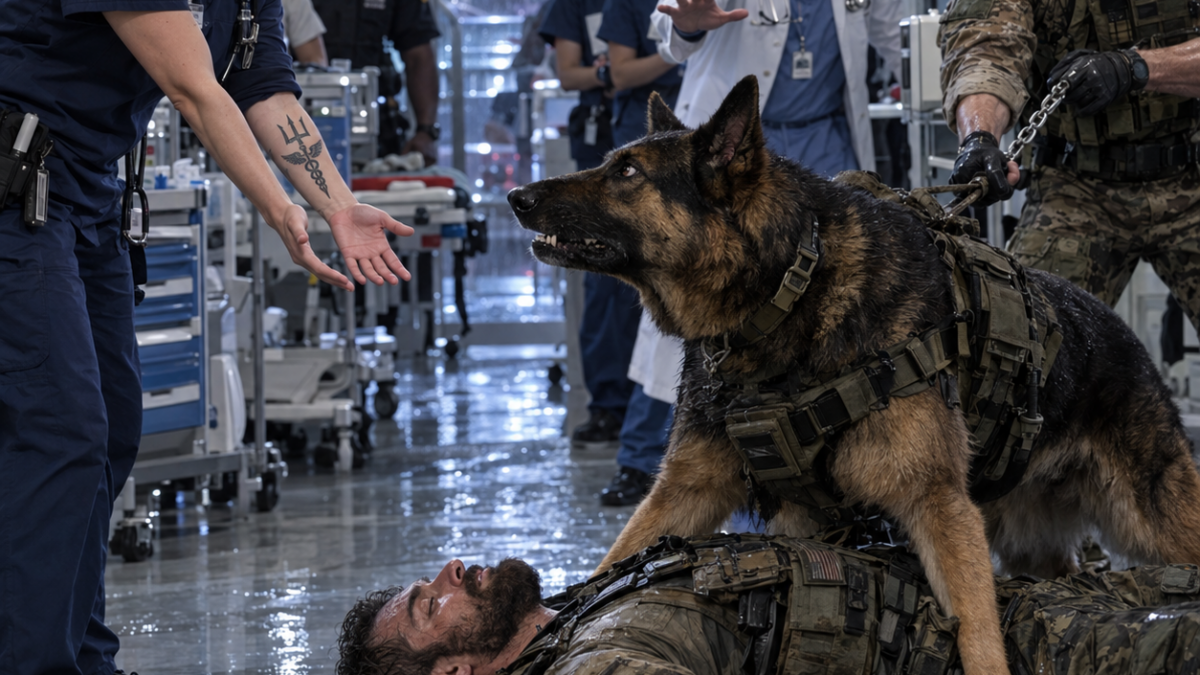
The dog stood over the dying SEAL like a wall of teeth and grief.
Every doctor in Trauma One saw normal numbers on the monitor, but I saw the lie hidden beneath them.
To save him, I had to reveal the one mark on my body I had spent eight years pretending did not exist.
The first hand that reached for Senior Chief Mason Trent never touched him.
A dark working dog came off the trauma room floor like a spring snapping loose, and everyone froze.
That is the part I remember most clearly—the silence after the growl.
Hospitals are never truly quiet. Machines breathe. Monitors chirp. Wheels squeak down polished halls. Nurses call for labs, doctors call for scans, families cry behind curtains, and somewhere a printer is always spitting out paperwork nobody has time to read.
But when Atlas planted himself over the unconscious man on our wet trauma room floor, the whole world seemed to stop breathing.
His lips peeled back from white teeth. His front legs locked low and wide. A tactical harness hugged his chest, the black patch across it reading K9 in block letters. His growl rolled through the room deep enough to vibrate in the metal trays.
Dr. Preston Albright stumbled backward with one hand raised.
“Get that animal out of my trauma bay!” he shouted.
Petty Officer Garrett Doyle had both fists wrapped around the dog’s chain. The links bit through his gloves and into his skin, but he couldn’t move Atlas an inch.
“I can’t, sir,” Doyle said, breathless. “He won’t take my command. Nobody touches the senior chief.”
Senior Chief Mason Trent lay flat on the tile, still in his vest, eyes closed, beard damp with sweat. A patch across his chest read U.S. Navy. His boots had dragged saline across the floor when the team tried to move him, leaving clear streaks under the bright lights.
The monitor above him showed numbers that should have comforted us.
Heart rate 72.
Oxygen 98.
Respirations 16.
Good numbers.
Calm numbers.
Lying numbers.
Everyone in that room wanted to believe them because numbers are easier than instinct. Numbers don’t shake. Numbers don’t growl. Numbers don’t stand over a man like they know something the rest of us are too slow to see.
But I knew better.
I stood beside the supply cart with a fistful of gloves clenched in one hand, unable to move.
My name is Iris Callahan. I was thirty-three years old, a trauma nurse at Seabrook Regional Medical Center in Port Alder, Virginia. I had worked there for five years. Five years of night shifts, code blues, drunk drivers, cardiac arrests, gunshot wounds, frightened parents, and exhausted residents who learned very quickly that I did not raise my voice unless something was truly wrong.
Most people at Seabrook knew me as quiet.
Reliable.
Private.
The nurse who always arrived early, always finished charting, always kept her sleeves tugged down to her wrists, no matter how hot the room became.
In five years, nobody there had seen my forearms.
Nobody had asked why.
Nurses learn early not to ask too many questions about scars. Everybody who works trauma long enough carries something. Some carry divorce papers. Some carry old addictions. Some carry the last words of patients they couldn’t save. Mine was ink.
Old black ink on the inside of my left forearm.
A trident wrapped with a winged serpent staff.
Two words beneath it.
Harrow Medical.
I had sworn I would never show it again.
Then Atlas looked at me.
Ten minutes earlier, the ambulance bay doors had burst open and four men in camouflage had carried Senior Chief Trent into our ER while Atlas ran beside them. The clerk at the front desk later told me Trent had walked in under his own power at first. Gray-faced. Sweating. One hand pressed to his left side.
He had asked her one question before he collapsed.
She had been shaking too badly afterward to repeat all of it.
“I only caught one word,” she told our charge nurse, Monica Tavares. “He said, ‘Doc.’”
The word landed in my chest like something dropped from a great height.
Doc.
I had not been called that in eight years.
Not since the riverbed.
Not since the helicopter.
Not since I made the choice that ended one life in my hands and saved another.
Monica saw my face change.
“Iris?” she asked quietly. “You okay?”
I didn’t answer.
I was staring at the dog.
Dark coat. Broad head. Notch in the left ear.
Older now.
Heavier through the chest.
But I knew him.
God help me, I knew him.
I knew how his weight shifted when the person he guarded was hurt. I knew the way his eyes swept a room and made judgments faster than most people spoke. I knew the notch in his ear because I had cleaned it once with gauze and bottled water while mortar fire stitched the ridge above us.
I had spent one week of my life learning that dog’s body language in a place I had spent eight years trying not to dream about.
Atlas.
The name was still in me.
I wished it wasn’t.
Lieutenant Commander Wes Alcott stood at the edge of the yellow trauma tape in Navy camouflage, one hand pressed over his mouth. Everyone else stared at the dog.
He stared at me.
Security rushed in with a catchpole and a sedative dart.
Alcott stepped in front of them.
“Nobody hurts that dog,” he said quietly.
Dr. Albright rounded on him.
“He is blocking care in my trauma bay.”
“He is doing exactly what he was trained to do,” Alcott said.
Atlas’s ears twitched.
His eyes moved across the room—past Albright, past the residents, past security, past Doyle—and stopped on me.
For one breath, the growl died.
My hands went cold.
Then the growl started again, lower this time, and every hair on my arms rose beneath my sleeves.
Security tried the catchpole once.
Only once.
Atlas turned his head. The loop never closed. He did not lunge. He did not snap. He simply stepped closer to Trent and set one paw against the senior chief’s vest.
Nobody tried again.
Albright paced along the yellow tape with his hands on his hips. He was tall, silver-haired, and used to winning every argument in rooms where people bled. Most attendings develop confidence. Some develop the dangerous belief that confidence and truth are the same thing.
“Vitals are normal,” he snapped. “Heart rate seventy-two, oxygen ninety-eight. This man is stable. We are wasting time because of a dog.”
Doyle shook his head.
“He’s not stable, sir. He walked in gray. He kept pressing his left side.”
“Operators hide pain,” Albright said. “If I can’t touch him, I can’t treat him. Somebody fix this.”
I stepped forward.
Only one pace.
Monica grabbed my sleeve.
“Don’t,” she whispered. “That dog will take your hand off.”
I gave her the smallest nod.
I wasn’t watching Atlas anymore.
I was watching Trent.
His lips had a faint gray tint. His breathing was too shallow, no matter what the monitor claimed. Sweat shone at his throat. His skin looked cool. His body was doing exactly what strong, young, brutally trained bodies do when they are bleeding somewhere no one can see.
Compensating.
Lying.
Holding the line until the line vanished.
Atlas knew it too.
He pushed his nose toward Trent’s left side and held it there, steady as a finger pointing at a secret.
I had seen that exact lie once before.
A dry riverbed.
A burning truck.
A body that kept normal numbers until it didn’t.
I had spent eight years building a life around silence. I followed protocol. I clocked in, worked hard, went home, slept badly, and returned. I did not speak about the mission that ended my old life. I did not say Danny Quinn’s name out loud. I did not wear short sleeves. I did not allow myself to be Doc anymore.
But that dog looked at me as if I had stepped straight out of the past he had never stopped guarding.
Alcott crossed the tape slowly with his hands open.
Atlas tracked him, but didn’t charge.
“This dog was trained by a man who gave his life for his team,” Alcott said to the room. “Since that day, he has guarded the senior chief the same way. When the senior chief goes down, Atlas decides who is safe.”
Albright snorted.
“Safe? We are a licensed trauma team.”
Alcott did not raise his voice.
“Not safe enough for him. Not yet.”
Doyle swallowed.
“The senior chief told us something in the truck. He said if he went down, nobody worked on him until we found her.”
Monica frowned.
“Found who?”
Doyle looked at the floor.
“He didn’t give a name. Just a description. He said to find the medic who wears the mark.”
The room went quiet.
My sleeve suddenly felt too tight against my wrist.
Atlas gave a short, low whine and looked directly at me.
Then the monitor changed.
Heart rate 72 became 88.
The blood pressure dipped slightly.
Nobody else noticed.
I did.
I took one slow step toward the tape and lifted my hands, palms open, low and empty.
“Atlas,” I said softly.
The dog’s head snapped toward me.
The room gasped.
Doyle’s mouth fell open.
“How do you know his name?” he whispered. “It isn’t on the harness. It isn’t in any record.”
I looked at him.
“Loosen the chain.”
My voice did not sound like the voice my coworkers knew.
It was flat.
Certain.
Old.
“One link at a time, Petty Officer.”
“Ma’am, if I loosen it—”
“He won’t.”
Doyle looked to Alcott.
Alcott gave the smallest nod.
The chain slipped a few inches.
Atlas shifted his weight, ears flat, eyes locked on my hands.
Albright exploded.
“Callahan, step back. You are not authorized to approach a hostile animal. Security, get her out of that zone.”
Two guards moved.
Alcott raised one palm.
“Doctor, if you want your patient alive, you will let her finish.”
“Alive?” Albright spat. “His heart rate is seventy-two.”
“Then why,” Alcott asked, “is the dog begging for help?”
Silence.
I knelt on the wet tile three feet from Atlas.
My knees trembled.
Not from fear of the dog.
From what I knew I had to do.
For eight years, I had pulled my sleeves down every morning like armor. I had hidden the mark from coworkers, patients, dates that never became relationships, therapists who knew better than to push, and myself most of all.
I gripped the cuff of my left sleeve.
My fingers shook.
“I never wanted to show this again,” I whispered.
I rolled the sleeve to my elbow.
The room saw the ink.
The faded trident.
The winged serpent staff.
The words beneath it.
Harrow Medical.
Someone cursed under their breath.
A nurse covered her mouth.
One of the residents took a full step backward as if the tattoo itself had reached out and struck him.
Alcott’s voice cracked.
“Harrow Medical,” he said. “I haven’t seen that mark in eight years. I was told nobody wore it anymore.”
“One person does,” I said.
Atlas stopped growling.
It happened all at once.
His lips lowered. His shoulders sagged. The tension ran out of him so suddenly he seemed older, almost fragile. He let out a long, shaking sound—half whine, half sigh—and stepped toward me carefully.
Then he pressed his forehead against my bare forearm, right over the tattoo.
He trembled.
I closed my eyes.
A single tear slipped down my cheek and disappeared into his fur.
“Hey, old boy,” I whispered. “I’m here.”
My voice broke.
“I’m sorry it took me so long.”
Monica was crying openly behind me.
The residents stood frozen.
Even Albright’s hand had slowly dropped to his side.
Alcott knelt beside me on the wet tile.
His eyes were wet.
“Doc,” he said. “You’re Doc. The corpsman from Harrow.”
I opened my eyes.
All I could think of was the last time I had seen Atlas, stretched across Danny Quinn’s chest in the dust.
“Where is Danny, Commander?” I asked. “Tell me he made it.”
Alcott’s jaw tightened.
“Danny is gone. You know that.”
“I know,” I said. “I know exactly where I left him.”
“No, ma’am.”
He shook his head.
“That is not what the senior chief came here to tell you.”
I stared at him.
“He has spent eight years looking for you, and you still don’t know why.”
Atlas pushed his nose against my wrist.
Then he turned and pointed his snout at Trent’s left side.
Held there.
Unmoving.
Steady as a compass.
The nurse in me took over.
Thank God.
I pressed two fingers against Trent’s neck, then his wrist.
The pulse was there, but it was wrong—fast and thin beneath numbers that had not yet admitted the truth.
I lifted the edge of his vest and placed my palm against the left side of his abdomen.
Rigid.
Boardlike.
My stomach dropped.
“He’s compensating,” I said. “He’s bleeding inside.”
Albright’s face tightened.
“The monitor says otherwise.”
“The monitor says what a strong body wants it to say. He is losing blood, and his body is hiding it. When the pressure drops, it will drop all at once.”
My hands moved faster now.
“I need a bedside ultrasound.”
“I am the attending here,” Albright said stiffly.
“Yes, doctor.”
I looked up and held his eyes.
“And you can run the scan yourself in thirty seconds, please.”
I think it was the please that got through.
Not because it was submissive.
Because I was not challenging his authority. I was trying to save his patient.
He stared at me for one more second.
Then he turned.
“Bring the ultrasound.”
The room began moving.
Monica cleared a path with one sharp command. The residents snapped out of their paralysis. Someone adjusted the light. Someone pulled the curtain. Brandon Ellis, our tech, wheeled in the ultrasound with shaking hands.
Atlas let him pass.
But he never moved his nose from Trent’s left flank.
Albright pressed the probe against the senior chief’s side.
The screen filled with shifting gray.
Ten seconds.
Nobody breathed.
Then a dark shadow spread beneath the spleen like ink in water.
Albright’s voice dropped.
“Free fluid. A lot of it.”
“Left upper side,” I said. “Near the old fragment.”
He froze.
“What old fragment? There’s nothing in his chart.”
“There wouldn’t be,” I said.
The record stopped at a riverbed.
I didn’t say that out loud.
Not yet.
But my mind had already gone back.
Dusk.
Dust.
Smoke from a burning truck.
The metallic taste of fear.
Two men down.
Senior Chief Mason Trent on his back with a wound that looked too small for the damage it had done.
Petty Officer Danny Quinn twenty yards away, blood spreading beneath him, Atlas stretched over his chest, refusing to leave him.
A helicopter inbound.
Room for one stretcher.
One minute to load.
I remembered Danny’s face, gray and calm in a way that terrified me more than panic would have.
“Take Trent, Doc,” he had said.
“No.”
“Atlas is with me.”
“No, Danny.”
He smiled through blood.
“That’s an order. Go.”
I had gone.
That was the fact I had built my guilt around for eight years.
I had chosen one man over another.
I had loaded Trent.
I had held pressure while the helicopter lifted.
I had watched Danny and Atlas shrink beneath us until dust swallowed them.
I had written one line in my field notes before everything went black inside me.
Retained fragment, left flank. Monitor.
Then the mission vanished behind classification, review boards, missing records, sealed statements, and the silence of people who knew too much and said nothing.
“I chose one man over another,” I said quietly. “I never forgave myself.”
Monica touched my shoulder.
“Iris.”
I blinked and returned to the lights, the alarms, the smell of antiseptic.
“Where is the surgeon?” I asked.
“Dr. Nandakumar is in Room Three,” Monica said. “Cardiac case. Fifteen minutes, maybe twenty.”
“He doesn’t have fifteen.”
The monitor chirped.
Heart rate jumped to 120.
A second alarm followed.
Blood pressure fell.
90 over 50.
Then 70 over 40.
The calm numbers shattered all at once, exactly as I knew they would.
Now everyone saw it.
Atlas barked once—sharp as a gunshot—and the entire room moved.
“Activate massive transfusion protocol,” I said. “Two large-bore IVs. Warm the blood. Get him ready for the OR now.”
Nobody argued.
Albright blinked once, then gave a small nod.
“Do what she says.”
Hands flew.
Monica ran for blood.
Brandon placed the second line.
A resident cut away the vest.
I pressed both hands against Trent’s left flank, locked my elbows, and leaned my body weight into the pressure.
“Atlas,” I said. “Stay.”
The dog dropped flat beside me.
He did not move again.
Albright came to my shoulder, his voice lower now.
Almost gentle.
“Tell me what to do, Nurse Callahan.”
“Keep his head down. Legs raised. Push blood as fast as the lines will take it. Call Dr. Nandakumar and tell her this bleed cannot wait. I’ll hold pressure until she gets here.”
He looked at my tattoo, then my hands, then Trent.
“You were never just a nurse.”
“I was a corpsman,” I said. “That’s all I ever was.”
Blood bags went up in a row.
The warmer hummed.
Every pair of hands in the bay found a job, and for the first time since Trent hit the floor, every job was the right one.
Alcott crouched across from me.
“Doc,” he said over the alarms, “I need to tell you something while you can still hear it.”
“Not now, Commander.”
“Now.”
His voice shook.
“The senior chief has been trying to find you for eight years. Everyone thought he was chasing a ghost. The Navy sealed the final radio call from the riverbed. Danny Quinn’s last words.”
My hands didn’t move.
My breath did.
“It was opened last month,” Alcott said. “Trent fought every year to get it released to you.”
I stared at the blood gathering beneath my gloves.
“Danny called in after the helicopter lifted. I have the recording on my phone.”
“No.”
“He said, ‘Tell Doc she made the right call. Tell her I gave the order. Tell her not to carry it.’”
The room blurred.
I pressed harder against Trent’s wound and bit the inside of my lip until pain steadied me.
Alcott continued.
“The review board closed the case in a week. Two lines. Corpsman followed a lawful order from a wounded operator. No fault.”
I could barely hear him now.
“You left before it finished. Nobody could find you to tell you.”
“I thought they blamed me,” I whispered.
“Nobody blamed you.”
I looked down at Trent.
He had crossed the country to put those words in my hands.
Now he was bleeding out beneath them.
“Not now, Senior Chief,” I whispered. “Not on my watch. Not again.”
Atlas lifted his head and rested his chin on my boot.
Then Dr. Priya Nandakumar burst through the double doors in surgical scrubs still stained with someone else’s blood, her team behind her.
“Where is he?”
“Left upper side,” I said without lifting my eyes. “Retained fragment, possible splenic bleed. Pressure held ten minutes.”
She looked at the ultrasound screen.
Then at me.
“Who briefed you?”
“A man who is going to live,” I said. “Roll him.”
They moved.
We kept pressure through transfer.
The OR doors swung shut.
Then the hallway went silent.
I stood there with Atlas pressed against my knee, my hands still shaking from ten minutes of hard pressure. My sleeves were rolled to my elbows. The tattoo was bare beneath the fluorescent lights.
Nobody told me to cover it.
Nobody ever would again.
Albright came out of Trauma One and stopped a few feet away.
He looked older than he had twenty minutes earlier.
“Nurse Callahan,” he said, “I owe you an apology.”
“You listened when it mattered.”
“I trusted numbers over someone who knew better.”
“You made the call to change course,” I said. “That counts.”
He nodded slowly.
Then he walked away without another word.
Monica sat beside me on the hallway bench and handed me a cup of water.
The staff had formed a quiet half circle nearby.
Nobody spoke.
Nobody needed to.
After eight years of hiding my arms, I felt more exposed sitting in that hallway than I had ever felt under fire.
Two hours later, Dr. Nandakumar came through the OR doors with her mask pulled down.
I stood too fast.
Atlas rose with me.
“Splenic injury,” she said. “Migrated fragment. We repaired what we could and removed it. He lost a great deal of blood.”
I waited.
She looked at me.
“Another ten minutes, and I would be telling you something else.”
The breath left my body so slowly it felt like I had been holding it since the riverbed.
By morning, Senior Chief Mason Trent was awake.
Pale.
Exhausted.
Propped against pillows in recovery.
Atlas lay across the foot of the bed like he owned it, which in many ways he did.
When I stepped inside, his tail thumped twice against the sheet.
Trent turned his head.
His eyes were gray and clear.
He looked at me for a long moment.
“Doc,” he said.
“Senior Chief.”
“I got a little careless.”
He tried to smile, but pain cracked it.
“Took me eight years to find a nurse who would listen to a dog.”
My voice broke.
“You should have called.”
“No number. No name. Only the mark.” He swallowed. “Danny drew the design himself before the mission. Nobody else wore it.”
I looked down at the ink on my forearm.
“He told me you were the best medic he ever served with,” Trent said. “He said you would find a way to carry us all.”
I pressed the heel of my hand against my eyes.
“I left him.”
“You obeyed him,” Trent said. “He chose. He wanted you to take me, and he wanted you to live free of it.”
Alcott stood in the doorway with his phone in his hand.
He lifted it.
The room went still.
For a moment, I wanted to run.
Not because of bullets.
Not because of blood.
Because I knew the past could still kill pieces of you if it found the right wound.
Then Danny Quinn’s voice came out of the phone, small and steady through eight years of static and silence.
“Tell Doc she made the right call.”
I listened to the whole message.
Every word.
Every breath.
Every crackle of distance.
When it ended, I did not cry.
I exhaled.
Long and slow.
Like a woman finally setting down a body she had carried across a continent.
The ending was not clean.
Real endings rarely are.
Dr. Nandakumar told Trent his time in the field was over. Medical retirement was already in the paperwork. He accepted it with the grim quiet of a man who had spent his life running toward danger and now had to learn how to sit still.
The Navy would retire Atlas too.
He needed a home.
A quiet one.
With someone he trusted.
Trent looked from the dog to me.
“He picked you before I did.”
Atlas rose, crossed the room, and sat at my feet.
I knelt and held his big head in both hands.
His fur had more gray than I remembered. So did I, probably.
“All right, old boy,” I whispered. “We’ll both stay.”
Months later, the staff at Seabrook still talked about the night a military working dog shut down Trauma One and saved a man no monitor believed was dying.
They talked about the tattoo too, though carefully, because trauma people know when a story has edges sharp enough to cut.
I still worked every shift.
I still spoke softly.
I still followed protocol.
But I wore short sleeves now.
The first time I did, Monica cried in the supply room and pretended she was checking inventory. Albright never mentioned the mark again, but when a nurse told him something didn’t feel right, he listened before the numbers agreed. Brandon asked Atlas if he wanted a job in radiology. Atlas sneezed on his shoe.
Life did not become easy.
I still woke some nights hearing rotors. Some mornings, guilt sat beside me before coffee. Some scars remain scars no matter how kindly the world touches them.
But Atlas slept at the foot of my bed, and when the nightmares came, he put his head against my wrist right over the old ink until I came back to the room.
Trent visited sometimes, thinner now, slower, carrying a cane he hated and a gratitude neither of us knew what to do with.
On good days, we talked about Danny.
Not the heroic version. The real one.
How he sang badly. How he cheated at cards. How he drew the Harrow Medical design on a scrap of packaging because he said every unofficial team needed an unofficial mark.
On hard days, we sat without speaking.
That was all right too.
People think healing is a bright thing. A breakthrough. A speech. A moment when the burden lifts and never returns.
It isn’t.
Healing is quieter.
It is rolling up your sleeves one morning and letting the world see the part of you you thought would make everyone turn away.
It is learning that you did not leave someone behind when you carried the only person you could.
It is listening to an eight-year-old recording and finally believing the dying man who loved you enough to set you free.
Sometimes new nurses asked about the tattoo.
I used to hide from that question.
Now I looked down at the mark and smiled.
“I didn’t leave him behind,” I would say. “I carried the one I could.”
Then I would look at Atlas, usually asleep under the nurses’ station like he had always belonged there.
“And the rest carried me.”
That was the truth.
Maybe not the whole truth.
Some parts would always belong to the riverbed, to the men who didn’t come home, to files sealed in places ordinary people never saw.
But it was enough.
After eight years of silence, enough felt like mercy.