𝗙𝗨𝗟𝗟 𝗦𝗧𝗢𝗥𝗬 The Dog Saw the Mark I Had Spent Three Years Trying to Hide
𝗙𝗨𝗟𝗟 𝗦𝗧𝗢𝗥𝗬
They shook because humiliation does something strange to the body when it has survived worse things. It reaches backward. It finds old rooms. Old voices. Old blood under fingernails. It reminds you how little control you had in the moments that broke you.
Dr. Langley stepped closer and tapped my badge with one finger.
“Do you know what this tells me?”
I did not answer.
“It tells me you do not belong in a trauma bay.”
The residents went quiet, waiting for the next cut.
“Next time, ask permission before you touch anything. Even the trash.”
My throat tightened.
“I’m sorry,” I said.
My voice was so small the monitors almost swallowed it.
That pleased him.
I could see it in his eyes.
I tugged my right sleeve down over my forearm and went back to restocking supplies.
Across the room, Administrator Roberta Haynes stood in the doorway with a tablet pressed against her chest. She had seen everything.
Our eyes met for half a second.
Then she turned and walked away.
That was the moment that hurt more than Langley’s words.
Cruel people exist everywhere.
But cruelty survives because decent people decide it is inconvenient to interrupt.
On a gurney near the wall, Mrs. Odum watched me with eyes sharper than anyone in that room expected from an eighty-one-year-old woman waiting for an inpatient bed.
She had once been an Army nurse, she told me earlier that night, long ago in a war most of the residents only knew from documentaries and required reading. Her hands were knotted with age, but when she reached out and caught my wrist, her grip still carried authority.
“Honey,” she whispered.
I leaned closer.
“They never looked at you,” she said. “They only looked down at you. Those are two very different things.”
For one second, the air left my chest.
I looked at her, really looked at her, and something old and steady flickered inside me.
Then I smiled politely, straightened her blanket, and walked away before she could see what those words had done.
Every night after my shift, I sat in my car in the parking lot and held my right arm against my chest for a full minute before driving home.
I told myself it was habit.
It was not.
The tattoo was there, beneath my sleeve.
An anchor with two folded wings.
Small enough to hide.
Heavy enough to carry.
For three years, I had tried to become someone who could live without that symbol meaning anything.
I had failed.
At two o’clock that morning, the storm came in hard.
Rain hammered the emergency room windows, blurring the parking lot lights into trembling orange streaks. The automatic doors hissed open and shut as paramedics arrived soaked, breathless, and shouting over thunder.
The trauma bay smelled like antiseptic, wet asphalt, coffee, and fear.
I was replacing saline bags in the warming cabinet when the overhead radio crackled.
“Trauma alert. Military patient. Male, thirty-five. Blast fragment injury to right chest. Pressure dropping. Four minutes out.”
Every head lifted.
Dr. Langley straightened his white coat.
A military case meant attention.
Attention meant performance.
He smiled at the residents.
“Positions.”
People began moving.
Nurses cleared Trauma One. Residents snapped on gloves. A tech rolled in portable suction. Someone called respiratory.
Langley turned toward me.
“Mouse, stay by the wall.”
I froze for half a second.
Then I nodded and moved to the edge of the room.
The doors burst open before the ambulance crew could finish rolling in.
Five men in dusty tactical gear entered with the stretcher, rainwater dripping from their sleeves and boots. Their faces were hard, gray with exhaustion, streaked with dirt and something darker. They did not look like men arriving from a training accident.
They looked like men who had carried death through a storm and refused to let it have the man on the stretcher.
At the front was a broad-shouldered man with a dark beard and eyes cold enough to stop a room.
One of the others called him Havoc.
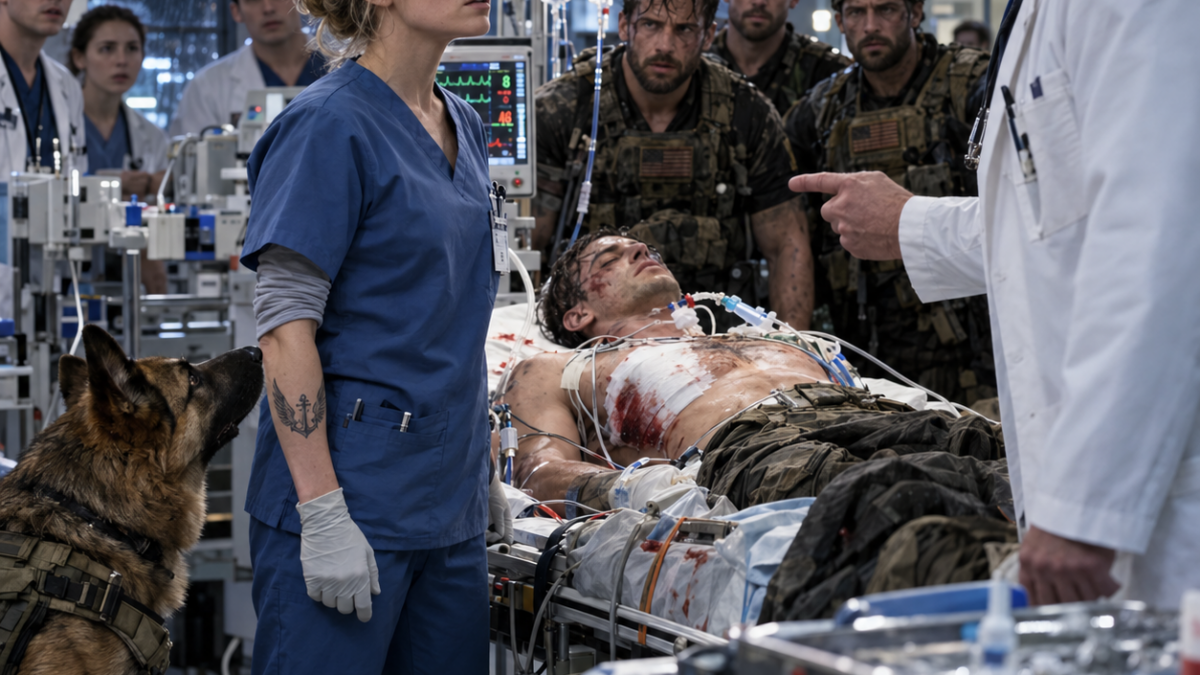
On the stretcher lay Petty Officer Jericho Malone, Navy SEAL. His shirt had been cut open, and his right chest was soaked with blood. His skin had turned the dangerous color I had seen too many times: pale gray at the lips, waxy at the cheeks, the body bargaining for oxygen it could not get.
Beside him came a German Shepherd in a tactical vest.
He was straining against a leash held by a younger SEAL whose boots slid on the wet floor. The dog’s ears were pinned, teeth bared, eyes locked on every hand that came near the stretcher.
“Get that animal out of my trauma bay!” Langley shouted.
The dog answered with a growl so deep the metal instruments on the cart seemed to rattle.
Two residents backed away.
The young SEAL tightened his grip.
“Axel, hold.”
The dog did not hold.
He guarded.
There was a difference.
“Live-fire exercise,” Havoc said. His voice was controlled, but barely. “Bad charge threw metal into his chest. Twenty minutes ago he was talking. Now he can’t get a full breath.”
Dr. Langley leaned over the stretcher.
I saw the wound from where I stood.
A ragged hole on the right side of Jericho’s chest, small enough to fool a careless person and deadly enough to kill him in minutes. With every attempted breath, it made a wet, whistling sound.
My body knew before my mind finished naming it.
Sucking chest wound.
Air was being pulled through the opening into his chest cavity. His lung was collapsing. Pressure could build. If the wrong thing was done, if air was trapped inside, he could crash before they reached the operating room.
Langley snapped, “Flat on his back. Pack that hole with gauze and get a tube in his throat.”
The room tilted.
No.
The word rose inside me before I could stop it.
Packing the wound could trap air where it did not belong. Laying him flat would make breathing harder. The priority was to seal the chest while allowing trapped air to escape, keep him positioned to breathe, and move fast.
I took one step forward.
“Doctor,” I said.
My voice shook.
Langley turned slowly, annoyed that furniture had spoken.
“That is a sucking chest wound,” I said. “If you pack it, the air gets trapped. He needs a chest seal that lets air out.”
For a second, nobody moved.
Then Langley’s eyes narrowed.
“Step back, Mouse.”
Jericho gave a thin, rattling gasp.
His eyes rolled back.
On the monitor, his oxygen saturation dropped.
Eighty-two.
Eighty.
Seventy-eight.
The alarm began to scream.
The residents froze.
I saw it happen.
The moment when everyone in the room waited for someone else to move.
In that single second, the hospital disappeared.
I was not in Kansas City anymore.
I was in a dry riverbed on the other side of the world, hearing rounds snap overhead while a young corpsman pressed both hands into a wound and begged me to tell him what to do.
I heard my old instructor’s voice.
Steady.
Low.
Unforgiving.
Airway. Breathing. Circulation. Do the next right thing and do it fast.
My hands were trembling.
I looked down at them.
Then I looked at Jericho Malone dying on the stretcher.
Something inside me unlocked.
“No,” I said quietly. “Not this time.”
I stepped between Dr. Langley and the patient.
“Move,” he snapped.
I did not move.
I grabbed a chest seal from the red trauma cart, tore the package open with my teeth, and felt my hands stop shaking all at once.
Not gradually.
Not bravely.
Instantly.
Like a switch had been flipped.
The room narrowed into function.
I cleared blood away from the wound with a fast sweep of gauze, exposing the hole enough to place the seal properly. I watched his chest. Waited for the breath out. Pressed the seal flat over the opening and held it firm with my palm.
The whistling stopped.
The sound was small.
The silence that followed was enormous.
“Sit him up,” I ordered. “Lean him toward the injured side. Oxygen full flow. Two large-bore IVs. Now.”
No one moved for half a second.
Then one nurse broke toward the oxygen. Another grabbed IV supplies.
Nobody had given them permission to obey me.
But nobody could deny that Jericho was breathing.
As I reached to lift him, my right sleeve slid back to my elbow.
The tattoo showed.
Small.
Dark.
Unmistakable.
An anchor with folded wings on the inside of my forearm, beside a faint white scar.
Axel stopped growling.
His ears rose.
For one long moment, the dog stared at my arm.
Then the muscles along his back began to tremble.
The young SEAL holding the leash whispered, “Axel?”
The dog threw back his head and barked three times.
Sharp.
Loud.
Deliberate.
The sound rang off glass and steel.
Then he broke free.
He crossed the trauma bay in two bounds and pressed his huge head against my knee, whining like a puppy.
I could not breathe.
Not because of fear.
Because I knew him.
I knew that dog.
Six years vanished.
Rain on hospital windows became dust in my teeth. Fluorescent lights became muzzle flashes. The trauma bay became a dark road where I had knelt over a younger version of Axel with blood slick under my hands and a team screaming for movement behind me.
“Axel,” I whispered.
His body shuddered against my leg.
The ER froze.
Havoc stared at the tattoo.
Then at the scar above my eyebrow.
Then into my eyes.
His face changed in a way that nearly broke me.
“Echo,” he said.
Barely above a whisper.
I did not answer the name.
I could not.
“Not now,” I said. My voice came out harder than I felt. “Keep him sitting up and leaning right. I need pressure monitored, oxygen sealed, IV access now. Move.”
They moved.
Even the residents moved.
The monitors continued shrieking, but the numbers were climbing.
Eighty-five.
Ninety.
Ninety-four.
Jericho’s chest rose and fell more evenly. Color began returning to his lips.
Dr. Langley found his voice.
“What is this circus?”
Nobody looked at him.
“Security!” he shouted. “Remove this woman from my patient. She has no authority to touch him.”
Havoc turned toward him.
Just one step.
The security guard who had entered behind the group stopped where he stood.
“Doctor,” Havoc said, voice low, “if anyone lays a hand on her, he will answer to every man in this room.”
Langley’s face flushed.
“She is a first-year nurse.”
Havoc did not blink.
“She is more than you will ever understand.”
Jericho’s eyes fluttered open.
He looked first at Axel, who had pressed himself against the stretcher, whining softly. Then his gaze moved upward and found me.
His pupils struggled to focus.
Then recognition cut through the fog.
“Echo,” he rasped. “I knew it.”
My throat tightened.
“Stay with me, Jericho.”
His breathing hitched.
“I heard your voice.”
I brushed damp hair away from his forehead.
“Then keep listening. Breathe for me.”
Around the stretcher, the SEALs lowered their heads.
One of them, a big man with a shaved head, wiped his eyes with the back of a dusty glove and did not hide it.
They had carried their brother through rain and blood with nothing but hope.
And I had almost let the name Mouse keep me against the wall.
Dr. Langley stepped forward.
“I am the attending physician,” he said. “This has gone far enough.”
He reached toward the chest seal.
I caught his wrist before his fingers touched it.
My grip closed hard enough that his face changed.
Nobody in that room had ever heard my voice when I spoke next.
“If you remove it, he dies,” I said. “Step away from the patient.”
The words were calm.
Low.
Not loud.
But they carried command.
Langley pulled his hand back as if burned.
The trauma bay doors swung open again, and Dr. Terrence Bell, the on-call trauma surgeon, hurried in with his sleeves already rolled. He stopped beside the stretcher and looked at the wound, the seal, the oxygen mask, the position of the patient, and the monitor.
“Who did this?”
Every resident pointed at me.
Dr. Bell studied my work for one long second.
“Textbook,” he said quietly. “Fast and clean. Get him upstairs. Operating Room Three.”
The room exhaled.
But only for a moment.
Before the stretcher moved, Administrator Haynes pushed through the crowd, heels clicking against the tile, tablet clutched to her chest.
“What is going on in my trauma bay?”
Dr. Langley smoothed his white coat.
“This nurse interfered with my patient. She grabbed my arm in front of the entire staff. Completely out of line.”
Haynes turned toward me.
Her face was tight.
“Nurse Ferris, you are suspended pending review. Give me your badge.”
The room went still again.
I looked at Jericho.
His breathing was still fragile but present.
The seal was holding.
Axel stood beside him, watching every person who came close.
I looked back at Haynes.
For three weeks, she had watched.
For three weeks, she had chosen quiet.
I unclipped the badge from my scrubs and placed it in her open hand.
“Yes, Administrator,” I said. “After he is in surgery.”
Before she could answer, the main doors slid open.
A gust of cold rain blew across the floor.
Three men in dark suits entered the emergency department.
They were wet and calm, with credentials hanging from their necks. The tallest had a smooth face, careful hair, and a smile that never touched his eyes.
“Special Agent Colton Drake,” he said. “This patient is part of a classified federal investigation. By order of the department, he is being transferred to a secure facility immediately. We will also take his equipment bag.”
The change in the room was subtle.
Most people heard authority and relaxed.
I heard the wrong words in the wrong order.
Havoc stepped forward.
“He is not stable.”
“That is not your decision,” Drake said.
Haynes nodded too quickly.
“If he’s federal custody—”
“He needs an operating room,” Dr. Bell said.
Drake ignored him.
His eyes had already moved beneath the stretcher.
Not to Jericho.
Not to the monitor.
To the black equipment bag under the rails.
A true federal agent entering a trauma bay for a wounded military patient would ask whether the patient could survive transport. He would confirm medical stability. He would speak to the surgeon. He would care, at least procedurally, whether moving the man would kill him.
Drake had not glanced once at the oxygen saturation.
His shoes were wet but spotless.
The shoes of a man who had walked from a vehicle to a hospital entrance, not from a range, not from a field site, not from anywhere near a blast.
The credentials around his neck hung from cheap plastic clips.
Axel had stopped whining.
Now he was growling again.
Low.
Deep.
Focused.
I watched Drake’s right hand.
It hovered too near the inside of his jacket.
“A federal agent would ask if the patient can survive the move,” I said. “You haven’t asked.”
Drake slowly turned his head toward me.
“Step aside, nurse.”
“No.”
His expression hardened.
His hand shifted toward his jacket.
I did not raise my voice.
“Havoc, lock the main bay doors. Nurse Grant, drop the fire shutters on the east side. Bell, stay with the airway. Everyone else with me. We are moving him now.”
Haynes stammered, “I did not authorize any lockdown.”
I looked at her.
“Then stop me, Administrator. Then explain to his family why you did.”
She said nothing.
For three weeks, I had walked every corridor in that hospital pretending to restock supplies and deliver samples.
Nobody asked why I studied walls.
Nobody asked why I memorized access panels, fire doors, blind corners, freight routes, stairwell positions, and maintenance codes.
They thought I was nervous.
I was mapping.
The stretcher rolled into the narrow service corridor behind the supply room. Dr. Bell moved with us, one hand steady near the oxygen setup, eyes on Jericho’s breathing. Residents followed with wide eyes and open mouths. One nurse pushed IV fluids. Another carried the trauma kit. Havoc took the rear, and Axel stayed glued to the stretcher until I pointed toward the door.
“Axel, guard.”
The dog planted himself in front of the fire door with his teeth bared.
Two SEALs took positions on either side of the frame.
Behind us, the fire door closed with a heavy metal clap.
A second later, fists hammered against it.
Drake shouted threats through the metal.
Federal charges.
Prison.
Career-ending consequences.
The residents flinched at every blow.
I turned to them.
“Look at me.”
They did.
Every frightened face.
Every young doctor who had laughed when Langley called me Mouse.
Every nurse who had stayed silent because surviving the shift had seemed easier than challenging the room.
“Breathe,” I said. “Your only job in this moment is to keep this man alive. Hands on the stretcher. Eyes on the monitor. Nobody speaks unless something changes.”
They obeyed.
At the freight elevator, I punched in the override code I had memorized from the maintenance board near the loading dock. The old cage groaned upward.
Through the narrow glass window in the corridor door, I saw Drake shove past a security guard and sprint toward the stairs.
“He’s going to cut us off at the third floor,” I said. “Havoc. East stairwell. Axel, go with him.”
The dog was gone before I finished speaking.
When Drake burst out of the third-floor stairwell less than a minute later, he ran straight into Havoc and a snarling German Shepherd.
Havoc put him on the floor with one clean move.
The black bag under Jericho’s stretcher was never touched.
Night security had called Kansas City police the moment the shutters came down. By the time we reached the operating floor, officers were entering through the emergency department. Drake and his two men were pulled upright in handcuffs, pale and silent, their fake authority stripped down to wet suits and fear.
Back in the trauma bay, Dr. Langley stood alone beside an empty cart, his white coat wrinkled and his confident smile gone.
One resident later told me someone whispered, “Who was the woman we called Mouse?”
Nobody answered.
They were about to find out.
Dr. Bell operated through the night.
Time became strange in the waiting room.
The rain faded from hard percussion to a soft tapping against glass. The vending machine hummed. A wall clock ticked with offensive confidence, as if each second did not weigh more than it had any right to.
Havoc sat in a plastic chair with his elbows on his knees.
Axel stretched across his boots, head resting between his paws, eyes never fully closing.
The SEALs stood or sat in silence around the room.
Some had blood on their uniforms.
Some had hands wrapped in gauze.
All of them looked like men who had nearly lost more than a teammate.
I stood by the window with my sleeves still pushed up.
The tattoo was visible now.
There was no point hiding it.
Haynes hovered near the doorway, pale and shaken.
Dr. Langley had disappeared into an administrative office with security and police. I did not ask where. For the first time since I started at Prairiegate, I did not care what he was saying about me.
Havoc came to stand beside me.
For a moment, neither of us spoke.
Then he said, “Three years.”
I looked at the rain.
“I know.”
“We searched.”
“I know.”
“Jericho never stopped.”
My throat tightened.
“Havoc.”
His voice softened.
“You could have called.”
I laughed once, but there was no humor in it.
“And said what? That Echo was gone? That I was working nights in Kansas City trying to become a person nobody needed?”
He did not answer.
That was why I had always trusted him.
Havoc knew when silence was the kinder response.
I stared down at my hands.
They were steady now.
That almost frightened me more than the trembling had.
“I lost Nolan,” I said.
Havoc closed his eyes.
The name still hurt him too.
Nolan had been a young corpsman attached to our team, barely old enough to grow a decent beard, brilliant with trauma care, terrified of spiders, and determined to prove he belonged. He died in my arms after an extraction went bad in a place that had no mercy in it.
I had done everything right.
That was the part that destroyed me.
Sometimes people imagine guilt only comes when you make a mistake.
They are wrong.
Guilt can grow even in the clean spaces, even when every decision was correct, even when the wound was too catastrophic, the helicopter too far, the blood loss too fast.
I had held pressure.
Opened his airway.
Called for evacuation.
Begged him to stay.
He died anyway.
After that, rank felt obscene.
Call signs felt like lies.
Everyone kept telling me how many lives I had saved.
All I could see was the one I had not.
So I disappeared.
I left the Navy through channels I barely remembered signing, took a civilian nursing job under my given name, hid my tattoo under long sleeves, and told myself gentleness would return if no one knew what I had been.
But hiding is not healing.
It is only silence with the lights off.
At dawn, Dr. Bell walked out of surgery.
Everyone stood.
He looked exhausted.
His surgical cap hung loose in one hand.
For a terrible second, I could not read his face.
Then he smiled.
“He’s going to live.”
The sound that came out of Havoc was not quite a laugh and not quite a sob.
Axel sprang to his feet.
Dr. Bell looked directly at me.
“That chest seal bought him the time he needed.”
My knees nearly gave out.
I gripped the windowsill.
Havoc turned toward the gathered room.
Nurses, residents, guards, SEALs, Haynes, and even Mrs. Odum in her wheelchair had slowly gathered near the waiting area.
Havoc’s voice filled the space.
“Let me tell you who this is.”
I looked at him sharply.
He ignored me.
Of course he did.
“Lieutenant Commander Molly Ferris. Navy Nurse Corps. Call sign Echo. Six years attached to my team. Forty-one missions.”
The room became utterly still.
“She pulled me out of a burning vehicle when every doctor on scene thought I was gone. She kept Axel alive under fire when he took a round leading us out of an ambush. She saved more men than most people in this hospital will ever meet.”
I stared at the floor.
Not because I was ashamed.
Because hearing that life spoken aloud after three years of silence felt like being opened without anesthesia.
Havoc continued, quieter now.
“And then she vanished. None of us knew why.”
I lifted my eyes.
They were wet.
I hated that.
Then I decided not to hate it.
“I lost a friend,” I said.
My voice trembled, but I did not stop.
“A young corpsman. He died in my arms, and I could not save him. After that, I did not want a rank. I did not want a call sign. I did not want anyone depending on me again.”
I looked around the room.
At the residents who had laughed.
At the nurses who had looked away.
At Haynes, who had ignored what cruelty was doing inside her own hospital.
“I wanted to be nobody,” I said. “I wanted to learn how to be gentle again.”
Havoc’s voice softened.
“You were never nobody.”
Axel pressed his head against my hip.
I rested my hand between his ears.
Administrator Haynes cleared her throat.
Her face had lost all its color.
“Dr. Langley,” she said.
He had returned at some point, standing at the edge of the crowd like a man hoping furniture could hide him.
“The board will review every order you gave tonight. You are suspended effective immediately.”
Langley opened his mouth.
Dr. Bell spoke before he could.
“His order would have killed that man.”
No one argued.
Langley looked at the SEALs.
Then at the nurses.
Then at the residents.
Then finally at me.
For the first time since I met him, he looked down.
Haynes stepped forward and held out my badge.
“Nurse Ferris,” she said. “I owe you an apology. We all do.”
I looked at the badge in her hand.
For three weeks, that little rectangle had felt like borrowed permission to exist in the building.
Now it looked smaller than ever.
I took it, but I did not clip it back on.
“Do not apologize to me,” I said.
Haynes swallowed.
“Then what would you like me to do?”
“Change the way this place treats people.”
My voice was quiet, but the room heard every word.
“Nobody should be made small in a room where lives are saved.”
Mrs. Odum raised a trembling hand from her wheelchair.
Slowly, with effort, she brought it to her forehead in a salute.
My breath caught.
One by one, the nurses followed.
Then the residents.
Then the guards.
Then the SEALs, standing tall in dusty gear.
I stood in the middle of them with my chin high, my back straight, and my hands no longer trembling.
For once, everyone looked up.
Weeks later, I stood in the second-floor training room at Prairiegate Medical Center with a roll of clear plastic, a roll of tape, and a chest seal packet on the table in front of me.
The sign on the door was simple.
Seal the Chest: Emergency Trauma Skills for Everyone.
Every chair was filled.
Nurses.
Doctors.
Security guards.
Teachers.
Parents.
Even two cafeteria workers who told me they had come because they “wanted to know what to do if something bad happened before the ambulance arrived.”
That mattered to me.
Skills should not belong only to people with titles.
Calm can be taught.
Preparation can be shared.
Courage can be practiced before the moment demands it.
Jericho came to the first class on his own two feet.
He moved stiffly and breathed carefully, but he walked in smiling with Axel at his side. The little anchor-and-wings patch was freshly stitched onto Axel’s vest. I had sewn it myself the night before with hands that did not shake.
Havoc stood at the back wall, arms crossed.
He said nothing.
But he smiled the whole time.
During the lesson, I kept the instructions clear.
Expose the wound.
Wipe enough blood to see what you are doing.
Use a proper vented chest seal when available.
If there is no commercial seal and help is not yet there, clean plastic taped on three sides can act as a temporary flutter valve.
Do not pack the hole.
Do not push objects inside.
Keep the person positioned to breathe if injuries allow.
Watch closely.
Call emergency services.
Stay calm enough to notice changes.
I saw the residents listening differently now.
Not fearfully.
Seriously.
That was enough.
After the class ended, people lingered to ask questions. Mrs. Odum attended in her wheelchair, wearing a purple cardigan and an expression that dared anyone to underestimate her.
When she reached me, she squeezed my hand.
“They’re looking now,” she said.
I smiled.
“Yes, ma’am.”
On his way out, Havoc stopped beside me.
“The team still has a seat for you, Echo.”
I looked at him.
He raised both hands slightly.
“No pressure. Just a seat.”
For a moment, the room disappeared again.
I saw dust.
Desert roads.
Night skies.
Axel younger and leaner, running ahead through smoke.
Nolan laughing over bad coffee.
Jericho half-awake on a stretcher, whispering that he knew my voice.
The old life was not gone.
It would never be gone.
But for the first time, remembering it did not feel like drowning.
“I know,” I said.
Havoc nodded.
He understood that was the only answer I could give.
After everyone left, a young resident stayed behind.
One of the residents who had laughed at Langley’s sticky note routine.
He looked ashamed, but he stayed anyway.
“Can I ask you something?” he said.
“Yes.”
“Why didn’t you go back?”
“To the Navy?”
He nodded.
I rolled my sleeve all the way up and looked at the tattoo.
The anchor.
The folded wings.
The promise I had tried to hide.
“I used to think protecting people only counted if I was doing it in uniform,” I said. “Then I thought I had lost the right to protect anyone at all.”
He waited.
I touched the edge of the tattoo.
“I was wrong both times.”
The resident looked down.
“I’m sorry,” he said.
I knew he meant more than the question.
I nodded.
“Then be different next time.”
He looked up.
“I will.”
For once, I believed him.
That night, I sat in my car in the hospital parking lot.
The city was quiet after rain.
Streetlights glowed on wet pavement. Somewhere in the distance, an ambulance siren rose and faded. The hospital behind me buzzed with ordinary emergencies, ordinary grief, ordinary miracles nobody would ever hear about unless they belonged to the person saved.
For three years, this parking lot had been the place where I held my arm against my chest and reminded myself to stay hidden.
That night, I did not.
I rolled down the window and let the cool air move across my face.
My badge rested on the passenger seat.
My sleeve was pushed up.
The tattoo was visible.
I thought about Dr. Langley and wondered whether he would ever understand that the worst thing he had done was not calling me Mouse.
The worst thing was teaching others that it was safe to look down on someone in a room where every life depended on people being seen clearly.
I thought about Haynes and hoped her apology would become policy.
I thought about Mrs. Odum’s salute.
About Axel’s head against my knee.
About Jericho breathing under my hands.
About Nolan.
For the first time in years, his memory did not come with only pain.
It came with responsibility.
Not the crushing kind that had driven me into hiding.
The living kind.
The kind that says, you are still here, so do something with it.
I picked up my badge.
For a moment, I considered clipping it back onto my scrubs.
Instead, I held it in my palm and looked at my name.
Molly Ferris.
Not Mouse.
Not only Echo.
Both.
All of it.
The woman who had been broken.
The nurse who had run.
The soldier who remembered.
The teacher who could stay.
I clipped the badge back on.
Then I started the car.
As I drove home through Kansas City’s wet, quiet streets, I realized something I had spent three years trying not to know.
Hiding had never made me gentle.
It had only made me lonely.
Gentleness was not the absence of strength.
It was strength with its hands open.
It was knowing how to stop the bleeding and still speak softly.
It was standing between a patient and danger without needing to prove you were brave.
It was teaching the next person what to do, so that someday, in some other room, someone else might choose the next right thing and do it fast.
I had come to Prairiegate wanting to disappear.
But that night, after the dog recognized the mark I could no longer hide, I finally understood that I was not meant to be nobody.
I was meant to be found.
And maybe, in the end, that was what home really was.
Not a place where the past never followed.
A place where it could walk beside you without dragging you back into the dark.
𝗧𝗛𝗘 𝗘𝗡𝗗
The Dog Saw the Mark I Had Spent Three Years Trying to Hide
They called me Mouse because they thought quiet meant harmless.
They never wondered why I counted exits, why my hands shook only when people watched, or why I kept one sleeve pulled low even under the hot lights of the trauma bay.
Then a wounded Navy SEAL was rolled through our doors, his dog saw the tattoo on my arm, and the life I had buried came back before I could stop it.
For three weeks, almost nobody at Prairiegate Medical Center used my real name.
My badge said Molly Ferris.
Registered nurse.
Night shift trauma unit.
But inside that hospital, under the white-blue glare of fluorescent lights and the constant shriek of monitors, most people knew me by the name Dr. Victor Langley had chosen for me.
Mouse.
He said it with a smile the first time, in front of two residents and a respiratory therapist who looked away too late.
“Try not to scurry, Mouse,” he had said as I carried a tray of wound supplies across Trauma Two. “You’ll make the patients nervous.”
Everyone laughed because he laughed.
That was how cruelty worked in a place like ours.
It did not always arrive screaming.
Sometimes it wore a white coat, carried a clipboard, and waited for an audience.
By the end of my first week, the name had settled over me like a stain.
Mouse, restock the gauze.
Mouse, stay by the wall.
Mouse, don’t touch that.
Mouse, did anyone ask you to think?
I never corrected him.
I should have.
There were many things I should have done during those three weeks.
I should have gone to the administrator when he moved my name onto the worst shifts three nights in a row, then mocked me for looking tired.
I should have spoken up when he handed me an unlabeled specimen cup and told me to “find its owner” while the residents watched me walk from station to station, cheeks burning.
I should have refused when he told me to ask permission before touching anything, “even the trash.”
But I had become very good at making myself small.
That was the truth nobody in that hospital understood.
They thought I was naturally timid.
They saw the oversized blue scrubs, the gray-blue eyes that avoided confrontation, the dirty-blonde hair twisted into a tight knot at the back of my head. They saw the way my hands trembled whenever someone stared too long. They saw a quiet rookie nurse who flinched under Dr. Langley’s voice and tugged her right sleeve down over her forearm a hundred times a night.
They did not see the things I was hiding.
The thin white scar above my left eyebrow, which I kept behind a loose strand of hair.
The tattoo on the inside of my forearm.
The memories beneath both.
And most of all, they did not see what happened to me when alarms went off.
Because when the trauma bay erupted, I did not panic.
I went still.
My breathing slowed.
My eyes moved.
Exits.
Oxygen.
Monitors.
Sharps.
Pressure points.
Blood source.
Airway.
Personnel.
Threats.
Every room became a map.
Every voice became information.
Every second became something to be used or lost.
That was the part of me I could not bury, no matter how deeply I tried.
Dr. Langley noticed everything about me except the truth.
He was the chief physician on night trauma rotation, a tall, polished man with silver at his temples and a voice that could fill a room without ever sounding rushed. He loved being watched. He loved explaining things other people already understood. He loved humiliating people just enough that they could not accuse him of anything serious without seeming oversensitive.
The younger residents orbited him like nervous planets.
They laughed when he laughed.
They smirked when he smirked.
They learned quickly which people were safe to mock.
I was safe.
At least, that was what they believed.
One night, near the end of my third week, Dr. Langley stood in the middle of the trauma bay with a clipboard and a half circle of residents behind him. I was restocking gauze at the supply cart, trying to ignore the fatigue humming behind my eyes.
He pulled a yellow sticky note from his pocket.
“Educational moment,” he announced.
The residents straightened.
I knew before he began that it would be about me.
He cleared his throat and read in a high, silly voice.
“Item one. Mouse asked a question about a chest tube tray.”
A few residents laughed.
“Item two. Mouse checked the same patient twice.”
More laughter.
“Item three. Mouse stood too close to a monitor as if she might catch something.”
The laughter sharpened.
I kept my eyes on the gauze.
My hands began to shake.
Not because I was afraid of him.
That would have been easier to explain.
They shook because humiliation does something strange to the body when it has survived worse things. It reaches backward. It finds old rooms. Old voices. Old blood under fingernails. It reminds you how little control you had in the moments that broke you.
Dr. Langley stepped closer and tapped my badge with one finger.
“Do you know what this tells me?”
I did not answer.
“It tells me you do not belong in a trauma bay.”
The residents went quiet, waiting for the next cut.
“Next time, ask permission before you touch anything. Even the trash.”
My throat tightened.
“I’m sorry,” I said.
My voice was so small the monitors almost swallowed it.
That pleased him.
I could see it in his eyes.
I tugged my right sleeve down over my forearm and went back to restocking supplies.
Across the room, Administrator Roberta Haynes stood in the doorway with a tablet pressed against her chest. She had seen everything.
Our eyes met for half a second.
Then she turned and walked away.
That was the moment that hurt more than Langley’s words.
Cruel people exist everywhere.
But cruelty survives because decent people decide it is inconvenient to interrupt.
On a gurney near the wall, Mrs. Odum watched me with eyes sharper than anyone in that room expected from an eighty-one-year-old woman waiting for an inpatient bed.
She had once been an Army nurse, she told me earlier that night, long ago in a war most of the residents only knew from documentaries and required reading. Her hands were knotted with age, but when she reached out and caught my wrist, her grip still carried authority.
“Honey,” she whispered.
I leaned closer.
“They never looked at you,” she said. “They only looked down at you. Those are two very different things.”
For one second, the air left my chest.
I looked at her, really looked at her, and something old and steady flickered inside me.
Then I smiled politely, straightened her blanket, and walked away before she could see what those words had done.
Every night after my shift, I sat in my car in the parking lot and held my right arm against my chest for a full minute before driving home.
I told myself it was habit.
It was not.
The tattoo was there, beneath my sleeve.
An anchor with two folded wings.
Small enough to hide.
Heavy enough to carry.
For three years, I had tried to become someone who could live without that symbol meaning anything.
I had failed.
At two o’clock that morning, the storm came in hard.
Rain hammered the emergency room windows, blurring the parking lot lights into trembling orange streaks. The automatic doors hissed open and shut as paramedics arrived soaked, breathless, and shouting over thunder.
The trauma bay smelled like antiseptic, wet asphalt, coffee, and fear.
I was replacing saline bags in the warming cabinet when the overhead radio crackled.
“Trauma alert. Military patient. Male, thirty-five. Blast fragment injury to right chest. Pressure dropping. Four minutes out.”
Every head lifted.
Dr. Langley straightened his white coat.
A military case meant attention.
Attention meant performance.
He smiled at the residents.
“Positions.”
People began moving.
Nurses cleared Trauma One. Residents snapped on gloves. A tech rolled in portable suction. Someone called respiratory.
Langley turned toward me.
“Mouse, stay by the wall.”
I froze for half a second.
Then I nodded and moved to the edge of the room.
The doors burst open before the ambulance crew could finish rolling in.
Five men in dusty tactical gear entered with the stretcher, rainwater dripping from their sleeves and boots. Their faces were hard, gray with exhaustion, streaked with dirt and something darker. They did not look like men arriving from a training accident.
They looked like men who had carried death through a storm and refused to let it have the man on the stretcher.
At the front was a broad-shouldered man with a dark beard and eyes cold enough to stop a room.
One of the others called him Havoc.
On the stretcher lay Petty Officer Jericho Malone, Navy SEAL. His shirt had been cut open, and his right chest was soaked with blood. His skin had turned the dangerous color I had seen too many times: pale gray at the lips, waxy at the cheeks, the body bargaining for oxygen it could not get.
Beside him came a German Shepherd in a tactical vest.
He was straining against a leash held by a younger SEAL whose boots slid on the wet floor. The dog’s ears were pinned, teeth bared, eyes locked on every hand that came near the stretcher.
“Get that animal out of my trauma bay!” Langley shouted.
The dog answered with a growl so deep the metal instruments on the cart seemed to rattle.
Two residents backed away.
The young SEAL tightened his grip.
“Axel, hold.”
The dog did not hold.
He guarded.
There was a difference.
“Live-fire exercise,” Havoc said. His voice was controlled, but barely. “Bad charge threw metal into his chest. Twenty minutes ago he was talking. Now he can’t get a full breath.”
Dr. Langley leaned over the stretcher.
I saw the wound from where I stood.
A ragged hole on the right side of Jericho’s chest, small enough to fool a careless person and deadly enough to kill him in minutes. With every attempted breath, it made a wet, whistling sound.
My body knew before my mind finished naming it.
Sucking chest wound.
Air was being pulled through the opening into his chest cavity. His lung was collapsing. Pressure could build. If the wrong thing was done, if air was trapped inside, he could crash before they reached the operating room.
Langley snapped, “Flat on his back. Pack that hole with gauze and get a tube in his throat.”
The room tilted.
No.
The word rose inside me before I could stop it.
Packing the wound could trap air where it did not belong. Laying him flat would make breathing harder. The priority was to seal the chest while allowing trapped air to escape, keep him positioned to breathe, and move fast.
I took one step forward.
“Doctor,” I said.
My voice shook.
Langley turned slowly, annoyed that furniture had spoken.
“That is a sucking chest wound,” I said. “If you pack it, the air gets trapped. He needs a chest seal that lets air out.”
For a second, nobody moved.
Then Langley’s eyes narrowed.
“Step back, Mouse.”
Jericho gave a thin, rattling gasp.
His eyes rolled back.
On the monitor, his oxygen saturation dropped.
Eighty-two.
Eighty.
Seventy-eight.
The alarm began to scream.
The residents froze.
I saw it happen.
The moment when everyone in the room waited for someone else to move.
In that single second, the hospital disappeared.
I was not in Kansas City anymore.
I was in a dry riverbed on the other side of the world, hearing rounds snap overhead while a young corpsman pressed both hands into a wound and begged me to tell him what to do.
I heard my old instructor’s voice.
Steady.
Low.
Unforgiving.
Airway. Breathing. Circulation. Do the next right thing and do it fast.
My hands were trembling.
I looked down at them.
Then I looked at Jericho Malone dying on the stretcher.
Something inside me unlocked.
“No,” I said quietly. “Not this time.”
I stepped between Dr. Langley and the patient.
“Move,” he snapped.
I did not move.
I grabbed a chest seal from the red trauma cart, tore the package open with my teeth, and felt my hands stop shaking all at once.
Not gradually.
Not bravely.
Instantly.
Like a switch had been flipped.
The room narrowed into function.
I cleared blood away from the wound with a fast sweep of gauze, exposing the hole enough to place the seal properly. I watched his chest. Waited for the breath out. Pressed the seal flat over the opening and held it firm with my palm.
The whistling stopped.
The sound was small.
The silence that followed was enormous.
“Sit him up,” I ordered. “Lean him toward the injured side. Oxygen full flow. Two large-bore IVs. Now.”
No one moved for half a second.
Then one nurse broke toward the oxygen. Another grabbed IV supplies.
Nobody had given them permission to obey me.
But nobody could deny that Jericho was breathing.
As I reached to lift him, my right sleeve slid back to my elbow.
The tattoo showed.
Small.
Dark.
Unmistakable.
An anchor with folded wings on the inside of my forearm, beside a faint white scar.
Axel stopped growling.
His ears rose.
For one long moment, the dog stared at my arm.
Then the muscles along his back began to tremble.
The young SEAL holding the leash whispered, “Axel?”
The dog threw back his head and barked three times.
Sharp.
Loud.
Deliberate.
The sound rang off glass and steel.
Then he broke free.
He crossed the trauma bay in two bounds and pressed his huge head against my knee, whining like a puppy.
I could not breathe.
Not because of fear.
Because I knew him.
I knew that dog.
Six years vanished.
Rain on hospital windows became dust in my teeth. Fluorescent lights became muzzle flashes. The trauma bay became a dark road where I had knelt over a younger version of Axel with blood slick under my hands and a team screaming for movement behind me.
“Axel,” I whispered.
His body shuddered against my leg.
The ER froze.
Havoc stared at the tattoo.
Then at the scar above my eyebrow.
Then into my eyes.
His face changed in a way that nearly broke me.
“Echo,” he said.
Barely above a whisper.
I did not answer the name.
I could not.
“Not now,” I said. My voice came out harder than I felt. “Keep him sitting up and leaning right. I need pressure monitored, oxygen sealed, IV access now. Move.”
They moved.
Even the residents moved.
The monitors continued shrieking, but the numbers were climbing.
Eighty-five.
Ninety.
Ninety-four.
Jericho’s chest rose and fell more evenly. Color began returning to his lips.
Dr. Langley found his voice.
“What is this circus?”
Nobody looked at him.
“Security!” he shouted. “Remove this woman from my patient. She has no authority to touch him.”
Havoc turned toward him.
Just one step.
The security guard who had entered behind the group stopped where he stood.
“Doctor,” Havoc said, voice low, “if anyone lays a hand on her, he will answer to every man in this room.”
Langley’s face flushed.
“She is a first-year nurse.”
Havoc did not blink.
“She is more than you will ever understand.”
Jericho’s eyes fluttered open.
He looked first at Axel, who had pressed himself against the stretcher, whining softly. Then his gaze moved upward and found me.
His pupils struggled to focus.
Then recognition cut through the fog.
“Echo,” he rasped. “I knew it.”
My throat tightened.
“Stay with me, Jericho.”
His breathing hitched.
“I heard your voice.”
I brushed damp hair away from his forehead.
“Then keep listening. Breathe for me.”
Around the stretcher, the SEALs lowered their heads.
One of them, a big man with a shaved head, wiped his eyes with the back of a dusty glove and did not hide it.
They had carried their brother through rain and blood with nothing but hope.
And I had almost let the name Mouse keep me against the wall.
Dr. Langley stepped forward.
“I am the attending physician,” he said. “This has gone far enough.”
He reached toward the chest seal.
I caught his wrist before his fingers touched it.
My grip closed hard enough that his face changed.
Nobody in that room had ever heard my voice when I spoke next.
“If you remove it, he dies,” I said. “Step away from the patient.”
The words were calm.
Low.
Not loud.
But they carried command.
Langley pulled his hand back as if burned.
The trauma bay doors swung open again, and Dr. Terrence Bell, the on-call trauma surgeon, hurried in with his sleeves already rolled. He stopped beside the stretcher and looked at the wound, the seal, the oxygen mask, the position of the patient, and the monitor.
“Who did this?”
Every resident pointed at me.
Dr. Bell studied my work for one long second.
“Textbook,” he said quietly. “Fast and clean. Get him upstairs. Operating Room Three.”
The room exhaled.
But only for a moment.
Before the stretcher moved, Administrator Haynes pushed through the crowd, heels clicking against the tile, tablet clutched to her chest.
“What is going on in my trauma bay?”
Dr. Langley smoothed his white coat.
“This nurse interfered with my patient. She grabbed my arm in front of the entire staff. Completely out of line.”
Haynes turned toward me.
Her face was tight.
“Nurse Ferris, you are suspended pending review. Give me your badge.”
The room went still again.
I looked at Jericho.
His breathing was still fragile but present.
The seal was holding.
Axel stood beside him, watching every person who came close.
I looked back at Haynes.
For three weeks, she had watched.
For three weeks, she had chosen quiet.
I unclipped the badge from my scrubs and placed it in her open hand.
“Yes, Administrator,” I said. “After he is in surgery.”
Before she could answer, the main doors slid open.
A gust of cold rain blew across the floor.
Three men in dark suits entered the emergency department.
They were wet and calm, with credentials hanging from their necks. The tallest had a smooth face, careful hair, and a smile that never touched his eyes.
“Special Agent Colton Drake,” he said. “This patient is part of a classified federal investigation. By order of the department, he is being transferred to a secure facility immediately. We will also take his equipment bag.”
The change in the room was subtle.
Most people heard authority and relaxed.
I heard the wrong words in the wrong order.
Havoc stepped forward.
“He is not stable.”
“That is not your decision,” Drake said.
Haynes nodded too quickly.
“If he’s federal custody—”
“He needs an operating room,” Dr. Bell said.
Drake ignored him.
His eyes had already moved beneath the stretcher.
Not to Jericho.
Not to the monitor.
To the black equipment bag under the rails.
A true federal agent entering a trauma bay for a wounded military patient would ask whether the patient could survive transport. He would confirm medical stability. He would speak to the surgeon. He would care, at least procedurally, whether moving the man would kill him.
Drake had not glanced once at the oxygen saturation.
His shoes were wet but spotless.
The shoes of a man who had walked from a vehicle to a hospital entrance, not from a range, not from a field site, not from anywhere near a blast.
The credentials around his neck hung from cheap plastic clips.
Axel had stopped whining.
Now he was growling again.
Low.
Deep.
Focused.
I watched Drake’s right hand.
It hovered too near the inside of his jacket.
“A federal agent would ask if the patient can survive the move,” I said. “You haven’t asked.”
Drake slowly turned his head toward me.
“Step aside, nurse.”
“No.”
His expression hardened.
His hand shifted toward his jacket.
I did not raise my voice.
“Havoc, lock the main bay doors. Nurse Grant, drop the fire shutters on the east side. Bell, stay with the airway. Everyone else with me. We are moving him now.”
Haynes stammered, “I did not authorize any lockdown.”
I looked at her.
“Then stop me, Administrator. Then explain to his family why you did.”
She said nothing.
For three weeks, I had walked every corridor in that hospital pretending to restock supplies and deliver samples.
Nobody asked why I studied walls.
Nobody asked why I memorized access panels, fire doors, blind corners, freight routes, stairwell positions, and maintenance codes.
They thought I was nervous.
I was mapping.
The stretcher rolled into the narrow service corridor behind the supply room. Dr. Bell moved with us, one hand steady near the oxygen setup, eyes on Jericho’s breathing. Residents followed with wide eyes and open mouths. One nurse pushed IV fluids. Another carried the trauma kit. Havoc took the rear, and Axel stayed glued to the stretcher until I pointed toward the door.
“Axel, guard.”
The dog planted himself in front of the fire door with his teeth bared.
Two SEALs took positions on either side of the frame.
Behind us, the fire door closed with a heavy metal clap.
A second later, fists hammered against it.
Drake shouted threats through the metal.
Federal charges.
Prison.
Career-ending consequences.
The residents flinched at every blow.
I turned to them.
“Look at me.”
They did.
Every frightened face.
Every young doctor who had laughed when Langley called me Mouse.
Every nurse who had stayed silent because surviving the shift had seemed easier than challenging the room.
“Breathe,” I said. “Your only job in this moment is to keep this man alive. Hands on the stretcher. Eyes on the monitor. Nobody speaks unless something changes.”
They obeyed.
At the freight elevator, I punched in the override code I had memorized from the maintenance board near the loading dock. The old cage groaned upward.
Through the narrow glass window in the corridor door, I saw Drake shove past a security guard and sprint toward the stairs.
“He’s going to cut us off at the third floor,” I said. “Havoc. East stairwell. Axel, go with him.”
The dog was gone before I finished speaking.
When Drake burst out of the third-floor stairwell less than a minute later, he ran straight into Havoc and a snarling German Shepherd.
Havoc put him on the floor with one clean move.
The black bag under Jericho’s stretcher was never touched.
Night security had called Kansas City police the moment the shutters came down. By the time we reached the operating floor, officers were entering through the emergency department. Drake and his two men were pulled upright in handcuffs, pale and silent, their fake authority stripped down to wet suits and fear.
Back in the trauma bay, Dr. Langley stood alone beside an empty cart, his white coat wrinkled and his confident smile gone.
One resident later told me someone whispered, “Who was the woman we called Mouse?”
Nobody answered.
They were about to find out.
Dr. Bell operated through the night.
Time became strange in the waiting room.
The rain faded from hard percussion to a soft tapping against glass. The vending machine hummed. A wall clock ticked with offensive confidence, as if each second did not weigh more than it had any right to.
Havoc sat in a plastic chair with his elbows on his knees.
Axel stretched across his boots, head resting between his paws, eyes never fully closing.
The SEALs stood or sat in silence around the room.
Some had blood on their uniforms.
Some had hands wrapped in gauze.
All of them looked like men who had nearly lost more than a teammate.
I stood by the window with my sleeves still pushed up.
The tattoo was visible now.
There was no point hiding it.
Haynes hovered near the doorway, pale and shaken.
Dr. Langley had disappeared into an administrative office with security and police. I did not ask where. For the first time since I started at Prairiegate, I did not care what he was saying about me.
Havoc came to stand beside me.
For a moment, neither of us spoke.
Then he said, “Three years.”
I looked at the rain.
“I know.”
“We searched.”
“I know.”
“Jericho never stopped.”
My throat tightened.
“Havoc.”
His voice softened.
“You could have called.”
I laughed once, but there was no humor in it.
“And said what? That Echo was gone? That I was working nights in Kansas City trying to become a person nobody needed?”
He did not answer.
That was why I had always trusted him.
Havoc knew when silence was the kinder response.
I stared down at my hands.
They were steady now.
That almost frightened me more than the trembling had.
“I lost Nolan,” I said.
Havoc closed his eyes.
The name still hurt him too.
Nolan had been a young corpsman attached to our team, barely old enough to grow a decent beard, brilliant with trauma care, terrified of spiders, and determined to prove he belonged. He died in my arms after an extraction went bad in a place that had no mercy in it.
I had done everything right.
That was the part that destroyed me.
Sometimes people imagine guilt only comes when you make a mistake.
They are wrong.
Guilt can grow even in the clean spaces, even when every decision was correct, even when the wound was too catastrophic, the helicopter too far, the blood loss too fast.
I had held pressure.
Opened his airway.
Called for evacuation.
Begged him to stay.
He died anyway.
After that, rank felt obscene.
Call signs felt like lies.
Everyone kept telling me how many lives I had saved.
All I could see was the one I had not.
So I disappeared.
I left the Navy through channels I barely remembered signing, took a civilian nursing job under my given name, hid my tattoo under long sleeves, and told myself gentleness would return if no one knew what I had been.
But hiding is not healing.
It is only silence with the lights off.
At dawn, Dr. Bell walked out of surgery.
Everyone stood.
He looked exhausted.
His surgical cap hung loose in one hand.
For a terrible second, I could not read his face.
Then he smiled.
“He’s going to live.”
The sound that came out of Havoc was not quite a laugh and not quite a sob.
Axel sprang to his feet.
Dr. Bell looked directly at me.
“That chest seal bought him the time he needed.”
My knees nearly gave out.
I gripped the windowsill.
Havoc turned toward the gathered room.
Nurses, residents, guards, SEALs, Haynes, and even Mrs. Odum in her wheelchair had slowly gathered near the waiting area.
Havoc’s voice filled the space.
“Let me tell you who this is.”
I looked at him sharply.
He ignored me.
Of course he did.
“Lieutenant Commander Molly Ferris. Navy Nurse Corps. Call sign Echo. Six years attached to my team. Forty-one missions.”
The room became utterly still.
“She pulled me out of a burning vehicle when every doctor on scene thought I was gone. She kept Axel alive under fire when he took a round leading us out of an ambush. She saved more men than most people in this hospital will ever meet.”
I stared at the floor.
Not because I was ashamed.
Because hearing that life spoken aloud after three years of silence felt like being opened without anesthesia.
Havoc continued, quieter now.
“And then she vanished. None of us knew why.”
I lifted my eyes.
They were wet.
I hated that.
Then I decided not to hate it.
“I lost a friend,” I said.
My voice trembled, but I did not stop.
“A young corpsman. He died in my arms, and I could not save him. After that, I did not want a rank. I did not want a call sign. I did not want anyone depending on me again.”
I looked around the room.
At the residents who had laughed.
At the nurses who had looked away.
At Haynes, who had ignored what cruelty was doing inside her own hospital.
“I wanted to be nobody,” I said. “I wanted to learn how to be gentle again.”
Havoc’s voice softened.
“You were never nobody.”
Axel pressed his head against my hip.
I rested my hand between his ears.
Administrator Haynes cleared her throat.
Her face had lost all its color.
“Dr. Langley,” she said.
He had returned at some point, standing at the edge of the crowd like a man hoping furniture could hide him.
“The board will review every order you gave tonight. You are suspended effective immediately.”
Langley opened his mouth.
Dr. Bell spoke before he could.
“His order would have killed that man.”
No one argued.
Langley looked at the SEALs.
Then at the nurses.
Then at the residents.
Then finally at me.
For the first time since I met him, he looked down.
Haynes stepped forward and held out my badge.
“Nurse Ferris,” she said. “I owe you an apology. We all do.”
I looked at the badge in her hand.
For three weeks, that little rectangle had felt like borrowed permission to exist in the building.
Now it looked smaller than ever.
I took it, but I did not clip it back on.
“Do not apologize to me,” I said.
Haynes swallowed.
“Then what would you like me to do?”
“Change the way this place treats people.”
My voice was quiet, but the room heard every word.
“Nobody should be made small in a room where lives are saved.”
Mrs. Odum raised a trembling hand from her wheelchair.
Slowly, with effort, she brought it to her forehead in a salute.
My breath caught.
One by one, the nurses followed.
Then the residents.
Then the guards.
Then the SEALs, standing tall in dusty gear.
I stood in the middle of them with my chin high, my back straight, and my hands no longer trembling.
For once, everyone looked up.
Weeks later, I stood in the second-floor training room at Prairiegate Medical Center with a roll of clear plastic, a roll of tape, and a chest seal packet on the table in front of me.
The sign on the door was simple.
Seal the Chest: Emergency Trauma Skills for Everyone.
Every chair was filled.
Nurses.
Doctors.
Security guards.
Teachers.
Parents.
Even two cafeteria workers who told me they had come because they “wanted to know what to do if something bad happened before the ambulance arrived.”
That mattered to me.
Skills should not belong only to people with titles.
Calm can be taught.
Preparation can be shared.
Courage can be practiced before the moment demands it.
Jericho came to the first class on his own two feet.
He moved stiffly and breathed carefully, but he walked in smiling with Axel at his side. The little anchor-and-wings patch was freshly stitched onto Axel’s vest. I had sewn it myself the night before with hands that did not shake.
Havoc stood at the back wall, arms crossed.
He said nothing.
But he smiled the whole time.
During the lesson, I kept the instructions clear.
Expose the wound.
Wipe enough blood to see what you are doing.
Use a proper vented chest seal when available.
If there is no commercial seal and help is not yet there, clean plastic taped on three sides can act as a temporary flutter valve.
Do not pack the hole.
Do not push objects inside.
Keep the person positioned to breathe if injuries allow.
Watch closely.
Call emergency services.
Stay calm enough to notice changes.
I saw the residents listening differently now.
Not fearfully.
Seriously.
That was enough.
After the class ended, people lingered to ask questions. Mrs. Odum attended in her wheelchair, wearing a purple cardigan and an expression that dared anyone to underestimate her.
When she reached me, she squeezed my hand.
“They’re looking now,” she said.
I smiled.
“Yes, ma’am.”
On his way out, Havoc stopped beside me.
“The team still has a seat for you, Echo.”
I looked at him.
He raised both hands slightly.
“No pressure. Just a seat.”
For a moment, the room disappeared again.
I saw dust.
Desert roads.
Night skies.
Axel younger and leaner, running ahead through smoke.
Nolan laughing over bad coffee.
Jericho half-awake on a stretcher, whispering that he knew my voice.
The old life was not gone.
It would never be gone.
But for the first time, remembering it did not feel like drowning.
“I know,” I said.
Havoc nodded.
He understood that was the only answer I could give.
After everyone left, a young resident stayed behind.
One of the residents who had laughed at Langley’s sticky note routine.
He looked ashamed, but he stayed anyway.
“Can I ask you something?” he said.
“Yes.”
“Why didn’t you go back?”
“To the Navy?”
He nodded.
I rolled my sleeve all the way up and looked at the tattoo.
The anchor.
The folded wings.
The promise I had tried to hide.
“I used to think protecting people only counted if I was doing it in uniform,” I said. “Then I thought I had lost the right to protect anyone at all.”
He waited.
I touched the edge of the tattoo.
“I was wrong both times.”
The resident looked down.
“I’m sorry,” he said.
I knew he meant more than the question.
I nodded.
“Then be different next time.”
He looked up.
“I will.”
For once, I believed him.
That night, I sat in my car in the hospital parking lot.
The city was quiet after rain.
Streetlights glowed on wet pavement. Somewhere in the distance, an ambulance siren rose and faded. The hospital behind me buzzed with ordinary emergencies, ordinary grief, ordinary miracles nobody would ever hear about unless they belonged to the person saved.
For three years, this parking lot had been the place where I held my arm against my chest and reminded myself to stay hidden.
That night, I did not.
I rolled down the window and let the cool air move across my face.
My badge rested on the passenger seat.
My sleeve was pushed up.
The tattoo was visible.
I thought about Dr. Langley and wondered whether he would ever understand that the worst thing he had done was not calling me Mouse.
The worst thing was teaching others that it was safe to look down on someone in a room where every life depended on people being seen clearly.
I thought about Haynes and hoped her apology would become policy.
I thought about Mrs. Odum’s salute.
About Axel’s head against my knee.
About Jericho breathing under my hands.
About Nolan.
For the first time in years, his memory did not come with only pain.
It came with responsibility.
Not the crushing kind that had driven me into hiding.
The living kind.
The kind that says, you are still here, so do something with it.
I picked up my badge.
For a moment, I considered clipping it back onto my scrubs.
Instead, I held it in my palm and looked at my name.
Molly Ferris.
Not Mouse.
Not only Echo.
Both.
All of it.
The woman who had been broken.
The nurse who had run.
The soldier who remembered.
The teacher who could stay.
I clipped the badge back on.
Then I started the car.
As I drove home through Kansas City’s wet, quiet streets, I realized something I had spent three years trying not to know.
Hiding had never made me gentle.
It had only made me lonely.
Gentleness was not the absence of strength.
It was strength with its hands open.
It was knowing how to stop the bleeding and still speak softly.
It was standing between a patient and danger without needing to prove you were brave.
It was teaching the next person what to do, so that someday, in some other room, someone else might choose the next right thing and do it fast.
I had come to Prairiegate wanting to disappear.
But that night, after the dog recognized the mark I could no longer hide, I finally understood that I was not meant to be nobody.
I was meant to be found.
And maybe, in the end, that was what home really was.
Not a place where the past never followed.
A place where it could walk beside you without dragging you back into the dark.