FULL ENDING The Day She Raised Her Hand Against My Service Dog Was the Day the Whole Neighborhood Finally Saw Her for What She Was
𝗙𝗨𝗟𝗟 𝗦𝗧𝗢𝗥𝗬
“Anyone can buy a vest online.”
Ranger was not wearing a vest at that moment. He did not need one to be legitimate, and I did not always make him wear it around the neighborhood. But I understood what she was doing. She was not looking for facts. She was searching for a crack.
“He’s trained,” I said. “He performs specific tasks related to my disability.”
Karen looked me up and down slowly, her mouth curving. “You look fine to me.”
The words landed in my chest with more force than they should have.
You look fine.
I had heard variations of that before. From strangers. From people who thought trauma needed to limp or bleed to be real. From people who believed disability had to be visible to deserve accommodation.
I kept my voice steady. “That isn’t your call.”
Her face hardened. “This is my community.”
“No,” I said. “It’s a community. Not yours.”
The landscapers had gone quiet.
Karen noticed. Her smile snapped back into place, bright and false. “I’m simply trying to keep everyone safe.”
“Ranger has never threatened anyone.”
“Yet.”
That one word told me everything.
A week later, the violation notices changed.
Before, they had been petty. After that, they became targeted.
Failure to register pet.
Unapproved restricted breed on premises.
Dog waste left in common area.
Animal off leash near clubhouse.
Nuisance barking reported between 11 p.m. and 2 a.m.
Every accusation was false. Ranger was always leashed outside. I carried waste bags like any responsible dog handler. He rarely barked, and when he did, it was because someone came too close to the house at night. Half the dates listed in the notices were impossible because Ranger and I had not even been home.
I responded in writing every time. Short. Factual. Calm.
Service animal. Not pet.
No violation occurred.
Please provide evidence.
She never did.
Instead, she escalated to phone calls.
Sometimes she called from the HOA office number, her voice sugary and poisonous. Other times, she left voicemails that sounded rehearsed.
“Hi, this is Karen Whitmore with the HOA. We’ve received another complaint regarding your animal. As president, I have a responsibility to address ongoing safety concerns…”
Safety concerns.
That became her favorite phrase. She could make it mean anything.
A few neighbors started noticing. Mr. Alden from three houses down caught me one afternoon peeling another notice off my door.
“Let me guess,” he said. “Karen?”
I gave him a tired smile. “Am I that obvious?”
“She gave me a warning once because my grandson left a basketball hoop near the curb overnight.” He shook his head. “Kid was twelve. She wrote it up like we’d committed municipal treason.”
I laughed despite myself.
“She’s always been like this,” he said, lowering his voice. “But she’s worse with people who push back.”
“I’m not pushing back. I’m just existing.”
“With Karen, that’s the same thing.”
Over the next month, I learned that nearly everyone had a Karen story.
A young mother named Elise had been fined for “excessive sidewalk chalk.” Another neighbor had received three warnings for potted plants that were “too visually cluttered.” A retired teacher had been reported for wind chimes. A widower had been told his flagpole was “emotionally aggressive,” whatever that meant.
People laughed when they told the stories, but there was fear under the laughter. Exhaustion, too. Karen had trained the neighborhood the way bullies always do. She made fighting back more annoying than surrendering. Most people paid the fines, removed the plants, dragged the basketball hoops inside, and went quiet.
I understood that kind of silence.
I hated it.
Still, I tried to handle everything properly. I emailed the HOA board. I attached documentation of Ranger’s training, explained that he performed disability-related tasks, and cited the relevant protections. I kept copies of every notice, every voicemail, every email. I created a folder on my computer labeled HOA and another physical folder in the cabinet by the front door.
Maybe that sounds paranoid.
It was not paranoia.
It was experience.
When someone in power starts building a false story about you, documentation is not optional. It is armor.
Karen’s next move was public humiliation.
The community meeting was supposed to be about landscaping contracts and pool maintenance. I almost did not go. Crowded rooms were hard for me. Folding chairs arranged too close together, people shifting behind me, the buzz of fluorescent lights, the echo of voices against clubhouse walls—it all made my skin feel too tight.
But the agenda had one vague line item near the bottom: “Resident Animal Safety Concerns.”
I knew.
So I went.
Ranger wore his vest that night. He walked beside me into the clubhouse, calm and focused, while conversations lowered around us. I took a seat near the back where I could see the door. Ranger lay down at my feet, chin on his paws.
Karen sat at the front table like a queen receiving petitions.
She wore a cream blouse with a deep neckline, a fitted blazer, and pearls at her throat. Her makeup was perfect. Her smile was effortless. She laughed too loudly at something the treasurer said and touched his arm as if every man in the room needed reminding she could still turn heads.
Then she called the meeting to order and became ice.
For forty minutes, we discussed mulch, sprinkler repairs, and whether the pool furniture needed replacing. Karen moved through each topic quickly, impatiently, until finally she folded her hands on the table and looked directly at me.
“Next,” she said, “we need to discuss dangerous animals in the community.”
The room changed.
People shifted in their chairs. Someone coughed. Ranger did not move.
Karen picked up a folder. “Several residents have expressed concern about large aggressive breeds being kept in violation of HOA rules.”
I raised my hand. “If this is about Ranger, he’s a service dog.”
“I didn’t name anyone,” she said sweetly.
“You stared at me while saying it.”
A few people murmured.
Karen’s smile sharpened. “This is exactly the kind of hostility that concerns me.”
I felt heat crawl up my neck. “Hostility?”
“These animals can sense instability,” she said, looking around the room now, performing for them. “If an owner becomes agitated, the animal may become agitated. We have children here. Elderly residents. We have liability issues.”
Ranger lay still under my chair, breathing softly.
Mr. Alden spoke from the second row. “That dog has never bothered anyone.”
Elise nodded. “My daughter waves at him almost every morning. He doesn’t even react.”
Karen’s jaw tightened. She did not like losing control of a room.
“With respect,” she said, in a tone that held none, “most attacks happen without warning. People always say the animal was friendly until it wasn’t.”
“He is not an animal under your pet policy,” I said. “He’s a trained service dog protected under federal law.”
Karen leaned back, eyes glittering. “Anyone can claim that.”
“You’ve received documentation.”
“Documentation can be exaggerated.”
“That’s a serious accusation.”
“So is bringing a dangerous dog into a family neighborhood and expecting everyone else to tolerate it.”
My hands curled around the arms of my chair.
Ranger lifted his head and pressed his shoulder against my shin. Not dramatic. Not obvious. Just contact. A reminder. I looked down at him and breathed.
Karen saw it and smiled as if she had proved something.
“There,” she said. “See? Even now, he’s reacting.”
“He’s doing his job.”
“Or he’s responding to your aggression.”
The room went quiet again, but this time the silence felt different. People were uncomfortable, yes, but not just with me. With her.
That should have made me feel better.
It did not.
Because Karen noticed it too.
The meeting ended with no official action taken. Legally, there was not much she could do, and I think that infuriated her more than anything. She liked rules because she liked control. But here was one rule higher than hers, one boundary she could not cross with a signature and a smug email.
As I walked out, she followed me into the parking lot.
The night air was cool. Ranger moved between us without being commanded, not threatening, just positioning himself where he belonged.
Karen stopped a few feet away, arms folded.
“You think you embarrassed me in there,” she said.
“I think you embarrassed yourself.”
Her smile vanished.
Without the audience, her beauty changed. The gloss remained, but the charm drained away. What was left was something brittle and ugly.
“You have no idea who you’re dealing with,” she said.
I almost laughed. Not because it was funny, but because I had heard men with rifles sound less impressed with themselves.
“Good night, Karen.”
I turned to leave.
Her voice followed me.
“That dog won’t be here much longer.”
The next morning, I filed another written complaint with the HOA board.
I quoted her exact words. I listed dates. I attached prior notices. I requested that the harassment stop immediately and that all communication regarding Ranger go through formal written channels.
No one responded for three days.
Then I received an email from the HOA secretary, a nervous man named Paul who always looked as if he wanted to disappear into his own collar.
“Thank you for your message. The board will review the matter.”
That was it.
The board will review the matter.
Karen continued.
She began taking photos.
I caught her once from my kitchen window, standing across the street with her phone angled toward my yard. Ranger was lying in a patch of sunlight near the fence. He was doing nothing. Still, she took picture after picture.
Another time, she followed us in her car during our evening walk. Slowly. A white SUV rolling behind us with the driver’s window cracked. I could smell her perfume when the breeze shifted.
I stopped and turned.
She stopped too.
I stared until she finally drove away.
That night, I slept badly. Ranger woke me twice from nightmares. The second time, I came awake gasping, one hand already reaching for something that was not there. Ranger put his paws on the mattress and pressed his head into my chest until the room came back into focus.
“It’s okay,” I whispered, though I was not sure which one of us I was trying to convince.
He licked my wrist.
My life had become smaller because of Karen. That was what angered me most. I had chosen that neighborhood to heal, or at least to live quietly with the parts of me that had not healed. Instead, I found myself scanning windows. Checking corners. Saving emails. Planning routes to avoid the clubhouse. Timing walks for when Karen’s SUV was not in her driveway.
She had turned home into another place where I had to stay alert.
Then came the fake complaints from “anonymous residents.”
One accused Ranger of lunging at a child near the mailboxes.
Impossible. I had been at a VA appointment at the time listed.
Another claimed he barked aggressively at a jogger.
Ranger and I had not walked that path in two weeks.
Another said he was seen off leash in the pool area.
Dogs were not allowed in the pool area, service animal or not, and I had never taken him there.
Each report used the same phrasing. “I feared for my safety.” “The animal appeared unstable.” “The owner was confrontational.” Karen thought repetition created truth.
I responded with proof when I had it: appointment records, time-stamped security footage from my doorbell camera, GPS data from my phone. The board’s replies grew shorter and more strained.
Then Paul called me privately.
His voice shook.
“I shouldn’t be calling you like this,” he said.
“Then why are you?”
A pause. “Because this is getting out of hand.”
I stood in my kitchen, Ranger at my feet, the phone pressed hard to my ear.
“Karen is pushing for a special enforcement action,” Paul said.
“Against my service dog.”
“Yes.”
“She can’t.”
“I know.”
“Do the rest of you know?”
Another pause.
“That’s the problem,” he said quietly. “Some people are afraid to oppose her.”
“She’s one vote.”
“She has influence.”
“She has a hobby,” I snapped. “Harassing disabled veterans.”
He went silent.
I regretted the sharpness immediately, not because it was untrue, but because Paul was not my enemy. He was weak, maybe, but weakness and malice are not the same thing.
“I’m sorry,” I said. “I’m tired.”
“I understand.” His voice softened. “For what it’s worth, I’ve never seen your dog behave aggressively.”
“Then say that at the board meeting.”
“I’ll try.”
Try.
That word haunted me.
People always said they would try when they already knew fear might win.
For two more weeks, the pressure built. Karen sent me a “final warning” demanding that Ranger be removed from the property pending board review. I replied through an attorney I had contacted through a veterans’ legal clinic. The letter was firm, professional, and apparently enraging.
Karen stopped pretending to be polite after that.
She cornered me near the mailboxes one afternoon.
“You ran to a lawyer?” she hissed.
“I asked someone to explain the law to you since you didn’t want to hear it from me.”
Her eyes flashed. Up close, I could see the fine lines around them, the tiny cracks in the perfect makeup. Anger made her look younger and older at the same time.
“You are not special,” she said.
“No. I’m protected.”
“You’re hiding behind that dog.”
I looked down at Ranger. He was standing calmly, ears forward, waiting for my next cue.
“I’m alive because of this dog.”
For half a second, something almost human passed across her face. Not sympathy. Never that. Maybe discomfort. Maybe the brief awareness that she had stepped near a truth deeper than her little kingdom of violation notices.
Then she scoffed.
“Drama,” she said.
I walked away before my temper could answer.
Looking back, I think that was the moment she decided paperwork was not enough.
The morning she attacked us was clear and cool.
I remember that with a sharpness that still bothers me. Trauma has a way of preserving useless details. The sky was pale blue. Someone had cut their grass the day before, and the whole street smelled clean and green. A sprinkler clicked somewhere in a yard. Ranger’s leash was black nylon, looped twice around my wrist. I had coffee before the walk but had not eaten breakfast.
Normal things.
Peaceful things.
We took our usual route along the community path behind the houses. I chose that route because it avoided the main street and because Ranger liked the squirrels that ran along the fence line, though he never chased them. He just watched with professional disapproval.
I was starting to relax.
Then Ranger stopped.
Not abruptly. Not aggressively. He simply paused, head turning toward the bend in the path before I heard the footsteps.
Karen came around the corner fast.
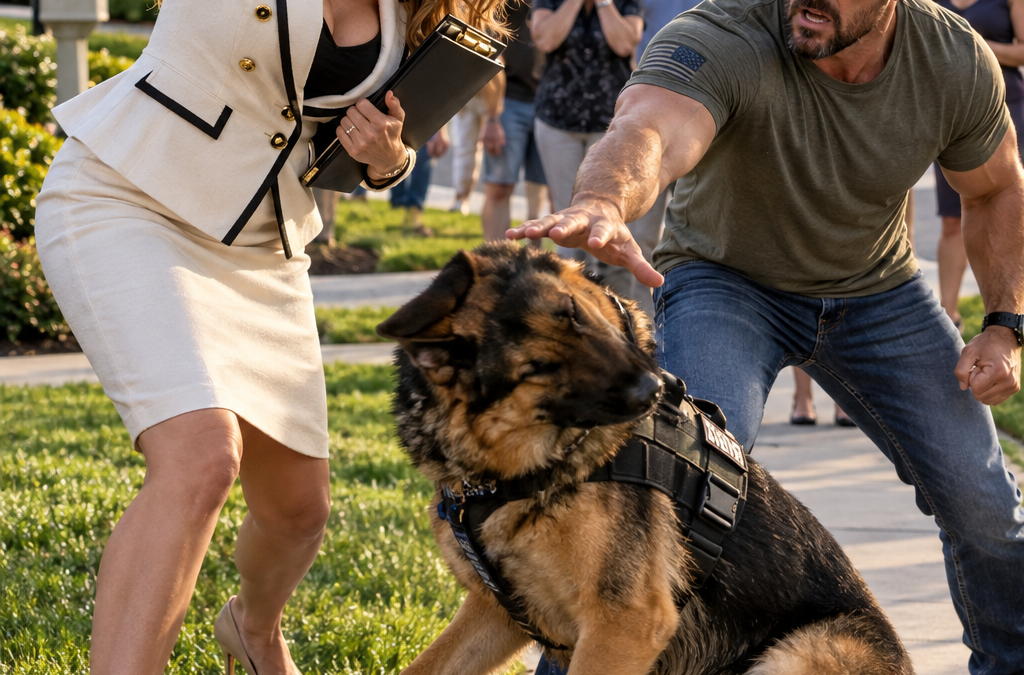
She was dressed for exercise in a tight pink zip-up jacket and black leggings, though I had never once seen her jog. Her hair was pulled into a high ponytail. Sunglasses covered her eyes. Her mouth was set in a hard line.
She walked directly into the center of the path and blocked us.
My stomach dropped.
“Move, Karen,” I said.
“You need to take that mutt back home.”
Ranger stood beside me, still and alert.
“He’s allowed to be here.”
“No, he isn’t.”
“I’m not doing this today.”
I shifted to step around her.
She moved with me.
That was when my pulse started climbing. I could feel the old response waking up in my body, that cold electric readiness I hated. Ranger felt it too. He leaned lightly into my leg.
Karen pointed at him. “See? He’s getting aggressive.”
“He’s standing still.”
“He’s intimidating me.”
“You walked up to us.”
“I am the HOA president.”
“You’re blocking a disabled resident and his service dog on a public community path.”
Her nostrils flared. “Do not lecture me.”
“Then stop giving me reasons.”
She leaned closer, lowering her voice. “I told you that dog wouldn’t be here much longer.”
Every sound around me seemed to sharpen: sprinkler clicks, distant mower, Ranger’s breathing, my own heartbeat.
“Karen,” I said carefully, “you need to walk away.”
Instead, she reached into her purse.
I saw the movement before I understood it.
A small canister came out in her hand.
For one frozen second, my brain refused to accept what my eyes were seeing. People threaten. People posture. People say insane things when they feel cornered. But there is a line between saying and doing, and some part of me still believed Karen knew it existed.
She did not.
She pointed the canister downward toward Ranger’s face.
“Get back!” she screamed.
Ranger had not moved toward her.
I shouted, “Don’t!”
She sprayed.
The world became fire.
It hit Ranger first. I heard his yelp before the burn reached me, a sound so sharp and terrified that something inside me tore open. Then the spray blew across my face and eyes. Pain exploded white-hot. I stumbled back, blind, choking, one hand locked around the leash.
Ranger cried. Not barked. Cried.
That sound still visits me sometimes in the dark.
He thrashed against the leash, not attacking, not lunging at Karen, just trying to escape the pain. I dropped to one knee, blinking uselessly, tears pouring from my burning eyes.
“Ranger!” I gasped. “Down! Stay with me!”
He tried. God, he tried. Even blinded and hurting, he fought to obey because that was who he was. His body shook against my leg.
Karen started screaming.
“Help! Help me! The dog attacked me!”
I could barely see her through the blur. A pale shape moving backward. A phone lifted. Her voice rising, theatrical and shrill.
“It lunged at me! I had to defend myself!”
“You sprayed him,” I choked.
“He attacked me!”
Neighbors came running.
Doors opened. Footsteps pounded pavement. Someone shouted my name. Someone else yelled, “What happened?”
Karen was crying now, or pretending to. “That vicious animal came at me!”
Ranger whined and pawed at his face.
I forgot Karen existed.
I pulled my water bottle from my belt with shaking hands, but I could not see well enough to aim. Then someone knelt beside me.
“Let me help,” a woman said. Elise.
She took the bottle and poured water over Ranger’s eyes while murmuring, “Easy, boy, easy, sweetheart.”
Ranger trembled but let her help.
Another neighbor guided me to sit on the curb. Water splashed over my face. The burn flared, then dulled slightly, then flared again. My breath came too fast.
“Ambulance?” someone asked.
“Police,” Mr. Alden barked. “Call police. And animal emergency.”
Karen kept talking.
The lies poured out of her like she had rehearsed them.
“He lunged.”
“He snarled.”
“I feared for my life.”
“The owner can’t control him.”
“I warned the HOA.”
I sat on the curb with my eyes streaming and Ranger pressed against my knees, and I understood something with absolute clarity.
She had planned this.
Not every detail, maybe. Maybe she had not known exactly when she would use the spray. Maybe she had been waiting for a moment she could twist. But she had brought that canister because she wanted proof of the story she had been telling. She wanted a scene. A frightened crowd. A hurt dog. Her own fake tears. Photos on her phone. A reason to say, See? I told you he was dangerous.
She did not care that he suffered.
She did not care that I suffered.
She cared about winning.
The first police cruiser arrived within minutes, though it felt longer. Then a second. By then, several neighbors were openly arguing with Karen.
“I saw the whole thing,” Elise said. “The dog didn’t touch her.”
Karen snapped, “You were not close enough.”
“I was at my mailbox.”
“He lunged!”
“He was standing beside him!”
Karen turned to Mr. Alden. “You hate me anyway, so of course you’ll lie.”
Mr. Alden’s voice went cold. “Lady, I don’t hate anybody enough to lie about a service dog being assaulted.”
The officers separated everyone. One came to me, a broad man with tired eyes and a calm voice.
“Sir, can you tell me what happened?”
I tried. My throat burned. My eyes felt scraped raw. Ranger was leaning against me, still shaking.
“She sprayed my dog,” I said. “He’s my service dog. He didn’t attack her.”
The officer looked at Ranger’s vest, then at his face. His expression changed.
“Is he trained for a disability?”
“Yes. PTSD. Mobility grounding. Nightmare interruption. Panic response.”
The officer nodded slowly. “Do you need medical attention?”
“My dog needs a vet.”
“We’ll get that handled.”
Karen’s voice cut across the path. “Officer, I demand that animal be removed immediately. I am the HOA president, and I have documented concerns—”
The second officer interrupted her. “Ma’am, did you deploy pepper spray?”
“I defended myself.”
“That wasn’t my question.”
Karen drew herself up, even then trying to look offended rather than afraid. “Yes, I used pepper spray because the animal attacked me.”
The officer glanced toward Elise. Then Mr. Alden. Then two other neighbors who had gathered nearby.
“Multiple witnesses say the dog did not attack you,” he said.
“They’re friends with him.”
“I barely know him,” Elise snapped.
Karen ignored her. “They’re biased. This neighborhood has become completely hostile to leadership.”
Leadership.
She actually said leadership while my dog was trembling from chemical burns.
The first officer stood. “Ma’am, interfering with a service animal is serious.”
Karen blinked. “Interfering?”
“You sprayed a service dog.”
“It’s a dog.”
“It is a service animal.”
Her face tightened. “He claims that.”
The officer’s voice hardened. “And you decided to test that with pepper spray?”
Karen’s confidence wavered for the first time.
Only slightly.
But I saw it.
The mask cracked.
“I was scared,” she said, softer now. “He’s big. He looked aggressive.”
Ranger let out a low whine, and I put my hand on his back.
“He was walking,” I said. My voice came out rough. “He was walking beside me.”
Karen looked at me then, and for one second, the hatred in her eyes was naked. No perfume, no pearls, no HOA language, no safety concerns. Just pure fury that I had not submitted.
The officer asked to see her phone.
She hesitated.
That hesitation mattered.
“Ma’am,” he said, “your phone.”
“I was documenting an attack.”
“Then the photos should help, shouldn’t they?”
She handed it over.
I never saw the photos that day, but I saw the officer’s face as he looked through them. There were pictures of Ranger after he had been sprayed, face wet, body low, me half-blind beside him. No torn clothing. No bite marks. No lunge. No attack. Just evidence of what she had done.
The ambulance arrived. I refused transport after they flushed my eyes and checked my breathing. The emergency vet tech came in a van from a nearby clinic because Elise had called ahead and begged them. They loaded Ranger carefully, and I rode with him because there was no force on earth that could have separated us right then.
As the van doors closed, I saw Karen in handcuffs.
She was not crying anymore.
She was pale with rage.
The entire neighborhood watched as the officers guided her toward the cruiser. Her ponytail had come loose. Her sunglasses were gone. One heel slipped slightly on the pavement, and for the first time since I had met her, she looked small.
Not harmless.
Never harmless.
But smaller.
The emergency vet smelled like antiseptic, wet fur, and fear.
They took Ranger back immediately. I stood in the lobby with my hands hanging uselessly at my sides, still tasting pepper spray in the back of my throat. A tech asked me questions. I answered what I could.
How long ago?
Was it direct exposure?
Was he coughing?
Any known health issues?
I wanted to be calm. Ranger needed me calm. But when they disappeared behind the doors with him, my knees almost gave out.
Elise had followed in her own car. She came into the lobby carrying my wallet, which I had apparently dropped on the sidewalk.
“You didn’t have to come,” I said.
“Yes,” she said. “I did.”
That was when I almost broke.
Not because of Karen. Not because of pain. Because kindness, when you have been bracing against cruelty for long enough, can hit harder than either.
We waited for hours.
The vet finally came out and told me Ranger had corneal irritation, respiratory inflammation, chemical burns around the eyes and muzzle, and severe stress response. They expected him to recover, but he needed treatment, medication, observation, and rest.
Expected to recover.
I held onto those words like a rope.
The bill was over three thousand dollars by the time everything was done.
I would have paid ten times that if I had to.
That night, I sat beside Ranger in a small recovery room while he slept under observation. His eyes were swollen. His breathing was raspy. Every few minutes, his paws twitched like he was trying to run from something in a dream.
I put my hand lightly on his side.
“You did good,” I whispered.
He did not wake.
“You did everything right.”
My voice cracked.
“I’m sorry.”
That was the thought I could not escape. Not anger. Not yet. Guilt.
I had brought him there. I had moved us into that neighborhood. I had tried to be patient, reasonable, controlled. I had documented and emailed and waited for proper channels while Karen sharpened herself into a weapon. Ranger had trusted me to keep him safe, and I had not been able to stop her hand.
By morning, guilt had hardened into something cleaner.
Resolve.
Karen was charged with interfering with a service animal, assault, and animal cruelty. There were other possible charges discussed, but those were the ones that mattered most to me at first. The police took witness statements. The HOA board suddenly discovered urgency. Paul called me three times in one day, each message more panicked than the last.
I did not call him back.
My attorney did.
That changed everything.
For months, the board had treated Karen as a headache they could survive by ignoring. Now she was a liability with a mugshot.
Her arrest broke something open in the neighborhood. People who had whispered before started speaking aloud. Neighbors sent me copies of old fines, old warnings, old emails where Karen had threatened them, insulted them, or invented violations. The retired teacher with the wind chimes wrote a four-page statement. Mr. Alden gave the board copies of every basketball hoop notice he had ever received. Elise wrote about the sidewalk attack in detail, including the fact that Ranger had not moved toward Karen at any point.
A week after the arrest, the HOA board held an emergency meeting.
I went because I needed to see it.
Ranger could not come. He was recovering at home, wearing a soft protective collar and sleeping more than usual. Leaving him behind felt wrong, but my attorney advised me to attend, and a neighbor I trusted stayed with him.
The clubhouse was packed.
People stood along the walls. Some had papers in their hands. Others looked angry in that quiet way people get when they realize fear has cost them too much for too long.
Karen was not there.
Her absence filled the room anyway.
Paul sat at the front table looking like he had aged ten years. The treasurer stared down at his notes. The vice president, a woman named Denise who had barely spoken at any prior meeting, cleared her throat and announced that the board had voted to remove Karen Whitmore from the presidency pending formal proceedings.
A murmur moved through the room.
Then Mr. Alden stood.
“Pending?” he said. “She assaulted a service dog.”
Denise swallowed. “There are bylaws—”
“Were there bylaws when she fined my grandson over a basketball hoop? Were there bylaws when she threatened Elise over chalk? Were there bylaws when she spent months harassing a disabled man because she didn’t like his dog?”
Applause broke out.
Not polite applause.
Real applause.
The kind that comes from people who have been waiting too long to exhale.
I sat near the back, hands folded, feeling the sound move through my ribs.
One by one, people stood and told their stories. Some were petty. Some were disturbing. All of them formed a pattern.
Karen had not been strict. She had been hungry.
Hungry for control. Hungry for attention. Hungry for the little thrill of making other people rearrange their lives because she said so.
When my turn came, the room went quiet.
I did not plan a speech.
I stood anyway.
“My dog is recovering,” I said.
My voice sounded strange in the microphone. Too flat. Too controlled.
“He has chemical injuries because your president decided her authority mattered more than federal law, more than basic decency, and more than the life of an animal trained to help me function.”
No one interrupted.
“I warned this board. I documented everything. I asked for help before this happened.”
Paul looked down.
“I don’t want revenge on this neighborhood,” I said. “I moved here because I wanted peace. But if this board protects her, excuses her, or minimizes what she did, then you become part of it.”
Denise’s face tightened.
“Understood,” she said quietly.
For the first time, I believed she meant it.
Karen was officially removed from the board within days.
The violation notices stopped.
It felt unreal at first, the silence. I kept checking my email expecting another message, another accusation, another demand disguised as procedure. Nothing came. No folded paper appeared on my door. No SUV slowed in front of my house. No perfume drifted from behind hedges while Ranger and I walked.
Peace returned slowly, the way feeling returns to a limb after it has gone numb.
But the legal process did not move gently.
Karen’s first court appearance was exactly what I expected and somehow worse.
She walked in wearing pearls.
I remember that detail because it made me furious. Ranger had spent hours at an emergency vet because of her, and she came to court dressed like she was attending a charity luncheon. Cream suit. Nude heels. Perfect hair. Soft makeup. She looked beautiful, composed, and offended by the inconvenience of accountability.
Her attorney tried to present her as a concerned community leader who had made a split-second decision under fear.
Then the prosecutor played the witness statements.
Then came the photos.
Then the officer’s report.
Then the vet records.
Karen’s expression shifted with each piece of evidence. First impatience. Then annoyance. Then disbelief. She kept glancing around as if searching for someone important enough to rescue her from consequences.
When asked whether she had sprayed Ranger, she admitted she had.
When asked whether Ranger had bitten, scratched, or touched her, she hesitated.
That hesitation told the whole courtroom the truth before her mouth did.
“No,” she said finally. “But he was threatening.”
The judge looked over his glasses. “By standing near his handler?”
Karen flushed. “He’s a large German Shepherd.”
“He is a service animal.”
“He could have been fake.”
The judge’s face did not change, but the room cooled. “Ms. Whitmore, your suspicion does not authorize you to assault a disabled person’s service animal.”
Her attorney touched her arm, silently telling her to stop talking.
Karen did not stop.
“I had a responsibility to protect my community.”
“You were not acting as law enforcement,” the judge said.
“I was HOA president.”
“That is not law enforcement.”
A few people behind me shifted. Someone coughed into their hand. Karen heard it and turned her head sharply, humiliated.
Good, I thought.
Then felt no guilt for thinking it.
The criminal case ended with probation, fines, restitution, mandated counseling, community service, and a short jail sentence that Karen’s attorney fought hard to reduce but could not erase completely. She also had to pay toward Ranger’s treatment. It was not enough to undo the harm, but it was something official. Something written down. Something that said what she did was not a neighborhood disagreement.
It was a crime.
The civil case took longer.
I sued Karen and the HOA. Not because I wanted to become rich from pain. There are cleaner ways to live than turning suffering into money. But bills were real. Legal fees were real. Ranger’s treatment was real. And responsibility needed a price high enough that no future board could pretend disability rights were optional if enforcement became inconvenient.
The HOA’s insurance company got involved. So did more attorneys. Statements were taken. Emails were reviewed. Karen’s history as president became part of the record.
That was when the board really began to understand what they had allowed.
Not caused, maybe.
But allowed.
There is a difference, but not as large as people like to think.
Karen had left a trail of obsession so obvious it was almost embarrassing: complaints about Ranger, emails questioning my disability, messages to board members calling me unstable, notes about “building a case,” even a draft proposal for stricter animal enforcement that singled out “large breeds falsely presented as medical necessities.”
My attorney showed me one printed email where Karen wrote, “If we let him get away with this, others will exploit the same loophole.”
Loophole.
That was what she called the legal protection that let me live with the animal trained to keep me alive.
For two days after reading that, I could not sleep through the night.
Ranger, still recovering, woke me each time.
Even hurt, he worked.
That was what people like Karen never understood. Service is not an accessory. It is not a costume. It is not a trick. It is trust turned into action over and over again.
Ranger did not know about lawsuits or HOA boards or federal protections. He knew my breathing changed before panic hit. He knew my hands shook after nightmares. He knew when to lean, when to nudge, when to block, when to wake me.
He knew me.
And because he knew me, I could keep living.
The settlement came months later.
I cannot share every detail, but it covered the vet bills, legal expenses, and enough beyond that for me to do something I had only thought about in passing before.
I started a small nonprofit fund for veterans who needed help with service animal costs.
It began modestly. A website. A local fundraiser. A partnership with a trainer I trusted. A few donations from neighbors who had once been too afraid of Karen to speak to me for longer than thirty seconds. Mr. Alden wrote the first check. Elise organized a community bake sale. The retired teacher with the wind chimes proofread every page of the application forms like she was grading final exams.
We named the fund Ranger’s Watch.
I did not tell Ranger. He would have expected payment in cheese.
Karen’s house went up for sale in early spring.
By then, she had become a ghost in the neighborhood. She rarely came outside. When she did, she wore sunglasses even on cloudy days and moved quickly from door to car. Her SUV had disappeared, probably sold or repossessed or traded down. The rumors said restitution and legal fees had drained her. I did not chase the details. I had no interest in watching every piece of her life collapse.
But I will admit this.
When the moving truck came, I watched from my porch.
So did half the street.
Not openly at first. People pretended to water flowers, check mail, adjust lawn chairs. Then Mr. Alden came outside with an actual folding chair and a glass of iced tea, and everyone stopped pretending.
Karen stepped out of her house wearing oversized sunglasses, tight jeans, and a white blouse that looked expensive even wrinkled. She glanced around at the watching neighbors, and her mouth twisted.
For a moment, I thought she might say something.
Maybe one last insult.
One last threat.
One last performance.
Instead, she saw Ranger.
He sat beside me on the porch, healthy again, vest on, ears up, calm as sunrise.
Karen froze.
Ranger did not bark. He did not growl. He did not move.
He simply looked at her.
That was enough.
Her face tightened, and she turned away first.
The movers loaded the last boxes. The truck door rolled down. Karen got into a small sedan driven by someone I did not recognize. As the car pulled away, no one clapped. No one cheered.
But the silence felt like judgment.
And when she was gone, really gone, the neighborhood changed.
Not all at once. Places do not heal overnight any more than people do. But small things returned.
Basketball hoops stayed by curbs until sunset.
Kids drew chalk cities across the sidewalks, bright roads and crooked houses and purple suns. Potted plants multiplied on porches. Wind chimes sang from the retired teacher’s eaves. Someone painted their mailbox blue and no one received a violation. The HOA meetings got shorter and more boring, which was exactly how HOA meetings should be.
People started talking to me.
Not just nodding. Talking.
Elise’s daughter asked if Ranger was feeling better and brought him a hand-drawn card covered in hearts and uneven paw prints. Mr. Alden stopped by with dog treats he claimed were homemade, though I recognized the packaging from the pet store. Paul came to my door one evening and apologized in person.
He looked miserable.
“I should have done more,” he said.
“Yes,” I said.
He flinched.
I let the silence sit for a second, then added, “But you’re doing more now.”
He nodded, eyes damp. “I am.”
That was enough.
Not forgiveness exactly. Forgiveness is too complicated to hand out on a porch in one conversation. But it was a beginning.
Ranger recovered physically before I did emotionally.
His eyes healed. His breathing cleared. The vet eventually approved him for normal work again. The first time we walked the full community path after the attack, I thought I was ready.
I was not.
At the bend where Karen had appeared that morning, my body locked.
One second I was walking. The next I was back there, blind and burning, Ranger crying, Karen screaming lies, the world narrowing to pain.
Ranger stopped immediately.
He turned, pressed his body against my legs, and looked up at me.
The path was empty. The sky was clear. Somewhere behind a fence, a dog barked twice and stopped.
I could not move.
Ranger nudged my hand.
I looked down.
He nudged again, firmer this time, then leaned his full weight into me.
“Yeah,” I whispered. “I know.”
Breathe.
That was what he was telling me.
So I did.
In through the nose. Out through the mouth. Again. Again.
A woman walking on the far side of the path slowed, concern crossing her face. She did not rush over. She did not crowd me. She just waited a respectful distance away.
“Take your time,” she said gently.
I did.
Then Ranger and I walked past the bend.
It sounds small.
It was not.
After that, the path became ours again, step by step.
The nonprofit grew slowly. One veteran got help with training costs for a Labrador. Another received support for emergency veterinary care. A third, a young woman with panic attacks so severe she had stopped leaving her apartment, called me crying after her service dog woke her from a nightmare for the first time.
“I slept,” she said, voice breaking. “I actually slept.”
I sat at my kitchen table, Ranger’s head on my knee, and had to close my eyes.
That was the payoff Karen never intended to create.
She wanted to make my world smaller.
Instead, she helped me build something larger.
I will not pretend everything became perfect. PTSD does not vanish because one villain leaves the neighborhood. Some nights are still bad. Sudden noises still hit wrong. Crowds still press too close. There are mornings when peace feels fragile, like glass balanced on the edge of a table.
But my house feels like mine now.
The porch is quiet.
The front door is clear of violation notices.
The sidewalks no longer feel like enemy territory.
Sometimes, in the evenings, I sit outside with coffee while Ranger lies at my feet, older now but still watchful. Kids ride bikes past the driveway. Neighbors wave. Someone’s grill smokes in the distance. Wind chimes ring softly down the block.
It is ordinary.
Beautifully, painfully ordinary.
The kind of ordinary I used to think other people got to have.
Every so often, someone new moves in and asks about the HOA. They hear stories, of course. Neighborhoods remember their villains. Karen’s name still comes up sometimes, usually with an eye roll or a shake of the head. People talk about the pepper spray, the arrest, the court case, the moving truck.
But when they ask me about it, I do not start with Karen.
I start with Ranger.
I tell them he did nothing wrong.
I tell them he stood beside me like he had been trained to do.
I tell them that even in pain, even blinded and terrified, he tried to obey because his whole heart was built around keeping me safe.
And then, if they are still listening, I tell them the part that matters most.
A community is not safe because one person controls it.
It is safe because people refuse to let cruelty hide behind rules.
Karen thought power meant making everyone afraid of her.
She was wrong.
Power was Elise kneeling on the sidewalk to rinse my dog’s eyes while Karen screamed lies behind her.
Power was Mr. Alden telling the truth even when he knew it would drag him into a fight he had avoided for years.
Power was a room full of tired neighbors finally standing up, one by one, and saying, Enough.
Power was Ranger leaning against my legs on that path months later, reminding me that fear could be survived one breath at a time.
Karen lost her title, her house, her reputation, and the illusion that she could hurt anything she disliked without consequence.
I got my peace.
Not the untouched kind I thought I was buying when I moved in. Not the fragile quiet that depends on everyone staying silent.
Something stronger.
A peace that had been tested.
A peace that had teeth.
And every morning when Ranger and I walk through the neighborhood, past the mailboxes, past the clubhouse, past the bend in the path where everything changed, I feel that peace settle around us.
No one blocks our way now.
No one questions whether he belongs beside me.
No one dares call him a pet.
He walks at my left side, steady and proud, while the neighborhood wakes around us. Sprinklers tick. Garage doors rise. Kids wait for the bus with backpacks too big for their shoulders. Neighbors lift hands from steering wheels as they pass.
And Ranger, my good boy, my anchor, my shadow, my reason for making it through more days than I can count, keeps walking forward.
So do I.