FULL ENDING The Day Karen Took My Wheelchair, She Learned Exactly What It Means to Steal Someone’s Legs
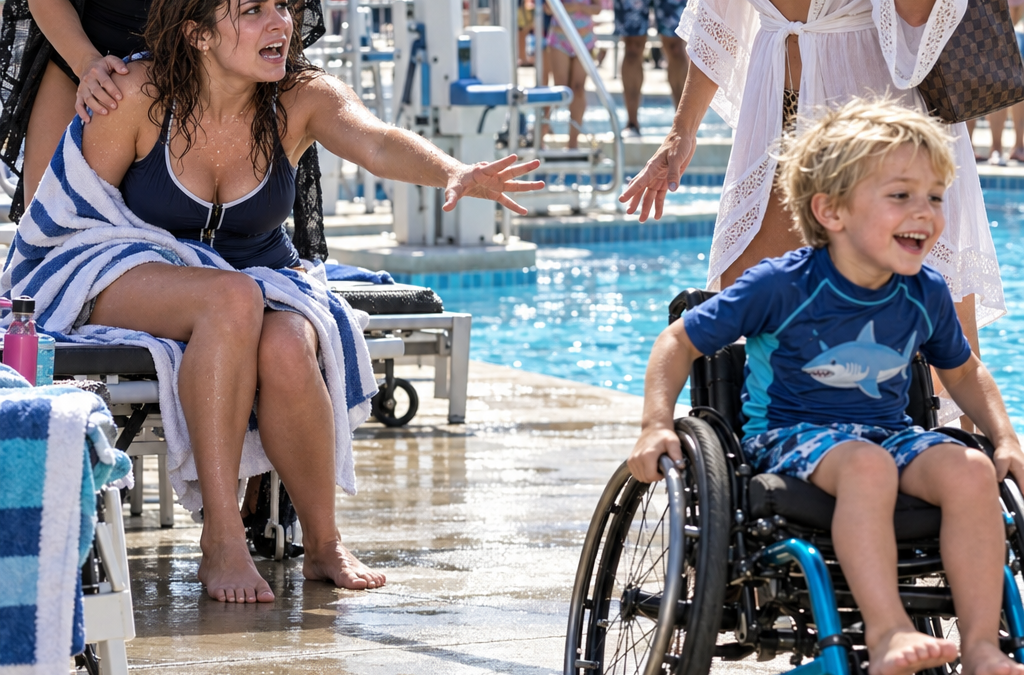
𝗙𝗨𝗟𝗟 𝗦𝗧𝗢𝗥𝗬
The woman who came marching toward us looked like she had been designed by a committee to ruin someone’s afternoon.
She was around forty, though she clearly fought that number like it had personally insulted her. Her bleached blonde hair was pulled into a high, severe ponytail that swung like a whip when she walked. Oversized sunglasses rested on top of her head, flashing gold at the temples. She wore a white cover-up over an expensive-looking swimsuit, big hoop earrings, glossy lips, and the kind of confidence that came not from self-respect, but from years of discovering that if she was loud enough, pretty enough, and offended enough, people moved out of her way.
She did not look at me first.
She looked at her son.
“Timmy,” she said again, sharper now, slapping his little hand away from my wheel. “I told you, don’t touch random things.”
Then, as if remembering there was an actual human being attached to the chair, she glanced at me.
“Sorry,” she said.
It was the kind of sorry that meant absolutely nothing. The kind people throw over their shoulder after stepping on your foot.
“It’s okay,” I said, even though it wasn’t. “But please don’t let him play with it. It’s medical equipment.”
Her expression changed.
Not into concern.
Into evaluation.
Her eyes moved over me with the slow, invasive sweep I had come to hate. My arms, stronger from pushing myself everywhere. My legs, thinner than they used to be. The surgical scars visible near my hip and thigh. My swimsuit. My chair. My face.
People think they are subtle when they try to decide if you are disabled enough to deserve what you use.
They are not.
“Well,” she said, lifting one shoulder, “he wasn’t hurting it. He just likes wheels. Cars, trucks, scooters, anything that moves. You know how boys are.”
Lisa set her water bottle down a little too hard.
“Sure,” Lisa said. “But it’s not a toy. It’s how she gets around.”
The woman’s head turned slowly toward Lisa. Her smile sharpened without warming.
“I wasn’t talking to you.”
Lisa’s eyebrows rose. “You are now.”
I put a hand lightly on Lisa’s wrist. Not because she was wrong, but because I could already feel the air changing. I had dealt with enough entitled strangers to know when a small moment was becoming something larger.
The woman turned back to me, and this time she smiled. She was beautiful in the polished, brittle way a chandelier is beautiful right before it falls. Her lips curved, her voice softened, and suddenly she became almost flirtatious, as if charm were a weapon she had used so often she no longer had to think about it.
“Look,” she said. “He’s fascinated. Can’t he sit in it for one second? Just for a picture?”
I stared at her.
At first, I thought I had misunderstood.
“No,” I said.
Her smile held, but her eyes cooled.
“I mean just a quick picture. He would love it.”
“No,” I repeated. “Absolutely not. This is my wheelchair. It’s custom fitted for me. It is not for photo ops.”
Timmy pressed against his mother’s side, his face already puckering with disappointment.
“I want to sit in it,” he whined. “Mommy, I want to drive it.”
Karen placed one hand dramatically over his damp curls and looked at me like I had just slapped him.
“You see?” she said. “You’re upsetting him.”
“I’m not upsetting him,” I said. “You asked for something inappropriate, and I said no.”
Her mouth tightened.
“It’s just for a minute.”
“It’s not happening.”
“You’re not even using it right now.”
I looked down at myself, sitting in the chair.
Lisa made a sound somewhere between a laugh and a gasp. “She is literally sitting in it.”
Karen waved a manicured hand, her nails bright coral and perfectly shaped. “You know what I mean. He just wants to pretend. Don’t be selfish.”
There it was.
Selfish.
The favorite word of people who believe boundaries are insults.
A strange heat spread through my chest, but I kept my voice level.
“I am not being selfish. I’m protecting an expensive medical device that I rely on every day. The answer is no.”
Karen leaned in slightly, and I caught the smell of sunscreen, perfume, and something sugary on her breath. Her voice dropped low enough that only Lisa and I could hear.
“You people always make everything so dramatic.”
My fingers curled around my push rims.
“You people?”
She blinked, then smiled wider, as if daring me to react.
“I mean people who enjoy attention.”
Lisa stood up so quickly her chair scraped the concrete.
“Okay,” Lisa said, “we’re done here.”
Karen’s eyes flicked over Lisa dismissively. “Sit down.”
“Back away from my friend.”
For a moment, Karen looked almost pleased. Some people do not avoid conflict. They feed on it. She glanced around at the nearby families, maybe checking for an audience, maybe deciding how big of a performance she wanted.
Then she straightened, flipping her ponytail over one shoulder.
“Fine,” she said loudly. “Come on, Timmy. Apparently some people don’t know how to share.”
She took her son’s hand and walked away, hips swaying with theatrical irritation, every step announcing that she believed the world had wronged her.
I watched her go until she reached a lounge chair near the kiddie splash pad.
Lisa sat back down slowly.
“What the actual hell?” she muttered.
I tried to laugh it off. I wanted to. I wanted that to be the whole story: rude mom asks ridiculous thing, disabled woman says no, friend makes sarcastic comment, everyone moves on.
“I’ve heard worse,” I said.
Lisa gave me a look. “That doesn’t make it okay.”
“No,” I admitted. “It doesn’t.”
We moved to another shaded table farther from Karen because I did not trust her energy and because, honestly, I wanted distance. I parked close beside the table, angled slightly away from the walkway. Lisa went to refill our waters from the fountain nearby. I checked my phone, answered a text from my sister, and tried to let my heartbeat slow down.
Five minutes.
That was all it took.
Five minutes for my day to split open.
Lisa came back holding two water bottles, but she stopped mid-step. Her face went strange, drained of color and sharpened by anger.
“What?” I asked.
She did not answer at first.
Her eyes were fixed on the empty space beside me.
I turned.
My wheelchair was gone.
For half a second, my brain refused to understand what my eyes were seeing. There was the table. There was the concrete. There was the damp mark from one of my wheels. There was my towel, no longer on my chair but lying on the ground like discarded trash.
But the chair itself was not there.
My hands shot to the edges of the table as if I could push myself up through sheer panic. My stomach dropped so violently I thought I might throw up.
“Where is it?” I asked.
Lisa’s jaw clenched. She pointed across the pool deck.
“She took it.”
Karen was near the kiddie splash pad.
Timmy was in my wheelchair.
He sat in it like it was a carnival ride, his wet little feet planted on my footrest, his hands gripping my push rims while Karen pushed him in slow, lazy circles. She was smiling. Not apologetic. Not guilty. Smiling. She bent forward now and then, saying something to him, her sunglasses back over her eyes, her hair swinging down her back.
My water bottle had been tossed beside my towel. My bag had slid halfway off the chair when she moved it and was now lying open on the concrete.
For one terrifying moment, all I felt was helplessness.
People think anger comes first.
It does not.
Not when someone takes your mobility away.
First comes the fear.
It hits the body before words can form. My skin went cold despite the heat. The pool deck stretched between me and my chair like a road I could not cross. I could crawl, maybe, but the concrete was rough and wet and hot. I could drag myself by my arms while strangers stared. I could ask Lisa to carry me, though she was strong but not that strong, and the humiliation of needing to be hauled across a public pool because some woman decided her child’s amusement mattered more than my ability to move lodged in my throat like glass.
Then came the anger.
Hot. White. Blinding.
“Help me over there,” I said.
Lisa put the water bottles down immediately. “I yelled at her. I told her to stop. She told me to mind my own business.”
My laugh came out sharp and humorless.
“Of course she did.”
Lisa crouched slightly and offered her shoulder. I locked my jaw and shifted my weight, using the table to pull myself up as much as I could. My right leg could bear a little weight in short, unstable bursts, but not safely and not far. Lisa wrapped an arm around my waist. I hooked one arm over her shoulders.
Every movement hurt.
Not just physically, though there was that too. My hip protested. My spine tightened. My bad leg dragged awkwardly. My body, which I had spent years learning to trust again in new ways, suddenly felt exposed and unreliable.
People were watching now.
I could feel their eyes.
A teenage lifeguard stood frozen near his stand. A father holding a toddler turned to stare. Two older women lowered their magazines. The normal pool sounds dimmed around me until all I could hear was the slap of wet feet, Timmy’s laughter, and Karen’s voice.
“Wheee,” she sang, pushing him in another circle. “Look at you go, sweetheart.”
We got close enough for her to hear me.
“Get your son out of my wheelchair. Now.”
Karen did not stop.
She did not even look at me.
“He’s almost done.”
My fingers dug into Lisa’s shoulder.
“I said now.”
Karen sighed, slow and dramatic, like I was the one interrupting something sacred.
“He’s having fun. You had your turn.”
For a second, I could not speak.
My turn.
My turn in my own wheelchair.
“You stole my wheelchair,” I said, my voice rising. “That is theft. Get him out.”
That finally made her stop.
Timmy looked startled, his small hands still on the rims. Karen straightened, one hand resting possessively on the back of my chair, and turned to face me fully.
Up close, her expression was almost fascinating in its ugliness. She was not confused. She was not ashamed. She was annoyed that I had forced her to stop pretending she was kind.
“You are being incredibly rude,” she said.
“Rude?”
“Yes. Making a scene in front of children.”
Lisa barked out a laugh. “You took her wheelchair.”
Karen looked at her. “I borrowed it.”
“You don’t borrow someone’s legs.”
That landed somewhere nearby. I heard a man mutter, “Jesus Christ.”
Karen’s nostrils flared. For the first time, she seemed to realize this was becoming public in a way she could not fully control. But instead of backing down, she lifted her chin.
“Timmy,” she said brightly, “say thank you to the lady for sharing her toy.”
Toy.
The word cracked through me.
“That is not a toy,” I said.
Timmy scrambled out, confused and pouty, leaving wet footprints on my cushion. I could see the grimy marks immediately. Sunscreen smeared on my push rims. Water dripping near the brake. My backrest tilted slightly from where his weight had pressed wrong against it.
Karen took his hand as if she had completed a generous community activity and started to walk away.
“Lock the brakes,” I snapped.
She ignored me.
The chair, left on a slight incline, began to roll.
Toward the pool.
Everything slowed.
The front casters turned first. Then the whole frame crept forward, inch by inch, as casually as a nightmare. I saw the edge of the pool behind it. I saw the water glittering. I saw, in a horrible flash, the cushion absorbing chlorine, the bearings flooding, the backrest mechanism ruined, the frame maybe damaged, my independence sinking because Karen could not be bothered to flip two brake levers.
“Lisa!” I shouted.
Lisa lunged.
She caught the back of the chair just before the front wheels reached the wet lip of the pool deck.
A sound rose from the watching crowd. A collective gasp. A curse. Someone said, “Oh my God.”
Lisa yanked the chair backward and locked both brakes with shaking hands.
I lowered myself into it with her help. The moment my body hit the seat, a tremor went through me so hard my teeth clicked. My palms gripped the rims. I was back in control, technically, but the safety of it had been violated. My chair no longer felt untouched. My skin crawled.
Karen had made it maybe twenty feet away.
“Call the manager,” I said to Lisa. My voice was low now. Too low. “And call the police.”
Karen turned.
Her sunglasses slid down her nose as she stared at me.
“You’re calling the police?”
“Yes.”
“For what?” She laughed, but there was a crack in it. “Borrowing a chair?”
“For stealing medical equipment.”
The pool deck went even quieter.
Karen looked around, saw the faces turned toward her, and shifted into a new performance. Her shoulders dropped. Her free hand went to her chest. Her mouth parted in wounded disbelief.
“Are you serious right now? You’re going to traumatize my child because he wanted to play?”
“You traumatized him when you taught him other people’s bodies and property don’t matter.”
Her eyes narrowed.
“You are crazy.”
“Maybe,” I said. “But I’m the crazy woman pressing charges.”
Lisa was already on the phone. Her voice was tight and controlled as she explained what had happened. A few people nearby stepped closer, not crowding me, but making it clear they were watching Karen now. The father with the toddler handed the child to his wife and folded his arms. One older woman shook her head with open disgust.
Karen’s confidence began to flicker.
Only for a second.
Then she doubled down.
“I’ll tell them you said he could use it,” she snapped. “It’s your word against mine.”
I looked around at the pool deck.
“At least fifty people saw you.”
“They saw you overreacting.”
“They saw Lisa catch my chair before it went into the pool.”
“That was not my fault.”
“You left it unlocked on an incline.”
“How was I supposed to know?”
“By not touching it in the first place.”
Her son started crying then, not because he understood what had happened, but because adults were angry and his mother’s grip on his hand had tightened. Karen immediately seized on it.
“Look what you’re doing,” she said, bending to stroke his hair. “You’re scaring him. He’s just a little boy.”
I looked at Timmy. His lower lip trembled. He was a child. A spoiled one, maybe, but still a child. He was not the villain. He had been curious. Then his mother had given him permission to turn that curiosity into harm.
“I’m sorry you’re upset, Timmy,” I said, keeping my voice as steady as I could. “But your mom should not have taken something that did not belong to her.”
Karen stood so fast her ponytail snapped.
“Do not speak to my son.”
“Then parent him.”
A few people murmured. Someone actually said, “Damn.”
Karen’s face flushed under her tan.
That was when Jenna arrived.
Jenna was the pool manager, and I knew her by sight because I had been coming to that aquatic center for years. She was in her thirties, compact and serious, with a radio clipped to her waistband and the kind of calm authority that made teenagers stop running before she opened her mouth. Lisa walked beside her, still holding her phone.
Jenna looked at me first.
“Are you okay?”
The question nearly undid me.
Because I was not, not really. But I nodded once.
“My chair needs to be checked,” I said. “She took it without permission, put her son in it, dumped my things, and left it rolling toward the pool.”
Jenna’s jaw tightened.
She turned to Karen.
“Ma’am, did you take her wheelchair?”
Karen laughed in disbelief, but it was thinner now.
“She said he could try it.”
“No,” Lisa said immediately. “She did not.”
Karen pointed at Lisa. “You weren’t even there.”
“I was standing right there when she told you no.”
Karen looked at Jenna with wide, wet eyes that appeared on command so quickly I almost admired the mechanics of it.
“This is a misunderstanding. My son thought it was a pool toy. She was rude from the beginning. I was just trying to give him a nice day.”
Jenna’s voice stayed level.
“We have cameras covering the pool deck.”
Karen froze.
It was small, the change in her face, but I saw it. The tiny widening of her eyes. The moment calculation replaced performance.
Jenna continued. “I can pull the footage right now. The police can review it when they arrive.”
Karen’s mouth opened, closed, then opened again.
“I don’t have time for this.”
“You’ll need to make time.”
“I am a paying member.”
“Not anymore,” Jenna said.
Karen blinked.
“What?”
“Your membership is revoked effective immediately.”
Karen gave a short, ugly laugh. “You can’t do that.”
“I can, and I am. You removed a disabled guest’s mobility aid without permission and created a safety hazard. Gather your belongings and wait by the front gate for the officers.”
The phrase disabled guest’s mobility aid did something to the air.
People heard it differently than wheelchair. They heard the truth of it. They heard what Karen had taken.
Karen heard it too, because her face twisted.
“Oh, so now everyone is ganging up on me,” she said, voice rising. “Because I’m a mother? Because I tried to let my kid have fun?”
The older woman with the magazine leaned forward and said, “Then buy him a toy car.”
A ripple moved through the crowd. Not laughter exactly. More like approval.
Karen spun toward her. “Mind your business.”
“It became everyone’s business when you stole from a disabled woman,” the older woman said.
Karen’s mask slipped completely then.
She was no longer the glossy, flirty, put-together mother smiling under the sun. She was furious. Her beauty turned hard, almost mean. Her coral nails dug into her son’s shoulder. Her lips peeled back from her teeth.
“You people are unbelievable,” she hissed.
“There it is again,” Lisa said. “You people.”
Jenna stepped slightly between Karen and the rest of us.
“Front gate. Now.”
For a moment, I thought Karen might refuse. I saw it in the way she planted her feet. She was used to intimidation working. She was used to customer-service voices folding under the pressure of her anger. She was used to people deciding it was easier to appease her than enforce consequences.
But there were too many witnesses now.
Too many eyes.
Too many phones visible in too many hands.
So she grabbed a designer tote from her lounge chair with one violent motion, shoved sunscreen and goggles into it, and dragged Timmy toward the exit while muttering loudly about lawsuits, discrimination against mothers, and “crazy attention seekers.”
Jenna stayed with me.
“I’m so sorry,” she said quietly.
That nearly made me cry.
Not Karen’s insults. Not Timmy’s footprints. Not even the panic.
Kindness almost did it.
“I need to get it inspected,” I said. “If anything’s bent—”
“We’ll document everything,” Jenna said. “Security footage, incident report, witnesses. Whatever you need.”
Lisa stood beside me, one hand resting on my shoulder. I could feel her shaking.
“I should’ve tackled her,” she muttered.
Despite everything, I let out a weak laugh.
“Please don’t get arrested before she does.”
The police arrived about ten minutes later.
By then Karen had positioned herself near the front gate like a tragic heroine awaiting rescue from injustice. She had reapplied her sunglasses. Her son sat on a bench, sniffling into a popsicle Jenna had somehow produced for him because Jenna was apparently a better adult to that child than his own mother had been that afternoon.
Two officers came in, one older man with a stern face and one younger woman who carried a notebook. They spoke with Jenna first, then with me.
I gave my statement carefully.
I explained what my wheelchair was. I explained that it was custom-fitted medical equipment, not pool property, not a rental chair, not a toy. I explained that Karen had asked to let her son sit in it and I had clearly refused. I explained that she later took it anyway while I was unable to stop her, placed her child in it, pushed him around, dumped my belongings, and left the chair unsecured on an incline.
As I spoke, my voice shook once.
Only once.
The younger officer noticed.
“You’re doing fine,” she said.
I swallowed.
“I felt trapped,” I admitted. “I couldn’t get to it without help. I know that might not sound—”
“It sounds exactly as serious as it is,” she said.
That sentence settled over me like shade.
Lisa gave her statement next, with more anger and fewer attempts to sound composed. Jenna provided the incident report. Several pool guests volunteered to give their names. The father with the toddler had recorded part of it on his phone, including Lisa yelling at Karen to stop and Karen saying, clear as day, “Mind your own business.”
Karen’s story collapsed almost immediately.
At first, she insisted I had given permission.
Then, when told about the video and cameras, she claimed she had misunderstood.
Then she said she did not know it was expensive.
Then she said she did not know it was medical equipment.
Then she said her son had been crying and she only wanted to calm him down.
Then she said I had embarrassed her.
That, I believed.
Not because it justified anything, but because it was probably the first honest thing she had said.
The older officer listened without expression.
“Ma’am,” he said when she finally stopped, “taking someone’s wheelchair without permission is not borrowing. It is theft. This is medical equipment. You removed her ability to move independently.”
Karen dabbed under one eye with a finger, careful not to smear mascara.
“I didn’t know.”
“She told you.”
Karen looked at me then. Really looked at me. And for one second, there was something like hatred in her face. Not remorse. Not shame. Hatred that I had refused to play the role she wanted. Hatred that I had said no and made the no matter.
“She was rude,” Karen whispered.
The officer’s expression did not change.
“Being rude is not a crime. Taking her wheelchair is.”
Karen began to cry harder.
It was not pretty crying, despite her best efforts. Her cheeks blotched. Her voice pitched high. She kept glancing around to see who was watching. Every sob seemed calculated to find sympathy, but the crowd had run out of it.
Then her husband arrived.
I did not know who he was at first. A tall man in khaki shorts and a polo hurried through the gate, phone in hand, scanning faces with the panicked confusion of someone who had received a very bad call without enough details. Karen saw him and immediately turned toward him as if salvation had arrived.
“Mark,” she cried. “They’re saying I stole something.”
He slowed.
His eyes moved from Karen to the officers, to Jenna, to me in my chair, to the crowd, to Timmy sitting miserably with a popsicle dripping onto his swim trunks.
“What happened?” he asked.
Karen rushed toward him. “It’s insane. I borrowed a chair for Timmy for one minute and this woman lost her mind.”
The older officer stepped in before she could continue rewriting reality.
“Sir, your wife removed this woman’s wheelchair without permission after being told no, placed your son in it, and left it unsecured near the pool. We have witness statements and video.”
Mark’s face changed.
At first, confusion.
Then disbelief.
Then horror.
He looked at Karen.
“You did what?”
Karen’s mouth tightened. “Don’t say it like that.”
“You took her wheelchair?”
“It was just sitting there.”
I felt my entire body go rigid.
Mark heard it too. The awfulness of that sentence. The casual cruelty of it.
He stared at his wife like he was seeing a stranger.
“Are you out of your mind?”
Karen recoiled. “Do not yell at me in public.”
“I’m not yelling,” he said, though his voice had gone rough. “I’m trying to understand how you thought this was okay.”
“She was being selfish. Timmy wanted—”
“Timmy wanting something doesn’t mean you steal it.”
The silence that followed was brutal.
Timmy looked up at his father, then down at the popsicle melting over his hand.
Mark turned to me. His face was pale now.
“I am so sorry,” he said.
Karen made a sharp sound. “Mark.”
He ignored her.
“I’m sorry,” he repeated. “There is no excuse for that. None.”
I nodded once. I did not know what else to do with his apology. It was better than hers, because hers did not exist. But apologies from bystanders to someone else’s cruelty always arrive with a strange weight. They acknowledge the damage without undoing it.
The officers asked if I wanted to press charges.
Karen stopped crying instantly.
Her head snapped toward me.
“Are you serious?” she said. “You would ruin my life over this?”
There it was again. Her life. Her embarrassment. Her consequences.
Not my fear. Not my body. Not the thousands of dollars of equipment she had endangered. Not the fact that she had looked at another human being’s mobility and decided her child’s amusement outranked it.
I looked at my chair.
At the wet footprints fading into the cushion.
At the smears on the rims.
At my towel still lying on the concrete where she had thrown it.
Then I looked at Karen.
“Yes,” I said. “I want to press charges.”
Her face crumpled with rage disguised as devastation.
“You’re horrible.”
“No,” I said. “I’m done being polite to people who hurt me and expect gratitude when they stop.”
The officer wrote it down.
Karen was cited for theft and, after some discussion I did not fully understand in the moment, interference with an assistive device under state law. The officers took photographs of my chair, including the brand, serial number, cushion, and any visible marks. They gave me a case number. They told me to have it inspected and keep any receipts or reports.
The whole thing felt official in a way that made my stomach twist.
Part of me was relieved.
Another part of me hated that I had to prove something so obvious.
By the time it was over, the sun had shifted lower and the pool day was ruined. Jenna offered us a private room if I needed a minute before leaving. Lisa insisted on driving. I did not argue.
In the changing room, I cleaned the chair as best I could with wipes from my bag. My hands moved mechanically. Wipe the push rims. Check the brakes. Check the cushion. Check the frame. Check the backrest. Again. Again.
Lisa stood nearby, quiet for once.
When I finally stopped, she said, “I’m sorry.”
“You didn’t do it.”
“I know. But I’m sorry it happened.”
I looked at her then, and the tears came so suddenly I had no defense ready. Not loud sobs. Just silent, humiliating tears that slid down my face while I stared at the floor.
“I couldn’t get to it,” I whispered.
Lisa crouched in front of me.
“I know.”
“I was right there, and I couldn’t get to it.”
Her eyes filled too.
“I know.”
That was the part people did not understand when they heard the story later. They understood the theft. They understood the entitlement. They understood the legal consequences. But the thing that stayed lodged in my body was the distance between me and my chair. The sight of my own independence rolling away while I sat helpless under a cabana, unable to stop it without someone else’s strength.
I had spent three years rebuilding my life around the belief that I was still capable.
Karen had taken five minutes to remind me how quickly someone could make me powerless.
That night, I did not sleep.
Every time I closed my eyes, I saw my chair rolling toward the pool.
I saw Karen’s hand on the backrest.
I heard her say, “You had your turn.”
The next morning, I took the chair to the mobility equipment shop that had helped fit it. The technician, a quiet man named Rob who had adjusted my brakes more times than I could count, listened while I explained what happened. His face darkened with each sentence.
“She put a kid in this?” he asked.
“Yes.”
“And pushed him around?”
“Yes.”
He crouched beside the chair, jaw tight.
People like Rob understand wheelchairs differently. To him, it was not “inspirational equipment” or a symbol or a prop. It was engineering married to someone’s body. He checked the frame alignment, caster forks, brakes, axle, cushion, backrest, rims, and footplate. He adjusted one brake slightly and cleaned residue from the push rims.
Nothing was bent.
Nothing was broken.
When he told me, I exhaled so hard my shoulders dropped.
“But you were right to bring it in,” he said. “A small shift can mess you up.”
“I felt stupid,” I admitted.
He looked at me over the frame.
“For protecting your mobility?”
I looked away.
He stood, wiped his hands on a cloth, and said, “Don’t let people make you feel dramatic for knowing what your life depends on.”
I carried that sentence home with me.
Jenna called the next business day.
She sounded mad all over again.
“I still cannot believe she did that,” she said before even saying hello properly.
“Same.”
“I wanted you to know her membership has been permanently revoked. She has been formally trespassed from the facility. If she comes back, staff will call immediately.”
“Thank you.”
“I also held a staff meeting this morning. From now on, mobility aids are hands off. No exceptions. If staff sees anyone touching, moving, leaning on, playing with, or interfering with someone’s chair, walker, cane, scooter, anything, they step in right away. No waiting to see if it becomes a problem.”
Something loosened in my chest.
“That means a lot.”
“I’m sorry it took this happening to make us say it out loud,” Jenna said.
That, more than anything, made me believe her.
Later that week, Mark reached out through the pool. Not directly, not by finding me online, not by cornering me. He asked Jenna to pass along a message and said I could ignore it if I wanted to.
I agreed to read it.
His apology was short and plain.
He said he was horrified by what happened. He said there was no excuse for his wife’s behavior. He said he had spoken to Timmy about respecting other people’s bodies and equipment. He said he understood if I wanted no further contact. He offered to pay for the inspection and cleaning.
I let him pay the small bill from Rob’s shop.
I did not respond beyond that.
Karen never apologized.
Not once.
Not through her husband. Not through Jenna. Not in court. Not in any form that reached me.
From what I heard later, she was far more upset about being embarrassed than about what she had done. Her lawyer advised her not to fight the citation because of the witnesses and video. She paid a fine. There was some mandatory community education component connected to disability access, though I never learned the details. Maybe she sat through it rolling her eyes. Maybe she complained afterward. Maybe, by some miracle, a single sentence made it past her pride and lodged somewhere useful.
I do not know.
I stopped caring whether Karen became a better person.
That may sound harsh, but there is freedom in it.
For a while, I wanted remorse from her. I wanted the perfect apology, the trembling realization, the moment where she would understand that she had not borrowed an object but violated a boundary so fundamental it should never have needed explaining. I wanted her to say, “I saw you as less than me, and I was wrong.”
But people like Karen rarely offer that kind of truth.
They offer excuses. They offer tears when consequences arrive. They offer, “I didn’t mean it that way,” and, “You misunderstood,” and, “I was just trying to help my child,” and, “You embarrassed me.”
So I stopped waiting for her to understand.
Instead, I changed what I could.
I bought a small cable lock, the kind people use for strollers and bikes, and started looping it through my chair when I transferred into pool chairs or medical tables or anywhere I had to leave it out of reach. The first time I used it, I hated it. My throat burned with humiliation. Locking my wheelchair felt like admitting the world could not be trusted with the simplest respect.
But then I clicked it shut and realized something else.
It was not shame.
It was control.
I still went back to the aquatic center.
Not right away. For a few weeks, the thought of it made my stomach tighten. I imagined Karen’s sunglasses. Timmy’s wet footprints. My chair rolling toward the water. I told myself I was busy. I told Lisa I was tired. I told everyone else I was fine.
Then one Saturday, Lisa showed up at my apartment with iced coffees and a tote bag.
“No pressure,” she said, which meant there was absolutely pressure. “But I packed sunscreen.”
I looked at her.
She looked at me.
I laughed despite myself. “You’re annoying.”
“Deeply.”
We went.
My hands shook a little when I transferred into the pool chair. I locked my personal chair to the cabana post. Jenna saw me from across the deck and gave me a small nod, not making a scene, not rushing over, just acknowledging that she saw me and that things were different now.
For the first twenty minutes, I could not relax.
Every splash made me turn. Every child’s laugh pulled my attention toward the cabanas. My mind kept measuring the distance between me and my chair.
Then Lisa floated beside me and said, “That entrepreneur texted me again.”
I blinked. “Sneaker garage guy?”
“He says he’s pivoting into crypto wellness.”
I laughed.
Not politely. Not carefully.
I laughed so hard I tipped sideways in the water and had to grab the rail.
And just like that, the pool became the pool again.
Not completely. Trauma rarely gives back a place untouched. But joy does not always need perfect conditions to return. Sometimes it comes back in pieces. A laugh. A cool wave against your shoulders. A friend who knows when to make a terrible joke. A manager who enforces the rules. A chair locked in the shade, waiting exactly where you left it.
A few weeks later, I saw a little girl near the ramp watching me transfer. She was maybe seven, serious-eyed, with goggles pushed up into her hair.
“Does that chair go fast?” she asked.
Her mother immediately looked mortified. “Honey, don’t—”
“It’s okay,” I said.
The girl looked at me, waiting.
“It can,” I said. “But only when I’m the one driving it.”
She nodded like that made perfect sense.
“Cool.”
“Very cool,” I said.
Her mother gave me an apologetic smile, but not the pitying kind. Just human. Just grateful for the grace of a normal answer.
The girl did not touch my chair.
She did not ask to sit in it.
She did not need to.
Curiosity is not the problem.
Entitlement is.
That is what Karen never understood. Her son looking at my wheels was not the harm. His wanting to know was not the harm. Even asking, if done respectfully, would not have been unforgivable.
The harm was Karen deciding my no was negotiable.
The harm was her believing my body’s needs ranked below her child’s boredom.
The harm was the way she touched my independence with careless hands and called me selfish for wanting it back.
I still think about that day sometimes.
Usually when I lock my chair.
Sometimes when strangers lean on it without asking, or when someone moves it “just a little” to get past, or when a child points and a parent panics instead of teaching respect. I think about Karen’s coral nails on my backrest. I think about my voice when I said yes, I wanted to press charges. I think about how my hands shook afterward and how badly I slept and how furious I was that a stranger could follow me home inside my own nervous system.
But I also think about Lisa catching the chair before it hit the water.
I think about Jenna saying mobility aids are hands off, period.
I think about the officer saying it sounded exactly as serious as it was.
I think about Mark’s horrified, “You did what?”
I think about that little girl asking if my chair went fast and accepting my answer like the world was simple: it belonged to me, so I decided.
That is the ending I choose to keep.
Karen paid her fine. She lost her membership. She lost the comfortable illusion that her beauty, her motherhood, her anger, and her tears could bend every room around her. Maybe she went home still convinced she was the victim. Maybe she told her friends a version where I was unstable and cruel and she was punished for being a loving mother.
Let her.
The people at that pool saw the truth.
More importantly, I did too.
I saw that my fear did not make me weak. I saw that my anger did not make me cruel. I saw that my boundaries did not need to be sweetened before they deserved respect.
And I learned something I wish I had not needed to learn in such a public, painful way.
My wheelchair is not just a chair.
It is not a prop, not a lesson, not a toy, not a community resource, not an object someone can borrow because their child is bored.
It is part of how I move through the world.
It is part of how I reclaim my life every single day.
And if someone ever tries to take it from me again, I will not whisper. I will not soften the truth to protect their pride. I will not let them turn my survival into their inconvenience.
I will lock the brakes, raise my voice, call it what it is, and make sure everyone hears me.
Because the day Karen took my wheelchair, she thought she was stealing a moment of fun for her son.
What she actually stole was my silence.
And I never gave it back.
𝗧𝗛𝗘 𝗘𝗡𝗗
The Day Karen Took My Wheelchair, She Learned Exactly What It Means to Steal Someone’s Legs
She smiled like I was the cruel one while her son rolled away in the only thing that let me move through the world.
By the time I realized my wheelchair was gone, the entire pool deck had gone strangely quiet.
And when Karen looked me in the eye and called it “just a chair,” something in me finally broke.
I had been a wheelchair user for three years by the summer I met Karen.
Three years is long enough for people to start assuming you have accepted everything. Long enough for strangers to think you have learned not to flinch when they stare. Long enough for friends and relatives to praise you for being “so strong” in that soft, polished voice people use when they do not know what else to say.
But three years is not long enough to forget what it felt like to walk without thinking about it.
Sometimes, even now, I still dream in my old body. I dream that I am crossing a parking lot with a coffee in one hand and my keys in the other. I dream that I am running late, taking stairs two at a time, annoyed by ordinary little inconveniences. Then I wake up, and before I open my eyes, I know. There is always that split second where my mind reaches for movement my legs can no longer give me.
After the car accident, people kept telling me I was lucky.
Lucky to be alive. Lucky the injury was not higher. Lucky my hands still worked. Lucky I had insurance. Lucky I had friends. Lucky I had “a positive attitude,” as if attitude could lift me over a curb or help me reach a grocery shelf or stop strangers from speaking over me like I had become part of the furniture.
Maybe I was lucky.
But my wheelchair was not luck.
My chair was independence. It was freedom. It was the difference between asking and doing. It was not something I had picked from a hospital hallway. It was a lightweight, active manual chair custom-fitted to my body after months of measuring, adjusting, arguing with insurance, saving money, and crying in private because every inch of that frame reminded me of what I had lost and what I was fighting to reclaim.
It cost more than some used cars. The cushion was designed to protect me from pressure sores. The backrest helped keep my spine from screaming by noon. The wheels sat at just the right angle for my shoulders. The brakes had been adjusted exactly how I needed them. If the frame bent even slightly, if someone slammed it, dropped it, soaked it, or treated it like a toy, my body would be the one paying for it.
So no, to me, it was never just a chair.
It was my legs.
That July Saturday was supposed to be nothing special. It was blisteringly hot, the kind of North Carolina summer day where the air felt thick enough to chew, and my friend Lisa texted me that morning with one simple sentence.
Pool before we melt?
I said yes immediately.
Lisa had been in my life since before the accident, and somehow she had managed the rare miracle of changing with me without making me feel like I had become a project. She helped when I needed help, teased me when I deserved it, and never treated basic access like a heroic adventure. With her, I was not “inspiring.” I was just me.
We went to the local public aquatic center because it was one of the few places in town that had actually done accessibility right. There was an accessible changing room, a ramp into the main pool, and a waterproof pool wheelchair people could use to enter the water. That mattered more than most people understood. Water was one of the only places where my body felt almost light again.
When we arrived, the place was packed with families, teenagers, lifeguards rotating under umbrellas, kids shrieking in the splash area, and parents pretending not to be exhausted. I changed, transferred into the pool chair, and left my personal wheelchair under a shaded cabana close to the pool edge.
I locked the brakes. I placed my towel and water bottle on the seat. I checked it the way I always did.
Then I let myself relax.
For a while, the day was perfect.
Part 2
The water was cool enough to shock the heat from my skin. Lisa and I drifted near the ramp, talking about nothing important. She told me about a bad date she had gone on with a man who described himself as “an entrepreneur” but apparently meant he resold sneakers from his mother’s garage. I laughed so hard I nearly swallowed pool water.
For that one hour, I was not thinking about parking spaces or ramps or pain levels or how people looked at me.
I was just a woman at a pool with her friend on a hot day.
Eventually, we decided to take a break and get water. Lisa helped me transfer back from the pool chair into my own. The moment I settled into my seat, I felt that familiar relief of being back in something that belonged to me. My palms found the push rims. My weight settled into the cushion. My body understood the shape of it before my mind had to.
We moved toward a shaded table. I dried my arms, took a drink, and leaned back while Lisa wrung water from her hair.
That was when I noticed the little boy.
He was maybe five or six, blond curls plastered damply to his forehead, his cheeks pink from sun and excitement. He stood a few feet away staring at my front caster wheels with the intense concentration only small children can give to things that spin. Then he crouched, reached out, and flicked one of the wheels with his finger.
The caster spun.
He grinned.
“Hey, buddy,” I said gently. “Careful with that, okay? That’s my chair. It’s not for playing.”
I kept my voice calm. Kids are curious. I understand curiosity. Honestly, I would rather a child ask than stare in frightened silence because some adult told them not to look. But he did not ask. He just giggled and spun the caster again, harder this time.
Before I could say anything else, a voice sliced through the noise of the pool.
“Timmy, don’t touch that. It’s dirty.”
The woman who came marching toward us looked like she had been designed by a committee to ruin someone’s afternoon.
She was around forty, though she clearly fought that number like it had personally insulted her. Her bleached blonde hair was pulled into a high, severe ponytail that swung like a whip when she walked. Oversized sunglasses rested on top of her head, flashing gold at the temples. She wore a white cover-up over an expensive-looking swimsuit, big hoop earrings, glossy lips, and the kind of confidence that came not from self-respect, but from years of discovering that if she was loud enough, pretty enough, and offended enough, people moved out of her way.
She did not look at me first.
She looked at her son.
“Timmy,” she said again, sharper now, slapping his little hand away from my wheel. “I told you, don’t touch random things.”
Then, as if remembering there was an actual human being attached to the chair, she glanced at me.
“Sorry,” she said.
It was the kind of sorry that meant absolutely nothing. The kind people throw over their shoulder after stepping on your foot.
“It’s okay,” I said, even though it wasn’t. “But please don’t let him play with it. It’s medical equipment.”
Her expression changed.
Not into concern.
Into evaluation.
Her eyes moved over me with the slow, invasive sweep I had come to hate. My arms, stronger from pushing myself everywhere. My legs, thinner than they used to be. The surgical scars visible near my hip and thigh. My swimsuit. My chair. My face.
People think they are subtle when they try to decide if you are disabled enough to deserve what you use.
They are not.
“Well,” she said, lifting one shoulder, “he wasn’t hurting it. He just likes wheels. Cars, trucks, scooters, anything that moves. You know how boys are.”
Lisa set her water bottle down a little too hard.
“Sure,” Lisa said. “But it’s not a toy. It’s how she gets around.”
The woman’s head turned slowly toward Lisa. Her smile sharpened without warming.
“I wasn’t talking to you.”
Lisa’s eyebrows rose. “You are now.”
I put a hand lightly on Lisa’s wrist. Not because she was wrong, but because I could already feel the air changing. I had dealt with enough entitled strangers to know when a small moment was becoming something larger.
The woman turned back to me, and this time she smiled. She was beautiful in the polished, brittle way a chandelier is beautiful right before it falls. Her lips curved, her voice softened, and suddenly she became almost flirtatious, as if charm were a weapon she had used so often she no longer had to think about it.
“Look,” she said. “He’s fascinated. Can’t he sit in it for one second? Just for a picture?”
I stared at her.
At first, I thought I had misunderstood.
“No,” I said.
Her smile held, but her eyes cooled.
“I mean just a quick picture. He would love it.”
“No,” I repeated. “Absolutely not. This is my wheelchair. It’s custom fitted for me. It is not for photo ops.”
Timmy pressed against his mother’s side, his face already puckering with disappointment.
“I want to sit in it,” he whined. “Mommy, I want to drive it.”
Karen placed one hand dramatically over his damp curls and looked at me like I had just slapped him.
“You see?” she said. “You’re upsetting him.”
“I’m not upsetting him,” I said. “You asked for something inappropriate, and I said no.”
Her mouth tightened.
“It’s just for a minute.”
“It’s not happening.”
“You’re not even using it right now.”
I looked down at myself, sitting in the chair.
Lisa made a sound somewhere between a laugh and a gasp. “She is literally sitting in it.”
Karen waved a manicured hand, her nails bright coral and perfectly shaped. “You know what I mean. He just wants to pretend. Don’t be selfish.”
There it was.
Selfish.
The favorite word of people who believe boundaries are insults.
A strange heat spread through my chest, but I kept my voice level.
“I am not being selfish. I’m protecting an expensive medical device that I rely on every day. The answer is no.”
Karen leaned in slightly, and I caught the smell of sunscreen, perfume, and something sugary on her breath. Her voice dropped low enough that only Lisa and I could hear.
“You people always make everything so dramatic.”
My fingers curled around my push rims.
“You people?”
She blinked, then smiled wider, as if daring me to react.
“I mean people who enjoy attention.”
Lisa stood up so quickly her chair scraped the concrete.
“Okay,” Lisa said, “we’re done here.”
Karen’s eyes flicked over Lisa dismissively. “Sit down.”
“Back away from my friend.”
For a moment, Karen looked almost pleased. Some people do not avoid conflict. They feed on it. She glanced around at the nearby families, maybe checking for an audience, maybe deciding how big of a performance she wanted.
Then she straightened, flipping her ponytail over one shoulder.
“Fine,” she said loudly. “Come on, Timmy. Apparently some people don’t know how to share.”
She took her son’s hand and walked away, hips swaying with theatrical irritation, every step announcing that she believed the world had wronged her.
I watched her go until she reached a lounge chair near the kiddie splash pad.
Lisa sat back down slowly.
“What the actual hell?” she muttered.
I tried to laugh it off. I wanted to. I wanted that to be the whole story: rude mom asks ridiculous thing, disabled woman says no, friend makes sarcastic comment, everyone moves on.
“I’ve heard worse,” I said.
Lisa gave me a look. “That doesn’t make it okay.”
“No,” I admitted. “It doesn’t.”
We moved to another shaded table farther from Karen because I did not trust her energy and because, honestly, I wanted distance. I parked close beside the table, angled slightly away from the walkway. Lisa went to refill our waters from the fountain nearby. I checked my phone, answered a text from my sister, and tried to let my heartbeat slow down.
Five minutes.
That was all it took.
Five minutes for my day to split open.
Lisa came back holding two water bottles, but she stopped mid-step. Her face went strange, drained of color and sharpened by anger.
“What?” I asked.
She did not answer at first.
Her eyes were fixed on the empty space beside me.
I turned.
My wheelchair was gone.
For half a second, my brain refused to understand what my eyes were seeing. There was the table. There was the concrete. There was the damp mark from one of my wheels. There was my towel, no longer on my chair but lying on the ground like discarded trash.
But the chair itself was not there.
My hands shot to the edges of the table as if I could push myself up through sheer panic. My stomach dropped so violently I thought I might throw up.
“Where is it?” I asked.
Lisa’s jaw clenched. She pointed across the pool deck.
“She took it.”
Karen was near the kiddie splash pad.
Timmy was in my wheelchair.
He sat in it like it was a carnival ride, his wet little feet planted on my footrest, his hands gripping my push rims while Karen pushed him in slow, lazy circles. She was smiling. Not apologetic. Not guilty. Smiling. She bent forward now and then, saying something to him, her sunglasses back over her eyes, her hair swinging down her back.
My water bottle had been tossed beside my towel. My bag had slid halfway off the chair when she moved it and was now lying open on the concrete.
For one terrifying moment, all I felt was helplessness.
People think anger comes first.
It does not.
Not when someone takes your mobility away.
First comes the fear.
It hits the body before words can form. My skin went cold despite the heat. The pool deck stretched between me and my chair like a road I could not cross. I could crawl, maybe, but the concrete was rough and wet and hot. I could drag myself by my arms while strangers stared. I could ask Lisa to carry me, though she was strong but not that strong, and the humiliation of needing to be hauled across a public pool because some woman decided her child’s amusement mattered more than my ability to move lodged in my throat like glass.
Then came the anger.
Hot. White. Blinding.
“Help me over there,” I said.
Lisa put the water bottles down immediately. “I yelled at her. I told her to stop. She told me to mind my own business.”
My laugh came out sharp and humorless.
“Of course she did.”
Lisa crouched slightly and offered her shoulder. I locked my jaw and shifted my weight, using the table to pull myself up as much as I could. My right leg could bear a little weight in short, unstable bursts, but not safely and not far. Lisa wrapped an arm around my waist. I hooked one arm over her shoulders.
Every movement hurt.
Not just physically, though there was that too. My hip protested. My spine tightened. My bad leg dragged awkwardly. My body, which I had spent years learning to trust again in new ways, suddenly felt exposed and unreliable.
People were watching now.
I could feel their eyes.
A teenage lifeguard stood frozen near his stand. A father holding a toddler turned to stare. Two older women lowered their magazines. The normal pool sounds dimmed around me until all I could hear was the slap of wet feet, Timmy’s laughter, and Karen’s voice.
“Wheee,” she sang, pushing him in another circle. “Look at you go, sweetheart.”
We got close enough for her to hear me.
“Get your son out of my wheelchair. Now.”
Karen did not stop.
She did not even look at me.
“He’s almost done.”
My fingers dug into Lisa’s shoulder.
“I said now.”
Karen sighed, slow and dramatic, like I was the one interrupting something sacred.
“He’s having fun. You had your turn.”
For a second, I could not speak.
My turn.
My turn in my own wheelchair.
“You stole my wheelchair,” I said, my voice rising. “That is theft. Get him out.”
That finally made her stop.
Timmy looked startled, his small hands still on the rims. Karen straightened, one hand resting possessively on the back of my chair, and turned to face me fully.
Up close, her expression was almost fascinating in its ugliness. She was not confused. She was not ashamed. She was annoyed that I had forced her to stop pretending she was kind.
“You are being incredibly rude,” she said.
“Rude?”
“Yes. Making a scene in front of children.”
Lisa barked out a laugh. “You took her wheelchair.”
Karen looked at her. “I borrowed it.”
“You don’t borrow someone’s legs.”
That landed somewhere nearby. I heard a man mutter, “Jesus Christ.”
Karen’s nostrils flared. For the first time, she seemed to realize this was becoming public in a way she could not fully control. But instead of backing down, she lifted her chin.
“Timmy,” she said brightly, “say thank you to the lady for sharing her toy.”
Toy.
The word cracked through me.
“That is not a toy,” I said.
Timmy scrambled out, confused and pouty, leaving wet footprints on my cushion. I could see the grimy marks immediately. Sunscreen smeared on my push rims. Water dripping near the brake. My backrest tilted slightly from where his weight had pressed wrong against it.
Karen took his hand as if she had completed a generous community activity and started to walk away.
“Lock the brakes,” I snapped.
She ignored me.
The chair, left on a slight incline, began to roll.
Toward the pool.
Everything slowed.
The front casters turned first. Then the whole frame crept forward, inch by inch, as casually as a nightmare. I saw the edge of the pool behind it. I saw the water glittering. I saw, in a horrible flash, the cushion absorbing chlorine, the bearings flooding, the backrest mechanism ruined, the frame maybe damaged, my independence sinking because Karen could not be bothered to flip two brake levers.
“Lisa!” I shouted.
Lisa lunged.
She caught the back of the chair just before the front wheels reached the wet lip of the pool deck.
A sound rose from the watching crowd. A collective gasp. A curse. Someone said, “Oh my God.”
Lisa yanked the chair backward and locked both brakes with shaking hands.
I lowered myself into it with her help. The moment my body hit the seat, a tremor went through me so hard my teeth clicked. My palms gripped the rims. I was back in control, technically, but the safety of it had been violated. My chair no longer felt untouched. My skin crawled.
Karen had made it maybe twenty feet away.
“Call the manager,” I said to Lisa. My voice was low now. Too low. “And call the police.”
Karen turned.
Her sunglasses slid down her nose as she stared at me.
“You’re calling the police?”
“Yes.”
“For what?” She laughed, but there was a crack in it. “Borrowing a chair?”
“For stealing medical equipment.”
The pool deck went even quieter.
Karen looked around, saw the faces turned toward her, and shifted into a new performance. Her shoulders dropped. Her free hand went to her chest. Her mouth parted in wounded disbelief.
“Are you serious right now? You’re going to traumatize my child because he wanted to play?”
“You traumatized him when you taught him other people’s bodies and property don’t matter.”
Her eyes narrowed.
“You are crazy.”
“Maybe,” I said. “But I’m the crazy woman pressing charges.”
Lisa was already on the phone. Her voice was tight and controlled as she explained what had happened. A few people nearby stepped closer, not crowding me, but making it clear they were watching Karen now. The father with the toddler handed the child to his wife and folded his arms. One older woman shook her head with open disgust.
Karen’s confidence began to flicker.
Only for a second.
Then she doubled down.
“I’ll tell them you said he could use it,” she snapped. “It’s your word against mine.”
I looked around at the pool deck.
“At least fifty people saw you.”
“They saw you overreacting.”
“They saw Lisa catch my chair before it went into the pool.”
“That was not my fault.”
“You left it unlocked on an incline.”
“How was I supposed to know?”
“By not touching it in the first place.”
Her son started crying then, not because he understood what had happened, but because adults were angry and his mother’s grip on his hand had tightened. Karen immediately seized on it.
“Look what you’re doing,” she said, bending to stroke his hair. “You’re scaring him. He’s just a little boy.”
I looked at Timmy. His lower lip trembled. He was a child. A spoiled one, maybe, but still a child. He was not the villain. He had been curious. Then his mother had given him permission to turn that curiosity into harm.
“I’m sorry you’re upset, Timmy,” I said, keeping my voice as steady as I could. “But your mom should not have taken something that did not belong to her.”
Karen stood so fast her ponytail snapped.
“Do not speak to my son.”
“Then parent him.”
A few people murmured. Someone actually said, “Damn.”
Karen’s face flushed under her tan.
That was when Jenna arrived.
Jenna was the pool manager, and I knew her by sight because I had been coming to that aquatic center for years. She was in her thirties, compact and serious, with a radio clipped to her waistband and the kind of calm authority that made teenagers stop running before she opened her mouth. Lisa walked beside her, still holding her phone.
Jenna looked at me first.
“Are you okay?”
The question nearly undid me.
Because I was not, not really. But I nodded once.
“My chair needs to be checked,” I said. “She took it without permission, put her son in it, dumped my things, and left it rolling toward the pool.”
Jenna’s jaw tightened.
She turned to Karen.
“Ma’am, did you take her wheelchair?”
Karen laughed in disbelief, but it was thinner now.
“She said he could try it.”
“No,” Lisa said immediately. “She did not.”
Karen pointed at Lisa. “You weren’t even there.”
“I was standing right there when she told you no.”
Karen looked at Jenna with wide, wet eyes that appeared on command so quickly I almost admired the mechanics of it.
“This is a misunderstanding. My son thought it was a pool toy. She was rude from the beginning. I was just trying to give him a nice day.”
Jenna’s voice stayed level.
“We have cameras covering the pool deck.”
Karen froze.
It was small, the change in her face, but I saw it. The tiny widening of her eyes. The moment calculation replaced performance.
Jenna continued. “I can pull the footage right now. The police can review it when they arrive.”
Karen’s mouth opened, closed, then opened again.
“I don’t have time for this.”
“You’ll need to make time.”
“I am a paying member.”
“Not anymore,” Jenna said.
Karen blinked.
“What?”
“Your membership is revoked effective immediately.”
Karen gave a short, ugly laugh. “You can’t do that.”
“I can, and I am. You removed a disabled guest’s mobility aid without permission and created a safety hazard. Gather your belongings and wait by the front gate for the officers.”
The phrase disabled guest’s mobility aid did something to the air.
People heard it differently than wheelchair. They heard the truth of it. They heard what Karen had taken.
Karen heard it too, because her face twisted.
“Oh, so now everyone is ganging up on me,” she said, voice rising. “Because I’m a mother? Because I tried to let my kid have fun?”
The older woman with the magazine leaned forward and said, “Then buy him a toy car.”
A ripple moved through the crowd. Not laughter exactly. More like approval.
Karen spun toward her. “Mind your business.”
“It became everyone’s business when you stole from a disabled woman,” the older woman said.
Karen’s mask slipped completely then.
She was no longer the glossy, flirty, put-together mother smiling under the sun. She was furious. Her beauty turned hard, almost mean. Her coral nails dug into her son’s shoulder. Her lips peeled back from her teeth.
“You people are unbelievable,” she hissed.
“There it is again,” Lisa said. “You people.”
Jenna stepped slightly between Karen and the rest of us.
“Front gate. Now.”
For a moment, I thought Karen might refuse. I saw it in the way she planted her feet. She was used to intimidation working. She was used to customer-service voices folding under the pressure of her anger. She was used to people deciding it was easier to appease her than enforce consequences.
But there were too many witnesses now.
Too many eyes.
Too many phones visible in too many hands.
So she grabbed a designer tote from her lounge chair with one violent motion, shoved sunscreen and goggles into it, and dragged Timmy toward the exit while muttering loudly about lawsuits, discrimination against mothers, and “crazy attention seekers.”
Jenna stayed with me.
“I’m so sorry,” she said quietly.
That nearly made me cry.
Not Karen’s insults. Not Timmy’s footprints. Not even the panic.
Kindness almost did it.
“I need to get it inspected,” I said. “If anything’s bent—”
“We’ll document everything,” Jenna said. “Security footage, incident report, witnesses. Whatever you need.”
Lisa stood beside me, one hand resting on my shoulder. I could feel her shaking.
“I should’ve tackled her,” she muttered.
Despite everything, I let out a weak laugh.
“Please don’t get arrested before she does.”
The police arrived about ten minutes later.
By then Karen had positioned herself near the front gate like a tragic heroine awaiting rescue from injustice. She had reapplied her sunglasses. Her son sat on a bench, sniffling into a popsicle Jenna had somehow produced for him because Jenna was apparently a better adult to that child than his own mother had been that afternoon.
Two officers came in, one older man with a stern face and one younger woman who carried a notebook. They spoke with Jenna first, then with me.
I gave my statement carefully.
I explained what my wheelchair was. I explained that it was custom-fitted medical equipment, not pool property, not a rental chair, not a toy. I explained that Karen had asked to let her son sit in it and I had clearly refused. I explained that she later took it anyway while I was unable to stop her, placed her child in it, pushed him around, dumped my belongings, and left the chair unsecured on an incline.
As I spoke, my voice shook once.
Only once.
The younger officer noticed.
“You’re doing fine,” she said.
I swallowed.
“I felt trapped,” I admitted. “I couldn’t get to it without help. I know that might not sound—”
“It sounds exactly as serious as it is,” she said.
That sentence settled over me like shade.
Lisa gave her statement next, with more anger and fewer attempts to sound composed. Jenna provided the incident report. Several pool guests volunteered to give their names. The father with the toddler had recorded part of it on his phone, including Lisa yelling at Karen to stop and Karen saying, clear as day, “Mind your own business.”
Karen’s story collapsed almost immediately.
At first, she insisted I had given permission.
Then, when told about the video and cameras, she claimed she had misunderstood.
Then she said she did not know it was expensive.
Then she said she did not know it was medical equipment.
Then she said her son had been crying and she only wanted to calm him down.
Then she said I had embarrassed her.
That, I believed.
Not because it justified anything, but because it was probably the first honest thing she had said.
The older officer listened without expression.
“Ma’am,” he said when she finally stopped, “taking someone’s wheelchair without permission is not borrowing. It is theft. This is medical equipment. You removed her ability to move independently.”
Karen dabbed under one eye with a finger, careful not to smear mascara.
“I didn’t know.”
“She told you.”
Karen looked at me then. Really looked at me. And for one second, there was something like hatred in her face. Not remorse. Not shame. Hatred that I had refused to play the role she wanted. Hatred that I had said no and made the no matter.
“She was rude,” Karen whispered.
The officer’s expression did not change.
“Being rude is not a crime. Taking her wheelchair is.”
Karen began to cry harder.
It was not pretty crying, despite her best efforts. Her cheeks blotched. Her voice pitched high. She kept glancing around to see who was watching. Every sob seemed calculated to find sympathy, but the crowd had run out of it.
Then her husband arrived.
I did not know who he was at first. A tall man in khaki shorts and a polo hurried through the gate, phone in hand, scanning faces with the panicked confusion of someone who had received a very bad call without enough details. Karen saw him and immediately turned toward him as if salvation had arrived.
“Mark,” she cried. “They’re saying I stole something.”
He slowed.
His eyes moved from Karen to the officers, to Jenna, to me in my chair, to the crowd, to Timmy sitting miserably with a popsicle dripping onto his swim trunks.
“What happened?” he asked.
Karen rushed toward him. “It’s insane. I borrowed a chair for Timmy for one minute and this woman lost her mind.”
The older officer stepped in before she could continue rewriting reality.
“Sir, your wife removed this woman’s wheelchair without permission after being told no, placed your son in it, and left it unsecured near the pool. We have witness statements and video.”
Mark’s face changed.
At first, confusion.
Then disbelief.
Then horror.
He looked at Karen.
“You did what?”
Karen’s mouth tightened. “Don’t say it like that.”
“You took her wheelchair?”
“It was just sitting there.”
I felt my entire body go rigid.
Mark heard it too. The awfulness of that sentence. The casual cruelty of it.
He stared at his wife like he was seeing a stranger.
“Are you out of your mind?”
Karen recoiled. “Do not yell at me in public.”
“I’m not yelling,” he said, though his voice had gone rough. “I’m trying to understand how you thought this was okay.”
“She was being selfish. Timmy wanted—”
“Timmy wanting something doesn’t mean you steal it.”
The silence that followed was brutal.
Timmy looked up at his father, then down at the popsicle melting over his hand.
Mark turned to me. His face was pale now.
“I am so sorry,” he said.
Karen made a sharp sound. “Mark.”
He ignored her.
“I’m sorry,” he repeated. “There is no excuse for that. None.”
I nodded once. I did not know what else to do with his apology. It was better than hers, because hers did not exist. But apologies from bystanders to someone else’s cruelty always arrive with a strange weight. They acknowledge the damage without undoing it.
The officers asked if I wanted to press charges.
Karen stopped crying instantly.
Her head snapped toward me.
“Are you serious?” she said. “You would ruin my life over this?”
There it was again. Her life. Her embarrassment. Her consequences.
Not my fear. Not my body. Not the thousands of dollars of equipment she had endangered. Not the fact that she had looked at another human being’s mobility and decided her child’s amusement outranked it.
I looked at my chair.
At the wet footprints fading into the cushion.
At the smears on the rims.
At my towel still lying on the concrete where she had thrown it.
Then I looked at Karen.
“Yes,” I said. “I want to press charges.”
Her face crumpled with rage disguised as devastation.
“You’re horrible.”
“No,” I said. “I’m done being polite to people who hurt me and expect gratitude when they stop.”
The officer wrote it down.
Karen was cited for theft and, after some discussion I did not fully understand in the moment, interference with an assistive device under state law. The officers took photographs of my chair, including the brand, serial number, cushion, and any visible marks. They gave me a case number. They told me to have it inspected and keep any receipts or reports.
The whole thing felt official in a way that made my stomach twist.
Part of me was relieved.
Another part of me hated that I had to prove something so obvious.
By the time it was over, the sun had shifted lower and the pool day was ruined. Jenna offered us a private room if I needed a minute before leaving. Lisa insisted on driving. I did not argue.
In the changing room, I cleaned the chair as best I could with wipes from my bag. My hands moved mechanically. Wipe the push rims. Check the brakes. Check the cushion. Check the frame. Check the backrest. Again. Again.
Lisa stood nearby, quiet for once.
When I finally stopped, she said, “I’m sorry.”
“You didn’t do it.”
“I know. But I’m sorry it happened.”
I looked at her then, and the tears came so suddenly I had no defense ready. Not loud sobs. Just silent, humiliating tears that slid down my face while I stared at the floor.
“I couldn’t get to it,” I whispered.
Lisa crouched in front of me.
“I know.”
“I was right there, and I couldn’t get to it.”
Her eyes filled too.
“I know.”
That was the part people did not understand when they heard the story later. They understood the theft. They understood the entitlement. They understood the legal consequences. But the thing that stayed lodged in my body was the distance between me and my chair. The sight of my own independence rolling away while I sat helpless under a cabana, unable to stop it without someone else’s strength.
I had spent three years rebuilding my life around the belief that I was still capable.
Karen had taken five minutes to remind me how quickly someone could make me powerless.
That night, I did not sleep.
Every time I closed my eyes, I saw my chair rolling toward the pool.
I saw Karen’s hand on the backrest.
I heard her say, “You had your turn.”
The next morning, I took the chair to the mobility equipment shop that had helped fit it. The technician, a quiet man named Rob who had adjusted my brakes more times than I could count, listened while I explained what happened. His face darkened with each sentence.
“She put a kid in this?” he asked.
“Yes.”
“And pushed him around?”
“Yes.”
He crouched beside the chair, jaw tight.
People like Rob understand wheelchairs differently. To him, it was not “inspirational equipment” or a symbol or a prop. It was engineering married to someone’s body. He checked the frame alignment, caster forks, brakes, axle, cushion, backrest, rims, and footplate. He adjusted one brake slightly and cleaned residue from the push rims.
Nothing was bent.
Nothing was broken.
When he told me, I exhaled so hard my shoulders dropped.
“But you were right to bring it in,” he said. “A small shift can mess you up.”
“I felt stupid,” I admitted.
He looked at me over the frame.
“For protecting your mobility?”
I looked away.
He stood, wiped his hands on a cloth, and said, “Don’t let people make you feel dramatic for knowing what your life depends on.”
I carried that sentence home with me.
Jenna called the next business day.
She sounded mad all over again.
“I still cannot believe she did that,” she said before even saying hello properly.
“Same.”
“I wanted you to know her membership has been permanently revoked. She has been formally trespassed from the facility. If she comes back, staff will call immediately.”
“Thank you.”
“I also held a staff meeting this morning. From now on, mobility aids are hands off. No exceptions. If staff sees anyone touching, moving, leaning on, playing with, or interfering with someone’s chair, walker, cane, scooter, anything, they step in right away. No waiting to see if it becomes a problem.”
Something loosened in my chest.
“That means a lot.”
“I’m sorry it took this happening to make us say it out loud,” Jenna said.
That, more than anything, made me believe her.
Later that week, Mark reached out through the pool. Not directly, not by finding me online, not by cornering me. He asked Jenna to pass along a message and said I could ignore it if I wanted to.
I agreed to read it.
His apology was short and plain.
He said he was horrified by what happened. He said there was no excuse for his wife’s behavior. He said he had spoken to Timmy about respecting other people’s bodies and equipment. He said he understood if I wanted no further contact. He offered to pay for the inspection and cleaning.
I let him pay the small bill from Rob’s shop.
I did not respond beyond that.
Karen never apologized.
Not once.
Not through her husband. Not through Jenna. Not in court. Not in any form that reached me.
From what I heard later, she was far more upset about being embarrassed than about what she had done. Her lawyer advised her not to fight the citation because of the witnesses and video. She paid a fine. There was some mandatory community education component connected to disability access, though I never learned the details. Maybe she sat through it rolling her eyes. Maybe she complained afterward. Maybe, by some miracle, a single sentence made it past her pride and lodged somewhere useful.
I do not know.
I stopped caring whether Karen became a better person.
That may sound harsh, but there is freedom in it.
For a while, I wanted remorse from her. I wanted the perfect apology, the trembling realization, the moment where she would understand that she had not borrowed an object but violated a boundary so fundamental it should never have needed explaining. I wanted her to say, “I saw you as less than me, and I was wrong.”
But people like Karen rarely offer that kind of truth.
They offer excuses. They offer tears when consequences arrive. They offer, “I didn’t mean it that way,” and, “You misunderstood,” and, “I was just trying to help my child,” and, “You embarrassed me.”
So I stopped waiting for her to understand.
Instead, I changed what I could.
I bought a small cable lock, the kind people use for strollers and bikes, and started looping it through my chair when I transferred into pool chairs or medical tables or anywhere I had to leave it out of reach. The first time I used it, I hated it. My throat burned with humiliation. Locking my wheelchair felt like admitting the world could not be trusted with the simplest respect.
But then I clicked it shut and realized something else.
It was not shame.
It was control.
I still went back to the aquatic center.
Not right away. For a few weeks, the thought of it made my stomach tighten. I imagined Karen’s sunglasses. Timmy’s wet footprints. My chair rolling toward the water. I told myself I was busy. I told Lisa I was tired. I told everyone else I was fine.
Then one Saturday, Lisa showed up at my apartment with iced coffees and a tote bag.
“No pressure,” she said, which meant there was absolutely pressure. “But I packed sunscreen.”
I looked at her.
She looked at me.
I laughed despite myself. “You’re annoying.”
“Deeply.”
We went.
My hands shook a little when I transferred into the pool chair. I locked my personal chair to the cabana post. Jenna saw me from across the deck and gave me a small nod, not making a scene, not rushing over, just acknowledging that she saw me and that things were different now.
For the first twenty minutes, I could not relax.
Every splash made me turn. Every child’s laugh pulled my attention toward the cabanas. My mind kept measuring the distance between me and my chair.
Then Lisa floated beside me and said, “That entrepreneur texted me again.”
I blinked. “Sneaker garage guy?”
“He says he’s pivoting into crypto wellness.”
I laughed.
Not politely. Not carefully.
I laughed so hard I tipped sideways in the water and had to grab the rail.
And just like that, the pool became the pool again.
Not completely. Trauma rarely gives back a place untouched. But joy does not always need perfect conditions to return. Sometimes it comes back in pieces. A laugh. A cool wave against your shoulders. A friend who knows when to make a terrible joke. A manager who enforces the rules. A chair locked in the shade, waiting exactly where you left it.
A few weeks later, I saw a little girl near the ramp watching me transfer. She was maybe seven, serious-eyed, with goggles pushed up into her hair.
“Does that chair go fast?” she asked.
Her mother immediately looked mortified. “Honey, don’t—”
“It’s okay,” I said.
The girl looked at me, waiting.
“It can,” I said. “But only when I’m the one driving it.”
She nodded like that made perfect sense.
“Cool.”
“Very cool,” I said.
Her mother gave me an apologetic smile, but not the pitying kind. Just human. Just grateful for the grace of a normal answer.
The girl did not touch my chair.
She did not ask to sit in it.
She did not need to.
Curiosity is not the problem.
Entitlement is.
That is what Karen never understood. Her son looking at my wheels was not the harm. His wanting to know was not the harm. Even asking, if done respectfully, would not have been unforgivable.
The harm was Karen deciding my no was negotiable.
The harm was her believing my body’s needs ranked below her child’s boredom.
The harm was the way she touched my independence with careless hands and called me selfish for wanting it back.
I still think about that day sometimes.
Usually when I lock my chair.
Sometimes when strangers lean on it without asking, or when someone moves it “just a little” to get past, or when a child points and a parent panics instead of teaching respect. I think about Karen’s coral nails on my backrest. I think about my voice when I said yes, I wanted to press charges. I think about how my hands shook afterward and how badly I slept and how furious I was that a stranger could follow me home inside my own nervous system.
But I also think about Lisa catching the chair before it hit the water.
I think about Jenna saying mobility aids are hands off, period.
I think about the officer saying it sounded exactly as serious as it was.
I think about Mark’s horrified, “You did what?”
I think about that little girl asking if my chair went fast and accepting my answer like the world was simple: it belonged to me, so I decided.
That is the ending I choose to keep.
Karen paid her fine. She lost her membership. She lost the comfortable illusion that her beauty, her motherhood, her anger, and her tears could bend every room around her. Maybe she went home still convinced she was the victim. Maybe she told her friends a version where I was unstable and cruel and she was punished for being a loving mother.
Let her.
The people at that pool saw the truth.
More importantly, I did too.
I saw that my fear did not make me weak. I saw that my anger did not make me cruel. I saw that my boundaries did not need to be sweetened before they deserved respect.
And I learned something I wish I had not needed to learn in such a public, painful way.
My wheelchair is not just a chair.
It is not a prop, not a lesson, not a toy, not a community resource, not an object someone can borrow because their child is bored.
It is part of how I move through the world.
It is part of how I reclaim my life every single day.
And if someone ever tries to take it from me again, I will not whisper. I will not soften the truth to protect their pride. I will not let them turn my survival into their inconvenience.
I will lock the brakes, raise my voice, call it what it is, and make sure everyone hears me.
Because the day Karen took my wheelchair, she thought she was stealing a moment of fun for her son.
What she actually stole was my silence.
And I never gave it back.